Happy Independence Day!

Happy 4th of July to those of you who celebrate it; to those of you who don’t — happy Wednesday. It’s pouring rain right now, and it’s been relatively cool all day, unusually so for July. I’ve spent the day reading, napping, riding my bike (a nice easy ride which I probably shouldn’t have taken since I’m still feeling a bit sick, but I told you I’m bad at laying off the exercise …), and I’ll probably spend the evening comforting Muttboy when the locals set off their fire crackers and he gets scared. The 4th of July is not a good holiday for dogs.

I began reading Roger Shattuck’s book Proust’s Way today; I didn’t intend to begin the book until I finished In Search of Lost Time, but it looked so interesting, I couldn’t resist. LK rightly warned me that the book has spoilers, so I’ve been trying to avoid bits that might give away plot events that occur in the last volume — but, as I’ve said before, I don’t think one really reads Proust for the plot.

The book is quite good so far — it’s got suggestions for how to read the novel, which are coming a bit late for me, but which are interesting anyway, as they explain things like the structure of a typical Proustian sentence and how that structure reinforces the sentence’s meaning. The book has a number of cool charts — ones that explain the main characters, the various love interests, the structure of the novel’s action, and the places the action occurs, among other things. It has a section on Proust’s life, but it’s not a biography — mostly it gives an overview of what the novel’s all about and offers interpretations of its meaning and significance.

I’m pleased to be reading something that will help me think about Proust more deeply and will help me pull my experience of reading him together, even though I’m not quite finished. Reading Shattuck’s book sometimes teaches me new things and sometimes reinforces things I’ve already thought about Proust.

I prefer to read about a book after experiencing the book itself, rather than preparing for reading a book first and then picking it up. Sometimes that means I’m bewildered as I read the primary text and don’t get things I might if I’d prepared first. But I prefer to experience something directly first and then to try to make sense of the experience afterwards by doing the critical reading, if I’m going to do any critical reading at all.

6 Comments

Filed under Fiction, Life

Not racing (whiny)

I don’t like not racing. I’ve been sort of sick for the last week or so and sat out the race today and I didn’t finish the race last week. I don’t know what’s wrong with me; I may have overtrained and now need a break — I rode very hard two weekends ago and may not have let myself recover sufficiently. Or I may be fighting off a virus, or something like that. I’m not sure. But my heart rate is unusually high and I feel weak and tired. I’m not good at backing off the exercise — all last week I wasn’t feeling quite right, but I ignored it and rode a couple times and did a lot of walking and some vigorous yoga. Maybe I’m in need of a real, serious break.

Anyway, while I generally like watching bike races, I don’t like watching them when I’m not able to ride myself. The riders look like they are having so much fun and the pack looks so pretty gliding around the course that I really want to join them. I went to the race this evening to watch Hobgoblin ride, and that was fine, I like watching him ride, but it’s also a reminder that I’m not able to do it myself. Other racers ask me why I’m not racing, and I have to explain, and a couple of them told me that they weren’t feeling well themselves but decided to race anyway — which was not exactly fun to hear. And then I listen to my teammates discuss the race afterward, and they are so full of adrenaline, having so much fun dissecting the dynamics of the race, and I’m jealous. Mostly, though, I’m annoyed because my training is all messed up, and I don’t know when I’ll feel like training again.

10 Comments

Filed under Cycling

On Boswell

I’m learning a lot of interesting stuff from Adam Sisman’s book Boswell’s Presumptuous Task — stuff about Boswell himself and about eighteenth-century culture. Sisman talks a lot about the state of biography in the eighteenth century, which is that it was a very new genre, and quite different from what we know today:

Literary biographies in Johnson’s time tended to be brief, usually consisting of no more than a summary of the external events of the writer’s life, often prefixed to an edition of his works. Few biographers attempted to probe the inner life of their subjects, to analyse the writings critically, or to illuminate the work in the light of the life.

What a change between now and then, right? People who wrote biographies were expected to hide the flaws of their subject, not to reveal them, much less to revel in them, as biographers sometimes do today. Johnson himself is partly responsible for a change in this belief; he was willing to reveal people’s faults in biographies he wrote, and he argued, “If we owe regard to the memory of the dead, there is yet more respect to be paid to knowledge, to virtue, and to truth.” Clearly, he’s not revealing failings in order to gossip or gloat over them, but in order to encourage his readers to learn from other people’s faults and to improve themselves.

Boswell followed this same method by trying to describe Johnson more fully than any of his peers would have, including flaws as well as strengths in his portrayal — and he caught some flak for doing it. People were upset at the personal details he revealed about Johnson. I haven’t read about the reception of The Life of Johnson yet, but I’ve read about people’s responses to an earlier work, The Journal of a Tour to the Hebrides, which foreshadows some of Boswell’s methods in The Life. This is what Sisman says about it:

The Journal of a Tour to the Hebrides strikes the modern reader as such a natural, informal book that it is hard for us to appreciate how different and disturbing it seemed two hundred years ago. One aspect of the book that many of Boswell’s contemporaries found particularly difficult to accept was its record of private conversations. To them, Boswell’s behaviour in publishing these amounted to an abuse of Johnson’s trust and a betrayal of his friendship. It was not respectable; it was undignified. Furthermore, what had been tried once could be done again. If this new style of biography caught on, nobody would be safe, perhaps not even the King; everybody would be anxious that their remarks might be recorded and then published.

To be clear, Boswell isn’t revealing anything that would strike us as particularly personal — he’s simply recording everyday conversations and giving details of what Johnson’s appearance and habits. But this was too much for many readers — although his book sold well and people also reported enjoying it. It seems they were both shocked and amused and weren’t quite sure which response was stronger.

People’s worries about the new style of biography strike me as valid. The new biographical style did catch on, and nobody is safe because anybody’s private conversations can possibly be published (or posted online), and the famous are particularly vulnerable. We have crossed lines today that 18C people wouldn’t conceive of crossing. The only ones who seem to worry, though, are the famous who don’t want their lives broadcast to the world. One 18C person wrote, “the custom of exposing the nakedness of eminent men of every type will have an unfavourable influence on virtue. It may teach men to fear celebrity.” Things aren’t that simple — many do fear celebrity, but many seek it out, and many (myself included) put their personal thoughts out into the public realm without too much worry about seeming “undignified” (although some would call blogging undignified, I’m sure).

I’m not sure which practice is preferable — knowing more than we would ever want to know about people’s lives but also having our basic curiosity about others satisfied, or feeling that it’s unseemly to reveal too much personal information and keeping a veil up to hide the inner lives of others.

6 Comments

Filed under Books, Nonfiction

Today’s acquisitions

Hobgoblin and I just returned from a trip to Manhattan; we spent a lot of time walking around (my feet hurt!) and looked into a couple of bookstores, the Strand and St. Mark’s. Here are the things I brought home:

  • Journals of Dorothy Wordsworth, edited by William Knight. This is an old book, published in 1930, and it has much of the Grasmere and Alfoxden journals, plus the entire Recollections of a Tour Made in Scotland, plus extracts from other later journals. Up till now I’ve owned only the Grasmere and Alfoxden journals, although I’ve read Recollections in a library copy. I’m excited to have more of her work.
  • Sidetracks by Richard Holmes. The Strand had a copy of Holmes’s Dr. Johnson and Mr. Savage, but I decided to get that some other time. Sidetracks is a follow-up volume to his book Footsteps, which I read last winter and loved, so I’m excited to find more of the same. Sidetracks is subtitled Explorations of a Romantic Biographer, and it include discussions of a whole bunch of authors including Thomas Chatterton, James Boswell, Percy Shelley, Voltaire, and others.
  • Carlyle’s House and Other Sketches by Virginia Woolf (published by Hesperus). I saw this for only $2, so how could I resist? This is what the inside cover says: “Stemming from her own experiences, these sketches offer a precious insight into her thoughts on the society in which she moved — whilst also betraying the passions and prejudices of a troubled genius.”
  • Proust’s Way, by Roger Shattuck, subtitled A Field Guide to In Search of Lost Time. I didn’t intend to do this, but it turns out that I’m collecting a bunch of books on Proust to read once I’ve finished the novel, including Edmund White’s short biography and Alain de Botton’s How Proust Can Change Your Life. Shattuck’s book looks very good, with a discussion of themes and form, instructions on how to read the book (it’s a little late for that!), critical debates, and more.
  • Finally, Essential Keats, poems selected by Philip Levine. In a way this is a foolish purchase, since I probably already own several copies of all the poems the book contains — I own a number of anthologies that include his work. But I don’t like reading from anthologies unless I have to (it feels too much like work reading), and I really want to read some Keats, so a separate, short book with some of the best poems is perfect.

12 Comments

Filed under Books

Reading Proust

I haven’t posted on Proust in a while (which Stefanie’s post reminded me of); I’m not sure why I haven’t, except perhaps laziness — it feels like a lot of effort to pull together a post on In Search of Lost Time. But I have been reading steadily away, and have reached the middle of The Fugitive, the second to last volume. I plan on finishing the entire thing by the end of the summer, assuming nothing unexpected gets in the way.

To be honest, I don’t think I’d be able to keep reading this if I didn’t have a steady pattern of reading 50-60 pages a week. I mean, if I read now and then, stopping and starting, picking it up as I have time and am inspired, I probably would have stopped for good at some point. I would have piled other books on top of it and would have eventually given up. But a regular schedule keeps me going; reading Proust is just one of the things I do every week. When I’m finished reading Proust I will feel a sense of loss, I think. He’s been a constant companion for a year now.

Oh — I just remembered that it’s almost exactly one year since I began reading Proust. Involuntary Memory, the group blog devoted to reading Proust began last July. I wonder how the other members are doing with the book? That blog has languished of late.

I don’t want to imply that reading Proust has not been enjoyable — it certainly has. It’s just that … well, one doesn’t keep reading it for the plot. It’s beautiful and thought-provoking and brilliant, but not exciting. So a little bit of discipline helps me out.

I found the first two volumes Swann’s Way and In the Shadow of Young Girls in Flower to be the best so far (I’ve heard wonderful things about the last volume, though, so I don’t know which ones will turn out to be my favorites). The third and fourth volumes, The Guermantes Way and Sodom and Gomorrah are a bit slower going. They still have much that’s wonderful — those long passages where the narrator analyzes his thoughts and feelings in such wonderful depth and detail and that say so many wonderful and true things about life and existence — but they also have long passages describing parties and social intrigues and gossip that aren’t quite as fascinating. (This is one advantage of reading through the volumes slowly — I never feel that bogged down when things get slow, since I’m only reading 10-20 pages at a time.)

I’ve felt that in The Prisoner and The Fugitive the book is closer to what it was in the first two volumes. There are fewer party scenes and more passages of introspection and analysis. These are the Albertine volumes, where the narrator describes his ever-changing feelings toward her — and believe me, they are ever-changing.  Nobody captures the vicissitudes of feeling better than Proust.  I have just finished a section of The Fugitive, about half the volume, where the narrator describes his feelings in response to a big plot event — which I won’t give away here, although someone gave the event away to me a while back, so I’ve spent a long time wondering when this big thing would happen.  It’s a little like reading Clarissa, where big events don’t happen very often, so you learn to treasure the ones that do.

I’m far enough along in the book now that I’m quite sure I’ll finish it, and I know I will be happy that I did.  The world will never look quite the same again after reading Proust.

If we went to Mars or Venus while keeping the same senses, everything we might see there would take on the same aspect as the things we know on Earth.  The only real journey, the only Fountain of Youth, would be to travel not towards new landscapes, but with new eyes, to see the universe through the eyes of another, of a hundred others, to see the hundred universes that each of them can see, or can be …

8 Comments

Filed under Books, Fiction

The perfect thing

I began Alison Lurie’s novel Foreign Affairs last night and continued reading it for a while this afternoon, and I’m finding it to be the perfect thing to read right now. It’s a novel that I feel I can read for hours on end; although I really loved The Voyage Out, I didn’t feel I could read it for hours on end (maybe one or two, but not longer). I’m in need of something absorbing — something serious, but just a little on the lighter side. Lurie is perfect.

It’s got a lot of things I like — it’s about characters and relationships and emotions and conversations; it’s also about academic-type people, which, although I sometimes feel this is a masochistic tendency, I like reading about. (Don’t I spend enough time among academics as it is?) It’s about Americans in London, so I can read and fantasize about being there myself.

The story is about two English professors from Corinth University, which, since it’s prestigious and in upstate New York, I’m presuming is something like Cornell; plus there’s the fact that Lurie has taught at Cornell for many years. Both professors are conducting research in London. One of them is a woman in her 50s, independent and eccentric; the other is in his late 20s, recently separated from his wife, and very unhappy. So far they have met in London a few times and don’t like each other particularly.

One thing I’ve noticed — a couple of times Lurie refers directly to her text; for example, she mentions the length of a particular paragraph, or in Chapter 3 she makes a reference to Chapter 1. She’s being playful, I suppose, pointing out to readers that it’s a novel they’ve got in their hands, not trying to be perfectly realistic and to make readers forget that it’s a book they are reading. And the tone of the novel is light; it seems like she had fun writing it, and I’m having fun reading it.

11 Comments

Filed under Books, Fiction

Virginia Woolf’s The Voyage Out

I have now finished Virginia Woolf’s The Voyage Out, and I just finished reading the chapter on the novel in Julia Briggs’s Virginia Woolf: An Inner Life. I enjoyed all this reading very much and would like to continue reading more of her work and more about her, although I’m not sure I’ll pick up another novel really soon. But I can see myself reading through Woolf’s novels slowly over the course of a few years. I always talk about how much I love Woolf’s writing, and yet there’s so much of hers that I haven’t read, or that I should re-read. I read both The Waves and Jacob’s Room and found myself a bit bewildered, and I wonder if I re-read them now whether I would have a different response. I like Woolf’s other novels and essays enough to be willing to give it a try.

The Voyage Out is a more traditional novel than many of Woolf’s later works, although even here she is playing around with narrative conventions. I can’t really describe how she plays around with these conventions or I’d have to give away the ending, but let’s just say that the ending does something quite different from your typical 19C novel.

The story is about a group of English people who travel to South America; among them are Rachel Vinrace, a young woman who has led a very sheltered life, and Helen Ambrose who takes charge of Rachel and attempts to educate her. In South America, they meet a group of people staying in a resort hotel, and the novel describes the interactions among all these people — the love affairs, engagements, arguments, irritations, likes and dislikes, etc.

Underneath all these interactions lies much that is deeper and darker. Rachel has many difficult things to learn; she undergoes a sort of sexual initiation that leaves her shaken. She learns about prostitutes in Piccadilly and realizes:

“So that’s why I can’t walk alone!”

By this new light she saw her life for the first time a creeping hedged-in thing, driven cautiously between high walls, here turned aside, there plunged in darkness, made dull and crippled for ever — her life that was the only chance she had — a thousand words and actions became plain to her.

“Because men are brutes! I hate men!” she exclaimed.

Women’s status in society is a recurring theme — the characters talk about differences between men and women, the possibility that women will gain the vote, and the compromises that marriage requires. The novel considers the various fates that await women; one woman is single and must work for a living, and the other characters admire but mostly pity her. For another character, Susan Warrington, marriage seems to be a way out of a life spent caring for an aging relative, but she is heading into a similar relationship with her husband-to-be. And even Helen’s marriage, which seems to be the strongest, has flaws.

Through the course of the novel, Rachel learns much about the flawed, complicated world Woolf describes — and she only ambivalently finds her own place within it. She’s haunted by dreams that speak to the difficulty of the initiation she is undergoing.

The book has a dream-like quality to it, perhaps partly because of its exotic location; the characters feel adrift in a world that is so different from England — they try to recreate English traditions, but it often feels like play-acting. A group of them take a trip into the interior to see a native village and (in a way that is reminiscent of Heart of Darkness) feel themselves increasingly uneasy and disoriented as they travel inland.

The conversations struck me as odd, although they also struck me as typical of Woolf’s writing; there isn’t the psychological exploration in this novel that she would develop in her later ones, but I do see the beginnings of it in the way the characters often seem to be speaking from the depths of their minds. The dialogue doesn’t seem realistic to me at all, but somehow it captures a truth about these characters’ experiences and it works to create that dream-like mood. To me, Woolf captures what it feels like to exist, to be aware of one’s own mind and the minds of others.

9 Comments

Filed under Books, Fiction

Novel obsessions

I’m wondering what people think about the conversation in Don Quixote between the canon and the priest in chapters 47-48. The canon at times seems very logical and at other times inconsistent. He criticizes novels of chivalry as “foolish stories meant only to delight and not to teach, unlike moral tales, which delight and teach at the same time.” And yet he says that he has read the beginning of almost every chivalric novel that’s been written. He can’t read to the end of any of them, though, because their plots are so repetitive. So why does he keep beginning them over and over?

In spite of being so critical of chivalric novels, he can’t seem to let them go:

Despite all the bad things [the canon] had said about those books, he found one good thing in them, which was the opportunity for display that they offered a good mind, providing a broad and spacious field where one’s pen could write unhindered, describing shipwrecks, storms, skirmishes, and battles …

and the canon goes on for a long paragraph listing all the wonderful things a writer of chivalric novels can write about. He ends his long speech describing how fabulous a chivalric novel could be if only people wrote them well:

And if this is done in a pleasing style and with ingenious invention, and is drawn as close as possible to the truth, it no doubt will weave a cloth composed of many different and beautiful threads, and when it is finished, it will display such perfection and beauty that it will achieve the great goal of any writing, which, as I have said, is to teach and delight at the same time. Because the free writing style of these books allows the author to show his skills as an epic, lyric, tragic, and comic writer, with all the characteristics contained in the sweet and pleasing sciences of poetry and rhetoric; for the epic can be written in prose as well as verse.

He’s so convinced the genre of chivalric novel can be saved, that he has tried to write one of his own and has written more than a hundred pages.

The canon sees so much potential in this genre that he seems obsessed with it. And I can’t help but think of Don Quixote itself when I read the last sentence of the above quotation — Don Quixote has its own “free writing style” that combines epic, lyric, tragic, and comic aspects, with a little poetry and rhetoric and a lot of prose. Is Cervantes speaking through the canon here, working his way toward the new genre that the novel will be?

3 Comments

Filed under Books, Fiction

New books

I’ve been on a book-buying and book-mooching spree lately; I’m not sure why, since I don’t need any more books and have distressingly little time to read (my summer class has begun and it’s intense), but when does that ever stop a book lover? Just today The Walker’s Literary Companion arrived in the mail, a book I’ve mentioned multiple times on this blog. I’m not sure I’ll read the entire thing, but it will be a good source of information on authors who write about walking for whenever I get in the mood to read about it.

Just the other day, Kate Sutherland’s book of short stories All In Together Girls arrived in the mail; I want to read at least one more collection of short stories this year, and this sounds like an excellent one — plus I’m looking forward to reading the work of a fellow blogger. I ordered it from Canada; the book will be available in the U.S. in August, but given the mood I’m in, I decided not to wait.

Geoff Dyer’s Out of Sheer Rage I received recently from a Book Moocher; it’s “the best book about not writing a book about D.H Lawrence ever written” according to Amazon. I really don’t care about D.H. Lawrence all that much, but a book about the struggles of writing a biography sounds like just my thing. Another interesting nonfiction book to arrive recently is Daniel Mendelsohn’s The Elusive Embrace: Desire and the Riddle of Identity, which is part memoir, part philosophical pondering, part literary criticism. It sounds like a great mix.

And I also mooched Stephen Dixon’s Gould; I’ve never read Dixon before, but lots of bloggers rave about him, so I thought I’d give him a try.

9 Comments

Filed under Books

Not for children!

Online Dating

I got this rating because I used the words “dead,” “death,” and “murder.”  Hmmm … I didn’t know this blog was so morbid …

4 Comments

Filed under Books

I’m back …

I’m going to settle down to reading soon because I haven’t done a whole lot of it over the last few days, but I wanted to write just a few words about my trip home first. Hobgoblin and I rode 100 miles over the course of the two full days we were gone, 60 one day and 40 the next; both times we followed a course that took us along the shore of Lake Ontario.  The landscape is beautiful; it felt so different from what I’m used to in Connecticut — the land is flatter and more open, with more farmland and fewer trees so we could see the whole sky and a long way up the road ahead of us.  I always think of myself as a person who loves hills and mountains, but I was surprised to find myself loving the flat, open country.  I haven’t visited the area in summer in a long time, and I found I had forgotten how pretty it is.

But today my legs hurt … the landscape was wonderful, but the wind was not.  We had an easy time riding out, but once we turned to head home, we faced the wind and had a hard time of it.  My average speed dropped two miles an hour at least.  There’s nothing more demoralizing than working super hard just to crawl along at a slow pace.  I’m not used to riding on relatively flat roads either and it felt different; I’m used to coasting down hills now and then, and when I can’t coast and do nothing but pedal for hours and hours I hurt.

But that’s not the only cycling news I have — Hobgoblin and I went to watch a bike race in downtown Rochester on Saturday night and had a fabulous time; I’ve never seen so many spectators and such excitement at a bike race before.  This was a race we considered riding in, until I discovered it would conflict with my brother’s graduation party, so we went to the party and checked out the pro races afterward.  I can’t say I regret not being able to race, though, because the course looked difficult; it had seven or eight corners, including one hairpin turn, and just thinking about riding them at speed terrified me.  We may ride in the race next year, but I’m already nervous about it — cornering is not my strength!  We had so much fun , though, watching the the tail end of the women’s pro race and the full two hours of the men’s; we walked around the course a couple times, analyzing how the riders took the corners, watching them lean over frighteningly far.  Spectators lined the course the whole way around, cheering the riders on; it’s an amazing course, really, because from most places you can see two different sections of it, including two bridges that cross the Genessee River.  If I can get up the nerve, I think I’ll have fun riding on it.

But now I’m off to read … and I’ll be back posting on books soon.

11 Comments

Filed under Cycling, Life

Gone for the weekend …

I’m going to be out of town for the next few days, traveling to western New York state where my parents live — I have a brother who is graduating from High School this weekend (I’m the oldest child and he’s the youngest, with five other siblings in between), so Hobgoblin and I will attend the graduation ceremony and the graduation party. We’re bringing our bikes along with us to ride on the relatively flat roads along Lake Ontario. What a difference it will be from the never-ending hills of Connecticut!

I don’t think I’ll get a whole lot of reading done on the trip, but of course I’m going to bring along some books. Virginia Woolf is definitely coming along; I’m about halfway through The Voyage Out and enjoying it a lot. As other bloggers have noted, this first novel hints at some of the directions her later fiction would head, although it’s more traditional in form than books like To the Lighthouse. Then I’m bringing along Ali Smith’s The Accidental, which I probably won’t get to, but I want it on hand in case I finish the Woolf.

And then I began a new nonfiction book last night: Adam Sisman’s book Boswell’s Presumptuous Task, about the writing of his Life of Johnson. I’ve read the introduction and first chapter, and it promises to be quite entertaining. It’s got three sections, one giving a brief biography of Boswell, the second — the longest — describing the writing of The Life, and the third discussing its reception.

Here are a couple interesting bits from the introduction:

In his book James Boswell made a heroic attempt to display his friend “as he really was.” He did not conceal his partiality; his reverence, affection, and even love for Johnson are obvious throughout, and an endearing feature of his biography. But neither did he conceal Johnson’s faults: his rudeness, his prejudices, and his temper. Boswell was the first biographer to attempt to tell the whole truth about his subject, to portray his lapses, his blemishes, and his weaknesses as well as his great qualities: an aim we take for granted today, but in Boswell’s time a startling innovation.

Sisman tells how Boswell was mocked for his insistence on filling the biography with everyday details about Johnson — his eating, clothes, behavior, etc. All the things that make the biography fun, in other words, were the things people didn’t seem to get when the book first came out.

Sisman has this to say about the relationship between the two men:

The Life of Johnson can be read as an unending contest between author and subject for posterity. Johnson and Boswell are locked together for all time, in part-struggle, part-embrace. Boswell will forever be known as Johnson’s sidekick, remembered principally because he wrote the life of a greater man; Johnson is immortalized but also imprisoned by the Life, known best as Boswell portrayed him. Each is a creation of the other.

I wonder what they would have thought of this fate, if they could have known.

6 Comments

Filed under Books, Life

Final thoughts on The Walk

I finished Jeffrey Robinson’s The Walk: Notes on a Romantic Image recently, and I enjoyed it immensely (which won’t surprise you if you follow this blog, as I’ve raved about it a few times before), although I think it’s a rather odd book. The key to understanding the purpose of the book is the word “notes” in the subtitle; it’s really not a developed, detailed argument, but a short, suggestive exploration of the topic. If you come to the book expecting to find depth, you will be disappointed, but if you want an introduction to all kinds of walking literature and the kinds of topics and themes that appear in that literature, this is definitely a good resource.

I say it’s odd partly because of the way it meanders through its topics; I wasn’t always sure where Robinson was heading or why he was discussing a particular work in a particular chapter, and sometimes his arguments get a little abstract, without a whole lot of supporting details to back them up. He also mixed up personal experience with discussions of literature; he opens the book by describing a walk he took in Denver, where he lives, and there’s another chapter made up of numbered notes that describe a walk he took through a Degas exhibit at the Met in NYC. I love this mix of the personal and the academic, when I know a little bit about what attracts an author to the subject and can feel the author’s enthusiasm for the subject in a direct way.

And of course this type of book is wonderful for the recommendations I can glean from it for further reading; I’ve got The Walker’s Literary Companion on the way right now, a book with tons and tons of selections from all kinds of authors, from Dorothy Wordsworth (yay!) to Eudora Welty. I’m actually not super-fond of reading anthologies and selections, but I imagine I’ll find lots to read in this one, and that it will lead me to the longer works that get excerpted here.

Let me leave you with a quotation from the book, one that says surprising things about the benefits of forgetting:

On a walk one is continually encountering the new and, by the “despotism of the eye,” the tyranny of bodily pleasure, willingly forgetting the old. Every forgetting is an assertion of freedom from which the mind goes on another journey. Every forgetting is, in addition, a self-forgetting, an assertion of renewed innocence and pleasure. As we forget, and forget ourselves, we become aware of the gradual fact of hoarding of encounters, impressions, and discoveries. We begin to experience our world as a growing plenitude …

6 Comments

Filed under Books, Nonfiction

Time for reading?

How many books do you think you could read in, say, a year, if you had all the time you wanted to read? I’m thinking about this question right now because I’m on “summer vacation” and am not doing as much reading as I thought I might. I put summer vacation in quotation marks because I don’t want anyone to think I’m doing no work whatsoever — I have work-related writing projects to agonize over and a class to teach beginning very soon. But I do have extra time right now, and what I’m finding is that I read about the same amount as I did when the semester was in full swing and I was busy.

It seems that I read about the same amount year-round, maybe a bit more during the summer, but not as much as I expect. During the school year I look forward to the summer and eagerly anticipate all the books I’ll rip through, but when the time comes, I read just about the same amount as ever, and I spend any extra time I have on … I’m not sure what.

I’m beginning to think that there’s only so much I can read at any one time, only so many hours a day. That’s roughly true — there are always exceptions, like the times I can’t put a book down and will sit with it for hours. But generally, if I sit still with a book for too long I get antsy, and if I spend too many days in a row doing little but reading I get restless.

So — why do I look forward to vacation as a time I’ll get so, so much reading done? I’m not a binge reader, capable of doing enormous amounts of reading all at once. Better to think of myself as a slow and steady reader who can consistently read, say, four or five books a month and that’s it. And why do I wish I didn’t have to work so I could spend more time reading? Because I probably wouldn’t spend all that time reading.  I’d still read 50 or 60 books a year and fill the extra time with something else.

17 Comments

Filed under Books, Life, Reading

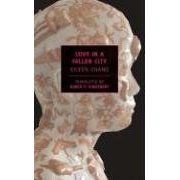
Eileen Chang’s Love in a Fallen City

218ht7ekj0l_aa180_.jpgFirst, let me say that I am SO HAPPY to be sitting quietly in my study doing nothing right now. I rode the hardest race of the season this morning, and now I’m beat (riding seems to be good for my back and neck, at least in the short term — they are feeling much better). It was a hilly road race, and while I didn’t do all that well, getting dropped on a particularly nasty hill, I did better than last year, when I got dropped on one of the foothills of the particularly nasty hill, and that’s really all I was hoping for. If you’d like to hear more about these vicious hills, read Hobgoblin. All I have to say about it is that hills suck.

But I wanted to write about Eileen Chang’s Love in a Fallen City, a collection of novellas and stories. Most of them were first published in China in 1944 in a book called Romances, and they have been reissued by the wonderful NYRB Classics. I got off to a tiny bit of a slow start with the first novella, but after that I gobbled these stories up; they are gripping tales of love, family, and politics — often about the conflict among these three things. Chang lived through and wrote about political and social turmoil; the title novella takes place in a besieged Hong Kong, where scenes of violence strengthen the main character Liusu’s shaky romance and settle her uncertain future. This is not to belittle the political turmoil of the time, but to show how it can affect individual people:

Hong Kong’s defeat had brought Liusu victory. But in this unreasonable world, who can distinguish cause from effect? Who knows which is which? Did a great city fall so that she could be vindicated? Countless thousands of people dead, countless thousands of people suffering, after than an earth-shaking revolution … Liusu didn’t feel there was anything subtle about her place in history.

Liusu’s “victory” is getting her lover to marry her, therefore ensuring a comfortable future and no loss of social status. In these stories, love often seems indistinguishable from war — whether it takes place in a besieged city or not, love and courtship can be a fight for one’s life.

Chang also writes about the conflict between traditional family structures and customs and the modern world that’s threatening them. One of the things that’s fascinating about this book is the glimpse it gives into a world where family members refer to each other as “Ninth Old Master” or “Second Mistress” or “Third Brother,” where a matchmaker arranges marriages, and where one’s status in society can determine one’s life. But the stories also tell of characters who are struggling to be modern, such as Zhenbao in the novella “Red Rose, White Rose,” who was “the ideal modern Chinese man”:

Never had a son been more filial, more considerate, than Zhenbao was to his mother; never was a brother more thoughtful or helpful to his siblings. At work he was the most hard-working and devoted of colleagues; to his friends, the kindest, truest, and most generous of men. Zhenbao’s life was a complete success. If he had believed in reincarnation — he didn’t — he’d have hoped simply to pick up a new name, then come back and live the same life all over again.

Zhenbao came from a poor family but worked hard to create a better life for himself; Chang describes him as the perfect Western self-made man. But — and this should be no surprise, for if an author describes a character’s life as perfect in the beginning of a story, it simply must get shaken up — Zhenbao cannot be “modern” in the sense of following all his desires. He is unhappy with his wife but feels he cannot pursue the woman he loves; he is torn between romance and loyalty to family and friends. He is in many ways a traditional man wanting to be free of tradition, but unable to make himself so.

The gender dynamics are a little hard to take, which is no surprise, as the book describes a society that is still old-fashioned in many ways; what I’m uncertain about is Chang’s take on the subject. Occasionally, the narrator will step in and say something about “what women are like,” which tends not to be very flattering, and I don’t know if this is Chang talking to us, or if she is speaking for the culture and not for herself. It’s not easy to detect Chang’s presence in this book — what her views are on the stories she tells.

The writing is captivating, although it follows a rhythm that feels unusual to me — many of the stories cover large sweeps of time, decades in a character’s life perhaps, and Chang will offer a scene for a few pages that gives all kinds of detail and moves through time slowly, and then she’ll sum up years in a short sentence or two. The narratives move abruptly. This is not a flaw; it just takes some getting used to.

For more information on this book, check out Scott Esposito’s interview with Chang’s translator Karen S. Kingsbury and Orpheus’s interesting post on Chang and popularity.


9 Comments

Filed under Books, Cycling, Fiction

Books, etc.

So much for celebrating walking — Hobgoblin and I went on a three-hour walk today and about halfway through I could feel one of the muscles in upper back/shoulder area tighten up into an ugly knot, and now I can’t easily move my head. I’ve had trouble with tight muscles and knots and pinched nerves in my upper back for quite a while now. I’m pretty sure this began shortly after my first rather disastrous backpacking trip for which I carried a backpack that was much too heavy and which apparently did a lot of damage.

Funny, as much as I’m loving reading The Walk, it hasn’t yet talked about how much walking can hurt, and yet, much as I love walking, it quite often hurts very badly.

Anyway, just a couple quick notes on books — I finished Rainer Maria Rilke’s Duino Elegies recently and thought they were extraordinarily beautiful. They cover so much it’s hard to describe what they are about, but it seems like they are about everything important — birth, death, angels, lovers, time, beauty … rather than try to describe the book, I should simply give you a couple quotations:

Who has turned us around this way so that we’re always whatever we do
in the posture of someone who is leaving? Like a man
on the final hill that shows him his whole valley
one last time who turns and stands there lingering —
that’s how we live always saying goodbye.

How we squander our sorrows gazing beyond them into the sad
wastes of duration to see if maybe they have a limit.
But they are our winter foliage, our dark evergreens
one of the seasons of our secret year — and not only a season
they are situation, settlement, lair, soil, home.

If you are looking for some great poetry to read, I highly recommend this.

And I’ve begun Virginia Woolf’s The Voyage Out; I’m excited to be reading Woolf again, and so far I’m enjoying it — I was particularly pleased to see Richard and Clarissa Dalloway appear as characters here; I’m curious to learn more about why Woolf used these characters multiple times and how they develop from one novel to another. Fortunately, I have Julia Briggs’s book Virginia Woolf: An Inner Life on hand, which perhaps will explain some of this for me.

9 Comments

Filed under Books, Life, Poetry

Happy books once again

I got some very interesting comments to that post on happy books I wrote a couple days ago — thank you! — and they got me thinking. First of all, I realized that my own claim about not paying attention to whether books or happy or sad or something in between isn’t quite true. When I pick up a title that’s new to me I’m not all that concerned about what type of ending it has or whether the book’s mood is light or heavy. But it’s different with re-reading. I realized that one of the charms of Jane Austen novels, which are among my favorites in the whole world, is their happy endings. When I re-read them, which I do fairly regularly, one of the reasons I do it is because of the comforting quality of the happy resolutions. I suppose most of the time I feel ready for the challenge of whatever I might find — happy or sad, serious or light — in new books, but other times I want the familiar, and the familiar is usually happy.

(That said, though, even those Jane Austen novels don’t always have perfectly happy endings — isn’t Emma’s marriage to Mr. Knightley just a little odd, more like a father/daughter relationship than a husband/wife one? And Marianne’s marriage from Sense and Sensibility? Edmund and Fanny?)

A number of people suggested that my students wanted entertainment out of their reading rather than to be hit with seriousness and sadness, and I think that’s true for some of them. For some, they don’t like reading and so they were wishing the experience could fly lightly by, as though they were reading fashion magazines or something. For others, they like reading but prefer to read something that’s going to leave them with a happy buzz — that’s not really going to challenge them.  One student mentioned the Chicken Soup for the Soul books once, and I worked hard at not rolling my eyes.

But others are good readers and serious students, so for them, the explanation is different. For these students, I think it’s more a matter of how they understand the world and how their view of literature fits with that understanding. Some are very aware of how harsh life can be, and they seemed not to want to be reminded of it again — they didn’t want to have to dwell on it while doing their homework and sitting in class. I can kind of understand this, but I don’t share the feeling — reading and thinking and talking about the harshness of life I find comforting because it makes me feel less alone.

I’m remember now, though, that students were more likely to make this sort of comment at the beginning of class, and by the end they seemed to like whatever it was we read a little better. I think I tried to communicate what inspires me about the stories in the hope that they would find their own sources of inspiration, and sometimes I think they did.

8 Comments

Filed under Books, Reading

The walking essay

I could write a post on each and every chapter of Jeffrey Robinson’s book The Walk, although I won’t, as I’ve already read four or five chapters now without commenting on them and I’d have to catch up (and you might get bored), but I say I could write a post on each chapter because they are all so suggestive and thought-provoking and fun.

So I’ll limit myself to a few quotations from Robinson’s chapter on the the walking essay, which begins with this marvelous bit about Virginia Woolf and essays:

For no subgenre of literature do Virginia Woolf’s remarks on the requirements for the essay — that it “lap us about and draw its curtain across the world” — apply more aptly than for the walking essay. If one does not, at least while reading such an essay, believe in the cozy pleasure of essay reading, a pleasure in which the mind is active but refuses the sharp twists and turns of mind in its most elaborate purposefulness, then one should not waste time with walking essays. In the walking essay, familiarity is its own solution; it confirms itself. One walks either to make a destination, or one walks for the pleasure of walking, says the walking tradition. If you choose the latter walk, you approximate the choice to read a walking essay.

I love the way Robinson connects the experience of walking with that of reading — he does it throughout the book; in fact, that’s really the main idea running through it. And with the walking essay, the idea is that walking and reading both offer a comforting familiarity, a way of engaging the mind that is active, but meandering. The point is not to get anywhere particular; the point is to enjoy the journey. No wonder I love both walking and essay reading so much! A bit later Robinson describes discovering a wealth of walking essays, once he began to look for them, and writes that walkers, “who are almost always bona fide essayists, are urged from somewhere to ambulate on paper about ambulation.”

Robinson also talks about how walking is similar to reading and writing essays because they are both about collecting: readers and writers love to collect essays; walkers love to collect experiences and observations and memories; essays are collections of observations, events, and sometimes lists. He has this to say about the essay:

Acquisition seems to be an important impulse behind the familiar essayist’s activity. Essayists love to list things, particularly, though not by any means exclusively, books. As many essays as there are about walking, there are perhaps twice as many or more about book collections, libraries, books-I-have-enjoyed.

Now this description of the essay reminds me of book blogs, with their frequent lists and tales of book acquisitions and descriptions of books-I-have-enjoyed. Perhaps blogs are about collection too — the collection of posts, of memories, of thoughts, of comments.

Then the essay moves into a discussion of library organization (these chapters really do wander from subject to subject), and includes this wonderful quotation from A.A. Milne on shelving books:

To come to Keats is no guarantee that we are on the road to Shelley. Shelley, if he did not drop out on the way, is probably next to How to be a Golfer through Middle-Aged.

Having written as far as this, I had to get up and see where Shelley really was. It is worse than I thought. He is between Geometrical Optics and Studies in New Zealand Scenery. Ella Wheeler Wilcox, whom I find myself to be entertaining unawares, sits beside Anarchy or Order, which was apparently “sent in the hope that you will become a member of the Duty and Discipline Movement” — a vain hope, it would seem, for I have not yet paid my subscription. What I found Out, by an English Governness, shares a corner with The Recreations of a Country Parson; they are followed by Villette and Baedeker’s Switzerland. Something will have to be done about it.

I am not quite sure how Robinson got from the Virginia Woolf quotation to this A.A. Milne one, but I can say that the journey from one to the other was a pleasure.

6 Comments

Filed under Books, Nonfiction

Happy books?

Do you think about the (relative) happiness or sadness of books when you choose to read them? I’m thinking of this because I recently read Hepzibah’s post in which she describes people telling her to stop reading so many depressing books and to read something happy instead. And reading that post I remember how some of my students voiced mild complaints about the depressing stories I chose for them to read. They wanted something uplifting.

I was surprised when my students said this, because it really hadn’t occurred to me to think about whether what I’ve read or asked my students to read is sad or not. Perhaps what I put on the syllabus is affected by a taste for sad stories I may have (this is a class where I teach students how to write about literature, so I can choose whatever literature I want), although I’ve never thought of myself as having such a taste, but my first response to this complaint is to think that much of really great literature is sad because that’s the way life is, and there’s nothing to be done about it. In fact, I’m guessing that what my students would consider “uplifting,” I’d consider cheesy and overly sentimental, and if I ever feel “uplifted” by literature, it’s when an author has said something bracingly difficult but true about life.

But maybe this has to do with how I read — with the fact that although I get caught up in stories I don’t tend to believe in them or get involved with them to the extent that what I’m reading affects my mood. I rarely feel sad, much less get depressed, when I read a sad book, so to call books depressing doesn’t make a whole lot of sense to me. I mean, reading something beautifully well-written can make me feel happy or reading something shoddy can make me feel irritated, but if I read a story where everybody dies or the marriage breaks up or a character fails to reach her dreams or whatever I’m not bummed for the rest of the day.

But maybe my students are? I do recall treating some of the violence in a Flannery O’Connor story lightly (not that this violence doesn’t carry significant meaning, but she does find humor in it sometimes) when that violence shocked my students. I wanted to tell them … but, but, it’s a story! Don’t take it so seriously! I mean — take it seriously, definitely, but don’t get upset about the violence! No one is actually dying here!

So, am I callous, or are they overly sensitive, or is this an age and experience thing?

20 Comments

Filed under Books, Reading

Apparently, I won a silver medal

I didn’t write about Saturday’s race because it felt pretty uneventful — I rode with category 3 and 4 women and finished somewhere in the middle of the pack, a little towards the back.  I felt uncomfortable pretty much the whole race because I didn’t like the corners; once again I’ve discovered that I need to practice cornering.  I’m particularly bad when I have to make left turns, which this course makes you do; I’m not sure why, but I’m much slower and more awkward turning left than I am turning right.  And I witnessed a nasty crash in the middle of my race on one of those awkward corners — last I saw one of the women who went down was lying on her side with a neck brace on, waiting to be moved onto a stretcher to go to the hospital.  So after the race I rode straight to the car and we went home — it was late anyway, and I was eager to be done with it all.

Well, today I checked out the results online, and it turns out I won a silver medal — and it turns out that I was 22nd out of 34 finishers.  Here’s how both of those things can be true: the category 3 and 4 women ride together but they get scored separately, so although 21 people finished ahead of me, only six of them were category 4 riders, so I got 7th in my field.  And then this particular race awards medals to the top 3 Connecticut riders, and I happened to be the second category 4 rider from Connecticut to cross the line (the others were from Massachusetts or Rhode Island), so I won a medal!  But I don’t have it because I ducked out of there so quickly.  Oops.

12 Comments

Filed under Cycling