Cakes and Ale

Cakes and Ale is the fourth Somerset Maugham novel I’ve read, and with each book I keep changing my opinion of him. I really liked Of Human Bondage, which was my first book, and then I listened to The Painted Veil, which I loved. So far so good; I thought at this point that I should eventually read everything he wrote. Then I got to The Razor’s Edge, which I didn’t like at all. It felt dull and ponderous. I like idea-driven novels, but in that one, I didn’t care about the ideas and didn’t like how they were presented. With Cakes and Ale, I’m beginning to think Maugham may not be quite as good as I thought. There were interesting aspects of the novel and enjoyable moments — particularly the discussions of authors and writing — but I was hoping to love it and I didn’t.

The novel tells the story of the Driffields — Edward Driffield, a famous author, and two Mrs. Driffields, his first wife, Rosie, and his second, Amy. (My edition has a preface by Maugham that says Edward Driffield is most emphatically not Thomas Hardy, in spite of what anybody says, which meant that I spent the entire novel thinking of him as Thomas Hardy, of course.) It’s narrated by William Ashenden, a writer himself who knew Edward and Rosie at various points in his life. There’s another writer involved as well, Alroy Kear, who is planning on writing a biography of Edward, who in the present tense of the novel has passed away. Alroy approaches the narrator in an effort to gather information about Edward’s life, which sends him off on long reminiscences of his time with the Driffields.

The difference between what the narrator remembers about the Driffields, what he chooses to tell Alroy, and what Alroy will actually put in the biography is the novel’s source of tension. The Driffields — Edward and Rosie — were…not quite proper. The narrator first meets the couple when they move into Blackstable, his hometown. Edward’s father was a bailiff and Rosie had worked as a bar maid, which was a big part of the problem, but they also never quite followed the rules as they were supposed to, and everyone knew it. Eventually Edward’s fame as a writer comes to make up for his social deficiencies, but Rosie was always a bit of a scandal.

The novel is really Rosie’s story in many ways, in part because of the narrator’s fascination with her and her bohemian ways that stayed with him all his life. But there’s also the problem of what to do about the troublesome, sexually-suspect first wife after she is gone and the second wife is trying to establish her husband’s reputation as a respectable, important writer. How should that first wife be portrayed in the biography, and what to do about episodes such as the time the Driffields skipped town with debts and servants left unpaid? And what about Rosie’s sexual history?

It’s all a question of class, of course, about how Alroy and Amy Driffield try to transform Edward from his working-class roots into a solid bourgeois, respectable writer and how the narrator questions and resists them. It’s also about writers and writing. Alroy Kear is the object of much scorn from the narrator; not only is he going to whitewash Edward’s past in what is sure to be a bland biography, but his writing, at least according to the narrator, sounds blandly boring as well:

I could think of no one among my contemporaries who had achieved so considerable a position on so little talent. This, like the wise man’s daily dose of Bemax, might have gone into a heaped-up tablespoon. He was perfectly aware of it, and it must have seemed to him sometimes little short of a miracle that he had been able with it to compose already some thirty books. I cannot but think that he saw the white light of revelation when first he read that Thomas Carlyle is an after-dinner speech had stated that genius was an infinite capacity for taking pains. He pondered the saying. If that was all, he must have told himself, he could be a genius like the rest; and when the excited reviewer of a lady’s paper, writing a notice of one of his works, used the word … he must have sighed with the satisfaction of one who after long hours of toil has completed a cross-word puzzle.

There is no room in Alroy Kear’s world for the exoticism that someone like Rosie Driffield can offer, and so the narrator scorns him.

I was disappointed in part by Rosie as a character; the back cover of my edition promises that she is Maugham’s “greatest heroine,” but she never quite came to life for me. It was the moment when the narrator tells us what she wasn’t a big talker that did it: I had pictured her as vivacious and voluble, and when I tried to picture her being quiet, I couldn’t do it. Then I began to doubt that I had really understood her at all. I’m also not entirely sure I like the narrator. There are times his mildly ironic tone is amusing and I can’t help but agree with his dismissal of Alroy Kear, but there’s something off-putting about the voice, something distancing. I suppose the mildly ironic tone gets a little wearying after a while. I don’t think that we are meant to read the narrator uncritically; as a writer himself, he is not exactly a disinterested observer of the fates of Driffield and Kear, and his detached, judgmental attitude toward his subjects seems self-serving. But critiquing the narrator in this way wasn’t enough to make the book a satisfying read.

I read this book for the Slaves of Golconda and am jumping over to join the discussion right now. Please feel free to join in!
14 Comments

Filed under Books, Fiction

The Daughter of Time

My mystery book group met this past weekend to discuss Josephine Tey’s mystery The Daughter of Time. In a way, I’d like to write simply that while it’s not a historical novel, it’s all about Richard III, that you have to be prepared for some serious history, and that it’s really good and I liked it a lot, and leave it at that. Because that it wasn’t historical fiction but was all about Richard III is all I knew about it when I picked the book up, and I’m glad I didn’t know more. So if you’re interested in reading this book, you might stop here.

I was glad not to know more because I was delighted to discover the structure of the novel: the fact that it takes place solely in a hospital room and that nothing happens action-wise except people coming and going, bringing books and having conversations about them. What an unusual structure for a mystery novel, and how cleverly done! I love that the mystery is entirely historical, about the question of whether Richard killed the two princes in the Tower and if he didn’t, then who did. (As a side note, I was in the Tower just a few weeks ago, and now I wish I’d read this book beforehand. They had an exhibit about the question of Richard’s guilt, and you could vote on who you think the murderer was. Alas, I can’t remember who the other options were.) I love that the mystery is solved solely through historical research and logical deduction. Although there’s a lot of intuition involved as well, as the whole mystery gets going when Tey’s detective, Grant, decides that Richard does not look like a murderer. He has this feeling, based on his years working with criminals, that Richard isn’t one.

I also loved how the mystery branches out from the question of who killed those princes to questions of history and history writing. As much as the characters research historical events, they also think a lot about how we learn history, what we remember and don’t remember from our history classes in school, the various ways history gets written, and why historical untruths get perpetuated. Tey is great at covering a whole lot of ground answering these questions without making it seem formulaic or contrived. Grant and his fellow researcher, Carradine, get a hold of history textbooks, historical fiction, scholarly tomes, and contemporary accounts and documents, and they survey various types of people on what they remember and what they believe about history, all without awkwardness in the narrative. And it turns out that history is shockingly unreliable. People believe things they’ve heard from authorities they no longer remember, and often those “authorities” turn out to be biased or lazy researchers or too busy looking at the larger picture to get the details right. And once people believe a certain thing, they resent finding out otherwise. Rather than accepting correction and being grateful for the truth, they get angry at the person bringing the news.

The book’s epigraph is “Truth is the daughter of time.” Wikipedia just told me that the full sentence is “Truth is the daughter of time, not of authority,” from Francis Bacon. That explains the title — the idea that time will eventually lead to truth and will win out over so-called authorities — but I wonder how much the book really backs up that idea. Grant and Carradine are on a quest for truth, and at least within the frame of the book they find it, and yet theirs seems a lonely crusade in a world that seems determined to cling to falsehood. Carradine has decided by the end to write a book against “tonypandy,” their term for received versions of events that turn out to be false, but who can really win against common opinion that’s been passed down for generations? I’m not quite sure if this book is undermining the idea that time will bring us closer to truth, or, more simply, celebrating Grant and Carradine as savvier, smarter seekers of truth than most other people. What it certainly does do is celebrate the joy of research and discovery. Rarely in a novel is scholarly research shown in such detail and made to seem so much fun.

Grant is very suspicious of the way history gets written as narrative. He wants facts, concrete bits of information gleaned from primary sources, not the stories woven around those facts — or woven around no facts at all, which is often the case. But we can’t do without narrative — without turning history into a story. All Grant is doing is creating a counter-narrative to the one historians and textbooks have been telling all along. And that is what Tey is doing as well, of course, making the argument that by delving into facts and turning those facts into a narrative, the detective and the novelist — neither of whom are “authorities” — can reveal something true. Whether we believe it or not is another matter.

The opinions in my book group were generally positive, although not everyone liked Grant’s rather arrogant manner. The question arose of whether this book works well the second time around, and I’m wondering as well if I would like it as much if I were to read it again. Once you understand the premise and the trajectory of the book, it might not be as much fun to wade through all the historical details, which do take quite a lot of wading through. Anybody out there who has read this multiple times have opinions?

This is the second Tey mystery I’ve read, and both have done such interesting things with the genre that I’d like to read more. This one has practically no action directly described, and Miss Pym Disposes only turns into a mystery in the last 1/4 of the book and is as interested in psychology as an academic discipline as The Daughter of Time is interested in history. I’m looking forward to seeing what other unusual things Tey has done with the mystery genre.

18 Comments

Filed under Books, Fiction

I’m radioactive!

Seriously. I took a radioactive iodine pill earlier this week, and for the last three days, I’ve been in quarantine. Or at least I was supposed to keep three feet away from other people, especially pregnant women and babies. I’m okay to be around now, though.

It’s been a strange experience. You may or may not remember that four years ago, I developed a thyroid problem — hyperthyroidism. I’ve lived with it pretty easily since then, feeling perfectly normal because of my anti-thyroid medication, although I’ve had to get blood work done once a month. But, eventually, it makes sense to get rid of the thyroid entirely instead of taking anti-thyroid medication with its rare but dangerous side effects. Taking thyroid hormone replacement is much safer and easier to regulate.

So, my choices were surgery or radioactive iodine, and although the iodine treatment is not perfect, it’s much better than surgery, or at least I thought so. The thyroid is the only organ that absorbs iodine, the radioactivity kills it, and that’s that. I prefer to keep knives away from my throat if at all possible, so radioactivity it had to be. The treatment itself is very easy: all you have to do is take a pill, although I needed a thyroid scan first, and I had to sign a bunch of documents, which I think mainly said that I understand what I’m doing involves radiation, I’m fully aware of what I’m doing, etc. But the treatment itself was anticlimactic — the doctor simply handed me a plastic cup with a normal-size pill and a cup of water, and that was it. He was careful to make sure I didn’t touch the pill with my fingers, though, which was … well, strange, since why would I want to put such a thing in my mouth? But I just thought about avoiding knives at my throat and swallowed the pill.

Afterward the doctor gave me a card that says, “This patient has received an Isotope for diagnostic imaging or therapy. The amount received is not considered hazardous, however may trigger a sensitive radiation detector.” Cool! Apparently, people sometimes get pulled over when police officers detect radiation, especially at high security sites like bridges and tunnels. And airports, of course; it’s definitely best not to try to fly after one of these treatments. I haven’t gotten pulled over for being a radiation threat, but I’m still hoping it will happen.

The next couple days were anticlimactic, though: I felt nothing. I sat around thinking “my thyroid’s dying right now,” but I couldn’t feel anything as it slowly absorbed the radioactive iodine. I’m not really sure what’s going on now, and I’m curious: is it all dead? partly dead? Shriveling up? Disintegrating? The treatment takes several weeks to take effect, and it can go on happening for months afterward, which is the main downside to this form of treatment. Surgery involves knives, but on the other hand, its effects are immediate. So I’m waiting. I’m slightly hyperthyroid at the moment, which happens because the treatment takes so long to kick in. Eventually, in a few weeks most likely, the process will be finished, and I’ll switch over to hypothyroidism and start my supplements. I’m just hoping we catch the switch-over quickly, so I don’t feel too much fatigue and whatever else might be involved.

My feelings about this are mixed: I’m grateful that there’s a treatment for me, very grateful that modern medicine has allowed me to live a normal life, instead of feeling weak and shaky all the time, which is what hyperthyroidism is like. But it’s also very strange to deliberately kill off an organ of mine, and I don’t like the idea of depending on hormone supplements for the rest of my life. Even though my thyroid has messed me up, I’m kind of sorry to see it go. It tried its best, after all, and since all this is caused by an autoimmune disease, my thyroid is actually a victim — a victim of the rest of my body. A victim of civil war, I guess. I’m looking forward to the end of hostilities.

20 Comments

Filed under Life

Contemporary Fiction

At the end of my last post I complained a little about being bored by contemporary fiction, and specifically realistic fiction, and a number of people said that they sometimes feel the same way. Lilian asked if I would be willing to explain what I meant. So, uh, maybe? I’m not entirely sure what I meant, except that I wanted to express a vague feeling of discontentment and to explain why I didn’t fall in love with The White Woman on the Green Bicycle, a book that others have fallen in love with and is probably worth falling in love with.

I certainly don’t feel bored by all contemporary fiction; looking over my list of books from the last year or so, I see that I loved Arthur Phillips The Tragedy of Arthur, Teju Cole’s Open City, Nicholson Baker’s The Anthologist, Jennifer Egan’s A Visit From the Goon Squad, and Joshua Ferris Then We Came to the End. I also liked Scarlett Thomas’s PopCo, although I thought it broke all kinds of fictional rules. I liked it because it broke fictional rules. And that’s what I liked about all these books, I see now. The Phillips book is a novel that pretends to be a play and a memoir; Open City is basically a guy walking around cities and thinking stuff; Baker’s novel has only a little bit of a story and lots and lots of meditations on poetry; Egan’s book is really linked stories with a lengthy chapter written using PowerPoint (and using it very well); Ferris’s book is in the second person (and focused unusually closely on the workplace); and PopCo spends a lot of time explaining how encryption works. That book explains everything.

And I loved all that. I think the perfect contemporary novel is one that breaks the rules in some way while still being fun. It’s possible to break the rules to such an extent that the book is boring or too difficult to enjoy, but the ones above do it perfectly.

Where I run into a problem is when books are more conventional in their plot lines and writing style. It’s not that I dislike all these books, necessarily, just that I don’t often get excited about them. Part of the issue is that I don’t read for story. There are exceptions, such as Sarah Waters, but mostly I don’t care about the plot. I don’t really read for beautiful sentences either, unless we’re talking about an extreme case — unless you’re Proust, for example. Mostly I read for that sense of excitement that comes when I fall a little in love with a character or a voice or the way a book explores an idea or does something new. I’m a little suspicious of sincerity, which is odd because I’m a serious and sincere person, but in my books, I prefer lightness and humor. Do what you do with energy and gusto, and I’ll be impressed.

That’s not always true, of course. I loved Olive Kitteridge, for example, which has hardly any lightness, humor, or gusto. But I guess there I liked the linked story form and the unremitting darkness of that book struck me as brave. I like brave books.

I keep talking about contemporary novels because my feelings about older novels are different. Conventional plot lines bother me less there. Seriousness and sincerity are fine in those books. I don’t look for experimentation in quite in the same way. But you can see why Tristram Shandy is a favorite of mine.

So, there, that’s my explanation of how I feel about contemporary fiction. Anybody else want to try to define their aesthetic? It’s a fun thing to think about.

17 Comments

Filed under Books, Reading

The White Woman on the Green Bicycle

I read this book (courtesy of NetGalleys) while in London and on the way home, so it was a while ago now, and it’s high time I say something about it. It tells the story of a couple, Sabine and George Harwood, who move from England to Trinidad in order to advance George’s career. They don’t know it at the time, but they are on the last ship to bring British colonials into the country (Sabine is French, but has married an Englishman). Shortly after they arrive, change begins to happen: Trinidad eventually gains its independence under their charismatic although ultimately disappointing leader, Eric Williams, and the white colonists will lose their status and power.

The novel has an interesting structure: for the first third or so, it takes place in 2006 and portrays an elderly George and Sabine, describing how their marriage has evolved, how their children have turned out, and what their lives have become. After this section, we move back in time to read about their arrival in Trinidad in 1956, and we follow them in later sections through the 1960s and 70s. This backwards structure works well to show how George and Sabine end up where they do: we see the results of their lives in Trinidad first, and then we look back to the causes. So we read about their unhappiness — their overwhelming feeling of listlessness and pointlessness, their estrangement from their children, their isolation, their sense that it could have been completely different — and then we turn to their younger selves and read about the series of decisions that led to their remaining in Trinidad even when nearly all other British families left. They never intended to stay longer than a couple years, or at least that’s what Sabine believed. She was always eager to go, but George fell in love with the place and resisted a move. Eventually, they become part of the island and could no longer fit in back in England if they were to return.

The novel tells the story of their marriage, and also of the political and social changes happening in Trinidad, and the two stories come together in the figure of Eric Williams, the first Prime Minister. In the 2006 section, George finds a collection of letters Sabine has written to Williams — tons of letters, describing her life, her marriage, and her feelings about Williams’s administration. These letters bewilder George — why did she write him so much? Did she know him? It turns out that she met him a few times and they had a couple conversations, but mostly the relationship was carried on in her head. Writing the letters was her way of making sense of the changes happening in her life and in the country, and also of getting a little bit of revenge on George, who was unfaithful to her. Williams is one of the book’s main symbols: a symbol of hope at first, of possibility, and then of disappointment and disillusionment. He becomes a way for Sabine to focus and express her hopes and then her anger.

The other main symbol is the green bicycle of the title: the bicycle Sabine used to ride to explore the city and meet her husband after his day’s work. This was a highly unconventional thing to do, although Sabine didn’t know this at first; she thought she was just enjoying herself and being free-spirited, when she was getting a reputation that stuck with her for being different from all the other British women. As Sabine loses her youthful energy and happiness, the bicycle appears less and less until it is abandoned.

Roffey does a very good capturing the complexity of the situation and telling the two stories — the personal one and the political one — so that while they are connected, they are not conflated or collapsed into each other. The Harwood marriage is powerfully affected by the political context, but it’s not simply a way of making a political point, and the political context takes on a life on its own and is not merely a device with which to tell the story of a marriage. And Roffey also describes the landscape of Trinidad beautifully. In fact, both George and Sabine personify that landscape and talk to it so that it becomes a kind of character in its own right.

Roffey does so much well here, and I enjoyed the book, but I didn’t have that feeling of excitement about it that I always hope for. I didn’t fall in love with it, and it’s hard to pinpoint why. I think I’m feeling some boredom with contemporary fiction — not all of it, but with more straightforwardly realistic contemporary novels. I suppose that while Roffey’s use of language is accomplished, it didn’t bowl me over in the way I want. But there is much to praise in this book, still, and it kept me good company while I was traveling.

11 Comments

Filed under Books, Fiction

Reading Updates

I mentioned visiting a bunch of bookstores in London, and I spent a good bit of time in the two bookstores in Dingle, so I’d better tell you what I bought:

  • Chet Raymo’s Climbing Brandon: Science and Faith on Ireland’s Holy Mountain. Hobgoblin has already read this one, and he told me it’s good. Mt. Brandon is on the Dingle Peninsula, and I climbed it while we were there. We had a gorgeous view of the summit and surrounding area until about 3/4 of the way to the top, when the fog moved in and we could no longer see anything. Still, it was a great experience. We went up the back side of the mountain, and on the way down the front side, the most commonly-climbed side, we saw crosses through the mist at regularly paced intervals to mark the path religious pilgrims take. This book tells the story of how it became a religious site. I picked it up in the shop specializing in all things Irish.
  • At Dingle’s other shop, I bought Hermione Lee’s Body Parts: Essays on Life-writing. I already have the American version of this book, called Virginia Woolf’s Nose, but that one is a lot shorter than the British version, with many fewer essays. I liked the parts of Lee’s book I’ve read already, so I was glad to find the rest.
  • The rest of the books come from London. Since I never find books by Jenny Diski in American stores, I brought home three of them, including her new one, What I Don’t Know About Animals. This is one of those books that I wouldn’t be interested in at all if knew only the title, but with Diski writing it, I’ll read it happily.
  • Also, A View From the Bed and Other Observations, a collection of essays. I already read a few of them about moving to Cambridge that I thought were great.
  • And one Diski novel, Apology for the Woman Writing, about Marie de Gournay, friend of Montaigne.
  • Norma Clarke’s The Rise and Fall of the Woman of Letters, about eighteenth-century women writers and their changing fortunes throughout the century.
  • Travel Writing, by Carl Thompson, kind of an overview of the history of travel writing and current critical debates about it. This will be useful for my class on literature and the journey this fall.
  • Lila Azam Zanganeh’s The Enchanter: Nabokov and Happiness. I just heard an interview with Zanganeh on the radio yesterday, and it was great. This is a personal meditation on Nabokov and his writing.
  • Daisy Hay’s Young Romantics: The Tangled Lives of English Poetry’s Greatest Generation. It’s about Byron and the Shelleys and other people in their circle. It will make a good addition to my collection of Romantic biographies, and it’s particularly appealing as a group biography.
  • Monica Dickens’s Mariana. This was my selection from the Persephone shop. The only thing that kept me from buying more was fear that my suitcase would be too heavy.
  • The Letters of Dorothy Wordsworth: A Selection. I’ve been reading this one slowly since the plane trip home. It’s fun to learn about her life and to get her perspective on what her brother William and his friends were up to.

I’m not sure I’ll be able to write detailed posts on what I read while I was traveling, but in case you’re curious, I started out with Edith Wharton’s Custom of the Country (read on my Nook), which was great. I loved returning to her; she is such a great chronicler of social ambition. Then I read the second Mary Russell novel, which I liked quite a lot, after not particularly liking the first one. A Monstrous Regiment of Women was much more focused and coherent than her first, and I liked the London setting. The Mary Russell put me in the mood to read a Dorothy Sayers, so I read Clouds of Witness, also on my Nook. Dorothy Sayers is so much fun! I suspect my favorite will remain Gaudy Night, but I liked this one a lot too.

At the same time, I was reading Geoff Dyer’s collection of essays Otherwise Known As the Human Condition (the first book I bought for my Nook), which was fabulous. This is one it would be worth writing more about, but in case I don’t, I was surprised at how much I loved the essays on photography with which the book begins. I know very little about photography, so these essays taught me a lot, and Dyer’s voice is so fabulously entertaining. His essays on literature were good, but I was less taken with those, perhaps because the subject matter was more familiar. The book ends with personal essays, almost all of which I loved.

I didn’t read much while we were in London, but I started Monique Roffey’s White Woman on the Green Bicycle, and I finished it on the plane home. That one I do want to write a full post on, so more on that later.

Since I’ve been home, I’ve had a little trouble concentrating on reading, but I did finish up the Dyer collection and read Willa Cather’s novel The Professor’s House. Perhaps more on that later. Just today I started Josephine Tey’s The Daughter of Time for my mystery book group meeting next week, and I’m still reading the Dorothy Wordsworth letters now and then.

And I think that catches you up on my bookish news. Have a great weekend everyone!

14 Comments

Filed under Books, Lists

On to London

The short trip from Dingle, Ireland, to London was a little disorienting. On the way to Shannon airport, we chatted with our bus driver the entire 2.5 hours or so it took to get there; he, like everyone we met in Dingle, was incredibly welcoming and enthusiastic about American visitors, and we had a great time talking about our experiences in Ireland, and his experiences in New York City (he said the best thing ever is to be an actual Irish person in NYC on St. Patrick’s Day. You are an instant celebrity, and he had never felt so popular. No wonder he loves the U.S.).

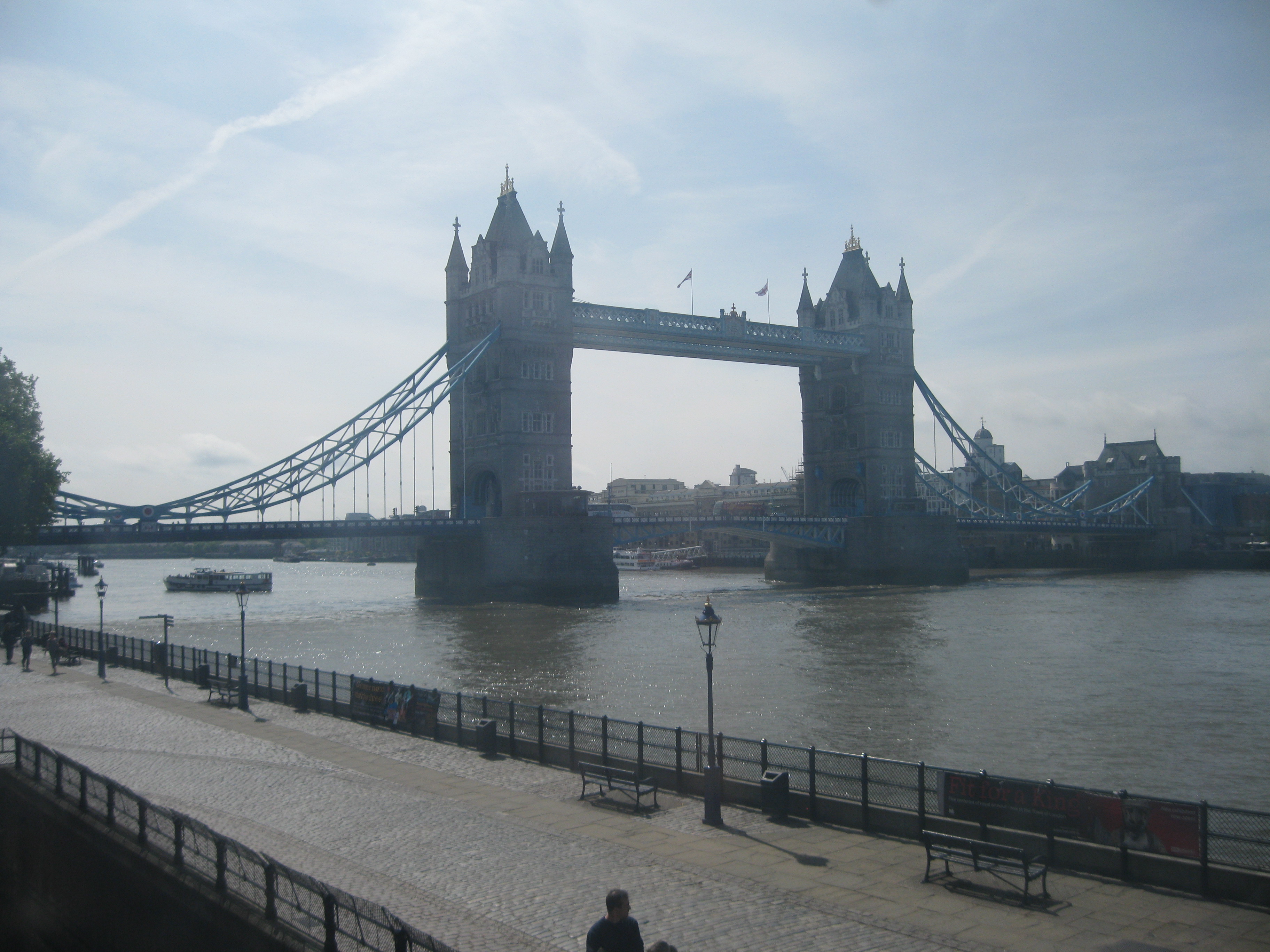
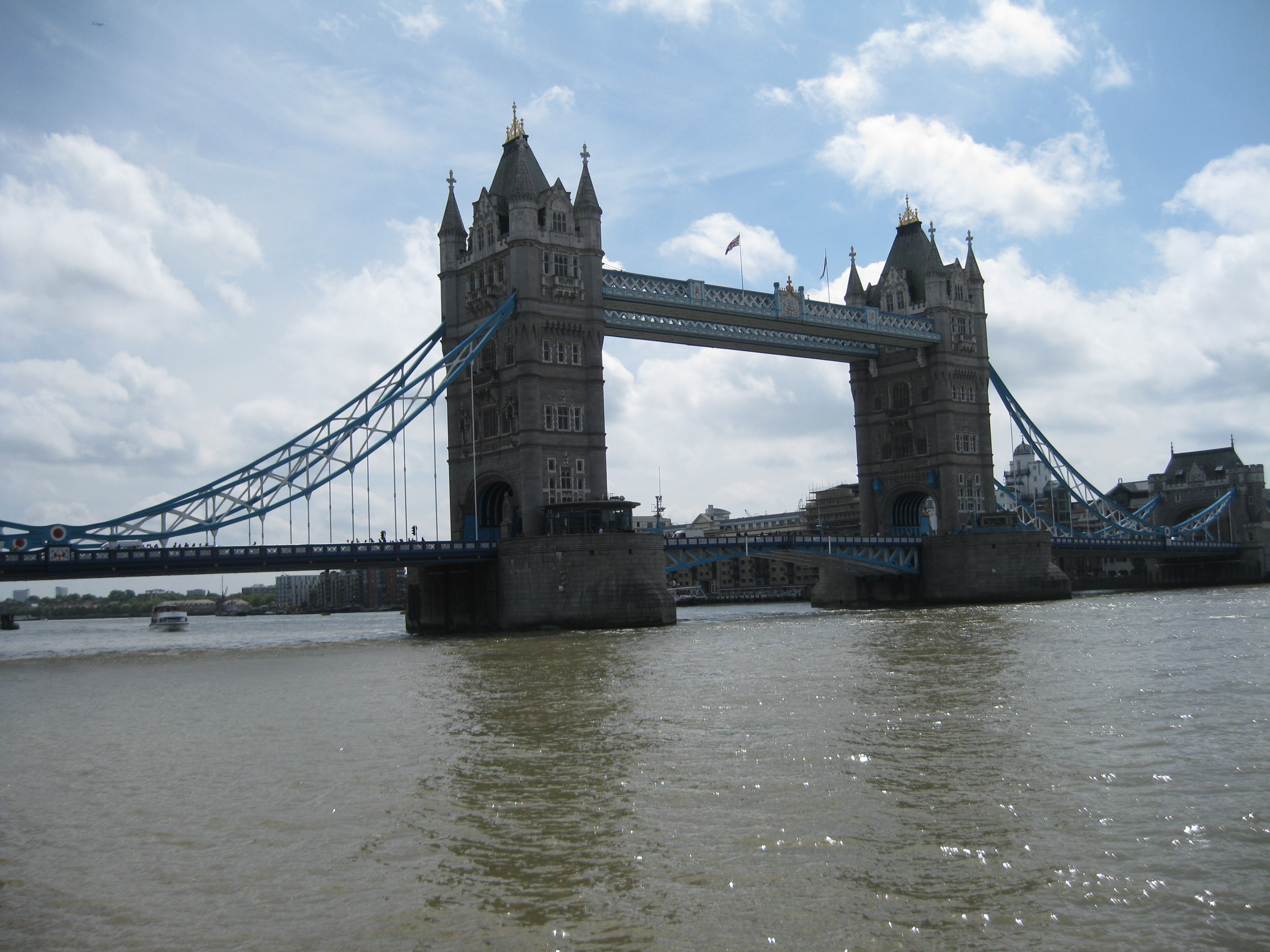
London was absolutely wonderful, but it felt odd that no one wanted to talk to us anymore, and we would walk into pubs to find people ignoring us. All the sudden, we had to figure everything out on our own and didn’t have a guide to tell us the best places to go. And the temperatures there got above 60 degrees! We adjusted quickly, and spent the next five days seeing as many sites as we could fit in. I had never been to London before, and it had been many years since Hobgoblin visited, so we set out to see all the major tourist sites. First up on Monday was the tower, and here’s a picture of Tower bridge:


From there, we climbed the Great Fire Monument, and toured St. Paul’s Cathedral (climbing to the top there as well — I climbed SO many stairs that day!). Over the next few days, we walked by Parliament, Big Ben, and Buckingham Palace, walked through St. James Park, and toured Westminster Abbey (spending a lot of time in Poet’s Corner). Tuesday night we saw Much Ado About Nothing in the Globe Theater. It was a great production — very funny with lots of good energy from the actors and audience. I had to laugh at the people in front of us as we left the theater complaining about how long the play was and how Shakespeare can go on and on and could have benefited from speeding things up. A response to be proud of, right?

Let’s see — we also saw the National Gallery — or parts of it, rather, since neither of us has a whole lot of endurance for museums. We tend to take 1-1 1/2 hours, see the sections that most interest us and call it a day. I couldn’t help but feel that each museum we saw we could have spent several days in. We also saw the British Museum (parts), a highlight of which was the Elgin marbles, and the London Museum, a great place to learn about the history of the city. At the end of our trip, we spent some time in the Victoria and Albert museum, although by that time, I’d had enough of reading museum displays, and just walked around looking at all the pretty things (of which they have tons — I loved the jewelry section in particular).

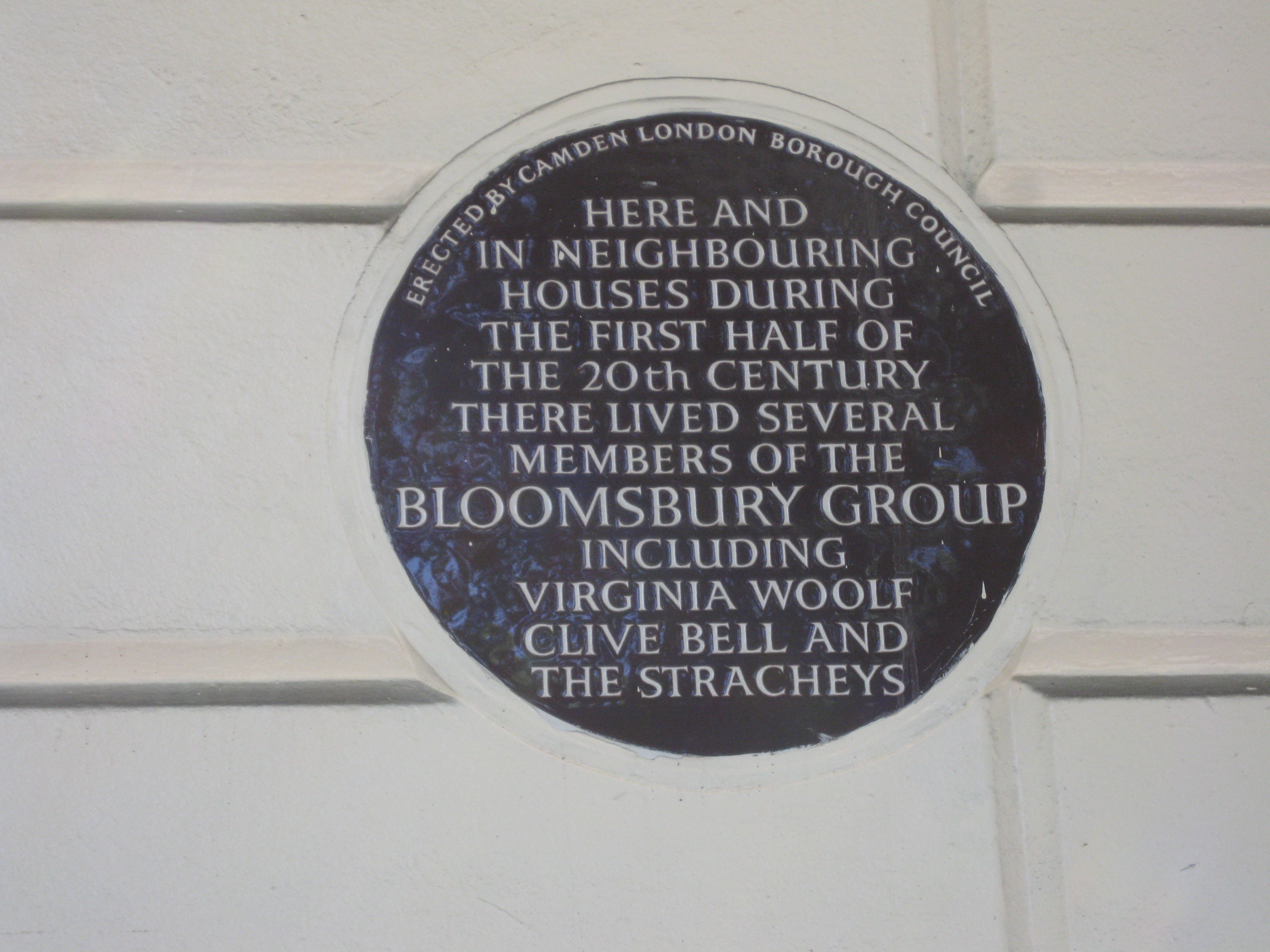
What else? We walked around Bloomsbury:

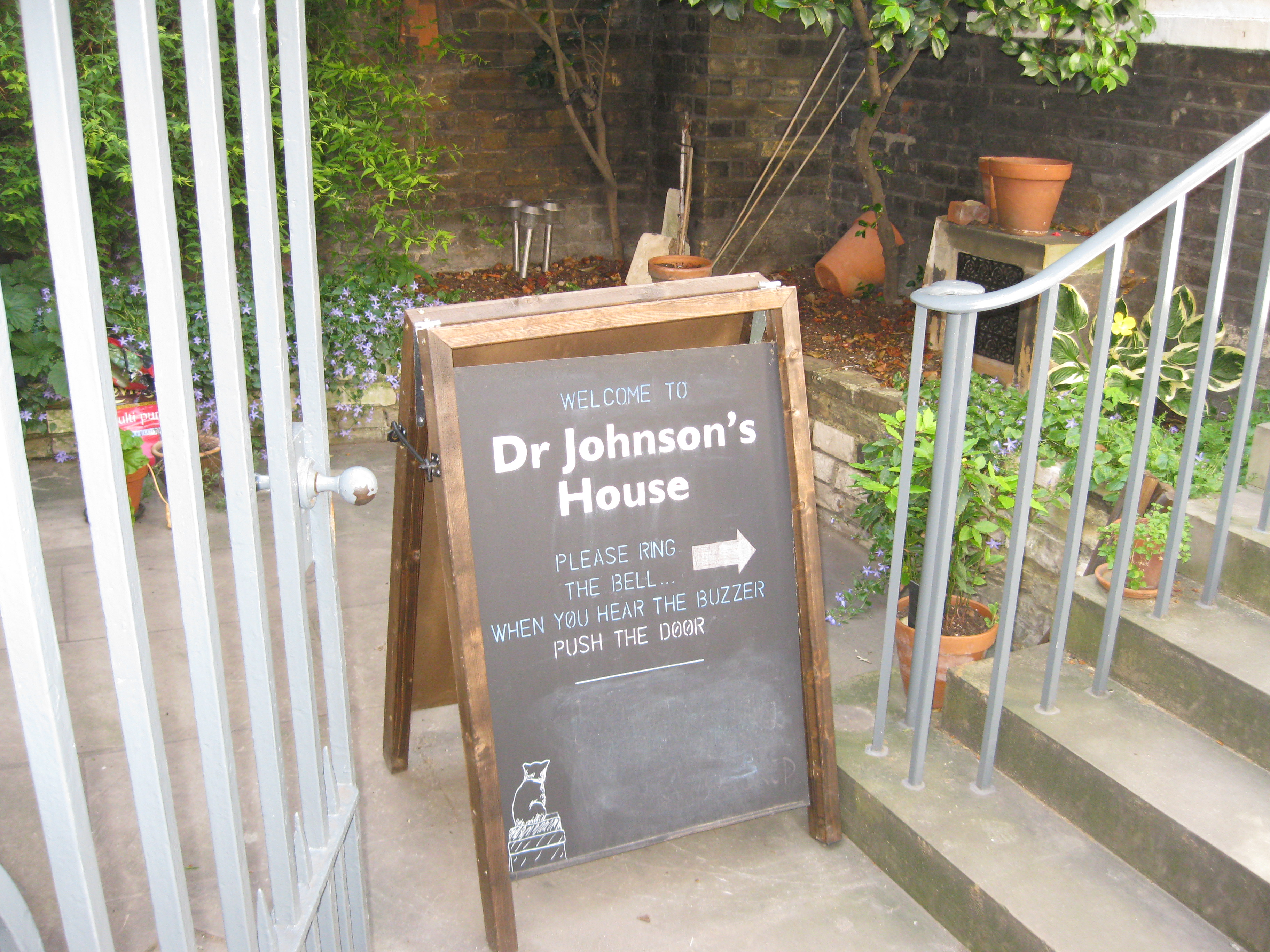
and saw Samuel Johnson’s house, as well as taking a guided tour called “Dr. Johnson’s Fleet Street,” where we saw some of Johnson’s haunts.

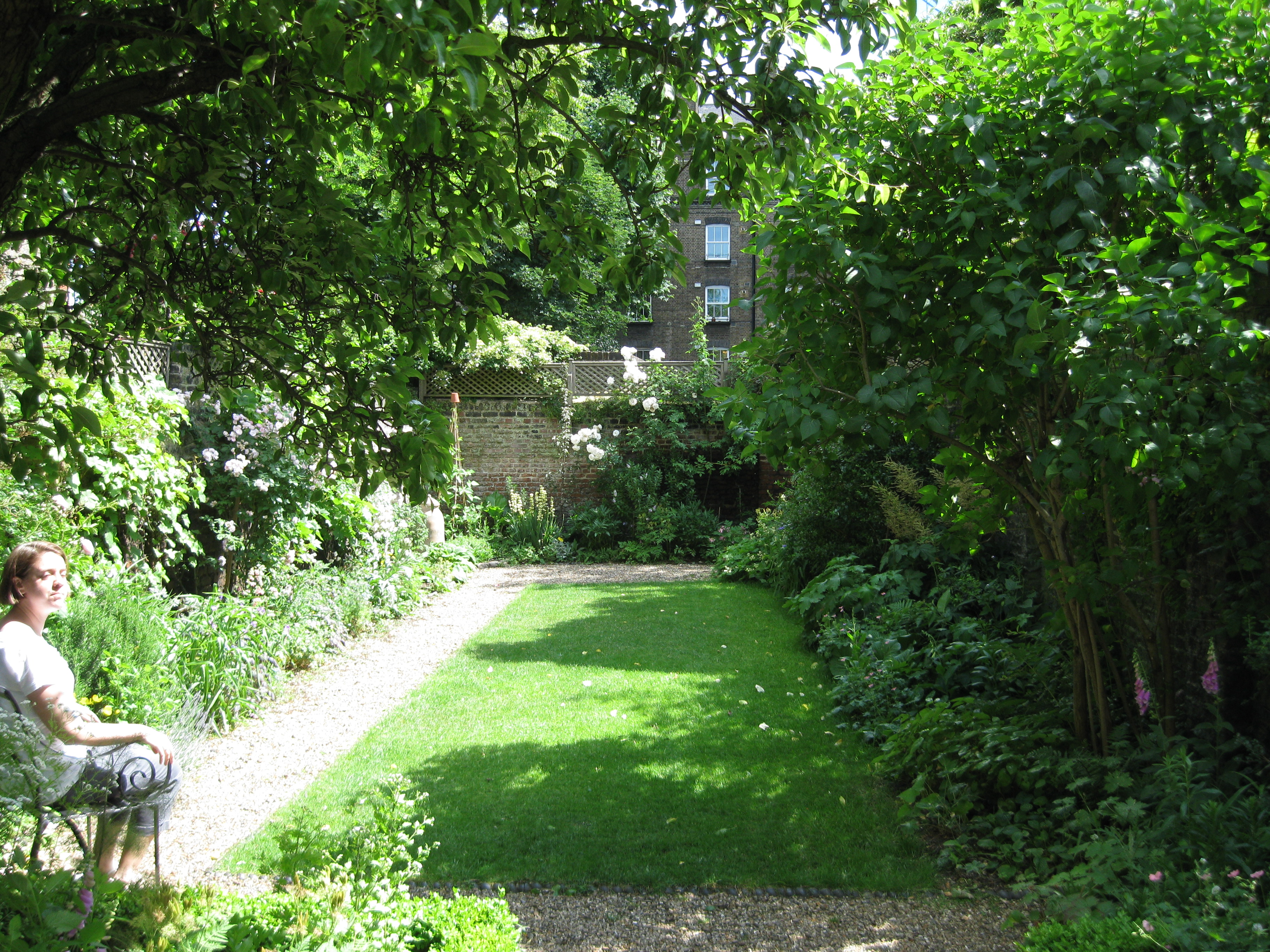
Somewhere in there we visited the Charles Dickens house, the Sherlock Holmes museum (cheesy, but fun), and the Carlyle house, which was a favorite, not least for the … odd … but very enthusiastic guides who showed us around the place. Here’s a picture of the tiny garden in the back:

We also visited a ton of bookshops, including Slightly Foxed, which wasn’t too far from our hotel and which we stopped by three times, although once for only 10 minutes before closing time. Also, the Persephone bookshop, and the London Review bookshop. We walked past 84 Charing Cross Road, which I knew had turned into a Pizza Hut, but what I didn’t know was that there are a bunch of bookstores elsewhere on Charing Cross, so we went to Blackwell’s and Foyle’s, as well as several shops with antiquarian and used books. And, of course, we went to Waterstone’s; I’m not even sure how many of them. I came home with 11 books, but I’ll tell you about those later.

By Friday, our fifth full day there, we were getting quite tired, so we started to slow our pace a bit, and we spent time just sitting in Hyde Park. On Saturday, it was time to go to Oxford to see Becky. After a tour of the city and some of the colleges:

Becky understood exactly what we needed, which was a chance to sit. So, we got some lunch and sat, found a pretty place along one of the rivers and sat, sat for a couple hours over tea, sat in a pub, sat over dinner. It was perfect and a great way to catch up on all our news.

Sunday was our last full day in London, and we spent it quietly, visiting some of our favorite bookshops and eating, and Monday we came home.

I’m satisfied what we did while there: there is obviously tons more to see in London, but I saw enough that if I don’t make it back for a while, I won’t mind too much. In addition to all the museums, churches, etc., we walked through a lot of neighborhoods, and I was happy to get a sense, even if it’s limited, of various parts of the city and how they all fit together.

And now it’s time to get back to books — hopefully I’ll be back soon to write about what I’ve been reading.

12 Comments

Filed under Life

Hello, World!

So Hobgoblin and I are home again; in fact, we’ve been home for five days or so, time which I have spent settling back in and trying to feel normal again. Coming home from travel is always hard for me (for most people?), and jet lag does not help. But I’m beginning to feel more like myself, and it’s high time I say something about my trip here.

But how to write about three weeks of travel without being uselessly vague? I admire Emily’s regular posts on her trip to France, but I didn’t have the energy or the reliable wireless to do something similar. So, the vague statements first: we had a wonderful time. Things will inevitably go wrong on any trip of that length, and it’s impossible to walk around in a state of bliss the entire time, but I think this trip was about as good as it’s possible to get.

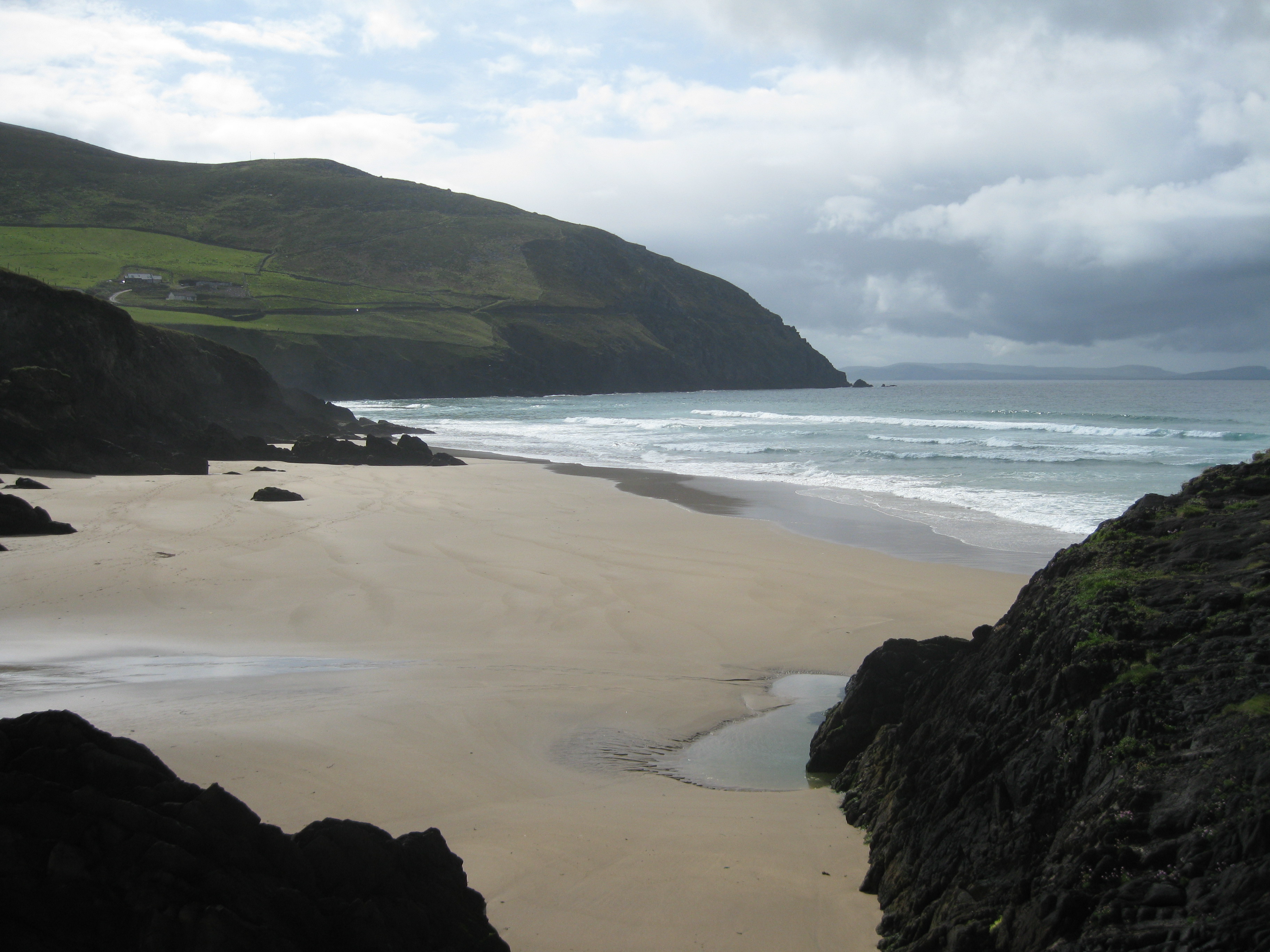
The thing that I loved about being in Ireland was that we were in one place for two weeks and had time to settle in and get to know the place well. As I described in my last post, because we settled into the community a bit and had people to guide us around, we got to see things and interact with local people in a way most tourists don’t. One of the highlights of our time was going on field trips to beautiful places along the coast and to see historical and archeological sites, each one led by local guides who are experts on local history, archeology, theology, and culture. These trips were part of the classes the students took, but I was invited on all of them. This is a picture from a trip to Brandon Bay:

Here is a shot of part of a beach walk we did at Smerwick Harbor:

Me on a windy hillwalk to see a lookout tour built to watch for Napoleon (who never arrived, of course). It was a very, very windy day, as most days were during our trip:

One of the archeological sites, Teampall Mancháin or the Temple Geal Oratory:

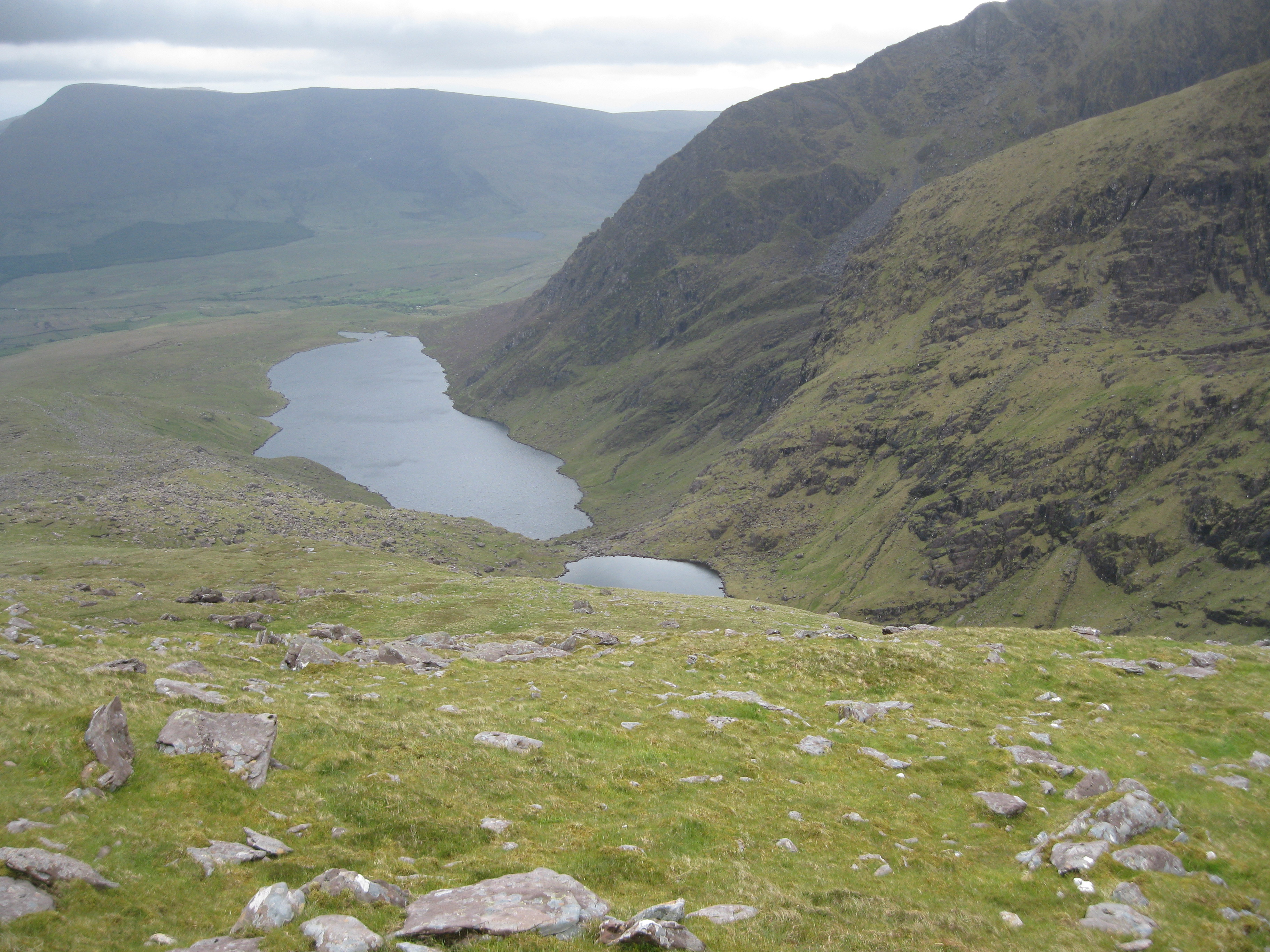
The view partway up Mt. Brandon, the second highest mountain in Ireland, which we climbed, and which left me sore for a couple days. It was a gorgeous hike, but by the time we got to the top, the clouds had moved in and we didn’t have a view.

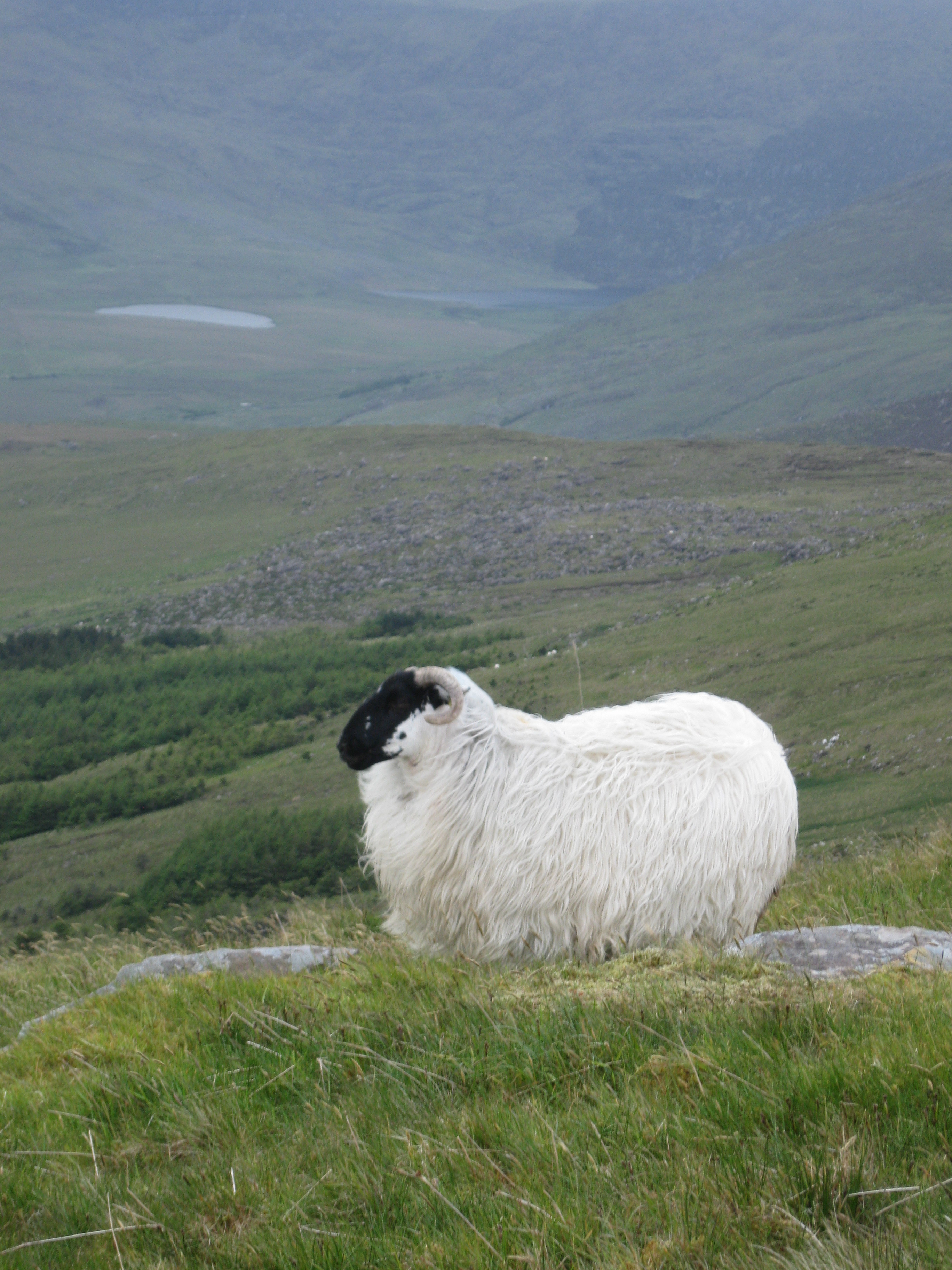
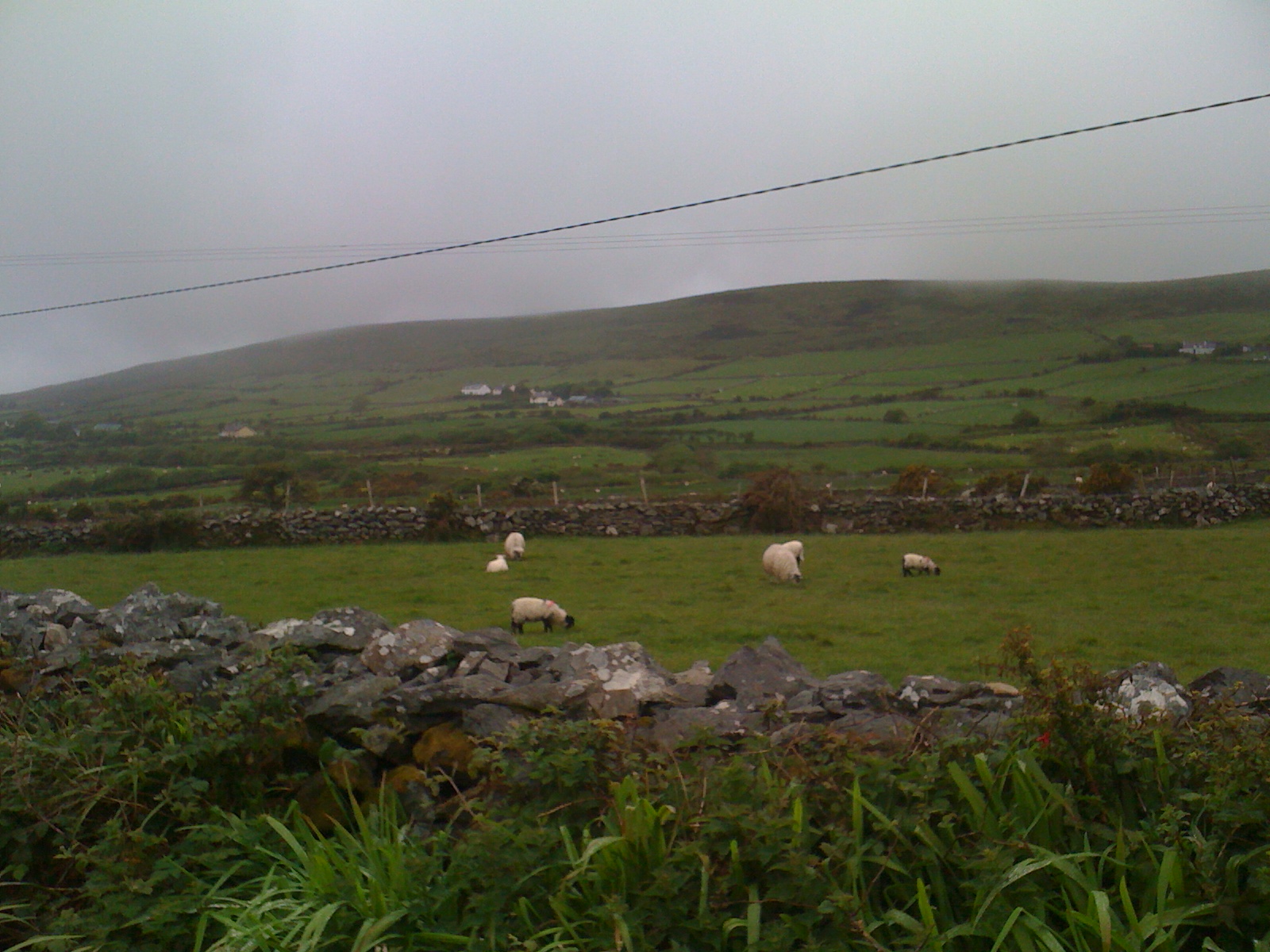
We saw a lot of sheep, all looking just as content as this one does:

And then there was Killarney National Park and Ross Castle:

I don’t happen to have a great picture of the town, but it was cute and colorful with lots of shops, restaurants, and pubs. It has two small bookstores, one a very good general-interest store, and the other a tiny but excellent shop that specializes in books on Ireland, in both English and Irish. The town is small, with maybe three main streets full of businesses, but it had enough variety to keep us occupied, and we didn’t have time to visit all the places we wanted to.

I don’t know how Hobgoblin had the energy to teach a class as well as do all the touring around we did; I spent the class time reading, walking, napping, and exploring town, and it was great to have some quiet. We had a pint with the other instructors every afternoon and dinner with the students at a different restaurant every night. Our lodgings were excellent: a two-bedroom apartment right in the middle of town (paid for by Hobgoblin’s university, which was totally awesome), so it was just a few steps to the school, the grocery store, etc. We took only two bike rides, largely because the weather was so difficult, but those two rides were memorable — one for the rain, and the other for the wind. But were beautiful, though.

You can see why I didn’t want to come home?

I think that’s enough for now; perhaps I’ll come back to write about London in a day or two.

14 Comments

Filed under Life

Do I have to come home?

All is going splendidly here. The weather hasn’t been the best, but we have fit in most of what we wanted to do in the dry spells. Over the weekend was a trip to Killarney, which involved a walk to Ross Castle, a bike ride to Muckross House and a gorgeous waterfall. This week has meant more visits to the Dingle peninsula coastline and several archeological expeditions where we saw ancient churches and fortresses. We have also experienced a bit of the local music scene, with live music in a pub, which I understand takes place in many pubs on just about any night of the week. Last night we went to Sean-nos, which is old-style a cappela Irish singing. Since it was four Irish singers and about 40 or so Americans, I don’t think the evening was quite traditional — there were some cowboy songs and pop songs thrown in there as well.

One of the best things about this trip is that we have had more contact with local people than most tourists do, since there is a local man in charge of the school activities, and he introduces us to all kinds of interesting people. We have had various guides take us around to the historical sites, all of whom have been extremely knowledgeable and very, very nice. Yesterday after the students’ archeological tour was over, Hobgoblin and I went with the guide on an extended tour of lesser-known religious sites, which involved tramping through mud, climbing over barbed wire, and sharing fields with outraged cows. It was most awesome. I do not want to go home!

Unfortunately, the slow wireless isn’t letting me post pictures right now, but perhaps I will have time to later.

8 Comments

Filed under Books

The Irish Coast

There are some gorgeous beaches here. A couple more photos:

11 Comments

Filed under Books

The Dingle Peninsula

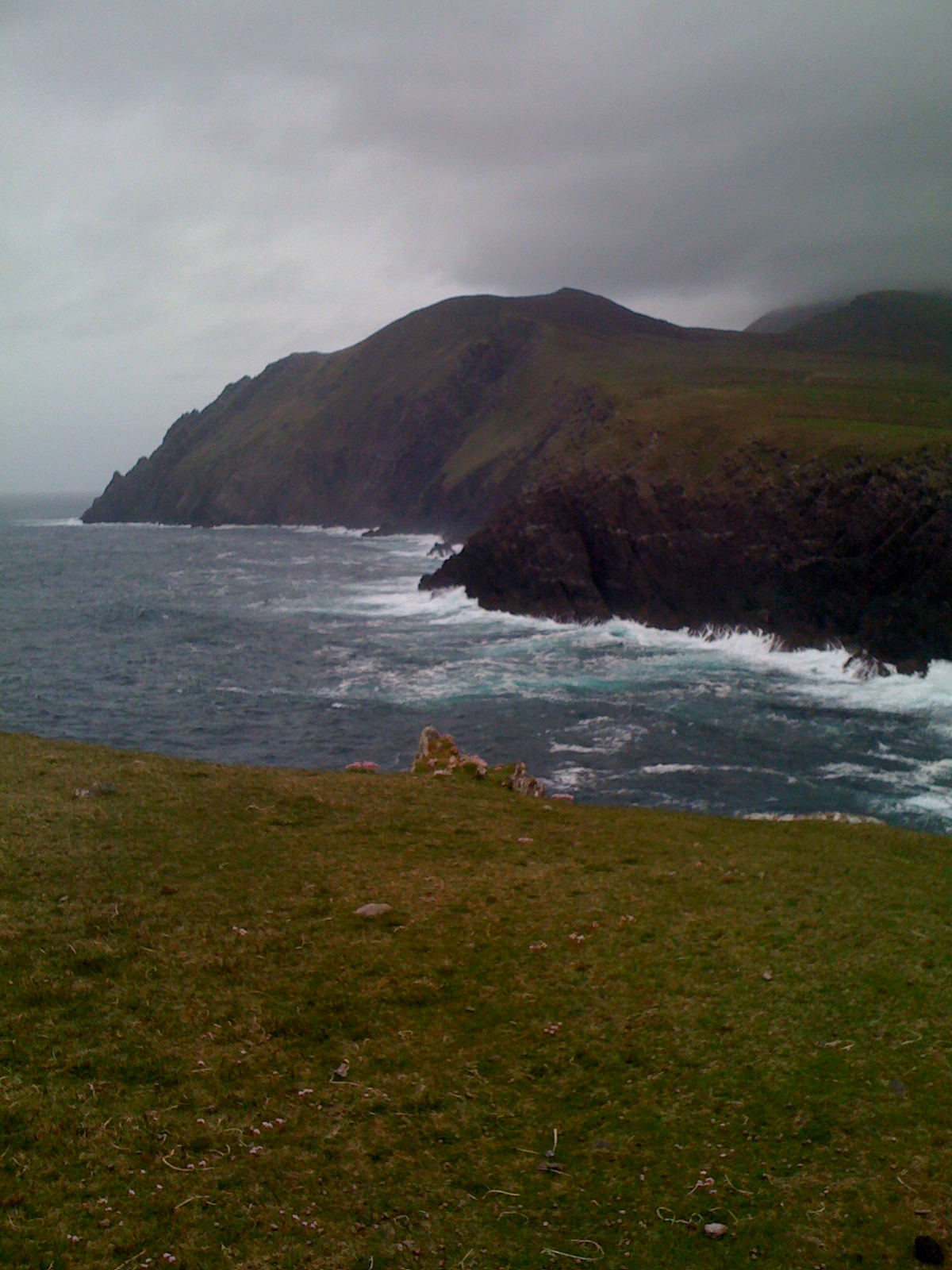
Hobgoblin is teaching, so I have a little time to post some photos. He usually has the camera, but I have a few pictures from my iPhone. This one is from a field trip we took with Hobgoblin’s class yesterday to the place where St. Brendan most likely set sail on his journey across the Atlantic. It was a gorgeous piece of coastline. Another view:

And here are a couple pictures from a walk I took this morning. It’s misty and chilly today, although I hear the sun is supposed to return tomorrow. I walked along the Dingle way, which is a path that takes you around the entire Dingle Peninsula. I only covered a couple miles, but it was a nice view of the countryside:

The trip has been quite good so far. I’ve had a chance to explore the town of Dingle and see a few sights, as well as spend time reading and taking naps. We are here for two weeks, and I like the leisurely pace of our visit.

13 Comments

Filed under Books

And I’m Off!

We leave for Ireland tomorrow. I have packed nothing at this point, but our flight doesn’t leave until 11:00 pm, and I need something to do during the day. Even with leaving my packing until the last moment, I’ll still have plenty of hours with nothing much to do. I think I’ll be bored out of my mind, and probably too distracted and anxious to read.

Anyway, I think I’ve finally settled the issue of what books to bring with me. The most important thing is my Nook, on which I have almost 60 books. Most of those books are free classics from sites like Project Gutenberg, and a couple are from the library or NetGalleys. I can’t travel with just an electronic device for reading, though, because what happens if the battery runs out? So I’ll be bringing along at least one paper book. My thought is that I should bring something I don’t mind leaving behind, in order to make more room to bring books back. So I’m planning to bring a mass market copy of Laurie King’s Monstrous Regiment of Women, which will probably make good plane/airport reading.

I also bought my first book for the Nook today — bought as opposed to downloaded for free. I want to bring something nonfiction as well as all the novels I have, but in order to avoid carrying another paper book, I thought it was worthwhile to buy something. So I got Geoff Dyer’s collection of essays Otherwise Known as the Human Condition. I loved his books Yoga for People Who Can’t Be Bothered to Do It and Out of Sheer Rage. So I think I will like this new one.

In case you’re interested in what I have on my Nook, here’s a list:

  1. Louisa May Alcott, An Old-Fashioned Girl
  2. Elizabeth von Arnim, Elizabeth and Her German Garden
  3. Jane Austen, Persuasion
  4. Aphra Behn, Love-Letters Between a Nobleman and his Sister
  5. E.F. Benson, Miss Mapp
  6. Isabella Bird, A Lady’s Life in the Rocky Mountains
  7. Mary Elizabeth Braddon, Charlotte’s Inheritance
  8. Robert Browning, The Letters of Robert Browning and Elizabeth Barrett
  9. Mary Brunton, Self Control
  10. John Buchan, The Thirty-nine Steps
  11. Frances Hodgson Burnett, The Shuttle
  12. Fanny Burney, Cecilia
  13. Willa Cather, O Pioneers!
  14. Agatha Christie, The Mysterious Affair at Styles
  15. Agatha Christie, The Secret Adversary
  16. Wilkie Collins, The Law and the Lady
  17. Abraham Cowley, Cowley’s Essays
  18. E.M. Delafield, Consequences
  19. Charles Dickens, David Copperfield
  20. Arthur Conan Doyle, Adventures of Sherlock Holmes
  21. Maria Edgeworth, Ennui
  22. George Eliot, Romola
  23. Sarah Fielding, The Governess
  24. E.M. Forster, Where Angels Fear to Tread
  25. John Galt, The Annals of the Parish
  26. Elizabeth Gaskell, Ruth
  27. Nikolai Gogol, Dead Souls
  28. Anna Katharine Green, The Leavenworth Case
  29. Thomas Hardy, Under the Greenwood Tree
  30. Nathaniel Hawthorne, The House of Seven Gables
  31. Georgette Heyer, The Black Moth
  32. Henry James, The Tragic Muse
  33. Henry James, The Europeans
  34. Sarah Orne Jewett, The Country of the Pointed Firs
  35. Mary Kingsley, Travels in West Africa
  36. Charlotte Lennox, The Life of Harriot Stuart
  37. Ada Leverson, Love at Second Sight
  38. Somerset Maugham, The Moon and Sixpence
  39. F.M. Mayor, The Third Miss Symons
  40. Edith Nesbit, The Railway Children
  41. Margaret Oliphant, The Rector
  42. Margaret Oliphant, Salem Chapel
  43. Margaret Oliphant, Phoebe Junior
  44. Ann Radcliffe, The Romance of the Forest
  45. Dorothy Richardson, Pointed Roofs
  46. Dorothy Sayers, Whose Body
  47. Dorothy Sayers, Clouds of Witness
  48. William Shakespeare, Much Ado About Nothing
  49. Frances Sheridan, Memoirs of Miss  Sidney Bidulph
  50. May Sinclair, Mary Olivier
  51. William Thackeray, Barry Lyndon
  52. Mrs. Humphry Ward, Lady Rose’s Daughter
  53. Mary Webb, Gone to Earth
  54. Rebecca West, The Return of the Soldier
  55. Edith Wharton, The Custom of the Country
  56. P.G. Wodehouse, My Man Jeeves
  57. Charlotte Mary Yonge, The Heir of Redclyffe

Plus, from the library I have Lars Iyer’s Spurious and from Netgalleys I have Monique Roffey’s White Woman on the Green Bicycle. I will not lack for reading material, as long as I remember my Nook power cord! I chose the books on my list of free classics based on what I have and haven’t read and what I own on paper. Many of the books are not the most obvious choices for a particular author, but they are the book by that author I wanted to read next.

I may post pictures here while I’m gone, but then again, I may not. So I’ll just say I’ll see you in June and possibly sooner. Take care while I’m gone!

15 Comments

Filed under Life

Open City, by Teju Cole

I just finished Teju Cole’s recent novel Open City last night, and although I had some doubts about it early on, it ended up winning me over and by the time I finished, I was loving it. Open City is often compared to W.G. Sebald’s books, and I felt about Cole the same way I feel about Sebald: I love the idea of the books but am not always sure about the execution. What bothers me at times is the reticence and emotional distance of the narrators. That is exactly what bothered me about Peter Stamm’s novel Seven Years. At times the writing in all these books crosses the line from being calm, quiet, and meditative into being dull.

But I do admire much in Sebald, and Cole’s novel finally won me over. It is about a man in his 30s, Julius, who is a psychiatrist in training and who spends his free time walking around New York City and, briefly, Brussels. The novel has no plot, but simply describes the narrator’s experiences and thoughts as he observes and interacts with people and with the city’s art and history. His thoughts keep returning to similar themes, so the various stories, descriptions, and meditations, rather than a plot line, provide the book’s coherence. Julius is fascinated by cities and the way their history is built in layers, with traces of the past existing underneath the present, like a palimpsest. As he walks, he notices traces of history: monuments and plaques and old buildings that don’t fit in their new neighborhoods. He describes the changes shops, buildings, and blocks have undergone. He is also interested in how people interact in cities, the way the crowds look and what it feels like to walk down streets and in and out of shops. He is extremely observant but is not only an observer; he often strikes up conversations with people or finds people talking to him. Although he comes across as reserved, he makes friends, or at least acquaintances, easily.

He also thinks about issues on a larger scale: the long and sad history of human violence, religious  and racial conflicts, the way identity is constructed and how that construction can lead to social and political tension. He has conversations with a recent acquaintance in Brussels about orientalism and east/west tensions, and the anger many immigrants in Europe feel at their often unwelcome reception and uncertain status. Inevitably, back in New York, he thinks about the World Trade Center and everything the empty space where the towers used to stand says about human conflicts that just won’t go away.

We also get his thoughts on his own history and personal experiences:  his relationships with his German mother and his Nigerian father, what it was like going to his boarding school in Nigeria and moving to America at 17, the racial tensions he experienced in both places, the grandmother he would like to reconnect with but can’t find. It’s in search of this grandmother that he goes to Brussels, but he only looks for her halfheartedly, and he doesn’t explain this reasons for his halfheartedness. I got the feeling as I read along, that there were a lot of things Julius wasn’t really explaining. He and a girlfriend have just broken up, and he describes his ambivalent feelings about her and his sorrow at their ended relationship, but there’s a sense he is not plumbing the depths of his feelings with us. He tends to stay on the surface of things, as one walking around a city observes from the outside and only gets brief glimpses at the life going on inside the houses and shops.

What makes this novel work is the way its themes and motifs weave their way in and out of the text, creating repetitions and echoes that resonate the whole way through. It’s easy to miss these connections if you read too quickly; this is a book that asks you to slow down and savor its images and juxtapositions. There is often a quietly ironic tone as one anecdote contrasts or obliquely comments on another one, and it’s a pleasure to follow the path of Julius’s thoughts, which are as suggestive as his walks, even if they are the same time disorderly and directionless.

Or perhaps the thoughts and the walks only seem directionless. There’s certainly a craft to creating the impression of drifting while at the same time actually getting somewhere. We don’t arrive at any new place or at some new realization or lesson, but we end up at a feeling of completion, of the pieces fitting together, the ideas connecting to one another. The novel reminds me of one of my favorite essays, “Street Haunting” by Virginia Woolf. Woolf’s tone is much lighter than Cole’s, but both writers use the occasion of a city walk to meditate on subjects large and small, moving (seemingly) effortlessly from the mundane to the philosophical in the space of a paragraph. It’s quite a trick to do that, and it’s a trick I admire very much.

7 Comments

Filed under Books, Fiction

Seven Years

My Ireland trip is fast approaching (this coming Thursday), and I’m losing my motivation to do anything but read and nap in preparation for vacation sloth. But I wanted to write something at least about Peter Stamm’s novel Seven Years before too much time passes. This novel is written in a distanced, emotionally-detached style while taking as its subject matter emotional detachment. It makes me wonder the extent to which those two things necessarily go together. Perhaps it is possible to write a heated, passionate novel about emotional coldness, but Seven Years is written in the first person from the point of view of someone who doesn’t know much about what he feels and wants, which makes a certain amount of detachment and distance in the writing inevitable.

The story is about a love triangle involving the narrator, Alex, his wife, Sonia, and Ivona, a woman with whom Alex has an inexplicable attraction — inexplicable to him as well as to everyone else who knows them — ever since he met her. Alex and Sonia meet in architecture school in Munich and go on to run an architecture business together. Their relationship begins in a halting, uncertain manner. There is more awkwardness than passion between them; it is as though they know intellectually that they are suited for one another rather than feeling it emotionally.

Alongside the development of this relationship is Alex’s conflicted, on-again, off-again obsession with Ivona, an illegal immigrant from Poland who works in a bookshop. Ivona is unattractive, everyone seems to agree, and also uninteresting. She has nothing of Sonia’s intelligence, style, and poise. She is described in harsh, unforgiving terms as lumpish and bovine. And yet Alex can’t forget her, and he keeps returning to her again and again through his courtship of and marriage to Sonia. Alex is cruel to Ivona and doesn’t seem to care much about it; he knows that she has latched onto him and pinned her hopes on his leaving his wife for her, but still he keeps coming back, not caring much what emotional turmoil she experiences.

This, as you can see, is one of those books where none of the characters are likable and there is no one to sympathize with, except perhaps Ivona, although even there I found her naivete and stubbornness irritating. I don’t mind at all not having anyone to like in the book, however, since the intellectual puzzle of the characters is interesting enough. Alex himself is the biggest mystery, both to himself and to the reader, but Sonia is a puzzle as well, what she knows about Alex and how much she cares. Both characters are living out the life society expects of them, running their business, acquiring a home, raising a child, but they do all this listlessly, carelessly, and only slowly and in the smallest steps do they discover who they are and what they want.

What I found disappointing about the book was that it was hard not to feel as detached and uncertain about the characters as they felt about each other and themselves. Detachment is interesting as a concept, but it doesn’t make for very engaging reading. Here is Alex thinking about Sonia’s past and her personality:

Sonia never did talk much. It often felt as though she had no previous life, or whatever it was had left no traces except in the photograph albums on her bookshelf, which she never took out. When I looked at the pictures, I had the sense that they came from another life. Now and then I asked Sonia about her time with Rudiger, and she gave me monosyllabic replies. She said she never asked me what I’d done before either. It doesn’t bother me, I said. After all, you’re mine now. But Sonia was stubbornly silent. Sometimes I wondered if it wasn’t that there was just nothing to say.

That there might be just nothing to say is an interesting proposition, although a sad one, but it’s interesting — in this novel at least — only in an abstract, analytical way. Still, Stamm captures well the state of not knowing oneself and the consequences that result. At the heart of the book is an emptiness that is frightening. It surely took some courage to try to capture that emptiness on the page.

For another take on the novel, see Michelle’s review of it at the journal Necessary Fiction.

9 Comments

Filed under Books, Fiction

Cycling update — with horses!

We had a beautiful weekend here in Connecticut, sunny with temperatures in the 60s and low 70s, and I was fortunate to be able to ride Friday, Saturday, and Sunday. Sadly, my riding is not up to the level it was last year, and it’s not likely ever to reach that level this year, given the various interruptions I’m facing. (Although some of the interruptions are good ones — only 1 1/2 weeks until Ireland!) But still, I’m enjoying myself. I ride some on my own but often with friends, and I’ve found that riding a bike is a great context in which to have a conversation. It gives me at least an hour to talk, although often much longer, and it’s a low pressure situation: it’s not awkward if you’re not talking the entire time, because you’re busy doing something else: riding. You are free to be quiet and ride if you want. Or you can talk the entire time, and the interruptions — getting out of the way of traffic, letting a loud truck go by — don’t matter much. In fact, they offer time to think about the conversation and plan what to say next. The interruptions also make it easy to bring up a new topic without awkwardness. Conversations are also much more fun when you are pumped full of adrenaline. Everyone is wittier and laughter comes much more quickly when you’ve been working hard and are feeling both pleasantly tired and full of energy.

Yesterday’s group ride was an odd one, though. It was 60 very hilly miles, and I rode with four other people, including Hobgoblin. About halfway through, I was riding with a friend about a quarter mile ahead of the others, and we passed three horses and two riders coming from the other direction. I didn’t think much of it — we were in horse farm country. A couple minutes later, though, I heard a clopping noise behind me. My first thought was that someone’s bike was making some very strange noises, but then I realized that it was a horse. My second thought was that it was strange for a rider to be galloping down the left side of the road, into oncoming traffic and uncomfortably close to me. Then the horse passed me, at top speed, and I realized it had no rider. And then another horse galloped past me, also at top speed, also with no rider. My friend started to panic, and we pulled over to the side of the road as she told me horror stories about friends getting kicked by horses. We looked back, and fortunately there were no more horses galloping at us. We waited for the other riders to catch up, but they didn’t appear. Finally a woman on a horse — thankfully fully under her control — came along and told us there had been a bad accident. She rode on without giving us any more information than that.

This time I panicked along with my friend. I have heard way too often about bad accidents and cyclists, and, unfortunately, Hobgoblin tends to be accident prone. If anyone is going to have a run-in with a horse while riding a bike, it quite possibly could be him. I was having visions of horse/cyclist run-ins, ambulances, concussions, broken bones, everything you can imagine. We headed back down the road trying to keep calm, and you can understand my relief when I saw the entire group all upright, everyone’s bike in working order. It turns out the horses had gotten spooked by the cyclists behind me. One of them had thrown its rider, and it and one of the other horses took off down the road. Everyone watched as they galloped toward my friend and I, yelling at us to get out of the way, but we couldn’t hear anything. Fortunately, the horses weren’t interested in knocking us down. Unfortunately, the woman thrown from her horse was hit hard enough to crack her helmet, although she didn’t want help and seemed to be okay.

We felt concerned for the woman who had taken the fall, but the situation felt so bizarre we rode the rest of the way home laughing. I kept saying I know this is horse country, but I never expected to be chased by them! It’s really kind of funny the way strange things happen to you when you spend hours out on your bike. There’s no way of knowing what any ride will bring. I have learned, though, to steer well clear of horses out on the road, no matter how calm they seem.

11 Comments

Filed under Cycling

Townie

Andre Dubus III’s memoir Townie is a harrowing read. It wasn’t quite on the same level of emotional intensity as Joyce Carol Oates’s memoir A Widow’s Story, but it, like Oates’s book, was both hard to put down and hard to shake off once I had put it down. It left me feeling somber and needing a little recovery time afterward. All of which I mean in a positive way — Townie was perhaps a bit too long (as was Oates’s book), but still, awfully good.

It tells the story of Dubus’s experiences growing up poor, first with his mother and his famous writer father, but soon enough with his mother alone, along with his three siblings. Even when the family was together, they never had much money, but his parents’ divorce turned a manageable situation into an extremely precarious one. His mother did her best to keep the family going, but money was always short — the family often went hungry — and the mother was either working or home exhausted and wasn’t able to keep tabs on what the children were doing. They moved frequently and usually lived in rough neighborhoods in decaying Massachusetts towns. These were former mill towns where vacant buildings were everywhere and unemployment was high.

Dubus was small and quickly became a target for bullies. Soon enough he was getting beaten up just about every day and lived in fear of running into the wrong people. Even his home wasn’t safe; knowing there were no adults around, local young people would hold afternoon parties in his living room. There was nothing he could do about it. His siblings tried to help him out by telling their mother about the beatings, but not much came of it.

This story of living in constant fear is one of the main threads of the book; eventually, after years of being bullied and doing nothing about it, Dubus decides he can’t take it anymore, and he begins to lift weights. He also learns how to box at a local gym. It takes a long time, but finally he learns that if he is the one who punches first, if he takes his opponent by surprise, he can win a fight. This is a breakthrough moment, a turn of events that lets him feel proud of himself, finally. But there is a downside: now that he has learned how to let his anger out, he isn’t sure he can control it. He becomes the guy who can defend innocent victims, but he is also the guy who starts fights and sends people to the hospital. Does he really want to be that way and are there better ways to handle his anger?

The other major thread running through the book is his relationship with his father. Dubus the father never fully abandoned his children; he sent money faithfully even though he never had much, and he took them out to dinner on Sundays and spent Wednesday evenings with his kids one at a time so they had a chance to see him on their own once a month. But still, there was so much he never knew about what his kids were going through, and poor as he was, his life was much more comfortable than his ex-wife’s. There are painful scenes where he tries to play catch with his son and learns that the son knows absolutely nothing about catching and throwing a ball or about baseball itself. How was he supposed to learn? Dubus never tells his father the truth about his life, out of shyness and shame. He mostly just felt uneasy around his father and was relieved to get away. As Dubus grows older, his relationship with his father becomes much closer, but he is still left with questions: how much should he tell his father? Would there be any point in hurting his father in that way?

Dubus’s story is riveting, both because of its inherent drama and because of the questions it raises about poverty, rage, and violence, and also about what it takes to leave a difficult childhood behind. Dubus writes extremely well: he conjures up the atmosphere of the mill towns he grew up in and evokes his feelings of hopelessness and fear so powerfully that you feel you are experiencing everything alongside him. I heard Dubus say in an interview that he had tried to write about his childhood in fiction but failed, and it was only in the memoir form that he found he could tell the story. In the book he writes about creating characters who were essentially himself, but the stories were never any good because he was trying too hard to make the reader sympathize with his fictionalized self. I don’t quite know what it was about the transition to nonfiction that made telling his story possible, but something clicked for him, and he has told the story wonderfully.

9 Comments

Filed under Books, Nonfiction

AfterWord: Conjuring the Literary Dead

AfterWord: Conjuring the Literary Dead is one of the first books I requested from NetGalley because it’s a collection of essays about writers and books, and I love a good collection about writers and books. I was a little disappointed in it, though; I thought the book’s idea sounded promising, but either I was mistaken about that, or the execution didn’t live up to the possibilities. I think the problem may be that the essays were uneven and perhaps, generally speaking, a little too short. They didn’t dig into their subjects deeply enough and so left me feeling a little dissatisfied.

The premise is that in each essay, a writer imagines a meeting with his or her favorite author, or perhaps an author he or she has written about or grappled with in some fashion. The various essayists tackle this task in different ways, some pretending that they have traveled back in time, some imagining they are meeting their subject in the present day or in some nebulous in-between space. In some cases, the authors know about things that have happened after their deaths, and in others they don’t.

Which, let me digress to say, is something I think about now and then: I remember somebody saying, or perhaps I read it, that the really sad thing about having to die is not knowing how things turn out. I agree with the feeling. I think about people who lived before the time of the novel and what it would be like not to know that a novel existed. Or not to know about Jane Austen or James Joyce or David Foster Wallace, or whoever. Who are the wonderful, amazing writers we won’t know about, and what genres will we not live to experience? Okay, best not to think about that too much…

Some of the essays in this collection are really charming — Cynthia Ozick on Henry James, Jay Parini on Robert Frost, Eugene Goodheart on Jane Austen, Francis King on Oscar Wilde, Jeffrey Meyers on Samuel Johnson. Others made me contemplate how difficult it is to create a convincing scene and realistic dialogue. There were some essayists who I presume were more academic types than fiction writers whose attempts at a kind of fiction writing were awkward. In a couple cases, I simply didn’t like the tone or the attitude expressed.

Mostly, though, I kept thinking about how none of this was real, how all of it was mere speculation. That’s what it’s supposed to be, of course, but it felt a little like reading a description of someone’s dream — an interesting dream, but not much more than that. If I’m going to read about an author’s life, I think I’d prefer either something more straightforwardly critical and argumentative, whether it’s a biography or a critical essay (no matter how imaginatively done) or a fully-realized novel along the lines of Colm Toibin’s The Master.

However, there are some essays I’m glad I read. Perhaps the best approach with this book is to read selectively, finding the essays about authors you find interesting and focusing on those. And for another view entirely, read Stefanie’s post on the book. The book did make me consider who I would write about if I had been a contributor to the collection: perhaps Virginia Woolf or Mary McCarthy. Oh no — it would be Laurence Sterne, definitely. But what in the world would I say to any of these people if I could meet them, even only in my imagination?

10 Comments

Filed under Books, Essays

The Tragedy of Arthur

Arthur Phillips’s new novel The Tragedy of Arthur was great fun. I’ve seen comparisons of this book to Nabokov’s Pale Fire, and the comparison works to a certain extent — they have a similar structure, both made up of a primary text and a commentary on that text — but it’s a rather unfortunate comparison for Phillips’s sake because who can compare to the great Nabokov? This book doesn’t have the insane brilliance of Pale Fire, but there’s a charm and wit to it that are appealing.

The text in Phillips’s case is a “newly discovered” long-lost Shakespeare play, printed in its entirety in the back of the book. The commentary takes the form of a memoir and fills up the first 250 or so pages. This commentary/memoir was supposed to be a standard critical introduction, but the guy who owns the manuscript, a character named Arthur Phillips, agreed to publish the introduction himself and decided to do it exactly as he wanted. It takes the unusual form of a long self-justification including his entire life story and an argument about the play’s authenticity. This question of authenticity is at the heart of the book, and it’s a particularly vexed question because the man who “discovered” the play, Arthur Phillips’s father, is a notorious con man who spent much of his adult life in jail for various forgeries (another book hovering in the background is William Gaddis’s The Recognitions, which is also about artistic forgeries and a difficult father/son relationship).

In this memoir of sorts — which describes a life at least superficially resembling the real Arthur Phillips’s life, both people having published the same novels and lived in at least some of the same places — Phillips tells the story of what it was like to grow up with a criminally unreliable father. This is a father who woke his two children up in the middle of the night, Arthur and his twin sister Dana, and dragged them around a field with strange, heavy machinery for hours and hours in order to convince people that aliens had left crop circles. Arthur grows up not knowing whether anything his father gives him — a signed baseball for example — is real or a forgery. As you can imagine, Arthur has some psychological issues to work out.

His father’s legacy wasn’t all about forgery, however. The cons and forgeries had at their root — or at least this is how the father would explain it — a certain creativity and love of creating experiences of wonder. Thinking about the crop circle and the farmer who originally found it, Arthur writes,

My father didn’t want to make people stupider or mock stupidity or celebrate stupidity. When the farmer said, “The shape. The shape is so … beautiful, so …” and trailed off, my father was right there with him in spirit. I suspect that he wished, of all the participants in this whole enterprise, to be that farmer, to be fooled. My father had given him (and the world) this glimpse of something hidden. He was only dissatisfied to be the giver and not the recipient.

The father is also, along with Dana, thoroughly obsessed with Shakespeare. Arthur grew up with Shakespeare’s language forever in his ears. But this also is a complicated legacy. Arthur decides early on that he doesn’t like Shakespeare much, and while he correctly points out that this isn’t at all unusual, in his case it has at least something to do with the fact that Dana and their father bond over a love of the playwright and Arthur feels left out. He loves his sister dearly and feels he has some very weighty competition for her attention.

So, when his father bequeaths Arthur the lost Shakespeare play, Arthur has some serious thinking to do. Is it possible that this one time his father is telling the truth?

The memoir part of this book is a mix of a whole bunch of things — in addition to memoir, it’s also an anti-memoir, as Arthur complains about the genre every chance he gets, although it’s clear he needs the genre in order to make his point about his father and thus about the Shakespeare (?) play. It also contains a synopsis of the play, because that’s what an introduction is supposed to do, of course, and in that same spirit, it discusses the play’s themes and background. In addition to being all mixed up with the personal stories, however, this critical material is shaped in such a way as to further Arthur’s arguments about his father. It all ultimately revolves around Arthur himself — is the character Arthur in the play The Tragedy of Arthur supposed to be him? Was his father sending him a message?

Arthur writes notes for the play as well, and here it’s personal too: some of the notes speculate on where his father might have gotten his material from, if indeed he did write the play himself. In addition to Arthur’s notes, there are notes from a Shakespeare scholar, and these two voices contradict each other. In addition to everything else going on in this book, it’s also about the uncertainty of scholarship and the impossibility of finding a truly objective point of view. Arthur is obviously a biased reader — given the circumstances there is no way he could be anything else — but the scholar’s readings struck me as questionable as well. It’s clear that he wants the play to be authentic  and some of his justifications and explanations seemed just as unreliable as Arthur’s speculations.

As for the play itself, it’s not bad. Those who claim it’s authentic say that it’s clearly very early Shakespeare, which means readers should not expect greatness of the Hamlet level and that is most certainly not what you get. But for what it is — whatever that is — it’s entertaining, with some fine speeches, interesting action, and a little bit of humor.

This is a playful book — complete with author biographies and publication lists of both Arthur Phillips and Shakespeare, because Shakespeare deserves credit, of course! — and I love that spirit. Give me a highly literary, self-reflexive, self-aware book that’s good but doesn’t take itself too seriously, and I’m a happy reader.

17 Comments

Filed under Books, Fiction

On the Contrary

I enjoyed Mary McCarthy’s essay collection On the Contrary, although many of the pieces felt dated. But there’s a certain kind of datedness that’s interesting, particularly when the topic is literature. It’s fun reading about the literary scene as it existed for McCarthy in the 1950s — the authors she was paying attention to and the ones from previous generations whose reputations she was busy sorting out. She has a way of starting out with a ridiculous claim such as there are no characters in fiction anymore or nobody is writing real novels these days, and I get ready to dismiss the entire essay as absurd, but then she starts defining her terms and giving examples and building up her arguments, and before I know it, I am beginning to agree, at least a little.

Other essays in the book are about the political and social scene, including some essays on feminism; some of these struck me as both relevant to today (in that way some essays can make you think that things never change) and also as dated. The datedness comes from the way she drops references to people and events without explaining them, because of course her audience at the time didn’t need these things explained. This makes me think that McCarthy writes wonderfully well about topical subjects, because in spite of feeling as though I’m out of the loop and lacking the context to understand her references, the essays are quite entertaining and good. How often are topical essays interesting 50 or 60 years later? This book kept me engrossed the whole way through.

The best essays, though, are “Artists in Uniform,” which I wrote about here, and “Settling the Colonel’s Hash,” the title of which is truly awful, but which is a wonderful companion piece to “Artists.” “Settling the Colonel’s Hash” was inspired by responses she got to her the “Artists” essay, in particular, a letter from a school teacher wanting to know, among other things, “how closely do you want the symbols labeled?” Her students had spent a great deal of time discussing the story and while some of them insisted that it had no other meaning than the literal level, most students found it to be full of symbols.

Well, McCarthy didn’t answer this letter, except indirectly in the form of the essay itself, but she came down on the side of the students who read the piece on the literal level. There are symbols in the story, perhaps, but not the kind the students were looking for. The various shades of green she wore on the day described in “Artists in Uniform” were simply what she happened to be wearing that day, not an invention on her part meant to say something about fertility and growth. The contrasting greens she wore might possibly symbolize her desire to look like an artist, a little bohemian, but that’s where it ends. Similarly, the Colonel’s hash might say something about his desire to eat food considered properly manly, while McCarthy chose a more feminine sandwich.

This leads her into a discussion of various types of symbols, those that take the reader out of the text toward the world of archetypes and myths, and those that lead the reader back into the text:

In any account of reality, even a televised one, which comes closest to being a literal transcript or replay, some details are left out as irrelevant (though nothing is really irrelevant). The details that are not eliminated have to stand as symbols of the whole, like stenographic signs, and of course there is an art of selection, even in a newspaper account: the writer, if he has any ability, is looking for the revealing detail that will sum up the picture for the reader in a flash of recognition.

This is the interesting kind of symbol, she argues, the kind that merely is what it is — the shades of green McCarthy wore, the food she ate — while at the same time telegraphing, signaling something about her personality. In another example, there is the train in Anna Karenina:

The train is necessary to the plot of the novel, and I believe it is also symbolic, both of the iron forces of material progress that Tolstoy hated so and that played a part in Anna’s moral destruction, and also of those iron laws of necessity and consequence that govern human action when it remains on the sensual level.

One can read the whole novel, however, without being conscious that the train is a symbol; we do not have to “interpret” to feel that import of doom and loneliness in the train’s whistle …

The essay ultimately turns into an argument about how best to read, which does not involve the kind of symbol-hunting the unfortunate high school teacher encouraged her students to do:

The images of a novel or a story belong, as it were, to a family, very closely knit and inseparable from each other; the parent “idea” of a story or a novel generates events and images all bearing a strong family resemblance. And to understand a story or a novel, you must look for the parent “idea,” which is usually in plain view, if you read quite carefully and literally what the author says.

To illustrate this idea, she gives a close reading of her “Artists” essay, describing what her main point was and how the details of the story relate to that point. This is very satisfying, largely because “Artists” is such a great essay and it’s fun to hear McCarthy discuss the thoughts that went into it. It satisfies our curiosity about what the writer really meant and whether we “got it” or not.

And then she ends with this:

In any work that is truly creative, I believe, the writer cannot be omniscient in advance about the effects that he proposes to produce. The suspense in a novel is not only in the reader, but in the novelist himself, who is intensely curious too about what will happen to the hero…. Hence, I would say to the student of writing that outlines, patterns, arrangements of symbols may have a certain usefulness at the outset for some kinds of minds, but in the end they will have to be scrapped. If the story does not contradict the outline, overrun the pattern, break the symbols, like an insurrection against authority, it is surely a still birth. The natural symbolism of reality has more messages to communicate than the dry Morse code of the disengaged mind.

I’m not sure anything McCarthy says in this essay isn’t something I’ve heard elsewhere, but she says it all so well. There is something about the directness and forcefulness of her style that I love. Typical of McCarthy and the attitude that makes me love her is her statement that in “Artists in Uniform,” “I wanted to embarrass myself and, if possible, the reader too.” Any writer who sets out with that goal in mind is a writer I’m inclined to like.

7 Comments

Filed under Books, Essays

Ireland! And London!

I think I’m heading slowly toward a blogging break, just like I was last year at this time. Maybe it will become a yearly April/May/into the summer thing? I’m riding more, I’m busy at work, and I don’t want to give up reading time. So posting might slow around here a bit. This year things are complicated by the fact that I’m leaving for Ireland in the middle of May and won’t return until a week into June. I’ll have internet access while I’m gone, at least part of the time, but I’ll have to steal Hobgoblin’s laptop away from him if I want to get online, as I don’t see the point of hauling my own around. So, blogging break.

And yes, I’m very excited about Ireland and our week in London afterward. Our plans are slowing coming into place, such as they are. Fortunately, Hobgoblin and I travel in a similar way, which is to say, we don’t make detailed plans. We both like to show up some place and figure things out from there, if possible by throwing our things in the hotel and setting off on foot. This sometimes backfires (we’ve ended up walking into the wrong part of town before), but mostly it’s fun and a good way to get our bearings in a new place. We did buy some travel guides, but we haven’t opened them yet. The plane trip is a good time to read over travel guides, I think.

We will probably buy some theater tickets, but other than that, I can’t bear to make any decisions. My problem with planning, I think, is that it makes the time away feel limited and too short. I don’t want to know what I’m doing every day, or even what I’m going to do at all, because I want to keep the illusion that the vacation will be endless and we will have time for everything. So why plan? We’ll get to it all eventually.

I don’t think I’ve written about why we are going. Up until this point in our lives, Hobgoblin and I have not been able to/not been the type to take off to Europe for a vacation — and we still aren’t, really. We are taking this trip because Hobgoblin will be teaching a two-week course in old Irish literature (that’s all I know about it — something about myths and legends — it’s a class I need to take) for his university. I’m going along for the fun of it, and because it’s relatively cheap: Hobgoblin’s university will cover his airfare and also provide a cottage for us to live in. We figured since so much of the trip is already paid for (and he will be paid for the class itself), why not add on to the trip by going to London? One of the best parts of the whole thing is that we may be able to do the trip again in two years, when it will be his turn to teach in the program again. We’re thinking of going to Paris next time.

But back to this trip … the other thing I’m bad at when it comes to travel is reading books about the place I’m going to visit. Most respectable readers and book bloggers would probably have made up a list of books by Irish authors and books set in Ireland to read in the run-up to the trip and on the plane. But that just doesn’t appeal to me. I’m more likely to read Irish books after the trip, to remind me of the place I’ve just been. For right now, I prefer to keep the whole thing promisingly vague. Don’t tell me what I’m going to experience, other than that the landscape will be beautiful. People have told me that many times, and I was very glad to hear it.

16 Comments

Filed under Books, Life