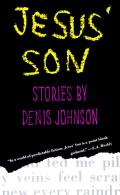
 I finished this book a few days ago and have been thinking about it since then. It’s a collection of linked short stories with the same first-person narrator in each one; it’s a powerful collection, moving and disturbing and beautifully written. This is very far from the usual sort of story I read — the narrator is a young man who is an alcoholic and drug addict who drifts through his life looking for more drugs, wandering here and there, meeting people, getting into trouble, getting high, and thinking about life.
He doesn’t tell us a whole lot of what he thinks about life, actually, as more often than not he seems to be trying not to think, but he comes out now and then with comments and judgments on the world around him that are all the more startling for being relatively rare. The narrator’s voice is haunting; he’s mostly matter-of-fact in the way he recounts his life, often using strings of short sentences or long sentences made up of strings of short phrases that seem not to reveal much until suddenly they reveal a whole lot. This is the way one story begins:
I was after a seventeen-year old belly dancer who was always in the company of a boy who claimed to be her brother, but he wasn’t her brother, he was just somebody who was in love with her, and she let him hang around because life can be that way.
This is a typical Denis Johnson sentence, I think, one that starts off a little bit shocking and becomes more complicated as you go on, and then ends with a phrase that takes you into another place entirely, some place larger and more thoughtful. Here’s how another story begins:
I’d been staying at the Holiday Inn with my girlfriend, honestly the most beautiful woman I’d even known, for three days under a phony name, shooting heroin. We made love in the bed, ate steaks at the restaurant, shot up in the john, puked, cried, accused one another, begged of one another, forgave, promised, and carried one another to heaven.
And you’ll find passages like this one, where the narrator starts off describing the events of a day and end up taking the measure of his life:
Georgie and I had a terrific time driving around. For a while the day was clear and peaceful. It was one of the moments you stay in, to hell with all the troubles of before and after. The sky is blue and the dead are coming back. Later in the afternoon, with sad resignation, the county fair bares its breasts. A champion of the drug LSD, a very famous guru of the love generation, is being interviewed amid a TV crew off to the left of the poultry cages. His eyeballs look like he bought them in a joke shop. It doesn’t occur to me, as I pity this extraterrestrial, that in my life I’ve taken as much as he has.
I’d like to keep giving you example after example of the writing, because it’s so beautiful and so stunning. You can see in the last quoted sentence that the narrator is looking back on his life, writing about it in some future time; occasionally he’ll make reference to how he has changed and what he has lost, sounding nostalgic at times for this youthful, free-wheeling life and culture. He mentions urban renewal a number of times, soon to become reality (the book is set in the early 70s), which will destroy the landscapes he knows, bleak ones, yes, but familiar ones too.
And yet he also is writing from the perspective of sober adulthood, knowing very well just what a harsh and difficult life he has led; the last story describes a narrator newly-sober and struggling to settle into a new life, offering the reader a hint of the narrator’s future trajectory. This last story is one of the best and most disturbing, I think; the narrator spends a lot of time spying on an unsuspecting couple in their home, longing to understand and maybe to imitate their normalcy. He can only gaze in on this conventionality from the outside, though, and the people he finds himself actually involved with are outcasts like himself. The story ends with this thought:
All these weirdos, and me getting a little better every day right in the midst of them. I had never known, never even imagined for a heartbeat, that there might be a place for people like us.
In spite of all the darkness, the collection ends with the possibility that the narrator will find his place after all, will figure out how to shape a life for himself.
From the collection’s title you will be able to guess that there are religious references throughout; these don’t occur all that often, but just enough so that you know the narrator has a spiritual awareness; he is aware of just how far he has strayed from God, perhaps, or maybe it’s that he feels that God has abandoned him and the world he sees around him. The title feels ironic at times — this guy is Jesus’ son? — and yet he also seems watched over, somehow, as though the older narrator knows that the younger version of himself will find a way out of the mess; if he won’t find salvation, exactly, he’ll find a new life:
There were many moments in the Vine like that one — where you might think today was yesterday, and yesterday was tomorrow, and so on. Because we all believed we were tragic, and we drank. We had that helpless, destined feeling. We would die with handcuffs on. We would be put a stop to, and it wouldn’t be our fault. So we imagined. And yet we were always being found innocent for ridiculous reasons.
To be found innocent for ridiculous reasons — that’s one version of salvation, I suppose.





 Of Books and Bicycles