In the Body of the World

I’m going to try an experiment and write really short reviews, say just a couple hundred words or so, and try to review more of the books I read and post more often. One thing that keeps me from posting, sometimes, is that I don’t have, or don’t want to take, the time to write long reviews, so I don’t write any at all. Perhaps removing that pressure will encourage me to post more.

I’ve had my eye on Eve Ensler’s memoir In the Body of the World at my library for a while, and something, I’m not sure what, made me pick it up last time I was there. Flipping through it at home, some of the language caught my eye, so I gave it a go, and read the first half in one sitting. I found that first half riveting. Then sitting down to read the second half didn’t go quite as well, and I’m not sure if the book changed, or if my mood changed.

The book is an account of Ensler’s (author most famously of The Vagina Monologues) struggles with cancer, although she tells also about her work for women’s rights around the world and especially in Africa. It’s a book about suffering, both her own suffering and that of the women she works with, and it’s also a book about alienation from one’s body (her body) and from the earth. She connects her own experiences to larger world events: her years of feeling disconnected from her body to our larger societal disconnect from environmental damage. In a way, it seems absurd to make the leap from one’s personal circumstances to what is happening on a global scale, but Ensler makes it meaningful and, in places, moving.

The writing in this book is, at its best, urgent and passionate. At its worst, it feels florid and overwrought. Perhaps that’s what went wrong with my reading of the second half. The entire book is very emotionally raw, and the book won’t work for you if that isn’t your thing. But it has a lot to say about living comfortably in one’s own body and how suffering shapes and changes you, and it mourns eloquently for the abuses brought on women throughout the world.

6 Comments

Filed under Books

Bookish podcasts

I’ve done a couple posts on bookish podcasts in the last couple years, the most recent one from April 2012, which you can find here. I’m always looking for new podcasts, though, and changing the ones I listen to regularly, so an update is in order. Here are the ones I’m enjoying currently:

  • Literary Disco. This is my favorite one of them all. I used to listen to a lot of author interviews, and I still listen to some, but the kind of podcast where the hosts discuss books they’ve read and liked or discuss bookish topics generally are the kind I now prefer, and Literary Disco is one of the latter. It has three hosts, and the chemistry among them is what makes it fun. They discuss a new book each episode — or in some cases short stories or essays, and they include poetry, YA books, and genre fiction — and also play games and discuss books from their shelves. It’s fun.
  • The Bookrageous Podcast. This is a discussion of books the three hosts are reading as well as of current topics in the book world. It’s a good source of information on new and forthcoming books, guaranteed to add to your TBR list. The chemistry among the hosts here is fun too.
  • Late Night Library. This one has interviews, most often with publishers, editors, agents, and other people in the book world. They also do a monthly podcast that is a discussion of a debut book. They focus on debut books and indie presses, and are a great source of information on publishing generally.
  • Books on the Nightstand. Another book discussion podcast. They have a bookish topic to discuss each episode, and they end with a segment called “Two books we can’t wait for you to read,” which is generally about new or forthcoming books, also guaranteed to add to your TBR pile.
  • Slate’s Audio Book Club. This podcast gets released monthly, and is an in-depth discussion of one book, hosted by various people from Slate. It’s the most intellectual, in-depth book discussion of the various podcasts I listen to, not in any overwhelming way, just very smart.
  • The Readers. This one’s from the UK, and is another book discussion podcast. It’s in a transition period right now, as one of the two hosts is taking an extended break and the new host hasn’t yet been announced, but it’s always been a good source of news about new books.
  • Book Fight. This one alternates between discussions of a book and answers to questions from listeners about writing and publishing. The two hosts are writers and teachers, and they run a literary magazine, so they have a lot of insight into the writing world. Their episodes are very rambly and have a very, um, aggressive tone to them, which should be no surprise given the title of the podcast. But the book discussions can be interesting and the episodes on writing are a good source of information.
  • The Longform Podcast. This is an author interview podcast, usually with writers or editors of long form journalism. I’ve learned a lot about what it takes to be a journalist and the craft of nonfiction writing from this podcast.
  • Other People Podcast. This consists of author interviews, or occasionally interviews with people who work in publishing. The interviews generally don’t get deeply into the books, though, but instead are about the authors’ lives and experiences with writing.
  • The Bat Segundo Show. This podcast consists of author interviews, conducted by Ed Champion. The interviews here are very much about the book, in-depth discussions of themes, style, etc., and a good source of information on new books.
  • The Book Riot Podcast. This podcast focuses on book news — the stories that stand out in the book world each week and information on new releases.
  • KCRW’s Bookworm. Michael Silverblatt hosts this podcast, which interviews authors of recent books. It’s similar to the Bat Segundo Show in its focus on the book itself.
  • BBC Radio 4’s A Good Read. This is hosted by Harriet Gilbert and features two guests each episode, all of whom choose a book to discuss. The discussions are brief but interesting.

And then there are a few that I have on my radar but haven’t listened to much yet, including:

Lots to listen to here, yes? If you want even more, check out this discussion thread in the Books on the Nightstand discussion group on Goodreads.

7 Comments

Filed under Books

Two books: Rebecca Solnit and Amelie Nothomb

I recently finished two books, Rebecca Solnit’s A Field Guide to Getting Lost and Amélie Nothomb’s Life Form. The Solnit book is amazing. I’ve read one other Solnit book before, Wanderlust, which I highly recommend to anyone who likes walking or who simply likes interesting nonfiction that draws on multiple genres. A Field Guide to Getting Lost is just as good. It’s shorter than the other, more meditative and less about information, but it’s similarly smart and beautifully-written. The book isn’t presented as a series of essays, but that’s what it is, basically — essays that all touch on being lost or losing something in some way. She writes a lot about being lost in nature, but also about being emotionally lost, or what we lose when when we lose contact with nature, and also about voyagers’ and explorers’ stories of being lost. She writes about what is valuable about lostness: that it opens up the possibility for discovery, for finding things we never knew. The first essay is a contemplation of a quotation from a Socratic dialogue: “How will you go about finding that thing the nature of which is totally unknown to you?” All the essays in some way or other are about how being lost takes us into the unknown. Being lost is not a negative state: it can be a dangerous one, yes, but a productive one too. The essays range widely in their subjects; they contain personal writing as well as history, philosophy, nature writing, and other genres, but Solnit always brings everything together — finds her way back — in satisfying ways.

The other book, Nothomb’s Life Form, is a novella, and I was drawn to it in part because it uses the epistolary form, a favorite of mine. It’s not entirely made of letters, but much of the text is, and the rest is the main character’s analysis of those letters. That main character is named Amélie Nothomb, and while normally I find it annoying when authors give characters their own names, it didn’t bother me here because it was integral to the story. She receives a letter from a fan who is a soldier in the Iraq war, and the two begin corresponding regularly. This allows Nothomb to write about what it’s like to be an author who receives fan mail and why she writes back and why she chooses to write what she does to her correspondents. This particular correspondent is deeply unhappy in the war and has responded — as have other fellow soldiers — by aggressively overeating and becoming obese. There’s a twist at the novel’s end that I saw coming from far away and another aspect of the ending that just seemed bizarre, but it’s still an interesting meditation on how people respond to war and how art can and can’t improve their lives. I wasn’t sure I liked the way obesity becomes a metaphor for the wrongs of war; there’s always something a little disturbing when actual illnesses get transformed into metaphors and lose their realness. But Nothomb uses the epistolary form well, which to me means using it as a way to think about the act of letter-writing, and of writing generally, itself.

6 Comments

Filed under Books

Smithereens’ Bookish Questions

Smithereens very kindly tapped me for an award that involves answering some questions, and I thought I’d give them a shot:

  1. What’s your most recent favorite book? I can’t give just one, can I? So in the memoir category, it’s Vivian Gornick’s Fierce Attachments, general nonfiction is Phillip Lopate’s To Show and To Tell: The Craft of Literary Nonfiction, literary fiction is Jeff in Venice, Death in Varanasi, and mystery is All Mortal Flesh by Julia Spencer-Fleming.
  2. Name a writer you would blindly follow and buy any new book of? Nicholson Baker. I don’t love every book he writes, but I’ve loved enough to make him a favorite author. Also, Geoff Dyer.
  3. What book would you like to re-read? At this very moment, I’d like to re-read Middlemarch, as a friend of mine is reading it for a book group, so it’s on my mind. In other moments, I think about re-reading a Jane Austen novel. Just about any one would do.
  4. What favorite book would you read to your 5 year-old child (or relative)?
    Uh, I’m not sure. What’s appropriate for five year-olds? I’m sure I’ll know by the time my own kid is five, but for now, we read board books he can chew on.
  5. Have you ever regretted posting something on your blog? I think occasionally about things I’ve written here that now seem a little silly (I’m not going to point them out to you, obviously), but overall, I don’t regret postings things here. Generally, what I post isn’t controversial enough to regret.
  6. How do you manage nasty comments on your blog? I don’t get nasty comments, thank goodness. The worst I’ve gotten is some slightly rude ones. But I have no problem deleting nasty comments were I to get them. This is my blog, and I decide what goes on here.
  7. Have you read and enjoyed Tolkien’s books? No. I read The Hobbit a long, long time ago, but that’s it, and it didn’t do much for me. I might feel differently were I to pick up The Lord of the Rings now, but I’m just not that interested. Now, if Cormac ever wants to read the novels, I’d be open to reading them with him. But that’s probably the only reason I’d ever do it.
  8. If someone offered you a free air ticket, which destination would you choose? Ireland. My one visit there made me want to see more. I’d love to do a very slow tour of the coast, see Dublin, and then hop over to Scotland and tour around there.
  9. What is the weirdest food you’ve ever eaten? I’m a very boring eater. The students in the Culinary Arts program at my school tried to offer me frogs’ legs recently, and I just couldn’t do it. You won’t catch me eating anything weird.
  10. What’s your favorite post on your own blog? I don’t really know … I don’t re-read my archives much to develop a favorite. So I’ll just say this one.
  11. What website do you visit for a 1mn break? I wish it were something interesting, but I’m afraid it’s just Facebook or Twitter, or maybe Feedly, my feed reader, or perhaps Goodreads, to see what my friends are reading.

2 Comments

Filed under Books

Summer

I think frequently about posting here. But when it comes time to decide what I’m going to do with my two free hours in the evening once Cormac has gone to bed, I almost always pick up a book. I’m sure you understand. I apologize for not commenting on posts, fellow bloggers, and for not answering comments here very well. I do read your blogs regularly, though! It’s easy to read your posts with my phone in one hand, and Cormac’s bottle in the other, but commenting is much more challenging.

Here he is, exploring the bookshelf:
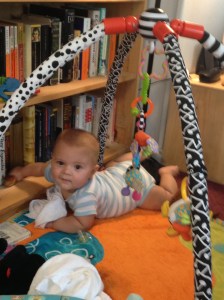
Cormac 6 months 2

And here he is in his pack, which we bought for him a couple months ago. My goodness, does he get a lot of attention in that pack. He gets attention no matter what, but something about putting him in his pack, which is an elaborate affair, designed to carry baby plus cargo up and down mountains, or wherever we want to take him, makes him irresistible:

Cormac 6 months 3

And one more picture, just for fun:

Cormac 6 months

We are having a very good summer, complete with visits from friends, trips to see family, and vacation in Maine. Cormac traveled with us to Vermont, to Rochester, New York, back home, then to Bar Harbor, Maine, and back home again, and he did fabulously well. We are lucky to have a happy, even-tempered baby who can handle pretty much whatever we ask of him.

In my two hours in the evening, I’ve been able to read a fair amount. Lately, I’ve torn through books #5 and #6 in Julia Spencer-Fleming’s Clare Fergusson and Russ Van Alstyne series. These aren’t great, great books, I don’t think, but they are a lot of fun and kind of addictive. I think I’ve read three in the series this year, which is unusual for me. I have one left, plus a new one coming out this fall. Spencer-Fleming knows how to keep dramatic tension going throughout a series. I don’t think I’d read these for the mysteries themselves — they are fine but nothing spectacular — but they are well worth reading for relationship between her two main characters.

I picked up my first Georgette Heyer novel in a while — my third ever, I think — and enjoyed it tremendously: it was The Talisman Ring, and I laughed my way through it. The other Heyer books I’ve read were entertaining, but not laugh-out-loud funny, but this one was hilarious. She has two heroines, a spirited, naive young woman, and an older, wiser, friendly but sharp-witted friend. The interplay between the two is where the fun lies.

I finally got around to reading fiction by Geoff Dyer, a favorite nonfiction writer of mine (especially Out of Sheer Rage). I picked up Jeff in Venice, Death in Varanasi and thought it was fascinating. As the title suggests, the novel has two parts to it, and each part individually is fine, interesting, well-done, but it’s the connections between the two, and simply their presence together, that really make the book. The first half is celebratory, sensual, sexy — and also frivolous — and the second half is much weightier and darker. They are two perspectives on life and death, each of which would be incomplete without the other.

Other books I’ve enjoyed: This is Running For Your Life, by Michelle Orange, is a fabulous essay collection. The essays include film criticism — a topic that doesn’t interest me much, but which Orange makes compelling — cultural commentary and personal narrative, and what I admired most was Orange’s confidence, erudition, and intelligence. She writes in a personal, informal way, but the sentences are meaty nonetheless. The book asks you to slow down and take your time with it.

Also: Enon, by Paul Harding, a follow-up to his Pulitzer-winning novel Tinkers (very beautifully-written, a novel about place, as well as about character), Submergence, by J.M. Ledgard (another novel about place, although in an entirely different way — a very smart, thinky novel that weaves together various themes, including people’s relationship to the natural world), Blankets, by Craig Thompson (a graphic novel that looks huge but which reads quickly — a compelling coming-of-age story; the text and images work well together), Tampa, by Alissa Nutting (Wow. The subject matter is tough, but Nutting handles it perfectly. This is an intensely uncomfortable read — brave and incredibly well-written).

There have been other books, but these are the highlights. And now on to the fall semester….

6 Comments

Filed under Books

To Show and To Tell

First of all, some sad news. Those of you who have been following this blog for a while will know about Muttboy, our dog. Sadly, his health declined in the last year, and we decided at the end of May that the end had come. Fortunately, he had a good end with what we think and hope was a minimum of suffering. We are missing him greatly, though. Even with a new baby around, the house still feels too quiet. He is greatly missed.

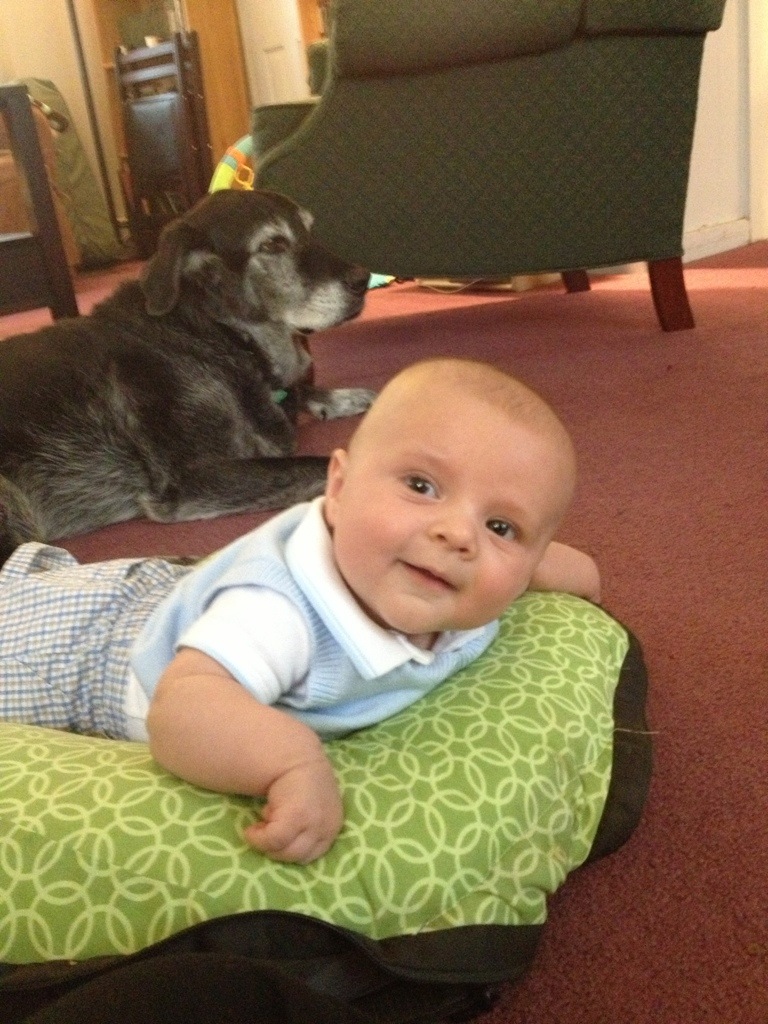
Cormac is doing well. At nearly five months, he now rolls over in both directions, although getting from front to back (which I thought was supposed to be the easier direction) only happens as an accident now and then. What he does now is roll over from back to front, struggle to roll onto his front again, fail, and then fuss until we turn him over ourselves. Then he repeats the whole process.

Cormac Future Reader

As for reading, my reading pace has slowed considerably in the last few months as I’ve gotten back to work. It turns out that it’s work that keeps me from reading as much as I’d like and not the presence of a new baby. Although taking care of a brand new baby was difficult in the early months, it still left me with plenty of time to read — especially in the late night hours waiting for the baby to fall back asleep. I’m very grateful that I no longer spend my night hours that way, and I’m also grateful to be back at work (teaching summer classes at the moment), but now I’m squeezing reading into one or two hours at most in the evening. But that’s okay. Having a baby has confirmed what I already knew about myself: I am in no way whatsoever cut out to be a stay-at-home parent, and I should never, ever, ever attempt it. Thank goodness for Hobgoblin and daycare and working from home.

One of my favorite books from the last couple months is Phillip Lopate’s To Show and To Tell: The Craft of Literary Nonfiction. I really loved this book, and I think it’s essential for anyone who wants to write or who likes to read literary nonfiction. He makes the argument that literary nonfiction doesn’t need to aspire to be like fiction, which is apparently something some people believe; writers in the genre should take full advantage of the opportunities it offers to “tell” as well as to “show,” to deal directly with consciousness and ideas rather than focus solely on the art of storytelling. I agree 100%. I like my literary nonfiction, and even my fiction, to tell me things, as a person talking to me might.

I also admired Lopate’s judicious use of examples to make his points. Sometimes books of this type get a little too detailed with close reading of examples for my taste. I hasten to add that theories of literature stand or fall based on the examples used to back them up and close readings are valuable and important, particularly in books of a more academic nature. But when I read how-to books like Lopate’s, I’m more interested in theories than I am in close readings of particular books, and Lopate gets the balance just right. He also has a wonderful suggested reading list in the back of the book that would keep any nonfiction reader happily busy for a long time.

I’m not entirely sure if Lopate’s taste in nonfiction mirrors my own or if it helped create my own; I discovered literary nonfiction through Lopate’s anthology The Art of the Personal Essay and his introduction to that book is another crucial work of criticism on the genre. I suspect I find myself agreeing vehemently with everything Lopate says in his recent book because I’ve absorbed his aesthetic over the years, whether I’ve been aware of it or not.

At any rate: highly recommended.

19 Comments

Filed under Books

The Handsell plus baby pictures

Have you heard of The Handsell, run by Ron Hogan? You list three to five books you like, and Ron and a guest — an author or a bookseller — will offer a recommendation based on your list. You enter your list of books here. A week or so ago, I entered my list, and today, this video appeared with my recommendations. Kind of fun!

I’m happy with the recommendations, although I suspect the recommendation Ron’s guest made — James Salter’s All That Is — wasn’t based on my list but was just a book he happens to like a lot. But still, I’ve been meaning to read Salter for a while now and haven’t gotten to it yet. I may start with A Sport and a Pastime, though, which is what I have on hand. Ron’s recommendation is more appropriate to my list — Iain Sinclair’s Ghost Milk: Recent Adventures Among the Future Ruins of London on the Eve of the Olympics. Sinclair is someone I’ve been aware of for a while but haven’t read yet. Ron’s description sounds perfect: the book is a mix of memoir, history, walking tour, and discussions of the city. It’s exactly what I’m looking for — unclassifiable, voice-driven nonfiction.

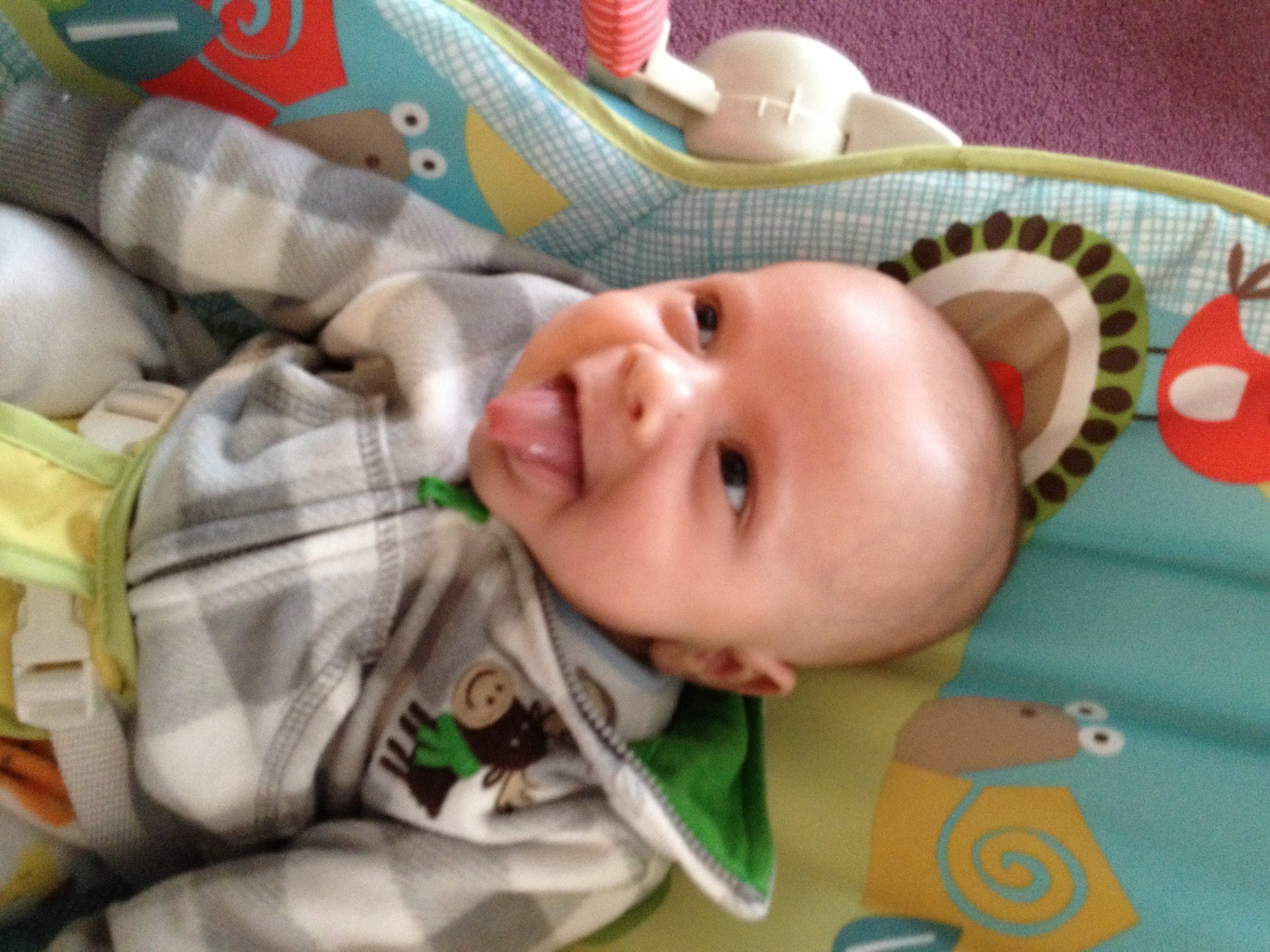
I can’t post these days without a baby picture or two, so here they are, first, a picture that makes clear what Cormac thought of his vaccinations yesterday:

20130521-100055.jpg

And then a happier picture, with Muttboy in the background:

20130521-100203.jpg

18 Comments

Filed under Books

Stalking the Essay

Here’s a reason I’m a fan of Twitter: without it I wouldn’t have found out about a one-day conference at Columbia called “Stalking the Essay.” (Many thanks to Michele Filgate for mentioning it.) It was too tempting to pass up, so although I couldn’t get away for an entire day, I made it to the two afternoon sessions. They were fabulous. The entire day was organized by Phillip Lopate, one of my heroes as editor of the anthology The Art of the Personal Essay, so it was a delight to get to see him. And then I got to see three other writers I’m fond of: Vivian Gornick, whose The Situation and the Story I’ve read; Colm Toibin, author of The Master, which I loved, and of Brooklyn which I hope to read soon; and David Shields, whose book Reality Hunger I’ve enjoyed criticizing and arguing with but from which I’ve gotten a ton of wonderful book recommendations. I also was introduced to some writers I haven’t read yet but hope to at some point: Patricia Hampl, Margo Jefferson, Daniel Mendelsohn, and Geoffrey O’Brien.

The first session was on “Criticism and the Essay,” and it dealt with boundaries among genres, for example, the book review versus the review essay, i.e., moving beyond the book itself to the broader context in which a book sits, or criticism, which implies an expert pronouncing judgment on a subject, versus the essay, which leaves room for not knowing, for lacking expertise. They talked about the challenge of writing what one wants to write while at the same time meeting the needs of a particular publication and a particular audience. They also talked about moving from writing polemically, i.e. letting a particular political point of view dominate one’s writing, toward writing essayistically, i.e. letting the subject rather than the point of view lead the piece.

The second session was on “The Personal and Impersonal Essay,” and the speakers in this part each gave a talk that was partly autobiographical, partly about how they negotiate the personal in their essay writing. Colm Toibin talked about how uncomfortable he is writing personally, but that he finds a way to write about himself indirectly, through the subjects that he chooses, which often end up (often unexpectedly) relating in some fashion to his personal experiences. Patricia Hampl spoke about what it is like to write autobiographically when, as she put it, nothing has ever happened to her. That turned out not to be true, of course. David Shields did a lot of what he does best: recommending great books and arguing for their greatness.

Perhaps the best part of the day came at the end when I got Shields and Lopate to sign books for me. There wasn’t a formal book signing, but all the speakers were milling around at the front of the lecture hall and looked approachable, so I got over my reluctance to talk to intimidating and famous (to me) strangers, and got their signatures. I did it without, I think, saying anything stupid.

So yay to Columbia for organizing an awesome event, and yay to Twitter for making it easier to publicize awesome events. I don’t know if I’ll be able to make it to this one, but the next event (discovered on Twitter) that I’ve got my eye on is at Housing Works bookstore: “A Discussion of Women and Criticism” with Laura Miller and others.

I’ll go to this event if I can manage to tear myself away from this charming little guy:

Cormac 9 weeks

14 Comments

Filed under Books, Essays, Life

Updates

First of all, a baby picture:

Cormac 8 weeks

Cormac is almost two months now and is doing well. He’s even letting me get some sleep now and then. Good boy!

He’s also left me with a surprising amount of time to read, or perhaps I have that time because I haven’t yet gone back to work. That happens next week. So far this year I’ve read 30 books, which is a lot for me. A good number of them I read before Cormac was born, but I’ve been reading steadily ever since. I read while he eats, or while Hobgoblin is watching him, or while he hangs out in the swing, and now and then I read while he naps, although he doesn’t nap much, or at least not regularly. I don’t think my reading has changed much since Cormac was born. Perhaps I’ve read a few more mysteries and lighter, easier reads than usual, but not a significantly larger number. The main reason for this, I think, is that while I’m tired a lot of the time, I’m not as exhausted as I thought I would be, and I’m getting more sleep most nights than I thought I would. Hobgoblin is to thank for this: he does a lot of the work and lets me sleep in many mornings. I haven’t slept straight through the night since the night before Cormac was born, but that doesn’t matter so much when the total number of hours I sleep is high enough.

I can’t write, even briefly, about every book I’ve read, so I won’t try. But here are some highlights:

  • Sven Birkerts’s The Art of Time in Memoir. This is a great study of structure in memoir, how the events of a life are organized into a meaningful, coherent narrative. It struck me as a good introduction to the genre, with in-depth discussions of many examples, but also a good book to read for anyone who is considering writing a memoir.
  • Justin Torres’s We the Animals. This short novel/novella describes scenes and stories from the life of a family, told from the perspective of one of three young boys. It’s beautifully written and the voice/perspective is done extremely well. I loved it.
  • Maria Semple’s Where’d You Go, Bernadette. This is a hugely entertaining comic novel. The story is told largely through emails, letters, and other types of documents, which adds to the fun. It’s about an eccentric family in Seattle. The main characters are very well-drawn and the social satire is amusing.
  • Mark Doty’s Heaven’s Coast. I read this memoir after reading and loving his later book Dog Years. Heaven’s Coast tells the story of the death of Doty’s lover from AIDS. It’s a very moving, beautiful book. I think Dog Years is better, though; it’s shorter, sharper, and more focused. But still, I find Doty’s voice and authorial presence in both books warm and wise.
  • Meghan Daum’s My Misspent Youth. This is an essay collection from the 1990s; many of the essays are about money, class, New York City, and finding one’s identity and place in the literary world. The title essay is great in its blunt discussion of money, giving numbers in a way that most people avoid. Daum’s writing is light and humorous and at the same time perceptive.
  • Nick Hornby’s Housekeeping Versus the Dirt. These essays are addictive. I don’t share Hornby’s taste in reading material very often, and I sometimes disagree with his ideas about what’s valuable in literature, but he’s such a fun writer about books that I read him with great enjoyment anyway.
  • Mohsin Hamid’s How to Get Filthy Rich in Rising Asia. I got this book through the LibraryThing Early Reviewers program, and here’s the review I wrote for them: “I very much enjoyed this book; it’s a good story with interesting characters, and a light style that’s entertaining and readable. It’s sort of a parody of self-help books, and that conceit works well. The author follows the life of his main character pretending that it’s an illustration of how to become rich. But this is really a way to tell what is a traditional story of a man’s life. The self-help element is used partly to consider what a “self” really is and also as a way to say something about the state of Asia today. I can’t say it goes very deeply into these topics, but it handles them with a enjoyably light touch.”

There are more books I’ve read, more good ones too, but for now it’s time to return to reading.

12 Comments

Filed under Books

What’s keeping me busy

20130221-101525.jpg

Cormac is doing great and even letting me sleep on occasion. I’m managing to read a few books, although getting to my laptop to blog is a challenge. Maybe someday soon!

15 Comments

Filed under Books

Baby!

Cormac

Little Cormac Robert was born on Wednesday, January 23rd, at 7:47 pm. He was 6 pounds, 12 ounces, 19.5 inches. He’s doing great, as am I. Isn’t he a little darling?

36 Comments

Filed under Books

Updates: Recently read and 38 weeks

I’m still here, waiting, sometimes patiently, sometimes not, for the baby to arrive. I’m not due for two more weeks, but I’m far enough along that it could possibly be any day now. I’m excited, but I also spend my time in a little bit of a haze: I read some, I sleep a lot, I take walks now and then, I panic about whether I’m ready and reorganize the baby’s clothes once again. I’m watching Hobgoblin and other teacher friends return to school after winter break, and it feels strange not to be working on my own syllabi.

So here are some very brief thoughts about what I’ve been reading. I’d love to write longer reviews … except that’s a lie, because I’m feeling lazy and wouldn’t really love it. Brief thoughts are all I have ambition and energy for.

  • Barbara Comyns’s Who Was Changed and Who Was Dead. I put this on my list of my best books of 2012, but I wanted to mention it again here, as I read it right at the year’s end. What a fabulous book! Comyns has a wonderful style and creates a marvelously strange atmosphere. It reminded me of Shirley Jackson, although Comyns is less gothic. I’m looking forward to reading her other books and now have The Vet’s Daughter on its way here.
  • Megan Abbott’s Dare Me. I listened to this one on audio and liked it. It’s about a group of high school girls on a cheer leading squad and a new coach who comes in and transforms their lives. The book is forthright about the combination of vulnerability and cruelty, especially the cruelty, of young women at this age, which I admired, but I loved the depiction of female athleticism and what it means to the characters to train hard and transform their bodies for competition.
  • Lauren Groff’s Arcadia. This was a very absorbing read and very well-written. It’s about a commune in upstate New York and tells the story of Bit who spends his childhood there. It’s more accurate to say that the book is about Bit himself, because it follows him after he grows up and  leaves Arcadia, but, unsurprisingly, Arcadia haunts his entire life. The novel is well-written, Bit is an appealing character, and the ideas the novel explores about utopian societies are interesting.
  • Jamaica Kincaid’s Annie John. I approached this book as a novel, so I was surprised to see Sven Birkerts mention it as a memoir in his book on the subject. Perhaps the book combines elements of both genres. At any rate, it’s a very good book. It’s a coming-of-age story and focuses on Annie’s relationship with her mother, first with their closeness and then their growing estrangement. The outlines of the story are not unique, but it’s particularly well-told and moving.
  • Madeline Miller’s The Song of Achilles. I liked this retelling of Achilles’s story very much. It’s from the point of view of Patroclus and focuses on their relationship. The novel makes the familiar story of the Iliad feel fresh and new.
  • Nicholson Baker’s The Way the World Works. This is a collection of essays, some of which were fabulous, and some of which left me thinking, huh? I should care about this why? These particular essays could have benefited from a little context, more explanation of why they were written and how they fit into the magazine or book collection they were originally written for. Baker is fascinated by the everyday stuff we are surrounded by, and I admire that quality in him, but sometimes he doesn’t convince us that his preoccupations might be our preoccupations as well. But then some of the essays are great, particularly the ones that are longer and more in-depth, where we get a sense of why his subject matters.
  • Rachel Cusk’s A Life’s Work: On Becoming a Mother. I was inspired to check out a couple memoirs about motherhood from the library recently, and this is the first one I read. I also found Anne Enright’s Making Babies: Stumbling Into Motherhood, which Hobgoblin picked up and read immediately. He laughed his way through Enright’s book, while I read Cusk’s account of motherhood with growing anxiety. I admired the honesty of Cusk’s book, but her experience was very difficult. I can only hope mine won’t at all be like hers, although if it is, I’ll look back at her book and find comfort.
  • Lastly, Eric Ambler’s A Coffin for Dimitrios. We are discussing this book at my mystery book group meeting this weekend. I enjoyed the novel very much, although I found its structure odd: it’s a thriller, I guess, but surprisingly long chunks of it are made up of people sitting around talking. There isn’t a whole lot of action, or at least not as much as you might expect. But the story itself is a good one, and the novel is very writerly as well: the main character is a crime novelist who decides he wants to investigate a crime himself, and so there is a lot of discussion of novelistic vs. real-life crimes, criminals, and crime narratives. That’s a lot of fun.

Finally, my week 38 picture:

38 weeks

16 Comments

Filed under Books

Best of 2012

I think I’ll do what I did last year, and rather than make a list of the best books I read in 2012, I’ll discuss my reading in terms of categories. Some of my best reading experiences this year included:

  • A bunch of reading by and about Virginia Woolf, including Hermione Lee’s awesome biography of Woolf, Woolf’s diaries Volume 2, and Mrs. Dalloway. It’s been great to think about Woolf from multiple angles including different types of writing. Perhaps I’ll continue this Woolf obsession by reading To the Lighthouse this coming year.
  • Two books by Zadie Smith, both of which were awesome: NW and her essay collection Changing My Mind. I got to see her do a reading as well. I liked Smith before this year based on my reading of White Teeth, but now I’m a real fan.
  • Two books by Barbara Comyns, of which I really loved Who Was Changed and Who Was Dead. Our Spoons Came From Woolworths was also good, but not as good as the other. I’m looking forward to getting my hands on more Comyns books soon.

Probably two of my favorite books of the year:

  • Maggie Nelson’s Bluets. This book is beautiful, it has an innovative structure, it’s smart, and it’s also personal, emotional, and compelling. Fabulous.
  • Mark Doty’s Dog Years. Unmissable for anyone who loves dogs, and a really, really good read even if you don’t, because the book is about much more than that.

Some favorite novels not already mentioned:

  • David Mitchell’s Black Swan Green for its distinctive voice and beautiful writing.
  • Kate Zambreno’s Green Girl for unabashedly exploring an unsympathetic character (except she’s not entirely unsympathetic).
  • Gillian Flynn’s Gone Girl for being thoroughly absorbing and entertaining, an unputdownable book (Tana French’s In the Woods was very good for the same reasons),
  • Helen DeWitt’s The Last Samurai for its inventiveness and energy.
  • Tove Jansson’s The True Deceiver for its mysteriousness, beautiful writing, and perfectly-captured atmosphere.
  • Ben Lerner’s Leaving the Atocha Station for its ideas about art and its perfect handling of a meandering style and form.

Some favorite nonfiction not already mentioned:

  • Katherine Boo’s Beyond the Beautiful Forevers — an important story beautifully and movingly told.
  • Tim Parks, Teach Us to Sit Still — the subject matter is important to me (mind/body connections, illness, meditation) and Parks combines ideas with personal story in a way that works very well.
  • John Jeremiah Sullivan’s Pulphead — a great collection of essays, as is Tom Bissell’s Magic Hours, although I think Sullivan’s is more consistently good.

Best mysteries: Dorothy Hughes’s In a Lonely Place, Julia Spencer-Fleming’s Clare Fergusson series (I read the third book this year), and Tana French’s In the Woods.

Some honorable mentions: Christine Schutt’s Prosperous Friends, D.T. Max’s biography of David Foster Wallace, Cheryl Strayed’s Wild, Dodie Smith’s I Capture the Castle, Ali Smith’s The Accidental, Kenzaburo Oe’s A Personal Matter, and Jonathan Lethem’s Motherless Brooklyn.

All in all, a good year in reading. Happy new year everyone!

19 Comments

Filed under Books

2012 Wrap-Up

I finished two books today and am unlikely to finish another one by tomorrow, so it’s time for my usual by-the-numbers wrap-up. I’ll probably come back and make a list of my favorite books in a day or two. It was a good year for reading; I read 84 books, which is my second highest number, down from the 100 I read last year, but up from my usual 60-70 of recent years. I may have read lengthier books this year than last year, which would account for the difference. This year there was no Little House on the Prairie read-through to bump up my numbers, which is fine. Whatever. My resolution for 2012 was not to care about numbers so much, and I was only moderately successful at that; I still set a goal over on Goodreads (of 75 books) and I paid attention to whether I would reach that number or not throughout the year. For 2013, however, I am not going to set any kind of goal whatsoever, on Goodreads or elsewhere. With a new baby, I’ll be happy if I get to read some books, and I’ll leave it at that. So here are my stats:

  • Books read: 84
  • Audiobooks: 6
  • eBooks: 3
  • From library: 23
  • Fiction: 54 (64%)
  • Nonfiction: 30 (36%, up a little bit from last year)
  • Poetry: 0 (harumph)
  • Essay collections: 8
  • Biography/autobiography/letters/journals: 14
  • Theory/criticism: 3
  • Short story collections: 1
  • Mysteries: 11
  • Books in translation: 6

Gender breakdown:

  • Men: 30 (36%, a little more equal than last year where men were only 28%, but still off the perfect gender balance I used to [accidentally] keep, which is fine)
  • Women: 51 (61%)
  • Both:3

Nationalities:

  • Americans: 46 (55%)
  • British: 24 (28%)
  • Canadian: 2
  • Japanese: 2
  • One each by Bosnian, Czech, Egyptian, Finnish, Irish, and Swedish writers. Plus one book by an author of uncertain nationality (Olaudah Equiano — was he born in Africa or South Carolina?) and three books by multiple authors from various nationalities. There was not as much diversity here as usual, alas.

Year of publication:

  • 18th century: 3
  • 19th: 0 (wow — down from the already low number of 2 from last year! I need to read some 19th-century fiction soon)
  • First half of 20th century: 8
  • Second half of 20th century: 20
  • 2000-2009: 18
  • 2010-2012: 35

I’m reading a lot more contemporary fiction lately, which I don’t like in theory, although I’m enjoying it in practice.

As for cycling, my total mileage is way down this year, for obvious reasons. I rode 3,677 miles, down from 5,213 the previous year. But I rode over 3,000 of those miles in the first half of the year, mostly before I knew I was pregnant. If I’d kept up that pace, I would have been close to my old yearly mileage record of 6,597. That’s a number I won’t see again for a while. I did some races last year, maybe 6 or so, but that’s all over for a while. Next year, I’ll be grateful for every mile I get to ride, and I won’t even think about racing.

And now to think about which books from this year I liked best …

19 Comments

Filed under Books

Updates: Recent reading and 35 weeks

I hope everyone is having a great holiday season. All is well here, although everything feels slightly strange, in a not-bad way. Hobgoblin and I usually spend Christmas with my parents, but this time we didn’t want to drive the six hours required to get there so (relatively) close to my due date, so Christmas was quiet, with just the two of us and Muttboy. But we had fun opening presents, eating Hobgoblin’s awesome cooking, and seeing The Hobbit (not my kind of movie, really, and not perfect, but enjoyable nonetheless).

And now I … wait. After submitting final grades last week, I now have no obligations at work until I return 6-8 weeks after the baby is born (at which point I won’t have many obligations — it will be nothing but putting in an appearance in the writing center a couple times a week during the remainder of the spring semester to keep the paychecks coming). So all I have to do is stay healthy, take care of a few things like buying a car seat and arranging the nursery, and sit on the couch and read in between muttering complaints about my sore back. I’m extremely lucky to have so much time to rest before the baby is born (extremely!), but at the same time, I’m wondering what the next few weeks will bring. I generally don’t deal well with having a lot of time on my hands. I get anxious and cranky and find myself doing nothing at all. But this time I’m going to keep telling myself to enjoy it while it lasts, because it won’t last long, and maybe I’ll convince myself. We’ll see.

As for what I’ve read recently, I’ve been ploughing through Francis Burney’s long (900+ page) novel Camilla and should finish it in a day or two. It’s been a fun read. Yes, it could be shorter — there are episodes that could easily be cut — but it’s obviously not the kind of book you pick up when you want a quick read; it’s the kind of book you pick up when you want to be absorbed in a long story, and it’s perfect for that. Camilla is that very typical 18th/19th novel character — the young woman venturing out into the world for the first time without the protection of a mother, finding that all is not what it seems and that people can be treacherous and deceitful. Even those who appear to be kindhearted and friendly can pose dangers — in fact, these are the most dangerous of all because they seem so trustworthy. But they are all too often frivolous, or friends with the wrong people, or profligate with their money, or vain, and they lead poor, susceptible Camilla down dangerous paths. The book is all about the dangers of having the wrong friends, and also, although Burney wouldn’t frame it this way, about how horrible it is that women of Camilla’s background can’t easily earn money. As the novel goes on, it gets more and more obsessed with money and the problem of not having any, and Camilla can do nothing about it except look for new people to borrow from and hope her relatives can come to her rescue. If only she could just work a small part-time job for a while, she would be fine, but, of course, she doesn’t live in that world. And I don’t live in Camilla’s world, a fact for which I’m very, very grateful. The restrictions she lives under are absurd, but no one in her world sees it that way.

I also finished Virginia Woolf’s diary, volume 2, which I’ve been reading off and on for several months now. I’ll admit I skimmed over some of the passages where she talks about her social life, except those where T.S. Eliot and E.M. Forster appear, in favor of passages where she discusses her writing and reading and her mental state. Those passages are fascinating, particularly toward the end of this volume where she is working on Mrs. Dalloway. She struggles with it at times, but she also seems to know that this is going to be one of her masterpieces. She is writing in a way that pleases her and she doesn’t much care, at least in her best moments, about what people think. She’s found her style and her subject, and it’s fun to know from the perspective of the future that her confidence is justified.

A few quick notes on other books I’ve read in the last month or so: first, Katherine Boo’s Behind the Beautiful Forevers, which was as great as everyone seems to be saying it is. It’s an absorbing story, and at the same time it leads you to thoughts, questions, and conclusions about global economic structures without being at all didactic. She has a great way of keeping her focus on the story, but getting the reader to realize the implications of the story without spelling them out. Surely that’s not easy to do.

I also read Christopher Beha’s What Happened to Sophie Wilder, which I liked very much — it has a satisfying structure and is the sort of book that makes you turn back to the first page after finishing it to see what you missed the first time around. It turns out to be worthwhile to take that extra look because then you understand the book as a whole so much better. It’s a book about art, specifically about being a writer, and it’s also about faith. This is where I balked a little bit, for the very personal and non-literary reason that I didn’t understand the religious conversion the main character undergoes. Hers is a kind of faith I have a hard time wrapping my mind around. I’m still undecided as to whether Sophie makes sense as a character. But in a way this is okay because the narrative purposely keeps a distance from her and she is meant to be mysterious (as the novel’s title indicates). I liked the way the novel circles around her, trying and never quite succeeding to understand what happened.

And, finally, I finished Christina Schutt’s novel Prosperous Friends, which was a dark and difficult read that I liked very much. The characters are complicated and frequently unlikeable and the prosperous friends are not always friends you actually want to have. It’s a book about relationships and marriages gone wrong and only occasionally going right. I think I’m in the mood for unlikeable characters these days, so all this was fine, but I particularly liked the writing, which was rich and poetic — not always a good thing as far as I’m concerned, but it worked well here. The writing makes you work a bit, as Schutt does not always fill in all the pieces of the narrative, but it captures the mood of the novel perfectly.

I’ll close with my latest picture, which shows me looking a little bit harried — which is only to be expected, I guess! I hope to be back soon with my year-end round-up.

35 weeks

9 Comments

Filed under Books, Fiction, Life, Nonfiction

Updates: Recent reading, new books, and 32 weeks

It’s time for another update post, I think, since I’d like to record at least brief thoughts about the books I’ve finished over the last month or so. Here they are:

  • First, there was Kenzaburo Oe’s novel A Personal Matter, which is a strange choice of book to read during pregnancy, since it’s about a man who discovers that his son was born mentally handicapped. He spends the rest of the novel reacting badly to this news. But I wasn’t bothered by the subject matter, and I liked the novel a lot. There’s an unsparing directness to it, a sense of strangeness and a willingness to dig deep into the main character’s disturbing, although in moments unexpectedly sympathetic, mind that I admired.
  • Then I read Tim Parks’s illness memoir Teach Us to Sit Still, which I also liked very much. He tells the story of mysterious pelvic pain that he suffered from for many years before feeling desperate enough to seek solutions in unexpected places. He turns to various forms of meditation and finds that this helps him recover and transforms him in deeper ways as well. The book is a really interesting exploration of the limits of western medicine and the surprising (to him and to many other people I’m sure) connections between the mind and the body.
  • I listened to The Age of Miracles by Karen Thompson Walker on audio, and I’m not sure why, but I didn’t respond to this with as much enthusiasm as I thought I would. Parts of the story were great, the depiction of how people responded to the totally mysterious slowing down of the earth’s rotation in particular. I liked how simply and naturally Walker describes what this was like. The integration of the sci-fi elements with a coming-of-age story was well-done as well. But the coming of age story itself seemed a little cliché. I didn’t really like the teenage romance element.
  • Then there was Black Swan Green by David Mitchell, which I thought was fabulous. I suppose this is a fairly cliché coming-of-age story as well, but the writing was very, very good, which made up for it. Mitchell has a marvelous way with a sentence. It’s a novel-in-stories, each chapter forming its own vignette in the life of the main character, a thirteen year-old boy who struggles with bullies and a stammer. Mitchell captures this character and the setting in which he lives very well.
  • For my mystery book group, I read Dorothy Hughes’s In a Lonely Place, a book I chose after having heard good things about Hughes. It turned out to be a good choice, as the group liked her, and the discussion was lively. It’s told in the first person from the perspective of the murderer, and the mood is unsettling and claustrophobic. We spent a lot of time trying to figure out the extent to which the narrator is unreliable and what exactly the other characters figured out and when. I like that sort of puzzle.
  • From the library, I got a copy of Jami Attenberg’s The Middlesteins, a book I thought was very well done, a good, entertaining piece of literary fiction that made me feel a little dissatisfied with the state of literary fiction generally. I can’t pinpoint anything wrong with the book, but I guess I’m in the mood for books that are more innovative or do something more exciting on the sentence level. It’s a book about a family in Chicago and their struggles with a wife/mother who is seriously ill because of her weight. The descriptions of the family dynamics are good and if you’re in the mood for a family drama, you might very well like it more than I did.
  • Then Kate Zambreno’s book Heroines, which I liked with some reservations. It’s partly literary criticism, history, and biography, and partly memoir. I enjoyed the combination of these things. Zambreno focuses on the “wives of modernism,” writers such as Zelda Fitzgerald, Vivien Eliot, and others who were kept from writing or whose writing was dismissed and ignored because of their gender. Zambreno analyzes the language used to belittle these writers and the ideas about women and creativity that still influence us today. All this I liked. I just wished the book had a clearer organizational structure, as it felt repetitious and too long.
  • Finally, I just finished Meghan O’Rourke’s memoir about her mother’s death, The Long Goodbye. This is a book that grew on me as I read; at first it seemed to be a fairly unremarkable story about illness that I wished had more reflection rather than straightforward narrative. The reflective elements of the book became more important as it went on, however, and the second half or so has a lot of interesting insights into grief and mourning.

I thought I’d give you the list of books I bought during a spur-of-the-moment book buying spree in Manhattan last weekend; I decided that I wanted to get out and walk around the city a bit while I still easily can. I visited 192 Books for the first time, a very small but great bookstore, and also old favorites Three Lives and McNally-Jackson. Here’s what I got:

  • Jean Strouse’s Alice James A Biography
  • Andre Aciman’s Alibis: Essays on Elsewhere
  • Jo Ann Beard’s Boys of My Youth
  • Barbara Comyn’s Who Was Changed and Who Was Dead
  • Maggie Nelson’s  Jane: A Murder
  • William Gass’s On Being Blue: A Philosophical Inquiry
  • Roland Barthes A Mourning Diary

And now for a pregnancy update: I’m a little under eight weeks away from my due date. All is going well, although I’m eagerly awaiting the end of the semester, which will get here in about two weeks, so I can stop having to lumber around campus feeling ridiculously large. My teaching is going fine, but it’s getting increasingly uncomfortable to stand in front of a class. I’m both looking forward to some time in which to linger on the couch and do nothing, and worried that I will be too uncomfortable to enjoy it and/or bored out of my mind. We shall see. Here I am at 32 weeks:

32 weeks

19 Comments

Filed under Books

Transformational Books

I’ve seen a couple lists of people’s favorite books and authors lately that inspired me to think about what my own list would look like. But what springs to mind is not a list of my favorite books so much as a list of the books that have transformed my thinking about books. Perhaps the two lists are actually the same. I’m not sure. But a list of transformational books seems different somehow. These are books that have changed my idea of what it’s possible to write about and how it’s possible to write. They are the books that excite me and make me want to share them. People who love (some of) these books are people whose taste I’m likely to trust.

I decided to omit a few categories, for the sake of simplicity and brevity. I’m not including children’s or young adult books, although those are perhaps the most transformational books out there. But that’s a subject for a different post. I’m also not including books that have influenced my life generally – obvious examples are religious, political, or philosophical books that have changed my thinking about the world – but am instead sticking to books that have changed my thinking about literature specifically. It also occurred to me that I could put some books on this list that are negative examples, books that have helped me define my literary aesthetic by helping me figure out what I don’t like. But I won’t get negative here.

This list is in no particular order.

  • Virginia Woolf’s works, especially To the Lighthouse but also Mrs. Dalloway and A Room of One’s Own
  • Laurence Sterne’s Tristram Shandy and A Sentimental Journey
  • All of Jane Austen, especially Pride and Prejudice
  • Middlemarch
  • Montaigne’s essays
  • Mary McCarthy’s essays and Memories of a Catholic Girlhood
  • Vladimir Nabokov’s Pale Fire
  • David Foster Wallace’s Infinite Jest and his two essay collections
  • Phillip Lopate’s edited essay collection The Art of the Personal Essay
  • George Orwell’s collected essays
  • Nicholson Baker’s books, especially U&I, The Mezzanine, and The Anthologist
  • Jenny Diski’s Stranger on a Train and Skating to Antarctica
  • Mark Doty’s Dog Years
  • Tove Jansson’s The Summer Book
  • Janet Malcolm’s books, especially The Silent Woman
  • The Quest for Corvo
  • Joan Didion’s The White Album
  • Richard Holmes’s Footsteps
  • Lauren Slater’s Lying
  • Dorothy Wordsworth’s Journals
  • W.G. Sebald’s Rings of Saturn
  • Josephine Tey’s The Daughter of Time
  • David Shield’s Reality Hunger
  • Geoff Dyer’s Out of Sheer Rage
  • Scarlett Thomas’s PopCo and Our Tragic Universe
  • Rebecca Solnit’s Wanderlust
  • George Saunders’s Civil War Land in Bad Decline
  • Thomas Pynchon’s The Crying of Lot 49
  • Tom McCarthy’s Remainder
  • Henry James’s novels, especially The Wings of the Dove
  • William James’s The Varieties of Religious Experience
  • Dashiell Hammett’s The Glass Key
  • Wilkie Collins’s The Moonstone
  • Maggie Nelson’s Bluets
  • Louise Gluck’s The Wild Iris
  • Mary Oliver’s American Primitive
  • Patricia Highsmith’s The Talented Mr. Ripley
  • Thomas de Quincy’s Confessions of an English Opium Eater
  • Boswell’s Life of Johnson
  • Agatha Christie’s The Murder of Roger Ackroyd

Looking over this list, it feels partial and unsatisfactory, but it’s not a bad start.

And because this pregnancy thing is getting serious, I’ll close with one of my latest pregnancy pictures, at 29 weeks:

19 Comments

Filed under Books

Updates: Hurricanes, short reviews, and me at 27 weeks

It’s been quite the week around here, although I will be the first to say that though we were hit by hurricane Sandy, we had it relatively easy. We lost power on Monday night during some truly scary winds and spent four days waiting for the power to come back, but those four days were made much more enjoyable by a friend who offered to lend us a generator. Plus there’s the fact that even in a power outage we have not only running water, but hot running water. So thanks to the generator we had a working refrigerator, wireless, a microwave, and some lights. A quick trip to the hardware store to buy a space heater made everything just fine, and now after 24 hours with the power on, I feel back to normal. All in all, it was an easy experience, and I only wish the same were true for everyone who has gone through this storm. Sadly that’s not the case, and I keep reading stories of houses ruined and people who are struggling to get by without basic necessities and lives lost. Let’s hope the recovery moves along quickly.

As for bookish news, I’ll have to do a quick round-up of books I’ve read in the last few weeks. So here’s the list:

  • The Newlyweds by Nell Freudenberger. I listened to this one on audio, and found myself getting impatient with it. There were moments I got caught up in the story – it’s about a young Bangladeshi woman who marries an American and moves to the U.S. (to Rochester, New York, of all places, the city I grew up near) – but I wanted more. More in the way of ideas, more interesting writing, something beyond the story that’s there.
  • More Baths, Less Talking, by Nick Hornby. This one was fun. It’s the second collection of Hornby’s Believer columns I’ve read, and I’m ready to read more. These columns are monthly round-ups of his reading and the books that he’s bought, and they are written in what I can only think of as blog-post style (which is not to say that all blogs are written this way!) – chatty, informal, and personal. Hornby is always amusing and he reads a wide range of books, many of which I’m not about to read myself, but sometimes our tastes overlap and occasionally he’ll get me to add books to my TBR list.
  • Hermione Lee’s biography of Virginia Woolf. I’d been reading this book for ages, but I don’t mean to imply it’s not a compelling read, it certainly is. It’s just very lengthy and is written in shortish chapters that provide good stopping points. I loved this book. Lee’s approach is to move roughly chronologically through Woolf’s life but to focus on themes or topics along the way, so the biography is more idea-driven than it is driven by strict chronology. This works for me as I have a sorry mind for facts and prefer to focus on ideas.
  • Elizabeth Taylor’s A Game of Hide and Seek. I really liked two Taylor novels I read a few years ago, but this one disappointed me, and I’m not sure if it’s a matter of my tastes changing or the book not being as good. I’m inclined to think it’s the former. I just didn’t care much about the subject matter – unhappy marriages, affairs, children, disappointment in society. The characters were unlikeable, which I don’t mind generally in novels – I don’t need to like the people I read about – but these didn’t seem unlikeable for interesting reasons. The writing was lively, though, and there moments of insight into human nature I appreciated.
  • A.M. Homes’s Music for Torching. This book covers much the same subject matter as the Taylor novel, if in a different country and time period, but I liked it much more. It’s a story about suburban family unhappiness, which doesn’t sound promising, but it’s a step or two beyond strict realism in its approach, and I found the exaggerated, strange behavior of the characters and the almost surreal atmosphere of the novel exhilarating. The book starts with the couple deciding on the spur of the moment to burn their house down, which, we quickly find out, fails completely. From there, the plot maintains a brisk pace. At first, to be honest, I kind of hated all the plot strangeness and the book felt cold, but as I kept reading, I began to get in the right spirit for it. The characters behave like no one I know, and frankly I’m grateful for that, but I admire their desperate bravery.
  • Milan Kundera’s The Art of the Novel. This is a collection of essays, in some cases in dialogue or list form, in other cases in more traditional essay format. They describe Kundera’s understanding of the history of the novel and its relationship to history more broadly, and they also offer a summary of Kundera’s own fictional aesthetic. Kundera’s understanding of novel history was fascinating if narrow – by which I mean he drew from a small selection of favorite novelists and I couldn’t help but feel that the history of the novel might be completely different with a another group of authors. But still, there were lots of ideas to ponder here.
  • Ben Lerner’s Leaving the Atocha Station. I loved this book. This is an example to prove my claim that I don’t need to like the people I read about, as the main character is pretty awful – self-absorbed, untrustworthy, immature, and not only that but an unlikeable guy who’s led a very privileged life. But he is aware of his failings and thinks about them a lot, which saves it for me, as does the fact that the book is meditative and idea-driven and has a lot to say about emotional experience vs. detachment and about poetry and its purpose, if there is one. The main character is an American in Spain on a prestigious fellowship, but he spends his year abroad mostly not working on the project he set for himself, and instead he processes his experiences, observes the people around him, and generally tries to get by without too much unhappiness. It’s a thoughtful, philosophical novel, and it made me want to read more poetry.
  • Simon Gray’s The Smoking Diaries. I feel like every book I like in this list sounds awful when I describe it – in this case, it’s a diary written by an old curmudgeonly type who spends a lot of time thinking about death. But I loved this book too. It’s sort of a diary, but the entries are more like mini-essays where Gray recounts memories from the past or contemplates the fate of his friends (sometimes famous ones like Harold Pinter). He describes the world around him and alternates between satirical amusement and panic at the nearness of death and what he’s made of his life. The style is very informal and conversational, and Gray can tell a story well. It’s the first in a trilogy, and I will have to find the other two.

And now to close with my latest pregnancy picture, at 27 weeks. My hair is wet not because I couldn’t blow dry it without power, but because I never blow dry it, being kind of lazy that way:

9 Comments

Filed under Books

Updates: Smith, Chabon, Baker, Wallace, and me, 23 weeks pregnant

The bookish highlight of the last few weeks is undoubtedly getting to hear Zadie Smith and Michael Chabon read at the 92nd St. Y in Manhattan this past Thursday. The only disappointment is that Hobgoblin and I couldn’t stay late enough to say hi to the authors and get books signed, but the reading itself was great. Chabon went first and read Part 3 of Telegraph Avenue in its entirety, which consisted of one sentence and took about 40 minutes to read. I don’t know much about the novel and don’t know how the section fit into the book as a whole, but it was an entertaining piece, and Chabon is a very good reader. He was funny and managed to capture the one-sentence feel of the excerpt without sounding manic or breathless. Zadie Smith read two sections from NW, both of which were good set pieces. She also was a great reader; I especially admired the way she caught the different accents of her characters. She, too, was funny. They did a brief question and answer session afterward, but the questions were mostly stupid ones, the first one about which actors they would cast to play their characters and another one about the presidential debate the night before. They did a good job answering the questions in spite of the questions’ lameness, although it seemed pretty clear that Chabon felt way more comfortable up there than Smith did. I’ve heard her describe herself as shy, and that seemed to be true, although she was still charming.

So, I finished NW a couple weeks ago, I guess it is, and I liked it a lot. I’ve read a number of mixed reviews of the novel, and the reviewers’ criticisms might have had some validity to them, but they picked things out for criticism that I didn’t think mattered all that much. The book had an energy that I liked, it had characters I was drawn to, it did interesting things with language, and it explored its themes in a satisfactory way. It may have a structure that’s kind of a mess, but that didn’t detract from the good things. It’s told in four parts, the first three following a different character, and a short fourth section wrapping things up. The first and third sections follow two women who grew up as friends and stayed friends into adulthood, although their friendship goes through some difficult times and their feelings toward each other are complex. These sections were my favorites, both for the interesting writing in them, and for the themes they explore: class differences, career and marriage tensions, having or not having children, growing up and changing but staying roughly in the same neighborhood. The second section was also good, but more conventionally told. I think this is a novel that takes a while to absorb and I wouldn’t be surprised to see the critical consensus change over time.

I also read The Long Goodbye for my mystery book group, which I enjoyed, although I felt that it was a little too long and the quality of the writing began to slacken as I neared the end. But Raymond Chandler is still great – he has such a way with images. The book is ultimately about friendship, I think, which is an interesting topic for a mystery novel. Philip Marlowe, Chandler’s protagonist, is entertainingly stubborn, illogical, and a smart-ass. I also read Nicholson Baker’s novel  A Box of Matches, which I liked, although it’s in the same vein as The Mezzanine, but not as good and suffers from the comparison. The premise is that the protagonist has decided to get up at 4:00 each morning, light a fire, and write out his thoughts, and these writings are the novel itself. They are about mundane things, as Baker’s novels often are, but described with lavish and loving detail. The best chapters gesture toward deeper ideas and feelings, and I liked the way more profound thoughts are hinted at through the juxtaposition of stories – stories about death, say, or about animals and what we can know about their minds. Not all chapters are that successful, but when they work, they have lightness and depth both.

And just now I finished the new biography of David Foster Wallace, Every Love Story is a Ghost Story, by D.T. Max. I’m still gathering my thoughts about it, but I think it was a very good biography. It’s only 300 pages and therefore not bogged down with detail, but it captures his life well, and every time Max discussed one of Wallace’s books, I immediately wanted to read or reread it. I think Max’s book is very good; what I’m still gathering my thoughts about is what I think about Wallace himself. He is one of my favorite writers, and I’ll return to his books again and again, but he’s a complicated person, unlikeable in a number of ways, but at the same time a charismatic and compelling figure, and also a sad one, a person who battled crushing depression his whole life.

As for what I’m currently reading, that includes the Hermione Lee biography of Woolf (still! I may finish in the next week or two) and also her diaries, although I’ve slowed down with those in an attempt to finish other things. I began listening to The Newlyweds by Nell Freudenberger on audio the other day, and I also picked up More Baths, Less Talking by Nick Hornby. I need to find a new novel (one to read and not listen to), but I can’t decide which one to pick up next, so I’ve focused on finishing my nonfiction books instead.

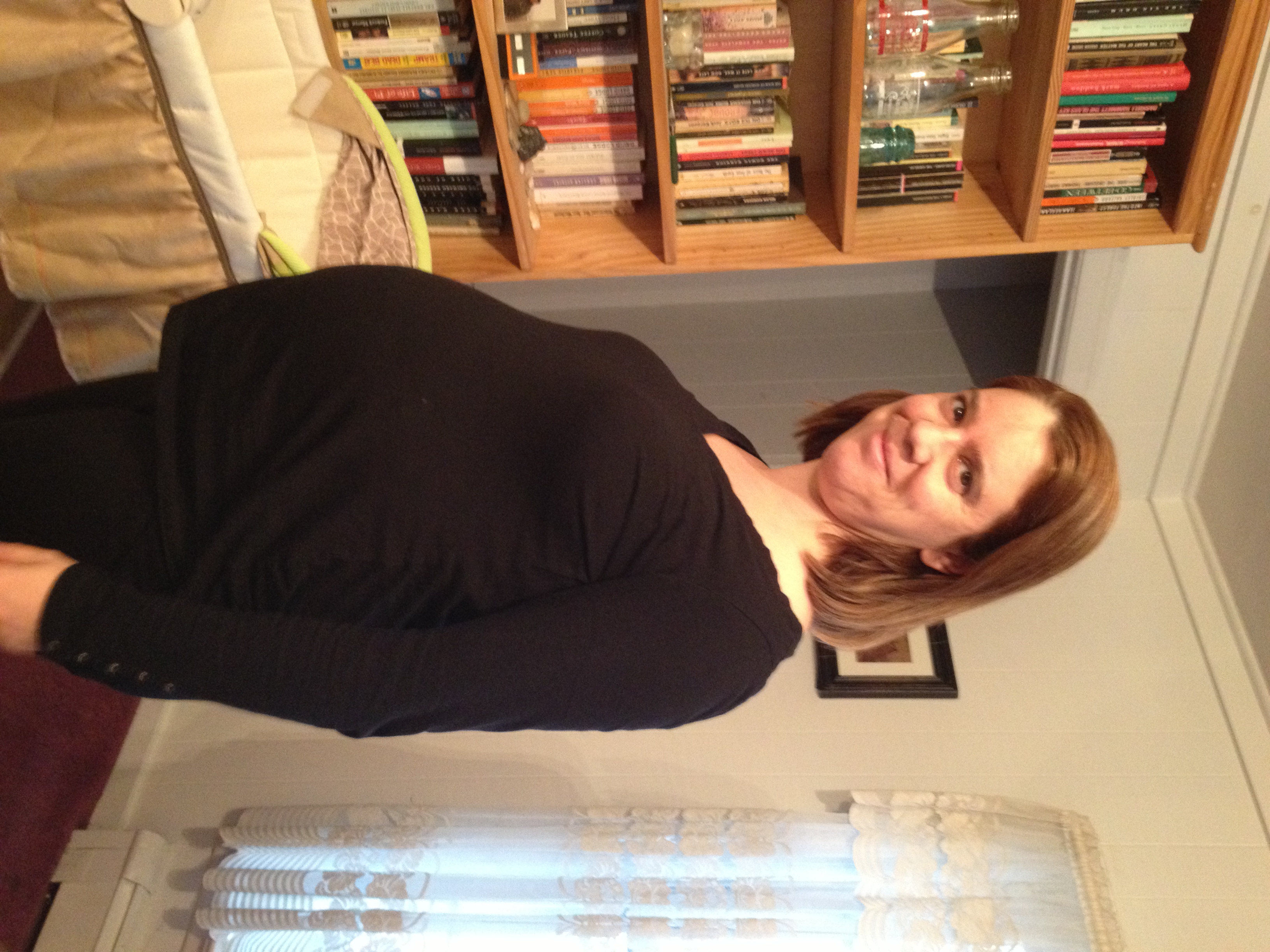
Finally, here’s my latest pregnancy picture, at 23 weeks:

I’m still feeling remarkably well and can only hope I feel this way as long as possible. I’m even still riding, although only now and then, and only on my hybrid bike with an adjustable stem that raises up the handlebars (you can see it in the background) and wearing one of Hobgoblin’s much roomier jerseys. But it’s great to be able to ride, and when I’m not riding, I’m often out walking in the woods, which is lovely.

Have a great weekend everyone!

10 Comments

Filed under Books

Updates: New (used) books, Green Girls, and NW

So, school has begun.  I’m on top of things so far, but starting school every year requires quite the transition — from having loads of time to all the sudden having to fight for time to read. I love my job and won’t complain, but the transitions are my least favorite aspect of it. This semester feels different to me, though, since I know I won’t be returning to teach in the spring. I normally have an image in my mind of the teaching year running from September to May, but now it’s only September to December, and then … everything changes, as people keep telling me.

Last weekend Hobgoblin and I had the pleasure of seeing our book-buying friends (here and here) and visiting the fabulous Book Barn in Niantic. The store is awesome, partly because it’s HUGE — it has three different locations around town, and each one is sizeable. We visited all three, of course, with a break for dinner. Here’s what I found:

  • Michael Holroyd’s A Book of Secrets:  Illegitimate Daughters, Absent Fathers. The kind of nontraditional biography I like.
  • Vera Brittain’s Testament of Youth, a book discussed by a number of bloggers, but most especially Rohan.
  • Edmund White’s A Boy’s Own Story, to add to my memoir collection.
  • Frank Baker’s Miss Hargreaves, for when I’m in the mood for something lighter, possibly post-childbirth.
  • Willa Cather’s O Pioneers, for when I’m in the mood for another classic-type book.
  • Theodor Fontane’s Effi Briest, ditto, or I should say, for when I’m in the mood for a classic in translation.
  • Eugen Herrigel, Zen in the Art of Archery, for when I want something more philosophical.

As for reading, last week I finished Kate Zambreno’s novel Green Girl, and liked it a lot. I heard about it through the Tournament of Books where it got eliminated immediately (by The Marriage Plot, which got so, so, so much more attention, but which wasn’t as intriguing as Green Girl was). Apparently a lot of readers found the main character, Ruth, unlikeable. She IS unlikeable, in some ways at least, although I found myself getting fond of her and certainly sympathizing with her, but that unlikeableness is part of the point. She’s a young American living in London, trying to scrape by on low-paying jobs. She’s isolated and bored and unhappy. She doesn’t have what I can only think of as internal resources to get her through — she’s not interested in much beyond pop culture and fashion, movies and boys and parties. She doesn’t know much about the world and doesn’t know how to reach for anything more meaningful, or even that anything more meaningful exists. She’s a depressed and depressing creation of modern media, consuming as much as she can but never finding any satisfaction in it. She’s full of surface-level images of what girls should be and she does her best to live up to these images while finding the entire enterprise horribly empty.

It’s the critique of fashion, celebrity, party-girl culture that I liked. There is a sense, if only a vague one, that Ruth will eventually move on and grow up, but for right now, she’s trapped. There is also an interesting narrator who in the beginning of the book self-consciously conjures Ruth up and then continues to comment directly on her throughout — a commentary that is both critical and sympathetic and is a pretty good guide for figuring out what to make of the character.

I’ve been reading Zambreno’s blog for a while now and am looking forward to reading her new nonfiction book Heroines. She is a writer I plan to follow.

Then I started Zadie Smith’s new novel NW, which I was lucky to be able to get quickly from the library. I haven’t finished it yet — I’m about 70 pages from the end and hope to finish it today — so I won’t write much about it now. But so far I’m enjoying it. Having a lean, tight structure is not exactly Smith’s thing — the book feels a bit all over the place — but it’s never been my thing either, and I like the book’s different sections with different writing styles. I’m liking the characters and the way Smith conjures up a particular part of London. More on that one soon (hopefully).

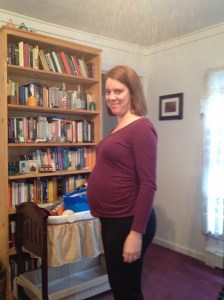
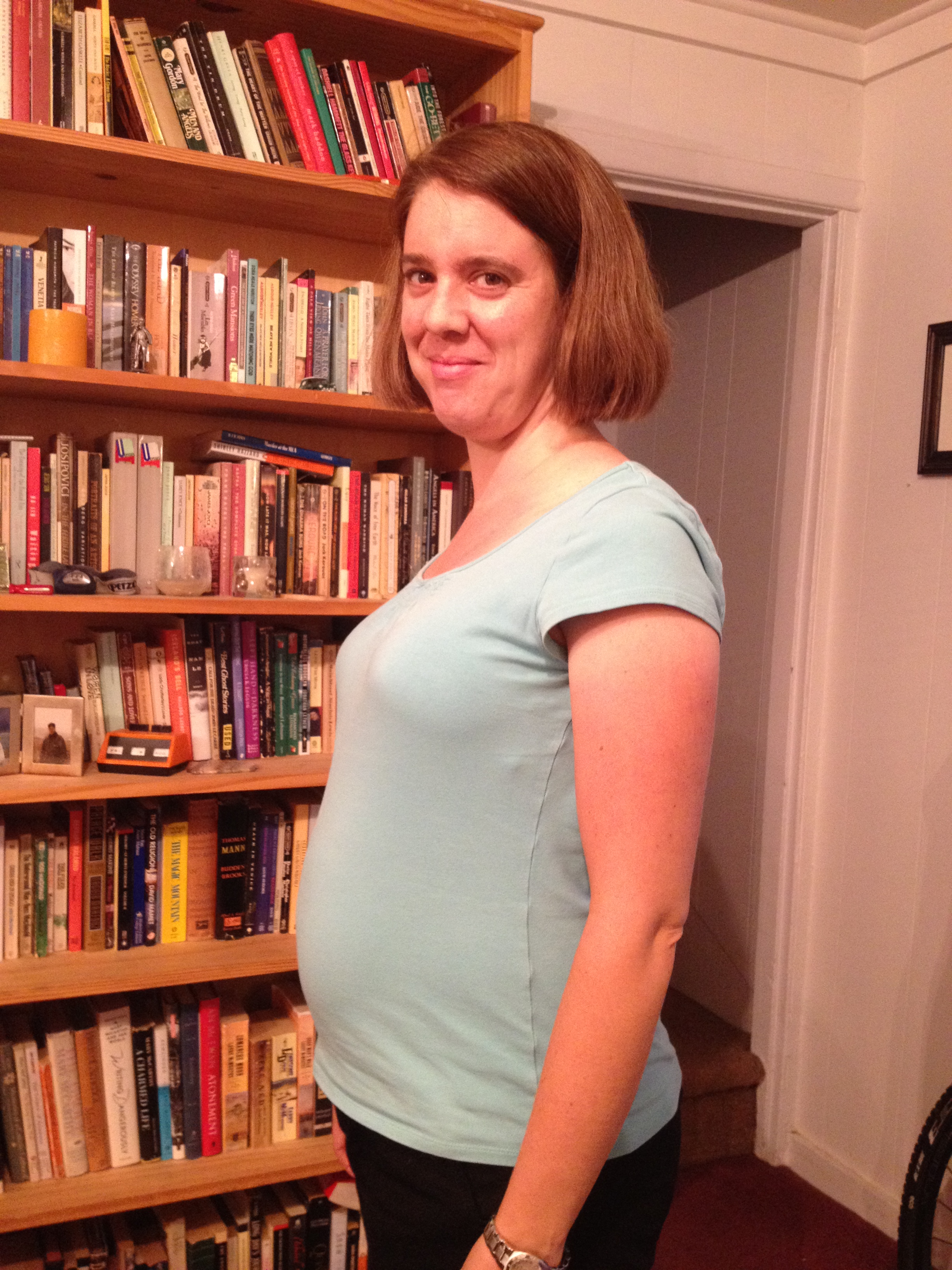
Finally, here is another pregnancy picture. I’m going to give you the 19-week one instead of the 20-week, which I wasn’t happy with. I’m past halfway now!

8 Comments

Filed under Books, Life