Used bookstore visit and a reminder

First of all, the reminder: the Slaves of Golconda are reading and discussing their next book soon — it’s Ruth Hall, and posts are due September 30th.  Anyone is free to join the group; just write about the book on your own blog and/or join the discussion at Metaxu Cafe.  It will be fun!

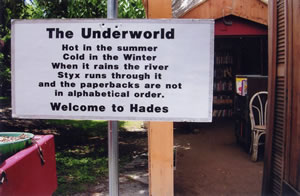
And now for the used bookstore.  I spend a couple hours yesterday afternoon with friends (three of whom have blogs!) browsing in the Book Barn in Niantic, Connecticut.  This is no ordinary used bookstore.  It’s got multiple buildings, first of all, each of which is jam-packed with books, over 350,000, as I learned from the website.  These buildings vary in size and in their holdings; there is the main barn, which is where the store first began and which has all kinds of subjects, from African American studies to women’s studies and woodworking.  There is also an area called Ellis Island, which houses books new to the shop that haven’t yet been sorted.  You can shop here, but nothing is alphabetized.  Then there is the Annex, where the fiction is kept and where I spent most of my time.

There is also Hades, with this sign:

And there is the haunted book shop (horror, mystery, science fiction), the “last page” (travel, sports), and another building about a mile away, with a whole range of subjects.

And that’s not all — there also also sheds and tents and other makeshift spaces that hold books that you can look through on your way from one building to another.  And there were goats!  And cats too, and the shop owners offer coffee and donuts, just in case you tire yourself out from all that browsing.

It was a mix of indoor and outdoor shopping — people sat around on park benches and at tables scattered around the property, and you wandered indoors and out and hardly noticed the difference.  It was lovely!

Of course I came home with some books:

  • Elizabeth Taylor’s A Wreath of Roses.  I love Elizabeth Taylor and want to read as many of her books as I can.  This one is a Penguin edition, but it was also published by Virago.
  • Vivian Gornick’s The End of the Novel of Love.  This is a collection of essays on love in novels by people such as Kate Chopin, Jean Rhys, Willa Cather, and others.
  • Margaret Oliphant’s The Perpetual Curate, a Virago edition.  The store had a lot of Viragos, and I could have come home with a dozen, easily.
  • Rosamund Lehmann’s The Weather in the Streets, another Virago.  This is a sequel to her novel Invitation to the Waltz.

I will certainly be visiting this store again!  After shopping, our group went out to dinner and told stories of bike crashes through much of the meal.  These friends are readers, and they are also cyclists.  Who could ask for a better day, right?

16 Comments

Filed under Books

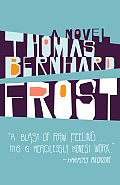
Frost

Thomas Bernhard’s novel Frost is a strange and difficult book, and I’m not entirely sure what I want to say about it.  It was a book with very little plot, which I often like, and it wasn’t much like a novel, which I also like, but this one … I wasn’t sure I enjoyed what it had to offer in place of the usual things.  It was bewildering and unsettling.  It’s beautiful in places, dark and despairing much of the way through, with uncomfortable truths about life that I often agreed with but didn’t much want to think about.  It’s the kind of book that’s a challenge — it never lets you get comfortable or lose yourself in it.

In some moments I liked the challenge and was glad to grapple with its difficult ideas, and in other moments I just wanted the book to end.  I thought about quitting with it several times, but the insights I got now and then were enough to keep me going.

The novel centers around two characters, one of whom, the narrator, is a medical student who accepts a mission to travel to the little Austrian village of Weng to observe his mentor’s brother and to report back what he sees.  The mentor’s brother is a painter named Strauch, although he hasn’t actually painted anything in a long time.  Instead, he spends his time taking walks in the forests surrounding the village and talking with the locals.

The two quickly become friends — friends of sorts, at least — and take many walks together; most of the time on these walks the painter talks and the narrator takes it in.  The novel consists mainly of the narrator’s reports of these conversations, jumping back and forth between his own words and long stretches of quotation from the painter.

What the painter talks about is not always clear — sometimes he’s coherent and other times his long ramblings are full of quick, confusing transitions, vague quasi-philosophical musings, and rants against the people in the village and against humanity in general.  I haven’t decided if it’s better or worse that the narrator frequently declares himself confused as well — it makes me realize maybe I’m not meant to understand the painter’s speeches but then I can’t help but wonder what the point of it all is.

The plot, such as it is, concerns the way the narrator becomes more and more drawn into the bizarre world of the painter.  He is both attracted to and repelled by the strange man. He struggles to report back to the painter’s brother as he is supposed to do, but he loses the ability to think objectively about the painter and can barely find the words to describe his experience.  He starts to lose his sense of the boundary between himself and the painter, wondering if his feelings about the situation are his own or are actually the painter’s feelings that he has internalized.

I might have hated this book, but there is some great (though gruesome) writing in it; here are the opening sentences:

A medical internship consists of more than spectating at complicated bowel operations, cutting open stomach linings, bracketing off lungs, and sawing off feet; and it doesn’t just consist of thumbing closed the eyes of the dead, and hauling babies out into the world either.  An internship is not just tossing limbs and parts of limbs over your shoulder into an enamel bucket.  Nor does it just consist of trotting along behind the registrar and the assistant and the assistant’s assistant, a sort of tail-end Charlie.  Nor can an internship be only the putting out of false information; it isn’t just saying: “The pus will dissolve in your bloodstream and you’ll soon be restored to perfect health.”  Or a hundred other such lies.  Not just: “It’ll get better” — when nothing will.  An internship isn’t just an academy of scissors and thread, of tying off and pulling through.  An internship extends to circumstances and possibilities that have nothing to do with the flesh.

The book is fearless in the way it talks about ugliness, despair, and death; it’s bracing in the steadiness of its gaze at the dark side of human experience — or perhaps “the dark side” isn’t the right way to say it, but rather the dark truth of human experience.  I suppose some might see in the book some grisly humor; it isn’t all heaviness and seriousness, although the humor is pretty dark indeed.

I may have picked the wrong Bernhard novel to read; this is his first one, and from what I understand his later novels follow similar formats (one character reporting on the thoughts of another character) but are shorter.  This one could have benefited from some cutting; I would have been much happier (so to speak) reading 150 pages about existential angst and despair than I was reading 300.

I might be open to reading another Bernhard novel if anybody convinced me it would be worthwhile; I have nothing against reading dark, difficult books now and then, and it would be interesting to see what else Bernhard has done with his unusual method and style.  But I think I’ll need a while to recover from this one …

9 Comments

Filed under Books, Fiction

Updates

Triathlon training feels a lot different than training for bike races — it’s not just that I have three sports now instead of one, but that I have more workouts a week.  I used to ride 4 or 5 times a week most weeks, but now I’m riding 3 or 4 times a week plus running 3 times and swimming 3 times, so that’s 9 or 10 workouts instead of the old 4 or 5.  Since many of the workouts are fairly short, I’ve added only maybe 2 or 3 hours a week total to my training, but it feels like more because of the greater number of workouts.  Each workout requires its own preparation time and usually some time for stretching afterward, and getting to the pool takes some driving time.  And then I have to shower more, especially if I work out once before work and then again afterward.  It’s a lot!

But it’s fun, and it’s a great way to deal with work stress.  After my evening workout, I’ve completely forgotten about my day at school, which is a good thing, even if it wasn’t a particularly hard day.

So, about books.  First of all, I’m excited because Tom McCarthy’s novel Remainder appeared in my mailbox the other day, a book I swear I read very good things about over here, but I can’t find the link right now. I also have Nicholson Baker’s The Fermata and David Lodge’s Author, Author on the way from Book Mooch.  Oh, and then I ordered Kenko’s Essays in Idleness when I read and liked an excerpt from Philip Lopate’s Art of the Personal Essay (I’ve still got the essay project going that you can see on my sidebar; I just don’t move very fast because every time I read a new essay I find another writer I like whose work I have to read in more depth).

And then I have a trip to a used book store planned with some friends this weekend, which, of course, will make this a very nice weekend indeed.

I’m now in the middle of David Wroblewski’s The Story of Edgar Sawtelle; this is a book Hobgoblin recommended to me, and while I often ignore his recommendations (and he ignores mine), he chose this one for our book group, and so I was stuck.  But I’m loving it!  (And of course I know that I should follow Hobgoblin’s suggestions more often, but it’s a tradition not to.)  It’s such a good story.  More on that later.

10 Comments

Filed under Books, Triathlon

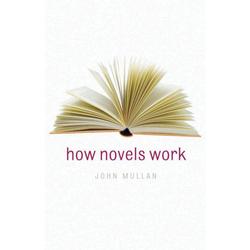
How Novels Work

I’ve now finished John Mullan’s book How Novels Work, and I enjoyed it, with only a few reservations.  The book is a survey of the various technical aspects of fiction-writing; it has chapters on “Beginning,” “Narrating,” “People,” “Voices,” “Genre,” and so on, and each chapter is broken down into smaller sections on, for example, the various types of point of view, different character types, or various literary techniques such as the use of epigrams and novels-within-novels.  The book is a thorough and systematic introduction to the basics.

As someone who has studied literature for many years and taught it for quite a few as well, there wasn’t much that was new to me here, although some of the vocabulary I’m not sure I could have defined (I can never remember words like “prolepsis” and “ekphrasis”) and I had to look up the term “roman-fleuve” (which, oddly, Mullan doesn’t define).

But I think anyone who wants to know more about how novels work will enjoy this book and learn a lot from it, and for me, much of the pleasure of reading the book came from the way Mullan deploys his examples.  Mullan’s procedure in each chapter is to take one or two contemporary novels and analyze their use of the relevant formal element.  In fact, the book came out of a series of Guardian articles meant to explore contemporary novels that might be popular with book groups.

Mullan doesn’t draw solely on contemporary fiction, however; what I like about the book is the way he makes connections between contemporary novels and older fiction, particularly from the 18C, showing how recent writers are part of a tradition.  For example, in a section on “Addressing the Reader,” Mullan moves from Henry Fielding’s novel Tom Jones to Martin Amis’s Money, showing how each novelist tries to establish a certain kind of relationship with the reader by addressing him or her directly.  He talks about the rather strange continuing reliance on letters as a plot device in fiction, a reliance that made perfect sense in Jane Austen’s day, but not as much in ours.  It’s easy to think that writers are working in entirely new ways these days, and Mullan reminds us of the continuity of forms and techniques.

I did get a little tired of seeing the same books appear again and again as I worked my way through the book.  Mullan has his favorite writers (Ruth Rendell, Michael Cunningham, Mark Haddon and others) who make multiple appearances in different chapters, and while I can see how finding new examples might have been difficult (particularly since Mullan had that material from the Guardian articles already ready to go), the book does get a tad repetitious in places.  This problem may stem from the book’s source in those Guardian articles; the articles were organized around particular novels that Mullan used to elucidate a number of different literary techniques, so in the migration to a book organized by technique, the insights about particular novels necessarily got spread around into different chapters.

Still, I liked this book more than Francine Prose’s Reading like a Writer (which I posted on here and here).  The books both attempt to dissect fiction into its parts in order to help readers understand it better, although Prose’s book is more focused on helping people who want to write, while Mullan’s is aimed more toward an interested, general reader.  Both books are most interesting in the way they use examples and both books offer a useful overview of the basics.  But Prose’s advice-giving tone bothered me at times — she’s clearly trying to get you to read in a particular way — while Mullan’s mode of analysis rather than didacticism suits me better.

Given my last two posts, you can see how obsessed I am with what makes a novel a novel.  It’s part of the reason I love studying the 18C, as it gives you a chance to see how it all began (unless, that is, you think the novel actually began much earlier!).

9 Comments

Filed under Books, Nonfiction

The Novel

I’m working my way slowly through Franco Moretti’s collection of essays The Novel, Volume I: History, Geography, and Culture and am about halfway through it.  It’s the kind of book that’s best for browsing in rather than reading straight through, except that I’m the kind of person who prefers to read straight through if possible, and this book rewards it.  I decided when I picked the book up that I would give up on any essay that wasn’t interesting, but I’ve quit reading only one essay (because it was horribly written, full of the worst kind of academic jargon) and have skimmed my way through only a couple more.  Otherwise, I’ve read and enjoyed each one.

The essays generally take up a time period and a country and give you an overview of what was happening with the novel at that time, so, for example, there are essays on the novel in 19C Japan, premodern China, 19C Russia, ancient Greece, medieval France, and early modern Spain.  There are also essays that take up a particular type of writing that is related to the novel or to narrative more generally and explain that relationship, forms such as midrash, myth, monogatari (a Japanese form), romance, and qissa (an Arabic form).

I just finished a section with some of the most fascinating essays in the book so far.  The essays in the section take up the question of book production and consumption in various locations at various times.  So, for example, the first essay analyzes how many novels were published in Britain from 1750-1830, as well as how many novels were published anonymously, how many publishing companies were involved in producing new novels, how many of the new novels were epistolary in form, and how many translated novels were published and from what languages.  There are similar essays describing the situation in the United States, Italy, Spain, India, Japan, and Nigeria, covering periods from the 19C into the 20th.  Each of these essays has lots of tables and charts, and each one makes an argument about how looking at statistics on book production and consumption can alter the accepted wisdom about each place and time.  Literary critics and historians tend not to be number crunchers, but these essays make the case for looking at the publishing and marketing context within which writers write.

There is so much good information here!  I’ve been tempted to write posts on individual essays as I’ve gone along, but it was the kind of thing that got pushed aside when I had other books to write about.  But if all this sounds interesting to you, the book is worth a look.

It is written by various people, though, which means the quality of writing varies, as well as the level of difficulty and the use of jargon.  My biggest complaint about the quality of writing is that many of the essays seem to presume the reader is already familiar with the field.  This would be fine, as it seems to be marketed toward academics or at least toward very knowledgeable general readers, except that the book covers so many fields that even an expert can’t be an expert in all of it.  With my academic background I’m pretty well equipped to read this book, and yet I still found some of the essays disorienting and difficult to follow because I lack a background in, say, narrative forms in ancient Greece.  I sometimes wanted a little more explanation, a little more by way of introduction to each piece.

But not all essays have this problem, and some of the best have made me think about time periods I’m familiar with in new ways.  One of the best essays is by Franco Moretti himself, and it explores, among other things, the role of “fillers” in fiction — those sections of a narrative where no major plot events, no turning points in the narrative, occur.  One of the main innovations of the 19C novel is the way it draws on this filler more and more; whereas 18C novels often have one major plot event after another in quick succession (unless you’re Samuel Richardson, I suppose), Jane Austen in Pride and Prejudice gives us three major plot events and the rest of the novel is made up of smaller moments:

Narration: but of the everyday.  This is the secret of fillers,  Narration, because these episodes always contain a certain dose of uncertainty (how will Elizabeth react to Darcy’s words?  will he accept to talk with the Gardiners?); but the uncertainty remains local, circumscribed, without long-term consequences “for the development of the story,” as Barthes would say.  In this respect, fillers function very much like the good manners so important in Austen: they are both mechanisms designed to keep the “narrativity” of life under control – to give a regularity, a “style” to existence.

He then goes on to talk about the role of the everyday in the 19C novel — why it all the sudden became so important and what this has to do with the social and economic conditions of the time.

I’m only about halfway through the book, so I’m looking forward to what’s coming up, although at the rate I’m reading, it might be another half a year before I finish.

7 Comments

Filed under Books

My last race

Last night was my last race of the season — there are others I could do, but I feel as though I’ve done enough, and I have no desire to do any more.  It was a fine race.  It went as it usually did — I rode hard, stayed with the pack the entire way, and finished near the back, trying to stay out of people’s way.  Since I have no hope of winning these things, I don’t even try.  I’m there for the workout and the fun.

It’s been an odd year for riding.  I started out the year hoping that I might do a triathlon, but I had to give up that plan when I injured my foot.  My continuing desire to do a triathlon, though, meant that I became very aware of all the things I don’t like about bike racing.  I allowed myself to feel dissatisfied in a way I hadn’t before.  So even though I rode in lots of bike races, I was always thinking that I really wanted to do something else and that my focus would soon be elsewhere.  This is not a great mindset to have when competing in races, and I never did all that well (although I didn’t embarrass myself either — I did respectably).

Now my foot is all healed and I’m running and swimming as well as riding, and I still feel odd because I’m training in all these sports, but the first triathlon I’ll do won’t be until late spring next year, and it feels so far off and not at all real.

But at least at this point I can concentrate on one thing instead of feeling all scattered — or rather I can concentrate on three things, the three triathlon sports.  In running, I simply need to keep from injuring myself, first, and also work on endurance.  I can add in some speed work later on when my endurance has improved.  In swimming, I need to work on technique and endurance.  It looks like I may be able to attend a master’s swim class at least once a week this fall, and that should help tremendously.

In cycling I feel a little more uncertain at the moment, as my basic skills and endurance are there already, and the triathlons I’ll be competing in aren’t long, but it’s too early to be working on speed.  I suppose I just need to maintain my cycling fitness for now, and keep from getting burnt out on the sport.

After the race last night we had a little end-of-season party, and the race organizer gave out awards for the top 10 finishers in the series competition.  Hobgoblin got first place!

9 Comments

Filed under Cycling, Triathlon

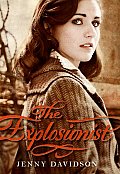
The Explosionist

I really loved fellow blogger Jenny Davidson’s young adult novel The Explosionist; it was a good story with an appealing heroine and an interesting concept — what would the world be like if Napoleon had won the Battle of Waterloo?  It’s an alternative history novel where the political configurations are nothing like what we know today — much of Europe is one entity that has taken over England, and Scotland, where the novel is set, is allied with various other northern European countries to form the New Hanseatic League.  These two groups are perilously close to war.

The novel is set in the 1930s and tells the story of Sophie, a teenager in Edinburgh who lives with her great-aunt and has a fairly normal life attending school and spending time with friends.  But her great-aunt has some peculiarities — she is politically well-connected and influential, for one thing, and she also has a strong interest in mediums and the spirit world and holds séances at her house.  In this alternate universe, though, this kind of spiritualist interest is more wide-spread than it is in ours, so the great-aunt’s involvement in it is only mildly unusual and not alarmingly strange.

It does become alarming, however, when Sophie attends a séance conducted by a woman who delivers a frightening prophecy and then ends up dead just a little while afterwards.  Sophie and her friend Mikael investigate the death and find themselves in a much more complicated situation than they ever expected — they run into trouble with the law, investigate suspicious politicians, communicate with the spirit world, and much more.

I loved the novel for a bunch of reasons; one of the main ones was Sophie herself, who is smart and thoughtful, and although she does doubt herself at times, which is what one would expect in a 15-year old who has to deal with some strange situations, she trusts her insights and her intelligence.  She knows that boys and girls, men and women, are equally capable and smart, and she makes sure she holds her own in her adventures with Mikael.  She believes just as strongly that children are basically young versions of adults and are capable of much more than adults usually give them credit for.  Her actions in the novel prove her point.

All the historical and cultural differences between the novel’s world and our own are a lot of fun to discover as well.  Many famous names appear in the novel, but they are famous for different reasons than they are in our world — Sigmund Freud, for example, has a talk show on the radio and blathers on about the Daedalus complex.  Albert Einstein writes poetry and James Joyce is famous for his operas.

And, of course, it’s a good story, too, with a plot that moves along at a steady, satisfying pace.  One of the most chilling parts of the plot has to do with an organization called IRYLNS, the Institute for the Recruitment of Young Ladies for National Security.  The acronym is pronounced “irons,” and its activities, which I won’t describe here, are horrifying.  Sophie learns more about it than she ever wanted to know.

Like all good young adult novels, this one is excellent reading for people of all ages.  If you’re interested, you’ll find an author’s blog here.

9 Comments

Filed under Books, Fiction

Library sales

A while back I mentioned that there were some local library sales coming up, and, of course, I had to check them out (and volunteer at one — this year I volunteered for the second day of the sale, so I wouldn’t miss being able to buy books on the first day, a lesson I learned from last year).  I came back from both sales with quite a stack, and now I’m hoping to be finished with buying books for a while (but we’ll see of course).  Here’s what I found:

  • Barbara Pym’s An Academic Question: The one Pym novel I’ve read I loved, Excellent Women, so I couldn’t resist snapping up another.
  • Matthew Sharpe’s The Sleeping Father: I don’t know anything about this one, but the name was familiar, and I later remembered he wrote Jamestown, which got some blog attention, I believe.  Anyway, it sounded interesting.
  • Ian Rankin’s Dead Souls: I haven’t yet read Rankin, and he definitely should be a part of my reading in the mystery genre.  A couple friends recommended him.
  • Henning Mankell’s Before the Frost: This one is a Linda Wallender mystery; I knew there were Kurt Wallender ones, but not Linda Wallender ones.  I’ve got one of the Kurt mysteries on audiobook, so these two together will make a nice introduction to Mankell.
  • Alan Lightman’s Einstein’s Dreams: This one has been on my wishlist ever since reading Lightman’s book on science, A Sense of the Mysterious.
  • Anthony Trollope, The Eustance Diamonds: It seemed to me like a good idea to have an unread Trollope novel lying around, just in case.
  • Elfriede Jelinek’s The Piano Teacher: I’m not sure I’ll like this book, but I’d like to read Jelinek just to see what I think, controversial figure that she is.
  • Benjamin Black’s Christine Falls: I’ve read the sequel, The Silver Swan, and now it’s time to read the first in the series.
  • Sarah Waters’s The Night Watch: After having a great time reading Fingersmith, I couldn’t resist another Waters novel.
  • James Salter’s Last Night: This is a collection of stories by an author I’ve heard praised by fellow bloggers; I might have preferred to find a novel, but this will give me a chance to read more short stories.
  • Nicholson Baker’s A Box of Matches: Eventually I’ll have read everything Baker’s written.  Well, maybe not — his latest nonfiction doesn’t interest me very much.  But thanks to Book Mooch I have The Fermata on the way to me from Verbivore.
  • Jane Gardam’s The People on Privilege Hill: I’ve heard of Gardam’s novel Old Filth and so was intrigued by this collection of stories.
  • Robert Hughes’s High Wind in Jamaica: I’m always happy to find NYRB books around, and this one looked particularly good.
  • Jane Urquhart’s Away.  Verbivore is the inspiration for this purchase; she sounds like a writer I will like.

There were many more I could have gotten, but that seemed like enough …

15 Comments

Filed under Books

Virginia Woolf

I just got an email advertising an upcoming exhibition in New York City about Virginia Woolf, This Perpetual Fight: Love and Loss in Virginia Woolf’s Intimate Circle, and I’m really excited about it. It features “over 200 items, including books, images, letters and other manuscript materials, some of which have never been exhibited publicly.It’s open September 17 to November 22. I’m sure I could drag Hobgoblin to see this, but he’s not exactly a Virginia Woolf fan (one of his very, very few failings). Is there anyone out there in the NYC area who might like to meet up one day to look through it? It could be a fun book blogger outing, for sure. Let me know.

14 Comments

Filed under Books

After the accident

Hobgoblin is doing well after his accident, although he’s in pain. I think it’s often true that the day after an accident is worse than the day of the accident itself. The initial shock is over, the body has had time to figure out what has happened and to protest, and new aches and pains and bruises keep appearing. Hobgoblin keeps saying he feels like he’s been hit by a truck and then laughing because he has, in fact, been hit by a truck. We spent today running accident-related errands, sad about the accident, but happy that we both had an air-tight excuse to get out of irritating meetings at school.

It’s odd how most days are completely normal and not much surprising happens, and then all the sudden one day turns out to be entirely different than what you expected. Yesterday and today both were like that, not at all what I thought they would be. I was settling down into an afternoon of work on my courses for the fall yesterday when I got a phone call from an unknown woman who said Hobgoblin had been hit by a car, she’d called 911, and an ambulance was on the way. It was one of those moments when I realized my life could from now on be completely and utterly different — when I asked if Hobgoblin was okay, the woman didn’t really answer me, and so the only thing I could do was imagine the worst. Her mention of a backboard and neck brace and the fact that they were trying to keep him still and that they had stopped traffic all along the road so there was no point in trying to drive out there just made it worse.

It turned out, of course, that the worst hadn’t happened, but for a good hour or so, I had no idea.

This accident has been hard on Hobgoblin and, to a much lesser extent, hard on me, but both of us agree that, short of something awful like permanent paralysis, it’s better to be the one hit than the one who did the hitting. We both feel a little bad for the driver. When we visited the police department today to pick up Hobgoblin’s bike, the officer who handled the incident said that the driver felt terrible about what he’d caused.

The thing is, I can easily see how I could do exactly what the driver did. He wasn’t out to hurt anybody; he was just distracted or absent-minded, things I often am, and he simply didn’t see the cyclist right there in front of him. It’s impossible to stay aware of everything going on around you at all times, so who can possibly say they will never be responsible for hitting someone? For very good reasons Hobgoblin doesn’t want to have any contact with the driver (I would feel the same way too), but I hope he finds out one way or another that Hobgoblin is fine and suffered only minor injuries. In some ways, Hobgoblin is the lucky one — he has a broken bike and some injuries, but the driver has to live with guilt.

Things should be back to normal soon and we will put this behind us, but I hope to remember this enough to stay cautious on the road and I hope I’m lucky enough never to cause such an accident myself.

17 Comments

Filed under Cycling, Life

What a day …

Hobgoblin is just fine, but it’s no fun getting a phone call from a stranger saying that he will soon be on the way to the emergency room.  We’ve both had better days, let me tell you.

8 Comments

Filed under Life

Death in a White Tie

I’m enjoying my tour through the world of mysteries, both with my mystery book club and on my own, and Ngaio Marsh’s novel Death in a White Tie was a fun, albeit lightweight, example. It’s the first Marsh I’ve read and not necessarily the last, although she is a writer for a particular kind of mood — the kind of mood where you need something calming and predictable.

Set in the 30s, the novel tells of debutantes, balls, and London social seasons; the detective, Inspector Alleyn, comes from this high class world, although having a real job, he’s a little at odds with it as well. The first few chapters introduce you to the cast of characters (it does this very straightforwardly with a chapter entitled “The Protagonists”). We learn of trouble beneath the facade of glamour and luxury; some of the characters are being blackmailed, and one of the novel’s most likeable characters, Bunchy, otherwise known as Lord Robert Gospell, is put on the case. When he ends up murdered, Alleyn is saddened by the loss of his friend but must manage to put his feelings behind him so he can conduct the investigation — an awkward business, since many of those he must investigate are his friends.

The novel follows a very predictable structure, and at times this can get a bit dull; there is a long section in the middle where Alleyn interviews every major character, and these go on a bit. But there is pleasure to be found in following Alleyn as he and his assistant Fox piece the puzzle together, and as we meet some intriguing minor characters, such as the odd, extremely inhibited secretary Miss Harris. It’s the pleasure, I suppose, of knowing pretty much exactly where you’re going and happily enjoying the journey.

There are certainly a number of strange moments in the book, for example the hard-to-believe, at times embarrassingly awkward love story between Alleyn and the painter Agatha Troy. And then there is the bizarre conversation Alleyn and his mother have about gender politics. She argues that

… no woman ever falls passionately in love with a man unless he has just the least touch of the bounder somewhere in his composition.

Alleyn is surprised by this argument in favor of male arrogance and bullying, but then he tries it out on Troy with surprising success. I didn’t like this, but I was amused by the way Alleyn’s mother calls this gender dynamic “savagery” and argues that it is the same savagery that lies behind the church wedding ceremony and behind the season itself:

As long as one recognizes the more savage aspects of the Season, one keeps one’s sense of proportion and enjoys it.

I read this on vacation, and it was a good vacation book — not too mentally taxing, fun in a low-key kind of way. Not everyone in my book group was as easy to please as I was; many of them didn’t like it at all while some others reacted much as I did, with mixed feelings. I don’t know who we are reading next, but I’m looking forward to finding out.

5 Comments

Filed under Books, Fiction

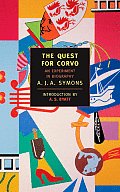
The Quest for Corvo

A.J.A. Symons’s The Quest for Corvo: An Experiment in Biography is forever linked in my mind to Janet Malcolm’s book about Sylvia Plath, The Silent Woman.  The books are different in many ways, but the subtitle “An Experiment in Biography” could serve equally well for them both; both of them attempt to lay bare the experiences that go into creating biographies — the moment of inspiration, the research, the interviews, the wrangling over permission to quote, the exciting discoveries.  Both authors describe the emotions involved in researching a person’s life — the obsession, the frustration, the determination, as well as the complicated mix of feelings they develop toward the person him or herself.

Symons’s book was published in 1934, and it opens with the moment a friend hands him the novel Hadrian the Seventh, Baron Corvo’s most famous work.  He falls in love with it, whereupon his friend hands him some of Corvo’s letters, which produce an entirely different reaction — he is horrified by decadence and corruption he finds in them.  The combination of these two entirely different pieces of writing from the same person troubles and fascinates him, and his quest begins.  He discovers that not much is known about Baron Corvo, whose real name is Frederick Rolfe, so he follows what leads he has and soon is uncovering the details of Corvo’s life — some of them inspiring, but many of them pathetic and sordid.

The Quest for Corvo tells multiple stories — it outlines Symons’s research into Corvo’s life, it tells the story of the life itself, it tells of Symons’s response to that life, and it attempts to account for why Corvo is who he is.  Symons soon finds he has become obsessed with a very wonderful and strange man:

… nearly everyone who knew Rolfe thought him the most remarkable man of their acquaintance.

Corvo could certainly charm people and was quick to make friends and persuade people to help him — but he was the type of person who always needed help.  He tried to make his living in various ways, including painting and writing, but he always failed and was always in financial trouble.  His charm would inevitably fade, and a darker side would appear; Corvo was one of those people who seem to be working toward their own success while they are actually in the process of undermining it.  He would misuse money until his current benefactor lost patience and then would be horribly shocked and hurt when that benefactor began to ask questions and make demands.  He would end up in misunderstandings — somehow or other — with the friends he depended on, and would then react in a manner violently out of proportion to any perceived slight he received.  If his friend tried to make amends, he would refuse to consider the appeal as being beneath his dignity, even though he depended on this friend for the very food he ate.

In short, the man was completely insufferable, and yet — and here is the question at the heart of the book — he managed to write works of genius.  (At least, they were works of genius in Symons’s mind; not very many people have agreed, obviously, since Baron Corvo is not a well-known name, and I suspect that if I were to try to read even his most famous work, I wouldn’t like it.)  How does it happen that someone with mental problems we wouldn’t have too much trouble diagnosing these days, someone who made such a mess of his life, someone who managed to alienate every single person he interacted with in his life, could write so beautifully?  Symons offers some answers to the question of what made Corvo the strange person he was, but he acknowledges that the larger questions about art remain unanswered.  Art and creativity and the ability to work magic with words remain a mystery.

I loved this book because of its strangeness — the unusual structure as well as the unusual subject — and I loved it in spite of the fact that I became convinced I would disagree, probably vehemently, with Symons’s assessment of Corvo.  Symons tries very hard to be fair and to acknowledge what a horror Corvo was to his friends, but he is clearly fond of him and wants readers to be fond of him too.  I, however, would stay far away from Corvo if he were still alive, and I found it hard, not having had the experience of falling in love with his writing, to see what could possibly make the man appealing.  But it’s a testament to the strength of Symons’s writing that I found the book fascinating in spite of my distance from Corvo — or perhaps the truth is that this disagreement with Symons made for another interesting layer in an already very rich book.

6 Comments

Filed under Books, Nonfiction

Walks and books

Well, there’s nothing like a flattering mention by a favorite blogger to motivate one to write … so let’s see, what have I been doing?  Not nearly as much reading as I’d like, but life has been full of other good things instead, such as getting to climb mountains in Vermont and New Hampshire, including a climb up Mt. Washington, home of the world’s worst weather.  Fortunately for Hobgoblin, Muttboy, and I, we didn’t actually encounter the world’s worst weather and had, instead, a gorgeous, clear, dry day to hike.  Still, while it was in the 70s at the base of the mountain, by the time we reached the top, the temperature had plummeted to the 40s and my extra sweater didn’t do much to keep me warm.

What a lovely hike that was, well worth the days of sore muscles I experienced afterwards.  All my illusions that my cycling and running would make climbing mountains any easier were shattered — Hobgoblin and I hobbled around like we were 95 years old for three or four days afterward.  Well, we did managed to loosen up our aching muscles enough to climb some smaller Vermont mountains, but once we’d sat around for a while after the climbs, we could barely get up again.  Yes, a little training would have been a good idea.

We also had a grand time not camping.  We enjoyed every one of the many restaurants we visited, every moment in our comfortable bed and shower, every chance to lounge around on the sofa, every stroll around a cute Vermont town.  I do love camping and backpacking, I do, but sometimes it’s nice not to do it.

And, of course, I came home with more books than I left with.  We spent some time in Hanover, New Hampshire, which has two excellent bookstores (at least), one of which is the Dartmouth College bookstore — one of those Barnes and Noble college stores, but one well worth getting lost in.  The other was a used bookstore just up the street from the first.  After a long time spent in both stores, I walked away with John Mullan’s How Novels Work, which I have begun and am enjoying; it’s a good introduction to the technical aspects of fiction.  Also Charles Lamb’s The Essays of Elia to add to my essay collection, Elizabeth Phelps’s The Story of Avis, a 19C American novel, and Lady Morgan’s The Wild Irish Girl, originally published in 1806.

There was also an awesome used bookstore in Woodstock, Vermont, where I spent at least an hour combing through the shelves; I brought home a collection of D.H. Lawrence’s literary criticism.

Since I’ve returned home a few more books have arrived through Book Mooch: Theodore Zeldin’s An Intimate History of Humanity, Jenny Diski’s Stranger on a Train, and Anne Fadiman’s At Large and at Small.  The book piles threaten to get out of control: there are two local libraries having their book sales soon, at which point I’ll probably be drowning in books.

I did finish one book on the trip, A.J.A. Symons’s The Quest for Corvo, which I hope to write about soon.

13 Comments

Filed under Books

Back home

Hi everyone — I’m back from vacation and had a wonderful time (except for this incident), but I’m having trouble settling back into things at home; it’s always hard to come back from vacation, but even harder when I face unpleasantness at work.  So while I’d love to resume regular blogging, I’m not feeling up to it at the moment; instead, I’m enjoying Ngaio Marsh’s Death in a White Tie, and wishing I could have stayed in Vermont … I’ll be back soon.

10 Comments

Filed under Life

Vacation!

Day after tomorrow, Hobgoblin, Muttboy, and I are headed out of town, so this may be my last post before we leave. We’re visiting my parents first, in the Rochester, NY, area, and then we’re heading over to Vermont where we will spend a week hiking, riding our bicycles, and seeing some sights. We know Vermont almost entirely because of backpacking, which is a great way to see a state (its woods and mountaintops at least), but rather exhausting. This trip will be wonderfully luxurious in contrast — instead of a tent or a three-sided lean-to shared with strange people and mice, we’ll have a real bed for each and every night! We’ll have showers! Restaurants! Hot food! On the downside, we won’t be woken by a moose walking to within a few feet of our tent. But that’s okay.

I’m not sure how much reading I will do, although I will certainly take along a backpack full of books. Our vacations in the past have been rather manic; instead of lounging around all day, we were more likely to climb a mountain — or three — after taking a long bike ride in the morning. But who knows? Perhaps this time we’ll be in the mood for some quiet.

I want to mention before I go that I recently finished André Aciman’s novel Call Me By Your Name and thought it was very beautiful — a perfect summer book. I don’t have time for a full review, but briefly, it’s about a summer love affair that takes place on the coast of Italy. Elio, the narrator, is a precocious 17-year-old who falls in love with Oliver, a young scholar visiting Elio’s family for six weeks to finish up his academic book. The novel tells of Elio’s obsession with Oliver and his uncertainty about how to approach him, whether to approach him, how to interpret his bewildering behavior, and how to process his own bewildering, contradictory feelings. The book captures the brief, intense love affair of summer wonderfully well; I read it fast and was caught up in its slow, thoughtful, dreamy, sometimes anguished, mood and didn’t want to put it down and didn’t want it to end. I will admit that I sometimes have trouble reading novels about the ridiculously privileged/wealthy/hyper-educated and those feelings came out here, but I did my best to ignore them for the sake of an excellent piece of writing.

As for what books I’m taking with me, definitely A.J.A. Symons’s The Quest for Corvo, which I have begun and have fallen in love with — it’s subtitled “An Experiment in Biography,” and although its subject matter is very different from Janet Malcolm’s The Silent Woman, the two books are similar in structure and method — both are about the author’s growing obsession with an intriguing and elusive biographical subject and about the course of his/her researches. Both authors turn their research into an entertaining story — entertaining because of the information revealed about the subject and about the author.

Also Charlotte Brontë’s novel Shirley, which I mean to begin any day now. I think I’ll take Jenny Davidson’s new novel The Explosionist too. I’m not sure what else. I may grab some things that appeal to me in the moment I happen to be packing.

So I’ll be back in a couple weeks with a full report. Enjoy August everyone!

18 Comments

Filed under Books, Cycling, Life, Reading

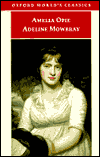
Adeline Mowbray

I very much enjoyed reading Amelia Opie’s 1804 novel Adeline Mowbray; if you are interested in reading novels from the time period, something beyond Austen, Scott, or Burney, you might consider this one — it’s a very interesting take on the institution of marriage, dealing with it in a way that might surprise contemporary readers.

Adeline is a young woman who was raised by a mother foolishly obsessed with philosophy — I say foolishly because while she prides herself on her intellect, she has no practical skills whatsoever, and is the type of mother who composes a treatise on the education of children all the while neglecting her daughter. Adeline herself is fortunate to be raised by her grandmother as well as her mother; she inherits her mother’s philosophical bent but also learns usefulness and practical skills from her grandmother.

What she does not learn, however, is how harsh and unforgiving the social world of her time can be, and so when she reads a book arguing that marriage is an outmoded, unnecessary institution, she has no idea how shocking this is. She finds the arguments set forth perfectly logical and makes up her mind never to marry.

Meeting and falling in love with the man who wrote the anti-marriage book doesn’t change her mind in the least; instead, she decides she would like to live with him in a relationship that is as stable and steady as marriage but without actually undergoing the ceremony. This man, Glenmurray, now finds himself in a dilemma. On the one hand, he believes in the validity of his own anti-marriage arguments, but he knows that Adeline would pay a high price for choosing cohabitation. He decides he is willing to bend to the dictates of society and get married. On the other hand, he can’t back down from his beliefs without disappointing Adeline and losing her respect. She believes it is a matter of honor that he stick to his beliefs, and she is determined she will not allow him to compromise for her sake.

A chain of events eventually leads to their cohabitation, and here things get interesting, for Adeline finally must learn just how high a price she will pay for her radicalism. And what a price she pays. From here on out, everything goes wrong — she loses all her friends, for no respectable woman would associate with a “kept” mistress. She is subject to attacks by men — practically every man she runs into — because each one assumes she is sexually available. When Glenmurray becomes ill, she realizes she will be penniless if he dies. She becomes pregnant but the distress of her life leads to a miscarriage. She is estranged from her mother, the only one who could protect her were Glenmurray to die. She spends the rest of the novel stumbling from one disaster to the next, never able to recover from her initial “mistake,” if you choose to see it that way.

It’s possible to read this as a pro-marriage, anti-radical novel, which is the way the Victorians saw it. And there may be some truth to this reading, as by the end of the novel Adeline is so thoroughly demoralized and so convinced that her anti-marriage stance was a huge mistake, that the novel seems to argue against doing anything that deviates from tradition and social expectations.

And yet it seems to me that this is less a pro-marriage novel than it is a critique of an oppressive society that allows women absolutely no room for error whatsoever. All the awful things that happen to Adeline — her isolation, her vulnerability, her economic distress, her sexual danger — seem way too high a price to pay for her youthful beliefs, especially since she had no idea just how dangerous they would be. Whether her anti-marriage arguments have any validity at all seems almost beside the point; what matters is that her “mistake” was entirely innocent and she was not allowed to recover. There are a few people along the way who help Adeline out, but the vast majority of people, especially men but also women, mock her, take advantage of her, and shun her. Even a sympathetic man, one who is attracted to her and considers marrying her, decides he cannot because she is “damaged goods.”

Adeline so clearly does not deserve this treatment; she is a much stronger, much smarter, much more honorable, and much more honest person than anyone else in the novel. The novel leads us to sympathize with her and wonder just what it is about a strong woman that society cannot handle. When she finally changes her mind about marriage and comes to believe in it as a necessary institution, she claims that she changed her mind because of logical reasoning, and yet it’s hard not to feel that it was the battering, the non-stop abuse that led to the change. No one could have withstood it.

Adding another layer of interest to the novel is that fact that it was loosely (very loosely) modeled on the life of Mary Wollstonecraft, a radical woman who fell in love with an anti-marriage philosopher, William Godwin, and then wound up marrying him. Amelia Opie moved in radical circles herself, at least in the earlier parts of her life before she became a Quaker, and was known to admire Wollstonecraft, a fact that bolsters more subversive interpretations of the novel.

This can be a painful read at times, as the above description probably makes clear, and yet it’s fascinating to watch an 18/19C woman grappling with an issue that seems to us to be so very contemporary. We are certainly not the first ones to wonder if cohabitation makes more sense than marriage and also to lament that women so often have to pay a high price for acting on an unpopular belief.

17 Comments

Filed under Books, Fiction

Happy weekend!

I hope you all enjoy your weekend.  Looking back, I see that today was a good day.  I had a book group meeting this morning where we discussed Nam Le’s short story collection The Boat.  The verdict was mostly positive, although everyone liked some stories more than others, and we had some criticisms of this and that.  But everyone agreed he is an excellent writer.

Then I came home and went running, and my feet didn’t hurt at all.  After that a book arrived in the mail, Parson Woodforde’s diary, written from 1758 to 1803.  It’s a big thick book, something that will take me a long time to read and that I’m pretty sure I will enjoy.  Perhaps it will make a good bedside book.

And then there was a trip to the chiropractor, where I got my shoulders massaged and my neck adjusted, and then dinner.  Somewhere in there was some time to read, and I picked up André Aciman’s Call Me By Your Name, a book highly recommended by Jenny D., partly because it’s a beautiful book and partly because it has lots of swimming, running, and cycling in it.  I’m having trouble putting it down.

Then there was swimming in the evening, where I did some drills and swam a half mile altogether (with lots of breaks) — not terribly far, really, but the farthest I’ve gone since who knows when.  And then there was a walk to town for ice cream, and now I’m home, ready to return to my novel.

That’s how a summer day should go, don’t you think?

11 Comments

Filed under Books, Life, Reading, Triathlon

Sei Shonagon’s Pillow Book

Sei Shonagon’s Pillow Book, written by a court gentlewoman in 10th century Japan, is thoroughly enjoyable.  It’s the kind of book best read in small bits and pieces, kind of like a diary, although it isn’t one, exactly.  In fact, although I didn’t choose to do this, you could take a hint from the book’s title and read a little bit of it as you hit the pillow every night.  The introduction to my edition explains that the meaning of the book’s title is uncertain, but that we can possibly imagine Sei Shonagon:

taking away her pile of paper to keep by her pillow and write, in the form of private jottings and as if purely for her own entertainment, a work that would redound to the credit of Teishi’s court — a work conveying the brilliant wit, exquisite taste and sheer ‘delightfulness’ for which that court had become known and which Sei Shonagon was felt to epitomize.

The book is made up of small sections, some of them as short as one line and the longest ones reaching to 10 or 15 pages.  Many of the entries are lists; Sei Shonagon will list, for example, “Things that make you feel nostalgic,” or “Occasions that induce half-heartedness” (including “Preparations for something still far in the future”) or “Things people despise” (including “People who have a reputation for being exceptionally good-natured”).  She will also list interesting place names or the names of flowers that sound good in poetry or names that are significant for one reason or another.

Other sections tell stories, many of them having to do with love intrigues and flirtation and cultured conversation.  There are many stories about men visiting their lovers at night and women waiting for the note that is sure to come after such a visit.  Sei Shonagon also writes about visits the court members make to one another and about court ceremonies and religious festivals.

An element of almost all these stories is poetry, which plays a surprisingly important role in Japanese court culture.  Again and again, Sei Shonagon tells stories about receiving letters with poetic allusions to which she must respond with a clever reference of her own, or stories about challenges to produce a poem on the spot, a challenge she must live up to, as she has a reputation for her quick wit.  There was a body of poetry that everyone — or at least everyone who hoped to succeed at court — had memorized, and which formed the basis of a whole system of communication.  You were expected to write poetry as well.  To write a bad poem was a deeply embarrassing thing, as was the failure to write one at all when one was expected of you.  To write a clever or beautiful poem could greatly increase your reputation and earn you respect.

The Pillow Book is fascinating for the glimpse it provides into a culture radically different from our own, and it’s also a pleasure to read for the sake of Sei Shonagon’s personality, which shines through every page.  She is an astute observer of the world and the people around her, and she never spares judgment, telling her stories and writing up her lists with a forthright, honest, and often funny voice.  One of the most famous passages from the book (it’s excerpted in my Art of the Personal Essay anthology) is a list of “Infuriating things,” and here’s a taste of it:

A guest who arrives when you have something urgent to do and stays talking for ages.  If it’s someone you don’t have much respect for, you can simply send them away and tell them to come back later, but if it’s a person with whom you feel you must stand on ceremony, it’s an infuriating situation….

A very ordinary person, who beams inanely as she prattles on and on….

It’s also quite disgusting to witness men getting noisy and boisterous in their cups, groping round inside their mouth with a finger or wiping their whiskers if they have them, and forcing the saké cup on others.  “Go on, have another!” they’ll cry, and they wriggle and squirm and wag their heads, and pull down the corners of their mouths in a grimace, and generally perform just like a child singing “Going to See the Governor.”  I’ve seen even truly great men behave in this way, and I must say I find it most offputting.

I also really hate the way some people go about envying others, bemoaning their own lot in life, demanding to be let in on every trivial little thing, being venomous about someone who won’t tell them what they want to know, and passing on their own dramatized version of some snippet of rumour they’ve heard, while making out that they knew it all along.

A baby who cries when you’re trying to hear something.  A flock of crows clamouring raucously, all flying around chaotically with noisily flapping wings.  A dog that discovers a clandestine lover as he comes creeping in, and barks.

A man you’ve had to conceal in some unsatisfactory hiding place, who then begins to snore.  Or, a man comes in on a secret visit wearing a particularly tall lacquered cap, and of course as he scuttles in hastily he manages to knock it against something with a loud bump ….

And I could go on … it occurs to me that this book would make an excellent source of memes.  Perhaps we should start an “infuriating things” meme?  Or how about “splendid things” or “things later regretted” or “times when someone’s presence produces foolish excitement” or “endearingly lovely things”?

Sei Shonagon is someone who becomes a companion as you read her thoughts and stories; I’m sorry to have finished this book and will miss her.

13 Comments

Filed under Books

Training updates

I just got home from another fun Tuesday night race.  In spite of the fact that I am officially burnt out on racing, I still enjoy the Tuesday night races, largely because I have no hope whatsoever of doing well, and so there is no pressure.  I just hang out in the back, watch what is going on, and get a good workout.  I like hanging out in the very back these days because from there I can see clearly what the people up front are doing as they ride around the corners.  That way I keep an eye on where Hobgoblin is — and he’s generally up front somewhere, usually winning or in the top five.  He’s leading the series by a ridiculous number of points.  At this point, I’m much more interested in how he does than how I do.

So my triathlon training is going pretty well, all things considered.  My feet don’t protest the running too much, although I run only a very little way.  I started with a mile and am all the way up to a mile and a quarter!  Yes, it will take me quite a while before I can run a marathon, but I hope to get there one day.  The doctor tells me I can increase my mileage by 10% each week or 15% at most, assuming I have no serious pain, so you can see how slow the whole process is.

But the big news in my training is that I am now taking swimming lessons.  I can get myself across a pool, and can even do it a decent number of times, but I can’t do it with anything like proper technique, so I decided to get myself some lessons before my bad habits get any further ingrained.  My teacher, who was very patient in the face of my occasional incomprehension, gave me some drills to do, and a workout to do on my own, and I’m so happy to have some direction, instead of just floundering around trying to figure out the right way to swim but not really getting it.

My goal is to run and swim three times a week and ride my bike four times a week, or perhaps three if I do long rides.  All that is easy to do right now, although it will be more of a challenge when school starts.  I had my eye on a September triathlon I thought I might be able to do, but I don’t think I’ll be ready for the running part of it.  But that’s okay — if all goes well, I’ll compete in triathlons beginning in the late spring, and that will give me plenty of time to figure out what I’m doing.

11 Comments

Filed under Cycling, Triathlon