Category Archives: Fiction

Novel obsessions

I’m wondering what people think about the conversation in Don Quixote between the canon and the priest in chapters 47-48. The canon at times seems very logical and at other times inconsistent. He criticizes novels of chivalry as “foolish stories meant only to delight and not to teach, unlike moral tales, which delight and teach at the same time.” And yet he says that he has read the beginning of almost every chivalric novel that’s been written. He can’t read to the end of any of them, though, because their plots are so repetitive. So why does he keep beginning them over and over?

In spite of being so critical of chivalric novels, he can’t seem to let them go:

Despite all the bad things [the canon] had said about those books, he found one good thing in them, which was the opportunity for display that they offered a good mind, providing a broad and spacious field where one’s pen could write unhindered, describing shipwrecks, storms, skirmishes, and battles …

and the canon goes on for a long paragraph listing all the wonderful things a writer of chivalric novels can write about. He ends his long speech describing how fabulous a chivalric novel could be if only people wrote them well:

And if this is done in a pleasing style and with ingenious invention, and is drawn as close as possible to the truth, it no doubt will weave a cloth composed of many different and beautiful threads, and when it is finished, it will display such perfection and beauty that it will achieve the great goal of any writing, which, as I have said, is to teach and delight at the same time. Because the free writing style of these books allows the author to show his skills as an epic, lyric, tragic, and comic writer, with all the characteristics contained in the sweet and pleasing sciences of poetry and rhetoric; for the epic can be written in prose as well as verse.

He’s so convinced the genre of chivalric novel can be saved, that he has tried to write one of his own and has written more than a hundred pages.

The canon sees so much potential in this genre that he seems obsessed with it. And I can’t help but think of Don Quixote itself when I read the last sentence of the above quotation — Don Quixote has its own “free writing style” that combines epic, lyric, tragic, and comic aspects, with a little poetry and rhetoric and a lot of prose. Is Cervantes speaking through the canon here, working his way toward the new genre that the novel will be?

3 Comments

Filed under Books, Fiction

Eileen Chang’s Love in a Fallen City

218ht7ekj0l_aa180_.jpgFirst, let me say that I am SO HAPPY to be sitting quietly in my study doing nothing right now. I rode the hardest race of the season this morning, and now I’m beat (riding seems to be good for my back and neck, at least in the short term — they are feeling much better). It was a hilly road race, and while I didn’t do all that well, getting dropped on a particularly nasty hill, I did better than last year, when I got dropped on one of the foothills of the particularly nasty hill, and that’s really all I was hoping for. If you’d like to hear more about these vicious hills, read Hobgoblin. All I have to say about it is that hills suck.

But I wanted to write about Eileen Chang’s Love in a Fallen City, a collection of novellas and stories. Most of them were first published in China in 1944 in a book called Romances, and they have been reissued by the wonderful NYRB Classics. I got off to a tiny bit of a slow start with the first novella, but after that I gobbled these stories up; they are gripping tales of love, family, and politics — often about the conflict among these three things. Chang lived through and wrote about political and social turmoil; the title novella takes place in a besieged Hong Kong, where scenes of violence strengthen the main character Liusu’s shaky romance and settle her uncertain future. This is not to belittle the political turmoil of the time, but to show how it can affect individual people:

Hong Kong’s defeat had brought Liusu victory. But in this unreasonable world, who can distinguish cause from effect? Who knows which is which? Did a great city fall so that she could be vindicated? Countless thousands of people dead, countless thousands of people suffering, after than an earth-shaking revolution … Liusu didn’t feel there was anything subtle about her place in history.

Liusu’s “victory” is getting her lover to marry her, therefore ensuring a comfortable future and no loss of social status. In these stories, love often seems indistinguishable from war — whether it takes place in a besieged city or not, love and courtship can be a fight for one’s life.

Chang also writes about the conflict between traditional family structures and customs and the modern world that’s threatening them. One of the things that’s fascinating about this book is the glimpse it gives into a world where family members refer to each other as “Ninth Old Master” or “Second Mistress” or “Third Brother,” where a matchmaker arranges marriages, and where one’s status in society can determine one’s life. But the stories also tell of characters who are struggling to be modern, such as Zhenbao in the novella “Red Rose, White Rose,” who was “the ideal modern Chinese man”:

Never had a son been more filial, more considerate, than Zhenbao was to his mother; never was a brother more thoughtful or helpful to his siblings. At work he was the most hard-working and devoted of colleagues; to his friends, the kindest, truest, and most generous of men. Zhenbao’s life was a complete success. If he had believed in reincarnation — he didn’t — he’d have hoped simply to pick up a new name, then come back and live the same life all over again.

Zhenbao came from a poor family but worked hard to create a better life for himself; Chang describes him as the perfect Western self-made man. But — and this should be no surprise, for if an author describes a character’s life as perfect in the beginning of a story, it simply must get shaken up — Zhenbao cannot be “modern” in the sense of following all his desires. He is unhappy with his wife but feels he cannot pursue the woman he loves; he is torn between romance and loyalty to family and friends. He is in many ways a traditional man wanting to be free of tradition, but unable to make himself so.

The gender dynamics are a little hard to take, which is no surprise, as the book describes a society that is still old-fashioned in many ways; what I’m uncertain about is Chang’s take on the subject. Occasionally, the narrator will step in and say something about “what women are like,” which tends not to be very flattering, and I don’t know if this is Chang talking to us, or if she is speaking for the culture and not for herself. It’s not easy to detect Chang’s presence in this book — what her views are on the stories she tells.

The writing is captivating, although it follows a rhythm that feels unusual to me — many of the stories cover large sweeps of time, decades in a character’s life perhaps, and Chang will offer a scene for a few pages that gives all kinds of detail and moves through time slowly, and then she’ll sum up years in a short sentence or two. The narratives move abruptly. This is not a flaw; it just takes some getting used to.

For more information on this book, check out Scott Esposito’s interview with Chang’s translator Karen S. Kingsbury and Orpheus’s interesting post on Chang and popularity.

9 Comments

Filed under Books, Cycling, Fiction

Storytelling

My reading in Don Quixote is zipping along; I’m nearly up to p. 300 and enjoying it immensely. I’m now in the middle of the first of what I understand will be several long interpolated stories; I remember people saying they get a bit dull and make one long for Don Quixote and Sancho Panza to return, and I will probably feel that way eventually, but for now I’m enjoying the story of Anselmo and Lotario from “The Man Who Was Recklessly Curious.” Isn’t that a great story title?

These interpolated stories are nice reminders of just how interested Cervantes is in storytelling, and I like how he includes one just after the chapter in which the characters — Don Quixote excluded — discuss the value of those chivalric romances DQ is so obsessed with. We get discussions about the value of stories and then we get the stories themselves, so we can think about them theoretically — maybe that’s too strong a word, but we can think about what their purpose is and what makes them work along with the other characters — and then we can experience them directly. I haven’t gotten to the end of “The Man Who Was Recklessly Curious” yet, but I’ll bet when it’s finished, the characters will have a discussion of the story’s merits and perhaps of the quality of the reading (the priest reads the story out loud). I love the way Cervantes includes all these layers of story and response — and I’m only talking about the interpolated stories here, when they are only a small part of all the self-reflexivity going on.

I really got a kick out of reading Chapter 32, the one mentioned above about the merits of chivalric romances; when the priest tells the story of how these romances turned DQ’s brain, the innkeeper launches into a defense of them:

The truth is, to my mind, there’s no better reading in the world; I have two or three of them, along with some other papers, and they really have put life into me, and not only me but other people, too. Because during the harvest, many of the harvesters gather here during their time off, and there’s always a few who know how to read, and one of them takes down one of those books, and more than thirty of us sit around him and listen to him read with so much pleasure that it saves us a thousand gray hairs; at least, as far as I’m concerned, I can tell you that when I hear about those furious, terrible blows struck by the knights, it makes me want to do the same, and I’d be happy to keep hearing about them for days and nights on end.

Cervantes is clearly having a laugh at these people and the simplicity of their enjoyment and their response (they sound like modern-day boys going to see thrillers at the movies because they like the violence and the special effects), but there’s also something charming about this story of the harvesters gathering around and listening to the stories of chivalry. Their pleasure in them is infectious.

After the innkeeper speaks, several other characters give their assessment; the innkeeper’s wife, speaking to her husband, says she likes chivalric tales “because I never have any peace in my house except when you’re listening to somebody read; you get so caught up that you forget about arguing with me.” Maritornes likes the love stories, and the innkeeper’s daughter enjoys feeling sorry for the knights who are mourning the absence of their ladies. These are all unsophisticated ways of reading, and I think Cervantes wants the readers of his novels to read in more complicated ways than these characters do, but I also think Cervantes hopes his readers get some simple pleasure out of his novel too; he knows just how much fun it is to sit around and listen to stories with others or to read them in privacy, so just as much as he’s making fun of the inkeeper and his family, he’d like to be able to entertain them too.

The priest and the innkeeper then to go on to debate the truthfulness of the chivalric tales; the priest tells the innkeeper that some of the books are full of lies, while others tell stories that are based on historic events. He seems to be trying to keep fact and fiction separate and therefore to be a much more sophisticated reader than the innkeeper, who believes, much like Don Quixote does, that many of the obviously fictional tales are real. But even the priest has trouble telling what’s what; of the adventures of Diego Garcia de Paredes, one of the real-life heroes of literature, he says:

he [Diego Garcia] recounts them and writes about them himself, with the modesty of a gentleman writing his own chronicle, but if another were to write about those feats freely and dispassionately, they would relegate all the deeds of Hector, Achilles, and Roland to oblivion.

Even the priest, trying hard to teach the innkeeper how to be a more sophisticated reader, ends up mixing fact and fiction, real life and literature himself.

So when the priest tries to lecture the innkeeper on the uses of chivalric literature (they are “intended to amuse our minds in moments of idleness”) and claims that “I would have something to say about the characteristics that books of chivalry ought to have in order to be good books,” I don’t think we’re meant to take him seriously.

What we have are the priest and the innkeeper with conflicting views of what’s valuable and what’s true, and neither of them is particularly persuasive. The innkeeper is enthusiastically gullible, and the priest is more sophisticated but patronizing and lecturing and lacking in self-awareness.

I see this a challenge to the readers of Don Quixote — can we be better readers than the innkeeper and the priest? We have plenty of models of bad reading in this novel (Don Quixote himself as chief among these) — can we do any better?

8 Comments

Filed under Books, Fiction

Anita Brookner’s Leaving Home

A friend recommended Anita Brookner’s novel Leaving Home; this was a book she’d loved and was intrigued by, partly because of Brookner’s writing style, which breaks the “show don’t tell” rule all over the place. This style is one my friend is drawn to because it’s similar to her own — this is the friend whose novel I’ve been reading and giving feedback on. Both Brookner and my friend write about consciousness, what it’s like to live in one’s mind, and do so in an analytical way — although there’s lots of emotion in the writing too — that involves a lot of explanation and summary. This style appeals to me greatly; while I like plot, what I’m really drawn to (and I know I’ve written about this at length already) is character and idea, and there’s something appealing in a writer breaking a commonly-known rule (show don’t tell) and writing something great while doing so.

Although I enjoyed reading Leaving Home, I have to say that as far as analytical, idea-driven, consciousness-exploring novels go, I’ve been having more fun reading my friend’s book than Brookner’s. I don’t think this is fair to Brookner, though; maybe reading two novels in this style at once is a little much, and at another time I would have been more absorbed in Brookner’s book. I liked it, definitely; I just was willing to set it aside a little too frequently.

The story is about 26-year-old Emma who decides to leave her quiet life with her mother in London and move to Paris to study landscape gardening. She longs for a life that is fuller and more exciting than what she’s known, but she also knows herself quite well and knows that she is most comfortable in the order and solitude she has left behind. She leaves home and then begins to wonder what “home” is and whether she will ever feel at home again. Although she learns to be independent and meets new people in Paris — Michael, with whom she takes very chaste walks, and Francoise, who lives the kind of exciting life she sometimes wishes for — she soon enough finds herself returning to London — and then traveling back and forth between the two cities — as she tries to figure out just what she can have and what she wants out of life.

The fundamental question she faces is whether she should push herself to change the kind of person she has been in order to live a more vibrant life, or whether she should accept the quietness, the isolation, the melancholy, as simply who she is, make peace with it, and go on. The landscape gardening she studies becomes a metaphor for this conflict — the careful control of nature she sees in the gardens mirrors her own self-controlled, orderly life, and as she feels ambivalently about her life, so she feels ambivalently about those gardens, wanting, at times, nothing more than to devote her life to studying them and, at others, rejecting the whole enterprise.

The writing is very calm and matter-of-fact, expressing Emma’s personality by both hiding and revealing the emotional turmoil underlying the surface quiet. The sentences themselves are generally simple and straight-forward, almost emotionless; for example, she says of her mother:

We passed the slow day together, reading. I was beginning to mirror her habits, her reclusion. When we embraced it was wordlessly, as if we understood each other perfectly. Away from her it seemed as if there were no end to leaving home.

But the emotion is there, after all, and maybe more present because it is so seldom acknowledged. In this sense, Brookner does show instead of tell — she leaves the reader to intuit the level of turmoil her narrator experiences. The narrator tells us much about her thoughts and feelings — in long analytical passages of summary — but there are also depths she hides.

I will certainly read more Brookner novels in the future; this is my second one (after Hotel du Lac), and I’ve liked both of them enough to be interested in reading them again, as well as picking up more of her numerous other novels.

8 Comments

Filed under Books, Fiction

Lionel Shriver’s The Post-Birthday World

12314620.gif It seems like it’s been a long time since I’ve written a substantive post on books; actually, it seems like it’s been a while since I’ve been truly absorbed in a book at all. I read a bit here and there, but mostly I’ve been busy doing this and that (retreats, visits with friends, errand-running), and I’ve been on a manic exercise kick that keeps me busy. For those of you who follow my races, last night’s race went very well; it was the longest, fastest race so far this season, and I stayed with the pack the whole time. I didn’t even work all that terribly hard to do it. Don’t get me wrong — I was definitely working — but it wasn’t kill-myself working. This weekend’s race got postponed, so the next race is Tuesday, which means I have some days available to do some long rides. I hope to begin tomorrow.

But, yeah, I’m going to write about books. I finished Lionel Shriver’s The Post-Birthday World last week and can report that I liked the experience very much; this is my first Shriver novel, but probably not my last (I need to read Double Fault next, if only because it’s got women athletes in it). It was a gripping novel, one I was happy reading for hours at a time, and, at over 500 pages, one that lasts a while too. It’s got three main characters, and we stay with them and only them for most of the novel; there are other minor characters here and there, but mostly it’s a lot of time with those three people. So, as you can probably guess, there’s lots and lots of character analysis, lots of relationship analysis, lots of scenes of agonized and agonizing dialogue and critique and confession. There are lots of fights and frustration and anger. It could feel claustrophic, all that time in a fairly narrow world, but it didn’t feel that way to me. Or maybe that’s just the way life is — a lot of time spent thinking about just a few relationships.

The main character, Irina, is practically married, although not quite, to Lawrence — they’ve been together many years but have never gotten around to the ceremony — and early in the novel (I won’t give anything much away) Irina is tempted to kiss Ramsay Acton, a snooker star, on his birthday. What happens is that two versions of the “post-birthday world” arise — one where she does kiss him, and one where she doesn’t. From that point on, the narrative splits into two strands, one following each world and each one narrated in alternating chapters. We get to see how things work out each way.

Shriver has a lot of fun (or it strikes me that it would have been fun) narrating the two worlds side-by-side; things are different in each world, obviously, but not as different as we might think. A lot of the same things happen in each version, but not always done by the same person or with the same meaning. Similar conversations take place, but the dialogue gets spoken by different people; Irina finds some successes and some failures in one world, and mirroring ones in the other; the roles of victim and victimizer, betrayer and betrayed shift around. It’s hard to say which world is better, and surely that’s part of the point — that the decisions we make can seem so very significant and life-changing, but from a larger perspective perhaps don’t make as much difference as we think.

I was struck throughout the novel at what jerks both Lawrence and Ramsay could be; although they are very different types of people, which is why Irina has such trouble making up her mind about them (she says at one point that they would be perfect combined into one man), they both tend to treat her badly, bossing her around, judging her, not letting her be herself. I’m not sure what to make of this — are we supposed to feel bad for Irina, that even though she loves both of these men, and they each make her happy in their own, very different ways, she doesn’t seem realize just what controlling bastards they can be? I wanted her to figure more of that out, to complain about it more, but she tends to accept their criticism and their pettiness and to blame herself, as though she’s constantly making mistakes, when she’s not.  I suppose this isn’t really a complaint about the novel, since the story is told from Irina’s point of view (third person, but following her consciousness), and it’s part of Irina’s character not to stick up for herself as much as she might, but it was painful to read about nonetheless.

At times I thought the writing was a bit sloppy; the point of view didn’t always seem consistent — it was told from Irina’s perspective, but sometimes a voice would intrude, saying things that Irina wouldn’t, in order to get across some information. But that’s a minor quibble. Mostly I was enthralled with this very close look at love and romance, at the varied types of love different relationships can offer, at the effects of time on any relationship.

It turns out that Charlotte has recently read this book too; make sure not to miss her post on it.

13 Comments

Filed under Books, Cycling, Fiction

New reading

I’ve recently started two new books of fiction that promise to be interesting; one of them is Denis Johnson’s collection of stories Jesus’ Son. This is one of those books I’ve been meaning to read for so long, that I can’t remember how I originally heard about it or who recommended it to me, but now that I’ve actually read the first two stories I’m realizing it’s nothing like I thought it would be. I didn’t have any concrete expectations, actually, but I still found myself surprised — the first two stories are dark.

The book is a collection of linked stories and is told in the first person by what appears to be the same narrator in each one. The stories tell about car wrecks, drugs, violence, anger, recklessness, death, desolation — and that’s only in two stories, both of which are very short.

But they are also beautifully written. There’s something mysterious and wonderful about them, although I’m not sure what — it includes a powerful use of language, but also something honest and bracing about the narrator’s voice.

I also began Lionel Shriver’s The Post-Birthday World; this book is quite long, at something over 500 pages, but I have a feeling that one of these days I’m going to have trouble putting it down and will ignore all my other books to devote all my time to it. I’m enjoying the story, the characters, and the narrative voice; I’m not that far into it, maybe 40 pages, but I’m already won over by the main character Irina, and I really want to know what happens to her. I’ve read that the narrative splits and explores two possible tracks based on a decision Irina makes — I’m very curious to see how I like this narrative experimentation, but my initial feeling is that I will like it very much.

And then I find myself in the delicious situation of having finished a nonfiction book, A Sentimental Murder, about which I’ll write more later, and so wanting to pick up another and getting to decide which one it will be. Should I read Adam Sisman’s book Boswell’s Presumptuous Task, on the writing of his great Life of Johnson? Should I read Edmund White’s biography of Proust? Robinson Jeffrey’s book on walking in the Romantic period? Calvin Trillin’s About Alice? Hmmm …

8 Comments

Filed under Books, Fiction, Reading

Reading and writing in Don Quixote

As I’m reading Don Quixote, I’m reminded of a certain type of eighteenth-century novel, particularly those of Henry Fielding, which I realize is backwards, of course — Henry Fielding’s novels should remind me of Don Quixote, not the other way around — but I came to Henry Fielding first. As backwards as my response is, I’m pleased, because one of the reasons I wanted to read Don Quixote was to understand more about the history of the novel, although, no surprise, I’m ending up with more questions than answers. But I’m seeing the same light-hearted tone in Don Quixote that I learned to love in Tom Jones and Joseph Andrews; the same picaresque, episodic style; the same violence; the same stories within stories; the same type of humorous, vulnerable but also paradoxically invulnerable type of character — the type who gets bruised and battered over and over and over and always ends up being just fine.

If Henry Fielding was hugely influenced by Cervantes, I’m left with questions about Cervantes’s influences. Obviously, he was inspired by those chivalric romances the novel is always mentioning — inspired to make fun of them, that is — but I wonder what other models and sources lie behind this novel. What conventions that Cervantes draws upon come from those chivalric works, what come from other types of books, and what things weren’t conventions at all, but were things Cervantes made up? Perhaps I’ll have to do some reading about this …

I’m also interested in the way both Fielding and Cervantes have a lot to say about writing and reading, and how much they draw attention to their books as artifacts. They are not trying to get you lost in the story and to make you forget you are reading a book; rather, they draw your attention to that fact again and again. Obviously, Cervantes is writing about reading when he makes Don Quixote so very obsessed with romances and determined to become a knight just like the ones he’s read about. Cervantes has so much to say about the pleasures and the dangers of reading in this sense.

But he also draws attention to books and authors in other ways, for example, in the library scene, where the priest, barber, and housekeeper go through Don Quixote’s collection of books to throw out those dangerous tales of chivalry — comically, the priest winds up wanting to keep most of them, finding something of value in them after all. And then between Parts One and Two of the novel’s first part, the narrator interrupts the story to tell us a bit about the text itself. Cervantes has presented himself, not as somebody who has made up a story, but as the one who found Don Quixote’s true history written up by others, and as the one who is putting various texts together into a coherent story. And at the end of Part One, he tells us that he has reached the end of his sources and must look around for others:

But the difficulty in all this is that at this very point and juncture, the author of the history leaves the battle pending, apologizing because he found nothing else written about the feats of Don Quixote other than what he has already recounted. It is certainly true that the second author [that is, Cervantes] of this work did not want to believe that so curious a history would be subjected to the laws of oblivion, or that the great minds of La Mancha possessed so little interest that they did not have in their archives or writing tables a few pages that dealt with this famous knight; and so, with this thought in mind, he did not despair of finding the conclusion to this gentle history, which, with heaven’s help, he discovered in the manner that will be revealed in part two.

This passage accomplishes a lot of things: it ends Part One with a cliffhanger — Don Quixote has been battling “the gallant Basque” and we’ll want to rush on to Part Two to find out how it goes — but it also allows Cervantes to talk up his subject. Surely so great a story as that of Don Quixote wouldn’t remain untold? Surely the story that Cervantes has so enjoyed, other people will have enjoyed in the past and will again in the future? How could we, Cervantes’s readers, not love what he is offering to us?

The author becomes a reader too, something we see even more clearly near the beginning of Part Two:

… at that extremely uncertain point, the delectable history stopped and was interrupted, without the author giving us any information as to where the missing parts could be found.

This caused me a good deal of grief, because the pleasure of having read so small an amount was turning into displeasure at the thought of the difficult road that lay ahead in finding the large amount that, in my opinion, was missing from so charming a tale.

Cervantes is acting out what he wants his reader to experience — enjoyment in the story, grief when the story ends.  A bit later, once Cervantes has found another manuscrupt, the continuation of the story, we get this wonderful passage:

I say, then, that for these and many other reasons, the gallant Don Quixote is deserving of continual and memorable praise, as am I, on account of the toil and effort I have put into finding the conclusion of this amiable history, though I know very well that if heaven, circumstances, and fortune do not assist me, the world will be deprived of the almost two hours of entertainment and pleasure the attentive reader may derive from it.

I love this passage. The author steps in and tells us not only that his main character is wonderful, but that he, the author, is wonderful too, having put so, so much work into producing his book. If he hadn’t done it, and if he didn’t have heaven’s help, the reader might lose out on two hours of pleasure. He’s mocking himself and his enterprise a bit, of course, but there’s also a seriousness to it — two hours of entertainment and pleasure may not be such a little thing after all.

3 Comments

Filed under Books, Fiction

Narration

In the chapter on narration in Francine Prose’s Reading Like a Writer, she talks about the problem of figuring out who you are writing for or who your narrator is addressing when you are writing your novel or story:

Who is listening? On what occasion is the story being told, and why?  Is the protagonist projecting this heartfelt confession out into the ozone, and, if so, what is the proper tone to assume when the ozone is one’s audience?

She solved this problem initially by writing framed stories — stories where narrators told their experiences to other people.  The listener would appear at the novel’s beginning and end and in the middle now and then to comment on or react to the story. In this way, the audience was obvious and the writing came more easily.  She knew exactly who was talking and who was listening and why the narrator was telling the story and what led up to the telling of the story and what the narrator’s motivations were.  This method led her to the question:

Would anyone imagine that these recounted events would hold another human being’s interest, and would the reader believe that anyone, even a fictional character, would stay focused and pay attention all the way through?

What Prose says after this interests me:

It was fortunate that I had lived so much in books, and especially in the books of the past.  For one thing, I seemed not to know that no one wrote that way anymore.  For another, I was somehow unaware that no one lived that way any longer — that is, in circumstances that encouraged and facilitated the telling of long stories.

She goes on to talk about how we don’t have the patience to listen to other people’s stories these days, and we tend to do our best to avoid them (unless they are telling their story on a TV show), so a story like Chekhov’s “On Love” where a group of men tell long stories to each other about their past love affairs can seem highly unrealistic.

I’m not sure if this is true or not — if we really don’t believe anymore that people will listen with interest to other people’s long stories — but it certainly isn’t true for me.  The kind of book Prose is talking about is exactly the kind I like.  Perhaps that makes me old-fashioned, or perhaps Prose hasn’t got it quite right.  I don’t know, but I think this explains why I like epistolary novels — books that are all about people telling each other stories.  Here it’s assumed that your audience is  interested and will read and respond, and that the time put into reading and writing letters is time well-spent.  Yes, at times books like Samuel Richardson’s Pamela or Clarissa come to seem unrealistic — how could they really write all that?  when did they find the time? — but I like the sense of an ongoing conversation in those novels, that the characters can assume that people value their stories, and that they believe taking the time to shape their stories for a particular audience has value.

Prose gives Wuthering Heights as another example of a book about storytelling, this one “constructed like a series of Russian nesting dolls,” beginning with Mr. Lockwood, who gets Nelly to tell him the story, and then with Heathcliff and others telling stories within hers.  Frankenstein is constructed like this too; it opens with letters from Robert Walton to his sister, moves to Frankenstein’s story, which he tells to Walton, and then moves to the creature’s story, which he tells to Frankenstein.  Each of these narratives is quite long.

Perhaps few write this way anymore (I can’t think of modern examples like this, although they must exist — ??), but it doesn’t strike me as unrealistic.  In the past I’ve been known to write long letters myself, and although I don’t tell long stories or expect that people would want to hear them if I did, I like to hear other people’s long stories, provided they are interesting.  Can you think of modern examples of this type of novel, or is Prose right (excepting her own early work, of course)?

10 Comments

Filed under Books, Fiction, Nonfiction, Reading

Prologue to DQ

Cross-posted at Tilting at Windmills 

I read the prologue to Don Quixote with great delight; there’s something very appealing about its lighthearted tone that bodes well for my enjoyment of the rest of the book (and having read the first couple chapters now, I can say I’m enjoying it greatly). Sylvia has already written an interesting post on the Prologue; I thought I’d add to her post a few thoughts on some of my favorite passages.

I love the way Cervantes claims that he’s not asking for the generosity of readers as they read and judge his book, and yet he’s asking for their generosity at one and the same time. He says:

I do not wish to go along with the common custom and implore you, almost with tears in my eyes, as others do, dearest reader, to forgive or ignore the faults you may find in this my child, for you are neither his kin nor his friend, and you have a soul in your body and a will as free as anyone’s, and you are in your own house, where you are lord, as the sovereign is master of his revenues, and you know the old saying: under cover of my cloak I can kill the king. Which exempts and excuses you from all respect and obligation, and you can say anything you desire about this history without fear that you will be reviled for the bad things or rewarded for the good that you might say about it.

How can you read this passage and have any desire whatsoever to criticize this poor author? How could you heartlessly attack this novel after the author so kindly refrained from asking you not to attack it? I like the way this figures the author/reader relationship — no, the author can’t do anything whatsoever to keep readers from criticizing his book, except to appeal to their sense of kindness, to call the book his child, to imply that they couldn’t possibly be so mean as to say a harsh word. All the author has, besides the strength of the book itself, is the chance to flatter the reader into liking it.

After this uncertain opening, the author’s self-doubt deepens; first we get a description of writer’s block — he absolutely could not write the Prologue, try as he might:

For I can tell you that although [the book itself] cost me some effort to compose, none seemed greater than creating the preface you are now reading. I picked up my pen many times to write it, and many times I put it down again because I did not know what to write.

Fortunately for him, a friend comes along while the author continues to bemoan his weakness and uncertainty. He’s worried about how the public will receive the book, about how long it’s been since he’s published anything, how he has no sonnets by famous people to open his book with, how he’s lacking all the serious, scholarly paraphernalia other books have, the citations from Aristotle and Plato and the marginal notes and indexes. In despair, he says:

In short, my friend … I have decided that Don Quixote should remain buried in the archives of La Mancha until heaven provides someone who can adorn him with all the things he lacks; for I find myself incapable of correcting the situation because of my incompetence and my lack of learning, and because I am by nature too lazy and slothful to go looking for authors to say what I know how to say without them.

He comes across here as someone worried only about the quality of the book, as someone self-effacing enough to put the book away until an author more qualified comes along to publish it. He is not in this for personal gain. If he is lazy and slothful, it’s because he’s honest and doesn’t want to ask others to say what he can say himself. What is not to like about this poor, beleaguered author?

His friend answers with a hilarious speech about how the author can overcome all these problems:

By God, brother, now I am disabused of an illusion I have lived with for all the time I have known you, for I always considered you perceptive and prudent in everything you do. But now I see that you are as far from having those qualities as heaven is from earth.

What a friend. He goes on to say that the author can solve these problems quite simply: he can write his own sonnets and falsely attribute them to famous people; he can insert Latin phrases that he already knows by heart into relevant passages to make them seem more scholarly with a minimum of effort; he can create instant annotations by naming characters after famous people and then write notes to explain the allusions; he can make up a list of references to add to the back of book and he doesn’t have to worry if he doesn’t actually use those references — no one will notice or care.

But then after this joking, the friend gets more serious and says that the book doesn’t need all this scholarly apparatus because it’s doing something completely different. His goal is to mock books of chivalry, and that’s something classical authors knew nothing about. The author is heading off into a completely new direction and he needs to rules and guidelines. What he needs to do instead is:

to make use of mimesis in the writing, and the more precise that is, the better the writing will be … instead you should strive, in plain speech, with words that are straightforward, honest, and well-placed, to make your sentences and phrases sonorous and entertaining, and have them portray, as much as you can and as far as it is possible, your intention, making your ideas clear without complicating and obscuring them.

What he should worry about is the writing itself, not the book’s packaging, the apparatus that surrounds the story itself. It’s the story and the writing only that matter:

Another thing to strive for: reading your history should move the melancholy to laughter, increase the joy of the cheerful, not irritate the simple, fill the clever with admiration for its invention, not give the serious reason to scorn it, and allow the prudent to praise it. In short, keep your eye on the goal of demolishing the ill-founded apparatus of these chivalric books, despised by many and praised by so many more, and if you accomplish this, you will have accomplished no small thing.

He will have accomplished no small thing indeed. This strikes me as a wonderful description of what the novel, or at least one form of it, can do — it’s about mimesis, or capturing life as accurately as possible, and doing so in beautiful and clear language. And it’s a form that everyone can enjoy, from the melancholy to the cheerful, from the simple to the clever.

4 Comments

Filed under Books, Fiction

Elizabeth Gaskell’s Wives and Daughters

I finished Elizabeth Gaskell’s Wives and Daughters a couple days ago and found it was a satisfying read; it wasn’t quite as absorbing as I wanted it to be, but as I’ve written here before, that could well be my fault. I did find myself consistently interested in the characters and stories and I found lots to think about. I’d say this is a book that was more likely to make me pause and think than to keep turning the pages at a fast pace.

The novel’s title is a big clue as to its themes, of course; it’s all about family relationships, particularly as they affect women. This is a typical 19C novel in the sense that it’s about young women as they reach marriageable age, telling the story of how they and their families negotiate all the difficulties this brings. Two of the main characters, Molly and Cynthia, contrast in interesting ways; Molly is a quiet, meek, obedient, nearly-perfect heroine, but Cynthia is much more complex and troubling. She is flirtatious and popular; she is secretive and slightly suspicious; she is not quite regular and proper and therefore destined to a nice-quite-perfect fate. Molly is likeable, but Cynthia is much more compelling; Gaskell makes it clear that it is her upbringing — her mother’s neglect, in particular — that has made her the way she is, and while this is not her fault, there is no getting around the fact that she must suffer for it. Cynthia knows this and she seems to mourn it a little, but she also accepts it bravely.

There is something troubling about this; Gaskell leads the reader to sympathize with Cynthia — Molly sympathizes with her too — but it’s clear that there is no way Cynthia can overcome this handicap. She is doomed by her upbringing. Well, not really doomed — she ends up in a reasonably nice marriage — but there is no way she will reach the level of Molly’s goodness and happiness. This is typical of 18C and 19C novels where characters can seem stuck; a certain amount of change may occur but ultimately they’ll get sorted out according to their family background, their upbringing, their innate level of goodness, and rewarded or punished at the novel’s end accordingly. You know from fairly early on that Molly will find a good husband and be happy, and that Cynthia will struggle and suffer and make mistakes and wind up with a clearly less-than-perfect end. Her story is more about how she will accept her circumstances rather than how she might change them.

I was also interested in the fates of the two main male characters, Roger and Osborne (whom I wrote about here). Not surprisingly, these two have more room to change and grow and make mistakes than the female characters do; Roger’s main story is that he falls in love with the wrong woman, but he is allowed to recover from this and eventually find the right one, and Osborne marries the “wrong” woman who eventually turns out to be the right one, or at least an acceptable one, and he is forgiven. These are things that Molly would never, ever do, and that Cynthia gets punished for.

Roger is an outdoorsy type, a scientist, a traveler, and a writer; the introduction to my edition notes that Gaskell modeled him after Charles Darwin. He’s a much more stereotypically masculine figure than his brother Osborne, the poetry-writer, the romantic, the handsome one, the one with a secret life. It’s like Gaskell is writing the end of the Romantic era and the beginning of the Victorian one; the book was published in 1866, and my introduction tells me it was set about 40 years earlier than its writing. The book is clearly written from an 1860s perspective, looking back at the 1820s; it’s full of references to the way things used to be, to the peaceful, quiet past, and also to changes to come, the railroads, for example.

This is only a brief sketch of a few things going on the in novel; there is so much more to notice. Molly’s father I find troubling — at the beginning of the book he mentions in conversation that he doesn’t think women need much training in reading and writing, which surely is Gaskell’s signal that we are to be a bit suspicious of him — and her stepmother is as well. She’s a comic figure much of the time, so self-absorbed and manipulative she’s almost unbearable. There is also a host of minor characters who are amusing and annoying and thought-provoking in turn. This makes the second Gaskell novel I’ve read; I think I may well end up reading more.

9 Comments

Filed under Books, Fiction

Introduction to DQ

I was hoping to post on Harold Bloom’s introduction to Don Quixote after I’d had a chance to read it this evening, but I’ve just finished it and I thought it was terrible, so I won’t be posting on it after all.  Has anybody else read it, from the Edith Grossman translation?  Yes, I’ll admit I’m tired this evening and not at my reading best, but still I couldn’t make much sense out of it and I’m sure I wouldn’t have liked it even if I’d felt more alert.  It’s rambling and vague and has rather too much Hamlet in it.

So, instead, I’ll give you a paragraph from Edith Grossman’s “Translator’s Note to the Reader,” which is short but much better than Bloom’s irritation introuction.  Describing Cervantes’s writing, she says:

[It] is a marvel: it gives off sparks and flows like honey.  Cervantes’s style is so artful it seems absolutely natural and inevitable; his irony is sweet-natured, his sensibility sophisticated, compassionate, and humorous.  If my translation works at all, the reader should keep turning the pages, smiling a good deal, periodically bursting into laughter, and impatiently waiting for the next synonym (Cervantes delighted in accumulating synonyms, especially descriptive ones, within the same phrase), the next mind-bending coincidence, the next variation on the structure of Don Quixote’s adventures, the next incomparable conversation between the knight and his squire.  To quote again from Cervantes’s prologue: “I do not want to charge you too much for the service I have performed in introducing you to so noble and honorable a knight; but I do want you to thank me for allowing you to make the acquaintance of the famous Sancho Panza, his squire….”

Tomorrow — to the novel itself!

8 Comments

Filed under Books, Fiction

Novels on novels, II

I’m a little more than halfway through Elizabeth Gaskell’s Wives and Daughters, and although I’ve found it slow in places, I think that’s my fault and not the book’s, and there are just as many times I’ve found myself wanting to read on as I’ve been tempted to put the book down. All that’s to say, I’m still reading this book and am glad I’m doing so.

When I was reading Jane Austen’s Sanditon, I noticed that Austen had some things to say about novels and reading, and it turns out Gaskell does too; it seems to be the case that we can judge a character based on what Gaskell tells us about his or her reading habits. (And, really, isn’t that the way the world should be? That all our time spent reading would communicate volumes, so to speak, about what wonderful people we are?)

Mrs. Hamley, for example, is meant to be a sympathetic character; the novel’s heroine, Molly, loves her very much, and she turns out to be a peaceful center in the novel, the other characters missing her very much when she’s gone. And this is how Gaskell describes her reading:

Mrs. Hamley was a great reader, and had considerable literary taste. She was gentle and sentimental; tender and good.

I love the easy slide here from being a great reader with taste to being a good person.

Molly herself is not a deep reader; when asked if she likes reading, she says, “It depends upon the kind of book … I’m afraid I don’t like ‘steady reading’ as papa calls it.” But she does love poetry and she is capable of losing herself in a Sir Walter Scott novel (The Bride of Lammermoor). She turns out to be suggestible when it comes to reading; when she befriends Roger, another central character, he becomes her personal tutor, suggesting books for her to read and discussing them with her. When Molly and Roger are separated for a while:

He felt something like an affectionate tutor suddenly deprived of his most promising pupil; he wondered how she would go on without him; whether she would be puzzled and dishearted by the books he had lent her to read …

A little later in the novel another character accuses her of becoming a bluestocking and reading “deep books — all about facts and figures.” She responds that she has come to find those “deep books” interesting. As befits a novel’s heroine, she has proven her ability to learn and change.

Roger has a brother Osborne, and early on we learn that Osborne reads and writes poetry, while Roger:

is not much of a reader; at least, he doesn’t care for poetry and books of romance, or sentiment. He is so fond of natural history; and that takes him, like the Squire, a great deal out of doors; and when he is in, he is always reading scientific books that bear upon his pursuits. He is a good, steady fellow, though …

The family owns a portrait of these brothers showing Osborne deep in a book of poetry, and Roger trying to draw his attention to something outdoors. I get the feeling that Gaskell thought of reading and writing poetry as a feminized pursuit and therefore a little unsuitable for Osborne; it’s fine for Molly and Mrs. Hamley to love poetry, but not for Osborne — he turns out to be a disappointment, a weak and susceptible failure, not “manly” enough. Roger, however, turns out splendidly, becoming his family’s savior; his scientific reading and his love of nature bring him worldly success — he earns some fame for publishing an important scientific paper — but it also seems to prove he is, according to Gaskell, the proper sort of man, energetic, capable, outdoorsy, and scientific, but not poetic. In her “deep” reading of facts and figures, Molly may be venturing a bit into “male” territory, but she is doing so with a man’s guidance, and so this doesn’t really disrupt the proper gender roles.

Molly has a stepmother, Mrs. Gibson, who is — no surprise! — a major pain. And this is what Gaskell says about her reading:

About novels and poetry, travels and gossip, personal details, or anecdotes of any kind, she always made exactly the remarks which are expected from an agreeable listener; and she had sense enough to confine herself to those short expressions of wonder, admiration, and astonishment, which may mean anything, when more recondite things were talked about.

No, she is not known for her intelligence or her insight. She also reads light novels, ones, not at all like Wives and Daughters, that are meant merely to pass the time, “the dirty dog’s-eared delightful novel[s] from the Ashcombe circulating library, the leaves of which she turned over with a pair of scissors.” She considers these novels “little indulgences that were innocent enough in themselves, but which [her] former life had caused her to look upon as sins to be concealed.”

Mrs. Gibson’s daughter, Cynthia, who is a sympathetic character but not entirely trustworthy and with a dark secret in her past (at least I think so — it hasn’t been revealed yet, but there are hints …), turns out not to be much of a reader; she prefers millinery to reading, we learn. Mrs. Gibson tries to get Cynthia to undertake some “improving reading,” but her motives for this are bad ones, and neither Mrs. Gibson or Cynthia persist in this quest to improve Cynthia’s mind.

So, I’m fascinated by the way one’s reading is a clear guide to one’s character in this novel, and the way reading gets gendered. I shall have to see how all this plays out as the novel continues …

7 Comments

Filed under Books, Fiction

And now back to books

Thanks, everyone, for your kind comments about Hobgoblin’s father and about my interview; things are beginning to get back to normal or at least are getting closer to it, so it’s time to return to book talk.

I finished two books during the last week, Never Let Me Go and Boswell’s Life of Johnson; I thought I’d write about the former today, as it’s been on my mind ever since I finished it. I loved it so much that I told a work colleague about it who immediately asked if she could borrow my copy, and I told another friend about it who just told me she now has a copy and will read it this weekend. I love it when people listen to me!

One of the things I found so compelling is the way Ishiguro writes about a subject so eerie and frightening and mysterious — human clones — in a manner that’s perfectly normal and straightforward — and beautiful and insightful as well. This could be a regular kind of coming-of-age novel; it’s all about Kathy H.’s relationships with her school friends and teachers and her efforts to understand the world and her role in it. She and her friends fight and make up and try to figure out the lives of their teachers and think about their futures, just as normal children do. And Kathy is a wonderfully appealing protagonist; this is a first-person story, told by a 31-year-old Kathy looking back at her life, and she’s very smart and observant and insightful into relationships and social dynamics and conversations. It’s a pleasure to watch her mind at work, describing the shifting moods and voices of her friends; I love the depth and carefulness with which she describes everything — I love real people and characters both who put that much care into thinking about other people.

But as normal as that all sounds, what Kathy and her friends are trying to come to terms with is the fact that they are clones created so that their organs can be harvested for “regular” people. And I think part of the brilliance of this book is the way Ishiguro slowly reveals the facts about their lives and the way the characters both know the truth about themselves and don’t know it — as children they know some of the facts but they don’t really grasp them and later when they grasp those facts a bit better, they still have ways of talking around them. After leaving school they become “carers,” or caretakers of those in the process of donating organs, and then they become actual “donors” who spend their time recovering from operations until they can no longer recover and they die. Facing the facts about their fates head-on is one of the hardest things the characters ever have to do.

And this brings me to my other reason for loving this book: it strikes me as a book that’s really about having to face death, and while the characters have a particularly cruel death ahead of them, that doesn’t take away from the fact that we are in the same situation. We grow up knowing that we will die, or learning the basic fact of it somewhere so early on that we really don’t know when we learned it, and then spend our lives thinking — or not thinking — about what that basic fact means. This book about clones whose lives have a carefully defined “meaning” to them — they exist to provide healthy organs — makes me think about what meaning my own life has in the face of death — if any. The meaning Ishiguro’s characters find, if there is any at all, is in the moments of companionship as they help each other face their lives. But in this novel moving towards death ultimately means increasing isolation.

It’s a sad book, and a particularly sad one to read while mourning the loss of a family member (I suggested to the Hobgoblin that he read it — but not now), but I found it just the right book for me at the right time. I think I needed something to help me think through just what it was my own life was touching up against.

12 Comments

Filed under Books, Fiction

Novels on novels

It always amuses and fascinates me when novelists comment on novels and novel reading in their novels — this happens an awful lot in the 18C when the novel is just becoming an established genre and people were really anxious about what it meant and how it was changing the culture of reading. It happens also in Jane Austen’s unfinished last novel Sanditon (1817).

Charlotte, the novel’s heroine, has decided that Sir Edward, who has spent some time flirting with her, is a complete idiot (my words, not hers), and she knows this partly because of the way he talks about novels. Sir Edward claims he is “no indiscriminate novel-reader,” staying away from “the mere trash of the common circulating library,” but when Charlotte asks him what kind of novels he likes to read, he has a peculiar answer:

You will never hear me advocating those puerile emanations which detail nothing but discordant principles incapable of amalgamation, or those vapid tissues of ordinary occurrences from which no useful deductions can be drawn. — In vain may we put them into a literary alembic; — we distil nothing which can add to science. — You understand me I’m sure?

Charlotte astutely replies, “I am not quite certain that I do” and asks him a follow-up question. His answer is an even longer string of sentences that make little sense, including this extraordinary one:

They hold forth the most splendid portraitures of high conceptions, unbounded views, illimitable ardour, indomptible decision — and even when the event is plainly anti-prosperous to the high-toned machinations of the prime character, the potent, pervading hero of the story, it leaves us full of generous emotions for him…

Sir Edward’s problem is that he is a bad reader. He claims to be a good reader and to read only “quality” novels, but the narrator tells us otherwise:

The truth was that Sir Edward whom circumstances had confined very much to one spot had read more sentimental novels than agreed with him.

It’s not just that he’s read too many sentimental novels (which were extremely popular at the time), but that he’s not smart enough to make proper sense of them. He has a “perversity of judgment” that makes him sympathize with the villain when it’s clear that’s not what the author wanted. And he thinks reading well means pulling out every big word he can find and then throwing it into casual conversation — which results in the kind of atrocious sentence I quoted above.

Austen singles out Richardson in particular — Sir Edward is too fond of Richardson and those who have imitated Richardson:

His fancy had been early caught by all the impassioned, and most exceptionable parts of Richardson’s; and such authors as have since appeared to tread in Richardson’s steps, so far as man’s determined pursuit of woman in defiance of every feeling and convenience is concerned, had since occupied the greater part of his literary hours, and formed his character.

All of this amuses me because Austen was a Richardson fan herself, and, of course, she’s a producer of the novels that she’s here pointing out the dangers of. She learned a lot from Richardson, after all.

What it comes down to, I guess, is that novelists were very concerned about what novels were supposed to be, what makes a good novel or a bad novel, what novel-reading would do to people’s minds, and how people would interpret their own novels. Were their readers going to be smart and savvy, or stupid like Sir Edward?

So, many novelists have passages like this one from Sanditon where they seem intent on separating their own good, wholesome novels from those bad ones that have pernicious effects. And in these kinds of passages, they are also asking us to be smart readers — we are supposed to be more like Charlotte than like Sir Edward, to read this passage and condemn Sir Edward and determine not to be foolish like him. What novelist doesn’t want to have smart readers, after all, so why not throw in passages like this one that indicate to us how we should read — or how we shouldn’t?

11 Comments

Filed under Books, Fiction

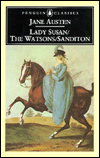
Lady Susan

1127015.gifPosts on Lady Susan aren’t due until tomorrow, but as the Hobgoblin and I are going on a long hike, and I’m not sure I’ll feel like posting when we get back, I’m going to write on it now. I enjoyed this book very much; it was a pleasure to read something by Jane Austen I hadn’t read before. I’m very familiar with her six major novels, but there is still a lot of shorter stuff I haven’t yet gotten to. My edition of Lady Susan includes The Watsons and Sanditon, the first of which I’ve now finished and the last of which I’m going to read next.

I’ve heard many people talk about the limitations of the epistolary form, and it’s probably true that there’s a limited number of things you can do with it, but I do like the form anyway. Perhaps it’s all the reading in the 18C I’ve done, a time when the epistolary novel flourished. What I like about it is the way you can see different versions of a character in the letters written to different audiences, and the way reading an epistolary novel gives one the sense of the importance of words and writing and how people can do battle with language — and other, less violent things, of course. But I think of doing battle with language when I think about Lady Susan, as Susan seems to be at war with much of the world.

Here is what she says in the very first letter of the novel:

I can no longer refuse myself the pleasure of profiting by your kind invitation when we last parted, of spending some weeks with you at Churchill … I impatiently look forward to the hour when I shall be admitted into your delightful retirement.

And this is what she says in the second letter of the novel:

I take town in my way to that insupportable spot, a country village, for I am really going to Churchill. Forgive me, my dear friend, it is my last resource. Were there another place in England open to me, I would prefer it.

Already we know so much about Lady Susan. She presents herself in very different ways in these letters, but even within one letter, her language can be interpreted in multiple ways. She writes the following to her brother-in-law, the owner of Churchill:

I am determined you see, not to be denied admittance at Churchill. It would indeed give me most painful sensations to know that it were not in your power to receive me.

As this is the novel’s first letter, we might interpret this to mean that Lady Susan wants to visit Churchill very much because she is genuinely interested in seeing those who live there, and this is the meaning she expects her brother-in-law to find. Upon knowing something more about Lady Susan, however, we can see that these sentences hint at her real feelings: she must leave her current residence, Langford, home of the Manwarings, because she has gotten herself into trouble there, and if she cannot stay at Churchill, she will experience “painful sensations” because her escape route will be blocked.

It’s this kind of facility with language that makes Lady Susan a very fun heroine — or villain, rather, except that, as Margaret Drabble, author of the introduction to my edition, points out, there really is no satisfactory heroine here, so Lady Susan steals the show. She prides herself on her ability to talk herself into and out of any situation (“If I am vain of anything, it is of my eloquence”); this is how she keeps Reginald, her gullible young admirer, by her side for so long. When Lady Susan can no longer convince people to believe her version of events, the novel ends — there is no more story.

The difference between appearance and reality, and the time and trouble it takes to learn to tell the two apart is a very common plot line in 18C fiction, and Lady Susan has much going for her as she tries to fool nearly everybody. She’s beautiful, and even Mrs. Vernon, her most serious enemy, is susceptible to it:

She is delicately fair, with fine grey eyes and dark eyelashes; and from her appearance one would not suppose her more than five and twenty, though she must in fact be ten years older … Her address to me was so gentle, frank and even affectionate, that if I had not known how much she has always disliked me for marrying Mr Vernon, and that we had never met before, I should have imagined her an attached friend.

Lady Susan is a symptom of a larger problem:

One is apt I believe to connect assurance of manner with coquetry, and to expect that an impudent address will necessarily attend an impudent mind; at least I was myself prepared for an improper degree of confidence in Lady Susan; but her countenance is absolutely sweet, and her voice and manner winningly mild.

We expect people’s insides to match their outsides, in other words — to be beautiful only if their hearts and minds are beautiful, and to act mildly and kindly only if they have mild and kind minds. Someone who combines a beautiful appearance and pleasant manners with lying and deceit is dangerous.

So Lady Susan depends on her pleasing appearance and behavior to keep her out of trouble and to get her whatever she wants. Besides the appearance vs. reality theme, there’s the juxposition in the novel between public reputation and the impression a person makes in private. Lady Susan counts on the power of private impression to overrule reputation; of her enemy Mrs. Vernon she says:

I hope [she is] convinced how little the ungenerous representations of any one to the disadvantage of another will avail, when opposed to the immediate influence of intellect and manner.

The novel shows, however, that reputation does mean something, and that the “ungenerous representations” of Lady Susan are a better source of truth than anything she herself says or does. You are better off trusting public concensus than trusting your own instincts — collective wisdom outweighs the individual’s insights.

Opposed to Lady Susan’s doubleness and deception is her daughter Frederica, whose simplicity Lady Susan cannot stand:

Her feelings are tolerably lively, and she is so charmingly artless in their display, as to afford the most reasonable hope of her being ridiculed and despised by every man who sees her. Artlessness will never do in love matters, and that girl is born a simpleton who has it either by nature or affectation.

Frederica’s artlessness is held up for praise in the novel; her mother’s criticism is a sign that we are to admire her, and yet she is a boring and lifeless character. All the interest in the novel belongs to Lady Susan. So we are left to deplore Lady Susan’s cruelty and deceitfulness, and yet we can’t help but admire her energy and intelligence and, yes, her artfulness and artifice. After all, Lady Susan’s skill with language is a skill she shares with her creator.

If you’d like to join the discussion of Lady Susan, come on over to Metaxu Cafe!

7 Comments

Filed under Books, Fiction

Aunt Julia and the Scriptwriter

I recently finished Mario Vargas Llosa’s novel Aunt Julia and the Scriptwriter, which turned out to be a fun read — it’s a light, comic novel, but it also plays around with ideas about writing and the writer and stories, which gives the book some depth. Apparently, the book is somewhat autobiographical, based on the relationship leading up to Vargas Llosa’s first marriage, and the real-life Julia wrote her own side of the story in a book called What Little Vargas Didn’t Say. I don’t know anything about Julia’s book, but judging by the title, Vargas probably didn’t like it.

The novel tells the story of Mario, an 18-year-old university student in Lima who works at a local radio station preparing news bulletins. Part of the story is about how he falls in love with “Aunt” Julia — she’s related to Mario only by marriage — but their relationship is still scandalous because she’s 32 and divorced. The other part is about Pedro Camacho, a scriptwriter recently come to write serials for the radio station. He soon becomes hugely popular as radio listeners find themselves enthralled by his stories, but then the stories start to take some very odd turns and nobody knows what to do with Camacho anymore. Camacho is a very odd character, with strange ticks and mannerisms, a unusual physical appearance (he’s almost short enough to be considered a dwarf), a self-centered and imperious manner, and some disturbing prejudices against Argentinians and against women generally.

These two plot lines unfold slowly over the novel’s course; every other chapter, however, gives the story of one of the serials Camacho is writing, appearing in the novel as regular prose, not in script form. These stories are soap operas, dramatic, shocking, and fun. But as Camacho’s serials start to turn strange, so too do these interpolated chapters. Characters get interchanged with one another, plot lines get mixed up, characters from one story begin to appear in another, and eventually the authorial voice has lost control of the stories entirely. By the end of the book we don’t have straightforward stories anymore, but attempts at plot filled with questions about the plot direction and the characters’ fates.

Camacho has become overwhelmed by his own productivity; he had been producing scripts at such a wild rate, that he begins to forget his plot lines and characters, collapsing under the strain of his long hours. It has turned into a battle between the author, trying to give form and shape to life, and chaos, undermining the very possibility of coherence and order.

Meanwhile, Mario himself dreams of becoming a writer. He watches Camacho with interest, trying to figure out the secret of Camacho’s amazing productivity:

Riding back to Miraflores in a jitney, I thought about Pedro Camacho’s life. What social milieu, what concatenation of circumstances, persons, relations, problems, events, happenstances had produced this literary vocation (literary? if not that what should it be called then?) that had somehow come to fruition, found expression in an oeuvre and secured an audience? How could he be, at one and the same time, a parody of the writer and the only person in Peru who, by virtue of the time devoted to his craft and the works he produced, was worthy of that name?

Mario thinks about what it means to be a writer, and whether he’s capable of becoming one himself.  Camacho is very nearly the perfect definition of a hack writer, churning out the melodramatic stories day after day, but, at this point in the story at least, Mario can’t help but admire his energy and his ease with words and stories:

It was becoming clearer and clearer to me each day that the only thing I wanted to be in life was a writer, and I was also becoming more and more convinced each day that the only way to be one was to devote oneself heart and soul to literature. I didn’t want in the least to be a hack writer or a part-time one, but a real one like — who? The only person I met who came closest to being this full-time writer, obsessed and impassioned by his vocation, was the Bolivian author of radio serials: that was why he fascinated me so.

So this is a love story, but also a story about stories and about writing as a vocation. It’s a novel of the writer-in-training, about a character who lives through the excitement of teenage love and rebellion but who also gets a chance to watch a writer at work and to think about what kind of writer he wants to be.

9 Comments

Filed under Books, Fiction

Special Topics in Calamity Physics

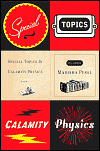
10745276.gifI feel decidedly so-so about this book, Marisha Pessl’s Special Topics in Calamity Physics. For one thing, I thought it was too long at over 500 pages; I have no problem with 500-page novels generally speaking, but the pacing of this particular long novel struck me as odd. It meandered along for 300 pages or so, with some interesting events and character interactions but without a strong sense of forward motion, and then at page 300, something really exciting happened and the book took off in a new direction. I won’t even hint at what the exciting event or the new direction is, so don’t worry about continuing to read this post if you plan on reading the novel in the future. But before this exciting event I found myself putting the book down without too much trouble, and after, it was much harder. I suppose the good news is that the book does eventually take off, but the bad news is that it does so so late.
The story is about Blue Van Meer, a teenager, and her father Gareth, a Political Science professor; Gareth is constantly taking on new Visiting Professor positions and so the two of them move just about every semester. Blue has learned very well how to make her way in strange new schools and new towns and talks about the dynamics of the High School social scene in jaded, cynical terms. But during her senior year, her father finally takes a year-long appointment, and Blue settles into the St. Gallway School, an elite private school known for sending its students to the Ivies.

Here Blue meets a beautiful, mysterious film studies teacher, Hannah Schneider. Blue notices that Hannah spends a good bit of her free time with a clique of five students whom Blue calls the blue-bloods; they have a meal together every Sunday, and soon Hannah invites Blue along. From this point on, the story is about the agonizingly slow way Blue befriends the blue-bloods, although her status in this group is always tenuous, and about the fascination the students have with Hannah’s personality and her past. Hannah seems suspiciously careful not to give away any details of her life before she began teaching at St. Gallway.

But none of this tells you much about how the book is written, and here I come to some of my other doubts about the novel. First of all, Pessl uses a syllabus format to organize the story; “Special Topics in Calamity Physics” is the name of the course and the course readings become the titles of individual chapters. Every chapter is named after some work of literature; we begin with Othello and end with The Metamorphoses. The novel’s introduction explains that Blue couldn’t figure out how to tell her story (the novel is in first-person from Blue’s perspective) until she hit on the syllabus idea, which gives her an organizing structure. The novel ends with a final exam. This format is original and amusing, but I found it only incidental to the unfolding of the story; sometimes I’d notice parallels between the chapter title and the chapter’s content, but often I’d forget I was supposedly reading through a syllabus, and I don’t think I missed anything by it. The structure struck me as more clever than useful.

As part of the “academic” format of the book, there are citations sprinkled throughout the book. Sometimes these take the form of documenting books mentioned in the narrative; for example, Pessl will give us something like this:

One Sunday, I watched in awe while Hannah fixed her own recessed doorbell with electrician gloves, screwdriver and voltmeter — not the easiest of processes, if one reads Mr. Fix-It’s Guide to Rewiring the Home (Thurber, 2002).

Often, these citations are of books not mentioned in the narrative, but provided as “documentation” of whatever point Blue is making. Usually these citations are an ironic counterpoint to the story’s details, for example:

It was the first Friday of November and Jade had gone to considerable lengths to pick out my outfit: four-inch malevolent gold sandals two sizes too big and a gold lame dress that rippled all over me like a Shar-pei (see “Traditional Wife’s Bound Feet,” History of China, Ming, 1961, p. 214; “Darcel,” Remembering “Solid Gold,” LaVitte, 1989, p. 29).

All this means the book has a very odd narrative voice. There are really two voices at work in this book, the knowledgeable, hyper-educated, fledging academic voice, and, hiding behind it, the voice of a lonely and scared teen. Blue comes across as incredibly well-educated, as old and experienced and world-weary, although, of course, she’s very young. But she also comes across as extremely vulnerable, and the novel’s rather bizarre ending bears this out. The academic trappings of the story come to seem like a coping mechanism, a way of finding order and meaning in a very chaotic life.

I feel like I can appreciate some of the things Pessl is doing here, especially with the narrative voice, but ultimately all the playfulness and experimentation didn’t come together for me. I just didn’t feel engaged, or at least consistently engaged, with the story.

I am curious to hear about other people’s experiences with the book, however, because I can see how other people might have enjoyed it very much.  It just didn’t work that well for this particular reader.

13 Comments

Filed under Books, Fiction

The History of Love (and other things)

I’ve just checked out this year’s National Book Critics Circle awards, and I’m seeing that it’s good I’ve got Kiran Desai’s The Inheritance of Loss on my shelves, as she won for fiction, and the awards have also reminded me that I’d like to read Daniel Mendelsohn’s book The Lost: A Search for Six of Six Million, which won for autobiography and that I must, must, must read Lawrence Weschler soon, whose book Everything that Rises: A Book of Convergences won for criticism. I’ve got his book Vermeer in Bosnia on my shelves. I don’t like letting prizes dictate my reading — I like at least to pretend that I make book choices based on my own insights rather than other people’s, although surely that’s largely an illusion — but the awards are reminding me of books I’ve been interested in lately (the hundreds and hundreds of them — there’s little likelihood I’m getting to any of these really soon).

I finished Special Topics in Calamity Physics a couple days ago (post on that to come), and so now I’m working on finishing up some of my other books and will then choose another novel. I can’t decide exactly what I need right now — something old, perhaps Elizabeth Gaskell’s Wives and Daughters, or something new (and shorter) like Kazuo Ishiguro’s Never Let Me Go. Or something entirely different. We’ll see. I’ll let the impulse of the moment guide me.

But for now I want to write about having finished the audiobook of Nicole Krauss’s The History of Love, which I enjoyed very much and highly recommend. I find it hard to write about audiobooks because I don’t have the book in front of me to look at, and I can’t refresh my memory of the plot details or give you quotations, but I can say that this has some great characters and an intriguing plot, it has humor and pathos, it’s about people who write and who love books and reading, and although the book’s title makes it sound like it might be hopelessly and annoyingly sentimental, it’s not.

The novel introduces you to various characters and then throughout the story brings them closer and closer and reveals unexpected connections among them. It feels a little bit like a mystery. There’s Leo Gursky, an old man living in isolation in New York City, who has loved one woman in his life, named Alma, whom he knew when he was a boy in Poland, and then lost when she moved to America. He had written a novel called The History of Love before emigrating to America himself, but, because he left his hometown fleeing the Nazis, he lost the manuscript. There’s another Alma who’s a 14-year old trying to deal with her mother’s depression and her brother’s worrisome obsession with religion, who becomes fascinated with a novel called The History of Love, which her mother is translating. Much of the pleasure of the novel comes from the way it unravels the mystery of what happened to the manuscript and how Leo’s and Alma’s lives are connected.

I really liked Leo’s character; he’s funny and wise, and the narrator who read the sections devoted to him had a wonderful voice and accent. The narrator who read Alma’s sections had a voice I found a little grating, but she’s a wonderful character too, odd and quirky and smart in a way that can make teenagers’ lives a misery but turns them into fascinating adults.

This book is a pleasure, plain and simple.

12 Comments

Filed under Books, Fiction

My latest audiobooks

10744574.gifLast time I wrote about audiobooks, I was in the middle of listening to Jennifer Egan’s The Keep. Well, now I’ve finished it, and I have to say I wasn’t all that terribly impressed. The story never quite came together for me; I never really came to care about the characters all that much. And then there was a strange shift in narrators near the end, along with a new reader, so I felt like I was listening to a completely new book and it was jarring. The thing is, on the back of the CD case were pictured two readers, a man and a woman, so I knew another reader would be coming along at some point, but since it didn’t happen until near the end of the novel, I spent quite a long time wondering when the reader would shift. I found it irritating. This is not the fault of the book, of course, just some unfortunate circumstances that kept me from giving it a fair chance, I suppose.

The novel is about two stories that intertwine; one is about Danny, a tough, New York City guy who gets into some trouble and so jumps at the opportunity to go visit his cousin in Europe. This cousin owns and is renovating a castle somewhere on Germany’s border. The other story is about Ray, a guy in prison who is taking a writing class and is falling in love with his instructor. I liked the beginning of the novel, which has a harrowing scene from Danny’s childhood where he and some friends abandon his cousin in a cave, but the rest of the novel doesn’t live up to this beginning. It’s got some odd, fantastical, magic-realism elements to it that I didn’t really get the point of and I wasn’t all that interested in the novel’s ideas. It’s a reworking of the gothic, with the castle and some mystery and a frightening Baroness, but Egan didn’t convince me that there was a larger point to this reworking, besides the chance to have some fun writing about Baronesses and castles.

But I’m now listening to Nicole Krauss’s The History of Love, and so far I’m liking it much better. This book also has multiple narrators and multiple readers, but it’s got more of a regular pattern to it, which works just fine. The only problem is that one of the CDs is damaged; I’m having to miss maybe 5-10 minutes of the story. I’m liking the book enough I considered buying a paper copy and reading it the regular way, but not having been at a bookstore lately, I haven’t had the chance. We’ll see if I can piece together the story.

I liked the first narrator very much; he’s Leo Gursky, an old man living in New York City, who has only one friend, Bruno, and who is lonely. Leo and Bruno check every day to make sure the other person is still alive. Leo feels so isolated he goes about the city making scenes and being difficult to make sure that people notice him. He doesn’t want to die on a day nobody has seen him. He is so desperate to be seen, he volunteers to be a nude model in a drawing class; he is happy to think that people will be staring at him for hours and creating images of his body. Leo has a wonderfully humorous voice, and the man who reads this section does a wonderful job. After Leo, the book shifts to Alma, a young girl who is trying to find a boyfriend for her depressed mother. We shall see where this book takes me …

14 Comments

Filed under Books, Fiction

The Rings of Saturn

1525990.gifI finished W.G. Sebald’s The Rings of Saturn yesterday, and it has won me over; I admire this book, although I still find it a bit baffling. But this is not a bad thing, not at all. First of all, how do I categorize this book when I’m counting up the things I’ve read this year — is it fiction or nonfiction? How do I categorize this post? The book’s publishers have labeled it “fiction,” this word appearing on the back cover to tell bookstores where to shelve it, but I wonder what Sebald would think of this. To me, it feels more like nonfiction, an account of someone — someone like Sebald — who takes a walking tour on the eastern coast of England and writes about it and so much else. It has the feel of a long, meditative essay.

Sebald describes the stages of his narrator’s journey, telling us about having walked a certain number of hours on a particular day and about getting lost in a maze on another day and about looking out across the sea, but these things are only small parts of the story. He also digresses into long stories about many other things. And here is a central question of the book — how do all the stories fit together? Why did he choose to tell these particular stories?

These stories include the history of the herring industry; a short biography of Joseph Conrad and an account of the devastations of colonialism in Africa that Conrad witnessed; an account of how the production of silk spread from China to Europe; histories of Swinburne, Chateaubriand, and Edward Fitzgerald; massacres in Bosnia; the opening up of China to the west, and many others. Most of these stories (all of them? I’m not sure) connect with the landscape and the towns the narrator is walking through; his location is the starting point for meditations on far-flung times and places.

The narrative veers off in different directions without much warning; I often found myself looking up from the page trying to figure out how I’d gotten to some new subject and then having to go back to hunt down the path the narrator follows from story to story. This is partly why I felt a bit baffled and disoriented while reading; I never knew where I’d end up, what person or what century I’d be reading about next.

Many of these stories tell of the violence humans inflict on one another. It tells tales of horror and destruction that cover the globe. The tone is very matter-of-fact, though; the writing is unemotional, letting the stories themselves do the work of creating an emotional impact on the reader. Now and then, but only very occasionally, the narrator will comment on what all these stories add up to, and the picture is bleak (these quotations are in different places in the book):

If we view ourselves from a great height, it is frightening to realize how little we know about our species, our purpose and our end.

It seems to me sometimes that we never got used to being on this earth and life is just one great, ongoing, incomprehensible blunder.

Within the overall context of the task of remembering, such colorful accounts of military spectacles and large-scale operations form what might be called the highlights of history which staggers blindly from one disaster to the next.

This last quotation sums up the book, in a way — it labors on the “task of remembering” and tells some of the “highlights of history,” not to gain perspective on them or to draw conclusions about them, but simply to recount them and fix them in our memories. If history staggers blindly from one disaster to the next, we can do little better as we attempt to understand it. Looking at the Waterloo Panorama, a reconstruction of the battle site, the narrator says:

This then, I thought, as I looked around me, is the representation of history. It requires a falsification of perspective. We, the survivors, see everything from above, see everything at once, and still we do not know how it was.

The book both tells how things are and denies its ability to tell how things are. This is why I’m not troubled by my slightly bewildered and baffled response to the book; it purposely fails to guide the reader through it, to offer the comforting conclusions and the larger perspective.

I must mention the beautiful and haunting photographs; these are sprinkled throughout the book — pictures of the landscapes the narrator sees, of historical figures, of manuscripts and handwriting, of maps. Sebald himself is in one picture; he’s leaning against a huge cedar tree, a tree he tells us will soon collapse in a hurricane. He is a figure of innocence and ignorance — what we all are in the face of an unknown future.

I would like to read this book again sometime; I don’t know when, but it’s that kind of book, the kind that is worth coming back to.

Update: There’s an interview with Sebald here if you are interested; thanks to Brad for pointing this out to me.

7 Comments

Filed under Books, Fiction, Nonfiction