Category Archives: Books

Reading Updates

I mentioned visiting a bunch of bookstores in London, and I spent a good bit of time in the two bookstores in Dingle, so I’d better tell you what I bought:

  • Chet Raymo’s Climbing Brandon: Science and Faith on Ireland’s Holy Mountain. Hobgoblin has already read this one, and he told me it’s good. Mt. Brandon is on the Dingle Peninsula, and I climbed it while we were there. We had a gorgeous view of the summit and surrounding area until about 3/4 of the way to the top, when the fog moved in and we could no longer see anything. Still, it was a great experience. We went up the back side of the mountain, and on the way down the front side, the most commonly-climbed side, we saw crosses through the mist at regularly paced intervals to mark the path religious pilgrims take. This book tells the story of how it became a religious site. I picked it up in the shop specializing in all things Irish.
  • At Dingle’s other shop, I bought Hermione Lee’s Body Parts: Essays on Life-writing. I already have the American version of this book, called Virginia Woolf’s Nose, but that one is a lot shorter than the British version, with many fewer essays. I liked the parts of Lee’s book I’ve read already, so I was glad to find the rest.
  • The rest of the books come from London. Since I never find books by Jenny Diski in American stores, I brought home three of them, including her new one, What I Don’t Know About Animals. This is one of those books that I wouldn’t be interested in at all if knew only the title, but with Diski writing it, I’ll read it happily.
  • Also, A View From the Bed and Other Observations, a collection of essays. I already read a few of them about moving to Cambridge that I thought were great.
  • And one Diski novel, Apology for the Woman Writing, about Marie de Gournay, friend of Montaigne.
  • Norma Clarke’s The Rise and Fall of the Woman of Letters, about eighteenth-century women writers and their changing fortunes throughout the century.
  • Travel Writing, by Carl Thompson, kind of an overview of the history of travel writing and current critical debates about it. This will be useful for my class on literature and the journey this fall.
  • Lila Azam Zanganeh’s The Enchanter: Nabokov and Happiness. I just heard an interview with Zanganeh on the radio yesterday, and it was great. This is a personal meditation on Nabokov and his writing.
  • Daisy Hay’s Young Romantics: The Tangled Lives of English Poetry’s Greatest Generation. It’s about Byron and the Shelleys and other people in their circle. It will make a good addition to my collection of Romantic biographies, and it’s particularly appealing as a group biography.
  • Monica Dickens’s Mariana. This was my selection from the Persephone shop. The only thing that kept me from buying more was fear that my suitcase would be too heavy.
  • The Letters of Dorothy Wordsworth: A Selection. I’ve been reading this one slowly since the plane trip home. It’s fun to learn about her life and to get her perspective on what her brother William and his friends were up to.

I’m not sure I’ll be able to write detailed posts on what I read while I was traveling, but in case you’re curious, I started out with Edith Wharton’s Custom of the Country (read on my Nook), which was great. I loved returning to her; she is such a great chronicler of social ambition. Then I read the second Mary Russell novel, which I liked quite a lot, after not particularly liking the first one. A Monstrous Regiment of Women was much more focused and coherent than her first, and I liked the London setting. The Mary Russell put me in the mood to read a Dorothy Sayers, so I read Clouds of Witness, also on my Nook. Dorothy Sayers is so much fun! I suspect my favorite will remain Gaudy Night, but I liked this one a lot too.

At the same time, I was reading Geoff Dyer’s collection of essays Otherwise Known As the Human Condition (the first book I bought for my Nook), which was fabulous. This is one it would be worth writing more about, but in case I don’t, I was surprised at how much I loved the essays on photography with which the book begins. I know very little about photography, so these essays taught me a lot, and Dyer’s voice is so fabulously entertaining. His essays on literature were good, but I was less taken with those, perhaps because the subject matter was more familiar. The book ends with personal essays, almost all of which I loved.

I didn’t read much while we were in London, but I started Monique Roffey’s White Woman on the Green Bicycle, and I finished it on the plane home. That one I do want to write a full post on, so more on that later.

Since I’ve been home, I’ve had a little trouble concentrating on reading, but I did finish up the Dyer collection and read Willa Cather’s novel The Professor’s House. Perhaps more on that later. Just today I started Josephine Tey’s The Daughter of Time for my mystery book group meeting next week, and I’m still reading the Dorothy Wordsworth letters now and then.

And I think that catches you up on my bookish news. Have a great weekend everyone!

14 Comments

Filed under Books, Lists

Do I have to come home?

All is going splendidly here. The weather hasn’t been the best, but we have fit in most of what we wanted to do in the dry spells. Over the weekend was a trip to Killarney, which involved a walk to Ross Castle, a bike ride to Muckross House and a gorgeous waterfall. This week has meant more visits to the Dingle peninsula coastline and several archeological expeditions where we saw ancient churches and fortresses. We have also experienced a bit of the local music scene, with live music in a pub, which I understand takes place in many pubs on just about any night of the week. Last night we went to Sean-nos, which is old-style a cappela Irish singing. Since it was four Irish singers and about 40 or so Americans, I don’t think the evening was quite traditional — there were some cowboy songs and pop songs thrown in there as well.

One of the best things about this trip is that we have had more contact with local people than most tourists do, since there is a local man in charge of the school activities, and he introduces us to all kinds of interesting people. We have had various guides take us around to the historical sites, all of whom have been extremely knowledgeable and very, very nice. Yesterday after the students’ archeological tour was over, Hobgoblin and I went with the guide on an extended tour of lesser-known religious sites, which involved tramping through mud, climbing over barbed wire, and sharing fields with outraged cows. It was most awesome. I do not want to go home!

Unfortunately, the slow wireless isn’t letting me post pictures right now, but perhaps I will have time to later.

8 Comments

Filed under Books

The Irish Coast

There are some gorgeous beaches here. A couple more photos:

11 Comments

Filed under Books

The Dingle Peninsula

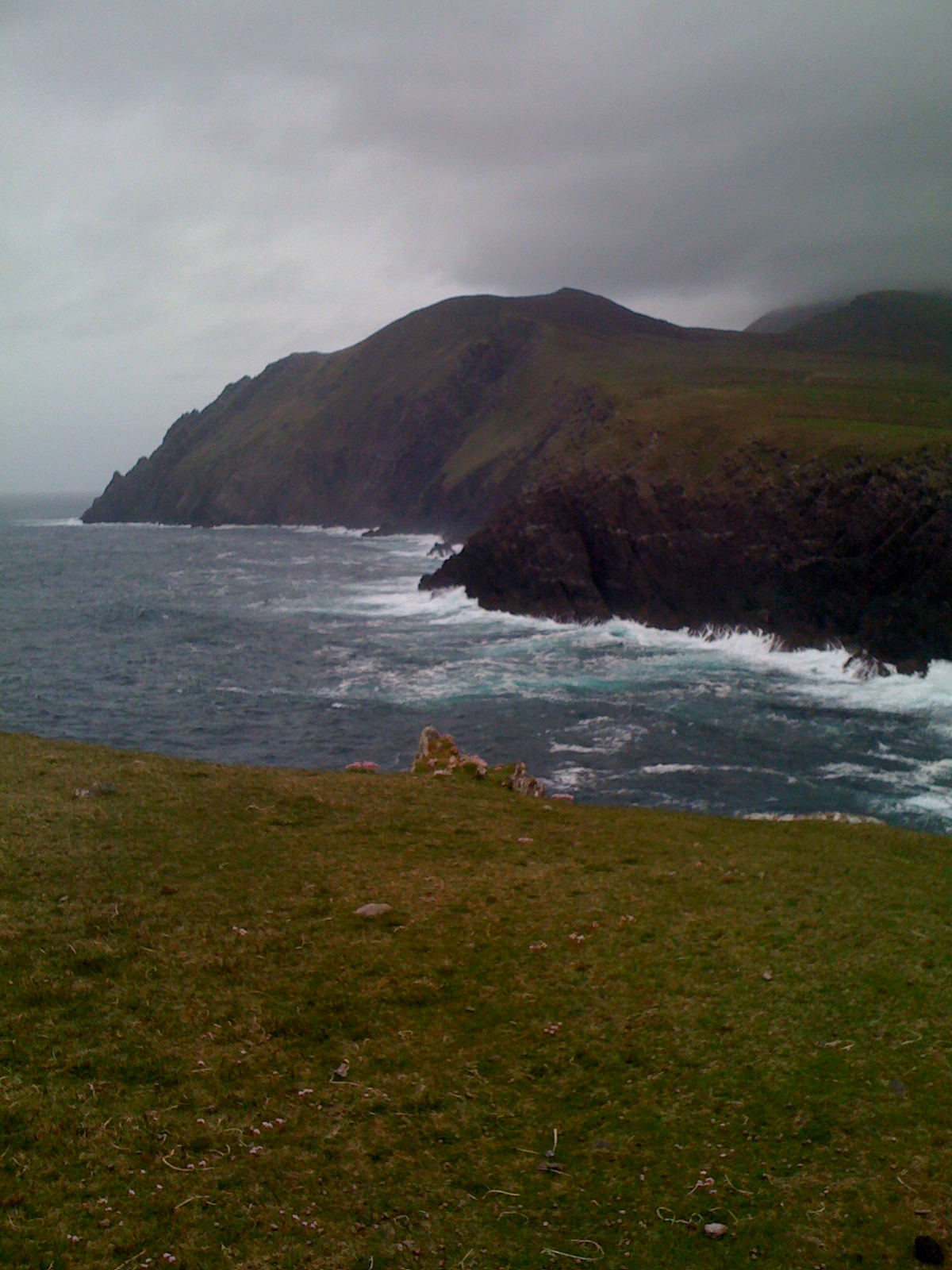
Hobgoblin is teaching, so I have a little time to post some photos. He usually has the camera, but I have a few pictures from my iPhone. This one is from a field trip we took with Hobgoblin’s class yesterday to the place where St. Brendan most likely set sail on his journey across the Atlantic. It was a gorgeous piece of coastline. Another view:

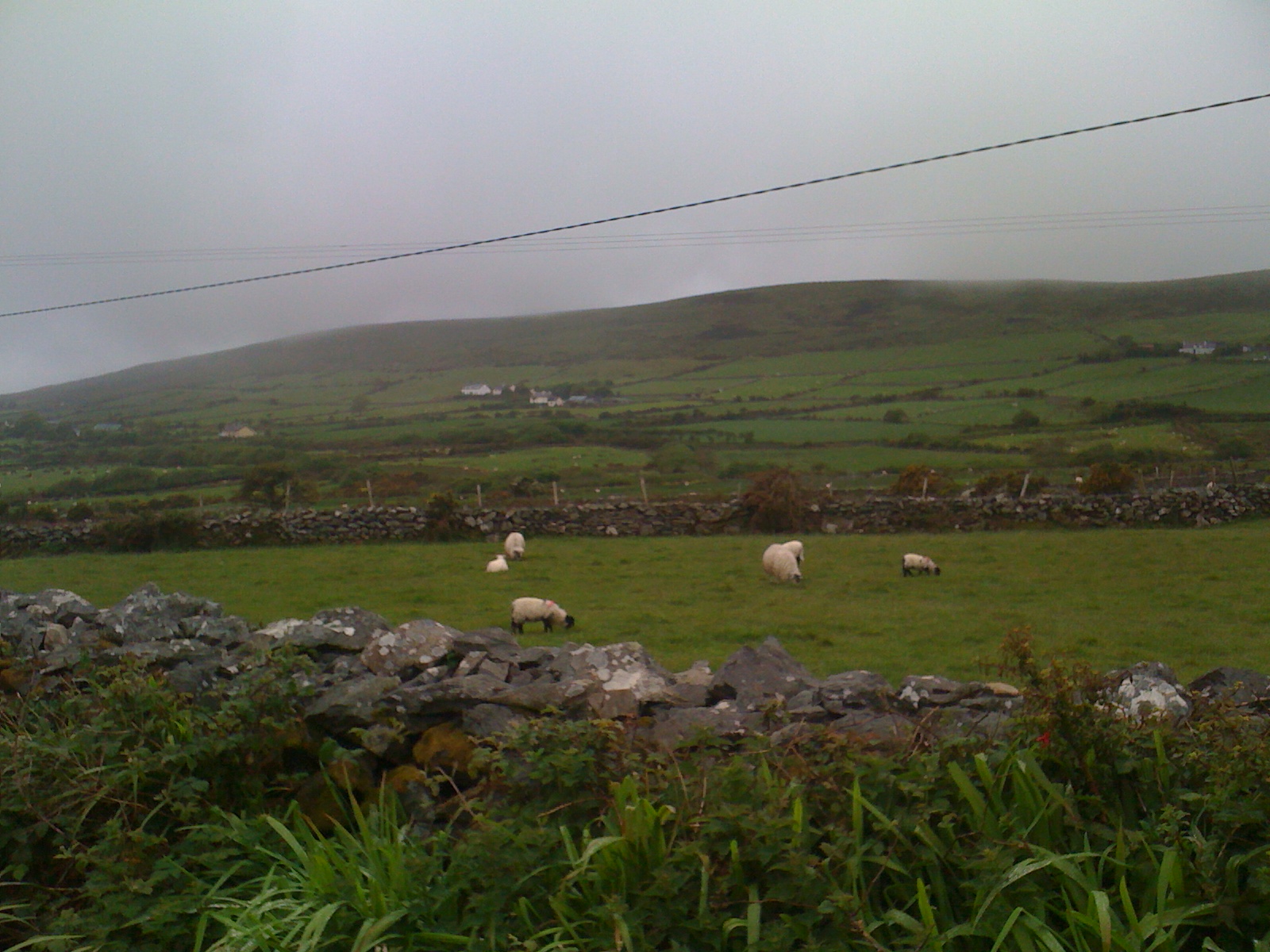
And here are a couple pictures from a walk I took this morning. It’s misty and chilly today, although I hear the sun is supposed to return tomorrow. I walked along the Dingle way, which is a path that takes you around the entire Dingle Peninsula. I only covered a couple miles, but it was a nice view of the countryside:

The trip has been quite good so far. I’ve had a chance to explore the town of Dingle and see a few sights, as well as spend time reading and taking naps. We are here for two weeks, and I like the leisurely pace of our visit.

13 Comments

Filed under Books

Open City, by Teju Cole

I just finished Teju Cole’s recent novel Open City last night, and although I had some doubts about it early on, it ended up winning me over and by the time I finished, I was loving it. Open City is often compared to W.G. Sebald’s books, and I felt about Cole the same way I feel about Sebald: I love the idea of the books but am not always sure about the execution. What bothers me at times is the reticence and emotional distance of the narrators. That is exactly what bothered me about Peter Stamm’s novel Seven Years. At times the writing in all these books crosses the line from being calm, quiet, and meditative into being dull.

But I do admire much in Sebald, and Cole’s novel finally won me over. It is about a man in his 30s, Julius, who is a psychiatrist in training and who spends his free time walking around New York City and, briefly, Brussels. The novel has no plot, but simply describes the narrator’s experiences and thoughts as he observes and interacts with people and with the city’s art and history. His thoughts keep returning to similar themes, so the various stories, descriptions, and meditations, rather than a plot line, provide the book’s coherence. Julius is fascinated by cities and the way their history is built in layers, with traces of the past existing underneath the present, like a palimpsest. As he walks, he notices traces of history: monuments and plaques and old buildings that don’t fit in their new neighborhoods. He describes the changes shops, buildings, and blocks have undergone. He is also interested in how people interact in cities, the way the crowds look and what it feels like to walk down streets and in and out of shops. He is extremely observant but is not only an observer; he often strikes up conversations with people or finds people talking to him. Although he comes across as reserved, he makes friends, or at least acquaintances, easily.

He also thinks about issues on a larger scale: the long and sad history of human violence, religious  and racial conflicts, the way identity is constructed and how that construction can lead to social and political tension. He has conversations with a recent acquaintance in Brussels about orientalism and east/west tensions, and the anger many immigrants in Europe feel at their often unwelcome reception and uncertain status. Inevitably, back in New York, he thinks about the World Trade Center and everything the empty space where the towers used to stand says about human conflicts that just won’t go away.

We also get his thoughts on his own history and personal experiences:  his relationships with his German mother and his Nigerian father, what it was like going to his boarding school in Nigeria and moving to America at 17, the racial tensions he experienced in both places, the grandmother he would like to reconnect with but can’t find. It’s in search of this grandmother that he goes to Brussels, but he only looks for her halfheartedly, and he doesn’t explain this reasons for his halfheartedness. I got the feeling as I read along, that there were a lot of things Julius wasn’t really explaining. He and a girlfriend have just broken up, and he describes his ambivalent feelings about her and his sorrow at their ended relationship, but there’s a sense he is not plumbing the depths of his feelings with us. He tends to stay on the surface of things, as one walking around a city observes from the outside and only gets brief glimpses at the life going on inside the houses and shops.

What makes this novel work is the way its themes and motifs weave their way in and out of the text, creating repetitions and echoes that resonate the whole way through. It’s easy to miss these connections if you read too quickly; this is a book that asks you to slow down and savor its images and juxtapositions. There is often a quietly ironic tone as one anecdote contrasts or obliquely comments on another one, and it’s a pleasure to follow the path of Julius’s thoughts, which are as suggestive as his walks, even if they are the same time disorderly and directionless.

Or perhaps the thoughts and the walks only seem directionless. There’s certainly a craft to creating the impression of drifting while at the same time actually getting somewhere. We don’t arrive at any new place or at some new realization or lesson, but we end up at a feeling of completion, of the pieces fitting together, the ideas connecting to one another. The novel reminds me of one of my favorite essays, “Street Haunting” by Virginia Woolf. Woolf’s tone is much lighter than Cole’s, but both writers use the occasion of a city walk to meditate on subjects large and small, moving (seemingly) effortlessly from the mundane to the philosophical in the space of a paragraph. It’s quite a trick to do that, and it’s a trick I admire very much.

7 Comments

Filed under Books, Fiction

Seven Years

My Ireland trip is fast approaching (this coming Thursday), and I’m losing my motivation to do anything but read and nap in preparation for vacation sloth. But I wanted to write something at least about Peter Stamm’s novel Seven Years before too much time passes. This novel is written in a distanced, emotionally-detached style while taking as its subject matter emotional detachment. It makes me wonder the extent to which those two things necessarily go together. Perhaps it is possible to write a heated, passionate novel about emotional coldness, but Seven Years is written in the first person from the point of view of someone who doesn’t know much about what he feels and wants, which makes a certain amount of detachment and distance in the writing inevitable.

The story is about a love triangle involving the narrator, Alex, his wife, Sonia, and Ivona, a woman with whom Alex has an inexplicable attraction — inexplicable to him as well as to everyone else who knows them — ever since he met her. Alex and Sonia meet in architecture school in Munich and go on to run an architecture business together. Their relationship begins in a halting, uncertain manner. There is more awkwardness than passion between them; it is as though they know intellectually that they are suited for one another rather than feeling it emotionally.

Alongside the development of this relationship is Alex’s conflicted, on-again, off-again obsession with Ivona, an illegal immigrant from Poland who works in a bookshop. Ivona is unattractive, everyone seems to agree, and also uninteresting. She has nothing of Sonia’s intelligence, style, and poise. She is described in harsh, unforgiving terms as lumpish and bovine. And yet Alex can’t forget her, and he keeps returning to her again and again through his courtship of and marriage to Sonia. Alex is cruel to Ivona and doesn’t seem to care much about it; he knows that she has latched onto him and pinned her hopes on his leaving his wife for her, but still he keeps coming back, not caring much what emotional turmoil she experiences.

This, as you can see, is one of those books where none of the characters are likable and there is no one to sympathize with, except perhaps Ivona, although even there I found her naivete and stubbornness irritating. I don’t mind at all not having anyone to like in the book, however, since the intellectual puzzle of the characters is interesting enough. Alex himself is the biggest mystery, both to himself and to the reader, but Sonia is a puzzle as well, what she knows about Alex and how much she cares. Both characters are living out the life society expects of them, running their business, acquiring a home, raising a child, but they do all this listlessly, carelessly, and only slowly and in the smallest steps do they discover who they are and what they want.

What I found disappointing about the book was that it was hard not to feel as detached and uncertain about the characters as they felt about each other and themselves. Detachment is interesting as a concept, but it doesn’t make for very engaging reading. Here is Alex thinking about Sonia’s past and her personality:

Sonia never did talk much. It often felt as though she had no previous life, or whatever it was had left no traces except in the photograph albums on her bookshelf, which she never took out. When I looked at the pictures, I had the sense that they came from another life. Now and then I asked Sonia about her time with Rudiger, and she gave me monosyllabic replies. She said she never asked me what I’d done before either. It doesn’t bother me, I said. After all, you’re mine now. But Sonia was stubbornly silent. Sometimes I wondered if it wasn’t that there was just nothing to say.

That there might be just nothing to say is an interesting proposition, although a sad one, but it’s interesting — in this novel at least — only in an abstract, analytical way. Still, Stamm captures well the state of not knowing oneself and the consequences that result. At the heart of the book is an emptiness that is frightening. It surely took some courage to try to capture that emptiness on the page.

For another take on the novel, see Michelle’s review of it at the journal Necessary Fiction.

9 Comments

Filed under Books, Fiction

Townie

Andre Dubus III’s memoir Townie is a harrowing read. It wasn’t quite on the same level of emotional intensity as Joyce Carol Oates’s memoir A Widow’s Story, but it, like Oates’s book, was both hard to put down and hard to shake off once I had put it down. It left me feeling somber and needing a little recovery time afterward. All of which I mean in a positive way — Townie was perhaps a bit too long (as was Oates’s book), but still, awfully good.

It tells the story of Dubus’s experiences growing up poor, first with his mother and his famous writer father, but soon enough with his mother alone, along with his three siblings. Even when the family was together, they never had much money, but his parents’ divorce turned a manageable situation into an extremely precarious one. His mother did her best to keep the family going, but money was always short — the family often went hungry — and the mother was either working or home exhausted and wasn’t able to keep tabs on what the children were doing. They moved frequently and usually lived in rough neighborhoods in decaying Massachusetts towns. These were former mill towns where vacant buildings were everywhere and unemployment was high.

Dubus was small and quickly became a target for bullies. Soon enough he was getting beaten up just about every day and lived in fear of running into the wrong people. Even his home wasn’t safe; knowing there were no adults around, local young people would hold afternoon parties in his living room. There was nothing he could do about it. His siblings tried to help him out by telling their mother about the beatings, but not much came of it.

This story of living in constant fear is one of the main threads of the book; eventually, after years of being bullied and doing nothing about it, Dubus decides he can’t take it anymore, and he begins to lift weights. He also learns how to box at a local gym. It takes a long time, but finally he learns that if he is the one who punches first, if he takes his opponent by surprise, he can win a fight. This is a breakthrough moment, a turn of events that lets him feel proud of himself, finally. But there is a downside: now that he has learned how to let his anger out, he isn’t sure he can control it. He becomes the guy who can defend innocent victims, but he is also the guy who starts fights and sends people to the hospital. Does he really want to be that way and are there better ways to handle his anger?

The other major thread running through the book is his relationship with his father. Dubus the father never fully abandoned his children; he sent money faithfully even though he never had much, and he took them out to dinner on Sundays and spent Wednesday evenings with his kids one at a time so they had a chance to see him on their own once a month. But still, there was so much he never knew about what his kids were going through, and poor as he was, his life was much more comfortable than his ex-wife’s. There are painful scenes where he tries to play catch with his son and learns that the son knows absolutely nothing about catching and throwing a ball or about baseball itself. How was he supposed to learn? Dubus never tells his father the truth about his life, out of shyness and shame. He mostly just felt uneasy around his father and was relieved to get away. As Dubus grows older, his relationship with his father becomes much closer, but he is still left with questions: how much should he tell his father? Would there be any point in hurting his father in that way?

Dubus’s story is riveting, both because of its inherent drama and because of the questions it raises about poverty, rage, and violence, and also about what it takes to leave a difficult childhood behind. Dubus writes extremely well: he conjures up the atmosphere of the mill towns he grew up in and evokes his feelings of hopelessness and fear so powerfully that you feel you are experiencing everything alongside him. I heard Dubus say in an interview that he had tried to write about his childhood in fiction but failed, and it was only in the memoir form that he found he could tell the story. In the book he writes about creating characters who were essentially himself, but the stories were never any good because he was trying too hard to make the reader sympathize with his fictionalized self. I don’t quite know what it was about the transition to nonfiction that made telling his story possible, but something clicked for him, and he has told the story wonderfully.

9 Comments

Filed under Books, Nonfiction

AfterWord: Conjuring the Literary Dead

AfterWord: Conjuring the Literary Dead is one of the first books I requested from NetGalley because it’s a collection of essays about writers and books, and I love a good collection about writers and books. I was a little disappointed in it, though; I thought the book’s idea sounded promising, but either I was mistaken about that, or the execution didn’t live up to the possibilities. I think the problem may be that the essays were uneven and perhaps, generally speaking, a little too short. They didn’t dig into their subjects deeply enough and so left me feeling a little dissatisfied.

The premise is that in each essay, a writer imagines a meeting with his or her favorite author, or perhaps an author he or she has written about or grappled with in some fashion. The various essayists tackle this task in different ways, some pretending that they have traveled back in time, some imagining they are meeting their subject in the present day or in some nebulous in-between space. In some cases, the authors know about things that have happened after their deaths, and in others they don’t.

Which, let me digress to say, is something I think about now and then: I remember somebody saying, or perhaps I read it, that the really sad thing about having to die is not knowing how things turn out. I agree with the feeling. I think about people who lived before the time of the novel and what it would be like not to know that a novel existed. Or not to know about Jane Austen or James Joyce or David Foster Wallace, or whoever. Who are the wonderful, amazing writers we won’t know about, and what genres will we not live to experience? Okay, best not to think about that too much…

Some of the essays in this collection are really charming — Cynthia Ozick on Henry James, Jay Parini on Robert Frost, Eugene Goodheart on Jane Austen, Francis King on Oscar Wilde, Jeffrey Meyers on Samuel Johnson. Others made me contemplate how difficult it is to create a convincing scene and realistic dialogue. There were some essayists who I presume were more academic types than fiction writers whose attempts at a kind of fiction writing were awkward. In a couple cases, I simply didn’t like the tone or the attitude expressed.

Mostly, though, I kept thinking about how none of this was real, how all of it was mere speculation. That’s what it’s supposed to be, of course, but it felt a little like reading a description of someone’s dream — an interesting dream, but not much more than that. If I’m going to read about an author’s life, I think I’d prefer either something more straightforwardly critical and argumentative, whether it’s a biography or a critical essay (no matter how imaginatively done) or a fully-realized novel along the lines of Colm Toibin’s The Master.

However, there are some essays I’m glad I read. Perhaps the best approach with this book is to read selectively, finding the essays about authors you find interesting and focusing on those. And for another view entirely, read Stefanie’s post on the book. The book did make me consider who I would write about if I had been a contributor to the collection: perhaps Virginia Woolf or Mary McCarthy. Oh no — it would be Laurence Sterne, definitely. But what in the world would I say to any of these people if I could meet them, even only in my imagination?

10 Comments

Filed under Books, Essays

The Tragedy of Arthur

Arthur Phillips’s new novel The Tragedy of Arthur was great fun. I’ve seen comparisons of this book to Nabokov’s Pale Fire, and the comparison works to a certain extent — they have a similar structure, both made up of a primary text and a commentary on that text — but it’s a rather unfortunate comparison for Phillips’s sake because who can compare to the great Nabokov? This book doesn’t have the insane brilliance of Pale Fire, but there’s a charm and wit to it that are appealing.

The text in Phillips’s case is a “newly discovered” long-lost Shakespeare play, printed in its entirety in the back of the book. The commentary takes the form of a memoir and fills up the first 250 or so pages. This commentary/memoir was supposed to be a standard critical introduction, but the guy who owns the manuscript, a character named Arthur Phillips, agreed to publish the introduction himself and decided to do it exactly as he wanted. It takes the unusual form of a long self-justification including his entire life story and an argument about the play’s authenticity. This question of authenticity is at the heart of the book, and it’s a particularly vexed question because the man who “discovered” the play, Arthur Phillips’s father, is a notorious con man who spent much of his adult life in jail for various forgeries (another book hovering in the background is William Gaddis’s The Recognitions, which is also about artistic forgeries and a difficult father/son relationship).

In this memoir of sorts — which describes a life at least superficially resembling the real Arthur Phillips’s life, both people having published the same novels and lived in at least some of the same places — Phillips tells the story of what it was like to grow up with a criminally unreliable father. This is a father who woke his two children up in the middle of the night, Arthur and his twin sister Dana, and dragged them around a field with strange, heavy machinery for hours and hours in order to convince people that aliens had left crop circles. Arthur grows up not knowing whether anything his father gives him — a signed baseball for example — is real or a forgery. As you can imagine, Arthur has some psychological issues to work out.

His father’s legacy wasn’t all about forgery, however. The cons and forgeries had at their root — or at least this is how the father would explain it — a certain creativity and love of creating experiences of wonder. Thinking about the crop circle and the farmer who originally found it, Arthur writes,

My father didn’t want to make people stupider or mock stupidity or celebrate stupidity. When the farmer said, “The shape. The shape is so … beautiful, so …” and trailed off, my father was right there with him in spirit. I suspect that he wished, of all the participants in this whole enterprise, to be that farmer, to be fooled. My father had given him (and the world) this glimpse of something hidden. He was only dissatisfied to be the giver and not the recipient.

The father is also, along with Dana, thoroughly obsessed with Shakespeare. Arthur grew up with Shakespeare’s language forever in his ears. But this also is a complicated legacy. Arthur decides early on that he doesn’t like Shakespeare much, and while he correctly points out that this isn’t at all unusual, in his case it has at least something to do with the fact that Dana and their father bond over a love of the playwright and Arthur feels left out. He loves his sister dearly and feels he has some very weighty competition for her attention.

So, when his father bequeaths Arthur the lost Shakespeare play, Arthur has some serious thinking to do. Is it possible that this one time his father is telling the truth?

The memoir part of this book is a mix of a whole bunch of things — in addition to memoir, it’s also an anti-memoir, as Arthur complains about the genre every chance he gets, although it’s clear he needs the genre in order to make his point about his father and thus about the Shakespeare (?) play. It also contains a synopsis of the play, because that’s what an introduction is supposed to do, of course, and in that same spirit, it discusses the play’s themes and background. In addition to being all mixed up with the personal stories, however, this critical material is shaped in such a way as to further Arthur’s arguments about his father. It all ultimately revolves around Arthur himself — is the character Arthur in the play The Tragedy of Arthur supposed to be him? Was his father sending him a message?

Arthur writes notes for the play as well, and here it’s personal too: some of the notes speculate on where his father might have gotten his material from, if indeed he did write the play himself. In addition to Arthur’s notes, there are notes from a Shakespeare scholar, and these two voices contradict each other. In addition to everything else going on in this book, it’s also about the uncertainty of scholarship and the impossibility of finding a truly objective point of view. Arthur is obviously a biased reader — given the circumstances there is no way he could be anything else — but the scholar’s readings struck me as questionable as well. It’s clear that he wants the play to be authentic  and some of his justifications and explanations seemed just as unreliable as Arthur’s speculations.

As for the play itself, it’s not bad. Those who claim it’s authentic say that it’s clearly very early Shakespeare, which means readers should not expect greatness of the Hamlet level and that is most certainly not what you get. But for what it is — whatever that is — it’s entertaining, with some fine speeches, interesting action, and a little bit of humor.

This is a playful book — complete with author biographies and publication lists of both Arthur Phillips and Shakespeare, because Shakespeare deserves credit, of course! — and I love that spirit. Give me a highly literary, self-reflexive, self-aware book that’s good but doesn’t take itself too seriously, and I’m a happy reader.

17 Comments

Filed under Books, Fiction

On the Contrary

I enjoyed Mary McCarthy’s essay collection On the Contrary, although many of the pieces felt dated. But there’s a certain kind of datedness that’s interesting, particularly when the topic is literature. It’s fun reading about the literary scene as it existed for McCarthy in the 1950s — the authors she was paying attention to and the ones from previous generations whose reputations she was busy sorting out. She has a way of starting out with a ridiculous claim such as there are no characters in fiction anymore or nobody is writing real novels these days, and I get ready to dismiss the entire essay as absurd, but then she starts defining her terms and giving examples and building up her arguments, and before I know it, I am beginning to agree, at least a little.

Other essays in the book are about the political and social scene, including some essays on feminism; some of these struck me as both relevant to today (in that way some essays can make you think that things never change) and also as dated. The datedness comes from the way she drops references to people and events without explaining them, because of course her audience at the time didn’t need these things explained. This makes me think that McCarthy writes wonderfully well about topical subjects, because in spite of feeling as though I’m out of the loop and lacking the context to understand her references, the essays are quite entertaining and good. How often are topical essays interesting 50 or 60 years later? This book kept me engrossed the whole way through.

The best essays, though, are “Artists in Uniform,” which I wrote about here, and “Settling the Colonel’s Hash,” the title of which is truly awful, but which is a wonderful companion piece to “Artists.” “Settling the Colonel’s Hash” was inspired by responses she got to her the “Artists” essay, in particular, a letter from a school teacher wanting to know, among other things, “how closely do you want the symbols labeled?” Her students had spent a great deal of time discussing the story and while some of them insisted that it had no other meaning than the literal level, most students found it to be full of symbols.

Well, McCarthy didn’t answer this letter, except indirectly in the form of the essay itself, but she came down on the side of the students who read the piece on the literal level. There are symbols in the story, perhaps, but not the kind the students were looking for. The various shades of green she wore on the day described in “Artists in Uniform” were simply what she happened to be wearing that day, not an invention on her part meant to say something about fertility and growth. The contrasting greens she wore might possibly symbolize her desire to look like an artist, a little bohemian, but that’s where it ends. Similarly, the Colonel’s hash might say something about his desire to eat food considered properly manly, while McCarthy chose a more feminine sandwich.

This leads her into a discussion of various types of symbols, those that take the reader out of the text toward the world of archetypes and myths, and those that lead the reader back into the text:

In any account of reality, even a televised one, which comes closest to being a literal transcript or replay, some details are left out as irrelevant (though nothing is really irrelevant). The details that are not eliminated have to stand as symbols of the whole, like stenographic signs, and of course there is an art of selection, even in a newspaper account: the writer, if he has any ability, is looking for the revealing detail that will sum up the picture for the reader in a flash of recognition.

This is the interesting kind of symbol, she argues, the kind that merely is what it is — the shades of green McCarthy wore, the food she ate — while at the same time telegraphing, signaling something about her personality. In another example, there is the train in Anna Karenina:

The train is necessary to the plot of the novel, and I believe it is also symbolic, both of the iron forces of material progress that Tolstoy hated so and that played a part in Anna’s moral destruction, and also of those iron laws of necessity and consequence that govern human action when it remains on the sensual level.

One can read the whole novel, however, without being conscious that the train is a symbol; we do not have to “interpret” to feel that import of doom and loneliness in the train’s whistle …

The essay ultimately turns into an argument about how best to read, which does not involve the kind of symbol-hunting the unfortunate high school teacher encouraged her students to do:

The images of a novel or a story belong, as it were, to a family, very closely knit and inseparable from each other; the parent “idea” of a story or a novel generates events and images all bearing a strong family resemblance. And to understand a story or a novel, you must look for the parent “idea,” which is usually in plain view, if you read quite carefully and literally what the author says.

To illustrate this idea, she gives a close reading of her “Artists” essay, describing what her main point was and how the details of the story relate to that point. This is very satisfying, largely because “Artists” is such a great essay and it’s fun to hear McCarthy discuss the thoughts that went into it. It satisfies our curiosity about what the writer really meant and whether we “got it” or not.

And then she ends with this:

In any work that is truly creative, I believe, the writer cannot be omniscient in advance about the effects that he proposes to produce. The suspense in a novel is not only in the reader, but in the novelist himself, who is intensely curious too about what will happen to the hero…. Hence, I would say to the student of writing that outlines, patterns, arrangements of symbols may have a certain usefulness at the outset for some kinds of minds, but in the end they will have to be scrapped. If the story does not contradict the outline, overrun the pattern, break the symbols, like an insurrection against authority, it is surely a still birth. The natural symbolism of reality has more messages to communicate than the dry Morse code of the disengaged mind.

I’m not sure anything McCarthy says in this essay isn’t something I’ve heard elsewhere, but she says it all so well. There is something about the directness and forcefulness of her style that I love. Typical of McCarthy and the attitude that makes me love her is her statement that in “Artists in Uniform,” “I wanted to embarrass myself and, if possible, the reader too.” Any writer who sets out with that goal in mind is a writer I’m inclined to like.

7 Comments

Filed under Books, Essays

Ireland! And London!

I think I’m heading slowly toward a blogging break, just like I was last year at this time. Maybe it will become a yearly April/May/into the summer thing? I’m riding more, I’m busy at work, and I don’t want to give up reading time. So posting might slow around here a bit. This year things are complicated by the fact that I’m leaving for Ireland in the middle of May and won’t return until a week into June. I’ll have internet access while I’m gone, at least part of the time, but I’ll have to steal Hobgoblin’s laptop away from him if I want to get online, as I don’t see the point of hauling my own around. So, blogging break.

And yes, I’m very excited about Ireland and our week in London afterward. Our plans are slowing coming into place, such as they are. Fortunately, Hobgoblin and I travel in a similar way, which is to say, we don’t make detailed plans. We both like to show up some place and figure things out from there, if possible by throwing our things in the hotel and setting off on foot. This sometimes backfires (we’ve ended up walking into the wrong part of town before), but mostly it’s fun and a good way to get our bearings in a new place. We did buy some travel guides, but we haven’t opened them yet. The plane trip is a good time to read over travel guides, I think.

We will probably buy some theater tickets, but other than that, I can’t bear to make any decisions. My problem with planning, I think, is that it makes the time away feel limited and too short. I don’t want to know what I’m doing every day, or even what I’m going to do at all, because I want to keep the illusion that the vacation will be endless and we will have time for everything. So why plan? We’ll get to it all eventually.

I don’t think I’ve written about why we are going. Up until this point in our lives, Hobgoblin and I have not been able to/not been the type to take off to Europe for a vacation — and we still aren’t, really. We are taking this trip because Hobgoblin will be teaching a two-week course in old Irish literature (that’s all I know about it — something about myths and legends — it’s a class I need to take) for his university. I’m going along for the fun of it, and because it’s relatively cheap: Hobgoblin’s university will cover his airfare and also provide a cottage for us to live in. We figured since so much of the trip is already paid for (and he will be paid for the class itself), why not add on to the trip by going to London? One of the best parts of the whole thing is that we may be able to do the trip again in two years, when it will be his turn to teach in the program again. We’re thinking of going to Paris next time.

But back to this trip … the other thing I’m bad at when it comes to travel is reading books about the place I’m going to visit. Most respectable readers and book bloggers would probably have made up a list of books by Irish authors and books set in Ireland to read in the run-up to the trip and on the plane. But that just doesn’t appeal to me. I’m more likely to read Irish books after the trip, to remind me of the place I’ve just been. For right now, I prefer to keep the whole thing promisingly vague. Don’t tell me what I’m going to experience, other than that the landscape will be beautiful. People have told me that many times, and I was very glad to hear it.

16 Comments

Filed under Books, Life

Maisie Dobbs: A Lesson in Secrets

Jacqueline Winspear’s Maisie Dobbs series is the only series of mystery novels I’ve read in its entirety and that I make a point of keeping up with. I always enjoy them, although I don’t think they are top-notch novels. They are fun, but mostly I keep reading them because I want to find out what happens to the character, and I also find the process of reading through an entire series interesting. I like watching what happens to her over the years, the relationships that begin and end, the jobs that come and go, the ways her personality and experiences change. I like seeing just how much Winspear will develop her character over the course of one book and how she ends certain stories and begins new ones.

I also like seeing how Winspear deals with the changing historical context — the 1920s into the 1930s — and how that context shapes the mysteries Maisie attempts to solve. The earlier books focused on the lingering consequences of World War I, especially veterans suffering from war wounds, both physical and mental, that they couldn’t quite recover from. More recently, and especially in this latest book, Winspear is beginning to shift her focus onto the new conflict on its way, although World War I still plays an important role in the story. There is a heavy sense of foreboding in A Lesson in Secrets; the more perceptive characters are aware that the situation in Germany is looking more and more dangerous, and people are beginning to discuss Hitler and the Nazi party.

In A Lesson in Secrets, Maisie is approached by the British Secret Service. They want her to take on a job teaching philosophy at a college in Cambridge to keep an eye on possibly subversive activity there. The college was founded with the goal of promulgating peace by bringing students from many different countries together. As will be no surprise to mystery readers, it’s not too long before someone gets murdered, at which point Maisie has two jobs — her original undercover work and her efforts to solve the murder. Her detective work leads her in interesting directions — she learns about a man who wrote young adult books espousing pacificism that were so powerful that disillusioned soldiers in the trenches of World War I stopped fighting. She also investigates students and staff from the college who attend pro-Nazi rallies in London. Maisie is worried that the Secret Service is not taking these meetings seriously enough.

I described her as having two jobs, but really, of course, she has three, which is the thing that drove me a little crazy about this book. In addition to her complicated detective work (there is another subplot about a missing friend, although she is not in charge of that investigation), she is becoming a teacher for the first time. I just could not believe that anybody could take up teaching quite as easily and naturally as Maisie does, all the while spending most of her time on her investigations. She has no worries or angst about what goes on in the classroom; she carries around a stack of papers, but doesn’t seem to spend much time reading them; and we don’t learn much about how and when she prepares for class. And this after being out of an academic environment for many years. Oh, and she gets the job very, very easily, although that may have been because of connections and the Secret Service pulling strings. But she only needs to spend a week or two preparing for her interview and her new classes, apparently having forgotten absolutely nothing of the curriculum from her Cambridge years.

This touches on something that has bothered me about Maisie before — she is just too perfect. Yes, she has flaws, but they feel fake — not really flaws, just struggles that come out of her poor childhood and her World War I nursing experiences. She would feel more human to me if she did stupid things occasionally, or if she forgot something important, or if her amazing intuitive powers failed her now and then.

But still, I enjoy reading these books, and they always give me things to think about, even, sometimes, if it’s thoughts about what didn’t work.

10 Comments

Filed under Books, Fiction

Selected Stories of Merce Rodoreda

It’s been a while since I finished The Selected Stories of Merce Rodoreda, published by Open Letter Books, so details of individual stories are a little hazy, but overall, the collection impressed me. The stories are full of drama and passion, not at all like the quiet stories with small epiphanies that you find so often in American short fiction. I like quiet stories as well, but it was a nice change to have more action, more bright, vibrant characters and overpowering emotions.

Rodoreda is a Catalan writer who died in 1983; these stories come from three collections published in 1958, 1978, and one that (as far as I can tell) was collected after her death. These stories are published in chronological order, and become more experimental toward the end, moving toward a more impressionistic, stream-of-consciousness style. I was less taken with these stories than with the more realistic ones, but it was interesting to see her moving in new directions and experimenting with new styles.

Most of the stories are short; there are 30 stories in 255 pages, and some of them are only two or three pages long. Rodoreda captures a wonderful depth of emotion and life in such a short space. For example in the story “Ice Cream,” only a little over two pages long, a man and woman get engaged while eating ice cream but have entirely different responses to their engagement, responses that foreshadow years of unhappiness. The man cannot bear to be parted from his lover:

It was always the same: As the moment of parting approached, it seemed as if a bucket of sadness was being poured over him, and he would hardly utter a word during the time they had left together.

While she, on the other hand, feels trapped:

She spread her fingers to look at [the ring], stretched her arm out, and turned her hand from side to side. With secret regret she thought about her hand only a moment before, without a ring, nimble and free. Her eyes welled up.

There are many similar moments in these stories, moments when people can’t communicate their emotions or feel trapped by them. In one of my favorite stories, “Carnival,” a young man and woman meet unexpectedly on the street when she asks him, previously a stranger, for directions to the taxi stand. When they can’t find a taxi, they decide to walk. They are both in costume for the carnival, and there is a feeling of possibility and excitement in the air. They walk for hours as though they are in another, magical world. But the illusion of other-worldliness is destroyed when it begins to rain, they become exhausted, and are accosted by a man demanding money from them. The young man describes his disappointment with the night:

I wanted to make this evening … I don’t know how to explain … a night like this! I wanted a memory, something I could cling to, keep for the future. Because I will never take any trips, or write poetry. And it’s not true that I study. I used to, now I work. I have a younger brother and I’m head of the household. So, now you know it all. You also know what a bad impression I’ve made. I’ve made a fool of myself.

For her part, she is filled with sadness at his disappointment, but also wishes he would just disappear — his intensity is almost too much for her to take. Both of them are overwhelmed by the journey — a journey through the city but also a journey into their own hearts.

There is a wide range of situations, characters, and perspectives in these stories, but each one has an intensity to it that makes for exciting reading. I enjoyed these stories very much and am curious what her novel-length fiction is like.

10 Comments

Filed under Books, Fiction, Short stories

The Transit of Venus

I was not entirely sure what to make of Shirley Hazzard’s 1980 novel The Transit of Venus while I was reading it, and I’m not entirely sure what to make of it now. I enjoyed the book very much in the way that I enjoy reading slow, demanding books occasionally, and part of that enjoyment comes from the fact that I don’t mind feeling a little bit at sea. It’s not so much the complex language that made me feel that way, although the language certainly is dense. It’s that it took me a while to figure out the mood and the focus of the book, and I’m still figuring it out.

As I read through the first half or so of the book, I kept wondering exactly where Hazzard was taking the story. In the beginning, we learn about two sisters who grew up in Australia and are now living in England. One of the sisters, Grace, is engaged to be married. She is a fairly conventional young woman who is happy to follow the traditional path of marriage and motherhood. The other, Caro, is more complicated, not gifted with Grade’s ability to please others without effort. She is independent and a little prickly. It is clear from the beginning that her life will be more difficult.

So I thought it would be a novel about the relationship of these two sisters and how Grace’s marriage affects it — which is partly what the book is about, but it’s not really the main point. Then we come to a flashback about the sisters’ childhood in Australia growing up with their emotionally manipulative and truly awful half-sister, Dora. I thought then that the book would move back and forth regularly between the past and the present, showing how the one created the other. But that’s not really what happens, either.

Instead, the book expands outward from its opening scenes, moving forward through many years to cover long stretches of the main characters’ lives. And it also shifts from character to character, moving away from the two sisters now and then to tell other stories. It expands outward in terms of place as well; there are sections in New York and in South America, as well as the flashbacks to Australia.

Ultimately, I think, the book is about relationships and the various ways they develop, mostly, unfortunately, in sad ways. Grace’s relationship with her husband, Christian Thrale, ends up complicated. Caro marries happily, but … something goes wrong there too, something entirely different from what happens to Grace. Ted Tice, a character introduced to the two sisters early on, spends his whole life longing for Caro, who is indifferent to him. And then there is Paul Ivory. He is engaged to be married to a neighborhood woman, but he and Caro begin an affair, one that reveals Caro’s depths and Paul’s harshness.

All this sounds a little soap opera-ish, and if I were to give away the entire plot, it would sound even more so. But that’s not the way the book feels. Instead, Hazzard captures the experiences and emotions of her characters with depth and subtlety. One of the most memorable sections for me is when Caro is living alone in London working as a lowly secretary to a horrible, sexist, stingy man. She is lonely and has no money. When Dora is suffering and needs help — Dora, the half-sister who was supposed to raise her and failed utterly at it — Caro raises money and sets out to help her even though it’s a huge sacrifice. Christian Thrale, Grace’s husband, doesn’t lift a finger to help, even though he has the means to do so. The depths of Caro’s isolation seem bottomless. Her life does improve, but it’s hard as a reader to forget just how bad things once were. It makes sense not to trust happiness in this book.

I’ve been discussing the book with other Slaves of Golconda readers over at the discussion boards, and the consensus seems to be that it would richly reward a rereading. There are a couple crucial moments where the narrative flashes forward, and without catching those moments, the reader might be lost at the end. But I hear there are other instances of foreshadowing that I didn’t catch the first time around that would be great to explore on a reread.

If you would like to read more about the book, there are lots of posts on it over at the Slaves site. It’s an excellent book for a group discussion!

5 Comments

Filed under Books, Fiction

Mystery Man

My mystery book group met this past Saturday to discuss Mystery Man by Colin Bateman. It was a good discussion, as always, about a book that struck me as strange. The book didn’t quite come together for me, but it was very funny, at least in places, and kind of a puzzle to think about. What made it so odd was the fact that it’s written in first person from the point of view of a man who is mentally disturbed, to one degree or another. It’s a little hard to tell just what’s going on with him because, of course, he’s the narrator and we get no other perspective on the story. This made reading the book as uncomfortable as it was amusing.

The narrator is strange, paranoid, and often kind of nasty, although this is presented in a funny way. He lives in Belfast and owns a mystery book shop, and he’s the kind of guy who sells a customer a map when they ask for directions, even though he could easily point the way. He needs to make money after all. And there are scenes like this one:

So he gave me their number and said they were on the Newtownards Road and I thanked him for his time and still suitably enthused, or bored, I was about to phone them when the shop door opened and a man came in and asked if I could recommend the new John Grisham and I said, yes, if you’re a moron.

It’s enough to make me wonder how in the world this guy (unnamed) ever keeps a bookstore open. His methods of drumming up business involve hosting events like Serial Killer Week, and inviting the famous author Brendan Coyle to teach creative writing classes. Coyle is a local author of literary fiction who “dabbles” in crime writing every now and then (and could be, as Emily points out, John Banville/Benjamin Black):

He is a vain, boorish snob, and sometimes I wonder why I ever bothered inviting him to teach a monthly creative writing class in No Alibis.

Then I remember that it’s because he does it for nothing and that I also sell a lot of books off the back of his visits. The only reason he does it for free is that I convinced him that he should be giving something back to ‘his’ people, and he was sucker enough to fall for it. I like to think that every minute he spends talking twaddle in No Alibis in one minute fewer spent trying to write crime, which is a blessing for us all.

The narrator turns into a detective when the real detective in the shop next door disappears. The missing detective’s customers wander over into the mystery bookshop hoping they can find some help there. The narrator is skeptical of their plaintive requests for help at first, but he soon gets caught up in the fun of solving cases, all of which he gives a name such as The Case of Mrs. Geary’s Leather Trousers or The Case of the Fruit on the Flyover. Eventually a really big case comes along, The Case of the Musical Jews (or, in earlier editions of the book, The Case of the Dancing Jews — Bateman changed details in later editions to make his story different from the real-life story of a woman named Helen Lewis).

The narrator needs to be pushed into taking on this big case, however. As a paranoiac, he is utterly afraid of just about everything, and he knows this case could be dangerous. It’s the woman who works across the street, Alison, the woman whom the narrator has had a crush on and has spied on for years, who is enthusiastic enough about taking on detective work to push the narrator into it. He keeps calling her his sidekick and getting upset when she takes too much initiative, but it seems pretty clear that she provides much of the brains and just about all of the energy and ambition of their operation. The two of them, along with the narrator’s assistant, Jeff, work together with varying degrees of competence and sanity until the case is solved.

Bateman’s sense of humor isn’t exactly mine, but still, there was an awful lot in this book that was funny, and the book seemed even funnier during the group discussion, as we retold the best stories and laughed over them. Hobgoblin loved this book and particularly the narrator, but for me, there was something about him that never quite came into focus. I wasn’t sure exactly how reliable he was, if at all, and if he’s completely unreliable, then where does that leave the reader? There weren’t many opportunities to see the narrator from other people’s perspectives in order to begin to figure him out, and there was a lot he never told us about himself. The book is very much a spoof of detective novels, which is part of the fun of it, but it was hard to tell whether it was merely a spoof, or whether there was something more serious going on at the same time.

I also had trouble believing the relationship between the narrator and Alison. He has had a crush on her forever, pretty much, and the story of how they meet is fun. But after that, there are a number of scenes where he treats her quite badly, and she is always ready to forgive and forget, unrealistically, worryingly so. But, again, I was unsure how seriously to take all this. Is the author mocking wildly unrealistic relationships in novels, or … not? I kept hoping for some answers to these questions and never really found them.

I wonder whether I would have had these problems had the author’s sense of humor been more like my own. We discussed in our group the possibility that Irish readers might find the book funnier and more coherent than American readers. Bateman seems to be writing for an Irish audience (which makes sense, of course) and does little to help readers from elsewhere along. Maybe it partly boils down to a matter of culture.

14 Comments

Filed under Books, Fiction

Wheels of Change

This weekend I had the pleasure of reading a book about women and cycling called Wheels of Change: How Women Rode the Bicycle to Freedom (With a Few Flat Tires Along the Way) by Sue Macy. It’s a wonderful book. It’s a fast read, at only 96 pages with lots of pictures and not a lot of text; it’s aimed at a young adult market, but great for anybody interested in the subject.

The pictures themselves were wonderful: pictures of cool old bicycles, of old advertisements for bikes and cycling gear, of women on their bikes, of the clothes women wore while riding. I’ve always wanted posters of women cyclists from back in the early days of cycling, although I haven’t yet collected any, and I saw tons of images in this book that would be perfect for the purpose.

The text, although short, is fascinating. It focuses on the last couple decades of the nineteenth century when the bicycle first became popular and when women began riding, often as a way to find more freedom and independence. Macy first discusses the invention of the bicycle, and then moves on to debates over the safety, propriety, and morality of women riding. Some writers applauded the new opportunities for exercise and freedom the bicycle offered women, while others worried about what women might get up to with that new freedom or whether they would bother to attend church anymore if they could be out cycling instead. Some tried to regulate and monitor women’s behavior on the bicycle, as did, for example, an article from the Omaha Daily Bee from 1895 with a list of “Don’ts for Women Wheelers.” Some “don’ts” from this list include:

  • Don’t be a fright.
  • Don’t carry a flask.
  • Don’t attempt a “century.”
  • Don’t say, “Feel my muscle.”
  • Don’t criticize people’s “legs.”
  • Don’t boast of your long rides.
  • Don’t go to church in your bicycle costume.
  • Don’t imagine everybody is looking at you.
  • Don’t ask, “What do you think of my bloomers?”
  • Don’t try to ride in your brother’s clothes “to see how it feels.”

If it weren’t for the rule about not going to church in your bicycle costume, I’d be tempted to break every one of these rules, just for the fun of it. But I really can’t go to church in a bicycle costume, at least not a modern-day “costume.” I’m not entirely sure what they mean by “Don’t be a fright,” either.

Macy has a chapter on clothes for cycling and how cycling influenced the movement toward more comfortable clothing for women. The was a debate about the acceptability and aesthetics of the above-mentioned bloomers, but there was such a strong backlash against them, they didn’t last long. Cycling did encourage shorter skirts and fewer layers of bulky undergarments, however.

My favorite section was the one on women racers. There were women from the 1880s and 1890s whose riding and racing puts me to shame — and they did it on heavy, clunky bikes and without spandex. Louise Armaindo, for example, rode 1,050 miles in six days, on a 1/8-mile track. Dora Reinhart rode 17,196 miles in one year, riding centuries for days in a row, including a stretch of 10 days and another of 20 when she rode a century every day. In 1894, Annie Cohen Kopchovsky rode much of the way around the world, setting off with no money and only two lessons in bicycle riding. Some women were fiercely competitive: Jane Yatman and Jane Lindsay battled to see who could ride the most miles in the least number of hours. Lindsay eventually won with an 800-mile ride done in 91 hours, 48 minutes.

It makes me hurt just to think about it. These women are an inspiration.

There’s so much that’s interesting in this book, but it only scratches the surface and I wish it were longer. But that’s my only complaint. If you’re at all interested in cycling and/or women’s history, I highly recommend it.

14 Comments

Filed under Books, Cycling, Nonfiction

Artists in Uniform

Although I haven’t picked it up in a while because of limited reading time, I’ve been enjoying Mary McCarthy’s collection of essays On the Contrary. It has a lot of essays that are new to me, and a couple that I’ve read before and loved, one of which is “Artists in Uniform.” The essay tells the story of McCarthy meeting and striking up a conversation with a man, the Colonel, on a train journey across the U.S. The two of them have been sitting in a car with a few other people, and because the Colonel is a man who tends to get what he wants, everyone expects that McCarthy will have lunch with him, even though he never actually asked her. But McCarthy hears the Colonel making anti-Semitic remarks, and she decides she will refuse lunch. She argues with him and tells him that he ought to be ashamed of himself for his offensive comments, and although she eventually gives in and does have lunch with him, she keeps on arguing with him the entire time.

What makes the essay enjoyable is the way McCarthy describes their intellectual battle. The Colonel insists that there must be some personal reason McCarthy is so adamant about her anti-anti-Semitism; he can’t wrap his mind around the possibility that someone would have such a view just because it’s the right view to have. McCarthy believes what she does because it’s the right thing to believe, but the truth of the matter is that her grandmother was Jewish. She realizes she can’t let the Colonel know this, or he will dismiss her beliefs as personally motivated. So the two of them go at it: he keeps asking her questions trying to figure out what her personal connection to the Jews is, and she keeps trying to use reason and logic with him.

She sees that she’s much smarter than he is, and, given that it’s Mary McCarthy here, there’s no reason to doubt her. She’s aware of what’s going on in his head, all the twists and turns of his thinking, as he tries to figure her out. At the same time, she describes her own weaknesses and mistakes:

“I’m sorry,” I said. “I can’t have lunch with anybody who feels that way about the Jews.” The colonel put down his attache case and scratched the back of his lean neck. “Oh, come now,” he repeated, with a look of amusement. “You’re not Jewish, are you?” “No,” I said quickly. “Well, then …” said the colonel, spreading his hands in a gesture of bafflement. I saw that he was truly surprised and slightly hurt by my criticism, and this made me feel wretchedly embarrassed and even apologetic, on my side, as though I had called attention to some physical defect in him, of which he himself was unconscious. “But I might have been,” I stammered. “You had no way of knowing. You oughtn’t to talk like that.” I recognized, too late, that I was strangely reducing the whole matter to a question of etiquette: “Don’t start anti-Semitic talk before making sure there are no Jews present.” “Oh, hell,” said the colonel, easily. “I can tell a Jew.” “No, you can’t,” I retorted, thinking of my Jewish grandmother, for by Nazi criteria I was Jewish. “Of course I can,” he insisted. “So can you.” … All at once the colonel halted, as though struck with a thought. “What are you, anyway?” he said meditatively, regarding my dark hair, green blouse, and pink earrings. Inside myself, I began to laugh. “Oh,” I said gaily, playing out the trump I had been saving. “I’m Irish, like you, Colonel.” “How did you know?” he said amazedly. I laughed aloud. “I can tell an Irishman,” I taunted.

McCarthy, despite having given in on the matter of lunch and despite making some minor tactical errors along the way (such as assuming the Colonel is religious, when he is not), is in control of the situation. She is watching the Colonel trying to catch her out and failing again and again.

She is in control, that is, until all the sudden she’s not. I won’t give away the essay’s ending, but the encounter does not conclude in the way McCarthy wanted it to. Her hopes of converting this man into a more enlightened way of thinking completely disappear. What the essay ends up being about, finally, is McCarthy’s own pride — pride in her intellect and in her ability to reason people into good behavior. Intellect will only get you so far, after all. If the Colonel doesn’t want to believe something, he won’t, and no amount of arguing will change his mind.

That dynamic captures what I like about McCarthy: she’s wickedly smart, but she’s not afraid to make herself look a little foolish. That, I think, is often what the best personal essayists do.

8 Comments

Filed under Books, Essays, Nonfiction

Weekend report and book list

I had a lovely weekend chock full of bike racing, but the downside is that I didn’t have much time to read. Oh, well. Much as I’d love to have more hours in the day (or to need less sleep), that’s not the case, and sadly I can’t do everything, so now and then something has to go. Reading is never something I set aside for long, as I start to get antsy and to feel scattered if I don’t read at least a little. I’m going to try to squeeze in an hour or two tonight, if I don’t fall asleep first.

I rode in two bike races, one on Saturday and one today. The Saturday race took place in Coxsackie, New York (where do they get these names??), a two hour drive from home. The race was divided into only three fields, which means women rode with men, which means I didn’t have much hope of placing well. Some women are fast enough to keep up with the guys, but I’m not quite there yet. Or rather, I’m faster than some of the guys, but not all 75 or so of them out there yesterday. The race was seven laps, 42 miles total. I stayed with the pack for the first lap and a half, and then dropped off the back after taking a corner badly and slowing down too much. After that, I rode with a handful of other people up until the very last lap when I left one rider behind, another left me behind, and I was by myself for the last six miles. Let me tell you, those six miles were long. But I got a fabulously good workout in, with my heart rate pretty much as high as I can possibly hold it for over two hours. That’s serious work.

Today was the local race, and after the two+ hours of yesterday, 45 minutes at top speed seemed awfully short. As I wrote last week, my weakness is positioning myself close to the front of the pack, as opposed to the very back, and I did better this week staying in the right place. I was a little too far back heading into the final sprint, but I passed some people right at the very end and ended up getting 15th place. To put that in context, there were probably 35-40 riders out there. Considering that I was entirely off the back last week, that’s not too bad.

But now on to my book list. Litlove recently listed her “Top 10 Books I Absolutely Had to Have — But Still Haven’t Read.” That sounds like the perfect meme for me, especially at a time when I’m not reading as much as I’d like. After I make the list, it’s off to pick up a book and head for the couch.

  1. What comes to mind immediately is essay collections, especially Zadie Smith’s Changing my Mind. I got this last fall and thought I would dive in immediately. Yeah, still waiting.
  2. I’m also collecting essays about essays, or books that discuss the essay from a theoretical standpoint. Collecting, not reading. They include The Made-Up Self: Impersonation in the Personal Essay by Carl Klaus, Reading Essays: An Invitation by Douglas Atkins, and Truth in Nonfiction by David Lazar.
  3. The Diary of Virginia Woolf, Volume 2. I read the first volume several years ago, and thought it made great before-bed reading. I could read only a page or two and still feel as though I’d gotten something out of it. But I haven’t gotten any farther.
  4. George Grossmith’s Diary of a Nobody. Remember a while back when somebody described bloggers as “Pooterish” (main character in the novel) and some bloggers claimed the title proudly? I said I wanted to read the source, so I got the book.
  5. Colette, Cheri and The Last of Cheri. I’ve needed to read Colette forever! And maybe I will this year, since she’s on the the official TBR list for 2011 (on the right).
  6. I have a whole collection of Romantic biographies I had to have but have yet to read. I have gotten to Richard Holmes’s very long biography of Coleridge, but I still need to read Stanley Plumly’s Posthumous Keats, The Ballad of Dorothy Wordsworth by Francis Wilson, Shelley: The Pursuit by Richard Holmes, The Friendship: Wordsworth and Coleridge by Adam Sisman, and Being Shelley: The Poet’s Search for Himself, by Ann Wroe. Oh, and I really want Daisy Hay’s Young Romantics.
  7. Another whole collection, this time of David Foster Wallace books, including Brief Interviews with Hideous Men, Oblivion: Stories, Everything and More: A Compact History of Infinity, and Fate, Time, and Language: An Essay on Free Will. Not to mention David Lipsky’s book on Wallace, Although Of Course You End Up Becoming Yourself.
  8. Rebecca West novels, including The Birds Fall Down, Cousin Rosamund, and This Real Night. I also really want The Return of the Solder, but perhaps I should resist for now?
  9. Lorrie Moore’s Anagrams. Somehow I became convinced a while back that I would like her and had to have one of her books.
  10. Letter collections including the letters of Jane Austen, Charles Lamb, and John Keats.

Some day I will read all of these, I swear!

13 Comments

Filed under Books, Cycling

Seeing Ian Rankin

Both Hobgoblin and I follow crime-novelist Ian Rankin on Twitter (here) and when he tweeted that he would be doing a book tour in the U.S., we both said, let’s go! So yesterday we drove up to Cambridge, Massachusetts, to hear him speak. (He’s also appearing today in New York City, but Hobgoblin has an evening class so we couldn’t make that talk.) The event took place at Porter Square Books, just a mile or so from the center of Cambridge and the Harvard campus. I’d been there once to visit a friend a while back, but it had been a while, so Hobgoblin and I decided to arrive early and spend some time exploring. We found, of course, the bookstores, or some of them: Raven Used Books, Harvard Book Store, and the Globe Corner Bookstore, a travel bookshop. All of them were fabulous, as was the main location for the evening, Porter Square books. It’s so marvelous to be able to show up some place, start walking down the street and find bookstores immediately.

After browsing to our heart’s content and getting dinner at a local Irish pub, we staked out our places for the talk. Careful observation and a little hovering got us what we wanted: front-row seats. I heard at one point that they were expecting maybe 60 people, although I think more showed up, so it was nice to be in the front row of six or so people just a few feet away from the microphone.

I expected it to be mostly a reading with some Q&A afterward, but after his introduction, Rankin launched into the story of how he came to write the series he’s known for, the Rebus books, and from there he talked for almost an hour. He did read something, but that took maybe five minutes tops. He was clearly more interested in talking to us. And what a fun talker he is! He told us funny stories about getting in trouble after writing about his family’s embarrassing secrets and making them locally famous, and also about getting taken in for questioning when the plot of his first novel too-closely matched a recent crime. He was, he said, the main suspect for a while, which came as a huge surprise, as he had never heard about the crime on the local news. He has a great sense of humor, and he had us laughing the whole time.

The most interesting part of the talk was hearing about his writing process. He said that he usually gets to the end of the first draft without knowing who the murderer is. He sometimes doesn’t know who the murderer is even after the second draft. He said that he becomes like a detective himself, trying to piece together the evidence to discover the most logical conclusion. I find this method amazing — what if he were to discover that there really is no solution and the evidence doesn’t add up to anything? But he said that’s never happened to him. It sounds like a hugely risky way to write a novel, but I like the idea of the author as detective, searching for the solution just as the detective does and the reader later will, rather than the other possible model of the author as God, presiding over a world with all the answers already at hand. He said he doesn’t see the point in writing a novel where the solution is already worked out. What’s the point of that? He writes to find out what the solution is. He said that the one time he wrote an outline of an entire novel complete with the mystery solved, he never went on to write the book itself, because he found the prospect boring. It was a good story, he said, and too bad to lose it, but what would be the point of doing anything more?

I’ve read only one Rankin novel, The Falls, but I enjoyed it very much and I’d like to read more. Getting to see Rankin in person has made me that much more eager to pick up some of his other books.

14 Comments

Filed under Books

E.F. Benson’s Mrs. Ames

Mrs. Ames is the second book by E.F. Benson that I’ve read; a couple years ago I read his Queen Lucia and enjoyed it quite a lot (I received Mrs. Ames through the LibraryThing Early Reviewers program). Mrs. Ames, published in 1912, covers much the same territory as Queen Lucia, published 8 years later. Both books are about small-town English life among the leisured classes. They are about gossip, dinner parties, and social rivalry. Neither book delves into anything terribly deep, dramatic, or tragic. In both books Benson shows affection for his pampered, petty characters, while at the same time making it clear just how absurd they are.

Queen Lucia is about Lucia’s struggle to maintain her control over the local social scene, and Mrs. Ames finds herself doing the exact same thing. The threat to Mrs. Ames takes a while to emerge, but it turns out to be Mrs. Evans, the doctor’s wife, who is relatively new to town. She has ideas for entertainments — masked costume parties! — that the town has never seen before. She also, more ominously, begins to spend more and more time with Mr. Ames, and the two of them begin a flirtation. It is entirely innocent to begin with, but over the course of the book grows increasingly serious.

Mrs. Ames sees what is going on and does her best to win her husband’s attention back, although, at the same time, she begins to wonder just how happy she is in her marriage. Her attempts to win back her husband’s affections provide some of the book’s uncomfortable comedy: she tries a wrinkle cream and colors her hair to get rid of the gray, but, sadly, her husband doesn’t notice and the women think she looks odd and see right through her attempts to regain youthfulness. It’s kind of pathetic, and yet perfectly understandable and sad.

In an effort to regain her place at the center of society that Mrs. Evans took away with her costume party, Mrs. Ames takes up the cause of women’s suffrage. Here’s where the book gets particularly interesting, and where the comic tone wavers a bit. Mrs. Ames began not caring at all about votes for women, only wanting to make a splash and force people to choose sides, but over time she finds she is genuinely concerned. The suffragist movement speaks to her vague feelings of dissatisfaction with her life and her marriage, and she sees that having greater independence and political involvement could bring a new meaning to life.

This part of the story climaxes in a scene where Mrs. Ames is forced to choose between, on the one hand, her loyalty to her husband and the codes of politeness she has spent her whole life blindly following, and, on the other, her new-found belief in votes for women. Her husband has invited a local politician to dinner, the very same man, unfortunately, that the suffragist group has decided to heckle during his speech later that day.

How Mrs. Ames resolves this dilemma and whether her unhappiness and her husband’s love affair will rip apart the social order provide the drama for the rest of the novel. I enjoyed the book very much, although it’s the book’s unevenness of tone that, strangely, made me like it: I found it fascinating that Benson was willing to take the story in a darker direction than anything in Queen Lucia, even if it disrupted the tone of light comedy established earlier in the book. The novel’s portrayal of women’s fight for the vote is mixed, but Benson does write some moving passages about Mrs. Ames’s self-awakening, and he is far from dismissive of her unhappiness. So, while this may not be a brilliant novel, it’s an entertaining, funny one that offers much that’s serious to think about.

8 Comments

Filed under Books, Fiction