Category Archives: Blogging

Sharing knowledge

I liked this bit from Seneca:

Nothing, however outstanding and however helpful, will ever give me any pleasure if the knowledge is to be for my benefit alone. If wisdom were offered to me on the one condition that I should keep it shut away and not divulge it to anyone, I should reject it.

I agree with this idea, and I think that it informs my decision to be a teacher and is part of the joy I find in blogging, not to say that I’m a dispenser of wisdom, exactly, but that I need an outlet of some sort for sharing the things I learn. I’m happy learning things on my own; I always liked school but don’t feel that I need it to learn things and often think I can learn better by myself. But what to do with knowledge I’ve gained? There’s something depressing about learning things and doing nothing with them. I think I’ve said this before, but still, it doesn’t hurt to say it again: blogging is a wonderful way do something with all the books I read and the ideas I encounter.

9 Comments

Filed under Blogging, Books, Essays

The Fun of Blogging about Books

I was interested to read this post from The Literary Saloon about the panel “Grub Street 2.0: The Future of Book Coverage,” which was part of the NBCC’s symposium: “The Age of Infinite Margins: Book Critics Face the 21st Century.” I don’t want to write about the future of book coverage, exactly, but a few of Literary Saloon blogger M.A. Orthofer’s comments caught my attention. Orthofer notes that the panel’s participants didn’t seem to recognize one value of book blogs vs. print reviews that seems crystal clear to me: that book blogs deal with older works as well as newly-released ones, and that even when it comes to newly-released books, book blogs offer more variety of coverage:

the fact that the big newspaper (and magazine) book sections tend to have an awful lot of overlap in what titles they cover was not raised — and the fact that the reach of the online sites is, if nothing else, much deeper seems to have gone unnoticed by all.

Well, duh, right? Anyone who has read even a few book blogs for a little while will notice that a broad range of books gets discussed and you never know what you’ll find, but you are almost certain to find something new. Isn’t it clear that if a reader wants to find out about books published in the past, even the recent past, print reviews are not the place to go? And might not blogs be a good place to start such a search?

The other thing I noticed is a comment made by one of panelists, paraphrased by Orthofer as the suggestion that:

unlike someone writing a novel or poetry and finding satisfaction in creating something like that, even if it was never published, no one writes book reviews just for their own pleasure and satisfaction.

Orthofer disagrees with this idea, and I do too, at least to a certain extent. Now, I’m quite certain that I would never write a book review if I knew no one would see it ever. But I’m happy to write about books without attempting to publish what I write in any traditional venue (recognizing that publishing them on a blog is a sort of publication). I write this blog purely for my own pleasure and satisfaction; I’ve never wanted to use the blog to try to find myself some other kind of writing work and I know I’ll never make any money from it – and I don’t even try.

In fact, the writing I do on the blog is, depending on how I look at things, possibly keeping me from doing other kinds of writing that would help my career, in some way. The time I spend writing for this blog I could actually spend writing scholarly articles, if I were interested in spending more time on them. Or I could spend the time writing specifically for non-academic types of publication – review articles or maybe even a book of some sort. I write about 300-800 words just about every night for this blog – if I wrote for some other, more “useful” purpose, those words would accumulate pretty quickly into publishable work (in the traditional sense). But I’m not terribly interested in doing more of those things than I do now, so I don’t.

(I’m not pretending to be a book reviewer on this blog, let me clarify; if I thought of myself as a “book reviewer” I’d work harder on writing more thorough posts. But I do write things that could be considered related to book reviews, and so do most of the bloggers I read.)

There’s something wonderful about producing writing about books for no reason other than the enjoyment of it — if I were paid to blog, I bet it wouldn’t be as much fun.

9 Comments

Filed under Blogging, Books

Marriage, the novel

As I’m reading Jane Austen in Context, I can’t help but feel that maybe I should re-read one of Austen’s novels. I almost picked one of them up the other day, but instead turned to Susan Ferrier’s novel Marriage, which was published one year after Austen’s death in 1818. I figured something from the same time period would do just as well. So far it’s highly entertaining, although not very Austen-like — which I don’t hold against it, as that would be unfair. If I didn’t know the date  of publication and had to guess I would have said it was written earlier, as it reminds me of eighteenth-century novels such as Evelina, with its lively, humorous characters that — at least so far — are types rather than the fleshed-out characters that we’ve come to expect in novels.

But those types are highly entertaining — in Marriage we have the ill-educated, fashionable, vain young woman; several blustery, temper-prone fathers; a trio of foolish, prating aunts who believe that a good bowl of soup is the cure for everything; a young man swept off his feet by beauty, who quickly realizes his mistake, but does so too late.

The book is set in Scotland, where the ill-educated, fashionable, vain young woman, Lady Juliana, finds herself after her marriage. When she discovers just what she’s gotten herself into — life in a gloomy, isolated castle in the Scottish Highlands — she falls into fits of hysterics. Susan Ferrier lived in Edinburgh her whole life, and she seems to be enjoying making gentle fun of her own countrypeople as well as mocking the spoiled Englishwoman who can’t function away from fashionable society.

This book is good fun, and I’m only a little ways into it … I’ll post more on it later, I’m sure.

5 Comments

Filed under Blogging, Fiction

Why I blog

The “why I blog” meme, which Emily tagged me for, is a good subject to take up tonight because I’ve been feeling uninspired by the blog lately, and I’m hoping that by writing about blogging I can get some inspiration and enthusiasm back. I’m as excited as ever to read everybody else’s posts, but often these days when I sit down to write my own, I find that I have no energy for it. I’m sure this is a passing phase, probably caused by my illness, and I’ll get back into it sooner or later.

But this brings me to one reason I blog, not the most important one, definitely, but a reason nonetheless: I like the discipline of it. I like it that I have a pattern of writing 5 or 6 times a week that I’ve kept up for over a year now, and that I do it even when I don’t particularly feel like it. I like it that people are out there who read me and would notice if I stopped and would wonder what happened to me. And I also like it that when I don’t feel like blogging but I sit down to do it anyway, almost always as I write I start to enjoy myself and by the end of the post, I’ve got more energy than I had when I started. Right now, as a matter of fact, I’m feeling better than I was when I started my first paragraph. Riding my bike works this way too; I’m often reluctant to start, but once I get going, I’m happy I did.

There are also book-related reasons I blog, many of which Litlove described in her own response to the meme. I blog because I want a record of the thoughts in my head and my responses to the books I read. I blog because I want to be a part of the book-blogging community I’ve found. I blog because I want to offer other people my book suggestions just as I get suggestions from so many of them. I want to be a better reader and I hope to become so by writing regularly about what I read. I want to take part in book groups, which get me reading things I wouldn’t otherwise.

There’s another reason I blog, which isn’t so high-minded as the previous ones: I like the attention. I’m thrilled when people read my posts, subscribe to my blog feed, leave comments, link to me, pick up on ideas I’ve written about. In person, I’m not an attention-seeker; in fact, I’ll go out of my way to avoid drawing attention to myself. I’m not a particularly good talker, and I’m dreadful at getting people’s attention in large groups. I talk as a teacher, yes, and lots of people pay attention to me in the classroom, but — and maybe this is why I like teaching — they pay me attention automatically, without my having to work for it. Even as a teacher, though, I tend to deflect attention from myself, trying to get students to discuss and debate, for example, or having them work in groups.

So, all that to say, blogging is a way I can get people to pay attention to me without me having to talk. It’s a wonderful thing, I think, that almost everything that goes on online is written (I will almost certainly never do a podcast). I like having the time to think about things before I post or comment or add something to a discussion board. Discussions happen quickly online, but I still have enough time to ponder and reflect.

Okay — much better now! I’m ready to soldier on.

13 Comments

Filed under Blogging, Memes

I apologize profusely

I’m SO, SO sorry for linking to and commenting on this article about how much book blogs suck, but I simply can’t help myself. I’ve wanted to stop posting about these attacks on blogs because it gets boring after awhile, not to mention disheartening and repetitive. But then someone says something so utterly annoying I can’t keep quiet.

So, I’ll keep this short. The author of the article, Richard Schickel, starts off by quoting from a New York Times article that discusses shrinking space for book reviews and the possibility that book bloggers will pick up some of the slack; here’s Schickel’s claim:

“Some publishers and literary bloggers,” the article said, viewed this development contentedly, “as an inevitable transition toward a new, more democratic literary landscape where anyone can comment on books.”

Anyone? Did I read that right?

Let me put this bluntly, in language even a busy blogger can understand: Criticism — and its humble cousin, reviewing — is not a democratic activity.

I find it interesting the way Schickel moves seamlessly from the quotation that talks about commenting on books to a defense of reviewing and criticism. He’s assuming that all book bloggers attempt to produce professional reviews or criticism, which isn’t at all the case. What makes Schickel slip from commenting to reviewing all at once, thereby eliding a whole range of possible ways of writing about books? Why do people assume that if you write about books, your only purpose can be to become a professional reviewer?

Of course, there’s no reason a blogger can’t produce reviews or criticism that’s just as good as anything that appears in print (and on this issue you simply must see Dan Green’s wonderful response).

What’s wonderful to me about blogs is the range of writing you can find — everything from formal reviews and criticism, to informal commentary, to highly personal reading responses, to news of the book world and gossip about writers. Why do people who attack blogs assume that all bloggers are aiming at one thing — to produce writing that will “threaten” what appears in print?

Okay, I’m done. Now for an announcement: I’ll be gone for a few days on a work-related retreat (which probably sounds dreadful, although I don’t think it will be). I’ll be back on Friday or thereabouts.

11 Comments

Filed under Blogging

Tilting at Windmills update

Update: check out Sylvia’s Don Quixote buttons for the group! If you’d like, add one to your blog.

For those of you interested in the Don Quixote group reading, I’ve sent out invitations for you to join Tilting at Windmills. Those of you already using WordPress I’ve added to the blog already, so you should have access right now. I’m not sure if WordPress will send you a notifying email or not (although it should, I would think). If you can’t access the blog, let me know.

For those of you who haven’t used WordPress before, you’ll need to create a WordPress account (free and easy), and then you can join. I’ve sent invitations to your email addresses, and if you follow the instructions, I think it’ll work. Let me know if you have any problems joining up.

I tried to include everyone who indicated interest in joining the group, but it’s possible I missed someone — if so, send me an email, and I’ll get an invitation out to you. If you’ve changed your mind and no longer want to be part of the group, let me know that too, and I’ll remove you. My email address is ofbooksandbikes at yahoo dot com.

Thanks — and I’m looking forward to this!

16 Comments

Filed under Blogging

I’m tired of blog spats

I’ve been following the whole fight between n+1 and The Elegant Variation and the post and comments at The Valve, and I’m not going to comment on it much — don’t worry! — but it does make me think about what it is I’m doing here. Imani has a post in which she talks about having gone through multiple identity crises as a result of following this controversy, and I know just what she means. There’s nothing like a heated argument about what blogs should do and if they are any good or not to make a blogger feel all self-conscious and uncertain.

I’m particularly torn because I’ve read a number of academically-minded bloggers who wish that book bloggers in general would be more academically-minded and write something more like literary criticism than book chat, and since I’ve been known to write academic things in my non-blogging life, this kind of comment seems directed right at me. But you know what? I don’t want to be an academic blogger, and I’m interested in writing literary criticism on this blog only when inspired to do so, and I’m not going to if I don’t feel like it. And you know what? I don’t think all book blogs have to do the same thing, or even that one particular book blog has to produce the same kind of writing day after day. And I don’t get why those who don’t like reading book chat (which I love) feel the need to criticize those who do or the blogs that produce it. There’s a mean-spiritedness in many of the comments I’ve read recently that doesn’t make any sense to me.

But I said I wouldn’t comment much on this, and I won’t (I’m getting bored of blogging about blogging and you may be too). I think I need to go read.

21 Comments

Filed under Blogging

One-year blog anniversary

7790606.gifOne year ago today, I began this blog, and what a wonderful experience it’s been. I think back to the time before I began the blog and before I read blogs, and I wonder how I managed to survive — it’s hard to believe that I read books regularly without writing about them and without telling anybody about them, and that I had only a tiny little list of books I’d like to read, instead of the multi-page one I’ve got now, and that I’d wander the bookstore sometimes not feeling inspired by anything. These days as I look through bookstores, I’m reminded of this blog and that blog as I see things that look familiar, and I think “oh, so-and-so really liked that book” and “let me look for that other book so-and-so recommended.”

Blogging has changed my reading habits tremendously. I’m still reading a lot of the same stuff I would have read anyway, but I’ve also tried a lot of things I wouldn’t have — books for the Slaves of Golconda reading group, for example, or books about books like Alberto Manguel’s A History of Reading that I hadn’t heard of before, or Proust for Involuntary Memory. I’m reading new types of books, such as poetry, which I’ve finally picked up again after a long period of not reading it, and short story collections, which I have unfortunately neglected in the past.

But more than that, the writing I do about books has changed my experience of reading — the posts themselves which get me to think a little deeper about my reading than I might otherwise have done, and the comments here and on other blogs that allow me to participate in a conversation about books I didn’t have before blogging. I love sharing my enthusiasms about books and reading about what books have gotten other bloggers excited, and all this has made an already wonderful thing — reading books — that much better. I know that blogging or reading blogs isn’t for everyone, but I’ve had so much fun with it that sometimes I wonder why every reader out there isn’t doing it (and then I’m grateful that they don’t because I’m already overwhelmed with the number of great blogs out there I like to read ….)

I like participating in something that feels new and exciting and that has the potential to change — is changing right now — the culture of books and reading and reviewing and publishing. Sometimes with horror, always with interest, I follow the debates about what blogging is and can and should be and about the quality of blogs and the relationship of blogs to print publications and how blogs are or aren’t changing everything, and I’m happy that there’s this medium that anybody can participate in and shape in their own large or small way. I’m very curious to see how blogs and blogging will develop, and I hope all the changes will be good ones.

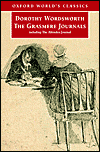
So, as a little thank you to all of my blog friends and acquaintances, all you people who have made this first year of blogging a great one, I’d like to have a book give-away (also to recognize that many of you have kindly sent me books!). I have a copy of Dorothy Wordsworth’s Grasmere and Alfoxden Journals to give away; she, if you don’t know this already, is the source of my blog pseudonym. Just leave a comment letting me know you’re interested in the book by next Friday night (the 23rd) and I’ll draw a name on Saturday.

Thank you!

31 Comments

Filed under Blogging

Blogs that make me think

thinkingbloggerpf8.jpgSusan from Pages Turned has nominated me for a Thinking Blogger Award — thanks Susan! I do my best to think and I guess sometimes I manage it!

The idea is that I’ll now nominate five bloggers who make me think (who can then, if they like, nominate five more). While there are many, many blogs that make me think, these ones are on my mind right now:

Tales from the Reading Room

Telecommuter Talk

The Public, the Private, and Everything in Between

The Books of My Numberless Dreams

The Hobgoblin of Little Minds

12 Comments

Filed under Blogging

Blogging personas

Litlove’s fascinating post on Borges and on her relationship to her blogging alter ego has got me thinking about my own relationship to Dorothy, how I am and am not her. When I first started blogging, I thought in terms of a persona; I thought that I was creating one, and that that persona was not me, and that I was happy to be creating a persona because it would give me more freedom, freedom to write in ways that the “real-world me” might not, and therefore freedom to explore parts of me that I don’t normally express. This is partly why I chose to take on a pseudonym, so that my online self could be substantially different from my regular self, if I wanted it to.

But that hasn’t happened really — I feel instead like Dorothy is really me, just with a different name. She’s not a separate person, a mask, or a persona; she’s me, but she’s not quite the “me” I think of as my real-world self. The writer of this blog doesn’t feel like a fictional creation at all, although, in a sense, she is a fictional creation, because our selves are all fictional creations of sorts. Writing this blog has made me more aware of how fictional the various versions of myself are, since it is so easy to shape my online self by giving out certain bits of information and not others, and this makes me realize that I’m always communicating different versions of “myself” to the people I meet, online or in-person, and I’m even communicating a version of myself to myself. The mental image I have of Dorothy is incomplete — I see one version and you see another — and this is also true for image I have of the “real-world me.” My image of myself matches no one else’s image, and who is to say whose image is the more accurate one?

Anyway, Dorothy is calmer than I am, than the version of “me” I’m familiar with. She’s much less busy than I am, and more certain, less nervous, and more chatty. She’s nicer and more open. She’s not as critical and she’s much more optimistic. She’s a little less self-conscious and more willing to try new things. She’s more of a group person, more willing to participate. She likes people more. She’s just as serious, but occasionally more willing to be silly. She’s more willing to talk about herself (or she wouldn’t blog of course!), and less concerned with what people think of her.

All that sounds quite nice, doesn’t it? It makes me want to be Dorothy … and perhaps the interesting thing about blogging is that it might help me become a little more like her. Perhaps after our online selves have been in existence for a while, we begin to merge with them.

20 Comments

Filed under Blogging, Writing

Book blogs

I came across this at The Valve; it’s an excerpt from an article called “The Blog Reflex” from n+1:

People might have used their blogs to post the best they could think and say. They could have posted 5,000-word critiques of their favorite books and records. Some polymath might even have shown, on-line, how an acute and well-stocked sensibility responds to the streaming world in real time. But those things didn’t happen, at least not often enough. In practice, blogs reveal how much we are unwitting stenographers of hip talk and marketing speak, and how secondhand and often ugly our unconscious impulses still are. The need for speed encourages, as a willed style, the intemperate, the unconsidered, the undigested. (Not for nothing is the word blog evocative of vomit.) “So hot right now,” the bloggers say. Or: “Jumped the shark.” The language is supposed to mimic the way people speak on the street or the college quad, the phatic emotive growl and purr of exhibitionistic consumer satisfaction – “The Divine Comedy is SOOO GOOOD!” – or displeasure – “I shit on Dante!” So man hands on information to man.

Why, when I read these kinds of articles about blogging, do I never recognize the blog world that’s being described? Does anybody out there who reads book blogs recognize what’s being described here? Why do I feel like the people who write these kinds of articles are looking at a different internet than the one I see?

Okay, sucky book blogs are out there, but — they’re not that hard to recognize and then avoid. And people do write great stuff, they do write long critiques, they do respond intelligently to the world. The main criticism here seems to be that book blogs don’t really talk about books and reading and ideas; they are all about publicity and popularity and making quick, undigested judgments on the latest new thing. I just don’t buy it.

I don’t subscribe to n+1 and I don’t know if the full article will ever appear online, but I am interested in trying to read it somehow. Or maybe I shouldn’t — I will just get more annoyed. (Do check out the Valve post; it’s kind of funny.)

16 Comments

Filed under Blogging

Blogging and the body follow-up

The author of the article on blogging and the body I posted about a few days ago, danah boyd, has found my blog and left a couple comments. As they are interesting ones, and ones that clarify what she was getting at in the article, I thought I’d link to them and encourage you to read them, but then I thought I could just copy them here to make it easier on you. I’m encouraging you to read them because she said she’s interested in the comments people left on my post and would like to hear more. So here’s our exchange; first, danah’s comment (she blogs under the name zephoria):

I want to clarify what i meant when i talk about blogs as bodies. It’s not that i think that people see their blogs as bodies per say. It’s that the properties that we take for granted as embodied creatures are lacking when we go online, namely presence. For example, i walk into the room and my body signals my presence to others around. Had i not posted a comment here, you wouldn’t know that i was lurking. You may get an IP address, but what’s that mean? Part of my presence though is not just my comment on your post – it’s the link back to my own blog where my identity resides in many ways. In this way, i reference my blog in my comments on your blog to create a culture of presence. I do think that the spatial metaphor is a lot easier for thinking of your own blog directly. You can think of decorating your blog like decorating your house. Yet, when people visit your blog, it’s a mixed view. They don’t just see the space you’ve created – they see a facet of you. In this way, the decorations serve as fashion accessories to a body as well as decorations on a room. I do think it’s complicated and sticky but it’s presence that connects things deeply to bodies. And the fact that you have to write yourself into being online… you don’t just exist by appearing and reading… your presence goes unnoticed.

Anyhow, i hope that helps in some way.

Here’s what I said:

Hi Zephoria — thanks so much for stopping by and commenting; this is the first time an author I’ve written about has commented back, and I’m pleased to hear your explanation (and also to hear another aspect of your voice, outside of the academic article — I was wishing to discuss this stuff as bloggers rather than in an academic context, after all). Thinking of the blog as a way to create presence when the body is absent makes sense to me. It’s interesting to me the way other commenters felt uncomfortable thinking of the blog as a body or as the thing that creates presence — as though that metaphor is too revealing and intimate. And I wonder what image people have of me from reading the blog — I guess we’re all sorting out this new way of presenting ourselves that’s very different from the usual way of being physically present, and so things like posting pictures and revealing names and choosing blog templates can sometimes be anxiety-inducing.

And her response:

No doubt there’s a lot of anxiety-producing effects. This is why a lot of folks try to play ostrich. If you pretend like you don’t have an audience, you can just keep writing. Or if you imagine that you have an audience of people exactly like you want, you can keep writing. If you are told that everyone who has ever met you is reading your blog, it’s paralyzing. This is the problem with unknown audiences – we have to envision who our audience is to write… it’s an imagined community rather than a defined or bounded one like a room. (I still want an invisibility potion though for meatspace.)

I read your commenters and i’m curious to know more. I wonder if the concern about it being too intimate has to do with the assumption that we are revealing everything. It’s not a naked body unless you choose it to be. My digital body is cloaked in professional wear with the occasional goofy accessory. Why? Because i have to face that audience. It’s not that this is not me but there’s another “me” on LiveJournal that is far different because that’s the me wimpering about life with my friends while my blog is me musing about things that the professionals who read my blog want to see.

Further thoughts anyone?

7 Comments

Filed under Blogging

The blog as a body?

I didn’t get through many of the articles on blogging I linked to the other day, but the one by danah boyd I quoted from I did read thoroughly, and it had some interesting ideas (if you check out the articles, you’ll find they are rather dry but you might find them worthwhile to look at anyway) — particularly about how we shouldn’t define blogs by the nature of their content (I hate that word but I can’t think of another right now); instead we should consider them as a medium, like radio or TV. The author says blogs are better understood as being like paper rather than like diaries or journals or journalism or whatever. Just as you can write anything on paper, so you can write anything on a blog. Now that strikes me as obvious, but I also know I’ve spent a good bit of time thinking about how blogs are like diaries and journals and personal essays. It makes sense to me that it’s better to stop thinking that way — thinking that bloggers produce a particular type of writing — and to think more about the nature of the blog as a way of communicating whatever it is bloggers want to communicate.

Once you’ve begun to think about blogs as a medium, boyd says, you can think about the particular ways blogs allow people to communicate, and blogs do a number of unique things, including blurring spatiality and corporeality. They are like spaces, and they are also like bodies. Blogs are spaces in the sense that they are a location for people to gather, but, unlike chatrooms, blogs are owned by the blogger, so they are more like rooms in the blogger’s home. The blogger invites people in and hopes that they will be polite and not say mean things. Of course, that analogy doesn’t quite work because not everyone is there all at once. But it strikes me as a better one than the cafe metaphor, because cafes are neutral spaces, not owned by anybody participating in the conversation, whereas a blogger can exclude a nasty commenter, just as a host might kick out a violent guest.

But boyd also says that bloggers think of their blogs as being like their bodies, or even as their online face. Now that’s interesting. Those of you who blog, do you think of your blog as an extension of your body, or perhaps as your face? I realized as I was thinking about switching from Blogger to WordPress that finding the right look for my blog is important to me, but I tend to think of setting up the blog as analogous to decorating my house (a process that makes me quite anxious just as changing the blog did) rather than, say, choosing clothes or a hairstyle.

But then when I think about the photo I’ve got up on the blog, I realize that I’m hiding my face in such a way that either the book I’m holding becomes a substitute for my face or the blog itself does. My body is behind the book and the bicycle, the two subjects I write all the words on this blog about, which are another way of representing myself, a substitute body. And I create a picture of what I think bloggers look like based on their blogs and I remember other bloggers writing about that too, so the blog is a body in the sense that we use it to create images in our minds of other people. This is what boyd says about it:

Bloggers see their blog as a reflection of their interests and values. They also contend that the blog does not show them in entirely, but only what they choose to perform in that context. This corporeal relationship deeply affects the way in which people choose to manage their blogs. There is a sense of ownership, a sense that a blogger has the right to control what acts and speech are acceptable and to dictate the norms in general. Part of this stems from the sense that whatever others write affects the representation of the blogger, not simply of the blog. In other words, people’s additions are like graffiti on one’s body.

Both these metaphors — blogs as spaces and as bodies — are ways of saying that a blog is important to the blogger’s identity, the body metaphor implying that blogs are a closer, more intimate way of shaping identity than the space metaphor. Attacking one’s house — analogous to leaving a nasty comment — is an invasion and a threat, but attacking one’s body is much worse. The point boyd is making about how these metaphors get blurred is that a tension can arise when the blogger sees the blog as part of his/her body and the reader sees it as a space for conversation. In that case, the blogger and the reader might interpret the comments the reader leaves in very different ways.

This article is interesting, and perhaps the others are too, but I realized as I read it that I’d prefer to hear all this discussed in the more informal voices of bloggers than the formal voice of an academic writing in a purely academic mode. Reading the article is like being lectured to; if a blogger wrote it in more informal blogging voice (not that blogging voices have to be informal), it would be more like a brief presentation meant to get a conversation going.

18 Comments

Filed under Blogging

New year, new blog, new posting policy

As you may have noticed, I’ve been posting every day, just about, since I began blogging, with some exceptions for vacations, and I’ve been very happy doing it. There’s great pleasure to be had in producing something every day and in discovering that I can come up with ideas again and again and again and again.

But now I think it may be time for a change. I thought I’d back off from posting every day when I got so busy I couldn’t handle it anymore, but that’s not the case; in fact right now I have plenty of time. But I think I’d like to see what it’s like to post, say 4 or 5 or 6 times a week when I feel most inspired, instead of posting every day and making the inspiration happen.

It interests me that I feel compelled to make an announcement out of this — this is my own blog, after all, and I can make changes without making a big deal out of it. But I’m an annoyingly conscientious and obsessive kind of person, and I feel like if I have been following a schedule and people know I follow a schedule, then if I’m going to change that schedule, I ought to make that clear. The more positive interpretation here is that blogging is about community, and so what I’m doing is acknowledging that community and clarifying the nature of my participation in it. I’m acknowledging that there might be people out there who will notice a change and wonder about it.

Anyway — one of the reasons I’m making this change now is that I’m too tired to write a regular post, which is what I’d normally be doing at this time. Having a more flexible posting schedule gives me an out for times like this.

I’m so tired because the Hobgoblin, Muttboy, and I went on a 6-hour hike today. We drove up to the Appalachian Trail at the Connecticut/Massachusetts border and climbed two mountains there and walked through one beautiful ravine. It was a perfect day for a hike — mid-40s and sunny, and also very windy so that I was grateful to be hiking and not on my bike fighting against a headwind or in danger of getting knocked over by a particularly strong gust.

During the beginning and middle of long hikes like this one, I begin to daydream about backpacking and I plan our next trip — I’m hoping we can do a long one in Vermont this coming summer. But by the end of the hike, I’ve stopped daydreaming about backpacking and I begin to notice how much my legs and feet hurt and that I’ve got a blister on my toe, and I begin to feel grateful that I’m heading to my car, and from there to get Chinese take-out, and then home to a hot shower and a cozy bed. And that’s exactly how I feel about backpacking — enchanted by the possibility one moment and secretly grateful I’m not doing it the next.

So, I’m not sure how much things will change around here, and I may end up posting every day again because I will have discovered that’s what I prefer, but for now, I’ll post often, just not quite so diligently.

And now for some pictures from the hike:

20 Comments

Filed under Blogging, Life

Experiment

Update: The experiment is over, and I’m permanently here.  Yay!

This blog is an experiment, just in case I decide to dump Blogger. For now, I’m still posting regularly here.

17 Comments

Filed under Blogging

My year in books continued

When it comes to books, it’s been a year of changes. First of all, of course, this year I began blogging, and this has changed my reading life — my life, period — pretty radically. I used to keep a wimpy list of potential books to read that was about 10 books long and I hardly ever looked at it, and when I was in the store, I’d often have trouble finding something I wanted. No more, let me tell you. Now my list of books I’d like to read is something like 250 books long and growing fast. I’ve found dozens of blogs I read regularly, and I’ve learned so much about books and authors I’d never heard of before from them. I think about books and the publishing world differently now that I blog and read blogs.

And I read differently, knowing that I will write here about everything that I read. I’ve always felt that my reading should have some purpose; with my well-developed Puritan work ethic and sense of guilt, I can’t just read purely for pleasure very easily. Being an English teacher is one way of “doing something” with my reading, but I’ve discovered that blogging is another. My reading doesn’t stop with me; instead I write about the experience and people read me and sometimes write back. Something of my reading experience gets circulated back out into the world in a more direct and immediate fashion than it used to, and I like that a lot.

Blogging has meant that I’m now involved in conversations about books I never was before, and I’m part of books groups — online and in-person — that are new to me. I’ve made some great online blogging friends, and one of them, Emily, turns out to live near me, so we can be — what do you call them, in-person? traditional? regular? — friends too. I’m reading Proust because of blogging, and I’m reading more short stories, and I’m reading new books because of the Slaves of Golconda. As other people have said before, it’s like being in a very fun literature class, or like being part of a literary salon. It’s class without the grading and where I write all the “papers” effortlessly.

My reading habits have changed this year as well. I’m now reading poetry again, which I’m very happy about. I don’t read it very fast, but I do read it regularly. I’m reading multiple books at once, which means I feel able to read more challenging things — if I have only one book at a time, I’m much less likely to pick up something long and difficult because I don’t want to find myself stuck with it and bored. I can tackle something difficult for a while, and then put it down for my fun novel or nonfiction book. This means I’m not finding it difficult to read Proust. Rather than driving myself crazy trying to read it and it alone, I’m reading it along with a lot of other books that provide some variety.

What else … I found Book Mooch, which means I have whole shelves full of books strangers have mailed me, and I mail books out to strangers now and then. Half of the books on this year’s list I might not have read if it weren’t for blogging. I’ve taken to accumulating books at a frightening rate. I never used to do this; I generally bought books at the pace I read them, but no more.

I’ve developed some unexpected obsessions this past year — for books about books and reading, for example. I’ve read 4 of these books this year — by Jane Smiley, Alberto Manguel, Sara Nelson, and Nick Hornby — and I am looking forward to reading more. I had a brief but intense love affair with footnotes after reading The Mezzanine and Dracula (the editor’s footnotes were wonderful). And I’ve recently gotten excited about books on walking, with Rory Stewart’s book and now Footsteps, and with Rebecca Solnit’s A Field Guide to Getting Lost on my shelves, and W.G. Sebald and Bruce Chatwin waiting for me. I also discovered the joys of reading diaries — Virginia Woolf’s and Frances Burney’s in particular.

All this feels like a lot in one year. It makes me wonder what next year will bring.

Leave a comment

Filed under Blogging, Books

On blogging

How do you fellow blog readers keep blogs from taking up all your time? I’m not talking about blog writing — I’m content to spend the time I do on the writing; I’m talking about reading other people’s blogs. I ask because it seems like I can add new blogs to my reading list endlessly. I’m thrilled when someone new leaves a comment on one of my posts — thrilled! — but often that means a new blog to check out and it might very well be one I want to keep reading. That’s great, but I can’t keep adding new ones or I’ll never have any time for anything else. There are most definitely more excellent, intelligent, well-written book blogs out there than I can possibly read. How do you decide what to read and what to skip?

I use bloglines, which means I can read people’s posts all in one place, making the reading easier since I don’t actually have to go to each website to see if there’s a new post. It’s a lot more time consuming to visit the actual sites to check for new material — I like to visit people’s actual sites to read the posts in the context the author created, but with a feedreader like bloglines, I can visit only when I know there’s a new post. My point is that bloglines helps cut down on time spent online — but still, I’m subscribed to 78 blogs at the moment, and that’s a lot to read, even if many of the blogs aren’t updated all that regularly. My current pattern is to subscribe to the feeds of new, interesting blogs (new to me, at least) on bloglines and read them for a while to see if I like them or not. But I tend to like more blogs than I dislike, so my list grows.

I suppose I can also skim posts more often and read only those that I find most interesting. I do this with some blogs already (not those written by anybody who reads here regularly!), but I prefer to find bloggers I really like and then read most if not all of their posts. Blogs tend to make more sense and be more enjoyable if you read them regularly, and since I think good blogs succeed because of the writer’s voice, I want to experience that voice often. And, since blogging for me is largely about community and sharing thoughts and ideas, I prefer to follow those writers I like closely to keep up with their lives and what the conversations are about.

A related issue is that of blogrolls, so I can ask that question as well: how do you decide what links to put on your blogroll? This is on my mind because of Danielle’s recent post and the accompanying comments on the subject. Do you think a blogroll should be short or long? Mine doesn’t strike me as terribly long, but that’s largely because I don’t update it very often — if I put all the blogs I read on the blogroll, it would be longer. The argument for a shorter blogroll might be that the links would then be more meaningful — they are the best of the best, perhaps. But a longer blogroll is more inclusive and more welcoming, which seems like a very good thing. There’s no need to make blogging clique-ish.

By the way, if you’re a regular reader, and you’re not on my blogroll, leave a comment or email me, and I’ll put you there.

Leave a comment

Filed under Blogging

The blogger meet-up

My new book club met yesterday – I shouldn’t call it a blogger meet-up, since only three of us were bloggers – and it was a lot of fun. The Hobgoblin and I were there, of course, and Emily from Telecommuter Talk and three other women. Talking about the book, Barbara Noble’s Doreen, was a lot of fun, but one of the best things about it was meeting a fellow blogger and finally putting a face to a name. I haven’t had the experience of meeting a blogger in the flesh I’d known only online, and it’s interesting the way your mental image of a person, shaped by their blogger persona, has to adapt to the real-live person. Well, for those of you wondering, Emily is even cooler in person than she is on her blog — and we all know her blog is pretty cool.

We had a great discussion of the novel; we talked for something like an hour and a half, at first very intensely, and then we slowed down a bit, but it was like we didn’t want to finish up and we kept coming back to the book to make new observations. A couple of the people brought notes and questions and I felt a tiny bit unprepared – I must remember to take notes next time! – but ultimately that didn’t matter, as we all had things to contribute. It felt comfortable and completely non-competitive, and it was the kind of book discussion I like, where people feel free to make personal connections and tell stories from their lives that relate to the book and help to make sense of it.

And I learned more about the book – one of the coolest things about the meeting was that one of the book club members is English and so she could give us some information into the dynamics of class in England, an important part of the novel. We Americans were eating up all her insights into how accurately the book portrayed the class tensions – interestingly, she told us that the two ways of pronouncing Doreen – the accent on the first syllable or the second – was a marker of class difference, a detail I would never have figured out on my own.

So the group is planning on making the trek to the Tenement Museum in New York City in February – they’d read Triangle, a book about a fire in the Triangle Shirtwaist factory in the city and are visiting the museum as a follow-up to that. And I suggested and everyone agreed that we read Anzia Yezierska’s novel Bread Givers about a young Jewish girl growing up on the Lower East Side and struggling with her father and her religious heritage. I’m looking forward to the trip!

Leave a comment

Filed under Blogging, Books, Life

Blogger issues

Not much of a post for you today because I spent too much time switching over to Blogger beta and it’s not working for me. When you switch to the new Blogger, to get the full benefit you have to upgrade your template, and when I did that, I lost a lot of stuff. I could replace everything except Haloscan, which I use for comments; I tried and tried but just couldn’t figure out how to make Haloscan work. And I like Haloscan — I find it easier to keep track of comments that way. So I’m back to the old template and I don’t get to use most of the new features of Blogger. What a waste of time!

I did, however, manage to acquire some new books recently: yesterday Alberto Manguel’s A Reading Diary showed up in my mailbox thanks to Book Mooch, so I can continue my reading about reading pattern. Then last night the Hobgoblin and I were at the bookstore, one of those stores that has a 3-for-2 deal, and since the Hobgoblin needed one of those books for a Christmas gift, we figured we might as well buy one more of them and get one for free. So the Hobgoblin picked out one, and I got Kiran Desai’s The Inheritance of Loss; I had trouble choosing between that one and John Banville’s The Sea, but Desai won out eventually. And just a couple days ago I got Edmund White’s short biography of Proust, courtesy of Book Mooch. I’m looking forward to learning some more about Proust’s life.

Leave a comment

Filed under Blogging, Books

Blogs and the mainstream media

One part of me says I should leave this alone, but another part of me can’t resist saying something. I’m talking, as you probably guess, about John Sutherland’s article on the sorry state of web reviewing (mainly Amazon reviews but also blogs) and Rachel Cooke’s article on how dull and badly written book blogs are (I came across the links at the Literary Saloon).

It’s the Cooke article that interests me most; she sums up the significance of the disagreements over web reviewing thusly:

The question that Sutherland has raised – what effect is the internet having on criticism? – is not only fair; it is one that no one who cares about art, and especially writing, can ignore.

Cooke says that professional reviewing and book blogging can coexist at present, but she’s worried that someday “serious criticism” might disappear so that we are left with only “the populist warblings of the blogosphere.” She dearly hopes that this will never happen.

At this point, I’m with her — I think it would be a shame to lose the professional criticism we’ve got. I read it and value it.

But then she goes on to attack book blogs, and at this point she loses me. She spends a day reading blogs and comes away very unimpressed, citing examples of blogs she can live without. But I don’t think she’s done her research very well. Anybody can come along and pick a few sentences out of a blog and hold them up for ridicule; I could do it myself with my own blog writing (I can see it now — “she reads a Jane Kenyon poem and all she can say is ‘I like this poem because it reminds me of how wonderful it is to walk in the woods in winter’?”). Many blogs create their effect over time; people find pleasure in them because they get to know the blogger’s voice and sensibility and interests, and if they like those things, they come back day after day, even to read the less-than-stellar posts.

Perhaps Cooke is not interested in spending that much time getting to know a blogger’s voice, but one day’s reading will only give her a taste of all the blogs out there. If she wants high-quality writing all the time, I’m positive she can find it on a blog, if only she would look around a little more. The thing that bothered me most about Cooke’s article was her claim that there’s no good writing on the internet, that good writing must be paid for:

I read and I read; I dutifully followed every link. And come supper time all I could think was that not a sentence I’d read was a millionth as good as anything in The Polysyllabic Spree, Nick Hornby’s recently published diary of ‘an exasperated but ever hopeful reader’. Why? Because his words are measured, rather than spewed, out; because he is a good critic, and an experienced one; and because he can write. The trouble is, these qualities are exceptional – which is why they must be paid for.

I encounter excellent writing on blogs every day. It’s absurd to believe that one has to pay for good writing; bloggers write for all kinds of reasons and many of them, while being good writers, aren’t interested in making a living from it. It’s possible Cooke and I have radically different ideas of what constitutes good writing, but it’s much more likely she wasn’t really giving bloggers a fair chance.

There are all kinds of blogs — book review blogs, publishing industry gossip sites, reading diaries — and only some of them have the kind of reviews and articles that might get published in the mainstream media. So it strikes me as odd that when criticizing book blogs, people tend to blame them for not living up to the standards of professional reviewing. Why can’t bloggers have different purposes and do radically different things than one finds in newspapers and magazines? If Cooke finds reading diaries dull, which it’s her right to do, then there are plenty of other people who love them. What blogs do so wonderfully is open up the possibility for new kinds of writing, so it makes no sense to me to dismiss blogs for not doing the same old thing.

And I’m not buying the idea that professional writers and reviewers must be at odds with book bloggers. Why the hostility? Will internet book reviewing really place traditional, professional criticism at risk? I don’t know, actually, but what I hope will happen is that the two will exist side by side — ideally without the carping — and that the various types of writing about books will enrich the others. Amateur book bloggers have much to learn from professional critics — and vice versa. And the two categories overlap anyway; some professional writers have their own blogs, some literary critics keep reading diaries online, some people who make a living off one type of writing turn to the internet to produce another. There ought to a fruitful relationship here, not antagonism.

Leave a comment

Filed under Blogging