A little bit on books and bikes

It feels like a really busy week to me, but that’s mostly because I’m trying to get a lot of riding in. The weather is finally warming up a bit, the snow from last weekend’s snow storm is melting, and I’m trying to ride as much as I possibly can. Last weekend’s race got cancelled because of the snow, which is why you have no race report. I can, however, link to the blog of the guy who runs the Spring races I ride in. His name’s Aki, over at Sprinter della Casa; if you do jump over there (and this is totally self-indulgent of me — I don’t blame you if you ignore it), you’ll find a race video shot from Aki’s helmet. If you watch it you can get a taste of what it’s like to ride in a race, and you can see the actual course I ride on (yippee, right?).  He’s not riding in my race, or the Hobgoblin’s, so you won’t see us, although that would be pretty cool, wouldn’t it?  Or maybe not, if I look like a dork out there, which is entirely possible.

And now I have just the tiniest bit of book chat before I close up the computer and start reading for the evening. First of all, my copy of the Edith Grossman translation of Don Quixote has arrived, and I love the way the book looks. There’s the cool cover, of course:

7075756.gifAnd then there’s the way the book feels in my hand, heavy and solid, but soft and flexible too, so that it will easily lie flat. It’s got those rough uneven edges I like, and the print isn’t tiny. I’ve discovered that it’s important to me not to read a book with tiny print. Maybe I’m a bit superficial about this, but I find it discouraging to feel like I’m reading and reading and reading just to get to the bottom of one page. Reading Proust would be an entirely different experience if I had an edition with tiny print. I’m so grateful for the six not overly-large volumes of Proust I’ve got with pages that don’t go on forever.

I’ve got the Don Quixote blog on my mind; by the beginning of May, I’ll have it set up, and we decided it will be called Tilting at Windmills. Do let me know if you want to join in the group reading — I posted on it here.

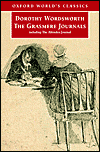
And two other reminders. If you’d like to read Jane Austen’s short novel Lady Susan with the Slaves of Golconda, you’ve got until March 31st; it’s very short, so there’s plenty of time to join in. And, let me know if you’d like your name entered in a drawing for Dorothy Wordsworth’s Grasmere and Alfoxden Journals, which I’m giving away to celebrate my first year of blogging. Leave a comment over here if you are interested. By the way, I have absolutely no problem mailing the book overseas. I do it all the time for Book Mooch, and other bloggers have generously done it for me. So don’t let geography keep you from participating!

12 Comments

Filed under Books, Cycling

I’m tired of blog spats

I’ve been following the whole fight between n+1 and The Elegant Variation and the post and comments at The Valve, and I’m not going to comment on it much — don’t worry! — but it does make me think about what it is I’m doing here. Imani has a post in which she talks about having gone through multiple identity crises as a result of following this controversy, and I know just what she means. There’s nothing like a heated argument about what blogs should do and if they are any good or not to make a blogger feel all self-conscious and uncertain.

I’m particularly torn because I’ve read a number of academically-minded bloggers who wish that book bloggers in general would be more academically-minded and write something more like literary criticism than book chat, and since I’ve been known to write academic things in my non-blogging life, this kind of comment seems directed right at me. But you know what? I don’t want to be an academic blogger, and I’m interested in writing literary criticism on this blog only when inspired to do so, and I’m not going to if I don’t feel like it. And you know what? I don’t think all book blogs have to do the same thing, or even that one particular book blog has to produce the same kind of writing day after day. And I don’t get why those who don’t like reading book chat (which I love) feel the need to criticize those who do or the blogs that produce it. There’s a mean-spiritedness in many of the comments I’ve read recently that doesn’t make any sense to me.

But I said I wouldn’t comment much on this, and I won’t (I’m getting bored of blogging about blogging and you may be too). I think I need to go read.

21 Comments

Filed under Blogging

Yoga for People Who Can’t Be Bothered to Do It

7544847.gifI’ve finished Geoff Dyer’s Yoga for People Who Can’t Be Bothered to Do It, and let me say, first of all, that it’s not about yoga. At least, it’s not about the poses people think of when they think about yoga. It does have something to do with the philosophy that lies behind yoga, but more on that later.

Let me say, second of all, that I enjoyed this book very much. It’s uncategorizable, which is my favorite kind of book — it’s part travel narrative, part personal essay, part memoir, and part philosophical meditation, although the more philosophical sections are short. What philosophical meditations we get are moments in the midst of the stories, moments that come out of the stories and lead back into them.

Many of the blurbs on the book mention how funny it is, but except for one or two moments when I laughed out loud, I didn’t find this book very funny. But it was so many other interesting things, I didn’t miss the humor. There are ten chapters, each one set in a different location, including New Orleans, Rome, Libya, Cambodia, the Burning Man festival in the Black Rock Desert, and others. Dyer tells stories about the people he meets, the parties he attends, the love affairs he has, the drugs he does — at this point you may be wondering why I like this book, since I’m a boring, stay-at-home kind of person who wouldn’t know how to find drugs if I wanted to.

But the persona here is appealing. He’s got an open attitude toward life; he’s willing to try just about anything. He’s frequently depressed and despairing, but also capable of finding moments of peace, and his meditations about himself and his life are always interesting. He’s thoughtful but also reckless, hard on himself but also forgiving.  He’s brutally honest about himself and the world:

… I looked up from my notes and was confronted, in the mirror above my desk, with the awful reality — grey hair, bulbous nose, scrawny neck — of my appearance. I have often been disappointed by my appearance, but I have never looked so utterly repulsive as I did then … “Life,” said the face in the mirror, “is taking its toll. All the disappointment and regret, all the bitterness and rage that you have tried to keep hidden, is now breaking out, eroding the last patina of handsomeness, and hope. You are no longer a handsome man. This is the fate of all those who place an undue value on physical attractiveness. You will become one of those people — one of the hundreds of people to whom you paid the bare minimum of attention simply because you did not like the way they looked.”

Maybe his attitude can be best summed up in this conclusion to a chapter spent describing a visit to Roman ruins:

… at some level I knew I had been kidding myself: that all the intellectual discipline and ambition of my earlier years had been dissipated by half-hearted drug abuse, indolence, and disappointment, that I lacked purpose and direction and had even less idea of what I wanted from life now than I had when I was twenty or thirty even, that I was well on the way to becoming a ruin myself, and that that was fine by me.

Ultimately, the book is about what to do after you realize you’re turning into a ruin. Do you despair, or accept it, or both? Dyer’s travels seems to be a response to this realization — he’s traveling as a distraction from pain, seeking out new people and new experiences to pass the time as comfortably as possible, and yet he’s aware at the same time that everywhere he goes, he finds only himself. There is no escape. Travel as distraction and escape leaves him all the more burdened with the weight of himself:

I felt disappointed, cheated. As the gloom settled I saw that I had spent the last fifteen years dragging the same burden of frustrated expectation from one corner of the world to the next.

And so the only thing to do is to try to make peace with yourself, even if only for a moment. And here we come to the meaning of the book’s title, because yoga’s true meaning is not the poses you might do in a yoga class, but has more to do with the search for insight and enlightenment. The term “yoga” comes from a word that means “yoke” or “union”; it’s really about finding unity with God or with something larger than oneself, or, perhaps, finding unity within oneself.

So, in the midst of the sometimes manic movement from place to place, Dyer is looking for a sense of unity and coherence of experience, for moments when he can just be where he is:

“What I want,” I said, “is a place where we can sit down, where we can just chat for a couple of hours before we go to Matt and Alexandra’s lavish suite. A place with nice music, comfortable seats, and nice tea, and so forth.” I went on and on about this, and as I did so I had a dim sense that I was working through something, some neurosis that refused to manifest itself plainly. And then it came to me.

“D’you know,” I said, “I have just described exactly the place we’re in. I’m already in the place I want to go to.”

“Well done, darling,” said Dazed. “You’ve escaped from samsara.”

This exchange (Dazed is Dyer’s current girlfriend) sums up the book beautifully — it’s about learning to want to be in the place you’re in, and it’s an insight expressed with a little bit of self-mockery and mild sarcasm. Dyer takes up some heavy subjects in this book, but he never takes himself — or anything else for that matter — too deadly seriously.

15 Comments

Filed under Books, Nonfiction

One-year blog anniversary

7790606.gifOne year ago today, I began this blog, and what a wonderful experience it’s been. I think back to the time before I began the blog and before I read blogs, and I wonder how I managed to survive — it’s hard to believe that I read books regularly without writing about them and without telling anybody about them, and that I had only a tiny little list of books I’d like to read, instead of the multi-page one I’ve got now, and that I’d wander the bookstore sometimes not feeling inspired by anything. These days as I look through bookstores, I’m reminded of this blog and that blog as I see things that look familiar, and I think “oh, so-and-so really liked that book” and “let me look for that other book so-and-so recommended.”

Blogging has changed my reading habits tremendously. I’m still reading a lot of the same stuff I would have read anyway, but I’ve also tried a lot of things I wouldn’t have — books for the Slaves of Golconda reading group, for example, or books about books like Alberto Manguel’s A History of Reading that I hadn’t heard of before, or Proust for Involuntary Memory. I’m reading new types of books, such as poetry, which I’ve finally picked up again after a long period of not reading it, and short story collections, which I have unfortunately neglected in the past.

But more than that, the writing I do about books has changed my experience of reading — the posts themselves which get me to think a little deeper about my reading than I might otherwise have done, and the comments here and on other blogs that allow me to participate in a conversation about books I didn’t have before blogging. I love sharing my enthusiasms about books and reading about what books have gotten other bloggers excited, and all this has made an already wonderful thing — reading books — that much better. I know that blogging or reading blogs isn’t for everyone, but I’ve had so much fun with it that sometimes I wonder why every reader out there isn’t doing it (and then I’m grateful that they don’t because I’m already overwhelmed with the number of great blogs out there I like to read ….)

I like participating in something that feels new and exciting and that has the potential to change — is changing right now — the culture of books and reading and reviewing and publishing. Sometimes with horror, always with interest, I follow the debates about what blogging is and can and should be and about the quality of blogs and the relationship of blogs to print publications and how blogs are or aren’t changing everything, and I’m happy that there’s this medium that anybody can participate in and shape in their own large or small way. I’m very curious to see how blogs and blogging will develop, and I hope all the changes will be good ones.

So, as a little thank you to all of my blog friends and acquaintances, all you people who have made this first year of blogging a great one, I’d like to have a book give-away (also to recognize that many of you have kindly sent me books!). I have a copy of Dorothy Wordsworth’s Grasmere and Alfoxden Journals to give away; she, if you don’t know this already, is the source of my blog pseudonym. Just leave a comment letting me know you’re interested in the book by next Friday night (the 23rd) and I’ll draw a name on Saturday.

Thank you!

31 Comments

Filed under Blogging

Some thoughts and a meme

  • I think I may be spending too much time on the internet: the tip of my right index finger is sore, and I think it got that way from too much typing and too much use of the touch pad on my laptop. Yeah, and too much time holding on to a pen to grade papers. That last one must be the culprit. I need to cut back on my grading, not on my internet time.
  • I’m now reading Geoff Dyer’s Yoga for People Who Can’t Be Bothered to Do It and I’m enjoying it quite a bit, but I’m also intrigued by his book Out of Sheer Rage: Wrestling with D.H. Lawrence, which has been called “the best book about not writing a book about D.H. Lawrence ever written.” I have very little interest in D.H. Lawrence (well, not quite true. I just don’t really get him. I’m wondering if this will change one day, like I need to reach a certain maturity level or something), but I’m interested in a book about the inability to write about Lawrence. I like books that this, ones that are about the process of doing something or the attempt to do something, or the failure. It’s why I liked Footsteps so much.
  • This also explains why I find Robert Dessaix’s Twilight of Love: Travels with Turgenev intriguing. (See Dark Orpheus’s post on the subject as well.) I’ve never read Turgenev, although I’ve been meaning to forever, but this book sounds interesting because it’s about Dessaix’s travels to research Turgenev’s life and about his attempts to puzzle out some of the mysteries of Turgenev’s life. Along these same lines, I’m also curious about Janet Malcolm’s Reading Chekhov, which is a mix of biography, criticism, and memoir.
  • I recently got myself a dual-language edition of Rilke’s Duino Elegies, which I’m quite excited about. I studied German a long time ago, and although unfortunately I don’t remember all that much, not having used it in years, I’m looking forward to having the German there so I can at least read at least some of it in the original and can puzzle out words I don’t remember. I’m always meaning to improve my German, although it’s one of those things I never get around to, not having enough to motivate me, I suppose.
  • I have a blog anniversary coming up on Saturday; be sure to check back that day for the chance to win a book I’m giving away in celebration …

And now for the meme. Susan had a great post on theme reading she can do chosen entirely from books she already owns. I can’t resist thinking of the ways I can organize the books I’ve got on hand:

The Virginia Woolf books:

  • Virginia Woolf: In Inner Life, Julia Briggs
  • Moments of Being, Virginia Woolf
  • The Voyage Out, Virginia Woolf

Eighteenth-century books:

  • Roderick Random, Tobias Smollett
  • The Adventures of Ferdinand Count Fathom, Tobias Smollett
  • Journal of a Plague Year, Daniel Defoe
  • Captain Singleton, Daniel Defoe
  • The Recess, Sophia Lee

Books about walking and travel:

  • The Walk: Notes on a Romantic Image, Jeffrey Robinson
  • The Snow Leopard, Peter Matthieson
  • A Field Guide to Getting Lost, Rebecca Solnit
  • In Patagonia, Bruce Chatwin
  • Travels into the Interior of Africa, Mungo Park

Books about religion:

  • The Bhagavad Gita
  • The Varities of Religious Experience, William James
  • The Jefferson Bible
  • A Short History of Myth, Karen Armstrong

Essay collections and memoirs:

  • The Oxford Book of Essays
  • Quarrel and Quandary, Cynthia Ozick
  • The White Album, Joan Didion
  • The Amateur: An Independent Life of Letters, Wendy Lesser
  • About Alice, Calvin Trillin

Books for Kate’s Reading Across Borders challenge:

  • Palace Walk, Naguib Mahfouz
  • Soul Mountain, Gao Xingjian
  • Love in a Fallen City, Eileen Chang
  • Hopscotch, Julio Cortazar
  • The Makioka Sisters, Junichiro Tanizaki
  • The Temple of the Golden Pavilion, Yukio Mishima

9 Comments

Filed under Books, Lists, Memes

Your weekly Johnson post

I think it’s time for another post on Boswell and Johnson. I’ve been marking interesting passages with post-it notes and after I blog on those passages taking them out, so when I see a lot of post-it notes accumulating in the book, that means it’s time to write about it again.

First of all, I can’t resist giving you Boswell’s description of Johnson’s extremely odd mannerisms:

…while talking or even musing as he sat in his chair, he commonly held his head to one side towards his right shoulder, and shook it in a tremulous manner, moving his body backwards and forwards, and rubbing his left knee in the same direction, with the palm of his hand. In the intervals of articulating he made various sounds with his mouth; sometimes as if ruminating, or what is called chewing the cud, sometimes giving a half whistle, sometimes making his tongue play backwards from the roof of his mouth, as if clucking like a hen, and sometimes protruding it against his upper gums in front, as if pronouncing quickly under his breath, too, too, too: all this accompanied sometimes with a thoughtful look, but more frequently with a smile. Generally when he had concluded a period, in the course of a dispute, by which time he was a good deal exhausted by violence and vociferation, he used to blow out his breath like a whale.

Johnson is someone I wish I could have seen. Much if not most of The Life is taken up with accounts of conversations; Johnson, Boswell, and friends sit around and talk about literature and politics and the latest gossip (and they do love to gossip!), and while reading Boswell’s accounts of it all is great, surely it’s nothing compared to actually being able to witness these bull sessions.

Boswell describes Johnson getting angry, violent, and vociferous, but then quickly calming down, realizing he’d gone too far, being willing to make peace with whomever he was angry at. Can you imagine, Dr. Johnson getting furious with you? I’d be terrified.

And, unfortunately, I’d have every reason to be terrified of Johnson if I’d had the chance to meet him because he hated Americans (and, also unfortunately, some of the things he says about women I’m not too keen on):

From this pleasing subject, he, I know not how or why, made a sudden transition to one upon which he was a violent aggressor; for he said, “I am willing to love all mankind, except an American:” and his inflammable corruption bursting into horrid fire, he “breathed out threatenings and slaughter;” calling them, “Rascals — Robbers — Pirates;” and exclaiming, he’d “burn and destroy them.” Miss Seward, looking to him with mild but steady astonishment, said, “Sir, this is an instance that we are always most violent against those whom he have injured.” — He was irritated still more by this delicate and keen reproach; and roared out another tremendous volley which one might fancy could be heard across the Atlantick.

I don’t remember just what caused this hatred, if it has any explanation at all. From this safe distance in time I can be amused at this moment of irrationality from so rational a man, but I’m still extremely grateful I wasn’t there to witness it. Boswell describes trying his best to calm Johnson down and divert him with some other, safer topic; in fact, he fairly regularly needs to do this. Johnson sometimes seems like a man who needed a little managing.

But the extent of their regard for each other comes through very clearly. Boswell is always praising Johnson to the skies and worrying that Johnson is angry with him, and Johnson clearly loves Boswell in return and tries to reassure him, although somewhat impatiently. This is Johnson speaking:

Nay, Sir, you are more likely to quarrel with me, than I with you. My regard for you is greater almost than I have words to express; but I do not chuse to be always repeating it; write it down in the first leaf of your pocketbook, and never doubt of it again.

And here is Boswell’s justification for recording many little details of Johnson’s life:

I cannot allow any fragment whatever that floats in my memory concerning the great subject of this work to be lost. Though a small particular may appear trifling to some, it will be relished by others; while every little spark adds something to the general blaze: and to please the true, candid, warm admirers of Johnson, and in any degree increase the splendour of his reputation, I bid defiance to the shafts of ridicule, or even of malignity. Showers of them have been discharged at my “Journal of a Tour to the Hebrides;” yet it still sails unhurt along the stream of time, and as an attendant upon Johnson, “Pursues the triumph, and partakes the gale.”

And in another letter Boswell says this:

I vow to thee an eternal attachment. It shall be my study to do what I can to render your life happy; and if you die before me, I shall endeavour to do honour to your memory; and, elevated by the remembrance of you, persist in noble piety.

What a friendship! I am enjoying reading all the details about Johnson’s life, but I’m enjoying even more reading this record of affection.

6 Comments

Filed under Books, Nonfiction

What the Living Do

I recently finished Marie Howe’s book of poems What the Living Do, published in 1998. A friend of mine sent me the book for Christmas; she’d described the poems as not terribly innovative with poetic technique, but interesting in their emotional complexity, and now that I’ve read the book, I agree. I thought the collection was powerful. I don’t usually find myself compelled to keep reading in a poetry book; I’m content to read a couple poems and then put the book down, but with this volume, I found myself wanting to read on.

This might be a good book to read if you’re not terribly familiar with or comfortable with poetry but would like to try it — one of the blurbs on the back of the book says that it has “the fierce galloping pace of a great novel,” and it strikes me that a volume of poems with a bit of a narrative might work for people who are most familiar with fiction.

The poems don’t really set out to tell stories, but they are clustered around events in the speaker’s life, so that we get a series of moments or scenes that have shaped the speaker in some profound way. The subject matter of the poems is often harsh; the speaker describes abuse she experienced as a child, the death of her brother and the deaths of two other friends, and her rocky relationship with her husband, or at least some rocky moments in their relationship. This list of topics might make you think the poetry is confessional in the tradition of Anne Sexton, and while I admire Sexton, I’m not sure I would have liked the book if that were true. But the feeling of Howe’s book is different — there’s a calmness to the voice, a clarity and simplicity that I found appealing. Even when she describes terrible events, it’s not anger that comes through; rather it’s something like an urgency to describe as clearly as possible, a desire to understand.

I find myself wanting simply to give you a couple of the poems, so instead of trying to describe them further, that’s what I’ll do. Here are two I liked that stand on their own reasonably well:

“The Copper Beach”


Immense, entirely itself,
it wore that yard like a dress,


with limbs low enough for me to enter it
and climb the crooked ladder to where


I could lean against the trunk and practice being alone.


One day, I heard the sound before I saw it, rain fell
darkening the sidewalk.


Sitting close to the center, not very high in the branches,
I heard it hitting the high leaves, and I was happy,


watching it happen without it happening to me.


“My Dead Friends”


I have begun,
when I’m weary and can’t decide an answer to a bewildering question


to ask my dead friends for their opinion
and the answer is often immediate and clear.


Should I take the job? Move to the city? Should I try to conceive a child
in my middle age?


They stand in unison shaking their heads and smiling — whatever leads
to joy, they always answer,


to more life and less worry. I look into the vase where Billy’s ashes were —
it’s green in there, a green vase,


and I ask Billy if I should return the difficult phone call, and he says, yes.
Billy’s already gone through the frightening door,


whatever he says I’ll do.

7 Comments

Filed under Poetry

Race report

Today’s race was odd. The oddness started while I was on my way over to the course; it’s only about two miles over there, so I rode my bike to do some warming up on the way. As I went around a very sharp corner near my house, I crashed. I was riding along fine, and next thing I knew, I’d hit the pavement. I was fine and got up immediately, looking around furtively to see who’d noticed me being an idiot. The only spectator I saw was a guy in a pick-up truck who slowed down to see if I was okay, but as I was so quickly back on my feet, he took off again.

I couldn’t figure out why it happened, except that I’d taken a sharp corner too fast. As my only injury was a scrape on my elbow and a bruise on my hip, I got back on the bike and continued on to the course. I considered not telling anybody and saving a little face. As I rode, I thought to myself, “you don’t deserve to be on a bike, much less race on one!”

But when I got to the course I figured out what the problem was. Black ice. This was odd because the temperature back at home was in the mid-30s, and it hadn’t occurred to me that the roads could be icy when the temperature is above freezing. But the course was covered in black ice too. I felt a little less like an idiot, although I probably still looked like one to the guy in the pick-up. I decided that the crash would actually make a good story, a nice illustration of how awful the roads were.

Because of the ice, the race was delayed an hour and a half, so I ended up spending almost two hours warming up and then waiting, warming up and then waiting, while the race officials figured out what to do. They did a little sweeping and scraping, but mostly they just waited until the sun got high enough to melt everything.

With all that, it’s a wonder the race went decently. I didn’t do as well as I did last week, dropping off the pack a little earlier, but the race was faster this time around, and I think all that warming up and waiting actually tired me out a bit. Mostly I’m grateful I didn’t have another embarrassing meeting with the pavement.  There were no crashes in my race, or the Hobgoblin’s, right after mine.

Although I never like crashing, if I have to crash, this is exactly how I’d like it to happen.

6 Comments

Filed under Cycling

Special Topics in Calamity Physics

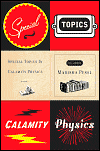
10745276.gifI feel decidedly so-so about this book, Marisha Pessl’s Special Topics in Calamity Physics. For one thing, I thought it was too long at over 500 pages; I have no problem with 500-page novels generally speaking, but the pacing of this particular long novel struck me as odd. It meandered along for 300 pages or so, with some interesting events and character interactions but without a strong sense of forward motion, and then at page 300, something really exciting happened and the book took off in a new direction. I won’t even hint at what the exciting event or the new direction is, so don’t worry about continuing to read this post if you plan on reading the novel in the future. But before this exciting event I found myself putting the book down without too much trouble, and after, it was much harder. I suppose the good news is that the book does eventually take off, but the bad news is that it does so so late.

The story is about Blue Van Meer, a teenager, and her father Gareth, a Political Science professor; Gareth is constantly taking on new Visiting Professor positions and so the two of them move just about every semester. Blue has learned very well how to make her way in strange new schools and new towns and talks about the dynamics of the High School social scene in jaded, cynical terms. But during her senior year, her father finally takes a year-long appointment, and Blue settles into the St. Gallway School, an elite private school known for sending its students to the Ivies.

Here Blue meets a beautiful, mysterious film studies teacher, Hannah Schneider. Blue notices that Hannah spends a good bit of her free time with a clique of five students whom Blue calls the blue-bloods; they have a meal together every Sunday, and soon Hannah invites Blue along. From this point on, the story is about the agonizingly slow way Blue befriends the blue-bloods, although her status in this group is always tenuous, and about the fascination the students have with Hannah’s personality and her past. Hannah seems suspiciously careful not to give away any details of her life before she began teaching at St. Gallway.

But none of this tells you much about how the book is written, and here I come to some of my other doubts about the novel. First of all, Pessl uses a syllabus format to organize the story; “Special Topics in Calamity Physics” is the name of the course and the course readings become the titles of individual chapters. Every chapter is named after some work of literature; we begin with Othello and end with The Metamorphoses. The novel’s introduction explains that Blue couldn’t figure out how to tell her story (the novel is in first-person from Blue’s perspective) until she hit on the syllabus idea, which gives her an organizing structure. The novel ends with a final exam. This format is original and amusing, but I found it only incidental to the unfolding of the story; sometimes I’d notice parallels between the chapter title and the chapter’s content, but often I’d forget I was supposedly reading through a syllabus, and I don’t think I missed anything by it. The structure struck me as more clever than useful.

As part of the “academic” format of the book, there are citations sprinkled throughout the book. Sometimes these take the form of documenting books mentioned in the narrative; for example, Pessl will give us something like this:

One Sunday, I watched in awe while Hannah fixed her own recessed doorbell with electrician gloves, screwdriver and voltmeter — not the easiest of processes, if one reads Mr. Fix-It’s Guide to Rewiring the Home (Thurber, 2002).

Often, these citations are of books not mentioned in the narrative, but provided as “documentation” of whatever point Blue is making. Usually these citations are an ironic counterpoint to the story’s details, for example:

It was the first Friday of November and Jade had gone to considerable lengths to pick out my outfit: four-inch malevolent gold sandals two sizes too big and a gold lame dress that rippled all over me like a Shar-pei (see “Traditional Wife’s Bound Feet,” History of China, Ming, 1961, p. 214; “Darcel,” Remembering “Solid Gold,” LaVitte, 1989, p. 29).

All this means the book has a very odd narrative voice. There are really two voices at work in this book, the knowledgeable, hyper-educated, fledging academic voice, and, hiding behind it, the voice of a lonely and scared teen. Blue comes across as incredibly well-educated, as old and experienced and world-weary, although, of course, she’s very young. But she also comes across as extremely vulnerable, and the novel’s rather bizarre ending bears this out. The academic trappings of the story come to seem like a coping mechanism, a way of finding order and meaning in a very chaotic life.

I feel like I can appreciate some of the things Pessl is doing here, especially with the narrative voice, but ultimately all the playfulness and experimentation didn’t come together for me. I just didn’t feel engaged, or at least consistently engaged, with the story.

I am curious to hear about other people’s experiences with the book, however, because I can see how other people might have enjoyed it very much.  It just didn’t work that well for this particular reader.

13 Comments

Filed under Books, Fiction

Blogs that make me think

thinkingbloggerpf8.jpgSusan from Pages Turned has nominated me for a Thinking Blogger Award — thanks Susan! I do my best to think and I guess sometimes I manage it!

The idea is that I’ll now nominate five bloggers who make me think (who can then, if they like, nominate five more). While there are many, many blogs that make me think, these ones are on my mind right now:

Tales from the Reading Room

Telecommuter Talk

The Public, the Private, and Everything in Between

The Books of My Numberless Dreams

The Hobgoblin of Little Minds

12 Comments

Filed under Blogging

The History of Love (and other things)

I’ve just checked out this year’s National Book Critics Circle awards, and I’m seeing that it’s good I’ve got Kiran Desai’s The Inheritance of Loss on my shelves, as she won for fiction, and the awards have also reminded me that I’d like to read Daniel Mendelsohn’s book The Lost: A Search for Six of Six Million, which won for autobiography and that I must, must, must read Lawrence Weschler soon, whose book Everything that Rises: A Book of Convergences won for criticism. I’ve got his book Vermeer in Bosnia on my shelves. I don’t like letting prizes dictate my reading — I like at least to pretend that I make book choices based on my own insights rather than other people’s, although surely that’s largely an illusion — but the awards are reminding me of books I’ve been interested in lately (the hundreds and hundreds of them — there’s little likelihood I’m getting to any of these really soon).

I finished Special Topics in Calamity Physics a couple days ago (post on that to come), and so now I’m working on finishing up some of my other books and will then choose another novel. I can’t decide exactly what I need right now — something old, perhaps Elizabeth Gaskell’s Wives and Daughters, or something new (and shorter) like Kazuo Ishiguro’s Never Let Me Go. Or something entirely different. We’ll see. I’ll let the impulse of the moment guide me.

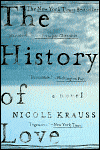
But for now I want to write about having finished the audiobook of Nicole Krauss’s The History of Love, which I enjoyed very much and highly recommend. I find it hard to write about audiobooks because I don’t have the book in front of me to look at, and I can’t refresh my memory of the plot details or give you quotations, but I can say that this has some great characters and an intriguing plot, it has humor and pathos, it’s about people who write and who love books and reading, and although the book’s title makes it sound like it might be hopelessly and annoyingly sentimental, it’s not.

The novel introduces you to various characters and then throughout the story brings them closer and closer and reveals unexpected connections among them. It feels a little bit like a mystery. There’s Leo Gursky, an old man living in isolation in New York City, who has loved one woman in his life, named Alma, whom he knew when he was a boy in Poland, and then lost when she moved to America. He had written a novel called The History of Love before emigrating to America himself, but, because he left his hometown fleeing the Nazis, he lost the manuscript. There’s another Alma who’s a 14-year old trying to deal with her mother’s depression and her brother’s worrisome obsession with religion, who becomes fascinated with a novel called The History of Love, which her mother is translating. Much of the pleasure of the novel comes from the way it unravels the mystery of what happened to the manuscript and how Leo’s and Alma’s lives are connected.

I really liked Leo’s character; he’s funny and wise, and the narrator who read the sections devoted to him had a wonderful voice and accent. The narrator who read Alma’s sections had a voice I found a little grating, but she’s a wonderful character too, odd and quirky and smart in a way that can make teenagers’ lives a misery but turns them into fascinating adults.

This book is a pleasure, plain and simple.

12 Comments

Filed under Books, Fiction

Why write? (or read? or ride my bike?)

I’ve found enough essays I’ve enjoyed in The Best American Essays 2006 to keep me going, although I’ve had lots of grave doubts about the overall quality of the book. My ambivalence has continued with my latest essay “Why Write?” by Alan Shapiro. I found myself irritated with Shapiro’s silly sense of humor through the beginning of the essay, until I got to one extraordinary page that redeemed the whole thing for me.

Maybe something is wrong with my sense of humor, but I found these opening sentences intensely irritating:

Some years ago, I went to a child psychologist. (If Henny Youngman had written this opening sentence, he would have added: “The kid didn’t do a thing for me.” But I digress.)

Anyway, the essay begins with the story of how Shapiro gets diagnosed with Attention Deficit Disorder as an adult, having been tested when one of his children was diagnosed, after which the doctor tells him that his writing can be seen as a “compensatory behavior” for his disability. In response, Shapiro says something genuinely funny:

“Let me get this straight,” I said. “I write books in order to make up for my inability to remember the names of the people I meet at a party, or because I come home from the grocery store with a red pepper instead of a tomato?”

He goes on from there to consider the various reasons he’s sought a career in writing, since, after all, the money’s no good and fame is so fleeting. After some irritatingly silly joking, Shapiro gets to a serious answer to his question about why he writes, by way of Elizabeth Bishop, and along the way he addresses the question of why we read (it’s a long passage, but a great one):

Bishop writes that what we want from great art is the same thing necessary for its creation, and that is a self-forgetful, perfectly useless concentration. We write, Bishop implies, for the same reason we read or look at paintings or listen to music: for the total immersion of the experience, the narrowing and intensification of focus to the right here, right now, the deep joy of bringing the entire soul to bear upon a single act of concentration. It is self-forgetful even if you are writing about the self, because you yourself have disappeared into the pleasure of making; your identity — the incessant, transient, noisy New York Stock Exchange of desires and commitments, ambitions, hopes, hates, appetites, and interests — has been obliterated by the rapture of complete attentiveness. In that extended moment, opposites cohere: the mind feels and the heart thinks, and receptivity’s a form of fierce activity. Quotidian distinctions between mind and body, self and other, space and time, dissolve.

Now as far as writing goes, this passage doesn’t ring true to me, as I can’t really remember ever feeling that absorbed in my writing; or, if I have felt that way, it’s not something that has “stuck,” something I need to return to again and again. This is probably why I tend not to think of myself as “a writer,” although I do a decent amount of it. Shapiro speculates that writers may have a reputation for suffering from melancholy, not because good writing requires sadness and depression, but because after feeling the absorption and attentiveness of writing, Bishop’s “perfectly useless concentration,” their non-writing lives seem lacking and they feel haunted until they can return to that trance-like state.

This passage does ring true to me when I think about reading, however; and I like how Bishop describes both writing and reading as activities that can create this happy absorption. Bishop portrays reading or viewing a work of art as a creative act in itself and her formulation excludes nobody; everybody can interact with art and be self-forgetful for a while.

What really made me happy about this part of the essay, however, were the next lines:

Athletes know all about this nearly hallucinatory state. They call it being in the zone. They feel simultaneously out of body and at one with the body.

Yes, I know exactly what he’s talking about. Sometimes when I’m riding or hiking I feel like a truly whole human being, no separation between my mind and my body. I’m not thinking about what I’m doing; I’m just doing it. I’m just a being walking or riding a bike, wholly focused on the present moment.

And then, to add to all this goodness, Shapiro writes a passage that dovetails beautifully with Litlove’s recent post on the symbolic and the semiotic, the symbolic being straightforward language and the semiotic being the musical, poetic quality of language. Shapiro talks about how infants experience a form of the concentration he has been describing, expressing it through their babbling babytalk. Of his children as infants he says,

He or she would be talking, but the meaning of the words were indistinguishable from the sensation of the sound, and the sound was part and parcel of the mouth that made the sound, of the hands and fingers that the mouth was sucking as it sang.

In other words, the symbolic and the semiotic are one and the same.  And from there, he moves to how we as adults continually seek out this lost relationship to language, the lost connection of the symbolic and the semiotic:

No matter how sophisticated our poems may be, or how deadly serious they are about eradicating or exposing the terrible injustices around us, I still think that we are trying — by means of words, of consciousness — to reawaken that pre-verbal joy, to repossess, reinhabit what someone else has called the seriousness of a child at play. Bishop says this concentration’s useless because it is its own reward, the mysterious joy of it. It is singing for the sake of singing.

Isn’t it beautiful how this all comes together? Writing and reading, and walking and riding for that matter, are ways of finding unity and wholeness — of the body and the mind, of the adult self with the child self. The close of Litlove’s post brings it together wonderfully:

Great writers know how to tap into and express the semiotic in their works, and so what they say speaks to us at a profound level. I like to think of this layer of other meaning, beyond and within communication, as the defining characteristic of the literary. And our ability, from birth, to hear and express it, to tap into it and to play with it, is what makes us all fundamentally literary creatures, in a basic instinctual way.

10 Comments

Filed under Books, Nonfiction

How to treat a book

The New York Times Book Review yesterday had an essay by Ben Schott on how he treats books, called “Confessions of a Book Abuser,” where he argues that it really doesn’t matter a whole lot if you treat your books a little roughly. Barring certain kinds of books like rare ones or books of historical interest or books that belong to libraries or to other people, he’s okay with folding corners and writing in the margins and keeping a book he’s reading open face down on a table.

It was mostly a silly, light essay, but I did agree with his conclusions: when thousands of copies of books are made quite easily and quickly, does it matter if we don’t keep them in pristine shape? And isn’t treating books roughly a sign of taking them seriously and engaging with them?

I liked this paragraph in particular:

Indeed, the ability of books to survive abuse is one of the reasons they are such remarkable objects, elevated far beyond, say, Web sites. One cannot borrow a Web site from a friend and not return it for years. One cannot, yet, fold a Web site into one’s back pocket, nor drop a Web site into the bath. One cannot write comments, corrections or shopping lists on Web sites only to rediscover them (indecipherable) years later. One cannot besmear a Web site with suntan-lotioned fingers, nor lodge sand between its pages. One cannot secure a wobbly table with a slim Web site, nor use one to crush an unsuspecting mosquito. And, one cannot hurl a Web site against a wall in outrage, horror or ennui. Many chefs I know could relive their culinary triumphs by licking the food-splattered pages of their favorite cookbooks. Try doing that with a flat-screen monitor.

This is a great argument for why books are wonderful — the fact that they are objects matters, that they become parts of our lives and can absorb and carry a bit of our past. I kind of like having worn and abused books around (although, don’t get me wrong, I like new ones too). I like having books with a history, mine or somebody else’s. While I try not to buy used books that other people have underlined or written in, if I accidently come across somebody’s comments, I’m curious. If I read a friend’s copy of a book he or she has underlined or written comments in, I try to figure out what was going on in that person’s mind.

I like to think about when I first bought a book and when I first read it, and I like the way the presence of underlining is a sign that I read something, even though I might have forgotten it since. I can recall entire college courses by looking the notes and underlining in some of my books. I like the way some older paperbacks with cracked spines will lie flat, so I can read them at the dinnertable without propping them up. I like seeing a book on the shelf with a bunch of post-it notes sticking up out of the top. I like seeing my Penguin edition of Clarissa on the shelf next to me and noticing the multiple cracks of the spine, the incredibly thick spine, that show I read that book from cover to cover.

Here’s the way the article ends:

To destroy a book because of its content or the identity of its author is a despicable strangulation of thought. But such acts are utterly distinct from the personal abuse of a book — and there is no “slippery slope” between the two. The businessman who tears off and discards the chunk of John Grisham he has already read before boarding a plane may lack finesse, but he is not a Nazi. Indeed, the publishing industry thinks nothing of pulping millions of unsold (or libelous) books each year. And there was no outcry in 2003 when 2.5 million romance novels from the publisher Mills & Boon were buried to form the noise-reducing foundation of a motorway extension in Manchester, England.

It is notable that those who abuse their own books through manhandling or marginalia are often those who love books best. And surely the dystopia of “Fahrenheit 451” is more likely avoided through the loving abuse of books than through their sterile reverence.

A reader can love books without mistreating them, yes, but for me, it’s a sign of taking them seriously if they look a little used.

23 Comments

Filed under Books

Race report

My first bike race of the season didn’t suck! Woo-hoo! That’s really all I ask.

I ended up finishing the race, which is a big improvement on last year’s first race, and I stayed with the main pack up until the last 2 laps (out of 17 or 18 laps, I’m not sure). At that point somebody decided to sprint off the front, the pack surged forward to catch him, and I couldn’t keep up. I might have stayed with them, but I was on the wheel of a guy who couldn’t keep the pace, and when I went around him to try to catch up, I hit a head wind and couldn’t do it.

But going into the race, I had no idea whatsoever what I’d be able to do. Last year for my first few races, I didn’t finish, or I finished so far off the back of the pack that it hardly counted as a finish. I’ve done a lot more riding this year than last, so I thought I might do better, but I had no real idea how much training the other riders have been doing or who most of the other riders would be.

So I went into it hoping just to hang on as long as I could. When I’d ridden a couple of laps without feeling like I was going to die or throw up, I relaxed a bit and thought I might be able to do okay. After that, I told myself to try to hang on for five more minutes — just five! — and after that I told myself to hang on another five minutes, and another, up until the end (the whole thing was about 40 minutes). At that point, many of the guys in the pack still had energy left to sprint, but I most definitely did not, so I wasn’t surprised they left me behind. And there were a bunch of guys who fell behind much earlier than I did — I don’t like to have that competitive attitude, but — it’s really nice to be faster than at least a few people.

It was a cold day, although not colder than one might expect in early March, low 30s in the morning. But it felt much colder than that when I finished my race and stayed to cheer on the Hobgoblin and other teammates. Clouds blew in and covered the sun and the wind picked up, and I stood there shivering, wearing the Hobgoblin’s jacket, wishing it were spring. I like watching bike races, but I’ll like it more when it’s warm.

Oooh — one of my teammates just sent me an email telling me I rode a good race today!  My teammates are awesome.

11 Comments

Filed under Cycling

More of the wisdom of Johnson

I can’t let the week end, I think, without giving you some more of the wisdom of Johnson (I warned you a while ago you’d be reading a lot of him, if you stuck around here …). I’ve noticed just how often the subject of melancholy comes up in The Life; Johnson struggled with it frequently and wrote often about how to deal with it. Here is what he writes in a letter to Boswell after Boswell has complained that “his mind has been somewhat dark this summer”:

I am returned from the annual ramble into the middle counties … I was glad to go abroad, and, perhaps, glad to come home; which is, in other words, I was, I am afraid, weary of being at home, and weary of being abroad. Is not this the state of life? But, if we confess this weariness, let us not lament it; for all the wise and all the good say, that we may cure it.

For the black fumes which rise in your mind, I can prescribe nothing but that you disperse them by honest business or innocent pleasure, and by reading, sometimes easy and sometimes serious. Change of place is useful…

I know the feeling of being weary at home and weary abroad, and going back and forth and back and forth — or of being weary of busyness and weary of leisure (my school year and my summer) and going back and forth and back and forth — but what else is there to do but go back and forth and back and forth and be grateful that a change comes around every once in a while? When I think of my own state of mind, I realize that the thing I’m afraid of is not change so much as things staying always the same. It’s good to have a regular change of place or change of pace to look forward to. It’s keeping in mind that change will soon happen and therefore I ought to be content with what I have now that’s hard.

There is also this passage, a little further on:

Talking of constitutional melancholy, he observed, “A man so afflicted, Sir, must divert distressing thoughts, and not combat with them.” Boswell. “May not he think them down, Sir?” Johnson. “No, Sir. To attempt to think them down is madness. He should have a lamp constantly burning in his bed chamber during the night, and if wakefully disturbed, take a book, and read, and compose himself to rest. To have the management of the mind is a great art, and it maybe attained in a considerable degree by experience and habitual exercise.” Boswell. “Should not he provide amusements for himself? Would it not, for instance, be right for him to take a course of chymistry?” Johnson. “Let him take a course of chymistry, or a course of rope-dancing, or a course of any thing to which he is inclined at the time. Let him contrive to have as many retreats for his mind as he can, as many things to which it can fly from itself.”

Now for serious depression, I don’t think this advice would do a lot of good, but it strikes me as quite right for milder cases of melancholy — it seems to me impossible to “think down” sad thoughts, but diversion more often does the trick. Johnson and Boswell talk about diversions of mind — new things to read and study — and those are wonderful, but if I want to fly from my own mind, there’s little better than doing something with my body, a walk or a ride, maybe. The worst thing is to sit there and stew.

And here’s a small touch of Boswell’s humor:

On Wednesday, April 3, in the morning I found him very busy putting his books in order, and as they were generally very old ones, clouds of dust were flying around him. He had on a pair of large gloves such as hedgers use. His present appearance put me in mind of my uncle, Dr. Boswell’s description of him, “A robust genius, born to grapple with whole libraries.”

9 Comments

Filed under Books, Nonfiction

Don Quixote group reading?

7075756.gifThere have been rumors going around the book blog world about getting a Don Quixote reading group together sometime this summer.  I’d like to read the book during the summer months, say, from May to August.  So — who’d like to join me?  Shall we set up a group blog?  Blogger or WordPress?  What shall we call it?  I’m no good at thinking up clever names, so somebody else will have to help me.

Would you like to set up a reading schedule or simply set up the group blog and have people post on their reading experiences as they go along?

What translation will you read?  I, for one, am going to choose the new Edith Grossman translation.

26 Comments

Filed under Books

Reading report

It’s that time of the semester again — the time when I begin to get a little busier and have less time for reading. Which means I begin to get anxious and to count the weeks until summer (eight weeks of class, with a spring break thrown in there and then finals week). I’m feeling like I haven’t finished a book in forever, a feeling I don’t like at all. Actually, it’s been a little less than two weeks since I finished a book, which, since I’ve got five going now, isn’t too bad, I suppose, but which still feels like a long time.

I wish I didn’t feel this way — what’s so important about finishing a book if I’m happy reading the ones I’ve got? And I am happy reading them. But I still begin to get anxious. This is the only drawback with reading multiple books at once, I’ve found. Since I don’t like to abandon any book for too long, I find myself switching back and forth amongst all my books very frequently, which means I don’t spend much time with each one, which means it takes me forever to finish what I’ve got.

Part of this feeling comes from the fact that I’m in the middle of two really big books, the Johnson bio and Proust. I’m enjoying them both — so why am I anxious to finish them? I’m also reading a book of poems, Marie Howe’s What the Living Do, which I’m liking a lot and will post on later, but I’m wishing I could get to this one more frequently. It’s the one I neglect most often, just because reading poetry takes just enough more effort that when I’m tired I won’t do it. I’m still working on The Best American Essays 2006, determined to finish the thing — and I’m finding some good essays mixed in with the mediocre ones.

And I’m also in the middle of Special Topics in Calamity Physics. I’m not sure what I think about it. At times I find myself a bit bored (which doesn’t help the anxious feeling that I need to finish it); some parts make me wonder if they are really necessary — if they add to the plot or to the ideas. The first-person voice is funny at times, moving at times, irritating at others. More on this book later.

Finally, a meme from Booking Through Thursday:

  1. How many books would you say you read in an average month? These days, 5 or 6. But this month I finished 3, only one of which I began in February, and one of which I began last November (a Proust volume).
  2. In a year? Last year it was 56.
  3. Over the last five years? I have no idea. I didn’t keep records in 2005, but at some point last year I tried to remember and recall only 31. Before that, I have no record at all. But this was the time in which I wrote my dissertation (yes, it took five years, from beginning the proposal to finishing it), and my reading-for-pleasure time was limited. I did a lot of article-reading and academic book-skimming though.
  4. The last 10? No clue here either. But this covers the time I wrote my dissertation and the time I did my graduate coursework, so I know I read a decent number of books for classes. I didn’t read for fun while taking literature classes because I didn’t have time; once I finished these, I began reading for fun again and haven’t stopped since. But “reading for fun” isn’t so clearly opposed to reading for class — I took an awful lot of novel classes and so it didn’t always feel like work.

8 Comments

Filed under Books

A Good Man is Hard to Find

First of all, if you haven’t read the Hobgoblin’s post on his father and on what’s happening to war vets, do go check it out.

I taught Flannery O’Connor’s story “A Good Man is Hard to Find” in my classes yesterday and had such a fun time doing it; I’m not sure I got the students to like the story as much as I do, but that might be because it’s a story that grows on you with every reading. For me, the story gets funnier and funnier each time (and I’ve re-read it quite a few times now).

The story describes a family on a trip from Georgia to Florida; they get side-tracked down a dirt road and run into an escaped convict called the Misfit and violence ensues. Now that doesn’t sound like funny material at all; in fact, when I talked about how funny I think the story is, a number of my students were shocked. But that’s the genius of O’Connor, and what makes her so strange: that she can write a funny story about violence that also has a profound and beautiful religious element. This paragraph will give you a taste of O’Connor’s style:

The children’s mother still had on slacks and still had her head tied up in a green kerchief, but the grandmother had on a navy blue straw sailor hat with a bunch of white violets on the brim and a navy blue dress with a small white dot in the print. Her collars and cuffs were white organdy trimmed with lace and at her neckline she had pinned a purple spray of cloth violets containing a sachet. In case of an accident, anyone seeing her dead on the highway would know at once that she was a lady.

This last line just kills me; it captures the grandmother perfectly, with her primness and properness and her failure to recognize that if she’s dead on the highway, she’s not going to care what she looks like. And the bratty children crack me up:

“Let’s go through Georgia fast so we won’t have to look at it much,” John Wesley said.

“If I were a little boy,” said the grandmother, “I wouldn’t talk about my native state that way. Tennessee has the mountains and Georgia has the hills.”

“Tennessee is just a hillbilly dumping ground,” John Wesley said, “and Georgia is a lousy state too.”

“You said it,” June Star said.

What sends the family down the dirt road is that the grandmother remembers a nearby plantation she visited as a young woman and she gets the children excited about stopping there. They set off down the side road, and it’s then that she has a terrible thought. This terrible thought makes her jump, which lets the cat out of the basket where she’s been hiding it, which then jumps up onto the father’s shoulder startling him and causing them to veer off into a ditch. This is the grandmother’s response:

As soon as the children saw they could move their arms and legs, they scrambled out of the car, shouting, “We’ve had an ACCIDENT!” The grandmother was curled up under the dashboard, hoping she was injured so that Bailey’s wrath would not come down on her all at once. The horrible thought she had had before the accident was that the house she had remembered so vividly was not in Georgia but in Tennessee.

The grandmother is just such an awful person. She’s self-centered and irritating, and not so different from her bratty grandchildren, and this is what makes her such a great character — O’Connor gets her perfectly. And yet, in spite of being so awful, she has a wonderful moment at the end of the story, a moment when she manages to be someone different from who she’s been up until that point. There’s something wonderful about the extremity of this story, the violence and the humor and the suddenness of the grandmother’s moment of insight at the end. O’Connor isn’t interested in the subtle shifts in thinking we often see in short story characters; she gives us drama and lots of action and the possibility of sudden transformation.

I’ve read all of O’Connor’s fiction, I’m pretty sure, unless I missed a story or two. But it was quite a while ago I read it, and I think it would be fun to read her again — she’s someone whose work it wouldn’t be hard to read in its entirety, as she has only two short novels and a couple short story collections. She’s someone I might read differently now that I’m a bit older; I feel like with a little age I can better appreciate her sense of humor.

I found myself reminding my students that this is fiction we’re talking about; yes, there’s violence in the story, and yes, it’s gruesome, but that’s not really the point. It’s not as though it’s the kind of gratuitous violence you frequently see in the movies; it’s violence that gets you to think about God and grace and what the point of trying to be good is. And since it’s a truly horrible person who leads us into all of these serious thoughts, why not make that horrible person and her family as funny as you can? You can get a sense of O’Connor’s rather wicked sense of humor from the story’s closing lines:

“She would of been a good woman,” The Misfit said, “if it had been somebody there to shoot her every minute of her life.”

“Some fun!” Bobby Lee said.

“Shut up, Bobby Lee,” The Misfit said. “It’s no real pleasure in life.”

13 Comments

Filed under Books, Short stories

My latest audiobooks

10744574.gifLast time I wrote about audiobooks, I was in the middle of listening to Jennifer Egan’s The Keep. Well, now I’ve finished it, and I have to say I wasn’t all that terribly impressed. The story never quite came together for me; I never really came to care about the characters all that much. And then there was a strange shift in narrators near the end, along with a new reader, so I felt like I was listening to a completely new book and it was jarring. The thing is, on the back of the CD case were pictured two readers, a man and a woman, so I knew another reader would be coming along at some point, but since it didn’t happen until near the end of the novel, I spent quite a long time wondering when the reader would shift. I found it irritating. This is not the fault of the book, of course, just some unfortunate circumstances that kept me from giving it a fair chance, I suppose.

The novel is about two stories that intertwine; one is about Danny, a tough, New York City guy who gets into some trouble and so jumps at the opportunity to go visit his cousin in Europe. This cousin owns and is renovating a castle somewhere on Germany’s border. The other story is about Ray, a guy in prison who is taking a writing class and is falling in love with his instructor. I liked the beginning of the novel, which has a harrowing scene from Danny’s childhood where he and some friends abandon his cousin in a cave, but the rest of the novel doesn’t live up to this beginning. It’s got some odd, fantastical, magic-realism elements to it that I didn’t really get the point of and I wasn’t all that interested in the novel’s ideas. It’s a reworking of the gothic, with the castle and some mystery and a frightening Baroness, but Egan didn’t convince me that there was a larger point to this reworking, besides the chance to have some fun writing about Baronesses and castles.

But I’m now listening to Nicole Krauss’s The History of Love, and so far I’m liking it much better. This book also has multiple narrators and multiple readers, but it’s got more of a regular pattern to it, which works just fine. The only problem is that one of the CDs is damaged; I’m having to miss maybe 5-10 minutes of the story. I’m liking the book enough I considered buying a paper copy and reading it the regular way, but not having been at a bookstore lately, I haven’t had the chance. We’ll see if I can piece together the story.

I liked the first narrator very much; he’s Leo Gursky, an old man living in New York City, who has only one friend, Bruno, and who is lonely. Leo and Bruno check every day to make sure the other person is still alive. Leo feels so isolated he goes about the city making scenes and being difficult to make sure that people notice him. He doesn’t want to die on a day nobody has seen him. He is so desperate to be seen, he volunteers to be a nude model in a drawing class; he is happy to think that people will be staring at him for hours and creating images of his body. Leo has a wonderfully humorous voice, and the man who reads this section does a wonderful job. After Leo, the book shifts to Alma, a young girl who is trying to find a boyfriend for her depressed mother. We shall see where this book takes me …

14 Comments

Filed under Books, Fiction

The upcoming race season: a cycling post

I got home just a little while ago from a 37-mile bike ride that felt like it was at least 50.  It was a good ride, just very hilly and therefore slow, and I was convinced at one point that I was lost, and so I spent at least 20-30 minutes in a panic, certain I would have to turn around and retrace my route, which would involve climbing up more hills.  I didn’t, thank heavens — I eventually came to a place I recognized and realized I was on the right route all along.  But that kind of experience makes a ride feel much longer.

The race season begins next Sunday, and I have no idea how ready I am.  I’ve been riding regularly through the winter, but not terribly intensely — which I think is how I should be riding; the intensity can come later.  The problem is that the race season here begins ridiculously early.  I’m torn between wanting to be ready for the first race so I don’t embarrass myself horribly, and worrying about working so hard I get burnt out.  If I ride too intensely now, I won’t leave myself enough room to add intensity later.  But if I don’t ride intensely now, I’m running the risk of not having enough strength to finish the first races.

I rode with my cycling club yesterday; they were practicing race tactics to get ready for next week, doing things like working together to catch a sprinter who’s made a break from the pack.  I didn’t actually directly participate in these drills, as I’m not strong enough; I just rode at the back of the pack, trying my best to stay with everybody.  This could be an indication that I’m not ready to race, but it was a mixed group — some beginners and some more advanced riders (categories 4 and 5) — and so I still don’t know how I match up against riders in my category.  There were other guys who looked about as tired as I was.

As usual, I was the only woman in the group; there is at least one other woman in my club who races (and maybe more, depending on whether a couple new people decide to give it a try), but she doesn’t train with the guys much.  There will be a women’s race next week, but I’m not going to ride in it — the women’s race is usually very fast because women of all levels ride in it, whereas the men’s race I’ll ride in is limited mostly to newbies, and so a bit slower.  That was a lesson I learned very well last year.

So who knows.  I’ll give it my best shot next week, but if I don’t do well, that will be okay, because it’s the beginning of the season and I have plenty of time to get myself into shape for races later on.

And the real truth of the matter is that I race because I like riding and I want a challenge.  I don’t care much how well I do.

7 Comments

Filed under Cycling