Booking Through Thursday

I’ve never answered one of the Booking Through Thursday questions, but today the question caught my eye, so maybe today is a good day to start. Here’s the question:

Okay, so the other day, a friend was commenting on my monthly reading list and asked when I found the time to read. In the ensuing discussion, she described herself as a “goldilocks” when it comes to reading–she needs to have everything juuuuuust right to be able to focus. This caught my attention because, first, I thought that was a charming way of describing the condition, but, two, while we’ve talked about our reading habits, this is an interesting wrinkle. I’d never really thought about it that way.

So, this is my question to you–are you a Goldilocks kind of reader?

Do you need the light just right, the background noise just so loud but not too loud, the chair just right, the distractions at a minimum?

Or can you open a book at any time and dip right in, whether it’s for twenty seconds, while waiting for the kettle to boil, or indefinitely, like while waiting interminably at the hospital–as long as the book is open in front of your nose, you’re happy to read?

I’m too much like a “goldilocks” reader for my own comfort. I don’t require perfect conditions, but I require very good ones. I can read when there are distractions around, but I read very slowly when there are — even more slowly than usual. I wish I were the kind of person who could focus well, but I’m not.

It’s rare, actually, that I’m completely absorbed in what I’m reading. I often look up from my book, sometimes to think about a passage, sometimes to notice something about my surroundings, and then my thoughts will wander and I’ll have to drag myself back to the book once again. I’m particularly bad about this when there are people around. I love to watch people, and I can’t help but notice social dynamics, so reading in airports or doctor’s offices is hard (although I do it). I’ll notice if someone starts a conversation, and once that happens, I can’t help but listen in. If people are having an argument, my book becomes useful only as something to hide the fact that I’m eavesdropping.

And I find it hard to quiet my mind to settle into reading. I suspect I’d benefit greatly from meditating regularly — I need to teach myself not to let my thoughts distract me from my book or whatever else. This is particularly hard when the semester is underway and I’ve got lots to think about. I’ll read for a few minutes and then notice that I’m not reading anymore and am thinking instead about how class went that day. Over the course of an evening’s reading, this gets better; by the evening’s end, I’m able to pay closer attention.

6 Comments

Filed under Books, Reading

Starting new books

I’ve been enjoying starting new books — what greater pleasure is there than diving in to a new book? One of them is Ursula LeGuin’s Left Hand of Darkness; I’m about 40 pages into it and think I’ve figured out what’s going on — it takes a while to get all the new names and new vocabulary and the rules of a new world when reading science fiction — or when reading any book, really, but science fiction especially. It promises to be fun. It’s the first science fiction I’ve read in, oh, probably a couple decades. Perhaps when I’m finished with this I’ll ask for more recommendations.

I also began Bruce Chatwin’s travel book In Patagonia. I’m still figuring out how this book works, too, although once I figure it out I think I’ll end up liking it. Actually, it’s not so different from beginning Left Hand of Darkness because I also have to figure out the “world” of the book — before I began it, I barely knew where Patagonia was. And I have to figure out exactly how Chatwin goes about writing a travel tale. It’s not exactly a straightforward narrative, but is made up of very short chapters, 1-2 pages long, each with their own vignette. So far there’s not much discussion of why he traveled and how he went about all the little steps of the trip — all the connective tissue of the journey; instead, he focuses on interesting people he meets and on the landscape, and he moves really quickly from one incident to the next. It’s amusing — he’ll mention walking down a road, running into a man walking the other direction, and next thing I know, Chatwin is visiting the man’s house, getting introduced to his family, and spending the night there. I’m not exactly sure how they got from passing each other to becoming friends. As far as I can tell, he’s a drifter who sleeps in a bed when he can get one, and behind a bush when he can’t.

I also began listening to Mark Haddon’s The Curious Incident of the Dog in the Night-time, and oh, what a fun book! I love the reader’s voice and accent, and I find the main character so very appealing. Listening to it makes me want to meet him and show him that I get it — that I’m not one of those annoying people who uses sloppy language and tells lies. This book is so charming.

6 Comments

Filed under Books, Reading

One of my more absurd rides

I finished off my summer with a 50-mile ride yesterday, my longest since I got sick. I’m training for distance right now, but also trying to get some of my hill-climbing ability back — not that I ever had all that much — so I headed for a hilly course (the Housatonic Hills course, for those of you who know the area — it’s about 12-13 miles from my house).

Things started off fine, although I ran into the beginnings of a parade as I rode through one town (side note: Emily, it was your town — were you there??); people were milling about on the edge of the road, cars were swerving all over the place, vendors were out with their big carts, so I did my best to dodge everybody and got out of there.

I had some nice moments. I passed Hobgoblin, who was riding in the other direction, and we stopped for a brief chat. I soaked up as much of the beautiful view as I could, the green and the warmth. Those things will soon be gone, but I’ll still be riding out there. I need to appreciate them while I can.

I had an embarrassing moment when I stopped in a little market/convenience store and handed the guy at the register $2, when he wanted $2.50. I didn’t know why he was looking at me funny. He laughed and said I’ve been working so hard riding I can’t think straight, which was pretty much true; I do get absent-minded when I’ve been exercising for a while.

It was shortly after this, though, that things got much worse. I was riding along, and all the sudden I heard a scraping noise and my butt dropped about two inches. The bike all the sudden felt very wrong. I stopped to see what had happened and saw that my saddle was at an odd angle; it was pointed up — the saddle had slipped. I didn’t have any bike repair tools on me, although even if I had, I’m not entirely certain I could have made the repair; I still suck at bike mechanics. I thought about heading back to the store and asking to use their phone (no, I have no cell phone) to call Hobgoblin and have him come get me, but I thought better of it. The bike was rideable after all, if a bit uncomfortable.

I was 14 miles from home at that point, kind of tired and annoyed, but I figured I could make it the rest of the way if I took it easy so as not to let the awkwardly-angled saddle cause me any muscle problems. I stood up as much as possible, and hoped that when other cyclists passed me (which they did, of course, in droves), that they wouldn’t notice the saddle and think I was an idiot who didn’t know what a bike should look like.

Everything was okay until I returned to the town having the parade. By now, they were in the middle of it. I thought I’d ride around it by taking a back road; I asked a police officer if I could ride through a road block they had set up, thinking I’d head in a different direction from the parade. He said sure, no problem, so I went ahead, and next thing I knew I was in the middle of the parade. The back road was no escape — it was the parade route itself.

If I were thinking straight, I probably would have turned around and gotten out of there, but I wasn’t, so I just kept riding. The parade was on my left and the spectators on my right, and if I thought the road was crowded the first time I went through, I realized it was really crowded this time. Little kids kept bouncing around dangerously close to my bike, and the vendors were even more in the way. People were throwing candy for the kids to pick up, and I kept accidentally riding over the pieces. I had to work to keep a line between the people parading and the people watching. A few people cheered for me. One kid yelled out “Go, Lance!”

And I just wanted to ride quietly home; the last thing I wanted was to make a spectacle of myself, with my ridiculous saddle and all! The spectators probably thought I was obnoxious for refusing to keep out of their way; I would have thought so, if I saw someone riding through a parade like that.

Sometimes it just all goes wrong, you know?

11 Comments

Filed under Cycling

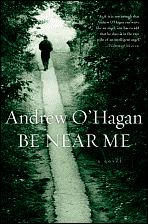
Be Near Me, by Andrew O’Hagan

12864414.gif I’m down to only two books I’m currently reading, and I’m about to finish one of them! I haven’t been in this situation in a long time. The only thing to be done about it is to start a couple new books, at least. Ursula LeGuin’s Left Hand of Darkness, Walter Scott’s Waverly, and Bruce Chatwin’s In Patagonia are the ones I’m planning to choose from.

But for now, I want to write a bit about Andrew O’Hagan’s new novel Be Near Me. I thought the novel had a few flaws, but overall it’s beautifully-written, absorbing, and moving. It’s about a Catholic priest, David Anderton, assigned to a small parish in Scotland who finds himself (David often seems passively drawn into things) involved with two teenage kids, Mark and Lisa. Mark and Lisa are wild; they do their best to shock David, but find themselves drawn to him when he isn’t shocked — when they see he wants to spend time with them. The three of them hang out after school and at night, talking and driving places; David takes the teenagers on trips to local landmarks they had never visited; generally, they have a lot of fun, although it’s clear from early on that these relationships are complicated and bound to become more so.

The novel is told in first person, and mixed in with the Mark and Lisa scenes, David tells about his past, his time at school and at Oxford, especially, and the story of falling in love with Conor, a fellow student. These background stories help to fill in David’s character. He doesn’t fit in easily anywhere and says he’s not sure where he belongs; he had an exciting youth, participating in the student protests of the 60s (he’s now in his 50s), but when he became a priest, he turned away from all that and has since lived a very quiet life, serving in parishes in England and only recently in Scotland.

He seems disconnected from himself, and his voice comes across as stoic and a little bit melancholy, as though he knows he has missed out on much but refuses to admit it. His housekeeper Mrs. Poole, with whom he has forged a friendship, tells him has spent his life trying to avoid life, but he refuses to believe this.

So when he meets and befriends Mark and Lisa, it inaugurates something new; he sees in them the youthful energy he no longer has, but he also grasps at the chance to change himself, to be a participant in life, to take risks and do foolish things. This is the most moving part of the book, I think; the longing David has for newness that he finally allows himself to indulge.

But it all goes wrong, inevitably, and David pays dearly for this experience of freedom and abandon.

What I loved best about the book is how richly it describes David’s sense of self and his interiority; it’s a very smart, thoughtful book, rather sad in the way it portrays growing older and taking stock of what one has become, but hopeful about the possibility of change, even in the midst of disaster. I did feel the narrator’s voice was sometimes a little too withholding, a little too reticent, and in these moments, rather than communicating hidden depths, the narrator left me a bit cold. This is the danger of using first person with a character like David, I suppose; his ambivalence about himself can at times make him seem a little blank.

But I only felt this blankness in moments, and mostly the experience of reading this book was a pleasure.

4 Comments

Filed under Books, Fiction

What I’m reading

I hope everyone is enjoying their Labor Day weekend; I’m not doing anything special, just riding a bit, reading a bit, and trying not to think about school starting soon. I’ve completed or am nearing the end of several books, the De Quincey one, first of all, of which I have about 25 pages left. This is one of the odder books I’ve read in a while. I’ve written a few posts on it (here, here and here), but these posts by no means capture the oddness of it. I’ve given you little snippets, but it’s the contexts they come out of that are so strange. His writing is so digressive; he takes you all over the place, and often you don’t know where he’s going until you get there, and then he’s off someplace else.

The book takes some patience to read, for me at least, since his writing is fairly dense, but it’s very much worth it. He leaves you wondering and wondering what’s going on until he hits with you a beautiful passage that takes your breath away. He tells a story in “Suspiria de Profundis” about a mountain called the Brocken in Germany with an optical effect where, if you climb to the top at the right time of day, you see an image of a person of gigantic size a couple miles off in the distance, set against the sky or clouds or rocks. Only after noticing that the gigantic figure follows all of your movements, do you realize that it’s an image of yourself. De Quincey calls this the “Dark Interpreter” and the passage starts to get psychological:

This trial is decisive. You are now satisfied that the apparition is but a reflex of yourself; and, in uttering your secret feelings to him, you make this phantom the dark symbolic mirror for reflecting to the daylight what else must be hidden for ever.

The Dark Interpreter turns out to be an aspect of yourself that, separate from the self you are familiar with, allows you to reveal your hidden depths. De Quincey says the Dark Interpreter is often the “self” that appears in his dreams. He takes the metaphor further; as the apparition of the Brocken is sometimes disturbed by storms so that it no longer looks like him, so the Dark Interpreter is sometimes like an alien being living in him:

What he says, generally is but that which I have said in daylight, and in meditation deep enough to sculpture itself on my heart. But sometimes, as his face alters, his words alter; and they do not always seem such as I have used, or could use. No man can account for all things that occur in dreams.

So the apparition of the Brocken turns out to be the strange version of ourselves that appears in dreams, sometimes recognizable, sometimes so strange that we wonder how those words and ideas got in our heads in the first place.

Kind of cool and strange, right? The whole book is obsessed with dreams — the sources of them and how our minds transform those sources.

The essay I’m reading now, the last one, is about mail coaches. Yes, he’s written a fascinating 50-page essay on mail coaches. Report to follow.

But I didn’t mean to turn this into a post on De Quincey, which is what it has become, I’m afraid. I’m also about to finish my book of Keats poems, which I have enjoyed tremendously, and I just finished Andrew O’Hagan’s novel Be Near Me. I’ll write about that one next, to give you a break from all this De Quincey.

6 Comments

Filed under Books

A century?

I think I may try to ride a century this fall — a hundred miles in one ride. In a more typical year, I would have ridden a century last Sunday and would be planning to ride another one or two in the next month. These are organized rides that run on the same weekend every year and that have lots of support — a marked course, food and water along the way, mechanical support, lots of other riders, and usually a t-shirt and other free stuff. I usually spend July and early August doing progressively longer rides to get ready.

But this year my health got in the way, and the typical season got disrupted. So instead I thought I might try to do one on my own, probably in late October or early November. My riding has gotten steadily better over the last month, so that now I feel like I’m back to normal, just about — I’m not in race shape, by any means, but I can ride as well as or better than I could last January or February before I got in race shape.

And I need something to work toward, some sort of goal. I don’t need to be training for races right now, as those don’t start up again until March, but I don’t want to just ride either — I’d feel too purposeless. So working toward a century should do the trick. As to whether I can actually complete one, that will depend on my health and my free time and the weather.

A good number of riders I know have enough endurance to just ride a century, without elaborate preparation, but not me. I’m perfectly comfortable up to about 50 miles, and after that I get tired fast if I don’t train. The training I do for races doesn’t help at all, because most of my races are usually relatively short — 20-25 miles or so for the ones I’m best at. I spend most of the training season working on intensity, not endurance.

So I’ll try to do a series of long rides on the weekends in September and October; the longest I’ve done since I got sick was about 38 miles, so I’ll do a couple of 50-mile rides, a couple of 60-mile rides, maybe a 70-mile one and hopefully an 80-mile one, and then I’ll be more than ready. I’m lucky to have a marked century route that begins and ends practically at my front door, as I can be bad at making up my own routes — this route heads south for a bit before circling back to my town, and then follows a northern loop for the rest of the ride. There are plenty of convenience stores and delis to get food and water, so I won’t miss the food stops of an organized century.

We’ll see how I do!

15 Comments

Filed under Cycling

Library sale!

If you’ve read Hobgoblin’s post today, you’ll have an idea what mine is going to be about. Yes, we went to another library sale. How could we not when it’s huge and just a few miles up the road? I swear this is the last library sale I’m going to until … next year. Here’s what I found:

  • Rosamund Lehmann, A Note in Music. Litlove recommended the author to me, although not this particular title. It’s a Virago edition.
  • Somerset Maugham, The Razor’s Edge. I loved Of Human Bondage, I’m ready to try another Maugham novel, and how could I resist after reading Becky’s post?
  • Anne Bronte, Agnes Grey. I already have one unread Anne Bronte novel (The Tenant of Wildfell Hall), but I love having unread Victorian novels lying around, so I snatched it up.
  • Frances Burney, Camilla. She has two very long novels I haven’t yet read, this one and Cecilia. Someday I’ll get to both of them.
  • Elizabeth Taylor, A Game of Hide and Seek. I discovered Taylor last summer when I read two of her novels and loved them, so I’m happy to find another.
  • Rose Macaulay, The Towers of Trebizond. Surely this will make Emily happy! I found a pretty NYRB classics edition, and it was only $1.50.
  • Penelope Fitzgerald, The Book Shop. This is a slim volume, and how could I resist the title? I’ve never read Fitzgerald, but I keep hearing she’s good.
  • Nicholson Baker, Room Temperature. Yes, I am a Nicholson Baker fan.
  • Edith Wharton, The Buccaneers. I love the Wharton novels I’ve read, and Hepzibah writes about Wharton so well, I had to get this one.
  • William Styron, Sophie’s Choice. This kind of speaks for itself, doesn’t it? A great book, so I hear.
  • Samuel Taylor Coleridge, Biographia Literaria: Biographical Sketches of My Literary Life and Opinions. To further my interest in the romantics. Copies on Amazon seem like of pricey, so I’m glad I got it.

Who knows when I’ll actually read these, but I’m happy to have them now.

11 Comments

Filed under Books, Lists

Mind as palimpsest

I’m on to De Quincey’s third essay in my collection, “Suspiria de Profundis,” or “Sighs From the Depths.” This is such a rich essay that I find myself wanting to write a blog post about many sections from it — isn’t it a delight to find a good book that inspires many blog posts? I think of these books as “bloggable” ones, ones that will keep a regular poster going for quite a while.

Anyway, there’s a short section about halfway through called “The Palimpsest” that I found particularly fascinating; it spends five pages or so explaining what a palimpsest is — a manuscript written on multiple times and nearly erased after each use but leaving a trace of the previous text that is still readable. In his example, a Greek tragedy is written and then scraped away, a legend about a Christian monk replaces it, and a romance about knights replaces that. De Quincey gives no indication where he is going with the topic until he has explained it thoroughly, at which point he makes it all clear:

What else than a natural and mighty palimpsest is the human brain? Such a palimpsest is my brain; such a palimpsest, O reader! is yours. Everlasting layers of ideas, images, feelings, have fallen upon your brain softly as light. Each succession has seemed to bury all that went before. And yet in reality not one has been extinguished.

What a wonderful metaphor, is it not? The idea is that nothing we have experienced is lost; it’s simply been covered over by something else and by something else again. But traces remain:

Yes, reader, countless are the mysterious handwritings of grief or joy which have inscribed themselves successively upon the palimpsest of your brain; and, like the annual leaves of aboriginal forests, or the undissolving snows on the Himalaya, or a light falling upon light, the endless strata have covered up each other in forgetfulness.

The more I read the more I realized how Proustian this whole metaphor is, but instead of involuntary memory — when a sensory experience triggers a memory of a long-forgotten moment — as the mechanism that reveals the forgotten layers in our minds, for De Quincey, it’s approaching death, severe illness, or opium that brings the memory back:

[Memories] are not dead but sleeping. In the illustration imagined by myself, from the case of some individual palimpsest, the Grecian tragedy had seemed to be displaced, but was not displaced, by the monkish legend; and the monkish legend had seemed to be displaced, but was not displaced, by the knightly romance. In some potent convulsion of the system, all wheels back into its earliest elementary stage.

Perhaps De Quincey’s conception of memory allows for a more active role than Proust’s does — one can take opium to induce these memories, if one wishes. For Proust, involuntary memory simply happens, outside our control.

De Quincey also begins to found Freudian:

But the deep tragedies of infancy, as when the child’s hands were unlinked for ever from his mother’s neck, or his lips for ever from his sister’s kisses, these remain lurking below all, and these lurk to the last. Alchemy there is none of passion or disease that can scorch away these immortal impresses.

So the partially erased layers of the palimpsest are the unconscious, waiting for its chance to emerge — to be read. But this implies there is little more we can do but “read” the layers; they cannot be fully wiped away.

5 Comments

Filed under Books, Nonfiction

A little too much patriarchy

I’m reading Naguib Mahfouz’s novel Palace Walk right now and enjoying it greatly; it’s a long, rich, satisfying read, about a family in Cairo after World War I (although I had to look up the date, which I couldn’t figure out from the novel itself — this is probably my fault for not getting historical references). It’s the kind of book you can live with for a long time; it moves slowly but in a good way, giving you lots of detail about setting and character. It feels like a Victorian novel in a lot of ways, as one of its main preoccupations is getting the young people properly married.

Its resemblance to Victorian novels is making me realize that I’ve been reading an awful lot about how much life used to suck for women — which is not to say that it doesn’t suck today, at least for some, especially outside of the Western world. But still — Palace Walk right after The Crimson Petal and the White reminds me of just how grim life could be. Yesterday I wrote about how Faber’s novel describes the impossibilities women faced in Victorian society, so I won’t repeat that. In Palace Walk, the situation seems even worse, although the women in the novel haven’t yet expressed any dissatisfaction. Here, the two young daughters, as respectable women eligible for marriage, are not allowed to be seen by any man, not even through through a window. They spend their days in the house, mostly doing housework, as far as I can tell. They have little education. The mother — the whole family actually — defers to every whim and desire of the father. The mother is little more than a glorified servant.

I’m not surprised by this at all, but it does make me long to read something with a more feminist bent to it, and soon. I remember people mentioning that Ursula LeGuin’s Left Hand of Darkness has an interesting take on gender; perhaps this is a good possibility?

10 Comments

Filed under Books, Fiction, Reading

The Crimson Petal and the White

6938770.gif Michel Faber’s The Crimson Petal and the White was such an enjoyable book; it’s about 900 pages long, but it felt much shorter. The pages flew by. The excitement and speed doesn’t come from an incredibly complex plot; rather, it comes from the fun of being caught up in a vividly-realized world so very different from our own.

The book is set in London in 1875, and the author takes special delight in describing all that was horrid about the place — the filth, the smells, the poverty, the inequality, the prostitutes, the thieves, the beggars and pickpockets. Maybe there’s something a little wrong about enjoying these things in one’s reading, but still, it is delightful to read about a time not so far back in history that makes a person glad she’s alive today and not then. It makes one think, though — maybe people will one day read historical fiction about our time and wonder how we ever managed to survive when things were obviously so very terrible.

The story revolves around three main characters, William Rackham, head of a perfume industry; Agnes Rackham, his wife; and Sugar, the prostitute William falls in love with. Each character is vividly portrayed. Sugar is very smart and knows how to manipulate weak men such as William; she uses William’s infatuation with her to the fullest extent possible. She’s writing a novel describing her fantasies of revenge against all the men who have abused her in her life. William is insecure and foolish; he wanted a literary life but gave that dream up so he could make money, but he never quite trusts himself or his decisions. He wants to have the perfect home with wife and child and luxury and refinement, but he also wants Sugar for the pleasure and flattery she brings. He wants it all, and he lives in a society that gives him no reason to think he can’t have it.

Agnes, the wife, is one of the most fascinating characters; she’s startlingly ignorant about sex and reproduction, ashamed of her body, and unwilling to acknowledge that she’s given birth to a daughter. She’s the perfect Victorian woman — proper, modest, polite, and ignorant. But she’s also teetering on the brink of insanity. The point is obvious — conventional Victorian womanhood drives women mad — but it’s still a pleasure to see how Faber makes it all work out. Agnes and Sugar fall into the virgin/whore dichotomy, but these roles slip and slide and undermine each other and by the end, both women refuse to be what William — and society — want them to be.

Faber takes pleasure in spelling out just how restrictive the rules of proper society were; I knew something about what it meant to be a high-class Victorian woman, but I was still shocked at the many, many rules. It wasn’t proper for a woman to laugh with her mouth open. She couldn’t acknowledge any bodily function whatsoever. She was supposed to walk in such a way as to deny she has legs; she’s supposed to glide across the floor as though she is an angel. She couldn’t do any physical labor whatsoever, not so much as closing the curtains or putting a log on the fire. She couldn’t acknowledge there was such a thing as prostitution. It’s all this detail that makes historical fiction so much fun, isn’t it?

14 Comments

Filed under Books, Fiction

Kind of a miserable day

Today was one of those days when nothing goes right. First of all, this morning as I made some tiny-but-apparently-very-significant movement with my shoulders, my upper back muscles seized up, and now I can’t move my head very well. I’ve had a history of upper-back problems, so this is nothing new, but still, it’s painful. And the worst thing about it is that I can’t read all that comfortably. I feel best when I’m moving about; when I sit still to read, I can feel my shoulders tensing up. I’d be happy right now only if I could spend the next day or two completely unconscious so that when I wake up, the pain will be gone.

Then I had a work welcome back barbeque to go to, which is a sad thing in and of itself, as it signals the end of my summer, which hasn’t been all that wonderful, truth be told, but still was better than the school year will be. But the barbeque would have been fine, if I hadn’t gone into my office beforehand and found myself utterly bewildered because I didn’t recognize anything in there. My things were gone and somebody else’s things had replaced them. Maybe I was fired and didn’t know it! Actually, I had requested an office change earlier in the summer, but I hadn’t heard anything, and so had assumed I’d been ignored. But no — whoever is in charge of such things wasn’t ignoring me; these people had fulfilled my request but had failed to tell me they were going to do it.

So I found out from my department chair where my new office is, and I ran around to at least three different offices to get my new key. This involved walking to various far-flung corners of campus and left me sweating — a symptom of my thyroid disease is intolerance of heat, and times like this are when I feel it most. Everyone around me will be fine, and I’ll be standing there hoping the sweat isn’t soaking through my shirt. I went back to my new office and looked inside, only to find that my things weren’t there; somebody else’s things were there instead.

So, back to my department chair, who helped me hunt down the dean in charge of such things; the dean had a long conversation with this other guy about how he was certain they hadn’t moved my things and he had no idea where they were. I had to keep insisting my things weren’t there — nobody knew where my books and papers were! I did not like having to listen to a dean and other Important People blunder about wondering where my books and papers were.

Finally, they discovered they’d taken them to the wrong office, and they fixed it and got me moved in to my new place. Things calmed down from there; I hung out at the barbeque and complained about my office, and people just laughed and said “welcome to our school!” Great.

To top off this day, I had to cancel my walk with Emily because of my back — and she’s moving soon, too, so it’s not like we can take a walk any old day.

But I do have one piece of good news: Muttboy’s tumor is benign, so he is now completely healthy. This makes up for a lot.

Now I have to figure out how I can spend my evening comfortably reading. Maybe I should walk around the house with a book in my hands, so I can read and move around at the same time??

Next post: The Crimson Petal and the White.

17 Comments

Filed under Life

On the Knocking At the Gate in Macbeth

I have now read the second De Quincey essay in my collection; it’s called “On the Knocking At the Gate in Macbeth,” and it tries to explain why De Quincey finds the knocking that takes place after Duncan’s murder so eerie.  The essay is about five pages long, and it makes a fairly simple point about Macbeth (the knocking brings us back from the horror of murder to the everyday world — and returning to the everyday world deepens the horror of murder), but along the way it is full of digressions, taking in a philosophical point about the mind, the story of a real-life murder, what it’s like to witness someone fainting, and what it’s like to watch a state funeral procession.

Here is part of the philosophical digression:

Here I pause for one moment to exhort the reader never to pay any attention to his understanding when it stands in opposition to any other faculty of his mind.  The mere understanding, however useful and indispensable, is the meanest faculty in the human mind and the most to be distrusted: and yet the great majority of people trust to nothing else; which may do for ordinary life, but not for philosophical purposes.

I love this philosophical digression that warns us against paying too much attention to our understanding!  He goes on to illustrate this point with an example: if you were to ask someone to draw a picture of a street, they probably wouldn’t do a very good job, unless they happened to know the rules of perspective.  Here is why:

The reason is — that he allows his understanding to overrule his eyes.  His understanding, which includes no intuitive knowledge of the laws of vision, can furnish him with no reason why a line which is known and can be proved to be a horizontal line, should not appear a horizontal line …

Even though we can see with our eyes the way a street actually looks, our understanding takes over when we try to draw it and it messes us up.  We’d be better off trusting our eyes and getting our mind out of the way.

The purpose of this digression?

But, to return from this digression, — my understanding could furnish no reason why the knocking at the gate in Macbeth should produce any effect direct or reflected: in fact, my understanding said positively that it could not produce any effect.  But I knew better: I felt that it did: and I waited and clung to the problem until further knowledge should enable me to solve it.

That’s a long way around to make the point that reason only gets us so far and that the senses, emotion, and intuition can carry us farther, but I do like taking the long way around to get to one’s point, at least when it’s done as De Quincey does it, with something interesting along the way.

7 Comments

Filed under Books, Nonfiction

Book sale!

Awhile back I made the mistake of signing up to work during the first shift of my library’s book sale. I discovered today why it was a mistake — I had to keep busy straightening books and answering questions (or trying to) while other people snatched up the good stuff. It wouldn’t have been so bad if the woman organizing things hadn’t assigned me to the travel, science, computers, reference, and children’s book sections; if I’d been over in fiction, I probably could have set books aside to buy later. Next time I’ll remember — sign up to work at the library sale by all means, but not during the first shift!

But I did come home with some good things (as did Hobgoblin):

  • John Galsworthy’s Forsyte Saga. I found an old hardcover edition, which will make pleasant reading when I get there, I think. I’ve been hearing about Galsworthy a lot lately because of the Outmoded Authors challenge. I suspect I won’t be reading this as part of the challenge, however.
  • Jamaica Kincaid’s Annie John. As much as I felt ambivalently about Jane Smiley’s book about the novel (13 Ways), she does have a good reading list. I learned about this one there.
  • Arthur Phillips, Prague. I should get in the habit of noting why I put things on my list of books I’d like to read; some things are on there and I have no idea why. I’m not sure why this book has stuck in my mind, but it has, and now I own it. Has anybody else read it?
  • Pat Conroy’s Beach Music. Courtney has written so eloquently about this book, how could I resist?
  • Ivy Compton-Burnett, Manservant and Maidservant. Oh, shoot, I just learned that NYRB Classics has published this book — if I’d known that I might have waited to get that edition. Perhaps it’s silly to care about editions like that, but I do like to hold a nicely-made book in my hands … this is another Outmoded Authors author.
  • Andrew O’Hagan, Personality. I read a good review of O’Hagan’s latest novel and so thought I might like an earlier one.
  • Elizabeth Gaskell, Mary Barton. I’ve decided it’s impossible to own too much Gaskell!

The worrying thing is that there’s another local library sale next weekend, and I really don’t need more books, but I’m sure I’ll go …

And, finally, thanks to Jenny D. for the link to this fabulous article on walking by Nicole Krauss. A small taste:

My idea of a walk, influenced by Kazin and honed over these last nine years that I’ve lived in New York, involves a freewheeling thoughtfulness powered by the legs but fed by observation, a physical and mental stream of consciousness nudged this way and that by an infinite number of human variables: an old man doing his esoteric exercises, a lone glove dropped in the middle of a snowy sidewalk, an Orthodox Jew in a shtreimel.

A detail — Chinese lantern flowers in the window of a brownstone — leads to an association, and then another; a thought forms, expands, breaks apart into subsidiary thoughts, which in turn briskly scatter with the sudden appearance of a balloon floating down Seventh Avenue. All the while, on another level of the mind, decisions are being made about direction: a right here, now a left, straight until the river.

There is no destination. Ideally, the afternoon is wide open. Time is limitless. The streets taken on the way out are never the ones taken on the way back. The walk unfurls according to mood, physical endurance and visual appetite.

8 Comments

Filed under Links, Lists, Reading

A few random things

I have a few short things to write about this Friday evening. The first is this article about Percy Shelley from The New Yorker; it’s about a new book called Being Shelley by Ann Wroe. According to the article:

Wroe tries to see as Shelley saw—to inhabit his consciousness and capture its every movement. This is, as she frankly says, ‘an experiment,’ and any reader who opens the book expecting a conventional biography is in for a surprise.

I do love unconventional biographies! And I’ve enjoyed reading Keats and now De Quincey so much that I’m considering reading more of the Romantics and could turn to Shelley at some point. I remember having to read Prometheus Unbound in college, though, and being a bit bewildered by it — I liked it, it was just something … strange. He’s a writer who intimidates me a bit. Perhaps I’ll turn to Coleridge first.

Then I was pleased to see this list of “The 86 Greatest Travel Books of All Time” (link via The Literary Saloon), but saddened to note that I’ve read only 4 of them — Hunter S. Thompson’s Fear and Loathing in Las Vegas, Rory Stewart’s The Places in Between, W.G. Sebald’s The Rings of Saturn, and Tobias Smollett’s Travels Through France and Italy. Clearly I need to read more travel writing, as I do enjoy the genre. Perhaps I’ll read some Bruce Chatwin next; I’ve been meaning to for ages.

Then I thought insomniacs or people whose thoughts trouble them at night might like this Keats poem, which I thought beautiful, particularly the last six lines:

Sonnet to Sleep

O soft embalmer of the still midnight,
Shutting with careful fingers and benign
Our gloom-pleased eyes, embower’d from the light,
Enshaded in forgetfulness divine:
O soothest Sleep! if so it please thee, close,
In midst of this thine hymn, my willing eyes,
Or wait the Amen ere thy poppy throws
Around my bed its lulling charities.
Then save me or the passed day will shine
Upon my pillow, breeding many woes;
Save me from curious conscience, that still hoards
Its strength for darkness, burrowing like the mole;
Turn the key deftly in the oiled wards,
And seal the hushed casket of my soul.

Finally, a health update. Muttboy is healing very well, and has his full appetite and energy back. He has to wear a t-shirt much of the time, though, to keep him from scratching or licking his belly where the stitches are, so he looks undignified and undog-like. Poor thing.

I am healing quite well also; when I saw the endocrinologist yesterday and mentioned that I have been riding some, in spite of her orders not to, she said “I’ll pretend I didn’t hear that” and then told me to take it easy, which I’m taking as permission to ride as much as I’d like. Yay! When I talked to my mother about this, telling her about the early riding, she said she would have done the same thing. You see why I am the way I am??

10 Comments

Filed under Books, Life, Links

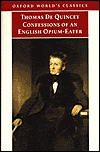
Confessions of an English Opium-Eater

7790332.gif I have just finished the title essay from a collection of Thomas De Quincey’s work, Confessions of an English Opium-Eater; the book has three longish-essays (the title one was 80 pages) and one short one. I’m planning on reading them all, but Confessions was the reason I picked this book up. I’m not sure what attracted me to it, since confessions of drug addicts aren’t my usual thing, but I’ve heard this mentioned as an interesting essay and as an example of walking literature, and I’m fascinated by De Quincey’s time period (1785-1859), so that’s reason enough.

The essay, as you might guess from the title, tells the story of De Quincey’s addiction to opium, but it does so with lots of digressions and philosophical asides and glimpses of life in De Quincey’s time. After a brief introduction justifying his decision to write an essay that exposes his weakness, he tells of his boyhood school days and his decision to run away from school at the age of 17. He wanders through parts of Wales and ends up in London, where, he says, the seeds of his addiction were planted. He runs out of money and comes very close to starving to death, which causes him stomach problems that come back to haunt him — at which point he becomes an addict, taking opium every day to relieve the pain.

But De Quincey takes his time with the Wales and London episodes, and they are some of the most interesting sections. Particularly moving is the story of his friendship with the prostitute Anne; they offer each other companionship and aid — she saves him from starvation at one point. Tragically, De Quincey leaves London briefly to try to find some money, and when he returns he can’t find her. He mourns the loss of their friendship for the rest of his life.

De Quincey took opium regularly before he became addicted; he was careful to let enough days go by between indulgences so that the drug would maintain its potency. And he writes about the pleasures of opium quite beautifully; one of the things I like best about this essay is that De Quincey is fully honest about both the pleasures and the pains. He writes:

And, at that time, I often fell into these reveries upon taking opium; and more than once it has happened to me, on a summer-night, when I have been at an open window, in a room from which I would overlook the sea at a mile below me, and could command a view of the great town of L—-, at about the same distance, that I have sate, from sun-set to sun-rise, motionless, and without wishing to move.

A bit later he goes into raptures over the drug:

Oh! just, subtle, and mighty opium! that to the hearts of poor and rich alike, for the wounds that will never heal, and for “the pangs that tempt the spirit to rebel,” bringest an assuaging balm; eloquent opium!

He goes on like that for a full paragraph. But he is also clear about the horrors of opium addiction:

[The opium-eater] lies under the weight of incubus and night-mare; he lies in sight of all that he would fain perform, just as a man forcibly confined to his bed by the mortal languor of a relaxing disease, who is compelled to witness injury or outrage offered to some object of his tenderest love: — he curses the spells which chain him down from motion: — he would lay down his life if he might but get up and walk; but he is powerless as an infant, and cannot even attempt to rise.

He does, you will be happy to know, overcome his addiction, but he is still haunted by one of the worst effects of addiction — horrible nightmares, some of which he describes in detail.

I am looking forward to seeing what the other essays are like; he’s got a style I enjoy — digressive, allusive, difficult to categorize.

10 Comments

Filed under Books, Nonfiction

All In Together Girls

b1.gif I have just finished Kate (of Kate’s Book Blog fame) Sutherland’s collection of short stories All In Together Girls, and enjoyed it very much; the collection has 14 stories, all of them quite short, each one capturing a glimpse into the life of a female protagonist.

Many of the stories are about young girls in their early or late teens who are trying to figure out their relationships with parents and with friends and with boys; these stories describe acts of disobedience and rebellion and often also moments of humiliation and frustration. They are about trying to find one’s identity while negotiating the needs and demands of others. They tell of the desire for freedom and the uncertainty about what to do with it; the first story, for example, is about a group of friends who lie to their parents so they can spend the night hanging out, but things quickly go sour leaving them wanting nothing but to go home. In a later story a girl skips her dance lessons to hang out with friends, and in another the protagonist lies to her parents and spends the night with her friends trying, but failing, to smoke dope. In each of these stories, the promised fun times never quite materialize, and instead the protagonists are left with an air of sadness and worry.

The adult protagonists of some of the other stories seem just as lost; in “Outside the Frame,” the narrator tries to piece together her mother’s story from a photograph, seeking to understand the quality of her mother’s marriage as her own is falling apart. The story alternates between the mother’s experience, as imagined by the narrator, and the narrator’s accounting of why she is leaving her husband. In “Notes for a Documentary,” one of my favorites, the protagonist travels to Scotland to do research and to see family; she visits the places where her parents courted and ponders what to do about her own love affair. She is unsettled, positioned between an unchanging past and an uncertain future.

I enjoyed each and every one of these stories. Many of them are told in the first person, and the voices are clear and appealing, telling their stories straightfowardly, recounting hard times but not asking for pity. The language is simple and direct, drawing attention not to itself, but to the predicaments of the characters — it’s their thoughts about themselves and their lives that matter here.

This is the second collection of short stories I’ve read this year (the first was Jesus’ Son), which fulfills my short story-reading goal; I’m enjoying reading more in the genre, though, and may pick up another. I’ve got Mavis Gallant’s Paris Stories on my shelves if I get the urge.

8 Comments

Filed under Books, Short stories

Muttboy

If you follow Hobgoblin’s blog, you’ll know that our dog Muttboy had surgery today to have a tumor removed from the skin of his chest. Well, he’s still at the vet’s office, but we’ve learned that he came through it very well, and will be coming home in about 1 1/2 hours. Yay!

They did chest x-rays to see if the tumor had spread, which it hadn’t. We still don’t know exactly what type of tumor it is, but so far, everything looks fine.

Today was spent waiting — waiting to take Muttboy to the vet’s, waiting until we could call for news, waiting until we could call for further news, and now waiting to go pick him up. But all that’s okay as long as he’s fine.

By the way, I have a question: did we skip the rest of August and September and move straight to October? I ask because today the temperature hasn’t gotten above 58 and it’s been raining all day. I’m just wondering if I missed something.

13 Comments

Filed under Life

On finishing Proust’s In Search of Lost Time

I want to write just a few words about finishing Proust’s In Search of Lost Time; I don’t feel up to writing a big long summing-up post that tries to say smart things about what it all means, but I do want to say something. I am happy to have finished, but I do miss reading Proust a bit; I’ve been used to a near-daily dose of the narrator’s slow-moving, contemplative voice, and now I don’t have that.

It’s hard to see how a 3,000-page book without all that much plot, relatively speaking, could cohere, but I think it does. I found the ending, say, that last couple hundred pages, really did wrap things up; it provides an answer to the question that has haunted the whole book — will Marcel ever write his masterpiece? This is a question that has lingered from the very first volume when it becomes clear that Marcel has an interest in, and perhaps a talent for, writing. The answer the book provides is satisfying, and realistic, given everything that has happened up until that point.

My favorite volumes were the first two and the last one; the third and fourth, The Guermantes Way and Sodom and Gomorrah, got a little long, but then the fifth volume, which contains The Prisoner and The Fugitive begins to pick up a bit in preparation for the grand ending. It’s the long party scenes in some of the middle volumes that got tiresome. What I loved about the book are the insights into the mind, art, time, and love, but the novel is also obsessed with society and rank and how people behave at parties, topics that didn’t thrill me quite as much. But even here there are things to interest; Proust captures snobbery and hypocrisy and the deadness that can lie behind the glittering masks of high society beautifully well.

But mostly this novel is worth reading because of what it can teach about observing the world around you and in you. Proust has a meticulous eye for how the mind perceives input from the senses and for how we come to understand our experiences, and, of course, he has a beautiful way with a sentence to capture all that insight. I love how there can be so much wisdom and experience in one of those long sentences — how they can take in so much.

12 Comments

Filed under Books, Fiction

The perils of cycling

I’m used to bugs hitting and bouncing off my cycling jersey as I ride, and when that happens I’m just grateful they didn’t land on my face or — worse — in my mouth.  I’ve gotten stung in the mouth before, and it was no fun.  But today something else entirely hit my jersey.  I thought it was a bug, but when I checked to see if it had flown off my shoulder where I felt it hit, I noticed what it really was: bird shit.  This is the first time this has happened to me, and now I wonder why it doesn’t happen more often; I ride under trees all the time, after all.  I had another hour to ride before I made it home, and I could see it sitting on my shoulder every time I turned my head to the right.  Ick!

9 Comments

Filed under Cycling

On finishing Don Quixote

7075756.gif Most of this post will be about the second half of Don Quixote and the ending, so if you don’t want to hear about it, you might want to save this post for later. I loved the way the second part of the novel became a kind of commentary on the first (is this what people are talking about when they say that everything comes together in the second half?), how everyone Don Quixote and Sancho Panza meet have read the novel’s first half and so are in on the story of his peculiar form of madness. Most of them decide to have some fun playing jokes on the two, to see just how far the madness of Don Quixote will go. So, in addition to all the metanarrativity that was already going on in the first part — the multiple authors and the long conversations on storytelling and the frequent mentions of Cide Hamete Benengeli — Cervantes adds his critique of the false sequel to Don Quixote published in between his two volumes and mixes up real life and fiction even more by having Don Quixote confront the results of his literary fame again and again.

It is this playfulness about fiction and authorship that I will remember about the book, long after I’ve forgotten individual episodes — episodes it probably won’t take me all that long to forget, in truth, because some of them dragged on a bit and my attention wandered. But I love that self-interrogation is built into the structure of one of the first novels ever, depending on how one defines “novel,” or, at the very least, one of the earliest and most influential novels. Don Quixote is a novel about madness, friendship, adventure, and love, but it’s also very much a novel about novels, and it starts a very long tradition of novels that reflect on themselves, a traditional so influential that even ostensibly realistic novels usually have some kind of self-reflexive element to them.

About the novel’s ending: it is so sad! I didn’t expect to see Don Quixote regaining his sanity, and even less did I expect that moment of sanity to be rather depressing:

“Señores,” said Don Quixote, “let us go slowly, for there are no birds today in yesterday’s nests. I was mad, and now I am sane; I was Don Quixote of La Mancha, and now I am, as I have said, Alonso Quixano the Good. May my repentance and sincerity return me to the esteem your graces once had for me, and let the scribe continue.”

And he goes on reciting his will. It’s this melancholy at the end that convinces me (even further than I was already convinced) that Cervantes has great affection for his two main characters, in spite of their foolishness. It’s the energy of their madness that carries the story forward, so that as soon as Don Quixote regains his sanity, there is no story anymore, and the novel abruptly ends. Without Don Quixote’s madness, Cervantes has nothing. So, yes, Cervantes mocks Don Quixote’s foolish and naïve way of reading, but I think he glories in the energy and the fun of it too. To me, Don Quixote comes across as admirable in his imagination, his resourcefulness, his persistence, and his liveliness. I realize this is a very contemporary way of looking at the novel, and earlier readers may not have seen anything admirable in Don Quixote whatsoever, but I can’t help reading as a contemporary person, can I?

4 Comments

Filed under Books, Fiction