Category Archives: Books

The Glimpses of the Moon

Edith Wharton’s novel The Glimpses of the Moon was an immensely satisfying read; it’s a good story that moves along at just the right pace, and it offers much to think about: it deals with love and marriage, money and society, ambition, work, children, novel-writing, travel, class, isolation, loneliness, and probably more things that I’m not thinking about now.  I don’t think the book is quite on par with The Age of Innocence or The House of Mirth, maybe because it is more narrow in focus than the other two and perhaps because I’m biased towards books with a tragic rather than a comic structure.  But still, I felt a depth and heft to this book that I too often feel is missing in more contemporary fiction.

The novel tells the story of Susy Branch and Nick Lansing, both of whom have no money but have found ways of living comfortably in high society — they have been sponging off of friends in order to support the lifestyles to which they have been accustomed.  When they meet and hit it off, they decide to marry and live as long as they can off the wedding presents they receive and the offers of houses to visit that come from their rich friends.  The novel opens with the couple beginning their honeymoon at a friend’s villa on Lake Como.  The catch, though, is that they have agreed to end the marriage if one or the other finds someone rich who will marry them.  Their marriage is opportunistic through and through, although they are, without a doubt, quite fond of each other.

With this precarious situation at the novel’s opening, things are bound to unravel, and unravel they do.  First of all, Nick and Susy discover that their intense focus on money is bound to warp their relationship.  It turns out they have different ideas about what manipulation and deception, what “management” — an important term in the novel — is acceptable when it comes to securing money or a house to live in.  They quarrel about whether Susy should take a box of cigars left by their friend, and this quarrel causes a rift that won’t soon heal and that hints at the even greater struggles the two of them will soon face.

This conflict is interesting because of the way it’s gendered; as a woman Susy is more vulnerable than Nick is and therefore needs a moral code that is more flexible to maintain her position.  Nick has the luxury of being a little more discriminating.  Wharton describes this conflict in satisfying detail, especially the way Susy regrets that she has disappointed Nick and longs to attain a higher moral standard, but at the same time fully understands the reasons for her behavior and is able to forgive herself.

From here things fall apart further; friends and their friends’ children intrude into their honeymoon bliss, jealousies flare, misunderstandings arise.  Nick and Susy have much to learn, both about themselves and about the world they live in.  They eventually are faced with the demoralizing realization that the world they worked so hard to maintain their place in is ultimately frivolous and shallow.  Their friends lead silly, pointless lives and are intensely selfish.  They only care about Nick and Susy to the extent that they have something to gain from them.

In contrast to their wealthy but frivolous friends are the Fulmers, a family of struggling artists and many children who lead honest lives but have no money.  Susy and Nick are horrified by these people, by their obliviousness to fashion and their unsophisticated happiness.  But they are innocent and relatively unspoiled by the idleness and silliness of the other characters (at least at first).  Eventually Susy and Nick will learn something from these people; their changing attitude towards the Fulmers will mark changes within themselves.

The novel’s structure is satisfying too (although perhaps a trifle too neat?  I enjoy this kind of neatness though).  I’m going to be discussing plot events from later in the novel, so take care — after Nick and Susy split they each find another love interest and another family to take care of them, and each of them have lessons to learn about themselves and about each other.  Only after they have learned these lessons apart from one another are they able to find a way to come together again.  I found the ending plot twists exciting, although a tad unrealistic, but I was willing to get over this for the sake of the pleasure the ending brought.

Overall, what a satisfying book this is!  Check out the Slaves of Golconda site for other posts and discussion.
7 Comments

Filed under Books, Fiction

Meme time

A lazy summer Saturday seems like the perfect time to do a meme, something I haven’t done in a while, generally because I’m disobeying orders from Her Majesty, which hasn’t gotten me in trouble yet, but I’m still being careful. This time around, Pete tagged me.

What was I doing 10 years ago?

Ten years ago I was getting ready for my wedding, or, more accurately, helping Hobgoblin get ready for our wedding. I was also studying for my masters comprehensive exams and preparing to begin my Ph.D. I was also preparing to teach for the first time ever. That summer I also went on a backpacking trip and did some house sitting for a faculty member at my school. Wow. How did I have the energy for all that?

Five snacks I enjoy in a perfect, non weight-gaining world:

  1. Hot fudge sundaes
  2. Brownies with ice cream
  3. Nachos
  4. Chocolate
  5. Apple pie

Five snacks I enjoy in the real world:

  1. Occasionally the above, but more often:
  2. Chips, of any sort
  3. Popcorn
  4. Cheese
  5. Apples

Five things I would do if I were a billionaire:

  1. Travel, including visiting other continents, but also hiking the Appalachian Trail
  2. Buy land and donate it to environmental organizations for conservation
  3. Donate money to research global warming and alternative energy sources
  4. Buy bikes and books
  5. Quit my full-time job but get a part-time one so I won’t go crazy with too much time on my hands

Five jobs that I have had:

  1. Babysitter
  2. Salad-bar filler
  3. School supply picker and packer
  4. Assistant Freshman Year Director
  5. Professor

Five habits:

  1. Checking email and Google Reader obsessively
  2. Reading a page or two before I fall asleep
  3. Drinking coffee in the morning — decaf
  4. Recording my cycling statistics (riding time, miles ridden, speed, heart rate, cadence, route)
  5. Recording books I’ve read, including dates begun and finished

Five places I have lived:

  1. Buffalo, New York
  2. Rochester, New York
  3. Chicago suburbs
  4. The Bronx
  5. Bethel, Connecticut

If this meme looks like fun, consider yourself tagged!

8 Comments

Filed under Books

Reading and riding update

Mostly this will be a riding update, and it will be short, as I’m tired! I just got back from a 4 hour 20 minute ride with Hobgoblin and another friend. It was a lovely ride, even more so as we were in danger of not going because the weather forecast threatened rain and storms. But we decided that since it’s not cold, getting wet shouldn’t be a problem, and then all we encountered was a few sprinkles now and then. Perfect!

For those of you who know the area, we started out in Ridgefield and then rode over into New York, up into Putnam County, down into northern Westchester, and then back to Ridgefield. It was hilly (of course), but not ridiculously so, and I rode it fairly fast (for me), at 17.5 mph.

The friend we rode with is training for the Lake Placid Ironman triathlon, and I’m in awe of her abilities. She’s a very powerful rider, and instead of doing what Hobgoblin and I do after a long ride, which is to head for refrigerator, the shower, and then the couch, she heads for the treadmill or out to the road again to do some running. Yikes.

We are planning an epic 100+ ride for July 4th. Perhaps I can break my speed record for a century, which is 17 mph.

On the reading front, things are moving slowly. I haven’t had nearly as much time to read as I thought I would … I think this has to do with the riding I’m doing, but also with the work I’m doing on my online course, and also with having more of a social life than I usually have. Generally Hobgoblin and I spend the summer almost entirely in the house, in the woods, or out racing or riding our bikes, but this time around, we’re actually getting out and doing other things and seeing friends. It’s nice for a change! But it means I’m not flying through the books as fast as I thought I would.

But that’s okay. Believe it or not, I’m happier when I don’t have too much free time, even free time to read. When I have a lot of time, I find I don’t use it very well and can get lazy and listless.

I am having a great time reading Edith Wharton’s The Glimpses of the Moon, which the Slaves of Golconda are reading for the end of June. What a fun book! It seems to be slighter than her most famous novels in terms of theme and scope, but still it’s insightful into relationships and the mind in ways that I love. More on that later.

I recently checked out the latest Maisie Dobbs mystery from the library, and so may pick that up soon, and Hobgoblin and I went yesterday to our local bookshop to check out mysteries for our next book club meeting. This is turning out to be a year of reading mysteries, which I didn’t at all expect, but which has turned out to be fun.

I’m hugely enjoying my nonfiction reads too, the ones you see on the sidebar; I just don’t have as much time to devote to them.

So once again I’ll remind myself that it really doesn’t matter how many books I read every year — as long as I’m enjoying what I read and finding books that make me think, that’s all that matters.

7 Comments

Filed under Books, Cycling

Beat Not the Bones

Charlotte Jay’s novel Beat Not the Bones manages an unusual feat: it is interesting and boring at the same time.  It has a lot of ideas, a lot of good things to discuss, but the experience of reading it was dull.  Surely you’ve had that experience before?  I kept wondering why I wasn’t enjoying myself more; I felt I should have enjoyed it, but I found it too easy to put the book down.

I was relieved to read that Emily found it boring too, and to hear that many of the members of my mystery book group agreed (Hobgoblin’s take on the novel is here).  One member wondered if he was reading it under poor circumstances, which might explain why he found it hard to get through, but when others said that they had a similar experience, it seemed clear that it’s a fault of the book and not of the reader.

The book is marketed as a mystery and it won the Edgar Allan Poe award in 1954, but it felt to me like it could just as easily be considered literary fiction as mystery.  There is a mysterious death that gets explained by the novel’s end, but the heart of the novel is really in the changes that take place in the main character, Stella, and there is no way for the reader to figure out how the plot will resolve itself — there are no clues to follow and there is no detective.  I wondered if I would feel differently about the book if I approached it as literary fiction rather than as mystery — when I pick up a mystery, I expect a fast-moving plot at least, but with other kinds of fiction I’m more tolerant of slowness.

The story is about the death of Stella’s husband which took place in the colonial outpost of Marapai in New Guinea.  Stella, who had been living apart from her husband in the time leading up to his death, travels to Marapai to discover what happened to him.  People have told her that he committed suicide, but she believes he was murdered.  In the novel’s opening chapters we are introduced to a potential suspect, Alfred Jobe, who has discovered gold in the jungle village of Eola.  Stella’s husband has blocked his claim to the gold, providing him with a motive for murder.  Stella’s quest is initially to find Jobe, but she soon learns that the situation is much more complicated than she originally thought.

The novel’s colonial context is one of the most interesting things about it; there is the inevitable tension between the white colonialists and the Papuans, and it quickly becomes apparent that most if not all of the colonialists are incapable of seeing the Papuans as human beings.  Racial inequality is a given; the colonialists are there to bring “civilization” to the natives and the natives are there to gratefully accept it — and to work as servants.  The atmosphere is even darker than this description implies, however, as the whites have largely stopped believing in their “mission” and are focused on survival and perhaps on making some money.

All this raises the question of Jay’s own take on the colonial situation and on race relations.  I couldn’t help but feel that the book is meant as a critique of racism and colonialism and that the bleakness of the situation is a reflection on what inevitably happens when one group of people tries to control another.  As the novel progressed, I was overwhelmed by the ugliness of it all, the horror of what the colonizers were willing to do to maintain their position and to protect themselves from any culpability, and I think Jay meant the reader to feel that way.

On the other hand, I’ve been struggling to figure out exactly what to make of Jay’s portrayal of the Papuans.  The book is a little like Somerset Maugham’s The Painted Veil (many thanks to Becky for pointing out this comparison) in the sense that both novels use a colonial setting as the backdrop to the tell the story of a woman’s growth and self-realization, and I can’t help but wonder whether the plight of the natives gets a little lost.  Is this another example of a colonial setting functioning mainly as the spur to change in the colonizers?

And yet while Jay largely keeps her focus on the white characters and their struggles and challenges, she does offer a complex and powerful Papuan character in Hitolo, and in a way it makes sense for her to focus on the colonizers rather than to try to get into the minds of the Papuans, which might feel presumptuous and arrogant.  And what I think ultimately matters is the sense a reader almost inevitably leaves the novel with that the colonial project is hopelessly corrupt and doomed.  The ugliness of it pervades every page.

So with all this interesting stuff going on, I’m sad that the novel wasn’t a more absorbing read.  Part of the problem was that the characters weren’t developed enough to be believable — they tended to do strange and unexpected things, and I never found a way to fit all the pieces of each character together.  The pace was too slow as well, and it had abrupt and uncomfortable transitions that unfortunately invite a reader to set the book aside.

I am interested, though, in the combination of mystery novel and colonial setting.  Can you think of other books that do something similar?  Hobgoblin mentioned The Moonstone as a possibility.  Any others?

9 Comments

Filed under Books, Fiction

Annoyed!

Today has proven to be a good day to get annoyed (this has nothing to do with today’s mystery book group meeting, which was great as usual), so I thought I’d mention this annoying article.  I know I shouldn’t let the article get to me, as the author is obviously trying hard to annoy people and I’m falling right into the trap, but oh, well.  Sometimes it’s fun to get annoyed.

The article is basically a discussion of authors the columnist, Rod Liddle, thinks are overrated.  There is also a list of authors other critics and writers can’t stand.   Some of the explanations in the list are funny — it can be amusing to watch other people get annoyed — but many of them bother me because of their easy dismissal of authors generally considered great.  I have no problem with someone disliking Charles Dickens or Virginia Woolf’s The Waves or the late Henry James on a personal level, but someone writing as though anybody in their right mind would hate Dickens and The Waves and the late Henry James just irks me.  Who are you to say you’re right and everyone else is wrong?

To return to the article, I’ll let you decide just how irritating you think Liddle is on your own (does he have a reputation for being an ass?  It wouldn’t surprise me), but I did want to say something about this bit — Liddle is talking about an informal survey he did asking writers what books they thought were overrated:

The columnist Catherine Bennett chose “the entire Virago imprint”, bemoaning the fact that, for political reasons, she had felt duty-bound to plough through Rosamund Lehmann and the like when there was Philip Roth waiting there, unread.

Okay, so Bennett doesn’t like Lehmann.  Fine.  No one is required to like Lehmann.  But I’m troubled by the phrase “and the like” and by the dismissal of all Virago books.  Virago books are written by a wide range of authors.  You can’t get away with lumping them all together and pitting them against Philip Roth as though all the Virago books are actually just one.  It’s absurd.  If you think Philip Roth could beat Rosamund Lehmann in some kind of a writing contest, fine, but don’t pit Roth against a whole range of women writers and assume that contest makes any sense.

There are other absurd and offensive things in the column, but I don’t want to rant on.  I suppose my real problem is that I expect all critics and columnists to be reasonable, rational people who try hard to be fair.  Yes, I can be a naive idealist, I know.

16 Comments

Filed under Books

Crazy Saturday

I’d thought yesterday that I might write a serious post today, perhaps my thoughts on Charlotte Jay’s Beat Not the Bones, which I’m discussing with my mystery book group tomorrow and which I’d hoped to write about soon.

But — what was I thinking? I got up at 6 a.m., left the house at 7, arrived at my bike race around 8, stayed at the bike race until after 7 p.m., and only got home an hour or so ago. Crazy. The problem was that Hobgoblin’s race was sometime around 9 a.m. and mine was scheduled for 5:30 p.m., but it didn’t really start until 6. Last year we drove back and forth to the race course twice to avoid staying there all day, but this year we couldn’t bear the thought of all that driving and gas expenditure, so we brought some books, decided to take Muttboy at the last minute, made sure we had comfortable chairs, and settled in.

I thought I might get a lot of reading done, but it turned out I read only about three pages before I gave up and spent the rest of the day watching the races and talking with friends and fellow racers. In spite of the long hours, I had fun. The truth is, the social aspect of racing is at least as much fun as the racing itself — sometimes significantly more so.

As for my race, it was a bit of a mess. It was, to put it mildly, very poorly run. The race promoter decided to have three women’s groups, and to have them race separately, which makes sense, but to have them race separately on the course at the same time, which didn’t make any sense at all. So after the first group started (the Pro-1-2 field), the second group (Category 3) waited 30 seconds and then started, and then my group (Category 4) waited 30 seconds and then started. So there were three fields out on a mile-long course all at once.

I expected the Pro-1-2 field to catch up to us, but instead we caught up with the Cat 3 riders, the ones who are supposed to be faster than us. We passed them, although we probably shouldn’t have and it was confusing, but everything seemed okay until the Cat 3 riders caught up with us and wanted to pass, and then we couldn’t figure out which way to go to let them get by — people yelled out “move to the left!” and others yelled “on the left!” and others just yelled out “left!” which meant we had no idea where to go. They somehow managed to pass us safely, but it turned out there were three riders in my group that stayed ahead of them, so we spent the rest of the race unsuccessfully chasing.

In spite of the confusion and danger, I was riding well, staying up front most of the time and even riding at the very front for a little while, but on the last lap at the third corner I let some riders get ahead of me and I took the last corner too slow, and my sprint at the end didn’t do much. I ended up getting 14th place. It wasn’t a very good result, but I did get some practice riding near the front of the pack, practice I desperately need.

So yeah, it was a crazy day — not least because I spent much of the day thinking “I hate racing! — why do I do this???” but in the race itself I thought, “hey — this is okay, it’s not so bad” and after the race I thought, “how can I do that better next time?” In other words, I can’t decide whether I hate racing, love racing, or something in between. I think the truth is that as long as I continue racing, I’m going to continue agonizing about it. Something to look forward to, right?

7 Comments

Filed under Books

Riding and math

Let me just say, first of all, that I had a great bike ride today, and although I may have worked so hard I’ll still be tired on Saturday when I race next, I don’t really care. I wouldn’t want to not have done this ride today. Really, great training rides are SO much more fun than races. Sometimes I feel like my racing gets in the way of my riding.

Anyway, I rode with Hobgoblin and two other friends with whom we’ve got a semi-regular Thursday ride going. We rode for three hours, although we were out closer to four when you count the stop at the coffee shop, the stop to fix a flat, and the stops to regroup. It was a fast ride, something over 18 mph (fast for me), covering 56 miles. We rode down to the Long Island Sound and back, and the weather was beautiful — in the 70s and dry. We couldn’t have asked for a better summer day.

But now on to books. I’m really enjoying Keith Devlin’s The Math Gene and am about half way through it. I like math a lot and wish I knew more about it. I haven’t studied it since high school, since I got far enough there to test out of my college requirements. It didn’t occur to me then to study it just for fun, although it occurs to me now; someday I’ll take math classes at my school, since I can do it for free.

But even if you don’t enjoy math or think you aren’t good at it, you can still read and get something out of Devlin’s book. He’s very good at writing for non-math people, and, in fact, large portions of his book are devoted to the question of why some people just can’t seem to do math — or think they can’t. You won’t be surprised to learn that he doesn’t buy the idea that some people simply can’t do math; he argues that those people haven’t been taught to understand what math is all about — they don’t get it because they don’t understand the meaning behind it. They were taught rules but have no idea what the rules mean or why they matter. This makes me appreciate my high school calculus teacher who took great pains to teach us just what calculus is useful for and how it began.

My favorite part so far is where he gets into some actual math instead of talking about it more generally; he has a section of a chapter where he explains group theory and gives the equations that explain some of the relevant concepts. He introduces this section by saying that it’s okay to skip it if the math becomes too hard, although skipping it will mean you won’t understand all of his later points fully. Of course this laid down a fun challenge, and although I struggled a bit, I made sure I understood what was going on with those equations. But I also like the way he takes care to reassure the reader that not getting it is okay. He’s a very kind and understanding author that way.

The book is also fun because it explains things like why lots of people count on their fingers, why parts of the multiplication tables can be so hard to remember (why many people, including me, have to think a bit about problems like 8×7, 8×6, and 9×6), and why Chinese and Japanese students tend to do better at math in school than Americans. This is not entirely explained by the relative quality of education, but it also has do with language: numbers are easier to learn in Chinese and Japanese because the words for numbers are easier. One study shows that most Chinese and Japanese children can count to 40 by age 4, while it takes American children one year longer to reach this point. We know this difference is due to language because, interestingly, there are no differences among these children when it comes to learning numbers 1-12, numbers that are easy to learn in English as well as Asian languages. It’s the numbers 13 and beyond that trip American children up because of the complicated way they are formed.

Devlin is excellent at explaining things — at using clear examples and telling interesting stories. If you aren’t a “math person,” but are at all tempted by this, be reassured that he makes the subject accessible and interesting. I’m looking forward to the book’s second half!

9 Comments

Filed under Books, Cycling, Nonfiction

The Loving Couple

The Loving Couple is written by Virginia Rowans, who is really Patrick Dennis, the guy who wrote Auntie Mame. The authorial gender switching makes the book that much more interesting because it is split in half, one part from the perspective of a woman and the other from that of a man — in fact, the two parts each have their own cover complete with a title page and publishing information so you can’t tell which part you are supposed to begin with. You just pick one side, read to the middle, flip the book over and start with the other.

I started with the woman’s story, and as I was reading I found it jarring when I remembered that a man wrote it. I felt as though it were written by a woman. But then when I got to the man’s story, I found it hard to believe that the same person had written the woman’s version I’d just finished. It felt like two different people wrote the book. This is pretty impressive, I think.

The novel covers one bad day in the life of a marriage — it begins with a horrific fight and a breakup, and then follows the man and the woman as they have one of the worst days ever. They meet awful people, get caught up in awful parties, get tracked down by angry family members, feel trapped, get betrayed, learn things about other people, and learn things about themselves. The structure is interesting as the characters go through parallel events; for example, each character meets someone who tempts them into a possible affair, and they have to decide how they will respond.

The parallel narratives cover the same day, but for the most part they don’t cover the same exact events, so we don’t get the psychologically-interesting technique of having each character’s perspective on the same conversation or event. Instead what we get is a more exterior view, a satirical look at what happens to two people as they try to recover from their vicious fight by running away to fascinating new people and places.

The book is light and entertaining, as it was meant to be, and yet it offers a contemporary reader a lot to think about, as it is very much a book of its time, 1956, in terms of the way it portrays social issues. My God, is this a snobby book. Rowans has all kinds of fun lampooning the awful suburban culture the characters have moved into — the elite development somewhere on the Hudson that cross-examines potential members to make sure they are the right sort, although the right sort can be pretty horrid, as we learn when we meet the neighbors. Opposed to this stuffy suburban life is the wild city where you can meet bohemians and artists deep in the heart of Greenwich Village. Part of the plot is the characters’ need to figure out just where they belong — who are their real friends and where is their real home?

The city/suburb conflict is amusing, but the pervasive sexism and racism is not. I’m not sure how much of this Rowans is satirizing or how much is simply a reflection of the way people, including the author, thought at the time, but it’s hard to read casual comments about, for example, how one family was excluded from membership in the development because of a Jewish ancestor and to see that the only African-Americans are servants and are very stereotypically portrayed.

It’s a good reminder of all that has changed in the last fifty years, which isn’t that long, really. As I read I went back and forth between enjoying myself and wincing at some new dismissal of women or some other detail offensive to modern readers. It’s not as though in 2008 we’re so terribly enlightened, but a book like this can show that we’ve made some progress at least.

So all in all it’s an interesting read, and for a number of different reasons. I’m glad I picked it up.

8 Comments

Filed under Books, Fiction

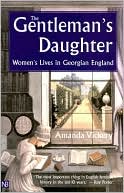
The Gentleman’s Daughter

I’m really enjoying Amanda Vickery’s book The Gentleman’s Daughter: Women’s Lives in Georgian England; it is a survey of women’s lives in the 18th and early 19th centuries, making arguments about women throughout the country, but looking specifically at certain families in Yorkshire and Lancashire, largely because women here happen to have left lots of letters behind that are rich with information.  The book also focuses on a particular class, women of the lower gentry and those connected to the professional classes — wives and daughters of landed gentlemen, doctors, attorneys, clerics, and certain kinds of merchants and manufacturers.

The author critiques some of the arguments and assumptions that previous scholars have made about the time period, including the idea that the 18th and early 19th centuries saw the dramatic rise of the domestic woman enshrined at home and kept from all contamination by the outside world, whereas in earlier time periods, women had a more active role in public life.  Vickery writes that many scholars:

offer a narrative of decline and fall, using women’s manuscripts to  illustrate a tale of increasing female passivity and ever-tightening domestic encirclement.  In fact, it is almost impossible to open a book on wealthier British women between the sixteenth and nineteenth centuries that does not offer a catalogue of declining female options.

The actual situation was not that simple, however; the separation between home and outside world was never clearcut, and women stayed in touch with that outside world in various ways throughout the centuries.  In terms of the kind of work women did within the home and outside of it, the situation in the 19th century doesn’t look so different from earlier centuries.  Scholars argue that the idea of “separate spheres,” public and private, for men and women became more and more important in this time, and yet, Vickery argues, this idea has always existed and still exists to a certain extent today.

Vickery also argues that the category of women she’s discussing tends to get lost in scholarly accounts, that people focus on the aristocracy and also on the merchant and manufacturing classes and see these two groups as separate and antagonistic.  They miss, however, a middle group of lower gentry and professionals that connects the aristocracy and the bourgeoisie and that shows how complex social status and family connections could be.  Some families have such a mix of people, including landed gentry, professionals, and manufacturers that they are nearly impossible to classify.   She’s arguing for a more complex view of status than many scholars have seen:

It has been customary to imagine the gentry, the professions and the upper trades as distinct strata of the social hierarchy.  It makes more sense, however, to see each as a thread in the complicated texture of genteel society — a woven fabric or an intricate cobweb being more exact metaphors to conjure social structure and social relations in the provinces.

After an introduction and a chapter describing the class system, Vickery moves to chapters on love and marriage and on motherhood.  There’s all kinds of interesting stuff here, including a detailed description of one particular courtship that is representative of the time and that shows what a long drawn-out process it often was.  Getting to the altar required a lot of time and patience — all that persuading of parents and the extended family and all that negotiating about money to be done — and involved some danger on the woman’s part: if the engagement ended during the negotiation period, the woman’s reputation would be damaged, so once she accepted a proposal, it was in her best interest to finalize the marriage as quickly as possible.

Vickery also argues that we shouldn’t think in terms of arranged marriages versus love matches (one older scholarly account says that the 18th century saw the fall of the arranged marriage and the rise of the love match); instead, most marriages were a mixture of the two — a combination of affection, prudence, and parental approval, and that people could easily find themselves genuinely torn between their romantic inclination and their desire for parental approval.

In the chapter on motherhood, Vickery discusses another common story told about the 18th century, which is that the decline of the midwife and the rise of doctors to oversee births is evidence of a decline in women’s power.  At one time, the story goes, childbirth was an entirely woman-centered event and a manifestation of female solidarity, but then male doctors began to intrude on this women’s space and to establish their own power there.  Vickery argues, however, that women themselves often wanted to have the doctors present, and that women themselves can therefore be seen as responsible for the decline of the midwife.  Vickery sensibly points out that when women realized doctors were able to help them in ways midwives couldn’t, they chose in favor of the doctor.

One other interesting thing: in the writings Vickery researched, she found lots of references to the physical discomforts of pregnancy, but very few references to nausea, which is such a common thing to talk about today.  She hypothesizes that vomiting was “seen as both normal and healthy given the universal reliance on purging as a prophylactic and general cure-all.”  Much greater emphasis was put on “melancholy, aches and immobility of pregnancy.”

I’ve only gotten through the first few chapters of this book — I’m greatly looking forward to reading the rest.

8 Comments

Filed under Books, Nonfiction

New books

I am now reading six books at once, and although I know plenty of people read that many at once and more, I can’t help but feel that my reading is getting a bit out of control.  Six is a lot for me, and I have a couple books I need to get to soon for book groups, so the number may go up.

As I mentioned in an earlier post, Emily promised to leave some books on the nightstand for me to look into while I was there, and I ended up bringing two of them home, in spite of the fact that I need no more books whatsoever (and she calls me a pusher!).  One of them is Keith Devlin’s The Math Gene, the first couple chapters of which I’ve now read.  I keep talking about how I want to read more about math and science and yet I haven’t done much of it, so it’s high time I got to a book like this.  So far it has discussed the definition of mathematics and its relationship to arithmetic; the factors that go into possessing mathematical ability, such as number sense, numerical ability, and algorithmic ability; and the extent to which animals and babies have a sense of numbers.  If phrases like “algorithmic ability” sound frightening, I can assure you that Devlin is a very clear writer with a knack for explaining things.  Eventually he’s going to get to an argument about how math is like language, and I’m looking forward to learning about it.

I am also borrowing Virginia Rowans’s 1956 novel The Loving Couple, written under a pseudonym by Patrick Dennis, the same guy who wrote Auntie Mame. It’s a fun novel, set in the New York City area and telling the story of a young couple whose marriage is falling apart.  What’s interesting about it is the way it’s told in two parts; one half of the book is from the woman’s perspective and the other is from the man’s.  The book itself is in two parts, with one cover devoted to her and one to him, one story starting in the usual way and proceeding until the middle of the book, at which point you have to flip the book over and start at the other end.  It’s impossible to tell which side you are supposed to start with — you just have to pick one arbitrarily.  I started with the woman’s perspective and finished it this morning; now the story will start over again from the beginning, but this time from the man’s point of view.  It will be interesting to get his take on things.

I wonder if, when picking up this book, most people begin with their own gender as I did, or if people are just as likely to begin with the opposite gender.  That would be an interesting thing to know, wouldn’t it?

The book is highly entertaining, even if it is dated and not masterfully written.  It’s a good light read, and I always enjoy reading about NYC and its environs — there’s a lot going on here with the tension between the city and the suburbs.

I’ll just have to tell myself there’s no rush to finish all these books; it’s only when I start to want to finish something that reading many things at once begins to feel like a burden.

9 Comments

Filed under Books

Weekend at Emily’s

Well, I had a fabulous time at Emily’s. Heavenly, you might say (ha, ha, sorry, inside joke). I went not knowing what we were going to do, except talk a lot, of course, and talk a lot we did, and we did many other interesting and surprising things too. As I wrote on Saturday, Emily and Bob have a fabulous house chock full of books, and any free moment I had I wandered around from room to room checking them out. But mostly I spent the time lounging around on sofas deep in conversation, and now and then we headed out into the heat to do some sightseeing.

The weekend is memorable for lots of reasons, but among them is the fact that I got to talk with a real live minister to whom I could relate as a friend rather than as an intimidating person who might ask me embarrassing questions about my (lack of) faith. I’ve never had that experience before, and I took full advantage of it. Actually Bob did do things like tell me I’m a sinner and need to confess, but he did it as a joke, and I just laughed at him. Can I just say it’s delightful to be irreverent and joke about religious matters with a minister? To swear and take the Lord’s name in vain in front of a minister and have it be no big deal? There’s something positively healing in being able to do that.

I don’t remember exactly how the topic of religion came up, but pretty soon I was asking Bob questions like “what’s your conception of God?” and we were off into deep theological waters. What I learned, among other things, is that if you ask a minister a question like that, you’d better be ready to spend a few hours talking about the answer. Bob did a wonderful job of answering my question, which really requires several years and a book-length response, in a short period of time and with great clarity and lots of good anecdotes.

I also got a kick out of attending a church service run by the minister with whom I’d spent much of the weekend being irreverent; I was pleased to discover that he wanted to hear my critique of his sermon afterwards, and that he’d added in a phrase or two at the last minute that addressed our earlier conversations. Part of my pleasure in all this is that it made me feel like such a grown-up — a church leader genuinely wanted to hear my opinion and took it very seriously and was really listening to what I had to say, rather than waiting for an opportunity to start preaching to me once again, which has been my experience with ministers in the past.

But the real highlight of the weekend was being able to talk with Emily; we talked about books and houses and friends and family and churches and theology and teaching, and also quite a lot about blogging.  It’s interesting that, although we both have been blogging for about two years and have already had many a long conversation about it, we haven’t run out of things to say; the experience remains rich enough to require even more conversation.  Also interestingly, Bob is a skeptic about the value of blogging, so the three of us argued about things like whether blogging is democratic in the sense that it gets people with different ideas and beliefs in conversation with one another or whether it makes it easy for people to retreat into groups of like-minded people who never challenge each other, and so is contributing to the fragmentation and isolation of our culture.  Although Bob had other arguments against blogging, this struck me as the most interesting; I think that blogging is whatever you make of it, so it can lead to increased exposure to different ideas and people, but I suspect that in practice it often doesn’t.  I’m not sure.  Thoughts?

Emily and Bob live in the heart of Amish country, so I saw buggies and men with long beards and women in modest dresses all over the place, and also fields and farms and livestock.  We saw some of the tourist sights, including a little village with shops selling local cheese and fudge and jam, all of which I brought home samples of, and we toured the local market, which contains mostly organic and locally-grown food, and which I really want to have just up the street from me. I had fun at the Lancaster Brewing Company, although the ghost story Bob told while we were sampling their beer is still scaring me a little at night.

Among the unexpected things we did was to spend time at the local hospital and rehab center; Emily and I would hang out in the lobby and talk while Bob visited church members.  Bob seemed to feel bad for dragging us along on these trips, but I was fine with it, as the air conditioning was a blessed relief from being outdoors, and I really just wanted to talk with Emily anyway.  It also gave me a glimpse into a pastor’s life, and I have a new respect for all the hard work they do — it’s not just the frequent visits pastors make but the fact that each one could potentially be an emotionally wrenching experience.  I saw just how much a pastor’s job is never ending and isn’t really a job at all, but more of a lifestyle.

So, to conclude, if you ever get the chance to visit Emily, don’t turn it down!  You never know what bracing debate you might find yourself in or what local public institution you might visit.  Plus, there’s the frog shrine, which is not to be missed.

10 Comments

Filed under Blogging, Books, Life

Sneaking in a blogging moment

I’m at Emily’s house right now and am sneaking in a moment to blog while Emily and her minister husband are out doing ministerial duties — I just wanted to say that oh, my god, does Emily have a great house filled with amazing books.  This is a house to die for.  I want one just like it.

9 Comments

Filed under Books, Life

More on Anne

Tomorrow I am leaving to go visit Emily in Pennsylvania; in addition to the pleasure of seeing Emily herself, I have something else to look forward to: she has promised to leave a stack of books on my nightstand for me to look through and perhaps borrow.  I’m very curious to see what she chooses.  I’ll be back on Monday.

For now I want to write a bit about my Anne of Green Gables rereading.  As much as I admire Kate’s plan to read the book slowly, I can’t follow suit; if I hadn’t had a busy couple of days and if I weren’t reading a few other books I would have finished the novel already.  I don’t think I’m capable of showing any discipline when it comes to that book; I can’t resist reading just one more chapter.

I’ve been trying to figure out what the source of Anne’s appeal is for me.  I’m not at all like her.  I don’t talk much, I have little imagination (at least of the sort Anne has), I’m not artistic, and I am not, as the narrator describes Anne, “feminine to the core.”  But of course I don’t have to be like a character to feel drawn toward her.  I suspect I’m much more like Diana Barry, who is different from Anne in a lot of ways too.  Diana doesn’t have Anne’s imagination or talent for coming up with ideas (or for getting into trouble), but she is willing to go along with whatever Anne proposes and is ardently devoted to her.  I could see myself happily being Anne’s sidekick.  As I read along I find myself wondering if Anne would consider me a kindred spirit if I met her in real life, and I can’t help but hope she would.  Perhaps that’s part of her appeal too — the reader can’t help but want to be a part of her inner circle, one of the chosen, one of those people who really gets her.

I’ve also been thinking about religion in the novel, something I’m pretty sure I didn’t pay much attention to as a kid, although perhaps I absorbed some important lessons without being aware of it.  I’m struck by Anne’s irreverence and her determination to stick to her own view of God and of people, no matter how much Marilla rebukes her.  This comes up, of course, in Anne’s doubtfulness about the value of prayer when Marilla first asks her to say her prayers at night (“Mrs. Thomas told me that God made my hair red on purpose, and I’ve never cared about him since”), and in her response to the minister’s prayers in church (“He was talking to God and he didn’t seem to be very much interested in it, either.  I think he thought God was too far off to make it worth while”).

It’s not that Anne doesn’t believe in God, exactly, but that God seems kind of beside the point in her life.  As Marilla describes her, she is a “freckled witch of a girl who knew and cared nothing about God’s love, since she had never had it translated to her through the medium of human love.”  She also seems to value her own perceptions of the world most of all, and she will admit to the existence and importance of God only to the extent that this makes sense to her. I don’t get the sense that Anne would ever subordinate her own instincts about life in order to conform to traditional piety in the name of religious faith.  She trusts herself too much to do this.  I find this attitude appealing; it’s a confidence I myself have developed only very slowly and mostly as an adult, but I wonder if I didn’t learn a little bit of it from Anne.

I also am struck by one particular way Anne talks about imagination; in the Aunt Josephine episode, the one where Anne and Diana incur her wrath by jumping into her bed in the middle of the night, she says this:

Have you any imagination, Miss Barry?  If you have, just put yourself in our place.  We didn’t know there was anybody in that bed and you nearly scared us to death.  It was simply awful the way we felt.  And then we couldn’t sleep in the spare room after being promised.  I suppose you are used to sleeping in spare rooms.  But just imagine what you would feel like if you were a little orphan girl who never had such an honor.

Anne is asking Josephine Barry to empathize with her and to do so through an act of imagination.  Here is one aspect of Anne’s imagination I care a lot about and hope to share — to be able to understand people, to put myself in their place, by thinking creatively and thereby, maybe, to refrain from judging them or from getting angry at them.  There is an ethical aspect to imagination, and I admire Anne for drawing on it here.

14 Comments

Filed under Books, Fiction

What Was Lost

Catherine O’Flynn’s novel What Was Lost (my copy sent to me by the publisher) is a good read, not perfect, but absorbing; it’s a mystery, sort of, not a traditional one with a detective who solves the crime, but a mystery nonetheless — it tells the story of a young girl who one day disappears and of the people left behind who after 19 years discover what happened.

The novel begins with a 70-page section on that young girl, Kate Meaney, an orphan living with her grandmother.  Actually when I said the novel doesn’t have a detective, that’s not quite true; this novel’s detective is the one who disappears, Kate herself.  Armed with her book How to Be a Detective, she sets up her own detecting business, although so far it’s had only one customer, her friend Adrian, a young man who works at a nearby shop.  This section of the novel is utterly charming, and that’s because Kate is such a great character — smart, lively, full of ideas, serious and unselfconscious in that way only children can be.  Kate has lost much — she doesn’t remember her mother who left when she was very young, and she found her father’s body after he died from a stroke — but she seems to have found ways of coping, her detecting work perhaps chief among them, with its focus on putting the world to rights.

The next section, which makes up the bulk of the book, shifts 19 years into the future, and here I felt some dissatisfaction, as I didn’t want to leave Kate’s company, and I thought the pace slowed and dragged in some moments.  Kate had done most of her detecting work in the Green Oaks Mall, and in the second section the scene settles here permanently, introducing us to a number of new characters, most importantly Lisa, Adrian’s sister who knew Kate slightly and who works in a music store, and Kurt, a mall security guard.  Both of these characters, who don’t know each other at the section’s beginning, although they eventually meet, are unhappy in their jobs and with their lives, but they haven’t yet found any way of changing their situations.  The novel spends a good deal of time introducing us to their families and their lives.

The two sections intersect when Kurt notices a mysterious young girl on the security camera; his efforts to track this girl down lead him toward Lisa and toward solving the mystery of what happened to Kate.

The book is about lost people — not only is Kate lost, but her friend Adrian also disappears when he is accused of complicity in Kate’s disappearance — but it’s also about lost communities and lost dreams.  The Green Oaks Mall becomes the concrete symbol of these more nebulous losses; after its construction the city center disappears, its shops forced to close because of the mall’s power to lure their customers away.  The mall was built over an abandoned industrial site and so in its very being tells the story of the loss of solid manufacturing jobs and their replacement by service positions.  Kurt’s father was laid off by one of the now-abandoned factories, and he refuses to shop at the mall or to allow his family to shop there, the symbol of their lost economic security.

O’Flynn is particularly good at describing the horrors of the mall (and I’m particularly open to hearing about how horrible they are, as there are few places I hate more than a mall); an institution that bleeds the life out of its employees, who work low-wage jobs with abusive bosses and equally abusive, sometimes insane, customers.  The mall seems to bleed the life out of the customers as well, who often appear as zombie-like creatures, wandering around buying things because they have nothing better to do.  It’s a nightmarish place, symbolizing a society that has lost its way and perhaps lost its soul.

This is not an entirely sad book, as its ending does have glimmers of hope and promise, and the mystery does get solved, but the novel does such a good job of showing loss on many levels that I closed it feeling sad for the people and the world it describes.  The novel’s structure and pacing left me a little dissatisfied, but there are lots of other things to admire in the novel, and if the subject matter sounds interesting to you, I would recommend it.

7 Comments

Filed under Books, Fiction

Monday Miscellania

I meant to write a review of Catherine O’Flynn’s novel What Was Lost today, but it will have to wait for another time when I feel more up to it.  I have already spent an awful lot of time online today, so this will be relatively quick.  I’m preparing to teach my first online course beginning at the end of June, and all that online time went toward getting started on that work.

The problem was that once I got going it was hard to stop.  It’s work I get absorbed in easily, and then questions came up that didn’t have easy answers and I couldn’t let them go, even though I have weeks to solve them.  The hardest part of setting up this course has been organizing everything, figuring out how much work to give students, when to make things due, how to set up the due dates so that they aren’t confusing or overwhelming, how to set up all the pages and subpages and arrange all the information so it’s clear.  It feels like I’m giving students a lot of work, but I have to remember (and they should too!) that we have no class time whatsoever, so asking them to do a lot of work really isn’t asking too much.  I’m thinking now that all I can ask for is that the first time through this not be a disaster and then maybe I’ll learn enough to do it better next time.  Anybody out there who has taken an online course who has ideas about what works and what doesn’t?

So, yesterday was my first race after last Tuesday’s crash, and this time around it was crash-free, although barely so.  On the last lap there was some bumping and jostling right in front of me that made me nervous enough to hit my brakes hard, but everybody stayed upright and everything turned out okay.  I was the 12th person across the line (out of 18), although officially I got 11th place because the officials relegated the woman who was doing the bumping to last place.  I was a little nervous riding with the pack, but only a little; Thursday’s long group ride helped me get back to normal.  I’m still a little afraid of crashing, but I’ve always been a little afraid of crashing, so that’s okay.

And now on to book news.  First, I’m participating in Kate’s group read of Anne of Green Gables (how could I resist this!?), which so far has been tremendous fun.  I’m maybe 50 pages into the book, and I’m loving every minute of it.  And remembering practically every detail of the book too — I read it so many times as a kid that I practically had it memorized. Check out the group blog here — there are some interesting posts up already.

I also began Amanda Vickery’s book The Gentleman’s Daughter: Women’s Lives in Georgian England, which is a fascinating read; it’s very much academic in nature, so she spends a good bit of time arguing with what other historians have claimed about the time, but it’s very clearly written with an engaging style, and it has lots of great information on what women from the ranks of the lower gentry experienced and believed.  More on this later.

I have bought and mooched a few books too, including the latest selection for my mystery book club, Charlotte Jay’s Beat Not the Bones. The novel was published in 1952, and it takes place on New Guinea, describing a young woman who is trying to find out why her husband committed suicide.  Sounds interesting, doesn’t it?  I also ordered Sei Shonagon’s The Pillow Book; Shonagon is a woman from 10th century Japan, and the book contains her thoughts about her life and the world around her.  I read an excerpt of the book in Phillip Lopate’s The Art of the Personal Essay as part of my essay project (see sidebar) and was intrigued.

Also, Edith Wharton’s The Glimpses of the Moon for the next Slaves of Golconda read at the end of June (plenty of time to join us if you like!).  And from Bookmooch, Janet Malcolm’s The Silent Woman: Sylvia Plath and Ted Hughes, because I’ve been wanting to read Janet Malcolm forever and this book is bound to be interesting, and James Woodforde’s Diary of a Country Parson, because Woodforde is from the 18C and I love reading about that time period.

Okay, now I’m off to do some reading!

6 Comments

Filed under Books, Cycling, Life, Reading, Teaching

The criticism of loving adoration

I have now finished George Saunders’s collection of essays The Braindead Megaphone, and I’m sad there are no essays left to read.  I wrote about the first half of the book here, where I concluded I liked the collection very much, and now having finished the book I can say I loved the collection absolutely.  Not every essay is on the same level of wonderfulness, but even the not-so-wonderful ones are great, and the truly wonderful ones are breathtaking.

The book’s second half offers an essay on conflicts at the U.S./Mexico border where Saunders spends some time with members of the Minutemen, an anti-immigration group, and one on “Buddha boy,” Ram Bahadur Bomjon, who supposedly meditated for many months without food or water.  In both of these essays, Saunders creates a persona who is out to see what he can see, keeping an open mind about everything and preparing to be surprised.  He doesn’t withhold judgment entirely — it’s clear, for example, that he doesn’t agree with the politics of the Minutemen — but he does look for the stories and the details that might surprise readers and himself.  Saunders’s specialty, it seems to me, is seeing, and then getting readers to see, the complexity of the situations he describes and the people he meets.  The entire book is an argument for reserving judgment, for taking one’s time to think about things, for really looking to see what’s out there before drawing any conclusions.  It’s a particularly humane argument and one I think our culture needs.

All that was great, but what I really, really loved were his essays on literature, the ones that made me realize there’s a genre of criticism, or perhaps I should just call it writing about literature, that I love, which is the sort of writing about literature that enthuses so eloquently, with so much passion and very little attempt at critical distance, that the reader finds it irresistible, even if the reader doesn’t know or like the literature being written about.  TJ and I have been talking about this mode of writing because of his Loving Iris blog, which promises to be a fine example of the kind of writing I’m talking about.  The title of his Iris Murdoch blog reminded me of the book Loving Dr. Johnson, which I haven’t yet read but hope to soon, and which is about the love many people have for Johnson, including the author.  All this reminded me of Nicholson Baker’s book U & I, which is a completely over-the-top celebration of Baker’s love for Updike, and then I read Saunders’s essays on Huck Finn and the Donald Barthelme short story “The School,” two brilliant examples of what I’m describing here.

TJ and I agreed that we love this form of criticism, but we can’t decide what to call it.  TJ suggested “adoration crit” but wasn’t really pleased with it, and all I can think of is my post title, “the criticism of loving adoration,” which has a nice rhythm to it, I think, but is obviously too unwieldy.

Can you think of a better term for what I mean, if what I’m meaning is making sense?  More importantly, can you think of other examples of this type of writing?

Saunders’s essay on Huck Finn was written as an introduction to the Modern Library paperback edition to the novel, but it’s not a typical introduction, which comes as no surprise if you know Saunders at all.  It opens with this sentence:

Let me begin by confessing that I have had more trouble with this piece than I’ve ever had writing anything in my life, mainly because I love this book and was deathly afraid I would fail to do it justice, which caused me to rush off to the library and do hours and hours of research, which only terrified me further and reduced me to writing quaking tautological sentences like “Much has been written about the fact that much has been written about the fact that, whereas the shores of the Mississippi, mythologically speaking, represent America’s violence, the center of the river, which traditionally has been represented as Utopian, is also occasionally seen to contain bloated floating corpses.”

Fortunately, Saunders gets past this difficulty and comes up with his “Tentative Narrative Theory regarding Huck Finn” (he capitalizes Important Ideas in all his essays, a tic which would usually annoy me but which somehow seems to work with Saunders), which he explains by way of a brilliant analogy involving airport people movers and piles of dirt.  Saunders can work magic with an analogy.  I’ll let you read the essay to find out what the Tentative Narrative Theory is, but I will say that the essay deals with the complicated issues of race and class in the novel in a way that’s both accessible and profound.  It manages to say good things about the book and about American culture both, all the while using Saunders’s personal, colloquial, loving voice.  He loves the novel, it’s clear, but he also sees its flaws — in fact, he seems to love it for those very flaws.

And then there’s the essay “The Perfect Gerbil” on Barthelme’s short story.  This is a 10-page masterpiece of loving adoration, an essay that says wonderful things about Barthelme’s “The School” but also about the short story genre itself. Here’s an example of one of his brilliant analogies, which he uses to analyze what Barthelme does:

When I was a kid I had one of these Hot Wheels devices designed to look like a little gas station.  Inside the gas station were two spinning rubber wheels.  One’s little car would weakly approach the gas station, then be sent forth by the spinning rubber wheels to take another lap around the track or, more often, fly out and hit one’s sister in the face.

A story can be thought of as a series of these little gas stations.  The main point is to get the reader around the track; that is, to the end of the story.  Any other pleasures a story may offer (theme, character, moral uplift) are dependent upon this.

So: if the writer can put together enough gas stations, of sufficient power, distributed at just the right places around the track, he wins: the reader works his way through the full execution of the pattern, and is ready to receive the ending of the story.

These “gas stations” can be plot events, but they can also be interesting uses of language — they are any sort of surprise that brings the reader pleasure.  Saunders’s essay charts how Barthelme uses these little surprises to delight the reader and then how he creates the perfect ending, though the entrance of the “perfect gerbil” of Saunders’s title.

Saunders essay becomes like a short story itself, the story of reading and delighting in Barthelme’s story. It’s complete with tension — how will Barthelme pull this off?  Will Saunders like the ending? — and surprises — where did that character Helen come from?  Wow, there’s a love story appearing now! — and a narrator whose charming personality comes through in the tone and syntax of every page.

I’m not sure why, but writing like this pleases me in a way that no other kind of writing does.  I suppose it’s a reminder of how much fun reading can be — a reminder experienced directly in my own reaction to the piece and indirectly through the writer’s own pleasure.  Anyone want to help me with a name or more examples?

8 Comments

Filed under Books, Nonfiction, Reading

A day in Salem: Hawthorne, witches, and terrifying bookshops

People, I am tired. Many thanks to those of you who wrote nice comments about my crash on Tuesday — I’m doing fine, although the bruises are getting uglier. I felt so fine, in fact, that I went on an 81-mile ride today, at a much faster speed than usual for a long, hilly ride (16.7 mph). It was a group ride, with four other people, including Hobgoblin. I started off feeling sluggish and nervous about riding with others — when anyone would yell or wobble in the slightest I would panic — but pretty soon my energy returned and I forgot about the crash on Tuesday and began to ride normally. The only thing that brought the crash back to mind was that whenever I went over a pothole or a crack in the road (which was often, as those of you who know Connecticut will readily believe), the bruises on my arm hurt.

It was a beautiful day, in the 60s and 70s, dry, and sunny, and we rode through beautiful Litchfield county. The riding doesn’t get any better in Connecticut, that’s for sure.

I also wanted to tell you about my day yesterday, which was Hobgoblin’s birthday and was spent taking a day trip to Salem, Massachusetts. The first thing we saw was the house where Hawthorne was born, and the House of Seven Gables, made famous by Hawthorne’s novel. The two houses are now right next to each other, although this is because Hawthorne’s birth home was moved in the 1950s. Both of the houses are great fun to walk through — I love looking at old houses, even if they aren’t historically famous — they have the low ceilings and small rooms you would expect from houses several centuries old. The House of Seven Gables has a secret staircase that takes you from the dining room up to the attic, and it has an interesting history, with additions added and then removed, gables removed and then restored, fortunes of the owners gained and lost, and, of course, Hawthorne’s own visits to the place. I have yet to read the novel, but now feel inspired to try to get to it soon.

Next we checked out the Peabody Essex Museum and managed to see only a small part of it, as it’s surprisingly large and we have limited endurance when it comes to museums. We spent a lot of the time looking at their very cool collection of model ships (which made me feel like reading Patrick O’Brian), and then we headed off to their special exhibits, including one on weddings around the globe and another on Mauri tattoos.

After that we had time and energy for one more museum, this one not as erudite as the other two — the pirate’s museum, which was silly but fun; it wasn’t much of a museum, actually, but more of a tour through some rooms with models of pirates and a guide who told us stories of piratical violence and betrayal.

Salem has a ton of museums, most of them probably like the pirate’s museum, which, although fun, wasn’t a lot more than an excuse to have a gift shop. It’s got several museums about witches, and in fact, much of the town is witch-obsessed. There are many witch-themed shops, and the entire month of October is basically a festival celebrating witches and all things Halloween-related. The irony of this is, of course, obvious. I couldn’t help but wonder what those women accused of being witches would have thought of the modern-day town, and also what Hawthorne would have thought of the place — would he like or hate it?

To recover from our museum-attending, we checked out two of the local bookshops, the first one a good independent store, and the second a used bookstore. The used bookstore is memorable, not for its stock, which was pretty mainstream with its multiple copies of extremely famous contemporary authors, but for the terror it inspired in me. For perhaps the first time in my life I breathed a sigh of relief when we left the shop. Believe me when I tell you that the books there are dangerous. Life-threatening, in fact.

The problem isn’t with the books themselves, but with the way the owners decided to cram them into the shop — most of them are stacked on top of each other rather than shelved side by side, and the stacks tower over you, threatened to topple on your head. I made the mistake of pulling a book out of one such stack and then I panicked because it started swaying towards me. I got my hand up in time to keep it from falling on me, but the stack wouldn’t stay put, and I couldn’t figure out how stabilize it with my one free hand. Thankfully the store owner came to my rescue and fixed the pile himself. I then decided I would look only at books toward the top of the stacks, but I embarrassed myself once again: the aisles are so narrow that as I walked down one of them, my handbag brushed against one of the piles, knocking it over. Once again the owner came to my rescue, restacking the books for me. The owner’s facial expression made it pretty clear that he spends a good bit of every day rescuing klutzy customers from themselves.

I couldn’t believe the place. The book stacks bulged and teetered, making me dizzy. One section was even wrapped in a thick cord to keep the books from sliding off their stacks and onto the floor. There is no cash register in sight; instead, near the door there is a gap in the book piles, about the length of a mass market paperback, through which customers carefully hand their purchases to the cashier, who carefully hands them back once the books are paid for. I went through this process with a P.D. James novel that sounded good and walked out the door relieved that I hadn’t done even more damage.

After that we got dinner, stuffed ourselves with chocolate cake, and headed home. We had such a good time, we’re hoping to head back before too long and see the things we didn’t have time for that day. I highly recommend a visit if you get the chance, but do be careful — danger lurks in some unexpected places.

16 Comments

Filed under Books, Cycling, Life

Elizabeth Gaskell’s Cranford

Elizabeth Gaskell’s Cranford is a delightful novel, although calling it a “novel” doesn’t seem quite right, as it’s really more a series of sketches which only eventually settle into a conventional plot. It tells the story of a place, the small, isolated town of Cranford, more than it tells the stories of people’s lives, although it does plenty of that too. Cranford is old-fashioned, peaceful, beyond the reach of fads and fashions, and seemingly unchanging, although, of course, new people do arrive now and then, and people grow up, get married (or more often don’t), and grow old, as people must. Hardly anyone does any traveling, and London is portrayed as a far-away exotic place, different in all respects from Cranford, and by no means an object of anyone’s desire. People in Cranford like their lives and don’t see any need to try to make them any better.

As the very first sentence points out, the town is dominated by women:

In the first place, Cranford is in possession of the Amazons; all the holders of houses above a certain rent are women.

To call these women “amazons” hardly seems right, as they are by no means warrior-like or fierce. But they do keep their town going, establishing their own customs and habits — their clothes are forever out of date and their social rules different from other places — and they take care of each other, at least when they aren’t involved in petty feuds about such things as whether Samuel Johnson is a more worthy author than Charles Dickens.

The book is not all about the town on a general level, though; it starts that way, and then moves into the lives of particular characters. There is the narrator, first of all, who doesn’t live permanently in Cranford, but visits friends there frequently. We never discover much about her life, except that she has never traveled beyond the bounds of Cranford and her hometown. She makes a good narrator for the novel, as the inhabitants of Cranford ask her to visit whenever anything exciting happens, after which she heads home again, a circumstance which allows Gaskell to skip around in time at will, just giving us the good bits without having to fill in the rest or make awkward transitions from one time period to another. The novel is told in the first person, and the narrator’s voice is quiet and contemplative, as it should be to portray a place such as Cranford properly, but it is also sensitive to the humorous aspects of Cranford, and now and then gently ironic, showing the reader how odd and charming the place can be, but never criticizing or complaining about it. There were moments when I laughed out loud at some of the narrator’s observations.

There is also Miss Matty, who becomes more and more important as the book goes on; she is a sweet, timid woman, getting on in years but still dominated by the memory of her now-deceased sister whose strong opinions ruled her life for many years. Miss Matty comes to seem like Cranford itself — she has her quirks and oddities and is extremely old-fashioned and set in her ways, but she proves to have sources of strength in the face of trials she must face, trials that form what there is of the book’s plot.

In some ways one might call this a conservative novel; it celebrates tradition, stability, and permanence, and it explicitly contrasts the quiet, virtuous lives led in Cranford with the uncertain, dangerous, ever-changing world around it. It values self-sufficient community, where people live peacefully with what money they have rather than seeking riches and self-aggrandizement. The characters are also extremely class-conscious, carefully maintaining boundaries between middle-class merchants and the genteel leisured class.

On the other hand, there is something subversive about this town made up mostly of women. Yes, at the novel’s end money comes in the form of a long-lost male relative returning from the east, but throughout the novel, the women take care of themselves and each other, deciding on their own when they want to invite in some male help. Many of them are suspicious of men, and they clearly value their female-centered community and don’t want it disrupted. They are “amazons” in the sense that they rule their own little world, finding their fulfillment in each other. Men seem to be largely beside the point.

This is the third Gaskell novel I’ve read; at this point I’m looking forward to reading and rereading more.

13 Comments

Filed under Books, Fiction

Summer plans

I’m back from the retreat and now my summer vacation is officially beginning. I’ll still have plenty of work to do all summer, though. Some things are minor like reports to write and articles to polish off, and other things are more time-consuming, like preparing for a new class in the fall. Most of my working time this summer, though, will go toward preparing to teach and then teaching my first online class, which will run in July. I’m thrilled to be able to teach without having to leave my study and without having to pay for gas and spend the time commuting, although I’m guessing I’ll end up preferring classroom teaching to online teaching.

Now I’m going through the awkward transition time between the busy semester and the more leisurely summer; inevitably I go through a few days or a week where I feel all out of sorts and strange and as though I don’t quite know what to do with myself, before I settle into a pattern of work and leisure that I can maintain for a few months. I always expect to feel nothing but euphoria when I’ve wrapped up the school year, but of course it doesn’t work that way.

I’m tremendously excited about one thing coming up this summer: I’ll be spending a weekend with Emily, and it looks like the two of us will travel to the middle of Pennsylvania somewhere to meet Courtney. Another blogger meet-up! I’m becoming addicted to hanging out with bloggers. I’ll be sure to write up the details.

I’m also hoping to go backpacking or perhaps rent a place in northern New England somewhere to do some hiking and bike riding. I wanted to do such a trip last year, but my illness got in the way, so I’m determined to make it happen this year. I’ve felt a longing lately to do a bit of traveling, or at least to get out of my house more, so although we don’t have money to do much in the way of real traveling, I want to see some of the beautiful local or relatively local places I haven’t yet seen. Perhaps, if I’m lucky, I’ll get to climb Mt. Washington in New Hampshire this year.

And, of course, I’ll be reading. There’s the list I created here with some books to choose from and also the list of nonfiction books I posted here that still looks enticing. There will be the summer library sales to visit and the library itself and of course there are all the books I’ve got unread on my shelves (I just recently added Thomas Bernhard’s novel Frost).

I’ll be racing too; I’ve got races every Tuesday night and races many weekends through July, and I hope to fit in many rides in between all those races. I’d love to do another 130-mile ride like the one I did a few years ago; perhaps I will be able to do it without crying from pain for the last ten miles as I did last time. Sounds like fun, right?

Now I’m off to finish reading Cranford, an utterly charming novel. Then I’ll have the fun of deciding what novel to read next.

9 Comments

Filed under Books, Cycling, Life

The Braindead Megaphone

I’m going on a school retreat for most of the upcoming week, and so won’t be around to post for a while … just so you know.

I’m about halfway through George Saunders’s book of essays The Braindead Megaphone and am enjoying it very much.  When I picked it up I wasn’t sure what to expect; I’ve read some his short essays in the New Yorker and found them interesting and entertaining in their bizarre other-worldliness, but I wasn’t sure I wanted to read an entire book like that.  What I discovered, though, is a mix of seriousness and strangeness that is appealing.

The essays I like best are the more traditional ones, the ones that have more-or-less traditional essayistic elements such as a thoughtful, reflective voice and a mix of personal experience and social commentary.  The title essay, for example, makes a point about the dumbing down of our culture caused at least in part by certain media figures blaring stupidities at us all day long — these figures are like a guy coming into an intelligent, literate party with a megaphone and starting to talk.  He’s not necessarily saying the stupidest things that could be said, but in fact it hardly matters what he says because everyone is forced to listen to him and they find it hard if not impossible to keep their own conversations going.  The smart people are drowned out and everyone suffers because of it.

I don’t find the argument of this essay particularly original, but his style makes it worth reading — it’s funny, conversational, insightful in a low-key, understated kind of way.  Here are the closing two paragraphs to give you a taste of what it’s like:

This battle, like any great moral battle, will be won, if won, not with some easy corrective tidal wave of Total Righteousness, but with small drops of specificity and aplomb and correct logic, delivered titrationally, by many of us all at once.

We have met the enemy and he is us, yes, yes, but the fact that we have recognized ourselves as the enemy indicates we still have the ability to rise up and whip our own ass, so to speak: keep reminding ourselves that representations of the world are never the world itself.  Turn that Megaphone down, and insist that what’s said through it be as precise, intelligent, and humane as possible.

This is so typically George Saunders (if I’ve read enough to make such a claim), with its capitalized “Total Righteousness” and the whipping of our own asses — the directness of it — and it’s inspiring and moving in a way I don’t see in his more satirical pieces.  I like this more personal, intimate, sincere voice.

I enjoyed some of the later essays even more, though; the second essay is about a trip to Dubai in which Saunders describes the fabulous wealth on display, as well as all the poor people working to make those displays possible.  His persona in the essay is that of a man who hasn’t seen much of the world and is thrust into an entirely new situation and left to grapple with it alone.  His reactions vary wildly as he notices the extreme economic inequities but also the happiness with which exploited workers live out their exploitation, for their home countries offer much less opportunity than they can find here.  All this sounds so serious, though, and while the essay has a serious point to make (and a very moving conclusion, but I don’t want to keep quoting his conclusions here), it’s lightly humorous at the same time.  One of Saunders’s strengths, I’m seeing now, is using humor to make you want to relax and enjoy the ride, and then with the easiest, most natural of transitions hitting you with a moving scene or a profound thought, and then moving off in another direction toward another point that adds to or modifies or maybe even contradicts the first one.  It’s a style that invites pleasure and contemplation both and that allows for nuance and complexity, as Saunders wanders here and there, exploring an idea or an experience rather than preaching about it.

There is also a wonderful essay telling how Kurt Vonnegut transformed his ideas about reading and writing and another one on Esther Forbes’s Johnny Tremain as an early inspiration to become a writer.

What matters most to me in an essay collection is the voice, the sense of the person behind the words (the extent to which this sense is an illusion doesn’t matter), and it’s this quality that makes me wish this book wouldn’t end.  I’m a bit surprised to say that Saunders makes a good companion; I knew he was a funny, sharp social satirist, but not that he could write essays with so much feeling in them.

8 Comments

Filed under Books, Nonfiction