
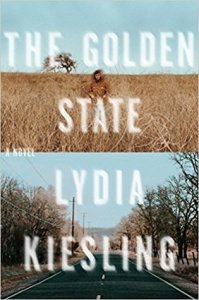
 There’s so much I loved about Lydia Kiesling’s The Golden State. What stands out to me most is its portrayal of motherhood, but I also loved the picture of the northern Californian landscape and culture we get in the book, the portrayal of university life in the book’s beginning, and the poignancy and political commentary in the situation with the protagonist and her husband. I also really liked the novel’s voice — it was sharp, funny, smart, and communicated a world of feeling in an understated way.
The protagonist, Daphne, works at an unnamed San Francisco university (Berkeley) and cares for her toddler-aged daughter. Her husband is stuck in Turkey, unable to return to the U.S. because he got screwed over by a nasty border officer, so Daphne has to care for her daughter alone. This part sent waves of anxiety through me, both at the knowledge that our government routinely separates families in this way, and at the thought of having to care for a young child as a single parent. Kiesling describes perfectly what it’s like to get through a very long day with a child who demands your attention but is also kind of boring, as young children are. The predicament with her husband is unsettling; he is simply stuck in Turkey with his family until the very, very slow bureaucratic wheels turn and his request to return to the U.S. is considered. Daphne is considering joining her husband in Turkey, but isn’t sure what she wants to do.
Instead, what she does is leave work suddenly one day, pick up her daughter, and drive hours up north to a mobile home her grandparents have left her in a tiny town in the middle of nowhere. She thinks there’s a chance she’ll have some time and space up there to figure out how to deal with her situation. She does have some of that, but she also learns about the movement underway in that part of California to secede from the state and form the “State of Jefferson” (mainly in order to avoid taxes). She gets involved in the lives of her neighbors and an elderly woman she happens to meet in a restaurant.
I loved how the novel is politically timely, both in terms of domestic and international issues that connect in important ways, but also about experiences and situations that can happen at any time to any one — being separated from family, struggling with work, struggling with children that one deeply loves but that are hard to take care of day after day. The novel is in first person, and Daphne makes a wonderful companion, someone whose voice I was happy to have in my head for the few days it took me to read this.
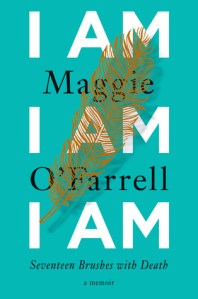 I finished reading I Am, I Am, I Am by Maggie O’Farrell on a plane, and it made me tear up, which is not ideal, when one is on a plane among strangers. Perhaps planes make me a little extra weepy because I hardly ever cry over books, but this book really did move me, especially the last chapter, which I won’t get into here. The book’s subtitle is “Seventeen Brushes with Death,” and that’s exactly what it is: essays about seventeen times O’Farrell faced death, sometimes very immediately and dangerously, sometimes in a more distanced but still real and frightening way. O’Farrell has lived a pretty exciting life, with lots of travel and serious illness, and she has a certain recklessness that leads her into trouble sometimes. But still it seems to me like seventeen brushes with death is a particularly unfortunate record. O’Farrell writes about these experiences simply, in a straightforward manner without much direct philosophizing about life and death. But she still manages to be evocative and to inspire reflection even as she sticks to the story at hand. The experiences build on one another, later stories inspiring memories of earlier ones, hospital experiences contrasting with one another, childhood dangers helping us understand adult ones. The essays are not in chronological order, but they still add up to a full sense of the person that O’Farrell is. The book is labeled a memoir, and it feels like one, even as the individual essays can stand alone as well. The last chapter is the most wrenching, and it brings the book together beautifully. I just loved it.
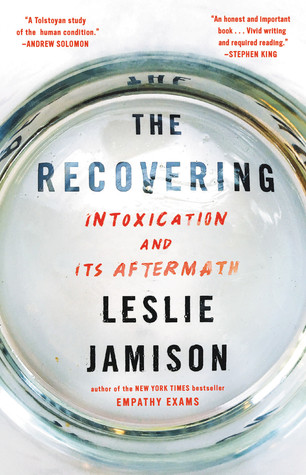 The Recovering: Intoxication and Its Aftermath by Leslie Jamison had a lot of good things about it, although I had a lot of questions at the same time. It’s part memoir, part discussion of addiction in literature and society, and Jamison moves back and forth between the two throughout the book. I found the personal story compelling: Jamison’s narrative is not that dramatic, as she herself acknowledges, at least compared to what many addiction narratives are like, but she makes it interesting because she’s a good storyteller. I like her writing and her voice; I’m happy to listen to her tell personal stories no matter what they are.
 Stuart Kells’s
  I finished There There by Tommy Orange last night and what a great book it is! It tells the story of a group of Native Americans living in or heading to Oakland, California. You hear early on about a big Oakland Powwow that’s going to happen soon, and the novel moves steadily toward that event. Along the way we meet a range of people: 12 characters of various ages and experiences, each of whom takes a turn being the focus of the story. There are children trying to figure out what it means to be Native, grown-ups dealing with alcoholism and destructive marriages, parents and grandparents worried about or estranged from their children and grandchildren, young people trying to pull their lives together, or feeling pressure from their parents to do so.
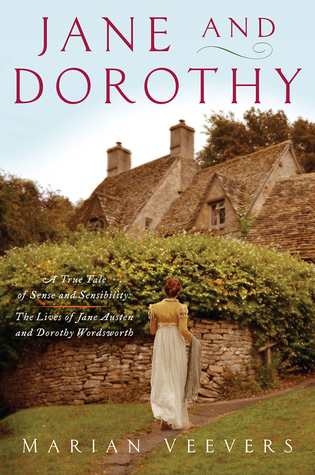 Jane and Dorothy: A True Tale of Sense and Sensibility: The Lives of Jane Austen and Dorothy Wordsworth by Marian Veveers was an interesting and enjoyable read. I think it’s best meant for casual fans of Austen and/or Dorothy Wordsworth (probably the former?) rather than for experts or those who have read in-depth biographies of these figures before. But, then, I’ve read biographies of both these writers and I still enjoyed this book, even though it didn’t have information I hadn’t read elsewhere. It’s relatively short for a biography of two writers — just over 300 pages, so for me, it was a quick review of these writers’ lives, plus some compelling points about how the two lives illuminate each other.
 I enjoyed this book so much! It’s perfect for me: a smart, thoughtful, well-written novel about cycling. I’m not sure what non-cycling readers will make of it: I can’t tell because an important part of the experience for me was reading great writing about what it’s like to ride and race, but my guess is they will find much to like in it too.
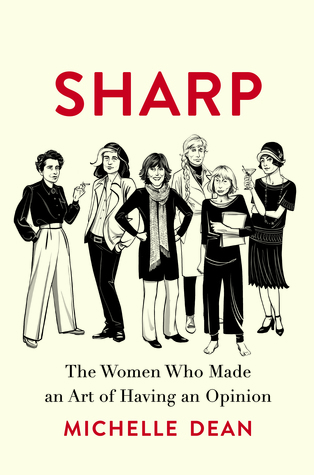 Michelle Dean’s Sharp: The Women Who Made an Art of Having an Opinion seems like the perfect book for me — I like reading about women’s history, women writers, literary history, and criticism, and I’m a fan of many of the writers she discusses. Her ten main subjects are Dorothy Parker, Rebecca West, Hannah Arendt, Mary McCarthy, Susan Sontag, Pauline Kael, Joan Didion, Nora Ephron, Renata Adler, and Janet Malcolm. Dean’s writing is lively and interesting, and she manages to be satisfyingly thorough in a relatively short book by focusing on the women’s writing careers rather than telling their whole biography, although you do get a sense of the shape of their lives. She points out connections among the women — similarities among their lives and the ways they knew each other — and although I found these less compelling than I expected, it didn’t matter because their stories as individuals were enough.
 I recently finished the novel Chemistry by Weike Wang, and I liked it so much! It tells the story of a 20-something woman in a chemistry graduate program who is deeply unhappy and figuring out what to do about it. She’s frustrated by her research and her unsupportive advisors. She also doesn’t know what to do about her boyfriend’s marriage proposal. She has been happy with him, more or less, but the idea of marriage really freaks her out, not least because her parents’ marriage was so deeply unhappy. She is also worried about how she will feel if she follows her more-successful boyfriend/husband so he can pursue his career, while her own languishes. Will she end up made miserable by that decision?
 I really loved Eventide by Therese Bohman, translated from the Swedish by Marlaine Delargy. It’s a novel about the academic world, which always appeals to me, and it’s a smart look at life for a newly-single woman in her forties who is struggling to figure out what she wants out of life and what meaning the world has for her. It’s a dark novel — another thing I like — and a philosophical one and one that takes a close look at the experience of being a middle-aged woman.
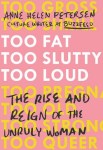 As for the book itself, it’s the kind of nonfiction that I approach with trepidation, not because of the topic, but because its ten chapters cover one “unruly” woman each, and I often find that format boring. It’s hard to make the give-the-theory-in-the-intro-and-apply-it-over-and-over-again-in-the-chapters format consistently fresh and interesting. Peterson does a pretty good job with this, though, mostly, I think, because each chapter has not only a different unruly woman to discuss (not interesting enough in and of itself), but it looks at a different type of unruliness in each chapter: too pregnant, too shrill, too queer, too fat, too slutty, too loud, etc., so there’s a wide variety of material.
 Of Books and Bicycles