Reading round-up

I thought I might try posting occasionally — maybe once a week, maybe less often — a listy-type post about what books I’m reading, what books I’ve acquired recently, and/or what books I’ve put on my TBR list. It might be fun to keep track a little more closely of the books that come in and out of my house and the ones that have caught my eye.

For today, I’ll list the books that I’ve put on my TBR list recently (I keep track of these books on GoodReads):

  • Ted Solotaroff’s The Literary Community: Selected Essays 1967-2007. I know nothing about this book and GoodReads doesn’t tell me much about it. But the table of contents looks interesting, and it would be good to browse through to see if I might like it. I put it on my list to remember in case I run across it somewhere. I read about it on a Book Riot post.
  • Leslie Jamison’s The Empathy Exams. The amazing Roxane Gay has been been writing about and praising this book. It’s a collection of essays and won the Graywolf Press Nonfiction Prize.
  • Mitchell S. Jackson’s The Residue Years. This is a novel, published by Bloomsbury Press. I heard an interview with Jackson that intrigued me.
  • Ann Patchett’s Truth and Beauty. I’m reading Patchett’s recent collection of essays, and although I have some reservations about it, I’m enjoying it in parts and I want to read this memoir about her friendship with Lucy Grealy. I’ve got Grealy’s memoir on my shelves to read, and I like the idea of reading the two books together. Speaking of reading two books together, Patchett briefly mentions the brothers Tobias and Geoffrey Wolff, both of whom wrote memoirs of their childhoods, although they lived in different places. These would make another good pairing.

The two books I acquired this week are:

  • Victor LaValle’s The Ecstatic, acquired through Book Mooch. I don’t remember where I first heard about LaValle, but the name has stuck with me as one to investigate further.
  • D.A. Mishani’s The Missing File, which I’ll be reading next for my mystery book group.

As for what I’m reading:

  • I’m finishing up the Patchett essay collection This Is the Story of  Happy Marriage, and
  • I’m about halfway through Minae Mizumura long, long work A True Novel.

More of these last two books later!
6 Comments

Filed under Books

Maine, by J. Courtney Sullivan

I very much enjoyed listening to J. Courtney Sullivan’s novel Maine on audio. It’s the kind of book that I probably enjoyed more on audio than I would have on paper; it’s hard to tell, but I might have remained indifferent reading on paper, but on audio, where I tend to get more emotionally caught up in the story, I enjoyed the family drama. It’s a multi-generational family saga, a genre which I’ll admit only occasionally appeals to me, but this one’s relatively tight focus worked well. It’s set roughly in the present time with flashbacks to earlier years to fill in back story, and I appreciated that we are never in the back story for too long and the shifts are handled well.

What made me like the book the most are the sharply-drawn characters, whom we see through multiple points of view, so we come to understand their inner lives as well as the reasons they drive other family members crazy. The book is divided into sections that switch among four different narrators: there’s Alice, the family matriarch, who is difficult and drinks too much, and whose past life her family knows only a little about. There’s Ann Marie, her daughter-in-law, a seemingly perfect martyr-type who tries so very, very hard to keep her world just so. There’s Kathleen, Alice’s daughter, a former alcoholic trying to stay as far away from her complicated family as possible, and there is Maggie, Kathleen’s daughter, living in New York City and trying to forge a life for herself that feels genuine but that is very different from the lives of the other women in her family. Each character makes us understand her own inner life while we are in her head, in the kind of close third person perspective that made me think sometimes it was actually first person, while showing us how the others look from the outside, so the final picture of each character is richly complex.

The plot largely revolves around a summer home Alice owns in southern, coastal Maine that her children and grandchildren both love and loathe — it’s the site of many treasured memories but also of conflict and anxiety. There are numerous subplots, all of which Sullivan handles well. What I enjoyed most, though, is the book’s emotional complexity, its sense that each person contains more stories than we are ever aware of.

10 Comments

Filed under Books

Tiny Beautiful Things

Tiny Beautiful Things: Advice on Love and Life from Dear Sugar by Cheryl Strayed is not at all the kind of thing I usually read, but I’m glad I stepped outside of my usual territory to read it, because it’s a beautiful book. For those of you not familiar with her, Cheryl Strayed, who is also the author of the memoir Wild, wrote an advice column anonymously for the website The Rumpus, using the name Sugar. I never knew about the column while she was writing it, but it had a lot of readers. She revealed her identity something like two years ago, and this book is a collection of some of those columns.

Strayed answers all kind of questions — about family, love, friendship, money — and her answers are personal and revealing. She almost always tells stories about her own life as a way of answering the question. I think this is the thing that makes the columns work so well, that she reveals her own struggles and shows her vulnerabilities at the same time that she doesn’t balk at taking an authoritative stance and telling people what she thinks they should do. Her advice is often tough and it frequently takes the form of telling people they need to make major changes and work harder at facing their problems. She by no means coddles her readers. But this is so much easier to take alongside the stories of her own struggles. You feel as though she has earned every bit of her authority and insight.

The columns are so warm, too. My only experience with advice columns before this was reading Dear Abby and Miss Manners a long time ago, and their voices were so much cooler and more detached, and entirely impersonal. Strayed isn’t just giving people advice; she is sharing with the world her hard-won personal wisdom, and you can tell she genuinely feels the pain of the people who write to her. She calls just about everyone who writes to her “sweet pea,” a habit I thought would annoy me, but instead it feels like a kind way to acknowledge the humanity of the people who write to her.

I was reluctant to read the book because I was afraid I would find it too saccharine and I was turned off by the universal adoration it has received. But enough people I respect love it, including the kind of people who are likely to worry about it being too saccharine for their tastes too, so it seemed worth the risk. And it most definitely was.

6 Comments

Filed under Books

New books!

Or rather, used books! Hobgoblin and I drove across Connecticut to visit the Book Barn in Niantic (which I wrote about here), a book store it is worth driving the entire way across a state to visit (yes, a small state, but still). We met some friends there who had two kids in tow plus there was our own kid, so we didn’t spend as long as I would have liked, but I found some nice things anyway. Hobgoblin found the entire Harry Potter series in hardcover, which we snapped up. We need to be prepared to read to our little one when he gets older, right?

I came home with:

  • Elena Ferrante’s My Brilliant Friend. I was hoping to find The Days of Abandonment, but this one sounds good too. Oh, I just discovered it’s the first in a trilogy, although it looks like only the first two have appeared so far and the second hasn’t been translated into English. It’s a story about friendship between two women, which is promising.
  • Patrick Leigh Fermor’s A Time of Gifts. The man who was working the register when we paid for our books rhapsodized about Fermor, and I’ve heard many other rhapsodies about his writing, so surely this will be good.
  • Pico Iyer’s The Man Within My Head. This is partly about Iyer and partly about Iyer’s obsession with Graham Greene. I like this particular mix of genres, memoir and literary criticism.
  • Gideon Lewis-Kraus’s A Sense of Direction: Pilgrimage for the Restless and Hopeful. This one is a mix of memoir and travel.
  • Georgette Heyer’s Footsteps in the Dark. All the Heyers I’ve read so far have been the romances, so I’m curious what I will think of one of her mysteries.

I could have come home with so much more, so maybe it’s a good thing the kids desperately needed their lunch and we needed to leave. Especially since I’ve accumulated a few new books from other sources. I picked up a copy of The Best American Essays, 2013, edited by Cheryl Strayed, a series I make sure to read every year (and I’m such an essay geek that frequently one of the most enjoyable parts of the book is the introductory essay on the essay genre). I also snagged a copy of Elizabeth Gilbert’s new novel The Signature of All Things from Goodreads. AND, I bought a copy of Hawthorn and Child by Keith Ridgway, which is supposed to be a new take on the detective novel. And also the essay collection How to Slowly Kill Yourself and Others in America by Kiese Laymon. I love the title.

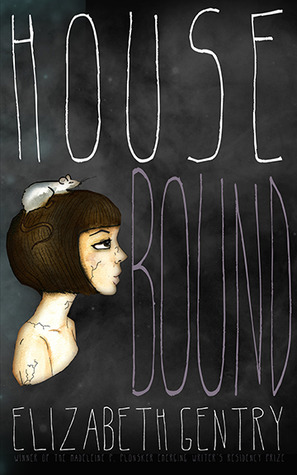
But most exciting of all, I got an advanced reader’s edition of a novel coming out in November, written by a good friend of mine, Elizabeth Gentry’s Housebound. You will be hearing more from me about this book when it comes out in November, but in the meantime, just go ahead and add it to your TBR pile, because it’s awesome. Here’s the cover:

Housebound

12 Comments

Filed under Books

Claire DeWitt and the City of the Dead

It’s been a while since I’ve posted about a mystery book group meeting. The group is still going strong and has now read 42 books in, I think, 5 1/2 years. We were sad to see a couple members leave a few years ago, but happy to get some cool new members as well. The book discussions are as interesting as ever. This time around we discussed Claire DeWitt and the City of the Dead, by Sara Gran. Feelings in the group ranged from mixed to very positive, with my own take on the more positive side. There were moments early on when I wasn’t sure I would take to the book or not, but by the end, she had won me over. It’s a fabulous portrayal of post-Katrina New Orleans, first of all. Gran shows how effective fiction can be at capturing complicated truths about a place and an event. I also admired Claire DeWitt very much. People in the group commented on what a difficult person she is in the novel, and I was taken by surprise at this. I saw, when I thought about it more, that she is indeed a pretty nasty person in a lot of ways, but as I was reading that didn’t even occur to me. I got so caught up in the first person voice and got used to seeing things from her perspective that I didn’t step back to evaluate what kind of head I had been inhabiting. DeWitt is a character in the hard-boiled detective tradition, and so of course she has many flaws and a prickly personality, but she is still a great person to spend some time with (mediated, of course, by the pages of a book).

The novel is also a commentary on mysteries themselves. DeWitt is a disciple of the philosopher-detective Jacques Silette, whose book Détection she quotes from liberally and which is full of enigmatic statements such as

There are no innocent victims…. The victim selects his role as carefully and unconsciously as the policeman, the detective, the client, or the villain. Each chooses his role and then forgets this, sometimes for many lifetimes, until one comes along who can remind him.This time you may be the villain or the victim. The next time your roles may switch.

It is only a role. Try to remember.

This is the part of the book I wasn’t so sure about at first. Some of Silette’s ideas are interesting, but others, such as in the quotation above, didn’t make much sense to me. I wasn’t sure to what extent we are even supposed to make sense of such statements. There is a mystical, unrealistic aspect to the book that left me feeling uneasy, as I didn’t quite know what to do with it. But, at the same time, the book explores an idea that I liked very much: that life is full of mysteries and that mysteries are everywhere, only we don’t usually see them as such. What goes on in a mystery novel is only one small part of the constant flow of the mysterious all around us. To solve a case is to put artificial boundaries around the vast unknown.

I liked this one enough to want to read the next in the series, which was recently released. Next up for the mystery group, though, is The Missing File, by D.A. Mishani, a book and an author I’d never heard of before.

8 Comments

Filed under Books

The Return of the Soldier, by Rebecca West

A friend of mind told me that Rebecca West’s novella The Return of the Soldier was very good, and as I’d already enjoyed West’s novel The Fountain Overflows very much, I thought I would give it a try. I found it to be a slow read in the best possible way: it asks you to read carefully to savor all of its details and emotional complexity. The story is set during World War I, and was in fact written during World War I, and is about two women in England who hear that Chris, one woman’s husband and the other woman’s cousin, has become ill. The news is very bad: he is mentally ill, suffering from shell shock. And the news is brought by a woman, Margaret, whom Chris loved 15 years earlier, and with whom he believes himself to still be in love. He has completely forgotten the last 15 years during which he got married, had and then lost a child. Now he is returning home to face the wife he doesn’t remember.

Described like this, the story sounds sensational, but it doesn’t feel that way. Jenny, Chris’s cousin, narrates the story in the first person, and filtered through her point of view, we see a great deal of complexity in the main characters, not least in Jenny herself. We see how Chris has changed in the shift from his young, 21-year-old love for Margaret to his more recent relationship with his wife, a colder, more practical, more sophisticated woman than Margaret. Now that he has returned from the war and is in love with Margaret again, he seems younger than ever. Far from being a detached, observing narrator, Jenny might be called unreliable, or at least extremely biased, as she has a hard time understanding Margaret and has strong feelings toward Chris. Even though she is describing a love triangle of which she seems not to be a part, she is nonetheless closely involved.

The mechanism that brings about the book’s end is perhaps too pat, but that doesn’t spoil the book, which remains satisfyingly complex all the way through. Now that I have enjoyed two West books, I am going to need to read more. I’m particularly interested in, but also scared of, reading what I understand is her masterpiece, Black Lamb and Grey Falcon, a travel and history book about Yugoslavia. I would under almost all circumstances not be drawn to that kind of book, especially since it’s very, very long. But I’ve heard from very reliable people that it’s great, and I want to get to it one day.

7 Comments

Filed under Books

Still Writing, by Dani Shapiro

As I wrote back when I posted on John Gardner’s The Art of Fiction, I enjoy reading books on writing, even though I’m not a writer, or at least a creative one, myself. The same holds true for Dani Shapiro’s new book Still Writing. The book is part memoir, part writing guide, part inspirational text. I found it less useful as a reader than some of the other books on writing I’ve read, as it really is aimed more directly toward creative writers than the others, but it was still interesting and enjoyable. The book is written in short sections, generally only a couple pages each, that take on a different aspect of writing — facing the blank page, for example, or developing a writing schedule that works for you, or dealing with feedback from readers. The sections often tell stories from Shapiro’s life — her upbringing as an only child with unhappy parents, for example — as a way of describing what shaped her identity as a writer. By doing this, she gives readers a reason to trust her and to take her advice seriously. Her persona is warm and wise. I imagine that if I were a writer and were looking for inspiration, I would find it here. As it is, the book was a window into the writing life that in moments made me wish I did write. But I believe strongly what people say about writing because you need to. Writers do it because they feel it’s something they have to do, and they would do it whether they got published or not. Mostly, I’m happy to be a reader, and to get to enjoy the fruits of other people’s hard labor.

10 Comments

Filed under Books

Longbourn, by Jo Baker

Longbourn I’ve never read any Jane Austen-inspired fiction before, although I notice it all the time and wonder if there’s any chance I’d like it. Generally, the answer is probably not. But I’d heard enough people talking excitedly about Jo Baker’s Longbourn that it started to sound appealing. It turns out that the book is pretty good. There were some parts I didn’t like (an extended period that takes us to the Napoleonic wars in Europe) and sometimes I didn’t like the treatment of point of view. A few bumpy spots early on made me wonder whether I really wanted to be reading the book or not. But before too long I got fully caught up in the book and my doubts were gone.

The book, if you’re not familiar with it, is a retelling of Pride and Prejudice from the servants’ perspective. One of the most interesting things about the novel is the different perspective we get on Austen’s plot and characters. We can see the events of P & P going on, but that action is very much in the background. The “upstairs” characters come and go, and we hear brief mentions of, for example, Jane’s stay at Netherfield or Mr. Collins’s visit and rejected marriage proposal, but the center of the action is downstairs, particularly around Sarah, one of the housemaids. She is a smart, thoughtful woman who enjoys reading when she can — Elizabeth lends her books — but whose body is slowly being worn down by the hard labor required of her. She watches after Polly, the young second housemaid, and observes with interest the new footman whom Mr. Bennett unexpectedly and rather mysteriously hires. In the meantime, it’s amusing to see that Elizabeth stands out not so much because of her wit and charm, but because her habit of tramping across the fields means the servants spend more time cleaning the mud off her boots and clothing. The worries and the priorities of this novel are different than Austen’s: it doesn’t matter so much that Mrs. Bennett is an embarrassment to her more well-bred older daughters or that Lydia’s misbehavior might keep Jane from a promising marriage prospect. What matters is that Mr. Collins, the future owner of Longbourn, find a wife who will keep the current set of servants so they won’t lose their jobs. Jane is the sister most admired among the five, not Elizabeth, because Jane is neat and mild-mannered and good at keeping the peace.

I think it’s possible to enjoy this novel without being familiar with Pride and Prejudice, but it wouldn’t be nearly as much fun. The story is interesting in and of itself, but playing the two novels against each other as you read adds another, very satisfying, layer to the reading experience.

14 Comments

Filed under Books

The Secret History

I’ve spent the last week or so, maybe longer, reading The Secret History by Donna Tartt. I wanted an absorbing novel, which it was, although I felt it was longer than it needed to be. It’s hard to tell, though, if a book feels too long because it IS too long, or because I’m too busy to read it at the pace I’d like and so it takes me longer to finish than I think it will. At any rate, it was enjoyable. I’ve been in the mood for academic novels lately, and this book scratched that itch. It’s set in a Vermont town that’s pretty clearly Bennington, and is about a close-knit group of students who take almost all their courses from one Greek professor. We learn at the book’s beginning that one of these students was murdered, but we don’t know how or why. So the novel is a cross between an academic novel and a murder mystery. As I was reading it, I kept thinking about the dust-up over this interview where Claire Messud gets (justifiably) irritated at a question about whether anyone would want to be friends with her character Nora from The Woman Upstairs. That interview sparked a whole lot of talk about likeable characters and whether readers want them in novels and whether it’s okay to want them. I found the characters in The Secret History to be intensely unlikeable all the way through. If they aren’t privileged, wealthy, and spoiled, they are arrogant and rude or feckless and foolish. The first-person narrator is one of the students, and he is the most sympathetic, but he still gets himself involved in horrible doings when he should know better and his attitude toward the novel’s events felt oddly distanced. Even so, I enjoyed reading about these characters, and so did a lot of other readers, evidently, as the book has been very popular. Perhaps this idea that readers want likeable characters just isn’t true, or perhaps readers are more likely to give college-aged students a pass? At any rate, I was surprised when one of the people on a podcast I listen to said that, given the option of what fictional world she’d like to live in, she’d choose the world of The Secret History, just without the murders. While a world where it’s possible to live in Vermont and spend tons of time studying Greek sounds appealing, I wouldn’t want to be a part of The Secret History. I’m very happy just to read about it and keep a safe distance.

15 Comments

Filed under Books

Seeing Stephen King

A couple months ago, I was lucky enough to snag tickets to see Stephen King and his son Owen King at a reading in Manhattan. The tickets were on sale for about five minutes before selling out, and I barely got my hands on a pair. The event itself was this past Tuesday, and this makes the third time I’ve seen King at a reading or book signing, twice in Manhattan and once in Portsmouth, New Hampshire. And I’m not really a big Stephen King fan! I’ve read three of his novels and liked them, but I don’t read much horror, and so don’t pick him up regularly. But, of course, Hobgoblin is a huge fan, and I’m always happy to accompany him to events.

This one was fun. Stephen and Owen both read twice, the first time reading from each other’s books, and the second time reading from their own. Stephen’s new book is Doctor Sleep, a sequel to The Shining, and Owen’s is Double Feature, neither of which I have read or am likely to read, to be honest, but Hobgoblin assures me that Owen’s book is very good, and I’m sure Stephen’s will be too. The most enjoyable part of the evening, though, was an interlude between readings when the two of them chatted informally for a while. Owen pulled out a book he said he’d found in a used bookstore, which turned out to be The Stephen King Quiz Book. Owen then asked Stephen a few questions about himself. The first question was an easy one about where he was born, which Stephen answered with no trouble. But the next three questions he missed! I don’t remember the specifics, but they were questions about places and character names from his novels, and I guess when you’ve written as much as Stephen King has, the details begin to get blurry after a while. So we all had a good, friendly laugh about that.

It was moving to see father and son together; they were clearly proud of each other and enjoyed each other’s company. One of the audience members asked Stephen, had he known back in 1970 that he would one day become Stephen King the extremely famous and popular author, whether he would have done anything differently back then. From what I know about some difficult times in his life, there are lots of ways he could have answered this. But he said, you know, I’m still happily married to the woman I married back then, and I have three great kids, and no, I wouldn’t have done anything differently. It was thoroughly charming.

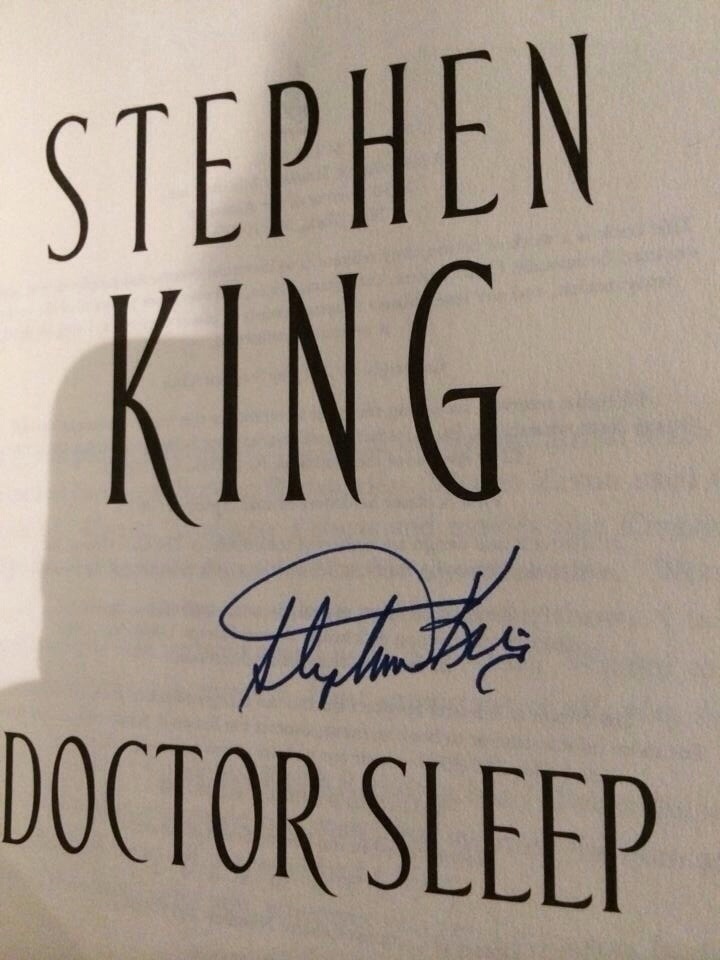
Part of the price of admission was a copy of Doctor Sleep to be distributed after the reading. Some of them would be signed, but not all, and it was a matter of chance which each person would get. And look what I came home with:

20130926-192329.jpg

15 Comments

Filed under Books

Charles Ferdinand Ramuz’s Beauty on Earth

I was thrilled to get my hands on a copy of Charles Ferdinand Ramuz’s 1927 novel Beauty on Earth, newly translated by Michelle Bailat-Jones, who writes the blog Pieces. Ramuz is a Swiss writer, not well known here in the U.S., and it’s exciting to see that his work is now available. The novel tells the story of a young woman, Juliette, who comes to live with her uncle in a small Swiss town after her father’s death. She grew up in Cuba, and so has a large change ahead of her. The focus of the novel is not on her experience of this change, however, or at least not on her inward experience, for we see her mainly from the outside as she arrives in the town, an unusual and surprising figure to whom the villagers don’t know how to respond. The novel is focused more on the experiences of the uncle, Milliquet, a café owner, and Rouge, a fisherman, as well as a handful of other townspeople. It’s a story of a stranger coming in and disrupting what appears to be a quiet, peaceful place, revealing tensions lying beneath the surface. It’s Juliette’s beauty that the town finds so disruptive; she captivates all — or at least many — of the people who meet her. Her beauty provokes them to want to possess her. The fact that Juliette provokes such possessiveness and that we never learn much about her inner life suggests that she is meant to be a symbol for human longing for the unattainable.

One of the most intriguing aspects of the book is the narrative voice and the novel’s point of view. The book starts off in a straightforward third person objective point of view, but the narrator quickly shifts to first person plural, and from there on, moves back and forth between first and third, and sometimes shifts into second. It’s disorienting for readers, as sometimes we’re outside the scene looking in, and sometimes, through the narrator’s use of “we,” are in the scene itself, one of the townspeople, taking part in the action. Sometimes, when the narrator uses “you,” we are being addressed directly. Readers never quite know where they are, what their place is, and are therefore not allowed to sit in judgment on the townspeople from afar. Readers are implicated in the desire to possess Juliette, and, just like the townspeople, are frustrated in any attempt to know her.

Ramuz’s writing — and Michelle’s translation — is beautiful; the lake and village landscapes are gorgeously evoked. I finished the book with a strong sense of the place — its cliffs and waves and storms. The novel’s title refers to Juliette’s disruptive beauty, but it also surely gestures toward the beauty of the landscape. I wish I could visit, although I would not want to be drawn, as Juliette is, into the schemes of the townspeople. The genius of this novel is that Ramuz never lets the reader keep a safe, observing distance. To read this novel is to take part in its struggle, an unsettling, but satisfying, experience.

9 Comments

Filed under Books

Levels of Life, by Julian Barnes

I very much admired Julian Barnes’s nonfiction book about facing the prospect of death, Nothing to Be Frightened Of, so I was happy to hear he has a new book somewhat along the same lines coming out. This one is called Levels of Life, and while it’s also about death, it takes a different tack. Nothing to Be Frightened Of is about, among other things, his fear of his own approaching death. Levels of Life at first doesn’t seem to be a book about death at all; instead, it begins with the stories of three nineteenth-century people involved in one way or another with ballooning: Fred Burnaby, Sarah Bernhardt, and Félix Tournachon. Through the stories of these three, he gives a brief, partial history of ballooning, and also talks about the intersections of ballooning and the new field of photography. From there, he moves to a story about a love affair between Fred Burnaby and Sarah Bernhardt. I’m not sure the extent to which the story of this love affair is true, but Barnes tells the story as though it were fiction, creating scenes and dialogue. In his final section, Barnes moves to his own life, telling the story of his grief after his wife’s death. The book brings together widely divergent topics, but Barnes interweaves them beautifully, so the book as a whole makes sense and feels complete. The stories about ballooning and photography are interesting, but they also are important as metaphors — metaphors for the emotional heights of a love affair and the crash back to earth that death and loss can bring. By the time you get to the grief memoir part of the book, it’s clear that Barnes wanted a supporting structure for the difficult story he had to tell, a deeper language with which to describe it.

It’s a very short book — although I didn’t, I could have read it in a day, and there aren’t many books I can read that quickly — and a powerful one. I’m grateful to Barnes for being willing and able to turn the experience of grief into art.

7 Comments

Filed under Books

Bike and baby updates

I haven’t written here about cycling in a long time, but that’s not because I haven’t been riding. I have ridden over 2,100 miles so far this year, which doesn’t strike me as bad for a year in which I gave birth! I began riding in the middle of March, and have ridden more or less steadily since then, with some breaks for travel and busyness. I’d say my fitness is decent as far as recreational riding goes, but I’m far from being ready to race. I’m not sure if I will race next year or not. I want to keep riding through the fall and winter, but I don’t know if I will have time or energy to do the kind of riding that’s necessary to prepare for racing. I will just wait and see, and in the meantime, I’m enjoying getting out on my bike in the cooler fall weather.

The hard thing, though, is that I am doing much more riding by myself than I used to. A few times during the summer Hobgoblin and I hired a babysitter so we could go riding together, but that babysitter is no longer in the area, and now that summer’s over we are busier and need babysitters for other reasons. So he and I usually take turns riding while the other watches the baby, which is fine, but sometimes without someone to ride with, I lose my motivation. I can ride with other friends occasionally, but that’s sometimes hard to arrange. So I ride by myself and think about how lucky I am to be able to get out at all, what with a new baby and a full-time job.

Cormac is doing great, although even now as I type, I’m listening to him play upstairs in his crib when he should be taking a nap. Some days he is a good napper, but many days he is not, and he will frequently take 20-30 minutes to fall asleep, then sleep for 20-30 minutes, and then be ready to play again for another couple hours. I think 20-minute naps are marvelous for myself, but would prefer that my baby would sleep a little longer.

But I won’t complain about his napping, because he is a fantastic sleeper at night. We plop him in bed between 6:30 and 7:00 in the evening, and he sleeps until 5:30 or 6:00 most mornings. That’s a long stretch of time. He is an easy baby to take care of; he is happy and cheerful and fun to play with. He is very close to crawling, at which point we will spend our days chasing him around the house. It should be fun! Here’s a recent photo:

20130917-165126.jpg

5 Comments

Filed under Cycling, Life

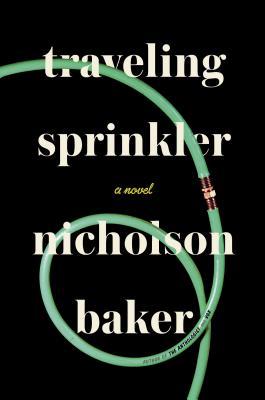
Nicholson Baker’s Traveling Sprinkler

Traveling Sprinkler If you have been reading this blog for any length of time, you will know that Nicholson Baker is one of my favorite contemporary authors. Traveling Sprinkler is a sequel to one of my favorite Baker books, The Anthologist. It continues the story of his main character, Paul Chowder, a poet and, in the case of this novel, aspiring song-writer. The Anthologist was about Chowder’s attempts to write an introduction to his forthcoming poetry anthology, and in this new book, the anthology has come out, and Chowder is supposed to be writing new poetry. Instead, he spends his time learning music software and trying to win back his ex-girlfriend Roz. The format is typical Baker: his main character thinks about the world around him, shares his thoughts on this and that, and not much happens.

I don’t think this book is as good as The Anthologist, but the thing about Baker is that even while I’m thinking to myself, “this book isn’t as good as The Anthologist,” I’m still beguiled by the narrative voice. I don’t want the book to end, which for me doesn’t happen with very many books. I’m aware as I’m reading that the thoughts Chowder is having, random as they seem sometimes, do fit together and add up to something bigger. Baker weaves his themes carefully together, and in this case, he’s interested in what art can do in a world constantly at war. Chowder wants to write a political protest song, and he thinks throughout the book about drones and a friend who gets arrested protesting U.S. foreign policy, and he wonders what good one person can do, particularly a person who spends his time quietly, thinking about poetry. Here is where the traveling sprinkler fits in:

National Walking Sprinkler of Nebraska made Wilson’s machines, and they still do. They made them for Sears and that’s where my father bought his. Everything about it is immediately understandable. It’s what America did before it threw itself wholeheartedly into the making of weapons that kill everyone.

I have been trying to write a poem about this sprinkler for years, because I like it so much, and I’ve never managed to do it. What a joy now to wind it around Nan’s tomatoes and watch it, in all its intuitive clumsy ungainly beauty, do some good.

Chowder is trying to appreciate what good there is in the world, as a counterweight to all that is bad. This effort may not get him very far, but it’s a worthy way to spend his time, at least.

So even with my doubts along the way, I was feeling warmly toward the book by the end. It has large things to say about the world, but it does it in an understated, charming manner that I find hard to resist.

5 Comments

Filed under Books

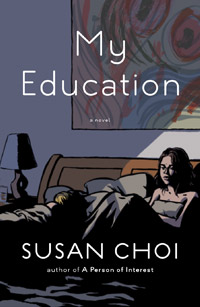
Susan Choi’s My Education

my-education-by-susan-choi I picked up Susan Choi’s book My Education at the library because I was in the mood for an academic novel, and Choi is an author I’ve been meaning to read for a while. I suppose it was my desire for an academic novel that made me enjoy the first half better than the second, because in the second half, the novel takes off in a different direction. So it’s probably not fair to call this an academic novel at all, because its interests ultimately seem to lie elsewhere. The first half was very enjoyable; it tells the story of a young woman heading to graduate school in English at an unnamed school that has to be Cornell. She is well-trained in contemporary literature and the latest in literary theory, but gets a chance to be a TA for a professor teaching Chaucer where she can learn something very different from her usual fare. It’s not all about the literature, though; this is a professor who has a reputation for sexual exploits and whom she finds attractive. As the book goes on, it turns into a novel about love and sexual obsession, although it doesn’t follow the track that you might expect, given the set-up. Its real interest lies in exploring various kinds of desire and obsession and the love that is possible and not possible between people of different ages and backgrounds. The writing is interesting and rich, with lots to think about, but I don’t think the story really holds together. The second half slowed down too much and my attention wandered. Choi does have a lot to say about love — how it changes us and how our ability to love changes as we get older. I just think it would have been a better book if it were shorter and more tightly focused.

6 Comments

Filed under Books

The Art of Fiction, Part 2

I have now finished John Gardner’s book The Art of Fiction and enjoyed it very much. As I wrote in my earlier post, the first half of the book deals with Gardner’s ideas about fiction generally, and the second half gets into more technical details about how fiction works. At the end of the book are a series of exercises for beginning (or, for that matter, more advanced) writers to practice on. He believes that new writers can improve by taking one small fictional element and working on that, at the same time as they are working on stories as a whole. So the exercises are things like writing opening paragraphs, or a couple paragraphs of suspense, or a paragraph of description. These exercises will help the writer figure out how to put all the pieces together into a complete work.

I wrote last time that I wasn’t satisfied with how Gardner dealt with unconventional fiction, but the book’s second half does more justice to the subject. He describes various types of experimental writing and the challenges each type holds, as well as the new things it can do. I still think he’s biased towards conventional fiction, and his focus on metafiction seems a little dated, but the book is better on the subject than I’d originally thought.

I’ll close with a passage I particularly liked in which he contrasts the novel and the novella. I don’t have a strong opinion on his views of the novella, but I liked his description of the novel very much:

Through the sparest means possible — not through the amassing of the numerous forces that operate in a novel but by following out a single line of thought — the novella reaches an end wherein the world is, at least for the central character, radically changed…. Nothing can be more perfect or complete than a good novella. When a novel achieves the same glassy perfection — as does Flaubert’s Madame Bovary — we may tend to find it dissatisfying, untrue. The “perfect” novel lacks the richness and raggedness of the best long fiction. We need not go into the reasons for this except to notice that the novella normally treats one character and one important action in his life, a focus that lends itself to neat cut-offs, framing. The novel, on the other hand, at least makes some pretense of imitating the world in all its complexity…. As a result, too much neatness in a novel kills the novel’s fundamental effect…. The novel is by definition, to some extent at least, a “loose, baggy monster” — as Henry James said irritably, disparaging the novels of Tolstoy. It cannot be too loose, too baggy or monstrous; but a novel built as prettily as a teacup is not of much use.

8 Comments

Filed under Books

A Rare DNF

I don’t keep track of the books I abandon unfinished, so I’m not sure how many there have been this year, but it’s possible that Rachel Kushner’s The Flamethrowers is the first one. I don’t mind mentioning it as one I abandoned, because it’s doing quite well, and my dissent from the general consensus that it’s a great book is not going to hurt it. I’m generally reluctant to leave books unfinished, so I usually soldier on, or in some cases, read on full of hope, giving the book a chance to improve. But sometimes, particularly when a book I’m uncertain about is long and feels as though it will never end, I give up. Yes, I know I should feel free to abandon books and that life is so much better when you do. I know that. Please don’t remind me! But I do like to give books a full chance when I can.

The Flamethrowers just wasn’t keeping my attention. It’s about a young woman, Reno, in the 1970s, who goes to New York from Nevada to participate in the art scene there. People have praised it for its portrayal of the New York City scene, and that certainly interests me, but if that’s part of the book’s interest, then I wanted more of it. Reno herself wasn’t coming to life for me either. She is described with too much detachment, and her actions seemed arbitrary. I didn’t understand why she befriended the people she did. And then interspersed among Reno’s story are sections about an Italian man from earlier in the 20th century and his love of motorcycles, and, while I knew these sections were going to connect up with Reno’s story, I still found them dull.

But don’t necessarily take my word for it — lots of people have loved this book and recommended it, so you might like it too. But I have since moved on to a novel I’m enjoying more, so I think I made the right decision.

4 Comments

Filed under Books

The Art of Fiction

I’m about halfway through John Gardner’s how-to book The Art of Fiction. I like reading these kinds of books even though I’m completely uninterested in writing any fiction of my own. But these books seem equally useful (if not more so) to readers of fiction than to writers of it. They offer theories of reading that are interesting to think about, as well as concepts of craft that help readers appreciate what authors are doing, or where they might be failing. As a teacher of literature, I appreciate the ideas about craft these books give me to bring to the classroom.

As I understand it, Gardner’s book is a classic of the genre, and so far I’m enjoying it very much. It’s incredibly clearly written — he makes it seem so easy — with great examples and illustrations and a nice use of humor. I like particularly the balance he strikes between the need for rules in fiction writing and the more complicated truth that the rules exist for writers to break and possibly to transform:

However he may get it, mastery — not a full mental catalogue of the rules — must be the writer’s goal. He must get the art of fiction, in all its complexity — the whole tradition and all its technical options — down through the wrinkles and tricky wiring of his brain into his blood … Mastery is not something that strikes in an instant, like a thunderbolt, but a gathering power that moves steadily through time, like weather.

In other words, art has no universal rules because each true artist melts down and reforges all past aesthetic law.

He argues that good fiction creates the feeling of a dream: “what counts in conventional fiction must be the vividness and continuity of the fictional dream the words set off in the reader’s mind.” This strikes me as absolutely true of, as he puts it, conventional fiction. We want to believe in the world the fiction creates and not get knocked out of that dream by details that seem false or by sentences that seem awkward or characters that don’t convince.

I find myself less convinced by the way he treats unconventional fiction. He acknowledges that the kind of fiction that doesn’t aspire to be a dream has its pleasures and its interest, but he seems biased toward the conventional anyway. I’m not seeing in his discussion of unconventional fiction the range of experiment that I’ve found in such books. Perhaps this has something to do with the book’s 1983 publication date? I keep thinking, what would Gardner make of something like Nicholson Baker’s 1988 book The Mezzanine? It doesn’t have a conventional narrative arc and as far as creating the feeling of a dream goes, it doesn’t seem interested in it, unless you consider getting lost in someone else’s thoughts as like inhabiting a dream.

But disagreeing with this kind of book is part of the pleasure of reading it. The book’s first half is about fiction generally and the second half gets into the nitty-gritty of technique. I’m looking forward to what he has to say next.

7 Comments

Filed under Books

Sanctuary Line, by Jane Urquhart

Jane Urquhart’s new novel, Sanctuary Line, tells the story of an extended family living, among other places, on the north shore of Lake Erie. The family came from Ireland and is full of lighthouse keepers, farmers, and orchardists, or at least it was until the most recent generation, which has moved on to other things. Now the farm on Lake Erie is falling into disrepair. The story is told in the first person by Liz Crane who is living alone in the old farmhouse, mourning the loss of her cousin, who has died in combat in Afghanistan. She is a scientist and is conducting research on monarch butterflies. She gives us some details of her current work and her isolated life, but most of the book is filled with stories from her childhood and family legends, many of which have come down to her from her uncle, a charismatic but troubled man. The narrator moves back and forth among all these narratives, building up a picture of the place and the family. The tension in the novel concerns what happened one summer during Liz’s adolescence, a series of events that transformed her life and led to her uncle’s permanent disappearance.

The writing here is beautiful, and Urquhart evokes such a strong sense of place, it made me nostalgic for an area I’ve never seen (although it seems not so different from the south shore of Lake Ontario, which is where I grew up). The novel verges on being too slow in its pacing, and it probably will be too slow for some people. She takes her time with the narrator’s various tales and stories, but I found myself wrapped up in the novel’s atmosphere and wanting to know what happened that summer. I wasn’t sure I liked Urquhart’s choice to have her narrator address an unnamed “you” in her account of her life; this “you” wasn’t consistently evoked and seemed unnecessary, although this does eventually get resolved. But mostly the novel felt satisfyingly rich in its portrayal of the changes time can bring.

4 Comments

Filed under Books

Cassandra at the Wedding

I found out about Dorothy Baker’s 1962 novel Cassandra at the Wedding from Emily Books, which makes ebook versions of print books, in this case, an NYRB Classic. I enjoyed the novel very much. As I got deeper into the book, I realized it was giving me something I’d been missing lately — an absorbing reading experience where the focus is not on plot but on character and emotion. Things happen in the book, big things, but not very many of them, and Baker kept me happily turning the pages (or swiping the screen) in between the plot points.

The novel is about twins, Cassandra and Judith, who have been very, very close for most of their lives, but as part of the growing-up process have recently been diverging. Judith sees this separation as necessary, and Cassandra does not. Cassandra heads home for Judith’s wedding, ready to resist it in any way she can. The tension in the novel is, of course, what will happen with the wedding, but even more so, what will happen with the sisters’ relationship. What makes the book particularly interesting, I think, is the two first person voices we encounter — first Cassandra, then Judith, then Cassandra at the end (which is something that could be a spoiler, except the Table of Contents reveals that much). Cassandra has an amusing voice — comedic and satirical — but we quickly learn not to trust it, as there is a lot she is hiding, from herself as well as from others. Judith’s more rational, sedate voice provides a contrast to Cassandra’s and offers firmer footing than Cassandra’s storytelling provides. The novel’s form thus nicely follows its subject matter, as we read about the complex interaction between these two women.

There’s lots to think about here, and I recommend it if this sounds like the sort of thing you like.

4 Comments

Filed under Books