Happy Thanksgiving!

My day will be quiet; the Hobgoblin and I are staying home and having Thanksgiving dinner all by ourselves — well, with Muttboy, of course, who will get his share of the food (although not nearly as much as he’d like). Our closest relatives, my parents, are five hours away, and while such a drive is possible, we don’t usually make it on Thanksgiving, largely because we’re too swamped with school work to take much time off. Yes, unfortunately, my Thanksgiving weekend will be spent grading. I still haven’t decided whether I’ll grade today or not; it sucks to work on a holiday, but it also sucks to have even more work on the remaining days because I took one day off. Yes, the glamorous life of the teacher.

Even if I do a little work, though, I’ll still have plenty of time for other things: eating, of course, and maybe a bike ride if it doesn’t rain all day, and I may even have time to finish Proust’s In the Shadow of Young Girls in Flower. I’m about 30 pages from the end. Or I may rush through The Polysyllabic Spree, just because it’s so much fun. I’ll surely read at least one more Alice Munro story, and I may even read a few poems from Jane Kenyon’s Otherwise, a book I’ve neglected lately.

At any rate, to American readers, enjoy the holiday! To others, have a great day too!

Leave a comment

Filed under Life

The Polysyllabic Spree

In addition to Alice Munro’s Runaway, I recently began Nick Hornby’s Polysyllabic Spree, and I’m enjoying it immensely. I remember other bloggers writing about this book enthusiastically, and I couldn’t resist. Apparently books about books are what I need these days; I’m reading this book shortly after Sara Nelson’s So Many Books — although I think I’ll like Hornby’s book better. Books about books are good during times of stress I think — they are usually fairly light reading, they make good company, and they keep me thinking about things I’ll read when I have more time.

Hornby organizes his book into chapters that cover one month’s reading. For each month, he begins with a list of books bought and books read, and then he discusses those books for a few pages, not in a whole lot of depth, but very amusingly. Somehow he manages to say substantive things in very short chapters, so that I don’t feel he’s rushing through his book discussions but I don’t get bogged down in details either. Sara Nelson’s book had a similar format, short chapters covering her reading over a certain period of time, but I finished her book feeling that the tone was too breezy and that she hadn’t really said all that much. Hornby doesn’t go into depth, but somehow he captures the essence of his response to a book in a way that’s both succint and satisfying. I’m not sure how else to account for why I liked one book and not the other except to say that it might just be a personality thing. In these books, personality is everything.

Side note — I feel a little bad picking on Sara Nelson in the way that I have over a few posts now. Just recently, Kimbofo had a post asking people if they review books they don’t like. I do. I believe it’s important to think about what doesn’t work in a book and why, and I think such analysis makes book talk everywhere stronger and more interesting. But I do still feel a little bad.

An excerpt from Hornby on rereading and on forgetting:

I don’t reread books very often; I’m too conscious of both my ignorance and my mortality. (I recently discovered that a friend who was rereading Bleak House had done no other Dickens apart from Barnaby Rudge. That’s just weird. I shamed and nagged him into picking up Great Expectations instead.) But when I tried to recall anything about [Stop-Time by Frank Conroy] other than its excellence, I failed. Maybe there was something about a peculiar stepfather? Or was that This Boy’s Life? And I realized that, as this is true of just about every book I consumed between the ages of, say, fifteen and forty, I haven’t even read the books I think I’ve read. I can’t tell you how depressing this is. What’s the fucking point?

It’s both depressing and it’s true — it’s true for me certainly; my memory of what I’ve read can be so bad. And here’s Hornby doing the numbers on what he’s read:

I read 55 percent of the books I bought this month — five and a half out of ten. Two of the unread books, however, are volumes of poetry, and, to my way of thinking, poetry books work more like books of reference: They go up on the shelves straight away (as opposed to onto the bedside table), to be taken down and dipped into every now and again … And anyway, anyone who is even contemplating ploughing straight through over a thousand pages of [Robert] Lowell’s poetry clearly needs a cable TV subscription, or maybe even some friends, a relationship, and a job. So if it’s OK with you, I’m taking the poetry out, and calling it five and a half out of eight — and the Heller I’ve read before, years ago, so that’s six and a half out of eight. I make that 81 1/4 percent! I am both erudite and financially prudent!

I suppose one reason I’m liking the book is that I often think this way myself — maybe without the humor, but certainly with the obsession.

Leave a comment

Filed under Books, Nonfiction

Short stories


I began Alice Munro’s book of short stories Runaway last night, and I finished the first one, the title story. I haven’t been a big reader of short stories; what Diana said about the effort it takes to get into a story and the fatigue of having to do it again and again with a book of stories really resonated with me. With a novel, you orient yourself once, or maybe a couple of times with new characters and locations, but then you’re set, and you’re in a world for as long as the novel lasts, and you can return again and again to that world every time you pick the book up. I like to live with characters for a while.

But I do want to read more stories, and while A Curious Singularity, the short story discussion group, is helping me, I’m eager to read some collections of stories on my own. Okay, that sounds more planned and organized than I really feel — I got inspired to read stories when I saw the Munro book, and I’m getting the feeling that I should continue to read stories now and then.

So, the Munro story was good [spoilers ahead]. It’s about a young married woman Clara, her husband Clark, and their older neighbor Sylvia; Clara turns to Sylvia for help when she realizes how unhappy she is in her marriage. Munro describes the marriage dynamic extraordinarily well; I can see just why Clark was so difficult, just why Clara would have been attracted to him in the first place, and just why she’d think about leaving him. And why she’d return, as much as I didn’t want her to. Munro can dramatize all this history and all these feelings so effortlessly.

I remember a commenter telling me to look out for the goat in this book — well, the goat appears in this first story and turns out to be the story’s symbolic center. Clara’s goat Flora is missing through most of the story, but she appears at a crucial moment near the conclusion when Clark confronts Sylvia for helping Clara run away. The goat comes walking out of a fog, illuminated by passing headlights, and frightens the two characters, so that Clark grabs Sylvia’s shoulder in a protective move and she lets him do so, although the two had just been fighting. Sylvia writes to Clara later that:

[Flora’s] appearance at that moment did have a profound effect on your husband and me. When two human beings divided by hostility are both, at the same time, mystified — no, frightened — by the same apparition, there is a bond that springs up between then, and they find themselves united in the most unexpected way. United in their humanity — that is the only way I can describe it. We parted almost as friends. So Flora has her place as a good angel in my life and perhaps also in your husband’s life and yours.

And yet — if you’ve read the story, you’ll know this is not what happens at all. Flora comes to stand for something much different — much darker — in their marriage. So the story ends, not with the issues resolved and not with the kind of reconciliation Sylvia hopes they might have had:

All she could hope was that perhaps Clara’s flight and turbulent emotions had brought her true feelings to the surface and perhaps a recognition in her husband of his true feelings as well.

If Clara and Clark have recognized their true feelings by the end of the story, this recognition is not an easy or a rewarding one. Sylvia’s hopes are a dark counterpoint to the reality of the marriage — a marriage in which Clara now seems firmly entrenched.

Okay, now I’m depressed. But, sigh, this seems like real life to me. I suppose part of Munro’s genius is to capture a rich, if dark, emotional world in such a short space. I’m looking forward to the rest of the stories in this collection.

Leave a comment

Filed under Books, Short stories

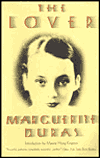
Marguerite Duras’s The Lover

I finished The Lover over the weekend. It’s a very short novel, more like a novella, really, at 115 pages, and a fascinating read. If you’re interested in the novel, you should check out Litlove’s post on Duras. There she discusses The Lover plus Duras’ life and reputation.

It’s a story about a girl of fifteen who lives in Indochina with a difficult, poor family — her mother and two brothers — and who has an affair with older Chinese man. But the novel doesn’t stay focused solely on the affair; it skips around in time, telling stories of the narrator’s later life in France and of what happens to her family members. We watch her as she realizes she wants to be a writer, and as she struggles with her love/hate relationship with her mother, and we see all this from different perspectives in time. At the beginning of the novel Duras describes the beginning of the affair, and at the novel’s end she describes the lovers’ fate, but in between, Duras takes us to many different years, often abruptly with rapid switches.

The narrator’s voice is simple and spare; the sentences seem empty of feeling, although emotion lurks under the surface, unexpressed but present. Here is a sample (from early in the book — I’m not giving anything away):

My younger brother died in three days, of bronchial pneumonia. His heart gave out. It was then that I left my mother. It was during the Japanese occupation. Everything came to an end that day. I never asked her any more questions about our childhood, about herself. She died, for me, of my younger brother’s death. So did my elder brother. I never got over the horror they inspired in me then. They don’t mean anything to me any more. I don’t know any more about them since that day.

The voice is halting and obviously pained but also detached, as though she’s trying to make sense of her experience but only can repeat sentences about the meaninglessness of it all.

The narrator is isolated; she feels loyalty to her family and yet the family fails her in many ways, she attends school but has few friends, and she quickly gets a bad reputation because of her sexual experience. She travels to and from school in an odd outfit that marks her as the outsider she feels herself to be.

The love affair is described in a similarly matter-of-fact manner; it is all-consuming — the narrator spends all her time with her lover and sneaks home late at night — but it seems emotionless. We learn very little about the lover, except that his father refuses to let him marry the narrator.

This is largely the story: the novel tells how the lovers meet, gives us some stories about the difficult family dynamics, describes the narrator’s desire to be a writer, and moves forward in time now and then to give glimpses of the narrator’s future life. What The Lover excels at is creating a mood; through its shifts in time and its short, simple sentences, it creates a feeling of a writer haunted by her past, exploring it but grazing across the surface of it rather than digging in deep.

Set in Indochina in the 1930s, the novel also gives a sense of what it was like to be a French family far away from their home country. It describes race and class tensions, as well as familial ones.

Although the story is a dark one, I enjoyed the experience of reading it; there’s something compelling in the voice of the narrator, haunted by the past as she is. I don’t usually like prose styles one might call “lyrical,” as one can call the prose in this book, but the blunt honesty and courage of the narrator saves it for me.

The novel is largely aubiographical; I’m curious to find out more about Duras and her life. She seems like a fascinating figure.

This book is part of my “From the Stacks” challenge — one down, four to go. Next up will be Alice Munro’s Runaway.

Leave a comment

Filed under Books, Fiction

Reading in airports

The Hobgoblin is home! I picked him up at the airport Thursday night and yesterday we spent recovering — the Hobgoblin had more to recover from than I did by far, but since I’m the type of person who suffers if I get just the tiniest bit less than 8 (preferably 9) hours of sleep a night, the fact that I didn’t get home until 3 am threw me for a bit of a loop. Let’s just say that with all the flight delays I had plenty of time to get some reading done while waiting in LaGuardia airport.

I think two types of books work well for reading in airports — those that are so completely absorbing that the time flies by and you barely notice what’s going on around you, and those that you read slowly and ponder and look up from often to let your mind wander a bit before returning to read another paragraph or page. My airport reading experience this time around was the latter. With the slower reads, you can still do the people-watching that is so much fun in airports, particularly New York City airports, and you can get yourself in a dreamy book-inflected mood where you’re half in the airport, half in the book, but really no place except your head where the time flies too.

I had Nick Hornby’s The Polysyllabic Spree with me, but I didn’t get to it and still haven’t begun it, and I also had Marguerite Duras’ The Lover, which I managed to read about 60 pages in. Considering the number of hours I was at the airport and how quickly the pages in The Lover read, that isn’t very much. But I was relatively content sitting there and sort of reading, sort of watching people as they walked by. The book was a good companion — it’s got a powerful narratorial voice that rewards slow, meditative reading. This is not a book to rush through.

Plus, it’s kind of fun to notice people glancing at my book and to wonder what they think of it. Isn’t this a striking cover?

Leave a comment

Filed under Reading

Early reading meme

Kate’s got a great meme on early reading, and it’s high time I did it.

1. How old were you when you learned to read and who taught you?

A frequent refrain in my answers will be “I don’t remember exactly,” but I’ll do my best. I think I learned to read in kindergarten, when I was five, although apparently I knew my letters much earlier. My dad tells this story about how I was going to school and going to school and going to school until one day I came home and picked up a book and out of the blue began reading. I have a memory of coming home from school and beginning to read out loud to my parents’ delight, so maybe my memory and my dad’s story refer to same thing, although there’s no knowing for sure.

2. Did you own any books as a child? If so, what’s the first one that you remember owning? If not, do you recall any of the first titles that you borrowed from the library?

I have an early memory of owning a copy of Dr. Seuss’s Yertle the Turtle. I’m sure I owned others, but for some reason the huge stack of turtles sticks in my mind. Later I remember owning a complete set of the Laura Ingalls Wilder Little House on the Prairie books, the ones with the yellow covers that came in a yellow box. My friend had a set of the Little House books with blue covers and a blue box, and I was a little jealous as I liked the blue set better. I remember finding the Betsy-Tacy books in the library, as well as the Louisa May Alcott ones.

3. What’s the first book that you bought with your own money?

I’m not entirely sure. I know I bought Nancy Drew books at some point, though, which I loved very much. But most often I got books from the library or read ones my parents owned. I was a very frequent library visitor as a child.

4. Were you a re-reader as a child? If so, which book did you re-read most often?

I most definitely was a re-reader. An obsessive re-reader, in fact. I practically had the Little House books memorized, as I really wanted to be Laura Ingalls. I re-read the Alcott books, Little Women and the others, including Eight Cousins and Rose in Bloom. Also I read the Anne of Green Gables books frequently. I think I re-read Nancy Drew books, and I’m sure I re-read the Betsy-Tacy books.

5. What’s the first adult book that captured your interest and how old were you when you read it?

I don’t have a clear memory of this. But I do remember reading books from my dad’s bookshelves, so the first adult book was likely one of these. I know I read David Copperfield very early, so it’s quite possible Dickens was one of my earliest adult reads. I read Ayn Rand early on (shudder!).

6. Are there children’s books that you passed by as a child that you have learned to love as an adult? Which ones?

I read The Lion, the Witch, and the Wardrobe when I was young, but I didn’t read the rest of the series until I was an adult. I can’t say I learned to love those though. Other children’s or young adult books I’ve read as an adult weren’t published when I was a child, such as the Philip Pullman books and Harry Potter (I’ve read only the first one of these). I somehow never found L.M. Montgomery’s Emily books as a child, and I still haven’t read them as an adult, so I think I’ll seek them out at some point. I never got into the Madeleine L’Engel books as a child, but I suspect I might like them now, so perhaps I should give those a try too.

Leave a comment

Filed under Memes, Reading

Bike repair class

I think I’m a poor student. Or maybe it’s that I’m an obnoxious one. I’ve been in a number of classes lately, short, half-day things, and each time I find myself resistant, rebellious, and generally annoyed at the procedings. I don’t know if this is simply my (not very nice at times) personality, or if my years as a teacher have made me extremely sensitive to less than perfect teaching. Not that my own teaching is perfect, by any means, let me be clear; it’s just that I’m very tuned in to what’s working and what’s not.

Yesterday evening I went to a bike repair class and had a mixed experience. I think I learned some things, so I’m not unhappy I went, and I got a pretty cool bike repair book, but there’s a lot the class covered that I didn’t really learn because I had a hard time seeing what was going on and I didn’t get the chance to try it out for myself.

The class was at the “novice” level and some of it was review for me; I already know how to fix a flat for example, although I did learn some tricks to make it easier, such as shifting the chain into the smallest cog to make getting the rear wheel back on a bit easier. I had a bad moment when we were practicing fixing a flat and I was struggling to get the tire off the wheel and the instructor, trying to be nice and help me out, took the wheel from me and took the tire off himself. That’s exactly what I don’t need! But he was just trying to help out. And as a teacher, I know it’s hard to figure out when to let students struggle on their own and when to have mercy on them and provide assistance. But as a difficult student, I got irritated at this.

And then we went over some maintenance things like making sure the stem is on tight and adjusting the brakes and the cable tension. This part really irritated me because I didn’t get a chance to try it out myself. But then again, it would have been very hard to have everybody try these things out without enough instructors to really keep an eye on each person to make sure nobody did any damage. We didn’t really have enough time for all that.

The Hobgoblin has very nicely tried to teach me some things about bike repair over the years, and I’ve learned some things from him, but if I was a bad student in the bike repair class, I’m a truly awful student with the Hobgoblin — for lots of complicated reasons, it’s probably best that we not try to teach each other things. It just doesn’t work.

But the good thing about the class is that it’s motivated me to continue to learn more about bike repair and maintenance. I think I really do enjoy working with mechanical things when I have some sense of what I’m doing; up till now I’ve been reluctant to learn much about bikes because how they work seemed so mysterious.

I’m also very bad at regular maintenance; I just don’t like the constant cleaning and fiddling and adjusting and testing that keeping a bike (or a car or a house, for that matter) in good shape requires. This is one area where I’m decidedly lazy. I know that good maintenance can extend the life of bike parts and save me tons of money, but it’s still so hard to drag the bike outside for regular cleanings and to check the tires for wear and do all those things I’m supposed to do.

Anyway, there will be follow-up classes to this one, which I am going to try, partly because I heard they will have only 4 students in them, which will make it a lot easier to really learn stuff.

1 Comment

Filed under Cycling

So Many Books, So Little Time

I finished Sara Nelson’s book So Many Books, So Little Time last night and although I didn’t like it any better by the end than I was liking it when I wrote this, I did find myself fairly contentedly reading on to the end. I’m not sure why the experience of reading the book was positive when I felt unimpressed by it — perhaps I enjoyed the experience of not liking it or maybe I kept hoping it would get better. Its short chapters certainly kept me feeling that I was breezing my way through it which made it easy to keep going. Perhaps it’s that I enjoy book talk so much I’ll contentedly read it even when it doesn’t impress me.

The things that annoyed me about the book can probably be summed up by Nelson’s comment in one of the book lists at the back; here she is commenting on J.M. Coetzee’s Disgrace. She finds it:

a surprisingly readable novel about racism and family in South Africa, proof positive that prize winners — this won the Booker — are not automatically homework.

Why surprisingly readable? Why assume this book would be dull? And why assume prize winners are homework? There’s something anti-intellectual about the tone here that bugs me.

But I was struck by one thing she said, and I’d like to get your opinion on it. She talks about the “skip-around method”: “the one where you read the end first and then work your way back to the middle, if not the beginning,” and she says that “people skip around in books all the time.” For the first 30 years of her life, she writes, she wouldn’t have considered doing such a thing, but she considers it now because she’s stuck in a book she really wants to finish and she thinks that reading the ending might motivate her. She does a survey of her friends and finds that many of them don’t read in order.

I can’t think of a time when I’ve done this. Do you skip around? I pretty much subscribe to Nelson’s earlier philosophy that:

You have to start at the beginning and get to the end before you’re allowed to comment on what came in between. There’s an order to these things you must respect. Beginnings, middles, and ends are meant to be beginnings, middles, and ends: confuse them at your own peril.

I don’t even read collections of stories or essays or poems out of order, or at least not often. I’m probably too devoted to the “rules” of reading, too worshipful of the text as the author presents it to me. But as far as novels go, I don’t really want to know the ending until I get there.

What do you think — is skipping around common?

Leave a comment

Filed under Books, Nonfiction

Katherine Mansfield’s “At the Bay”

I appreciate A Curious Singularity for introducing me to new authors and stories; I’d never read Katherine Mansfield until now and I’m glad I’ve read “At the Bay.” It’s quite a long short story with a relatively large cast of characters; it’s structured in a series of vignettes that tell the stories of members of the Burnell family. It takes place over the course of one day, opening with a fairly extended scene filled with descriptions of the natural world. We see a shepherd leading a flock of sheep past the bungalows of a summer colony in an unnamed place, although it’s presumably New Zealand where Mansfield was born.

From there we get brief stories about the characters who range in age from the very young, unnamed “boy” and his three older sisters to the mother Linda Burnell, her husband Stanley, and Linda’s sister Beryl. I found these stories unsettling. Stanley seems supremely self-absorbed, expecting the entire family to cater to his every need, and when he returns at the end of the day contrite and apologetic for not having said goodbye to Linda that morning, he only gets irritated when he realizes she has no idea what he is apologizing for. In the section devoted to Linda, she confesses that she doesn’t love her children, and at the story’s end, we read about Beryl’s sinister encounter with the husband of her friend.

The most enjoyable parts of the story were the descriptions of the children. Mansfield captures the feeling of being young very well, but even here the story is jarring as Linda’s daughter Lottie becomes distressed when she can’t figure out how to follow the game the children are playing and screams when she sees a strange face in a window. Another daughter Kezia, in a scene where she is napping with her grandmother, realizes for the first time what death means. She tries desperately to get her grandmother to deny that she will die one day, but she gets no answer and instead her attention is diverted. Instead of answers all we get is distraction.

These unsettling stories are framed by quiet, peaceful nature scenes, a pattern that reminds me of Virginia Woolf’s “Kew Gardens,” where descriptions of nature also predominate. In Woolf’s story, the natural world showed the brevity and relative insignificance of the human lives; her story of the snail trying to get past the leaf seemed just as important as anything happening in the people’s lives. In Mansfield’s story there seems to be more of a contrast between the peaceful natural setting and the discontented humans who populate it. Mansfield highlights the precariousness and uncertainty of human experience by contrasting it with the stability of nature. Here’s the closing section:

A cloud, small, serene, floated across the moon. In that moment of darkness the sea sounded deep, troubled. Then the cloud sailed away, and the sound of the sea was a vague murmur, as though it waked out of a dark dream. All was still.

In contrast to this stillness and serenity, the people seem stuck in a “dark dream.”

I think this story is most effective in the way it creates a mood — it evokes a feeling of dreaminess that begins to shade over into a nightmare at times. It doesn’t have a strong story line, but instead it gives a brief glimpse into a number of characters’ lives and through those glimpses builds its atmosphere.

Leave a comment

Filed under Books, Short stories

Memes

There are two brand new memes out right now that I’d like to do; Kate has one on childhood reading, and Litlove has an “Aspirational Meme” that is designed to get you to think about “what would make life that bit better.” Since this past weekend was a little rough (the Hobgoblin is now safely in Houston visiting his father, and Muttboy and I are left here feeling lonely. Poor Muttboy — there’s nothing sadder than a depressed dog.), I think I’ll go for the aspirational meme first to get myself thinking about how life could possibly change. Here’s the meme:

What part of the past would you bring back if you possibly could?

Summer vacation. I haven’t had a summer vacation — meaning the entire summer off — in a long while, since I’ve had jobs that go year round for the past few years and before that I’ve had the summer “off” but have had things like course papers and dissertations to write. I’d love to have a real summer vacation and have months with nothing to do but whatever I want.


What character trait would you alter if you could?

I’d like to be more relaxed. As I’m sitting here typing, I can feel the muscles in my shoulders all tense and tight; I’ve been seeing a chiropractor for a long time about neck and shoulder problems caused by tension, and she tells me ways to stay relaxed, but I just can’t seem to. I’m uptight and anxious an awful lot of the time.


Which skill would you like to have the time and energy to really work on?

I’d really like to become a better reader (read more kinds of things, read difficult things, become a better reader by writing more about reading), and I’d really like to become a better cyclist, and I’d also really like to be good at yoga. I suppose this last one is the best answer, since I already do “really work on” the former two. But yoga is the thing that I skip when I run out of time and that means I skip it a lot. And doing more yoga would really help keep me relaxed.


Are you money poor, love poor, time poor or freedom poor?

Time poor. I could use more money but I’m usually okay there; I’m not love poor in the least, and I’m not freedom poor, except to the extent that a lack of time and not having tons of money keep me from doing some things I’d like.


What element of your partner’s character would you alter if you could?

You know … I’d better stay away from this one. The Hobgoblin is far away from home now and he’s probably not reading my blog from Texas, but he still might read through my archives and find this answer. Maybe I can say that I wish he had a knack for making lots of money? Otherwise, he’s perfect 🙂


What three things are you going to do next year that you’ve been meaning to do for ages but never got around to?

Practice yoga regularly. Hike the entire Long Trail (it runs the length of Vermont and will take 3 weeks). Read Don Quixote.


If your fairy godmother gave you three wishes, what would you wish for?

Just a little more time, a little more money, and some peace of mind. With too much time on my hands I get depressed, so I only need a little more, and too much money would make my life more complicated, not less so. I can do with tons of peace of mind.


What one thing would you change about your living conditions?

While I love my town, I wish I could live in a more open, rural area. I really love the countryside. I also wish this hypothetical place still had the four seasons like my current place does, but was on average 5-10 degrees warmer from November to March. That would be perfect.


How could the quality of your free time be improved?

I need to be able to forget about work while I’m not working. I’ve gotten better at compartmentalizing my work and leisure time, but I’d still love to obsess less about work problems and really be able to relax.


What change have you made to your life recently that you’re most proud of?

I’ll agree with Litlove on this one — beginning to blog. It’s added so much to my life.

Leave a comment

Filed under Memes

An experiment


I tried an experiment last year that didn’t work so well, but now I’m considering trying it again. The experiment was to listen to audiobooks while I rode on the indoor trainer. Stefanie wrote about this recently and inspired me. I’ve listened to music in the past and that worked okay, but I hate the trainer so much that music only makes it better for a little while. The idea with an audiobook is that it might get me really interested in it so that I won’t want to get off the bike — I’ll be operating with the rule that I only listen to the audiobook on the bike or in the car. So maybe I’ll get so wrapped up in it that I’ll stay on the bike to hear what happens next. Maybe.

The trick, I think, is to pick the right book. Last year I chose Benjamin Kunkel’s Indecision, which didn’t really work; I never got all that interested in it. This time around I think I’ve chosen better. This morning I walked down to the local library and picked out Jacqueline Winspear’s Pardonable Lies: A Maisie Dobbs Novel. What could be more engrossing than a mystery? And Danielle has written so eloquently about the Maisie Dobbs novels that this one caught my eye immediately. Pardonable Lies is not the first in the series, which is too bad, but it’s the only one my library had, so it’ll do.

I’ll let you know how this experiment goes; it looks like today might be the first time this season I’ll ride indoors. Yesterday was beautiful — 60s, sunny — a day that makes me think winter might never get here. I rode for two hours and didn’t need more than shorts, a jersey, and arm warmers. But today is supposed to be rainy, and although it’ll be relatively warm, I still won’t want to ride in the rain. So, unless there’s a break in the rain that looks like it’ll last for an hour or so, I’ll be indoors on the trainer. Ugh. Have I said just how much I hate the trainer?

Update: The rain held off long enough so I could ride outdoors today — no trainer for me! Not yet, at least.

Leave a comment

Filed under Books, Cycling, Reading

Reading notes

The less time I have to read, the more I long to do it. I’m really looking forward to things slowing down in a month or so when I’ll finally have some solid chunks of time to read. In the meantime, it helps to read shorter things, or I begin to feel bogged down. So the book I just finished, Hotel du Lac, was perfect, and the one I’m going to begin this weekend, Marguerite Duras’s The Lover, is as well. And it’s part of the From the Stacks Winter Challenge, for an extra bonus.

Am I violating the challenge, which involves reading books that I already own instead of buying new ones, if I admit I just bought two books on Amazon? Oh well, what can I do, since I need the books for two book clubs? The first is The Street of Crocodiles by Bruno Schultz, which I’m reading for the Slaves of Golconda. We won’t be discussing the book until the end of January, so if you like, get a copy and join in.

The other is Doreen by Barbara Noble, which I’m reading for a group Emily just invited the Hobgoblin and I to join. This is a real-live, face-to-face group — did you know Emily and I live practically up the road from one another? Okay, it’s one town away, say 5-10 miles or so. We had no idea our houses were that close until very recently, and I’m very excited about meeting Emily in the flesh — a blogger meet-up! I know nothing about Doreen, and I’m eager to get the book and find out.

I am about 20 pages from finishing Frances Burney’s Journals and Letters, which has been quite a read — it’s pretty long and not uniformly interesting unless you’re a real Burney fan (which I am), but it has a lot of really great sections, including one very exciting episode where Burney, at this point 65 years old, is walking along the coast and gets caught by the incoming tide. She scrambles up a rocky cliff and gets stuck and has to wait as the water rises to see if it will climb high enough to pull her into the sea. I knew as I was reading that she survives — because the journals and letters continue — but it was a suspenseful episode nonetheless.

And Proust is coming along nicely; I’m maybe 100 pages from the end of the second volume. I’m reading along steadily and enjoying it, although I haven’t felt inspired to post about him on the Proust blog. I’m guessing with more time and leisure will come inspiration. Until then, I’ll enjoy the book quietly.

Leave a comment

Filed under Books, Reading

Too many novels!

Check out this article over at The New Yorker. It’s the latest Shouts and Murmurs, if you’re familiar with the magazine. If you’re not, Shouts and Murmurs is a humor column; I don’t always find it funny, but this time it’s great. The column starts off with this excerpt from an article on “Ten Sure Ways to Trim your Budget”:

Check books out of the library instead of buying them. . . New releases of hard-cover novels cost $25 and more these days. If you buy just two a month, that’s $600 a year.

The author, Ian Frazier, then gives a series of quotations from people who live in a made-up world where people are addicted to novels and waste tons of money on them and could turn their financial lives around if only they’d stop buying novels. Some highlights:

Mrs. Louise Rodgers, Eau Claire, Wisconsin: “I never owned brand-new hardcovers when I was a girl, and now I want my twin sixteen-year-old boys to enjoy opportunities I didn’t have. My boys are like any American teen-agers, in that they eat, sleep, and breathe novels. And they don’t want the three-dollar used paperback version, either. It’s got to be new, mint, original dust jacket, the works. How do you tell a youngster that he can’t have that just-released Modern Library edition of the complete Sinclair Lewis he’s been dreaming of? But I guess that’s what I’m going to have to do; I don’t see any other option.”

Jules Amthor, Torrance, California: “Let me give you a hypothetical situation: I’m walking down the street, I pass a bookstore, and they have a little table out front with some of the latest novels. I pick one up. The jacket says it’s about a male professor of writing who has an affair with a much younger female student. I leaf through the book, and I come across a sentence about the student, who is also very beautiful, sleeping in the passenger seat of a car that the narrator (the professor) is driving, and the student wakes, and stretches, and looks at the professor, and—here’s the part that gets me—the pattern of the car-seat upholstery is still imprinted on her cheek. Well, there’s simply no way I’m not going to buy that book. I can be dead broke, nothing left on the credit cards—doesn’t matter. And that’s what happens to me, over and over again.”

Mitch Gelman, West Hempstead, New York: “As an accountant, the first thing I tell my clients is ‘Get a library card!’ Otherwise, you’re too subject to temptation, and liable to find yourself in over your head. Few people know that the leading cause of personal bankruptcy in the United States is the ‘Clan of the Cave Bear’ novels. You overspend on one, and, just when you begin to dig yourself out, the next installment comes along. Public libraries began during the Depression as a government measure against this very problem. They’re there for our protection, so we should use them.”

Melissa S., Manhattan: “Eventually, I was able to cut back on novels to one a month, then half a novel, then just a few pages. As of this week, I have not looked at a novel (except from the library) for eighteen months, knock wood. For the first time, I’m learning what it is to live within a budget. At the end of the month, I’m always surprised to find a positive balance in my checking account—it’s nice. Little by little, I’ve reacquainted myself with my TV. There have been some innovations in the formats of reality shows that I had known nothing about. Every morning now I make it a point to get dressed and go outside. I’m paying more attention to my hair. If I hadn’t happened to pick up that copy of the News that day, I don’t know where I’d be.”

I may have given you most of the article. Anyway — wouldn’t that be a very different world to live in?

Leave a comment

Filed under Books, Links

Hotel du Lac

I just finished Anita Brookner’s Hotel du Lac and ended up enjoying it quite a lot. You’ll find my earlier post on the book and my musings on Brookner’s reputation here. The ending — I won’t give anything away — was satisfying; it was suitably, quietly dramatic. I’m eager to read more Brookner, but I’m thinking, based on comments people made on my earlier Brookner post, that she’s probably best read occasionally rather than all in a rush. She strikes me as someone, like Elizabeth Taylor, who is good to have on hand for when the right mood strikes. I’m going to try to get her latest, Leaving Home, when it comes out in paper, and I’m curious about Look at Me after the wonderful review on Book World.

The main character, Edith, is a romance novelist, and it seems to me that it might be fun for an author to have a main character who is a writer. You can play around with ideas about writing and what authors are like and what they do and you could explore some of your own feelings about writing, or maybe create a writer who’s very different than you are.

Brookner plays around with the genre of the romance a bit: Edith can be said to have a romantic outlook on the world and on her life, in the sense that she believes in love’s power to transform. She refuses to take a more “practical” approach to her life, although many people put pressure on her to do so when she has the chance to marry a good man she does not love. We find out early on that she is involved in an affair with a married man, and the drama of the rest of the book is not so much about what will happen to that relationship, but about whether Edith will give up on love itself. Hotel du Lac is not at all a romance novel of the type Edith would write, but it is a romance novel in another sense – it’s a novel that ponders what it means to be devoted to the ideals of romance.

The hotel itself is almost a character in its own right. It’s an out-of-fashion resort hotel where one finds people who have gone there for years out of habit, and it’s a place where families and friends send women they aren’t quite sure what to do with, women who need some rest and recovery, who may have strayed from acceptable behavior and need some time to ponder their sins. Edith is there for this reason, to get herself back to normal, and, as one might expect in a novel, this is precisely what she doesn’t do. As you can imagine, a hotel of this sort is a wonderful setting for a novel – it’s a confined space full of interesting people, and Brookner makes good use of it.

What makes this novel work, I think, is the strength of the main character. I loved seeing the world through her eyes. In several scenes, Edith sits in her hotel room writing letters to her married lover, describing the hotel’s odd characters and the slow pace of life there, and I was struck as I read those letters at the way Brookner creates a sense of a gap between how Edith felt about her life and how she wrote about it in her letters. She’s trying to give shape to her life and inject some energy into it through her writing – this is true of her novels too – and the writing seems very brave and hopeful but also that much sadder because we know that real life isn’t like what it is in novels and brave, cheery letters. Edith comes across as heroic – an odd sort of hero, but a hero nonetheless.

Leave a comment

Filed under Books, Fiction

Not a post on books

I usually write my posts in the evening and post them the next morning, and here I am on Tuesday evening, and it’s looking like I won’t be able to write a coherent post on my usual subjects. There’s a lot going on right now, the Hobgoblin’s father’s illness, mainly. For all I knew this morning, the Hobgoblin would be flying out tomorrow to Houston to visit his father, but right now it’s looking like that won’t happen for another week or so. So we’re at home feeling restless and distracted and unable to concentrate on anything or do anything.

Which gets me to the other thing going on – the election, of course, and watching the returns come in. We don’t have a television, or, rather, we have a television but don’t get TV reception, so I’m getting my news from internet. So I’m sitting here reading political blogs, rather frantically hitting refresh to see if there are new posts with new information. I’ve got my laptop where I can read blogs, we’re listening to NPR on streaming audio, and I’ve got Sara Nelson’s So Many Books, So Little Time that I glance in occasionally. It’s a good book for dipping into now and then in between election news fixes.

That’s going to be my evening, I’m afraid; there’s way too much going on to do much reading. By the time I post this tomorrow, we’ll know (hopefully) how things turned out and this post will be irrelevant, except as a record of how I’m feeling at the moment.

Back to the books soon.

Leave a comment

Filed under Life

Books and book blogs

In addition to the four books I’ve had going in recent days, I’ve begun reading Sara Nelson’s So Many Books, So Little Time. I’ve got mixed feelings about it. It’s kind of fun, and it keeps me interested and happily turning the pages, but … I’m just not that impressed with her book discussions. The idea behind the book is that she’ll read a book a week for a year and then write about them. The chapters are short meditations on some of those books — she’s also got a list at the back of books she read but didn’t discuss — where she writes about how she found the book, what the book’s about, what she thinks about it. The chapters tend to have more on context, how she found the book and the circumstances in which she’s reading it, than about content.

She’s got a chapter on “The Clean Plate Book Club,” about how she learned to set down books she’s not enjoying rather than suffering through to the end, and another on what it means when a new friend gives you a book — it’s the moment of truth, when you find out for sure if this friendship will last. She writes about how important the location and the timing are in determining how much you will enjoy a book, and about what it feels like to get completely wrapped up in a book so much so that you can’t put it down.

All that’s good. But I’m reading along and thinking that my blog writer friends do this exact same thing and do it better. It’s a reading diary, and an exploration of what it’s like to be a reader, and a discussion of a lot of individual books, and I love that stuff, but I’m thinking I now prefer to get it from a bunch of blogs rather than a book. It strikes me as much nicer to read a person’s reading diary as it gets produced, in regular blog posts, and to be able to comment on it and maybe influence how that reader thinks and what he or she reads, and to be able to respond on my blog, and do all the things book bloggers do. As far as reading diaries go, they seem much more interesting on blogs than in books, where they can be interactive and immediate.

I’m also not connecting with Nelson’s choice of books, which accounts for some of my mixed feelings. I picked up the book hoping to get some good recommendations, at least, but nothing she’s reading is really getting my interest. For this type of book to work, the author has to win the reader over, and I’m feeling a little bit resistant still. I’m hoping to get a little more excited about the book as I read further (being a loyal member of the Clean Plate Book Club, I’m afraid), and it is reliably entertaining, but I’m coming away from it feeling more than justified in all the time I devote to reading book blogs.

Leave a comment

Filed under Blogging, Books, Nonfiction

Anita Brookner

In addition to the four books I’ve had going in recent days, I’ve begun reading Sara Nelson’s So Many Books, So Little Time. I’ve got mixed feelings about it. It’s kind of fun, and it keeps me interested and happily turning the pages, but … I’m just not that impressed with her book discussions. The idea behind the book is that she’ll read a book a week for a year and then write about them. The chapters are short meditations on some of those books — she’s also got a list at the back of books she read but didn’t discuss — where she writes about how she found the book, what the book’s about, what she thinks about it. The chapters tend to have more on context, how she found the book and the circumstances in which she’s reading it, than about content.

She’s got a chapter on “The Clean Plate Book Club,” about how she learned to set down books she’s not enjoying rather than suffering through to the end, and another on what it means when a new friend gives you a book — it’s the moment of truth, when you find out for sure if this friendship will last. She writes about how important the location and the timing are in determining how much you will enjoy a book, and about what it feels like to get completely wrapped up in a book so much so that you can’t put it down.

All that’s good. But I’m reading along and thinking that my blog writer friends do this exact same thing and do it better. It’s a reading diary, and an exploration of what it’s like to be a reader, and a discussion of a lot of individual books, and I love that stuff, but I’m thinking I now prefer to get it from a bunch of blogs rather than a book. It strikes me as much nicer to read a person’s reading diary as it gets produced, in regular blog posts, and to be able to comment on it and maybe influence how that reader thinks and what he or she reads, and to be able to respond on my blog, and do all the things book bloggers do. As far as reading diaries go, they seem much more interesting on blogs than in books, where they can be interactive and immediate.

I’m also not connecting with Nelson’s choice of books, which accounts for some of my mixed feelings. I picked up the book hoping to get some good recommendations, at least, but nothing she’s reading is really getting my interest. For this type of book to work, the author has to win the reader over, and I’m feeling a little bit resistant still. I’m hoping to get a little more excited about the book as I read further (being a loyal member of the Clean Plate Book Club, I’m afraid), and it is reliably entertaining, but I’m coming away from it feeling more than justified in all the time I devote to reading book blogs.

Leave a comment

Filed under Books, Fiction

A recent acquisition

We’ve got four used bookstores in my small town, which I’m sure I’ve mentioned before, and last night, while we were waiting for our takeout pizza, the Hobgoblin and I wandered over to one of them. It’s a very odd bookstore, mainly because it’s kind of hard to get to the books. It’s a small room to begin with, and then every aisle is full of boxes, which block some of the books and make it hard to get at the others. I have no idea why this is. And I wonder how much money the owner makes with the place. My town really isn’t big enough to support four used bookstores, and this one doesn’t seem to get many customers as far as I can tell.

The owner is rather odd. Does that come with the territory? Are many used bookstore owners odd? I’d love to own a used bookstore myself, and I’m not sure if I’m odd enough. Maybe I am. It’s difficult to measure one’s own oddness. Although, truth be told, when I try to think about what makes this man odd, I can’t come up with particulars except for the boxes that block the books and the sense that he spends an awful lot of time alone in the store, most likely talking to himself. He seems caught up in a world all his own, and walking into the store feels a little bit like a personal invasion.

Anyway, he’s very chatty, and he remembered what I bought the last time I was in the store: two Elizabeth Taylor novels. I was impressed. I was also very happy to see that he had two more Elizabeth Taylor novels in stock, and I made sure to walk away with one of them: The Blush, which, I just this very moment discovered is not a novel, in fact, but a book of short stories.

It’s nice to know that there’s another Elizabeth Taylor book for sale within walking distance of my house, the book I left behind. I loved the two novels I read last summer, and I’ve decided it’s a very good thing to have an unread Elizabeth Taylor book in the house, ready for me when the mood strikes.

I wasn’t planning on buying any more books, but it’s rare that I walk into a used bookstore without buying something — and that’s not so much because I see things I can’t resist but because there’s something about the smallness and intimacy of used bookstores that makes me very aware of the owners, and I feel this urge to help them out and support the store. And it’s not hard to give in to this urge when the books are fairly inexpensive. So I find something or other I’ll want to read eventually and feel much better. There’s something I really don’t like about walking out of a used bookstore empty handed.

Leave a comment

Filed under Books, Life, Reading

A challenge!

Here’s a challenge I think I can do. It’s from Overdue Books, and here’s what it is:

“If you are anything like me your stack of purchased to-be-read books is teetering over. So for this challenge we would be reading 5 books that we have already purchased, have been meaning to get to, have been sitting on the nightstand and haven’t read before. No going out and buying new books. No getting sidetracked by the lure of the holiday bookstore displays.”

Now, what to pick? Following Kate’s example, I’m going to try to pick books, at least some books, that have been sitting around for a while, not ones I’ve recently acquired. I’ll try to pick at least one difficult book — something that feels like a challenge and that I’ve been avoiding reading because I feel intimidated by it.

Okay, here’s a try. I reserve the right to make some changes as I go along, but if I do make changes, I’ll substitute something I’ve had around for a roughly equivalent period of time.

  • The Lover, Marguerite Duras. I’ve had this forever. And when I’m finished reading it, I can take another look at Litlove’s post on it from a while back.
  • Molloy, Samuel Beckett. I’ve also had this one around forever. This is my “challenge” challenge read — something I’ve been avoiding because it looks scary. Perhaps I’ll be surprised.
  • Snow, Orhan Pamuk. I haven’t had this one quite as long, but it’s been staring at me from my TBR shelves for a while now.
  • Buddenbrooks, Thomas Mann. I’ll have more time on my hands than usual in December, so I think I can commit to a longer novel, and I’ve had this one for a number of years.
  • Runaway, Alice Munro. I’ve never read her, and I simply must.

One of these books overlaps with my Thirteen Classics in 2007 challenge: Thomas Mann’s Buddenbrooks. Now it’s virtually certain that I’ll make it through that book 🙂

Leave a comment

Filed under Books, Lists, Reading

The Time Traveller’s Wife, part II


I finished the book last night, and I liked the second half almost as much as the first (which I posted on here). A couple things bugged me, though. The first is that I felt the novel got a bit long; about 2/3 of the way through it, the pace slowed down and I felt ready to get to the end.

The bigger thing that bugged me was a conversation Henry and Clare had when Clare confessed to Henry some of her sexual experiences before their relationship began (The adult relationship, that is — they’d had a friendship going on when she was a child and he was time-traveling to her as an adult … it’s complicated). Henry had slept with lots of women before he met her and Clare didn’t have much trouble with that fact. She worried, though, about what Henry would say about her own experiences, and I kept waiting for Henry to point out the potential double standard or for Clare to realize it, but neither of them did. That struck me as strange.

And then at the end (I’m not really giving anything away here), Niffenegger gives us a quotation from The Odyssey about Odysseus and Penelope reunited at long last, and I’m reminded of how Penelope spent the whole Odyssey waiting, and I realize Clare spends the whole book waiting too; in fact, the first words of the book are “It’s hard being left behind. I wait for Henry, not knowing where he is, wondering if he is okay. It’s hard to be the one who stays.” I’m bugged by the stereotypes here. These two things together — Clare as the woman waiting and as a woman who worries that her husband will be angry that she slept with another man, well before their marriage — are making me rethink my response to the book.

So, if this is a kind of retelling of The Odyssey, in a very loose sort of way, does Niffenegger do any updating of the traditional gender roles in that ancient story? I’m thinking not, but maybe I’m missing something. Any thoughts, those of you who have read this??

BUT, the experience of reading this book was great, and I do recommend it, the above reservations aside. Its chief pleasures, for me, were trying to wrap my mind around what it would be like to time travel and meet myself as a younger or older person. Also, Niffenegger does interesting things with the problem of how knowing the future can possibly change the future; Henry refuses to tell some things about the future, saying that he feels it would be wrong, but there’s nothing to stop him from giving things away, and, in fact, he uses his ability to time travel to make lots of money on stocks and lotto. He does tell people what will happen to them now and then. But he always says that those things will happen anyway no matter what people do and that they can’t change it — and in a few cases he creates future events by telling people that those events will happen.

So we’re left with the question of free will: it seems from what Henry says that the future is set and we can’t change it, and yet sometimes he seems to interfere with the future. But when he interferes with the future, is he really changing it or is he living out what would have happened anyway, no matter what?

The book makes you think about interesting questions like this — and it’s an entertaining love story. Not bad, eh?

Leave a comment

Filed under Books, Fiction