Post in which I reveal I’m a little bit of a Scrooge

Sorry! If you’re way into the Christmas spirit, don’t feel that you have to read this. So why am I doing this Christmas meme if I can be a bit of a scrooge? Because that’s what scrooges do! Actually, it’s not so bad. I’m only a little bit of a scrooge, not a full-blown one.

I’m not sure who began this meme; if it’s you, let me know and I’ll give you proper credit.

1. Egg Nog or Hot Chocolate? Hot Chocolate. I don’t have much experience with egg nog. I’m open to change, but I doubt I’ll develop a taste for it.

2. Does Santa wrap presents or just set them under the tree? I wrap them. Or sometimes I make the Hobgoblin do it.

3. Colored lights on tree/house or white? None. We don’t decorate. Now there’s a reason for this — it’s because we almost never celebrate Christmas at our place. We travel to my parents’ house and stay there for a few days, so it doesn’t seem worth the effort to make the house look festive.

4. Do you hang mistletoe? No.

5. When do you put your decorations up? We don’t.

6. What is your favorite holiday dish? Um … pie? My mother makes delicious sweet rolls for Christmas morning — that’s my favorite.

7. Favorite Holiday memory as a child: Trying with my six other siblings to wake my parents up so we can open presents right away.

8. When and how did you learn the truth about Santa? I don’t remember.

9. Do you open a gift on Christmas Eve? Sometimes. Since the Hobgoblin and I celebrate Christmas at my parents’, we sometimes open a gift privately on Christmas Eve, away from my family. I don’t think this has quite become a tradition though.

10. How do you decorate your Christmas Tree? I don’t.

11. Snow! Love it or Dread it? Dread it. Most years we drive to western New York state where my parents live. If you know anything about winter weather in western New York state, you know this is a very bad idea.

12. Can you ice skate? I did it semi-successfully a time or two when I was a teenager, but not since then. So no, not without some time to practice.

13. Do you remember your favorite gift? Books, always.

14. What’s the most important thing about the Holidays for you? A break from school — whether I’m taking classes or teaching them. It’s lovely to hang out at my parents’ place and do meaningless things like extremely difficult sudoku puzzles for hours on end.

15. What is your favorite Holiday Dessert? Christmas cookies with frosting and sprinkles.

16. What is your favorite holiday tradition? Attending the Christmas Eve church service with my parents and then complaining to the Hobgoblin about how awful it is.

17. What tops your tree? Nothing.

18. Which do you prefer: giving or receiving? I’m supposed to say giving, right?

19. What is your favorite Christmas Song? No Christmas music, please!

20. Candy Canes! Yuck or Yum? Well, I’ll eat ’em. But I prefer Christmas cookies.

There. Now I’m in the holiday spirit!
Leave a comment

Filed under Life

Reading patterns

Danielle posted a great set of questions recently (I find Danielle’s blog a great source of inspiration — uncertain what to blog about? Go check it out and you’ll find an idea):

Do you read a certain type of book more than others? … Do you choose books mainly for the story? Or do you just try anything at all? Do read outside your comfort zone often?

I’m not sure if I do read a certain type of book more than others. I do have a certain kind of book that’s a comfort read; this year that’s meant authors like Anita Brookner and Elizabeth Taylor and Curtis Sittenfeld — these authors write character-driven books that are fairly introspective, quiet, domestic, and most often about women.

But I don’t know that I read this type of book more often than others. I suppose I’m drawn to contemporary literary fiction of the prize-winning type — think Alan Hollinghurst, Alice Munro, David Mitchell, Kazuo Ishiguro, my recently-bought-and-still-unread Kiran Desai — but obviously these examples don’t really fit neatly in a category.

And if I read too many of this type of author, I start to get a bit restless and begin to long for something different. I’ve been feeling this way lately. My current novel, Orhan Pamuk’s Snow, is providing me with something a little different, as it’s set in Turkey and it’s a novel in translation, but I could easily have listed it in the previous paragraph as contemporary literary fiction of the prize-winning type.

The other kind of book I turn to frequently is the 18C or 19C novel. This year I’ve read Frances Burney and George Sand and Bram Stoker and Jane Austen and Henry Mackenzie, and that’s pretty typical.

All these types of books are easy for me to pick up, and they are what I’m drawn to most naturally. But I do try to read things outside this pattern — most often when I’m consciously picking out something different, it will be a work in translation or something modernist or postmodernist that feels like a challenge, or maybe a classic that isn’t necessarily as easy to read as Dickens — say, The Tale of Genji, which I read earlier this year. I’ve got Samuel Beckett’s Molloy on my list of things to read, which fits into this “stretching myself” category, as does Gertrude Stein’s Three Lives and Cortazar’s Hopscotch. Boccaccio’s Decameron fits in here, as does Boswell’s Life of Johnson. I expect to enjoy these books, but they don’t bring quite the same kind of effortless enjoyment the other kind of book does. But I’m not always in this for effortless enjoyment.

Danielle asks if we choose books mainly for the story, and I don’t, really — I choose them based on what category I think they fit into, and there are tons of categories I use when I’m thinking this way — for example, a 19C novel that’s not as famous as Dickens or Eliot (Elizabeth Gaskell maybe), a lesser-known novel by a famous author such as Virginia Woolf (The Voyage Out), serious contemporary fiction that deals with important social or political issues (Snow or maybe something by Coetzee), not-quite-so-serious contemporary fiction that sounds like a lot of fun (Kate Atkinson?), experimental fiction (Delillo perhaps). The list could go on. When I’m choosing books I don’t usually think about story; rather, I think about what I know about the author, the author’s reputation, and what category I place the author into and whether that category is different enough from the book I just finished. I don’t just try anything at all, as Danielle asks — I generally know something about how to place an author in the literary world, and I use that knowledge to help make a decision.

And all this doesn’t even cover my reading patterns in nonfiction — that’s another issue entirely. Do you have recognizable reading patterns?

Leave a comment

Filed under Books, Reading

On blogging

How do you fellow blog readers keep blogs from taking up all your time? I’m not talking about blog writing — I’m content to spend the time I do on the writing; I’m talking about reading other people’s blogs. I ask because it seems like I can add new blogs to my reading list endlessly. I’m thrilled when someone new leaves a comment on one of my posts — thrilled! — but often that means a new blog to check out and it might very well be one I want to keep reading. That’s great, but I can’t keep adding new ones or I’ll never have any time for anything else. There are most definitely more excellent, intelligent, well-written book blogs out there than I can possibly read. How do you decide what to read and what to skip?

I use bloglines, which means I can read people’s posts all in one place, making the reading easier since I don’t actually have to go to each website to see if there’s a new post. It’s a lot more time consuming to visit the actual sites to check for new material — I like to visit people’s actual sites to read the posts in the context the author created, but with a feedreader like bloglines, I can visit only when I know there’s a new post. My point is that bloglines helps cut down on time spent online — but still, I’m subscribed to 78 blogs at the moment, and that’s a lot to read, even if many of the blogs aren’t updated all that regularly. My current pattern is to subscribe to the feeds of new, interesting blogs (new to me, at least) on bloglines and read them for a while to see if I like them or not. But I tend to like more blogs than I dislike, so my list grows.

I suppose I can also skim posts more often and read only those that I find most interesting. I do this with some blogs already (not those written by anybody who reads here regularly!), but I prefer to find bloggers I really like and then read most if not all of their posts. Blogs tend to make more sense and be more enjoyable if you read them regularly, and since I think good blogs succeed because of the writer’s voice, I want to experience that voice often. And, since blogging for me is largely about community and sharing thoughts and ideas, I prefer to follow those writers I like closely to keep up with their lives and what the conversations are about.

A related issue is that of blogrolls, so I can ask that question as well: how do you decide what links to put on your blogroll? This is on my mind because of Danielle’s recent post and the accompanying comments on the subject. Do you think a blogroll should be short or long? Mine doesn’t strike me as terribly long, but that’s largely because I don’t update it very often — if I put all the blogs I read on the blogroll, it would be longer. The argument for a shorter blogroll might be that the links would then be more meaningful — they are the best of the best, perhaps. But a longer blogroll is more inclusive and more welcoming, which seems like a very good thing. There’s no need to make blogging clique-ish.

By the way, if you’re a regular reader, and you’re not on my blogroll, leave a comment or email me, and I’ll put you there.

Leave a comment

Filed under Blogging

The blogger meet-up

My new book club met yesterday – I shouldn’t call it a blogger meet-up, since only three of us were bloggers – and it was a lot of fun. The Hobgoblin and I were there, of course, and Emily from Telecommuter Talk and three other women. Talking about the book, Barbara Noble’s Doreen, was a lot of fun, but one of the best things about it was meeting a fellow blogger and finally putting a face to a name. I haven’t had the experience of meeting a blogger in the flesh I’d known only online, and it’s interesting the way your mental image of a person, shaped by their blogger persona, has to adapt to the real-live person. Well, for those of you wondering, Emily is even cooler in person than she is on her blog — and we all know her blog is pretty cool.

We had a great discussion of the novel; we talked for something like an hour and a half, at first very intensely, and then we slowed down a bit, but it was like we didn’t want to finish up and we kept coming back to the book to make new observations. A couple of the people brought notes and questions and I felt a tiny bit unprepared – I must remember to take notes next time! – but ultimately that didn’t matter, as we all had things to contribute. It felt comfortable and completely non-competitive, and it was the kind of book discussion I like, where people feel free to make personal connections and tell stories from their lives that relate to the book and help to make sense of it.

And I learned more about the book – one of the coolest things about the meeting was that one of the book club members is English and so she could give us some information into the dynamics of class in England, an important part of the novel. We Americans were eating up all her insights into how accurately the book portrayed the class tensions – interestingly, she told us that the two ways of pronouncing Doreen – the accent on the first syllable or the second – was a marker of class difference, a detail I would never have figured out on my own.

So the group is planning on making the trek to the Tenement Museum in New York City in February – they’d read Triangle, a book about a fire in the Triangle Shirtwaist factory in the city and are visiting the museum as a follow-up to that. And I suggested and everyone agreed that we read Anzia Yezierska’s novel Bread Givers about a young Jewish girl growing up on the Lower East Side and struggling with her father and her religious heritage. I’m looking forward to the trip!

Leave a comment

Filed under Blogging, Books, Life

Blogger issues

Not much of a post for you today because I spent too much time switching over to Blogger beta and it’s not working for me. When you switch to the new Blogger, to get the full benefit you have to upgrade your template, and when I did that, I lost a lot of stuff. I could replace everything except Haloscan, which I use for comments; I tried and tried but just couldn’t figure out how to make Haloscan work. And I like Haloscan — I find it easier to keep track of comments that way. So I’m back to the old template and I don’t get to use most of the new features of Blogger. What a waste of time!

I did, however, manage to acquire some new books recently: yesterday Alberto Manguel’s A Reading Diary showed up in my mailbox thanks to Book Mooch, so I can continue my reading about reading pattern. Then last night the Hobgoblin and I were at the bookstore, one of those stores that has a 3-for-2 deal, and since the Hobgoblin needed one of those books for a Christmas gift, we figured we might as well buy one more of them and get one for free. So the Hobgoblin picked out one, and I got Kiran Desai’s The Inheritance of Loss; I had trouble choosing between that one and John Banville’s The Sea, but Desai won out eventually. And just a couple days ago I got Edmund White’s short biography of Proust, courtesy of Book Mooch. I’m looking forward to learning some more about Proust’s life.

Leave a comment

Filed under Blogging, Books

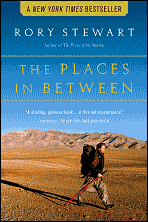
The Places in Between, Part 2

The Places in Between, part II

So I’ve been meaning to write about Rory Stewart’s The Places in Between. I thought this was a fantastic book for a lot of reasons — the writing is wonderful, the story of his walk is enthralling, and the information he gives about Afghanistan is of the type you won’t find in most other books about the country.

As I was reading I had a tendency to focus on the adventure parts of it, but I don’t want to neglect the political and historical aspects: I learned a lot about the history of Afghanistan, as Stewart gives descriptions of the towns and villages he passes through and tells a bit of their past. He talks a lot about the complex religious heritage of the place, including the Buddhism practiced in ancient times and the more contemporary Islamic history; he explores the remains of the Bamiyan Buddha sculptures destroyed by the Taliban only 9 months before he arrived there. He also criticizes westerners who lament the lost Buddhas but know very little of what’s happening to the people alive there today.

I was fascinated by the conversations with villagers Stewart recounts, and the very vague and hazy picture of the west many of the people have — not so different from the hazy picture of Afghanistan many westerners have, although it’s easy, particularly for Americans, to think that the whole world knows everything about us. Many of the people he talked to had never traveled farther than a few miles from their villages. There are very few women in the book, as for the most part they keep themselves separate from the groups of men Stewart moves among, although, interestingly, in the remote mountainous area the Hazara people inhabit, women are allowed a little more freedom. Stewart stays away from overt political statements, but he does criticize western politicians for saying ill-informed things about Islam and westerners in general for not understanding or caring much about the region.

And then there’s the adventure:

Daulatyar was only fifteen kilometers away and there were probably two hours of daylight left, but I had forgotten how much deep mud and wet snow slowed my pace. I felt muffled in the snow-fog and imprisoned by the rain hood I was wearing. I threw back the hood. I could hear and see again. The day was very silent and the plain seemed very large. The snow driving into my eyes at a forty-five-degree angle made me feel much freer, but my left foot seemed frozen to a cold iron plate.

Exhaustion and repetition created within the pain a space of exhilaration and control. And at this point, I saw two jeeps, their headlights on, weaving slowly toward us through the fog. They were the first vehicles I’d seen since Chaghcharan. When they reached me, an electric window went down. It was the Special Forces team from the airstrip.

“You,” said the driver, “are a fucking nutter.” Then he smiled and drove on, leaving me in the snow. I had seen these men at work when I was in the army and in the Foreign Office and I couldn’t imagine a better compliment. I walked on in a good mood.

Stewart insists on walking every inch of the way, even though he must walk in freezing temperatures over mountains, making his way through snow drifts, often in wet clothes. He’s sick much of the way, probably having caught a virus in the water and because he doesn’t eat very well. He depends on local hospitality traditions, often very reluctantly kept, for his food and shelter every night. At one point he lay down in the snow exhausted and in despair, and even though I knew he made it out of Afghanistan alive, I was afraid he wouldn’t get up again. His dog Babur rescues him, barking and whining until he gets up and starts walking again.

Babur turns out to be an important part of the story; Stewart picks him up in an Afghan village when a family, who had been mistreating the dog, offers to give him away. He is a huge mastiff of one type or another, and Stewart spends much of the book dragging him reluctantly along. Poor Babur causes a lot of trouble; at every village they pass, a pack of dogs comes chasing after him looking for a fight. Stewart is constantly beating back these wild dogs with his walking stick. But Babur is an excellent companion and his life with Stewart is much better although more physically demanding than his previous one.

And, finally, here is an example of the kind of writing you’ll find in this book:
Almost every morning, regrets and anxieties had run through my mind like a cheap tune — often repeated, revealing nothing. But as I kept moving, no thoughts came. Instead I became aware of the landscape as I once had in the Indian Himalayas. Every element around me seemed sharper, the colors more intense. I stared, expecting the effect to fade, but the objects only continued to develop in reality and presence. I was suddenly afraid, uncertain I could sustain this vision.

This moment was new to me. I had not dreamed or imagined it before. Yet I recognized it. I felt that I was as I was in the place, and that I had known it before. This was the last day of my walk. To feel in these final hours, after months of frustration, an unexplained completion seemed too neat. But the recognition was immediate and incontrovertible. I had no words for it. Now, writing, I am tempted to say that I felt the world had been given as a gift uniquely to me and also equally to each person alone. I had completed walking and could go home.

Leave a comment

Filed under Books, Nonfiction

Walking

I finished Rory Stewart’s The Places in Between and loved it, and I’ll write about it soon, but I’m too tired right now. The book does remind me of how fond I am of walking and particularly of going on epic walks (Rory Stewart walks across Afghanistan in the winter through the mountains).

I just came across this article from the New York Times about how the novelist Will Self walked from Kennedy airport to Manhattan — about 20 miles — rather than taking a cab. He flew to New York from Heathrow and he didn’t take a cab to Heathrow either; he walked there from his home, about 26 miles. He wanted to do the New York walk because:

It would take him through parts of the city that most people never notice while driving in a car: an experience that Mr. Self, a student of psycho-geography, believes has imposed a “windscreen-based virtuality” on travel, cutting us off from experiencing our own topography.

“People don’t know where they are anymore, “he said, adding: “In the post-industrial age, this is the only form of real exploration left. Anyone can go and see the Ituri pygmy, but how many people have walked all the way from the airport to the city?”

I’m not quite sure what “psycho-geography” is, although it sounds interesting. I like his idea a lot — that the best adventures available today are those we can experience in near-by places, if we just get outside and actually experience them.

I’ve written before about how much I liked Rebecca Solnit’s book Wanderlust, a history of walking. Does anybody know of other good books about walking — either theoretical/historical ones, or stories of long walks? I know of Bill Bryson’s book A Walk in the Woods, and Dark Orpheus mentioned Bruce Chatwin’s book Songlines as one that would interest me. Others? I haven’t read enough contemporary travel writing, and this is one form of it that particularly interests me.

More on Rory Stewart tomorrow …

Leave a comment

Filed under Books, Nonfiction

This and that

  • Love eighteenth-century literature? Know someone who does? Check this out then. It’s Mall Flanders, “accessories for reading eighteenth-century British literature.” It’s got Brobdingnag and Lilliput University T-shirts and sweatshirts, two different Tristram Shandy mugs, a Robert Burns mousepad, an Alexander Pope clock, Academy of Lagado tote bags, and a Pamela journal. If I kept a journal anymore, I’d make sure I kept it in a Pamela journal. It’s also got these stickers — I must get my hands on this Tristram Shandy plotline sticker:

  • You’ve probably already seen the Un-suggestor (link via Maud), a Library Thing service which tells you what you don’t need to read. You type in a book you own or have read, and it comes back with un-suggestions. What interested me about it was that when I typed in Mrs. Dalloway, I got back a whole bunch of religious books. I don’t need to read Rick Warren’s The Purpose Driven Church or John R.W. Scott’s The Cross of Christ or Millard J. Erickson’s Christian Theology or Max Lucado’s Just Like Jesus. Thank heavens. Similar books came up when I typed in Swann’s Way, although the Harry Potter books came up too. The religious book results amuse me because I’ve got a brother who reads just those things. How did we end up in the same family? Well, long story.
  • Finally, I was interested to find this article (via Reading Matters) by Genevieve Tucker in The Australian. It’s on book blogging, and it’s pretty good. After a glowing mention of Metaxu Cafe, she says, “it’s the conversation with other readers that is bringing them back again and again to share their considered readings and thoughts, rather than a constantly shifting, shimmering page of book news and snippets of the here and now.” That strikes me as exactly right.

Leave a comment

Filed under Books, Lists

Barbara Noble’s Doreen

I finished Barbara Noble’s 1946 novel Doreen this weekend and found it quite interesting; I’m grateful to my new book club for getting me to read it, as I’d never heard of it before. I can’t say I thought it was a brilliant novel, but it was a fun read and it gave insight into an interesting time period.

It’s set in World War II and is about what happens to children evacuated from London; Doreen is a 9 year old whose mother has decided she has taken her chances keeping Doreen in the city for too long, and when the opportunity arises to place her in a good home in the country, she takes it. Of course, this is difficult for mother and daughter both, but Doreen settles into her new home fairly quickly.

Here is the problem, however, since Doreen’s new family — the childless Geoffrey and Francie Osbourne — quickly fall in love with her, and Doreen’s mother, when she finds out about it, becomes jealous. Doreen is caught between her love of her mother and her affection for the Osbournes and enjoyment of her new life. The novel centers around this conflict; most of the adults are well-meaning, but they find themselves at odds with one another and the unwilling Doreen must try to keep peace.

The novel is interesting because of its depiction of London and the countryside during the war; Noble gives descriptions of bomb shelters and air raids in the city, and the quieter but still unsettled life of the country. Even more so, it’s interesting because of the class dynamics among the characters. Doreen’s mother is working class; she cleans offices and struggles to keep up a respectable life while living in a decaying house turned into apartments on a seedy street. Doreen’s mother and father are separated, which makes things even more complicated. The Osbournes, on the other hand, are comfortably middle class. They live on a hill above a town, a situation meant to indicate their status relative to the town’s working class residents.

So Doreen experiences new comforts with the Osbournes — her own room, a garden, occasional presents — and it becomes harder and harder to imagine her going back to her cramped London life. Her mother is torn between wanting to keep her daughter safe and fearing that she will lose her loyalty and affection. The book showed me a little of the attitudes toward class distinctions at the time — surprisingly strict, I thought — and it probed the psychological effects of the disruptions of war and evacuation very effectively.

It’s a slow-moving novel; I wondered for a long time when something exciting was going to happen. It did, eventually, but this book is more meditative than action-packed. It isn’t a stunning novel, but in its quiet way, it’s quite good.

Leave a comment

Filed under Books, Fiction

Mountain biking

I haven’t done a cycling post in a while, not because I haven’t been riding but because the riding hasn’t been all that terribly exciting. But yesterday I did something I haven’t done in quite a while: rode on my mountain bike. I’ve had one for 3 or 4 years, but it generally sits out in the shed; I don’t think I’d been on it for almost 2 years. But the Hobgoblin got them out on Saturday and cleaned and repaired them, so yesterday we took them out to a local park and rode for an hour or so.

I’m not a very good mountain biker, but I shouldn’t be surprised or upset at this, as I have done maybe a dozen off-road rides in my life. But I’m always surprised at how different road and mountain bike riding are; they feel like two completely different sports. Mountain biking is much more intense, I think; I’m worn out after an hour, whereas on the road, an hour is about the shortest time possible to make the ride worthwhile. That the mountain bike is much heavier than the road bike is part of the reason, but also the hills tend to be steeper, and you have to guide yourself over rocks and roots, which takes extra power. A short hill that takes less than a minute to climb can leave me completely out of breath with my heartrate sky-rocketing.

Yesterday was a beautiful day, although cold — cold compared to what I’m used to at least; the last week has been in the 50s and 60s, but yesterday it was barely 40 when we left home. We drove to a park about 5 miles a way, one that is well known among local mountain bikers for having excellent trails. I like the park because it’s got a variety of trails — lots of carriage roads for the unskilled like me, and even more single-track trails for the experts.

As I got on the bike for the first time, I realized that I’d forgotten how, exactly, to fit my shoes into the pedals, and once I’d figured that out, I saw I was heading down a hill steep enough to make me ride the brakes the whole way down. It took me a long time to get back in the groove of mountain bike riding; that hill was actually insignificant, but I forget so easily what I’m capable of and what the bike is capable of, and so I spent quite a while riding around the easiest trails getting the hang of it again.

By the end of the ride, though, I felt skilled enough to try a short bit of single-track. Here things got a lot more interesting, as all the sudden I had to maneuver my way between trees terrifyingly close together and over jagged rock gardens that took up the entire space of the trail and up little hills where I felt my front wheel was in danger of lifting off the ground.

No, I’m not a very good mountain biker. I didn’t crash, but that’s because I got off the bike and walked it over anything too dangerous. Good mountain bikers crash now and then because they try risky things. I even walked my bike around a few menacing puddles and mud patches because I didn’t want to get wet and dirty, which is totally not in the mountain biking spirit.

But I did get an excellent workout. I’m hoping if I keep mountain biking now and then over the winter, I will build up some power that will help me out with racing in the spring. At any rate, it’s nice to do something a little bit different. Okay, it’s not all that different; I was still on a bike after all, but different enough for me.

Leave a comment

Filed under Cycling

Spare language

I keep coming back in my mind to a passage from Nick Hornby’s The Polysyllabic Spree about writing that gets praised for being “spare”:

Anyone and everyone taking a writing class knows that the secret of good writing is to cut it back, pare it down, winnow, chop, hack, prune and trim, remove every superfluous word, compress, compress, compress. What’s that chinking noise? It’s the sound of the assiduous creative-writing student hitting bone.


Hornby uses J.M. Coetzee to illustrate what he means by the “spare tradition” and it turns out that while he admires Coetzee, he’s actually not a fan of super-pared-down language. The passage above comes at the beginning of a long celebration of Dickens, the most un-spare writer there is, and Dickens clearly comes out ahead in the comparison. Here’s what he says about pared-down writing:

There’s some stuff about the whole winnowing process that I just don’t get. Why does it always stop when the work in question has been reduced to sixty or seventy thousand words — entirely coincidentally, I’m sure, the minimum length for a publishable novel? I’m sure you could get it down to twenty or thirty, if you tried hard enough. In fact, why stop at twenty or thirty? Why write at all? Why not just jot the plot and a couple of themes down on the back of an envelope and leave it at that?

As I was typing this passage, I realized that I don’t like it, although I think I share Hornby’s taste for wordy, talkative fiction. Working toward spare, pared-down language doesn’t mean one is working toward nothingness, of course. This is Hornby being churlish and unfair.

But I do love long novels and digressive, wordy prose; while I also admire writers in the “spare tradition,” I tend not to love them. Prose that begins to veer toward poetry begins to feel like work to me, and while I’m often happy to do that work, I’m not going to get absorbed in the story. Here’s what it is — I often read novels with that spare, poetic, pared-down prose and I enjoy the experience, but it’s not quite as visceral or thrilling as a novel that isn’t overtly drawing attention to its own language.

But then Hornby gets even more annoying:

The truth is, there’s nothing very utilitarian about fiction or its creation, and I suspect that people are desperate to make it sound like manly, back-breaking labor because it’s such a wussy thing to do in the first place. The obsession with austerity is an attempt to compensate, to make writing resemble a real job, like farming or logging.

The first line is fine; I agree that fiction isn’t utilitarian in the least. But then we’re back to the gendered language I’ve complained about before. Okay, he’s joking, but still — writing as wussy? My feeling is that people’s desire to write in a simple, pared-down manner has nothing to do with whether writing is a “real job” or not. Hornby seems to be reading his own uncertainties about the seriousness and manliness of writing into other people’s aesthetic tastes.

But I really didn’t mean to turn this into a pick-on-Hornby post. I’m interested in these passages because I’ve felt ambivalently about the “spare tradition,” which leads me to thoughts about what I look for in a novel. Am I looking for a story so absorbing it makes me forget I’m reading, or do I want to be immersed in language itself, aware of the ways an author is using it? Do I want a flood of words on the page, or do I want carefully-measured, crafted prose that suggests more than it actually says? All of these things, obviously, at different times and to suit different moods. But I feel most comfortable with the Dickensian tradition, and I wonder what that says about me as a reader.

1 Comment

Filed under Books, Writing

Books I’ve finished

I finished listening to the audio version of Jacqueline Winspear’s Pardonable Lies: A Maisie Dobbs Novel, and I thought it was a lot of fun — I like Maisie a lot and the story was good. I thought perhaps the ending dragged on a bit long; I could feel things wrapping up for a good two of the nine CDs I was listening to, but that was the only flaw.

One of the things that intriqued me about the novel was its touch –just a touch really — of eastern thought. The implication seems to be that Maisie’s particular insightfulness comes from a mix of her “western” rationality and her “eastern” spirituality and insight. She meditates, she’s gotten training from someone of eastern origin — I have to be vague because I listened to the book and so can’t go back and check my source — she’s acutely aware of other people’s states of mind and how these are reflected in their bodies. She’s not a hard-nosed detective type but finds success through intuition as much as logic. There’s something just a little bit mysterious and mystical about her.

I’m now realizing how gendered this is. Of course she’s not a hard-nosed detective! She combines “masculine” strength and resolve and logic with “feminine” compassion and intuition and that’s what makes her so good at what she does.

I liked this book enough to want to seek out other Maisie Dobbs novels, perhaps also in audio. I must see what my library has.

I’ve also finished Proust’s In the Shadow of Young Girls in Flower. I find myself with little to say about it, although I continue to enjoy reading the novel a lot. It’s so rich I should have much to say about it; I think, though, that I have been letting it wash over me and haven’t tried to back away to get some critical distance in order to write something. Perhaps this is a sign of defeat — maybe I should try to get some critical distance on it — but I don’t really have the energy, and, more importantly, I’m enjoying the experience plenty as it is.

I’ve begun Barbara Noble’s novel Doreen for a book club meeting next week, at which I’ll meet Emily. This will be fun!

Leave a comment

Filed under Books, Fiction

Alice Munro

I finished Runaway last night and have decided, much to nobody’s surprise, that Alice Munro is a genius. I will agree that too much Munro might not be a good thing, but too much of anybody is probably not a good thing.

There are eight stories in this collection, all of them with a woman as their main character, at all different stages of life. Often Munro will cover decades in one story, so we might see a young woman as she meets a man and gets engaged, and then we see her as a widow, and we learn how the marriage turned out. Munro gives long stretches of time and she does it gracefully, the information on what happened in intervening years worked into scenes so that it doesn’t feel like summary.

I particularly liked a sequence of three stories about the same character, Juliet. She’s off to her first teaching job in the first story, in the second, she’s returning home to visit her parents after a long absence, and in the third she’s an older woman and the story is about her relationship with her daughter. Each story is fairly focused in time, but together they give a sense of Juliet’s entire life. I like this scale; the stories show both how much Juliet gets wrapped up in each event in her life and what the events mean in the larger picture. We get the emotions of the moment which we can place in the context of an entire life.

I’ve read criticisms of Munro’s work that claim she’s too narrowly focused on the personal and private and doesn’t let larger world events into her fiction. This may be a valid point, but one important social and political event that does inform her stories is the women’s movement. Juliet, for example, is a graduate student whose male professors do not take her intellect and her job prospects seriously:

Her professors were delighted with her — they were grateful these days for anybody who took up ancient languages, and particularly for someone so gifted — but they were worried, as well. The problem was that she was a girl. If she got married — which might happen, as she was not bad-looking for a scholarship girl, she was not bad-looking at all — she would waste all her hard work and theirs, and if she did not get married she would probably become bleak and isolated, losing out on promotions to men (who needed them more, as they had to support families). She would not be able to defend the oddity of her choice of Classics, to accept what people would see as its irrelevance, or dreariness, to slough that off the way a man could. Odd choices were simply easier to men, most of whom would find women glad to marry them. Not so the other way around.

As she ages, however, and as her society becomes a little more open to ambitious women, she finds ways to take on a public role. The public world — the world outside the family and the self — does have a place in Munro’s fiction; it’s just indirect and muted. It’s not the focus. But this strikes me as realistic, in its own way; many of us deal with significant world events in indirect and muted ways.

I remember somebody calling Munro’s stories “novelistic,” in the sense that are so rich with emotion and complexity that they could fill the space of a novel — this makes sense to me, although I wouldn’t want to sound like I’m denigrating the short story genre by calling excellent stories “novelistic.” Perhaps I should just say that these stories are satisfying in the way they capture whole worlds and lives and minds and emotions.

I enjoyed my experience of reading a book of short stories, which I have rarely done, and I think I would like to read more. The trick, for me, is to read them fairly slowly, meaning only one at a time, and to read them in one sitting if I can. To read a whole series of stories at once would confuse me (just as reading a whole series of poems would), but to sit down and read one an evening or every other evening works well.

This book, as you can see in the sidebar to the left, is my second book in the Winter Stacks challenge — three more to go!

Leave a comment

Filed under Books, Short stories

Thursday thirteen: re-reading

This will be a pooter-ish post, one that might get me soundly mocked. But, in the spirit of Danielle’s post from yesterday and in the spirit of book-blogging solidarity, because many people think lists and reading plans and TBR piles are fun, here we go!

Inspired by another one of Danielle’s posts, I’m going to try my own list of books I’d re-read. I’d like to re-read more than I do because, if the book is a good one, the second time around feels so much richer. I sometimes retain so little of what I read, and I’m afraid it’s because I rush through things and don’t absorb them properly. But there are so many wonderful new books out there … anyway, here’s a list of things I’d likely turn to if I got the urge to re-read.

1. Anything by Jane Austen, even though I’ve already re-read the novels a lot. In fact, I’ve read all her major novels except Northanger Abbey multiple times; I don’t even know how many times. I turn to them when I want something comfortable and familiar and lengthy; they feel like an indulgence. I’ve also been assigned many of her books for various classes. What I haven’t done is read her juvenalia, which I really must do some day.

2. The Moonstone. I’m guessing that many of the books in this list will be ones I’ve already read multiple times. I can be such a creature of habit. The Moonstone is wonderful fun and I never seem to tire of it; I think I’ve read it twice, although it’s possible I’ve read it a third time. At any rate, I’d be happy to read it again. What I really like is the way Collins tells the same story from multiple perspectives.

3. Virginia Woolf’s To the Lighthouse and/or Mrs. Dalloway. To the Lighthouse I’ve read at least twice; I’m not sure about Mrs. Dalloway, but I love them both.

4. A.S. Byatt’s Possession. I’m not being original here — Danielle mentioned this one too — but it was so much fun. This is one I’ve read only once.

5. The Anne of Green Gables books. I’ve read these books who knows how many times, but I’ve never re-read them as an adult. It would be interesting to see if my responses to them would change.

6. Anything by George Eliot. I’ve already read Middlemarch and Daniel Deronda twice and Adam Bede and Silas Marner once. I read The Mill on the Floss in High School, so that’s probably the one I’d choose were I to read Eliot again. What can I say — I love the Victorian novel.

7. Crime and Punishment. I read this book during college, I think, in the summer, and was enthralled. I’d like to go back and see if I have the same intense experience.

8. The Phillip Pullman series. I read this just last spring and tore my way through them; I’d get a kick out of doing it again. This sounds like a wonderful thing to do during the holidays — just hunker down and read fun novels really fast.

9. Philip Lopate’s The Art of the Personal Essay. If I haven’t read all the essays in that book, I’ve read most of them and they are definitely worth returning to.

10. Swann’s Way. Yeah, I read it just last summer, but this is a book that rewards multiple readings and I can already see that I’m going to want to look at parts of In Search of Lost Time again.

11. Flaubert’s Parrot by Julian Barnes. I love this kind of smart, quirky, unconventional novel.

12. Flannery O’Connor’s short stories. She’s so fascinating and odd and she’s such a master of the short story, I can see myself re-reading some or all of them. Maybe her novels too, both of which I’ve read once each.

13. Mary Oliver’s book of poems American Primitive. Poetry is an obvious thing to re-read — it can be so complex and rich and it’s short and so doesn’t require a huge time commitment — and yet I didn’t think of it much as I was making this list.

I could probably think of more, but I was beginning to slow down toward the end of that list; I guess when I re-read I tend to turn to the same very small number of books, mainly Victorian or early 20C novels. I could have put Tolstoy and James on that list too.

Leave a comment

Filed under Books, Lists

How do I read Cortazar’s Hopscotch?

I just got a copy of Julio Cortazar’s novel Hopscotch through Bookmooch, and although the truth of the matter is that I won’t read it for quite a while (not because I don’t want to, but because of all my other reading obligations and desires), I was intrigued by its form — and also set a bit on edge by it.

The novel comes with a “Table of Instructions” (which will make more sense if you know the novel has 155 chapters):

In its own way, this book consists of many books, but two books above all.

The first can be read in a normal fashion and it ends with Chapter 56, at the close of which there are three garish little stars which stand for the words The End. Consequently, the reader may ignore what follows with a clean conscience.

The second should be read by beginning with Chapter 73 and then following the sequence indicated at the end of each chapter. In case of confusion or forgetfulness, one need only consult the following list:

73-1-2-116-3-84-4-71-5 [I won’t give you all the numbers, but they continue on for 10 lines or so of text].

Each chapter has its number at the top of every right-hand page to facilitate the search.


I’m not sure what to make of this, and I don’t know how I’ll read the book when I do get to it. The notion of reading the first 56 out of 155 chapters and then quitting with “a clean conscience” seems highly unrealistic, given my intense desire to finish books — finish them all the way to the end. There’s no way I’d quit after 56 out of 155 chapters with a clean conscience.

But following the jumbled-up sequence of chapters doesn’t seem quite the thing to do either. It upsets my notions of how to read a book.

The other option, of course, is to disregard the Table of Instructions and read the thing from cover to cover in the normal way. But … would that work? Would it make any sense at all?

I’m curious about what the different ways of reading would be like. I suppose there’s another option, which is to read the novel in the two ways the author describes: once through the end of chapter 56, and then once following the jumbled sequence of chapters. That way I’d know what the two experiences are like, and I’d be following instructions like the obedient reader I tend to be. But that would take a lot of time and would require re-reading large chunks of the novel. Maybe even I am not prepared to be that obedient.

I realize that my uneasy feelings must be part of Cortazar’s point; he’s making me aware of my conventionality in reading, my obedience, my feeling that I must complete books, my need to have the experience I think the author wants me to have. He’s making me question the traditional arc of a story, the convention of reading from cover to cover, and my assumptions of what must be included to make a story complete (at least I think he’s doing these things — can’t really say until I read the thing I suppose).

Has anybody read this novel before, and, if so, how did you do it? If not, which reading method would you choose?

2 Comments

Filed under Books, Fiction, Reading

The Places in Between

I’ve begun Rory Stewart’s The Places in Between, a book about his walk across Afghanistan starting in January, 2002. It’s quite absorbing, and it makes me want to go on adventures. Before this trip, he’d spent 16 months walking across Iran, Pakistan, India, and Nepal, but he’d had to skip Afghanistan because the Taliban refused to let him into the country. After the fall of the Taliban, he decided to give it another try. This is how he begins his Preface:

I’m not good at explaining why I walked across Afghanistan. Perhaps I did it because it was an adventure. But it was the most interesting part of my journey across Asia.

I love that attitude, the “I’m not sure why I did it, I just wanted to” attitude. Because why do anything at all, really? In a lot of ways walking across Asia makes as much sense as anything else anybody might choose to do. So he walked across Asia because it was there and he could.

Can I tell you how much this makes me want to go off on some crazy, senseless adventure?

So far the book is very well written, very absorbing, and full of sentences like these:

It was possible that they had simply told Qasim and Abdul Haq to take me outside the city and kill me. No one would notice in the middle of a war. I felt it would be ludicrous to be killed only eight kilometers into my journey and not for the first time worried that when I was killed people would think me foolhardy.

I’ve read story after story of Stewart walking into strange villages with no idea whether he’ll be welcomed or attacked. In his previous walks, people had always taken him in, following customs of hospitality, but in Afghanistan things are not so simple — while the hospitality custom is still strong, so is fear of strangers in a country so unsettled.

Stewart briefly describes what fills his mind while he’s walking day after day. This is the only passage I’ve come across so far that talks about walking in a more theoretical way; I kind of wish he’d do it more often, but that’s not what the book is about (and if you’re interested in that subject, I highly recommend Rebecca Solnit’s Wanderlust):

Before I started, I imagined I could fill my days by composing an epic poem in my head or writing a novel about a Scottish village that would become more rooted in a single place as I kept moving. In Iran I tried earnestly to think through philosophical arguments, learn Persian vocabulary, and memorize poetry. Perhaps this is why I never felt quite at ease walking in Iran.

In Pakistan, having left the desert and entered the lush Doab of the Punjab, I stopped trying to think and instead looked at peacocks in trees and the movement of the canal water. In India, when I was walking from one pilgrimage site to another across the Himalayas, I carried the Bhagavad Gita open in my left hand and read one line at a time. In the center of Nepal, I began to count my breaths and my steps, and to recite phrases to myself, pushing thoughts away. This is the way some people meditate. I could only feel that calm for at most an hour a day. It was, however, a serenity I had not felt before. It was what I valued most about walking.

As an occasional backpacker, I’m interested in what people think about when they spend hours walking (or something similar like running or riding) — for me, sometimes get in the meditative mood Stewart describes and I agree with him that it’s one of the best things about walking.

More on this book later …

Leave a comment

Filed under Books, Nonfiction

Blogs and the mainstream media

One part of me says I should leave this alone, but another part of me can’t resist saying something. I’m talking, as you probably guess, about John Sutherland’s article on the sorry state of web reviewing (mainly Amazon reviews but also blogs) and Rachel Cooke’s article on how dull and badly written book blogs are (I came across the links at the Literary Saloon).

It’s the Cooke article that interests me most; she sums up the significance of the disagreements over web reviewing thusly:

The question that Sutherland has raised – what effect is the internet having on criticism? – is not only fair; it is one that no one who cares about art, and especially writing, can ignore.

Cooke says that professional reviewing and book blogging can coexist at present, but she’s worried that someday “serious criticism” might disappear so that we are left with only “the populist warblings of the blogosphere.” She dearly hopes that this will never happen.

At this point, I’m with her — I think it would be a shame to lose the professional criticism we’ve got. I read it and value it.

But then she goes on to attack book blogs, and at this point she loses me. She spends a day reading blogs and comes away very unimpressed, citing examples of blogs she can live without. But I don’t think she’s done her research very well. Anybody can come along and pick a few sentences out of a blog and hold them up for ridicule; I could do it myself with my own blog writing (I can see it now — “she reads a Jane Kenyon poem and all she can say is ‘I like this poem because it reminds me of how wonderful it is to walk in the woods in winter’?”). Many blogs create their effect over time; people find pleasure in them because they get to know the blogger’s voice and sensibility and interests, and if they like those things, they come back day after day, even to read the less-than-stellar posts.

Perhaps Cooke is not interested in spending that much time getting to know a blogger’s voice, but one day’s reading will only give her a taste of all the blogs out there. If she wants high-quality writing all the time, I’m positive she can find it on a blog, if only she would look around a little more. The thing that bothered me most about Cooke’s article was her claim that there’s no good writing on the internet, that good writing must be paid for:

I read and I read; I dutifully followed every link. And come supper time all I could think was that not a sentence I’d read was a millionth as good as anything in The Polysyllabic Spree, Nick Hornby’s recently published diary of ‘an exasperated but ever hopeful reader’. Why? Because his words are measured, rather than spewed, out; because he is a good critic, and an experienced one; and because he can write. The trouble is, these qualities are exceptional – which is why they must be paid for.

I encounter excellent writing on blogs every day. It’s absurd to believe that one has to pay for good writing; bloggers write for all kinds of reasons and many of them, while being good writers, aren’t interested in making a living from it. It’s possible Cooke and I have radically different ideas of what constitutes good writing, but it’s much more likely she wasn’t really giving bloggers a fair chance.

There are all kinds of blogs — book review blogs, publishing industry gossip sites, reading diaries — and only some of them have the kind of reviews and articles that might get published in the mainstream media. So it strikes me as odd that when criticizing book blogs, people tend to blame them for not living up to the standards of professional reviewing. Why can’t bloggers have different purposes and do radically different things than one finds in newspapers and magazines? If Cooke finds reading diaries dull, which it’s her right to do, then there are plenty of other people who love them. What blogs do so wonderfully is open up the possibility for new kinds of writing, so it makes no sense to me to dismiss blogs for not doing the same old thing.

And I’m not buying the idea that professional writers and reviewers must be at odds with book bloggers. Why the hostility? Will internet book reviewing really place traditional, professional criticism at risk? I don’t know, actually, but what I hope will happen is that the two will exist side by side — ideally without the carping — and that the various types of writing about books will enrich the others. Amateur book bloggers have much to learn from professional critics — and vice versa. And the two categories overlap anyway; some professional writers have their own blogs, some literary critics keep reading diaries online, some people who make a living off one type of writing turn to the internet to produce another. There ought to a fruitful relationship here, not antagonism.

Leave a comment

Filed under Blogging

A Jane Kenyon poem

After doing the poetry meme yesterday, I’m inspired to give you a Jane Kenyon poem I read recently and really liked. It’s also appropriate for the upcoming season:

Depression in Winter

There comes a little space between the south
side of a boulder
and the snow that fills the woods around it.
Sun heats the stone, reveals
A crescent of bare ground: brown ferns,
and tufts of needles like red hair,
acorns, a patch of moss, bright green ….

I sank with every step up to my knees,
throwing myself forward with a violence
of effort, greedy for unhappiness —
until by accident I found the stone,
with its secret porch of heat and light,
where something small could luxuriate, then
turned back down my path, chastened and calm.

I like this poem because it reminds me of how wonderful it is to walk in the woods in winter — to notice little things like the thawed space near the rock Kenyon is describing, and to see green things here and there, as a reminder that spring will come soon. The Hobgoblin and I have done a lot of winter hiking, sometimes involving laboring our way through several feet of snow and occasionally involving temperatures barely in the double digits. There’s nothing more exhilarating than a tramp through the snow and nothing nicer than coming home again and warming up with a hot shower and some food.

But Kenyon’s not talking about that kind of walk — the poem also reminds me of how well a walk in the woods can transform my mood. I never come home feeling the same as when I left. I think I know what Kenyon means by being “greedy for unhappiness” — I get like that sometimes: mildly depressed and doing my best to stay that way. And a walk will almost always break me out of that rut; whether it’s seeing something beautiful like Kenyon did in the poem, or whether it’s the movement and exercise that does it, I don’t know, but I rarely come home from a walk unhappy.

Leave a comment

Filed under Books, Poetry

Cam’s poetry meme

The Hobgoblin tagged me to do Cam’s poetry meme, so here goes:

1. The first poem I remember reading/hearing/reacting to was…. Surely nursery rhymes were among the earliest. This question makes you think about what a poem is, doesn’t it? I remember nursery rhymes, songs, chants from when I was a kid. I remember reading Tennyson’s “The Charge of the Light Brigade” for school. Oh, yeah, and I remember reading Ogden Nash early on too.

2. I was forced to memorize (name of poem) in school and…….. I wasn’t forced to memorize poems in school until I got to college, and then only one professor required it. That’s quite a shame, really, because there’s no better way to learn about poetry than memorizing it, I think. You get an intimate feel for how a poem works. I memorized W.H. Auden’s poem “Under Sirius.”

3. I read/don’t read poetry because….I read poems because I enjoy it and want to figure out more about how poems work. I only began reading poetry semi-regularly early this year, so I still feel strange calling myself a poetry reader. I read poems when I was in college and shortly after, but then I stopped for a long time. It’s not that I didn’t want to read them, I just never figured out a way to fit them into my life. Now I have a volume I keep on my shelf next to my reading chair, and I read a few poems a week. It’s not much, but it gets me through a book in a couple months.

4. A poem I’m likely to think about when asked about a favorite poem is …….I’d have to name poets rather than poems, as favorite poems don’t come to mind. Favorite poets? Elizabeth Bishop, Mary Oliver, Emily Dickinson.

5. I write/don’t write poetry, but…………..I don’t write poetry, although I can’t say I never will. But I just have no idea how to write one. I mean, what constitutes a poem? What should it be about? I have no idea. And I have little idea, to be honest, about what makes a good poem. As someone who teaches poetry now and then, maybe I shouldn’t admit that, but it’s true. It’s easy to teach older stuff because it’s generally accepted as good, but newer stuff, I have a hard time saying. That’s one reason I’m curious about reading more poems, to get a feel for how they work and what makes a poem great.

6. My experience with reading poetry differs from my experience with reading other types of literature…..I don’t really get poetry. My students sometimes say that and they mean it negatively, but I’m not being negative here. I don’t really think there’s anything to “get” about poetry, actually — that makes it sound like there’s a key or code to understanding it, which there isn’t beyond being familiar with tradition and form. I just mean I find it rather mystifying — and that’s part of what makes it fun.

7. I find poetry….. well, mystifying. In a good way. Sometimes enlightening, often beautiful.

8. The last time I heard poetry….The local coffee shop has an open mic on Wednesday nights and last February they had a day where people could bring their love poetry/erotic poetry to read. A lot of people showed up to read and to listen, and there was a lot of good energy in the room. It was fun.

9. I think poetry is like….Litlove wrote in a comment a while back that a poem is like a dream, and I’ve found that idea useful. I was initially resistant because I generally don’t find dreams and dream interpretations all that interesting, but the analogy does work; a poem often has loosely connected images that fit together in some shadowy half-known way, just as a dream does. A poem can get at truths in that sideways way a dream can.

I tag … whoever wants to do this great meme!

Leave a comment

Filed under Books, Memes, Poetry

More on The Polysyllabic Spree


So I finished Nick Hornby’s The Polysyllabic Spree yesterday, just as I thought I might. The weather never did get nice enough to go on a bike ride, although The Hobgoblin, Muttboy, and I did go on a hour-long walk in the rain at our local woodsy park. After that, it was nice to come home and take a warm shower and stay indoors for most of the rest of the day.

I thought the book was a lot of fun. It’s rather addictive; I’d finish a chapter and consider moving on to something else or drifting off to sleep, but then I’d look at the list of books read and books bought that begins the next chapter, and I’d think, oh, just one more. Next thing I knew, the book was finished. Hornby’s attitude toward books is infectious. I like how he reads all kinds of different stuff; he writes just as well and just as enthusiastically about a collection of Chekhov’s letters as he does about, say, Mystic River.

There were a couple things that bugged me. He has a bit of an attitude about the “literary novel”; he reads them and reads them happily, but he picks on them an awful lot, to the extent that I began to wonder why, and I also began to wonder if it’s really so clear just what the “literary novel” is. Is it really a clearly-defined category? When talking about Chris Coake’s book of short stories We’re in Trouble he says this:

Sometimes, when you’re reading the stories, you forget to breathe, which probably means that you read them with more speed than the writer intended. Are they literary? They’re beautifully written, and they have bottom, but they’re never dull, and they all contain striking and dramatic narrative ideas. And Coake never draws attention to his own art and language; he wants you to look at his people, not listen to his voice. So they’re literary in the sense that they’re serious, and will probably be nominated for prizes, but they’re unliterary in the sense that they could end up mattering to people.

Now this strikes me as unfair. Why should the “literary” be that which doesn’t matter to people? I think he’s got too much invested in this idea of the literary and that he too easily categorizes and dismisses books based on their supposedly “literary” qualities and readers based on their devotion to those qualities, whatever they are. I’m not sure most readers actually read with this category in mind.

Hornby plays around with Hemingwayesque, hyper-masculine posturing about books and writing a little too much for my taste. Books are always in a battle with other books or with other forms of art. This is what’s on the book jacket; it’s quite funny — but also … eh, not my thing:

Books are, let’s face it, better than everything else. If we played cultural Fantasy Boxing League, and made books go fifteen rounds in the ring against the best that any art form had to offer, then books would win pretty much every time. Go on, try it. The Magic Flute vs. Middlemarch? Middlemarch in six. The Last Supper vs. Crime and Punishment? Fyodor on points. See? I mean, I don’t know how scientific this is, but it feels like the novels are walking it. You might get the occasional exception — Blonde on Blonde might mash up The Old Curiosity Shop, say, and I wouldn’t give much for Pale Fire’s chances against Citizen Kane. And every now and then you’d get a shock, because that happens in sport, so Back to the Future III might land a lucky punch on Rabbit, Run; but I’m still backing literature twenty-nine times out of thirty.

This is clever, but after a couple of passages about fights among books and the degree of strength or wussiness it requires to write, I start to feel a little alienated. What saves it for me is that Hornby is not actually taking any of it seriously; he’s mocking himself a bit, pretty much admitting he’s not very good at the Hemingwayesque, hyper-masculine stuff.

I didn’t come away with a lot of new books I want to read, although I did pick up a couple of recommendations. One is Gabriel Zaid’s So Many Books; I remember Jenny D. has an intriguing post on it. The other is Janet Malcolm’s book on Chekhov, Reading Chekhov: A Critical Journey. This seems like a very interesting mix of literary criticism and personal narrative, a combination I like very much.

Leave a comment

Filed under Books, Nonfiction