
Yesterday, Hobgoblin, She Knits, Suitcase of Courage, and I had a most wonderful day: we went on a literary pilgrimage up to Walden Pond and Concord to see the place where so many great American writers lived. It’s a trip Hobgoblin and I had wanted to go on for a while, but we often talk about things for a long, long time before we actually get out and do them. I’m very grateful to our friends who provided some impetus to get us out the door and on our way up to Massachusetts.
The fun of the day began even before we got out of Connecticut, though. Since SOC and She Knits live fairly far from us, we decided to meet at a restaurant along the way for breakfast, and there just so happens to be a place called The Traveler Restaurant that is a restaurant and bookshop rolled into one. And — get this — it offers you three free books when you eat there. You can choose your free books from their selection upstairs in the dining room, and then you can head downstairs where there is a regular used bookshop. I was skeptical that I would find anything I wanted in the free book section, but I did come across some things I wanted, including a book by Nella Larson, a Virago I had never heard of before, and a novel by Georges Simenon.
But soon we were on our way for the final leg of the journey up to Concord. Walden Pond was the first stop. I had heard people say not to be surprised to find that Walden Pond is not exactly in the middle of nowhere and wouldn’t have been even in Thoreau’s time — it’s right next to a fairly busy road and only 1 1/2 miles or so from Concord. So I knew not to expect wildness. What I found was an absolutely gorgeous New England lake where people fish and swim and follow the hiking trails that lead around it. It’s not wild, but it’s quintessentially New England in the sense that you can be fairly close to civilization and yet feel yourself surrounded and engulfed by nature. Many of the leaves have fallen off the trees, but enough remain to create some beautiful oranges and browns:
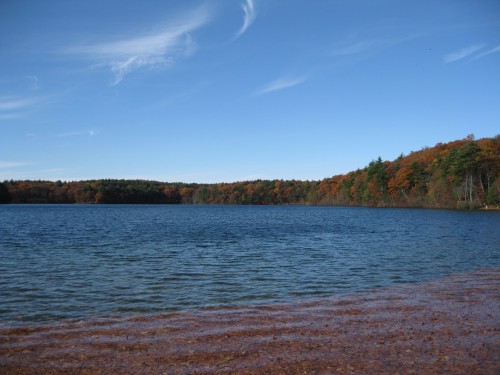
As you can see, we had a gorgeous day for our trip. It was raining when we left home, but on the way, the rain ended and the clouds blew away. The skies were beautiful, and the water was surprisingly clear.
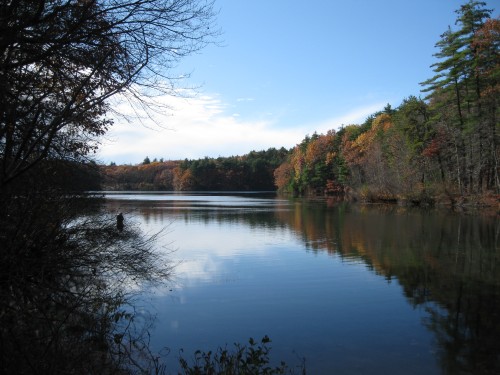
They have built a replica of Thoreau’s cabin where he lived while writing Walden, although it’s not on the original cabin site:

At the site itself, which wasn’t discovered until 1945, the boundary of the cabin is marked with stones, and right next to it is a rock pile where people add their own rock to commemorate their visit.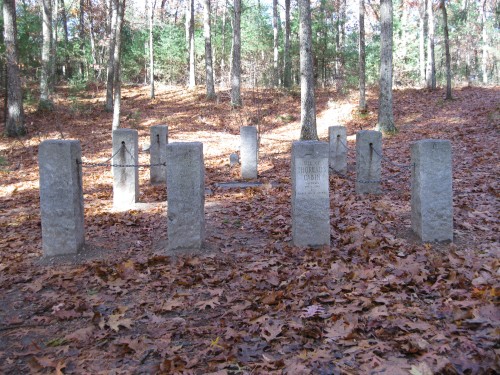
Standing on the very ground Thoreau walked on was an eerie experience — the first of a series of eerie experiences that day. It’s hard to wrap my mind around the fact that such great things happened in the very spot I was standing on.
After visiting the cabin site, we walked the rest of the way around the pond, admiring the view the entire time. Then it was time for lunch, followed by a cemetery. Thoreau, Hawthorne, Emerson, and Louisa May Alcott are all buried in the Sleepy Hollow Cemetery in a section called “Author’s Ridge.” Sleepy Hollow cemetery is a wonderful place; it’s gorgeous, with sloping hills and quiet paths. I was surprised to find that Thoreau, Hawthorne, and Alcott are buried all within just a few feet of each other. Emerson is nearby, but it seems he didn’t want to join the crowd. He’s buried under the big rock in the picture below:
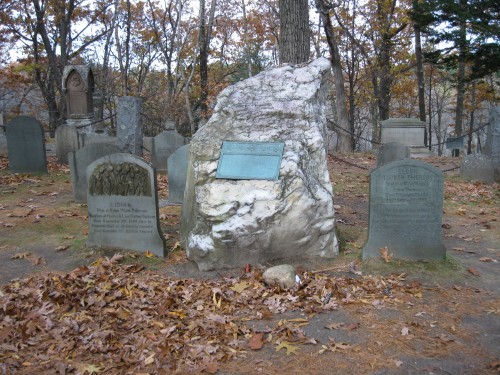
Thoreau’s grave is marked with a simple “Henry” and Hawthorne’s grave just says “Hawthorne.”
After the cemetery, it was time to visit the Old Manse, a house built by Emerson’s grandfather where Emerson and Hawthorne both lived at different times, and where they both did some of their most important writing. 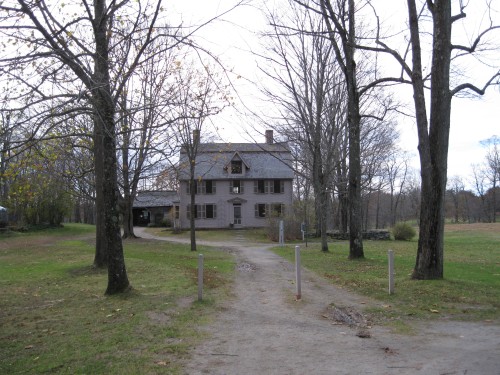
The tour of the house was amazing. We got to see the room where Hawthorne wrote most of the stories from Mosses from an Old Manse, and where Emerson wrote some of his essays, including the essay “Nature.” The tour guide told us that Emerson got inspiration from looking out the window at the fields and farms surrounding the house and the river that ran behind it, but Hawthorne found the view too distracting, so he built a desk into the wall looking away from the windows in order to concentrate. The desk is still there.
Among the wonderful things in the house are the words various members of the Hawthorne family scratched into the windows, which you can still read. Hawthorne’s wife Sophia did a lot of the scratching with the diamond from her wedding ring, and it was lovely to be able to read a series of messages Nathaniel and Sophia wrote to each other.
And that’s not all — you can stand in the room where Emerson and Hawthorne wrote and look out at the fields where the Revolutionary War began. Just outside the Old Manse is the North Bridge where the first shots of the war were fired, and where there stands the Minute Man statue with the poem about the “shot heard round the world.” After our tour, we spent an hour or so walking around the grounds and imagining what the beginning of the war must have looked like. Here’s the bridge, with the statue at the far end of it:
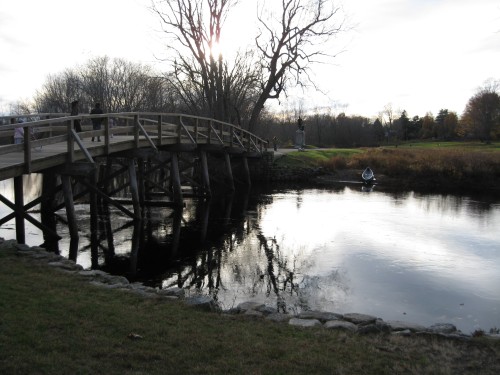
Here’s a more wide-ranging picture that gives you a sense of how open the landscape is:

After our walk through the area, we started to hit the point where all we wanted was to sit down and rest a while, and when an acceptable dinner hour finally arrived, we gratefully found ourselves a warm, cozy inn with a restaurant, where we discussed books and transcendentalism and ate a great meal.
We did a lot while we were there, but there is SO much more left to see. There is Louisa May Alcott’s house, Emerson’s house, another Thoreau house, as well as the Concord Museum. And there are two bookstores there we wanted to visit yesterday, but which were closed. We will definitely be back!
 I’ll admit I’m a newbie when it comes to ghost stories. I’ve read some, I’m sure, but it was a long, long time ago, and I don’t remember any details. So I don’t have much of a basis of comparison to work with here. What this book taught me, though, is that the circumstances in which one reads a ghost story matter a lot. Susan Hill’s The Woman in Black is only 150 pages long and probably should be read in as close to one sitting as possible. When I had the chance to sit down with this book for more than a few minutes at a time, I got caught up in the atmosphere and enjoyed myself. When I read only small pieces of it before putting it down again to go on to something else, I became too distanced from the story to feel much of the spookiness and suspense.
 I finished this book about a week ago and have thought of it off and on since then, and I’m still not entirely sure what I want to say about it. There were times when I thought it was incredibly moving and insightful, times when I thought it dragged a bit, times when I loved what it had to say about families, and times when I got annoyed because I couldn’t keep the minor characters straight. I suppose ultimately I don’t think this is a perfect book, but it offered a lot ot think about.
 So my mystery book group met this past Saturday to discuss Cornell Woolrich’s The Black Angel, and, as usual, it was a great discussion. It was the kind of discussion where many if not all of us left the meeting with different ideas about the book than those we had originally — not necessarily that we liked the book any better, but that we understood new things about it. Or perhaps I should just speak for myself — my understanding of the book is different now than it was before. I still have mixed feelings about it, but they are mixed in a different way.
 Of Books and Bicycles