Category Archives: Reading

Too many books?

I may be getting myself into, oh, just a tiny bit of trouble. I had a nice list of three “currently reading” books going for a while, the Proust, Gaskell, and Brewer, but then I got the urge last weekend to begin another book, and when the Alberto Manguel one on reading didn’t work out, I decided to try some poetry. So I’m now reading Rilke’s Duino Elegies. There are ten elegies, and I’ve finished the first. It’s quite beautiful, and I may post on it soon; for now I’ll say that I’m enjoying the dual-language edition, with German on one page and English on the other. I can read a little German, so I had fun thinking about the decisions the translator made.

So that’s fine, not a big deal, but then I decided to request some books from my library, and one of them turned up much sooner than I thought. I picked up Elizabeth Gilbert’s Eat, Pray, Love yesterday and couldn’t help but begin it right away. I’ve now read about 50 pages and may have trouble putting it down to spend some time with my other books. I find her breezy writing style occasionally just the tiniest bit irritating, but otherwise, this is exactly the kind of book I like — a mix of genres (travel, memoir, spiritual autobiography, food writing) and an appealing persona — she’s open, honest, courageous, and smart. I’ll be writing more about this soon.

Okay, so that’s a lot to be reading, but what’s really got me worried is that I’m supposed to be starting Don Quixote soon. I will be starting it next week, definitely, and I’m excited about it, but I think I’d better get a lot of reading done this weekend, or I’ll soon enough find myself in the middle of 6 books, a number I haven’t yet reached and won’t really know how to handle.

13 Comments

Filed under Books, Reading

Moods

If you’ve been following this blog recently, you’ll know that these last few weeks have been rough for Hobgoblin and me. I’m not going to write about that now, but I do want to write about how my stress levels and moods affect and are affected by my subjects here — my riding and my reading.

I’m struck by the way riding my bike is one of the best ways to improve my mood, but it’s also often the last thing I want to do when I’m feeling badly. I haven’t ridden much over the last couple weeks, a couple times, maybe, but I’d planned on riding much more; part of this is because of things happening in my life and part of it has been the weather. But the longer I go on without riding much, the harder it gets to get back on the bike. I start to feel as though I’ve screwed up all my training, I’ve lost my momentum, I’ve ruined my racing season, and so what’s the point? I get listless and lazy and I just don’t feel like riding.

But riding is exactly what I need — there’s really nothing better than a good long ride or even a good long walk to make me feel so, so much better. If there’s one thing I’ve learned as an adult about what makes me happy, it’s that some kind of outdoor exercise (I don’t like the word “exercise” as it sounds no fun at all, but I’m not thinking of a word I like better) will make all the difference.

So, this afternoon I finally got on my bike; I didn’t want to ride, feeling that laziness coming over me, but the day was just too beautiful to stay indoors. After last week’s epic storm, the weather is finally improving — it was 70 degrees today, without a cloud in the sky.

I set out thinking I’d take it easy, kind of ease into riding again, loosen my muscles up a bit, but mostly just enjoy the day. But my muscles seem to have a mind of their own, because the first hill I came to, I found myself accelerating up it. And I did that on the second hill and the one after that and pretty much every hill until I got home 1 1/2 hours later. Sometimes my body dictates what it will do, and my mind has absolutely no say in it, and today my body insisted that I would work hard. I guess I needed it. Truthfully, I’m not sure I could have ridden slowly if I had tried.

And, no surprise, I felt much, much better during and after the ride than I did before I left. I hear of people talking about being addicted to exercise, and I’ve never quite known what that was like, but perhaps this is what they mean?

Unfortunately, my reading lately has not helped me as much as today’s riding did. I’m feeling a tiny bit restless with Wives and Daughters. I think this is fully my fault and not the book’s. It gets my interest for a chapter, and then it will shift to a different set of characters, and I’ll feel boredom creeping up. I’m noticing interesting things about it — there’s a post on it I’ve been meaning to do for a while — but what I want is pure enjoyment, and I’m not finding it. I’m liking A Sentimental Murder, but I have trouble paying attention to the details at times.

Last night, in an effort to find a new book that would get me out of this slump, I picked up Alberto Manguel’s A Reading Diary, which I felt sure I would like because I often enjoy that sort of book and because I liked his History of Reading so much. But after reading a few pages, I felt nothing but intense loathing. The idea of the book is to combine Manguel’s re-reading of old favorites with observations on his personal experiences. Usually I like this sort of thing, but last night I just couldn’t figure out why I should care. So the book is going back on the shelf for a time I am more likely to appreciate it, and maybe I’ll give another book a try this evening. Or maybe I’ll just stick with Gaskell.

I’m sorry to say it, but I’m finding that books generally don’t help me cope with hard times. I wish I were the kind of reader who could easily lose herself in a book and forget the world, but I don’t think I am. It’s too hard for me to shake my usual awareness of what’s going on around me. I’m happiest reading when things are calm and I don’t have to work to forget my worries. To get myself out of dwelling obsessively in my mind, I need to be doing something active, something physical.

12 Comments

Filed under Books, Cycling, Reading

On reading a friend’s novel

I’m reading a good friend’s novel-in-progress. She’s sent me the first part, about 100 pages, to read and give feedback on, and I’m finding it such a pleasure to do. Now, admittedly, reading and giving feedback on somebody’s novel is the kind of thing that makes me nervous. I’m not worried about not liking the book, at least in this case — I know this friend’s writing well enough to know that I’ll like it — but I do worry about getting it wrong, somehow, missing something important, or providing feedback that doesn’t make sense or isn’t helpful. Giving this kind of feedback is really kind of a test of one’s reading skills, not to mention friendship-negotiating skills — I need to make sure I’m just as clear about what I like as I am about what I think needs work.

But as I read, I feel more confident about it. I’m finding things to say — confusing spots, or places the transitions aren’t clear — but mostly I’m enjoying it and appreciating what a good novel it is. There’s a reason this author and I are good friends, after all, and it’s partly because we often like the same kinds of books, the same ideas and themes, the same kind of narrative voice. The novel is a consciousness-driven one; not much takes place, at least so far, in terms of plot, but the narrator follows the characters’ thoughts in great detail, and in the 100 pages I’ve read so far, I’ve learned a ton about the relationships amongst the characters, their ways of thinking, their worries and preoccupations.

I only know the first 100 pages, but so far the story is about a family, all the members of which are unhappy with one another for various reasons. It takes place entirely in their house and in the yard outside it. This can feel claustrophobic at times, which is very much the point — the novel seems to be about the give-and-take of family life and how people can come to feel trapped by it.

The novel is partly autobiographical, too, so I have the fun of reading it and enjoying it plus recognizing the characters and comparing them to their real-life counterparts. Mostly, though, in addition to enjoying it as a work of art, I like learning something about my friend — not the autobiographical details but the shape and meaning she’s given to them.

16 Comments

Filed under Life, Reading

Books and reading: your weekly Johnson post

I’ve come across a number of passages in Boswell’s Life of Johnson on books and reading that I thought you might like. For those of you with large libraries, there’s this passage:

Dr. Johnson advised me today to have as many books about me as I could; that I might read upon any subject upon which I had a desire for instruction at the time. “What you read then, (said he,) you will remember; but if you have not a book immediately ready, and the subject moulds in your mind, it is a chance if you have again a desire to study it.” He added, “If a man never has an eager desire for instruction, he should prescribe a task for himself. But it is better when a man reads from immediate inclination.”

Here’s justification for having a book on hand, just in case! Have as many books around you as you can, because you just never know! I do like the idea that we’ll remember things better if we read about them right away when we get the impulse — if I’m curious about something I should read it now rather than waiting until I’ve read all the things I’ve got planned to read first. Although I’m susceptible to reading plans and complicated programs of instruction, I should probably make sure I’m willing to set them aside when they lose their interest. Actually, the more I think about it, the more I think there must be a middle ground here, because surely there’s something to be said for learning something methodically rather than always following the whim of the moment. But the method can’t outlast a reader’s ability to profit from it.

And Johnson has more to say about reading and education:

“I am always for getting a boy forward in his learning; for that is a sure good. I would let him at first read any English book which happens to engage his attention; because you have done a great deal, when you have brought him to have entertainment from a book. He’ll get better books afterwards.”

I like this idea. To have learned that reading can be fun is the first thing, and once a person has learned that, then they can learn how to have fun with more complicated kinds of reading. I have come across the idea a number of times recently that to say “it doesn’t matter what you read as long as you are reading” isn’t true — that it does matter what you read and reading easier kinds of things like commercial fiction isn’t just as good as other, more challenging kinds of reading. I feel ambivalently about all this, being uncertain what is meant by “good” reading and what it is we’re talking about that matters so much. I’m certain Johnson wouldn’t say that any kind of reading is always just as good as any other kind of reading, but he does recognize that very often people need to go through a period of reading regardless of quality. Johnson sees this trashier kind of reading as a stage one progresses through; I don’t see it as a stage one necessarily has to pass through or that it’s even a stage at all (a person can read lighter things alongside heavier ones), but I do agree that the enjoyment a person feels while reading any sort of book is a thing to be celebrated.

And about the glut of books out there available for us to read, Johnson says this:

“It has been maintained that this superfetation, this teeming of the press in modern times, is prejudicial to good literature, because it obliges us to read so much of what is of inferiour value, in order to be in the fashion; so that better works are neglected for want of time, because a man will have more gratification of his vanity in conversation, from having read modern books, than from having read the best works of antiquity. But it must be considered that we have now more knowledge generally diffused; all our ladies read now, which is a great extension. Modern writers are the moons of literature; they shine with reflected light, with light borrowed from the ancients.”

It amuses me to think that complaints about the overwhelming multitudes of books waiting for us to read them have existed for a long, long time. We so often think our complaints and worries are brand new. Women readers are apparently the answer to the 18C problem, another amusing thought; I suppose the more readers exist, the more likely it is that someone will be appreciating those ancient works in danger of neglect.

It’s comforting to know that we are not the only ones who have struggled with the problem of what to read first — that brand new book we can brag about having read at a party or that classic we have been meaning to get to forever.

7 Comments

Filed under Books, Nonfiction, Reading

Reading time

There’s a post up at Metaxu Cafe (originally posted here) asking people how much time they spend reading — and asking for hard numbers, and numbers not including time spent on newspapers or the internet, but time spent with books (although I suppose one can read a book on the internet and newspaper reading can sometimes be intense — and what about magazines? — but I think you get the idea — this is about time spent on intense, substantive reading). How many hours per day? Per week?

I think this is an interesting question; I find myself curious about people’s responses and wanting to hear more. I’m particularly interested in how much time those people who manage to read a lot of books a year (for me, “a lot of books” means something closer to 100 books or more rather than the 50 or so I’m capable of) spend reading each day. Those of you who can read that much, do you read super fast, or do you read a lot of hours a day?

For me, I manage about a 1-2 hours a day during the week in the middle of the semester (sometimes less, sometimes more), maybe 2 or 3 hours on the weekends, and then when school isn’t in session, probably 2-5 hours a day. What limits my reading time, besides work (which for me includes grading and prepping classes on the weekends), are the hours I spend riding my bike and the hours I spend on the internet (dare I even ask how much time people spend on the internet? I’m not going to admit my number …). Also, I find that I can’t read for too many hours in a day (over 5, say) before I find my brain is fatigued and I’m getting restless. I sometimes have trouble sitting still for long periods of time, so if a book isn’t super-high interest, I may jump up a lot and run an errand or check something online. I’m enjoying my book, but I also feel the need to take a lot of breaks. Writing blog posts cuts into reading time too. But I can’t imagine what those of you with children do to find reading time, and having more of a social life would cut down on the reading too.

How much time do you spend reading?

22 Comments

Filed under Reading

Currently Reading

I have begun reading Boswell’s Life of Johnson (which you may have noticed over in the “currently reading” section of the sidebar — I feel conflicted over those book lists, the “Currently Reading” one and the “Books Read” one because they feel so pooterish, but I like looking at other people’s lists and figured you might like to look at mine; they do give a quick way of judging if one’s reading tastes match those of the blogger). I tried to read this book a few years ago and got to page 340 out of the 1243 pages in my edition. I don’t remember what made me stop, but it wasn’t because I wasn’t enjoying it; it must have been that I got caught up in a busy semester or something and never returned to it.

Now that I think about it, this could possibly happen again, as I’m heading into what will probably be a busy semester, but I’m planning to finish this time — and I do enjoy the experience of reading it, don’t get me wrong. I want to know more about Johnson and also about Boswell; he’s got such a lively, energetic voice and his London journal, which I read a few years ago, was quite entertaining. I’m expecting to take a few months to make it through the entire Life of Johnson, but that’s okay; it’ll be a long-term project like Proust is. And I have another long book I want to read, Don Quixote, which I hope to get to this summer, so we’ll see if I can finish the Boswell by the beginning of summer or so. We’ll see.

Here are a couple passages about Johnson and reading; this first one is about his schooling:

He might, perhaps, have studied more assiduously; but it may be doubted, whether such a mind as his was not more enriched by roaming at large in the fields of literature, than if it had been confined to any single spot. The analogy between body and mind is very general, and the parallel will hold as to their food, as well as any other particular. The flesh of animals who feed excursively, is allowed to have a higher flavour than that of those who are cooped up. May there not be the same difference between men who read as their taste prompts, and men who are confined in cells and colleges to stated tasks?

And another on his reading habits:

… we may be absolutely certain, both from his writings and his conversation, that his reading was very extensive. Dr. Adam Smith, than whom few were better judges on this subject once observed to me, that “Johnson knew more books than any man alive.” He had a peculiar facility in seizing at once what was valuable in any book, without submitting to the labour of perusing it from beginning to end. He had, from the irritability of his constitution, at all times, an impatience and hurry when he either read or wrote. A certain apprehension arising from novelty, made him write his first exercise at College twice over; but he never took that trouble with any other composition; and we shall see that his most excellent works were struck off at a heat, with rapid exertion.

14 Comments

Filed under Books, Nonfiction, Reading

Buddenbrooks (and other things)

I finished Buddenbrooks yesterday, and now when it’s time to begin another book, I’m wishing I were already in the middle of one. I’m feeling tired and anxious about the new job, and in these circumstances I find it difficult to begin something. There’s something about the effort it takes to orient myself in a new book that’s hard when I don’t have much energy. Actually, I am in the middle of two books, but I’m talking about wanting to be in the middle of a novel and not Proust or anything like Proust.

I’m guessing I won’t finish the From the Stacks challenge, at least not by the deadline (end of January I think), and at least not in the form I’d originally planned. Samuel Beckett’s Molloy is next, and while I’d really like to read it, now doesn’t seem like the right time. It’s not quite the thing to follow Buddenbrooks — I’d prefer something lighter and easier. I’m consider pulling Mary McCarthy’s Groves of Academe off my TBR-shelves, which would fulfill the challenge in a slightly different way.

Anyway, Buddenbrooks. I sort of knew what this book was about going into it — a story of the Buddenbrook family over the course of several generations, and specifically the story of that family’s decline. I read The Magic Mountain a few years ago, and found that Buddenbrooks is quite different — more about the plot and less about ideas, although the ideas are there, just integrated into the story more. If you’ve read The Magic Mountain, you’ll know about the long philosophical passages — those aren’t to be found in Buddenbrooks.

Perhaps “plot” isn’t the right word to use to describe the story in Buddenbrooks, since it seems less like a carefully-crafted tale that’s obviously shaped and created and more like a description of how life really is. Okay, that last phrase sounds naive, but what I’m getting at is that Buddenbrooks is episodic, and the point of all those episodes is pretty simple — to tell the story of decline. Some editions include a subtitle, “The Decline of a Family,” (although my edition does not — I’m not sure why), which gives away even that simple storyline. The pleasures of this book are not about following the storyline through to the end to see what happens, but are about appreciating the moments along the way.

I found this lack of narrative drive a bit dull at times, which is not to say I didn’t enjoy the experience of reading overall, just to acknowledge that it’s not exactly a page-turner. Knowing what I know about Mann’s later novels, he will continue in this direction; The Magic Mountain, although wonderful, is even less of a page-turner. Buddenbrooks was published when Mann was 25 (in 1901), and I got the feeling as I read that it is Mann’s attempt at writing a Victorian novel, something, perhaps, he needed to do before he went off in a different direction.

What surprised me about Buddenbrooks is its obsession with business and with class. The Buddenbrooks are a mercantile family, and what makes them famous is their (in the beginning) hugely successful business. And their fame feels fairly small-scale; they are big fish in a small pond, but that small pond means so much to them. The characters make sacrifices for the sake of family tradition and reputation. Here is one character’s speech, to give you a taste of the Buddenbrook’s level of devotion to themselves:

To cherish the vision of an abstract good; to carry in your heart, like a hidden love, only far sweeter, the dream of preserving an ancient name, an old family, an old business, of carrying it on, and adding to it more and more honour and lustre — ah, that takes imagination, Uncle Gotthold, and imagination you didn’t have. The sense of poetry escaped you, though you were brave enough to love and marry against the will of your father. And you had no ambition, Uncle Gotthold. The old name is only a burgher name, it is true, and one cherishes it by making the grain business flouish, and oneself beloved and powerful in a little corner of the earth….Oh, we are travelled and educated enough to realize that the limits set to our ambition are small and petty enough, looked at from outside and above. But everything in this world is comparative, Uncle Gotthold. Did you know one can be a great man, even in a small place; a Caesar even in a little commercial town on the Baltic? But that takes imagination and idealism — and you didn’t have it, whatever you may have thought of yourself.

This effort to be great, even on a small scale, costs the characters a lot; part of the cause of their decline is simply the great effort it takes to live up to the old ideals. One of the main characters, Thomas, has a face that begins to look more and more like a mask, hiding the strain of being “a Caesar even in a little commercial town on the Baltic” — Thomas is the one who gives the speech above, which, from the perspective of the novel’s end, begins to look tragic.

In the effort to keep the family status intact, the characters obsess about their social interactions; much of the story is taken up with Buddenbrook family members analyzing who said what to whom and with what tone of voice and with what implications. And their personal choices are shaped by family concerns; several characters cannot marry whom they want or follow what career they want, and they suffer from this their whole lives. They may as well be part of a royal family with obligations to their country, for all the freedom they have.

There is also the problem of how art fits into this world of business and family status; young Johann, the only hope to keep the old ways going, is not interested in or competent in business; rather, he is a budding musician, a dreamy, introspective boy who feels terror at his father’s disapproval, but isn’t capable of following in his footsteps. Rather than allowing the new generations to follow their interests and letting the business die if need be, the younger people’s lives become sacrifices.

8 Comments

Filed under Books, Fiction, Reading

Kate’s challenge and other bookish topics

My new posting schedule may turn out to look suspiciously like my old one …

I got some more books as Christmas gifts today. A friend of mine sends me books most years for Christmas and my birthday, and often they are late, which she apologizes for, but I like getting late presents. Why not spread out the fun a little bit? She sent me Marie Howe’s book of poems What the Living Do, which looks good, and it will do perfectly for when I’ve finished the Jane Kenyon collection I’m working on now. She also sent me Nancy Pearl’s Book Lust, which I’ve heard lots of good things about from bloggers but have never gotten a copy of. It promises to be a lot of fun.

But what I really wanted to post about was Kate’s Reading Across Borders Challenge, which I’d like to do, in some form or fashion. Out of the 56 books I read last year, 45 of them were written by authors born in America, Britain, or Canada. Of the 11 remaining, 3 of them were by people from other countries who write in English, so that leaves 8 books I read in translation, including 5 books translated from French, 1 from Japanese, 1 from Portuguese, and 1 from Turkish.

My reading goal for 2007 was to read more books in translation than I did last year, so that would be at least 9. I’ve listed 13 classics I’d like to read this year and some of them are translations, either 4 or 7 depending on whether I count the 4 volumes of Proust as 1 book or 4. But what I’m really interested in doing for Kate’s challenge is to read books from outside Europe — my classics in translation are all European, including Proust, Mann, Balzac, and Cervantes. So let’s say for Kate’s challenge, in addition to the European books in translation, I’ll read 5 translated books from countries outside Europe.  That will get me up to my goal, no matter how I count Proust.

Which ones will I choose for my 5? I have no idea. I don’t want to specify and lose the chance to choose something spontaneously, so you will have to wait and see.

8 Comments

Filed under Books, Lists, Reading

A new year

I feel uncertain about making resolutions for the new year, not being a resolution-making kind of person and especially having just read Bloglily’s very sane post on the topic. But I do want to think about what I’d like to accomplish this year, if only to try something new. So here are some goals, but I won’t beat myself up if I don’t reach them. Mostly they have to do with reading, although I’ll end with some cycling goals.

First of all, back in October I made a list of 13 classics I’d like to read in 2007, and I’d like to complete that list, with one change. Here’s the list again, with James Boswell’s Life of Johnson substituted for the Burney novel, either Camilla or Cecilia, I’d had on there originally:

1. Marcel Proust, The Guermantes Way, Sodom and Gomorrah, The Captive, The Fugitive, and Time Regained.
2. Anne Bronte, The Tenant of Wildfeld Hall.
3. James Boswell, The Life of Johnson.
4. Miguel de Cervantes, Don Quixote.
5. Virginia Woolf, The Voyage Out.
6. Virginia Woolf, The Years.
7. Thomas Mann, Buddenbrooks.
8. Gertrude Stein’s Three Lives.
9. Elizabeth Gaskell, Cranford and/or Wives and Daughters.
10. Balzac’s Cousin Bette.
11. William James, The Varieties of Religious Experience.
12. Thomas DeQuincy’s Confessions of an Opium Eater.
13. James Hogg, Private Memoirs and Confessions of a Justified Sinner.

I’m determined to finish Don Quixote, Buddenbrooks, the Woolf novels, the William James, and the Proust novels; the others I’d really, really like to read but if I don’t, that’s okay. Considering my reading pace, 50-60 books a year, this list is pretty ambitious.

After that, I really don’t want to get specific about what I want to read, as I like room for spontaneity. But here are a few things I’d like to do:

  • Read more poetry than I did last year. As I read 2 1/2 books last year, this will mean 3 books, plus finishing up the 1/2 I have left in my current book — Jane Kenyon’s Otherwise.
  • Read more plays than I did last year. As I read no plays at all last year, this will meant reading at least one. We have a copy of Angels in America around the house I might pick up. I just realized, however, that I’ll be teaching a play this spring — as yet unidentified — and I suppose that will count. It kind of feels like cheating, though, in a weird way. If I’m reading it for work, it shouldn’t count for my New Year’s resolutions? That’s silly.
  • Read more short stories. I managed one collection (Alice Munro) and some individual stories for A Curious Singularity, so this means I’ll try to read two collections and probably more individual stories for the short story blog.
  • Read more books in translation. Last year I read 8. If I read all the books listed above, that will be 7 (Balzac, Mann, Cervantes, and 4 volumes of Proust). Any other books I read in translation I’d like to be non-European. (I’ll check out Book Traveller’s posts for inspiration.)
  • Read one science book. I love reading science but I haven’t done it lately. I have Brian Greene and Bill Bryson on my shelves; one of those will do nicely.

Okay, I’ll stop there. I could on, but the fewer goals I have, the likelier I am to reach them.

Before I begin all this, however, my first order of business is to decide which blog I want to use, the Blogger one or the WordPress one. I can make the big, life-shaping decisions almost instantly, but the little decisions take me forever.

As for cycling, I’m not sure what goals to set, as I’m really still not sure what I’m capable of. But here’s an attempt:

  • This past year I rode somewhere between 3,656 and 3,700 miles (depending on how far I ride today). For next year, I’d like to ride at least 4,000 miles but preferably as many as 4,500. The 3,656 number counts only outdoor rides on my road bike; I rode a few more miles on the indoor trainer and on my mountain bike, but those I can’t easily count. I’m aware that when it comes to preparing to race, I should probably focus less on the number of miles I ride and more on the level of intensity with which I ride those miles, but one of the things I learned last year is that I don’t have enough of an endurance base, so reaching a certain base level of miles ridden seems valuable.
  • I’d like to ride in more races than I did last year. Last year I did 16 — not all of them were official USCF races, but the non-official ones were just as challenging. I did 13 criteriums and 3 road races. I wimped out on a few races in May and June and then I got burnt out toward the end of the summer and stopped racing, so this coming year I’d like to complete more and stick with it longer.
  • I’d like to stay with the pack longer in each race and not get dropped as often. This goal should be more specific, but I don’t know how to make it so. So I’ll just have to say that I’m going to train harder so I’m stronger and therefore won’t be quite as easy to leave behind.

We’ll see how I do. Chances are I’ll accomplish some of these things, but other, maybe better, things will happen and the year will turn out differently than I expect.

3 Comments

Filed under Books, Cycling, Lists, Reading

By the numbers

I thought I’d do one more post about the past year; it occurs to me that looking at some of the numbers might be interesting and might show me something about how I read. I have never kept track of my reading quite so carefully before, so I might as well take advantage of it and analyze the information I’ve got.

  • Books read: 56 (it might possibly go up to 57 by Sunday night, but I’m not sure, so I’ll leave it at that.)
  • Novels: 36
  • Nonfiction: 17
  • Poetry collections: 2 (although I’m now halfway through another one.)
  • Short story collections: 1
  • Journals/diaries (included in the nonfiction number): 2
  • Books written by men: 24
  • Books written by women: 32
  • Books in translation: 8
  • Books from the 11th century: 1 (The Tale of Genji)
  • From the 18th century: 4
  • From the 19th century: 6
  • From the 20th century: 23
  • From the 21st century: 22
  • From the 20th or 21st century but about an earlier century: 6
  • Books read for book groups (online or in-person): 7
  • Nonfiction about books, reading, literature, or literary history: 9
  • Travel books: 2 (Tobias Smollett and Rory Stewart)

I tried to count how many essay collections and memoirs I’d read, but I run into problems with categorization; for example, is Pankaj Mishra’s An End to Suffering a memoir? A history book? A book on religion?

I have no idea what percentage of men vs. women I’ve read in the past; it wouldn’t surprise me, though, if I usually read more men than women. But this time I read more women than men, which makes sense to me, as I felt throughout the year that I was discovering a lot of women writers I really like: Rebecca West, Anita Brookner, Muriel Spark, Elizabeth Taylor.

I see I haven’t read as much from the 19th century or earlier as I thought I might — 11 books. Maybe for next year the classics challenge I’m doing (13 books) will change that. Not all of the 13 are from the 19C or earlier, but with those and others I might increase the number. But if I add in the books I read about earlier centuries, I reach 17, which isn’t too bad.

I’d like to read more books in translation. And more short story collections, and more poetry, and more travel books, and more essays, and more books on religious history, and more books on literary history, etc., etc. It’s the problem Stefanie wrote about: what to do when with every new book one reads (especially history and books about books), one’s to-be-read list grows? I’d like to read in many different areas, and I’d also like to read deeply in a few, but I can’t do both. My list of books I’d like to read now has 167 books on it, which doesn’t include the 90 books I own but haven’t yet read. Yikes!

2 Comments

Filed under Books, Lists, Reading

Reading patterns

Danielle posted a great set of questions recently (I find Danielle’s blog a great source of inspiration — uncertain what to blog about? Go check it out and you’ll find an idea):

Do you read a certain type of book more than others? … Do you choose books mainly for the story? Or do you just try anything at all? Do read outside your comfort zone often?

I’m not sure if I do read a certain type of book more than others. I do have a certain kind of book that’s a comfort read; this year that’s meant authors like Anita Brookner and Elizabeth Taylor and Curtis Sittenfeld — these authors write character-driven books that are fairly introspective, quiet, domestic, and most often about women.

But I don’t know that I read this type of book more often than others. I suppose I’m drawn to contemporary literary fiction of the prize-winning type — think Alan Hollinghurst, Alice Munro, David Mitchell, Kazuo Ishiguro, my recently-bought-and-still-unread Kiran Desai — but obviously these examples don’t really fit neatly in a category.

And if I read too many of this type of author, I start to get a bit restless and begin to long for something different. I’ve been feeling this way lately. My current novel, Orhan Pamuk’s Snow, is providing me with something a little different, as it’s set in Turkey and it’s a novel in translation, but I could easily have listed it in the previous paragraph as contemporary literary fiction of the prize-winning type.

The other kind of book I turn to frequently is the 18C or 19C novel. This year I’ve read Frances Burney and George Sand and Bram Stoker and Jane Austen and Henry Mackenzie, and that’s pretty typical.

All these types of books are easy for me to pick up, and they are what I’m drawn to most naturally. But I do try to read things outside this pattern — most often when I’m consciously picking out something different, it will be a work in translation or something modernist or postmodernist that feels like a challenge, or maybe a classic that isn’t necessarily as easy to read as Dickens — say, The Tale of Genji, which I read earlier this year. I’ve got Samuel Beckett’s Molloy on my list of things to read, which fits into this “stretching myself” category, as does Gertrude Stein’s Three Lives and Cortazar’s Hopscotch. Boccaccio’s Decameron fits in here, as does Boswell’s Life of Johnson. I expect to enjoy these books, but they don’t bring quite the same kind of effortless enjoyment the other kind of book does. But I’m not always in this for effortless enjoyment.

Danielle asks if we choose books mainly for the story, and I don’t, really — I choose them based on what category I think they fit into, and there are tons of categories I use when I’m thinking this way — for example, a 19C novel that’s not as famous as Dickens or Eliot (Elizabeth Gaskell maybe), a lesser-known novel by a famous author such as Virginia Woolf (The Voyage Out), serious contemporary fiction that deals with important social or political issues (Snow or maybe something by Coetzee), not-quite-so-serious contemporary fiction that sounds like a lot of fun (Kate Atkinson?), experimental fiction (Delillo perhaps). The list could go on. When I’m choosing books I don’t usually think about story; rather, I think about what I know about the author, the author’s reputation, and what category I place the author into and whether that category is different enough from the book I just finished. I don’t just try anything at all, as Danielle asks — I generally know something about how to place an author in the literary world, and I use that knowledge to help make a decision.

And all this doesn’t even cover my reading patterns in nonfiction — that’s another issue entirely. Do you have recognizable reading patterns?

Leave a comment

Filed under Books, Reading

How do I read Cortazar’s Hopscotch?

I just got a copy of Julio Cortazar’s novel Hopscotch through Bookmooch, and although the truth of the matter is that I won’t read it for quite a while (not because I don’t want to, but because of all my other reading obligations and desires), I was intrigued by its form — and also set a bit on edge by it.

The novel comes with a “Table of Instructions” (which will make more sense if you know the novel has 155 chapters):

In its own way, this book consists of many books, but two books above all.

The first can be read in a normal fashion and it ends with Chapter 56, at the close of which there are three garish little stars which stand for the words The End. Consequently, the reader may ignore what follows with a clean conscience.

The second should be read by beginning with Chapter 73 and then following the sequence indicated at the end of each chapter. In case of confusion or forgetfulness, one need only consult the following list:

73-1-2-116-3-84-4-71-5 [I won’t give you all the numbers, but they continue on for 10 lines or so of text].

Each chapter has its number at the top of every right-hand page to facilitate the search.


I’m not sure what to make of this, and I don’t know how I’ll read the book when I do get to it. The notion of reading the first 56 out of 155 chapters and then quitting with “a clean conscience” seems highly unrealistic, given my intense desire to finish books — finish them all the way to the end. There’s no way I’d quit after 56 out of 155 chapters with a clean conscience.

But following the jumbled-up sequence of chapters doesn’t seem quite the thing to do either. It upsets my notions of how to read a book.

The other option, of course, is to disregard the Table of Instructions and read the thing from cover to cover in the normal way. But … would that work? Would it make any sense at all?

I’m curious about what the different ways of reading would be like. I suppose there’s another option, which is to read the novel in the two ways the author describes: once through the end of chapter 56, and then once following the jumbled sequence of chapters. That way I’d know what the two experiences are like, and I’d be following instructions like the obedient reader I tend to be. But that would take a lot of time and would require re-reading large chunks of the novel. Maybe even I am not prepared to be that obedient.

I realize that my uneasy feelings must be part of Cortazar’s point; he’s making me aware of my conventionality in reading, my obedience, my feeling that I must complete books, my need to have the experience I think the author wants me to have. He’s making me question the traditional arc of a story, the convention of reading from cover to cover, and my assumptions of what must be included to make a story complete (at least I think he’s doing these things — can’t really say until I read the thing I suppose).

Has anybody read this novel before, and, if so, how did you do it? If not, which reading method would you choose?

2 Comments

Filed under Books, Fiction, Reading

Reading in airports

The Hobgoblin is home! I picked him up at the airport Thursday night and yesterday we spent recovering — the Hobgoblin had more to recover from than I did by far, but since I’m the type of person who suffers if I get just the tiniest bit less than 8 (preferably 9) hours of sleep a night, the fact that I didn’t get home until 3 am threw me for a bit of a loop. Let’s just say that with all the flight delays I had plenty of time to get some reading done while waiting in LaGuardia airport.

I think two types of books work well for reading in airports — those that are so completely absorbing that the time flies by and you barely notice what’s going on around you, and those that you read slowly and ponder and look up from often to let your mind wander a bit before returning to read another paragraph or page. My airport reading experience this time around was the latter. With the slower reads, you can still do the people-watching that is so much fun in airports, particularly New York City airports, and you can get yourself in a dreamy book-inflected mood where you’re half in the airport, half in the book, but really no place except your head where the time flies too.

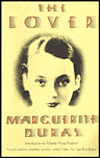
I had Nick Hornby’s The Polysyllabic Spree with me, but I didn’t get to it and still haven’t begun it, and I also had Marguerite Duras’ The Lover, which I managed to read about 60 pages in. Considering the number of hours I was at the airport and how quickly the pages in The Lover read, that isn’t very much. But I was relatively content sitting there and sort of reading, sort of watching people as they walked by. The book was a good companion — it’s got a powerful narratorial voice that rewards slow, meditative reading. This is not a book to rush through.

Plus, it’s kind of fun to notice people glancing at my book and to wonder what they think of it. Isn’t this a striking cover?

Leave a comment

Filed under Reading

Early reading meme

Kate’s got a great meme on early reading, and it’s high time I did it.

1. How old were you when you learned to read and who taught you?

A frequent refrain in my answers will be “I don’t remember exactly,” but I’ll do my best. I think I learned to read in kindergarten, when I was five, although apparently I knew my letters much earlier. My dad tells this story about how I was going to school and going to school and going to school until one day I came home and picked up a book and out of the blue began reading. I have a memory of coming home from school and beginning to read out loud to my parents’ delight, so maybe my memory and my dad’s story refer to same thing, although there’s no knowing for sure.

2. Did you own any books as a child? If so, what’s the first one that you remember owning? If not, do you recall any of the first titles that you borrowed from the library?

I have an early memory of owning a copy of Dr. Seuss’s Yertle the Turtle. I’m sure I owned others, but for some reason the huge stack of turtles sticks in my mind. Later I remember owning a complete set of the Laura Ingalls Wilder Little House on the Prairie books, the ones with the yellow covers that came in a yellow box. My friend had a set of the Little House books with blue covers and a blue box, and I was a little jealous as I liked the blue set better. I remember finding the Betsy-Tacy books in the library, as well as the Louisa May Alcott ones.

3. What’s the first book that you bought with your own money?

I’m not entirely sure. I know I bought Nancy Drew books at some point, though, which I loved very much. But most often I got books from the library or read ones my parents owned. I was a very frequent library visitor as a child.

4. Were you a re-reader as a child? If so, which book did you re-read most often?

I most definitely was a re-reader. An obsessive re-reader, in fact. I practically had the Little House books memorized, as I really wanted to be Laura Ingalls. I re-read the Alcott books, Little Women and the others, including Eight Cousins and Rose in Bloom. Also I read the Anne of Green Gables books frequently. I think I re-read Nancy Drew books, and I’m sure I re-read the Betsy-Tacy books.

5. What’s the first adult book that captured your interest and how old were you when you read it?

I don’t have a clear memory of this. But I do remember reading books from my dad’s bookshelves, so the first adult book was likely one of these. I know I read David Copperfield very early, so it’s quite possible Dickens was one of my earliest adult reads. I read Ayn Rand early on (shudder!).

6. Are there children’s books that you passed by as a child that you have learned to love as an adult? Which ones?

I read The Lion, the Witch, and the Wardrobe when I was young, but I didn’t read the rest of the series until I was an adult. I can’t say I learned to love those though. Other children’s or young adult books I’ve read as an adult weren’t published when I was a child, such as the Philip Pullman books and Harry Potter (I’ve read only the first one of these). I somehow never found L.M. Montgomery’s Emily books as a child, and I still haven’t read them as an adult, so I think I’ll seek them out at some point. I never got into the Madeleine L’Engel books as a child, but I suspect I might like them now, so perhaps I should give those a try too.

Leave a comment

Filed under Memes, Reading

An experiment


I tried an experiment last year that didn’t work so well, but now I’m considering trying it again. The experiment was to listen to audiobooks while I rode on the indoor trainer. Stefanie wrote about this recently and inspired me. I’ve listened to music in the past and that worked okay, but I hate the trainer so much that music only makes it better for a little while. The idea with an audiobook is that it might get me really interested in it so that I won’t want to get off the bike — I’ll be operating with the rule that I only listen to the audiobook on the bike or in the car. So maybe I’ll get so wrapped up in it that I’ll stay on the bike to hear what happens next. Maybe.

The trick, I think, is to pick the right book. Last year I chose Benjamin Kunkel’s Indecision, which didn’t really work; I never got all that interested in it. This time around I think I’ve chosen better. This morning I walked down to the local library and picked out Jacqueline Winspear’s Pardonable Lies: A Maisie Dobbs Novel. What could be more engrossing than a mystery? And Danielle has written so eloquently about the Maisie Dobbs novels that this one caught my eye immediately. Pardonable Lies is not the first in the series, which is too bad, but it’s the only one my library had, so it’ll do.

I’ll let you know how this experiment goes; it looks like today might be the first time this season I’ll ride indoors. Yesterday was beautiful — 60s, sunny — a day that makes me think winter might never get here. I rode for two hours and didn’t need more than shorts, a jersey, and arm warmers. But today is supposed to be rainy, and although it’ll be relatively warm, I still won’t want to ride in the rain. So, unless there’s a break in the rain that looks like it’ll last for an hour or so, I’ll be indoors on the trainer. Ugh. Have I said just how much I hate the trainer?

Update: The rain held off long enough so I could ride outdoors today — no trainer for me! Not yet, at least.

Leave a comment

Filed under Books, Cycling, Reading

Reading notes

The less time I have to read, the more I long to do it. I’m really looking forward to things slowing down in a month or so when I’ll finally have some solid chunks of time to read. In the meantime, it helps to read shorter things, or I begin to feel bogged down. So the book I just finished, Hotel du Lac, was perfect, and the one I’m going to begin this weekend, Marguerite Duras’s The Lover, is as well. And it’s part of the From the Stacks Winter Challenge, for an extra bonus.

Am I violating the challenge, which involves reading books that I already own instead of buying new ones, if I admit I just bought two books on Amazon? Oh well, what can I do, since I need the books for two book clubs? The first is The Street of Crocodiles by Bruno Schultz, which I’m reading for the Slaves of Golconda. We won’t be discussing the book until the end of January, so if you like, get a copy and join in.

The other is Doreen by Barbara Noble, which I’m reading for a group Emily just invited the Hobgoblin and I to join. This is a real-live, face-to-face group — did you know Emily and I live practically up the road from one another? Okay, it’s one town away, say 5-10 miles or so. We had no idea our houses were that close until very recently, and I’m very excited about meeting Emily in the flesh — a blogger meet-up! I know nothing about Doreen, and I’m eager to get the book and find out.

I am about 20 pages from finishing Frances Burney’s Journals and Letters, which has been quite a read — it’s pretty long and not uniformly interesting unless you’re a real Burney fan (which I am), but it has a lot of really great sections, including one very exciting episode where Burney, at this point 65 years old, is walking along the coast and gets caught by the incoming tide. She scrambles up a rocky cliff and gets stuck and has to wait as the water rises to see if it will climb high enough to pull her into the sea. I knew as I was reading that she survives — because the journals and letters continue — but it was a suspenseful episode nonetheless.

And Proust is coming along nicely; I’m maybe 100 pages from the end of the second volume. I’m reading along steadily and enjoying it, although I haven’t felt inspired to post about him on the Proust blog. I’m guessing with more time and leisure will come inspiration. Until then, I’ll enjoy the book quietly.

Leave a comment

Filed under Books, Reading

A recent acquisition

We’ve got four used bookstores in my small town, which I’m sure I’ve mentioned before, and last night, while we were waiting for our takeout pizza, the Hobgoblin and I wandered over to one of them. It’s a very odd bookstore, mainly because it’s kind of hard to get to the books. It’s a small room to begin with, and then every aisle is full of boxes, which block some of the books and make it hard to get at the others. I have no idea why this is. And I wonder how much money the owner makes with the place. My town really isn’t big enough to support four used bookstores, and this one doesn’t seem to get many customers as far as I can tell.

The owner is rather odd. Does that come with the territory? Are many used bookstore owners odd? I’d love to own a used bookstore myself, and I’m not sure if I’m odd enough. Maybe I am. It’s difficult to measure one’s own oddness. Although, truth be told, when I try to think about what makes this man odd, I can’t come up with particulars except for the boxes that block the books and the sense that he spends an awful lot of time alone in the store, most likely talking to himself. He seems caught up in a world all his own, and walking into the store feels a little bit like a personal invasion.

Anyway, he’s very chatty, and he remembered what I bought the last time I was in the store: two Elizabeth Taylor novels. I was impressed. I was also very happy to see that he had two more Elizabeth Taylor novels in stock, and I made sure to walk away with one of them: The Blush, which, I just this very moment discovered is not a novel, in fact, but a book of short stories.

It’s nice to know that there’s another Elizabeth Taylor book for sale within walking distance of my house, the book I left behind. I loved the two novels I read last summer, and I’ve decided it’s a very good thing to have an unread Elizabeth Taylor book in the house, ready for me when the mood strikes.

I wasn’t planning on buying any more books, but it’s rare that I walk into a used bookstore without buying something — and that’s not so much because I see things I can’t resist but because there’s something about the smallness and intimacy of used bookstores that makes me very aware of the owners, and I feel this urge to help them out and support the store. And it’s not hard to give in to this urge when the books are fairly inexpensive. So I find something or other I’ll want to read eventually and feel much better. There’s something I really don’t like about walking out of a used bookstore empty handed.

Leave a comment

Filed under Books, Life, Reading

A challenge!

Here’s a challenge I think I can do. It’s from Overdue Books, and here’s what it is:

“If you are anything like me your stack of purchased to-be-read books is teetering over. So for this challenge we would be reading 5 books that we have already purchased, have been meaning to get to, have been sitting on the nightstand and haven’t read before. No going out and buying new books. No getting sidetracked by the lure of the holiday bookstore displays.”

Now, what to pick? Following Kate’s example, I’m going to try to pick books, at least some books, that have been sitting around for a while, not ones I’ve recently acquired. I’ll try to pick at least one difficult book — something that feels like a challenge and that I’ve been avoiding reading because I feel intimidated by it.

Okay, here’s a try. I reserve the right to make some changes as I go along, but if I do make changes, I’ll substitute something I’ve had around for a roughly equivalent period of time.

  • The Lover, Marguerite Duras. I’ve had this forever. And when I’m finished reading it, I can take another look at Litlove’s post on it from a while back.
  • Molloy, Samuel Beckett. I’ve also had this one around forever. This is my “challenge” challenge read — something I’ve been avoiding because it looks scary. Perhaps I’ll be surprised.
  • Snow, Orhan Pamuk. I haven’t had this one quite as long, but it’s been staring at me from my TBR shelves for a while now.
  • Buddenbrooks, Thomas Mann. I’ll have more time on my hands than usual in December, so I think I can commit to a longer novel, and I’ve had this one for a number of years.
  • Runaway, Alice Munro. I’ve never read her, and I simply must.

One of these books overlaps with my Thirteen Classics in 2007 challenge: Thomas Mann’s Buddenbrooks. Now it’s virtually certain that I’ll make it through that book 🙂

Leave a comment

Filed under Books, Lists, Reading

Reading update


I think I posted recently about not wanting to acquire new books. Well. I have. First of all, I needed to buy volumes three and four of Proust, The Guermantes Way and Sodom and Gomorrah. I’m less than 200 pages away from finishing volume two, so I need to have the next books on hand. They look serious. Proust is such a stable, steady part of my life these days, I’m glad to have some more thick volumes on hand.

Then, the way that Book Mooch works is that you can create a wishlist, and then when other people post books from your wishlist on the site, they’ll send you an email letting you know the book is now available. So I can decide with the best of intentions not to mooch any more books, but then they send me those emails about books I’d really like that I can get for free, and it’s hard to resist.

So when I got an email about Bill Bryson’s A Short History of Nearly Everything, I snapped it up. I’ve now got two science books on my shelves (the second one is Brian Greene’s The Fabric of the Cosmos), so I should get to one of them soon. I do like reading science, although I don’t do it often.

Also, I’ve heard such good things about Nick Hornby’s The Polysyllabic Spree, I couldn’t resist that one either. It sounds like a fun book about books and reading, which strikes me as a perfect thing to read right now. And also, I saw Mark Danielewski’s House of Leaves, and decided to try it. I’m not sure if I’ll love it or find it gimmicky, so I’m curious. I’ve found that things people call gimmicky I tend to like, so I’m optimistic.

Who knows when I will get to these, but I’m glad they are around. I still have five points left, which could mean five more free books, so I’ll see what possibilities turn up in my email box.

Leave a comment

Filed under Books, Reading

Scary things

I’m not very into scary things. This is going to be a lame Halloween post. I realize I’ve got a strange relationship to Halloween, now that I think about why the holiday doesn’t interest me much — I celebrated Halloween in the normal way for a while when I was a kid, maybe until I was 5 or 6, but at that point because of the evangelical Christianity I’ve written about recently, my parents decided Halloween wasn’t an appropriate holiday for us to celebrate and I never dressed up to go trick-or-treating afterward. Instead, we had Halloween-replacement parties of one sort or another — usually just regular old parties at our church with food and games, and we’d pretend they were as cool as real Halloween parties.

So I have a very short history of dressing up and getting into the pagan spirit of the holiday, and I haven’t gotten back into it as an adult. The Hobgoblin, good pagan that he is, makes up for my lack of spirit a little bit; as I type, he’s downstairs carving pumpkins. We’ll pass out candy to the neighborhood kids, and that’s about it.

I can be such a spoil-sport sometimes. Actually, intellectually, I’m interested in the holiday and think it has a fascinating history, but when it comes to celebrating — I just have never really felt comfortable with it.

And, continuing with the theme of me not being comfortable with things, I’m not particularly interested in scary books — or movies too, for that matter. Scary movies really scare me, to the extent that I stop having fun. I don’t really understand the enjoyment people feel in being scared by them. For me, it’s not a pleasurable fright; it’s a “please, please, please make it stop!!!” kind of fright. So I don’t watch scary movies much. I can’t remember the last one I saw.

I’m a tiny bit better about scary books, but I can only say that because I just read Dracula, which I didn’t find all that scary. If I were to pick up a Stephen King horror novel, I have no idea how I’d take it. Except for Dracula, I can’t remember the last scary novel I read.

I’m willing to work on this, though — unlike scary movies, I might be able to handle scary books. I think I did okay this season, adding one scary novel to my usual list of staid realist fiction. Perhaps next year I’ll read two of them. And maybe I’ll choose something likelier to scare me than Dracula. The farther away things are in time, they less likely they are to scare us, perhaps? Older horror and gothic novels from the 18C and 19C are more likely to be funny than scary, I think.

Any recommendations for this reader who’s afraid of being afraid?

Leave a comment

Filed under Life, Reading