Category Archives: Fiction

Reading Serendipity

Litlove recently wrote a post in which she used the phrase “the usual serendipity of reading,” which is a great way to describe how books so often speak to each other and to us in unexpected ways. I’ve recently come across my own example. (And, in a nice twist, I’ve just been talking about serendipity in my “Intro to the Arts” course as we discuss how to access one’s creativity.) I’ve been reading Pema Chödrön’s book When Things Fall Apart where she writes about how we tend to run away from anything that is painful or unpleasant rather than facing it and considering what it means and what it might teach us. She writes:

Most of us do not take these situations [situations that cause discomfort] as teachings. We automatically hate them. We run like crazy. We use all kinds of ways to escape — all addictions stem from this moment when we meet our edge and we just can’t stand it. We feel we have to soften it, pad it with something, and we become addicted to whatever it is that seems to ease the pain. In fact, the rampant materialism that we see in the world stems from this moment. There are so many ways that have been dreamt up to entertain us away from the moment, soften its hard edge, deaden it so we don’t have to feel the full impact of the pain that arises when we cannot manipulate the situation to make us come out looking fine.

Those of you who participated in Infinite Summer may know where I’m going with this: Infinite Jest deals with exactly this dynamic — the impulse to run away from pain and discomfort straight into the arms of whatever distraction we can find. People are so desperate for entertainment and distraction, in fact, that in Infinite Jest their lives are at risk. At the center of the novel’s plot (such as it is) is a film referred to as “the entertainment” that is so seductive, so irresistable, that people literally can’t draw their eyes away from it and will starve themselves and die rather than have to stop watching it. And others — lots of others — distract themselves with alcohol and drugs, violence, obsessive work, or really anything that can keep them from having to think. Facing their problems directly is just too difficult.

My favorite character in the book, Don Gately, is a recovering drug addict who has learned all this, in his own way. Now that he is no longer addicted to drugs, thanks to AA, he is finding out what it means to face pain and discomfort directly. He is finding out that all the things the drugs helped him repress are now coming back, and he has become haunted by memories of his hellishly difficult childhood and his horribly violent young adulthood in a way he’s never experienced before.

I love Gately because he’s such a brave soul, and he has no idea just how brave he is. He looks around him at the halfway house where he lives and works and sees people who are just beginning to attend AA meetings and who scoff at all the cheesiness and cliches involved, and he understands why they scoff, but he has learned that facing reality in the way Pema Chödrön writes about is just so difficult that people can’t do it on their own. They need the support of the daily AA meetings, the belief in a vague “higher power,” the motivational cliches and all the rest of it. It’s a practice, really, not unlike meditation. Both practices teach people to take things one day at a time, or one moment at a time, to focus on what’s real, to face oneself directly and admit shortcomings honestly, to admit that we have no control over ourselves and our lives. Gately doesn’t understand why AA works, but he knows it does, and he’s willing to trust it, no matter what. And believe me, this trust gets tested.

I have no idea if David Foster Wallace was interested in Eastern spirituality at all, but I felt its presence in this novel. It may be I read it this way because I’m interested in it at the moment, but at any rate, I love how these two books have had so much to say to me.
11 Comments

Filed under Books, Fiction, Nonfiction

Book Notes

Just a few thoughts for a Friday evening. Since finishing Infinite Jest, I’ve been focusing on Laurie King’s The Beekeeper’s Apprentice, which I’m reading for my non-mystery book group, even though the book happens to be a detective novel. I’m almost finished with it, and I’ll write a proper review later, but my conclusion will be that the book is a disappointment. It has many potentially interesting things in it, but it never manages to pull everything together to be a really engaging read, and if a detective novel isn’t an engaging read, there’s a problem. From what I’ve heard from my book group friends, I don’t think there will be much controversy over this one; everyone so far has agreed it’s not that great. Oh, well.

I received one new book in the mail this week: Robert Dessaix’s Twilight of Love: Travels with Turgenev. I know nothing about Dessaix and have never read Turgenev (although I’ve been meaning to for a long time), but this book interested me because it’s a combination of memoir, travel narrative, and literary history, and I love books about books and writing that mix genres in this way. This is what Publisher’s Weekly says:

While the problem of irrational love in a world of reason is the dominant theme, Dessaix’s work explores much more: Russian theology, the experience of being far away and therefore barbarian in European eyes, the modern confusion of the erotic with the sexual, and of course, the problem of death.

And on the topic of books about books and writers, I recently learned that J.C. Hallman will be publishing a very interesting-sounding anthology called The Story About the Story, a collection of essays by writers about writing. The Table of Contents looks absolutely fabulous. It has selections by Virginia Woolf, Vladimir Nabokov, Salman Rushdie, Cynthia Ozick, Geoff Dyer, Randell Jarrell, Susan Sontag, and a whole bunch of other great people. The idea is that these selections are personal approaches to literature — great writing about great writing. (As I look over the Table of Contents I’m wondering why he didn’t include a selection from Nicholson Baker’s U&I, but, of course he couldn’t include everything).

Amusingly enough, I found out about the book on this blog, in the comments of which I called Hallman an impolite name (if you read the post, you’ll see why), and then Hallman himself appeared and responded. The internet can be such a great place, can’t it? I love it that people can be having a book discussion and then all the sudden the author can show up and contribute. Even if I do get caught out being impolite…

After I finish reading Laurie King, I’m not entirely sure what I will pick up next, although perhaps something I’m more likely to like, perhaps something older and canonical. Or perhaps an interesting nonfiction. We’ll see.

18 Comments

Filed under Books, Fiction, Nonfiction

On finishing Infinite Jest

Wow, people. Infinite Jest is a great book, and it’s going on my list of favorite novels ever. I don’t know if it would be on my top 10 or top 20 or top 50 or what, but it’s up there somewhere. Many people on the Infinite Summer forums and other places talk about rereading this book, in some cases many times, and in some cases rereading it pretty much immediately after finishing it for the first time, and while I’m not ready to reread it right away, I think I probably will someday. It’s a book that would reward rereading, without a doubt. And it’s a book worth spending lots of time with.

I appreciated having the Infinite Summer blog and forums available to help me sort out the plot events and to help me remember things I would otherwise have forgotten, but as far as I’m concerned the chief pleasure in this book is not piecing together its intricate structure or following the plot. The book is so enjoyable because of the narrative voice. The trick to enjoying the book for me was not to get caught up in figuring out all the details, and instead to just let it all wash over me. I picked up on the major events, but mostly I came to understand, eventually, that I would be able to figure out enough not to get lost and so I could relax and not worry about details. And not worrying about the details freed me up to enjoy the intelligence, the cleverness, the humor, and the wisdom of that voice. It’s a voice that varies from section to section with each new situation and narrator, but the truth is, it’s mostly the same voice throughout, or maybe more accurately it’s the same sensibility. It’s a similar voice to what Wallace creates in his nonfiction, and if you like that voice, I’m guessing, you’ll like whatever Wallace writes.

I was surprised to find so much wisdom in this book, and so much heart. Before I began reading I thought it was going to be a dry, detached, ironic kind of book, the kind that’s all about thinking and not about feeling. I’ve heard people criticize this book for being cold, and I’m pretty sure we didn’t read the same book, because that’s just not true. The book is incredibly funny, it’s overflowing with linguistic inventiveness, it has so much energy it feels like it’s bursting at the seams, it’s hyperactive and show-offy, its sentences can go on and on, and it has odd quirks like Wallace’s use of the word “like” throughout the whole book pretty much no matter who the narrator is or what the level of formality is. But it also made me tear up, and I cared about the characters, more than I usually care about characters in fact.

So, I’ll try to get more specific. I thought it was wise about how difficult it is to live in one’s own head and how hard it is to communicate genuinely with other people. And it was wise about how easily we get into the habit of running away from everything that is difficult and painful and instead turn to diversions, whether they be drugs or alcohol or sports or sex or endlessly-entertaining movies or whatever. In this novel, it’s mostly drugs and alcohol. And it was wise about just how hard it is to overcome addictions and that overcoming addictions means facing those difficult things we were running from in the first place. And also about the incredible variety of ways people are hurting and hurt and damaged and deformed, so much so that pretty much nobody is whole and perfect, and everybody is trying to recover from something.

So what is the book about? I don’t think I’ll spend much time describing that because what it’s about is just so random and, frankly, doesn’t sound all that interesting. It’s got one set of characters who are students at an elite tennis academy, and another set of characters who are residents of a drug and alcohol addiction halfway house, and another set of characters who are involved in political intrigue. It’s set in our time, roughly, but in a world different from our own, with slightly different technology and wildly different political structures. You’ll recognize the world, but it’s not ours.

I’m afraid that people may be too easily intimidated by this book. Yes, it’s long and challenging, but it’s very readable, and while it does throw a whole bunch of characters and scenes at you right at the beginning and you have to orient yourself a bunch of times to new situations, it does settle down eventually and you begin to sort out who is who and what the main storylines are. I think if you are at all tempted to read this book, you should, and if you aren’t sure, then you might try Wallace’s nonfiction and see if you like that. You might try Wallace’s 2005 graduation speech given to Kenyon College, which I think is really wonderful and which gives you an idea of why I think he’s a wise writer.

And now I’m glad I have more of Wallace’s writing available to read; at this point I’ve only read one novel and one nonfiction collection and a couple things online, so there is much more to look forward to.

22 Comments

Filed under Books, Fiction

On rereading The Moonstone

I’m SO close to finishing Wilkie Collins’s The Moonstone that I will have no trouble finishing it tonight before I drop off to sleep. My mystery book group is discussing the book tomorrow, so I’m finishing it just in time. I believe this will be the third time I’ve read the novel. I think I read it first as a teenager, grabbing it off my dad’s shelf of classics. I read it again sometime in my twenties probably, just for the fun of it. This time around, it was my pick for the book group; we had been talking about the possibility of reading it for a while, so I decided that it was finally time. I think many people in the group had already read it, so it will be a reread for a lot of us. I’m looking forward to hearing what other people thought.

My memories of my previous experiences reading The Moonstone are a little vague (I wasn’t blogging back then and so don’t have a record — alas), but I do recall enjoying the book’s multiple perspectives a lot. In fact, that’s what struck me most strongly during my first reading, and I remember thinking that I wanted to read other books with similar structures and that that structure would probably remain a favorite of mine, which it has. If you haven’t read it, The Moonstone has multiple narrators who pick up the thread of the story when they have something important to contribute. These narrators often respond to each other and disagree with each other. The first two narrators are particularly entertaining, as they are strong characters with amusing quirks who happen to dislike each other severely, and it’s funny when they tell you not to believe a word of what the other says. I also like how these multiple narrators allow you to see many of the characters both inside and outside. We get to hear Gabriel Betteredge, the first narrator, explaining how important Robinson Crusoe is to him, which he does with such enthusiasm we almost come to agree with him and go look for a copy of the novel ourselves, and we also get to see a different character completely bewildered at the fact that Betteredge is pushing Defoe at him as a source of wisdom on par with the Bible. It’s all a lot of fun.

I enjoyed the multiple narrators this time around too, but I noticed Collins’s wonderful sense of humor even more. His characters are just so entertaining. There’s Betteredge with his Crusoe obsession, his digressions, his strong opinions, his dignity combined with his failure to notice or to comment when Franklin Blake treats him rudely. And there’s Miss Clack with her tracts and intrusiveness and insatiable curiousity disguised as piety. The scene when she watches from behind the curtains as Rachel and Godfrey Ablewhite get engaged, watching while pretending not to, is classic comedy.

I’m not entirely sure I want to read this book again; perhaps I’ll change my mind, but I feel right now as though I’ve gotten what I can out of it, and I’d like to move on and read other Wilkie Collins novels. But three good experiences reading any novel is a pretty good record, I think.

12 Comments

Filed under Books, Fiction

Dance Night

Dawn Powell’s 1930 novel Dance Night has me thinking about what it would be like to live in a small town with very little education, very few job opportunities, and only vague ideas about what life is like in other places. The characters in the novel go to the movies regularly, but other than that, the chief source of information they have about the world outside their town comes from traveling salespeople and a dancing master, and the reach of these people is very small. The people who travel the farthest and would therefore have the most information are also the book’s most despicable characters. So everyone else is left with vague dreams and a strong pull to stay right where they are, doing the things their parents did.

Dance Night tells the story of Morry Abbott, a young man who is trying to figure out what he wants to make of his life. He lives with his mother behind the millinery shop she owns where he feels increasingly uncomfortable with the overwhelming femininity of the place. He is trying to find his way into the masculine worlds of the factory and the bar, but his youth and inexperience leave him uncertain and embarrassed. The novel also tells the story of Jen, a 14-year-old who has been abandoned by her mother and taken in by a local family. She feels isolated and alone and misses her younger sister, left behind in an orphanage. She turns to Morry for some companionship, and he is drawn to her, attracted by her hero-worship, but also repelled by her obvious neediness.

What has stayed with me about the book is all the unhappiness and the longing and the misunderstandings that haunt just about every character. Morry doesn’t know what to make of the young women who surround him who make fun of him but also, very confusingly, flirt with him. Morry’s mother is married to a man who is hardly ever home, but who makes her life miserable when he is. She is also desperately in love with the dancing master, who is hardly aware of her presence. The mother’s friend is having an affair. Her assistant torments Morry but also wants to be seen with him. The most important man about town, the one with all the money and property, moves through a series of superficial relationships. No one, it seems, is content, and nobody has much of an idea of what to do about it.

The townspeople do have one outlet — their weekly dance night, which begins with a dancing lesson, followed by the dance itself. Everyone, from old to young, looks forward to these evenings as a time to bring some lightness into their lives, but enjoyable as they are, they are also scenes of sexual competition and jealousy.

And there is also the problem of work. Morry gets a job in the factory and feels proud of himself for a while, but before too long he sees how builders are developing the town, has his own ideas of what kind of houses the town needs, and joins forces with a local architect to try to make his dream houses a reality. He becomes a big man about town himself, making plans and talking them up to the townspeople, shuttling about from person to person trying to make things happen. All this is immensely satisfying for a while, but it’s also precarious and uncertain, and for all Morry knows, it could collapse on him.

Morry senses that his world is changing and that there are opportunities out there — opportunities that could transform his life, if only he could get a proper hold on them. It’s a place where hard work and industry and vision can take him places, but he just can’t quite seem to make things work for him. His friend Jen is also full of dreams; she wants to sing and dance on stage and to live a busy and exciting life in some big city. But the problem, again, is how to make it happen. How can these people escape?

The picture Powell paints of a small town in changing and uncertain times is a grim one, but the portrait seems so real and the characters are so compelling that the book is a fascinating read. It makes me very glad I’m fortunate enough to live in an entirely place and time. Of course, we have our own uncertain times to deal with, but I think for a lot of people, it’s become easier to imagine a way out of claustrophic small towns.

11 Comments

Filed under Books, Fiction

On Borrowed Wings

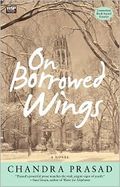
6a00d834515bbc69e2011571051d1e970c-120wi I finished Chandra Prasad’s On Borrowed Wings nearly a month ago, and so the details are beginning to get vague, but I did want to write at least a few words about the book before putting it away. I picked it up in the bookstore because I was in the mood for something easy and fun and comforting, and I remembered the title from Danielle’s very positive review. It served the purpose nicely; it was an entertaining read that was also smart and thought-provoking. It did just what comfort reading should do — comfort, without making me cringe at bad writing.

I was drawn to the book for another reason as well — it takes place in my state, Connecticut, and it’s about undergraduate life at Yale, and I always enjoy reading books about academic life, whether from a student’s or a professor’s perspective. The book also has cross-dressing and lots of feminism — two more points in its favor.

It tells the story of Adele Pietra, a young woman in a small mining town outside New Haven. It’s the 1930s, and life is difficult for the working-class people in Adele’s town, Stony Creek, and it’s particularly difficult for a smart young woman whose best opportunity in life seems to be marriage to someone she barely knows. Adele loves to read and study, but it’s her brother Charles whose education everyone cares about. His mother is helping him prepare to apply to Yale, a possibility that seems like a long-shot, but one his mother has pinned all her hopes on.

All future plans are destroyed, however, when Charlie and his father are killed in a mining accident. Adele and her mother mourn their loss, but when Charlie’s acceptance letter from Yale arrives, it occurs to Adele that she just might be able to seize an opportunity and make something incredible happen. Women were not admitted to Yale at that time, but Adele decides that she’s going to go anyway — by dressing as a man and taking her brother’s place.

And so begins an adventure. Adele has many obstacles standing in her way — not only must she dress and talk and act like a man, but she has little idea how to behave in a setting that is entirely new to her. As a working-class, small-town girl, she has had little exposure to the big city and to the privilege and comfort of life in a prestigious university. The scenes describing Adele’s arrival in New Haven and her first weeks on campus are suspenseful ones, as she has to figure out how to deal with unexpected problems such as the swim test all freshmen are supposed to pass. How can she take a swim test without revealing her secret?

Fortunately, she runs into another new student who is just as bewildered by his new surroundings, and through him, she manages to make a group of friends, and she also does well in her classes and manages to find a job and she even makes friends with a working-class family in the city.

She manages to do pretty well for herself, but the question always remains — how long can she keep her secret?

It’s fun to watch Adele live a life she never expected she could and do things nobody believed a woman should be able to do. Prasad does a good job making this fantasy believable and resolving the suspenseful situation she created. All in all, it’s a satisfying book.

7 Comments

Filed under Books, Fiction

Giving up on a book

I haven’t done this in ages, but for the first time this year and for who knows how long before that, I’m setting aside a book I’m not getting along with. I should give up on books I’m not loving more often, I know that, but I generally don’t anyway. I want to give a book a chance before I quit reading it, and once I’ve done that, I usually find myself far enough into it that it doesn’t seem too hard to just carry on.

But I was reading Christina Stead’s The Man Who Loved Children before I left on vacation, and while I found it interesting on some levels, I also found myself on page 150 or so out of 500+ pages wondering if I was ever going to be able to finish the thing. I felt like I’d already plowed through a lot, but that tons more was waiting for me, and I wasn’t sure the book was going to change or develop much to make the plowing on worth while. And then vacation intervened, and I had a lot of other books to read, and I haven’t picked it up in a few weeks now and will put it back on the shelf soon.

The book is a family story. It’s about a woefully mismatched couple with a large brood of children, and it describes the family dynamics, including the horrible fights the parents have and the way the children try to keep peace in their family. It captures the father’s highly imaginative use of language and the games he plays with his children, as well as the mother’s longing for a different kind of life and refusal to accept the circumstances she finds herself in. The eldest daughter, Louisa, is a child from the father’s previous marriage, a fact her step-mother never lets her forget. Louisa, in the heartbreaking way of children, accepts this and doesn’t question it, although she has also begun to explore the world outside the family more and is retreating into the private world of adolescence. There is cruelty in the way the parents treat the children, but, somehow, there is also love and moments of happiness. What else can young children do but make the best of the situation they find themselves in?

I liked the way the book explored this dynamic —  the problem of children trying to understand what is going on in their family when it both nurtures and harms them, in ways they aren’t grown up enough to comprehend. Certain kinds of dysfunctional families are very interesting to read about, and this family reminded me very much of the family in Jeannette Walls’s The Glass Castle. In both cases, the parents have wonderful things to offer to their children, but they can’t seem to grow up enough themselves to be capable of taking care of others.

The problem, though, is the pacing. I read and read, and not much happened, and there wasn’t enough narrative tension or tension among the characters to make me want to keep going. I think I can be a patient reader, but there wasn’t enough to reward my patience.

It’s a memorable book, though. Even if I never pick it up again, I’ll remember the family. Maybe I’m missing a really great ending, and if you have read this book before, you can let me know if I have, but I think with some books you don’t have to read the entire thing to get something from it.

12 Comments

Filed under Books, Fiction, Reading

On Reading Gertrude Stein

There are two books from before vacation I haven’t yet written about here: Gertrude Stein’s Three Lives and Chandra Prasad’s On Borrowed Wings. My memory of these books is getting a bit hazy, but I don’t want to ignore them entirely here.

So first, Gertrude Stein. I’ve been meaning to read Three Lives for a very long time; in fact, I’ve probably owned the book for well over a decade. Stein is a fascinating figure, but I’ve always found her intimidating and need to work up a bit of courage to pick up one of her books. Three Lives is certainly one of the easier, more approachable books she’s written; it may take me another decade or two to work up to reading something more challenging, if I ever decide to do it at all. I don’t feel that I’ve ever really understood Stein, but then again, lots of people feel that way, I know for a fact, and my tendency with writers I don’t quite understand is to keep returning to them to see if one more try will make a difference.

Three Lives is a straightforward read, not intimidating at all it turns out, with simple sentences and vocabulary, without much plot and with just a few characters. In fact, it’s such a simple, straightforward, non-astounding read that one might reasonably wonder why Stein is read at all, if it weren’t for the time period she lived in and the contrast between what she was doing and typical novels of the time. The book was published in 1909, and the contrast between her writing and other novels of the time is sharp. She has taken the sentence and pared it down, often using a series of simple sentences or short phrases strung together with conjunctions. She also uses a lot of repetition, repeating words from sentence to sentence and repeating ideas from page to page. For example:

Melanctha Herbert had not made her life all simple like Rose Johnson. Melanctha had not made it easy with herself to make her wants and what she had, agree.

Melanctha Herbert was always losing what she had in wanting all the things she saw. Melanctha was always being left when she was not leaving others.

Melanctha Herbert always loved too hard and much too often. She was always full with mystery and subtle movements and denials and vague distrusts and complicated disillusions. Then Melanctha would be sudden and impulsive and unbounded in some faith, and then she would suffer and be strong in her repression.

Stein piles bits of information on top of each other to build portraits of her characters; I suppose this is what every author does in order to create a character, but Stein draws attention to the piling on by repeating her character’s full name and using “and” in her lists, instead of commas. She uses repetition on a larger scale too. Her story moves forward in a jerky back-and-forth motion; she will tell you new information, and then she will circle back and repeat old information, perhaps with some variations, before moving on again.

It’s not a very exciting style, and at times I felt bored with the book, but she does manage to capture something that feels true about her characters. It’s an incantatory style; it’s almost like she’s chanting her way through these characters’ lives, conjuring them up and capturing their full history in a fairly short number of pages.

The book does exactly what the title promises: it tells the story of three women’s lives, none of which connect to the others in any way except that all three of her subjects live in the same town. She tells their full life stories, although most of the information we have on their childhoods comes through flashbacks. All three are ordinary working- or middle-class women, and the focus in all three stories is on their relationships — friendships, and in the case of the middle story “Melanctha,” romantic relationships. The Melanctha section is the most famous one, partly because of how it deals with race; Melanctha is a black woman and some see it as a sympathetic portrait of blackness, arguably forward-looking for its time (it’s a controversial point, though).

So, Three Lives is an interesting read, a good book to analyze stylistically and think about contextually, although it’s not engrossing or emotionally compelling, at least for me. I’m very curious and I wish there were some way of knowing how Stein’s reputation will fare in decades and centuries to come. I suspect she’ll remain known, at least for a while, although it’s hard to tell whether that will be because of her writing or because of her life story. I’m looking forward to reading Janet Malcolm’s book Two Lives: Gertrude and Alice to learn a little more about that life.

10 Comments

Filed under Books, Fiction, Reading

Recent Acquisitions

I don’t have nearly enough books, so Hobgoblin and I checked out a library sale yesterday evening, and I came home with five new novels. It’s a good thing I don’t hear about all the library sales in my area, because there must be dozens of them, and if we knew about them, we’d visit them, and then … well, then we’d be in trouble.

Here’s what I got. It was an evening for women’s fiction:

  • Barbara Pym, An Unsuitable Attachment
  • Barbara Pym, A Glass of Blessings
  • Elizabeth Von Arnim, The Enchanted April
  • Monica Dickens, Joy and Josephine
  • Anita Brookner, A Family Romance

But that’s not it. From Bookmooch I recently got or will soon receive these:

  • Evelyn Waugh, Brideshead Revisited
  • Jessie Fauset, There is Confusion
  • George Gissing, New Grub Street
  • Elizabeth George, Payment in Blood

I didn’t particularly enjoy the first Elizabeth George book I read, but enough people said the series gets better and enough people I respect have enjoyed her books that I thought I’d give her another try.

But that’s still not it. Oneworld Classics sent me a copy of Victor Hugo’s The Last Day of a Condemned Man, and I bought Chandra Prasad’s On Borrowed Wings (based on Danielle’s post) and Dawn Powell’s Dance Night (for the Slaves of Golconda) at local bookstores.

Oh, dear. I’m probably going to Manhattan with Hobgoblin this weekend, where we will probably venture into some bookshops, and I’m going on vacation starting next Thursday, during which I will probably visit some bookshops, and then there are a couple more library sales coming up, which I will almost certainly visit. Time to buy some more book shelves?

11 Comments

Filed under Books, Fiction

Maurice

14757842 E.M. Forster’s novel Maurice is an intriguing read, largely because of the time period it was written in and the way it treats its subject matter, homosexual love. Forster wrote it in 1913 and 1914, but he resisted publishing it, and it didn’t appear in print until 1971 after he died. He was worried that people would have a hard time accepting what turns out to be a vexed but positive portrayal of homosexuality.
I’ve also read Forster’s Howards End and Passage to India, and if I’m remembering correctly what those novels were like, this one is more psychological and emotional in its focus. The other novels are psychological as well, but this one emphasizes interior worlds even more than the others, capturing the mind and emotions of a young man as he struggles to figure out the world and his place in it. Maurice is more abstract, taking less time with context and setting, and spending more time describing emotional states.

It tells the story of Maurice Hall, a schoolboy at the beginning of the novel, whose teacher introduces him to sex by drawing pictures in the sand during their last conversation together before Maurice heads off to public school. He dreams two highly symbolic dreams, and finds himself unexpectedly emotional when he learns one of their servants, a young man named George, has left their service. These early experiences haunt him as he moves through public school and then university, trying to understand his complex reactions to his classmates. His most significant relationship at university is with Clive, a young man much more worldly and more intelligent than he is, but one who returns his interest and, soon enough, his love. The novel charts their relationship as the two make their way through Cambridge and then move out into the larger world. The Cambridge scenes are particularly enjoyable to read, as campus life is endlessly interesting, for me at least. Once the characters leave university, their lives become broader, but also much more uncertain, and Maurice is finally made to take stock of who he is and to act upon that knowledge.

I was interested in the way the novel keeps a certain amount of critical distance from Maurice. He is largely a sympathetic character, but at the same time, we see the limits of his intelligence; Clive can talk circles around him, and Maurice is not the best abstract thinker out there. He is also unpleasantly obsessed with class and uncertain about his own status. Here is Forster’s description of him:

In Maurice I tried to create a character who was completely unlike myself or what I supposed myself to be: someone handsome, healthy, bodily attractive, mentally torpid, not a bad businessman and rather a snob. Into this mixture I dropped an ingredient that puzzles him, wakes him up, and finally saves him.

I like the fact that Forster makes his protagonist so obviously flawed, while at the same time showing so much compassion and understanding. It would be easy in a book that explores such a vexed and complicated subject as sexuality, particularly homosexuality in the early part of the twentieth century, to make the protagonist more admirable and heroic and pioneering than this one is. Instead, Maurice is just an average person, flawed in perfectly normal ways and no more heroic than most of us are.

9 Comments

Filed under Books, Fiction

Infinite Jest update

I read 20 pages of Infinite Jest today and now I’m all caught up with the Infinite Summer reading schedule, which is to say, I’ve read up to page 232 (out of over 1,000 pages). I continue to love the experience. A lot of what I said in an earlier post remains true: there are lots of short sections that introduce us to many different characters, some of whom know and interact with each other and some of whom don’t. Everything is going to connect up with everything else eventually, I’m betting, and in a way, everything already does, if only in vague and tangential ways, such as shared themes or tropes or images.

There are a few plot threads that we return to again and again, such as the story of the students at the Enfield Tennis Academy (Hal, whom I wrote about in my earlier post is a student there), the family saga of the Incandenzas (including Hal; the adults in this family run the academy and the children attend it), and the residents of the Ennet House, a halfway house for recovering drug and alcohol addicts. The Ennet House is located right next to the academy, which is appropriate, because one of the major themes of the book is drug use and abuse, and many of the students at the academy spend their free time getting high.

And then there are other plot lines as well — a political thriller thread with two comic characters whose loyalties are nearly impossible to figure out, a couple different stories of drug dealing and violence, a really harrowing story of a deeply depressed woman, and lots more. There are also sections that don’t advance the plot much, but are informative or funny or there for some other reason, including one really great section on why video-phones failed.

I think the best way to read the book — at least for me — is to enjoy each section without getting too worried about how everything fits together and whether I’m remembering everything or not. Sometimes beginning a new section can be bewildering, but soon enough I find myself getting oriented to what’s happening and then I can enjoy it, almost like I would a really great short story.

I love the variety in this book, and not just the variety of characters and situations, but the variety of styles and points of view. Wallace takes on different voices now and then, using dialect or giving us a monologue by a particular character, or including transcripts of emails and articles and a paper that Hal wrote for school. There is just such abundance here.

The book is also laugh-out-loud funny (and I don’t usually laugh out loud at books), and also heart-wrenching in moments. And it’s really not that difficult of a read, in spite of the many characters and stories. I find it a much, much easier read than The Recognitions was.

Lots of people on the forums have said that you just have to make it through the first 200-250 pages or so, and then the stories and and ideas begin to come together more and it gets easier to read. If that’s the case, I think I’ll be doing just fine for the next 800 or so pages!

8 Comments

Filed under Books, Fiction

Discipline, by Mary Brunton

Mary Brunton’s 1814 novel Discipline turned out to be a bit of a disappointment. I’ve really enjoyed other early nineteenth-century novels such as Susan Ferrier’s Marriage, Maria Edgeworth’s Belinda, and Amelia Opie’s Adeline Mowbray, and I was hoping Discipline would be equally good. The novel has some good things to recommend it, but I found it too long, too predictable, and too moralistic. Although, to be fair, a lot of novels from the eighteenth and early nineteenth century feel too long to me (nothing against long novels at all, but some seem too long for the story they have to tell), many are predictable (if you know the conventions, you will not be surprised by any of Austen’s plots), and lots of them are moralistic. And what else should I expect, picking up a novel called Discipline?

The novel tells the story of Ellen Percy, a young girl who has been both dismissed and spoiled by parents who are generally well-meaning but make some serious mistakes. Upon observing her intelligence, all her father can say is:

“It is a confounded pity she is a girl, If she had been of the right sort, she might have got into Parliament, and made a figure with the best of them. But now what use is her sense of?”

Her mother responds:

“I hope it will contribute to her happiness,” said my mother, sighing as if she had thought the fulfilment of her hope a little doubtful. “Poh!” quoth my father, “no fear of her happiness. Won’t she have two hundred thousand pounds, and never know the trouble of earning it, nor need to do one thing from morning to night but amuse herself?” My mother made no answer: — so by this and similar conversations, a most just and desirable connection was formed in my mind between the ideas of amusement and happiness, of labour and misery.

Ellen’s father never finds much time for her, and her mother is too passive to try to rein her in. Her mother soon dies, leaving Ellen with a close friend who has the patience of a saint, but who also fails to instill Ellen with sound principles. Ellen grows up, goes to school, and learns to love luxury, idleness, snobbery, and gossip. In spite of this behavior, she is lucky enough to draw the attention of Mr. Maitland, a number of years older than she and a model of Christian gentlemanly behavior. He falls in love with her, but she is too busy enjoying her first taste of social success to pay him much attention.

This dynamic continues on for a while, Ellen growing more and more insufferable and Mr. Maitland looking more and more sorrowful. Ellen finds herself drawn into a flirtation with a man of uncertain principles who tries to lure her to Scotland where marriages are quick and easy. Before this can happen, though, disaster strikes — her father, it turns out, has just lost all his money and shot himself in despair. Now Ellen finds herself in an entirely new situation — she has no family, no money, and little idea what to do. Absolutely nothing in her life so far has prepared her in any way for this.

So Ellen is finally required to learn something about the world outside her former privileged social circle, and finally she is forced to learn some discipline. There are some interesting elements to this plot, in particular, the portrayal of how difficult it is for a woman to survive on her own and how little society prepares women of the monied classes to do anything useful with themselves. Ellen goes through some harrowing experiences that show exactly how vulnerable, powerless, and abandoned women without family and without money are. This is an idea that comes up again and again in novels of the time.

Also interesting is the portrayal of Scotland. Brunton is Scottish, and her heroine ends up there towards the end of the novel. There is a marked difference between the way the English and Scottish scenes are portrayed: London remains a rather vaguely defined and described place, but the Scotland scenes are described in lavish detail, the Scottish characters are given lots of space in which to tell stories about their family heritage and their culture, and the Scottish sections even have footnotes documenting the historical background of the novel. It’s no surprise that it is here where poor Ellen finally finds some peace and reaps the reward of her hard-earned discpline.

But I was disappointed by the way the characters’ motivations were often vaguely-defined and difficult to believe; in particular, it makes no sense to me why Mr. Maitland fell in love with Ellen in the first place, and Ellen’s behavior in the early parts of the novel is so foolish and so stupid, it’s hard to sympathize with her when things begin to go badly. And although I know that people of the time didn’t necessarily feel this way, as a 21st-century reader, all the moralizing gets old pretty quickly (and surely some 19th-century readers felt that way too).

But I’m glad I read the book anyway because I’m fascinated by the time period and I like to read as much as I can from and about it. Brunton was popular, at least for a short while (you can read Jane Austen’s brief comments on her here), and the Victorians liked her strongly moral writing, so the book gives a good idea of what people of the time were drawn to.

4 Comments

Filed under Books, Fiction

Christine Falls

My mystery book group met again this past Sunday to discuss Benjamin Black’s novel Christine Falls. As usual, it was a good discussion, although people had negative or mixed opinions of the book, which interests me, because from what I’ve read of blog reviews, a lot of people liked it. A common opinion in the group, though, was that it was an enjoyable read, but when we stopped to think about the plotting and Black’s use of mystery novel conventions, the book began to fall apart.

It was an odd reading experience for me because I had already read the sequel, The Silver Swan, and so I knew some of the major revelations that came in Christine Falls. In a lot of cases with a mystery series, it doesn’t seem to matter a whole lot if you read the books out of order, but in this case, I think it makes a difference. The two books felt less like two individual books, each with their own separate stories even though the characters are the same, and more like one novel with two different parts. So knowing what I did about what happens to the characters later, I had some of the major plot points spoiled for me, and that took some of the pleasure out of it.

That aside, I did find other things to enjoy in it, particularly in the main character Quirke, a pathologist who, in the novel’s opening scene, finds his brother-in-law Mal tampering with some documents in a highly suspicious manner. Quirke is compelled by forces in himself he doesn’t really understand — in that way so many characters in mysteries are — to find out exactly what Mal was up to, and from there he winds up embroiled in a plot that involves powerful people in the Catholic Church and extends all the way to America.

Quirke is a stereotypical mystery hero in a lot of ways — he has a troubled personal life and a drinking problem — but I liked him anyway. I suppose there’s no reason being stereotypical should make a character unlikeable, and there’s a reason such characters are popular. It’s interesting to think about the dynamic between the troubled personal life and the type of work these characters do. Quirke can be brutally honest about a lot of things, particularly about death, which makes sense since he is a pathologist and works with corpses all the time, but in other areas, he’s an expert at dodging painful truths and uncomfortable conversations. He’s a damaged guy trying to make his way through life with a minimum of fuss and trouble, but outward circumstances and, even more so, something in himself won’t let him off so easily.

A number of people in my group didn’t like the rather uneasy relationship this book has with mystery conventions, for example, the way it’s not entirely clear what the mystery is, even near the end of the book. The plot Quirke is uncovering isn’t terribly interesting as a plot, and some of the characters and events just don’t need to be there. I am less concerned about mystery conventions than others, as I don’t really care whether authors follow “the rules” or not, but I was bothered by the way so much seems nebulous in this book — the relationships among the main characters weren’t explained as well as I would have liked and the motivations among the bad guys for doing what they did seemed obscure. The novel is set in the 1950s, but this never felt real to me. Somehow, Black doesn’t make the time period concrete enough.

But I will say that I enjoyed myself as I read the book, even though I had some doubts later; it’s well-written with engaging characters, and I was curious to know what was going to happen to Quirke. I may have liked it even more if I hadn’t read The Silver Swan first.

We are reading Wilkie Collins’s The Moonstone next (my selection). I’m excited to return to an early mystery story and to think more about the genre’s roots.

13 Comments

Filed under Books, Fiction

Lectures on Literature

What an odd and wonderful book Vladimir Nabokov’s Lectures on Literature is. I enjoyed it very much, although I have some caveats to make, and I wouldn’t recommend this book unless you have read the books Nabokov discusses or you plan to read them alongside the lectures. He goes much too in-depth about his chosen books for it to be at all enjoyable if you’re not familiar with them.

What makes this book odd and unusual is the fact that it is a transcript of lectures Nabokov gave while at Cornell, so they are written with a classroom performance in mind and not necessarily meant for general readers. The course was called “Masters of European Fiction,” and covers Mansfield Park, Bleak House, Madame Bovary, The Strange Case of Dr. Jekyll and Mr. Hyde, Swann’s Way, The Metamorphosis, and Ulysses. The book’s editor makes it clear that he had to do a lot of editing, as the text is based on written-out lectures that weren’t always complete and where the organization wasn’t always clear. But the text we ended up with is very readable and clear, and it includes lots of pictures of Nabokov’s notes and marked-up copies of novels.

Nabokov makes a very strong argument for looking at the novels themselves and not paying any attention to biographical, historical, or cultural context. He believes in close reading and nothing but close reading. He wants readers to focus on the novel’s details, noticing patterns and making connections and focusing on how those details are structured. Here is what he says about how people should read:

We should always remember that the work of art is invariably the creation of a new world, so that the first thing we should do is to study that new world as closely as possible, approaching it as something brand new, having no obvious connection with the worlds we already know.

“Great novels are great fairy tales,” he argues, and should be treated as independent worlds, following their own rules, and existing without any connection to the world we live in.

I think I may post more on this book later, as there are so, so many interesting passages to quote and discuss, but for now I’ll say that I find his argument intriguing but limited. I love reading novels closely and focusing on structure and doing all the things he thinks readers should do, but I also love to think about biographical, social, and historical context, and I think there is value in doing so. So I suppose I see Nabokov’s way of reading as one very good way that exists alongside other good ways.

At times I found this book utterly brilliant, and at times it was … a bit dull. Nabokov is focused on details to such an extreme degree that he sometimes gets bogged down in plot summary. In each lecture he follows the chronology of the novel, analyzing it as he moves through its sections, and sometimes this works well, and at other times he stops analyzing and begins summarizing. On the plus side, these summaries make the lectures an excellent way to review each book if the details have gotten hazy.

The lectures reminded me of one of my English professors in college who was fairly traditional in his approach to literature and focused on close reading in just the way Nabokov does, moving through each work we studied and analyzing its structure in a methodical way. This seemed like a reasonably good way to learn about the literature we read, but I didn’t love that class as much as I did others where the professors took a broader approach and looked at context and history and theory as well as looking at the texts themselves. Nabokov is best, I think, when he uses the novels as a jumping off point to discuss what literature is and how we can best read it — when the details lead him to some larger point.

Who knows what I’ll end up doing, but I would like to return to this book and close at some of Nabokov’s claims more specifically.

12 Comments

Filed under Books, Fiction

Group Reading

As I read along in Infinite Jest, I’ve been thinking about what it means to read a book with a group of people — in this case, a very large group. Even though I’m not actively contributing to the Infinite Summer forums, I’m following the discussions pretty closely and am learning a lot from what people write there. And then there are very, very informative and helpful posts at the Infinite Summer blog, such as this weekly summary, which lists chapters that the group has read so far with a plot synopsis for each one, as well as descriptions of characters encountered in each chapter. I didn’t realize the blog would be doing weekly summaries, and when I first encountered this week’s summary, I was thrilled to have a way to check whether I understood what was going on.

But it also feels a little like cheating. In a way, I feel like I should be reading this book all by myself to be reading it “properly.” It would be an entirely different experience to be reading it all on my own, without help from the blog and forums or any other kind of reading guide. A part of me feels that to have the true experience of reading this book, I should encounter just the text itself. It should be just me and the book, and I should try making of it what I can all on my own. Reading guides and groups and forums seem more fitting for the second time through, when I’ve had a chance to form my own opinions.

But then, I can be too much of a purist about reading and about life in general. I’m a little too obsessed with doing things the “right way,” and of course, there really is no one right way to read a book. I felt similarly uncomfortable using the Reader’s Guide to The Recognitions to help make sure I was understanding the basics of what was going on, as well as to explain the book’s allusions. But I have to say, I was very glad to have that guide available, and it made reading The Recognitions a better experience. I think having the Infinite Summer community available will make reading that book a better experience.

I wonder what the authors would say about these websites and groups. Perhaps they wouldn’t care how we read their novels, or perhaps they would prefer to have us confronting the text by itself, without any props or support systems or weekly summaries? Probably they would just be happy to have that much attention drawn to their work.

What do you think — are you a perfectionist kind of reader like I am?

17 Comments

Filed under Books, Fiction, Reading

Beginning Infinite Jest

I began Infinite Jest the other day and am up to date with the Infinite Summer schedule, which means I’ve read up to page 63 — out of 981 pages, not including the lengthy endnotes section. So far things are going well, but I’m already aware that I’m not going to get everything going on in the book. I mean, I’ll be able to follow the plot and will understand the basics of what is happening, but I can already tell that there will be connections among characters and plot events and ideas that I will get some but not all of. A lot of characters have been introduced and I can already see some recurring themes and motifs that surely will be important, but I will have to carry a lot in my head over the course of such a long book to make sense of it all. This isn’t a book to understand fully in just one reading, I can see that already.

But I really am enjoying it. The opening section is brilliant. It describes one of the main characters, Hal, in an interview with a university admissions committee, the members of which are trying to understand some “irregularities” in Hal’s application. He’s a tennis star, and they really want to admit him, but while his grades are excellent and his admissions essays beyond brilliant (suspiciously so), his test scores don’t fit the profile. In the course of the interview, Hal just sits there, not saying anything, letting his uncle and his uncle’s assistant speak for him. Finally the committee gets Hal on his own, and finally Hal starts talking, and what he says sounds perfectly reasonable, but the committee starts to stare and look horrified and freak out, and finally they call an ambulance and get Hal taken away. It’s unclear what happened, but it explains why Hal was so quiet to start with — he knows that he can try as much as he likes, but what he says will be very different from what people hear. The scene is funny and sad both, and it’s a way to introduce what I’m sure will be a major theme of the book — the difficulty of communicating with others.

I’ve been following the discussions going on in the Infinite Summer forums as well, although I’m not participating (for no particular reason except I don’t feel like it — I have enough online writing to do already). It’s nice to read what others are thinking, and it helps me to see things I might otherwise have missed. Even though I’m observing and not participating in this reading group, I still feel like I’m benefiting from it.

7 Comments

Filed under Books, Fiction

Loving

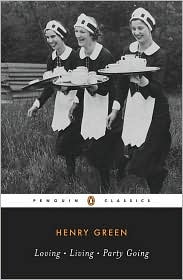
14734471 I have now finished Henry Green’s novel Loving, and while I was tempted to continue reading the two other novels in my edition, Living and Party Going, I decided to save those novels for another time. I would very much like to read more Henry Green at some point, though, because I thought Loving was very good.

It’s the kind of novel where not a whole lot happens. People talk, mainly. In fact, much of the novel is written in dialogue, and the narrator remains aloof, telling us what things look like and who does what, but not digging deeply into people’s thoughts. At times it’s a little like a play where you have stage directions in place of a narrator. It’s not a play, of course — there is a narrator who tells you the basics of what’s going on, but it’s a very distant narrator who refrains from commentary or judgment.

The novel is set during World War II (it’s published in 1945) and tells the story of a family and its servants who are living in a castle in Ireland. Most of these people are English. They are at a distance from the war raging on the continent, but are worried about a possible invasion and also about the Irish Republican Army and are uncertain whether they should  remain in the mild anxiety they are currently living in or venture back to England, where they have family, but where they might be forced to join the military.

We get scenes of the family itself, a mother and daughter-in-law with her children, but spend most of the time with the servants. The story is made up of a series of small events that the servants gossip about: one of the children kills one of the estate’s many peacocks, an expensive ring has gone missing, two of the servants are flirting with each other, and others have fallen in love. The novel follows them around as one woman tries to hide her drinking habit and two young girls giggle at absolutely everything and the nanny gets sick so the children aren’t properly watched after. And then one of the servants finds the daughter-in-law in bed with a man who’s not her husband, and everyone is thoroughly scandalized. The butler spends his time learning how to cook the books and extort bribes so he can set a little money aside for the future.

It’s a quiet picture of how life really is, especially during wartime when there’s a nagging anxiety underlying everything. Conversations circle around the same subjects again and again, and more often than not, people fail to understand each other, especially the servants and those they serve. These two groups try to understand each other, obsess about each other, get frustrated and angry, and then work hard at trying to hide it so that life can proceed as quietly as possible.

The writing is beautiful. The dialogue is done perfectly, capturing the distinct voices of the characters and also the rhythms of typical conversations, the way people repeat things and jump suddenly from one idea to the next. And although the narration is extremely distant, the narrator now and then comes out with beautiful descriptive sentences: “The slow tide frosted her dark eyes, endowed them with facets,” or “He slipped inside like an eel into its drainpipe,” or “When he saw her face which was as it sometimes looked on her bad days so called, pale or blotchy as a shrimp before boiling, he cleared his throat.” He gets the rhythm of sentences exactly right:

She got no other answer than a wail. Then Miss Burch rolled over face to the wall. The cap twisted off her head. Edith gently put it back and because her shiny skull was sideways on that pillow she could only place the cap so that it sat at right angles to Miss Burch’s pinched nose, as someone lying in the open puts their hat to protect their face and terrible eyes.

John Updike wrote the introduction to my edition, and I am perfectly willing to believe him when he claims that insofar as one can learn to write, Henry Green taught him. I’m certainly looking forward to reading more of his work.

14 Comments

Filed under Books, Fiction

Notes

I’m going to start Infinite Jest very, very soon. I’m just not entirely sure when. I’d really like to follow along with the Infinite Summer schedule, and I’m generally very good at sticking to reading schedules, but I haven’t quite gotten around to going up to my study and hauling that book off the TBR shelves. I have been poking around on the Infinite Summer forums by way of preparation, and the various hints I’ve gotten about the book are intriguing. Maybe I’ll start it tomorrow.

I’m almost finished with Vladimir Nabokov’s Lectures on Literature and am about halfway through Mary Brunton’s Discipline. I’m not sure what to think about the Brunton novel. At times I’m enjoying it, and at other times I get annoyed at the main character, a first-person narrator, who does some inexplicable things. The book has enough narrative tension to keep me moving along, though, so I’ll stick with it to see how it all turns out.

And now on to cycling. My race yesterday didn’t go well. It’s a race I hate, though, so the real question is why I keep doing it, not why I didn’t do well. I woke up yesterday morning feeling very draggy, and I never really got over that feeling, even after I’d been out racing for a while. I’m not sure how much of this is physical and how much is psychological; it’s quite possible that I’ve decided this race is so horrible that I psych myself out of doing well.

The race started off okay; we have a neutral start up a long, steep hill, which means that we ride slowly and don’t race until we reach the top. Last year the neutral start wasn’t really neutral — it was too fast to be called that — but this year they kept the start very slow. After that, though, things got worse. We headed down hill, which is an immediate problem, as the roads were wet and the pack kept speeding up and slowing down, forcing me to slam on my brakes as I was flying down the hill. I’m not a particularly fast downhill rider, and the yo-yo-ing the pack was doing made me nervous, so I was slower than usual. That meant that I fell a little behind and had to chase on the flat sections.

And then we hit the hills. I hung on for a while, but soon enough the pack was taking off, and I didn’t have the necessary will, leg muscle, cardiovascular fitness, or all of the above, and I fell behind again. And it was only 8 or so miles into a 50-mile race.

I found some other dropped riders and we rode together for a while, but then I saw Hobgoblin sitting on the side of the rode looking ill. I stopped to see what was wrong, and he didn’t look well at all. He said he’d come down with a migraine right in the middle of the race. He was in a lot of pain and was looking really weak, so we got him a ride in one of the race vans, and I rode back to the start/finish line planning to meet him there.

And that was that. I’m not at all happy Hobgoblin suffered, but I didn’t mind having a good excuse to drop out of what was promising to be a miserable ride. So once again he’s confirmation that hilly road races are not for me. I don’t mind riding up hills, but chasing other, faster riders up hills is truly nightmarish. To make myself feel better about riding in general, I went out on a 40-mile ride this morning, and it was lovely, so all is relatively well. And Hobgoblin seems to be feeling better today.

12 Comments

Filed under Books, Cycling, Fiction

The Other Side of You

Salley Vickers’s The Other Side of You is a lovely, smart, beautiful book. I didn’t fall in love with it, as I thought I might, but that doesn’t keep me from seeing how others might love it and that it has an awful lot to recommend it. I suppose what this tells me that being lovely, smart, and beautiful isn’t enough when it comes to fiction; there also has to be some spark or sense of identification (and not of the easy “I identify with the characters” sort) that a person feels for a book to truly fall in love with it.

It tells the story of David McBride, a psychiatrist, who is treating a particularly challenging patient, Elizabeth Cruikshank, who has tried and failed to commit suicide and who is now resistant to David’s attempts to get her to talk. In the book’s early pages, we learn about David’s life at the same time that we read about his first sessions with Elizabeth. David himself suffered a trauma as a young child: he witnessed his brother’s death as the brother tried to lead him across the street and was hit by a lorry. The narrative is written in the first person from David’s perspective, and David is open from the very beginning about how this tragedy still haunts him, many years later. He has done his best to recover from it, but he knows that this is the sort of event one doesn’t really ever get over.

Eventually Elizabeth does open up and begin to tell her story, which David retells to the reader in a long passages that recreate the scenes Elizabeth lived through. At this point something magical begins to happen to David. He finds himself so profoundly moved by Elizabeth’s story that he begins to think again about his own past and his own wounds, and he begins to move beyond the role of a psychiatrist to relate to Elizabeth as a friend.

One of the things I particularly liked about this book is the way it questions the roles of analyst and patient, particularly the power dynamic that usually exists between the two, with the patient as the needy one and the analyst as the source of healing and guidance. David reveals to us — and eventually to Elizabeth — just how vulnerable and broken he is and how in need of help he is himself. During long conversations in which they both tell their stories, he breaks some of the rules designed to keep boundaries up between doctor and patient and shows as he does so just how complex doctor/patient relationships really are and how mysterious the healing process can be. The dynamic between living, breathing human beings can’t really be contained by professional rules.

Vickers weaves into her story a contemplation of the way art can shape one’s life. Art is what begins the deepening of Elizabeth and David’s friendship: Elizabeth had fallen in love with a man who studied Caravaggio, an artist who has been meaningful in David’s life as well, and it’s David’s mention of Caravaggio that gets Elizabeth to talk in the first place. So bound up in this exploration of love and loss there is also a role for art and beauty, for the way art can express what seems impossible to put into words and the way it can become an inextricable part of the bonds that hold people together.

I’m almost writing myself into liking this book more than I really did. The truth is that I admired all this in a detached kind of way. Reading the book was an intellectual exercise in seeing how Vickers brought her ideas together, rather than an experience of thinking and feeling all at once. I never came to care about the characters all that much, except as ways to explore ideas. I don’t need to identify with characters in the sense of liking them or being able to imagine knowing them in my own life, but I do want to feel that they are alive, that there is some spark there that makes them seem real.

I’m genuinely sorry about this one, because all the elements are there that might make me fall in love with it. But, alas, even when we want to fall in love, sometimes it just doesn’t happen.

8 Comments

Filed under Books, Fiction

The Underground Man

So my education in detective novels continues. The latest book group selection was Ross Macdonald’s The Underground Man, published in 1971, which we discussed at our lovely noir picnic. It’s another hardboiled detective novel like the book we started out with, Dashiell Hammett’s The Glass Key. I’m surprised to find myself enjoying these books. When Hobgoblin told me the plot was convoluted I got a little worried, as I’m usually not fond of having to follow complicated plots. But as it turned out, I enjoyed the challenge (although I’m not sure I actually kept the relationships among all the characters straight).

Macdonald does his plotting very well, and it’s a pleasure to watch it all unfold. He introduces you to a couple characters who then lead you to a few more, and then some more, and then you learn that a couple of the characters know each other, and then that a few others know each other or had an affair or hated each other or some such, and then you learn about more people and more relationships, and the next thing you know, you’ve got a entire web of people and relationships that fits together beautifully. Or rather, not so beautifully, as very, very few of the relationships described are good ones.

This leads me to another thing I liked about the novel, which is that it creates a picture of late 60s/early 70s California in which what’s happening to the people happens also to the landscape. The novel is set in southern California where a forest fire is raging, threatening to destroy houses and neighborhoods. This is a place where people have begun to build where they probably shouldn’t, in areas that nature is going to try to reclaim in one way or another. As the fire rages and mudslides threaten and people try to figure out how to respond, this gets echoed by chaos on the social and moral level in the stories of cruel and incompetent parents, deceitful spouses and lovers, and the general atmosphere of secrets and lies.

There’s something deeply wrong at the core here, and the detective, Lew Archer, can only do so much to help things out. In fact at times he seems to cause more harm than good by dragging to light old secrets that end up causing more conflict. As he is zipping around California trying to find a young boy who’s been kidnapped and trying to piece together everyone’s story, the police and firefighters are busy trying to contain the fire, and all of them seem at the mercy of forces much larger than they are. The firefighters can only hope that the wind blows in the right direction, and Archer can only hope people will tell him the truth and he can do his job without becoming a victim himself. My book group noted the fact that Archer doesn’t seem to be all that great at questioning people and hasn’t figured out much more than is told to the reader, so there’s little sense in the book of any comforting presence or of anybody who has things under control. All anybody can do is to keep trying to figure out the truth and keep trying to straighten things out and hope for the best.

Several people in the book group said that while they liked Macdonald, Raymond Chandler is better. I have yet to read Chandler, and I see that I should, particularly since he often comes up in our discussions. The relative merits of Macdonald and Chandler are obviously up for debate, but at the very least I will have something equally good to look forward to when I finally get around to reading one of Chandler’s books.

13 Comments

Filed under Books, Fiction