Category Archives: Fiction

Art and life and Proust

I have recently come across a beautiful passage from Proust on the relationship of art and life. It is a passage on Vinteuil’s sonata, the famous sonata from which comes the “little phrase” that was so important to Swann as he fell in love with Odette. Now it’s the narrator who is thinking about its significance.

This is what he thinks: upon encountering a new work of art — “new” meaning something recent that departs from established methods and schools — we can’t understand it immediately. We don’t have the background to make sense of it; it seems foreign and chaotic, and maybe ugly. We can’t analyze it — break it into parts — because we can’t get a grasp of the entire thing in order to understand its structure. When we do begin to appreciate the new work of art, we don’t appreciate the right things:

Not only does one not immediately discern a work of rare quality; but even within such a work, as happened to me with the Vinteuil sonata, it is always the least precious parts that one notices first.


When we finally understand the work more fully, those things we valued at the beginning of the process, we have now forgotten. And here is his conclusion:

Because it was only in successive stages that I could love what the sonata brought to me, I was never able to possess it in its entirely — it was an image of life.


If we were to possess life entirely, it would have to be from the perspective of death, wouldn’t it? Otherwise, we are always changing and so can’t possess a thing in flux. But because we are changing constantly, our understanding of art is constantly changing, so we can’t possess the work of art either. Art isn’t so much a way of getting life to stand still as it is a way of charting its movement.

Proust elaborates:

But the great works of art are also less of a disappointment than life, in that their best parts do not come first. In the Vinteuil sonata, the beauties one discovers soonest are also those which pall soonest, a double effect with a single cause: they are the parts that most resemble other works, with which one is already familiar. But when those parts have receded, we can still be captivated by another phrase, which, because its shape was too novel to let our mind see anything there but confusion, had been made undetectable and kept intact; and the phrase we passed by every day unawares, the phrase which had withheld itself, which by the sheet power of its own beauty had become invisible and remained unknown to us, is the one that comes to us last of all. But it will also be the last one we leave. We shall love it longer than the others, because we took longer to love it.


I like what this says about art; I’m not sure I like what it says about life. About art, this tells me that some of the greatest pleasures to be had are those I have to wait and work for. It tells me, as I think about my post from a couple days ago, that pleasure and effort and patience are not opposed. If I stick with a difficult and bewildering work of art, it will begin to reveal beauties to me.

About life, Proust implies that the best parts come first, that we have the greatest access to beauty when we are young. I’m not sure I like this because I find it depressing, and also because I’m not sure it’s true. Perhaps we have more intense experiences of life when we are young — perhaps — but surely the nature of one’s experiences become deeper and more complex. Surely there is beauty in life that witholds itself until we have been patient long enough to see it revealed.

Leave a comment

Filed under Books, Fiction

Dracula

I reached my goal for the weekend: I finished Dracula, and what fun it was! The ending is very tense and exciting. And so now my rather lame RIP challenge is finished, only one book, and it’s not even October yet. I have time to read more RIP books if I like. We’ll see.

I thought the book was good in a number of ways, most of all, perhaps, because it was a great story. It’s a relatively long novel, but Stoker kept the tension high throughout. He’s fabulous at creating the frightening, eerie mood that this novel absolutely must have. The parts that take place in Transylvania — at the beginning and the end — are the most exciting and atmospheric, but the middle parts in England maintain the momentum.

The book is also good in ways Stoker might or might not have intended: it strikes me as the perfect late 19C novel (1897), reflecting so precisely so many of the period’s preoccupations. It’s about the too-thin veneer of order and rationality that we sometimes think is all of life, and how easily this gets ripped away to reveal the chaos and irrationality beneath. The book is full of train time tables and business accounts, signs of an orderly society at work, but order and rationality are at war with the supernatural. Nice, neat categories such as “alive” and “dead” are disturbed and forced to make room for the “undead” vampire. Up until the very end, the time tables are there, symbols of “civilization,” weapons the characters must wield against Count Dracula, whose powers and actions defy the rules that generally govern humanity.

The book is also about very weird and disturbing gender dynamics, and it’s obsessed with sexuality. You have the typical Victorian bifurcated view of women: Lucy, for example, the innocent, beautiful, sexually-attractive-but-pure, soon-to-be wife and angel of the house at first, who then transforms into a lustful, aggressive, evil vampire who must be killed. The issue is complicated, however, because while the men in the novel insist that Mina, the other main female character, remain out of their planning to destroy Dracula, they soon learn that Mina is precisely the one they need to track him down. It’s her good memory for those train tables and her forceful logical thought that save them in the end. The women in this novel are either perfectly pure or perfectly corrupt, but it is a woman who employs the stereotypically male power of logic to deduce Dracula’s whereabouts at a crucial moment in the story.

And Stoker has way too much fun playing around with images of sucking people’s blood and blood transfusions and exchanges of blood as thinly veiled sex acts. Sexuality is equated with vampirism, showing how a fear of and obsession with sex underlie Victorian staidness. Sex haunts the book, just as do a fear of the supernatural and of death.

I think Dracula belongs to the class of book which is at least as interesting for the ways it reveals something about the culture it came out of as it is for its story and characters. Any book will reveal something about its time and place of origin, but some books sum up what’s characteristic of its time and place so well that that becomes one of the chief pleasures of reading it. This novel is quite like The Monk and The Castle of Otranto in the way they all are often a bit sloppy and sometimes unintentially hilarious (well, maybe this is intentional?) but very good and interesting nonetheless, because of the energy and pleasure that obviously went into the writing and also because of the way they so perfectly speak to their times.

This book certainly has its flaws: I wished Stoker hadn’t bothered with the accents, especially Van Helsing’s, which is horribly distracting, and, like the accent of a bad actor, comes and goes. And not only are the gender stereotypes pervasive, but the national stereotypes are as well. The American character, Quincy Morris, made me laugh; he was from Texas, of course! and was rather cowboy-like. And the farther east the characters traveled across Europe, the more “primitive” and superstitious and irrational the natives became. But the book was just too much fun to let its flaws get to me.

If you’ve read Dracula before and are looking to read it again at some point, I highly recommend this edition. It’s not good for a first-time read (as mine was) because the footnotes are very intrusive and give away parts of the story early on, but it’s excellent for a re-reading. The footnotes are thorough and very funny in places; you can see my delighted posts on them here and here. They are the footnotes of a book-lover as well as a scholar, and they make good reading in and of themselves.

Leave a comment

Filed under Books, Fiction

Proust and the inconsistency of emotion

One of the things I’m enjoying in my Proust reading is the way he captures the waywardness of the mind and emotions, the manner in which a person can feel one thing in one moment and then the opposite in the next. He describes the contrariness of emotion and desire so excruciatingly well; I recognize my own shifts and variations and inconsistencies in Proust’s characters.

Towards the beginning of In the Shadow of Young Girls in Flower, the narrator talks a lot about his desire to be a writer and his confidence, or lack of confidence, in his ability to write. And his feelings change constantly. When the narrator’s father says about the narrator’s desire to write that “The main thing is to enjoy what one does in life. He’s not a child anymore, he knows what he likes, he’s probably not going to change, he’s old enough to know what’ll make him happy in life,” he has a strange response. He knows he should be happy because his father had wanted him to be a diplomat, and now, instead, he’s getting permission from his father to do what he’s dreamed of — be a writer. But instead:

On this occasion, much as an author, to whom his own conceptions seem to have little value because he cannot think of them as separate from himself, may be alarmed at seeing his publishers putting themselves to the trouble of selecting an appropriate paper for them and setting them in a typeface that he may think too fine, I began to doubt whether my desire to write was a thing of sufficient importance for my father to lavish such kindness upon it.


Now that his father is taking his desire to be a writer seriously, he’s not so sure that he’s worthy of it. And this proclamation from his father makes him nervous for other reasons; his father’s statement that he’s old enough to know what he likes and that he won’t change has made him realize that his life has truly begun. He is no longer on the threshold of life, full of possibility, but instead is already living, and, what’s worse, his life may not change all that much. Isn’t it often true that when we finally get the thing we’ve been longing for, we realize it’s a disappointment, or that we didn’t really want it, or that getting what we want just creates a whole new set of problems?

Near the above passage, Proust offers another example of the inconsistency of our minds and emotions:

Think of the travelers who are uplifted by the general beauty of a journey they have just completed, although during it their main impression, day after day, was that it was a chore.


He talks about the “promiscuity of the ideas that lurk within us.” Isn’t that a great way to describe what living in one’s mind is like? It’s true for me, certainly. That example of the traveler works particularly well for me, because I’m reminded of my backpacking trips, which I have fond memories of, many great memories, and yet when I try hard to remember what each moment actually felt like when I was backpacking, I have to admit that it was a lot of pain, misery, boredom, and unhappiness.

So which is it? Are my backpacking trips wonderful or terrible? Does the narrator want to be a writer or not? The answer depends on the moment you are asking the question.  postCountTB(’11

Leave a comment

Filed under Books, Fiction

More footnotes

I’m reading slowly these days, although fairly steadily; I’m maybe 1/3 of the way through Dracula, and finding some more funny footnotes, although nothing as good as the ones here. The editor gets pedantic about the ways the blood transfusions in Dracula are completely unrealistic, peppering the narrative with corrective comments. Here are a whole series of footnotes to a passage that’s about a page long:

In real life the hugger-mugger blood transfusions that follow would almost certainly kill both donor and patient, since no effort is made by Van Helsing or Seward to match blood types, which, in any event, they could not have known about until nearly three decades later. For those living at the end of the twentieth century, in the age of AIDS, this can be an especially poignant scene.

Veins are never empty. They are full of serum plus red blood cells.

The brightest blood is dilute, anemic blood. On the other hand, adequate normal blood is dark.

Stoker lays the groundwork for the erotic meaning of the blood transactions that are to come.

Narcotics are for pain; narcoleptic drugs and hypnotics are for sleep.

Fibrin is the clotting material in blood.

Did he transfuse the blood directly or use a receptacle?

If the loss of blood was telling on Arthur, it would be because he had given Lucy more than two pints of his own blood. The healthy adult human body has four or five quarts of blood flowing in it. Modern bloodbank practice is to limit blood donations to one pint at prescribed intervals.


It makes its own story, doesn’t it? It IS rather Pale Fire-like.

This footnote made me laugh out loud; to understand its humor, you have to remember that there are no llamas or monkeys in the book (as least as far as I know — although other animals are important), and military bands make no appearance whatsoever:

The Zoological Gardens, in the northwest corner of Regent’s Park, were open daily from 9:00 A.M. to sunset. Admission was (in Stoker’s time) one shilling, except on Monday, when it was sixpence. Children were half price. In a more God-fearing age than ours, the zoo was closed on Sunday.

On summer Saturdays at 4:00 P.M. there was a military band concert at the zoo.

Visitors were cautioned not to get too close to the llamas “on account of [their] unpleasant expectorating propensities.” The unpleasant odor of the monkey house was “judiciously disguised by numerous plants and flowers.”

Readers of Dracula will want to know that unaccountably the zoo’s bats were kept in the monkey house.


I love the “God-fearing age” detail and I do wonder, I really wonder, why the editor thought expectorating llamas and smelly monkeys were necessary to mention. And okay, there IS a bat in the book, a very important one, but why I’d want to know that the zoo’s bats were kept with monkeys I’m not sure.

And finally, another reassurance that our editor is doing his research. Here’s a passage from the novel:

We went round to the back of the house, where there was a kitchen window. The Professor took a small surgical saw from his case, and handing it to me, pointed to the iron bars which guarded the window. I attacked them at once and had very soon cut through three of them.


Here’s the footnote:

An unlikely story. An energetic undergraduate, using a modern high carbon steel surgical saw against an iron strap one eighth of an inch thick, was able to cut one-fourth of an inch into the strap in half an hour. Assuming that Seward was cutting into bars of modest thickness, three quarters of an inch per bar, the task of cutting three such bars should have taken five hours. This is to say nothing about the condition of the surgical saw which, in the modern experiment, was rendered nearly useless for iron bars and absolutely useless for surgery.

On the other hand, Seward was desperate.


So how’s that for active, experiential learning?

Oh, and I do like Dracula itself, very much. One day I’ll post on it. It’s just that the footnotes are so … great.

Leave a comment

Filed under Books, Fiction

Dracula

I’ve begun reading Dracula and am discovering how closely it adheres to the gothic style, particularly that of Ann Radcliffe, two books of whose I’ve read, The Mysteries of Udolpho and The Italian. You have the journey south and east across Europe, complete with stereotypes of superstitious Catholics, exotically-dressed locals, threatening wild beasts, and dangerous climbs over rocky crags. You have the lengthy descriptions of nature, which is both beautiful and threatening — although I should say it’s sublime, to use the appropriate aesthetic term. You have the ever-increasing chaos and uncertainty the further from England the traveler ventures. It’s all quite familiar to this avid-eighteenth-century novel reader, except for the trains, but they fit into the pattern as well: “It seems to me the further East you go the more unpunctual are the trains. What ought they to be in China?” We have a punctual, time-table-driven, proper Englishman — this part strikes me as the Victorian contribution to the eighteenth-century tradition — traveling to the “exotic” east.

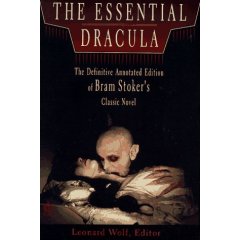
The introduction to the novel amused me; the editor gives a brief history of gothic novels and vampire stories, and he’s got some rather strong opinions on things that he’s not afraid to share (I’ve got The Essential Dracula, subtitled The Definitive Annotated Edition of Bram Stoker’s Classic Novel). On The Castle of Otranto, he says:

I am myself fond of Otranto without being either moved or surprised by it. It seems precisely the sort of novel a neurasthenic antiquarian with bad dreams and plenty of time on his hands would write in two months time “without knowing in the least what [he] intended to say or to relate.”


He admires Radcliffe somewhat more:

With Ann Radcliffe’s The Mysteries of Udolpho (1794), we have the first fully realized Gothic romance in the history of the genre. Despite its sometimes endless descriptions of places to which its author had never been; despite lapses into fifth-rate poetry; despite even its author’s insistence on demystifying her first-rate mysteries, the work has a compelling fascination that commands respect.


High praise, yes? His description of Matthew Lewis’s The Monk strikes me as about right:

Lewis, at nineteen, as Walpole did at forty-seven, wrote his book at top speed, finishing it in the space of ten weeks. The Monk is a work of wonderful adolescent gusto. The young Lewis intensely enjoyed the lustful and violent extravagances of his villain, Ambrosio, and devoted himself to giving them to us in every macabre and delicious detail.


He does not at all like John Polidori’s The Vampyre:

The Vampyre is a work almost without merit, having neither memorable characters, a plot worth pursuing, nor any noticeable style,

but he likes another vampire tale, Thomas Presket Prest’s Varney the Vampyre a bit better:

Varney the Vampyre (1847), a work that has no literary pretensions, is for that reason much more fun to read. The book is an enthusiastic potboiler whose energy almost never flags.


I wouldn’t take this editor’s judgments too seriously, but he does capture the feeling of a lot of these books, which, with the possible exception of Radcliffe, are more about having a lot of fun than taking care with craft. And there’s something wonderful about writing a novel solely in order to have some fun, I’d say.

Leave a comment

Filed under Books, Fiction

Swann’s Way

So I’ve now finished the first volume of Proust’s novel (and I’m counting each volume as a separate book!). It’s taken me about two months to read the entire thing; I’ve been reading in small chunks of about 10 pages or so, and read about 50 pages a week. For me, that’s the perfect way to read it; regularly enough to keep the story and ideas fresh in my mind, but at a slow enough pace to absorb it and to keep from feeling bogged down. This is most definitely not a book to rush.

And I’ve found it so very rewarding. Proust’s sentences are beautiful, long and digressive and convoluted, but they do yield their meaning, even if I have to read them a couple of times and turn the pages back and forth and back and forth to piece everything together. The book has sections that read quickly as well, particularly in the long middle section that tells the story of Swann and Odette. Here I found myself getting caught up in the story and the pages flew by. But best of all are Proust’s insights into consciousness, into what it’s like to be a young boy, for example, a very intense, intelligent, yearning young boy. We see him as both a little ridiculous – one of the things I liked was how I could imagine exactly why his parents found him exasperating – and as completely sympathetic and awe-inspiring and wonderful. His longing for his mother, and later for Gilberte, is moving; we know that such an intense, emotional child is bound to experience much struggle and pain.

This volume does have a carefully-wrought structure, although one entirely of Proust’s own devising; we begin with the unnamed narrator and a story of longing, and we end with that same narrator, a little older, longing still. All through the novel, Proust explores the way the mind mediates our experiences, shaping them through memory or desire; he considers how art affects his characters – the crucial role music and painting play in Swann’s love affair with Odette, for example. The novel is very much about reading; we learn a little about the narrator’s reading habits and desires in the first section, but also characters attempt to read one another, Swann desperately trying to understand Odette, the narrator reading much into everything his mother says, and then at the end turning the same attention toward Gilberte. The book trains readers to pay close attention, to their own minds and to other people and to the world. It contains some of most beautiful, detailed descriptions of nature I’ve read.

And the novel’s length strikes me as necessary, and not only because Proust needs the length to say what he wants to say about his characters and his ideas; there is something about living with this book for a long time, in much the same way that in reading Clarissa we come to feel like she is a companion, that we live with her, that we know her and she is a part of our lives. In Proust, we spend many, many hours luxuriating in the complexity of the mind and of emotion. We are forced – if we read carefully – to experience things slowly and to pay attention, to dig deeply into life.

And the way the narrative moves around in time, from the narrator as an older man describing himself as he is now, to the narrator telling stories from his childhood, to the narrator telling Swann’s story which took place before he was born, forces us to consider how our experience of time differs from “regular” clock time. In our minds, we move through time, back and forth, from past to present to future, easily and quickly. Proust’s central theme is memory, that capacity that holds us together and gives us a coherent identity. Except that our memories are not ours to control. A coherent identity may be an illusion, one fostered by memory, our ability to hold together disparate chunks of time, and undermined by memory too, since we can remember and forget involuntarily.

I’m looking forward to the other volumes; I’m curious about what Proust does with plot, oddly enough, perhaps. What will happen to these characters? Or will we even stay with these characters, or move on to others? But most of all, I’m looking forward to the company of Proust’s prose and his mind.

Leave a comment

Filed under Books, Fiction

Alison Lurie’s The War Between the Tates

I’ve begun Alison Lurie’s novel The War Between the Tates, and I’m finding it quite good. It’s a family drama, and it’s also an academic satire, although not a satire in the comic mode of Jane Smiley’s Moo or Richard Russo’s Straight Man. It has funny moments, but the predominating mood is serious. Brian Tate, the husband, is a political science professor who has dreamed of being an important political consultant, although he now knows he never will be. He begins an affair with a graduate student (we learn this early on — no spoilers here) and the quality of his life plummets from there.

The novel begins with his wife Erica who has recently realized that she hates her two children, Jeffrey and Matilda. They have reached the sullen early-adolescent age, and have become unbearable. I like the way she is honest with herself about this feeling; while she’s no child abandoner or neglecter, and while I’m left thinking that she must, deep down, feel loyal toward her children, the feeling of hatred penetrates fairly deeply. I felt conflicted as I read about this relationship because I was just such a sullen, unbearable, anger- and frustration-inducing adolescent myself. I understand completely why the children act as they do, and I understand completely why Erica hates them for it. If I ever have children, which is most definitely not in my future plans anywhere right now, I’m certain I’m going to have just such a sullen child myself, because I deserve it completely. So Erica is unhappy in many ways, and she is learning just how much of this is her husband’s fault — he’s at fault for the affair, of course, but also for manipulating her and shutting off opportunities for her and generally being insufferable. This is a story of Erica beginning to take some control of her life.

I like Erica’s character, and I also like the narrator’s way of dealing with Brian, who is very much a jerk, but the narrator lets us see his thought processes and motivations in such a way that makes him understandable, if not likeable. And Brian’s character offers some great opportunities for academic satire:

Teachers, especially university professors, often have an elective affinity with their subjects. Whether through original tropism, conscious effort, or merely long association, language instructors born in Missouri and Brooklyn look and act remarkably like Frenchmen and Italians; professors of economics resemble bankers; and musicologists are indistinguishable from musicians …

These affinities also profoundly influence the functioning of the various Corinth University departments. They determine, for instance, which academic issues will take the longest to resolve and arouse the strongest feelings. Members of the Maths. Department tend to quarrel over the figures in their annual report, and members of the English department over its wording. In Psychology, analysis of the personality traits of candidates for promotion sometimes ends in ego-dystonic shouting; and the controversy over the new men’s washroom in the Architecture Building (during which two professors who had not designed an actual building in twenty years came to blows) has already passed into University annals.


But the political science department is the worst:

Since every member of the Political Science department is in outward manner and inner fantasy an expert political strategist, every issue provokes public debate and private lobbying. Even when there is little at stake, eloquent speeches are made; wires are skillfully pulled and logs rolled out of simple enjoyment of the sport.

We get a wonderful description of a political science department meeting, which, as you can imagine, is excruciating.

I think this book is extremely well written; the novel is set during the Vietnam War, and the war, besides hovering in the background of the plot, becomes a metaphor for what is happening to the family:

Brian and Erica, like their friends, students, and colleagues, have spent considerable time trying to understand and halt the war in Vietnam. If he were to draw a parallel between it and the war now going on in his house, he would have unhesitatingly identified with the South Vietnamese. He would have said that the conflict, begun a year or so ago as a minor police action, intended only to preserve democratic government and maintain the status quo — a preventive measure, really — has escalated steadily and disastrously against his and Erica’s wishes, and in spite of their earnest efforts to end it. For nearly two years, he would point out, the house on Jones Creek Road has been occupied territory. Jeffrey and Matilda have gradually taken it over, moving in troops and supplies, depleting natural resources, and destroying the local culture.


And Lurie goes on in this vein for another couple of pages. The cleverness of the writing doesn’t distract from the family drama; rather, it provides some comic relief from a dark tale. I’m impressed with the way Lurie effortlessly places the story in the context of the war and of the feminist movement without any awkward exposition; it comes naturally through the characters’ conversations and the narrator’s descriptions of the family dynamics.

I’ve only read the first half of the book so far; I’ll be sure to let you know how I like the second half.

Leave a comment

Filed under Books, Fiction

More Elizabeth Taylor

I finished Elizabeth Taylor’s The Sleeping Beauty recently, the second Taylor novel I’ve read in a few months. I like reading multiple books by the same author like this — I did this also with Muriel Spark recently — but I don’t do it much. Too many other books by new authors I haven’t read before are out there enticing me to try them. But spending a little more time with an author than just one book yields so many insights into the way that author works. To put it in boring English teacher terms, you can do some comparing and contrasting and draw some deeper conclusions.

I’m seeing about Taylor that she writes about middle-aged women very well; both books I’ve read have women of that age at their center. The Sleeping Beauty has a younger woman as a love interest — the sleeping beauty herself, but at least as interesting is Isabella, a widow with a grown son, who hopes to be the love interest and is disappointed. In a Summer Season tells about a woman who has married a significantly younger man and how this enlivens and disrupts her rather sedate life. Taylor writes about middle-class sexual repression and expression extremely well. The Sleeping Beauty isn’t set in a town called Seething for nothing. Isabella and her friend Evalie spend a significant amount of time and money on beauty treatments trying to make themselves look younger and more sexually attractive, all the while interfering when they can in the love lives of others. The class issue arises most clearly when Isabella insults her son’s girlfriend, who is a nanny, and therefore unacceptable for her educated, talented son. Another character, Rose, does what she can to keep her sister Emily locked up in the prison of her home, keeping her from wandering out into the larger world where she might meet a man who will take her away.

And yet the surface of Taylor’s novels is serene and quiet. Both books took a while to get some momentum, and, although events do happen in them, they don’t happen often and they aren’t described dramatically. These are books that you should read slowly, because if you rush through them, you might miss the subtle dynamics of a conversation, which is where the story lies. Taylor excels at writing scenes charged with emotion, but with emotion that is usually kept hidden, below the surface. She is at her best in The Sleeping Beauty describing a particularly excruciating tea with Isabella, her son, his girlfriend, and two other guests, an event that goes so horribly wrong I’m left cringing at the brutality of it, even though no actual violence occurs. Middle-class decorum is forever at odds with jealousy, fear, and fury. And hypocrisy — Isabel and Evalie condemn gambling one moment and the next moment are whispering to each other about what horse to bet on. They both project self-satisfaction and self-righteousness, but their actions are, arguably, the cruelest in the novel.

I like the way Taylor shows the dark side of lives that seem so sedate and ordinary. Behind any normal-looking comfortable small-town or country home can lurk suffering and longing and regret. And most of all — interesting stories.

Leave a comment

Filed under Books, Fiction

The Island of Dr. Moreau

I’m not sure if I’m supposed to be posting on this today or tomorrow, but I figure that if it’s supposed to be tomorrow, you all can come back and read this then. I’m also not going to do this book justice, since I read it in a rather distracted state of mind. I felt as I was reading that I should re-read in order to fully appreciate it, but I didn’t have the time.

At any rate, I enjoyed the novel very much. This is my first experience of Wells, and I’m tempted to read the two other novels in my edition, The Time Machine and War of the Worlds. I’m curious what people make of the frame narrative – is there something complicated going on here, or is it simply by way of explaining and setting up the narrative to follow? Wells participates in an old tradition of frame narratives, whether it’s the frame story of escaping the plague in Boccaccio’s The Decameron or the multiple frame narratives that encircle the creature’s narrative in Frankenstein, or the explanation Defoe gives at the beginning of Robinson Crusoe that the narrative is a true one that Defoe had stumbled upon and decided to publish. Wells’s use is certainly not as complicated as Mary Shelley’s was, but the frame does give the reader a sense of the mysteriousness to come in the main narrative, and it tells us the interesting fact that Prendick “subsequently … alleged that his mind was a blank from the moment he escaped from the Lady Vain.” Did he find that his attempts to explain what he saw on the island were so impossible that he gave it up and simply said his mind was blank to avoid explanations entirely?

I’m reminded of Hawthorne’s story “Young Goodman Brown” where Brown journeys into the woods, discovers the horrors that (supposedly) exist in the human heart, and returns home a changed man, unable to live at peace with his family again. And also Gulliver, who after his travels becomes a bitter, cynical man. In both of these books, and in Wells’s novel too, one of the central questions is about what it means to be human: are humans like the houyhnhnms or the yahoos, or neither? The ending of the novel is moving; Prendick lives in fear and horror of his fellow humans and isolates himself from people, devoting his time to scientific studies. He writes:

They say that terror is a disease, and anyhow, I can witness that, for several years now, a restless fear has dwelt in my mind, such a restless fear as a half-tamed lion cub may feel. My trouble took the strangest form. I could not persuade myself that the men and women I met were not also another, still passably human, Beast People, animals half-wrought into the outward image of human souls, and that they would presently begin to revert, to show first this bestial mark and then that.


At the heart of the novel, I think, is the conversation between Prendick and Dr. Moreau where Moreau explains the nature of his experiments. This dialogue is all about the relationship of human beings and animals – a topic that has fascinated writers since the time of Gilgamesh, another work that tries to define humanity by considering how people differ from the gods on the one hand and the beasts on the other. The question in Wells’s novel centers around pain – what it means to be able to feel pain and how we should respond to our own pain and that of others. Moreau says:

For it is just this question of pain that parts us. So long as visible or audible pain turns you sick, so long as your own pains drive you, so long as pain underlies your propositions about sin, so long, I tell you, you are an animal, thinking a little less obscurely what an animal feels … A mind truly opened to what science has to teach must see that [pain] is a little thing.


Pain is an aspect of animal experience, not human, according to Moreau; as humans separate themselves from the animal world, pain will carry less and less significance. That he brushes aside Prendick’s objections to his cruelty shows that he has lost something essential to his humanity and has become much less than an animal, which would never behave as cruelly as he has. By working so horribly on animal bodies and denying the significance of the pain they experience, Moreau shows his abhorrence of bodies in general – he desires to leave the body and all its weaknesses behind. But in denying the body, he perverts human nature into something it’s not – the body is as central to human experience as the mind.

Moreau cannot succeed in turning animals into humans to his satisfaction because he misunderstands what it means to be human and animal both. He says of his animal/human creations that:

Least satisfactory of all is something that I cannot touch – somewhere – I cannot determine where – in the seat of the emotions. Cravings, instincts, desires that harm humanity, a strange hidden reservoir to burst suddenly and inundate the whole being of the creature with anger, hate, or fear.


He wants to drive what he sees as the beast out of the human, and yet what he considers “beast” – the body that feels pain and experiences instincts and cravings – is inseparable from the human. Prendick separates himself morally from Moreau when he recognizes the humanity of one of Moreau’s creations:

It may seem a strange contradiction in me – I cannot explain the fact –, but now, seeing the creature there in a perfectly animal attitude, with the light gleaming in its eyes, and its imperfectly human face distorted with terror, I realized again the fact of its humanity.


This is a redeeming moment for Prendick, who, rather than allowing this creature to enter Moreau’s torture chamber once again, shoots it. This is an act of mercy.

Okay – there is so much more going on in this novel, but I’ll leave it up to my fellow Slaves to point those things out.

Leave a comment

Filed under Books, Fiction

The Fountain Overflows

I have become a Rebecca West fan. The Fountain Overflows is a marvelously moving and entertaining read. I really had no idea what to expect when I picked the book up, knowing little about West or the novel beyond the fact that several bloggers recommended her. What I found is a novel with a captivating voice.

It’s about a family around the turn of the century – 19th to 20th – that is unconventional, musical, and troubled. The father is recognized as a great writer, but he gambles away any money he earns and doesn’t know how to make people happy and keep a job – and he isn’t interested in learning how. The mother had a promising career as a pianist earlier in her life, but now spends her time and energy caring for her family and teaching two of her daughters how to play. There are four children; the eldest, Cordelia, plays the violin and hopes for a professional career although the rest of the family is convinced that she has no talent. There are twins, Mary and Rose, and it is Rose who tells the story, writing as an adult looking back on her childhood. And then there is Richard Quin, the youngest, who has many talents, including a brilliant imagination and an uncanny ability in one so young to smooth out social awkwardness.

Although the story is clearly told from an adult perspective, I often forgot and thought I was hearing Rose’s voice as a child. One of the things I found so captivating about the novel is the way the narrator switches so easily and seamlessly from one mode to another: from what seems to be a child’s voice telling the story as it happens to the adult’s view of a childhood long gone by. When we are in the story, as opposed to getting adult commentary on the story, the novel’s language isn’t childlike exactly, but it does seem to be what Rose would be thinking and saying as a child and the language is such that I could imagine a precocious child using it.

Rose and her siblings are truly captivating characters. The children have witnessed and experienced much uncertainty and trouble, and they do their best to make sense of their situation, and the three youngest children, at least, cling together, comfort each other, and in many ways behave like adults, trying to take care of their mother, who can be more childlike than the children:

We were beginning to understand that Mamma would in some respects always be younger than we were, perhaps because she had not had as trying a childhood as we had had, and that for her sake we had sometimes to treat her with positive low cunning, to get round the fact that she was supposed to be older than us in all ways instead of just a few.

They are future artists in training, devoting themselves to their music. They are also social misfits, partly because of their unconventional family history, partly because of their eccentricity. This is true for everyone except Cordelia; while the younger children take their isolation and their social ostracization as a natural state, Cordelia fights against it.

I often laughed as I read about the children’s imaginations, their games, and made-up stories. And the description of the tight-knit family bond, at least among the mother and the three younger children, was moving – it’s enough to make you want to be a part of this family, as troubled as it is. But most of all, the pleasure of this book lies in following Rose’s childhood – and adult – attempts to make sense of her world. I didn’t want to leave the company of her intelligent, imaginative, passionate mind.

Leave a comment

Filed under Books, Fiction

My books are talking

This is getting quite strange. I was reading Elaine Scarry’s book recently where she talks about the gaze: whether gazing at a beautiful person or object can harm she/he/it, and then I turned to Proust for a while, and he was talking about the same thing! Not whether the gaze causes harm or not, but how gazing works for both the gazer and the gazed upon. I’m reading these two books at the same time purely by accident; I had no idea they spoke to each other so well.

Scarry takes up the argument against beauty that “when we stare at something beautiful, make it an object of sustained regard, our act is destructive to the object.” She quickly dispenses with the idea that gazing at beautiful objects might cause them harm, and takes up the issue of gazing at beautiful people, which is more complicated. She doesn’t dwell on the exact nature of the problem, but the idea is that by gazing at a beautiful person, the gazer turns that person into an object existing for the enjoyment of the gazer and denies the subjecthood of the person gazed upon. All the power, in this view, is with the one gazing, and none with the gazed upon. She counters this view by reminding us that:

It is odd that contemporary accounts of “staring” or “gazing” place exclusive emphasis on the risks suffered by the person being looked at, for the vulnerability of the perceiver seems equal to, or greater than, the vulnerability of the person being perceived. In accounts of beauty from earlier centuries, it is precisely the perceiver who is imperiled, overpowered, by crossing paths with someone beautiful.

And then Scarry gives a wonderful example:

Plato gives the most detailed account of this destabilization in The Phaedrus. A man beholds a beautiful boy: suddenly he is spinning around in all directions. Publicly unacceptable things happen to his body. First he shudders and shivers. Then sweat pours from him. He is up, down, up, down, adopting postures of worship, even beginning to make sacrifices to the boy, restrained only by his embarrassment to be carrying out so foolish an activity in front of us. Now he feels an unaccountable pain. Feathers are beginning to emerge out of his back, appearing all along the edges of his shoulder blades. Because this plumage begins to lift him off the ground a few inches, he catches glimpses of the immortal realm. Nonetheless, it cannot be denied that the discomfort he feels on the inside is matched by how ridiculous he looks on the outside.

So the gaze, in this account, is not a form of control over the object gazed upon; instead, it is a way to access beauty which can leave the gazer vulnerable and foolish, which can wrest self-control from the gazer, which can transform the gazer into something new.

Scarry says that the encounter with a beautiful person or object can affirm the aliveness of both — the one encountering beauty feels more alive himself or herself and the beautiful person or object “has conferred on it by the beholder a surfeit of aliveness: even if it is inanimate, it comes to be afforded a fragility and consequent level of protection normally reserved for the animate.” She says:

Beauty seems to place requirements on us for attending to the aliveness or (in the case of objects) quasi-aliveness of our world, and for entering into its protection.

Beauty is, then, a compact, or contract between the beautiful being (a person or thing) and the perceiver. As the beautiful being confers on the perceiver the gift of life, so the perceiver confers on the beautiful being the gift of life.

And then I come to Proust. When he writes, “And — oh, the marvelous independence of the human gaze,” you can imagine how I perked up. In the passage where he first sees Mme. de Guermantes, he writes about the gaze as that which transforms the gazer. First, he praises the gaze itself:

And — oh, the marvelous independence of the human gaze, tied to the face by a cord so lax, so long, so extensible that it can travel out alone far away from it — while Mme. de Guermantes sat in the chapel above the tombs of her dead, her gaze strolled here and there, climbed up the pillars, paused even on me like a ray of sunlight wandering through the nave, but a ray of sunlight which, at the moment I received its caress, seemed to me conscious.


Mme. de Guermantes’s gaze, here, does not claim control or power over the narrator; rather, it feels like a conscious ray of light — it is life-giving, instead of life-taking. It is a caress, a recognition and celebration of the narrator’s existence. And then the narrator gazes at her:

I felt it was important that she not leave before I had looked at her enough, because I remembered that for years now I had considered the sight of her eminently desirable, and I did not detach my eyes from her, as if each gaze could physically carry away, and put in reserve inside me, the memory of that prominent nose, those red cheeks, all the particular details that seemed to me so many precious, authentic, and singular pieces of information about her face … I was impelled to consider it beautiful by all the thoughts I had brought to bear on it …

The narrator’s gaze upon Mme. de Guermantes does two things: it bestows on her qualities of beauty and authenticity — it affirms her value and aliveness — and it changes the narrator. It creates in him memories he will carry with him forever. When he sees her, he is moved to say (and beauty does move us to action, in this case, to speaking out loud):

“How beautiful she is! How noble! What I see before me is indeed a proud Guermantes and a descendant of Genevieve de Brabant!” And the attention with which I illuminated her face isolated her to such an extent that today, if I think back to that ceremony, it is impossible for me to see a single one of the people who were present except for her and the verger who responded affirmatively when I asked him if that lady was really Mme. de Guermantes.


The memory of Mme. de Guermantes he now carries with him will affect his perceptions of the world. He will remember, also, Mme. de Guermantes’s gaze upon him, a memory that becomes a part of his being:

Recalling, then, the gaze she had rested on me during Mass, as blue as a ray of sunlight passing through Gilbert the Bad’s window, I said to myself: “Why she’s actually paying attention to me.” I believed that she liked me, that she would still be thinking of me after she had left the church, that because of me perhaps she would be sad that evening at Guermantes. And immediately I loved her …

This is a scene (p. 180-1 in the Davis translation) of the gaze as an action that transforms the gazer and the one gazed upon — it transforms them, as Scarry says, by affirming their value and aliveness. It is a reciprocal event, a compact, bringing benefits to both.

I couldn’t believe my luck in coming across Scarry’s philosophical proposition and then Proust’s embodiment of that proposition in the same day. And I’ll add that as I write about what I read in this blog, I feel that I’m living out Scarry’s idea that beauty provokes people to action, specifically to reproduce or to imitate the beauty they encounter: when I encounter something beautiful in my reading, I can reproduce it here and then reflect on it — it’s a way of being an active rather than passive reader and it’s a way of perpetuating the beautiful books and passages I come across.

Leave a comment

Filed under Books, Fiction, Nonfiction

The Fountain Overflows

This book is delightful. I’m maybe 1/3 into it, and I’m particularly loving its portrayal of childhood. The story is told from the perspective of Rose, a child, who narrates the story of her family — two rather unusual and difficult parents and her three siblings. Check out this passage:

Together we met a lot more made-up animals, or rather discovered that a lot of real animals were made-up ones too. Once we went as far as Richmond Park and found a vast empire of rabbits who had odd political troubles, and a small and aristocratic community of deer who were terrible snobs. Papa overheard us talking about them, and explained that the older deer were evidently trying to preserve the Habsburg system of protocol, while the young ones wanted to introduce the easier German and English system. We instantly recognized that was true.


This is the view Rose’s mother has of children, as narrated by Rose (and I think perhaps this is West’s view too):

Moreover she understood children, and knew that they were adults handicapped by a humiliating disguise and had all their adult qualities within them.


Yes, but the adults in the novel have a lot of childlike qualities too, or at least they understand some things about chldren very well and think about the world in ways some might call childlike. Often the adults seem more childlike and the children more like adults. Rose often has a world-weary perspective, which she must, since her difficult family has taught her much already.

At any rate, an extraordinary novel about children and family.

Leave a comment

Filed under Books, Fiction

A meaningful mistake

I’m pausing from reading The Fountain Overflows to note that in my last post I said the story is narrated from the point of view of a child, Rose, which isn’t true at all: the story is narrated by Rose as an adult, looking back on her childhood. But the narrator only very occasionally refers to her adult self; most of the time, the story feels as though it’s told by a child. I get lost in the child’s world, and when Rose the adult speaks, I’m only momentarily brought up out of that world before I sink into it again. No wonder I wrote that it’s from a child’s perspective; the voice moves so seamlessly from child to adult and back again.

And what a voice the child-Rose has: intelligent, imaginative, knowing and grown-up, and yet sincere and childlike too.

Or is it the other way around: knowing and childlike, and yet sincere and grown-up too?

Okay, now back to the book.

Leave a comment

Filed under Books, Fiction

A Short History of Tractors in Ukrainian

I recently finished A Short History of Tractors in Ukrainian, by Marina Lewycka, which turned out to be a fun, if occasionally frustrating, read. I began it on vacation — it seemed like the perfect vacation book — and finished it shortly afterward. And it was the perfect vacation book, fast-paced, funny, entertaining.

First the good things: the characters are lively, the writing is interesting, quirky, and amusing, and the story absorbing. The novel tells the story of two sisters, Nadia and Vera, and their father, Nikolai, all from Ukraine and now living in England. The father, at 84 years old, has met Valentina, a 30-something woman and also from Ukraine, and fallen in love. Valentina, it seems clear, is interested in the relationship for self-serving reasons: she wants to stay in England. The plot centers around the sisters’s efforts to keep their father from marrying Valentina, and then trying to get him to extricate himself from the marriage once he has done so. Vera and Nadia (the story is told from Nadia’s perspective) have a rocky relationship; they have fought bitterly over their mother’s legacy and had not seen each other for a number of years because of their anger. So we read about their attempts to tolerate and begin to understand each other as they unite to help save their father. Valentina, it turns out, is their worst nightmare — unscrupulous, conniving, obsessed with money, and, at least in their father’s estimation, beautiful. This comes from Nadia’s perspective:

Then I see her — a large blonde woman, sauntering down the garden towards us on high-heeled peep-toe mules. Her gait is lazy, contempuous, as though she can barely be bothered to stir herself to greet us. A denim mini-skirt rides high above her knees; a pink sleeveless top stretches around voluptuous breasts that bob up and down as she walks. I stare. Such a wanton expanse of dimpled, creamy flesh. Plump bordering on fat … The mouth curls into a pout that is almost a sneer, drawn in pale peach-pink lipstick that extends beyond the line of the lips, as though to exaggerate their fullness.


Valentina is more than a match for Vera and Nadia and the battles they fight are merciless.

The novel is not all comedy, however, for the other part of the story is their dark family history, especially their experiences in World War II. Nadia, the younger daughter, pieces together the family history by pestering her reluctant older sister for information. It’s a dark history — of suffering under Stalin’s senseless and cruel policies, of hunger, of laboring in a German camp, of separation, of abuse. We get bits of the story interspersed throughout the comic sections of the novel, and this history adds weight and depth to the character’s experiences. Nikolai, the father, is writing a history of tractors in Ukraine (which explains the novel’s title) and through that history tells of the inventiveness and ingenuity as well as the suffering of Ukrainians.

We see how this history has shaped the characters’ present-day selves, particularly in the conflict between Vera and Nadia; in response to her history, Vera has become cynical and angry and mistrustful, and has become an unrepentant capitalist and individualist. Nadia, on the other hand, has a softer side. As much as she hates the harm Valentina is wreaking on her father, she respects the energy and determination she sees in her. She flirted with Communism in her younger years, much to her father’s distress, given his personal tragic experience with it, and now has settled into a quieter socialism. She is a Sociology professor, but Vera pointedly keeps referring to her as a social worker, expressing her disdain of Nadia’s profession and social ideals. The sisters spar continually, as in this passage, where the they discuss more recent immigrants:

“When we first came here, Vera, people could have said the same things about us — that we were ripping off the country, gorging ourselves on free orange juice, growing fat on NHS cod-liver oil. But they didn’t. Everyone was kind to us.”

“But that was different. We were different.” (We were white, of course, for one thing, I could say, but I hold my tongue.) “We worked hard and kept our heads down. We learned the language and integrated. We never claimed benefits. We never broke the law.”

I broke the law. I smoked dope. I was arrested at Greenham Common. Pappa got so upset that he tried to catch the train back to Russia.”

“But that’s exactly my point, Nadia. You and your leftish friends — you never really appreciated what England had to offer — stability, order, the rule of law. If you and your kind prevailed, this country wold be just like Russia — bread queues everywhere, and people getting their hands chopped off.”

“That’s Afghanistan. Chopping hands off is the rule of law.”

….

“What I appreciated about growing up in England was the tolerance, liberalism, everyday kindness.” (I drive home my point by wagging my finger in the air, even though she can’t see me.) “The way the English always stick up for the underdog.”

“You are confusing the underdog with the scrounger, Nadia. We were poor, but we were never scroungers. The English people believe in fairness. Fair play. Like cricket.” (What does she know about cricket?) “They play by the rules. They have a natural sense of discipline and order.”

“No, no. They’re quite anarachic. They like to see the little man stick two fingers up to the world. They like to see the big shot get his come uppance.”

“On the contrary, they have a perfectly preserved class system, in which everyone knows where they belong.”

See how we grew up in the same house but lived in different countries?


Here is where the book excels: in its portrayal of the different ways people respond to the past and make sense of their history.

I was troubled, however, by some of the novel’s gender dynamics. The sister’s fight over whether their father deserves any sympathy for having fallen in love with some a young woman, and this becomes a fight over whether men can “help themselves” in the presence of a beautiful woman. This passage is an exchange between Nadia and her husband Mike; Mike says:

“But you can see it’s doing him good, this new relationship. It’s breathed new life into him. Just goes to show you’re never too old for love.”

“You mean for sex.”

“Well, maybe that as well. Your Dad is just hoping to fulfil every man’s dream — to lie in the arms of a beautiful younger woman.”

Every man’s dream?”

That night Mike and I sleep in separate beds.


There is much sparring along these lines, feeding into stereotypes of men’s inability to control their sexuality and the need for women to patiently bear with their weakness. The women are often stereotypes as well, especially Valentina, who embodies the “femme fatale” figure perfectly. The author leads us to laugh at all this, but never critiques it and never asked us to question. Nadia objects occasionally to all the stereotypical behavior going on around her, but these objections are weak, and ultimately she learns to laugh with all the others and to stop being so difficult.

However, while I would wish to change the novel’s gender dynamics, I did find pleasure in reading this, particularly in the way Lewycka charts the relationship of past and present and the wildly different ways the characters make sense of what has happened to them.

Leave a comment

Filed under Books, Fiction

More on beauty

I am now half way through Elaine Scarry’s book On Beauty and Being Just, which is a very short book, by the way, and so I can read a few pages at a time, spend some time pondering them before I pick it up again, and still make good progress through it. It divides into two halves, one called “On Beauty and being Wrong,” and the other “On Beauty and Being Fair.” What strikes me about the end of the first section is the way Scarry talks about beauty as something that provokes flexibility and capaciousness of mind:

I began here with the way beautiful things have a forward momentum, the way they incite the desire to bring new things into the world: infants, epics, sonnets, drawings, dances, laws, philosophic dialogues, theological tracts. But we soon found ourselves turning backward, for the beautiful faces and songs that lift us forward onto new ground keep calling out to us as well, inciting us to rediscover and recover them in whatever new thing gets made. The very pliancy or elasticity of beauty — hurtling us forward and back, requiring us to break new ground, but obliging us also to bridge back not only to the ground we just left but to still earlier, even ancient ground — is a model for the pliancy and lability of consciousness in education.


A bit later she says of an encounter with a beautiful object that “the perceiver is led to a more capacious regard for the world.” Litlove pointed out in a comment to an earlier post on this book that Scarry is interested not in what beauty is but what it does: that we are used to thinking of a beautiful object as merely existing — it’s a thing, to be gazed at — but that Scarry emphasizes the effects that the beautiful object has on us — the beautiful object reaches out to us and changes us. In that case, it really doesn’t matter much if we disagree on what things are beautiful and what things aren’t, because what really matters is what happens in our encounter with what we perceive to be beautiful.

And what beauty does is to make us want to make more beautiful things, it makes us look back into the past to find other similar beautiful things, it makes us think about other things that are beautiful that we might have failed to recognize:

This very plasticity, this elasticity, also makes beauty associate with error, for it brings one face-to-face with one’s own errors: momentarily stunned by beauty, the mind before long begins to create or to recall and, in doing so, soon discovers the limits of its own starting place, if there are limits to be found, or may instead — as is more often the case — uncover the limitlessness of the beautiful thing it beholds.

This discovery of the limitlessness of beauty coupled with the potential for error within ourselves sets the perceiver of beauty off on a quest for truth. Scarry talks about the relationship of beauty and truth and says they are associated but are not necessarily one and the same; after all the statement “1=1” is true but not beautiful. But beauty:

ignites the desire for truth by giving us, with an electric brightness shared by almost no other uninvited, freely arriving perceptual event, the experience of conviction and the experience, as well, of error. This liability to error, contestation, and plurality — for which “beauty” over the centuries has so often been belittled — has sometimes been cited as evidence of its falsehood and distance from “truth,” when it is instead the case that our very aspiration for truth is its legacy. It creates, without itself fulfilling, the aspiration for enduring certitude. It comes to us, with no work of our own; then leaves us prepared to undergo a giant labor.


In previous posts about this book, I’ve quoted Scarry writing about Proust; as I read Proust, I’m coming across other passages that illustrate what she’s talking about. In this passage, the narrator talks about learning to recognize beauty:

Sometimes in the afternoon sky the moon would pass white as a cloud, furtive, lusterless … I liked finding its image again in paintings and books, but these works of art were quite different — at least during the early years, before Bloch accustomed my eyes and my mind to subtler harmonies — from those in which the moon would seem beautiful to me today and in which I would not have recognized it then. It might be, for example, some novel by Saintine, some landscape by Gleyre in which it stands out distinctly against the sky in the form of a silver sickle, one of those works which were naively incomplete, like my own impressions, and which it angered my grandmother’s sisters to see me enjoy. They thought that one ought to present to children, and that children showed good taste in enjoying right from the start, those works of art which, once one has reached maturity, one will admire forever after. The fact is that they probably regarded aesthetic merits as material objects which an open eye could not help perceiving, without one’s needing to ripen equivalents of them slowly in one’s own heart.


The narrator finds the moon beautiful and thinks of other beautiful places he has seen the moon — novels and paintings. His mind moves outward from the beautiful object — the moon — to other beautiful objects in the flexible and capacious way Scarry describes. But his idea of what makes a moon beautiful is not static; changing over time, it shows the possibility of error in recognizing beauty: at first he missed the “subtler harmonies” that Bloch later pointed out to him and now he recognizes the beauty of the moon in places he couldn’t before. And he disagrees with his grandmother’s sisters that beauty is something that merely exists and waits to be recognized (“aesthetic merits as material objects which an open eye could not help perceiving”). Instead, a person develops the capacity to perceive beauty over time; this capacity is something that ripens and grows as a person has more and more beautiful experiences. The more we seek out beauty, the more capable we are of seeing it.

Leave a comment

Filed under Books, Fiction, Nonfiction

Elizabeth Taylor, In a Summer Season

I finished Elizabeth Taylor’s novel In a Summer Season over my vacation, and although I had some reservations about it at first, by the end, I was converted. It is a slow-moving book, and although some dramatic things happen at the novel’s end, for the most part, the book is quiet in tone and action. My reading of the book suffered from comparison with my previous fiction read, Jose Saramago’s Blindness, which was about large-scale social and political events and about barely hanging on to humanity and life. In contrast, Taylor’s themes of marriage, money, and the problems of leisure seemed small.

But that was entirely unfair, since for many people those themes are not small, and I really do like the type of novel that excels at anatomizing relationships and conversations and everyday struggles. Once I had thoroughly moved out of the world of Blindness, I adjusted to Taylor’s different pace and atmosphere and began to enjoy it.

The story is about a widowed woman, Kate, in her 40s who has married again, this time a man 10 years younger than she. Before her first husband died, she had seemed to be heading into a quiet life of reading and walking and listening to music with her cultured husband; she has two children who are nearly grown up, and plenty of money with which to live comfortably. The new husband, Dermot, changes all that, however — he is a completely different type, interested in nights at the pub rather than in the living room, unable to get Henry James references Kate’s friends make, a little too interested in fancy cars and aware of the attractiveness of younger women. Everyone around Kate expects the marriage to fail; they are all waiting for it to happen, rather gleefully. Kate knows this, and she also knows that she loves Dermot, and part of the novel’s interest is in what happens to their marriage — the ways Kate makes sense of what is happening to Dermot and to herself.

Kate’s old friend Charles and his daughter move back into their neighborhood, and the novel traces the relationships among the two families, the way the past weighs on them all, for Charles’s wife has died, and the two dead spouses haunt the living.

What is so delicious about the novel is Taylor’s probing of the characters’ minds. The reference to Henry James is not gratuitous: Taylor dissects the speech and body language and interactions of her characters in a wonderfully Jamesian manner. This, I think, is one of my favorite novelistic modes. But Taylor refers repeatedly to one specific James novel, The Spoils of Poynton, a book about people’s obsession with taste and houses and objects. One of Taylor’s characters gets involved in an antiques business, an obvious reference to Spoils, but the entire novel explores the relationship of people to their place and their possessions. Dermot feels more like a guest in Kate’s home rather than someone who belongs there, and this awkward relationship to place tells us something about his character.

I’m curious as to why Elizabeth Taylor is better known in Britain than America; before becoming a blog reader, I had never heard of her and I don’t think people I know have heard of her either. It interests me the way reading tastes and author fortunes differ on either side of the ocean.

2 Comments

Filed under Books, Fiction

Proust and art

I’m about 100 pages into Swann’s Way and noticing how often Proust talks about art, and how he even more often talks about reading. His descriptions of the experience of reading are among the best I’ve ever read. (I feel, as I’m reading this, that I find something blog-worthy on just about every page. How do people who try to write something large and definitive about this book do it?) When it comes to writing about Proust, what I most want to do is give you a quotation and say, isn’t that great? And then another quotation and another, and say, isn’t that just brilliant? Don’t you love it?

On the narrator’s grandmother and books:

Though she judged frivolous reading to be as unhealthy as sweets and pastries, it did not occur to her that a great breath of genius might have a more dangerous and less invigorating influence on the mind even of a child than would the open air and the sea breeze on his body.


That’s the wonder and the danger of books, isn’t it, that you just never know what effect they will have. Yes, children should read great works of genius, and, no, you absolutely cannot control how they read them or what they will learn. This lesson seems worth learning, though; again, about the grandmother:

In fact, she could never resign herself to buying anything from which one could not derive an intellectual profit, and especially that which beautiful things afford us by teaching us to seek our pleasure elsewhere than in the satisfactions of material comfort and vanity.


The novel describes a tension between art for the sake of beauty and art for the sake of moral edification. The tension appears in the grandmother’s attitude – she wants art to teach an anti-materialistic lesson and yet she thinks in terms of “intellectual profit.” The language of materialism is still there. Are we supposed to “gain something” from art? Or are we supposed to seek out beauty for beauty’s sake? Or, in seeking out beauty for beauty’s sake, do we gain something, perhaps unintentionally? The narrator (and presumably Proust) comes down on the side of art for art’s sake. This is about the narrator’s mother reading aloud from a George Sand novel; Sand’s prose:

always breathes that goodness, that moral distinction which mama had learned from my grandmother to consider superior to all else in life, and which I was to teach her only much later not to consider superior to all else in books too …


What the narrator wants is not moral distinction, but beauty. For him, any lessons to be learned from art begin with beauty, not with a moral sense.

The narrator often thinks in artistic terms, in terms of how a novelist or a painter might see the world. He thinks about his childhood view of Swann, so different from the Swann he knew as an adult, and says about the mistaken, childhood version of Swann that he “resembles less the other Swann than he resembles the other people I knew at the time, as though one’s life were like a museum in which all the portraits from one period have a family look about them, a single tonality.”

This reminds me of Muriel Spark’s The Prime of Miss Jean Brodie where every portrait Mr. Lloyd paints comes to look like Miss Jean Brodie rather than the ostensible subject. The artists in both examples see what they want to see, paint what they are really thinking about rather than what appears in front of them. The way people make sense of their lives, then, the things they are willing to see and the things they aren’t, what they choose to focus on and what they block out, is similar to the way artists take the materials they have around them and transform them to fit into their own vision. It’s all an act of interpretation, and we all do it, all the time.

This interpretation, this transformation of the everyday, can happen in conversation too. Describing the “lady in pink,” the narrator says:

She had taken some insignificant remark of my father’s, had worked it delicately, turned it, given it a precious appellation, and encasing it with one of her glances of the finest water, tinged with humility and gratitude, had given it back changed into an artistic jewel, into something “completely exquisite.”


An “artist” can be found anywhere, transforming the seemingly insignificant into something beautiful. I can see why Virginia Woolf admired Proust; this scene reminds me of Mrs. Ramsay and her dinner party; Mrs. Ramsay is another artist whose medium is people and conversation, an artist who can transform a meal – a thing that happens every day – into something exquisite and perfect.

I haven’t even gotten to the reading scene, so I must return to it later, or perhaps someone else will write about it. It is a wonderful description of the way the book, the mind, and the outside world blur when one is reading.

1 Comment

Filed under Books, Fiction

Blindness

I finished Blindness by Jose Saramago recently; this is the first novel of his that I’ve read, and I liked it very much; it’s a powerful novel that is dark and violent but profound and moving too. The story is about a plague of white blindness that hits an unnamed city; it begins with an old man driving, stopped at an intersection, who suddenly can see nothing but white. The blindness spreads from person to person, eventually reaching nearly everybody. The city government desperately tries to do something to fix the situation; it quarantines the earliest victims in a mental hospital. They are essentially abandoned. Since no one knows what causes the blindness or how it spreads, except from person to person like a virus, everyone is terrified of contact with another blind person, and the blind people in the hospital are left to organize themselves, receiving only semi-regular deliveries of food from soldiers who stay as far away from them as possible.

For most of the book we follow a small group of internees as they struggle for survival in the hospital, which quickly turns into a vision of hell. They try to organize themselves to find their way around, to distribute the meager food rations, to find beds for everyone, to stay healthy, but how do you organize a hospital full of blind people? Even simple things like counting how many people are in a room become complicated, especially when these people have no reason to trust each other, beyond the idea, which not everyone shares, that trusting each other might help them survive. It becomes a question of deciding whether to trust other people, and risk being taken advantage of, or trying to make it on one’s own.

As I read, I found myself thinking a lot about what it would feel like to be blind, and, in a testament to how engrossing this book can be, imagining that I was blind, so that I would have to look up from my book and remind myself that I can see after all. I became so absorbed in trying to understand what life in the mental hospital was like, that I had to remind myself, no, you won’t have trouble walking out of your study and down the stairs, because unlike these characters, you can actually see. The book inspires a level of empathy that can be frightening at times.

None of the characters are named; they are known by some short description, the girl with the dark glasses, for example, or the doctor and the doctor’s wife. And their dialogue isn’t clearly separated either. Saramago doesn’t use quotation marks or new paragraphs for new speakers, and he doesn’t separate the dialogue out into separate sentences either. Everything blurs together, so that it’s difficult sometimes to know who is speaking what. He writes in long sentences, with many run-ons. I haven’t settled on a good reason why he does this, and I’d be happy to hear other readers’ thoughts on this.

But I suppose all of these techniques heighten the sense that this horror could be happening anywhere, to anybody. It’s not really important to have a specific city and specific characters’ names (although the characters themselves are well-drawn and distinct), and even to know who says what all the time. What are important are the power dynamics among the groups of people: the soldiers and the internees, the various groups formed among the internees, the men and the women, the young and the old, the healthy and the sick. Another blogger asked me what I thought of the book’s portrayal of women; I noticed the narrator drawing on gender stereotypes now and then, but it’s difficult to sort out what to make of this because the narrator is an elusive figure. The narrator moves in and out of the characters’ minds, giving us their thoughts, but at times, that narrator seems to speak for the city itself, and I don’t think I would conflate the narrator with Saramago. And at one point one of the women in the hospital, knowing she is about to be raped, worries that she will find some pleasure in it. This moment was jarring, a false note, I felt, but the rape itself is pure violence, as the woman immediately realizes. One of the novel’s main characters, a rape victim, finds a way of subverting the power dynamic involved in the rape, and this becomes an important turning point in the novel.

This is most definitely a dark and emotionally difficult read, with plenty of insights into just how depraved human beings can become. But it has a lot to tell us about what might happen in an expected disaster – both the atrocities people are capable of committing, and the beautiful, compassionate actions they are capable of as well.

Leave a comment

Filed under Books, Fiction

My books are talking

Emily asked in a comment a few days ago whether, since I’ve taken to reading a bunch of books at once, the books are in conversation with one another — whether I’m finding that the books connect. Well, yes I am, as a matter of fact. I’m finding that (and this will probably surprise no one) Proust is the most voluble among them.

Stefanie wrote a post on the Proust blog Involuntary Memory about the way memories are wrapped up in objects, and encountering an object, such as the madeleine, can involuntarily conjure up a powerful memory. Objects hold the key to our past; Stefanie says:

The taste or smell or feel of an object can unlock a memory in such a way that one is transported back in time to relive it. But finding the key is purely chance, if we don’t encounter the right object before we die, then we will never experience whatever memory that object is the key to. We don’t even know what the keys look like though so we can’t even search for them.

For Proust, objects can tell us who we are. We look to them to hold our memories and we are indebted to them for the way they reveal things about us.

I also came across this passage from Proust in his long and beautiful description of the church at Combray, and particularly the steeple, the thing in the center of his town, what holds it together and unifies it. He talks about what the steeple means to him and to his grandmother:

Without really knowing why, my grandmother found in the steeple of Saint-Hilaire that absence of vulgarity, of pretension, of meanness, which made her love and believe rich in beneficent influence not only nature, when the hand of man had not, as my great-aunt’s gardener, shrunk and reduced it, but also works of genius. And certainly, every part of the church that one could see distinguished it from all other buildings by a sort of thoughtfulness that was infused into it, but it was in the steeple that it seemed to become aware of itself, affirm an individual and responsible existence. It was the steeple that spoke for it … And looking at it, following with her eyes the gentle tension, the fervent inclination of its slopes of stone, which approached each other as they rose like hands meeting in prayer, she would join so fully in the effusion of the spire that her gaze seemed to soar with it …

Here, the steeple comes alive or seems to come alive; it seems to become self-aware, it speaks for the church. And the grandmother responds emotionally, effusing with the spire, seeming to soar with it. Objects and people blend; people experience memories through objects and their emotions are evoked and strengthened through them. And objects participate, or seem to participate, coming alive as they inspire people to life.

Then I read this poem by Jane Hirschfield, called “Rock”:

What appears to be stubbornness,
refusal, or interruption
is to it a simple privacy. It broods
its one thought like a quail her clutch of eggs.

Mosses and lichens
listen outside the locked door.
Stars turn the length of one winter, then the next.

Rocks fill their own shadows without hesitation,
and do not question silence,
however long.
Nor are they discomforted by cold, by rain, by heat.

The work of a rock is to ponder whatever is:
an act that looks singly like prayer,
but is not prayer.

As for this boulder,
its meditations are slow but complete.

Someday, its thinking worn out, it will be
carried away by an ant.
A Mystrium camillae,
perhaps, caught in some equally diligent,
equally single pursuit of a thought of her own.


How different are the objects in this poem than in Proust! The rock resists getting pulled into the world of the human; it is merely itself, nothing else. It is not stubborn; it does not refuse; it merely does its one job, to be what it is. In doing this job, it may look like it is praying, but it is not. Rocks have no self-consciousness; they simply “fill their own shadows,” unlike humans who must think about what it is they are doing and why they are doing it.

So Proust seems to be interested in the ways objects help people experience the world and blur the boundaries between human and non-human, and Hirschfield in the ways objects are separate from the human world, as entities unto themselves. And yet this distinction isn’t quite true either; Proust keeps using the word “seems,” the steeple seems to become aware of itself, as if to recognize that this “seeming” comes from Proust’s imagination, and Hirschfield says that the rocks ponder and meditate and think, as humans do. Perhaps it is the rocks who have the greater degree of aliveness, since for Hirschfield they are doing a job; their existence is a form of work. The steeple begins to take on meaning when humans get involved; the rocks have meaning in and of themselves.

So this is what my books are talking about: the line between humans and objects, the existence of objects outside the world of the mind and the way objects enter the mind, somehow, to tell us who we are.

Proust has been talking with Muriel Spark, too; one of these days I’ll write about that conversation.

Leave a comment

Filed under Books, Fiction, Poetry

Reading Proust

Writing about Proust makes me nervous, just like the thought of reading him once did. But now I’ve read enough to know the reading is not so very, very difficult. And now’s the time to learn that writing about him isn’t so very, very difficult either.

For me, the trick to reading Proust is patience; I can’t read too many pages at once, or I’ll feel like I’ve got too much to absorb. What this means is that I’ll be reading Proust forever, which, at this early point at least, I’m thinking isn’t so bad. Because what a companion the narrator is turning out to be! I love following his thoughts wherever they lead, and they do lead all over the place, from one time to another, one story to another.

Most of the first section is taken up with the narrator’s memories of his childhood, and especially his childhood attempts to claim his mother’s attention – specifically, to make sure she gives him his goodnight kiss. The pain he feels when he can’t have her attention is overwhelming – I feel his despair and sadness very strongly. It reminds me that children, with very little experience of the world, have no larger context with which to understand their sufferings. The narrator as a child has nothing else in his life but his family; they are his universe, and when the universe doesn’t follow its regular patterns, it is, truly, a catastrophe. The novel begins with the narrator as an adult looking back on his childhood; this structure leads us to wonder what the true meaning of this childhood suffering is. Is it really that the child lacks a larger context with which to make sense of pain and loss, and when he gains one, this suffering at his mother’s absence will subside? Or does gaining a larger context change nothing, so that one’s childhood sufferings really become the defining moments of one’s life? This passage leads me to think it is the latter:

But for a little while now, I have begun to hear again very clearly, if I take care to listen, the sobs that I was strong enough to contain in front of my father and that broke out only when I found myself alone again with Mama. They have never really stopped; and it is only because life is now becoming quieter around me that I can hear them again, like those convent bells covered so well by the clamor of the town during the day that one would think they had ceased altogether but which begin sounding again in the silence of the evening.


In the midst of the child’s suffering, however, I found humorous scenes, particularly of the narrator’s great-aunts. When Swann gives the family a case of wine (for those of you not familiar with the novel, Swann is a friend of the narrator’s parents, and a frequent visitor at their house), the aunts thank him in a manner so obscure Swann could never recognize the thank you for what it was, but the aunts are confident they have done their social duty. They comically refuse to recognize Swann’s true social status, much higher than they give him credit for. One of the great-aunts:

Had him push the piano around and turn the pages on the evenings when my grandmother’s sister sang, handling this creature, who was elsewhere so sought after, with the naïve roughness of a child who plays with a collector’s curio no more carefully than with some object of little value.


This mistake leads the narrator to consider the uncertainty of identity:

None of us constitutes a material whole, identical for everyone, which a person has only to go look up as though we were a book of specifications or a last testament; our social personality is a creation of the minds of others. Even the very simple act that we call “seeing a person we know” is in part an intellectual one. We fill the physical appearance of the individual we see with all the notions we have about him, and of the total picture that we form for ourselves, these notions certainly occupy the greater part.


The “Swann” that the narrator’s family sees is very much their own construction – they see only parts of him, the parts they are comfortable with and that make sense to them – and the “Swann” that other people see will be very different.

Not only is our perception of other people incomplete, contingent, shaped by what we are willing and able to see in them and not what is really “there, ” but our perception of ourselves is equally uncertain. It is this idea that introduces the famous “madeleine” scene. About our relationship with our own past, the narrator says:

It is a waste of effort for us to try to summon it, all the exertions of our intelligence are useless. The past is hidden outside the realm of our intelligence and beyond its reach, in some material object (in the sensation that this material object would give us) which we do not suspect. It depends on chance whether we encounter this object before we die, or do not encounter it.


The narrator then goes on to discuss the madeline dipped in tea and the memories this suddenly and unexpectedly invokes in him. He has no control over these memories; they are involuntary, coming to him without any foreknowledge or effort on his part. Because of the tea and the madeleine, consumed at just the right time, memories flood him, memories that, as I understand it, he will spend many of the following pages describing. But he might possibly have missed this experience entirely; it is chance that allows us to access our own pasts, our chance encounters with objects that can suddenly unlock memories held unknowingly in our minds. When the objects that surround us do speak to us in this way, telling us something about who we are, then we can only accept it as a gift we are giving to ourselves – a gift of ourselves to ourselves.

Leave a comment

Filed under Books, Fiction