Category Archives: Books

My Don Quixote reading schedule

Cross-posted at Tilting at Windmills

My thought for the Tilting at Windmills blog was that people would choose their own reading schedules to finish the book whenever works best for them, but I also thought I’d share my own plans, and perhaps participants can post theirs in the comments or in a separate post.  Or not — we’re all about flexibility here.  But for me, setting a goal and making it public works pretty well.  It’s worked very well for my Proust reading — I’m still reading about 50 pages of Proust a week and I have been since last July.  I suppose I’m nothing if not methodical.

So I thought 50 pages a week of Don Quixote would work well too; with my edition (the Edith Grossman one) of about 950 pages of text and my plan to begin reading around May 1st, that would take me up into the first week in September.  For long novels that pace works well for me because it gives me plenty of time for other books so I don’t get to feeling bogged down, and it keeps me immersed enough in the book to stay interested and to feel I’m making steady progress.

So — feel free to post whenever you like and on whatever you like, as long as it’s at least loosely DQ-related, and let’s have fun!

6 Comments

Filed under Books

Books on novels

I worked hard on my funny tan lines this weekend. As of now, I’m pretty much ruined for tank tops and swimsuits for the rest of the spring and summer, unless I don’t mind looking a little freakish. I’ve now got a tan line on my upper arms and am working on a good one just above my ankle and a little above my knees. Pretty soon, I’ll have one on my wrists from my cycling gloves.

I went on a lovely hike yesterday with Hobgoblin and his students. (By the way, if any of you want to see a picture of us, check out Hobgoblin’s post — I’m the one in the red t-shirt.) I spent most of the hike talking with one of the students about books. Doesn’t that sound like a great way to spend a Saturday?

But I meant to write about an article from The New York Review of Books, “Storms Over the Novel,” by Hermione Lee. She reviews a whole bunch of books on the novel, and the list itself is intriguing as a potential source of reading material. Here’s the list of books she discusses:

The Curtain: An Essay in Seven Parts, by Milan Kundera, translated from the French by Linda Asher

Thirteen Ways of Looking at the Novel, by Jane Smiley

The Things That Matter: What Seven Classic Novels Have to Say About the Stages of Life, by Edward Mendelson

How Novels Work, by John Mullan

How to Read a Novel: A User’s Guide, by John Sutherland

The Novel, Volume 1: History, Geography and Culture, edited by Franco Moretti

The Novel, Volume 2: Forms and Themes, edited by Franco Moretti

Nation & Novel: The English Novel from Its Origins to the Present Day, by Patrick Parrinder

I’ve read the Smiley book, and liked it pretty well, but the others I haven’t yet looked at. I’m intrigued by the Kundera book; I’ve read some good reviews of it, although the one I liked the best was Arthur Phillips’s review from Harper’s magazine where he argued, if I remember correctly, that Kundera doesn’t follow his own prescriptions for what the best novels do, although Phillips admires Kundera’s novels greatly.

The Mendelson book sounds pretty good, although I’m worried about it being a bit preachy; Hermione Lee talks about his “strong, didactic tone,” and this is how she describes Mendelson’s writing:

He makes heartfelt, idiosyncratic, and illuminating diagnoses of seven novels by women writers (Mary Shelley, Charlotte and Emily Brontë, George Eliot, and Virginia Woolf) as humane lessons in how (or how not) to live a moral life.

I like “heartfelt, idiosyncratic, and illuminating,” but I’m unsure about the “humane lessons” on living a moral life part. I do think that novels can teach us things, but I’m not sure that living a moral life is one of them.

The John Mullan book is one of the most interesting here; Mullan is an 18C scholar whose criticism I’ve read and liked, and his book on the novel is about form and structure, which I’d like to know more about. Lee calls the book:

a modest, helpful, and sensible diagnosis of novelistic strategies—beginnings and endings, paratexts and intertexts, first- and third-person narratives, present and past tenses, inadequate and multiple narrators, and the like, drawing on mainly well-known examples from Samuel Richardson to Philip Roth.

I’ll probably never read John Sutherland’s book, however; Lee’s comment that “it ought to have been called How to Talk Knowingly About a Novel Without Actually Reading It” would have turned me off if I hadn’t already heard some negative things about the book. He gives bits of advice such as don’t bother to read every word but skim now and then — which I’m highly unlikely ever to follow. No, this book is not for me.

I am tempted, however, although also a bit frightened, by those Franco Moretti books. I came across Volume 1 in my local library, which surprised me, as I didn’t think my library would have anything so scholarly. It looked jam packed with fascinating information about the novel, but it also looked dense and difficult — not a bad thing at all, but it means I’ll need some energy to tackle it. The volumes are collections of articles by many different authors on the novel’s history and its forms. Each volume is almost $100, so it looks like I won’t be owning my own copy any time soon, unfortunately.

Lee doesn’t say a whole lot about the last book on her list by Patrick Parrinder, but Amazon says this:

What is ‘English’ about the English novel, and how has the idea of the English nation been shaped by the writers of fiction? How do the novel’s profound differences from poetry and drama affect its representation of national consciousness? Nation and Novel sets out to answer these questions by tracing English prose fiction from its late medieval origins through its stories of rogues and criminals, family rebellions and suffering heroines, to the present-day novels of immigration.

Doesn’t that sound fascinating?

Lee writes a bit about her experience as chair of the judges for the Man Booker prize, and she has good things to say about what makes novels novels — there’s a lot in her article that I haven’t mentioned here, so if you are interested, check it out.

14 Comments

Filed under Books, Life, Lists

Moods

If you’ve been following this blog recently, you’ll know that these last few weeks have been rough for Hobgoblin and me. I’m not going to write about that now, but I do want to write about how my stress levels and moods affect and are affected by my subjects here — my riding and my reading.

I’m struck by the way riding my bike is one of the best ways to improve my mood, but it’s also often the last thing I want to do when I’m feeling badly. I haven’t ridden much over the last couple weeks, a couple times, maybe, but I’d planned on riding much more; part of this is because of things happening in my life and part of it has been the weather. But the longer I go on without riding much, the harder it gets to get back on the bike. I start to feel as though I’ve screwed up all my training, I’ve lost my momentum, I’ve ruined my racing season, and so what’s the point? I get listless and lazy and I just don’t feel like riding.

But riding is exactly what I need — there’s really nothing better than a good long ride or even a good long walk to make me feel so, so much better. If there’s one thing I’ve learned as an adult about what makes me happy, it’s that some kind of outdoor exercise (I don’t like the word “exercise” as it sounds no fun at all, but I’m not thinking of a word I like better) will make all the difference.

So, this afternoon I finally got on my bike; I didn’t want to ride, feeling that laziness coming over me, but the day was just too beautiful to stay indoors. After last week’s epic storm, the weather is finally improving — it was 70 degrees today, without a cloud in the sky.

I set out thinking I’d take it easy, kind of ease into riding again, loosen my muscles up a bit, but mostly just enjoy the day. But my muscles seem to have a mind of their own, because the first hill I came to, I found myself accelerating up it. And I did that on the second hill and the one after that and pretty much every hill until I got home 1 1/2 hours later. Sometimes my body dictates what it will do, and my mind has absolutely no say in it, and today my body insisted that I would work hard. I guess I needed it. Truthfully, I’m not sure I could have ridden slowly if I had tried.

And, no surprise, I felt much, much better during and after the ride than I did before I left. I hear of people talking about being addicted to exercise, and I’ve never quite known what that was like, but perhaps this is what they mean?

Unfortunately, my reading lately has not helped me as much as today’s riding did. I’m feeling a tiny bit restless with Wives and Daughters. I think this is fully my fault and not the book’s. It gets my interest for a chapter, and then it will shift to a different set of characters, and I’ll feel boredom creeping up. I’m noticing interesting things about it — there’s a post on it I’ve been meaning to do for a while — but what I want is pure enjoyment, and I’m not finding it. I’m liking A Sentimental Murder, but I have trouble paying attention to the details at times.

Last night, in an effort to find a new book that would get me out of this slump, I picked up Alberto Manguel’s A Reading Diary, which I felt sure I would like because I often enjoy that sort of book and because I liked his History of Reading so much. But after reading a few pages, I felt nothing but intense loathing. The idea of the book is to combine Manguel’s re-reading of old favorites with observations on his personal experiences. Usually I like this sort of thing, but last night I just couldn’t figure out why I should care. So the book is going back on the shelf for a time I am more likely to appreciate it, and maybe I’ll give another book a try this evening. Or maybe I’ll just stick with Gaskell.

I’m sorry to say it, but I’m finding that books generally don’t help me cope with hard times. I wish I were the kind of reader who could easily lose herself in a book and forget the world, but I don’t think I am. It’s too hard for me to shake my usual awareness of what’s going on around me. I’m happiest reading when things are calm and I don’t have to work to forget my worries. To get myself out of dwelling obsessively in my mind, I need to be doing something active, something physical.

12 Comments

Filed under Books, Cycling, Reading

Blogs and the 18C press

John Brewer’s A Sentimental Murder describes the way newspapers were run in the 1770s, the decade when the murder that forms the book’s subject took place (it happened in 1779 to be exact). Brewer is writing about the way the story of the murder got written up in the press, the way some of the principle people involved did their best to shape the way the story was told, and the way the story itself shifted over time. Brewer’s description of the state of the newspaper business is quite fascinating:

Since the accession of George III in 1760 the rapid expansion of the press had produced a new kind of newspaper, more opinionated than ever before, fuller of comment and criticism, yet not governed by what today we would consider the professional protocols of impartial reporting and editorial control.

He goes on to describe how, because of a change in the price of paper, it became cheaper to make papers larger and longer, and so newspaper printers desperately needed content to fill those pages. Some of that writing came from very unprofessional (by our standards) part-time news-gatherers, but a lot of it came directly from the public.

This is what strikes me as so interesting — that regular people could easily get themselves published in the newspapers of the day:

This informal process of news-gathering supposed a very different relationship between the press and its readers than the print media have today. Those who read the papers — a broadly based group that extended well beyond the aristocracy, even if it did not include a great many of the poor — were also those who wrote them. The newspaper was not an authoritative organ, written by professionals to offer objective information to the public, but a place where public rumour, news, and intelligence could circulate as if it were printed conversation.

Doesn’t this sound a bit like what happens on blogs? Now let me be clear that I appreciate having professional journalists and our modern editorial apparatus (flawed as it often can be). Brewer talks a lot about the way this openness meant that news could be manipulated and could lead to a “climate of scandal and sensation.” Blogs can and do foster this kind of climate too, of course.

But I’m intrigued at the openness of this system, where many people could have a voice and could see themselves in print. It seems to me that when things are working right, we can get the best of both worlds — a professional press producing reliable newspapers and an open internet where anybody can have a voice. Okay, that’s a very idealistic view of things, I know. But I like the idea of a press or a blogosphere where we can all participate in keeping the “printed conversation” going.

8 Comments

Filed under Books, Nonfiction

Overwhelmed by books

Maybe it’s just the end of the semester bearing down on me, but I’m feeling overwhelmed in a number of ways.  Overwhelmed by work, yes, but also by too much information, too much information, even, about books.  Do you have the sense, sometimes, that there is simply way too much to learn and keep track of and explore?

For example, I usually take a look at the New York Times Book Review on Sunday mornings, and this past week they had a special issue on fiction in translation.  That’s great, but I flipped through it, recognizing only one of two of the names, and I couldn’t find the energy to focus on any one review to see if I might like the book enough to record the title and author on my to-be-read list.  It’s not that I’m not interested, really; it’s just that I can’t seem to absorb any new names.  I feel badly about this, because I really would like to learn about more authors, especially international ones, but at some point, my mind gets saturated with new information, and I simply can’t take any more in.

Mostly my experiences of reading book reviews and book blogs are positive ones, but at times, I feel myself pushing back against the flood of information coming from these sources. I look at book lists sometimes and I don’t see a familiar name, or I skim a blog post and don’t recognize the title and author the blogger is discussing, and I find myself wanting to run away rather than to find out more.

I don’t mean to sound whiny, and I’m sure at some point this spring or summer, I’ll be back to adding new books to my TBR list every day, practically, but I do think there are times when I need to retreat a little into familiarity.  This probably accounts for my decision to read Gaskell right now; although I’m not all that familiar with her in particular, I’m very familiar with the kind of novel she writes and her time period.  Victorian novels are a favorite kind of comfort read for me.

Perhaps I should save that special section on fiction in translation, though, for that time I’m itching for something new.

13 Comments

Filed under Books, Life

Reading and riding updates

Those of you who live in the northeast United States can easily guess why I didn’t race yesterday — although I did go watch those super-tough riders who decided to race anyway, in spite of the barely-above-freezing temperatures and pouring rain. I thought about racing, but just couldn’t bring myself to do it when I woke up at six o’clock to the sound of rain hitting the house. But I wanted to support my teammates who have been so supportive of me this season, so I bundled up, grabbed an umbrella and headed over to the racecourse to cheer them on. It was a good race to watch, actually; one of my teammates was in contention to win the entire series in his category, and although he didn’t win it, he came in an excellent third in the race and fourth for the series, and I and a few other people had a lot of fun watching him.

This particular series of races is now over, although a new series begins soon: starting on May 1st, there will be races every Tuesday evening at the local course. I did these last summer and they were fun but hard. We’ll see how it goes this year.

I haven’t ridden much in the last week, and I’m beginning to feel antsy about it. I’ve never really experienced the agitation regular exercisers describe feeling when they can’t exercise — my body usually accepts the rest gratefully. But now I can feel my muscles crying out to be used — I’ve got all this energy, so where are the hills I can climb!? But the rain and the mud on the roads will keep me off the bike for another couple days, I’m afraid.

I do have two new books I’m reading to keep my busy though (oh, yeah, and all those papers I have to grade …). I started Elizabeth Gaskell’s Wives and Daughters about a week ago, and now I’m a couple hundred pages in. It took me a little while to get oriented to the story and the characters, but now I’m fully into it and liking it a lot. I do love a good, long Victorian novel. This one was on my “13 classics to read in 2007” list, so not only do I enjoy it, but I get to feel that I’m accomplishing something I wanted to accomplish. I read Gaskell’s North and South quite a long time ago, but other than that, Gaskell is an unknown author to me, and someone I’d like to read more from.

And I also began John Brewer’s book A Sentimental Murder: Love and Madness in the Eighteenth Century, which tells the story of a murder and then analyzes its cultural significance. This will be a fun book, I think — a little bit of a story, some history, some eighteenth-century culture. I just finished a chapter on the state of the press in the 1770s, when the murder took place, and may post more on it later.

And one more thing: Imani sent me a bunch of links on Don Quixote, which I’ve posted on the Tilting at Windmills blog — thanks Imani!  I hope to have invitations out soon for those who wish to join the group.

8 Comments

Filed under Books, Cycling

One last Johnson post

Well, I’ve finished Boswell’s Life of Johnson, and I feel a real sense of accomplishment looking at the very thick, 1250-page edition I’ve got on my shelves. I’m very glad I read it and that I read the whole thing, but I must say that Sandra‘s suggestion that I might read the abridged version was a good one, and although I didn’t follow her advice, I would recommend an abridgement to someone interested in the book but not … you know … obsessive about the time period or the author or subject.

I’m not usually one for abridgements; in fact, I’m really never one for them, but in this case, I think it’s justifiable if you’re sort of interested in the book but are hesitant to devote 1250 pages worth of time to it. The Life of Johnson is filled with interesting stories about Johnson and his friends; great anecdotes; meditations on reading, writing, religion, politics, and famous people of the time; and all kinds of other things. But it’s also full of lots of dull sections, too. It has long descriptions of legal cases Boswell was working on and sought advice from Johnson about. It has a lot of letters, many of which aren’t all that interesting — letters inquiring about people’s health or settling business details or making travel arrangements. Boswell throws everything into the book that someone completely and utterly obsessed with Johnson’s life would want to see — and I mean completely and utterly obsessed. The level of documentation is rather overwhelming.

It’s not at all like the biographies we read today that try to cover the subject’s life evenly and thoroughly; the section on Johnson’s life before Boswell appeared on the scene is relatively short and the later parts of Johnson’s life after Boswell are long. Rather than trying to create the kind of modern biographical narrative with developed stories and smooth transitions and an overarching argument, The Life is rather choppy, made up of short episodes that move abruptly from one to the next. It’s more like a pastiche of documentation and evidence and anecdote than a narrative. Boswell is half biographer, half editor.

Boswell is also an important part of the biography himself; while telling his first-hand accounts of time spent with Johnson, Boswell reveals much about himself — not only his actions and his half of the conversations and his letters to Johnson, but his capacity for friendship and adoration.

If there is an overarching argument to the book, it’s that while Johnson was not a perfect human being, he was awfully darn close; those who had ever attacked and criticized Johnson come in for their own dose of criticism here. Boswell does try to be fair, pointing out what he sees as Johnson’s faults, but the overriding tone is defensive: yes, Johnson looked odd, he could come across as rude, he would argue for things he didn’t believe in just for the fun of it, he could take pleasure in attacking people, and he held some rather bizarre beliefs, but he was a genius, and that’s what we should remember.

I’m hoping Adam Sisman’s Boswell’s Presumptuous Task comes in the mail soon, via Book Mooch, because I’m excited to learn about the creation of The Life. That, in itself, is bound to be a marvelous story.

6 Comments

Filed under Books, Nonfiction

And now back to books

Thanks, everyone, for your kind comments about Hobgoblin’s father and about my interview; things are beginning to get back to normal or at least are getting closer to it, so it’s time to return to book talk.

I finished two books during the last week, Never Let Me Go and Boswell’s Life of Johnson; I thought I’d write about the former today, as it’s been on my mind ever since I finished it. I loved it so much that I told a work colleague about it who immediately asked if she could borrow my copy, and I told another friend about it who just told me she now has a copy and will read it this weekend. I love it when people listen to me!

One of the things I found so compelling is the way Ishiguro writes about a subject so eerie and frightening and mysterious — human clones — in a manner that’s perfectly normal and straightforward — and beautiful and insightful as well. This could be a regular kind of coming-of-age novel; it’s all about Kathy H.’s relationships with her school friends and teachers and her efforts to understand the world and her role in it. She and her friends fight and make up and try to figure out the lives of their teachers and think about their futures, just as normal children do. And Kathy is a wonderfully appealing protagonist; this is a first-person story, told by a 31-year-old Kathy looking back at her life, and she’s very smart and observant and insightful into relationships and social dynamics and conversations. It’s a pleasure to watch her mind at work, describing the shifting moods and voices of her friends; I love the depth and carefulness with which she describes everything — I love real people and characters both who put that much care into thinking about other people.

But as normal as that all sounds, what Kathy and her friends are trying to come to terms with is the fact that they are clones created so that their organs can be harvested for “regular” people. And I think part of the brilliance of this book is the way Ishiguro slowly reveals the facts about their lives and the way the characters both know the truth about themselves and don’t know it — as children they know some of the facts but they don’t really grasp them and later when they grasp those facts a bit better, they still have ways of talking around them. After leaving school they become “carers,” or caretakers of those in the process of donating organs, and then they become actual “donors” who spend their time recovering from operations until they can no longer recover and they die. Facing the facts about their fates head-on is one of the hardest things the characters ever have to do.

And this brings me to my other reason for loving this book: it strikes me as a book that’s really about having to face death, and while the characters have a particularly cruel death ahead of them, that doesn’t take away from the fact that we are in the same situation. We grow up knowing that we will die, or learning the basic fact of it somewhere so early on that we really don’t know when we learned it, and then spend our lives thinking — or not thinking — about what that basic fact means. This book about clones whose lives have a carefully defined “meaning” to them — they exist to provide healthy organs — makes me think about what meaning my own life has in the face of death — if any. The meaning Ishiguro’s characters find, if there is any at all, is in the moments of companionship as they help each other face their lives. But in this novel moving towards death ultimately means increasing isolation.

It’s a sad book, and a particularly sad one to read while mourning the loss of a family member (I suggested to the Hobgoblin that he read it — but not now), but I found it just the right book for me at the right time. I think I needed something to help me think through just what it was my own life was touching up against.

12 Comments

Filed under Books, Fiction

Blog notice and bookish distractions

Update: The Hobgoblin’s father passed away this morning.  The Hobgoblin is doing okay, but please do keep him in your thoughts.

Unfortunately, things are not looking good for the Hobgoblin’s father, so the Hobgoblin will be flying to Houston tomorrow to visit him and will stay through much of the week. I’m planning to write a bookish post now because it’ll distract me nicely for a little while, but I’m not sure how much I’ll be able to post in the coming days. For those of you who got to know the Hobgoblin through his blog, keep him in your thoughts this week if you would — I’m sure he’d appreciate it.

So, first let me say that I’m 2/3 of the way through Ishiguro’s Never Let Me Go and I’m loving it. I’ll write more about it when I’ve finished, but for now I just want to say it’s such a pleasure to read — pleasurable in a disturbing way, yes, but pleasurable nonetheless.

But what I really wanted to write about was having finished listening to Jacqueline Winspear’s Maisie Dobbs on audio. This is a series with four books in it so far, I believe; I listened to the third one a while back (it was what was available on the library shelf at the time) and this time I went back to the first one. I’ve liked them well enough to want to find the second and fourth books in the series and listen to those too. They make perfect audiobooks, in my opinion, since they are good stories and fairly easy to follow so I don’t have to concentrate too, too hard to follow the story as I’m driving.

The books are labeled mysteries, but they don’t strike me as typical of the genre — although I don’t know the genre very well. But the interest in them, for me at least, has more to do with the main character and the time period, World War I and afterward, rather than the mystery Maisie has to solve, which, in the first novel, gets solved fairly early and then the focus shifts elsewhere.

This is really the story of how Maisie grew up and how she became a “psychologist and investigator,” as her office door proclaims. Her story strikes me as perhaps not quite believable, but it’s an appealing story anyway. She is the daughter of a working-class father who sells vegetables for a living; after her mother dies, her father places her into service and shortly thereafter the family she now works for discovers her intelligence and her interest in reading. They provide her with an education, which eventually allows her to shift from being a personal maid to focusing solely on her studies. She attends university, and then World War I begins. Maisie serves as a nurse during the war, seeing much suffering that has left her with many painful memories.

But this story is actually sandwiched between sections that tell about Maisie’s life after the war where she is establishing her business investigating cases often of a personal nature — her first case begins as an investigation into a possible marital infidelity. This investigation soon takes Maisie mentally back into the war period as she investigates a series of mysterious suicides amongst war veterans. Along the way to solving her case, she must face her own personal history and the losses she suffered in the war.

Maisie is an appealing character: smart, talented, ambitious, and haunted by the past. She is, perhaps, too good to be true, but I’m willing to forgive that. And the material about the war is very interesting; Winspear gives a lot of detail about what it was like to be a nurse in France, the training that Maisie went through and what her actual work was like at the front. And what happens after the war is fascinating too, the way the class structure that was so rigid before the war (although it did bend enough to allow Maisie to rise from her working-class origins) begins to crumble.

So if you’re looking for an enjoyable read (or listen) with a historical focus, I think you might like this series.

16 Comments

Filed under Books, Life

Your (almost) weekly Johnson post

I’m nearing the end of Boswell’s Life of Johnson, and although I’m now feeling ready to move on, I will miss this book when I’m finished — it’s been such a nice almost daily companion for the last few months.

Death has been a recurring theme throughout the book, and, not surprisingly, it is appearing more and more often as Johnson ages — he talks about fearing death and not believing those who claim to face it with courage. He recognizes that it’s natural to fear death, but he also offers some wisdom as to how best to face it (this is Boswell’s recounting of Johnson’s conversation):

It is by contemplating a large mass of human existence, that a man, while he sets a just value on his own life, does not think of his death as annihilating all that is great and pleasing in the world, as if actually contained in his mind … It must be acknowledged, however, that Pope’s plaintive reflection, that all things would be as gay as ever, on the day of his death, is natural and common. We are apt to transfer to all around us our own gloom, without considering that at any given point of time there is, perhaps, as much youth and gaiety in the world as at another … Let us guard against imagining that there is an end of felicity upon earth, when we ourselves grow old, or are unhappy.

This attempt to keep a larger view of life — to realize that we are only a very, very small part of everything that exists — is a note Johnson frequently sounds. And I think it can be comforting to keep this larger view, especially when facing a particularly trying time. In the larger scheme of things, what does this little disturbance matter? On the other hand, when it comes to our own death, what else can we do but think of it as complete annihilation? Does it matter to me that the world goes on after I’m gone? Sometimes I think about what it would be like to live before a particular author existed — to not know about Shakespeare or Charles Dickens or Virginia Woolf because you lived before them, or to not know about the novel because you lived before it developed — and that makes me think about what I’ll miss. What wonderful writer will appear 100 or 200 years from now that I’ll never know about?

But as much as Johnson provokes gloomy thoughts of this sort, he also can be very good at putting them to rest. When Boswell complains to Johnson in a letter that he has “been troubled by a recurrence of the perplexing question of Liberty and Necessity,” this is Johnson’s response:

I hoped you had got rid of all this hypocrisy of misery. What have you to do with Liberty and Necessity? Or what more than to hold your tongue about it? Do not doubt but I shall be most heartily glad to see you here again, for I love every part about you but your affectation of distress.

Something about this combination of affection and gentle chastisement appeals to me. With problems that we can do absolutely nothing about, what use is there to dwell on them?

But lest you think The Life is all seriousness, I’ll include this amusing story. I’m not finding The Life terribly funny, but I did laugh out loud when I read this — speaking of the wife of a well-known author, Johnson says:

” … the woman had a bottom of good sense.” The word bottom thus introduced, was so ludicrous when contrasted with his gravity, that most of us could not forbear tittering and laughing; though I recollect that the Bishop of Killaloe kept his countenance with a perfect steadiness, while Miss Hannah More slyly hid her face behind a lady’s back who sat on the same settee with her. His pride could not bear that any expression of his should excite ridicule, when he did not intend it; he therefore resolved to assume and exercise despotick power, glanced sternly around, and called out in a strong tone, “Where’s the merriment?” Then collecting himself, and looking awful, to make us feel how he could impose restraint, and as it were searching his mind for a still more ludicrous word, he slowly pronounced, “I say the woman was fundamentally sensible;” as if he had said, hear this now, and laugh if you dare. We all sat composed as at a funeral.

Can you imagine?

5 Comments

Filed under Books, Nonfiction

Novels on novels

It always amuses and fascinates me when novelists comment on novels and novel reading in their novels — this happens an awful lot in the 18C when the novel is just becoming an established genre and people were really anxious about what it meant and how it was changing the culture of reading. It happens also in Jane Austen’s unfinished last novel Sanditon (1817).

Charlotte, the novel’s heroine, has decided that Sir Edward, who has spent some time flirting with her, is a complete idiot (my words, not hers), and she knows this partly because of the way he talks about novels. Sir Edward claims he is “no indiscriminate novel-reader,” staying away from “the mere trash of the common circulating library,” but when Charlotte asks him what kind of novels he likes to read, he has a peculiar answer:

You will never hear me advocating those puerile emanations which detail nothing but discordant principles incapable of amalgamation, or those vapid tissues of ordinary occurrences from which no useful deductions can be drawn. — In vain may we put them into a literary alembic; — we distil nothing which can add to science. — You understand me I’m sure?

Charlotte astutely replies, “I am not quite certain that I do” and asks him a follow-up question. His answer is an even longer string of sentences that make little sense, including this extraordinary one:

They hold forth the most splendid portraitures of high conceptions, unbounded views, illimitable ardour, indomptible decision — and even when the event is plainly anti-prosperous to the high-toned machinations of the prime character, the potent, pervading hero of the story, it leaves us full of generous emotions for him…

Sir Edward’s problem is that he is a bad reader. He claims to be a good reader and to read only “quality” novels, but the narrator tells us otherwise:

The truth was that Sir Edward whom circumstances had confined very much to one spot had read more sentimental novels than agreed with him.

It’s not just that he’s read too many sentimental novels (which were extremely popular at the time), but that he’s not smart enough to make proper sense of them. He has a “perversity of judgment” that makes him sympathize with the villain when it’s clear that’s not what the author wanted. And he thinks reading well means pulling out every big word he can find and then throwing it into casual conversation — which results in the kind of atrocious sentence I quoted above.

Austen singles out Richardson in particular — Sir Edward is too fond of Richardson and those who have imitated Richardson:

His fancy had been early caught by all the impassioned, and most exceptionable parts of Richardson’s; and such authors as have since appeared to tread in Richardson’s steps, so far as man’s determined pursuit of woman in defiance of every feeling and convenience is concerned, had since occupied the greater part of his literary hours, and formed his character.

All of this amuses me because Austen was a Richardson fan herself, and, of course, she’s a producer of the novels that she’s here pointing out the dangers of. She learned a lot from Richardson, after all.

What it comes down to, I guess, is that novelists were very concerned about what novels were supposed to be, what makes a good novel or a bad novel, what novel-reading would do to people’s minds, and how people would interpret their own novels. Were their readers going to be smart and savvy, or stupid like Sir Edward?

So, many novelists have passages like this one from Sanditon where they seem intent on separating their own good, wholesome novels from those bad ones that have pernicious effects. And in these kinds of passages, they are also asking us to be smart readers — we are supposed to be more like Charlotte than like Sir Edward, to read this passage and condemn Sir Edward and determine not to be foolish like him. What novelist doesn’t want to have smart readers, after all, so why not throw in passages like this one that indicate to us how we should read — or how we shouldn’t?

11 Comments

Filed under Books, Fiction

Lady Susan

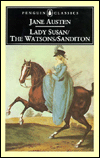
1127015.gifPosts on Lady Susan aren’t due until tomorrow, but as the Hobgoblin and I are going on a long hike, and I’m not sure I’ll feel like posting when we get back, I’m going to write on it now. I enjoyed this book very much; it was a pleasure to read something by Jane Austen I hadn’t read before. I’m very familiar with her six major novels, but there is still a lot of shorter stuff I haven’t yet gotten to. My edition of Lady Susan includes The Watsons and Sanditon, the first of which I’ve now finished and the last of which I’m going to read next.

I’ve heard many people talk about the limitations of the epistolary form, and it’s probably true that there’s a limited number of things you can do with it, but I do like the form anyway. Perhaps it’s all the reading in the 18C I’ve done, a time when the epistolary novel flourished. What I like about it is the way you can see different versions of a character in the letters written to different audiences, and the way reading an epistolary novel gives one the sense of the importance of words and writing and how people can do battle with language — and other, less violent things, of course. But I think of doing battle with language when I think about Lady Susan, as Susan seems to be at war with much of the world.

Here is what she says in the very first letter of the novel:

I can no longer refuse myself the pleasure of profiting by your kind invitation when we last parted, of spending some weeks with you at Churchill … I impatiently look forward to the hour when I shall be admitted into your delightful retirement.

And this is what she says in the second letter of the novel:

I take town in my way to that insupportable spot, a country village, for I am really going to Churchill. Forgive me, my dear friend, it is my last resource. Were there another place in England open to me, I would prefer it.

Already we know so much about Lady Susan. She presents herself in very different ways in these letters, but even within one letter, her language can be interpreted in multiple ways. She writes the following to her brother-in-law, the owner of Churchill:

I am determined you see, not to be denied admittance at Churchill. It would indeed give me most painful sensations to know that it were not in your power to receive me.

As this is the novel’s first letter, we might interpret this to mean that Lady Susan wants to visit Churchill very much because she is genuinely interested in seeing those who live there, and this is the meaning she expects her brother-in-law to find. Upon knowing something more about Lady Susan, however, we can see that these sentences hint at her real feelings: she must leave her current residence, Langford, home of the Manwarings, because she has gotten herself into trouble there, and if she cannot stay at Churchill, she will experience “painful sensations” because her escape route will be blocked.

It’s this kind of facility with language that makes Lady Susan a very fun heroine — or villain, rather, except that, as Margaret Drabble, author of the introduction to my edition, points out, there really is no satisfactory heroine here, so Lady Susan steals the show. She prides herself on her ability to talk herself into and out of any situation (“If I am vain of anything, it is of my eloquence”); this is how she keeps Reginald, her gullible young admirer, by her side for so long. When Lady Susan can no longer convince people to believe her version of events, the novel ends — there is no more story.

The difference between appearance and reality, and the time and trouble it takes to learn to tell the two apart is a very common plot line in 18C fiction, and Lady Susan has much going for her as she tries to fool nearly everybody. She’s beautiful, and even Mrs. Vernon, her most serious enemy, is susceptible to it:

She is delicately fair, with fine grey eyes and dark eyelashes; and from her appearance one would not suppose her more than five and twenty, though she must in fact be ten years older … Her address to me was so gentle, frank and even affectionate, that if I had not known how much she has always disliked me for marrying Mr Vernon, and that we had never met before, I should have imagined her an attached friend.

Lady Susan is a symptom of a larger problem:

One is apt I believe to connect assurance of manner with coquetry, and to expect that an impudent address will necessarily attend an impudent mind; at least I was myself prepared for an improper degree of confidence in Lady Susan; but her countenance is absolutely sweet, and her voice and manner winningly mild.

We expect people’s insides to match their outsides, in other words — to be beautiful only if their hearts and minds are beautiful, and to act mildly and kindly only if they have mild and kind minds. Someone who combines a beautiful appearance and pleasant manners with lying and deceit is dangerous.

So Lady Susan depends on her pleasing appearance and behavior to keep her out of trouble and to get her whatever she wants. Besides the appearance vs. reality theme, there’s the juxposition in the novel between public reputation and the impression a person makes in private. Lady Susan counts on the power of private impression to overrule reputation; of her enemy Mrs. Vernon she says:

I hope [she is] convinced how little the ungenerous representations of any one to the disadvantage of another will avail, when opposed to the immediate influence of intellect and manner.

The novel shows, however, that reputation does mean something, and that the “ungenerous representations” of Lady Susan are a better source of truth than anything she herself says or does. You are better off trusting public concensus than trusting your own instincts — collective wisdom outweighs the individual’s insights.

Opposed to Lady Susan’s doubleness and deception is her daughter Frederica, whose simplicity Lady Susan cannot stand:

Her feelings are tolerably lively, and she is so charmingly artless in their display, as to afford the most reasonable hope of her being ridiculed and despised by every man who sees her. Artlessness will never do in love matters, and that girl is born a simpleton who has it either by nature or affectation.

Frederica’s artlessness is held up for praise in the novel; her mother’s criticism is a sign that we are to admire her, and yet she is a boring and lifeless character. All the interest in the novel belongs to Lady Susan. So we are left to deplore Lady Susan’s cruelty and deceitfulness, and yet we can’t help but admire her energy and intelligence and, yes, her artfulness and artifice. After all, Lady Susan’s skill with language is a skill she shares with her creator.

If you’d like to join the discussion of Lady Susan, come on over to Metaxu Cafe!

7 Comments

Filed under Books, Fiction

Recent Acquisitions

This time of year makes me feel so conflicted — it’s beautiful outside and I’m happy about that, but it’s one of the busiest times of the academic year as the semester gets near the end (it’s not nearly close enough though), and that makes me feel tired and listless. I can’t go outside because I have so much work to do, but I can’t seem to bring myself to do my work …

Anyway, in this post, I’ll console myself by thinking about the books I’ve acquired recently that I’ll be able to read soon enough — maybe before the semester is over, but if not, certainly after.

  • I’ve got Adam Sisman’s Boswell’s Presumptuous Task on the way from Book Mooch — this comes highly recommended by bloggers, so I’m looking forward to it, and it’s the perfect follow-up to reading Boswell’s Life, of course, as it tells the story of how the Life got written.
  • Also through Book Mooch, I recently received John Brewer’s A Sentimental Murder: Love and Madness in the Eighteenth Century. Isn’t that a great title? Sandra wrote so eloquently about this one, I couldn’t resist. It tells the story of a murder, but goes on from there to meditate on history and storytelling and eighteenth-century culture.
  • I got a copy of Denis Johnson’s book of short stories Jesus’ Son; a book I’ve been meaning to read for quite a while and which I’ve heard wonderful things about. This book is part of my attempt to read more short stories; I’d like to read at least two collections this year, if not more.
  • I ordered the last two volumes of Proust, The Prisoner and The Fugitive combined into one volume, and Time Regained. I’m getting close to finishing Proust! Well, sort of. Actually I’m a little over half way, in the middle of volume four. I had to order these last two from the UK, and they look nothing like the first four in their American versions, unfortunately.
  • Cam recently sent me a selection of W.B. Yeats’s poetry. I’ve read some Yeats, but he’s a wonderful poet I need to read more of. Thanks Cam!
  • And, of course, there’s Don Quixote, ready for me when I’m ready for it. Here’s the template I set up for the group reading blog; I’ll get invitations out to people during April so we’ll be ready to begin in May. Let me know if there’s cool Don Quixote stuff on the web you know of so I can add some links to spice up the site a bit.

6 Comments

Filed under Books, Lists

Aunt Julia and the Scriptwriter

I recently finished Mario Vargas Llosa’s novel Aunt Julia and the Scriptwriter, which turned out to be a fun read — it’s a light, comic novel, but it also plays around with ideas about writing and the writer and stories, which gives the book some depth. Apparently, the book is somewhat autobiographical, based on the relationship leading up to Vargas Llosa’s first marriage, and the real-life Julia wrote her own side of the story in a book called What Little Vargas Didn’t Say. I don’t know anything about Julia’s book, but judging by the title, Vargas probably didn’t like it.

The novel tells the story of Mario, an 18-year-old university student in Lima who works at a local radio station preparing news bulletins. Part of the story is about how he falls in love with “Aunt” Julia — she’s related to Mario only by marriage — but their relationship is still scandalous because she’s 32 and divorced. The other part is about Pedro Camacho, a scriptwriter recently come to write serials for the radio station. He soon becomes hugely popular as radio listeners find themselves enthralled by his stories, but then the stories start to take some very odd turns and nobody knows what to do with Camacho anymore. Camacho is a very odd character, with strange ticks and mannerisms, a unusual physical appearance (he’s almost short enough to be considered a dwarf), a self-centered and imperious manner, and some disturbing prejudices against Argentinians and against women generally.

These two plot lines unfold slowly over the novel’s course; every other chapter, however, gives the story of one of the serials Camacho is writing, appearing in the novel as regular prose, not in script form. These stories are soap operas, dramatic, shocking, and fun. But as Camacho’s serials start to turn strange, so too do these interpolated chapters. Characters get interchanged with one another, plot lines get mixed up, characters from one story begin to appear in another, and eventually the authorial voice has lost control of the stories entirely. By the end of the book we don’t have straightforward stories anymore, but attempts at plot filled with questions about the plot direction and the characters’ fates.

Camacho has become overwhelmed by his own productivity; he had been producing scripts at such a wild rate, that he begins to forget his plot lines and characters, collapsing under the strain of his long hours. It has turned into a battle between the author, trying to give form and shape to life, and chaos, undermining the very possibility of coherence and order.

Meanwhile, Mario himself dreams of becoming a writer. He watches Camacho with interest, trying to figure out the secret of Camacho’s amazing productivity:

Riding back to Miraflores in a jitney, I thought about Pedro Camacho’s life. What social milieu, what concatenation of circumstances, persons, relations, problems, events, happenstances had produced this literary vocation (literary? if not that what should it be called then?) that had somehow come to fruition, found expression in an oeuvre and secured an audience? How could he be, at one and the same time, a parody of the writer and the only person in Peru who, by virtue of the time devoted to his craft and the works he produced, was worthy of that name?

Mario thinks about what it means to be a writer, and whether he’s capable of becoming one himself.  Camacho is very nearly the perfect definition of a hack writer, churning out the melodramatic stories day after day, but, at this point in the story at least, Mario can’t help but admire his energy and his ease with words and stories:

It was becoming clearer and clearer to me each day that the only thing I wanted to be in life was a writer, and I was also becoming more and more convinced each day that the only way to be one was to devote oneself heart and soul to literature. I didn’t want in the least to be a hack writer or a part-time one, but a real one like — who? The only person I met who came closest to being this full-time writer, obsessed and impassioned by his vocation, was the Bolivian author of radio serials: that was why he fascinated me so.

So this is a love story, but also a story about stories and about writing as a vocation. It’s a novel of the writer-in-training, about a character who lives through the excitement of teenage love and rebellion but who also gets a chance to watch a writer at work and to think about what kind of writer he wants to be.

9 Comments

Filed under Books, Fiction

Literary friendships

Inspired by Stefanie, many bloggers are posting lists of books they’d like to read right now if they weren’t in the middle of other books and had the time for it (one lucky person has posted about books she’d like to read on her upcoming vacation — I’m so jealous); I’m not going to give you a similar list here, but I just finished an article (unfortunately not available online) from the New York Review of Books that’s got me adding books to my list of things I’m longing to read. It’s Richard Holmes’s “The Passionate Partnership,” a review of Adam Sisman’s book The Friendship: Wordsworth and Coleridge.

Now first of all, Richard Holmes himself is someone I’m longing to read more of; he’s the author of Footsteps, a book I enjoyed immensely not too long ago, and he’s written biographies of Coleridge and Percy Shelley and a book on the friendship between Samuel Johnson and Richard Savage. This last one I’m certainly going to need to read.

And Adam Sisman’s book on Wordsworth and Coleridge sounds quite good; Holmes gives it a slightly mixed, but overall fairly positive review. It traces their friendship from the time they met in 1797 through their estrangement in 1810, telling the story of their collaboration on poetic projects; at times they worked so closely together that scholars aren’t sure who wrote what. There’s one poem, “The Mad Monk,” that appears in the Collected Works of both poets.

Here are some good passages from Holmes review:

All this leads to wider reflections which Adam Sisman’s book prompts but does not have time to pursue. There have been many famous “literary friendship” or double-acts. Each has its own dynamic, usually of love and loyalty, followed by trouble and strife, and finally some sort of reconciliation (if only from beyond the grave). Johnson and Savage, Goethe and Schiller, Victor Hugo and Sainte-Beuve, Gautier and Nerval, Fitzgerald and Hemingway come to mind …

But for emotional intensity, one almost needs the parallel of a literary love affair (as Sisman hints). The great Coleridge scholar John Beer has written provokingly in a recent essay: “It may be suggested that [Ted Hughes’s] admiration for [Sylvia] Plath bore strong resemblances to Wordsworth’s for the equally mercurial Coleridge.”

….

It may be, paradoxically, that the “sacred” nature of Romantic friendship is most truly revealed in the pains of its rupture. Coleridge’s nine-page letter of grand remonstrance to Robert Southey in November 1795 expresses a lover’s outrage: “you have left a large Void in my Heart — I know no man big enough to fill it.” Similarly Wordsworth, as restrained in his declarations of friendship as Coleridge was “gushing” (a new liquid word for sentiment), was nonetheless quite capable of expressing his feelings of rejection with vivid simplicity …

Also mentioned in the article is Adam Sisman’s earlier book Boswell’s Presumptuous Task, about the writing of The Life of Johnson, which sounds fascinating.

And then there’s this intriguing passage from Holmes’s article:

Coleridge’s Notebooks, still insufficiently known, may be considered as an inspiration to all confessional writers, and may even become — in their wild informality — the secret bible of Internet bloggers. (Apparently there are over fifty million of these.)

Since I’m not a “confessional” blogger, Notebooks is unlikely to become my secret Bible, but I’m intrigued, nonetheless.

Oh, there are so many good books to read …

12 Comments

Filed under Books

A Doll’s House

One of my reading goals for the year was to read a play, which I have now completed, as today I finished reading Henrik Ibsen’s A Doll’s House. I was hoping, however, that the play I read would be one I hadn’t read before, which didn’t turn out to be the case, as I’ve read A Doll’s House multiple times. I read it this time around because I’m teaching it in my Literature and Composition class. Perhaps I’ll still read a new-to-me play this year. We’ll see.

But I do love A Doll’s House. The thing I appreciate about it most, having read it I don’t know how many times, is the way Ibsen doesn’t waste a line. Everything is so tightly structured, so carefully crafted, that every line every character utters furthers the plot or the themes, and it’s a delight to see the way he leads the plot toward the stunning conclusion.

Is there anybody who hasn’t read this play? I read it in High School and have taught it so often that I feel like it’s an educational staple, but I might be wrong. If you’re not familiar with it, it’s about a couple, Nora and Torvald, who act in the first scene as though they have a perfectly happy marriage and family, but right from the start you pick up on some warning signs, and as the play goes on, you learn that Nora has a secret, that she’s desperately scrambling for money, that Torvald has little understanding of and respect for her, and that their family life is about to fall apart.

Here’s where I give away the ending, which is the best part of the play — Nora realizes just how little her husband knows about her, how much he cares about his own reputation even if she has to suffer for it, how poor of an education she has gotten and how little she knows about herself and the world, and she decides to leave Torvald and go live by herself until she has a chance to grow up. She leaves the doll’s house, and she leaves it dramatically; the play closes with these stage directions, “The sound of a door slamming is heard from below,” and the play is over. The play was first performed in 1879, and, as you can probably imagine, audiences found it shocking.

Ibsen doesn’t follow the classical unities of time, action, and place exactly, but he’s very close; the play takes place over the course of a few days around Christmas time, it’s all set in Nora and Torvald’s apartment, and it tells one unified story, that of the dissolution of the marriage. There are three other characters beside Nora and Torvald, two of whom, Mrs. Linde and Krogstad, operate as foils to the main couple; they have lived difficult lives, lost reputations and family members, and suffered in ways Nora and Torvald can’t really understand. But by the end of the play, they have found happiness, while Nora and Torvald have found their lives ripped apart; as the fortunes of one couple fall those of the other rise.

The other character is Dr. Rank who appears to have little to do with the plot; he’s the one character who is possibly expendable, if one is concerned about keeping the action unified. But Dr. Rank brings together many of the play’s themes. He’s suffering because of his father’s excesses — his father contracted a venereal disease which he then passed on to his son — and so introduces the idea of inheritance and the legacies, both good and bad, that parents leave for children. We learn that Nora’s father supposedly passed on his spendthrift ways and dubious moral character to her, and now Nora is deathly afraid of passing along her own errors to her children. As Dr. Rank says,

“To have to pay this penalty for another man’s sin! Is there any justice in that? And in every single family, in one way or another, some such inexorable retribution is being exacted.”

Nora’s decision to leave at the play’s end is partly an attempt to break this chain of heredity; she wants to live on her own until she has figured out what she believes and how she will live, and only then will she consider living with a family again.

But, of course, her leaving is also about her refusal to live with a man who won’t recognize her as a human being and who treats her as a child instead. Although Ibsen backed away from the claim that this is a feminist play, it’s very hard to read it otherwise; what Nora walks away from is a very narrowly defined role of wife and mother — she walks away from the husband who, when Nora talks about the sacred duty she has to herself, can say, “Before all else, you are a wife and a mother.” I noticed this time through that Mrs. Linde talks eloquently about the value of work, and Nora herself speaks of enjoying the little work she has been able to do, sewing to earn a little extra money. She’s longing for a taste of independence, for a challenge, for something to push her so that she can discover who she is.

So, yes, I enjoyed this play, and I think my students are enjoying it too. We’re discussing the conclusion to the play this week; we’ll see what they make of Nora’s dramatic exit.

7 Comments

Filed under Books, Teaching

And the winner is …

Amanda from The Blog Jar!

Thanks to everyone, once again, for spending some time at this blog — I’m so glad you do.

Amanda, send me an email (ofbooksandbikes at yahoo dot com) with your address, and I’ll put Dorothy Wordsworth’s Grasmere and Alfoxden Journals in the mail ASAP.

4 Comments

Filed under Books

Books and reading: your weekly Johnson post

I’ve come across a number of passages in Boswell’s Life of Johnson on books and reading that I thought you might like. For those of you with large libraries, there’s this passage:

Dr. Johnson advised me today to have as many books about me as I could; that I might read upon any subject upon which I had a desire for instruction at the time. “What you read then, (said he,) you will remember; but if you have not a book immediately ready, and the subject moulds in your mind, it is a chance if you have again a desire to study it.” He added, “If a man never has an eager desire for instruction, he should prescribe a task for himself. But it is better when a man reads from immediate inclination.”

Here’s justification for having a book on hand, just in case! Have as many books around you as you can, because you just never know! I do like the idea that we’ll remember things better if we read about them right away when we get the impulse — if I’m curious about something I should read it now rather than waiting until I’ve read all the things I’ve got planned to read first. Although I’m susceptible to reading plans and complicated programs of instruction, I should probably make sure I’m willing to set them aside when they lose their interest. Actually, the more I think about it, the more I think there must be a middle ground here, because surely there’s something to be said for learning something methodically rather than always following the whim of the moment. But the method can’t outlast a reader’s ability to profit from it.

And Johnson has more to say about reading and education:

“I am always for getting a boy forward in his learning; for that is a sure good. I would let him at first read any English book which happens to engage his attention; because you have done a great deal, when you have brought him to have entertainment from a book. He’ll get better books afterwards.”

I like this idea. To have learned that reading can be fun is the first thing, and once a person has learned that, then they can learn how to have fun with more complicated kinds of reading. I have come across the idea a number of times recently that to say “it doesn’t matter what you read as long as you are reading” isn’t true — that it does matter what you read and reading easier kinds of things like commercial fiction isn’t just as good as other, more challenging kinds of reading. I feel ambivalently about all this, being uncertain what is meant by “good” reading and what it is we’re talking about that matters so much. I’m certain Johnson wouldn’t say that any kind of reading is always just as good as any other kind of reading, but he does recognize that very often people need to go through a period of reading regardless of quality. Johnson sees this trashier kind of reading as a stage one progresses through; I don’t see it as a stage one necessarily has to pass through or that it’s even a stage at all (a person can read lighter things alongside heavier ones), but I do agree that the enjoyment a person feels while reading any sort of book is a thing to be celebrated.

And about the glut of books out there available for us to read, Johnson says this:

“It has been maintained that this superfetation, this teeming of the press in modern times, is prejudicial to good literature, because it obliges us to read so much of what is of inferiour value, in order to be in the fashion; so that better works are neglected for want of time, because a man will have more gratification of his vanity in conversation, from having read modern books, than from having read the best works of antiquity. But it must be considered that we have now more knowledge generally diffused; all our ladies read now, which is a great extension. Modern writers are the moons of literature; they shine with reflected light, with light borrowed from the ancients.”

It amuses me to think that complaints about the overwhelming multitudes of books waiting for us to read them have existed for a long, long time. We so often think our complaints and worries are brand new. Women readers are apparently the answer to the 18C problem, another amusing thought; I suppose the more readers exist, the more likely it is that someone will be appreciating those ancient works in danger of neglect.

It’s comforting to know that we are not the only ones who have struggled with the problem of what to read first — that brand new book we can brag about having read at a party or that classic we have been meaning to get to forever.

7 Comments

Filed under Books, Nonfiction, Reading

A little bit on books and bikes

It feels like a really busy week to me, but that’s mostly because I’m trying to get a lot of riding in. The weather is finally warming up a bit, the snow from last weekend’s snow storm is melting, and I’m trying to ride as much as I possibly can. Last weekend’s race got cancelled because of the snow, which is why you have no race report. I can, however, link to the blog of the guy who runs the Spring races I ride in. His name’s Aki, over at Sprinter della Casa; if you do jump over there (and this is totally self-indulgent of me — I don’t blame you if you ignore it), you’ll find a race video shot from Aki’s helmet. If you watch it you can get a taste of what it’s like to ride in a race, and you can see the actual course I ride on (yippee, right?).  He’s not riding in my race, or the Hobgoblin’s, so you won’t see us, although that would be pretty cool, wouldn’t it?  Or maybe not, if I look like a dork out there, which is entirely possible.

And now I have just the tiniest bit of book chat before I close up the computer and start reading for the evening. First of all, my copy of the Edith Grossman translation of Don Quixote has arrived, and I love the way the book looks. There’s the cool cover, of course:

7075756.gifAnd then there’s the way the book feels in my hand, heavy and solid, but soft and flexible too, so that it will easily lie flat. It’s got those rough uneven edges I like, and the print isn’t tiny. I’ve discovered that it’s important to me not to read a book with tiny print. Maybe I’m a bit superficial about this, but I find it discouraging to feel like I’m reading and reading and reading just to get to the bottom of one page. Reading Proust would be an entirely different experience if I had an edition with tiny print. I’m so grateful for the six not overly-large volumes of Proust I’ve got with pages that don’t go on forever.

I’ve got the Don Quixote blog on my mind; by the beginning of May, I’ll have it set up, and we decided it will be called Tilting at Windmills. Do let me know if you want to join in the group reading — I posted on it here.

And two other reminders. If you’d like to read Jane Austen’s short novel Lady Susan with the Slaves of Golconda, you’ve got until March 31st; it’s very short, so there’s plenty of time to join in. And, let me know if you’d like your name entered in a drawing for Dorothy Wordsworth’s Grasmere and Alfoxden Journals, which I’m giving away to celebrate my first year of blogging. Leave a comment over here if you are interested. By the way, I have absolutely no problem mailing the book overseas. I do it all the time for Book Mooch, and other bloggers have generously done it for me. So don’t let geography keep you from participating!

12 Comments

Filed under Books, Cycling

Yoga for People Who Can’t Be Bothered to Do It

7544847.gifI’ve finished Geoff Dyer’s Yoga for People Who Can’t Be Bothered to Do It, and let me say, first of all, that it’s not about yoga. At least, it’s not about the poses people think of when they think about yoga. It does have something to do with the philosophy that lies behind yoga, but more on that later.

Let me say, second of all, that I enjoyed this book very much. It’s uncategorizable, which is my favorite kind of book — it’s part travel narrative, part personal essay, part memoir, and part philosophical meditation, although the more philosophical sections are short. What philosophical meditations we get are moments in the midst of the stories, moments that come out of the stories and lead back into them.

Many of the blurbs on the book mention how funny it is, but except for one or two moments when I laughed out loud, I didn’t find this book very funny. But it was so many other interesting things, I didn’t miss the humor. There are ten chapters, each one set in a different location, including New Orleans, Rome, Libya, Cambodia, the Burning Man festival in the Black Rock Desert, and others. Dyer tells stories about the people he meets, the parties he attends, the love affairs he has, the drugs he does — at this point you may be wondering why I like this book, since I’m a boring, stay-at-home kind of person who wouldn’t know how to find drugs if I wanted to.

But the persona here is appealing. He’s got an open attitude toward life; he’s willing to try just about anything. He’s frequently depressed and despairing, but also capable of finding moments of peace, and his meditations about himself and his life are always interesting. He’s thoughtful but also reckless, hard on himself but also forgiving.  He’s brutally honest about himself and the world:

… I looked up from my notes and was confronted, in the mirror above my desk, with the awful reality — grey hair, bulbous nose, scrawny neck — of my appearance. I have often been disappointed by my appearance, but I have never looked so utterly repulsive as I did then … “Life,” said the face in the mirror, “is taking its toll. All the disappointment and regret, all the bitterness and rage that you have tried to keep hidden, is now breaking out, eroding the last patina of handsomeness, and hope. You are no longer a handsome man. This is the fate of all those who place an undue value on physical attractiveness. You will become one of those people — one of the hundreds of people to whom you paid the bare minimum of attention simply because you did not like the way they looked.”

Maybe his attitude can be best summed up in this conclusion to a chapter spent describing a visit to Roman ruins:

… at some level I knew I had been kidding myself: that all the intellectual discipline and ambition of my earlier years had been dissipated by half-hearted drug abuse, indolence, and disappointment, that I lacked purpose and direction and had even less idea of what I wanted from life now than I had when I was twenty or thirty even, that I was well on the way to becoming a ruin myself, and that that was fine by me.

Ultimately, the book is about what to do after you realize you’re turning into a ruin. Do you despair, or accept it, or both? Dyer’s travels seems to be a response to this realization — he’s traveling as a distraction from pain, seeking out new people and new experiences to pass the time as comfortably as possible, and yet he’s aware at the same time that everywhere he goes, he finds only himself. There is no escape. Travel as distraction and escape leaves him all the more burdened with the weight of himself:

I felt disappointed, cheated. As the gloom settled I saw that I had spent the last fifteen years dragging the same burden of frustrated expectation from one corner of the world to the next.

And so the only thing to do is to try to make peace with yourself, even if only for a moment. And here we come to the meaning of the book’s title, because yoga’s true meaning is not the poses you might do in a yoga class, but has more to do with the search for insight and enlightenment. The term “yoga” comes from a word that means “yoke” or “union”; it’s really about finding unity with God or with something larger than oneself, or, perhaps, finding unity within oneself.

So, in the midst of the sometimes manic movement from place to place, Dyer is looking for a sense of unity and coherence of experience, for moments when he can just be where he is:

“What I want,” I said, “is a place where we can sit down, where we can just chat for a couple of hours before we go to Matt and Alexandra’s lavish suite. A place with nice music, comfortable seats, and nice tea, and so forth.” I went on and on about this, and as I did so I had a dim sense that I was working through something, some neurosis that refused to manifest itself plainly. And then it came to me.

“D’you know,” I said, “I have just described exactly the place we’re in. I’m already in the place I want to go to.”

“Well done, darling,” said Dazed. “You’ve escaped from samsara.”

This exchange (Dazed is Dyer’s current girlfriend) sums up the book beautifully — it’s about learning to want to be in the place you’re in, and it’s an insight expressed with a little bit of self-mockery and mild sarcasm. Dyer takes up some heavy subjects in this book, but he never takes himself — or anything else for that matter — too deadly seriously.

15 Comments

Filed under Books, Nonfiction