Category Archives: Books

Discipline, by Mary Brunton

Mary Brunton’s 1814 novel Discipline turned out to be a bit of a disappointment. I’ve really enjoyed other early nineteenth-century novels such as Susan Ferrier’s Marriage, Maria Edgeworth’s Belinda, and Amelia Opie’s Adeline Mowbray, and I was hoping Discipline would be equally good. The novel has some good things to recommend it, but I found it too long, too predictable, and too moralistic. Although, to be fair, a lot of novels from the eighteenth and early nineteenth century feel too long to me (nothing against long novels at all, but some seem too long for the story they have to tell), many are predictable (if you know the conventions, you will not be surprised by any of Austen’s plots), and lots of them are moralistic. And what else should I expect, picking up a novel called Discipline?

The novel tells the story of Ellen Percy, a young girl who has been both dismissed and spoiled by parents who are generally well-meaning but make some serious mistakes. Upon observing her intelligence, all her father can say is:

“It is a confounded pity she is a girl, If she had been of the right sort, she might have got into Parliament, and made a figure with the best of them. But now what use is her sense of?”

Her mother responds:

“I hope it will contribute to her happiness,” said my mother, sighing as if she had thought the fulfilment of her hope a little doubtful. “Poh!” quoth my father, “no fear of her happiness. Won’t she have two hundred thousand pounds, and never know the trouble of earning it, nor need to do one thing from morning to night but amuse herself?” My mother made no answer: — so by this and similar conversations, a most just and desirable connection was formed in my mind between the ideas of amusement and happiness, of labour and misery.

Ellen’s father never finds much time for her, and her mother is too passive to try to rein her in. Her mother soon dies, leaving Ellen with a close friend who has the patience of a saint, but who also fails to instill Ellen with sound principles. Ellen grows up, goes to school, and learns to love luxury, idleness, snobbery, and gossip. In spite of this behavior, she is lucky enough to draw the attention of Mr. Maitland, a number of years older than she and a model of Christian gentlemanly behavior. He falls in love with her, but she is too busy enjoying her first taste of social success to pay him much attention.

This dynamic continues on for a while, Ellen growing more and more insufferable and Mr. Maitland looking more and more sorrowful. Ellen finds herself drawn into a flirtation with a man of uncertain principles who tries to lure her to Scotland where marriages are quick and easy. Before this can happen, though, disaster strikes — her father, it turns out, has just lost all his money and shot himself in despair. Now Ellen finds herself in an entirely new situation — she has no family, no money, and little idea what to do. Absolutely nothing in her life so far has prepared her in any way for this.

So Ellen is finally required to learn something about the world outside her former privileged social circle, and finally she is forced to learn some discipline. There are some interesting elements to this plot, in particular, the portrayal of how difficult it is for a woman to survive on her own and how little society prepares women of the monied classes to do anything useful with themselves. Ellen goes through some harrowing experiences that show exactly how vulnerable, powerless, and abandoned women without family and without money are. This is an idea that comes up again and again in novels of the time.

Also interesting is the portrayal of Scotland. Brunton is Scottish, and her heroine ends up there towards the end of the novel. There is a marked difference between the way the English and Scottish scenes are portrayed: London remains a rather vaguely defined and described place, but the Scotland scenes are described in lavish detail, the Scottish characters are given lots of space in which to tell stories about their family heritage and their culture, and the Scottish sections even have footnotes documenting the historical background of the novel. It’s no surprise that it is here where poor Ellen finally finds some peace and reaps the reward of her hard-earned discpline.

But I was disappointed by the way the characters’ motivations were often vaguely-defined and difficult to believe; in particular, it makes no sense to me why Mr. Maitland fell in love with Ellen in the first place, and Ellen’s behavior in the early parts of the novel is so foolish and so stupid, it’s hard to sympathize with her when things begin to go badly. And although I know that people of the time didn’t necessarily feel this way, as a 21st-century reader, all the moralizing gets old pretty quickly (and surely some 19th-century readers felt that way too).

But I’m glad I read the book anyway because I’m fascinated by the time period and I like to read as much as I can from and about it. Brunton was popular, at least for a short while (you can read Jane Austen’s brief comments on her here), and the Victorians liked her strongly moral writing, so the book gives a good idea of what people of the time were drawn to.
4 Comments

Filed under Books, Fiction

Christine Falls

My mystery book group met again this past Sunday to discuss Benjamin Black’s novel Christine Falls. As usual, it was a good discussion, although people had negative or mixed opinions of the book, which interests me, because from what I’ve read of blog reviews, a lot of people liked it. A common opinion in the group, though, was that it was an enjoyable read, but when we stopped to think about the plotting and Black’s use of mystery novel conventions, the book began to fall apart.

It was an odd reading experience for me because I had already read the sequel, The Silver Swan, and so I knew some of the major revelations that came in Christine Falls. In a lot of cases with a mystery series, it doesn’t seem to matter a whole lot if you read the books out of order, but in this case, I think it makes a difference. The two books felt less like two individual books, each with their own separate stories even though the characters are the same, and more like one novel with two different parts. So knowing what I did about what happens to the characters later, I had some of the major plot points spoiled for me, and that took some of the pleasure out of it.

That aside, I did find other things to enjoy in it, particularly in the main character Quirke, a pathologist who, in the novel’s opening scene, finds his brother-in-law Mal tampering with some documents in a highly suspicious manner. Quirke is compelled by forces in himself he doesn’t really understand — in that way so many characters in mysteries are — to find out exactly what Mal was up to, and from there he winds up embroiled in a plot that involves powerful people in the Catholic Church and extends all the way to America.

Quirke is a stereotypical mystery hero in a lot of ways — he has a troubled personal life and a drinking problem — but I liked him anyway. I suppose there’s no reason being stereotypical should make a character unlikeable, and there’s a reason such characters are popular. It’s interesting to think about the dynamic between the troubled personal life and the type of work these characters do. Quirke can be brutally honest about a lot of things, particularly about death, which makes sense since he is a pathologist and works with corpses all the time, but in other areas, he’s an expert at dodging painful truths and uncomfortable conversations. He’s a damaged guy trying to make his way through life with a minimum of fuss and trouble, but outward circumstances and, even more so, something in himself won’t let him off so easily.

A number of people in my group didn’t like the rather uneasy relationship this book has with mystery conventions, for example, the way it’s not entirely clear what the mystery is, even near the end of the book. The plot Quirke is uncovering isn’t terribly interesting as a plot, and some of the characters and events just don’t need to be there. I am less concerned about mystery conventions than others, as I don’t really care whether authors follow “the rules” or not, but I was bothered by the way so much seems nebulous in this book — the relationships among the main characters weren’t explained as well as I would have liked and the motivations among the bad guys for doing what they did seemed obscure. The novel is set in the 1950s, but this never felt real to me. Somehow, Black doesn’t make the time period concrete enough.

But I will say that I enjoyed myself as I read the book, even though I had some doubts later; it’s well-written with engaging characters, and I was curious to know what was going to happen to Quirke. I may have liked it even more if I hadn’t read The Silver Swan first.

We are reading Wilkie Collins’s The Moonstone next (my selection). I’m excited to return to an early mystery story and to think more about the genre’s roots.

13 Comments

Filed under Books, Fiction

A quick note

Happy Fourth of July to all of you who care! To those who don’t, I hope you are having a nice Saturday. I spent much of the day helping out at a big library event and working on my suntan. When I say I was working on my suntan, I mean I was making some of my funny fan lines worse and some of them better. Because I spend most of my outdoor time on my bike, I have suntanned arms and white hands, with a pretty distinct line on my wrist and some lines on my fingers you can see if you look closely. Today my hands finally got some sun and now they don’t look quite so ridiculous, although I did develop a new watch line. The line at the bottom of my neck and on my upper arms is now worse, though. I’m afraid I won’t look normal in the summer as long as I continue to ride my bike. Oh, well.

The library event — a big party for the library’s 100th birthday — went well, although it was windy and one of our tents flipped over on us. Mostly I sold coffee and bagels to hungry people, and I also helped kids make cat puppets. They had fun.

The other thing I’ve been doing is finishing Mary Brunton’s novel Discipline, and I also recently finished Benjamin Black’s Christine Falls, which means I get to choose a new novel and maybe a new nonfiction as well. Yay! I’m not sure what I’ll read, but I’ve considered picking up Kate Atkinson’s Case Histories and also Michael Frayn’s The Trick of It. And I’ll probably consider others before deciding on something.

One other thing I did today: I spent some time checking out these two posts from Fernham about books she might teach in her Transatlantic Women Modernists grad class this fall. There are a bunch of authors I’d never heard of in those lists, including Betty Miller, Gertrude Bell, Alice Dunbar-Nelson, and Jessie Fauset, as well as other authors I’ve heard of but know next to nothing about. The class looks fascinating, and my wishlist just got longer.

Enjoy your weekend everybody!

10 Comments

Filed under Books, Cycling, Life, Reading

Reading with one’s spine

I posted my thoughts on Nabokov’s Lectures on Literature the other day, and now I thought would share some interesting bits from the book. It begins with an introductory lecture called “Good Readers and Good Writers” in which he lays out his argument that “In reading, one should notice and fondle details.” This quotation is the simplest way to describe Nabokov’s method, really, as it sums up what he does in each of the main lectures — he looks closely at the details in order to examine the novel’s structure. Isn’t the word “fondle” an interesting one to use here? It captures his very involved, careful, intimate, and emotional style of reading:

So what is the authentic instrument to be used by the reader? It is impersonal imagination and artistic delight. What should be established, I think, is an artistic harmonious balance between the reader’s mind and the author’s mind. We ought to remain a little aloof and take pleasure in this aloofness while at the same time we keenly enjoy — passionately enjoy, enjoy with tears and shivers — the inner weave of a given masterpiece.

There is a lot to like here, especially the mix of the personal and the impersonal in reading: he calls for an attempt to enjoy passionately while at the same time keeping enough distance to notice what’s going on. I’m not entirely sure how that works, exactly, as passion seems to imply the loss of critical distance, but I know subjectively what he means, or at least I think I do. I also like the idea that there should be a balance between the author’s mind and the reader’s mind — that the reader and author are working together in good faith and with good will to try to create something meaningful.

I’m also amused at the way Nabokov sounds a little like an eighteenth-century woman of sensibility, one who prides herself on her exquisite emotional sensitivity and her ability to cry at affecting scenes in novels, when he talks about “tears and shivers.” But he only sounds like that for a moment, before he moves on to discuss what else besides emotion and imagination are required. Here’s how strong emotion connects to a novel’s detail:

What I mean is that the reader must know when and where to curb his imagination and this he does by trying to get clear the specific world the author places at his disposal. We must see things and hear things, we must visualize the rooms, the clothes, the manners of an author’s people. The color of Fanny Price’s eyes in Mansfield Park and the furnishing of her cold little room are important.

So detail is a check on emotion, as it keeps us grounded in the specifics of the world the author creates. In fact, Nabokov has already outlined several wrong kinds of imagination and emotion to be found in readers — including the kind that is solely personal because we relate the book only to our own experiences, and the kind that leads us to identify with a character. In an odd kind of way, our imagination and emotions are supposed to lead us beyond ourselves:

We all have different temperaments, and I can tell you right now that the best temperament for a reader to have, or to develop, is a combination of the artistic and the scientific one. The enthusiastic artist alone is apt to be too subjective in his attitude towards a book, and so a scientific coolness of judgment will temper the intuitive heat. If, however, a would-be reader is utterly devoid of passion and patience — of an artist’s passion and a scientist’s patience — he will hardly enjoy great literature.

I like all these ideas a lot, even if they are abstract. Nabokov ends this chapter with a metaphor, which I also like, although it doesn’t clear up the abstractness:

In order to bask in that magic a wise reader reads the book of genius not with his heart, not so much with his brain, but with his spine. It is there that occurs the telltale tingle even though we must keep a little aloof, a little detached when reading. Then with a pleasure which is both sensual and intellectual we shall watch the artist build his castle of cards and watch the castle of cards become a castle of beautiful steel and glass.

I like very much the idea of reading with one’s spine, even if I’m not entirely sure I know what it means. I also like the way a castle of cards can turn into a castle of steel and glass. We know the entire time we are reading that it’s a castle of cards — we know the work is a fiction — but through the magic of a writer and a reader working together that fiction somehow becomes real.

12 Comments

Filed under Books, Nonfiction, Reading

Lectures on Literature

What an odd and wonderful book Vladimir Nabokov’s Lectures on Literature is. I enjoyed it very much, although I have some caveats to make, and I wouldn’t recommend this book unless you have read the books Nabokov discusses or you plan to read them alongside the lectures. He goes much too in-depth about his chosen books for it to be at all enjoyable if you’re not familiar with them.

What makes this book odd and unusual is the fact that it is a transcript of lectures Nabokov gave while at Cornell, so they are written with a classroom performance in mind and not necessarily meant for general readers. The course was called “Masters of European Fiction,” and covers Mansfield Park, Bleak House, Madame Bovary, The Strange Case of Dr. Jekyll and Mr. Hyde, Swann’s Way, The Metamorphosis, and Ulysses. The book’s editor makes it clear that he had to do a lot of editing, as the text is based on written-out lectures that weren’t always complete and where the organization wasn’t always clear. But the text we ended up with is very readable and clear, and it includes lots of pictures of Nabokov’s notes and marked-up copies of novels.

Nabokov makes a very strong argument for looking at the novels themselves and not paying any attention to biographical, historical, or cultural context. He believes in close reading and nothing but close reading. He wants readers to focus on the novel’s details, noticing patterns and making connections and focusing on how those details are structured. Here is what he says about how people should read:

We should always remember that the work of art is invariably the creation of a new world, so that the first thing we should do is to study that new world as closely as possible, approaching it as something brand new, having no obvious connection with the worlds we already know.

“Great novels are great fairy tales,” he argues, and should be treated as independent worlds, following their own rules, and existing without any connection to the world we live in.

I think I may post more on this book later, as there are so, so many interesting passages to quote and discuss, but for now I’ll say that I find his argument intriguing but limited. I love reading novels closely and focusing on structure and doing all the things he thinks readers should do, but I also love to think about biographical, social, and historical context, and I think there is value in doing so. So I suppose I see Nabokov’s way of reading as one very good way that exists alongside other good ways.

At times I found this book utterly brilliant, and at times it was … a bit dull. Nabokov is focused on details to such an extreme degree that he sometimes gets bogged down in plot summary. In each lecture he follows the chronology of the novel, analyzing it as he moves through its sections, and sometimes this works well, and at other times he stops analyzing and begins summarizing. On the plus side, these summaries make the lectures an excellent way to review each book if the details have gotten hazy.

The lectures reminded me of one of my English professors in college who was fairly traditional in his approach to literature and focused on close reading in just the way Nabokov does, moving through each work we studied and analyzing its structure in a methodical way. This seemed like a reasonably good way to learn about the literature we read, but I didn’t love that class as much as I did others where the professors took a broader approach and looked at context and history and theory as well as looking at the texts themselves. Nabokov is best, I think, when he uses the novels as a jumping off point to discuss what literature is and how we can best read it — when the details lead him to some larger point.

Who knows what I’ll end up doing, but I would like to return to this book and close at some of Nabokov’s claims more specifically.

12 Comments

Filed under Books, Fiction

Group Reading

As I read along in Infinite Jest, I’ve been thinking about what it means to read a book with a group of people — in this case, a very large group. Even though I’m not actively contributing to the Infinite Summer forums, I’m following the discussions pretty closely and am learning a lot from what people write there. And then there are very, very informative and helpful posts at the Infinite Summer blog, such as this weekly summary, which lists chapters that the group has read so far with a plot synopsis for each one, as well as descriptions of characters encountered in each chapter. I didn’t realize the blog would be doing weekly summaries, and when I first encountered this week’s summary, I was thrilled to have a way to check whether I understood what was going on.

But it also feels a little like cheating. In a way, I feel like I should be reading this book all by myself to be reading it “properly.” It would be an entirely different experience to be reading it all on my own, without help from the blog and forums or any other kind of reading guide. A part of me feels that to have the true experience of reading this book, I should encounter just the text itself. It should be just me and the book, and I should try making of it what I can all on my own. Reading guides and groups and forums seem more fitting for the second time through, when I’ve had a chance to form my own opinions.

But then, I can be too much of a purist about reading and about life in general. I’m a little too obsessed with doing things the “right way,” and of course, there really is no one right way to read a book. I felt similarly uncomfortable using the Reader’s Guide to The Recognitions to help make sure I was understanding the basics of what was going on, as well as to explain the book’s allusions. But I have to say, I was very glad to have that guide available, and it made reading The Recognitions a better experience. I think having the Infinite Summer community available will make reading that book a better experience.

I wonder what the authors would say about these websites and groups. Perhaps they wouldn’t care how we read their novels, or perhaps they would prefer to have us confronting the text by itself, without any props or support systems or weekly summaries? Probably they would just be happy to have that much attention drawn to their work.

What do you think — are you a perfectionist kind of reader like I am?

17 Comments

Filed under Books, Fiction, Reading

Beginning Infinite Jest

I began Infinite Jest the other day and am up to date with the Infinite Summer schedule, which means I’ve read up to page 63 — out of 981 pages, not including the lengthy endnotes section. So far things are going well, but I’m already aware that I’m not going to get everything going on in the book. I mean, I’ll be able to follow the plot and will understand the basics of what is happening, but I can already tell that there will be connections among characters and plot events and ideas that I will get some but not all of. A lot of characters have been introduced and I can already see some recurring themes and motifs that surely will be important, but I will have to carry a lot in my head over the course of such a long book to make sense of it all. This isn’t a book to understand fully in just one reading, I can see that already.

But I really am enjoying it. The opening section is brilliant. It describes one of the main characters, Hal, in an interview with a university admissions committee, the members of which are trying to understand some “irregularities” in Hal’s application. He’s a tennis star, and they really want to admit him, but while his grades are excellent and his admissions essays beyond brilliant (suspiciously so), his test scores don’t fit the profile. In the course of the interview, Hal just sits there, not saying anything, letting his uncle and his uncle’s assistant speak for him. Finally the committee gets Hal on his own, and finally Hal starts talking, and what he says sounds perfectly reasonable, but the committee starts to stare and look horrified and freak out, and finally they call an ambulance and get Hal taken away. It’s unclear what happened, but it explains why Hal was so quiet to start with — he knows that he can try as much as he likes, but what he says will be very different from what people hear. The scene is funny and sad both, and it’s a way to introduce what I’m sure will be a major theme of the book — the difficulty of communicating with others.

I’ve been following the discussions going on in the Infinite Summer forums as well, although I’m not participating (for no particular reason except I don’t feel like it — I have enough online writing to do already). It’s nice to read what others are thinking, and it helps me to see things I might otherwise have missed. Even though I’m observing and not participating in this reading group, I still feel like I’m benefiting from it.

7 Comments

Filed under Books, Fiction

Loving

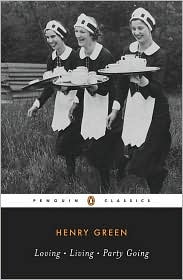
14734471 I have now finished Henry Green’s novel Loving, and while I was tempted to continue reading the two other novels in my edition, Living and Party Going, I decided to save those novels for another time. I would very much like to read more Henry Green at some point, though, because I thought Loving was very good.

It’s the kind of novel where not a whole lot happens. People talk, mainly. In fact, much of the novel is written in dialogue, and the narrator remains aloof, telling us what things look like and who does what, but not digging deeply into people’s thoughts. At times it’s a little like a play where you have stage directions in place of a narrator. It’s not a play, of course — there is a narrator who tells you the basics of what’s going on, but it’s a very distant narrator who refrains from commentary or judgment.

The novel is set during World War II (it’s published in 1945) and tells the story of a family and its servants who are living in a castle in Ireland. Most of these people are English. They are at a distance from the war raging on the continent, but are worried about a possible invasion and also about the Irish Republican Army and are uncertain whether they should  remain in the mild anxiety they are currently living in or venture back to England, where they have family, but where they might be forced to join the military.

We get scenes of the family itself, a mother and daughter-in-law with her children, but spend most of the time with the servants. The story is made up of a series of small events that the servants gossip about: one of the children kills one of the estate’s many peacocks, an expensive ring has gone missing, two of the servants are flirting with each other, and others have fallen in love. The novel follows them around as one woman tries to hide her drinking habit and two young girls giggle at absolutely everything and the nanny gets sick so the children aren’t properly watched after. And then one of the servants finds the daughter-in-law in bed with a man who’s not her husband, and everyone is thoroughly scandalized. The butler spends his time learning how to cook the books and extort bribes so he can set a little money aside for the future.

It’s a quiet picture of how life really is, especially during wartime when there’s a nagging anxiety underlying everything. Conversations circle around the same subjects again and again, and more often than not, people fail to understand each other, especially the servants and those they serve. These two groups try to understand each other, obsess about each other, get frustrated and angry, and then work hard at trying to hide it so that life can proceed as quietly as possible.

The writing is beautiful. The dialogue is done perfectly, capturing the distinct voices of the characters and also the rhythms of typical conversations, the way people repeat things and jump suddenly from one idea to the next. And although the narration is extremely distant, the narrator now and then comes out with beautiful descriptive sentences: “The slow tide frosted her dark eyes, endowed them with facets,” or “He slipped inside like an eel into its drainpipe,” or “When he saw her face which was as it sometimes looked on her bad days so called, pale or blotchy as a shrimp before boiling, he cleared his throat.” He gets the rhythm of sentences exactly right:

She got no other answer than a wail. Then Miss Burch rolled over face to the wall. The cap twisted off her head. Edith gently put it back and because her shiny skull was sideways on that pillow she could only place the cap so that it sat at right angles to Miss Burch’s pinched nose, as someone lying in the open puts their hat to protect their face and terrible eyes.

John Updike wrote the introduction to my edition, and I am perfectly willing to believe him when he claims that insofar as one can learn to write, Henry Green taught him. I’m certainly looking forward to reading more of his work.

14 Comments

Filed under Books, Fiction

Notes

I’m going to start Infinite Jest very, very soon. I’m just not entirely sure when. I’d really like to follow along with the Infinite Summer schedule, and I’m generally very good at sticking to reading schedules, but I haven’t quite gotten around to going up to my study and hauling that book off the TBR shelves. I have been poking around on the Infinite Summer forums by way of preparation, and the various hints I’ve gotten about the book are intriguing. Maybe I’ll start it tomorrow.

I’m almost finished with Vladimir Nabokov’s Lectures on Literature and am about halfway through Mary Brunton’s Discipline. I’m not sure what to think about the Brunton novel. At times I’m enjoying it, and at other times I get annoyed at the main character, a first-person narrator, who does some inexplicable things. The book has enough narrative tension to keep me moving along, though, so I’ll stick with it to see how it all turns out.

And now on to cycling. My race yesterday didn’t go well. It’s a race I hate, though, so the real question is why I keep doing it, not why I didn’t do well. I woke up yesterday morning feeling very draggy, and I never really got over that feeling, even after I’d been out racing for a while. I’m not sure how much of this is physical and how much is psychological; it’s quite possible that I’ve decided this race is so horrible that I psych myself out of doing well.

The race started off okay; we have a neutral start up a long, steep hill, which means that we ride slowly and don’t race until we reach the top. Last year the neutral start wasn’t really neutral — it was too fast to be called that — but this year they kept the start very slow. After that, though, things got worse. We headed down hill, which is an immediate problem, as the roads were wet and the pack kept speeding up and slowing down, forcing me to slam on my brakes as I was flying down the hill. I’m not a particularly fast downhill rider, and the yo-yo-ing the pack was doing made me nervous, so I was slower than usual. That meant that I fell a little behind and had to chase on the flat sections.

And then we hit the hills. I hung on for a while, but soon enough the pack was taking off, and I didn’t have the necessary will, leg muscle, cardiovascular fitness, or all of the above, and I fell behind again. And it was only 8 or so miles into a 50-mile race.

I found some other dropped riders and we rode together for a while, but then I saw Hobgoblin sitting on the side of the rode looking ill. I stopped to see what was wrong, and he didn’t look well at all. He said he’d come down with a migraine right in the middle of the race. He was in a lot of pain and was looking really weak, so we got him a ride in one of the race vans, and I rode back to the start/finish line planning to meet him there.

And that was that. I’m not at all happy Hobgoblin suffered, but I didn’t mind having a good excuse to drop out of what was promising to be a miserable ride. So once again he’s confirmation that hilly road races are not for me. I don’t mind riding up hills, but chasing other, faster riders up hills is truly nightmarish. To make myself feel better about riding in general, I went out on a 40-mile ride this morning, and it was lovely, so all is relatively well. And Hobgoblin seems to be feeling better today.

12 Comments

Filed under Books, Cycling, Fiction

Prayers of the Cosmos

Every once in a while, I find myself going through a phase where I become intensely interested in matters of theology and spirituality. To call it “a phase” is maybe not taking it seriously enough, but my point is that this feeling cycles in and out, and I appear to be entering another high-interest time. I’ve had a number of great conversations with a friend who has a similar religious background to mine, more great conversations with another friend who is studying to be a yoga teacher, and other great conversations with acquaintances who have an interest in the subject. This is happening at a time when I’ve been practicing yoga more regularly and loving the spiritual lessons that it has to offer and have also been reading more on the subject. As you may know if you have read this blog for a while, I grew up a serious Christian of the evangelical sort, but as an adult have become … I’m not sure what. I’ve become someone who is interested in “spirituality,” the sort of person I used to scoff at when I was much younger. It’s wonderful when life turns you into the sort of person you used to scoff at, isn’t it?

Anyway, I recently finished Neil Douglas-Klotz’s book Prayers of the Cosmos, which offers alternate translations of some of Jesus’s words: the Lord’s Prayer, the Beatitudes, and some other famous sayings. I’m not entirely sure of the merits of the argument Douglas-Klotz opens with, which is that we should look to Aramaic versions of the New Testament to understand what Jesus said, instead of Greek versions. But I’m not really concerned about arguments over which Biblical manuscripts are the earliest or most reliable. What interests me is that Jesus spoke Aramaic, and that Aramaic is a language where, according to Douglas-Klotz, words can have a range of meanings in a way they don’t in English. This means that the words Jesus spoke can be translated in a variety of ways, and each translation is there in the original words:

Furthermore, like its sister languages Hebrew and Arabic, Aramaic can express many layers of meaning. Words are organized and defined based on a poetic root-and-pattern system, so that each word may have several meanings, at first seemingly unrelated, but upon contemplation revealing an inner connection. The same word may be translated, for instance, as “name,” “light,” “sound,” or “experience.” Confronted with such variety, one needs to look at each word or phrase from several different points of view … Jesus showed a mastery of this use of transformative language, which survives even through inadequate translations.

What the book does is give a line that Jesus spoke and then analyze the Aramaic words and the possible translations of those words. So for example, the first line of the Lord’s Prayer, “Our Father which art in heaven,” could also be translated “Oh Birther, Father-Mother of the Cosmos,” because the roots of the Aramaic word “abwoon” point to a “divine parent” and also to a “cosmic birthing process.” The line “hallowed be thy name” becomes “focus your light within us,” and the line “Thy kingdom come” becomes “create your reign of unity now.” Douglas-Klotz’s translations point to a Jesus that is much more mystical and feminist than the one we are generally familiar with.

This book isn’t entirely scholarly, though; it could also be used as a devotional or a guide to meditation. Douglas-Klotz includes poetic responses to each of the lines he analyzes and also what he calls “body prayers,” which are ideas for how to meditate on each of the lines and how to use the prayers to help deal with life’s problems.

It’s a very short book, only about 90 pages, without a lot of text on each page, but it’s the kind of book you might want to read very slowly, since there is a lot to absorb and it seems appropriate to take the time to really soak up the language.

I liked this book because while I’m not all that invested in arguments about the reliability of manuscripts and how Jesus’s words got recorded, I do think the issue of translation is fascinating, and I like the idea that the version of Jesus I learned about in childhood isn’t necessarily the only version of him out there.

17 Comments

Filed under Books, Life, Nonfiction

The Other Side of You

Salley Vickers’s The Other Side of You is a lovely, smart, beautiful book. I didn’t fall in love with it, as I thought I might, but that doesn’t keep me from seeing how others might love it and that it has an awful lot to recommend it. I suppose what this tells me that being lovely, smart, and beautiful isn’t enough when it comes to fiction; there also has to be some spark or sense of identification (and not of the easy “I identify with the characters” sort) that a person feels for a book to truly fall in love with it.

It tells the story of David McBride, a psychiatrist, who is treating a particularly challenging patient, Elizabeth Cruikshank, who has tried and failed to commit suicide and who is now resistant to David’s attempts to get her to talk. In the book’s early pages, we learn about David’s life at the same time that we read about his first sessions with Elizabeth. David himself suffered a trauma as a young child: he witnessed his brother’s death as the brother tried to lead him across the street and was hit by a lorry. The narrative is written in the first person from David’s perspective, and David is open from the very beginning about how this tragedy still haunts him, many years later. He has done his best to recover from it, but he knows that this is the sort of event one doesn’t really ever get over.

Eventually Elizabeth does open up and begin to tell her story, which David retells to the reader in a long passages that recreate the scenes Elizabeth lived through. At this point something magical begins to happen to David. He finds himself so profoundly moved by Elizabeth’s story that he begins to think again about his own past and his own wounds, and he begins to move beyond the role of a psychiatrist to relate to Elizabeth as a friend.

One of the things I particularly liked about this book is the way it questions the roles of analyst and patient, particularly the power dynamic that usually exists between the two, with the patient as the needy one and the analyst as the source of healing and guidance. David reveals to us — and eventually to Elizabeth — just how vulnerable and broken he is and how in need of help he is himself. During long conversations in which they both tell their stories, he breaks some of the rules designed to keep boundaries up between doctor and patient and shows as he does so just how complex doctor/patient relationships really are and how mysterious the healing process can be. The dynamic between living, breathing human beings can’t really be contained by professional rules.

Vickers weaves into her story a contemplation of the way art can shape one’s life. Art is what begins the deepening of Elizabeth and David’s friendship: Elizabeth had fallen in love with a man who studied Caravaggio, an artist who has been meaningful in David’s life as well, and it’s David’s mention of Caravaggio that gets Elizabeth to talk in the first place. So bound up in this exploration of love and loss there is also a role for art and beauty, for the way art can express what seems impossible to put into words and the way it can become an inextricable part of the bonds that hold people together.

I’m almost writing myself into liking this book more than I really did. The truth is that I admired all this in a detached kind of way. Reading the book was an intellectual exercise in seeing how Vickers brought her ideas together, rather than an experience of thinking and feeling all at once. I never came to care about the characters all that much, except as ways to explore ideas. I don’t need to identify with characters in the sense of liking them or being able to imagine knowing them in my own life, but I do want to feel that they are alive, that there is some spark there that makes them seem real.

I’m genuinely sorry about this one, because all the elements are there that might make me fall in love with it. But, alas, even when we want to fall in love, sometimes it just doesn’t happen.

8 Comments

Filed under Books, Fiction

Returning to books soon …

I raced again tonight, as I almost always do on Wednesday nights. It was a good race, and I finished with the pack, which I’m pleased about, as I went into the race tired. I’ve been going a little crazy with the riding lately, and it’s been so much fun. My poor friends have to listen to me talking about cycling all the time, and I wouldn’t be surprised if they got tired of it. But really, it’s so much fun to be out on the bike, I can’t even tell you.

So I raced last Saturday, which I posted about here, and then I rode 60 miles on Sunday, and then I rode a very hard 60 miles yesterday, going up and down every hill in the area and working very hard. I went into this evening’s race feeling tired and draggy, and I didn’t warm-up as much as I usually do. But the race started off slowly and only picked up speed in the second half, and by that time I’d forgotten how tired I was, and I ended up finishing right in the pack with some extra energy to spare.

And now I will rest up for my horrible, hilly 54-mile race on Sunday.

I come back from the races on Wednesday nights completely unable to concentrate or to sleep, which is why I’m writing a rambling post about the current state of my cycling right now. It’s either that or surf the web aimlessly. Eventually I’ll settle down with a book, but I just can’t at the moment.

So instead, I’ll tell you what I’ve been reading. I finished Salley Vickers’s novel The Other Side of You about a week ago, and I’ve been meaning to post on it for a while. I’m not entirely sure what I’m going to say about it, though. I had a very ambivalent reaction, and I haven’t fully analyzed that reaction yet. We’ll see. I also just finished Henry Green’s short novel Loving. I enjoyed that one quite a lot. He has a distinctive style that relies very heavily on dialogue and has only short passages from the narrator, who is as distant as a narrator can get.

And I’m still working my way through Nabokov’s Lectures on Literature, which I’m enjoying in a bemused kind of way, as Nabokov has a very distinctive style and strong opinions, many of which I disagree with. But those disagreements don’t keep me from enjoying the book. And of course I’m still reading Montaigne.

And now I need to decide what novel to pick up next. I need to read Christine Falls for my mystery group by early July, but I don’t think I’m ready to begin that one next. I’m considering reading Mary Brunton’s Discipline, but I need to keep in mind my plan to participate in Infinite Summer, the group reading David Foster Wallace’s Infinite Jest. Reading is scheduled to begin this Sunday. Infinite Jest won’t be my only fiction read all summer, though, so I feel justified in picking up another novel right now. That means I need to spend some time figuring out if Discipline is what I most want to read, or if something else sounds better.

Do you ever feel that it’s very hard to figure out just what it is you want to read at any one moment? I can read pretty much anything I want, but what it is I most want to read? I’m not sure. Answering that question is complicated when I can’t read through a book really quickly, which means I’m dedicated to spending quite a lot of time with it. I need to choose wisely.

Okay, enough of the rambling. I’ll come back here and write a proper review of something really soon.

10 Comments

Filed under Books, Cycling

A little about books, a little about bikes

I had a couple races this past weekend and went on a long bike ride with a new cycling friend and got to visit some other cycling and bookish friends, and overall I had an excellent time.

The races were … well, odd. I came home with three bronze medals, so I should be happy about them, but the truth is that I didn’t race particularly well. I rode in two races; the first one was a race for women 30 and over. The race was short and intense and I worked hard the whole time. As usual, I wasn’t good at positioning myself for the sprint finish, and I ended up somewhere towards the back of the pack. I got 8th place, but there were only 11 of us.

The thing is, though, this was the Connecticut state championships, so the top three Connecticut riders get medals, I happened to be the third one from my state across the line. They were also giving another medal to the top Connecticut masters riders (meaning over a certain age), and so I got two medals for this showing.

The same thing happened in my second race, which was a category 4 race. I finished 11th out of 20 in my field, but was the third Connecticut rider across the line and so got another bronze medal, my third of the day.

This race was hard, though, because there was a nasty crash that happened right next to me about two laps from the finish. I don’t know what happened, but all the sudden the two riders to my left were going down, I was swerving slightly to get out of their way, and then spent the rest of the race shaken by the whole experience. Poor Hobgoblin thought I was one of the ones who crashed, so I was happy to come around with the pack again and show him I was fine.

I’m not entirely sure how to feel about this. I would be a lot more excited about it if I had actually ridden well, and if I weren’t haunted by the sight of bikes and bodies sliding across the road. Again, I wonder why it is I race, and I also don’t feel quite ready to give it up. If nothing else, it’s an excellent motivation to stay strong, not to mention a great way to get strong, and that’s something significant.

But anyway, being the cycling fiend I am, I was up and out riding a 60-mile ride with a new friend who’s just getting into bike racing. We rode the course of the horrible, awful, nasty, miserably hilly race I’m doing this coming Sunday. I was seriously ready not to do the race this year when I found out that we are riding 54 miles instead of the usual 27 miles we’ve ridden in past years. Quite a difference, isn’t it? But … I’ll do it because it’s good training and because I’ve done it the past three years and would feel a little silly skipping it now. It’s very much a sense of pride and maybe a little masochism that’s getting me out on that course next week. We’ll see.

After the tour of the horrible, awful, nasty, miserably hilly race course, Hobgoblin and I headed out to visit two bookish, blogging, cycling friends (here and here). It was a great time, with good food and two great bookstores, R.J. Julia’s and later the Book Barn, a used book shop. For some reason I wasn’t in a mood to acquire a whole lot of new books, perhaps because I’m aware of how many great ones I have waiting for me at home, but I had a wonderful time browsing anyway, and I did come home with two. One is Laurie King’s The Beekeeper’s Apprentice, which is the selection of one of my book groups (confusingly not my mystery book group, even though this is a mystery. That group is reading Benjamin Black’s Christine Falls next). The other is Mary Brunton’s 1814 novel Discipline. She’s been someone I’ve wanted to read for a while, largely because Jane Austen admired her. Also, I’m very pleased with Hobgoblin for buying Elaine Showalter’s book A Jury of Her Peers, which is a history of women writers. I’m going to have to borrow that one from him.

All in all it was a very good weekend, bike crashes aside. I can’t ask for much more than that.

12 Comments

Filed under Books, Cycling

The Underground Man

So my education in detective novels continues. The latest book group selection was Ross Macdonald’s The Underground Man, published in 1971, which we discussed at our lovely noir picnic. It’s another hardboiled detective novel like the book we started out with, Dashiell Hammett’s The Glass Key. I’m surprised to find myself enjoying these books. When Hobgoblin told me the plot was convoluted I got a little worried, as I’m usually not fond of having to follow complicated plots. But as it turned out, I enjoyed the challenge (although I’m not sure I actually kept the relationships among all the characters straight).

Macdonald does his plotting very well, and it’s a pleasure to watch it all unfold. He introduces you to a couple characters who then lead you to a few more, and then some more, and then you learn that a couple of the characters know each other, and then that a few others know each other or had an affair or hated each other or some such, and then you learn about more people and more relationships, and the next thing you know, you’ve got a entire web of people and relationships that fits together beautifully. Or rather, not so beautifully, as very, very few of the relationships described are good ones.

This leads me to another thing I liked about the novel, which is that it creates a picture of late 60s/early 70s California in which what’s happening to the people happens also to the landscape. The novel is set in southern California where a forest fire is raging, threatening to destroy houses and neighborhoods. This is a place where people have begun to build where they probably shouldn’t, in areas that nature is going to try to reclaim in one way or another. As the fire rages and mudslides threaten and people try to figure out how to respond, this gets echoed by chaos on the social and moral level in the stories of cruel and incompetent parents, deceitful spouses and lovers, and the general atmosphere of secrets and lies.

There’s something deeply wrong at the core here, and the detective, Lew Archer, can only do so much to help things out. In fact at times he seems to cause more harm than good by dragging to light old secrets that end up causing more conflict. As he is zipping around California trying to find a young boy who’s been kidnapped and trying to piece together everyone’s story, the police and firefighters are busy trying to contain the fire, and all of them seem at the mercy of forces much larger than they are. The firefighters can only hope that the wind blows in the right direction, and Archer can only hope people will tell him the truth and he can do his job without becoming a victim himself. My book group noted the fact that Archer doesn’t seem to be all that great at questioning people and hasn’t figured out much more than is told to the reader, so there’s little sense in the book of any comforting presence or of anybody who has things under control. All anybody can do is to keep trying to figure out the truth and keep trying to straighten things out and hope for the best.

Several people in the book group said that while they liked Macdonald, Raymond Chandler is better. I have yet to read Chandler, and I see that I should, particularly since he often comes up in our discussions. The relative merits of Macdonald and Chandler are obviously up for debate, but at the very least I will have something equally good to look forward to when I finally get around to reading one of Chandler’s books.

13 Comments

Filed under Books, Fiction

Writing about oneself

I’m reading along in Montaigne’s Complete Essays and continuing to enjoy it. There are three “books” in this volume, and I recently began the second one. The essays are on a whole range of topics, many of them related to philosophy, quite a few on warfare and politics, and many on how best to live one’s life. Even when the subject is one that I am not terribly interested in, Montaigne usually manages to give some bit of wisdom or to say something revealing about himself that keeps me engaged. And in his best essays, he’s wise, insightful, and amusing.

I was first turned on to Montaigne in college when I took a Senior Seminar in the personal essay, and my professor was a Montaigne devotee. I remember admiring Montaigne’s essays at the time, but mostly I was caught up in my professor’s enthusiasm, wanting to like the things he liked because I had so much respect for his opinions. I dipped into Montaigne in later years, although I never got all the way through the essays. I continued to admire him, but the complete essays require a level of devotion I didn’t have at the time.

This time around, I’m committed to reading the entire book, and I’m seeing that he’s an excellent companion. It’s not so much the specific things he says, which I will probably forget anyway, but it’s his attitude — his honesty and his energy — that I admire. He’s not afraid to talk about either his weaknesses or his strengths openly, and I think it takes courage to do both. He’s also not afraid to write at length about himself. He openly acknowledges that he finds himself interesting and that the whole purpose of the essays is to figure out who he is.

In the essay I just finished, “On Practice,” he discusses writing about himself, and it makes me realize that not only would he be an excellent blogger were he living today, but he would have no patience with those who accuse bloggers of useless self-absorption. He finds being absorbed in himself highly valuable, in fact, and not only useful for himself but potentially useful for others:

The lesson is not for others; it is for me. Yet, for all that, you should not be ungrateful to me for publishing it. What helps me can perhaps help somebody else. Meanwhile I am not spoiling anything: I am only using what is mine. And if I play the fool it is at my own expense and does no harm to anybody.

So, in other words, if you get annoyed with those who write about themselves, what’s your problem? It’s not hurting you. And he says it’s not easy either:

It is a thorny undertaking — more than it looks — to follow so roaming a course as that of our mind’s, to penetrate its dark depths and its inner recesses, to pick out and pin down the innumerable characteristics of its emotions.

To those who complain that talking about oneself can lead to boasting and presumption, he argues that just because some people do it badly doesn’t mean nobody should do it:

My belief is that it is wrong to condemn wine because many get drunk on it. You can abuse things only if they are good. I believe that prohibition applies only to the popular abuse. It is a bridle made to curb calves; it is not used as a bridle by the Saints, who can be heard talking loudly about themselves, nor by philosophers nor by theologians; nor by me though I am neither one nor the other.

And finally, he argues that writing and talking about oneself is valuable because it’s valuable to understand ourselves:

I hold that we must show wisdom in judging ourselves, and, equally, good faith in witnessing to ourselves, high and low indifferently. If I seemed to myself to be good or wise — or nearly so — I would sing it out at the top of my voice. To say you are worse than you are is not modest but foolish. According to Aristotle, to prize yourself at less than you are worth is weak and faint-hearted. No virtue is helped by falsehood; and the truth can never go wrong.

So, if you have ever felt uncertain or self-conscious or foolish for writing about yourself, Montaigne says don’t! If you are learning something about yourself, then what you’re doing is good.

11 Comments

Filed under Books, Essays, Nonfiction

The answers revealed

I’ll get back to books at some point soon, I promise. But for now I’ll tell you about my weekend and then give the answers to my quiz in my last post.

In most respects, it was an excellent weekend. It started with a noir picnic. Not sure what that is? Neither am I, really, but it’s fun. It consisted of getting together with my mystery book group, eating lots of good food, and sitting out in the sun on a beautiful day discussing Ross MacDonald’s novel The Underground Man. Perhaps a noir picnic should involve dark clouds, gloomy music, suspicious looks, and threats of violence, but we made do with what we had. We did take a walk in a woods that could possibly be called gloomy, although no one was kidnapped or harmed in any way.

Then on Sunday there was a bike race in my town. You’ll be happy to know that Hobgoblin recovered well enough from his concussion to get 6th place in his race. That’s the good news. The not-so-good news is that he got stung by something — we don’t know what — at the end of that race, and by the time we got home, he had broken out in hives. He took some Benadryl and seemed okay, so we proceeded to have a fabulous time hanging out with cycling friends and forcing them to walk (we make everyone who visits us walk) a mile into town to get some ice cream. The afternoon with friends was great, but when this morning got here and Hobgoblin wasn’t significantly better, we took him off to the doctor, where he was taken care of, and is now doing just fine. At this point, I think it’s only fair if Hobgoblin gets a chance to go through life without any accidents or incidents for a good long while.

My own race was pretty uneventful. There were only 11 women racing. It was an odd race because nobody wanted to ride out front into the wind, and so we all went pretty slowly through much of it, until we got to the bottom of the hill, at which point everyone started riding fast. I spent the race falling just a bit behind on the hill and then catching up during the rest of the lap. I got 7th, which was about right given my strength compared to everyone else’s.

But now on to the quiz. I think I might have made it a little difficult, but it’s hard to judge what my readers remember of the things I’ve said about myself. At any rate, here are the answers:

  1. C. I have six siblings. I think I tricked some of you with this one, because you might remember me mentioning the number “seven” in this context, but does that mean seven children total or seven siblings? It means seven children total. I’m the oldest.
  2. C. I’ve been teaching 11 years. I wasn’t teaching full-time all those years, and that number includes all the teaching I did as a grad student, but since teaching a class is teaching a class no matter whether I’m a graduate assistant or an assistant professor, I count them all. I taught at least one course a semester in all those years.
  3. B. I grew up in western New York state, the Rochester area to be specific. My parents are still there, so I return usually a couple times a year. It’s especially fun in winter time, when Hobgoblin and I almost always run into a blizzard.
  4. B. I specialized in eighteenth-century literature in grad school. I write about that enough that all of you got it right.
  5. D. I’m afraid of being upside down. I’m sure I wrote about that at least once on this blog, but I don’t blame anybody for not remembering it. I don’t know where the fear came from, but somersaults terrify me. Let’s not even talk about cartwheels or flips or anything like that.
  6. A. I hate potatoes. I’ve always hated them. There are lots of foods I hated as a child and learned to like as an adult, but potatoes aren’t on the list and never will be.
  7. C. I’m not a fan of D.H. Lawrence. All of you got that correct. That was an easy one.
  8. A. I’m particularly obsessed with essays. I’ve never read any true crime that I can remember, and while I like historical fiction and biographies, I wouldn’t say I’m obsessed with them. But I’m always reading essays, most often the personal or familiar sort.
  9. B. I’m usually bored by action movies. All that violence and special effects — who cares? Give me some interesting emotional drama and I’m happy.
  10. A. I don’t like shopping for clothes at all, although I suppose I do do it on the weekend now and then. But I’m much more likely to be found riding, hiking, or, alas, grading papers.

That was fun — feel free to write your own quiz if you want to!

12 Comments

Filed under Books, Life, Memes

Maisie Dobbs and other things

Now that summer is here I thought I’d have all the time in the world to blog, but it hasn’t quite worked out that way. This is partly because I’m teaching online, which doesn’t keep me too busy to blog, but it means that often I’ve maxed out on computer time before I sit down to write a post. There’s only a certain amount of time that I can stare at a computer comfortably before my eyes start to hurt and I get restless.

I’ve also kept busy riding my bike: last week I rode nearly 13 hours and almost 220 miles. I’m not sure if that’s a personal record or not, but it’s a lot of miles for me.

And then there are bike races to go to, and … well, unexpected visits to the hospital. Hobgoblin is just fine, but he did crash last night and suffered a concussion. Initially he seemed okay, if shaken up, but then he got dizzy and detached and slow to respond, so I got the car and we zipped off to the hospital. They did a CAT scan and everything looked fine, so they sent him home with some percocet. He’s recovering but still has a headache. As you can imagine, this kind of thing changes our plans pretty drastically. No one ever knows what’s going to happen to them ever, but sometimes this seems particularly true when a person spends hours and hours every week on a bicycle and rides in dangerous bike races …

But on to books. I’m considering participating in Infinite Summer, a website and a group of people dedicated to reading David Foster Wallace’s novel Infinite Jest over the course of the summer, from June 21st to September 22nd. There will be some regular posters at the Infinite Summer blog, and then there will be forums for discussion. They say we need to read only 75 pages a week to finish the book over the summer, and that seems entirely doable. Since I’m a new but ardent Wallace fan, and since Hobgoblin got me a copy of the novel for my birthday, the time seems right to read it.

And now on to Maisie. I finished Among the Mad, the latest Maisie novel recently, and enjoyed it, although with some mixed feelings. I think I’ll continue to read this series and continue to have mixed feelings.

This time around, Maisie seemed just a little bit too perfect. It struck me that she’s always right. The intuitions she has never lead her in the wrong direction and whenever anybody disagrees with her, you know they are going to be wrong. Maisie has a particularly strong and reliable intuitive power, one that borders on the supernatural at times, and that can get … boring.

I suppose this is a potential problem in all detective novels, since the detective does end up solving the case, and we read them partly to get to see our hero outsmarting everyone else. There’s always a danger the outsmarting will get dull. So a detective novelist has to find a way to keep this from getting too predictable, and really interesting heroes need to make mistakes, or at least have some believable flaws that keep them realistic.

And I’m not sure Maisie really has any flaws. She suffers, definitely, but her suffering comes from her experiences in World War I and not through any fault of her own. If anything, her flaws are that she works too hard and won’t allow herself to have a personal life, and this does become one of the recurring storylines, but for me, it’s not enough.

That aside, though, the story was interesting, not so much because of the mystery, but because of the historical context. All the Maisie Dobbs novels deal with the legacy of WWI in one way or another, and the author continues to keep this fresh and intriguing. This novel takes place in the winter of 1931 and tells about people who fought or worked in the medical field during the war and were damaged by it and who now feel that society has abandoned them. It deals with the history of chemical weapons development and animal experimentation, and one of the characters is a potential domestic terrorist, which gives the book a contemporary feel. The novel also makes it clear that World War II is on the way with references to fascists and political unrest.

I like the way the novels allow me to get a sense of the time period, and that’s really why I keep returning to them, besides the simpler motivation of wanting to know what happens to the characters. They aren’t perfect books, but they are really great light reading for when I’m in the mood.

16 Comments

Filed under Blogging, Books, Cycling, Fiction, Life, Reading, Teaching

The Slaves of Solitude

I think I may be a new Patrick Hamilton fan. I found his novel The Slaves of Solitude (which is the latest Slaves of Golconda pick) really dark and sad, but in a satisfying kind of way, the kind of satisfaction you feel when you’ve faced something difficult head-on, without flinching. The picture the novel paints of life generally, but especially life during war-time, is of isolation, irritation, boredom, misunderstanding, and deprivation.

The novel tells the story of Miss Roach — we learn in the middle of the novel that her name is Enid but the narrator never calls her this — who is 39 and single and has moved from London to the outer reaches of the suburbs to escape the bombings of World War II. She lives in the Rosamund Tea Rooms, a boarding house, and commutes to her secretarial job in the city.  The atmosphere in the Rosamund Tea Rooms is depressingly claustrophic, and most of the novel is set here, or, when the scene changes, it’s to take us to a nearby pub where people drink to escape or to take us out on the streets where Miss Roach walks, again, in order to escape.

What she’s escaping, besides the general claustrophia, are her fellow boarders, one of whom, Mr. Thwaites, is an absolutely horrible person. He terrorizes Miss Roach and intimidates everybody else. Here’s how the narrator describes him:

In his large, flat, moustached face … in his lethargic yet watchful brown eyes, in his way of walking and his way of talking, there could be discerned the steady, self-absorbed, dreamy, almost somnambulistic quality of the lifelong trampler through the emotions of others, of what Miss Roach would call “the bully.” That steady look with which as a child he would have torn off a butterfly’s wing, with which as a boy he would have twisted another boy’s wrist, with which as a man he would have humiliated a servant or inferior, was upon him as he now looked at Miss Roach; it never entirely left him.

Miss Roach hates Mr. Thwaites, but it never does her any good; he can always win any argument they have and can always get a reaction out of her and force her to answer his questions even when it’s the last thing she wants. He’s a nightmare — the kind of person you wouldn’t mind strangling, and who knows you feel that way and enjoys it.

Into this situation come two new people who offer a chance for some diversion and change, and possibly even improvement. Given the darkness of the initial scenes, though, we should be suspicious. One of these is Vicki, a young woman born in Germany who has lived in England for many years now, but who is still under suspicion because of her accent and her origin. Miss Roach stands up for her and befriends her, and then brings her into the boarding house, thinking that not only can she help Vicki, but Vicki might help her by changing the atmosphere in the the Tea Rooms.

The other is an American soldier who flirts with Miss Roach and soon enough becomes “her” soldier, implying that he wants her to return to America with him and help him run his laundromat business. Miss Roach is uncertain what she thinks of all this, but so little has happened to her of any interest at all, that she goes along with it in a bemused kind of way, just to see.

But her hopes are dashed as she figures out what kind of people Vicki and her American soldier really are. The rest of the novel charts just how bad these relationships can get.

What I particularly loved about this book is the way Miss Roach is such a careful observer of the people around her and the way the narrator takes time to describe the characters’ words and emotions so closely. It’s a story told through small scenes and little conversations, the kind of novel where tone of voice and word choice and facial expressions carry most of the plot. It’s a novel about war, but not about battles and armies; in fact, Miss Roach avoids hearing war news whenever she can. Rather, it’s about how war infects everything, right down to the words people use in everyday conversation and to the words on street signs:

To the endless snubbing and nagging of war, its lecturing and admonitions, Miss Roach was subjected from the moment she left the Rosamund Tea Rooms in the morning to the moment she returned at night, and these things were at last telling upon her nerves and general attitude.

Immediately she stepped forth into Thames Lockdon … the snubbing began with:

No Cigarettes

Sorry

in the window of the tobacconist opposite.

And such was Miss Roach’s mood nowadays that she regarded this less as a sorrowful admission than as a sly piece of spite. The “sorry”, she felt certain, had not been thrown in for the sake of politeness or pity. It was a sarcastic, nasty, rude “sorry”. It sneered, as a common woman might, as if to say “Sorry, I’m sure”, or “Sorry, but there you are”, or “Sorry, but what do you expect nowadays?”

This passage indicates the book’s sensitivity to language, which is another thing I loved about it. Miss Roach is always thinking about the language other people use and how that language tells her something about who they are. This is especially true of Vicki, who irritates Miss Roach horribly by using out of date slang in an effort to keep from sounding too German. And Miss Roach is very sensitive about the language people use to describe her, hating it when people imply she is an “English Miss,” too prim and proper and uptight to have any fun. And she can’t stand it when people make fun of her name. One of the book’s worst moments is when Mr. Thwaites says,

“Enter Dame Roach! … Dame Roach — the English Miss! Miss Prim. Dame Roach — the Prude … the jealous Miss Roach.”

The thought that Vicki might have overheard this horrible string of words is enough to make her sick.

So, no, this is not a happy book, but it captures the hardships of wartime, and also of loneliness and sadness and solitude, beautifully, brilliantly well.

9 Comments

Filed under Books, Fiction

Birthdays, books, and bikes

Yesterday was Hobgoblin’s birthday, and we spent the day doing some of our favorite things — riding, reading, and buying books. We started off the day going on what we came to call the cupcake ride: four cycling friends and the two of us set off on a 50-mile ride that included a stop at a bakery that sells fabulous cupcakes of all kinds. I had what they call — with wonderful redundancy — a “chocolate cupcake with chocolate” and Hobgoblin had one with a pecan pie theme. The cupcakes were great, but the ride itself was even better. We had so much fun zipping around Fairfield county, sprinting at the town line signs, making silly jokes, laughing, and generally being kind of dumb. We rode fast but it didn’t feel difficult — at least it didn’t for me, since I drafted most of the time and there were four guys over six feet tall who provided awesome drafts.

Once we got home we hopped on the train for Manhattan and had a chance to read for a bit; I had the latest Maisie Dobbs with me, which provided excellent train reading. In the city, we headed straight for the bookstores, took a break to go see Star Trek (which I liked quite a lot, and I think that means something, as I generally find action movies dull), headed back to bookstores, got some dinner, and ended the evening at the bookstores again.

It’s a nice way to spend a birthday, don’t you think?

Here’s what I brought home, all from the Strand, although we spent time looking around the Union Square Barnes and Noble too.

  • Richard Holmes, Coleridge: Darker Reflections. It’s the second volume of his Coleridge biography; I already had the first volume on my shelves. After Anne Fadiman’s essay on Holmes and Coleridge, I’m excited to start this one.
  • Richard Holmes, Shelley: The Pursuit. Another very long biography that I’ve heard raves about. I couldn’t decide for a while whether to read this one or the Coleridge bio first, but I think I’ll go with the Coleridge. I think.
  • Stanley Plumly, Posthumous Keats. It was definitely a day for Romantic biographies. After reading a glowing review here, I couldn’t resist picking this one up.
  • Virginia Woolf, Jacob’s Room. This is the next book to read in my Woolf project, and I’d like to get to it this summer, if possible.

I’ve acquired a number of other books recently I think I’ll take this opportunity to tell you about:

  • Vladimir Nabokov’s Lectures on Literature. I found a slightly beaten up but still impressive looking hardcover copy of this at a library sale, and have begun to read it already. I’ll report on how it’s going soon.
  • Franco Moretti’s Graphs, Maps, Trees: Abstract Models for a Literary History, in which he argues that literary scholars should “stop reading books and start counting, graphing, and mapping them instead” (quotation from here).
  • Neil Douglas-Klotz, Prayers of the Cosmos. At the retreat I went to last week, I had a long, fascinating conversation with a very open-minded, super-liberal Christian man who used to be a Unitarian and would probably still be one if his wife weren’t an Episcopal priest. We talked about church and theology and God, and I came away with a long list of books to read. I joked at the retreat that I’ve tried out many different versions of Protestantism and am now trying out agnosticism, which is pretty much true, but I’m still very much interested in reading about theology and church history. Here’s a product description from Amazon: “Reinterpreting the Lord’s Prayer and the Beatitudes from the vantage of Middle Eastern mysticism, Douglas–Klotz offers a radical new translation of the words of Jesus Christ that reveals a mystical, feminist, cosmic Christ.”
  • Marcus Borg, Meeting Jesus Again for the First Time. Another recommendation from that conversation, this time about the historical Jesus.

Um, I think it’s time to stop buying books for a while.

14 Comments

Filed under Books, Cycling, Life

Anne Fadiman’s At Large and At Small

Anne Fadiman’s essay collection At Large and At Small was a joy to read, nearly as much fun as Ex Libris, her book on books and reading, which I am now tempted to read again. It wasn’t quite as captivating as Ex Libris because it wasn’t entirely about books, but Fadiman is fun to read no matter what subject she takes on.

I will admit that I liked the essays on bookish subjects best, though. Her preface is about the familiar essay, a genre she worries is passing away and that she would like to revive. The familiar essay, she says, was most popular during the Romantic time period, when Charles Lamb and William Hazlitt were writing. Here’s how she describes it:

The familiar essayist didn’t speak to the millions; he spoke to one reader, as if the two of them were sitting side by side in front of a crackling fire with their cravats loosened, their favorite stimulants at hand, and a long evening of conversation stretching before them. His viewpoint was subjective, his frame of reference concrete, his style digressive, his eccentricities conspicuous, and his laughter usually at his own expense. And though he wrote about himself, he also wrote about a subject, something with which he was so familiar, and about which he was often so enthusiastic, that his words were suffused with a lover’s intimacy.

Now who wouldn’t want to read that? I think essays appeal to me so much because they match the way I like to think and write. Some friends and I were talking the other day about the way we write, and I said that rather than having something worked out in my mind that I want to say and struggling to get it right in words, I tend to start with only the vaguest idea of my point and perhaps without a point at all and to figure out what I’m saying as I write it. Not all essayists write that way, I’m sure, but a lot of times their essays appear to be written that way, with the meandering, digressive, conversational style Fadiman describes. I love the feeling of being in on a conversation with an essayist, or perhaps to be on a journey with him or her, not entirely sure where I’m heading.

In the preface, Fadiman claims that:

Today’s readers encounter plenty of critical essays (more brain than heart) and plenty of personal — very personal — essays (more heart than brain), but not many familiar essays (equal measures of both).

I don’t really agree with this assessment; it seems too simple to me, and it’s just not true to my experience, as I regularly come across essays these days that have both heart and brain. But still, I’m glad Fadiman wants to keep the genre alive and that she’s doing her part so well.

The two other pieces that involve books directly are about Fadiman’s obsession with Charles Lamb and her experience reading Richard Holmes’s biography of Coleridge. both of these pieces made me want to start new books right away — I have Lamb’s Essays of Elia and the Holmes biography on my shelves and would like to read them at some point, maybe soon. Perhaps those could be a summer project?

The other essays were very enjoyable as well, about a whole range of subjects, from butterflies to ice cream to coffee to arctic explorers to the mail. With each subject, she does exactly what she says a familiar essay should do — she tells a personal story about the topic, for example about the butterflies she and her brother happily caught and killed to add to their collection, and she gives information on the topic and offers some kind of analysis of it, for example, analyzing the process she and her brother went through of realizing how cruel their butterfly-killing was.

Particularly useful is the “Sources” section in the back of the book, which gives a brief bibliography for further reading on each of her subjects. I added a number of books to my TBR list based on the sources to the Preface alone, including The Norton Book of Personal Essays edited by Joseph Epstein, William Hazlitt’s Table Talk: Essays on Men and Manners, and Stuart Robinson’s Familiar Essays.

You have to love a book that inspires you to read a whole bunch of other books, right?

13 Comments

Filed under Books, Essays, Nonfiction