Updates: 9/2/2012: library sales, Kate Atkinson, and maternity pants

This past week included another trip to a library book sale, probably the last of the year. But it’s not the last book-buying trip of the year! Next weekend we have plans to visit a favorite Connecticut used bookstore. I have accumulated quite a few books in the past month or so, but if I ever start to feel bad about it, I think of it as stockpiling for the days when going book shopping won’t be quite as easy (although I did see quite a few parents with babies at these library book sales, so book-accumulation won’t be at a complete end). So, what I came home with this time:

  • Eat the Document, by Dana Spiotta. I liked her recent novel Stone Arabia very much and so want to read more.
  • The Mystery Guest, by Gregoire Bouillier. Did Litlove recommend this one at some point? I think so… anyway, it’s been on my list of books to check out for a while.
  • Black Swan Green, by David Mitchell. Cloud Atlas was great, and he seems like such an interesting writer.
  • Running with Scissors: A Memoir, by Augusten Burroughs. I’ve read enough memoirs and have read enough about memoirs, that it makes sense to me to collect some of the major ones, and this one seems important.
  • Borrowed Finery: A Memoir, by Paula Fox. See above.
  • Death in the Garden, by Elizabeth Ironside. I know nothing about this book or this author, but it’s published by Felony and Mayhem Press, which is an awesome name, and it looks appealing.
  • In the Land of Pain, by Alphonse Daudet. I think I heard about this from David Shields, of Reality Hunger fame. It’s translated by Julian Barnes. It looks like the kind of nonfiction I like.

As for reading, I had less time than in previous weeks because school is starting to get back into gear. My classes start on Tuesday, but last week I had meetings and advising to keep me busier than usual. With the reading time I had available, I finished Kate Atkinson’s Behind the Scenes in the Museum. I liked it. I was hoping to love it, which I didn’t exactly, but still, it was good. I had thought it had something to do with museums, which it doesn’t, at least not in a direct sense: it’s about a family and the changes it goes through throughout the 20th century, so the idea seems to be that the novel is showing the real-life, ordinary events behind the “museum” of history. It has a first-person narrator who tells her life story, and in between each chapter are footnotes to the main narrative that are flashbacks to earlier generations and their stories, all of which are shaped by larger historical events, usually wars. I liked the main narrator, and her sections are the most enjoyable. I also liked the family Atkinson created. It’s kind of a messed-up family, with a lot of stories of unfulfilled dreams, disappointment, unhappy marriages, and unwanted children. But she shows how each person got where they did and creates sympathy for them and their struggles. The title phrase “behind the scenes” also captures the importance of family secrets; there is a lot that the younger generations don’t know about the older ones, or that they only slowly find out about them. There are also many stories that are captured by objects, seemingly unimportant ones that turn out to carry greater weight than the younger generations realize. I did think the book got a little long towards the end, but overall, Atkinson manages her large cast of characters and her complicated story very well.

In other news, I bought maternity pants this past week. Fortunately, I have a friend who is willing and eager to go shopping with me, and she helped me navigate the shops and find some decent things. As of now, I have two pairs of stretchy running shorts I can wear, two pairs of yoga pants I can wear, and now two pairs of maternity pants, which I will do my teaching in. Eventually probably the shorts and yoga pants will get too tight, and then I’ll … live in my two pairs of maternity pants? Not sure. I’m such a terrible shopper. Fortunately again, this same friend is going to help Hobgoblin and me figure out what baby equipment we want to register for, and I’m so grateful for the help, because the world of baby equipment is bewildering. I’m so happy to be pregnant, but, my goodness, there is just so much involved.
17 Comments

Filed under Books, Life

Maternity Reading

This post is not primarily about books on pregnancy, childbirth, and child care; I have read only one book on pregnancy (The Girlfriend’s Guide to Pregnancy, which was pretty good) and no books so far on child care and development, although that may change. I have read a lot online, however, and that strikes me as a pretty good way to get information (from reputable sites, of course). The thing is, I much prefer to learn information and gather ideas as I need them, rather than trying to take in a lot of information all at once. Reading pregnancy and parenting books cover to cover doesn’t make as much sense to me as dipping into books or websites (primarily websites) now and then when I need them. It seems like a good way to avoid becoming completely overwhelmed. Also, I feel resentful and anxious about our culture of uptight parenting and want to participate in it as little as possible. So I’m not reading everything I can get my hands on and making plans and crafting parenting philosophies, etc., etc. I want to be as laid-back about this whole thing as possible (ha, ha — I know! it’s impossible! but let me live in my fantasy world while I can).

What I do want to think about, though, is the kinds of reading I might do after the baby is born, when I’m not getting much sleep and don’t have the ability to concentrate on anything serious. When I buy books, I tend to have my best reading self in mind, and I pick out ones that are fairly serious. It’s not that I don’t read lighter things, but I’m not as good at collecting them or planning for what I might want when I’m in the mood for it. So I’m wondering what books people would recommend as good to read after the baby is here. What do you turn to in those times when you aren’t concentrating well, have limited time and face frequent interruptions? Obviously, it doesn’t take a parent to answer this question, just a sense of what is good for the general situation. Any thoughts?

41 Comments

Filed under Books

Updates: 8/26/2012

I am feeling so out of it right now. I rode my bike for two hours this morning, and then volunteered at the town library book sale for 2.5 hours this afternoon and was on my feet the whole time, and while that’s probably not a whole lot, it’s all this pregnant lady can handle. I came home and before I knew it I was sleeping deeply. Thank God for naps.

Of course, volunteering is not the only thing I did at the book sale this week; yesterday, Hobgoblin and I checked it out to see what books we wanted for ourselves, and I came home with three: Tinkers, by Paul Harding, The Man of My Dreams, by Curtis Sittenfeld, and The Master Bedroom, by Tessa Hadley. The Harding I can’t tell you anything about except I’ve heard good things about it. The Sittenfeld is one whose title would normally keep me from buying it, but I’ve found I like Sittenfeld very much, so I’ll read anything of hers. And the Hadley I know nothing about, but she’s someone I’ve been meaning to read for a while. We’ll see how they go.

As for reading this week, I finished two books. One was The True Deceiver by Tove Jansson, which I liked a whole lot. It’s more plotty than The Summer Book, for those of you who have read it, although still not very plot-driven. But there is a definite story that keeps you wanting to read further, a story that involves the relationship between a 25-year-old woman, Katri, and an older woman, Anna, both of whom are eccentric, isolated, and set in their ways. Katri, however, wants to make a change — she wants to worm her way into Anna’s life for the financial benefit of her younger brother. How she does this and what the consequences are make up the rest of the story. What makes it so great, though, is the quality of the writing, which is simple and straightforward, while at the same time managing to communicate a lot of depth. As I said last week, I very much like the neutral, non-judgmental narrator who tells us the story while leaving us to draw our own conclusions. Sometimes, it’s necessary to work a little bit to draw those conclusions, with the effect that you’re caught up in the relationship between Katri and Anna, wondering who’s going to do what next. And you’re also left wondering what it means to be a “true deceiver” — what the truth is, exactly, and who is being true to whom.

The other book I finished is a short story collection by George Saunders, The Tenth of December. The book isn’t due out until January 2013, but I won a copy on LibraryThing. I read Saunders’s first story collection CivilWarLand in Bad Decline a long time ago and liked it very much, and I was surprised to see that the first few stories are in a different vein than those in the first book: they are straightforwardly realistic, whereas his stories are typically absurd, wacky, often futuristic in a Brave New World kind of way. About halfway through the collection, though, the stories switched into his typical non-realistic mode, and I felt I was back in familiar territory. I liked the stories, whether realistic or not. They sometimes got a little too close to false sentimentality, but most of the time, Saunders gives you characters in trouble, pathetic, difficult people, and he makes you care about them. The stories are often about difficult family relationships: parents who mess up their kids, messed up kids dealing with dealing with their messed up parents. Husband/wife relationships gone bad. Sometimes they are about exploitive work situations that force people to make impossible choices. They are all about people in deep trouble, trying to figure out who they are and clinging to some vestige of their humanity.

Oh, if you like essay collections, I highly, highly recommend George Saunders’s The Braindead Megaphone. It’s excellent.

Just last night I started reading Kate Atkinson’s Behind the Scenes in the Museum and am only a few pages in. I didn’t love her book Case Histories, but I’ve heard enough good things about her non-Jackson Brodie books that I wanted to give her another try.

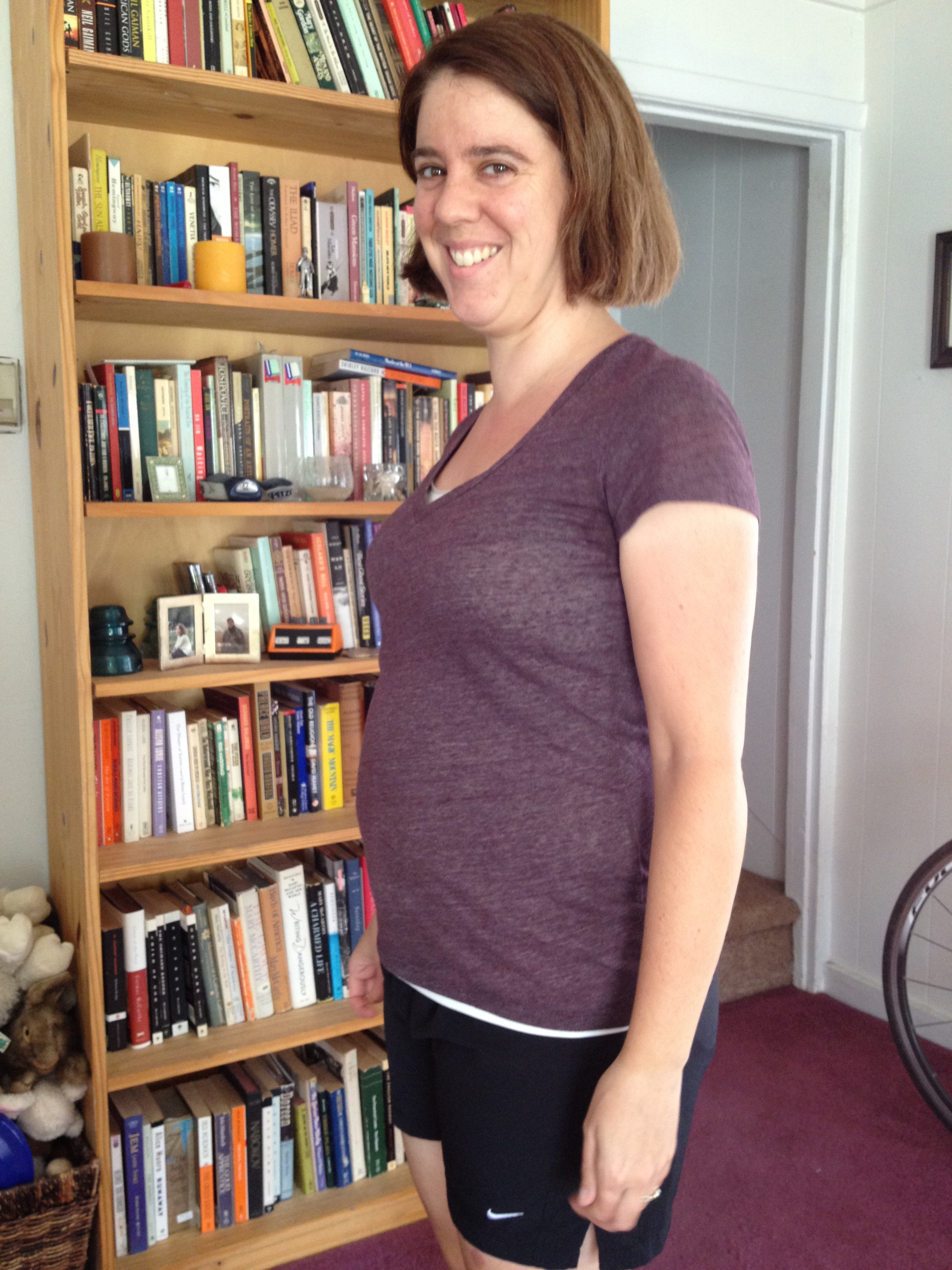
Finally, here’s the latest pregnant belly photo, at 17 weeks (there are always books and a bike in the background of these things, aren’t there!):

This week is the beginning of the semester — not of classes, but of the meetings that lead up to classes. So my life will soon get much busier. Sigh.

Have a great week everyone!

14 Comments

Filed under Books

Updates: 8/20/2012

I got back yesterday from my mystery book group meeting in Vermont, and it was a lovely time. Hobgoblin and I arrived on Friday afternoon and had some time to hang out, rest, and chat with our hosts (I guzzled limeade while the others drank martinis — I will certainly enjoy getting back to my moderate social drinking when this pregnancy is over!). Saturday involved a trip to the local farmer’s market in the morning, complete with bluegrass music, and a group excursion to Northshire Bookstore in the afternoon. We all brought home something; in my case, I found a used copy of Mark Doty’s memoir Heaven’s Coast, which I was thrilled to find after falling in love with his book Dog Years. We also bought our first children’s book, Tales from Old Ireland. The first of many more to come, I’m sure!

The book discussion Saturday evening was good, as it always is. Feelings were mixed about Sara Paretsky’s novel Hard Time, some really liking it and others finding it difficult to get through. Many people felt that Paretsky’s depiction of the prison system was the most powerful part of the book and the place where her writing really took off. It was clear that she has a passion for social justice, and when this passion lets loose, the writing gets stronger. The plot felt contrived, though, and we spent a lot of time talking about various plot points that seemed absurd. The mystery itself didn’t seem to work very well.

We also spent a lot of time talking about the news that John Banville/Benjamin Black will write a new Philip Marlowe book. Opinion here is very mixed as well, largely because many, although not all of us, strongly disliked Black’s novel Christine Falls and got the feeling that Black doesn’t have a whole lot of respect for the mystery genre. It’s my feeling that I might like John Banville’s version of Marlowe better than Benjamin Black’s, but we’ll see what happens.

And then Sunday morning we all headed home and back to regular life, which for me includes finalizing my classes for this fall. I will spend some time today thinking about how I will teach E.M. Forster’s Passage to India in my new online class.

As for other reading from the past week, I finished Gillian Flynn’s Gone Girl and liked it very much. I don’t want to say very much about it, as it’s a book that should be read with no preconceptions, but it was extremely absorbing, entertaining, and satisfying. I liked that it had a focus on writing and how writing shapes our identity and how other people think about us (and on how crime cases are solved). It’s a book that gets you to think about narration and how much to trust what you are told. The book reminded me a bit of Patricia Highsmith’s The Talented Mr. Ripley in the sense that it left me with a vague sense of dread and anxiety the entire time I was reading it — a feeling that sounds bad, but isn’t entirely. It’s a sign of a powerful book, I suppose, that it can grip the reader so tightly.

I also began reading Tove Jansson’s novel The True Deceiver and am about a third of the way through it. It’s similar to The Summer Book (which I loved) in its simple, pared-down writing style that is also very beautiful, although in other ways it’s an entirely different story. It’s set in a small Scandinavian village (I’m not sure if it’s in Sweden or Finland) and is about a young woman at odds with her fellow villagers, trying to take care of her younger brother, and developing a sketchy plan that involves a vulnerable older woman. I’m enjoying the writing, and also the detached, non-judgmental tone with which Jansson tells the story. She simply lets it unfold and allows you to draw your own conclusions.

That’s it for me for now — have a great week everyone!

4 Comments

Filed under Books, Fiction, Life

Updates: 8/12/2012

Most of my reading time this week has gone into my mystery book group selection, which is Sara Paretsky’s V.I. Warshawski novel Hard Time. We are doing something different for this meeting, which will be next weekend: we are gathering for the weekend in Vermont, where one couple in the group has a second home up in the mountains. I’m very excited about this, as I love their Vermont place, and it will be a lot of fun to extend our usual evening together into an entire weekend. I’m imagining there will be no end to the book talk that goes on.

As for the book itself, I enjoyed it, with some reservations. I’ve listened to two or three Paretsky books on audio, and once again I’m finding it to be the case that I generally like books more when I listen to them than when I read them on paper. I’m probably a less critical reader when I’m listening, and more inclined to get caught up in the story. I did enjoy the experience of reading the novel: I like the Warshawski character and found the story was absorbing and the novel was well-paced. I also like how overtly political a writer Paretsky is. Each of her books takes on some aspect of political or social trends going on at the time of writing, often ones that are directly related to her Chicago setting, and it’s satisfying to feel Warshawski’s frustration and anger at some of the things that outrage me too. But large chunks of the plot felt implausible to me. I won’t go into details, but I wondered how realistic her depiction of journalism and the criminal justice system was. I was pulled out of the story now and then as I shook my head, wondering if this could ever really happen. Some of the characters were too close to caricatures, which also bothered me. They were sometimes so extreme as to be unbelievable, and some could have been better developed. They are victims of Paretsky’s political mindset, I suppose; as much as I like the political element, it surely tempts a writer to turn characters into arguments.

Once I finished Hard Time, I was fortunate to get an email from my library telling me that a copy of Gillian Flynn’s Gone Girl was available, which I’ve been waiting for for the last month or two. I started it today, and 70 pages in, I’m enjoying it very much.

The other book I spend a significant amount of time with last week was Olaudah Equiano’s Interesting Narrative, which I’m teaching in an online class this fall. I needed to write up a couple lectures on it and prepare discussion questions. It’s a book I know well from grad school days, but it had been a number of years since I last read it. It’s a fascinating book bringing together a number of genres: it’s a slave autobiography, a travel adventure story (similar in this part to Robinson Crusoe, which we are also reading in this class), a spiritual autobiography, a political argument, an economic tract, and probably other things as well. There should be a lot there to discuss.

I’m making slow but steady progress in my Virginia Woolf books as well, the Lee biography and the second volume of her diaries. The Lee biography continues to impress me; about four chapters in, I’m admiring how she combines ideas and arguments with factual information. As someone with a bad memory for facts, I hesitate to pick up long, fact-filled nonfiction, but Lee has started every chapter with analysis and interpretation, something I have a better memory for, getting in the facts along the way. I like this focus very much. As for the diaries, Woolf is in 1920, getting starting on Jacob’s Room and writing about her response to reviews of Night and Day, which was published in 1919. It is clear she knows she is doing something new with Jacob’s Room, taking her writing in a new direction.

On a more personal note, Hobgoblin and I celebrated our 14th wedding anniversary this past week. 14! We celebrated by going hiking with Muttboy on a stretch of the Appalachian Trail that we have hiked many times together, the three of us. Then Hobgoblin and I went out for a fancy-schmancy dinner that ended with the chocolate sampler for dessert. Yum. Who could resist a chocolate sampler?

Finally, here is my first pregnant belly picture, taken at 15 weeks.

As you see, I’m in the awkward stage where I sort of look pregnant, but also look as though I’ve just had a very good summer eating-wise (which I have). People who know I’m pregnant say I’m showing, but I’m not sure anyone else would would venture to ask. I’ve noticed one questioning, uncertain look so far, but that person wasn’t going to risk getting it wrong.

17 Comments

Filed under Books

Essay Collections

It’s been a pretty good year for essay collections for me. I’ve read seven so far. I didn’t love all of them, but some will stand out as being really great. There were two collections about the essay as a genre, including Carl Klaus’s book Essayists on the Essay: Montaigne to Our Time, which included excerpts of pieces that try to define the genre or sum up its value and its history. It’s a great book if you want to get a better sense of what exactly an essay is. Not that anyone really agrees on the definition, but there are a lot of definitions on offer here. Then there was David Lazar’s edited collection Truth in Nonfiction: Essays, which takes up the question of what truth in nonfiction writing means — a vexed question that many people have been asking lately. Again, there are a variety of answers on offer here, or, more accurately, there are often no answers, just more complicated questions, which is as it should be. The essays are often from a personal perspective, which makes them entertaining reading, as well as being philosophically interesting. I’ll admit that I skipped a few essays toward the end of the book because they were more straightforward essays rather than meditations on truth in nonfiction, and I wasn’t in the mood for them. This is probably a collection that’s better to read around in rather than plow straight through.

But one can only do so much reading about a genre before it becomes high time to read the genre itself, and by far the best collection of essays I’ve read this year is Zadie Smith’s Changing My Mind, which was captivating the whole way through, no matter what Smith’s subject was. The next two collections, ranked in terms of how much I liked them, were John Jeremiah Sullivan’s Pulphead and Tom Bissell’s Magic Hours. If the mark of a truly great essayist is that she or he makes any subject interesting, no matter what it is, then these two writers aren’t quite up to the level of Smith, but are still pretty solid. They both have interesting, engaging essayistic voices, and both have good things to say about literature and culture. I found Sullivan more consistently enjoyable than Bissell, but both have some great moments. The pieces in Bissell were just a little more disjointed, a little less universally interesting. Still, an essayist to watch.

I also read the 2011 Best American Essays collection, which was mixed, as it always is, but with plenty of good essays. Favorites were by Victor LaValle (on obesity), Charlie DeDuff (on Detroit), and Bridget Potter (on getting an abortion in 1962). You never know what you’re going to find in these collections, and it’s fun to be surprised. The last collection I read this year was The Professor, by Terry Castle, which certainly had some essays I liked, but for the most part, I didn’t care much for her voice. There was something harsh about it that didn’t appeal to me.

That’s not a bad record for a year that’s not over. Anybody have any recommendations of collections I should turn to next?

8 Comments

Filed under Books

Updates: 8/5/2012

Hobgoblin and I had plans to buy books today, and although the exact nature of those plans shifted somewhat, that’s what we ended up doing. We decided to head down to Manhattan to visit the mystery bookshop Partners and Crime, which, very sadly, is closing soon. It’s a place we visited often. It turns out that their selection is already thinned out, so I didn’t find what I wanted there, but I was glad to be able to visit one more time. We stopped at a couple other stores as well, including the Strand and Three Lives.

Let me just say that if you like literary nonfiction, the Strand is the place for you. Down in the basement you can find aisle upon aisle of literary criticism, essays, memoirs, biographies, autobiographies, and other kinds of unclassifiable nonfiction. It’s amazing, and I always head pretty much straight down there whenever I visit. Today I came home with Hermione Lee’s biography of Edith Wharton, which I couldn’t resist after beginning Lee’s Woolf biography and seeing that I’m going to like it very much. Lee is a great biographer, and Wharton is a great subject, so there you go. I also found Milan Kundera’s Art of the Novel, which a friend highly recommended to me, and Katie Roiphe’s book Uncommon Arrangements: Seven Marriages, which comes highly recommended by several bloggers.

At Three Lives, I could have come home with a dozen books with no trouble at all (the store is very small, but the selection is fabulous). I chose Tim Parks’s Teach Us to Sit Still: A Skeptic’s Search for Health and Healing, influenced partly by bloggers and partly by this article at the Guardian, and also John Gardner’s The Art of Fiction. I guess it was a good day for nonfiction, and particularly for books on writing.

As for what I’m reading, I’m nearing the end of the Tom Bissell essay collection, which has a lot of good stuff in it, but is kind of uneven. Not all the subjects interest me; it takes a special talent to make essays on films and TV shows that I haven’t watched engaging — something which Zadie Smith managed to do, but I’m not feeling it quite as much here. But still, Bissell is an entertaining, talented writer, and I’m happy to continue following his career.

I began the Woolf biography, and the first chapter won me over. It was about biography and autobiography as genres and then shifted to a discussion of Woolf’s own views on biography and her (auto)biographical writings, and was really excellent. It looks like the book is going to be more thematic than chronological, as the second chapter is on houses and describes the locations Woolf spent her childhood years, instead of turning to the story of her ancestry, her parents’ lives, her birth, etc. I’m guessing it won’t lose sight of chronology entirely, but won’t move straightforwardly through time either.

I also began my next mystery book group book, which is Sara Paretsky’s Hard Time. I’m only 70 pages into it, and while I sometimes am bothered by the writing quality, I’m absorbed in the story and enjoying it.

Before I go, I want to mention another endeavor of mine, which I haven’t posted about here yet because I wasn’t sure how seriously I would take it. I started a Tumblr to keep track of quotations I like, with a photograph or two thrown in occasionally. I wasn’t sure at first how much I would post on it, but I’m enjoying having the space. It turns out that I mostly quote from and link to essays online rather than from the books I’m reading, for the simple reason that I rarely bring my book into the room where my computer is to retype the quotation, whereas it’s easy to cut and paste an online article using my phone. Anyway, if you are interested, you can find it here.

8 Comments

Filed under Books

Catching Up

Actually, this post won’t do a whole lot of catching up, as I have at least two months of reading that has gone undocumented here. It will have to stay undocumented, mostly. But I was thinking that I might try to do a once-weekly (or so — don’t want to get too specific) overview of what’s going on with my reading, as a way of keeping up with the blog without writing the long reviews I’m not feeling much like writing these days. We’ll see how that goes.

But first, I do want to say that Mark Doty’s Dog Years is unmissable if you like nonfiction and like dogs — and it’s unmissable even if you don’t like those things, although I won’t insist on that quite so loudly. But seriously, it’s not a book just for dog-lovers. It’s about Doty’s experiences with his two dogs, no surprise, but it’s really a book about loss, life, and death more generally, and it’s beautiful and profound. It’s so warm and human and moving, and it’s the best attempt to understand the mind of a dog I’ve ever read, while at the same time being very careful to acknowledge that dogs are not humans and we can’t ever really understand their mysteries. I think what works so well is that he shows such great respect for dogs, for their individuality and dignity, and he makes an important case for why loving animals matters and is not merely a waste of time and energy that could be devoted to other things.

Okay, now for more recent reading. I picked up Mrs. Dalloway the other day as part of my most likely decades-long attempt to read and reread Woolf’s major works. It’s been a while since my last Woolf book, The Common Reader. I’m not sure if this is my second or third reading of the novel, although I would guess it’s my third. I do know I read it in 1998, since I wrote that on the inside cover of my copy. It’s such a joy to return to, and I love the way the book makes me slow down to read it carefully. I don’t want to miss an idea or an image.

I’m enjoying the novel so much, I decided to pick up the second volume of her diary, which will take me through the four years up to the publication of Mrs. Dalloway. I’m thinking of keeping the diary on my nightstand and reading it before bed, which will mean I’ll probably be reading it for the next year or so, but that’s okay. I’ve also been tempted to pick up Hermione Lee’s biography of Woolf, and I still might do it, but I’m worried that I’ll feel bogged down by its length, slow reader that I am.

I’m also in the middle of Tom Bissell’s new essay collection Magic Hours: Essays on Creators and Creation. I really liked the first four essays, three of which are on literary topics and one of which is about film. The essay “Writing about Writing about Writing” is a very fun overview of how-to-write books, and there’s another great one on the Underground Literary Alliance and insiders and outsiders in the literary/publishing world. The next two essays haven’t been up to the quality of the first four, and I particularly disliked one in which he attacked the political writer Robert Kaplan. He may well need attacking, but the tone was unpleasant to read. But the essays are now taking a more literary turn, and I have hopes I will like the remaining ones.

10 Comments

Filed under Books

Of Books, Bicycles, and Babies

So, as you might guess from the title of this post, I’m pregnant! I’ve made the announcement other places online, so it’s high time I visited this blog again to share the news here. Hobgoblin and I are thrilled to be welcoming a little one into the world in late January 2013 (approximately). This has been an odd and wonderful experience so far. It’s only last winter that Hobgoblin and I decided that we might want to have a child after years of not being very interested, and here I am, with a creature growing in my belly. It’s freaky to think about, really. I’ve seen the baby twice through ultrasound so far, and I can hardly believe it. I have to say, Muttboy, although he doesn’t know the full extent of the disaster about to strike his calm and orderly life, has already shown unhappiness with our decision to turn the house upside down to create room for a nursery. But we will do our best to make the transition smooth for him, and he’ll come to love the new baby too, I’m sure.

As for books and bikes, I’m still riding, although less frequently and far less intensely than I used to. I’m hoping to ride for the rest of the summer at least, even if I have to switch from my racing bike to my hybrid, which is more upright and therefore has more room for a growing belly. I get out when the weather is good and I’m not too tired, and the exercise is great. Needless to say, racing is now completely out of the question, something I can’t say I mind terribly much.

My reading is going well, as I have a good amount of time for it these days, and I’ve found some books I love, including Mark Doty’s Dog Years (amazing!), Dodie Smith’s I Capture the Castle, John Jeremiah Sullivan’s essay collection Pulphead, Edith Wharton’s The Reef, and others. I will try to come back soon and write about recent reading in more detail. To be honest, I’m not sure about the future of this blog; I’ve been very quiet lately, and with a new baby, it will be that much harder to find time and energy to post. But I don’t want to close things up entirely yet, so I’ll just see how things go. I have been reading your blogs with pleasure, and you can follow my reading on Goodreads if you are interested. Hope to be back soon!

20 Comments

Filed under Books

The Yacoubian Building

I bought this book a while back for reasons I can’t remember now, but it’s the most recent choice for the Slaves of Golconda book group and so high time I read it. The novel tells the stories of multiple characters, none of whom could really be called the protagonist, since the narrative spends similar amounts of time with each story. It’s the Yacoubian building that holds all the stories and the novel itself together. The Yacoubian building contains apartments that house people of many different backgrounds and classes, so through their stories we get a glimpse into various parts of Egyptian culture and experience.

There’s more than the building that holds the novel together; there is also a simmering frustration with Egyptian society and government that plays a part in many if not all of the stories. Taha, for example, finds himself unable to fulfill his dream of entering the Police Academy because of favoritism and corruption and soon joins a militant Islamic group. Busayna discovers that the only way she can support herself and her family is by allowing male employers to take sexual advantage of her. Zaki falls victim to his conniving sister who evicts him from his own apartment by getting the police on her side. Money, family, and connections are everything, and without them, there is little one can do to change one’s fate. It helps very much not to be a woman as well.

I admired the range of stories (not that there are all that many main narrative threads, maybe a handful) and subject matter they explore, from political corruption to workplace exploitation, religious devotion, family dynamics, sexuality, con men, drug dealing, torture, and falling in love. It’s a lot to cover in 250 pages, and Al Aswany does it admirably, giving us a feel for life in Cairo. I was grateful for the list of characters and their descriptions included right before the novel’s opening because the frequent switching from story to story got distracting at times, and the guidance was helpful.

I was never fully immersed in the novel, another function, I’m sure, of the jumps from character to character. But there were rewards to compensate for this, especially the overview of Egyptian society the multiple stories offered and the economy with which Al Aswany captures a rich sense of his characters’ lives. The narrator seems to withhold judgment, portraying the characters’ virtues and failings with equanimity. He seems interested more in understanding why people are the way they are rather than in judging them for what they do. It’s possible to find this narrative style flat and affectless, but I felt an undercurrent of compassion that at times is powerful.

3 Comments

Filed under Books, Fiction

Recent Reading

Let’s see — what have I been reading recently? I finished Barbara Pym’s Jane and Prudence. I liked it, but didn’t love it. I kept thinking the whole time I was reading how much her subject matter is like Anita Brookner’s, but I like Brookner better. Pym has a lighter tone and is more satirical, whereas Brookner strikes me as working in a darker mode, and maybe that darkness appeals to me more. I did like the characters’ interactions in the Pym, especially the workplace dynamics she describes, and I liked the contrast between city and small town life. But I never felt fully absorbed in the story or in the novel’s ideas.

I also finished Ali Smith’s new novel, There But For The, which was also a little disappointing. I really liked The Accidental, and this one wasn’t as good. The two books have a similar structure: they are divided into four parts, each from a different point of view, each part adding a different perspective on the story. But in the new novel, the four parts don’t hold together very well, and they aren’t equally interesting. The last part was my favorite, told in the voice of a young girl who is brilliant and funny. I also liked the part describing the dinner party — the novel is about a dinner party guest who goes upstairs, locks himself in a bedroom, and refuses to come out — because it was wickedly satirical and funny. But it just never came together into a coherent whole. The four different perspectives in The Accidental were much more tightly focused on one story, so the reader can compare how the different characters made sense of it. There isn’t the same pleasure to be had in the new book.

Hmmm … it’s good that I’m happily in the middle of Tana French’s In the Woods, or this post would be almost entirely negative, since I discontentedly set aside Ben Marcus’s new novel The Flame Alphabet after about 90 pages. I liked his novel Notable American Women, but struggled with the new one, partly because it was too similar in tone, style, and theme to the earlier one. His books are strange and powerful, and need to be read in small doses, I guess. I think I can handle darkness and ugliness in my fiction, but somehow there needs to be something appealing about it, in some way, no matter how unexpected or perverse, and I wasn’t finding that here. Also, I had a hard time grasping the world he was creating because it seemed arbitrary and I didn’t really believe it — it’s a world like ours but where children’s language has suddenly become toxic, so adults are being stricken by horrible illnesses merely by living with their offspring. I would be okay not believing in the world of the novel if the ideas it is exploring are engaging, but Marcus’s interest in language as dangerous doesn’t resonate with me.

So, after reading a bunch of experimental fiction (or “experimental” or whatever — not counting the Pym, of course), some of which I liked — The Last Samurai — and some of which I didn’t, I figured it was time for something more traditional, hence In the Woods. It’s an absorbing story, which is exactly what I wanted.

10 Comments

Filed under Books

Pulphead

I’m currently reading Pulphead by John Jeremiah Sullivan, and oh my god, what a good book it is! I’ve read six of the 14 essays so far, and while they aren’t all at the same level of fabulousness, they are all pretty close. I just finished an essay on Michael Jackson, which sent me off to watch this video and appreciate him in a way I never have before. The first essay is on a Christian Rock festival, which he captures perfectly in all its weirdness, and there are also essays on Hurricane Katrina (with a haunting ending), his brother’s near-death experience, and the TV show The Real World. This last essay is written in a funny, hyped-up, super-informal tone befitting the subject:

I’d suspected there were puppeteers involved in The Real World, invisibly instigating “drama,” but to think that the network had gone for it like that and hired a shrink? One who, as the kids went on to assure me, was involved not only in manipulating the cast during shooting but also in the casting process itself? And she’s worked on other shows? This explained so much, about The Real World, about all of it. When I wrote that business earlier about how the casting people have made the shows crazier and crazier, I didn’t know I was right about any of that! This person is an unacknowledged legislator of the real world. Turns out Dr. Laura is a psychologist, not a psychiatrist, which is better, when you think about it, because psychologists don’t have to take the Hippocratic oath, and she’s definitely, definitely done some harm. No chance I was going to call her.

Or there’s this somewhat more serious passage from the same essay (don’t miss the last line):

People hate these shows, but their hatred smacks of denial. It’s all there, all the old American grotesques, the test-tube babies of Whitman and Poe, and great gauntlet of doubtless eyes, big mouths spewing fantastic catchphrase fountains of impenetrable self-justification, muttering dark prayers, calling on God to strike down those who would fuck with their money, their cash, and always knowing, always preaching. Using weird phrases that nobody uses, except everybody uses them now. Constantly talking about “goals.” Throwing carbonic acid on our castmates because they used our special cup and then calling our mom to say, in a baby voice, “People don’t get me here.” Walking around half-naked, with a butcher knife behind our backs. Telling it like it is y’all (what-what). And never passive-aggressive, no. Saying it straight to your face. But crying … My God, there have been more tears shed on reality TV than by all the war widows of the world. Are we so raw? It must be so. There are simply too many of them — too many shows and too many people on the shows — for them not to be revealing something endemic. This is us, a people of savage sentimentality, weeping and lifting weights.

Those are good passages, but not even the best I’ve found, just the ones I read recently. Sullivan’s voice is amazing. I love discovering a new great essayist.

7 Comments

Filed under Books, Essays

In the Freud Archives

I recently finished another book by one of my favorite nonfiction authors, Janet Malcolm; I’d already read The Silent Woman, about Sylvia Plath and Ted Hughes, and Two Lives, about Gertrude Stein and Alice Toklas, and now I have finished In the Freud Archives, a book about psychoanalysis and Freud scholars. The Silent Woman is my favorite so far, and will probably stay my favorite, but In the Freud Archives is a close second, and possibly is second only because psychoanalysis isn’t all that interesting to me, whereas Plath and Hughes are. With Malcolm, though, it doesn’t matter much whether the topic at hand is inherently interesting or not, because she makes it interesting. All these books follow a similar format: Malcolm takes an academic, literary, or cultural controversy and digs deep into the story, interviewing the major players and charting out the various sides of the conflict. She herself is a part of the narrative; although she is good at keeping the focus on the story at hand, she does give her personal impressions of the major characters and offers her particular slant on the story.

In the Freud book, as in the others, Malcolm is writing on a number of different levels. In the Freud Archives (published in 1984) is a book about controversies among Freud scholars, specifically about who will control the archives with many letters that scholars have not had a chance to study. It’s a story about Dr. Eissler, a distinguished Freud scholar and analyst, and Jeffrey Masson, a younger man who started his career as a Sanskrit scholar and found his way into the world of psychoanalysis. Eissler becomes a mentor to Masson, grooming him to take control of the archives. But Masson is a controversial figure among analysts; he is too pushy and too overtly ambitious, he seemed to come out of nowhere and made his way to the top of the field all too easily, and his views on Freud are increasingly unorthodox. The “plot” of the book is about the relationship between Eissler and Masson and about Masson’s status in the psychoanalytic world.

But In the Freud Archives is about Freud, too; we learn about what kind of a thinker and analyst Freud really was and about the development of his thought in his early years, the focus of Masson’s research. We learn about the history of the discipline and of scholarship on Freud. The way Malcolm describes it, psychoanalysis and Freud studies seem to be at a crisis point in the 1980s — or at least at a vulnerable moment — with a comfortable scholarly establishment too willing to overlook flaws in their theories and in their founder, an environment ripe for someone like Masson to come in and shake things up.

The book is also about Malcolm as well; she describes the settings in which she conducted her interviews and her impressions of all the major players. It’s also about her in a sense she couldn’t have predicted when she first wrote the book. My edition, from NYRB, contains an afterward written by Malcolm that describes the book’s aftermath: Masson sued her for libel and she spent 10 years fighting him in the courts. She was ultimately successful, but the episode shows the dangers of writing this kind of nonfiction. It’s impossible to know how one’s subjects will react to having their lives and careers dissected in print.

I kept thinking as I read the book that it would be interesting to have some one pull a “Janet Malcolm” on Malcolm herself — to write about the making of this book, the book’s reception, and the ensuing lawsuit and to follow up on what has happened in psychoanalysis and Freud studies in the years between then and now. In the Freud Archives is an absorbing read and an intriguing look into one corner of the scholarly world, but I have the feeling that there’s more of this story to be told.

4 Comments

Filed under Books, Nonfiction

The Last Samurai

I’m not entirely sure where I learned about Helen DeWitt — from blogs of course, but I can’t remember which ones — but she’s been on my mind lately because of her good showing in this year’s Tournament of Books. I thought The Last Samurai might be a better place to start than the most recent Lightning Rods, though. What a fun book it turned out to be! It’s over 500 pages, but a fast read and very absorbing. It tells the story of a mother and son living in London, both of whom are brilliant, but the son, Ludo, is particularly so, and the mother, Sibylla, doesn’t quite know how to handle him. He has a desperate hunger to know things, and is studying Greek and other languages at the age most children are barely ready for Sesame Street. At the novel’s beginning, he wants Sibylla to teach him Japanese, inspired by her obsessive rewatching of Kurosawa’s film The Last Samurai. For her part, she is struggling, both because money is very tight, and because she needs time to do the typing that brings in what money she has. It’s hard to find time, though, when Ludo constantly asks questions and begs to be taught more — and more and more.

What I liked particularly about the book is the style: DeWitt captures the craziness of Sibylla’s and Ludo’s experiences by throwing it all out on the page. There are pages where the sentences go back and forth at a dizzying pace between Sibylla’s thoughts and Ludo’s questions, or between a description of The Last Samurai and Ludo’s questions, or between comments they get from strangers as they ride the Circle Line all day to keep warm and Sibylla’s thoughts and Ludo’s questions. There is also a lot of Greek and Japanese and other languages in the pages, as well as numbers and math formulas. The novel has so much energy that it threatens to overrun its boundaries at times, both because it’s frequently breaking out into other languages and different fonts and because it’s constantly veering off into different stories. As Ludo grows older, he becomes more and more curious about his father and asks Sibylla more and more insistently to tell him who he is. Sibylla refuses, so Ludo goes on a quest to find him, or to find someone worthy of being him. Part of this quest is discovering stories of brilliant, adventurous, potential father-figures, and these stories become part of the novel.

It’s here that the novel faltered the only time; in the second half of the book, the narration settled down into a pattern that threatened to get dull. But only threatened — the energy and humor of the writing saved it, as did the relationship between Sibylla and Ludo and the fondness I had for Ludo throughout the whole book.

I think the thing I like best about the book is the great sense of openness it has. Even though Sibylla frequently feels harried and trapped by her situation, she’s able to offer Ludo so much intellectual possibility and so much freedom that it’s satisfying to watch him figure out the world and begin to make his way in it. He struggles with boredom, frustration, and uncertainty, but he also has great resourcefulness to match his intelligence. It’s a pleasure to watch him take on the world.

11 Comments

Filed under Books, Fiction

Bookish Podcasts

I wrote a post a little over a year ago in which I discussed some of my favorite literary podcasts, and I thought I would do a little update of that post, since I’ve found some new ones lately that I like. I’m still listening to Radio Open Source, and to the occasional author interviews on The Leonard Lopate Show and (less often) The Brian Lehrer Show and Fresh Air. But I’ve added to those The Bat Segundo Show, which is devoted solely to author interviews and in-depth discussion of books. Also, I’ve recently discovered Other People, which is author interviews conducted by novelist Brad Listi. While Bat Segundo is all about digging into the details of the books, Other People often doesn’t get to the book at all; I’ll sometimes get to the end of an interview and have no idea what the book is about. But I like it anyway because I learn a lot about the author and the conversations are amusing, and, more often than not, I finish the show wanting to read the book. The first time I listened to the podcast I was surprised to hear the host monologue about his personal life for 10 minutes or so, and I thought, wait, why do I care about you? Get to the interview! Shut up about yourself! But by the time I listened to the podcast again, I’d begun to like the opening monologue, and now I make a point of listening to it. These things grow on you.

And more recently I’ve discovered a bunch of other podcasts, some of which I’m still figuring out whether I really like or not. There’s Books on the Nightstand, which offers book recommendations from its two hosts, as well as news about the book world and issues related to reading and publishing. I like the concept of this podcast, although I haven’t figured out how much my reading tastes coincide with theirs. There’s also The Readers, which is done by two British guys who chat about books they like and host a summer book club. Again, I’m not sure how much my reading taste overlaps with theirs, and sometimes their show is a bit too giggly for my taste, but still, it can be interesting and fun.

There’s also the New York Times Book Review Podcast, which is basically supplemental material to the book review with author interviews and discussions of the best seller list. And there’s the Bookrageous Podcast with more book chat, and the BBC World Book Club with author interviews.

I’m a little afraid to ask if there are others you recommend because I have so much to listen to already, but … are there?

14 Comments

Filed under Books

Recent Reading: April

Another summary post, for now:

  • In March I read Ben Marcus’s Notable American Women, which I liked, mostly. I’ve been talking about Ben Marcus a lot with a friend who has been curious about Marcus and his ideas about experimental fiction, and I thought I’d try his one book that was currently available in the library. I’m looking forward to reading his most recent novel The Flame Alphabet when the hold comes in. But for now, Notable American Women was strange in a very interesting way. It’s about a cult of women in Ohio who try to cut language and movement out of their lives as much as possible. They basically try to shut themselves down entirely, removing themselves from engagement with the world. The main character is named Ben Marcus (I don’t get why experimental writers so often name their characters after themselves. It surely was a good idea the first time or so someone did it, but to be doing it still??), and he lives in this cult, trying to find his place in it and to figure out how to relate to his distant mother, and his father, who appears to be buried in the front yard. I liked the first part of the novel very much, which takes the form of a letter from the father to the reader, and the last part is also great, in the form of a letter from his mother. The middle describes the rules and procedures of the cult, and it’s strange — strangely fascinating at times and at times a little dull. All in all, it’s a memorable take on language, power, and family relationships.
  • Lidia Yuknavitch’s The Chronology of Water: A Memoir was a harrowing read. A friend asked me what it’s about, and I started to describe it — her difficult childhood, her rebellion, her struggles with addiction, her complex relationship with sexuality, her redemption through writing — and it all sounded so cliche. But that’s not how the book felt, largely because the writing is powerful and the story isn’t told in chronological order. It’s told in a loose, impressionistic, associative way, and the sentences move into poetic territory at times and at times collapse in on themselves. Mostly, I liked this. There is something compelling about Yuknavitch’s persona, something I liked about her, even though she practically dares you not to like her. At times the aggression of the writing was too much for me and at times the persona was just too prickly for me to handle. But there is a power in this book that made it hard to put down.
  • I don’t remember where I heard about Maggie Nelson’s Bluets, but I’m glad I paid attention to wherever it was, because I loved this book. It’s a short meditation on the color blue, written in brief numbered sections that look at “blue” philosophically, biologically, poetically, autobiographically, sociologically, and probably in other ways as well. It’s also the story of a breakup and the suffering that came with it. As always with a book like this, my enjoyment of it comes down to the persona, and in this case, I loved her, especially for her emotional rawness and sexual frankness mixed with a careful, philosophical thoughtfulness. There’s a confessional quality to the book that works beautifully because of the way it’s part of a larger context of ideas.
  • David Lipsky’s Although Of Course You End Up Becoming Yourself is basically a transcript of a multi-day interview Lipsky did with David Foster Wallace in 1996, just after the publication of Infinite Jest. Lipsky has written an introduction to the transcript, and has also inserted short explanations and commentary into the dialogue, but mostly it’s just the two of them talking, complete with sentences that trail off into nothingness and awkward transitions between topics that probably didn’t seem awkward at the time. Their conversations are interesting, for the most part, many of them about the process of writing Infinite Jest and Wallace’s attempts to make sense of his new-found fame and success. He was desperately worried about getting so caught up in the whirl of publicity that he would come to rely on it. You can see him both enjoying the attention of the interviewer and waiting eagerly for it all to be over, so he could get back to his normal quiet writing life. Lipsky’s book was published after Wallace’s death, and much of what Wallace says about suffering takes on a new meaning in that light. I don’t think this book would be that interesting for anyone not familiar with Wallace, and probably it’s best to have read Infinite Jest first, to understand a lot of the references in their conversations. I stumbled now and then over places where the conversation bordered on incoherence, but mostly I found the book absorbing, and I loved the insights into Wallace’s character and his writing.

7 Comments

Filed under Books

Recent Reading

First, some numbers:

  • bike miles logged since January 1st: 1,775.
  • Hours ridden: 114.
  • Races completed (in unspectacular but acceptable fashion): 1.
  • Books read: 16.
  • Hours worked: too many.

Rather than writing reviews, I’m busy enough to be reduced to lists, but that’s better than complete silence, so here’s what I’ve been reading since I last posted:

  • I finished Zadie Smith’s essay collection Changing My Mind, which was absolutely fabulous. If you like essays on literature and culture, read this! Smith is brilliant and charming, and I have become a fan (I read White Teeth a while back and liked it fine, but my response to this essay collection has been much stronger).
  • I finished Essayists on the Essay, a collection edited by Carl Klaus, which is exactly what the title promises. It’s very good if you want to get a sense of the essay as a genre and also if you want essay recommendations.
  • My mystery book group read Martin Cruz Smith’s Gorky Park, which I can appreciate as a very good example of a particular kind of mystery/thriller, but which I struggled with a little. I’m not a plot person, basically, and this was a lot of plot. I get tired of struggling to keep everything straight. But still, lots to appreciate here.
  • David Shields’s Reality Hunger deserves its own post, which it may not get. I give it five out of five stars for articulating a nonfiction aesthetic that I like very much and for having awesome book recommendations, and two out of five stars for being obtuse when it comes to the value of fiction. Also, I was never completely won over by the argument it implicitly makes about collage, quotation, and plagiarism.
  • Lorrie Moore, Anagrams, which was funny and inventive. It has an interesting structure, with four chapters or so that give you the same two characters but in different permutations: with different backgrounds, personalities, careers, etc. Eventually it settled down into one version of these characters and told a more coherent story. I was a little disappointed the opening structure didn’t continue through the whole book; once it settled down into one story, the whole thing got a tiny bit less interesting. But still, very good.
  • Darin Strauss, Half a Life: A Memoir. This tells Strauss’s experience of accidentally hitting and killing a high school classmate in a car crash when he was 18 and about to graduate. The accident wasn’t his fault, but of course the experience was still devastating. The story is well-told, and Strauss does a great job articulating what the experience was like. At times, I found the writing too vague and abstract for my taste; sometimes it was hard to wrap my mind around the thoughts and images. But still, it’s a brave book.

9 Comments

Filed under Blogroll, Books, Essays, Fiction, Nonfiction

Hi!

It’s been a while since I posted here, hasn’t it? I’m afraid my posting schedule is going to continue at this glacially slow pace for a while. This is a busy semester with a large extra responsibility on me in addition to my usual courses (it involves event planning — NOT my favorite thing!). Plus I’ve already ridden 1,041 miles since January 1st. And I just finished reading all 925 pages of 1Q84. So, busy.

As for what I’ve been reading, 1Q84 was an enjoyable story, not terribly fast paced but paced well enough to keep me going, and with characters I became fond of. But the writing! I don’t know whether to blame it on Murakami or the translator, but there were strange repetitions, awkward dialogue, distracting point of view shifts, and unnecessary explanations. Still, I could let those things go and just enjoy the story, which was good because I spent three weeks or so reading it.

Also, I listened to The Tiger’s Wife on audio and liked it very much (nice mix of realism and myth, a simple story at heart, although with a multitude of other stories surrounding it), and also Jesmyn Ward’s Salvage the Bones, which was harrowing. I found its style lyrical in a way that didn’t work for me — I thought it distracted from the characters and story rather than adding to it — but the situation and story were memorable (poor family in Mississippi in the days leading up to Katrina, a 15 year old girl coming to terms with the fact that she is pregnant).

I just started Zadie Smith’s essay collection Changing My Mind, and although I’ve only read one essay in the book, I’m already in love. The essay was on Zora Neale Hurston, and its mix of the critical and the personal was absolutely perfect. And I’ve also slowly been working on a collection called Essayists on the Essay: Montaigne to Our Time. It’s right up my alley, of course, and very, very good. The book is made up of short excerpts from essay writers discussing the genre itself. In addition to offering a good chance to think about one of my favorite genres, it’s motivating me to read more essays — and I don’t really need more motivation as I already read plenty!

That’s what’s going on with me. I apologize for not coming around to my usual blog haunts to comment, but I have been reading Google Reader faithfully and have enjoyed keeping up with you all.

10 Comments

Filed under Books

The Accidental

I finished Ali Smith’s The Accidental the other night, and I’m so glad I finally got around to reading it; I’m not quite sure I like the ending, but that’s not a big deal with a book that is not plot driven. Mostly, I liked the book because of the writing, the way Smith captures the consciousness of each character.

I’ve always liked books that tell the same story from multiple perspectives because you can see how people react to the same situation in different ways or how they interpret a situation differently given their varied preoccupations and levels of knowledge. It shows how little solid information we have about anything and how our most prized opinions may be based on very incomplete knowledge. Smith tells her story from four different perspectives, each one appearing three different times: Eve, her second husband Michael, and two children from her first marriage, 17-year-old Magnus and 12-year-old Astrid. They are on vacation in a rental house in Norfolk, and in walks Amber, a 30-something woman who wheedles her way into their lives. Each one thinks someone else in the family knows Amber, so no one seriously questions her presence. The story is about the havoc she wreaks as she develops different relationships with each family member and makes them confront who they are as individuals and as a family. There are short sections that are presumably from Amber’s perspective as well, although they don’t tell us much about who Amber is. She remains a mystery.

What works best is Smith’s use of language to capture the distinctive thought pattern of each character. The opening lines of Astrid’s story, for example, are interrupted by the words “Astrid Smart. Astrid Berenski. Astrid Smart. Astrid Berenski” in parentheses, as Astrid, in the midst of her thoughts on the dawn, also thinks about her own name and identity. She was born Astrid Berenski, but when her mother remarried, her name changed, and she is constantly thinking about what this change means. Eve’s first section is told in questions and answers, which is appropriate as she is a researcher and writer whose books are part biography, part fiction and who undergoes interviews herself. This format nicely captures her uncertainty and self-doubt. There is even a very odd section where’s Michael’s story transforms into a series of poems. Normally I would find this sort of thing irritating, but here it works: Michael is the sort who might start composing poems (bad ones) in his mind as a way of thinking about his life, and so it’s natural for the narrative to follow his mind there.

I found the characters almost equally compelling — which strikes me as hard to pull off when a writer is moving back and forth among four of them — and enjoyed being pulled into the emotional world of the Smart family. I read this book partly because I’ve heard very good things about Smith’s latest novel There But For The, and I wanted to read the Smith book on my shelves before moving on to the new one. I’m glad I did, and now I’m even more eagerly awaiting Smith’s latest.

10 Comments

Filed under Books, Fiction

Recent Reading

This year has started out pretty well for me, reading-wise; it’s not been perfect, but I did finish two novels I liked very much, Anita Brookner’s Look At Me and Jonathan Lethem’s Motherless Brooklyn. This is the third Brookner novel I’ve read, and I think it’s my favorite so far. Brookner captures a certain kind of consciousness so well — the lonely, smart, isolated figure who wants a different life but can’t quite reach it. It’s a first-person point of view, and the narrator is ruthless in her honesty, which makes for a sad story. But there’s something bracing in that honesty that I admire. What’s really hard to read is the process she goes through of figuring out that she was wrong about her relationships. She thought she was doing things right, when it turns out she wasn’t. Sad! But Brookner dissects it all so well.

The Lethem was fabulous as well. Motherless Brooklyn is the second Lethem novel I’ve read, after The Fortress of Solitude, and I think it’s my favorite (perhaps because the subject matter of the other one didn’t appeal as much). It’s a detective novel, and a book I read for my mystery book group, which met last night. In a lot of ways, it’s a straightforward mystery, with murders and detectives and clues, etc. But the main character, Lionel, has Tourette’s, which means he’s not able to control his words and actions as a traditional detective might. I thought Lethem did a great job portraying what life with Tourette’s might be like (not that I know for sure, of course, but his depiction was convincing), and I was fascinated by how imaginative and fluent Lionel was with language. The problem, of course, was that he couldn’t control the outpouring of words, and this frequently got him into trouble. He’s an appealing character — a thoroughly unconventional detective who does the best he can in some difficult circumstances.

I also finished Terry Castle’s collection of essays The Professor and Other Writings, which was a little disappointing. Some of the early essays in the book were good, especially the one on Susan Sontag and another one her obsession with World War I. Other essays I didn’t quite get the point of, and the title essay is much too long, book-length, really, with not enough pay-off. The success of an essay collection comes down to voice, I think, and I was never quite won over by Castle’s.

And now I’m reading Ali Smith’s The Accidental, which has been very good so far. It tells a story from multiple points of view and follows the characters’ minds closely in a stream-of-consciousness style that captures their different experiences well. I can sometimes be put off by writing that seems labored or self-consciously poetic, and I postponed reading this book for a long time because I was afraid I would find that kind of writing here, but that hasn’t been the case at all.

Before I go, a quick note on cycling: since January 1st, I’ve done 11 rides with 410 miles total in over 26 hours on the bike. That’s perhaps one reason I haven’t posted here much!

10 Comments

Filed under Books, Reading