
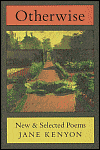
 Over the weekend, I finished Jane Kenyon’s book of poems, Otherwise, a book I’ve been slowly reading my way through for a good five months or so. It’s sometimes hard, actually, to finish a book after spending such a long time with it. I never spent that long with the book when I picked it up — I’d read maybe 2 or 3 poems at a time — but I read in it so regularly that Kenyon became a regular part of my life.
I liked the collection very much, although it took me a while to figure out how to read it — as I suppose happens with every poetry book, and every book really. For a long time I didn’t understand what people meant when they said that a book teaches you how to read it, but now I think I have an idea — each book has its own way of looking at the world, its own way of using language, its own obsessions and preoccupations, and it takes a while to get adjusted to those things.
Kenyon’s poems are typically about the spaces and objects in her house, or the natural world, or perhaps about her dog — she has several wonderful poems about dogs — and often about death. I got the feeling, reading through this book, that she had many encounters with illness and death, and I know she herself died quite young from leukemia. She writes about hospital visits and insomnia and bedside conversations with the ill and dying. She has a number of gripping poems about depression, which I think could only be written by someone who has first-hand experience of it.
Going through a list of the topics one might find in her book doesn’t really do the book justice, though — in fact, hearing that a poet writes nature poems might turn me away from the book if I were reading someone else’s review. There’s a lot of poetry about nature that I like, but to set out to read “nature poetry” sounds kind of dull. What’s most engaging about the book is Kenyon’s voice, the personality that comes through the poems, the sensibility that’s filtering the world for us. Sometimes she writes poems that are largely descriptive, perhaps evoking the feeling of a season or a walk in winter, and at other times she tells stories, of conversations, maybe, or of encounters with fellow townspeople, and either way her language is simple and clear; these poems are by no means difficult to follow or dense, and sometimes I wondered what, exactly, is poetic about them. But I think it’s the sharpness of observation and the often melancholy but always honest voice that makes them poetic; she writes with the kind of simplicity and clear-eyed vision that seems easy to imitate — until you actually try it.
I suppose what I look for when I read poetry — and Kenyon offers this without a doubt — are poems that make me look at the world in a different way, or even poems that make me look at the world, period. I’m well aware that there are those who say poems should make you look at poems differently — that the point of poetry is to say something about aesthetics and art and not to reflect on the world outside the poem — but I just don’t read them that way. I don’t like poetry that’s didactic or easily sentimental, but I do look to poetry for wisdom.
Here’s one of those wonderful poems about dogs, called “Biscuit”:
The dog has cleaned his bowl
and his reward is a biscuit,
which I put in his mouth
like a priest offering the host.
I can’t bear that trusting face!
He asks for bread, expects
bread, and I in my power
might have given him a stone.

 I began classes today, and while I won’t be really busy for a couple weeks when the first sets of papers come in, I’m still feeling a bit in shock — there’s a lot of new stuff to take in, new colleagues, new students, a new campus, a new daily and weekly pattern to life. It’s hard for me to settle down and read in these circumstances. And the thing is, I remember clearly writing this exact same stuff last fall, when I started my last new job. I’m ready for some quiet, some peace, some regularity — I’m ready for my life to be boring!
 Of Books and Bicycles
