A Post About Me

Many thanks to Charlotte for tagging me for this meme! I need a topic this evening that won’t tax my brain too much, and this is perfect, although I must say, I have been running words through my head all day, trying to come up with ones that fit. Here are the instructions for the meme:

List one fact, word or tidbit that is somehow relevant to your life for each letter of your first or middle name. You can theme it to your blog or make it general. Then tag one person for each letter of your name.

So here goes:

D: Dogs. I was not always a lover of dogs; it was getting Muttboy that changed me from a person intimidated by them to one who will approach just about any dog to say hello. Muttboy pretty much runs things in our household; his two daily walks and his meals and his snacks and his little rituals like playing in the backyard with Hobgoblin whenever he takes out the garbage give a structure to our days and weeks. How did we ever get by before we got Muttboy? I have no idea. Life must have been very boring.

O: Outdoors. I have not always been an outdoorsy person either; when I was a kid I liked to hike but didn’t do it that often, and generally I preferred to be indoors reading than outdoors playing in the yard or sunbathing or whatever. This hasn’t changed too terribly much. But upon getting older and having a car and a bit more money at my disposal, I started hiking more and took up backpacking, and, of course, began to ride. Now I try to find a balance; I’m still inclined to linger indoors, but I’ve discovered the magic of the world outdoors too.

R: Reading. What is there to say about this one? I don’t really need a justification for my choice of this word, or a description of how I love it. You already know about that.

O: Online. 10, 15 years ago I would have been shocked to learn that I would end up spending so much time online. If you go back far enough, of course, I wouldn’t know what that meant, spending time online, but even as recently as a couple years ago, I had no idea it would become so important to me. But it has — and for the most part, it’s been a very good thing.

T: Trail. I’m rather obsessed with trails, and especially the Appalachian Trail. I haven’t been on it in quite a few months, and I’m eager to go. There’s something magical about a trail that goes on for hundreds and thousands of miles, a trail you can follow for months and not get to the end of, a trail you can live on and that can sustain a whole community of hikers. I fell in love with the Appalachian Trail when I read an article about it in Reader’s Digest as a kid, and my feelings toward it have never changed. Next summer, I’m going backpacking, if it kills me!

H: Hobgoblin. I have no idea what life without Hobgoblin would be like; I can’t even begin to imagine such a thing. We’ve been married over 9 years now and have known each other for 11 years, exactly 1/3 of my life. That’s a pretty big chunk, isn’t it?!

Y: Yankee. Growing up in western New York state, I didn’t think of myself as a Yankee, tending to think that you had to be from New England to qualify, although I did have an interesting conversation when I was much younger with the family of a friend from the south; one family member asked me where I’m from and upon hearing the answer said, “Oh, you’re a Yankee! I’ve known a few good Yankees ….” Now that I live in Connecticut, I most definitely qualify.

W: Woods. I like my civilization, yes, I do, but I like a little wilderness as well. Don’t coop me up too much, or I’ll be longing for escape. Retreating to my book-lined study is a wonderful solace, but I need time out in the woods, time away from buildings and cars and all the fake plasticky things we surround ourselves with.

I’m not going to tag anybody for this meme, but if you’d like to do it, please do!
12 Comments

Filed under Life, Memes

Maisie Dobbs, Messenger of Truth

I recently finished listening to the latest Maisie Dobbs novel on audio, Messenger of Truth. Now I have to wait for Winspear to publish the next novel before I can read any more Maisie Dobbs! And then I have a dilemma — do I read the book when it comes out, or do I wait for the audio version to get made and delivered to my library? I’m so used to listening to these books that sitting down and actually reading one won’t feel right. And I do love to listen to the readers with their accents and inflections — hearing the book in my head in my own voice as I read quietly will be a different experience entirely. But it could be quite a while before the audio comes out. So, I have no idea what I’ll do.

You’ll probably guess from the above that I liked the latest Maisie Dobbs novel. Winspear explores a new theme in this one: art and the artist. The crime victim is a painter who painted scenes from World War I that many people found disturbing and controversial. So Maisie gets to spend some time thinking about art’s function and purpose, how people react to ground-breaking and controversial art, and what motivates artists to create what they do. She also gets to question traditional stereotypes of artists — that they aren’t practical or worldly or capable — since the artist she is investigating doesn’t quite live up to the stereotype.

She also finds herself caught up in a social scene full of artists and bohemians, and she has to think about how she does and doesn’t fit in. She feels both drawn to them and a little uncertain how to act in this new world of night clubs and parties and dancing. Experiencing this mix of emotions, she is forced to think about her longing for a little excitement and even frivolity, qualities that have been largely absent from her life.

As always, the story is absorbing and fun, and Maisie saves the day!

At the end of the audio book was an interview with Winspear, and one of the questions was about the research she does to prepare for the books. It was quite fascinating to hear what she had to say. She described being interested in the post-WW I time period for a very long time, so that she has been doing research for the books even when not working on them directly. She described reading archival letters from soldiers writing to family back home and realizing that she might be the first person reading them after the original recipient. These letters help her in her quest to get the language just right; she works very hard to make sure the characters in her novels speak as people at the time spoke. She also works hard to get the clothing and accessories right (which explains all those mentions of clothing I was complaining about in an earlier post!), and to give the novels a sense of time and place by working historical events into the narrative.

And she spoke about how Maisie is a typical woman of her day in the sense that she is one of the many “surplus” women, left without a husband or lover after the war and forced to make a new kind of life for herself. Some women never adapted to these demands, but others, like Maisie, took on new challenges like owning businesses and becoming professionals of various sorts.

Maybe what I should do is read the book and then listen to the audio afterwards … that would be fun.

16 Comments

Filed under Books, Fiction

A year of re-reading?

I came across this passage from Nabokov on reading and re-reading recently:

Curiously enough, one cannot read a book: one can only reread it. A good reader, a major reader, an active and creative reader is a rereader. And I shall tell you why. When we read a book for the first time the very process of laboriously moving our eyes from left to right, line after line, page after page, this complicated physical work upon the book, the very process of learning in terms of space and time what the book is about, this stands between us and artistic appreciation. When we look at a painting we do not have to move our eyes in a special way even if, as in a book, the picture contains elements of depth and development. The element of time does not really enter in a first contact with a painting. In reading a book, we must have time to acquaint ourselves with it. We have no physical organ (as we have the eye in regard to a painting) that takes in the whole picture and then can enjoy its details. But at a second, or third, or fourth reading we do, in a sense, behave towards a book as we do towards a painting.

I agree with what Nabokov says here, and it bothers me that I do relatively little re-reading. Of course, I feel pulled by the lure of new books too, and that pull is almost irresistible, but reading nothing but new books (new-to-me books) feels a little bit superficial sometimes, as though I’m not really digging into my reading, really thinking about it seriously and experiencing it fully. I know I’ve written about this before, and I don’t mean to rehash old thoughts, but this feeling does stay with me.

So I’m tossing around the idea of focusing on re-reading next year. I’ll certainly read plenty of new books, but I might try to pick out some books I’d like to re-read as well, maybe some books that meant a lot to me in the past, or that I didn’t understand well the first time around, or that have continued to intrigue me. Perhaps I’ll re-read something now and then, say, once a month or so. I’m trying very hard not to commit to any reading challenges, but this wouldn’t be a challenge, exactly, and I wouldn’t set the books I’ll re-read in stone. Maybe I’ll list some possibilities, but make the final choices only at the last minute.

So, what might I re-read? Right now, these are a few books that come to mind:

  • Henry Fielding’s Tom Jones. Of course I’d pick things from the 18C! I would like to know this early novel better; I’ve read Fielding’s novel Joseph Andrews quite a few times, as I’ve written about it before, but Tom Jones I don’t know as well.
  • William Faulkner’s The Sound and the Fury. This book has defeated me so far. I’ve tried to read it at least twice, succeeded only once, and didn’t really get it where I did succeed in finishing it. But I want to get it! I really do.
  • Something by George Eliot. She’s one of my favorite novelists ever, and this re-reading would feel like pure pleasure. I’ve already re-read several of her novels, including Daniel Deronda and Middlemarch. So, perhaps I’d re-read The Mill on the Floss? Or Adam Bede?
  • Emily Bronte’s Wuthering Heights. I don’t feel like I’ve done justice to this book; perhaps I read it when I was too young or wasn’t able to focus on it fully. I have vague memories of it, but would like to know it better.
  • Perhaps Lolita? I really love Nabokov’s writing, and I’m sure I have more to learn from this book. He’s such a wonderful writer, isn’t he?
  • Perhaps I should return to some books from my youth? Perhaps the Betsy-Tacy books, or some Anne of Green Gables.

I’m sure I’ll think of more as I go on …

24 Comments

Filed under Books, Reading

New books

Today I shall tell you about my new books. I have darkened the doorstep of very few bookstores lately, but the books keep coming in, mostly through Book Mooch and now and then from Amazon. Most of these books, you’ll see, I decided to acquire based on the recommendations of bloggers. Thank you, as always!

  • Jonathan Coe’s The House of Sleep. I may need to read Rosamund Lehmann’s The Echoing Grove before I read Coe’s book, as that’s where he found inspiration for it. I almost began this one yesterday after noticing the epigraph from Lehmann’s novel, but decided it wasn’t quite right for me at the moment. I’m prepared to enjoy this greatly when I’m ready, though, as several bloggers have told me how much they like Coe’s writing.
  • Goethe’s Elective Affinities. Litlove recommended this one to me, and I’m excited about it, as I’ve read some Goethe in the past (Sorrows of Young Werther and Faust), but had never heard of this novel. Here is a description: Elective Affinities is a “penetrating study of marriage and passion, bringing together four people in an inexorable manner. The novel asks whether we have free will or not and confronts its characters with the monstrous consequences of repressing what little ‘real life’ they have in themselves, a life so far removed from their natural states that it appears to them as something terrible and destructive.” It’s from 1809.
  • Werner Herzog’s Of Walking in Ice. This book tells the story of Herzog’s three-week walk from Munich to Paris. He walked to see his friend Lotte Eisner who was sick and near death; he believed that she wouldn’t die as long as he was walking to meet her. I’m kind of fascinated by Herzog, although I haven’t actually seen many of his films. But after seeing Grizzly Man and hearing some interviews with him, I want to know more. And, of course, this is an example of walking literature, which I’m always looking out for.
  • Gabriel Josipovici’s Goldberg: Variations. After reading Imani’s posts on this book, I couldn’t resist. I own Josipovici’s The Book of God, which I read parts of in college, but I don’t know anything about his fiction. I should take another look at The Book of God, now that I think of it; I do like reading books about the Bible.
  • Finally, The Owl Service, by Alan Garner. This is a young adult book, and it is the next Slaves of Golconda book, which we’ll be read at the end of the month. I don’t read much young adult literature, so I’m looking forward to this one.

12 Comments

Filed under Books, Lists

Rosamund Lehmann’s A Note in Music

Rosamund Lehmann’s A Note in Music fascinated me; not much happened in it, and yet so much happened — Lehmann is excellent at capturing inner worlds, the way moods shift and feelings come and go, and the way other people impinge upon our consciousness, often making us unhappy as they do.

The novel tells the story of Grace Fairfax, a 34-year-old woman living in a town in the north of England; she is married to kind but bungling Tom, who loves her but is also mystified by her. Grace figured out early on in their 10-year marriage that she made a mistake when she married Tom, but she has tried to make the best of it and they have muddled along, not happy, although not perfectly miserable either. Their life together feels indifferent, as though it means little or even nothing. In fact, Grace’s life is full of nothingness, which Lehmann makes clear from the very beginning; when Grace’s friend Norah tries to persuade her to see a fortune-teller, she refuses, fearing she will see only nothingness in her future:

For the truth was that she was afraid of the fortune-teller. She had a vision of the woman, scrutinizing her palm and saying finally:

‘This is a most curious case. There is nothing here: nothing in your past, nothing in your future. As for character — lazy, greedy, secretive — without will or purpose.’

The novel also tells Norah’s story; she too is unhappily married, in her case, to Gerald, an emotionally distant professor who retreats to his books to avoid any complicated human interaction.

Into this stew of discontent comes Hugh and his sister Clare; Hugh is a young, attractive man who is being groomed to inherit the company where Tom works as a clerk, and Clare is an old friend of Norah’s. Both of them bring life and energy into Grace and Norah’s small world, and Hugh quickly becomes an object of desire for both of them, with his handsome blonde hair and his charming, casual manners.

One of the most painful parts to read — in a book that is full of painful and yet at the same time pleasurable descriptions of emotional turmoil, pleasurable because of the accuracy with which they are detailed — occurs when we realize just how oblivious Hugh is to the impact he has on Grace and Norah both. For the women, encountering Hugh is a life-changing event that will give them food for thought for years and decades to come. For Hugh, his time with them is a brief interlude between much more exciting events in his life, a way of passing the time until the next episode begins. When Grace and Hugh develop a friendship that surprises them both, Grace feels that … well, that she is living up to her name, that Hugh’s presence and the love she feels for him have descended upon her as though they were gifts from heaven. Grace knows that these gifts are fleeting things, and that soon she will return to her quiet life with Tom, but they have changed her.

Lehmann uses a shifting perspective that gives us glimpses into the minds of all of the major characters at one point or another, including Tom and Gerald, so that we see just how the various characters are making sense of what occurs. This technique increases the emotional impact of the novel, as, for example, Tom’s earnest love for Grace is contrasted with Grace’s barely civil tolerance of Tom, or Norah’s good-natured attempts to please Gerald are contrasted with Gerald’s irritation at her fumbling and bumbling about. All the characters seem at odds with one another, which makes moments of emotional connection that much more meaningful.

I love this sort of book, although I can imagine people reading my description and thinking the book sounds claustrophobic and boring — but, in my opinion at least, it’s not; it’s a book that describes the type of life that many people lead, one where not much happens, and yet so much is happening, at every moment.

8 Comments

Filed under Books, Fiction

Revision pays off

Good news — I got word that an article of mine will be published next year. This is an article I sent to another journal a year or two ago, which got rejected because they weren’t terribly impressed with the argument, and which I then sent out to another journal immediately without changing a single word. This journal asked me to revise and resubmit it, and, interestingly, the reader’s report didn’t say a word about the argument, but instead asked me to work on describing the argument more fully in the introduction and then revising the prose, cleaning up sentences and wording and such. I just needed to find the right place, apparently. I got word today that they’re accepting this revision, and the report included these marvelous sentences: “I think the author has done an admirable job of revising this essay,” and “I would like to congratulate the author for working so hard to revise the essay to bring it to its full potential.” Woo-hoo!

Actually, I should change the post title to “Sometimes revision pays off,” as I’m glad I didn’t revise the essay after the first journal rejected it but happy I revised it for the second journal.

Oh, if you’re interested, the article is on Laurence Sterne’s A Sentimental Journey.

15 Comments

Filed under Writing

Totally pointless post

Don’t say I didn’t warn you. If you’re reading this and you start to get annoyed because you’re discovering that I’ve got absolutely nothing to say, don’t get mad at me about it. You probably shouldn’t be spending your time reading this anyway.

It’s only the second day of NaBloPoMo and I’m faltering! It’s not that I don’t have things to write about. I do, as a matter of fact — I want to write about Rosamund Lehmann’s A Note in Music now that I’ve finished it and I also want to write about Seneca. But I’m still sick, all coughing and sniffly and woozy, and I’m not sure I can think straight to write about something serious. And I just got terribly annoyed because I read through some student essay revisions and found that they hadn’t revised at all. After ten years or so of teaching writing, why this would surprise me, I don’t know, but I am still always surprised when it happens. I mean, why would anyone think it’s a good idea to hand in an essay revision that is almost exactly the same as the first draft? Don’t they realize I will get frustrated at them, which is, surely, the last thing they want? So I’m more in the mood to vent than to write something thoughtful and smart.

I have discovered over the years that the best approach for me to take in the classroom is to be all happiness and cheer all the time. Somehow I’ve never figured out how to make any other teaching persona work for me. If I let myself show frustration or annoyance, things go downhill fast. Given that I am by no means a cheerful person generally, staying so cheerful might sound hard, but since I see students only for three hours a week, I usually do okay. But what it means is that I have a powerful need to vent when the students aren’t around! Not that teaching is so hard or unpleasant, or that my students are so terrible, let me clarify. Most of the time they are a pleasure to teach. It’s just that … well, I’m a perfectionist and was a perfectly obedient, perfectly diligent student myself, and I (still) don’t understand why students aren’t more like I was. I have to remind myself that, yes, occasionally, even I skipped the reading now and then or asked for an extension or took the easy way out in an assignment. I think this is one of the hardest things to learn about teaching — so often (although not always) those who end up teaching were the model students of their day, and they have to learn that not all students are perfectly-organized perfectionists like they were. (But why not? why not?? Don’t they see how much easier things would be if they were?)

So, this has turned into a post about teaching, which is something I rarely write about. But at this point in the semester with all the grading I’m doing, it’s hard to think about much else. I do have the pleasure of choosing a new novel now; perhaps that will cheer me up after that disastrous grading session …

11 Comments

Filed under Blogging, Life, Teaching

Mothers of the Novel

Charlotte invited me to participate in NaBloPoMo (National Blog Posting Month [wait — why national? Shouldn’t it be international?]) this year, so here I am, officially posting every day this month, instead of following my usual most-likely-but-not-necessarily-posting-every-day method. We’ll see how it goes. I’m feeling a tiny bit anxious about this, as though actually committing to posting every day is so much harder than making no commitment but doing it anyway.

So, I’ve finished Dale Spender’s excellent Mothers of the Novel and can say that it’s well worth the read, even though it’s over 20 years old and tons of research has been done on these novelists since Spender wrote. But it’s an excellent overview and gives information about tons of authors and if you pick it up, it will most certainly add to your reading list. You’ll find Spender’s list here, along with some other writers thrown in for good measure.

What I liked best about the book, besides the information on new writers it’s given me, is its description of the strength of an 18C tradition of women’s writing and the accompanying disappointment that this tradition has largely disappeared. Spender stresses over and over again how vibrant women’s writing was in the 18C and how well-respected many of these writers were. She also describes female critics from the 18C and 19C who wrote about these women writers, trying to acknowledge their strength and establish a lasting tradition — which didn’t work, as we now know. Now, I knew there were a lot of women writers from the 18C, but I’m not sure I quite realized how important they were in their time and how seriously they were taken. Here is what Spender says:

Jane Austen read ‘women’s novels.’ So too did the reverend gentleman, her father. What is frequently ‘forgotten’ is that he also made his regular visits to the circulating library for the latest novel by a woman, who explored the implications of many a moral question of his time. And Mr. Austen’s reading habits were by no means unusual for a man in his position.

She also argues that over time women’s novels have tended to be lumped into one big category, that of the romance, in spite of the fact that there is great variety in their writing, both of subject matter and of quality. On the other hand, while men often wrote (and write) novels that are about romance, these works are rarely described as romances and aren’t so easily dismissed.

This dismissal happens mostly in the 19C. By the time the 19C got going, women had experienced enough success that male writers were getting nervous:

If we want to explain the dismissal of early women novelists from the literary heritage it is necessary to go much further than the misleading accounts about mass audiences and sensation, sentimental ‘blotterature.’ For in the eighteenth century, many of the women novelists who were writing for a small, refined and morally conscious audience, were held in very high repute. It is only since their time that the pervasive notion of silly novels by silly women novelists has held such sway.

The systematic devaluation of women writers and their concerns is more a product of the nineteenth century. By this time women’s position as novel writers was so well established that there were more than mutterings among the men about the dangers of women’s preeminence in the genre.

It’s a depressing story, yes, but I also find it heartening to know more about this tradition, and particularly the way women writers read and refined each other’s work, commenting on and responding to the writers who had gone before them, thereby doing much to extend what the novel can do.

Ann has asked about where to start with lesser-known writers, and while definitions of “lesser-known” will vary and while I haven’t actually read tons and tons of this stuff, I’m happy to list some of my favorites. I’d definitely read Sarah Fielding’s novels, including The Adventures of David Simple. I’ve read and enjoyed Charlotte Lennox’s The Female Quixote, Eliza Haywood’s Love in Excess, Charlotte Smith’s The Young Philosopher, Mary Hays’s Memoirs of Emma Courtney and The Victim of Prejudice, Mary Wollstonecraft’s two novels (Mary and The Wrongs of Woman), Maria Edgeworth’s Belinda, and Elizabeth Inchbald’s A Simple Story. And also Frances Burney’s Evelina and Ann Radcliffe’s gothic novels.

As for ones Spender has inspired me to read, they include Mary Brunton’s Self Control and Discipline (Austen admired Brunton greatly and learned much from her), Amelia Opie’s Adeline Mobray, and anything by Maria Edgeworth I can find. I hope to read more novels by the women listed above, as well as authors discussed in my post here, if I can find copies in print.

11 Comments

Filed under Blogging, Books, Nonfiction

Nightwood

Happy Halloween everyone! I’m sitting in my living room armchair, a place I rarely sit, so I can hop up and answer the door in case kids are out trick-or-treating. This is the extent of my Halloween celebrations, I’m afraid.

So, I finished Djuna Barnes’s Nightwood last week and have decided to go ahead and read it again right away. My response to the first reading was a mixture of awe and bewilderment. The plot is simple to follow, so it was not the plot that bewildered me, but there is not much plot anyway; rather, it’s the things the characters were saying that I sometimes had trouble following. But their speeches were beautiful and in the moments when meaning broke through, I found myself moved.

I learned pretty quickly I couldn’t read and re-read passages until I understood them perfectly, because that moment didn’t always come; instead, I read slowly and figured out what I could, and kept going even if I didn’t get everything. I did this partly because I knew I’d mostly likely be reading the book again, but also because trying to figure everything out would lead to frustration. I think this is the kind of book where you can read for mood and atmosphere and for the beauty of the language as much as you read for logical meaning.

Here’s a typical passage, a speech from one of the most important characters, the doctor:

Suppose your heart were five feet across in any place, would you break it for a heart no bigger than a mouse’s mute? Would you hurl yourself into any body of water, in the size you now are, for any woman that you had to look for with a magnifying glass, or any boy if he was as high as the Eiffel Tower or did droppings like a fly? No, we all love in sizes, yet we all cry out in tiny voices to the great booming God, the older we get. Growing old is just a matter of throwing life away back; so you finally forgive even those that you have not begun to forget.

I’m not entirely sure what this passage means, but I do like it. The book it not entirely made up of passages like this one; it also has plenty of dialogue and narration that’s easier to follow. The novel tells the story of a group of characters, following them through many years as they wander around, fall in love, marry in some cases, break up, despair, talk it over, despair, talk it over, etc. There’s the doctor, who has most of the eloquent, poetic speeches, who doesn’t seem to do much but talk to the other characters. There’s Baron Felix, who marries Robin Vote, who then leaves him to pursue Nora Flood and then leaves her to pursue Jenny. The conversations that come out of all this loving and leaving are more important than the actions themselves — the book is really about the sense that the characters make of what happens to them.

I do not at all feel as though I have a handle on this book, but perhaps after a second reading, I’ll get more of it. Perhaps I’ll look up some critical work as well.

5 Comments

Filed under Books, Fiction

Weekend Reading

And now I’m sick! Wonderful, isn’t it? I’ve got a cold that is not quite bad enough to keep me home from school, but just bad enough to make me unhappy about it. It was a beautiful fall afternoon with perfect weather for a bike ride, but I spent the time curled up in bed sleeping. Oh, well, I’m very grateful to have had a chance to take a nap.

The books I took with me on my Albuquerque trip turned out to be different from the ones I listed here. I did take along Sophia Lee’s The Recess, but I didn’t end up opening it; instead I spent my airport time switching among Dale Spender’s Mothers of the Novel and two new books — Rosamund Lehmann’s A Note in Music and Phyllis Rose’s The Year of Reading Proust: A Memoir in Real Time.

The Lehmann novel has turned me into a fan — score another one for Virago Modern Classics! I am nearly finished and so I’ll wait to say much about it until later, but for now — what a great book. I feel as though in the last couple years I have discovered so many women writers who are new to me — writers including Elizabeth Taylor, Anita Brookner, Alison Lurie, Barbara Pym, Georgette Heyer, and now Rosamund Lehmann. All of these women write similar types of novels, although there are great differences among them as well, of course; they tend to be quiet, character-driven novels about the emotional landscapes of women’s lives. I love this stuff. Lehmann’s novel is about two married couples — focusing mostly on the women (and one of them in particular), although occasionally veering into the consciousnesses of the men — who find their lives disrupted by the visit of a young man and his sister. The book described visits and conversations and outings, but mostly it describes what the characters think and feel; it has Proustian passages on memory and time and Woolf-like analyses of gender dynamics and moments of consciousness.

The other book, Phyllis Rose’s book on Proust, I’m still figuring out. It’s a mix of her thoughts on Proust and her thoughts on her own life; sometimes these two things are clearly connected, and sometimes the connection is more tenuous. I do like meditations on art and life, and I do like essayistic, rambling, all-over-the-place nonfiction books and memoirs, but I’m not entirely sure this one is making sense to me. I need to give it a bit more time. Maybe the problem is that one of her first chapters describes her love of television, a subject I cannot relate to and one only very loosely connected to Proust. And then the next chapter is about collecting ancient artifacts, and although she connects this topic more closely to Proust, it’s another area that doesn’t mean much to me. This may be a matter of a personality clash; perhaps Rose and I just don’t hit it off. But we’ll see.

P.S.  I forgot to describe one of the best parts of the conference, which was the closing poetry reading.  About a dozen of us gathered to read favorite poems from the 18C.  I didn’t come with any prepared, but ended up reading Anne Finch’s “A Nocturnal Reverie,” which is a beautiful poem, and another woman gave a very dramatic, funny reading of Aphra Behn’s “The Disappointment,” which I strongly encourage you to read — you won’t regret it!

13 Comments

Filed under Books, Fiction, Life, Nonfiction

The Conference

Well, can I just say that I’m feeling a bit overwhelmed? I had a nice weekend, but upon returning home last night, I felt that I needed a weekend to recover from my weekend. But I did not get one. No, I had to face one of the busiest days of my semester so far. So I’m tired and a bit disgruntled.

I must say that although I enjoyed myself on Saturday once I got involved in the conference itself, traveling on Friday was kind of miserable. I used to love air travel; I loved people watching in airports, and I loved all the time to read on the plane. Now I just dread it all. I didn’t want to leave home, and I felt the whole trip was stupid — a stupid conference, a stupid paper, and a stupid idea to travel during a busy part of the semester.

But I perked up once I got there. I didn’t see much of Albuquerque, since most of my time was taken up with conference things, but I did get a chance to walk through the old town section of the city, 10 or 12 blocks of restaurants, cute shops, and historical locations. That was on Friday evening.

Saturday I spent the whole day at the University of New Mexico campus, listening to papers and giving my own. The conference was on eighteenth-century women writers, and the best part about it was hearing about books and authors I’m now newly inspired to read. There were a lot of papers on Aphra Behn and Eliza Haywood, both of whom I’d like to read more of, particularly Haywood’s novel The History of Miss Betsy Thoughtless, a book that is a predecessor of Burney’s and Austen’s novels. I also heard a paper on Sarah Fielding’s novel The History of Ophelia that made me want to get a copy ASAP. Both of those books are published by Broadview Press, a wonderful publishing company that puts out editions of lesser-known works; just check out their 18C selection to see how great they are.  I came away from the conference with the feeling that there is so much good reading to be had from the 18C; compared to the average reader, I’ve read a lot in the area, I suppose, but there is so much more!  And I’m still working my way through Dale Spender’s book, which has greatly increased my list of novels I’d like to read from the time period.

My panel went well. People laughed as I read my paper; I find this interesting because I never would have guessed that my paper was funny in any way at all. It wasn’t my writing that was funny, really, but rather the quotations from the novel I was discussing (Sarah Fielding’s The Adventures of David Simple). It’s fascinating the way that having an audience can bring out aspects of a paper I had no idea were there. I didn’t really get any questions about my paper (a part of the whole process that’s quite scary, as you have no idea what you’ll be hit with), but my panel (there were three of us) and the audience had a good discussion afterward, and I got some nice comments.

It was a small conference and very friendly — unlike some conferences where people are snooty and mean and only want to talk with the important people and take every opportunity to show off. So I hung out with some other conference-goers on Saturday night and we had a good dinner and a couple bottles of wine and I didn’t get enough sleep that night.

And now I’m here, back home trying to recover. Maybe I’ll have a chance to rest next weekend??

16 Comments

Filed under Books, Life

Gone for the weekend

Have a wonderful weekend everyone; I’m heading to Albuquerque tomorrow bright and early, and I’ll be back Monday or Tuesday.  I’ll give you a full report then!

8 Comments

Filed under Life

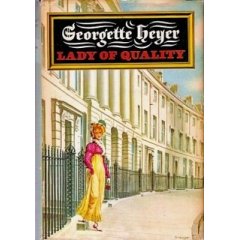
Georgette Heyer’s Lady of Quality

41h3kg3cfyl_aa240_.jpg I finished Georgette Heyer’s novel Lady of Quality last night, and it was such a pleasurable read! I don’t feel like doing a proper review, still suffering as I am from insomnia and general all-around crankiness, but I do want to say that I’ll have to find myself some more Georgette Heyer books because this was just so much fun.

It was a quiet book, about a 29-year-old woman named Annis living in Bath in the regency period, so, say, around 1810-1820 or so. She has recently left the home of her brother and his wife and family and has set up on her own, a mildly scandalous move for a woman people are beginning to call a spinster but who is still quite young. She is smart and beautiful with wit and a satirical sense of humor; she has received several offers of marriage, but none from any man who really impressed her.

Into her life come Lucilla and Ninian, two young people in their late teens; Lucilla has run away from home to avoid parental pressure to marry Ninian, and Ninian accompanies her to keep her safe. Chance brings Lucilla to Annis’s house, and the rest of the novel is about what to do with the girl, who decides she will not return home and who comes to love Bath and the pleasures it offers. She also brings her uncle on the scene, the rakish and rude but still mysteriously charming Oliver Carleton. Annis has never met a man quite like him before.

One of the interesting things about the book is the way Annis seems like an early example of the “excellent woman” phenomenon of which Barbara Pym wrote so well. Everyone wants to turn Annis into an “excellent woman,” one of those unmarried women who spend their lives taking care of others. They believe she should have stayed at home with her brother, enjoying his “protection” and helping to take care of his children. An independent woman who lives for herself is almost too much for people of the time to comprehend. Living on her own and according to her own wishes is acceptable only because Annis has some money and has the stubbornness and high spirits to insist upon it; otherwise, she would surely find herself drawn into other people’s lives and into their houses, away from her own. But she works very hard to keep her independence and to ward off the prying, meddling people who want to take up her time and attention.

In contrast to Annis is Miss Farlow, a single woman, considerably older than Annis and without any means to support herself — she’s an example of the Miss Bates type (from Emma), a genteel woman without much money who depends on the kindness of others to get by. Annis has kindly agreed to hire her as a companion, which earns Miss Farlow’s great gratitude, but unfortunately she repays her with irritating, never-ending chatter (also like Miss Bates) and vindictive jealousy when Lucilla appears on the scene. Miss Farlow is a figure of fun, but she also shows an alternative fate for women — without her money and without her beauty, Annis could easily be another Miss Farlow, alone and penniless.

The pace of the novel is slow and leisurely; there’s not a whole lot of narrative tension, but the sunniness of the mood and charm of the characters kept my interest. Now I’m off to see if Book Mooch has any more Heyer novels …

16 Comments

Filed under Books

Books for traveling

Well, I haven’t done a pooterish, list-y, rambling kind of post in a while, and since I’m feeling fatigued after getting practically no sleep last night and don’t want to think too hard, this evening seems like a good time for one. I’d like to post on Seneca again, and also on Dale Spender, but those posts will have to wait. I suffer insomnia only occasionally, but when I do, it really knocks me down hard. I desperately need my sleep! And hours and hours and hours of it!

So, I’m going away this weekend. I’ll be heading to Albuquerque to attend a conference. This should be fun, right? It’s a literary conference, and I’ll be presenting a paper of my own and listening to other people read theirs; we’ll all be talking about books and learning new things and generally having fun.

Except I hate conferences. I can’t tell you how much I’d prefer to stay home. I don’t like presenting papers of my own — the whole process makes me nervous. I don’t like listening to other people’s papers because I don’t listen well, being an extremely visual person. And I don’t like the feeling that I should be mingling, meeting people, making connections, and generally impressing people with my brilliance, instead of skulking about in my hotel room watching television, which is what I generally do.

So I’ll cheer myself up by thinking about what books I might possibly bring with me. I should be ready to begin a new novel or two, and maybe a new nonfiction book. So what sounds good?

  • I just mooched Margaret Forster’s novel Lady’s Maid, which Litlove recently wrote about; it’s about Elizabeth Barrett Browning’s maid Elizabeth Wilson and their vexed relationship. It’s long and looks fun — perfect for airports, maybe?
  • I’ve been in the mood for another long 18C or 19C novel, especially after reading about so many interesting authors from Dale Spender’s book, so perhaps Sophia Lee’s The Recess, subtitled “A Tale of Other Times”? Here’s what Amazon says: “First published in an era when most novels about young women concentrated on courtship and ended with marriage, The Recess (1783-1785) daringly portrays women involved in political intrigues, overseas journeys, and even warfare. The novel is set during the reign of Elizabeth I and features twin narrators, who are daughters of Mary, Queen of Scots, by a secret marriage. One of the earliest novels to convey the plot from multiple points of view, it was wildly popular in its day.” Sounds good, doesn’t it?
  • But I need to make sure I have some comfort reading with me; I might need to be cheered up if my paper presentation doesn’t go well. I’ve got an Alison Lurie novel on my shelves, The Last Resort; she’s always good for a smart, entertaining read.
  • And for nonfiction? I have a couple short things that would work, books I could possibly finish during the long plane ride, such as Gabriel Zaid’s So Many Books or Elizabeth Hardwick’s collection of essays Seduction and Betrayal. Long nonfiction books probably wouldn’t work, as I might tire of them, but these would be perfect.
  • Oh, and I have to bring the book I’m presenting on, of course, just in case I want to remind myself of some of the details; it’s this one, Sarah Fielding’s The Adventures of David Simple.

11 Comments

Filed under Books, Life

Novel writing

T.S. Eliot wrote a Preface to my edition of Djuna Barnes’s novel Nightwood, and I thought he had some interesting things to say about fiction:

… most contemporary novels are not really ‘written’. They obtain what reality they have largely from an accurate rendering of the noises that human beings currently make in their daily simple needs of communication; and what part of a novel is not composed of these noises consists of a prose which is no more alive than that of a competent newspaper writer or government official. A prose that is altogether alive demands something of the reader that the ordinary novel-reader is not prepared to give.

This comes from a section where Eliot is comparing Barnes’s prose to poetry — he says those who are trained on reading poetry are better prepared to fully appreciate Barnes’s work.

I feel ambivalently about Eliot’s claims here. On the one hand, I do want to read fiction where the author pays attention to the writing. I certainly don’t want to read prose that might come from a government official or newspaper writer — unless we’re talking about particularly talented officials or journalists of course. But, really, when I sit down to read a novel I’d like to read something well-crafted, and something well-crafted as fiction.

On the other hand, though, I don’t like the elitist tone of Eliot’s comments. Why separate out “ordinary novel readers” from some special group of readers whose faculties are supposedly sharper than the rest and who pick up on so much more? I’m not sure this category of “ordinary novel reader” actually exists. Can’t just about any novel reader — someone who seeks out and enjoys novels — appreciate prose that is alive? Not to say that they do, necessarily — perhaps they read for other reasons than to enjoy the prose — but they are capable of it.

That point aside, though, Djuna Barnes’s prose is certainly alive, and I’m enjoying it. I’m working my way through it very slowly, but I feel like it’s starting to take shape as I near the end, and I’m still planning on reading it again right away to see what it’s like on a second go-round.

11 Comments

Filed under Books, Writing

Judging the Booker

If you haven’t seen it yet, there’s an interesting article at the Guardian by Giles Foden on what it was like to sit on the panel of judges that chose the Booker prize winner this year (via). It sounds like the process was messy. One disagreement he describes was between those who “wanted to apply comparative principles across the range of books” and those who “wanted to voice their subjective preferences novel by novel.” As I read the list of comparative principles the first group wanted, I felt a twinge of horror:

The comparative principles, out of which it might be hoped measures of objectivity could be drawn, were not very sophisticated. It was just a simple taxonomy including the following: plot and structure; theme; language, tone and style; characterisation; impact and readability. But even these basic foundations to judging a novel could not be adequately established.

It seems that this approach was quickly abandoned and the judges turned to the more subjective method, judging the novels one by one on their own merits.

I think this “simple taxonomy” is dreadful. Can you really break a novel down into its parts in this way and expect to arrive at a valid judgment of which novel is the best? (Or perhaps the better question is whether it is possible to decide on a “best” novel at all.) Of course, you can break a novel down into its parts and analyze it; this is something I do in my writing and in my classroom. It’s a valuable way to understand how a novel works, to understand it on its own terms. But to use this method as a way to judge a contest or to award a literary prize? To use it to compare one novel to another? It seems like a recipe for choosing mediocrity.

I do not think it’s possible to be objective when making this kind of judgment. This method implies that there’s one correct way of doing things — one correct format for a plot, one best way to create characters, one theme that is inherently better than another, one style that is preferable to another. And “readability”? I’m not sure what that means, first of all, but secondly, is the more “readable” novel better or worse than the less “readable” one?

These criteria remind me of rubrics some teachers use to grade student writing, lists of the qualities of “good writing” that we are looking for, for example, structure, coherence, logical argumentation, correct grammar, etc. I’m not arguing against rubrics for grading here, and someday I may come to use one myself, but I worry that they miss the most interesting thing about student writing, which is some undefinable quality that has to do with originality and voice. Rubrics are useful to judge whether writing is competent or not, but to judge if it is interesting and worth my time to read? Then they don’t work.

A quotation I just came across in The New Yorker is relevant here; in an article on abridging classic novels, Adam Gopnik writes:

… masterpieces are inherently a little loony. They run on the engine of their own accumulated habits and weirdnesses and self-indulgent excesses. They have to, since originality is, necessarily, something still strange to us, rather than something that we already know about and approve.

Is there any rubric that can give this kind of originality its due?

9 Comments

Filed under Books, Links

The Turn of the Screw on stage

Last night Hobgoblin took a group of students to see the play version of Henry James’s The Turn of the Screw at a local theater, and I went along. I’d read the novella in college and wrote a paper on it even, so I knew the basic story, although I’d forgotten a lot of the details. I was curious to see how they would handle the uncertainty and ambiguity of the action — was the governess crazy or was she not? Were the ghosts real?

The director chose an intriguing method of staging the story. There were only two actors, a man and a woman; the woman played the governess, of course, and the man, Tom Beckett, played the master, the children’s uncle; Miles, one of the two children the governess is charged with; and Mrs. Grose, the housekeeper. He also functioned as a narrator from time to time, filling the audience in some of the background details. Flora, the other child, was played by no one; the other characters simply pretended she was there, and so turned her into a ghostly presence — or absence — on stage. The set was very simple too, only an old armchair, a spiral staircase, and wisps of smoke.

The effect was claustrophobic, in a way that suited the story perfectly. The two actors seemed to be descending into a nightmare, battling each other — even as Beckett switched into different characters — and at war within themselves too. They were stuck in a small space that never changed and where no one new ever appeared. All they could do was retreat into their minds or lash out at one another. It’s the perfect set-up for a ghost story: a creepy atmosphere, some eccentric characters, an isolated location, and no means of escape.

Beckett did a brilliant job switching from one role to another; he would change his accent, posture, and body language and transform himself from a 10-year old boy into a middle-aged housekeeper instantly.

I appreciated all this intellectually, but I must say that at times I found myself bored. I never quite lost myself in the story. I’m not sure if it simply wasn’t the right night for me to see a play — I was tired and distracted — or if there was something else going on. I wonder if The Turn of the Screw isn’t best experienced on the page after all. For me, at least, the play was both too visual and not visual enough. Seeing the governess descend into hysterics, hearing her ranting and raving, I was pushed away from the story instead of drawn into it. Something subtle and delicate from James’s novel was lost. And at the same time, I wanted more to look at. I have enjoyed plays where not much happens but people standing around and talking, but in those cases the dialogue was brilliant, and in last night’s performance, it wasn’t particularly. I suppose what I was missing was the voice of the narrator from James’s novella; it’s her voice that created the mood for me, and without it, the story lost some of its interest.

But, at any rate, even if I did get a bit bored, on some level I enjoy any experience that makes me think, which the performance certainly did. And I was thrilled to see Hobgoblin’s student Hepzibah, who is always so much fun to talk to. It was my first visit to this local theater, too, and I’ll make sure I return again soon.

10 Comments

Filed under Books, Fiction

Ways of reading

Bud Parr at Chekhov’s Mistress has an interesting post that’s partly in response to my post from a couple days ago about reading difficult books. He argues that reading difficult books has taught him that “it’s okay NOT to understand.” Here’s what he says:

I’m not arguing for aesthetics, I’m arguing for intuition and all the other ways into some level of meaning besides the logical. There are so many levels of experience to be had by a great book that getting at some meaning as perceived by critics or academics or ticking off known references in your head doesn’t have to be a part of your interpretation.

He points out that in my post I privileged reading for logical meaning over other ways of reading, and, as I understand it, his post is a celebration of those other ways — including listening to the language as it’s spoken out loud.

I find this interesting and I agree with Bud’s point that there are multiple ways of reading and getting meaning from the reading. I must admit, as I wrote my post on difficult books I dashed off the line Bud picks up on, the line where I said, about Tender Buttons, “you savor the language and give up trying to pull together a logical meaning,” which implies that logical meaning is more important than the language itself. But in that dashing off, I reveal my bias. I do read first for logical meaning. I do this automatically, without thinking about it. I don’t necessarily privilege critical, academic kinds of reading, which is something Bud talks about as well, the kind of reading where you make sure to get all the allusions and references and where you formulate thesis statements in your head as you read along. But on a first reading of a difficult book, I struggle to put the ideas together, to make sense of things.

Does everyone read this way? I can’t help but want to make logical sense of the words. But I value books like Tender Buttons for pushing me to read in other ways. I’ve read it a few times, and by the second and third time I knew enough about it to know it wasn’t going to make logical sense, and I started to read it for the beauty of the language, for the sounds and rhythms of the words, for the glimpses into meaning it offered and then evaded.

I remember the experience fondly, and I think it taught me to pay more attention to language and to loosen up a bit about wanting meaning. I suspect my reading of Nightwood, where the logical meaning is evading me at times, is more pleasurable because of my experience with Tender Buttons. I’m very happy to have learned this lesson; while there’s something satisfying about feeling that I’ve understood a text thoroughly, there’s also something satisfying about getting lost in language for a while, about dropping my usual expectations and seeing where it is an author will take me.

I also try to be aware that even while reading for logical sense, other ways of reading are happening at the same time — I’m using my intuition and emotions and my ear for language to create meaning. One of the pleasures of reading is that it can be a whole body experience, not purely a mental one.

11 Comments

Filed under Reading

Readers and reviewers

Would somebody remind me please that there’s no reason to expect every author who writes a good book now and then to refrain from saying stupid things? I came across this quotation from Ian McEwan (via):

Publishers seem to be very keyed up to embrace the Internet, but I don’t have much time for the kind of site where readers do all the reviewing. Reviewing takes expertise, wisdom and judgment. I am not much fond of the notion that anyone’s view is as good as anyone else’s.

He wrote this at Time.com back in June, in response to a reader who asked what he thought about disappearing literary reviews in newspapers and magazines. Now, how many problems in logic do we see in his claims? Do I even need to spell them out? Well, why not.

Okay, first of all, why separate “readers” and “reviewers”? Aren’t all reviewers automatically readers? I would hope so. And if what he really means is to distinguish between regular old amateur readers and professional reader/reviewers, I’m not sure there’s such a clear line between the two. I don’t really know much about it, but maybe somebody can fill me in: what are the entry requirements for becoming a professional reviewer? Is there a class you take, a degree you get, a test you pass?

When he says that “reviewing takes expertise, wisdom and judgment,” I agree completely. And, the truth is, I agree with his last line too: “I am not much fond of the notion that anyone’s view is as good as anyone else’s.” I’m just not sure how these sentences fit together. To take the first line, aren’t there multiple ways to gain expertise, wisdom, and judgment, and couldn’t a regular old “amateur” reader have those qualities? And, to address the second, can’t you read “amateur” reviews by “amateur” readers and still believe that one person’s view is better or worse than somebody else’s? I think so. To read the work of nonprofessionals is not necessarily to give up one’s right to make critical distinctions. Quality reviewing does not always correspond with whether one gets paid for those reviews or not.

There’s an underlying idea to McEwan’s claims that is not quite so objectionable: that it’s quicker and easier to find quality reviews in traditional sources than it is to find quality reviews online. If you don’t want to spend time hunting down websites you like and filtering out the ones you don’t, perhaps print reviews will do just fine for you. But I’m not sure that it’s that hard to find the good stuff — read a few book blogs and you’ll see the top ones linked to over and over again.  Start there and see what you like.

So, to return to my opening question about good authors and stupid comments — I should just forget dumb stuff like this when I’m reading his novels, right?

10 Comments

Filed under Blogging, Reading

On reading difficult books

I like challenging myself with difficult books now and then, but there are some books that leave me quaking in my boots. There are challenges, and then there are challenges, right? And then there’s a category of book that is quite possibly beyond me entirely. So, to get specific, a challenge of the first sort, the sort that is difficult but doesn’t leave me quaking, would be something like Djuna Barnes’s Nightwood, a book that is rather difficult to piece together, but still something I can follow, more or less, that makes a kind of sense, and if I read it a time or two more, I’ll feel like I can understand. Proust was like this too.

The sort of book that makes me quake is something like Ulysses, which I had to read in a college course, although I’m not sure how much I really got out of it. I know I can read this book and get it for the most part, especially with some critical help, but it requires an awful lot of work. I’m not opposed to doing this kind of work, I just want to do it in a time I have tons of energy and enthusiasm for it. I’d put the longer novels of Pynchon in this category, and certain kinds of poetry qualifies here too, like if I were to undertake reading the collected poems of John Ashbery, someone known for being a bit obscure.

The books that are perhaps beyond me entirely? What comes to mind immediately is Finnegans Wake. In fact, this may be the only book in this category. I’m okay reading books I can’t fully make sense of, but a book I can’t make sense of at all? That’s different. Not that I’ve tried, I must say — perhaps the book isn’t as difficult as I’m imagining. But I have my doubts.

I’m thinking about this issue because I just read this article in the New York Review of Books on Gertrude Stein. It’s a review of Janet Malcolm’s new book Two Lives: Gertrude and Alice. As I understand it, the book is about their lives, most interestingly about their lives during World War II, and also about Stein’s writing. Stein is a writer who makes me quake a little bit. I’ve read her book of poetry Tender Buttons, and I thought it was quite beautiful, even if it didn’t make any sort of logical sense. But it’s the kind of book you just let wash over you; you savor the language and give up trying to pull together a logical meaning.

But her other work scares me a bit, particularly the longer work, such as The Making of Americans, which the article describes as “gigantic and impenetrable.” Janet Malcolm calls it “a text of magisterial disorder.” And the article also says this:

Again, about The Making of Americans, Malcolm calls the book a laboratory for Stein, ponderous and unforgiving, a morass, a nervous breakdown of a novel, swerving between conventional narrative and gibberish, “a work that Stein evidently had to get out of her system—almost like a person having to vomit—before she could become Gertrude Stein as we know her.” But Malcolm admires its refusal to “impose a false order on disorderly complexity,” which might also be said of Cézanne’s art, in all its ambiguity and mystery.

I like that description, “a nervous breakdown of a novel,” but do I want to read it?

I don’t like the idea that any book is beyond me, though. I feel torn between not wanting to spend my time on impenetrable books that would frustrate me and not wanting to give up on any interesting-sounding book out there. I may never try to read The Making of Americans, but I don’t like the way it’s out there, taunting me with its difficulty.

12 Comments

Filed under Books, Reading