
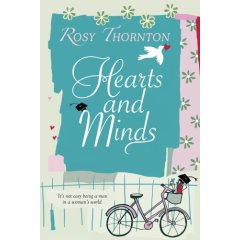
 It seems about right to be writing about Rosy Thornton’s campus novel Hearts and Minds on a day my students have given me a headache. Yes, the end of the semester is terrible, as usual. It’s too bad I’ve already finished this novel, because reading it would provide some comfort after a long day, whereas the book I’ve just begun, Against Happiness, will not. But maybe it will make me feel better to write about somebody else’s problems with faculty politics and student drama rather than dwelling on my own.
Hearts and Minds is a thoroughly entertaining novel. It takes place at Cambridge, specifically at an all-women’s college, St. Radegund’s, which has recently hired a male Head of House, to the consternation of many of the faculty. James Rycarte is his name, and although he’s an able administrator and knows how to deal with difficult people, he finds himself with some formidable opponents, especially faculty member Ros Clarke, who is determined to undermine his leadership and see him gone.
The other main character is Martha Pearce, an Economics faculty member and Senior Tutor, an administrative post that is due to end at the close of the year, leaving Martha without a job. Because of the demands of the Senior Tutor position, she has neglected her research, which will make it difficult to find another post. In addition to this looming problem, her husband has been more and more distanced of late and her daughter is showing signs of serious depression. She is left to manage this all on her own.
The plot thickens when a potential donor appears, a friend of Rycarte’s, whose money could save the library, which is sinking into the mud at an alarming rate. This friend appears to be the college’s savior, until he declares that his daughter will be applying for admission and implies that he expects the donation and his daughter’s acceptance to go hand in hand. Here is an issue that could potentially divide the faculty and give Ros Clarke the ammunition she needs to force Rycarte out.
I enjoyed the story and liked spending time with the characters, but another of the novel’s pleasures is reading about the college itself, with its traditions and oddities. Very near the beginning of the novel Rycarte arrives on campus for the first time since his interview, and so readers can learn about the college at the same time he does, watching him figure out details like the powers of the Head Porter and the lack of copy machines, and can follow along with him as he figures out who’s who amongst the faculty. It’s a good introduction to a place that in a lot of ways sounds charming — nearly everyone travels around on bicycles, which sounds wonderful — but which has its share of troubles, not least of which is a severe shortage of funds. The signs of financial hardship are everywhere, from the decision to stop offering the college’s residents breakfast to the existence of research fellowships that offer no stipend whatsoever. The college has been limping along for quite some time now, and Rycarte hopes the potential donation will turn things around, but he is unsure at what cost.
One aspect of the book bothered me — Martha Pearce’s relationship with her husband was hard to take. Martha is an extremely hard-working, extremely dedicated person, one who cares deeply about the college and is willing to do whatever it takes to serve the school and to keep her family going. Her husband, though, spends his days lounging around, napping, and claiming to be working on his poetry. He offers her very little support, most distressingly when their daughter is obviously suffering. There were moments in the novel when I wanted Martha to walk out on him immediately and not look back. Martha’s self-sacrifices happen in real life quite often I’m sure, so it’s not a failure of realism, but still I couldn’t help but get annoyed at this character that readers are clearly meant to sympathize with.
But this issue aside, I read the novel with great enjoyment; it’s a good book for when you want something that’s both smart and plot-driven, and I think lots of people would enjoy it, even those who haven’t set foot on a campus for decades.
 Of Books and Bicycles