
 I had a lovely snow day today — well, except for the snow — in which I did a lot of nothing: some reading, some email writing, some napping, some gazing out the window. There was some work I could have done, but I didn’t do it. It was great.
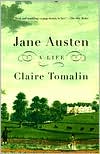
So, I finished Claire Tomalin’s biography of Jane Austena few days ago and enjoyed it thoroughly. It’s less than 300 pages, which has something to do with the scarcity of information on Austen’s life, surely, but at the same time is a welcome change from the usual thick biographical tome. I am reluctant to read those long biographies because as a slow reader, they take me forever to get through. It’s a pleasure to feel that I’ve gotten a good glimpse into Austen’s life without it taking months.
Tomalin has an engaging prose style and offers a good mix of material — enough information on Austen’s family and friends to give a sense of what her milieu was like, for example, without overwhelming the reader with names and relationships that few will remember. She quotes from Austen’s letters frequently — which are always a pleasure to read — and also gives examples of Austen’s poetry and poetry written by her family members, especially her older brother James. She offers brief readings of the novels, which are always well-done and insightful, and with each novel she considers the question many Austen lovers ask: to what extent does Austen resemble her heroines? The answer is, generally, not a whole lot. Tomalin notes possible sources for Austen’s inspiration, both in the people around her and in her own life and experience, but she argues strongly for Austen’s imagination as her chief source of material. As much as we might like to, we shouldn’t imagine Austen as Elizabeth Bennet. (I’m not quite ready to give up this idea, though — ready as I am to believe Tomalin, what I’ve learned about Austen’s sense of humor and liveliness does make her seem like Lizzie, my favorite.)
One thing that stands out in the biography is the way Austen depended on particular conditions in which to write and — most significantly — the fact that she had almost no power to create those conditions for herself. Up until the age of 25 she lived happily in her family home in the village of Steventon and was able to do a lot of writing while she was there, completing drafts of three of her major novels, but at that point her parents decided to leave Steventon and take up residence in Bath, and the news came as a complete surprise and unpleasant shock. Tomalin’s description of the time is sad:
There is a briskness and brightness in Jane’s letters at this time, much keeping up of spirits, but no enthusiasm. She is doing what she has to do, making the best of a situation over which she has no control, watching the breaking up of everything familiar and seeing what was left eagerly taken over; fitting in with plans in which she she has no say, losing what she loves for the prospect of an urban life in a house not yet found; no centre, no peace, and the loss of an infinite number of things hard to list, impossible to explain.
What happened is that she spent the next ten or so years of her life living in Bath at times, but also spending a lot of time traveling from one friend or relative’s house to another, and doing very little writing. Tomalin argues that she wrote best when she could live a quiet, regular life, settled comfortably in one place, but this she couldn’t arrange for herself, as she depended on her parents and other relations for her livelihood.
Eventually her mother (after Austen’s father died) settled in a house at Godmersham where one of her brothers was living, and Austen’s life quieted down enough to allow her to pick her writing back up again, arranging to have Sense and Sensibility and Pride and Prejudiced published and finally getting some recognition and earning a little bit of money for her work. And here is another one of the interminable “what if” questions — what if Austen hadn’t lost those ten years of writing time? What other masterpieces might she have produced?
There is also the fact that she died when she was only 41, a very young age. What might she have produced if she had lived another few decades? The cause of her death is unknown, but is possibly a lymphoma such as Hodgkin’s disease. Tomalin writes that she was brave and energetic until the end; she suffered for some months before she died but was still writing her unfinished novel Sanditon and towards the very end she wrote some lines of comic poetry, which she dictated to her sister Cassandra.
It seems possible that Austen could have written so much more than she did, but, of course, we do have six wonderful novels and some fun juvenilia, and that’s plenty.
 Of Books and Bicycles