Reading Serendipity

Litlove recently wrote a post in which she used the phrase “the usual serendipity of reading,” which is a great way to describe how books so often speak to each other and to us in unexpected ways. I’ve recently come across my own example. (And, in a nice twist, I’ve just been talking about serendipity in my “Intro to the Arts” course as we discuss how to access one’s creativity.) I’ve been reading Pema Chödrön’s book When Things Fall Apart where she writes about how we tend to run away from anything that is painful or unpleasant rather than facing it and considering what it means and what it might teach us. She writes:

Most of us do not take these situations [situations that cause discomfort] as teachings. We automatically hate them. We run like crazy. We use all kinds of ways to escape — all addictions stem from this moment when we meet our edge and we just can’t stand it. We feel we have to soften it, pad it with something, and we become addicted to whatever it is that seems to ease the pain. In fact, the rampant materialism that we see in the world stems from this moment. There are so many ways that have been dreamt up to entertain us away from the moment, soften its hard edge, deaden it so we don’t have to feel the full impact of the pain that arises when we cannot manipulate the situation to make us come out looking fine.

Those of you who participated in Infinite Summer may know where I’m going with this: Infinite Jest deals with exactly this dynamic — the impulse to run away from pain and discomfort straight into the arms of whatever distraction we can find. People are so desperate for entertainment and distraction, in fact, that in Infinite Jest their lives are at risk. At the center of the novel’s plot (such as it is) is a film referred to as “the entertainment” that is so seductive, so irresistable, that people literally can’t draw their eyes away from it and will starve themselves and die rather than have to stop watching it. And others — lots of others — distract themselves with alcohol and drugs, violence, obsessive work, or really anything that can keep them from having to think. Facing their problems directly is just too difficult.

My favorite character in the book, Don Gately, is a recovering drug addict who has learned all this, in his own way. Now that he is no longer addicted to drugs, thanks to AA, he is finding out what it means to face pain and discomfort directly. He is finding out that all the things the drugs helped him repress are now coming back, and he has become haunted by memories of his hellishly difficult childhood and his horribly violent young adulthood in a way he’s never experienced before.

I love Gately because he’s such a brave soul, and he has no idea just how brave he is. He looks around him at the halfway house where he lives and works and sees people who are just beginning to attend AA meetings and who scoff at all the cheesiness and cliches involved, and he understands why they scoff, but he has learned that facing reality in the way Pema Chödrön writes about is just so difficult that people can’t do it on their own. They need the support of the daily AA meetings, the belief in a vague “higher power,” the motivational cliches and all the rest of it. It’s a practice, really, not unlike meditation. Both practices teach people to take things one day at a time, or one moment at a time, to focus on what’s real, to face oneself directly and admit shortcomings honestly, to admit that we have no control over ourselves and our lives. Gately doesn’t understand why AA works, but he knows it does, and he’s willing to trust it, no matter what. And believe me, this trust gets tested.

I have no idea if David Foster Wallace was interested in Eastern spirituality at all, but I felt its presence in this novel. It may be I read it this way because I’m interested in it at the moment, but at any rate, I love how these two books have had so much to say to me.
11 Comments

Filed under Books, Fiction, Nonfiction

I appreciate book blogs!

It’s Book Blogger Appreciation Week, which means that lots of people are doing a lot of appreciating, and I thought I’d join in. So, thank you so, so, so, so much all you book bloggers out there! I’ve been struck again and again by just how friendly the book blogging world, as I know it at least, has been. I hear things about how ugly the internet can be, how people leave nasty comments all the time and wars get waged and stalking goes on, and who knows what else, but it’s not something I see. I realize that this is because my blog is a small one, and the book blogging world is a fairly quiet place, and if that’s what is required to keep things peaceful, then that’s just fine. My experience has been that book bloggers are wonderfully smart, generous, passionate, clever, witty, and generally awesome people.

I’m sitting in my study right now staring at shelves and stacks of books almost all of which I bought because book bloggers have recommended them to me. Following book blogs is one of the best ways there is to learn about books and to find things to read. People frequently ask me to recommend them books or they wonder how I know about the books I do or they think I’m really knowledgeable about what’s out there. The truth is that I’m not actually all that good at keeping up with book news on my own; before blogging I used to read reviews now and then, but sort of haphazardly and with a narrow focus. But following blogs has introduced me not only to the most recently-published books but also to tons and tons of older books I hadn’t heard of before. Following blogs makes it easy to know what’s going on. When people ask me how to find things they would like to read, I tell them to follow blogs. If you find blogs you like, which of course you will, it’s only a matter of time before you start feeling overwhelmed at the number of new books you’re learning about.

I’ve loved how book blogging has allowed me to feel like I’m an active part of the book world without having to be a professional reviewer or to have a job in the publishing world or to be a writer myself. I don’t have a big place in the book world, but it’s thrilling to find that people do actually read what I write and that I convince people now and then to read something I loved.

So, many thanks to whoever it was who nominated me for a BBAW award, many thanks to those of you who listed me as a favorite blog in the BBAW meme going on today, many thanks to those of you who link to me and read me and leave comments, and many, many thanks to those of you who publish your thoughts about books on the internet!

16 Comments

Filed under Blogging, Books

Book Notes

Just a few thoughts for a Friday evening. Since finishing Infinite Jest, I’ve been focusing on Laurie King’s The Beekeeper’s Apprentice, which I’m reading for my non-mystery book group, even though the book happens to be a detective novel. I’m almost finished with it, and I’ll write a proper review later, but my conclusion will be that the book is a disappointment. It has many potentially interesting things in it, but it never manages to pull everything together to be a really engaging read, and if a detective novel isn’t an engaging read, there’s a problem. From what I’ve heard from my book group friends, I don’t think there will be much controversy over this one; everyone so far has agreed it’s not that great. Oh, well.

I received one new book in the mail this week: Robert Dessaix’s Twilight of Love: Travels with Turgenev. I know nothing about Dessaix and have never read Turgenev (although I’ve been meaning to for a long time), but this book interested me because it’s a combination of memoir, travel narrative, and literary history, and I love books about books and writing that mix genres in this way. This is what Publisher’s Weekly says:

While the problem of irrational love in a world of reason is the dominant theme, Dessaix’s work explores much more: Russian theology, the experience of being far away and therefore barbarian in European eyes, the modern confusion of the erotic with the sexual, and of course, the problem of death.

And on the topic of books about books and writers, I recently learned that J.C. Hallman will be publishing a very interesting-sounding anthology called The Story About the Story, a collection of essays by writers about writing. The Table of Contents looks absolutely fabulous. It has selections by Virginia Woolf, Vladimir Nabokov, Salman Rushdie, Cynthia Ozick, Geoff Dyer, Randell Jarrell, Susan Sontag, and a whole bunch of other great people. The idea is that these selections are personal approaches to literature — great writing about great writing. (As I look over the Table of Contents I’m wondering why he didn’t include a selection from Nicholson Baker’s U&I, but, of course he couldn’t include everything).

Amusingly enough, I found out about the book on this blog, in the comments of which I called Hallman an impolite name (if you read the post, you’ll see why), and then Hallman himself appeared and responded. The internet can be such a great place, can’t it? I love it that people can be having a book discussion and then all the sudden the author can show up and contribute. Even if I do get caught out being impolite…

After I finish reading Laurie King, I’m not entirely sure what I will pick up next, although perhaps something I’m more likely to like, perhaps something older and canonical. Or perhaps an interesting nonfiction. We’ll see.

18 Comments

Filed under Books, Fiction, Nonfiction

On finishing Infinite Jest

Wow, people. Infinite Jest is a great book, and it’s going on my list of favorite novels ever. I don’t know if it would be on my top 10 or top 20 or top 50 or what, but it’s up there somewhere. Many people on the Infinite Summer forums and other places talk about rereading this book, in some cases many times, and in some cases rereading it pretty much immediately after finishing it for the first time, and while I’m not ready to reread it right away, I think I probably will someday. It’s a book that would reward rereading, without a doubt. And it’s a book worth spending lots of time with.

I appreciated having the Infinite Summer blog and forums available to help me sort out the plot events and to help me remember things I would otherwise have forgotten, but as far as I’m concerned the chief pleasure in this book is not piecing together its intricate structure or following the plot. The book is so enjoyable because of the narrative voice. The trick to enjoying the book for me was not to get caught up in figuring out all the details, and instead to just let it all wash over me. I picked up on the major events, but mostly I came to understand, eventually, that I would be able to figure out enough not to get lost and so I could relax and not worry about details. And not worrying about the details freed me up to enjoy the intelligence, the cleverness, the humor, and the wisdom of that voice. It’s a voice that varies from section to section with each new situation and narrator, but the truth is, it’s mostly the same voice throughout, or maybe more accurately it’s the same sensibility. It’s a similar voice to what Wallace creates in his nonfiction, and if you like that voice, I’m guessing, you’ll like whatever Wallace writes.

I was surprised to find so much wisdom in this book, and so much heart. Before I began reading I thought it was going to be a dry, detached, ironic kind of book, the kind that’s all about thinking and not about feeling. I’ve heard people criticize this book for being cold, and I’m pretty sure we didn’t read the same book, because that’s just not true. The book is incredibly funny, it’s overflowing with linguistic inventiveness, it has so much energy it feels like it’s bursting at the seams, it’s hyperactive and show-offy, its sentences can go on and on, and it has odd quirks like Wallace’s use of the word “like” throughout the whole book pretty much no matter who the narrator is or what the level of formality is. But it also made me tear up, and I cared about the characters, more than I usually care about characters in fact.

So, I’ll try to get more specific. I thought it was wise about how difficult it is to live in one’s own head and how hard it is to communicate genuinely with other people. And it was wise about how easily we get into the habit of running away from everything that is difficult and painful and instead turn to diversions, whether they be drugs or alcohol or sports or sex or endlessly-entertaining movies or whatever. In this novel, it’s mostly drugs and alcohol. And it was wise about just how hard it is to overcome addictions and that overcoming addictions means facing those difficult things we were running from in the first place. And also about the incredible variety of ways people are hurting and hurt and damaged and deformed, so much so that pretty much nobody is whole and perfect, and everybody is trying to recover from something.

So what is the book about? I don’t think I’ll spend much time describing that because what it’s about is just so random and, frankly, doesn’t sound all that interesting. It’s got one set of characters who are students at an elite tennis academy, and another set of characters who are residents of a drug and alcohol addiction halfway house, and another set of characters who are involved in political intrigue. It’s set in our time, roughly, but in a world different from our own, with slightly different technology and wildly different political structures. You’ll recognize the world, but it’s not ours.

I’m afraid that people may be too easily intimidated by this book. Yes, it’s long and challenging, but it’s very readable, and while it does throw a whole bunch of characters and scenes at you right at the beginning and you have to orient yourself a bunch of times to new situations, it does settle down eventually and you begin to sort out who is who and what the main storylines are. I think if you are at all tempted to read this book, you should, and if you aren’t sure, then you might try Wallace’s nonfiction and see if you like that. You might try Wallace’s 2005 graduation speech given to Kenyon College, which I think is really wonderful and which gives you an idea of why I think he’s a wise writer.

And now I’m glad I have more of Wallace’s writing available to read; at this point I’ve only read one novel and one nonfiction collection and a couple things online, so there is much more to look forward to.

22 Comments

Filed under Books, Fiction

A cycling post

I haven’t written about cycling in quite a long time, and that’s partly because there’s not much going on, but even more so because I’ve felt so strangely about it over the last month or two. Or perhaps to be more accurate I should say I’ve felt strangely about racing. Which is, actually, the way I usually feel about it.

Anyway, I did go on a lovely ride today. Seven of us left from the bike shop this morning and headed south to the beach, and on our way back home we stopped at a cupcake shop. Stopping at the cupcake shop is so much fun that we ride there regularly and now call the ride our cupcake ride. It was a gorgeous day that was perfect for riding, sixties and sunny. The company was good, and we rode hard-but-not-too-hard, which is just the right speed. I got home with SO much more energy than I had when I left.

The racing, though. I rode in my last race on July 22nd, and it was the last in a series of races where somebody around me crashed. I’ve managed to stay upright so far this season, but it was beginning to feel like everybody around me was destined to crash. And then cycling friend Sprinter della Casa got in a pretty awful crash from which he is still recovering, and it was all just too much. I had chances to race after that last race, but I wasn’t interested anymore, and I’m still not interested.

But I also recognize that I go through a yearly cycle: I start racing in March and am into it, and I stay into it until June or so at which point I start getting burnt out. I’m really burnt out by August and am ready to quit the entire racing enterprise entirely, for good. I enjoy riding all through fall, at my own pace and in my own way, and I start telling everyone that I’m not going to race next year. And then December and January roll around and the people around me start to train for races, and I’ve forgotten a little bit how much I don’t want to race and I remember how much I like having a goal to train for, and the next thing I know, it’s March and I’m racing again.

So now I’m in September feeling burnt out, and I’m tempted to say I’m not going to race next March, but what I need to do is to acknowledge this cycle of mine, recognize the cycle might continue or it might not, realize I have no idea what I’ll do next March, and leave it at that. So that’s what I’ll do.

As for regular old riding, I may have mentioned here before that my goal for this year is to ride 5,000 miles, which would mean beating my current record of 4,300 miles set last year. I’ve now ridden 3,580 miles this year, so unless something goes wrong, I should reach my goal. I’ll need to do a little less than 400 miles a month. There was talk on the ride today of doing some longer group rides this fall, and I’m excited about that. I hardly rode at all in August and I lost some fitness, but I’m starting to get it back now, and it feels good.

11 Comments

Filed under Cycling

Books, books, and more books

The last thing in the world I needed to do yesterday was to go check out the library sale going on in the town just south of mine. But I wanted to do it, and so I did it and came back with six books. It was a day for classics, with a few other things thrown in. Here’s what I found:

  • Henry James’s The Awkward Age. Henry James is a controversial figure in my house, but I’m the one who’s most likely to defend him, so I like to have an unread James novel on hand, just in case I get in the mood.
  • Willa Cather’s The Professor’s House. I really enjoyed A Lost Lady and My Antonia, so I thought I might like to read more of her work. After reading Elaine Showalter’s glowing appraisal of her work, I’m even more interested, and Dawn Powell  put me in the mood to read more about midwestern America.
  • The Modern Library collection of novels by William Dean Howells, including A Foregone Conclusion, A Modern Instance, Indian Summer, and The Rise of Silas Lapham. All for a dollar! I have never read Howells before and will probably begin with the last novel in the volume.
  • Helene Hanff’s 84, Charing Cross Road. She Knits by the Seashore recommended this one to me, and it sounds delightfully bookish.
  • Anne Fadiman’s Ex Libris. I’ve already read this book, but I read a library copy and I wanted to own it. It’s such a great collection of essays about bookish subjects that I’d like to read it again at some point.
  • And finally, Dubravka Ugresic’s collection of essays Nobody’s Home. I do love good essay collections, and Stefanie wrote a great review of this one, so I thought I’d give it a try.

Not a bad haul, right? And in other news, my mystery book group had a great discussion of The Moonstone last night. All but one of us loved it, and we spent much of the meeting raving about how great a book it is (the one dissenter must have felt a bit left out …). We came to the conclusion that, oddly enough, The Moonstone is really an anti-detective novel since ***Spoiler Alert!*** the detective fails to solve the case (it’s solved, but by other people) and order is not restored at the novel’s end, since the moonstone ends up back in India and not hanging on Rachel’s neck. You could say that the return of the moonstone to India IS restoring order, but that’s not the kind of order one usually finds, since it signals a failure of British power. And there’s no one person in the novel who is in control of everything and who knows what’s going on; instead, there are multiple narrators each of whom only knows a little piece. Or, if you want to say that Franklin Blake is the one who is in control since he is organizing the writing of all the novel’s sections, he’s an odd form of order since he spends most of the novel in ignorance of his own role in the story. Again, what a great book!

19 Comments

Filed under Books, Reading

On rereading The Moonstone

I’m SO close to finishing Wilkie Collins’s The Moonstone that I will have no trouble finishing it tonight before I drop off to sleep. My mystery book group is discussing the book tomorrow, so I’m finishing it just in time. I believe this will be the third time I’ve read the novel. I think I read it first as a teenager, grabbing it off my dad’s shelf of classics. I read it again sometime in my twenties probably, just for the fun of it. This time around, it was my pick for the book group; we had been talking about the possibility of reading it for a while, so I decided that it was finally time. I think many people in the group had already read it, so it will be a reread for a lot of us. I’m looking forward to hearing what other people thought.

My memories of my previous experiences reading The Moonstone are a little vague (I wasn’t blogging back then and so don’t have a record — alas), but I do recall enjoying the book’s multiple perspectives a lot. In fact, that’s what struck me most strongly during my first reading, and I remember thinking that I wanted to read other books with similar structures and that that structure would probably remain a favorite of mine, which it has. If you haven’t read it, The Moonstone has multiple narrators who pick up the thread of the story when they have something important to contribute. These narrators often respond to each other and disagree with each other. The first two narrators are particularly entertaining, as they are strong characters with amusing quirks who happen to dislike each other severely, and it’s funny when they tell you not to believe a word of what the other says. I also like how these multiple narrators allow you to see many of the characters both inside and outside. We get to hear Gabriel Betteredge, the first narrator, explaining how important Robinson Crusoe is to him, which he does with such enthusiasm we almost come to agree with him and go look for a copy of the novel ourselves, and we also get to see a different character completely bewildered at the fact that Betteredge is pushing Defoe at him as a source of wisdom on par with the Bible. It’s all a lot of fun.

I enjoyed the multiple narrators this time around too, but I noticed Collins’s wonderful sense of humor even more. His characters are just so entertaining. There’s Betteredge with his Crusoe obsession, his digressions, his strong opinions, his dignity combined with his failure to notice or to comment when Franklin Blake treats him rudely. And there’s Miss Clack with her tracts and intrusiveness and insatiable curiousity disguised as piety. The scene when she watches from behind the curtains as Rachel and Godfrey Ablewhite get engaged, watching while pretending not to, is classic comedy.

I’m not entirely sure I want to read this book again; perhaps I’ll change my mind, but I feel right now as though I’ve gotten what I can out of it, and I’d like to move on and read other Wilkie Collins novels. But three good experiences reading any novel is a pretty good record, I think.

12 Comments

Filed under Books, Fiction

Dance Night

Dawn Powell’s 1930 novel Dance Night has me thinking about what it would be like to live in a small town with very little education, very few job opportunities, and only vague ideas about what life is like in other places. The characters in the novel go to the movies regularly, but other than that, the chief source of information they have about the world outside their town comes from traveling salespeople and a dancing master, and the reach of these people is very small. The people who travel the farthest and would therefore have the most information are also the book’s most despicable characters. So everyone else is left with vague dreams and a strong pull to stay right where they are, doing the things their parents did.

Dance Night tells the story of Morry Abbott, a young man who is trying to figure out what he wants to make of his life. He lives with his mother behind the millinery shop she owns where he feels increasingly uncomfortable with the overwhelming femininity of the place. He is trying to find his way into the masculine worlds of the factory and the bar, but his youth and inexperience leave him uncertain and embarrassed. The novel also tells the story of Jen, a 14-year-old who has been abandoned by her mother and taken in by a local family. She feels isolated and alone and misses her younger sister, left behind in an orphanage. She turns to Morry for some companionship, and he is drawn to her, attracted by her hero-worship, but also repelled by her obvious neediness.

What has stayed with me about the book is all the unhappiness and the longing and the misunderstandings that haunt just about every character. Morry doesn’t know what to make of the young women who surround him who make fun of him but also, very confusingly, flirt with him. Morry’s mother is married to a man who is hardly ever home, but who makes her life miserable when he is. She is also desperately in love with the dancing master, who is hardly aware of her presence. The mother’s friend is having an affair. Her assistant torments Morry but also wants to be seen with him. The most important man about town, the one with all the money and property, moves through a series of superficial relationships. No one, it seems, is content, and nobody has much of an idea of what to do about it.

The townspeople do have one outlet — their weekly dance night, which begins with a dancing lesson, followed by the dance itself. Everyone, from old to young, looks forward to these evenings as a time to bring some lightness into their lives, but enjoyable as they are, they are also scenes of sexual competition and jealousy.

And there is also the problem of work. Morry gets a job in the factory and feels proud of himself for a while, but before too long he sees how builders are developing the town, has his own ideas of what kind of houses the town needs, and joins forces with a local architect to try to make his dream houses a reality. He becomes a big man about town himself, making plans and talking them up to the townspeople, shuttling about from person to person trying to make things happen. All this is immensely satisfying for a while, but it’s also precarious and uncertain, and for all Morry knows, it could collapse on him.

Morry senses that his world is changing and that there are opportunities out there — opportunities that could transform his life, if only he could get a proper hold on them. It’s a place where hard work and industry and vision can take him places, but he just can’t quite seem to make things work for him. His friend Jen is also full of dreams; she wants to sing and dance on stage and to live a busy and exciting life in some big city. But the problem, again, is how to make it happen. How can these people escape?

The picture Powell paints of a small town in changing and uncertain times is a grim one, but the portrait seems so real and the characters are so compelling that the book is a fascinating read. It makes me very glad I’m fortunate enough to live in an entirely place and time. Of course, we have our own uncertain times to deal with, but I think for a lot of people, it’s become easier to imagine a way out of claustrophic small towns.

11 Comments

Filed under Books, Fiction

On Borrowed Wings

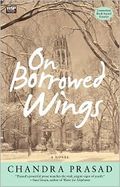
6a00d834515bbc69e2011571051d1e970c-120wi I finished Chandra Prasad’s On Borrowed Wings nearly a month ago, and so the details are beginning to get vague, but I did want to write at least a few words about the book before putting it away. I picked it up in the bookstore because I was in the mood for something easy and fun and comforting, and I remembered the title from Danielle’s very positive review. It served the purpose nicely; it was an entertaining read that was also smart and thought-provoking. It did just what comfort reading should do — comfort, without making me cringe at bad writing.

I was drawn to the book for another reason as well — it takes place in my state, Connecticut, and it’s about undergraduate life at Yale, and I always enjoy reading books about academic life, whether from a student’s or a professor’s perspective. The book also has cross-dressing and lots of feminism — two more points in its favor.

It tells the story of Adele Pietra, a young woman in a small mining town outside New Haven. It’s the 1930s, and life is difficult for the working-class people in Adele’s town, Stony Creek, and it’s particularly difficult for a smart young woman whose best opportunity in life seems to be marriage to someone she barely knows. Adele loves to read and study, but it’s her brother Charles whose education everyone cares about. His mother is helping him prepare to apply to Yale, a possibility that seems like a long-shot, but one his mother has pinned all her hopes on.

All future plans are destroyed, however, when Charlie and his father are killed in a mining accident. Adele and her mother mourn their loss, but when Charlie’s acceptance letter from Yale arrives, it occurs to Adele that she just might be able to seize an opportunity and make something incredible happen. Women were not admitted to Yale at that time, but Adele decides that she’s going to go anyway — by dressing as a man and taking her brother’s place.

And so begins an adventure. Adele has many obstacles standing in her way — not only must she dress and talk and act like a man, but she has little idea how to behave in a setting that is entirely new to her. As a working-class, small-town girl, she has had little exposure to the big city and to the privilege and comfort of life in a prestigious university. The scenes describing Adele’s arrival in New Haven and her first weeks on campus are suspenseful ones, as she has to figure out how to deal with unexpected problems such as the swim test all freshmen are supposed to pass. How can she take a swim test without revealing her secret?

Fortunately, she runs into another new student who is just as bewildered by his new surroundings, and through him, she manages to make a group of friends, and she also does well in her classes and manages to find a job and she even makes friends with a working-class family in the city.

She manages to do pretty well for herself, but the question always remains — how long can she keep her secret?

It’s fun to watch Adele live a life she never expected she could and do things nobody believed a woman should be able to do. Prasad does a good job making this fantasy believable and resolving the suspenseful situation she created. All in all, it’s a satisfying book.

7 Comments

Filed under Books, Fiction

Giving up on a book

I haven’t done this in ages, but for the first time this year and for who knows how long before that, I’m setting aside a book I’m not getting along with. I should give up on books I’m not loving more often, I know that, but I generally don’t anyway. I want to give a book a chance before I quit reading it, and once I’ve done that, I usually find myself far enough into it that it doesn’t seem too hard to just carry on.

But I was reading Christina Stead’s The Man Who Loved Children before I left on vacation, and while I found it interesting on some levels, I also found myself on page 150 or so out of 500+ pages wondering if I was ever going to be able to finish the thing. I felt like I’d already plowed through a lot, but that tons more was waiting for me, and I wasn’t sure the book was going to change or develop much to make the plowing on worth while. And then vacation intervened, and I had a lot of other books to read, and I haven’t picked it up in a few weeks now and will put it back on the shelf soon.

The book is a family story. It’s about a woefully mismatched couple with a large brood of children, and it describes the family dynamics, including the horrible fights the parents have and the way the children try to keep peace in their family. It captures the father’s highly imaginative use of language and the games he plays with his children, as well as the mother’s longing for a different kind of life and refusal to accept the circumstances she finds herself in. The eldest daughter, Louisa, is a child from the father’s previous marriage, a fact her step-mother never lets her forget. Louisa, in the heartbreaking way of children, accepts this and doesn’t question it, although she has also begun to explore the world outside the family more and is retreating into the private world of adolescence. There is cruelty in the way the parents treat the children, but, somehow, there is also love and moments of happiness. What else can young children do but make the best of the situation they find themselves in?

I liked the way the book explored this dynamic —  the problem of children trying to understand what is going on in their family when it both nurtures and harms them, in ways they aren’t grown up enough to comprehend. Certain kinds of dysfunctional families are very interesting to read about, and this family reminded me very much of the family in Jeannette Walls’s The Glass Castle. In both cases, the parents have wonderful things to offer to their children, but they can’t seem to grow up enough themselves to be capable of taking care of others.

The problem, though, is the pacing. I read and read, and not much happened, and there wasn’t enough narrative tension or tension among the characters to make me want to keep going. I think I can be a patient reader, but there wasn’t enough to reward my patience.

It’s a memorable book, though. Even if I never pick it up again, I’ll remember the family. Maybe I’m missing a really great ending, and if you have read this book before, you can let me know if I have, but I think with some books you don’t have to read the entire thing to get something from it.

12 Comments

Filed under Books, Fiction, Reading

Life According to Literature

I just posted this meme over on Facebook, and it seemed too good not to post here too. Give it a try if you like!

Using only books you have read this year (2009), answer these questions. Try not to repeat a book title. It’s a lot harder than you think!

Describe yourself: Loving (Henry Green)

How do you feel: At Large and At Small (Anne Fadiman)

Describe where you currently live: Among the Mad (Jacqueline Winspear)

If you could go anywhere, where would you go? The Other Side of You (Salley Vickers)

Your favorite form of transportation: On Borrowed Wings (Chandra Prasad)

Your best friend is: Jane Austen: A Life (Claire Tomalin)

You and your friends are: The Odd Women (George Gissing)

What’s the weather like: Gaudy Night (Dorothy Sayers)

You fear: The Great Mortality (John Kelly)

What is the best advice you have to give: Nothing To Be Frightened Of (Julian Barnes)

Thought for the day: An Academic Question (Barbara Pym)

How I would like to die: A Great Deliverance (Elizabeth George)

My soul’s present condition: Harmonium (Wallace Stevens)

17 Comments

Filed under Books, Memes

On Reading Gertrude Stein

There are two books from before vacation I haven’t yet written about here: Gertrude Stein’s Three Lives and Chandra Prasad’s On Borrowed Wings. My memory of these books is getting a bit hazy, but I don’t want to ignore them entirely here.

So first, Gertrude Stein. I’ve been meaning to read Three Lives for a very long time; in fact, I’ve probably owned the book for well over a decade. Stein is a fascinating figure, but I’ve always found her intimidating and need to work up a bit of courage to pick up one of her books. Three Lives is certainly one of the easier, more approachable books she’s written; it may take me another decade or two to work up to reading something more challenging, if I ever decide to do it at all. I don’t feel that I’ve ever really understood Stein, but then again, lots of people feel that way, I know for a fact, and my tendency with writers I don’t quite understand is to keep returning to them to see if one more try will make a difference.

Three Lives is a straightforward read, not intimidating at all it turns out, with simple sentences and vocabulary, without much plot and with just a few characters. In fact, it’s such a simple, straightforward, non-astounding read that one might reasonably wonder why Stein is read at all, if it weren’t for the time period she lived in and the contrast between what she was doing and typical novels of the time. The book was published in 1909, and the contrast between her writing and other novels of the time is sharp. She has taken the sentence and pared it down, often using a series of simple sentences or short phrases strung together with conjunctions. She also uses a lot of repetition, repeating words from sentence to sentence and repeating ideas from page to page. For example:

Melanctha Herbert had not made her life all simple like Rose Johnson. Melanctha had not made it easy with herself to make her wants and what she had, agree.

Melanctha Herbert was always losing what she had in wanting all the things she saw. Melanctha was always being left when she was not leaving others.

Melanctha Herbert always loved too hard and much too often. She was always full with mystery and subtle movements and denials and vague distrusts and complicated disillusions. Then Melanctha would be sudden and impulsive and unbounded in some faith, and then she would suffer and be strong in her repression.

Stein piles bits of information on top of each other to build portraits of her characters; I suppose this is what every author does in order to create a character, but Stein draws attention to the piling on by repeating her character’s full name and using “and” in her lists, instead of commas. She uses repetition on a larger scale too. Her story moves forward in a jerky back-and-forth motion; she will tell you new information, and then she will circle back and repeat old information, perhaps with some variations, before moving on again.

It’s not a very exciting style, and at times I felt bored with the book, but she does manage to capture something that feels true about her characters. It’s an incantatory style; it’s almost like she’s chanting her way through these characters’ lives, conjuring them up and capturing their full history in a fairly short number of pages.

The book does exactly what the title promises: it tells the story of three women’s lives, none of which connect to the others in any way except that all three of her subjects live in the same town. She tells their full life stories, although most of the information we have on their childhoods comes through flashbacks. All three are ordinary working- or middle-class women, and the focus in all three stories is on their relationships — friendships, and in the case of the middle story “Melanctha,” romantic relationships. The Melanctha section is the most famous one, partly because of how it deals with race; Melanctha is a black woman and some see it as a sympathetic portrait of blackness, arguably forward-looking for its time (it’s a controversial point, though).

So, Three Lives is an interesting read, a good book to analyze stylistically and think about contextually, although it’s not engrossing or emotionally compelling, at least for me. I’m very curious and I wish there were some way of knowing how Stein’s reputation will fare in decades and centuries to come. I suspect she’ll remain known, at least for a while, although it’s hard to tell whether that will be because of her writing or because of her life story. I’m looking forward to reading Janet Malcolm’s book Two Lives: Gertrude and Alice to learn a little more about that life.

10 Comments

Filed under Books, Fiction, Reading

New books

So I promised I’d write about the new books I bought on my travels. I didn’t do much reading while we were gone — Hobgoblin and I seem to have trouble sitting still while away from home — but I did collect some good things. We visited two bookstores in Portland, although there were others we didn’t have time for or that were closed while we were there. The first one was Longfellow books, which calls itself a “fiercely independent bookstore.” In addition to its other admirable traits, Portland seems to be especially devoted to its local, independent shops. So I was glad to support them by buying The Great Fire of London by Jacques Roubaud, an experimental French novel, and When Things Fall Apart by Pema Chodron, a book about Buddhism both Stefanie and Litlove have recently reviewed.

We also visited Cunningham Books, which is a used and rare bookshop. We were running out of time and so I didn’t get to look through the store thoroughly, but I did find a copy of Adam Sisman’s The Friendship: Wordsworth and Coleridge. I really enjoyed Sisman’s earlier book Boswell’s Presumptuous Task about the writing of Boswell’s Life of Johnson, so I’m looking forward to this one. I like how he writes biography that isn’t straightforward biography; instead, he chooses some angle of his subjects to focus on and tells something about their lives that way.

We also visited two bookshops in or near Bar Harbor, one of which was a used bookshop specializing in mysteries. I didn’t find anything there, but it was great to look through. And then I stopped at Sherman’s bookstore at least twice, once with Bob and Emily, and once when two sisters who hiked the Appalachian Trail barefoot were doing a book signing. So of course we had to get their book and ask them to sign it. It’s called Barefoot Sisters: Southbound, and it looks really impressive, both the book and their accomplishment.

And finally, we visited Northshire Bookstore, a really fabulous bookstore in Manchester Center, Vermont. It’s pretty big and has a fabulous selection; we spent a good amount of time browsing, but there were still sections I didn’t make it to. I decided to come home with Patrick’s Hamilton’s Twenty Thousand Streets Under the Sky, which I just discovered is a trilogy of interconnected novels centering on a London pub. After reading Slaves of Solitude, I became an avid Hamilton fan. I also bought Geoff Dyer’s The Ongoing Moment, a book about photography that I picked up not so much because I’m interested in photography, but because I like Dyer’s writing a lot (Out of Sheer Rage and Yoga for People Who Can’t Be Bothered To Do It are both great) and also William Gass’s A Temple of Texts, a collection of his writing on literature.

And now I’d better get on with the actual reading!

8 Comments

Filed under Books

Home again

I had a lovely vacation, but let me tell you, returning home right before the fall semester is about to begin is not much fun. I wish I could hop in the car and head out again. But instead I’ll tell you about what we did.

The first part was a trip to my parents’ home outside Rochester where the middle of my three younger sisters got married. It was a great family reunion, a gathering that just keeps getting larger and larger. We were a big family all by ourselves with two parents and seven children, but now we have four spouses, including the most recent addition, two significant others, and one 8-month-old baby, my first niece. Plus two aunts and an uncle joined us. Here I am with my adorable niece. I spent as much time holding her as I could:

Vacation 2009 #1 061

In addition to attending the wedding, Hobgoblin and I went walking on the shore of Lake Ontario, visited wineries along the Finger Lakes, walked along the Erie Canal, and watched my brother win a 5K running race. Here’s a picture of Chimney Bluffs on Lake Ontario:

Vacation 2009 #1 020

After the family time, we headed out to Portland, Maine, where we spent a much-too-short 1 1/2 days. It struck me as a fun, liberal, artistic, bookish, dog-friendly city, and I found myself wanting to live there, although surely the winters there are tough. We managed to do quite a lot in our short time there: we visited the Victoria Mansion, toured the Longfellow House, shopped in bookstores, went sailing on the Bagheera around the Portland harbor, and ate in as many restaurants as we could.

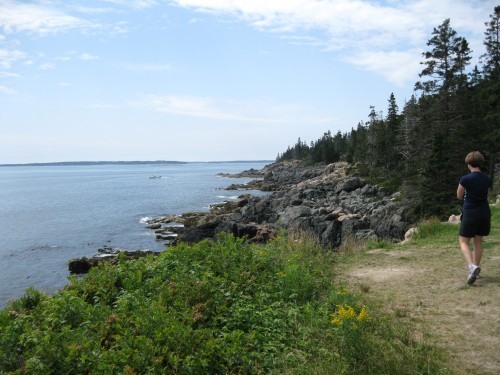
After that we drove to Mount Desert Island to see Acadia National Park and Bar Harbor. Bar Harbor is cute, if incredibly crowded, at least in August, and Acadia is breathtaking. I love how the park offers both mountains and the ocean:

Vacation 2009 #1 023

Here’s what the coast looks like:

Vacation 2009 #1 050

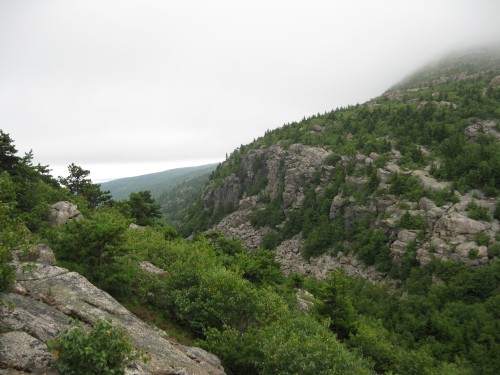
The mountains are very rocky with lots of pink granite, which means when you go hiking you do a lot of rock-hopping. We climbed up and down some very steep hillsides:

Vacation 2009 #1 041

We hiked every day we were there, and we also went sea kayaking and spent lots of time exploring the Bar Harbor shops and restaurants. It just so happened that Emily and Bob were on the island at the same time we were, so we met up for an afternoon hike followed by dinner and blueberry martinis (everything has blueberries in it when it’s August in Maine). It was lovely to see friends and have a chance to talk about books and to celebrate Emily’s new job.

Muttboy really likes the hiking in Acadia:

Vacation 2009 #1 048

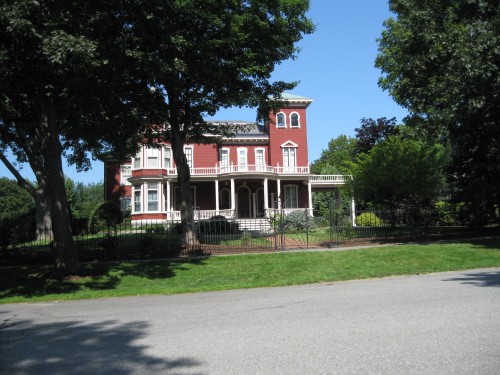
We were sorry to leave Acadia, but were cheered up by being able to make a little bookish pilgrimage as we drove through Bangor, where Stephen King lives. Hobgoblin found his address online somewhere, and it was only a short side trip off the highway to find it:

Vacation 2009 #1 055

We weren’t the only ones there — a couple motorcycles and another car were lingering on the road just as we were.

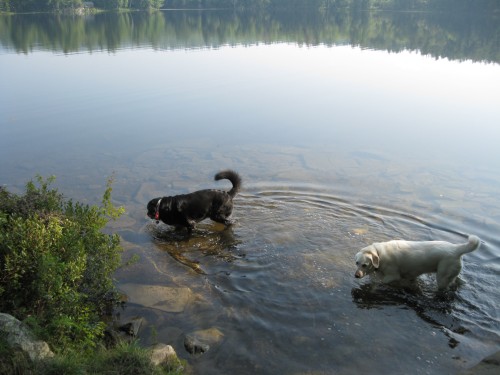
We had one more stop to make before heading home — Vermont, where some friends of ours have a summer home. They live near Bromley Mountain, a part of the Appalachian Trail we’ve backpacked through, so it was familiar territory. Rather than staying in the mountains this time, though, we got to see the towns and farms in the area, and rather than carrying everything on our backs, we got to live in luxury, with showers, couches, a comfortable bed, and lots and lots of good food. We took walks through the woods and around Lowell Lake, which Muttboy and his friend Phoebe really liked:

Vacation 2009 #1 057

And then it was time to come home.

I didn’t read much while we were gone, but I did buy a whole stack of books, which I’ll tell you about sometime soon.

18 Comments

Filed under Life

Vacation!

Hobgoblin and I decided to start our vacation a day early, so instead of leaving on Thursday, we will be heading out tomorrow. We are traveling to the Rochester area for my sister’s wedding, and then over to Maine for a week to visit Portland and Acadia National Park, and then to Vermont to visit some friends. So I’ll back in a couple weeks. In the meantime, enjoy August and read lots of books!

8 Comments

Filed under Life

Manhattan Book Shopping

Zhiv commented recently that I should try to get over the guilt I feel about buying books, and when fellow bloggers, particularly ones as kind and encouraging as Zhiv, offer good advice, I generally try to follow it. So yesterday Hobgoblin and I headed to Manhattan to look at some bookstores. I figured an excellent way to keep from feeling guilty about buying more books is to buy them from great independent bookstores that could probably use the support, so I remembered that I saw a walking tour of bookstores in New York City posted at The Millions and decided we would follow part of it.

We skipped the first two stores on the route, The Strand and St. Mark’s, as we have been to both of them frequently. We visited the next five stores, though, and each one was entirely new to us. I’ve been kicking myself since yesterday for not having visited these stores earlier, but at least I’ve found them now.

Three Lives was up first; it was probably the smallest store we visited, but it was the one I liked best because its selection was outstanding. If you take a typical bookstore, pull out all the crappy books you find everywhere, and then add in a bunch of really smart books and books from small presses and books you normally have trouble finding, you’ll have Three Lives. Hobgoblin and I kept excitedly showing each other books we thought the other would find interesting. I bought two books here, although I could have found dozens more: The Cloud of Unknowing, written by an anonymous monk in the 14th century, which I bought to feed my interest in spiritual writing, and the 2008 version of The Best American Essays. I’ve been wavering about buying that one for a while, but the other day I got a strong urge to read some contemporary essays, so I decided to go ahead.

Next up was Partners & Crime Mystery Booksellers, just a couple blocks away from Three Lives. I love that Manhattan has two bookstores devoted exclusively to mysteries (two that I know of!). I’ve been to the other one, The Mysterious Bookshop, and this was one perhaps a bit smaller, but equally interesting. They had sections devoted to mysteries in exotic locales, to mysteries with lurid covers, to out-of-print mysteries, to hard-boiled and soft-boiled mysteries, and probably to other categories too. From their 100 best mysteries ever shelves, I found Josephine Tey’s Miss Pym Disposes to take along with me. It occurred to me while we were there that my mystery book group might want to take a field trip to these two shops.

Then we walked across town to McNally Jackson, which I’ll remember chiefly as the place where they had their fiction divided up by country or region. I think this is a little odd and would cause categorization problems; for instance, I’m reading Christina Stead right now, who was born in Australia but who lived in England and America and other places, and whose novel that I’m reading now, The Man Who Loved Children, is set in the U.S. But still, if I ever decide I want to read a bunch of, say, African fiction or fiction from southeast Asia, I know where to go. The store was a pretty good size, with a good, smart selection. From the Russian section, I picked out Victor Pelevin’s Buddha’s Little Finger to take home.

Then it was on to Housing Works Used Book Cafe, just a block or two from Mcnally Jackson. Their website appears to be down, but you can read about the store here. It’s a non-profit bookstore and cafe, and the money it makes goes to help people with HIV/AIDS. They had an amusing sign up at the cafe saying that all their workers are volunteers, which is why nobody can find the cream. It was a fun store, a good size with an interesting selection of books. Hobgoblin and I were getting tired by this point, but after some coffee and a chance to sit for a little while, we found some more energy and I found these books: Annie Dillard’s The Maytrees, Anna Gavalda’s Someone I Loved, Georgette Heyer’s The Talisman Ring, and Jane Gardam’s Old Filth. Again, I could easily have found more.

By the time we got to the last shop, maybe half a mile from Housing Works, we were getting seriously tired, so we only took a quick look and didn’t buy anything, but it’s a shop that’s worth another visit: Bluestockings, a bookstore, fair trade cafe, and activist center, as its website says. I love the store’s name. The walking tour guide describes the store this way:

Of New York’s many bibliophile haunts, this one boasts perhaps the most pronounced curatorial sensibility. Punk, feminist, progressive, culture-theoretical, and environmental sensibilities predominate, without domineering.

Sounds like fun, right? Once we’d looked around a bit, Hobgoblin and I hobbled off to get some dinner and make our way back to Grand Central and back home.

We didn’t even make it to the four stores on the tour in Brooklyn. Those are for another day, I suppose.

Update: You can find out what Hobgoblin bought here.

18 Comments

Filed under Books

Richard Holmes’s Coleridge

Richard Holmes’s Coleridge: Early Visions is a fantastic book. I found myself enthralled by the story the whole way though. This is only the first volume and I haven’t had a chance to begin the second one yet, but I’m eager to get to it when I can. I don’t usually enjoy biographies quite this much; I like reading them now and then, but when I’m in the middle of them they can sometimes feel the tiniest bit like a chore, especially when they are long. I’m not particularly good at retaining facts, so I sometimes read biographies wondering how much of them I will forget very shortly. But Holmes does such a good job here those uncertainties didn’t bother me.

In his preface Holmes discusses one of his techniques that makes his biography stand out: he has:

attempted, from the very start, to set Coleridge talking, to tell his story through his own magnificent — and constantly humorous — flights of phrase and metaphor. I have tried to make his voice sound steadily through the narrative, and indeed in the end to dominate it.

And this is exactly what he does, using quotations from poems, letters, journals, and essays liberally throughout. It helps to create a rich picture of who Coleridge was and what he must have been like to know.

But Holmes was helped by having such a wonderfully interesting subject to write about. Coleridge was a great poet, but he was also a great personality and managed to wrap nearly everyone he met around his finger, at least for a while. Holmes tells the story of Hazlitt’s obsession with Coleridge, a story that illustrates what seems to have been a common dynamic: Hazlitt met Coleridge when he was a young, very awkward boy and was immediately overawed by Coleridge’s colorful personality. As he got older, though, he changed his mind, deciding that Coleridge’s mystical and metaphysical turn of mind was just a lot of balderdash and becoming thoroughly disillusioned and bitter. Coleridge had a history of very close, very intense friendships that eventually went awry, with Hazlitt, but even more famously with Robert Southey and William Wordsworth.

Coleridge was a great talker, both in private conversation and in his popular, if politically controversial, public lectures. He also had a flair for political journalism, for literary criticism, for letter-writing, and for private journal-keeping. Holmes greatly admires his poetry, but praises his prose style almost as highly. He also was one for big schemes and plans, including one called Pantisocracy that would have taken him and his family and a small group of friends over to America to found a utopian society on the banks of the Susquehanna. It didn’t work out, but Coleridge never lost his idealism and Holmes argues that Pantisocratic ideals shape Coleridge’s thinking for the rest of his life.

He was a genius, Holmes makes clear, at coming up with brilliant ideas and plans, but rarely did he follow through on them; in fact, he became notorious for his lists of ideas and dreams that remained unaccomplished. He held so much potential, so much of it unrealized, although Holmes emphasizes the brilliance of the things he was able to accomplish and argues that his ability to dream is in and of itself worthy of admiration.

This first volume takes us through the first 32 years of Coleridge’s life, from 1772 to 1804. The second volume is ominously subtitled “Darker Reflections,” although we can already see the beginnings of the darker part of Coleridge’s life in the first volume. He began taking opium in the first volume, the habit that will shape the second half of his life in dramatic ways. He also struggled with unhappiness in his marriage, uncertainty about his career path, and uncertain finances, although he did receive financial support from patrons who had great faith in his abilities.

I also admired Holmes for doing an excellent job of placing Coleridge in his intellectual context, describing his contributions to the literary and philosophical trends of the time. Coleridge knew so many important people and was good friends with many of them, so learning about Coleridge is a great way of learning about the time period itself.

So when I can, I’ll be on to volume 2, and I’ll have to prepare myself for some difficult times.

11 Comments

Filed under Books, Nonfiction

Recent Acquisitions

I don’t have nearly enough books, so Hobgoblin and I checked out a library sale yesterday evening, and I came home with five new novels. It’s a good thing I don’t hear about all the library sales in my area, because there must be dozens of them, and if we knew about them, we’d visit them, and then … well, then we’d be in trouble.

Here’s what I got. It was an evening for women’s fiction:

  • Barbara Pym, An Unsuitable Attachment
  • Barbara Pym, A Glass of Blessings
  • Elizabeth Von Arnim, The Enchanted April
  • Monica Dickens, Joy and Josephine
  • Anita Brookner, A Family Romance

But that’s not it. From Bookmooch I recently got or will soon receive these:

  • Evelyn Waugh, Brideshead Revisited
  • Jessie Fauset, There is Confusion
  • George Gissing, New Grub Street
  • Elizabeth George, Payment in Blood

I didn’t particularly enjoy the first Elizabeth George book I read, but enough people said the series gets better and enough people I respect have enjoyed her books that I thought I’d give her another try.

But that’s still not it. Oneworld Classics sent me a copy of Victor Hugo’s The Last Day of a Condemned Man, and I bought Chandra Prasad’s On Borrowed Wings (based on Danielle’s post) and Dawn Powell’s Dance Night (for the Slaves of Golconda) at local bookstores.

Oh, dear. I’m probably going to Manhattan with Hobgoblin this weekend, where we will probably venture into some bookshops, and I’m going on vacation starting next Thursday, during which I will probably visit some bookshops, and then there are a couple more library sales coming up, which I will almost certainly visit. Time to buy some more book shelves?

11 Comments

Filed under Books, Fiction

Sunflowers

I had a lovely time yesterday spending the afternoon with Hobgoblin and two blogger friends, Suitcase of Courage and She Knits By the Seashore. We took our bikes out to eastern Connecticut to go visit Buttonwood Farm, famous for its sunflowers. They have been planting and selling sunflowers for several years now, and all proceeds go to the Make-a-Wish foundation.

It’s a gorgeous place in the countryside with gently rolling hills, farms, and fields, and it was a lovely place to ride. We parked our cars a couple miles from the farm and took a back road to the farm itself, where we gazed at the flowers and took some photos:

Sunflowers 014

Isn’t that gorgeous? Here’s another shot:

Sunflowers 013

And now for a close-up:

Sunflowers 015

And a close-up of Hobgoblin’s bike (I didn’t think of getting one of mine):

Sunflowers 016

And, what the hell, the first-ever picture of me I’ve posted on this blog (where I’m showing my face that is). I’m in the white and She Knits is in pink:

Sunflowers 010

After getting our fill of the flowers, we rode up and down some hills for a while, and eventually made our way back to the farm, where they sell ice cream. I had what I think is called chocolate brownie batter or something like that. Yum. It doesn’t get much better than a bike ride with friends through beautiful countryside with ice cream as a reward.

24 Comments

Filed under Books

Maurice

14757842 E.M. Forster’s novel Maurice is an intriguing read, largely because of the time period it was written in and the way it treats its subject matter, homosexual love. Forster wrote it in 1913 and 1914, but he resisted publishing it, and it didn’t appear in print until 1971 after he died. He was worried that people would have a hard time accepting what turns out to be a vexed but positive portrayal of homosexuality.

I’ve also read Forster’s Howards End and Passage to India, and if I’m remembering correctly what those novels were like, this one is more psychological and emotional in its focus. The other novels are psychological as well, but this one emphasizes interior worlds even more than the others, capturing the mind and emotions of a young man as he struggles to figure out the world and his place in it. Maurice is more abstract, taking less time with context and setting, and spending more time describing emotional states.

It tells the story of Maurice Hall, a schoolboy at the beginning of the novel, whose teacher introduces him to sex by drawing pictures in the sand during their last conversation together before Maurice heads off to public school. He dreams two highly symbolic dreams, and finds himself unexpectedly emotional when he learns one of their servants, a young man named George, has left their service. These early experiences haunt him as he moves through public school and then university, trying to understand his complex reactions to his classmates. His most significant relationship at university is with Clive, a young man much more worldly and more intelligent than he is, but one who returns his interest and, soon enough, his love. The novel charts their relationship as the two make their way through Cambridge and then move out into the larger world. The Cambridge scenes are particularly enjoyable to read, as campus life is endlessly interesting, for me at least. Once the characters leave university, their lives become broader, but also much more uncertain, and Maurice is finally made to take stock of who he is and to act upon that knowledge.

I was interested in the way the novel keeps a certain amount of critical distance from Maurice. He is largely a sympathetic character, but at the same time, we see the limits of his intelligence; Clive can talk circles around him, and Maurice is not the best abstract thinker out there. He is also unpleasantly obsessed with class and uncertain about his own status. Here is Forster’s description of him:

In Maurice I tried to create a character who was completely unlike myself or what I supposed myself to be: someone handsome, healthy, bodily attractive, mentally torpid, not a bad businessman and rather a snob. Into this mixture I dropped an ingredient that puzzles him, wakes him up, and finally saves him.

I like the fact that Forster makes his protagonist so obviously flawed, while at the same time showing so much compassion and understanding. It would be easy in a book that explores such a vexed and complicated subject as sexuality, particularly homosexuality in the early part of the twentieth century, to make the protagonist more admirable and heroic and pioneering than this one is. Instead, Maurice is just an average person, flawed in perfectly normal ways and no more heroic than most of us are.

9 Comments

Filed under Books, Fiction