Category Archives: Reading

The Bible

I was reading recently about Victoria’s Bible-reading project and found myself intrigued. She’ll be reading one or two books of the Bible every month until she’s finished, doing it partly for intellectual reasons and partly for personal ones. As you all know if you read my post yesterday, I come from a Bible-reading family; I grew up reading, studying, listening to, memorizing, analyzing, hearing sermons on, and doing creative projects in Sunday School about the Bible. I feel like I know it well.

I couldn’t even tell you how many times I’ve read it because it was such an ever-present part of my life. I may have tried to read it systematically once or twice, but mostly I read bits and pieces as we studied it in Sunday School or youth group or Bible camp or Vacation Bible school or whatever else I was doing. I’m pretty sure there’s not a sentence of the Bible I haven’t read, but that’s not because I read it in the usual way one reads a book.

There must be a huge value to studying a book in this way as a child; even though my Christian upbringing causes me a lot of trouble and grief in some ways, I’m always grateful for that training in history and theology and myth and language.

And yet I feel like I have so much to learn about it still. I grew up reading and studying the Bible as though it were the inspired word of God — which, if you read yesterday’s post you’ll know I no longer believe — and this is very different from the way I’d read it now. I haven’t read it in quite a few years, except for short passages if I happen to attend a church service, which happens rarely these days.

But I have read some books about the Bible, and I’ve greatly enjoyed doing so. If you are interested in this sort of thing, I highly recommend Jack Miles’s book God: A Biography and Karen Armstrong’s A History of God and anything by Elaine Pagels, but especially Beyond Belief. These books were so much fun for me because I was finally seeing the history of the Bible that nobody had told me about when I was younger — the uncertainty about authors (not God!) and the complicated textual histories and the sheer weirdness of Genesis. When you look into it closely and learn something about the history and cultural background, you’ll discover that Genesis is one of the weirdest things ever written. There’s a whole world of Bible scholarship I never learned about, some of it written by believers and some by non-believers — scholarship that doesn’t take core evangelical beliefs in the divine inspiration and inerrancy of the Bible as a starting point. I find this scholarship fascinating.

All of this was a revelation to me, and it still is in a way; I haven’t read a book about the Bible in a while, but I’ve got my eye on Bart Ehrman’s books and am always on the lookout for others like them.

So I’m just as fascinated in the Bible as ever, and I’m pleased that my life story has a book as a central part of it, even though the role that book has played has changed dramatically. I’m not planning on re-reading the Bible anytime soon, but what I’d like to do at some point, some years down the road, is to read it again and see how it’s changed for me. Right now I’m content to read about the Bible occasionally, but someday I should take another look at the text itself. I may see some surprising things in it once again.
Leave a comment

Filed under Books, Reading

Book notes

I now have seven points over at Book Mooch. That means seven free books, if I choose to mooch them. But, like Danielle, I’m trying not to mooch too many more books than I mail out, so I’ll let those points sit around for a while and I’ll wait for a book that I just can’t resist to appear.

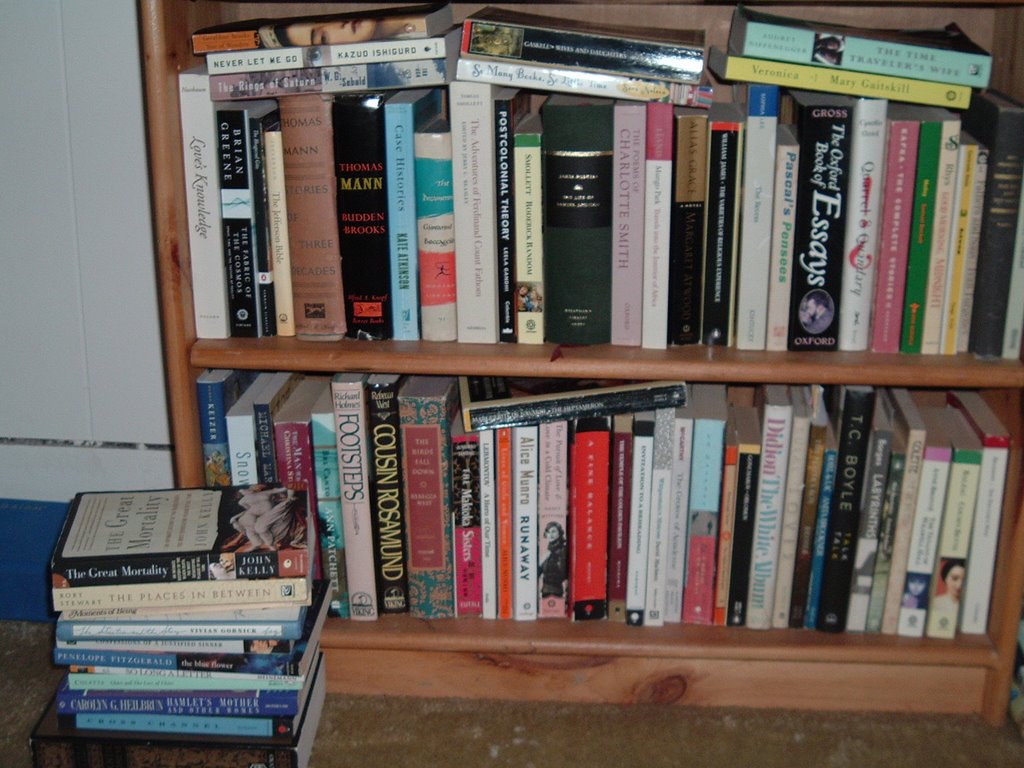
That doesn’t mean I haven’t made requests over the last couple weeks, however. That’s just a resolution to take effect starting now. I just received Penelope Fitzgerald’s The Blue Flower, a book I’ve heard about from Ex Libris, and I’ve got Peter Ackroyd’s The Lambs of London on the way, which I remember hearing about on Book World. And the wonderful Victoria just sent me A Gentle Madness by Nicholas Basbanes.

Also, W.G. Sebald’s The Emigrants will also be arriving shortly, as will De Quincy’s Confessions of an English Opium Eater, a book on my list of classics for next year.

And then there’s Mariama Ba’s So Long a Letter, which it turns out the Hobgoblin had and I didn’t realize it until recently, so now I’ve claimed it for my TBR shelves. That one I read about at Around the World in 100 Books.

What Kate said about blogs enriching our reading is absolutely true, isn’t it?

But when will I have time to read all this? I’m about to finish Indiana, and then I’ll get to choose what’s next. I’m considering the Fitzgerald book, or perhaps a Nancy Mitford novel, or perhaps The Time Traveler’s Wife, which has been sitting around for a little while. I’ve got lots of choices. Take a look at the latest version of my TBR shelves:

Leave a comment

Filed under Books, Reading

Mid-semester reading and riding

I started an experiment last spring with reading multiple books at once, and I have come to love it, but I’ve been needing to revise that practice lately. It turns out that when I’m stressed and busy — as I always am in the middle of a semester — I can’t handle it as well, and I feel the need to cut back. Danielle has a post on this topic, on wanting to cut back, and I’m agreeing here. I get even more stressed when I feel that I’m not reading in a particular book enough — those of you who are working on a book for months or years, how do you keep the momentum going?

Now I’ll be working on Proust for months and maybe years, but I’ll be doing that steadily. What’s harder for me to understand is reading in a book — especially a novel — only now and then so that the reading process extends for ages. I need to be making steady and regular progress. Without that, don’t you lose the thread of the story, forget characters, have to skim what came before? Or maybe that’s just me and my bad memory. I like having multiple books going, but I need to have time to read in all of them at least a couple times a week; otherwise I don’t really feel like I’m really reading.

So I finished the biography of Colette, and I’m not going to start another book until I finish something else. That leaves me with four books, one of which is a book of poems (Jane Kenyon’s Otherwise) which I don’t feel I need to read as quickly. And then there’s George Sand’s Indiana, which I will probably finish next, Fanny Burney’s Journals and Letters, and, of course, Proust.

As for riding — yesterday was my coldest ride yet at 47 degrees, and it started raining halfway through. Riding in the middle of the semester is even tougher than reading in the middle of it, but I’m determined to carve out some hours for both. Luckily, I don’t teach on Tuesdays and Thursdays until mid-afternoon, so I have some guaranteed daylight hours on those days. The challenge with riding in the winter is to fit it in before sunset (I won’t ride in the dark — too dangerous), and that makes the college teacher’s life perfect, with its flexible schedule. Unless, of course, I have meetings, which I did yesterday. Then I have to get on my bike even earlier to get home on time and then straggle into the meeting a minute or two late and with my hair still damp from my late-morning shower (because I refuse to use a hair dryer — what’s the point when the air will dry my hair for me?).

But you know what? I have priorities, and riding my bike is pretty high on the list. Don’t tell this to anybody at work, but when it comes to where I put most of my thoughts and energy, it’s not into work, it’s into my riding and my reading. That’s what keeps me sane, I think.

Leave a comment

Filed under Books, Cycling, Reading

So much for book reviews

As I’ve written about before, I read book reviews less often than I used to, but I do still enjoy a quick skim through the New York Times Book Review on Sunday mornings. Yesterday made me wonder why. The main problem was that I didn’t like Daniel Mendelsohn’s review of Jonathan Franzen’s new book The Discomfort Zone. The review struck me as overly focused on Franzen as a person, whom Mendelsohn clearly does not like. Mendelsohn does critique the writing too, but the whole thing is colored by his opening complaint about Franzen’s “excessively lofty sense of himself.” He describes the book as

an unappetizing new essay collection that makes it only too clear that the weird poles between which the author seemed to oscillate during l’affaire Oprah — a kind of smug cleverness, on the one hand, and a disarming, sometimes misguided candor, on the other; a self-involved and self-regarding precocity and an adolescent failure to grasp the effect of his grandiosity on others — frame not only the career, but the man himself.


Franzen has done a number of stupid things (the Oprah incident being the worst), but I can’t find it in myself to get as annoyed with him as a lot of people seem to. I’ve noticed on a number of the bigger book blogs that Franzen-bashing is kind of normal and expected — like you don’t have to bash the guy at all, just mention his name and people know what you mean — but I don’t see why. I liked his novel The Corrections, and I liked his book of essays too, How to Be Alone. And he strikes me as someone who has some flaws, like speaking before he thinks and therefore saying stupid things that get him into trouble, but also as someone who tries hard to write honestly about himself, flaws and all. In his essays, I suppose, I see a level of candor that I like. He has a quality I see in other essayists I like such as Mary McCarthy: a desire to tell the truth even if it makes him look foolish.

I don’t take gleeful delight in mocking Franzen because I can somehow see myself saying something stupid at just the wrong time to the wrong person, and although that person almost certainly won’t be Oprah, I’d feel trapped by the whole incident anyway and I’d hate to be defined by it, in the way Franzen is defined by his bad incident.

I’m not certain I’ll read Franzen’s new book, but that’s largely because I’ve already read big chunks of it in The New Yorker. We’ll see. I might check it out anyway.

The other thing that annoyed me about the book review yesterday was the quotation from Adam Gopnik’s new book Through the Children’s Gate that the reviewer ends with. This is about a chess match:

“Luke next played a slow girl who was taking everything down in proper notation,” Gopnik writes about his son. Of course the boy lost, learning a concrete lesson. “ ‘Girls with notebooks are risky,’ he said, truer words never having been spoken.”


At this point, I was ready to fling the paper across the room. Yeah, smart girls — you gotta watch out for those.

And I’ve been wanting to read Daniel Mendelsohn, who wrote the bad Franzen review, and Adam Gopnik as well. I might read both of them, but I’ll probably put it off for a while.

Leave a comment

Filed under Books, Reading

Introductions and prefaces

This is a follow-up to Danielle’s post on Introductions and Prefaces, on whether to read them or not. I began George Sand’s novel Indiana last night and went through an experience similar to Danielle’s; I had to decide whether to read the intro and the several prefaces or just go straight to the story. As I was tired and had a longing to read an absorbing story, I skipped all the opening stuff and began with the novel’s first sentence.

But I often do something a little more complicated, something more like skimming the intro hoping to find some good information on the book’s background and themes without picking up any major plot points that will give the story away. Sometimes I’ll look at an intro when I’ve gotten a little ways into the novel if I’m feeling confused or disoriented by the story; the intro will sometimes help clarify things. As for author prefaces, I usually feel like I should read those — if the author thought something preface-like should be said, then perhaps I should read it. Last night, however, I was too tired for prefaces. I’ll return to those later.

Danielle talks about the fear of not “getting it,” and it’s in this respect that reading or not reading introductions becomes complicated. I’ve felt that fear myself. I’d like to just read the novel and form my own opinion, notice what I notice, draw my own conclusions, and then test them against what the introducer says. When I’m tempted to read an introduction before the text, it’s usually because I’m nervous about not getting it — not a very good reason, is it? But I also don’t want the experience of missing something important in the novel and reading the whole thing without that key piece of information or that key idea or theme. When that happens, I will read the introduction and get frustrated because I wish I’d known that information to help me make sense of the book. While some books are very accessible on their own, others really do benefit from a little background and extra information.

Thinking about all this, I start to think that the best way to read is to read things twice. Now excluding poems and short stories, I realize that’s not feasible. But isn’t it the ideal approach? I could read something once with absolutely no outside help, no introduction and no notes. And after finishing it the first time, I could read the introduction, get some information on the author, maybe read a little criticism, and then read the text again, in the light of everything I just read. And then I could read it having gotten most of the initial comprehension issues out of the way — I’d know the plot and characters and some of the themes — and I could begin to consider more complicated interpretive questions.

But I don’t have the patience to read everything twice and don’t plan on trying. I do think, however, that it’s on a re-reading that I really begin to read.

Leave a comment

Filed under Books, Reading

Reading notes

Diana has a post on how she’s storing up for the winter in various ways, including stocking up on books, and that’s what I appear to be doing too, although there’s no need for me to panic about running out of reading material, since I can walk to four used bookstores in town. But I have the urge to acquire and accumulate also, and I haven’t resisted it. I haven’t really even tried. Recent acquisitions include:

  • Geraldine Brooks’s novel Year of Wonders, about the plague — which makes two books I own about the plague, the other being the nonfiction book The Great Mortality. Some fun winter reading!
  • The Time Traveler’s Wife, which everyone I know who has read it (which includes quite a lot of people) says I should read and will like. Looking forward to it.
  • James Hogg’s The Private Memoirs and Confessions of a Justified Sinner, which is quite a wonderful title. I heard about this from Jane Smiley’s book on the novel.
  • Elizabeth Gaskell’s Wives and Daughters. I’ve read one book by Gaskell, North and South, and liked it and am looking forward to another. I love 19C novels, and I’m happy that Gaskell has written quite a number of novels I haven’t read. I like all the potential that means.
  • Colette’s Cheri and The Last of Cheri, because, of course, since I’m reading the biography of Colette, I have to read more of her own writing as well. And this is the one Litlove recommended to me.
  • Virginia Woolf’s Moments of Being, uncollected autobiographical writings, because I can never get enough of Woolf. Thanks to Diana, who is sending me the book!
  • Finally (for now), Carolyn Heilbrun’s Hamlet’s Mother and Other Women, because I read about it on some blog, and I can’t remember which, and it sounded really cool.

Plenty of good choices here, I know, and plenty more on the TBR shelves that have been there for a while. I should be okay this winter.

Leave a comment

Filed under Books, Lists, Reading

What is it with me and footnotes lately?

I’ve begun reading The Mezzanine, by Nicholson Baker, and guess what? It’s a novel with footnotes! Not the usual kind of scholarly footnotes written by an editor, but footnotes written by the first-person narrator. I had no idea! I’ve only read about 15 pages of the novel — which is short at 135 pages — so I can’t say much about whether they work or not, but so far, I’m liking it. In typical Nicholson Baker-fashion, the book gives you everything in minute detail: the setting, the character’s thoughts, the action — which, as I understand it, consists of the main character taking an elevator ride. The footnotes elaborate in great detail on the already detailed main text, explaining such things as the history of staplers, the history of straws, and how the narrator pulls up his socks. This could be intensely annoying, but so far it’s not, although I am predisposed to like this book, as I like other things Baker’s written (especially U & I).

Thanks to Barry for pointing out Mark Dunn’s novel Ibid, a novel made up entirely of footnotes. This, clearly, I will have to check out.

One of the blurbs for The Mezzanine says this:

I love novels with gimmicks. The list of great ones — Tristram Shandy … Pale Fire … Ulysses, the ultimate gimmick novel. The Mezzanine is a definite contribution, a very funny book about the human mind. Mesmerizing.

I don’t like this reviewer calling these novels gimmicky. Isn’t the term “gimmicky” kind of dismissive? These novels are more than just gimmicks; they are experiments, explorations, novels where the author is pushing the limits of what a novel can do. If something is gimmicky, it’s interesting only in its newness and tricksiness, but these books do new things and also old things — old things like telling us what it’s like to be a person or to live in one’s mind or to experience the world or to be obsessed with another person.

Anyway, here’s an excerpt from one of Baker’s footnotes, one that’s about reading and eating:

I stared in disbelief the first time a straw rose up from my can of soda and hung out over the table, barely arrested by burrs in the underside of the metal opening. I was holding a slice of pizza in one hand, folded in a three-finger grip so that it wouldn’t flop and pour cheese-grease on the paper plate, and a paperback in a similar grip in the other hand — what was I supposed to do? The whole point of straws, I had thought, was that you did not have to set down the slice of pizza to suck a dose of Coke while reading a paperback. I soon found, as many have, that there was a way to drink no-handed with these new floating straws: you had to bend low to the table and grasp the almost horizontal straw with your lips, steering it back down into the can every time you wanted a sip, while straining your eyes to keep them trained on the line of the page you were reading. How could the staw engineers have made so elementary a mistake, designing a straw that weighed less than the sugar-water in which it was intended to stand? Madness!

Leave a comment

Filed under Books, Reading

Old and new books

I was intrigued by Patrick Kurp’s post on the value of reading old books as opposed to new ones — old meaning published many years ago, not old as in used. He says, “the past is a much bigger place than the present, so it follows that most worthwhile books were published not last week but some time in the previous three millennia. Every minute devoted to reading the new and middling is a minute spent languishing away from the old and dependably superior.” This makes sense to me in a way. Almost everything we read that’s recently published won’t last; it will be forgotten, and there’s no knowing which very few books are the exceptions. I was interested to read in Virginia Woolf’s diary about the books she reviewed, and I noticed that many of them I hadn’t heard of before. The books we are debating about today, people won’t have heard of 100 years from now. The things we read from the past are by definition the stuff that has lasted, and perhaps that means they’re superior to today’s books.

Patrick also argues, following William Hazlitt, that it’s the older books that are really new: they can show us a world different from the one we inhabit. Older books can shake us up a bit, show us new things, get us out of the familiar and make us encounter the alien. I like that idea too. I look for the new and unfamiliar in my reading, often.

And yet, I wonder. Why do we read? Is it for edification and instruction, or for comfort and pleasure? Okay, it can be both, sometimes both at once, sometimes in separate reading experiences, depending on one’s mood.

But here’s what I really wonder: does it matter why we read? I kind of buy the argument that reading older books can be an encounter with the new and can help us break out of our private comfortable worlds as Patrick argues. But does it have to be older books that do this? Can’t we have that experience with new books, if that experience is what we are looking for, ones that show us worlds different from the ones we know?

And when it comes to the argument that older books are the ones that have lasted and new books probably won’t, and that therefore reading older books is more worthwhile, I begin to wonder what we mean by “worthwhile.” What do we seek to get out of reading? I guess this kind of argument presumes that we should be reading for self-edification, for self-improvement, that reading should be a learning experience.

I’ve often thought that myself. I’ve read a whole lot of older books because I wanted to be a better person. I wanted to be well-read and well-educated, and knowledgeable and open-minded. But sometimes I wonder what the point of all that is. Does every minute we spend have to be spent in a worthwhile manner?

Maybe after all pleasure and not edification is a better goal. A part of me shudders to say that — forget being a better person, just enjoy yourself! I’ve spent most of my life thinking I needed to be a better person and that every minute should be devoted to it. Ultimately, I wouldn’t be able to shake that way of thinking, even if I decided I really wanted to. But I do sometimes think I might be better off if I decided that not a whole lot matters but enjoyment of the present moment, and in that case I’ll read what I damn well please, old or new.

I guess ultimately I think that if everyone decided that not a whole lot matters but enjoyment of the present moment, the world would be a messed-up place (oh, wait … the world IS a messed up place …), but I also think that people like me who are driven fairly mercilessly to spend every moment of time wisely might be better off seeking pleasure more often.

And so I’m having a bit of a bad reaction to the idea that my reading should be worthwhile. Would it hurt me much if my reading were more escapist?

Hmmm … I’m off to read Proust. Make of that what you will.

Leave a comment

Filed under Books, Reading

Thoughts on footnotes

I’ve written a number of times about the footnotes to my edition of Dracula (you can find those posts here and here), and I’ve continued to think about how fun they were — perhaps not so much as a first-time reader of the novel, but still, they were fun. And I’m reminded of a comment Mandarine left on one of those posts:

I was thinking someone should set up a literary comments/editing/footnote wiki, where one would suggest classics, and everybody could add/edit all sorts of comments around the text. Each comment would have categories, so a reader can then check or uncheck the ‘fun’, ‘gothic’, ‘schoolboy’, ‘academic’, ‘cultural reference’ footnotes as they please.


Now wouldn’t that be awesome? I think that’s a great idea. I have no idea how to set this up, but someone else surely does (maybe someone’s done this already?). The footnotes in Dracula make me realize how much fun this would be, because those footnotes provide a range of information, from historical background to personal responses to almost off-topic musings to textual inconsistencies. They are much more personal than footnotes generally are; in places they are more like a reader’s musings than formal footnotes. And reader’s musings are very interesting to read, provided, of course, that the reader is interesting. Maybe one of the options on this hypothetical literature wiki would be to follow the footnotes or comments of one particular author, so you could find a writer you liked and follow his or her way through the text.

For those of you who know Nabokov’s novel Pale Fire, you have a glimpse of how much fun this can be; that novel starts with a 999-line poem and the rest of it is one person’s notes on that poem, notes that are … fascinating. Given the right primary text and the right reader, or group of readers, this could be a great exercise in thinking about how people read. Or it could be just plain old fun.

And, of course, you could have the scholarly comments, the historical footnotes, the theoretical ponderings, the critical citations. And these wouldn’t be limited by space constraints. They could be limitless in number and endless in length.

The commentary would get much longer than the primary text, I would think. You’d need to make sure a person could search through the material and get a handle on it somehow. I guess you’d run into the problems they have over at Wikipedia with fights over who gets to post what material. But anyway — it would be cool to experiment with, wouldn’t it?

As I’m typing this, in the oddest of coincidences, the Hobgoblin is laughing uproariously at this website: Joe Mathlete Explains Today’s Marmaduke in 500 Words or Less — it’s a site that has a commentary on the cartoon that’s just as funny as or funnier than the cartoon itself. I call it a coincidence, because it’s kind of like the commentary I’m talking about with Dracula — parasitic, perhaps, second-hand, but very clever and funny. The internet makes this sort of thing easy. Isn’t the internet the best?

Leave a comment

Filed under Books, Reading

TBR shelves

Here are my nice, neat, pretty shelves full of books I own but haven’t yet read, from two weeks ago:

And here are my shelves today:

I blame this on Book Mooch; I swear I haven’t been near a bookstore recently, except to buy a copy of Indiana, which I need for a book group and Book Mooch doesn’t have. And now I’ve got two more books on the way: The Periodic Table by Primo Levi and Veronica by Mary Gaitskill. I’ll need a new shelf soon!

Leave a comment

Filed under Books, Reading

Book reviews

So Kate asks, “When and why do you read reviews?” And who am I to turn down a great idea for a blog post? As I consider my answer, I feel like I need to call it a confession: I don’t like reading book reviews of authors I’ve never heard of.

Well, that’s true when it comes to fiction and even more so for poetry. As for nonfiction, I love reading those reviews because I can often get the gist of the book without going to the trouble of … actually reading the book. The vast majority of nonfiction books that get published I’ll never read, and book reviews are a great way of keeping up with the ideas out there, a great way of learning a tiny bit of the latest in history, science, psychology, economics, politics, etc. etc. Sometimes I do end up reading the book; often, though, I get what I can from the review and move on.

As for fiction, though, that’s another story. The truth is that I feel overwhelmed by the number of novels out there and I’m sometimes resistant to new authors. I’m not especially pleased with myself for this; I’d like to be more adventurous in my reading. But I wait to see how widely a new name gets talked about, to see if the people I know, in person or online, talk about an author, to see what other authors recommend that person. I’m sure I’m missing out on a lot of good writing this way, but I don’t know what else to do, really, when my to-be-read list is already so long and I’m feeling too pressured by books I’m already aware of to take a look at new ones.

So I avoid those reviews of books that are completely new to me, unless I happen to glance at a sentence that catches my attention and then I might read further. But that doesn’t happen all that often.

The other problem with reading fiction reviews, for me, is that I’m bored by plot summary. I’m happy to read a plot summary after I’ve read the book because then it all makes sense to me, but beforehand? It’s hard work to make sense of a novel’s premise from a few paragraphs. I’ll read the reviewer’s opening hook with interest, but when the plot summary begins, my mind wanders and I’m off to the next review.

What I like to read about in a review are things like the reviewer’s sense of the author’s writing career and how the new book fits into it, or about writing style, or comparisons between the author under consideration and other authors, or the reviewer’s judgments about what works and what doesn’t. I find myself reading the opening and closing paragraphs of reviews because that’s where I most often find those elements; the middle gets lost in the plot summary.

As for poetry, I’m even less likely to take a risk on a poet I’ve never heard of before, so those reviews I generally ignore also.

Maybe I should make a point of taking a risk on a new author every once in a while. If I decide to make up some reading goals for the new year, maybe that’ll be one of them: to read a book by an author I’ve never heard of before and that nobody has recommended to me. So, readers, don’t give me any ideas.

Leave a comment

Filed under Books, Reading

My difficult books

I was fascinated by Bloglily’s post on difficult books, books she doesn’t finish because they just weren’t working for her. I’m going to steal her idea and talk about my own examples. She’s talking about books that she puts aside not because they are bad — an entirely separate category, I imagine, with its own list — but because she’s not ready for them for one reason or another. As an obsessive book-finisher, I don’t give up on many books, preferring to struggle on and suffer until the bitter end. But occasionally it happens, and then it rankles a bit. I feel challenged. I may have lost that round, but I’m coming back, one day when I’m stronger.

Bloglily mentions Henry James’s novel The Ambassadors, which is top on my list of unfinished books. I tried this book a few years ago, and just couldn’t for the life of me figure out what was going on. I looked around for some help on the internet and found a little bit, but I got annoyed that I needed a plot summary to keep going, and couldn’t get it on my own, and I said forget it. I did make it through The Wings of the Dove, another late James novel, with much sweat and perserverance, so I think I can get The Ambassadors; I just need the right conditions — a fairly calm, quiet, unstressful couple of weeks during which I can spend the time to get a handle on the story. Maybe, also, I need to learn something about reading slowly and about living with a little uncertainty. Maybe Proust will help me with that stuff.

More common for me, however, are those books that I’ve read twice, and come to like the second time around, when the first time I didn’t. Something about those books brought me back again, even after an initial bad response. Pale Fire is a good example; I had to read the book for a college class, and it left me kind of cold. I re-read it a few years later, and changed my mind entirely. There was something about the language of that novel, the excitement and intensity of the commentary that came after the opening poem, the playfulness of it all that I just couldn’t appreciate the first time, and came to love the second. I needed to learn something about the pleasures of experimentation with form and language, I think.

I had a similar experience with Don Delillo’s White Noise, which also left me cold at first. I’m not sure why I read it again, except perhaps because so many people loved it that I wondered what I had missed. When I re-read it, I finally got it — the humor and the social satire. Maybe I needed to learn how to read the type of book that doesn’t necessarily work to create emotionally-vibrant, psychologically-realistic characters of the sort I’m usually drawn to. I needed to learn how to read and appreciate satire. I think that’s true about me — I don’t always respond well to satire, preferring warmer, intimate reads that take me into the heart of a character rather than books that focus on the failings of people and of society from a more exterior point of view.

Thinking along these lines, maybe I should read The Magic Mountain by Thomas Mann once again. I read it a year or two ago, and found it okay in places, downright boring in others. I’m guessing this is because of a flaw in me and not in the book. Maybe if I take another look at it again a few years from now, I’ll find its highly philosophical meanderings and its very slow pace intriguing and absorbing.

At any rate, many thanks to Bloglily for writing a thought-provoking post. I like the idea of giving certain novels a second chance — and giving myself one too.

Leave a comment

Filed under Books, Reading

A reading and riding update

Today is my second century of the year. I kind of wish it were going to be rainy, so I could have an excuse to stay home and not ride, but, no, it’s going to be a gorgeous day, so I’ll be out riding for 6-7 hours. Once I’m out there it’ll be fun, but sometimes it’s hard to get myself up and out of the house at 6:30 in the morning to go ride all day. I’ll certainly let you know how it goes!

As for books, I now have my copy of George Sand’s Indiana, so I’m ready to read for the next Slaves of Golconda discussion. I think I’ll pick up another novel before I begin Sand’s, but that’s just to make sure I don’t read it so soon I forget it before the posts are due. I’m looking forward to it a lot.

But I don’t feel like my reading is going that well these days. I’m much busier than I was a few weeks ago, so I have less time, and am only slowly dragging myself through books that I thought would go much faster. Dracula should be a fast read, but it’s not when I only get through 20-30 pages a day. I’m on schedule with Proust, at about 50 pages a week, but my other books are languishing on the shelves. It’s at this point that reading multiple books gets to be a bit more difficult, as I don’t have time to read regularly in each one, and I begin to feel disconnected from them. Not that I’m going to give it up, mind you, but I do feel that if I can get to the end of one or two of my current reads, I might not pick up new ones, to get the total number down. It’s just that I’m in the middle of a bunch of long books, so there’s no end in sight: I’m maybe 1/3 of the way through my Colette biography, 1/4 of the way through Burney’s letters and journals, and only 25 pages or so into Jane Kenyon’s poems. And no where near the end of Proust.

I AM busy buying and mooching books though; my nice, neat to-be-read shelves are beginning to look a little less neat. In addition to Indiana, I’ve recently acquired The Great Mortality about the plague, and The Heptameron. I have The Places In Between, a travel book by Rory Stewart about walking through Afghanistan, W.G. Sebald’s The Rings of Saturn, and Sara Nelson’s So Many Books, So Little Time on the way to me through Bookmooch. In times when I can’t read much, buying (or mooching) books is a decent substitute.

Leave a comment

Filed under Books, Cycling, Reading

Footnotes

So you know how I thought the introduction to my edition of Dracula was funny? Well, the footnotes are funnier. I’m discovering that my edition isn’t a typically academic one; in fact, I think it’s geared more toward gothic/horror fans, although the book proclaims the editor as “the world’s premier Dracula scholar” (which reminds me of Little Miss Sunshine …).

The edition has commentary by “leading contemporary horror writers, including Harlan Ellison, Robert Bloch, and many more” and this commentary is interspersed throughout the book, so that in between chapters I’m invited to step outside of the story and think about what some other writer has to say about it. Actually, though, I just ignore those parts. The book also has “Over 35 illustrations, including stunning new Dracula illustrations by Christopher Bing.” These are fun, but I was a bit perplexed to come across a drawing of Bram Stoker himself – again, it’s disconcerting to get caught up in a story and then get pulled out of it to consider what the author looks like. Why couldn’t they just let the story be, and keep all that other stuff to the introduction or an appendix?

But the footnotes are the most intrusive of all; they are frequent, with probably 3 or 4 a page on average and often lengthy. Many of them contain useful information – a LOT of information – on the history and culture of Transylvania, on vampire stories, on Stoker’s life and times. But many of them contain no useful information at all, and instead offer interpretations of the book, point out inconsistencies in Stoker’s storytelling, make judgments on the characters’ actions, and generally just get in the way – and make me laugh. The book mentions the dish “paprika hendl,” and in the footnotes we get a recipe. The novel says that the driver “cracked his big whip over four small horses, which ran abreast,” and the footnote tells us “In no Dracula film yet made has anyone depicted the horses harnessed in this way.”

Dracula says, “I love the shade and the shadow, and would be alone with my thoughts when I may,” and the editor muses, “A surprisingly melancholy passage. Is Dracula lonely? Why does he want Harker there? Is he really testing his English, or his social skills, as he claims?” And what are these footnotes – attempts at creating a reader’s guide, complete with discussion questions? Harker considers escaping from Dracula’s castle, saying, “I shall try to scale the castle wall farther than I have yet attempted. I shall take some of the gold with me lest I want it later,” and the editor gets moralistic: “A pretty lame excuse for stealing Dracula’s gold.”

But the best footnote of all is yet to come (and I’ve only read about 60 pages! Hundreds left to go!). First, the text: this is the scene where Harker is first attacked by the three mysterious vampire women hanging out in Dracula’s castle (and the text itself is pretty funny, if you read it in the right way):

The girl went on her knees, and bent over me, simply gloating. There was a deliberate voluptuousness which was both thrilling and repulsive, and as she arched her neck she actually licked her lips like an animal, till I could see in the moonlight the moisture shining on the scarlet lips and on the red tongue as it lapped the white sharp teeth. Lower and lower went her head as the lips went below the range of my mouth and chin and seemed about to fasten on my throat. Then she paused, and I could hear the churning sound of her tongue as it licked her teeth and lips, and could feel the hot breath on my neck….


Here’s the accompanying footnote:

I have tried, calmly as well as passionately, to reproduce this churning sound with my tongue but without success. It may be a noise that only a passionate vampire can make.


I’m glad to know this editor is doing his research!

It would be better to read a less intrusive edition for my first time through the book, but I have to admit that the editorial apparatus is adding an entirely unexpected level of pleasure to my reading.

Leave a comment

Filed under Books, Reading

Thoughts on books

With that generic post title, I can write about anything! I’m finding myself with a whole lot of little ideas on what to write here and can’t decide what to focus on, so I’ll write a little about a lot of stuff.

First of all, while I won’t tell you you must read Alison Lurie because I don’t believe in telling people they have to read things (um … unless you’re a student in my class that is — in that case, there’ll be a quiz), I think it would be great if more people read her. I finished The War Between the Tates last night and loved it. It’s smart, extremely well-written, clever and satirical, but also warm in a way many satirical novels are not. I like reading academic satires now and then, and this book would certainly qualify as one, but I do sometimes find them rather cold and brittle. Give me some emotional warmth, and I’m happy, and I found it here.

I’ve discovered a number of writers recently whom I’ve come to love — writers that are new to me, although not necessarily to others — and I’m interested that they are women: Rebecca West, Colette, Alison Lurie, Elizabeth Taylor, maybe Anne Tyler (I liked her latest book a lot, but I’m not sure I’m inspired to go read more). I’ve sensed that when I think of “great” writers of recent times, let’s say the last 100 years, I tend to think of more male writers than female; maybe I’ve picked up biases from the educational systems I’ve gone through, or maybe it’s that male authors are written about and reviewed more often than female writers. Well, I know the latter is true; maybe, my point is, I’ve picked up a bias from the media as well as from my education. And now I’m poised to read Margaret Atwood for the first time (Alias Grace, although Dracula will come first), so maybe I’ll find another woman writer to love. And the poets — yes — I’d add Jane Kenyon, Jane Hirschfield, and Mary Oliver to my list of recently-discovered women writers whom I’ve come to love. The friend of mind who loves Anita Brookner was wondering why she hadn’t heard of Brookner before, and surely it has something to do with the lack of serious attention paid to women writers — still.

But at any rate — Alias Grace just arrived in the mail through Book Mooch, and I’ve got a rather embarrassingly large number of books still to come. I’ve sent out two books to people, and have received two and am waiting on five more. I’ve accumulated points (which is what you use to request books from others) by adding books to my Book Mooch list (1/10 of a point for each book), and by mailing a book to Canada, which earned me a whole three points instead of the usual one. I justify my greed by reminding myself that people like to get books mooched from them because they can get rid of what they don’t want and use the points they earn to get ones they do. I eagerly await emails from people saying they want books of mine. So I tell myself I’m making people happy when I ask them to mail me books. It’s true, I’m sure!

So here’s what I’m waiting on: Ishiguro’s Never Let Me Go, Marguerite Navarre’s The Heptameron (in the style of The Decameron but written by a woman), Mythologies by Roland Barthes (this one I can justify because the Hobgoblin wants it), Nicholson Baker’s The Mezzanine (I like this guy a lot, and I’m not entirely sure why), and John Kelly’s The Great Mortality, the book on the plague. I’m not sure why a book on the plague fascinates me so much, but it does.

And I finished the first volume of Proust. I loved it. I’ll have to write more on it later — that surely deserves its own post, not a brief mention in this random one.

One other thing: I’m considering moving my to-be-read books to their own separate shelf, something I’ve never done before. I’ve got some space on my bookshelves upstairs in my study where I do most of my reading that would work nicely. This would please and appease my obsessive, hyper-organized self (another way to sort things!), and it would have another benefit: I’ll put the books on the shelf across the room from me, which, since it’s not a very big room, I’ll be able to see quite clearly. That way, the books I own that I haven’t read will be before me at all times, tempting me (hopefully) to read them next instead of rushing off to the bookstore to buy more books.

Leave a comment

Filed under Books, Reading

Books, bikes, and numbers

I’m interested in the ways people keep track of their reading, or don’t; in the comments to yesterday’s post, people said some interesting things about the benefits and drawbacks of lists. Yesterday I mentioned the range of books I’ll probably end up reading this year, but the truth is, this is the first year I’ve kept track of my reading, so I have no idea how representative my number of 50-60 books is of my typical reading pattern. And it’s reading blogs that gave me the idea; seeing the lists of books read in people’s sidebars made me want a list of my own. That, and I don’t always remember accurately how long ago I read something, and now I have a way of checking.

This is the good thing for me about lists — to jog my memory — and it’s a good thing about the blog itself, where not only can I look up what I read, but what I thought about it. I wish I had a better memory, but I’m better off acknowledging I don’t, and therefore keeping a good record.

But the bad thing about list-making and book-counting is that it feeds my obsessive, number-crunching, year-to-year comparing, self-critical, and worried-about-stupid-things-all-the-time side. I’d like to think that it doesn’t matter how many books I read in a year or how long it takes me to read them, or how many pages I can read an hour. Actually, I do think it doesn’t matter — what matters is what I make of my reading and how much pleasure I get from it. I really do believe that. Well, one part of me does, the sensible, reasonable part. But the other part of me, equally strong, does care about numbers and loves making comparisons and would wonder why, if one year I read 60 books, another year I’d only read 40. When this side of me speaks, it says “keep track!” When my sensible, reasonable side speaks, it says “don’t!” So which side of me will win out? Probably the number-cruncher side. The blog, in spite of all its wonderful qualities, does encourage the number-crunching side of me. It makes it so much easier to keep lists and count books. And I do like math. I like numbers and statistics. I find them fun.

Bettybetty wanted to know if this worry about reading speed is a carry-over from cycling. In one sense, no; I’m not really worried about my reading speed; I can accept my slow pace with a book when I’m less likely to accept it on the bike. But in another sense, the interest in numbers is similar in both areas. There is so much I can count with my bike computer/heart rate monitor: miles ridden on each ride, miles ridden this month, miles ridden this year, average speed, maximum speed, average heart rate, maximum heart rate, average cadence, maximum cadence, calories burned, time spent in target heart rate zones, etc. etc. I’m sure I’m forgetting something. I discovered a website this year where I can keep track of these things: Bike Journal. Here, I can enter all my information, and it’ll keep track of it and add up my monthly and yearly numbers.

This is a wonderful thing. But it’s all about codifying an experience that is wonderful for all sorts of non-codified ways. Numbers are great for serious training, so there’s no way I’m giving them up, but I can get too obsessed with them, and wonder, for example, why I rode slower today than yesterday. Why is my average speed in August slower than it was in July? Ugh. It’s impossible, thank God, to keep stats about reading in the same way I keep them about riding, but the counting impulse is still there.

Somehow I have to find a way to balance my sometimes unbalanced self.

Leave a comment

Filed under Books, Cycling, Reading

Reading time

Do you consider yourself a slow or a fast reader? I’d call myself a slow one. Obviously, such things are relative, but I’ve found that the Hobgoblin not only reads more books over the course of a year than I do, but that he seems to be able to get to the bottom of the page faster during those few times we’ve shared a magazine or newspaper. And I read book bloggers who seem to get through books awfully quickly, posting book reviews with admirable frequency. I think I’m slow in terms of the speed with which I process words and sentences, and if I read a decent number of books a year — this year I’ll probably read between 50 and 60 — it’s because I have a lot of time for reading, or, rather, I make a lot of time. The Hobgoblin and I just had a conversation about the things we could do if we didn’t read so much — things like keeping the house clean, the lawn neat, the pool free from algae (or, better yet, we’d have time to get rid of the stupid thing and do something better with the yard) — a list which is not particularly inspiring. We’ll continue to opt for the reading time.

I’m in awe of those who can regularly read a book in a day or two, who can sit down for a couple of hours and get through hundreds of pages. I must have read a book in a day at some point in my life, but I can’t remember when, and the book must have been quite short. I can read things fast if I make myself — student papers are one example of reading material I’ll rip through, eager to get to the end — but generally I’m happy to linger over words and sentences, re-read things, pause frequently and look up to consider a point, and let my mind wander.

Even more significant for me, though, is that I can’t seem to take in that much of a story in one sitting before I begin to get a bit anxious, feeling like I need a break. I need a lot of time to process what I’m reading, I think. If I read too much of a novel in one day, say more than 70-80 pages, or even less, depending on the novel, I feel as though I’m not really appreciating it, not really absorbing it. It’s like I can only comprehend a certain amount of action or information, or a certain number of plot events or character revelations before I begin to feel overloaded. And with nonfiction, it’s even worse — if I’m reading something full of facts and ideas I’d like to remember, I need even more time to process it — to think about it and make sense of it before I go on to the next thing.

Reading multiple books helps me with this problem — if it is a problem; if I feel like I’ve read enough of Proust, I can turn to my biography of Colette, or my book of poetry, or whatever else, and I won’t feel overwhelmed. I think this has less to do with the total number of hours of reading in a day than with the amount of any one book I can take in at a time, although I can’t hop from book to book for all that terribly long either — I’ll get restless.

So — while I’d love to be able to read more books than I do, I’d really, really love it, I’m not sure I could, even if I had more hours available in the day. I’d lose something by trying to cram too much in. I think that if I tried to read more than, say, 60 books a year, I’d have to force myself to read less well. I love the idea of days and weeks with not much else to do but read (and ride my bike), but the reality is that I’d be unhappy. So I’m just going to have to pretend that I will have an unlimited number of years to read what I want to read, and therefore that my slow pace doesn’t matter.

Leave a comment

Filed under Books, Reading

I just bought a bunch of books

You know how I said in a recent post that I was going to read something I already own and that I don’t need to go to a bookstore? Well, I didn’t go to a bookstore (and I am reading something I already own — the Alison Lurie, about which more to come), but I did go to a local library book sale. And I came back with 10 books, for a total of $12.50. Wasn’t that a great deal? The Hobgoblin came back with another 6 books. So now my list of books I own that I haven’t read is nearing 60, and will hit it when the books I’ve mooched from BookMooch arrive. Yes, I know that isn’t nearly as long the list of many book bloggers, but it’s still very long for me. But — paperbacks for a dollar! How can I resist?

I got a bunch of books from Jane Smiley’s 13 Ways of Looking at the Novel, which has a list of the 100 books she read over the course of a few years. Some things on the list are obvious and widely-read, but it’s still a good list to get some recommendations from. Because of that list, I picked up Mikhail Lermontov’s A Hero of our Time, Nancy Mitford’s The Pursuit of Love and Love in a Cold Climate (in one volume), and Max Beerbohm’s Zuleika Dobson.

A friend recommended Ann Patchett’s Bel Canto, so I snatched up a copy of that one, and this same friend admires Anita Brookner, so I picked up her novel Hotel du Lac. Since I’ve become an admirer of Rebecca West, I was pleased to find a hardcover edition of The Birds Fall Down for 50 cents. And, as you know if you read here regularly, I’m a Colette fan, so, for another 50 cents, I was thrilled to find The Ripening Seed. Litlove recommended that one as a good place to start reading in Colette’s fiction.

Also, Mary McCarthy’s Groves of Academe, which Kate mentioned in her discussion of academic satires. I love Mary McCarthy, but I haven’t read all her novels, or her essays for that matter, so I must fix that. Finally, I got a copy of Ivan Goncharov’s novel Oblomov, which I remember hearing about recently, but I can’t remember where, and V.S. Naipaul’s A House for Mr. Biswas.

Not a bad haul, is it?

Oh, and now I need to find a copy of George Sand’s Indiana, as it’s the new Slaves of Golconda pick. Thanks Danielle, for the great choice!

1 Comment

Filed under Books, Lists, Reading

Random book thoughts

  • I’m going to do a wimpy version of Carl V’s R.I.P. reading challenge: I’m going to read … Dracula. The idea is to set yourself a challenge of some scary, eerie, frightening reading to be completed by Halloween. Many people are choosing five books, which is great, but I’m going to be realistic and set myself a “challenge” I know I can complete. I’ve been meaning to read Dracula for quite a while, just waiting around for the perfect time to do it — and here it is! Thanks Carl, for the idea.
  • I’ve joined BookMooch and have become a fan. I’ve been a member for maybe 1 1/2 weeks, and I’ve gotten two requests for books, and I’ve mooched three. The idea is that people will post books they’d like to give away, and then people will ask for yours and you’ll ask for others. All it costs is the postage to mail people books. I figured I had enough books sitting around I wouldn’t mind giving away, mostly contemporary fiction I didn’t like and a few things I acquired in some random ways. So I mailed off a copy of Meghan Daum’s The Quality of Life Report to somebody in Canada today, and I’ll be receiving Kate Atkinson’s Case Histories, Kazuo Ishiguro’s Never Let Me Go, and Margaret Atwood’s Alias Grace. Isn’t that the coolest?
  • I’ll be deciding any moment now which novel to pick up next. Dracula I think I’ll put off until October. For now, I’m not sure if I want something contemporary or something older. I tend to read older, “classic”-type books fairly regularly interspersed between two or three or four more contemporary novels, and it’s getting time to pick up something older. But — maybe not yet. I do want to read something I already own (no need to run off to the bookstore at all, no, not at all). I’ve got a copy of Balzac’s Cousin Bette which has been calling out to me, but I’ve also got my eye on Michael Martone’s book Michael Martone (which AC sent me — thanks!) and Orhan Pamuk’s Snow, and I picked up a copy of Alison Lurie’s The War Between the Tates at one of my local used bookstores after Litlove wrote about her. But there is also Anne Bronte’s The Tenant of Wildfell Hall which a random person at work gave me, if I do decide on something older. The reader’s dilemma — what next?

Leave a comment

Filed under Books, Reading

Plot and character

In the comments to yesterday’s post, Danielle asked a great question (as she so often does) about plot-driven vs. character-driven novels. I realize, now that I think about those terms, that the distinction is quite fuzzy. When I say “plot-driven,” I tend to think of action stories, and the book that comes immediately to mind is The Da Vinci Code. And when I say “character-driven,” I’m talking about books that go into a character’s mind or multiple characters’ minds in depth and focus on portraying a person or people in a complex way. I think, for example, of Proust. But this shows my biases, of course, because my example of a plot-driven novel is generally not considered great literature (okay, that’s an understatement), and Proust is. Danielle also names Dumas as an example of a writer focused on plot, someone who’s made the canon of western literature, sort of, but he also has a reputation as a super-fast writer who’s fun but not so serious.

I think Danielle is right to question the distinction between these two types of novels because although the distinction may wind up being useful, it has a lot of problems. Plot and character always go together, of course, or you don’t have a novel. Even if we’re talking about Clarissa, which much be the ultimate character-driven novel, it has plot, even if it consists of only three events. In 1,500 pages. In Search of Lost Time (or Remembrance of Things Past, if you prefer) has plot, even if it doesn’t follow any traditional story line (or does it? I don’t know yet). Still, I’m reading along right now in Swann’s Way and I want to know what happens to Swann and Odette. And plot-driven novels have characters, or there would be no plot to begin with, and if they are good novels, they’ll have interesting characters.

But there are lots of novels that don’t immediately strike me as one or the other. I just finished The Island of Dr. Moreau, which on first thought seems to me to be plot-driven, but then I start to think that the narrator in that novel is awfully interesting, and maybe it’s his responses to the plot that are at the heart of the novel? I suppose many, many novels work well because of the way they connect plot and character — the way that the plot comes out of the characters themselves, and then the characters remain interesting because of the ways they react to the plot. They don’t necessarily emphasize one over the other; rather, they integrate the two. And many, many novels emphasize one or the other to a degree, but not so much that a reader could clearly say this one is plot-driven and that one character-driven. Ultimately, I see the terms as useful for making very rough and quick distinctions, sort of like the way we use genre designations that work to a certain extent but when you look at them closely they begin to break down. This novel is “chick-lit,” that one is “speculative fiction,” this one is a “historical novel,” that one a “romance,” this is “plot-driven,” that is “character-driven.” The terms are a good starting place but not a good ending one.

The thing that interests me most is the question of bias I started out with. Am I showing my bias toward character-driven fiction when I name examples of plot-driven novels that people tend not to take seriously, such as The Da Vinci Code? What are some great plot-driven novels? Or would you rather not use the label at all? Do the terms have any usefulness?

Leave a comment

Filed under Books, Reading