Category Archives: Reading

Poetry Reading

I spent some time this afternoon reading poems by Billy Collins at a library event; the library has a reading series where they have poets come read their work, and then they end the series with a session devoted to some well-known poet, with local residents doing the reading. I’ve become known to the woman in charge of the series because of the volunteering I’ve done at library sales, and so a few weeks ago, she asked me to participate.

I’m glad I did because it can be so wonderful to hear poetry read out loud, and to read it out loud oneself. We were a small group, maybe 13 or 14, in a small, cozy room, and most people knew each other, so it was comfortable. I had chosen five poems to read, and as I read I was surprised when people found the poems funny and started to laugh. Now Collins can be a funny writer, but I don’t laugh out loud when I read his work. But doing a reading with an audience changes things; what’s mildly amusing on one’s own is laugh-out-loud funny in a group.

I knew that poetry is often meant to be read out loud, and that it’s often better experienced that way, but it’s another thing entirely to experience that directly.

It reminds me of the poetry reading that took place at the conference I went to last month; a bunch of us sat around in a room and read 18C poems out loud to each other. It was wonderful to hear poems I’ve known and read on my own being read out loud; they were funnier or more moving when experienced that way.

I’m not particularly good at listening to poetry if I’m not already familiar with the work; I am such a visual person that I have trouble following words if there’s no text. But when I know the work being read, then listening to poetry is a pleasure. Perhaps I should see if my library has any poetry on CD to listen to in the car … I wonder what that would be like.

Here’s one of the poems I read today; it’s one I teach, as it’s a good way to get students to think about the sonnet form:

Sonnet

All we need is fourteen lines, well, thirteen now,
and after this one just a dozen
to launch a little ship on love’s storm-tossed seas,
then only ten more left like rows of beans.
How easily it goes unless you get Elizabethan
and insist the iambic bongos must be played
and rhymes positioned at the ends of lines,
one for every station of the cross.
But hang on here wile we make the turn
into the final six where all will be resolved,
where longing and heartache will find an end,
where Laura will tell Petrarch to put down his pen,
take off those crazy medieval tights,
blow out the lights, and come at last to bed.
18 Comments

Filed under Books, Poetry, Reading

A Reading Meme!

From Dewey, via Charlotte.

1. Do you remember learning to read? How old were you? I don’t remember learning to read, although I know I learned when I was in kindergarten. My father tells a story about how as far as anyone knew I didn’t know how to read, until all the sudden I came home from school one day, pulled out a book, and began reading. I don’t really remember this though.

2. What do you find most challenging to read? Philosophy and literary theory. I enjoy reading in these categories now and then, but it can be hard work (at least with certain authors). It’s a good kind of challenge, though. A bad kind of challenging read, something I’m no good at? Reading directions. I never read directions; instead I just jump in and try to figure out on my own what I’m supposed to do.

3. What are your library habits? I visit the library regularly for audiobooks, and sometimes when I’m there I’ll check out a book, although I don’t do this regularly. When I check books out, they are usually very recent fiction that’s not out in paperback, and that I’m not sure I want to buy.  Right now I have the 2007 Best American Essays checked out.

4. Have your library habits changed since you were younger? I used to check books out of the library regularly, when I was a kid and didn’t have much money. When I was really young, there was a library within walking distance from home, and I visited it a lot and have fond memories of the place. Then we moved and had to drive to get to a library. Now, I can walk there once again, which is a lovely thing. I should visit more often.

5. How has blogging changed your reading life? Blogging has changed my reading life in tons of ways; I’ve written several long posts about this subject. Briefly, I now read more than one book at a time, I have a long and constantly growing TBR list, which I didn’t used to have, I now read authors I’d never heard of before blogging, and I depend on newspaper book reviews much less. Most of the recommendations I get come from bloggers.

6. What percentage of your books do you get from new book stores, second hand book stores, the library, online exchange sites, online retailers, other? This has recently changed. I used to get most of my books from new and used book stores, but now, within the last year or so, more and more of my books come from Book Mooch. In fact, most of my books these days come from Book Mooch. I also get a fair percentage from online stores.

7. How often do you read a book and not review it on your blog? What are your reasons for not blogging about a book? I almost always blog about what I read. It’s rare for me not to mention what I’m reading at the very least, and usually I will write a review, with varying degrees of thoroughness and formality. When I don’t mention something, it’s usually poetry, and usually poetry from an anthology — in other words, it’s not a separate book, but a poem here or a poem there.

8. What are your pet peeves about the way people treat books? I don’t mind so much how people treat the physical object (although when people fold paperbacks almost in half to read them, I’m not particularly pleased), but I do get bothered when people dismiss books based on stereotypes — i.e., it’s women’s fiction and so I’m not interested, or genre fiction isn’t as well-written as literary fiction, etc.

9. Do you ever read for pleasure at work? No. As a teacher, I’m required to be on campus for class, office hours, meetings (tons of meetings!), and special events; otherwise, I work at home. This means whenever I’m at work, I’m always working — there’s very little downtime.

10. When you give people books as gifts, how do you decide what to give them? I like to give books only to people I know well, people whose reading tastes I’m familiar with. Otherwise, I’d rather give something else, because I don’t want to get it wrong, and give a book that won’t get read. Buying books as gifts is great, but it can be stressful too, because buying someone a book makes a statement about what you think their tastes are. It’s possible to get it quite wrong.

Please, anyone who is interested — give this meme a try!

10 Comments

Filed under Books, Memes, Reading

Book Thoughts

Boy, sometimes Monday hits you hard! I’m feeling rather shell-shocked right now. This is the busiest part of the semester for me, with tons of paper drafts I need to read and comment on and classes to prepare for and meetings to attend and little annoying tasks that come out of nowhere and take forever to accomplish. Plus I want to ride and blog and read, and do all the usual stuff. And I really hate being busy. I don’t thrive on being busy, as some people (amazingly) do.

Anyway, that explanation accounts for my rambling thoughts this evening. So, I’ve begun listening to P.D. James’s The Murder Room, and, oh, what fun it is! Perhaps I should make a habit of listening to mysteries in the car … for some reason mysteries go well with being all on my own in the small space of a car. So far, and I’m not very far into the book, James’s writing is wonderful — smart, literate, entertaining. And there’s something about hearing an actual voice narrating the story that works so well; the reader’s voice is quiet and intimate and also a bit somber, as befits a murder mystery novel. I understand the main character, Adam Dalgliesh, is also in some other of her works, so perhaps I’ll have to seek those out.

I need more light, fun books to read. I’m feeling rather bogged down with Nightwood and The Recess, although I’m almost through with Nightwood, which will free up some time for other things. But, as often happens, the things on my shelves seem too serious. I’m so ambitious when I buy or mooch books, and I forget to think about the times when I’ll need something lighter. Shall I use this as an excuse to go to the bookstore? Or perhaps I can raid Hobgoblin’s shelves for some more mysteries; he’s got lots of Dorothy Sayers’s books and Ellis Peters and at least one Amanda Cross mystery. Perhaps I should throw aside all other reading plans for a while and reading nothing but mysteries until I feel better?

I wish I had another Georgette Heyer novel on hand; that would do quite well too …

My problem is that in the moment when I pick up some difficult book, I’m feeling optimistic and energetic and ambitious. But that feeling rarely lasts during these busy times of the year, and then I feel stuck in the middle of something I don’t have the energy for. If I do this a couple of times, then I’m stuck in the middle of a bunch of things I don’t have energy for. And as I don’t like to set books aside for too long, I generally keep going with what I’m in the middle of. I should just face up to the fact, perhaps, that the slower times of the year are better for ambitious reading, and the busier parts are not, and that’s okay. I don’t have to be reading difficult things all year round after all.

10 Comments

Filed under Books, Reading

Talking About Books I Haven’t Read

That’s exactly what I’m going to do in this post, as I haven’t read Pierre Bayard’s How to Talk About Books You Haven’t Read and probably won’t ever. But I did read Jay McInerney’s review of the book from the NYTimes and was intrigued by some of the points it made. While I’m no fan of pretending to have read something one hasn’t (those students in grad school who would dominate the conversation even though they hadn’t done the reading drove me nuts), Bayard makes the larger point that reading is such a complex act that there are many ways of doing it and many ways to relate to a book (see how easily I slip into making pronouncements about Bayard’s book as though I’ve actually read it? Bayard would approve).

There’s skimming, skipping sections, reading about a book, and reading a book and then forgetting about it. McInerney adds the example of the book reviewer who implies that she has read an author’s entire output, when she really has not. And I wonder, while some of these are clearly not reading — reading about a book or implying one has read books when one hasn’t — what about the others? How do you classify skimming or reading everything but the boring parts? War and Peace without the war? Moby Dick without the whaling parts? What about reading and then forgetting? This one interests me most, as it’s the one on this list I do most often (alas). Who has a better grasp of a book, the one who skims or skips and remembers, or the one who has read and completely forgotten? If I’ve completely forgotten a book, should I say I’ve read it? Am I really re-reading if I pick it up again?

Here’s what Bayard says about skimming:

The fertility of this mode of discovery markedly unsettles the difference between reading and nonreading, or even the idea of reading at all. … It appears that most often, at least for the books that are central to our particular culture, our behavior inhabits some intermediate territory, to the point that it becomes difficult to judge whether we have read them or not.

Yes, that makes perfect sense; I love the idea of the intermediate territory between reading and nonreading. Reading is not by any means a clear-cut act. Scanning the words of a book with one’s eyes to comprehend their meaning is both a reductive definition and a complicated one — mere scanning of words doesn’t seem like enough, but what does it mean to comprehend their meaning?

Bayard also writes about the notion of an “inner book”:

The set of mythic representations, be they collective or individual, that come between the reader and any new piece of writing, shaping his reading without his realizing it.

Not only is the act of seeing and comprehending words a complicated one, but we also bring a whole host of preconceptions and assumptions to reading that shape our experience of it. We can never escape this background, can never (or rarely) approach a book completely innocently, with no expectations.

While I don’t like the Bayard’s idea that talking about books you haven’t read is a creative act (that puts too much positive spin on it), I am intrigued by his analysis of what it means to read. McInerney ends his review this way:

I seriously doubt that pretending to have read this book will boost your creativity. On the other hand, reading it may remind you why you love reading.

Perhaps I should read this book after all?

12 Comments

Filed under Books, Nonfiction, Reading

A year of re-reading?

I came across this passage from Nabokov on reading and re-reading recently:

Curiously enough, one cannot read a book: one can only reread it. A good reader, a major reader, an active and creative reader is a rereader. And I shall tell you why. When we read a book for the first time the very process of laboriously moving our eyes from left to right, line after line, page after page, this complicated physical work upon the book, the very process of learning in terms of space and time what the book is about, this stands between us and artistic appreciation. When we look at a painting we do not have to move our eyes in a special way even if, as in a book, the picture contains elements of depth and development. The element of time does not really enter in a first contact with a painting. In reading a book, we must have time to acquaint ourselves with it. We have no physical organ (as we have the eye in regard to a painting) that takes in the whole picture and then can enjoy its details. But at a second, or third, or fourth reading we do, in a sense, behave towards a book as we do towards a painting.

I agree with what Nabokov says here, and it bothers me that I do relatively little re-reading. Of course, I feel pulled by the lure of new books too, and that pull is almost irresistible, but reading nothing but new books (new-to-me books) feels a little bit superficial sometimes, as though I’m not really digging into my reading, really thinking about it seriously and experiencing it fully. I know I’ve written about this before, and I don’t mean to rehash old thoughts, but this feeling does stay with me.

So I’m tossing around the idea of focusing on re-reading next year. I’ll certainly read plenty of new books, but I might try to pick out some books I’d like to re-read as well, maybe some books that meant a lot to me in the past, or that I didn’t understand well the first time around, or that have continued to intrigue me. Perhaps I’ll re-read something now and then, say, once a month or so. I’m trying very hard not to commit to any reading challenges, but this wouldn’t be a challenge, exactly, and I wouldn’t set the books I’ll re-read in stone. Maybe I’ll list some possibilities, but make the final choices only at the last minute.

So, what might I re-read? Right now, these are a few books that come to mind:

  • Henry Fielding’s Tom Jones. Of course I’d pick things from the 18C! I would like to know this early novel better; I’ve read Fielding’s novel Joseph Andrews quite a few times, as I’ve written about it before, but Tom Jones I don’t know as well.
  • William Faulkner’s The Sound and the Fury. This book has defeated me so far. I’ve tried to read it at least twice, succeeded only once, and didn’t really get it where I did succeed in finishing it. But I want to get it! I really do.
  • Something by George Eliot. She’s one of my favorite novelists ever, and this re-reading would feel like pure pleasure. I’ve already re-read several of her novels, including Daniel Deronda and Middlemarch. So, perhaps I’d re-read The Mill on the Floss? Or Adam Bede?
  • Emily Bronte’s Wuthering Heights. I don’t feel like I’ve done justice to this book; perhaps I read it when I was too young or wasn’t able to focus on it fully. I have vague memories of it, but would like to know it better.
  • Perhaps Lolita? I really love Nabokov’s writing, and I’m sure I have more to learn from this book. He’s such a wonderful writer, isn’t he?
  • Perhaps I should return to some books from my youth? Perhaps the Betsy-Tacy books, or some Anne of Green Gables.

I’m sure I’ll think of more as I go on …

24 Comments

Filed under Books, Reading

Ways of reading

Bud Parr at Chekhov’s Mistress has an interesting post that’s partly in response to my post from a couple days ago about reading difficult books. He argues that reading difficult books has taught him that “it’s okay NOT to understand.” Here’s what he says:

I’m not arguing for aesthetics, I’m arguing for intuition and all the other ways into some level of meaning besides the logical. There are so many levels of experience to be had by a great book that getting at some meaning as perceived by critics or academics or ticking off known references in your head doesn’t have to be a part of your interpretation.

He points out that in my post I privileged reading for logical meaning over other ways of reading, and, as I understand it, his post is a celebration of those other ways — including listening to the language as it’s spoken out loud.

I find this interesting and I agree with Bud’s point that there are multiple ways of reading and getting meaning from the reading. I must admit, as I wrote my post on difficult books I dashed off the line Bud picks up on, the line where I said, about Tender Buttons, “you savor the language and give up trying to pull together a logical meaning,” which implies that logical meaning is more important than the language itself. But in that dashing off, I reveal my bias. I do read first for logical meaning. I do this automatically, without thinking about it. I don’t necessarily privilege critical, academic kinds of reading, which is something Bud talks about as well, the kind of reading where you make sure to get all the allusions and references and where you formulate thesis statements in your head as you read along. But on a first reading of a difficult book, I struggle to put the ideas together, to make sense of things.

Does everyone read this way? I can’t help but want to make logical sense of the words. But I value books like Tender Buttons for pushing me to read in other ways. I’ve read it a few times, and by the second and third time I knew enough about it to know it wasn’t going to make logical sense, and I started to read it for the beauty of the language, for the sounds and rhythms of the words, for the glimpses into meaning it offered and then evaded.

I remember the experience fondly, and I think it taught me to pay more attention to language and to loosen up a bit about wanting meaning. I suspect my reading of Nightwood, where the logical meaning is evading me at times, is more pleasurable because of my experience with Tender Buttons. I’m very happy to have learned this lesson; while there’s something satisfying about feeling that I’ve understood a text thoroughly, there’s also something satisfying about getting lost in language for a while, about dropping my usual expectations and seeing where it is an author will take me.

I also try to be aware that even while reading for logical sense, other ways of reading are happening at the same time — I’m using my intuition and emotions and my ear for language to create meaning. One of the pleasures of reading is that it can be a whole body experience, not purely a mental one.

11 Comments

Filed under Reading

Readers and reviewers

Would somebody remind me please that there’s no reason to expect every author who writes a good book now and then to refrain from saying stupid things? I came across this quotation from Ian McEwan (via):

Publishers seem to be very keyed up to embrace the Internet, but I don’t have much time for the kind of site where readers do all the reviewing. Reviewing takes expertise, wisdom and judgment. I am not much fond of the notion that anyone’s view is as good as anyone else’s.

He wrote this at Time.com back in June, in response to a reader who asked what he thought about disappearing literary reviews in newspapers and magazines. Now, how many problems in logic do we see in his claims? Do I even need to spell them out? Well, why not.

Okay, first of all, why separate “readers” and “reviewers”? Aren’t all reviewers automatically readers? I would hope so. And if what he really means is to distinguish between regular old amateur readers and professional reader/reviewers, I’m not sure there’s such a clear line between the two. I don’t really know much about it, but maybe somebody can fill me in: what are the entry requirements for becoming a professional reviewer? Is there a class you take, a degree you get, a test you pass?

When he says that “reviewing takes expertise, wisdom and judgment,” I agree completely. And, the truth is, I agree with his last line too: “I am not much fond of the notion that anyone’s view is as good as anyone else’s.” I’m just not sure how these sentences fit together. To take the first line, aren’t there multiple ways to gain expertise, wisdom, and judgment, and couldn’t a regular old “amateur” reader have those qualities? And, to address the second, can’t you read “amateur” reviews by “amateur” readers and still believe that one person’s view is better or worse than somebody else’s? I think so. To read the work of nonprofessionals is not necessarily to give up one’s right to make critical distinctions. Quality reviewing does not always correspond with whether one gets paid for those reviews or not.

There’s an underlying idea to McEwan’s claims that is not quite so objectionable: that it’s quicker and easier to find quality reviews in traditional sources than it is to find quality reviews online. If you don’t want to spend time hunting down websites you like and filtering out the ones you don’t, perhaps print reviews will do just fine for you. But I’m not sure that it’s that hard to find the good stuff — read a few book blogs and you’ll see the top ones linked to over and over again.  Start there and see what you like.

So, to return to my opening question about good authors and stupid comments — I should just forget dumb stuff like this when I’m reading his novels, right?

10 Comments

Filed under Blogging, Reading

On reading difficult books

I like challenging myself with difficult books now and then, but there are some books that leave me quaking in my boots. There are challenges, and then there are challenges, right? And then there’s a category of book that is quite possibly beyond me entirely. So, to get specific, a challenge of the first sort, the sort that is difficult but doesn’t leave me quaking, would be something like Djuna Barnes’s Nightwood, a book that is rather difficult to piece together, but still something I can follow, more or less, that makes a kind of sense, and if I read it a time or two more, I’ll feel like I can understand. Proust was like this too.

The sort of book that makes me quake is something like Ulysses, which I had to read in a college course, although I’m not sure how much I really got out of it. I know I can read this book and get it for the most part, especially with some critical help, but it requires an awful lot of work. I’m not opposed to doing this kind of work, I just want to do it in a time I have tons of energy and enthusiasm for it. I’d put the longer novels of Pynchon in this category, and certain kinds of poetry qualifies here too, like if I were to undertake reading the collected poems of John Ashbery, someone known for being a bit obscure.

The books that are perhaps beyond me entirely? What comes to mind immediately is Finnegans Wake. In fact, this may be the only book in this category. I’m okay reading books I can’t fully make sense of, but a book I can’t make sense of at all? That’s different. Not that I’ve tried, I must say — perhaps the book isn’t as difficult as I’m imagining. But I have my doubts.

I’m thinking about this issue because I just read this article in the New York Review of Books on Gertrude Stein. It’s a review of Janet Malcolm’s new book Two Lives: Gertrude and Alice. As I understand it, the book is about their lives, most interestingly about their lives during World War II, and also about Stein’s writing. Stein is a writer who makes me quake a little bit. I’ve read her book of poetry Tender Buttons, and I thought it was quite beautiful, even if it didn’t make any sort of logical sense. But it’s the kind of book you just let wash over you; you savor the language and give up trying to pull together a logical meaning.

But her other work scares me a bit, particularly the longer work, such as The Making of Americans, which the article describes as “gigantic and impenetrable.” Janet Malcolm calls it “a text of magisterial disorder.” And the article also says this:

Again, about The Making of Americans, Malcolm calls the book a laboratory for Stein, ponderous and unforgiving, a morass, a nervous breakdown of a novel, swerving between conventional narrative and gibberish, “a work that Stein evidently had to get out of her system—almost like a person having to vomit—before she could become Gertrude Stein as we know her.” But Malcolm admires its refusal to “impose a false order on disorderly complexity,” which might also be said of Cézanne’s art, in all its ambiguity and mystery.

I like that description, “a nervous breakdown of a novel,” but do I want to read it?

I don’t like the idea that any book is beyond me, though. I feel torn between not wanting to spend my time on impenetrable books that would frustrate me and not wanting to give up on any interesting-sounding book out there. I may never try to read The Making of Americans, but I don’t like the way it’s out there, taunting me with its difficulty.

12 Comments

Filed under Books, Reading

Reading On Chesil Beach

Just a short post tonight to say that I’m about 3/4 of the way through Ian McEwan’s On Chesil Beach, and I’m finding it quite hard to put down.  I know what it’s all about, I know the whole plot and all the background, and I know what tons of reviewers have said about it.  Normally this would turn me off of a book.  I do get tired of reading reviews of the same books over and over again and sometimes it gets to the point where even though the book might have initially sounded quite good, I won’t read it, because I feel like I already have.  But when I saw On Chesil Beach in the library, I grabbed it, and here I am gobbling it up (after Hobgoblin did the same thing; here’s his review).  It’s been a while since I’ve picked up a book that has made me want to abandon all my other books until I finish it — not that it takes very long to finish McEwan’s book, as it’s a very quick 200 pages.

16 Comments

Filed under Books, Fiction, Reading

Women Writers and Virago Modern Classics

Thanks to The Literary Saloon, I came across a fabulous article by Jonathan Coe in The Guardian called “My Literary Love Affair,” about how he discovered Virago Modern Classics. The article is fabulous for a couple of reasons: because it’s got information on the history of the series and because Coe’s story of encountering these books is a good one. He describes coming across the series in a bookstore in 1982 and being intrigued by the phrase “modern classics” connected with names he hadn’t ever heard of before — May Sinclair, Dorothy Richardson, Rosamond Lehmann. He says that calling these books by largely forgotten women authors “modern classics” was a powerful political statement at a time when the term “classic” meant a little more than it does today.

So, he reads some of these books and finds himself and his writing changed. This is what he says about the experience:

Before long, the Virago novels would unseat some of my deepest assumptions as a reader, and also alter my course as a writer. It was under their influence, in my mid-20s, that I abandoned straightforward autobiographical writing and chose a female protagonist for my first published novel, The Accidental Woman; while my latest, The Rain Before it Falls, is intended (among other things) as an hommage to the whole list and the authors which it reintroduced.

He talks a lot about Dorothy Richardson’s long, Proustian-like novel Pilgrimage (Pointed Roofs is the first part). Pilgrimage was considered hugely important in its day, but around the time of World War II fell out of favor and has never returned. Coe describes how Richardson experiments with style, trying to produce what she termed “a feminine equivalent of the current masculine realism.”

He also describes May Sinclair’s work and says of Rosamond Lehmann that he has had a decades long literary love affair with her writing. Lehmann is an interesting case study in how women writers get marginalized for taking up supposedly “female” subjects; one male reviewer wrote of The Echoing Grove that “so prolonged a voyage in an exclusively emotional and sexual sea afflicts a male reader at least with a sense of surfeit” and another that “entirely, exquisitely feminine readers, trousered or otherwise, will probably receive the book with rapture.” Coe points out that Graham Greene’s novel The End of the Affair, published at the same time and with a similar tone and theme, did not receive the same treatment.

Coe argues that the Virago series was and still is important in countering critical bias against women writers, but that work still needs to be done, and he points to the relatively few women who make the Booker prize shortlists as evidence. But he does recognize that attitudes are changing, and he makes his point with this intriguing argument:

But there is a sense that the crude gender bias in British literary culture which Virago challenged so effectively in the 1970s and 80s no longer exists. Most of the new writers who have broken through to critical acclaim and big readerships in recent years have been women: Monica Ali, Zadie Smith, Ali Smith, Lionel Shriver, Marina Lewycka, Sarah Waters and Susanna Clarke, among others. And these writers are, for the most part, writing big, historically and politically engaged novels, not voyaging in “an exclusively emotional and sexual sea” – a phrase that might rather be applied (accurately, but non-pejoratively) to a novel like Ian McEwan’s On Chesil Beach. In 2007, it’s Graham Swift who writes a novel focused entirely on the domestic and familial (Tomorrow), while writers such as Rose Tremain and Marina Lewycka examine the plight of low-paid migrant workers in the modern British economy. The old clichés about what distinguishes male writing from female writing no longer stand up to scrutiny.

Interesting, isn’t it? Reading about how important these women writers were for Coe made me quite happy, and I realized that I responded so positively because I don’t often hear male writers saying such things. Correct me if you think I’m wrong, but doesn’t it seem to be the case that it’s rare for male writers to acknowledge the importance of a specifically female tradition of writing for their own work? Coe isn’t merely pointing out one or two important female influences; he’s pointing to a tradition, and it’s one that taught him to write in ways the male writers he was already familiar with hadn’t.

Has anyone read Coe? I liked this article enough I’m curious about his own fiction.

12 Comments

Filed under Books, Reading

On not liking books

I thought about giving Bruce Chatwin’s In Patagonia a proper review — oh, not really, I never review things properly, but I mean as proper as I get — but I just don’t have the energy or interest in it. I didn’t like the book very much. I found myself bored with it, and I only finished it because I’m obsessive that way and it was short, only 200 quick pages.

I think my problem with the book is that I never learned much about Chatwin himself, or his persona, to be more accurate about it. The book’s focus is not on the traveler, but on the people he meets, the places he sees, the stories he comes across, and the history of the land he travels over. Now those things shouldn’t be boring, should they? But I found myself not caring much. The stories he told tended to be short ones, and they tended to focus on externals — what people did and what they looked like. Without some attention paid to internal things — emotions, thoughts — I remain unconnected.

It’s curious that I wouldn’t like this classic of travel literature, since the scholarly work I’ve done is on travel writing. But here’s the thing — I’ve studied “sentimental” travel, meaning travel writing that focuses on emotions and on internal states (see Laurence Sterne’s A Sentimental Journey for a prime example). In a way, this is an odd type of travel writing, since one would think the genre is valuable because of what it can tell us about the world, not so much because of what it tells about the traveler (although of course it does both). But, although I like reading about the world, I want to know about the traveler too, or if not the traveler, then I want to know about the people that traveler meets, and I want to know not just brief summaries of their lives, but something about who they are and why they are the way they are. If there’s no emotional element or if there are no ideas, then I’m left cold.

And In Patagonia didn’t have anything in the way of emotions and not much in the way of ideas either. It had a lot of cool facts and some interesting speculations about things like the inspiration of Coleridge’s “Rime of the Ancient Mariner” and the Patagonian sources of Darwin’s theories. But this wasn’t enough.

This is not to say that you won’t like the book. You may love it; it’s probably a great book for people who like this kind of book — and I don’t mean to sound judgmental when I say that. In some cases when I don’t like books it’s because I think they are genuinely bad, but in this case, it’s simply that this was not the book for me.

8 Comments

Filed under Books, Nonfiction, Reading

Walter Scott on Reading

First of all, have you ever wondered how not to write a paper?

Now to Walter Scott, who has made a contribution to the debate going on here about what one should read and how one should read it; here’s a description of his hero Edward Waverley’s reading:

With a desire for amusement, therefore, which better discipline might soon have converted into a thirst for knowledge, young Waverley drove through the sea of books, like a vessel without a pilot or rudder. Nothing perhaps increases by indulgence more than a desultory habit of reading, especially under such opportunities of gratifying it … Edward … like the epicure who only deigned to take a single morsel from the sunny side of a peach, read no volume a moment after it ceased to excite his curiosity or interest; and it necessarily happened, that the habit of seeking only this sort of gratification rendered it daily more difficult of attainment, till the passion for reading, like other strong appetites, produced by indulgence a sort of satiety.

Waverly has suffered the fate that many heroes and heroines from 18C and 19C novels suffer — he is without sufficient parental supervision of his reading material; his mother died when he was young and his father doesn’t pay a whole lot of attention. In novels from this time, trouble is sure to develop if young people are allowed unfettered access to libraries. I haven’t gotten all that far in the novel, so I’m not sure what direction it’s heading in, but I’m certain that this lack of reading discipline foreshadows some sort of trouble for the young man.

Now, I believe both in young people having unfettered access to libraries and in teaching them (somehow) to develop discipline in their reading. How do you accomplish both of these things though? I’m not sure. But discipline is important to me, just as reading purely for pleasure is. I think I’d be suspicious of someone like Waverley who never, ever finished a book he wasn’t entirely enthralled with or someone who never challenged him or herself with something difficult.

Maybe it’s good I don’t have children so I don’t have to worry about such things …

14 Comments

Filed under Books, Fiction, Reading

Reading the Canon

There were lots of interesting comments on my post from yesterday about Seneca’s advice for reading — thank you readers! I wanted to pick up on a few ideas here, one of which Jenclair pointed out, which is that the publishing environment we have here today is surely very, very far from what Seneca experienced. But I couldn’t really tell you what type and amount of reading material was available in his day, and I wish I could. What in the world would he (and others from ancient times) make of the abundance of books we enjoy today? When he says “a multitude of books only gets in one’s way,” what does he mean by a “multitude”? That he feels anxious about the effects of having a multitude of books available shows that the similar worries we have today are nothing new at all.

The other thing I wanted to consider was the issue of the canon; some people felt we should read largely from the canon and others that more variety was better. I liked Hepzibah’s questions on the subject: “who does get to decide what is canonized and what is not? What makes one author more worthy than another?” Very good questions indeed. It’s because of questions like these that I am suspicious of the whole idea of the canon. Danielle’s question is relevant too: “If Seneca were here today do you think many women authors would make his cut?” I’m guessing they wouldn’t.

I don’t think that canons get created solely on the basis of literary merit, although it would be nice if they were — but even here we’re on shaky ground because I think definitions of literary merit shift over time. What people valued in the 18C, for example, isn’t what we value today. I think what ends up in the canon gets there partly because of aesthetic merit, however it gets defined at any particular time, and partly because of publishing trends; political and social forces (racism and sexism, for example); literary scholarship, created by people with biases and blind spots; the literary context, i.e. what other people were doing at the time that readers can later identify as a trend that then becomes a movement and is taught as such; educational trends, meaning what sorts of texts educators want to teach at a particular time; and surely a host of other factors unrelated to merit.

Canons also have a self-perpetuating factor to them, meaning that works that are perceived as important get passed on and on, not necessarily because they are “great” works of literature, but because they are what’s taught and what the people coming before us knew. I realize this is beginning to sound circular, but I think there’s a distinction to be made between the canon defined as a collection of the best literature that’s out there and the canon defined as “the things people have paid most attention to in the past.” I think this second definition is a more accurate description of what we are referring to when we mention the canon; I don’t think the canon defined in the first way really exists.

The marginal figures are the interesting ones to think about — why is Walter Scott in and out of the canon? Or James Fenimore Cooper? Or Aphra Behn? Or Mary Shelley? Writers like these make it clear, I think, that the canon is a shifty, uncertain thing, always subject to debate and controversy.

14 Comments

Filed under Books, Reading

Advice on Reading

The very first essay in my book of Seneca’s letters-which-are-really-essays is advice about reading. What fun!

Let’s see if we agree with what he says:

Be careful, however, that there is no element of discursiveness and desultoriness about this reading you refer to, this reading of many different authors and books of every description. You should be extending your stay among writers whose genius is unquestionable, deriving constant nourishment from them if you wish to gain anything from your reading that will find a lasting place in your mind. To be everywhere is to be nowhere.

….

A multitude of books only gets in one’s way. So if you are unable to read all the books in your possession, you have enough when you have all the books you are able to read. And if you say, “But I feel like opening different books at different times,” my answer will be this: tasting one dish after another is the sign of a fussy stomach, and where the foods are dissimilar and diverse in range they lead to contamination of the system, not nutrition. So always read well-tried authors, and if at any moment you find yourself wanting a change from a particular author, go back to ones you have read before.

Hmmm. I’m guessing Seneca would not approve of my reading. I do like the food metaphors in this passage, as I like to think of reading as a kind of eating, but I don’t see the problem with variety in one’s meals.

I can’t really agree with him, at least not fully. I see nothing wrong — and, in fact, I see a lot of good — in reading new things and a variety of things. And I don’t like the idea of reading nothing but “well-tried” authors either. I want to read well-tried authors, but I want to read little-known ones as well. What Seneca is calling for is reading within a very traditional canon, and I’ve spent way too long hearing about the virtues of opening up the canon to new authors to buy Seneca’s argument. I’d question his idea of “unquestionable genius” — okay, Shakespeare is an unquestionable genius and so are some other authors, but with some exceptions in mind, is it always so clear who is a genius and who is not?  Who gets to decide?

I do like the idea of taking your time with authors, to fully digest their writings. There’s something very satisfying — and surely very healthy — in knowing some writers well because you have absorbed their words into your being.

Do you agree with Seneca?

17 Comments

Filed under Books, Essays, Reading

On Noise

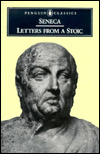
1127397.gif My book Letters from a Stoic — essayistic letters by Seneca — arrived the other day, and I’m reading through the introduction now. But what I want to write about today is an essay from Lopate’s book, Seneca’s “On Noise.” He begins the essay this way:

I cannot for the life of me see that quiet is as necessary to a person who has shut himself away to do some studying as it is usually thought to be.

As I’d written about this very subject recently, this opening caught my eye. If what Seneca says is true, then I am wrong and this is a flaw of mine, since I need quite a bit of quiet to concentrate. Seneca goes on to argue that a person with a well-ordered mind should be able to block out distractions:

For I force my mind to become self-absorbed and not let outside things distract it. There can be absolute bedlam without so long as there is no commotion within, so long as fear and desire are not at loggerheads, so long as meanness and extravagance are not at odds and harassing each other. For what is the good of having silence throughout the neighbourhood if one’s emotions are in turmoil?

He talks about how people often don’t find peace even when it’s perfectly quiet — even when they are sleeping — which shows that it’s not so much outside noise that is the problem, but inside turmoil. To a certain extent I agree with this. I have trouble concentrating sometimes because my mind is often not at peace. I’m not very good at forcing the kind of “self-absorption” Seneca is describing, and perhaps if I practice I could improve. This would be a good thing.

But I also think, particularly when we’re talking about noise produced by people, that distractableness can be a sign of something more positive: it can indicate an interest in people, a quality of tuned-in-ness to others. I can’t shut voices out very easily because I love to eavesdrop on conversations and observe how people interact and how they sound. If I’m continually distracted from my book by the kids playing outside that may indicate my lack of mental calm, but it may also indicate a irresistible curiosity about what the kids are saying as they play their games.

To me, there’s some connection between being good with people and being unable to shut out their voices. By being “good with people” I mean something like being focused on others, wanting to take care of them, wanting to keep things peaceful, wanting everybody to be happy. I often feel responsible (rightly or wrongly) for making sure everybody is content and everything is okay, and listening to people’s voices, even if they’re not directed at me, is a way to make sure that happens.

As much as I don’t fully agree with Seneca, I do, however, like this line from the essay:

The only true serenity is the one which represents the free development of a sound mind.

This I can agree with.

12 Comments

Filed under Books, Essays, Reading

Essays

Today I rode a slightly different version of the course I rode last week, but it was a completely different experience: no parades, no embarrassing scenes in the market, no saddle slippage. And I was a bit faster. Yay! Today’s ride was 53 miles, and next week I’m riding 60.

After thinking about my potential reading projects, I decided to begin one of them. We’ll see how they go. One thing I have to do is give myself permission to bail on it if it becomes uninteresting. I’m terrible at giving up on books and reading projects, even if they aren’t going well. But I can’t let myself get stuck in a long reading project I’m not enjoying.

So, I decided to begin the essay project; I read the first essay last night, Francis Bacon’s “On Truth,” which has a wonderful first line: “What is truth? said jesting Pilate, and would not stay for an answer.” The essay is quite short, only a couple pages, and it describes both the allure of lies and half-truths:

This same truth is a naked and open daylight that doth not show the masques and mummeries and triumphs of the world half so stately and daintily as candlelights.

and the goodness of truth:

Yet truth, which only doth judge itself, teacheth that the inquiry of truth, which is the love-making or wooing of it, the knowledge of truth, which is the presence of it, and the belief of truth, which is the enjoying of it, is the sovereign good of human nature.

I think the pleasure of reading his essays will lie not so much in the ideas themselves, but in the beauty of the sentences. The prose is dense — I read very slowly — and rich.

I have a collection of Bacon’s essays that I was assigned in grad school; after reading Bacon in The Oxford Book of Essays, I pulled down the Bacon collection and saw that I’d marked up the entire text. Hmmm. I don’t remember reading the entire thing. My class in 17C prose was one of the rare classes where I skipped a significant amount of the reading. But Bacon was the first book we read, and I suppose I was still feeling motivated at the beginning of the semester (before I found out I wasn’t so fond of the professor and stopped giving the class my full attention). I plan on looking through this collection again, reading in it as long as it interests me.

I thought Montaigne was in this collection, but I just checked, and he’s not — I was considering reading through his complete essays as a part of this project. Hmmm. I’ve read many of them, but not all — I tried a complete read-through once but stopped after a while. Should I go back and try again??

6 Comments

Filed under Books, Cycling, Essays, Reading

Reading projects?

In spite of the fact (or because of the fact?) that the semester has begun and I have less time for reading, and am therefore trying to keep the number of books I’m currently reading down to a minimum, I have felt a longing lately to start ridiculously long reading projects. For example, I’ve got The Oxford Book of Essays (edited by John Gross) that I’m tempted to begin reading in, and it’s a long book in itself, but I’d also like to read not just individual essays in the collection, but books by the authors I like along the way. I’d make it a big, long study in the essay. Doesn’t that sound like fun? And something that would take forever?

Or I could brush up on the history of philosophy as I’ve been thinking about for a while, except this time, study the authors in more depth rather than rushing through them as one must in a year-long course. Or could start reading novels in German again, because surely after a while I’d remember the vocabulary I once knew and reading them would get faster and be lots of fun? Or I could take this big fat anthology of 18C literature I’ve got and, maybe not read through it exactly, but do a study of the authors I don’t know very well?

I’m often torn between wanting to read systematically, and wanting to read at whim. Or I can put it this way — I’m torn between wanting to be an expert in one or two (or three or four) areas, and wanting to read a little bit of everything.

And the thing is, I’m not so terribly good at taking on long reading projects (Proust excepted, I suppose, but there I have the satisfaction of finishing a volume now and then). I get frustrated when I don’t finish books in a month or two, at the longest. Perhaps I need a “long-term reads” or “ongoing projects” category such as Danielle has; perhaps then I’d give myself permission to take my time. This is just one of the ways I’m sometimes at war with myself …

10 Comments

Filed under Books, Reading

Booking Through Thursday

I’ve never answered one of the Booking Through Thursday questions, but today the question caught my eye, so maybe today is a good day to start. Here’s the question:

Okay, so the other day, a friend was commenting on my monthly reading list and asked when I found the time to read. In the ensuing discussion, she described herself as a “goldilocks” when it comes to reading–she needs to have everything juuuuuust right to be able to focus. This caught my attention because, first, I thought that was a charming way of describing the condition, but, two, while we’ve talked about our reading habits, this is an interesting wrinkle. I’d never really thought about it that way.

So, this is my question to you–are you a Goldilocks kind of reader?

Do you need the light just right, the background noise just so loud but not too loud, the chair just right, the distractions at a minimum?

Or can you open a book at any time and dip right in, whether it’s for twenty seconds, while waiting for the kettle to boil, or indefinitely, like while waiting interminably at the hospital–as long as the book is open in front of your nose, you’re happy to read?

I’m too much like a “goldilocks” reader for my own comfort. I don’t require perfect conditions, but I require very good ones. I can read when there are distractions around, but I read very slowly when there are — even more slowly than usual. I wish I were the kind of person who could focus well, but I’m not.

It’s rare, actually, that I’m completely absorbed in what I’m reading. I often look up from my book, sometimes to think about a passage, sometimes to notice something about my surroundings, and then my thoughts will wander and I’ll have to drag myself back to the book once again. I’m particularly bad about this when there are people around. I love to watch people, and I can’t help but notice social dynamics, so reading in airports or doctor’s offices is hard (although I do it). I’ll notice if someone starts a conversation, and once that happens, I can’t help but listen in. If people are having an argument, my book becomes useful only as something to hide the fact that I’m eavesdropping.

And I find it hard to quiet my mind to settle into reading. I suspect I’d benefit greatly from meditating regularly — I need to teach myself not to let my thoughts distract me from my book or whatever else. This is particularly hard when the semester is underway and I’ve got lots to think about. I’ll read for a few minutes and then notice that I’m not reading anymore and am thinking instead about how class went that day. Over the course of an evening’s reading, this gets better; by the evening’s end, I’m able to pay closer attention.

6 Comments

Filed under Books, Reading

Starting new books

I’ve been enjoying starting new books — what greater pleasure is there than diving in to a new book? One of them is Ursula LeGuin’s Left Hand of Darkness; I’m about 40 pages into it and think I’ve figured out what’s going on — it takes a while to get all the new names and new vocabulary and the rules of a new world when reading science fiction — or when reading any book, really, but science fiction especially. It promises to be fun. It’s the first science fiction I’ve read in, oh, probably a couple decades. Perhaps when I’m finished with this I’ll ask for more recommendations.

I also began Bruce Chatwin’s travel book In Patagonia. I’m still figuring out how this book works, too, although once I figure it out I think I’ll end up liking it. Actually, it’s not so different from beginning Left Hand of Darkness because I also have to figure out the “world” of the book — before I began it, I barely knew where Patagonia was. And I have to figure out exactly how Chatwin goes about writing a travel tale. It’s not exactly a straightforward narrative, but is made up of very short chapters, 1-2 pages long, each with their own vignette. So far there’s not much discussion of why he traveled and how he went about all the little steps of the trip — all the connective tissue of the journey; instead, he focuses on interesting people he meets and on the landscape, and he moves really quickly from one incident to the next. It’s amusing — he’ll mention walking down a road, running into a man walking the other direction, and next thing I know, Chatwin is visiting the man’s house, getting introduced to his family, and spending the night there. I’m not exactly sure how they got from passing each other to becoming friends. As far as I can tell, he’s a drifter who sleeps in a bed when he can get one, and behind a bush when he can’t.

I also began listening to Mark Haddon’s The Curious Incident of the Dog in the Night-time, and oh, what a fun book! I love the reader’s voice and accent, and I find the main character so very appealing. Listening to it makes me want to meet him and show him that I get it — that I’m not one of those annoying people who uses sloppy language and tells lies. This book is so charming.

6 Comments

Filed under Books, Reading

A little too much patriarchy

I’m reading Naguib Mahfouz’s novel Palace Walk right now and enjoying it greatly; it’s a long, rich, satisfying read, about a family in Cairo after World War I (although I had to look up the date, which I couldn’t figure out from the novel itself — this is probably my fault for not getting historical references). It’s the kind of book you can live with for a long time; it moves slowly but in a good way, giving you lots of detail about setting and character. It feels like a Victorian novel in a lot of ways, as one of its main preoccupations is getting the young people properly married.

Its resemblance to Victorian novels is making me realize that I’ve been reading an awful lot about how much life used to suck for women — which is not to say that it doesn’t suck today, at least for some, especially outside of the Western world. But still — Palace Walk right after The Crimson Petal and the White reminds me of just how grim life could be. Yesterday I wrote about how Faber’s novel describes the impossibilities women faced in Victorian society, so I won’t repeat that. In Palace Walk, the situation seems even worse, although the women in the novel haven’t yet expressed any dissatisfaction. Here, the two young daughters, as respectable women eligible for marriage, are not allowed to be seen by any man, not even through through a window. They spend their days in the house, mostly doing housework, as far as I can tell. They have little education. The mother — the whole family actually — defers to every whim and desire of the father. The mother is little more than a glorified servant.

I’m not surprised by this at all, but it does make me long to read something with a more feminist bent to it, and soon. I remember people mentioning that Ursula LeGuin’s Left Hand of Darkness has an interesting take on gender; perhaps this is a good possibility?

10 Comments

Filed under Books, Fiction, Reading