Category Archives: Reading

Books, books, and more books

The last thing in the world I needed to do yesterday was to go check out the library sale going on in the town just south of mine. But I wanted to do it, and so I did it and came back with six books. It was a day for classics, with a few other things thrown in. Here’s what I found:

  • Henry James’s The Awkward Age. Henry James is a controversial figure in my house, but I’m the one who’s most likely to defend him, so I like to have an unread James novel on hand, just in case I get in the mood.
  • Willa Cather’s The Professor’s House. I really enjoyed A Lost Lady and My Antonia, so I thought I might like to read more of her work. After reading Elaine Showalter’s glowing appraisal of her work, I’m even more interested, and Dawn Powell  put me in the mood to read more about midwestern America.
  • The Modern Library collection of novels by William Dean Howells, including A Foregone Conclusion, A Modern Instance, Indian Summer, and The Rise of Silas Lapham. All for a dollar! I have never read Howells before and will probably begin with the last novel in the volume.
  • Helene Hanff’s 84, Charing Cross Road. She Knits by the Seashore recommended this one to me, and it sounds delightfully bookish.
  • Anne Fadiman’s Ex Libris. I’ve already read this book, but I read a library copy and I wanted to own it. It’s such a great collection of essays about bookish subjects that I’d like to read it again at some point.
  • And finally, Dubravka Ugresic’s collection of essays Nobody’s Home. I do love good essay collections, and Stefanie wrote a great review of this one, so I thought I’d give it a try.

Not a bad haul, right? And in other news, my mystery book group had a great discussion of The Moonstone last night. All but one of us loved it, and we spent much of the meeting raving about how great a book it is (the one dissenter must have felt a bit left out …). We came to the conclusion that, oddly enough, The Moonstone is really an anti-detective novel since ***Spoiler Alert!*** the detective fails to solve the case (it’s solved, but by other people) and order is not restored at the novel’s end, since the moonstone ends up back in India and not hanging on Rachel’s neck. You could say that the return of the moonstone to India IS restoring order, but that’s not the kind of order one usually finds, since it signals a failure of British power. And there’s no one person in the novel who is in control of everything and who knows what’s going on; instead, there are multiple narrators each of whom only knows a little piece. Or, if you want to say that Franklin Blake is the one who is in control since he is organizing the writing of all the novel’s sections, he’s an odd form of order since he spends most of the novel in ignorance of his own role in the story. Again, what a great book!
19 Comments

Filed under Books, Reading

Giving up on a book

I haven’t done this in ages, but for the first time this year and for who knows how long before that, I’m setting aside a book I’m not getting along with. I should give up on books I’m not loving more often, I know that, but I generally don’t anyway. I want to give a book a chance before I quit reading it, and once I’ve done that, I usually find myself far enough into it that it doesn’t seem too hard to just carry on.

But I was reading Christina Stead’s The Man Who Loved Children before I left on vacation, and while I found it interesting on some levels, I also found myself on page 150 or so out of 500+ pages wondering if I was ever going to be able to finish the thing. I felt like I’d already plowed through a lot, but that tons more was waiting for me, and I wasn’t sure the book was going to change or develop much to make the plowing on worth while. And then vacation intervened, and I had a lot of other books to read, and I haven’t picked it up in a few weeks now and will put it back on the shelf soon.

The book is a family story. It’s about a woefully mismatched couple with a large brood of children, and it describes the family dynamics, including the horrible fights the parents have and the way the children try to keep peace in their family. It captures the father’s highly imaginative use of language and the games he plays with his children, as well as the mother’s longing for a different kind of life and refusal to accept the circumstances she finds herself in. The eldest daughter, Louisa, is a child from the father’s previous marriage, a fact her step-mother never lets her forget. Louisa, in the heartbreaking way of children, accepts this and doesn’t question it, although she has also begun to explore the world outside the family more and is retreating into the private world of adolescence. There is cruelty in the way the parents treat the children, but, somehow, there is also love and moments of happiness. What else can young children do but make the best of the situation they find themselves in?

I liked the way the book explored this dynamic —  the problem of children trying to understand what is going on in their family when it both nurtures and harms them, in ways they aren’t grown up enough to comprehend. Certain kinds of dysfunctional families are very interesting to read about, and this family reminded me very much of the family in Jeannette Walls’s The Glass Castle. In both cases, the parents have wonderful things to offer to their children, but they can’t seem to grow up enough themselves to be capable of taking care of others.

The problem, though, is the pacing. I read and read, and not much happened, and there wasn’t enough narrative tension or tension among the characters to make me want to keep going. I think I can be a patient reader, but there wasn’t enough to reward my patience.

It’s a memorable book, though. Even if I never pick it up again, I’ll remember the family. Maybe I’m missing a really great ending, and if you have read this book before, you can let me know if I have, but I think with some books you don’t have to read the entire thing to get something from it.

12 Comments

Filed under Books, Fiction, Reading

On Reading Gertrude Stein

There are two books from before vacation I haven’t yet written about here: Gertrude Stein’s Three Lives and Chandra Prasad’s On Borrowed Wings. My memory of these books is getting a bit hazy, but I don’t want to ignore them entirely here.

So first, Gertrude Stein. I’ve been meaning to read Three Lives for a very long time; in fact, I’ve probably owned the book for well over a decade. Stein is a fascinating figure, but I’ve always found her intimidating and need to work up a bit of courage to pick up one of her books. Three Lives is certainly one of the easier, more approachable books she’s written; it may take me another decade or two to work up to reading something more challenging, if I ever decide to do it at all. I don’t feel that I’ve ever really understood Stein, but then again, lots of people feel that way, I know for a fact, and my tendency with writers I don’t quite understand is to keep returning to them to see if one more try will make a difference.

Three Lives is a straightforward read, not intimidating at all it turns out, with simple sentences and vocabulary, without much plot and with just a few characters. In fact, it’s such a simple, straightforward, non-astounding read that one might reasonably wonder why Stein is read at all, if it weren’t for the time period she lived in and the contrast between what she was doing and typical novels of the time. The book was published in 1909, and the contrast between her writing and other novels of the time is sharp. She has taken the sentence and pared it down, often using a series of simple sentences or short phrases strung together with conjunctions. She also uses a lot of repetition, repeating words from sentence to sentence and repeating ideas from page to page. For example:

Melanctha Herbert had not made her life all simple like Rose Johnson. Melanctha had not made it easy with herself to make her wants and what she had, agree.

Melanctha Herbert was always losing what she had in wanting all the things she saw. Melanctha was always being left when she was not leaving others.

Melanctha Herbert always loved too hard and much too often. She was always full with mystery and subtle movements and denials and vague distrusts and complicated disillusions. Then Melanctha would be sudden and impulsive and unbounded in some faith, and then she would suffer and be strong in her repression.

Stein piles bits of information on top of each other to build portraits of her characters; I suppose this is what every author does in order to create a character, but Stein draws attention to the piling on by repeating her character’s full name and using “and” in her lists, instead of commas. She uses repetition on a larger scale too. Her story moves forward in a jerky back-and-forth motion; she will tell you new information, and then she will circle back and repeat old information, perhaps with some variations, before moving on again.

It’s not a very exciting style, and at times I felt bored with the book, but she does manage to capture something that feels true about her characters. It’s an incantatory style; it’s almost like she’s chanting her way through these characters’ lives, conjuring them up and capturing their full history in a fairly short number of pages.

The book does exactly what the title promises: it tells the story of three women’s lives, none of which connect to the others in any way except that all three of her subjects live in the same town. She tells their full life stories, although most of the information we have on their childhoods comes through flashbacks. All three are ordinary working- or middle-class women, and the focus in all three stories is on their relationships — friendships, and in the case of the middle story “Melanctha,” romantic relationships. The Melanctha section is the most famous one, partly because of how it deals with race; Melanctha is a black woman and some see it as a sympathetic portrait of blackness, arguably forward-looking for its time (it’s a controversial point, though).

So, Three Lives is an interesting read, a good book to analyze stylistically and think about contextually, although it’s not engrossing or emotionally compelling, at least for me. I’m very curious and I wish there were some way of knowing how Stein’s reputation will fare in decades and centuries to come. I suspect she’ll remain known, at least for a while, although it’s hard to tell whether that will be because of her writing or because of her life story. I’m looking forward to reading Janet Malcolm’s book Two Lives: Gertrude and Alice to learn a little more about that life.

10 Comments

Filed under Books, Fiction, Reading

Categories of reading

So I’ve been feeling a little … frustrated might be too strong a word, but something along those lines, maybe more like overwhelmed … at the fact that there are so many different types of books I’d like to read right now, and I can’t do it, even though I’ve got more reading time than usual at the moment. I’m not even talking about individual books; I’m talking about categories, within which there are dozens if not hundreds of individual books I want to read.

This is partly an issue of feeling pulled between reading widely and reading deeply, both of which I’d like to do, of course. But if I read widely, I will only read occasionally within each category, and if I read deeply, a lot of categories will get ignored. So what do I do?

I thought I’d compile a list of the categories that interest me at the moment, just for fun. This list might look entirely different on another day though. I won’t even try to make these categories mutually exclusive.

  • Eighteenth-century and Romantic novels, such as the Mary Brunton one I read recently, and also Maria Edgeworth, Charlotte Smith, and Elizabeth Inchbald, plus earlier novelists like Eliza Haywood and Sarah Fielding;
  • Victorian novelists — more Trollope, Eliot, and Gaskell, plus Harriet Martineau, Margaret Oliphant and late Victorians such as Galsworthy and Gissing;
  • Contemporary fiction of all sorts, whatever strikes my fancy;
  • Lesser-known modernists, particularly modernist women of the sort discussed here (especially Stein, Larsen, Mansfield, and Smith);
  • Persephone and Virago books, such as Elizabeth Taylor, Antonia White, Radclyffe Hall, plus tons more;
  • Mysteries — for my book group, but also just for myself, including finding good series and reading them all the way through;
  • Random classics I’ve missed, such as Russians like Oblomov, Turgenev and more Chekhov, French writers such as Balzac and Zola;
  • Okay, nonfiction. Good literary criticism, especially of the novel. More books like Nabokov’s Lectures on Literature, critical essays by people like D. H. Lawrence or Forster, and more contemporary criticism by people like Nancy Armstrong or Michael McKeon, also more philosophical stuff by people like Elaine Scarry;
  • Essays and more essays — Montaigne, Bacon, Lamb, Hazlitt, Woolf, Orwell, McCarthy, Wallace, etc. etc.;
  • Books on theology and spirituality, particularly ones that look at the subject from a comparative perspective;
  • Science books — Brian Greene, Lisa Randall, and others;
  • Biographies, particularly of writers, and most especially those by great biographers such as Richard Holmes and Claire Tomalin;
  • Quirky, unclassifiable nonfiction, such as the kind of thing Geoff Dyer and Jenny Diski write;
  • Poetry — Romantic and Victorian poets among the older things I’d like to read, and also contemporary poetry by writers such as Louise Gluck and Mary Oliver.

What would your own list look like?

24 Comments

Filed under Books, Lists, Reading

Thoughts for Friday

I just got back from a lovely yoga class and am feeling all … relaxed. This class was a great follow-up to a book group meeting this morning where instead of discussing a book, we watched the documentary What the Bleep Do We Know, a film about quantum physics, spirituality, emotions, the brain, and changing one’s way of thinking. If those things sound at all interesting to you, I recommend the film highly. It really can change the way you think, if you are in the right frame of mind for it, which, at this point, I am.

It also got me interested in reading more books on science, such as Brian Greene’s Fabric of the Cosmos and Lisa Randall’s Warped Passages and a book by one of the scientists in the film, Joseph Dispenza, called Evolve Your Brain. To be honest, I’m not sure I’ll actually pick up one of these books very soon, but the film was a good reminder that I do want to read them at some point.

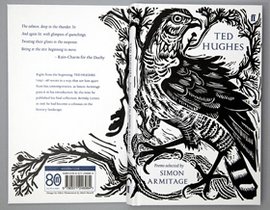
Today was a good day for another reason entirely: I received six beautiful volumes of poetry in the mail. I was incredibly lucky and won a contest over at Nonsuch Book to receive these books published by Faber in celebration of their 80th anniversary.

box_poetry_classics3_jpg_270x450_q85

The volumes are by W.H. Auden, T.S. Eliot, W.B. Yeats, Ted Hughes, Sylvia Plath, and John Betjeman, and each one is gorgeous.  I haven’t read any poetry in a while, and I think it may be time to start again soon. I think I will begin with Ted Hughes.

In other bookish news, I have two books to review, although time is slipping away from me, and it is taking me forever to get to them: Michael Frayn’s The Trick of It, and E.M. Forester’s Maurice. I enjoyed both of them, and we’ll see if I can manage to gather my thoughts to write reviews.

The deeper I get into summer, the harder I’m finding it to do anything much at all. However, I did ride 80 miles on my bike yesterday, a ride which started inauspiciously with a downpour that didn’t last long but which left me feeling damp for the rest of the ride. But once that passed, I had a great time riding around the back roads of Litchfield County, seeing some farms and some cows and a few small towns. It left me feeling a little beat today, but pleasantly so.

I now have a bit of catching up in Infinite Jest to do, but only a little, and the other book I’m reading is Richard Holmes’s biography of Samuel Taylor Coleridge, which I’m loving. Holmes is such an excellent storyteller, Coleridge is such an interesting person, and he lived in such interesting times, that there is no way I’m not going to like this book. I love the way that Holmes quotes liberally from Coleridge’s letters and lectures and poetry so we can really hear his voice, and I love how Holmes does such a good job of situating Coleridge in his context, so I get a sense of what it was like to live in England at that time. The biography is two volumes long, and I expecting to enjoy both of them fully.

I have picked up Gertrude Stein’s novel Three Lives, and it’s interesting, although the truth is, I’m not entirely sure this is the best time to read it. But the truth is also that my opinions change rapidly from day to day, so all I have to do is wait a while, and it will be a good time to read it. I’m not giving up just yet.

I hope you all enjoy your weekend!

12 Comments

Filed under Books, Life, Poetry, Reading

Bloggers, this is your fault

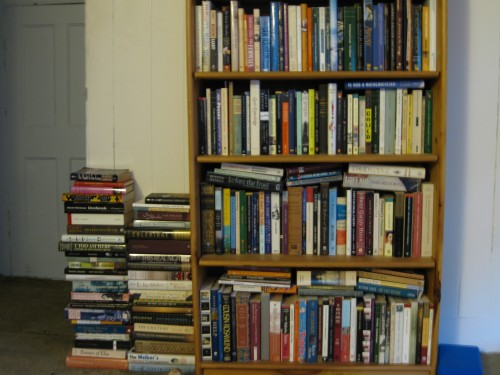
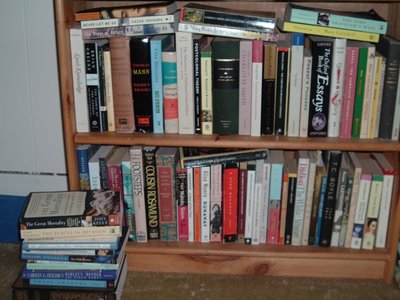
Recently people have been posting pictures of their to-be-read piles, so I thought I’d show you mine. First of all, though, here’s a picture of my TBR shelves from 2 1/2 years ago:

Books10.06 002

Just a couple shelves and a little pile on the floor. Not too bad! But here’s how things look now:

Bookshelves 001

There are about seven books on the left side of the top shelf that I’ve already read; the rest are all patiently waiting for me to get to them.

I really think I can’t be blamed for this situation, as just about every one of you reading this post has tempted me to read one book or another at some point. Tempted me beyond what I can bear. So yes, this is entirely YOUR fault.

Here is a closer shot of the piles on the floor, complete with one of Muttboy’s many abandoned bones strewn around the house:

Bookshelves 002

And now I need to go read …

30 Comments

Filed under Books, Reading

A quick note

Happy Fourth of July to all of you who care! To those who don’t, I hope you are having a nice Saturday. I spent much of the day helping out at a big library event and working on my suntan. When I say I was working on my suntan, I mean I was making some of my funny fan lines worse and some of them better. Because I spend most of my outdoor time on my bike, I have suntanned arms and white hands, with a pretty distinct line on my wrist and some lines on my fingers you can see if you look closely. Today my hands finally got some sun and now they don’t look quite so ridiculous, although I did develop a new watch line. The line at the bottom of my neck and on my upper arms is now worse, though. I’m afraid I won’t look normal in the summer as long as I continue to ride my bike. Oh, well.

The library event — a big party for the library’s 100th birthday — went well, although it was windy and one of our tents flipped over on us. Mostly I sold coffee and bagels to hungry people, and I also helped kids make cat puppets. They had fun.

The other thing I’ve been doing is finishing Mary Brunton’s novel Discipline, and I also recently finished Benjamin Black’s Christine Falls, which means I get to choose a new novel and maybe a new nonfiction as well. Yay! I’m not sure what I’ll read, but I’ve considered picking up Kate Atkinson’s Case Histories and also Michael Frayn’s The Trick of It. And I’ll probably consider others before deciding on something.

One other thing I did today: I spent some time checking out these two posts from Fernham about books she might teach in her Transatlantic Women Modernists grad class this fall. There are a bunch of authors I’d never heard of in those lists, including Betty Miller, Gertrude Bell, Alice Dunbar-Nelson, and Jessie Fauset, as well as other authors I’ve heard of but know next to nothing about. The class looks fascinating, and my wishlist just got longer.

Enjoy your weekend everybody!

10 Comments

Filed under Books, Cycling, Life, Reading

Reading with one’s spine

I posted my thoughts on Nabokov’s Lectures on Literature the other day, and now I thought would share some interesting bits from the book. It begins with an introductory lecture called “Good Readers and Good Writers” in which he lays out his argument that “In reading, one should notice and fondle details.” This quotation is the simplest way to describe Nabokov’s method, really, as it sums up what he does in each of the main lectures — he looks closely at the details in order to examine the novel’s structure. Isn’t the word “fondle” an interesting one to use here? It captures his very involved, careful, intimate, and emotional style of reading:

So what is the authentic instrument to be used by the reader? It is impersonal imagination and artistic delight. What should be established, I think, is an artistic harmonious balance between the reader’s mind and the author’s mind. We ought to remain a little aloof and take pleasure in this aloofness while at the same time we keenly enjoy — passionately enjoy, enjoy with tears and shivers — the inner weave of a given masterpiece.

There is a lot to like here, especially the mix of the personal and the impersonal in reading: he calls for an attempt to enjoy passionately while at the same time keeping enough distance to notice what’s going on. I’m not entirely sure how that works, exactly, as passion seems to imply the loss of critical distance, but I know subjectively what he means, or at least I think I do. I also like the idea that there should be a balance between the author’s mind and the reader’s mind — that the reader and author are working together in good faith and with good will to try to create something meaningful.

I’m also amused at the way Nabokov sounds a little like an eighteenth-century woman of sensibility, one who prides herself on her exquisite emotional sensitivity and her ability to cry at affecting scenes in novels, when he talks about “tears and shivers.” But he only sounds like that for a moment, before he moves on to discuss what else besides emotion and imagination are required. Here’s how strong emotion connects to a novel’s detail:

What I mean is that the reader must know when and where to curb his imagination and this he does by trying to get clear the specific world the author places at his disposal. We must see things and hear things, we must visualize the rooms, the clothes, the manners of an author’s people. The color of Fanny Price’s eyes in Mansfield Park and the furnishing of her cold little room are important.

So detail is a check on emotion, as it keeps us grounded in the specifics of the world the author creates. In fact, Nabokov has already outlined several wrong kinds of imagination and emotion to be found in readers — including the kind that is solely personal because we relate the book only to our own experiences, and the kind that leads us to identify with a character. In an odd kind of way, our imagination and emotions are supposed to lead us beyond ourselves:

We all have different temperaments, and I can tell you right now that the best temperament for a reader to have, or to develop, is a combination of the artistic and the scientific one. The enthusiastic artist alone is apt to be too subjective in his attitude towards a book, and so a scientific coolness of judgment will temper the intuitive heat. If, however, a would-be reader is utterly devoid of passion and patience — of an artist’s passion and a scientist’s patience — he will hardly enjoy great literature.

I like all these ideas a lot, even if they are abstract. Nabokov ends this chapter with a metaphor, which I also like, although it doesn’t clear up the abstractness:

In order to bask in that magic a wise reader reads the book of genius not with his heart, not so much with his brain, but with his spine. It is there that occurs the telltale tingle even though we must keep a little aloof, a little detached when reading. Then with a pleasure which is both sensual and intellectual we shall watch the artist build his castle of cards and watch the castle of cards become a castle of beautiful steel and glass.

I like very much the idea of reading with one’s spine, even if I’m not entirely sure I know what it means. I also like the way a castle of cards can turn into a castle of steel and glass. We know the entire time we are reading that it’s a castle of cards — we know the work is a fiction — but through the magic of a writer and a reader working together that fiction somehow becomes real.

12 Comments

Filed under Books, Nonfiction, Reading

Group Reading

As I read along in Infinite Jest, I’ve been thinking about what it means to read a book with a group of people — in this case, a very large group. Even though I’m not actively contributing to the Infinite Summer forums, I’m following the discussions pretty closely and am learning a lot from what people write there. And then there are very, very informative and helpful posts at the Infinite Summer blog, such as this weekly summary, which lists chapters that the group has read so far with a plot synopsis for each one, as well as descriptions of characters encountered in each chapter. I didn’t realize the blog would be doing weekly summaries, and when I first encountered this week’s summary, I was thrilled to have a way to check whether I understood what was going on.

But it also feels a little like cheating. In a way, I feel like I should be reading this book all by myself to be reading it “properly.” It would be an entirely different experience to be reading it all on my own, without help from the blog and forums or any other kind of reading guide. A part of me feels that to have the true experience of reading this book, I should encounter just the text itself. It should be just me and the book, and I should try making of it what I can all on my own. Reading guides and groups and forums seem more fitting for the second time through, when I’ve had a chance to form my own opinions.

But then, I can be too much of a purist about reading and about life in general. I’m a little too obsessed with doing things the “right way,” and of course, there really is no one right way to read a book. I felt similarly uncomfortable using the Reader’s Guide to The Recognitions to help make sure I was understanding the basics of what was going on, as well as to explain the book’s allusions. But I have to say, I was very glad to have that guide available, and it made reading The Recognitions a better experience. I think having the Infinite Summer community available will make reading that book a better experience.

I wonder what the authors would say about these websites and groups. Perhaps they wouldn’t care how we read their novels, or perhaps they would prefer to have us confronting the text by itself, without any props or support systems or weekly summaries? Probably they would just be happy to have that much attention drawn to their work.

What do you think — are you a perfectionist kind of reader like I am?

17 Comments

Filed under Books, Fiction, Reading

Maisie Dobbs and other things

Now that summer is here I thought I’d have all the time in the world to blog, but it hasn’t quite worked out that way. This is partly because I’m teaching online, which doesn’t keep me too busy to blog, but it means that often I’ve maxed out on computer time before I sit down to write a post. There’s only a certain amount of time that I can stare at a computer comfortably before my eyes start to hurt and I get restless.

I’ve also kept busy riding my bike: last week I rode nearly 13 hours and almost 220 miles. I’m not sure if that’s a personal record or not, but it’s a lot of miles for me.

And then there are bike races to go to, and … well, unexpected visits to the hospital. Hobgoblin is just fine, but he did crash last night and suffered a concussion. Initially he seemed okay, if shaken up, but then he got dizzy and detached and slow to respond, so I got the car and we zipped off to the hospital. They did a CAT scan and everything looked fine, so they sent him home with some percocet. He’s recovering but still has a headache. As you can imagine, this kind of thing changes our plans pretty drastically. No one ever knows what’s going to happen to them ever, but sometimes this seems particularly true when a person spends hours and hours every week on a bicycle and rides in dangerous bike races …

But on to books. I’m considering participating in Infinite Summer, a website and a group of people dedicated to reading David Foster Wallace’s novel Infinite Jest over the course of the summer, from June 21st to September 22nd. There will be some regular posters at the Infinite Summer blog, and then there will be forums for discussion. They say we need to read only 75 pages a week to finish the book over the summer, and that seems entirely doable. Since I’m a new but ardent Wallace fan, and since Hobgoblin got me a copy of the novel for my birthday, the time seems right to read it.

And now on to Maisie. I finished Among the Mad, the latest Maisie novel recently, and enjoyed it, although with some mixed feelings. I think I’ll continue to read this series and continue to have mixed feelings.

This time around, Maisie seemed just a little bit too perfect. It struck me that she’s always right. The intuitions she has never lead her in the wrong direction and whenever anybody disagrees with her, you know they are going to be wrong. Maisie has a particularly strong and reliable intuitive power, one that borders on the supernatural at times, and that can get … boring.

I suppose this is a potential problem in all detective novels, since the detective does end up solving the case, and we read them partly to get to see our hero outsmarting everyone else. There’s always a danger the outsmarting will get dull. So a detective novelist has to find a way to keep this from getting too predictable, and really interesting heroes need to make mistakes, or at least have some believable flaws that keep them realistic.

And I’m not sure Maisie really has any flaws. She suffers, definitely, but her suffering comes from her experiences in World War I and not through any fault of her own. If anything, her flaws are that she works too hard and won’t allow herself to have a personal life, and this does become one of the recurring storylines, but for me, it’s not enough.

That aside, though, the story was interesting, not so much because of the mystery, but because of the historical context. All the Maisie Dobbs novels deal with the legacy of WWI in one way or another, and the author continues to keep this fresh and intriguing. This novel takes place in the winter of 1931 and tells about people who fought or worked in the medical field during the war and were damaged by it and who now feel that society has abandoned them. It deals with the history of chemical weapons development and animal experimentation, and one of the characters is a potential domestic terrorist, which gives the book a contemporary feel. The novel also makes it clear that World War II is on the way with references to fascists and political unrest.

I like the way the novels allow me to get a sense of the time period, and that’s really why I keep returning to them, besides the simpler motivation of wanting to know what happens to the characters. They aren’t perfect books, but they are really great light reading for when I’m in the mood.

16 Comments

Filed under Blogging, Books, Cycling, Fiction, Life, Reading, Teaching

Thinking about summer

Here it is, Memorial Day, the beginning of summer, and I’m not entirely sure what I’m going to do with it. I usually have something planned, but this time, I really don’t. There have been some summers when I had to take exams for grad school or when my job extended through the summer or when I had my dissertation to write. Two summers ago I had a couple articles to work on, and last summer I taught online for the first time, which was a lot of work.

This summer I’m teaching online again, and that will take some time, but I’ll be honest and say that it won’t be too terribly hard. I also have some reports to write and some changes to make to my classes for the fall, but those things aren’t that difficult either.

I feel as though I should have some grand plans for the summer — a writing project or redecorating my house, or at the very least, some ambitious reading project. But I’m just not interested in any of that. Maybe some ambition will come to me as I muddle along, but for now, it’s hard to think past the next day or two.

I will be riding my bike a lot, although even there, I’m feeling unambitious. My race yesterday didn’t go well at all — I got freaked out by a crash that happened in front of me, and when I finally got around the crashed riders and discovered just how far behind the main pack I was, I said forget it, I’m through with this, and stopped riding. I’m still loving my training rides and the Wednesday night race series, but I’ve lost interest in any race I’m supposed to take seriously, and my most serious ambition is to ride 5,000 miles this year, which will be the most I’ve ever done. That’s a serious ambition, I suppose, but it only requires that I do just a bit more riding than usual.

I’ll also be attending my sister’s wedding in August, and afterward Hobgoblin and I will spend a week in Maine. We might take some short camping or backpacking trips, but then again, we might not.

So, I guess I’ll just keep muddling along, doing whatever occurs to me and reading whatever books I feel like. That’s something to look forward to, right?

9 Comments

Filed under Books, Cycling, Life, Reading

The week ahead

Although I’ve been avoiding it all day, I finally got around to packing for a work retreat — a seminar on teaching — that I have to go this week. I’ll be gone from Monday through Thursday. Believe me, I’d much rather stay home and read and sleep, and it makes me feel worse that this is a retreat I don’t actually have to go on. A colleague talked me into going two years ago, last year they put me on staff, and this year I agreed to be a staff member again. So yes, not only do I have to go to this thing, but I have to be enthusiastic about it.

The truth is, once I’m there I’ll be fine, but at the moment I’m not into it.

Although I won’t have much time for reading, I will bring some books along anyway. I’m taking Anne Fadiman’s excellent essay collection At Large and At Small, which I’m already over half way through. It’s an excellent little book — about all kinds of random things, but it doesn’t matter what she writes about, because she makes everything so fascinating. Her literary essays have made me want to read more Charles Lamb and to start reading Richard Holmes’s biography of Coleridge, which I have on my shelves.

I’ll also take Somerset Maugham’s novel The Razor’s Edge, which I’ve almost finished but won’t quite get to the end of before I leave. I’ve found this a very strange book, and I’m not particularly liking it, although it’s given me a lot to think about. Has anybody else out there read it? It’s just … odd. More on that later.

I’ll also be taking the next Slaves of Golconda book, Patrick Hamilton’s The Slaves of Solitude. We’ll see if I get a chance to crack it open.

I’m also taking my bike, which may provide a much-needed escape for an hour or so now and then, although I’m guessing other people attending will also be bringing their bikes, so it may not be an escape at all. If necessary, though, I can probably tell everybody I need to train hard for my next race and then proceed to leave them far behind. That would be kind of fun.

Okay — see you at the end of the week!

12 Comments

Filed under Life, Reading

On not reading

This really isn’t a post about not reading, as I do read something every day, if only a few pages before I fall asleep. It’s more about my limits as a reader. As much as I love reading, there are times I just can’t do it, and I also feel like I’m one of the few book lovers out there who feels that way. For me, reading is sort of relaxing, but really, when I’m exhausted and stressed out and trying to unwind, a book doesn’t always help. I wish I were the kind of person who could read all the time, but I’m just not. I have very definite limits on when I can read and for how long.

I’ve been thinking about this lately partly because I’ve been so busy and have had less time and energy for reading, but also because of the recent read-a-thon where people read for 24 hours straight. I admire all you who can read for 24 hours straight, but there’s no way in the world I could ever do that. I couldn’t read for even half that time, and probably not even for a quarter of that time, or maybe even an eighth. I would go stir-crazy. I wouldn’t be able to sit still. I would feel as though I were maxing out on whatever book I was reading. It’s been forever since I read an entire book in a day, and I know I’ve never read two or three. I just don’t like to take in that much at once.

I’m wondering if my tendency to stay away from lighter forms of fiction, generally-speaking, has less to do with my desire to be reading serious stuff all the time, than my habit of reading slowly and wanting books that suit that habit. It’s not worth it to spend an entire week immersed in something forgettable. But I might be willing to read forgettable books if I liked breezing through them in a few hours. Then I might find books better for relaxing, too. If this is true, it would make me feel a little less like a book snob, and more like someone with particular reading habits that just happen to lead to reading particular kinds of books.

I’m not sure if any of that makes sense, but I wanted to say something about how sometimes in the evenings when I have plenty of time to read, I put off picking up a book in favor of staring at the wall or surfing aimlessly online. I feel bad sometimes for not using that time better, but, as with many things I feel bad about, there’s no good reason for it.

18 Comments

Filed under Books, Reading

Saturday thoughts

  • I am resolutely ignoring the fact that I will be racing tomorrow, and, even worse, riding in two races. I find that denial is the best way to manage nerves. So — tomorrow will be a quiet day where I sleep in, spend lots of time reading, see some friends, and that’s it. Yes, it is.
  • I am the kind of dork who does homework on Saturday nights. I just spent a good bit of time reading through material for the online class I’m taking on how to teach online classes. It was interesting, although now my head is spinning with educational and technical jargon, including ugly words like “chunking,” which refers to the practice of breaking up text into manageable bits.  Apparently in an online class you are not supposed to simply upload your lecture notes for students to read, but instead are supposed to break the material up into separate shorter pages that are easier to process and then to intersperse activities and assignments and such to help students understand and remember everything. Makes sense to me.
  • I finished the book for my next mystery group meeting, Chester Himes’s The Real Cool Killers. I’ll post more on it later, but in the meantime, I’ll say that I liked it, although it’s very different from the sort of thing I usually like. It’s fast-paced and focused on the action, without a whole lot of character development or analysis. But the style fits the subject it covers — the dark, crime-ridden side of Harlem in the 1950s. What interests me about the book is the fact that Hobgoblin read a chapter or two and declared he couldn’t stand it and thought the writing was horrible. I picked it up thinking I’d probably agree and found I didn’t at all. So now I’m really looking forward to the discussion next week.
  • I couldn’t resist wandering over to the town library the other day and there I found a few nonfiction books I’ve been meaning to read, including Geoff Nicholson’s The Lost Art of Walking and Steven Nadler’s The Best of All Possible Worlds: A Story of Philosophers, God, and Evil. What I brought home, though, is Julian Barnes’s book Nothing to Be Frightened Of, which is sort of a memoir, sort of an extended essay on death. So far (I’ve read maybe 30 pages), it’s rambled around and touched on his family history, his relationship with his brother, his religious history, and his fear of dying. So far, so good — this is exactly the kind of book I like, and Barnes is such a great writer.
  • I’m looking forward to picking up Stefan Zweig’s The Post-Office Girl very soon for the Slaves of Golconda discussion beginning at the end of the month. As usual the group has chosen a book that sounds great and is one I’m happy to read although I probably wouldn’t have gotten to it soon on my own. That’s precisely why I’m so happy to be a part of that group — it gets me reading things I might not otherwise.
  • I’m going to try to finish the William Cowper biography I’ve been working on before I begin the Zweig, though — I don’t want to have too many books underway at once or I might start to feel overwhelmed.
  • And no, I’m not racing tomorrow … no, really …

6 Comments

Filed under Books, Cycling, Fiction, Nonfiction, Reading, Teaching

The 25 influential writers meme

I saw this over at Reassigned Time and thought it would be fun to do here. The instructions are to “name 25 writers who have influenced you. These are not necessarily your favorite writers or those you most admire, but writers who have influenced you. Then you tag 25 people.” I won’t be tagging 25 people, so if you want to do this, please do! I’m going to list names roughly chronologically (following my life).

  1. Authors of the Bible
  2. Laura Ingalls Wilder
  3. Maud Hart Lovelace
  4. Lucy Maud Montgomery
  5. Louisa May Alcott
  6. Jane Austen
  7. Charles Dickens
  8. George Eliot
  9. Virginia Woolf
  10. Mary Shelley
  11. Flannery O’Connor
  12. Michel de Montaigne
  13. Fyodor Dostoyevky
  14. Mary McCarthy
  15. Samuel Richardson
  16. Laurence Sterne
  17. Henry Fielding
  18. Sarah Fielding
  19. Mary Wollstonecraft
  20. Olaudah Equiano
  21. Dorothy Wordsworth
  22. Nicholson Baker
  23. David Foster Wallace
  24. Jenny Diski
  25. Janet Malcolm

#1-5 are about my childhood, pretty clearly, and then I read a lot of #6-8 in high school, which formed my taste for the Victorian novel (and the novel itself — this list is very novel-heavy).  #9-14 were college discoveries, and you can see the turn to the eighteenth-century I took in grad school in #15-21.  I could easily have added more authors here, including Boswell and Johnson. After that, I tried to think of authors I’ve been most excited about over the last few years; these ones I could possibly change up a bit, depending on my mood. The last few reflect my increasing enjoyment of nonfiction, which is why I like their presence there. I could also put Philip Lopate on the list, not because his writing has influenced me, but because the book he edited, The Art of the Personal Essay, has been so important.

It’s a pretty canonical list, isn’t it? But I suppose at heart I’m a pretty canonical kind of reader. Maybe it’s also true that people’s reading is often from the canon when they’re younger (at least English major types) and branches out afterward.  I haven’t read all of the canon, by any means, but I’ve read enough to feel that I’m ready to branch out more.

Anyone else want to try this?

13 Comments

Filed under Books, Lists, Memes, Reading

Updates

I’m taking an online course! I’m weirdly excited about this. It’s an online course in how to teach courses online — and yes, I’m doing this backwards because I’ve already taught courses online. Two, in fact. And it’s only now that I’m taking the course to learn how to do it. But that’s the way things generally work when it comes to college teaching — you get thrown into it with only the tiniest bit of training or maybe none at all and you figure things out on your own. You learn things from colleagues and maybe pick up some training here and there and you do the best you can. The course I’m in will run for nine weeks and I’ll get a certificate at the end of it if I complete at least 80% of the work.

I guess I’m just a nerd who likes learning new things. The fact that I’m looking forward to the class tells me that while teaching is fun, being a student is much more so (especially since I won’t be getting A, B, C-type grades).  Maybe I should take classes more often.

……

I really loved the recent New Yorker article on David Foster Wallace. It gives an overview of his life and, most interestingly, talks about his unfinished novel and what it was he was trying to do with his fiction. It sounds like the unfinished novel — which will be published some time next year — is fascinating and majorly ambitious, so much so that Wallace had a lot of trouble making progress. Part of the trouble is that its subject isn’t well suited for fiction — it’s about boredom and tells the story of IRS workers dealing with the dullness of their jobs, so the issue is how to make boredom interesting. He took on a difficult subject, but he also was trying to write in a new style:

Wallace was trying to write differently, but the path was not evident to him. “I think he didn’t want to do the old tricks people expected of him,” Karen Green, his wife, says. “But he had no idea what the new tricks would be.” The problem went beyond technique. The central issue for Wallace remained … how to give “CPR to those elements of what’s human and magical that still live and glow despite the times’ darkness.” He added, “Really good fiction could have as dark a worldview as it wished, but it’d find a way both to depict this world and to illuminate the possibilities for being alive and human in it.”

This is such an interesting combination to me — acknowledging the darkness of life but not succumbing to despair and managing to write about “the possibilities for being alive and human” without being trite or cheaply sentimental. I’m also intrigued by the way he is influenced by postmodernism — its irony and self-consciousness and playfulness with language — but also cared about writing fiction with a moral interest and with real emotional weight to it, things that the postmodernists sometimes ignored.

Apparently his last novel was only about one third finished, but it still sounds well worth reading.

…….

My cycling is coming along pretty well, with the exception of a few days last week when I couldn’t ride because of a snow storm. I was supposed to ride in my first race last Sunday, but it was canceled because of snow, so now my first race of the season will be this coming Sunday.  It may rain that day, but it’s supposed to be in the upper 50s, so I doubt we will be in danger of snow.

This week was bitterly cold, but it’s finally warming up a bit, and I am more than ready for the change. I really should have gotten on the trainer on those cold days, but I just couldn’t. I don’t like the trainer ever, but it’s particularly bad when it’s March and spring is on the way. Riding on the trainer in January is tolerable, barely, but riding on it in March is just impossible. I’d prefer to sit around and do nothing, even if my I lose some fitness and my mood plummets. That’s silly, probably, but oh, well.

…….

And now I want to go read some more of The Elegance of the Hedgehog, a book I’m greatly enjoying.

8 Comments

Filed under Books, Cycling, Life, Reading, Teaching

Disagreements

I came across a really great talk by Elizabeth Gilbert (via Chekhov’s Mistress), which you can find here.  She talks about what it’s like to have written a best seller and then to feel paralyzed because she may never write anything as successful ever again.  And then she goes on to talk about creativity and genius and how to keep doing your creative work without driving yourself mad. She turns out to be a really great speaker — she’s funny and fluent and has great examples, and I found myself tearing up at the end. I really do like Elizabeth Gilbert; I realize her writing style can sometimes be a bit glib and that the very fact she’s been so successful might turn people off, and maybe Eat, Pray, Love is a little self-absorbed (I don’t think this, actually, but some people do — I don’t mind if writers are self-absorbed as long as they are interesting), and maybe her interest in spirituality isn’t everybody’s cup of tea, but she’s just one of those people I’m ready to admire no matter what and I have a hard time understanding you if you don’t agree with me.

This isn’t the first time I’ve thought this about an author.  There are some writers I feel absolutely loyal to, and I know this feeling isn’t a rational or a logical one — because even the best writers write bad things now and then, and why should I feel such loyalty and even affection for writers I’ve never met and who in some cases are long dead? And why should I care if someone happens to disagree with me?  After all, disagreements keep things interesting, right?  We don’t want to have all the same opinions.

And if you disagree with me about Henry James, I won’t take it personally.  I happen to love Henry James, but I can see why people might find him insufferable and boring. And this is true for most authors — if you don’t like George Eliot, fine; if you don’t like Laurence Sterne, well, you’re missing out on some great fun but that’s your problem; if you don’t like Flannery O’Connor, then something may be wrong with your sense of humor, but I won’t hold that against you.

But there are some authors I can’t be quite as open-minded about. If you don’t like at least some of Virginia Woolf’s work, I’m sorry, but I have grave doubts about you (even if it’s just the essays — how can anyone not like this?) If you were to read Jenny Diski and not be at least a little charmed by her orneriness, I’m not sure we’ll ever really understand each other. If you aren’t awe-struck by David Foster Wallace’s essay on dictionaries, or thrilled by Nicholason Baker’s The Mezzanine, then I can’t help but suspect our friendship will always have its limits.

I don’t know. In theory, at least, I like the idea of civilized conversations about books where we can discuss the merits of this or that author and agree to disagree, but there are times when my patience runs out and I get tired of being open-minded and tolerant.

I recognize, of course, that you are entitled to have grave doubts about me because of books I like or don’t like. So — are there books or authors you are completely loyal to and don’t understand how anyone could possible disagree?

16 Comments

Filed under Books, Reading

Notes on reading

  • I just finished the biography of Jane Austen I’ve been working on for a while, and now I see another biography I need to read: Frances Wilson’s The Ballad of Dorothy Wordsworth. Given my mild obsession with that most intriguing writer, I think this is a book I need to read.
  • And here’s another biography I’ll need to read: Brad Gooch’s Flannery: A Life of Flannery O’Connor. This is, apparently, the first major biography of O’Connor.  I just finished teaching a couple of her stories last week, and teaching her work always confirms my feeling that she is a fascinating, wonderful, and wonderfully bizarre writer.  I studied her a bit in college and that was fine, but I’m beginning to wonder whether the O’Connor I knew then is the O’Connor I would encounter now if I undertook to read a big chunk of her work all at once.  She would be a good candidate for an author read-through, as it wouldn’t take too terribly long, and I could read a biography at the same time. That would make a great reading project.
  • I learned today what’s up next for my mystery book group: Chester Himes’s The Real Cool Killers. The book is from 1959, and is a part of a series of Harlem detective novels.  I’m not familiar with Himes at all, so I’m excited to have another new author to discover.
  • Musings from the Sofa kindly lent me a copy of Muriel Barbery’s The Elegance of the Hedgehog, which I’m looking forward to beginning.  We’ll see if the book matches all the hype.
  • I should have the chance to begin the Barbery book soon, as at the moment I’m in the middle of only two books — quite a small number compared with my usual five or so.  I finished Wallace Stevens’s first volume of poetry Harmonium yesterday, which leaves me with only (“only”) my Montaigne collection and The Recognitions.  I’ve neglected both over the last couple weeks, however, and am looking forward to picking them up again soon.
  • I’ve ordered a copy of Stefan Zweig’s The Post-Office Girl to read for the Slaves of Golconda discussion at the end of March.  Zweig, I’m just now learning, was an early-20C Austrian novelist and short-story writer; he wrote this particular novel near the end of his life in the 1930s as he was driven into exile by the Nazis.  It was published only after his death and was just translated into English in 2008.
  • I’m reading just as much as ever, probably, but alas, but the reading is not always for fun: I’m in the midst of paper-grading, and let me tell you, student papers are not as much fun to read as mystery novels.  If only they were …

12 Comments

Filed under Books, Fiction, Nonfiction, Reading

Updates

First of all, a cycling update: it appears that I’m going to be racing more this year than I thought.  Since I posted on the subject just a few days ago, I’ve had a conversation with a friend who is an awesome Ironman triathlete but who has never ridden in a bike race before, and she basically said she will race if I will.  Now I don’t want to feel pushed into bike racing because of guilt, but I don’t think that’s what’s going on.  The conversation made me feel more enthusiasm for the whole enterprise than I felt before, and I do like the idea of helping other women get into bike racing (and will probably go on to watch them do better than I do, but that’s okay).  If they need some moral support, I’m happy to help out.

It’s funny that female solidarity will tempt me to race much more so than the desire to win, but that’s just the way I am.  The first race of the season is only two weeks from today, and I’m looking forward to much pain and suffering.  Makes you want to race, doesn’t it?

Then I thought I’d tell you about some new books I’ve acquired.  First, a copy of Rebecca West’s novel This Real Night recently arrived via Bookmooch.  This is the second book in a trilogy that began with The Fountain Overflows, one of her most famous books (if not the most famous).  I have a copy of the third in the trilogy, Cousin Rosamund, so, when I get around to it, I can read the entire thing.  I suspect that the first novel is the best (although I have no real reason to say this except that the trilogy as a whole isn’t famous — only the first book is), but I’d like to read the whole thing anyway.

And then there is David Foster Wallace’s magnum opus Infinite Jest, which Hobgoblin gave me for my birthday a few weeks ago.  This is not a book I’ll read very soon, as I need more time and energy than I have right now — and I’m in the middle of William Gaddis’s The Recognitions, and I need only one large, ambitious, experimental, monumental book going on at a time.  Perhaps I’ll get to it this summer.  At any rate, I love what Wallace I’ve read so far, so I’m eager to see if I like his fiction.

I also have a copy of Karen Armstrong’s spiritual memoir The Spiral Staircase, which a friend sent to me, also for my birthday.  I’ve read this one before, but it was a while ago, and I remember really loving it and I’d like to read it again.  Does anybody happen to know of any books similar to Armstrong’s they can recommend?  I do enjoy a thoughtful, smart, idea-driven memoir now and then and would like to find more of them.

And then a few books I’d like to have (along with some unlimited time to read them, please):

  • Muriel Barbery’s The Elegance of the Hedgehog.  This book seems to be very popular right now and it has a quirky title, both of which make me hesitate, but after reading Diana’s review of it, I’m curious.  It seems like it might be exactly the kind of thing I like.
  • Lydia Davis’s Varieties of Disturbance: Stories. I’m very curious about what this book is like; all I know is that the stories are very (very) short and that they experiment with language.  And I know that Davis has translated Proust.
  • Maria DiBattista’s Imagining Virginia Woolf: An Experiment in Critical Biography.  Everything about this title sounds fabulous to me, from the Woolf reference to the words “experiment” and “biography.” Surely this is a book I will like??
  • Hermione Lee’s Virginia Woolf.  I’m reading a biography of Austen right now, and it’s high time I read one of Woolf.  I’m slow to pick up biographies sometimes, but I really do need to read biographies of the authors that are most important to me, as those two surely are.
  • Steven Nadler’s The Best of All Possible Worlds: A Story of Philosophers, God, and Evil. I don’t often read this kind of book, but I’m definitely attracted to it — the intellectual history kind about a particular moment in philosophy, science, or religion, the kind of book that’s interesting both for the ideas and for the historical background it offers.
  • Marilynne Robinson’s Home. I loved Gilead, and this one is tangentially related to it, and besides, I think Robinson is wonderful.

Time to start reading!

14 Comments

Filed under Books, Cycling, Reading

Never the same person twice

Musings from the Sofa asks, “does anyone still feel that there are books they ought to read for any reason (beyond work or study)?”  My answer is, well, sort of.  I find the question hard to answer because I get stuck on the word “ought.”  There are multiple senses of the word “ought,” right?  It could mean that I ought to read something, but boy it feels like a chore and I’d rather not.  In that case, I don’t read things I feel I ought to.  But it could also mean there are books I ought to read because they sound like great books and I might like them or I might hate them, but either way they seem worth a try.  These books carry a feeling of obligation too, but also some possibility, and in this case, I do read books I feel I ought to.

But the bigger problem for me with this question is that my feelings about obligation reading and fun reading change, and sometimes they change quickly.  There are books that feel like a fun read one day and an obligation read the next, and they might at some later point feel like a fun read once again.  These shifts don’t always have to do with the book itself, but are sometimes about how I’m feeling about books or life or work or all of them combined.  For example, I like reading multiple books at once — I’m usually in the middle of four or five — and I tend to add to the pile, sometimes getting up to six or seven, during the summer or during winter break.  And then the semester hits, and all that reading that felt like so much fun a while back all the sudden now feels like an obligation.  So that long classic I was enjoying during a more leisurely time all the sudden seems a little too much like work.  I still want to read the book, but it’s become less fun.

Or I’ll pick up a book like Gaddis’s The Recognitions all excited about it and eager to challenge myself with a long difficult novel, and I’ll do fine for a while, and then the sense of newness will wear away and the book will take a turn into some bizarre territory, and I still want to finish the book, but it now requires a little more effort to pick it up than it used to.  It begins to feel a tiny bit like a chore.

The problem is that I love challenges in some moods and don’t in others, and this problem is compounded by the fact that I’m a slow reader (and by the fact that I read multiple books at once so it takes me longer to get through each one) so once I begin something I’ve devoted myself to that book for a decent amount of time.

As I’ve gotten older I’ve developed a strong sense of my own changeability, the way my moods and feelings and desires are constantly in flux, so I have more and more trouble settling on what my actual opinions are.  Ask me a question and the answer you’ll get kind of depends on when you ask.  I don’t mind feeling this way, really; it’s just a little inconvenient at times.  I never know what I’m going to want to read tomorrow, or even an hour from now.

11 Comments

Filed under Books, Reading