Category Archives: Nonfiction

A mad King George III chases Frances Burney in Kew Garden

So I just read this extraordinary passage in Frances Burney’s Journals and Letters that I’ll give you some excerpts from; this is from February 1789 and King George III is suffering from a bout of insanity. Burney has a position as “Second Keeper of the Robes” to Queen Charlotte, so she’s a part of court life, but she’s trying to stay away from the king because he’s rather unpredictable. She fails:

I strolled into the Garden; I had proceeded, in my quick way, nearly half the round, when I suddenly perceived, through some Trees, two or three figures … I concluded them to be workmen, and Gardeners;–yet tried to look sharp, — and in so doing, as they were less shaded, I thought I saw the Person of his Majesty!

Alarmed past all possible expression, I waited not to know more, but turning back, ran off with all my might — But what was my terror to hear myself pursued! — to hear the voice of the King himself, loudly and hoarsely calling after me “Miss Burney! Miss Burney!–”

I protest I was ready to die; I knew not in what state he might be at the time; I only knew the orders to keep out of his way were universal; that the Queen would highly disapprove any unauthorised meeting, and that the very action of my running away might deeply, in his present irritable state, offend him.

Heavens how I ran! — I do not think I should have felt the hot Lava from Vesuvius, — at least not the hot Cinders, had I so ran during its Eruption. My feet were not sensible that they even touched the Ground.


He chases her for a while, along with some attendants who are trying to get her to stop. She refuses and keeps running out of terror. Finally she stops when the attendants tell her it hurts the king to run:

When they were within a few yards of me, the King called out “Why did you run away?–“

Shocked at a question impossible to answer, yet a little assured by the mild tone of his voice, I instantly forced myself forward, to meet him — though the internal sensation which satisfied me this was a step the most proper, to appease his suspicions and displeasure, was so violently combatted by the tremor of my nerves, that I fairly think I may reckon it the greatest effort of personal courage I have ever made.

The effort answered, — I looked up, and met all his wonted benignity of Countenance, though something still of wildness in his Eyes. Think, however, of my surprise, to feel him put both his hands round my two shoulders, and then kiss my Cheek! I wonder I did not really sink, so exquisite was my affright when I saw him spread out his arms! — Involuntarily, I concluded he meant to crush me; — but the Willis’s, who have never seen him till the fatal illness, not knowing how very extraordinary an action this was from him, simply smiled and looked pleased, supposing, perhaps, it was his customary salutation!

I have reason, however, to believe it was but the joy of a Heart unbridled now, by the forms and proprieties of established customs, and sober Reason …

Leave a comment

Filed under Books, Nonfiction

Colette and her mother

I’m not that far into Judith Thurman’s biography of Colette, maybe 60 pages out of 500, but she’s married already — the early years rush by in the biography, largely because there’s a lot that’s unknown about her early life. The chronology of how she met and got to know her first husband is unclear, for example (she married fairly young, at 20). I’m finding her an elusive figure as I read about her; the time is long enough ago (she was born in 1873), the place and customs different enough, and, most of all, the family dynamics and Colette’s own personality odd enough, that I find myself more mystified than ever about who she is. I feel as though I can often worm my way into someone’s life imaginatively — no matter how far apart we might be in time and place and personality — but not so with Colette, at least not yet. So far, she seems to be an elusive figure for the biographer as well, not least because Colette was known for exaggerating and embellishing and sometimes outright lying about her history. None of this lessens my interest in her; in fact, quite the opposite. I find myself wanting to know more and more about this mysterious figure.

Some of the most interesting parts of the biograhy are about Colette’s relationship with her mother, which, as some bloggers have pointed out to me and Thurman describes in some detail, was extremely complicated. In many ways, it seems, Colette’s mother, Sido, taught her much that was valuable, including a questioning attitude toward traditional morality and the patriarchy. Thurman writes,

If [Colette] never became a professional housewife, it was, in part, Sido’s doing. Her ambitions for her daughter did not include drudgery … the flash of defiance Colette saw in Sido’s garden face became the light she wrote by. It had shown her, very young, that a woman’s domestic burdens are incompatible with her creative freedom. And with Sido’s encouragement she rejected those aspects of her mother’s experience that Sido let her feel were demeaning, confining or sacrificial — including motherhood itself.


Isn’t that a great legacy? And yet, as I understand it, Colette was, at least at times, neglectful of her daughter. Motherhood can be confining, yes, but what to do when you’ve got a daughter who needs you? To learn from your mother that motherhood can be demeaning, confining, and sacrificial is bound to be a difficult, ambiguous lesson, one that could affect generations to come.

And here’s another part of Sido’s legacy: the jealousy and domination of Colette and her siblings. Here is Thurman again, on the wedding night Colette spent in her parents’ house:

In the small house where [Sido’s] daughter was losing her virginity, at least officially, the mother had not undressed for bed; had spent the whole night awake, evidently tormented and unhappy. She was unable to bear the thought of Colette’s “going off with a strange man,” or her initiation into an adult sexual life, and Colette was nearly unable to bear her mother’s sadness.

When I came to this scene, I thought of Isak Dinesen’s image for the ordeal of separation — the Bible story of Jacob wrestling with the Angel. “I will not let thee go,” says Jacob to the Angel, “until thou blesseth me.” Sido gave her daughter many inestimable gifts, but never the blessing of letting go.

We shall see, as I read on, what Colette makes of this complicated legacy.

Leave a comment

Filed under Books, Nonfiction

On Colette

So I’m reading Judith Thurman’s biography of Colette, Secrets of the Flesh, and already in the introduction I’m coming across all kinds of fascinating information. I’m particularly interested in what Thurman says about Colette and feminism; compared to actresses and courtesans Colette knew, Thurman says:

The feminists had less to attract her. By 1900, the women’s-rights movement in France had a solid history, a daily newspaper, and a distinguished following. But the combination of utopianism and Puritanism which marked so much feminist theory – and the denunciation of women who “collaborated” sexually with their oppressors – deterred many women otherwise eager for liberation from joining the cause. Colette’s antipathy to feminism was, in her youth, outspoken. In 1910, an interviewer asked if she were a feminist, and she looked at him, incredulous. “Me, a feminist? You’re kidding. The suffragettes disgust me. And if any Frenchwomen take it into their heads to imitate them, I hope they’ll be made to understand that such behavior isn’t tolerated in France. You know what the suffragettes deserve? The whip and the harem.”

And yet it seems to me that Colette did something to advance the cause – or a cause – of feminism through her independence, her sexual adventurousness, and her experimentation with gender roles. I suppose the feminism of the day wasn’t ready for Colette; in its earliest stages, there may not have been room for Colette’s complicated, fierce, and courageous self. When feminism’s focus is on gaining the vote for women, Colette’s subversiveness might have seemed more troublesome than exciting:

What is so subversive about Colette’s first novels is their suggestion that gender, too, is subjective. She perceived instinctively that the child of either sex has desires classified too strictly as masculine or feminine: urges to penetrate, devour, and possess; to be cherished, dominated, and contained.

This strikes me as a fine feminist statement, although not necessarily one that would have advanced the feminist goals of the time. For some reason I find myself interested in women whom I would call feminist, but who rejected the label. Another one from a different time period is Mary McCarthy, who is such a model of strong, independent womanhood and who wrote in powerful ways about women, but who also rejected feminism. I’m not sure what to think about this – are these women failing to understand feminism broadly enough to see that they do, in fact, embody feminism and write in a way that could be called feminist? Or is it a failing of feminism to define itself broadly enough to include these difficult, complicated, powerful women?

Leave a comment

Filed under Books, Nonfiction

Happiness

My latest book of poetry begins this way: “There’s just no accounting for happiness, / or the way it turns up like a prodigal / who comes back to the dust at your feet / having squandered a fortune far away.” I read this, a poem by Jane Kenyon called “Happiness,” and I know I’m in good hands, and the book’s going to be a good read. I’ve only read three poems in Kenyon’s Otherwise, but I know I’m going to love it. I’ve often thought, especially recently, that happiness is not a good goal, it’s not something to strive for, it’s not something that can be obtained, but I still need a reminder. It’s much better to think of happiness as something completely out of our control, something that visits us occasionally and that we are best off being grateful for without clinging to it.

The poem ends this way: happiness “even comes to the boulder / in the perpetual shade of pine barrens, / to rain falling on the open sea / to the wineglass, weary of holding wine.” I like the thought that happiness can come to natural objects and inanimate objects, and that it itself is like a natural force, something that simply happens to us. We have no say in happiness, just as we have no say in the weather.

This poem about happiness makes me think about the nonfiction book I just finished, Elaine Scarry’s On Beauty and Being Just, which I’ve posted on so often and quoted from so extensively, I might have a rather large percentage of this short book up on my blog. Scarry has nothing to say about happiness, at least not that I can remember. She may not even use the word in her book. But she does talk about the quality of aliveness that encounters with beauty can create for us: “Beauty quickens. It adrenalizes. It makes the heart beat faster. It makes life more vivid, animated, living, worth living.” This sounds to me like a much better goal than happiness: to fill one’s life with beauty, which can make one feel more alive. This might have something to do with happiness, it might not, but that hardly seems to matter. What are we doing on this earth but living, so why not try to live more fully?

Part of Scarry’s argument is that seeking beauty is not a self-indulgent or solipsistic pursuit. In fact, quite the opposite. Encounters with the beauty can help us get outside our own minds and begin to care about others. She says beauty can cause a “radical decentering”; to explain this, she quotes Simone Weil: beauty requires us “to give up our imaginary position as the center … A transformation then takes place at the very roots of our sensibility, in our immediate reception of sense impressions and psychological impressions.” Here is Scarry’s gloss on this: “It is not that we cease to stand at the center of the world, for we never stood there. It is that we cease to stand even at the center of our own world. We willingly cede our ground to the thing that stands before us.” There is something very freeing about the thought of giving up the imaginary position at the center of the world; perhaps the best goal is not seeking happiness for oneself, but seeking ways to leave the self behind.

Leave a comment

Filed under Books, Nonfiction, Poetry

My books are talking

This is getting quite strange. I was reading Elaine Scarry’s book recently where she talks about the gaze: whether gazing at a beautiful person or object can harm she/he/it, and then I turned to Proust for a while, and he was talking about the same thing! Not whether the gaze causes harm or not, but how gazing works for both the gazer and the gazed upon. I’m reading these two books at the same time purely by accident; I had no idea they spoke to each other so well.

Scarry takes up the argument against beauty that “when we stare at something beautiful, make it an object of sustained regard, our act is destructive to the object.” She quickly dispenses with the idea that gazing at beautiful objects might cause them harm, and takes up the issue of gazing at beautiful people, which is more complicated. She doesn’t dwell on the exact nature of the problem, but the idea is that by gazing at a beautiful person, the gazer turns that person into an object existing for the enjoyment of the gazer and denies the subjecthood of the person gazed upon. All the power, in this view, is with the one gazing, and none with the gazed upon. She counters this view by reminding us that:

It is odd that contemporary accounts of “staring” or “gazing” place exclusive emphasis on the risks suffered by the person being looked at, for the vulnerability of the perceiver seems equal to, or greater than, the vulnerability of the person being perceived. In accounts of beauty from earlier centuries, it is precisely the perceiver who is imperiled, overpowered, by crossing paths with someone beautiful.

And then Scarry gives a wonderful example:

Plato gives the most detailed account of this destabilization in The Phaedrus. A man beholds a beautiful boy: suddenly he is spinning around in all directions. Publicly unacceptable things happen to his body. First he shudders and shivers. Then sweat pours from him. He is up, down, up, down, adopting postures of worship, even beginning to make sacrifices to the boy, restrained only by his embarrassment to be carrying out so foolish an activity in front of us. Now he feels an unaccountable pain. Feathers are beginning to emerge out of his back, appearing all along the edges of his shoulder blades. Because this plumage begins to lift him off the ground a few inches, he catches glimpses of the immortal realm. Nonetheless, it cannot be denied that the discomfort he feels on the inside is matched by how ridiculous he looks on the outside.

So the gaze, in this account, is not a form of control over the object gazed upon; instead, it is a way to access beauty which can leave the gazer vulnerable and foolish, which can wrest self-control from the gazer, which can transform the gazer into something new.

Scarry says that the encounter with a beautiful person or object can affirm the aliveness of both — the one encountering beauty feels more alive himself or herself and the beautiful person or object “has conferred on it by the beholder a surfeit of aliveness: even if it is inanimate, it comes to be afforded a fragility and consequent level of protection normally reserved for the animate.” She says:

Beauty seems to place requirements on us for attending to the aliveness or (in the case of objects) quasi-aliveness of our world, and for entering into its protection.

Beauty is, then, a compact, or contract between the beautiful being (a person or thing) and the perceiver. As the beautiful being confers on the perceiver the gift of life, so the perceiver confers on the beautiful being the gift of life.

And then I come to Proust. When he writes, “And — oh, the marvelous independence of the human gaze,” you can imagine how I perked up. In the passage where he first sees Mme. de Guermantes, he writes about the gaze as that which transforms the gazer. First, he praises the gaze itself:

And — oh, the marvelous independence of the human gaze, tied to the face by a cord so lax, so long, so extensible that it can travel out alone far away from it — while Mme. de Guermantes sat in the chapel above the tombs of her dead, her gaze strolled here and there, climbed up the pillars, paused even on me like a ray of sunlight wandering through the nave, but a ray of sunlight which, at the moment I received its caress, seemed to me conscious.


Mme. de Guermantes’s gaze, here, does not claim control or power over the narrator; rather, it feels like a conscious ray of light — it is life-giving, instead of life-taking. It is a caress, a recognition and celebration of the narrator’s existence. And then the narrator gazes at her:

I felt it was important that she not leave before I had looked at her enough, because I remembered that for years now I had considered the sight of her eminently desirable, and I did not detach my eyes from her, as if each gaze could physically carry away, and put in reserve inside me, the memory of that prominent nose, those red cheeks, all the particular details that seemed to me so many precious, authentic, and singular pieces of information about her face … I was impelled to consider it beautiful by all the thoughts I had brought to bear on it …

The narrator’s gaze upon Mme. de Guermantes does two things: it bestows on her qualities of beauty and authenticity — it affirms her value and aliveness — and it changes the narrator. It creates in him memories he will carry with him forever. When he sees her, he is moved to say (and beauty does move us to action, in this case, to speaking out loud):

“How beautiful she is! How noble! What I see before me is indeed a proud Guermantes and a descendant of Genevieve de Brabant!” And the attention with which I illuminated her face isolated her to such an extent that today, if I think back to that ceremony, it is impossible for me to see a single one of the people who were present except for her and the verger who responded affirmatively when I asked him if that lady was really Mme. de Guermantes.


The memory of Mme. de Guermantes he now carries with him will affect his perceptions of the world. He will remember, also, Mme. de Guermantes’s gaze upon him, a memory that becomes a part of his being:

Recalling, then, the gaze she had rested on me during Mass, as blue as a ray of sunlight passing through Gilbert the Bad’s window, I said to myself: “Why she’s actually paying attention to me.” I believed that she liked me, that she would still be thinking of me after she had left the church, that because of me perhaps she would be sad that evening at Guermantes. And immediately I loved her …

This is a scene (p. 180-1 in the Davis translation) of the gaze as an action that transforms the gazer and the one gazed upon — it transforms them, as Scarry says, by affirming their value and aliveness. It is a reciprocal event, a compact, bringing benefits to both.

I couldn’t believe my luck in coming across Scarry’s philosophical proposition and then Proust’s embodiment of that proposition in the same day. And I’ll add that as I write about what I read in this blog, I feel that I’m living out Scarry’s idea that beauty provokes people to action, specifically to reproduce or to imitate the beauty they encounter: when I encounter something beautiful in my reading, I can reproduce it here and then reflect on it — it’s a way of being an active rather than passive reader and it’s a way of perpetuating the beautiful books and passages I come across.

Leave a comment

Filed under Books, Fiction, Nonfiction

Burney on Johnson

I came across this extraordinary description of Samuel Johnson in a letter by Frances Burney, written in 1777, when she is about 25. This is her first encounter with Johnson:

He is, indeed, very ill favoured, — he is tall and stout, but stoops terribly, — he is almost bent double. His mouth is almost constantly opening and shutting, as if he was chewing; — he has a strange method of frequently twirling his Fingers, and twisting his Hands; — his Body is in continual agitation, see sawing up and down; his Feet are never a moment quiet, — and, in short, his whole person is in perpetual motion:

His dress, too, considering the Times, and that he had meant to put on his best becomes [most becoming attire], being engaged to Dine in a large Company, was as much out of the common Road as his Figure: he had a large Wig, snuff colour coat, and Gold Buttons; but no Ruffles to his shirt, doughty fists, and black worsted stockings.

He is shockingly near sighted, and did not, till she held out her Hand to him, even know Mrs. Thrale. He poked his Nose over the keys of the Harpsichord, till the Duet was finished, and then, my Father introduced Hetty to him, as an old acquaintance, and he cordially kissed her. When she was a little girl, he had made her a present of The Idler.

His attention, however, was not to be diverted five minutes from the Books, as we were in the Library; he poured over them, shelf by shelf, almost brushing the Backs of them, with his Eye lashes, as he read their Titles; at last, having fixed upon one, began, without further ceremony, to Read to himself, all the Time standing at a distance from the Company. We were all very much provoked, as we perfectly languished to hear him talk; but, it seems, he is the most silent creature, when not particularly drawn out, in the World.

My sister then played another Duet, with my Father; but Dr. Johnson was so deep in the Encyclopedie, that, as he is very deaf, I question if he even knew what was going forward.


I feel a little bad, actually, typing up that passage about Johnson’s appearance, emphasizing the man’s physical problems (but not bad enough to refrain from doing it — it’s so interesting). The book’s editor says that people now speculate Johnson had Tourette’s Syndrome, which would explain some of his quirks and twitches. I love the part about Johnson ignoring people to pay attention to the books.

I’d like to read more by and about Johnson; I started Boswell’s Life of Johnson, but never finished it, so I must return to it. I like his novel Rasselas very much and I’ve read his travel book Journey to the Western Islands of Scotland. What I’d like to read more of are his essays. I’ll have to get my hands on this book (selected essays), although I do have this book (selected writings), which would be a good place to start. I also have Helen Deutsch’s book Loving Dr. Johnson on my to-be-read list, and I came across Dr. Johnson and Mr. Savage in a used bookstore recently, and failed to buy it, and now I regret it. I must find it again; it’s by Richard Holmes, whom I’ve never read but have heard good things about. These aren’t terribly high on my list of things to read, but Burney did spark my interest again.

Leave a comment

Filed under Books, Nonfiction

More on beauty

I am now half way through Elaine Scarry’s book On Beauty and Being Just, which is a very short book, by the way, and so I can read a few pages at a time, spend some time pondering them before I pick it up again, and still make good progress through it. It divides into two halves, one called “On Beauty and being Wrong,” and the other “On Beauty and Being Fair.” What strikes me about the end of the first section is the way Scarry talks about beauty as something that provokes flexibility and capaciousness of mind:

I began here with the way beautiful things have a forward momentum, the way they incite the desire to bring new things into the world: infants, epics, sonnets, drawings, dances, laws, philosophic dialogues, theological tracts. But we soon found ourselves turning backward, for the beautiful faces and songs that lift us forward onto new ground keep calling out to us as well, inciting us to rediscover and recover them in whatever new thing gets made. The very pliancy or elasticity of beauty — hurtling us forward and back, requiring us to break new ground, but obliging us also to bridge back not only to the ground we just left but to still earlier, even ancient ground — is a model for the pliancy and lability of consciousness in education.


A bit later she says of an encounter with a beautiful object that “the perceiver is led to a more capacious regard for the world.” Litlove pointed out in a comment to an earlier post on this book that Scarry is interested not in what beauty is but what it does: that we are used to thinking of a beautiful object as merely existing — it’s a thing, to be gazed at — but that Scarry emphasizes the effects that the beautiful object has on us — the beautiful object reaches out to us and changes us. In that case, it really doesn’t matter much if we disagree on what things are beautiful and what things aren’t, because what really matters is what happens in our encounter with what we perceive to be beautiful.

And what beauty does is to make us want to make more beautiful things, it makes us look back into the past to find other similar beautiful things, it makes us think about other things that are beautiful that we might have failed to recognize:

This very plasticity, this elasticity, also makes beauty associate with error, for it brings one face-to-face with one’s own errors: momentarily stunned by beauty, the mind before long begins to create or to recall and, in doing so, soon discovers the limits of its own starting place, if there are limits to be found, or may instead — as is more often the case — uncover the limitlessness of the beautiful thing it beholds.

This discovery of the limitlessness of beauty coupled with the potential for error within ourselves sets the perceiver of beauty off on a quest for truth. Scarry talks about the relationship of beauty and truth and says they are associated but are not necessarily one and the same; after all the statement “1=1” is true but not beautiful. But beauty:

ignites the desire for truth by giving us, with an electric brightness shared by almost no other uninvited, freely arriving perceptual event, the experience of conviction and the experience, as well, of error. This liability to error, contestation, and plurality — for which “beauty” over the centuries has so often been belittled — has sometimes been cited as evidence of its falsehood and distance from “truth,” when it is instead the case that our very aspiration for truth is its legacy. It creates, without itself fulfilling, the aspiration for enduring certitude. It comes to us, with no work of our own; then leaves us prepared to undergo a giant labor.


In previous posts about this book, I’ve quoted Scarry writing about Proust; as I read Proust, I’m coming across other passages that illustrate what she’s talking about. In this passage, the narrator talks about learning to recognize beauty:

Sometimes in the afternoon sky the moon would pass white as a cloud, furtive, lusterless … I liked finding its image again in paintings and books, but these works of art were quite different — at least during the early years, before Bloch accustomed my eyes and my mind to subtler harmonies — from those in which the moon would seem beautiful to me today and in which I would not have recognized it then. It might be, for example, some novel by Saintine, some landscape by Gleyre in which it stands out distinctly against the sky in the form of a silver sickle, one of those works which were naively incomplete, like my own impressions, and which it angered my grandmother’s sisters to see me enjoy. They thought that one ought to present to children, and that children showed good taste in enjoying right from the start, those works of art which, once one has reached maturity, one will admire forever after. The fact is that they probably regarded aesthetic merits as material objects which an open eye could not help perceiving, without one’s needing to ripen equivalents of them slowly in one’s own heart.


The narrator finds the moon beautiful and thinks of other beautiful places he has seen the moon — novels and paintings. His mind moves outward from the beautiful object — the moon — to other beautiful objects in the flexible and capacious way Scarry describes. But his idea of what makes a moon beautiful is not static; changing over time, it shows the possibility of error in recognizing beauty: at first he missed the “subtler harmonies” that Bloch later pointed out to him and now he recognizes the beauty of the moon in places he couldn’t before. And he disagrees with his grandmother’s sisters that beauty is something that merely exists and waits to be recognized (“aesthetic merits as material objects which an open eye could not help perceiving”). Instead, a person develops the capacity to perceive beauty over time; this capacity is something that ripens and grows as a person has more and more beautiful experiences. The more we seek out beauty, the more capable we are of seeing it.

Leave a comment

Filed under Books, Fiction, Nonfiction

Scarry on beauty

I have begun Elaine Scarry’s book On Beauty and Being Just, a short book that looks to be utterly fascinating. I’m particularly excited because she has already quoted from Proust twice (in the course of the first 20 pages), and I’ve become interested in what Proust says about the function of beauty and art (see yesterday’s post). Is there a function of art and beauty, and, if so, what? Scarry has not answered this yet, but she has said some wonderful things about how beauty operates and has begun to analyze errors we make when it comes to recognizing beauty.

These errors include, among others, thinking something is beautiful when it is not, or thinking something is not beautiful when it really is (she discusses one of her own errors: thinking that palm trees are not beautiful when they are). Here is what she says about Proust:

Proust, for example, says we make a mistake when we talk disparagingly or discouragingly about “life” because by using this general term, “life,” we have already excluded before the fact all beauty and happiness, which take place only in the particular: “we believed we were taking happiness and beauty into account, whereas in fact we left them out and replaced them by syntheses in which there is not a single atom of either.” Proust gives a second instance of a synethic error:

“So it is that a well-read man will at once begin to yawn with boredom when one speaks to him of a new ‘good book,’ because he imagines a sort of composite of all the good books that he has read, whereas a good book is something special, something unforeseeable, and is made up not of the sum of all previous masterpieces but of something which the most thorough assimilation … would not enable him to discover.”

(I am sorry if you do not like or do not want to hear more about Proust; I’m quickly discovering that so much of what I read that’s not Proust ends up connecting back to Proust after all.) I really like this idea: don’t talk about life or beauty in purely abstract terms because the terms then become meaningless. The terms must relate to something particular. And Scarry does a wonderful job of discussing the particular in the course of considering the abstract; she references many authors, she gives her own examples, she calls on the reader to provide his or her examples, and she is particularly attune to the way beauty works on the body:

A visual event may reproduce itself in the realm of touch (as when the seen face incites an ache of longing in the hand, and the hand then presses pencil to paper), which may in turn then reappear in a second visual event, the finished drawing. This crisscrossing of the senses may happen in any direction. Wittgenstein speaks not only about beautiful visual events prompting motions in the hand but, elsewhere, about heard music that later prompts a ghostly subanatomical event in his teeth and gums. So, too, an act of touch may reproduce itself as an acoustical event or even an abstract idea, the way whenever Augustine touches something smooth, he begins to think of music and of God.

And, finally (can you believe I’ve only read 20 pages in the book, with small pages and big print!, and have come across all this already?), Scarry has wonderful things to say about beauty in the university:

This willingness continually to revise one’s own location in order to place oneself in the path of beauty is the basic impulse underlying education. One submits oneself to other minds (teachers) in order to increase the chance that one will be looking in the right direction when a comet makes its sweep through a certain patch of sky. The arts and sciences, like Plato’s dialogues, have at their center the drive to confer great clarity on what already has clear discernibility, as well as to confer initial clarity on what originally has none … By perpetuating beauty institutions of education help incite the will toward continual creation … To misstate or even merely understate the relation of universities to beauty is one kind of error that can be made. A university is among the precious things that can be destroyed.

I don’t tend to think of the work of a university as perpetuating beauty, but I really, really like the idea.

Leave a comment

Filed under Books, Nonfiction

Essay recommendations?

Have I written about how much I love essays? Danielle has been writing about them, reminding me that I’m always on the lookout for good essay collections. She’s got some interesting questions about defining the genre, which, no surprise, turns out to be troublesome to pin down. There are essays that are highly personal, some that are highly factual, some that are highly philosophical or theoretical, some that do all of these things. Some are close to journalism or history, others are close to memoir, others close to polemic. As usual, I have more questions about the genre than answers.

The truth is, however, that what I really care about when it comes to an essay is not the type of essay it is, but the voice it contains. The essay can be about absolutely anything, as long as it’s written in an intriguing way with a strong sense of personality behind it. That’s what’s really so great about essays: that they give you a sense of the writer lurking behind them. That writer must be companionable or witty or sympathetic or brilliant or entertaining, or something enjoyable, and as long as the writer is one of those things, he or she can write about nail clippers for all I care — as Nicholson Baker does in his book The Size of Thoughts. (But good lord has anyone read his essay on lumber? There are limits to these things.)

My favorites include the great and wonderful Michel de Montaigne, whose complete essays I will one day read in their entirely (Stefanie has a wonderful series of posts on these essays). I adore a Virginia Woolf essay. My favorite essay of hers is “Street Haunting,” which you can find in The Art of the Personal Essay, my favorite essay anthology ever. Woolf’s Common Reader series is excellent. I’ve read many a George Orwell essay with pleasure: this collection is particularly good. And I know I’ve mentioned how fond I am of Mary McCarthy’s essays, particularly “My Confession” and “Artists in Uniform.”

I’ve read Addison and Steele’s essays with pleasure; I love F. Scott Fitzgerald’s essay “The Crack-up” (found in Lopate); I find James Baldwin’s essays powerful; and I’ve read several Richard Rodriguez essays that I’ve loved. I’ve read my way through The Best American Essays of the Century, edited by Joyce Carol Oates.

Does anybody have a favorite collection of essays? I’m particularly interested in single-author collections, but if you have a favorite anthology, I’d love to hear about that too. Any other essay enthusiasts out there?

Leave a comment

Filed under Books, Nonfiction

Olaudah Equiano

I’m reading Vincent Carretta’s recent biography of Olaudah Equiano, an 18C slave who bought his own freedom, traveled around the world, learned navigation and became literate, wrote a narrative of his life that became very popular and influential, and became an anti-slavery advocate in London. The narrative (The Interesting Narrative of the Life of Olaudah Equiano, or Gustavus Vassa, the African, published in 1789) is a very interesting read, telling his story from his boyhood in Africa, to his abduction by slave traders, his journey to the West Indies, his travels in various ships as a slave, his adventures in buying and selling commodities, his religious conversion, his attempted journey to the North Pole, and a bunch of other adventures.

The narrative is a mix of genres. It’s history, autobiography, and religious tract; it’s an early example of the slave narrative to become very common in the 19C, an economic tract (Equiano makes arguments about the economic value of Africans as trading partners, not as potential slaves), and a travel narrative. Combining all these elements, it doesn’t always hang together as one coherent narrative, but that’s part of what makes it so interesting — it’s a book that draws on a lot of important trends in 18C literature and makes its own sense of them, becoming something entirely new.

One of the most famous passages from the narrative occurs when Equiano begins to learn about books and literacy; it’s the “talking book” scene:

I had often seen my master and Dick employed in reading; and I had a great curiosity to talk to the books, as I thought they did; and so to learn how all things had a beginning: for that purpose I have often taken up a book, and have talked to it, and then put my ears to it, when alone, in hopes it would answer me; and I have been very much concerned when I found it remained silent.

He watches and listens to other people reading out loud, and tries it himself; he talks to the book and expects an answer, not understanding how the book communicates its message. The power of the passage lies in the way it describes his eagerness to learn about the world, his naivete about reading, and his disappointment when he can’t make it “work.” All this makes his eventual triumph as a reader and writer that much more moving. He gains some formal schooling here and there, for short bits of time, but mostly he relies on people who are willing to tutor him privately and, beyond that, he relies on his own intelligence and resourcefulness.

Equiano is not the only writer who describes the “talking book” experience; in fact, he’s drawing on a trope that a number of other African writers (James Gronniosaw and Ottobah Cugoano) had already used and that others would later pick up on. He’s writing about an experience that is important to him as an individual, but he’s also claiming his place in a community of writers exploring the importance of literacy to Africans trying to survive in England and America.

But Equiano’s status as “African” is a question that Carretta takes up in his biography; Equiano claims to have been born in Africa, but there’s some evidence to suggest he was actually born in South Carolina, and that he might be fabricating the early part of his “autobiography.” Carretta writes about the possibly made-up story of origins not as a flaw in the truthfulness of the narrative, but as an ingenious rhetorical ploy, done in order to make his abolitionist argument stronger. According to Carretta, Equiano probably realized that the abolitionist cause, which was just gathering strength in England when the narrative was published, needed a spokesperson who had actually experienced kidnapping from Africa and who had endured the “middle passage,” the journey from Africa to the Americas. The abolitionists who were trying to end the British slave trade had made arguments about the horrors involved in slavery, but they were white men who had not experienced them first hand. So Equiano could fill an important gap: he was in a position to tell his “experience” directly to better convince readers that the slave trade needed to end.

We’ll probably never know for sure if Equiano was born in Africa as he claimed, or if was born in America, but the possibility that he was born in America makes the narrative that much more interesting — it, possibly, combines very realistic and convincing fictional passages along with all the other forms of writing Equiano had already found useful.

Leave a comment

Filed under Books, Nonfiction

I keep writing about diaries even though I don’t keep one

And that’s because I’ve been reading such interesting examples. I began Frances Burney’s Journals and Letters over the weekend, and I’m only about three entries in, but already I am coming across some wonderful passages. I wrote a while back about feeling uncertain about audience and having trouble finding a voice that felt comfortable and honest while trying to keep a journal. Burney has something to say about this as well. This is an entry from 1768, when Burney is not quite sixteen:

To whom, then must I dedicate my wonderful, surprising and interesting adventures? — to whom dare I reveal my private opinion of my nearest Relations? the secret thoughts of my dearest friends? my own hopes, fears, reflections and dislikes — Nobody!

To Nobody, then, will I write my Journal! since To Nobody can I be wholly unreserved — to Nobody can I reveal every thought, every wish of my Heart, with the most unlimited confidence, the most unremitting sincerity to the end of my Life! For what chance, what accident can end my connections with Nobody? No secret can I conceal from Nobody, and to Nobody can I be ever unreserved. Disagreement cannot stop our affection, Time itself has no power to end our friendship. The love, the esteem I entertain for Nobody, Nobody’s self has not power to destroy. From Nobody I have nothing to fear, the secrets sacred to friendship, Nobody will not reveal, when the affair is doubtful, Nobody will not look towards the side least favorable ….

From this moment, then, my dear Girl — but why, permit me to ask, must a female be made Nobody? Ah! my dear, what were this world good for were Nobody a female? And now I have done with preambulation.

I think this is a pretty good way around the audience problem (if, indeed, you have an audience problem, which I know many of you don’t). I am always happy when I find that the writers I’m reading have the same problems and preoccupations I do. She’s both keeping the journal private by writing to “nobody” and creating a sort of character, “Nobody,” to whom she can write. This character is one who appears in her fiction as well: Evelina is a “nobody” too, with no name and no place in the world. She refers to herself as a nobody, and she signs her first letter, written to her guardian:

“Evelina —-

I cannot to you sign Anville [a made-up name], and what other name may I claim?”

And her journal entry identifies “nobody” with women, pointing out that women have no real legal or political status. They are both necessary to the world and without any stable identity in it. (For a critical treatment of this theme, see this.)

Here’s a bit of wisdom from Burney, now just barely 16:

Those who wander in the world avowedly and purposely in search of happiness, who view every scene of present Joy with an Eye to what may succeed, certainly are more liable to disappointment, misfortune and sorrow than those who give up their fate to chance and take the goods and evils of fortune as they come, without making happiness their study and misery their foresight.

Leave a comment

Filed under Books, Nonfiction, Writing

More on diaries

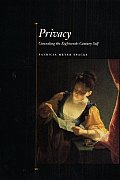
I finished Privacy: Concealing the 18C Self by Patricia Meyer Spacks and thought I’d give you a few quotations I liked. These come from Spacks’s chapter “Trivial Pursuits,” which is about diaries. She discusses Frances Burney’s journals, which I recently got a copy of, and, happily for me, Spacks introduced me to more 18C diaries which sound fascinating, including James Woodforde’s Diary of a Country Parson and the diary of Elizabeth, duchess of Northumberland.

Here is Spacks on why we like to read the diaries of famous people:

Surely we also want, when we have an opportunity to penetrate the “private lives of public figures,” the more primitive gratification of discovering that other people, even famous people, “public” people, resemble us. Self-doubt afflicts everyone. Could others be as undisciplined, as wavering, as rebellious, as lazy, as — fill in the blanks — as we? Do others have such nasty thoughts and impulses? We read diaries partly to find out, to glimpse the shape of other people’s self-doubt and their ways of triumphing over it, to see how they resolve the struggle between good and bad proclivities. We long for consoling testimony that others, like us, have something unmomentous yet personally important to conceal. Diaries allow us to investigate the gap between public persona and private actuality, not only in order to judge success but to reassure ourselves that the discrepancies we discover in ourselves exist everywhere.

I liked, when I was reading Virginia Woolf’s diary, to be reminded that she had no idea she was going to be famous. When famous people are in the midst of doing the things they will become famous for, they don’t know how things will turn out, and they can be just as anxious and uncertain and doubtful as we are.

I was interested to discover that Spacks shares some of the uncertainties of audience that I felt when I tried to keep a journal:

The diaries that Woolworth’s sold in my youth, for the use, mainly, of teenage girls, had tiny brass locks and keys. The idea of a secret life of writing lured me into a small investment, but my diary survived only six days: it made me too self-conscious. That diary was to be my secret, but already I had become a severe critic of my own writing. The journal’s scanty entries did not measure up to my standards … If [diarists] provide their own audiences, they must dread themselves as critics. Diarists in effect interrupt their own privacy by their records of their lives: they forever have a witness in themselves … Dividing themselves into experiencer, commentator, and audience, they can control no part of their willfully fragmented selves.


And one more; here’s Spacks on what diaries accomplish:

A diary like Woodforde’s validates the aspects of life that we take for granted, or even actively resent. “Public” personae conceal the universal secret that most “interesting” lives rest on a substratum of predictable and repeated small occupations. To write with precision about the things that one does all the time, almost without noticing, declares their importance.


This last quotation is almost enough to get me to write a diary again. Almost.

Leave a comment

Filed under Books, Nonfiction

This and that

First of all, for those of you interested in our recent conversation on gender, check out Martha Nussbaum’s review of Harvey Mansfield’s ridiculous book Manliness. Nussbaum’s critique (this is being nice — it’s more like destruction than critique) of Mansfield is awesome. Has anyone read any of Nussbaum’s books? When I think of contemporary philosophy I’d like to read, I think of her. (Thanks to Jenny D. for the link.)

Then, there’s one thing I wanted to say about my current read, Prep, by Curtis Sittenfeld, which, by the way, I’m enjoying quite a lot. I’m about one third of the way through and sometimes finding it difficult to put down. But after all the talk about teaching (see my previous post for links) and instilling a love of books in students, I was curious to come across a passage that took up the issue, not about exciting a love of reading in students exactly, but about getting students to write with passion. The main character, Lee Fiora, a high school sophomore, has a brand new 22-year-old English teacher who has the class read Whitman’s Song of Myself and then assigns the class an essay in which they are supposed to write 800 words on something that matters to them. They are supposed to take a stand on something. Lee has no idea what to write. Her roommate makes some suggestions — why not write about the death penalty? Abortion? Welfare?

My English-teacher self cringes at this because these topics are always what students turn to when they have no idea what to write. They are safe and expected; you can take a stand on them and no one will be surprised at what you say. Lee agonizes and finally writes her paper on prayer in schools (another safe and predictable choice), but adds a note to the teacher: “This is not an issue I truly care about, but I believe it fulfills the assignment.” This pisses the teacher off, who betrays her youth and inexperience by letting her anger show in class and attacking Lee afterward:

“There’s nothing you feel strongly about? Here you are, you’re going to this incredible school, being given every advantage, and you can’t think of anything that matters to you. What do you plan to do with yourself?”


This is what Lee thinks in response, although she doesn’t say this to the teacher:

And not feel strongly about things? I felt strongly about everything — not just my interactions with people, their posture or their inflections, but also the physical world, the smell of the wind, the overhead lights in the math wing, the precise volume of the radio in the bathroom if it was playing while I brushed my teeth. Everything in the world I liked or disliked, wanted more or less of, wanted to end or to continue. The fact that I had no opinion on, for instance, relations between the U.S. and China did not mean I didn’t feel things.


Lee is capable of writing a Whitmanesque essay on the things that matter to her, but she can’t figure out how to carry her preoccupation with the everyday details of life into a class assignment. In fact, the possibility of writing on something she knows about personally doesn’t even occur to her. If the assignment is to write on something she cares about, how can she have fulfilled the assignment, as her note claims, if she doesn’t care about the issue? But what she writes for class is supposed to matter, and what matters, in her own opinion, is not her life or her personal experience.

This is partly a problem with the teacher, who didn’t communicate to the class what she wanted, and partly a problem with being a high school sophomore — if there’s one thing Sittenfeld describes in great detail, it’s the way high school students will work incredibly hard to avoid taking risks and being vulnerable, especially in an essay for English class — but it’s sad that Lee keeps the rich world of her mind so closed off from everyone around her. It would be a true pedagogical triumph to get Lee to write an essay on something she cares about, on people or conversation or the physical world around her. She would write beautifully.

Leave a comment

Filed under Books, Fiction, Nonfiction

Privacy

Sunday, June 04, 2006

Privacy

So I began a new book called Privacy: Concealing the Eighteenth-Century Self by Patricia Meyer Spacks — I chose it because I was looking for interesting books about the eighteenth century, but then I began to realize that the topic is perfect for me to think about right now, having begun this blog only a couple months ago, because I’m sorting through what I think about privacy in a very direct way every time I write a post. Since this book looks at privacy through the lense of literature, largely the novel although including other genres, I’m afraid, reader, that you will be subjected to more quotations about Samuel Richardson. But not today.

Oh, sorry — I just found the quotation I wanted to give you and it’s about Clarissa. Okay, you will be endlessly subjected to quotations about Richardson, and I guess you’ll have to deal with it. This is Spacks talking about the contradictions in Clarissa’s attitude towards privacy:

Desiring to slide through life unnoticed, she resolutely separates herself — physically, as much as she can; psychically, almost completely — from others … Yet all eyes are upon her: the eyes of all she encounters, but also, by her prearrangement, the eyes of all who survive her: not only family and friends, but potential readers of the book to be compiled by Belford, for which she also arranges. She wants to slide through life unnoticed; she also wants all eyes upon her. She wants privacy; she wants fame.


This is quite the paradox — she wants to be alone and wall herself off from others but she arranges her own exposure through writing and reading; she wants privacy and fame both. It sounds a bit like blogging, doesn’t it? I write about exactly what I choose to write about, including some personal details and excluding others — a lot of others — and thereby I’m preserving my privacy. Sort of. Having a blog means that I’m violating my own privacy to some extent (if such a thing is possible — if I’m the one doing the violating, is it violation?). I’m both hiding and revealing myself. The thing that amuses me about the picture I put up of myself on the blog a while back is that it’s self-revelation — but not really. It’s Clarissa herself who’s hiding my face. Clarissa writes and writes and writes — the novel is made up of letters, a large number from Clarissa herself — but her character is in a lot of ways still obscure. Writing about oneself can be a way of revealing oneself, but, paradoxically, of shielding oneself too.

I recently came across this post from Tales from the Reading Room, where Litlove describes why she blogs:

If I did believe that identity was in fact composed of a myriad assortment of small narratives, and that our sense of self changed with the ebb and flow of the stories we told, wouldn’t it be intriguing to watch such a dynamic in action?


The wording here is interestingly ambiguous — who is intrigued? Watching the “ebb and flow of the stories we told” is intriguing for the writer and for the reader both, the “we” of Litlove’s phrase. The writer is discovering things as she writes just as the readers is discovering as she reads. I would add that what’s intriguing is not only watching the ebb and flow of a changing and fragmentary identity, but getting the sense of what is not said as well — of the person that lies behind the posts, undescribed and unrevealed. Making writing public somehow enhances the feeling of depths unexplored, kept private.

Leave a comment

Filed under Books, Nonfiction

On Pamela

Before I put away my novel history book, Licensing Entertainment, there is one more thing I want to say about it. In his chapter on Samuel Richardson, William Warner makes some big claims for the importance of his novel Pamela. He describes the fight over Pamela: critics and readers argued heatedly over whether she was as virtuous as she claimed to be. Warner says that Pamela and this critical conflict was partly responsible for our way of reading character:

It is at this point that English readers start engaging in the sort of sympathetic identification with and critical judgment of fictional characters that will lie at the center of novel reading from Richardson, Fielding, and Frances Burney through Jane Austen, George Eliot, and Henry James … The following are some of the interrelated elements of this new practice of reading: Pamela’s readers “read through” the words and ideas of the novel’s eponymous heroine in order to assess her character to discover whether Pamela is what the text’s subtitle declares her to be – a personification of virtue – or its reverse, a mere sham. By conferring on a character in a novel some of the free-standing qualities of a real person, and insisting that judgments of literary character reflect as much light on those who judge as they do on the judged, both sides in the Pamela wars confer an unprecedented moral seriousness upon the evaluation of fictional characters. The strife around Pamela draws readers into particular practices of detailed reading: selecting what to read so as to emphasize one thing instead of another; being provoked by incomplete descriptions; filling out the picture to one’s own taste; using one’s imagination to read between the lines; discerning the supposedly “real” intention of the author; and, finally, distinguishing the “proper” from the “improper” in a text, in order to judge whether a text is “readable” or “unreadable.”


Isn’t it surprising, if you buy Warner’s theory (and I see no reason not to), that our way of reading characters – seeing them as real people and judging them on realistic and moral grounds comes out of the eighteenth century and particularly from Pamela? From a story about a young girl resisting rape? Isn’t the history of the novel fascinating? Don’t you want to go read some eighteenth-century novels now?

I’ve said this before, but I very much like the idea that our ideas about reading that seem so natural – that we want to identify with a character, for example, and that we talk about characters as though we might meet them in person – have a history that isn’t so very long. If you buy Warner’s theory, that is.

It comes down to the question of whether Pamela is really as innocent as she makes herself out to be. For the other side of the story, read Henry Fielding’s Shamela, which is quite funny. I read Pamela twice, for two different graduate school classes, and I can’t say the book follows any of the “rules” of good fiction that we might come up with today – the structure of the thing is terrible – but that’s judging by contemporary standards which didn’t exist at the time. Pamela the character can be infuriating and the book can get boring, especially at the end, but as far as a book that is culturally significant and that can teach you something about eighteenth-century culture, you can’t go wrong with it.

Leave a comment

Filed under Books, Fiction, Nonfiction

Colette’s hair

I finished Colette’s My Mother’s House and Sido last night; if you aren’t familiar with it, the short chapters in My Mother’s House were published serially first and then collected in book form in 1922, and Sido was published seven years later. Sido is made up of three sections, one each about Colette’s mother, father, and siblings.

I enjoyed the book very much and recommend it — I do think it should be read slowly. I read it a bit fast and sometimes felt like it was rushing past me and I was missing things. The writing was beautifully lyrical, which is a phrase that would turn me off if I read it in someone else’s review, but in this case the writing worked for me. The short chapters are like prose poems, each capturing a story or a character or a mood. They got me interested in reading a biography of Colette; there are things hinted at in this book that I’d like to know more about — Colette’s conflicted feelings about femininity and sexuality, in particular.

Here is Colette writing about her hair:

I was twelve years old, with the manners and vocabulary of an intelligent, rather uncouth boy, but my gait was not boyish because my figure already showed signs of development, and above all because I wore my hair in two long plaits that swished through the air around me like whips. These I used indiscriminately as ropes from which to hang the picnic basket, as brushes to be dipped in ink or in paint, as whips for a recalcitrant dog or as ribbons to make the cat play. My mother wailed to see me maltreat these two golden brown thongs for whose sake I was daily condemned to get up half an hour earlier than my school-fellows. At seven o’clock on dark winter mornings I would fall asleep again, sitting before the wood fire, while my mother brushed and combed my nodding head. From those mornings I date my invincible hatred of long hair.


As someone who would head out in sub-zero weather with wet hair rather than wake up ten minutes earlier to use the blow-dryer, I sympathize. I love her impulse to think of her hair as a whip before she thinks of it as an object of beauty or a source of attention. She ends the paragraph this way:

Long hairs would be discovered tangled in the lower branches of the trees in the garden, long hairs attached to the cross-beam from which hung the trapeze and the swing. A pullet in the barnyard was supposed to be lame from birth, until we ascertained that a long hair, covered with pimply skin was bound tightly round one of its feet and atrophying it.


Could she be clearer about seeing the conventions of femininity as crippling? However, the next paragraph takes another turn:

There is just one moment, in the evening, when the pins are withdrawn and the shy face shines out for an instant from between the tangled waves; and there is a similar moment in the early morning. And because of those two moments everything that I have just written against long hair counts for nothing at all.


Colette both loves and hates her hair, she feels it holds her captive, but she is also captivated when it’s let loose. It can cover and hide her face, but the moment of her face “shining” through the dangling hair somehow compensates for everything. She is oddly removed from this passage; it’s not “my shy face” but “the shy face” that shines through, as though she can appreciate her own beauty only if she pretends it is someone else’s.

Colette’s chapter called “Maternity” is similarly conflicted. Her sister makes an unfortunate marriage and is estranged from the rest of the family; when they find out she is pregnant, here is Colette’s response:

I had ceased to think about her, nor did I attach any special significance to the fact that just at that time my mother began to have attacks of nervous faintness, nausea and palpitations. I only remember that the sight of my sister, distorted and grown heavy, filled me with still more embarrassment and disgust.


When her sister is giving birth, her mother, kept from her side because of the family feud, goes over to the sister’s house and lingers outside, listening for sounds that would tell her what is happening. Colette writes this remarkable passage:

A second cry, pitched on the same note, almost like the opening of a melody, floated towards us, and a third …. Then I saw my mother grip her own loins with desperate hands, spin round and stamp on the ground as she began to assist and share, by her low groans, by the rocking of her tormented body, by the clasping of her unwanted arms, and by all her maternal anguish and strength, the anguish and strength of the ungrateful daughter who, so near to her and yet so far away, was bringing a child into the world.


Colette is shocked and embarrassed by this physical spectacle, and yet she is fascinated by her mother as well, seeing the horror of her mother’s anguish and her tremendous strength at the same time. She knows, as a woman, she is a part of this process — the writer Colette has given birth to a daughter by this time — and she agonizes and at the same time she can’t keep herself away.

Leave a comment

Filed under Books, Nonfiction

Colette is my hero

Here’s why. This is from the introduction to Colette’s book My Mother’s House and Sido, by Judith Thurman:

[Writing] was not, however, the only bridge to liberation. Colette had perceived, precociously, that the beauty of a woman’s muscles is identical with their purpose, which is self-support. By 1902, she had installed a private gymnasium, with a trapeze and parallel bars in the studio upstairs from the luxurious conjugal apartment on the rue de Courcelles that Willy [her husband] had financed with her earnings.


A woman writer athlete! I’d like to know more about women who were writers and intellectuals and also were athletic, especially women from earlier periods when it was more complicated for a woman to be athletic than it is now. One of the things I admire about Mary Wollstonecraft was her insistence that women exercise and gain physical strength at the same time they worked their intellectual muscles. I also admire Dorothy Wordsworth for her amazing feats of walking. Does anyone know of more examples?

Here’s another reason to admire Colette. Again, according to Judith Thurman:

Colette was a pagan whose life and appetites were Olympian in their vitality, as was her oeuvre. She published nearly eighty volumes of fiction, memoir, drama, essays, criticism, and reportage, among them perhaps a dozen masterpieces.

A woman writer athlete who’s also a pagan? I simply must learn more.

Here, perhaps, is a clue to what makes Colette so unconventional. This quotation from Thurman is about Colette’s mother, whom Colette calls Sido:

Sido called marriage, only half-ironically, a “heinous crime,” and would rejoice in Colette’s liaison from 1905-1911 with a cultivated and melancholy lesbian tranvestite, the Marquise de Morny, largely because “Missy’s” generosity and solicitude were so wholesome for Colette’s fiction. Nor was Sido’s “precious jewel,” childless until forty, ever encouraged by her mother to procreate.

Does anyone know if Thurman’s biography of Colette is the best available, or are there other better ones?

Leave a comment

Filed under Books, Nonfiction

Novel anxieties

I’m almost finished with my novel history book, Licensing Entertainment, and I continue to be fascinated by the controversies over the early novel and its place in culture. Here’s a passage that compares plays to novels, showing some of the sources for this anxiety about fiction:

If plays could cause riots, novels could act at a distance. If plays put too much control in the hands of the playwrights, actors, and directors of the theater, novels put too much power in the hands of the reader, and of those who wrote and sold what they read. If plays offer an unseemly spectacle of vice, novels invite readers to produce this spectacle within their own head. While the play’s concentration of spectacle increased its danger, it opened it to state control. The very diffuseness of novelistic spectacle made its effects uncertain, and its control nearly impossible.


This reminds me of passages in Alberto Manguel’s book A History of Reading, where he discusses the subversive potential of reading. And this fear is a part of the novel’s early history — if you were invested in controlling the public, people’s morals or their actions or their politics, I would think novels would scare you. Once something is out in print, it is nearly impossible to gain control over it — both the book itself and the ideas it contains. Now I like plays a lot, but this comparison shows why, I think, I like novels even better.

People were particularly worried about women reading novels, which the increasing popularity of circulating libraries gave them easy access to. Warner points out that this worry came from two sources:

The first of these is that women’s leisure reading, as evidenced by circulating library use, upset those who wanted women doing useful domestic or commercial work. Second, circulating-library use might not just transmit romance delusions — it could also give women access to reading that could put in question traditional cultural authority.


Women’s relationship to publication and reading is fascinating; so many women in the eighteenth-century and later published anonymously or pseudonymously to avoid being accused of stepping into professional areas they “didn’t belong in” — areas that were designated “male.” And the sight of women reading could make people nervous because they had little control over the content of that reading and the thoughts it might produce. They were at best “wasting time,” and at worst, imbibing ideas that would lead them to having affairs or asking for power and independence.

Warner points out that evidence shows women probably weren’t reading novels in higher numbers than men, but the perception existed that they were, which indicates the extent of this fear.

All this is interesting to think about when we consider issues of gender and reading and publication today — I don’t see evidence that anybody worries too much about the amount of reading women do, but I do think women still often aren’t taken seriously as writers or readers. If you are interested, check out this article from the Guardian on why the Orange prize, a prize for women writing in English, is necessary. The article talks about how prize juries tend to see male writers as the “safe” choice for praise and recognition. And, of course, there’s that New York Times list of the best novels of the last 25 years that includes very few women. I think women readers are often considered as consumers of books — there as a potential market to be exploited, but not to be taken seriously as thinkers. And women writers are often not given the credit they deserve — sometimes because they write about domesticity or family or subjects that aren’t recognized as important.

Leave a comment

Filed under Books, Nonfiction

Virginia Woolf’s Diary

I haven’t posted on my Virginia Woolf reading for a while, so here are some quotations I’m come across in the last few weeks:

First, a defense of the imagination:

Now I confess that I have half forgotten what I meant to say about the German prisoners; Milton & life … All I can remember now is that the existence of life in another human being is as difficult to realise as a play of Shakespeare when the book is shut. This occurred to me when I saw Adrian talking to the tall German prisoner. By rights they should have been killing each other. The reason why it is easy to kill another person must be that one’s imagination is too sluggish to conceive what his life means to him — the infinite possibilities of a succession of days which are furled in him, & have already been spent.


Perhaps this is naively optimistic about the powers of imagination, but I like the idea that the imagination can, possibly, in certain circumstances, make it harder to harm another person. Imagination is no innoculation against violence, but it seems right to me that refusing to think about what another’s life is like would make it easier to destroy it.

Then, some literary criticism, on Paradise Lost:

The substance of Milton is all made of wonderful, beautiful, & masterly descriptions of angel’s bodies, battles, flights, dwelling places. He deals in horror & immensity & squalor & sublimity, but never in the passions of the human heart. Has any great poem ever let in so little light upon one’s own joys & sorrows? I get no help in judging life; I scarcely feel that Milton lived or knew men & women; except for the peevish personalities about marriage & the woman’s duties … But how smooth, strong & elaborate it all is! What poetry! I can conceive that even Shakespeare after this would seem a little troubled, personal, hot & imperfect. I can conceive that this is the essence, of which almost all other poetry is the dilution. The inexpressible fineness of the style, in which shade after shade is perceptible, would alone keep one gazing into, long after the surface business in progress has been dispatched. Deep down one catches still further combinations, rejections, felicities, & masteries. Moreover, though there is nothing like Lady Macbeth’s terror or Hamlet’s cry, no pity or sympathy or intuition, the figures are majestic; in them is summed up much of what men thought of our place in the universe, of our duty to God, our religion.


Could she ever write a diary entry. I love how she can fully appreciate the great things that Milton does, while keeping a keen sense of what he doesn’t do. I suspect if she had to, she’d choose Shakespeare over Milton, but since she doesn’t have to, she can write brilliantly about Milton’s strengths.

Finally, a passage about the writing life:

It’s the curse of the writer’s life to want praise so much, & be so cast down by blame, or indifference. The only sensible course is to remember that witing is after all what one does best; that any other work would seem to me a waste of life; that on the whole I get infinite pleasure from it; that I make one hundred pounds a year; & that some people like what I write.


Indeed, Virginia Woolf, some people do like what you write.

Leave a comment

Filed under Books, Nonfiction

The things one learns from reading

I finished Beyond Black yesterday, and – while I know there are people getting ready to read this book and I will definitely say parts of it are worth while and some people, a lot of people, really liked it – I thought the ending was a mess. Without giving any details away, I’d like to say that Colette’s decision at the end of the book sucks. And I thought Mantel started spelling out her “point” in a way that was borderline preachy.

Okay. I will be reading David Mitchell’s Cloud Atlas next.

Stefanie wrote yesterday about the way one’s relationship with books can be like a love affair; it reminded me of a passage in my book about the history of the novel, where I came across a quotation from Delariviere Manley’s 1709 novel The New Atalantis about using books to seduce a lover. This is a different take on the love/sex/books relationship Stefanie described, a more literal one. The story, which I think is only a small part of Manley’s book (I’ve only read the quotation from the history book, not the entire thing) is about a woman, Charlot, whose guardian/father-figure first uses books to teach her of the dangers of sex. But then he falls in love with her, and he uses books for the opposite purpose: seduction. It’s quite scandalous. Her guardian, the Duke:

was obliged to return to court and had recommended to her reading the most dangerous books of love – Ovid, Petrarch, Tibullus – those moving tragedies that so powerfully expose the force of love and corrupt the mind. He went even farther, and left her such as explained the nature, manner and raptures of enjoyment. Thus he infused poison into the ears of the lovely virgin. She easily (from those emotions she found in her self) believed as highly of those delights as was imaginable. Her waking thoughts, her golden slumber, ran all of a bliss only imagined, but never proved. She even forgot, as one that wakes from sleep and the visions of the night, all those precepts of airy virtue, which she found had nothing to do with nature. She longed again to renew those dangerous delights. The Duke was an age absent from her; she could only in imagination possess what she believed so pleasing. Her memory was prodigious. She was indefatigable in reading. The Duke had left orders she should not be controlled in any thing. Whole nights were wasted by her in that gallery. She had too well informed her self of the speculative joys of love. There are books dangerous to the community of mankind, abominable for virgins, and destructive to youth; such as explain the mysteries of nature, the congregated pleasure of Venus, the full delight of mutual lovers and which rather ought to pass the fire than the press. The Duke had laid in her way such as made no mention of virtue or honour but only advanced native, generous and undissembled love. She was become so great a proficient that nothing of the theory was a stranger to her.


The Duke wants to seduce her, and so absents himself and leaves her with books. Reading comes to take the place of sex while he’s gone, and reading about sex is described as kind of like sex itself: she is indefatigable, uncontrolled, longing, and passionate. It makes you think about the pleasures of reading in a new way, huh?

I think the narrator’s position in this passage is interesting. The narrator is judgmental – these books are poison, bringing corruption, and Charlot is a victim of the predatory Duke – but the narrator is also vicariously enjoying Charlot’s seduction. And Charlot’s pleasure is so well described that it overwhelms the moral judgments. Underneath the moralizing, the narrator is enjoying and legitimizing Charlot’s sexual awakening. This is scandalous stuff for an eighteenth-century woman writer, and so Manley is putting in the tone of warning, but she’s also enjoying herself through writing as Charlot is through reading, and the book is meant to titillate more than to teach a lesson about virtue. Manley is walking a fine line between being entertaining her readers, both men and women, (and thereby selling books) and getting into a lot of trouble.

Anyway, part of the point of the book – the history of the novel book, not Manley’s book – is to analyze this kind of early novel and help us understand its place in novel history. And to show that this kind of writing – precursor to modern “cheap,” “low-brow” romances – is as much as part of novel history as Daniel Defoe and Samuel Richardson.

Leave a comment

Filed under Books, Nonfiction, Reading