Category Archives: Nonfiction

Boswell’s Presumptuous Task

I really, really enjoyed this book — I enjoyed it because I’m fascinated by Boswell and Johnson, but also because it’s a book that has so many interesting things to say about eighteenth-century culture (I wrote about Boswell and 18C biography here). The book gives a brief overview of Boswell’s life up until the time he began to write the biography, and then it delves into Boswell’s process of researching and writing, and into the reception of the book once it was published.

One of the things I enjoyed most was learning a bit more about Boswell’s character and reputation — I knew already that he was a popular, amusing guy, prone to self-criticism and depression, who longed to be a success in London (and failed), and who was heavy drinker and a frequent visitor of prostitutes, going through agonies of temptation, indulgence, and guilt. But I learned that he had a reputation for being indiscreet and for saying exactly the wrong thing at the wrong time, for publishing personal details about others so that one never knew what might end up in print, for being, as Sisman says, “a fool in so many ways.” He was the kind of person who would say (or print) something outrageous and then wonder why everybody looked embarrassed. He loved London so much he moved there from Scotland even when he didn’t have the money to do so and was endangering his wife’s health because of the bad city air. He lived on foolish hopes and ambitions and could be counted on to make exactly the wrong decision.

This reputation haunted him after his death; Sisman talks about how many readers of Boswell in the 19C saw him as merely a note-taker, a Johnson-worshiper who followed him everywhere copying down what he said as he said it, a man who lucked into writing a masterpiece. He was just a person in the right place in the right time with the right habit of recording everything. It took the discovery of drafts of Boswell’s books, his letters, and his journals to correct this impression. Now a more common view is that Boswell carefully shaped and crafted his stories about Johnson, that he is talented in his own right, not merely a recorder of Johnson’s talent.

One of the other pleasures of this book is reading about what happened to Boswell’s papers, his letters and journals and book drafts, after his death and on into the present day. Because of his slightly ridiculous reputation, Boswell’s descendants were embarrassed by him, and resisted scholars’ efforts to find and publish his work. Sisman tells the story — quite thrilling at times — of how, all throughout the 20C, various people came across the many, many stashes of papers Boswell left behind and fought with the descendants and with each other to be the ones to collect all the material and to put out the definitive edition of Boswell’s writing.

It’s fascinating to study what happens to an author’s reputation and the artifacts he or she leaves behind; a writer’s reputation can get shaped by uncontrollable things like what papers get found when and what critic decides to write an appreciation or a condemnation and when that critic decides to do it. Boswell’s reputation was almost irreparably hurt by damning things the historian Thomas Babington Macaulay wrote about him in the 1830s, and was greatly enhanced by the discovery of his papers a century later.  It’s a lesson in the futility of trying to control what people say about you after death — they may say things that would shock you, could you know about them.
3 Comments

Filed under Books, Nonfiction

Elaine Pagels and popularizations

I read this post from The Paper Chase about Elaine Pagels’s latest book The Gospel of Judas with interest; I’ve read a couple of Pagels’s books, The Gnostic Gospels most memorably, and I enjoyed them. I felt I learned a lot about the history of Christianity and I became more interested in Gnosticism. But lately I’ve read a couple articles critical of her and now I’m re-thinking. I’m not re-thinking my enjoyment of Pagels’s books, so much as I am re-thinking whether she’s quite the authority I thought she was. People have criticized her for inaccuracies and oversimplifications, and for publishing the same basic idea over and over again.

All this is fine — I’m happy to figure this out, and I wouldn’t mind being directed to someone who does a better job, but it does make me think about the reliability of the nonfiction I read, particularly of the books I read outside of what I think of as “my area” — literary studies. When it comes to literary criticism, I generally know what’s what, or I have at least a faint idea, or I know how to find it out. But when I read about religious history or about science? I’m not so sure I can so easily figure out what’s reliable and what’s a vast oversimplification that the experts would scoff at.  The last thing I want to do is to rave about somebody everybody else already knows isn’t any good.

And, I suppose, reliability itself is up for debate, and it’s a legitimate question as to whether the general reader needs the most reliable and authoritative stuff out there. Popularizations of academic subjects always irritate at least some of the experts, after all, but that doesn’t mean that the popularizations aren’t worthwhile for some readers. We can’t all read the scholarly articles and university press publications in every discipline that interests us.

But it would be nice at times if it were easier to figure out what’s worth reading. Reviews help, but even there the reader has to make the judgment about whether the review is reliable. And maybe Pagels is worth reading as a start, that might then lead me toward other writers. And maybe Pagels is more reliable than the articles I’ve read say she is. You see the trouble a general reader can get herself in to?

7 Comments

Filed under Books, Nonfiction

On Boswell

I’m learning a lot of interesting stuff from Adam Sisman’s book Boswell’s Presumptuous Task — stuff about Boswell himself and about eighteenth-century culture. Sisman talks a lot about the state of biography in the eighteenth century, which is that it was a very new genre, and quite different from what we know today:

Literary biographies in Johnson’s time tended to be brief, usually consisting of no more than a summary of the external events of the writer’s life, often prefixed to an edition of his works. Few biographers attempted to probe the inner life of their subjects, to analyse the writings critically, or to illuminate the work in the light of the life.

What a change between now and then, right? People who wrote biographies were expected to hide the flaws of their subject, not to reveal them, much less to revel in them, as biographers sometimes do today. Johnson himself is partly responsible for a change in this belief; he was willing to reveal people’s faults in biographies he wrote, and he argued, “If we owe regard to the memory of the dead, there is yet more respect to be paid to knowledge, to virtue, and to truth.” Clearly, he’s not revealing failings in order to gossip or gloat over them, but in order to encourage his readers to learn from other people’s faults and to improve themselves.

Boswell followed this same method by trying to describe Johnson more fully than any of his peers would have, including flaws as well as strengths in his portrayal — and he caught some flak for doing it. People were upset at the personal details he revealed about Johnson. I haven’t read about the reception of The Life of Johnson yet, but I’ve read about people’s responses to an earlier work, The Journal of a Tour to the Hebrides, which foreshadows some of Boswell’s methods in The Life. This is what Sisman says about it:

The Journal of a Tour to the Hebrides strikes the modern reader as such a natural, informal book that it is hard for us to appreciate how different and disturbing it seemed two hundred years ago. One aspect of the book that many of Boswell’s contemporaries found particularly difficult to accept was its record of private conversations. To them, Boswell’s behaviour in publishing these amounted to an abuse of Johnson’s trust and a betrayal of his friendship. It was not respectable; it was undignified. Furthermore, what had been tried once could be done again. If this new style of biography caught on, nobody would be safe, perhaps not even the King; everybody would be anxious that their remarks might be recorded and then published.

To be clear, Boswell isn’t revealing anything that would strike us as particularly personal — he’s simply recording everyday conversations and giving details of what Johnson’s appearance and habits. But this was too much for many readers — although his book sold well and people also reported enjoying it. It seems they were both shocked and amused and weren’t quite sure which response was stronger.

People’s worries about the new style of biography strike me as valid. The new biographical style did catch on, and nobody is safe because anybody’s private conversations can possibly be published (or posted online), and the famous are particularly vulnerable. We have crossed lines today that 18C people wouldn’t conceive of crossing. The only ones who seem to worry, though, are the famous who don’t want their lives broadcast to the world. One 18C person wrote, “the custom of exposing the nakedness of eminent men of every type will have an unfavourable influence on virtue. It may teach men to fear celebrity.” Things aren’t that simple — many do fear celebrity, but many seek it out, and many (myself included) put their personal thoughts out into the public realm without too much worry about seeming “undignified” (although some would call blogging undignified, I’m sure).

I’m not sure which practice is preferable — knowing more than we would ever want to know about people’s lives but also having our basic curiosity about others satisfied, or feeling that it’s unseemly to reveal too much personal information and keeping a veil up to hide the inner lives of others.

6 Comments

Filed under Books, Nonfiction

Final thoughts on The Walk

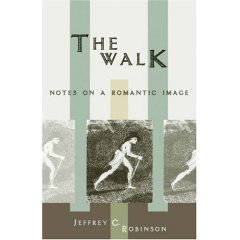
I finished Jeffrey Robinson’s The Walk: Notes on a Romantic Image recently, and I enjoyed it immensely (which won’t surprise you if you follow this blog, as I’ve raved about it a few times before), although I think it’s a rather odd book. The key to understanding the purpose of the book is the word “notes” in the subtitle; it’s really not a developed, detailed argument, but a short, suggestive exploration of the topic. If you come to the book expecting to find depth, you will be disappointed, but if you want an introduction to all kinds of walking literature and the kinds of topics and themes that appear in that literature, this is definitely a good resource.

I say it’s odd partly because of the way it meanders through its topics; I wasn’t always sure where Robinson was heading or why he was discussing a particular work in a particular chapter, and sometimes his arguments get a little abstract, without a whole lot of supporting details to back them up. He also mixed up personal experience with discussions of literature; he opens the book by describing a walk he took in Denver, where he lives, and there’s another chapter made up of numbered notes that describe a walk he took through a Degas exhibit at the Met in NYC. I love this mix of the personal and the academic, when I know a little bit about what attracts an author to the subject and can feel the author’s enthusiasm for the subject in a direct way.

And of course this type of book is wonderful for the recommendations I can glean from it for further reading; I’ve got The Walker’s Literary Companion on the way right now, a book with tons and tons of selections from all kinds of authors, from Dorothy Wordsworth (yay!) to Eudora Welty. I’m actually not super-fond of reading anthologies and selections, but I imagine I’ll find lots to read in this one, and that it will lead me to the longer works that get excerpted here.

Let me leave you with a quotation from the book, one that says surprising things about the benefits of forgetting:

On a walk one is continually encountering the new and, by the “despotism of the eye,” the tyranny of bodily pleasure, willingly forgetting the old. Every forgetting is an assertion of freedom from which the mind goes on another journey. Every forgetting is, in addition, a self-forgetting, an assertion of renewed innocence and pleasure. As we forget, and forget ourselves, we become aware of the gradual fact of hoarding of encounters, impressions, and discoveries. We begin to experience our world as a growing plenitude …

6 Comments

Filed under Books, Nonfiction

The walking essay

I could write a post on each and every chapter of Jeffrey Robinson’s book The Walk, although I won’t, as I’ve already read four or five chapters now without commenting on them and I’d have to catch up (and you might get bored), but I say I could write a post on each chapter because they are all so suggestive and thought-provoking and fun.

So I’ll limit myself to a few quotations from Robinson’s chapter on the the walking essay, which begins with this marvelous bit about Virginia Woolf and essays:

For no subgenre of literature do Virginia Woolf’s remarks on the requirements for the essay — that it “lap us about and draw its curtain across the world” — apply more aptly than for the walking essay. If one does not, at least while reading such an essay, believe in the cozy pleasure of essay reading, a pleasure in which the mind is active but refuses the sharp twists and turns of mind in its most elaborate purposefulness, then one should not waste time with walking essays. In the walking essay, familiarity is its own solution; it confirms itself. One walks either to make a destination, or one walks for the pleasure of walking, says the walking tradition. If you choose the latter walk, you approximate the choice to read a walking essay.

I love the way Robinson connects the experience of walking with that of reading — he does it throughout the book; in fact, that’s really the main idea running through it. And with the walking essay, the idea is that walking and reading both offer a comforting familiarity, a way of engaging the mind that is active, but meandering. The point is not to get anywhere particular; the point is to enjoy the journey. No wonder I love both walking and essay reading so much! A bit later Robinson describes discovering a wealth of walking essays, once he began to look for them, and writes that walkers, “who are almost always bona fide essayists, are urged from somewhere to ambulate on paper about ambulation.”

Robinson also talks about how walking is similar to reading and writing essays because they are both about collecting: readers and writers love to collect essays; walkers love to collect experiences and observations and memories; essays are collections of observations, events, and sometimes lists. He has this to say about the essay:

Acquisition seems to be an important impulse behind the familiar essayist’s activity. Essayists love to list things, particularly, though not by any means exclusively, books. As many essays as there are about walking, there are perhaps twice as many or more about book collections, libraries, books-I-have-enjoyed.

Now this description of the essay reminds me of book blogs, with their frequent lists and tales of book acquisitions and descriptions of books-I-have-enjoyed. Perhaps blogs are about collection too — the collection of posts, of memories, of thoughts, of comments.

Then the essay moves into a discussion of library organization (these chapters really do wander from subject to subject), and includes this wonderful quotation from A.A. Milne on shelving books:

To come to Keats is no guarantee that we are on the road to Shelley. Shelley, if he did not drop out on the way, is probably next to How to be a Golfer through Middle-Aged.

Having written as far as this, I had to get up and see where Shelley really was. It is worse than I thought. He is between Geometrical Optics and Studies in New Zealand Scenery. Ella Wheeler Wilcox, whom I find myself to be entertaining unawares, sits beside Anarchy or Order, which was apparently “sent in the hope that you will become a member of the Duty and Discipline Movement” — a vain hope, it would seem, for I have not yet paid my subscription. What I found Out, by an English Governness, shares a corner with The Recreations of a Country Parson; they are followed by Villette and Baedeker’s Switzerland. Something will have to be done about it.

I am not quite sure how Robinson got from the Virginia Woolf quotation to this A.A. Milne one, but I can say that the journey from one to the other was a pleasure.

6 Comments

Filed under Books, Nonfiction

More on The Walk

Every time I pick up Jeffrey Robinson’s book The Walk it makes me happy, and what more can one ask from a book? The Walk also makes me open up my computer almost immediately to see if the books it mentions are available. Yesterday I came across a reference to The Lore of the Wander: An Open-Air Anthology by George Goodchild (Amazon doesn’t have it, although I found it elsewhere), and E.V. Lucas’s collection of essays Turning Things Over, which contains an essay entitled “A Journey Round a Room” which Robinson praises highly, and which is inspired by Xavier de Maistre’s A Journey Around my Room (published by Hesperus), which I read and loved a few years ago. You see why this is fun?

This book isn’t perfect; I was disappointed by the third chapter, entitled “Throwing off the Burden: Walking and the Self,” which sounds so promising but didn’t quite deliver. Robinson seemed most interested in talking about walking and the self to make a point about Wordsworth, when I would have preferred him to talk about Wordsworth to make a point about walking and the self. This book is quite short — 140 pages — and I’m discovering that it makes no attempt to dive deeply into ideas, but instead covers a lot of ground (so to speak), and so is more suggestive than thorough. I’d like it to be more thorough, but I’m also coming to think that its suggestiveness is part of what makes me so happy; it leaves lots of room for me to read and think some more.

But even that disappointing chapter has this utterly charming pair of quotations to offer; first, this is Hazlitt from his wonderful walking essay “On Going a Journey”:

Give me the clear blue sky over my head, and the green turf beneath my feet, a winding road before me, and a three hours’ march to dinner — and then to thinking! It is hard if I cannot start some game on these lone heaths. I laugh, I run, I leap, I sing for joy. From the point of yonder rolling cloud, I plunge into my past being, and revel there, as the sun-burnt Indian plunges headlong into the wave that wafts him to his native shore. Then long-forgotten things, like ‘sunken wrack and sumless treasuries,’ burst upon my eager sight, and I begin to feel, think, and be myself again.

I think that’s wonderful, but I’m also sympathetic with Robert Louis Stevenson who has this to say about Hazlitt (from “Walking Tours”) — and those of you who are feeling overwhelmed by all that laughing, running, leaping, and singing might like it too:

I do not approve of that leaping and running. Both of these hurry the respiration, they both shake up the brain out of its glorious open-air confusion, and they both break the pace. Uneven walking is not so agreeable to the body and it distracts and irritates the mind. Whereas, when once you have fallen into an equable stride, it requires no conscious thought from you to keep it up, and yet it prevents you from thinking earnestly of anything else. Like knitting, like the work of a copying clerk, it gradually neutralises and sets to sleep the serious activity of the mind.

Although I admire Hazlitt’s energy and joy in his walking, I’m more on the side of Stevenson; I prefer to let walking soothe and calm my mind, almost to put it to sleep, and to walk in a regular pattern that invites a kind of quiet meditation. I don’t need to walk to think; I need to walk to keep from thinking.

And a couple more quotations from the introductory chapter (I haven’t even touched on the chapter on the walking essay, which I’ll have to save for another post):

The walker observes things from a distance, and if the power of the object is in some way too compelling, he by definition detaches himself from it by walking on. Yet the walker is in experience, feels and thinks in his movement through time and space, and is reaching out (or can) to the world in time. To deny either side of the walk is to deny half of experience.

……

When I walk, my mind does not flow like a stream. More literary than that, it works in mixed genres: at times autobiography, polemic, natural description, dialogue, essay, even treatise, story. Sometimes it seems a genre that keep resisting genre. Sometimes internal pressures or laxities break the integrity of genre. Other times the break comes from the squirrel that will not get off the path, the sprinkler’s spray that I must circle around, the old man trudging past in a heavy great coat on this warm day, the vague green lines of algae on lake water.

Robinson constantly points to the ways writing and reading and walking are all similar; in fact, I don’t think you can write a book about walking without doing so to some degree. He slips back and forth between the experience of walking and the experience of reading as though they are the same thing: “walkers, who are almost always bona fide essayists, are urged from somewhere to ambulate on paper about ambulation.”

6 Comments

Filed under Books, Nonfiction

The Walk

156478459201_aa240_sclzzzzzzz_v63860474_.jpgI’m wondering now why it has taken me so long to pick up this book, The Walk, by Jeffrey Robinson; I’ve had it on my shelves since December, and I’ve kept my eye on it as a possibility, but never quite got around to it. But when I picked it up yesterday on a whim, I realized very quickly that it is a book I’m going to enjoy a lot. First of all, and this isn’t even related to the book itself, I noticed that it’s published by Dalkey Archive Press, and it’s got a list of their books in the back, a list which looks quite wonderful, full of world literature titles, some of which I’ve heard of and many of which I haven’t. From what I can tell, they seem to be lesser-known works that tend toward the experimental and subversive. I’ve only recently begun to check out publishers’ websites and blogs, and now I’m wondering what took me so long with this too; I’ve enjoyed checking out the Hesperus Press blog and A Different Stripe, the New York Review of Books Classics blog.

But back to the book; after checking out the Dalkey Archive books, I looked through the “Bibliographic Essay” and the “Afterword,” both of which list books about walking. This sort of essay is a goldmine, isn’t it? Neither of them lists a whole lot of books, but the ones they do are intriguing. Here are a few of them:

  • The Walker’s Literary Companion, eds. Roger Gilbert, Jeffrey Robinson, and Anne Wallace
  • Walks in the World: Representation and Experience in Modern American Poetry, by Roger Gilbert
  • Rebecca Solnit’s Wanderlust (I’ve raved about this one on this blog before)
  • Joseph Amato’s On Foot: A History of Walking
  • Annie Dillard’s Pilgrim at Tinker Creek (I’ve read bits of this but never the whole thing)
  • Edward Hoagland’s Walking the Dead Diamond River
  • Gary Snyder’s book of poems The Back Country (I’ve never read Snyder, but think I will one day)
  • Eric Newby, A Traveller’s Life
  • Laurie Lee, As I Walked Out One Midsummer Morning
  • Aldous Huxley’s Along the Road: Notes and Essays of a Tourist
  • Authors who write about urban rather than rural walking, including Restif de la Bretonne, Baudelaire, Nerval, Andre Breton, Louis Aragon, Kafka, and Walter Benjamin. Also, Alfred Kazin (A Walker in the City), and poets Frank O’Hara and Charles Reznikoff.

And that’s not even all of it, and doesn’t include books mentioned in the main text itself. I’ve read the first two chapters of the main text, the first one an introductory chapter and the second on “The Foot and the Leg.” I love the idea of a chapter on the foot and the leg! I may post on quotations from the introductory chapter some other time, but for now, here are a couple of things from this second chapter:

People observe their feet or write about them with a unique detachment. The foot is not quite a part of the rest of the body, but not quite part of the mind and heart that direct actions and receive impressions. The foot is simply there, as the shoe that eventually may fit it is simply there.

Yet this does not mean that thoughts about the foot are simple or that people agree about its functions and, more provocatively, its character. Thoughts about the foot tend to exist in oppositions: the useful vs. the useless, the primitive or natural vs. the civilized, the animal vs. the spiritual, the physical vs. the mental, the heavy vs. the airy, the earthly vs. the spiritual, the ugly vs. the beautiful, the repulsive and disgusting vs. the sexually attractive and the adorable, the innocent vs. the seductive. The foot either responds to the body’s commands or works from an independent center. The foot is a thing or it is human.

And one more thing from later in the chapter:

Charles Lamb gushed over walking: “walked myself off my legs, dying walking!” This would be life as a pleasurable fulfillment, a leavening of the body into spirit, the rhythm of the legs dissolving the weight of the legs into energy. “To walk one’s legs off” does not indicate dismemberment. No violence hides beneath the swing of the legs. Along with the legs, one will have walked off self-consciousness, all heat. One may have arrived at what Rilke calls “The profound indifference of the heart.”

This is one of the reasons I love walking so much; I can walk off self-consciousness, and turn weight into energy.

11 Comments

Filed under Books, Nonfiction

A Sentimental Murder

I finished John Brewer’s A Sentimental Murder quite a while ago, but still want to write one last post on it (a previous post is here). It’s a wonderful book, in short. It tells the story of James Hackman’s murder of Martha Ray, mistress of the Earl of Sandwich, in 1779. But it does so much more than that — the first chapter tells what we know of the basic facts, and then subsequent chapters tell the story of how the story got told, how various versions developed, the “facts” changed, sympathies shifted.

There isn’t much we know of the facts, actually; Hackman had fallen in love with Martha Ray, but we don’t know for sure what her feelings were in return. On the night of the murder, he seemed more likely to commit suicide and leave Ray in safety, but something changed his mind, and he shot her just outside Covent Garden Theater. He tried to shoot himself, but failed.  He was tried for murder and hanged.

As the story gets shaped and retold through the end of the 18C and on into the 19C and 20C, the story focuses on different characters and different interpretations; at one point Hackman becomes a kind of sentimental hero — even though he is the murder — and at another, the focus is on Sandwich as an example of the corrupt aristocratic rake, and at another, on Martha, sometimes as an example of a fallen woman and sometimes as an exemplar of loyalty and devotion.

But the book does more than give varying interpretations of the story; it uses the story as a way to examine the culture surrounding it. Brewer includes a chapter on the 18C press, explaining how its openness and relatively amateur status meant that those in power could shape news stories as they saw fit (although those with competing versions of the story could do that too). He explains the late 18C culture of sensibility and how it fed into interpretations of the murder — this is a culture that valued emotional displays and loved to theorize about the political and social consequences of feeling. As he moves into the Victorian era, Brewer explains how writers took the murder as evidence of the decadence of late 18C life, compared, at least, to the moral uprightness of their own time.

One of my favorite parts of the book is the very end where Brewer backs up a bit to discuss theories of history and how his own story fits into them. He describes how, since the 1960s, the discipline of history has moved away from focusing solely on the public world of politics and economics and the big names — kings and presidents and prime ministers — and has moved toward telling the stories of everyday people. Writers of history also began to move away from using a detached and objective voice and wrote in a more subjective, personal, and engaged way. They began to look to new sources too — diaries and letters were sources of information, as well as the more traditional sources such as records of parliamentary debates.

Brewer explains how these changes in the discpline of history shaped his book:

The recent attempt to rethink the practice of historians, in other words, is a challenge not a threat. And it is in this spirit that I have written this book, partly as a certain kind of new history but also as an experiment, to see if it will work. I deliberately foreswore an approach that set out to recover the truth about events between 1775 and 1779, though I, as much as anyone, wonder about what lay behind the miasma of news, rumour, and information that circulated after Martha Ray’s death … I did not want to treat all subsequent accounts of the affair merely as sources of facts or evidence … I took what I considered a less invasive alternative. I tried to treat these accounts as stories or narratives with their own histories — not as databases of facts. The significance of each individual account — whether novel, anecdote, or essay — lay not in what it told us about James Hackman, Martha Ray, and the Earl of Sandwich, but in what it told us about the relationship between itself and the events of 1779, the connection between the past it was describing and its present.

If this book is an experiment in new forms of historical writing, I think it succeeds very well; he talks about history written from the bottom up, and this strikes me as a wonderful example — he gives us a picture of the late 18C century (and Victorian and 20C views of the late 18C) by focusing on one small story and following its development and implications. The story includes an aristocrat, but it’s a love story, not a political one — it’s a very personal story, and yet it tells us so much about the culture of the time. And the point is not so much what actually happened between Martha Ray and James Hackman — so much is unclear — but what the various versions of their story meant, what they reveal about the people telling the stories.

3 Comments

Filed under Books, Nonfiction

Reading like a Writer II

I thoroughly enjoyed reading Litlove’s and Stefanie’s posts on Francine Prose’s book Reading Like a Writer, and, if you haven’t read them yet, suggest that you go and read them first, and then return here.

I’ve now finished this book, and agree with Stefanie’s comment that the later chapters are better than the earlier ones. These later chapters cover things like character, dialogue, gesture, and detail, and perhaps these things are more complex and therefore more interesting than the topics of the earlier chapters, words, sentences, and paragraphs. At any rate, although my enjoyment of the book increased as I went on, I still have reservations about its quality.

To be fair, though, I’m not sure how I would have written such a book differently. Litlove confesses that she can be a quotation skipper at times, something I do as well, and much of this book is quotation (sometimes they go on for pages and pages). I got a little tired of quotation after quotation and felt that Prose’s analysis was sometimes a bit short and perfunctory. But how would one write this without the quotations? It’s good that the book was short or I would have found it tiresome; as it is, every time boredom threatened, I found I was near the end of a chapter and so contentedly moved on to another topic.

I’m also grateful the book was short (that sounds mean, although I don’t intend it to be) because what I found most valuable about it was the way it inspired me to pay more attention to the technical aspects of fiction, and that can be accomplished without reading something long. I loved Litlove’s point in her post that Prose is reading in a way that would make authors happy — she is pointing out their brilliance, calling attention to how they have carefully crafted their language — which is only one way of reading; another, perhaps deeper, way of reading is to read against the grain — to pay attention to the things an author may not have been so conscious of, to read subversively, as Litlove says. I’m trained to read in this latter way, and yet I’m intrigued by the former, by Prose’s attention to technical details. All this is to say that I’m grateful for Prose’s reminder of the pleasure to be found in enjoying a well-crafted sentence or bit of dialogue or a masterfully-chosen detail. Also I’m thinking about the technical aspects of writing more and more as I read my friend’s novel and talk with her about it and as I talk with Hobgoblin about his own writing process. All these things have added up to a fun glimpse into a writer’s life.

One more thing — my favorite chapter in Prose’s book is one near the end called “Learning from Chekhov”; here, Prose describes teaching a fiction writing class where her students notice the way she gives them advice about writing but then qualifies it and cites exceptions and backtracks, so much so that this turns into a class joke. She gives example after example of “rules” she has offered her students and then describes the almost eerie way she reads a Chekhov story after class that invariably breaks the rule. She tells a student that he needs to distinguish his two main characters more, and then reads a Chekhov story that has two main characters with the same name, for example, or she’ll tell a student to clarify a story’s point of view and then read a Chekhov story where the point of view similarly shifts.

I like this way of making a point that Prose has been developing throughout: that there really are no rules to fiction writing. It’s not that people sometimes break the rules; it’s that there are no rules. If I were a writer, I might find this idea a little bit terrifying (Prose’s students wanted some guidance, and I can understand why); as a reader, I find it completely freeing — I’m free to enjoy the infinite number of ways a story can be told.

5 Comments

Filed under Books, Nonfiction

Eat, Pray, Love, III

I finished Elizabeth Gilbert’s Eat, Pray, Love a while ago, but I haven’t written about the last part yet. I suppose I won’t say a lot about it, so I can let those of you who are planning to read it discover it on your own. But I will say that while the middle section in India was my favorite, I liked the last section too; it’s set in Bali where Gilbert goes to try to find a balance between pleasure and prayer.

She visited Bali a few years earlier and met a medicine man who told her she would return, and that when she does, she should seek him out and study with him. She takes him at his word, and although she goes through a few scary moments when he doesn’t seem to recognize her, eventually she says the right thing to remind him of who she is, and he welcomes her and invites her to spend big chunks of her day with him. I very much admire Gilbert’s courage here — her ability to take risks, her willingness to tolerate not knowing exactly what she will do and who she will stay with and if the medicine man will remember who she is or even if he meant what he said or if he was just putting her on. Gilbert’s method of traveling is simply to show up somewhere and to see what happens. If I were a traveler, I might do it that way too — I’d get myself into all kinds of problems and have adventures, and I’d love it.

Anyway, there’s lots more stuff that goes on in this chapter — it’s got more action and is less philosophical than the India section. I did want to give you a few of the more meditative passages in the chapter, however; Gilbert reflects on happiness in one section, describing a lesson she has learned from a spiritual teacher:

Happiness is the consequence of personal effort. You fight for it, strive for it, insist upon it, and sometimes even travel around the world looking for it. You have to participate relentlessly in the manifestations of your own blessings. And once you have achieved a state of happiness, you must never become lax about maintaining it, you must make a mighty effort to keep swimming upward into that happiness forever, to stay afloat on top of it. If you don’t, you will leak away your innate contentment. It’s easy enough to pray when you’re in distress but continuing to pray even when your crisis has passed is like a sealing process, helping your soul hold tight to its good attainments.

Now, I don’t know about you, but makes me feel exhausted. I kind of get what she’s saying — we can’t just expect happiness to fall into our laps, right? — but I shy away from any philosophy or form of spirituality requiring me to put in that much effort. Maybe I’m lazy, but I think it’s more likely that this is a hold-over from my younger days when I felt like I had to strive for perfection and could never, ever quite make it. I’m still exhausted from feeling that way. I used to think that I had to constantly guard my soul against sin, that I was in danger of messing up at any moment, that I needed to be forever vigilant against making a mistake. I’m not opposed to putting effort into a spiritual practice, not at all, but it’s got to come from an inner motivation, not from somebody else telling me what to do. And I tend to think that happiness actually does fall into our laps, that when we strive for it, it becomes elusive, and when we are focused on other things, it appears.

I liked this passage about happiness better:

I also keep remembering a simple idea my friend Darcey told me once — that all the sorrow and trouble of this world is caused by unhappy people. Not only in the big global Hitler-‘n’-Stalin picture, but also on the smallest personal level. Even in my own life, I can see exactly where my episodes of unhappiness have brought suffering or distress or (at the very least) inconvenience to those around me. The search for contement is, therefore, not merely a self-preserving and self-benefiting act, but also a generous gift to the world. Clearing out all your misery gets you out of the way. You cease being an obstacle, not only to yourself but to anyone else. Only then are you free to serve and enjoy other people.

I like that idea — that being happy means you are out of the way. You are less likely to trip other people up. I think this is a very freeing idea — wanting to be happy isn’t a selfish thing at all; finding happiness is a way of helping to make the people around you happy.

11 Comments

Filed under Books, Nonfiction

Narration

In the chapter on narration in Francine Prose’s Reading Like a Writer, she talks about the problem of figuring out who you are writing for or who your narrator is addressing when you are writing your novel or story:

Who is listening? On what occasion is the story being told, and why?  Is the protagonist projecting this heartfelt confession out into the ozone, and, if so, what is the proper tone to assume when the ozone is one’s audience?

She solved this problem initially by writing framed stories — stories where narrators told their experiences to other people.  The listener would appear at the novel’s beginning and end and in the middle now and then to comment on or react to the story. In this way, the audience was obvious and the writing came more easily.  She knew exactly who was talking and who was listening and why the narrator was telling the story and what led up to the telling of the story and what the narrator’s motivations were.  This method led her to the question:

Would anyone imagine that these recounted events would hold another human being’s interest, and would the reader believe that anyone, even a fictional character, would stay focused and pay attention all the way through?

What Prose says after this interests me:

It was fortunate that I had lived so much in books, and especially in the books of the past.  For one thing, I seemed not to know that no one wrote that way anymore.  For another, I was somehow unaware that no one lived that way any longer — that is, in circumstances that encouraged and facilitated the telling of long stories.

She goes on to talk about how we don’t have the patience to listen to other people’s stories these days, and we tend to do our best to avoid them (unless they are telling their story on a TV show), so a story like Chekhov’s “On Love” where a group of men tell long stories to each other about their past love affairs can seem highly unrealistic.

I’m not sure if this is true or not — if we really don’t believe anymore that people will listen with interest to other people’s long stories — but it certainly isn’t true for me.  The kind of book Prose is talking about is exactly the kind I like.  Perhaps that makes me old-fashioned, or perhaps Prose hasn’t got it quite right.  I don’t know, but I think this explains why I like epistolary novels — books that are all about people telling each other stories.  Here it’s assumed that your audience is  interested and will read and respond, and that the time put into reading and writing letters is time well-spent.  Yes, at times books like Samuel Richardson’s Pamela or Clarissa come to seem unrealistic — how could they really write all that?  when did they find the time? — but I like the sense of an ongoing conversation in those novels, that the characters can assume that people value their stories, and that they believe taking the time to shape their stories for a particular audience has value.

Prose gives Wuthering Heights as another example of a book about storytelling, this one “constructed like a series of Russian nesting dolls,” beginning with Mr. Lockwood, who gets Nelly to tell him the story, and then with Heathcliff and others telling stories within hers.  Frankenstein is constructed like this too; it opens with letters from Robert Walton to his sister, moves to Frankenstein’s story, which he tells to Walton, and then moves to the creature’s story, which he tells to Frankenstein.  Each of these narratives is quite long.

Perhaps few write this way anymore (I can’t think of modern examples like this, although they must exist — ??), but it doesn’t strike me as unrealistic.  In the past I’ve been known to write long letters myself, and although I don’t tell long stories or expect that people would want to hear them if I did, I like to hear other people’s long stories, provided they are interesting.  Can you think of modern examples of this type of novel, or is Prose right (excepting her own early work, of course)?

10 Comments

Filed under Books, Fiction, Nonfiction, Reading

Eat, Pray, Love, II

I finished the second part of Elizabeth Gilbert’s Eat, Pray, Love today, and while it’s quite different from the first (which I wrote about here), I enjoyed it very much. In this section, instead of seeking pleasure in Italy, Gilbert is seeking God in India. The section has a completely different feel to it; now, instead of practicing Italian and eating pasta all day, she scrubs floors, chants, and meditates in an Indian ashram. She intends to stay at this ashram only 6 weeks and then to travel around India for the next couple months, but after the first 6 weeks are up, she finds herself wanting to stay, so she does.

The section describes her spiritual explorations, her struggle with meditation, first, and then her extreme dislike of the ashram’s practice of chanting the Gurugita every morning. The Gurugita is 182 verses long, and it takes 1 1/2 hours to chant. People get up at 3:00 a.m. and get breakfast only after a session of meditation and then the chanting. Gilbert struggles and struggles with the discipline necessary to do all of this, and with her mind’s unwillingness to settle itself. This is how she describes her struggle with the Gurugita:

When I try to go to the chant, all it does it agitate me. I mean, physically I don’t feel like I’m singing it so much as being dragged behind it. It makes me sweat … Everyone else sits in the chant huddled in wool blankets and hats to stay warm, and I’m peeling layers off myself as the hymn drones on, foaming like an overworked farm horse. I come out of the temple after the Gurugita and the sweat rises off my skin in the cold morning air like fog — like horrible, green, stinky fog. The physical reaction is mild compared to the hot waves of emotion that rock me as I try to sing the thing. And I can’t even sing it. I can only croak it. Resentfully.

But she does learn to sing it. One morning she wakes up to find her roommate has padlocked her into her room and that she is about to miss the chant. Before she realizes what she’s doing, she finds herself jumping two stories out her window so she can join the others. There was something in her that didn’t want to miss it, that insisted she be there. When she arrives she tries to think of a way to make the chanting meaningful, and she decides to dedicate it to her nephew Nick, and this makes all the difference. The chant now becomes one of the most important parts of her time in India.

Gilbert describes a number of spiritual “breakthroughs” she experiences, times when she feels her mind finally quieting down, when she enters new levels of consciousness, when she has dreams and visions. All of this interests me very much, although I find myself, not suspicious or disbelieving of it, but distanced from it somehow. I am very interested in spirituality, but I don’t seem to be able to stick with any kind of spiritual practice long enough to experience anything similar. I’m not sure I’m the kind of person who can. But then again, I don’t know, and I wonder if I’m missing out on something wonderful.

I’m a little uncertain about giving meditation (or any other spiritual practice, for that matter) a serious try partly because, I think, I went through many years as a child of trying to participate in worship and prayer at my parents’ church and not succeeding very well. I grew up thinking I should be feeling God’s presence in church or in prayer on my own and sometimes thinking that I did, but then doubting myself almost immediately afterward. I spent a lot of time feeling like a spiritual failure, and one of the best things that happened to me was growing up and coming to believe that I was actually okay with being a spiritual failure, and that a life without believing in God or feeling God’s presence was quite all right with me.

So I remain intrigued by stories of people’s spiritual journeys, particularly those stories from outside the Christian tradition, and I also feel a bit wistful. There’s something in me that responds to these stories and that feels curious about them, and that also thinks I could learn a lot and benefit from picking up with my own journey. And there’s another part that would prefer to stay far away.

At any rate, Gilbert is now on her way to Indonesia for the last part of the book, which is supposed to be about finding pleasure and devotion both. I’m sure to post on it when I’ve finished.

24 Comments

Filed under Books, Nonfiction

Eat, Pray, Love

I’ve now finished the first of three sections in Elizabeth Gilbert’s Eat, Pray, Love, and although at first I found the writing style a bit glib and Gilbert’s sense of humor a little silly, I now find myself completely won over. The book is about how Gilbert decided to spend a year traveling after suffering through a bitter divorce and a heart-wrenching affair; she travels first to Italy to find pleasure, then to India to practice devotion, and then to Indonesia to try to find a balance between the two.

In the Italian section, Gilbert finds pleasure mainly by eating the best food possible in Rome and every other Italian city she travels to. She also takes joy in learning Italian, first through lessons at a language school and then simply by talking to as many Italians as she can.

Part of what won me over was simply the forthright honesty with which Gilbert tells her story — she describes her horrendous divorce in ways that make it clear just how awful it was but that also don’t ask for your pity and don’t sound whiny or self-indulgent. I think her light, almost glib tone works better when she’s describing something serious; somehow the serious subject matter modulates the voice so that it comes across as brave rather than annoyingly light.

But I also like the ideas she’s exploring, and, as I understand it, the next section on prayer and devotion are even more idea-driven, so I’m looking forward to it. In the Italian section, she writes a lot about the pursuit of pleasure and why she and Americans generally have such a hard time with it. These passages really spoke to me:

Generally speaking, though, Americans have an inability to relax into sheer pleasure. Ours is an entertainment-seeking nation, but not necessarily a pleasure-seeking one. Americans spend billions to keep themselves amused with everything from porn to theme parks to wars, but that’s not exactly the same thing as quiet enjoyment … Americans don’t really know how to do nothing. This is the cause of that great sad American stereotype — the overstressed executive who goes on vacation, but who cannot relax.

For me, though, a major obstacle in my pursuit of pleasure was my ingrained sense of Puritan guilt. Do I really deserve this pleasure? This is very American, too — the insecurity about whether we have earned our happiness. Planet Advertising in American orbits completely around the need to convince the uncertain consumer that yes, you have actually warranted a special treat.

I can be like this — not able to enjoy myself and relax and do nothing because I’m haunted by this feeling that I need to be using my time productively, need to be doing something worthwhile, need to be improving myself in some way. I am very much an inheritor of that Puritan guilt, the mindset and work-ethic that turns pleasure-seeking into a sin.

Towards the end of the section, Gilbert writes this:

It was in a bathtub back in New York, reading Italian words aloud from a dictionary, that I first started mending my soul. My life had gone to bits and I was so unrecognizable to myself that I probably couldn’t have picked me out of a police lineup. But I felt a glimmer of happiness when I started studying Italian, and when you sense a faint potentiality for happiness after such dark times you must grab onto the ankles of that happiness and not let go until it drags you face-first out of the dirt — this is not selfishness, but obligation. You were given life; it is your duty (and also your entitlement as a human being) to find something beautiful within life, no matter how slight.

Isn’t that last sentence beautiful? Seeking beauty in life is not a bad goal to have at all.

16 Comments

Filed under Books, Nonfiction

Blogs and the 18C press

John Brewer’s A Sentimental Murder describes the way newspapers were run in the 1770s, the decade when the murder that forms the book’s subject took place (it happened in 1779 to be exact). Brewer is writing about the way the story of the murder got written up in the press, the way some of the principle people involved did their best to shape the way the story was told, and the way the story itself shifted over time. Brewer’s description of the state of the newspaper business is quite fascinating:

Since the accession of George III in 1760 the rapid expansion of the press had produced a new kind of newspaper, more opinionated than ever before, fuller of comment and criticism, yet not governed by what today we would consider the professional protocols of impartial reporting and editorial control.

He goes on to describe how, because of a change in the price of paper, it became cheaper to make papers larger and longer, and so newspaper printers desperately needed content to fill those pages. Some of that writing came from very unprofessional (by our standards) part-time news-gatherers, but a lot of it came directly from the public.

This is what strikes me as so interesting — that regular people could easily get themselves published in the newspapers of the day:

This informal process of news-gathering supposed a very different relationship between the press and its readers than the print media have today. Those who read the papers — a broadly based group that extended well beyond the aristocracy, even if it did not include a great many of the poor — were also those who wrote them. The newspaper was not an authoritative organ, written by professionals to offer objective information to the public, but a place where public rumour, news, and intelligence could circulate as if it were printed conversation.

Doesn’t this sound a bit like what happens on blogs? Now let me be clear that I appreciate having professional journalists and our modern editorial apparatus (flawed as it often can be). Brewer talks a lot about the way this openness meant that news could be manipulated and could lead to a “climate of scandal and sensation.” Blogs can and do foster this kind of climate too, of course.

But I’m intrigued at the openness of this system, where many people could have a voice and could see themselves in print. It seems to me that when things are working right, we can get the best of both worlds — a professional press producing reliable newspapers and an open internet where anybody can have a voice. Okay, that’s a very idealistic view of things, I know. But I like the idea of a press or a blogosphere where we can all participate in keeping the “printed conversation” going.

8 Comments

Filed under Books, Nonfiction

One last Johnson post

Well, I’ve finished Boswell’s Life of Johnson, and I feel a real sense of accomplishment looking at the very thick, 1250-page edition I’ve got on my shelves. I’m very glad I read it and that I read the whole thing, but I must say that Sandra‘s suggestion that I might read the abridged version was a good one, and although I didn’t follow her advice, I would recommend an abridgement to someone interested in the book but not … you know … obsessive about the time period or the author or subject.

I’m not usually one for abridgements; in fact, I’m really never one for them, but in this case, I think it’s justifiable if you’re sort of interested in the book but are hesitant to devote 1250 pages worth of time to it. The Life of Johnson is filled with interesting stories about Johnson and his friends; great anecdotes; meditations on reading, writing, religion, politics, and famous people of the time; and all kinds of other things. But it’s also full of lots of dull sections, too. It has long descriptions of legal cases Boswell was working on and sought advice from Johnson about. It has a lot of letters, many of which aren’t all that interesting — letters inquiring about people’s health or settling business details or making travel arrangements. Boswell throws everything into the book that someone completely and utterly obsessed with Johnson’s life would want to see — and I mean completely and utterly obsessed. The level of documentation is rather overwhelming.

It’s not at all like the biographies we read today that try to cover the subject’s life evenly and thoroughly; the section on Johnson’s life before Boswell appeared on the scene is relatively short and the later parts of Johnson’s life after Boswell are long. Rather than trying to create the kind of modern biographical narrative with developed stories and smooth transitions and an overarching argument, The Life is rather choppy, made up of short episodes that move abruptly from one to the next. It’s more like a pastiche of documentation and evidence and anecdote than a narrative. Boswell is half biographer, half editor.

Boswell is also an important part of the biography himself; while telling his first-hand accounts of time spent with Johnson, Boswell reveals much about himself — not only his actions and his half of the conversations and his letters to Johnson, but his capacity for friendship and adoration.

If there is an overarching argument to the book, it’s that while Johnson was not a perfect human being, he was awfully darn close; those who had ever attacked and criticized Johnson come in for their own dose of criticism here. Boswell does try to be fair, pointing out what he sees as Johnson’s faults, but the overriding tone is defensive: yes, Johnson looked odd, he could come across as rude, he would argue for things he didn’t believe in just for the fun of it, he could take pleasure in attacking people, and he held some rather bizarre beliefs, but he was a genius, and that’s what we should remember.

I’m hoping Adam Sisman’s Boswell’s Presumptuous Task comes in the mail soon, via Book Mooch, because I’m excited to learn about the creation of The Life. That, in itself, is bound to be a marvelous story.

6 Comments

Filed under Books, Nonfiction

Your (almost) weekly Johnson post

I’m nearing the end of Boswell’s Life of Johnson, and although I’m now feeling ready to move on, I will miss this book when I’m finished — it’s been such a nice almost daily companion for the last few months.

Death has been a recurring theme throughout the book, and, not surprisingly, it is appearing more and more often as Johnson ages — he talks about fearing death and not believing those who claim to face it with courage. He recognizes that it’s natural to fear death, but he also offers some wisdom as to how best to face it (this is Boswell’s recounting of Johnson’s conversation):

It is by contemplating a large mass of human existence, that a man, while he sets a just value on his own life, does not think of his death as annihilating all that is great and pleasing in the world, as if actually contained in his mind … It must be acknowledged, however, that Pope’s plaintive reflection, that all things would be as gay as ever, on the day of his death, is natural and common. We are apt to transfer to all around us our own gloom, without considering that at any given point of time there is, perhaps, as much youth and gaiety in the world as at another … Let us guard against imagining that there is an end of felicity upon earth, when we ourselves grow old, or are unhappy.

This attempt to keep a larger view of life — to realize that we are only a very, very small part of everything that exists — is a note Johnson frequently sounds. And I think it can be comforting to keep this larger view, especially when facing a particularly trying time. In the larger scheme of things, what does this little disturbance matter? On the other hand, when it comes to our own death, what else can we do but think of it as complete annihilation? Does it matter to me that the world goes on after I’m gone? Sometimes I think about what it would be like to live before a particular author existed — to not know about Shakespeare or Charles Dickens or Virginia Woolf because you lived before them, or to not know about the novel because you lived before it developed — and that makes me think about what I’ll miss. What wonderful writer will appear 100 or 200 years from now that I’ll never know about?

But as much as Johnson provokes gloomy thoughts of this sort, he also can be very good at putting them to rest. When Boswell complains to Johnson in a letter that he has “been troubled by a recurrence of the perplexing question of Liberty and Necessity,” this is Johnson’s response:

I hoped you had got rid of all this hypocrisy of misery. What have you to do with Liberty and Necessity? Or what more than to hold your tongue about it? Do not doubt but I shall be most heartily glad to see you here again, for I love every part about you but your affectation of distress.

Something about this combination of affection and gentle chastisement appeals to me. With problems that we can do absolutely nothing about, what use is there to dwell on them?

But lest you think The Life is all seriousness, I’ll include this amusing story. I’m not finding The Life terribly funny, but I did laugh out loud when I read this — speaking of the wife of a well-known author, Johnson says:

” … the woman had a bottom of good sense.” The word bottom thus introduced, was so ludicrous when contrasted with his gravity, that most of us could not forbear tittering and laughing; though I recollect that the Bishop of Killaloe kept his countenance with a perfect steadiness, while Miss Hannah More slyly hid her face behind a lady’s back who sat on the same settee with her. His pride could not bear that any expression of his should excite ridicule, when he did not intend it; he therefore resolved to assume and exercise despotick power, glanced sternly around, and called out in a strong tone, “Where’s the merriment?” Then collecting himself, and looking awful, to make us feel how he could impose restraint, and as it were searching his mind for a still more ludicrous word, he slowly pronounced, “I say the woman was fundamentally sensible;” as if he had said, hear this now, and laugh if you dare. We all sat composed as at a funeral.

Can you imagine?

5 Comments

Filed under Books, Nonfiction

Books and reading: your weekly Johnson post

I’ve come across a number of passages in Boswell’s Life of Johnson on books and reading that I thought you might like. For those of you with large libraries, there’s this passage:

Dr. Johnson advised me today to have as many books about me as I could; that I might read upon any subject upon which I had a desire for instruction at the time. “What you read then, (said he,) you will remember; but if you have not a book immediately ready, and the subject moulds in your mind, it is a chance if you have again a desire to study it.” He added, “If a man never has an eager desire for instruction, he should prescribe a task for himself. But it is better when a man reads from immediate inclination.”

Here’s justification for having a book on hand, just in case! Have as many books around you as you can, because you just never know! I do like the idea that we’ll remember things better if we read about them right away when we get the impulse — if I’m curious about something I should read it now rather than waiting until I’ve read all the things I’ve got planned to read first. Although I’m susceptible to reading plans and complicated programs of instruction, I should probably make sure I’m willing to set them aside when they lose their interest. Actually, the more I think about it, the more I think there must be a middle ground here, because surely there’s something to be said for learning something methodically rather than always following the whim of the moment. But the method can’t outlast a reader’s ability to profit from it.

And Johnson has more to say about reading and education:

“I am always for getting a boy forward in his learning; for that is a sure good. I would let him at first read any English book which happens to engage his attention; because you have done a great deal, when you have brought him to have entertainment from a book. He’ll get better books afterwards.”

I like this idea. To have learned that reading can be fun is the first thing, and once a person has learned that, then they can learn how to have fun with more complicated kinds of reading. I have come across the idea a number of times recently that to say “it doesn’t matter what you read as long as you are reading” isn’t true — that it does matter what you read and reading easier kinds of things like commercial fiction isn’t just as good as other, more challenging kinds of reading. I feel ambivalently about all this, being uncertain what is meant by “good” reading and what it is we’re talking about that matters so much. I’m certain Johnson wouldn’t say that any kind of reading is always just as good as any other kind of reading, but he does recognize that very often people need to go through a period of reading regardless of quality. Johnson sees this trashier kind of reading as a stage one progresses through; I don’t see it as a stage one necessarily has to pass through or that it’s even a stage at all (a person can read lighter things alongside heavier ones), but I do agree that the enjoyment a person feels while reading any sort of book is a thing to be celebrated.

And about the glut of books out there available for us to read, Johnson says this:

“It has been maintained that this superfetation, this teeming of the press in modern times, is prejudicial to good literature, because it obliges us to read so much of what is of inferiour value, in order to be in the fashion; so that better works are neglected for want of time, because a man will have more gratification of his vanity in conversation, from having read modern books, than from having read the best works of antiquity. But it must be considered that we have now more knowledge generally diffused; all our ladies read now, which is a great extension. Modern writers are the moons of literature; they shine with reflected light, with light borrowed from the ancients.”

It amuses me to think that complaints about the overwhelming multitudes of books waiting for us to read them have existed for a long, long time. We so often think our complaints and worries are brand new. Women readers are apparently the answer to the 18C problem, another amusing thought; I suppose the more readers exist, the more likely it is that someone will be appreciating those ancient works in danger of neglect.

It’s comforting to know that we are not the only ones who have struggled with the problem of what to read first — that brand new book we can brag about having read at a party or that classic we have been meaning to get to forever.

7 Comments

Filed under Books, Nonfiction, Reading

Yoga for People Who Can’t Be Bothered to Do It

7544847.gifI’ve finished Geoff Dyer’s Yoga for People Who Can’t Be Bothered to Do It, and let me say, first of all, that it’s not about yoga. At least, it’s not about the poses people think of when they think about yoga. It does have something to do with the philosophy that lies behind yoga, but more on that later.

Let me say, second of all, that I enjoyed this book very much. It’s uncategorizable, which is my favorite kind of book — it’s part travel narrative, part personal essay, part memoir, and part philosophical meditation, although the more philosophical sections are short. What philosophical meditations we get are moments in the midst of the stories, moments that come out of the stories and lead back into them.

Many of the blurbs on the book mention how funny it is, but except for one or two moments when I laughed out loud, I didn’t find this book very funny. But it was so many other interesting things, I didn’t miss the humor. There are ten chapters, each one set in a different location, including New Orleans, Rome, Libya, Cambodia, the Burning Man festival in the Black Rock Desert, and others. Dyer tells stories about the people he meets, the parties he attends, the love affairs he has, the drugs he does — at this point you may be wondering why I like this book, since I’m a boring, stay-at-home kind of person who wouldn’t know how to find drugs if I wanted to.

But the persona here is appealing. He’s got an open attitude toward life; he’s willing to try just about anything. He’s frequently depressed and despairing, but also capable of finding moments of peace, and his meditations about himself and his life are always interesting. He’s thoughtful but also reckless, hard on himself but also forgiving.  He’s brutally honest about himself and the world:

… I looked up from my notes and was confronted, in the mirror above my desk, with the awful reality — grey hair, bulbous nose, scrawny neck — of my appearance. I have often been disappointed by my appearance, but I have never looked so utterly repulsive as I did then … “Life,” said the face in the mirror, “is taking its toll. All the disappointment and regret, all the bitterness and rage that you have tried to keep hidden, is now breaking out, eroding the last patina of handsomeness, and hope. You are no longer a handsome man. This is the fate of all those who place an undue value on physical attractiveness. You will become one of those people — one of the hundreds of people to whom you paid the bare minimum of attention simply because you did not like the way they looked.”

Maybe his attitude can be best summed up in this conclusion to a chapter spent describing a visit to Roman ruins:

… at some level I knew I had been kidding myself: that all the intellectual discipline and ambition of my earlier years had been dissipated by half-hearted drug abuse, indolence, and disappointment, that I lacked purpose and direction and had even less idea of what I wanted from life now than I had when I was twenty or thirty even, that I was well on the way to becoming a ruin myself, and that that was fine by me.

Ultimately, the book is about what to do after you realize you’re turning into a ruin. Do you despair, or accept it, or both? Dyer’s travels seems to be a response to this realization — he’s traveling as a distraction from pain, seeking out new people and new experiences to pass the time as comfortably as possible, and yet he’s aware at the same time that everywhere he goes, he finds only himself. There is no escape. Travel as distraction and escape leaves him all the more burdened with the weight of himself:

I felt disappointed, cheated. As the gloom settled I saw that I had spent the last fifteen years dragging the same burden of frustrated expectation from one corner of the world to the next.

And so the only thing to do is to try to make peace with yourself, even if only for a moment. And here we come to the meaning of the book’s title, because yoga’s true meaning is not the poses you might do in a yoga class, but has more to do with the search for insight and enlightenment. The term “yoga” comes from a word that means “yoke” or “union”; it’s really about finding unity with God or with something larger than oneself, or, perhaps, finding unity within oneself.

So, in the midst of the sometimes manic movement from place to place, Dyer is looking for a sense of unity and coherence of experience, for moments when he can just be where he is:

“What I want,” I said, “is a place where we can sit down, where we can just chat for a couple of hours before we go to Matt and Alexandra’s lavish suite. A place with nice music, comfortable seats, and nice tea, and so forth.” I went on and on about this, and as I did so I had a dim sense that I was working through something, some neurosis that refused to manifest itself plainly. And then it came to me.

“D’you know,” I said, “I have just described exactly the place we’re in. I’m already in the place I want to go to.”

“Well done, darling,” said Dazed. “You’ve escaped from samsara.”

This exchange (Dazed is Dyer’s current girlfriend) sums up the book beautifully — it’s about learning to want to be in the place you’re in, and it’s an insight expressed with a little bit of self-mockery and mild sarcasm. Dyer takes up some heavy subjects in this book, but he never takes himself — or anything else for that matter — too deadly seriously.

15 Comments

Filed under Books, Nonfiction

Your weekly Johnson post

I think it’s time for another post on Boswell and Johnson. I’ve been marking interesting passages with post-it notes and after I blog on those passages taking them out, so when I see a lot of post-it notes accumulating in the book, that means it’s time to write about it again.

First of all, I can’t resist giving you Boswell’s description of Johnson’s extremely odd mannerisms:

…while talking or even musing as he sat in his chair, he commonly held his head to one side towards his right shoulder, and shook it in a tremulous manner, moving his body backwards and forwards, and rubbing his left knee in the same direction, with the palm of his hand. In the intervals of articulating he made various sounds with his mouth; sometimes as if ruminating, or what is called chewing the cud, sometimes giving a half whistle, sometimes making his tongue play backwards from the roof of his mouth, as if clucking like a hen, and sometimes protruding it against his upper gums in front, as if pronouncing quickly under his breath, too, too, too: all this accompanied sometimes with a thoughtful look, but more frequently with a smile. Generally when he had concluded a period, in the course of a dispute, by which time he was a good deal exhausted by violence and vociferation, he used to blow out his breath like a whale.

Johnson is someone I wish I could have seen. Much if not most of The Life is taken up with accounts of conversations; Johnson, Boswell, and friends sit around and talk about literature and politics and the latest gossip (and they do love to gossip!), and while reading Boswell’s accounts of it all is great, surely it’s nothing compared to actually being able to witness these bull sessions.

Boswell describes Johnson getting angry, violent, and vociferous, but then quickly calming down, realizing he’d gone too far, being willing to make peace with whomever he was angry at. Can you imagine, Dr. Johnson getting furious with you? I’d be terrified.

And, unfortunately, I’d have every reason to be terrified of Johnson if I’d had the chance to meet him because he hated Americans (and, also unfortunately, some of the things he says about women I’m not too keen on):

From this pleasing subject, he, I know not how or why, made a sudden transition to one upon which he was a violent aggressor; for he said, “I am willing to love all mankind, except an American:” and his inflammable corruption bursting into horrid fire, he “breathed out threatenings and slaughter;” calling them, “Rascals — Robbers — Pirates;” and exclaiming, he’d “burn and destroy them.” Miss Seward, looking to him with mild but steady astonishment, said, “Sir, this is an instance that we are always most violent against those whom he have injured.” — He was irritated still more by this delicate and keen reproach; and roared out another tremendous volley which one might fancy could be heard across the Atlantick.

I don’t remember just what caused this hatred, if it has any explanation at all. From this safe distance in time I can be amused at this moment of irrationality from so rational a man, but I’m still extremely grateful I wasn’t there to witness it. Boswell describes trying his best to calm Johnson down and divert him with some other, safer topic; in fact, he fairly regularly needs to do this. Johnson sometimes seems like a man who needed a little managing.

But the extent of their regard for each other comes through very clearly. Boswell is always praising Johnson to the skies and worrying that Johnson is angry with him, and Johnson clearly loves Boswell in return and tries to reassure him, although somewhat impatiently. This is Johnson speaking:

Nay, Sir, you are more likely to quarrel with me, than I with you. My regard for you is greater almost than I have words to express; but I do not chuse to be always repeating it; write it down in the first leaf of your pocketbook, and never doubt of it again.

And here is Boswell’s justification for recording many little details of Johnson’s life:

I cannot allow any fragment whatever that floats in my memory concerning the great subject of this work to be lost. Though a small particular may appear trifling to some, it will be relished by others; while every little spark adds something to the general blaze: and to please the true, candid, warm admirers of Johnson, and in any degree increase the splendour of his reputation, I bid defiance to the shafts of ridicule, or even of malignity. Showers of them have been discharged at my “Journal of a Tour to the Hebrides;” yet it still sails unhurt along the stream of time, and as an attendant upon Johnson, “Pursues the triumph, and partakes the gale.”

And in another letter Boswell says this:

I vow to thee an eternal attachment. It shall be my study to do what I can to render your life happy; and if you die before me, I shall endeavour to do honour to your memory; and, elevated by the remembrance of you, persist in noble piety.

What a friendship! I am enjoying reading all the details about Johnson’s life, but I’m enjoying even more reading this record of affection.

6 Comments

Filed under Books, Nonfiction

Why write? (or read? or ride my bike?)

I’ve found enough essays I’ve enjoyed in The Best American Essays 2006 to keep me going, although I’ve had lots of grave doubts about the overall quality of the book. My ambivalence has continued with my latest essay “Why Write?” by Alan Shapiro. I found myself irritated with Shapiro’s silly sense of humor through the beginning of the essay, until I got to one extraordinary page that redeemed the whole thing for me.

Maybe something is wrong with my sense of humor, but I found these opening sentences intensely irritating:

Some years ago, I went to a child psychologist. (If Henny Youngman had written this opening sentence, he would have added: “The kid didn’t do a thing for me.” But I digress.)

Anyway, the essay begins with the story of how Shapiro gets diagnosed with Attention Deficit Disorder as an adult, having been tested when one of his children was diagnosed, after which the doctor tells him that his writing can be seen as a “compensatory behavior” for his disability. In response, Shapiro says something genuinely funny:

“Let me get this straight,” I said. “I write books in order to make up for my inability to remember the names of the people I meet at a party, or because I come home from the grocery store with a red pepper instead of a tomato?”

He goes on from there to consider the various reasons he’s sought a career in writing, since, after all, the money’s no good and fame is so fleeting. After some irritatingly silly joking, Shapiro gets to a serious answer to his question about why he writes, by way of Elizabeth Bishop, and along the way he addresses the question of why we read (it’s a long passage, but a great one):

Bishop writes that what we want from great art is the same thing necessary for its creation, and that is a self-forgetful, perfectly useless concentration. We write, Bishop implies, for the same reason we read or look at paintings or listen to music: for the total immersion of the experience, the narrowing and intensification of focus to the right here, right now, the deep joy of bringing the entire soul to bear upon a single act of concentration. It is self-forgetful even if you are writing about the self, because you yourself have disappeared into the pleasure of making; your identity — the incessant, transient, noisy New York Stock Exchange of desires and commitments, ambitions, hopes, hates, appetites, and interests — has been obliterated by the rapture of complete attentiveness. In that extended moment, opposites cohere: the mind feels and the heart thinks, and receptivity’s a form of fierce activity. Quotidian distinctions between mind and body, self and other, space and time, dissolve.

Now as far as writing goes, this passage doesn’t ring true to me, as I can’t really remember ever feeling that absorbed in my writing; or, if I have felt that way, it’s not something that has “stuck,” something I need to return to again and again. This is probably why I tend not to think of myself as “a writer,” although I do a decent amount of it. Shapiro speculates that writers may have a reputation for suffering from melancholy, not because good writing requires sadness and depression, but because after feeling the absorption and attentiveness of writing, Bishop’s “perfectly useless concentration,” their non-writing lives seem lacking and they feel haunted until they can return to that trance-like state.

This passage does ring true to me when I think about reading, however; and I like how Bishop describes both writing and reading as activities that can create this happy absorption. Bishop portrays reading or viewing a work of art as a creative act in itself and her formulation excludes nobody; everybody can interact with art and be self-forgetful for a while.

What really made me happy about this part of the essay, however, were the next lines:

Athletes know all about this nearly hallucinatory state. They call it being in the zone. They feel simultaneously out of body and at one with the body.

Yes, I know exactly what he’s talking about. Sometimes when I’m riding or hiking I feel like a truly whole human being, no separation between my mind and my body. I’m not thinking about what I’m doing; I’m just doing it. I’m just a being walking or riding a bike, wholly focused on the present moment.

And then, to add to all this goodness, Shapiro writes a passage that dovetails beautifully with Litlove’s recent post on the symbolic and the semiotic, the symbolic being straightforward language and the semiotic being the musical, poetic quality of language. Shapiro talks about how infants experience a form of the concentration he has been describing, expressing it through their babbling babytalk. Of his children as infants he says,

He or she would be talking, but the meaning of the words were indistinguishable from the sensation of the sound, and the sound was part and parcel of the mouth that made the sound, of the hands and fingers that the mouth was sucking as it sang.

In other words, the symbolic and the semiotic are one and the same.  And from there, he moves to how we as adults continually seek out this lost relationship to language, the lost connection of the symbolic and the semiotic:

No matter how sophisticated our poems may be, or how deadly serious they are about eradicating or exposing the terrible injustices around us, I still think that we are trying — by means of words, of consciousness — to reawaken that pre-verbal joy, to repossess, reinhabit what someone else has called the seriousness of a child at play. Bishop says this concentration’s useless because it is its own reward, the mysterious joy of it. It is singing for the sake of singing.

Isn’t it beautiful how this all comes together? Writing and reading, and walking and riding for that matter, are ways of finding unity and wholeness — of the body and the mind, of the adult self with the child self. The close of Litlove’s post brings it together wonderfully:

Great writers know how to tap into and express the semiotic in their works, and so what they say speaks to us at a profound level. I like to think of this layer of other meaning, beyond and within communication, as the defining characteristic of the literary. And our ability, from birth, to hear and express it, to tap into it and to play with it, is what makes us all fundamentally literary creatures, in a basic instinctual way.

10 Comments

Filed under Books, Nonfiction