Category Archives: Nonfiction

Sentimental fiction and The Recess

It’s kind of annoying when I decide I don’t like a book, and then a critic comes along and makes a convincing argument about how wonderful it really is. Here’s what Patricia Meyer Spacks says about the meaning of history in Sophia Lee’s The Recess:

Sublimity in this novel finds realization in history, history conceived as a concatenation of irresistible but incomprehensible forces. Obscure, terrible, all-powerful, unmindful of individuals, it possesses all the qualifications of the sublime. To be sure, there is no “it” there: “history” is an abstraction, a retrospective generalization, an unpredictable produce of memory, myth, and desire. The reader, obviously, is in a different position from the characters in relation to history. Lee brilliantly exploits the difference by constantly reminding us that what we accept as truth depends on where we stand … We are all of course caught up in history; this novel insists on how little we can know what that means.

Now doesn’t that make The Recess sound fascinating? And in a way, the book was fascinating … and yet my experience of reading it was too often one of boredom. There is a category, I suppose, made up of books that are more interesting to talk about than to read, and to me, The Recess clearly belongs here.

One of the things I appreciate most about Spacks’s book is the way she thinks about pleasure in reading and how it changes over time. She says, for example, that certain elements of Henry Fielding’s Tom Jones — “the systematic construction of suspenseful situations, with purposefully delayed resolutions; the enormous cast of characters; the frequent interventions by the narrator” — helped teach readers to take new and different kinds of pleasure in reading. I like the idea that authors can help readers learn to read in new ways and to find new pleasures simply by writing the way they do, and it’s fascinating to think that readers might not automatically find suspense, delayed resolutions, and enormous casts of characters pleasurable.

She also explains the pleasure readers found in sentimental novels, novels that often seem bizarre and foreign to us today. She argues that readers today enjoy exercising emotions as they read just as they did in the eighteenth century, but it’s the ways of evoking emotional response that seem strange to us now. Sentimental novels of the time depended on two modes that we don’t see today: a “curious withholding of elucidating or corroborative detail” and a “massive accumulation of ostensibly heartrending episodes.” These novels tend to give little detail about the character’s emotional responses, telling us straightforwardly about them rather than showing us with evocative detail. And they tend to include — to be overwhelmed by — story after story of suffering and woe.

In response to the lack of detail, readers learned to fill in the missing details themselves. If an author doesn’t tell us exactly how a character felt but simply says that the character suffered, then we are free to imagine exactly what that suffering was like:

Although the system of extreme understatement allows all feeling to be clichéd, it also leaves room for other possibilities. Engaged readers are at liberty to invent, to imagine, or to perceive afresh … Readers can always or intermittently refuse the implicit invitation mentally to elaborate rendered feeling, but opportunities abound, in this fiction, for their imaginative participation.

The plethora of stories about suffering and woe serve a different purpose; their proliferation implies that life is little else than suffering; they rehearse again and again the sufferings readers themselves can expect to experience. But they also communicate a sense of defiance. Spacks compares the melancholy of these novels to the writing of Samuel Beckett, arguing that while the sense of depression in Beckett’s work is relieved by his “exuberant linguistic power,” the melancholy of sentimental novels is mitigated by “an exuberance of defiance.”

All this I certainly saw in The Recess. Lee uses detail sparingly, so that I never got a vivid sense of what each character looked like or thought about; the characters seemed clichéd to me. She also tells story after story of suffering; the two main characters absolutely cannot catch a break. Nothing goes right — every time something good happens to them, it gets taken away or something else goes wrong.

I did not find myself filling in the details of the characters’ emotional experience, as Spacks says the text was inviting me to do; rather, I resisted the emotional descriptions and found them overwrought and silly. But given the popularity of The Recess in the eighteenth century, people then would not have agreed with me. The introduction to my edition describes reports of readers who found the novel genuinely moving, and tells about a novel by Elizabeth Tomlins in which a character reads The Recess, and has this to say about the experience:

From the moment I first opened it, till the last sorrowful scene which closes the overwhelming narration of miseries, I quitted not the book. As I read, I felt all the pains of suspense at my heart, and I know not a term which can convey to you an idea how infinitely I felt myself interested through the whole: I was frequently affected even beyond the power of weeping, and scarcely could prevail on my aunt, with all my entreaties, to let me read the last volume; but persuading her that I should, perhaps, be less affected when alone, I had all the luxury of weeping over it myself.

I have a hard time imagining weeping over The Recess, and yes, it is a fictional character doing the weeping here, but this response to the novel isn’t meant ironically or satirically; it seems possible real people shed some tears over it too.

The endless tales of sorrow did create an atmosphere of melancholy and darkness, and there was a sense of resiliency and defiance at the same time; so many horrible things happened to the characters — attacks, attempted rapes, imprisonment, enslavement, kidnappings, poisonings and on and on — but they kept up their energy and spirit and their persistence in writing their story. The novel is a rehearsal of a range of horrible things that can happen to a person, but there’s something reassuring in seeing the characters fight their way through each episode. I can see how an eighteenth-century reader might take a perverse kind of pleasure in this aspect of the novel.

I’m not prepared to say The Recess is an enjoyable read, but as I think about it more, those eighteenth-century readers who liked it seem a little less strange to me.
9 Comments

Filed under Books, Fiction, Nonfiction

Novelistic Multiplicity

I have begun reading Patricia Meyer Spacks’s new book on the 18C novel, Novel Beginnings: Experiments in Eighteenth-Century English Fiction. The front flap declares that the book is intended for a general audience, and so far (I’ve read the introduction and part of the second chapter), this seems to be true. It’s got lots of good information that a specialist would be interested in, but it’s clearly written and engaging and gives all the background a general, non-academic reader would need.

She argues that while critics have focused on realism in the development of the 18C novel, what actually happens is much more complex, and she will look instead at deviations from realism, at the many experiments that authors undertook with narrative forms. She discusses what is for me one of the most exciting characteristics of the 18C novel: the fact that during the 18C there were no novelistic “rules.” 18C writers made up many of the rules we’re familiar with today, but at the time, they didn’t exist. So Spacks’s idea is to focus on the diversity of form, style, and content present in novels, rather than pointing out unities that existed then and that would later harden into rules.

One of the points she makes that particularly intrigues me is about narrative multiplicity versus unity. Many if not most or even almost all early 18C novels told multiple stories; they did not focus on a handful of main characters and develop them in detail, but instead had lots of sets of characters and lots of stories. These stories were often brief and told without much detail. The focus was not on character development, but instead on events, lots and lots of events:

Narrative multiplicity rather than detailed development marks many early-century fictions, apparently predicated on the assumption that readers will not long sustain interest in a single set of characters or predicaments.

Think, for example, of The Decameron where there is a frame narrative but within that frame narrative a hundred stories are embedded. Another example is Mary Delarivier Manley’s work The New Atalantis, which also has a frame narrative that never gets developed in depth, and then the characters tell each other stories, which make up the bulk of the book. Isn’t it interesting to think that readers might not have wanted to read about the same people at length?

What this focus on multiple plots does is to offer the reader a particular kind of pleasure:

… the reader is invited to take pleasure in a collection of happenings linked more by sequence than by logic and to register the excitement of sheer event.

Writing of the early 18C novelist Jane Barker, Spacks argues that

The vigorous, varied, lavishly multiplied narratives that compose her novels declare the power of fiction, not to make the reader suspend disbelief; rather, to make disbelief irrelevant. The pleasure these stories provide acknowledges invention, manipulation, ground-shifting, and the wide possibilities of the reader’s role. Above all, the stories acknowledge their own fictionality.

We are far from realism here. Instead, what we have is such a multiplicity of stories that the reader is not led to believe in any of them, but rather to enjoy the energy and power of them, to enjoy the author’s inventiveness.

Now I must say that none of this appeals to me particularly. I find it hard to understand how readers would find pleasure in all this diversity and multiplicity. I much prefer the unity of plot and the character development that begins to become the norm in the second part of the 18C. Reading story after story after story where the action zips by and the characters are never fleshed out strikes me as wearisome rather than exhilarating. But it’s interesting to think about how different readers’ tastes can be, and I wonder how much of this is a personal matter (perhaps some of you would disagree with me?) and how much of it is a cultural matter — i.e., perhaps we have been trained by the 19C and 20C novel to value depth of character development and unity of plot and that makes it harder to appreciate the fun of multiple narratives.

Spacks’s account does help explain my impatience with The Recess; although it was published in 1783 when the novel was moving away from the multiplicity characteristic of the earlier part of the century, it still is full of plot events and is rather short on character development. It has unity of plot in the sense that it focuses on two main characters, but it’s so full of events, unbelievably full of them that it’s clear it was influenced by earlier forms of the novel. Believability is not the point at all; rather, the point is to see just how much those two main characters can handle.

Now if you’re wondering where a novel like Clarissa fits into this scheme, a novel where practically nothing happens and we are with the same characters for 1,500 pages, it’s evidence, for Spacks, of the diversity of form in the 18C. You can find lots of extremes in the period — short novels and long novels, novels about few characters and novels about many, novels that have lots of detail and novels that don’t, novels with a fast pace and novels with a slow pace. Over the course of the century, many of these extremes began to disappear and novelists found a happy medium. This happy medium would turn into what we tend today to think of as “the novel.”

5 Comments

Filed under Books, Nonfiction

My Last Frances Willard Post

Yes, I have finished A Wheel within a Wheel and am now very sad that there is no more left. But surely I can find other things Frances Willard has written, such as Writing Out my Heart: Selections from the Journal of Frances E. Willard. There is also a biography of her available.

I’ve valued Willard’s ability to tell some incident or story about cycling and then turn the story into some larger philosophical or moral point; in one of my favorite instances of this technique, she starts off by describing how difficult it is for a person to teach another person to ride a bike because it’s so hard to understand what the other is experiencing, and then she says this:

For one of these [people] perfectly to comprehend the other’s relation to the vehicle is practically impossible; the degree to which he may attain this depends upon the amount of imagination to the square inch with which he has been fitted out. The opacity of the mind, its inability to project itself into the realm of another’s personality, goes a long way to explain the friction of life. If we would set down other people’s errors to this rather than to malice prepense we should not only get more good out of life and feel more kindly toward our fellows, but doubtless the rectitude of our intellects would increase, and the justice of our judgments.

I’ve often thought something along these lines — that when we misunderstand each other or when conflict crops up, it’s so often caused by a failure of imagination. We don’t see what the other person is experiencing and can’t grasp what emotions they are going through. We are quick to think they have offended us on purpose, when they really had no such intention or were simply caught up in their own thoughts and feelings to pay attention to ours.

I also appreciate Willard’s witty turns of phrase. I love her line “the amount of imagination to the square inch with which he has been fitted out” — I wonder how much imagination I’ve been granted for each of my square inches! And then there’s this clever analogy she uses to describe learning how to mount a bicycle:

As has been stated, my last epoch consisted of learning to mount; that is the pons asinorum of the whole mathematical understanding, for mathematical it is to a nicety. You have to balance your system more carefully than you ever did your accounts; not the smallest fraction can be out of the way, or away you go, the treacherous steed [she loves to call the bicycle a steed] forming one half of an equation and yourself with a bruised knee forming the other. You must add a stroke at just the right angle to mount, subtract one to descend, divide them equally to hold your seat, and multiply all these movements in definite ratio and true proportion by the swiftest of all roots, or you will become the most minus of quantities.

And, finally, one more quotation that is not witty but is fascinatingly open-minded. She has just told the story of falling off her bicycle and breaking her arm. Before the doctors treat her, they give her some ether to dull the pain. Under the influence of ether, she has fabulous dreams, and then the most profound feeling of peace and love she has ever experienced settles over her. She is convinced that “there is no terror in the universe, for God is always at the center of everything.” And as she comes out of the ether-induced visionary state, she concludes:

Little by little, freeing my mind of all sorts of queer notions, I came back out of the only experience of the kind that I have ever known; but I must say that had I not learned the great evils that result from using anesthetics I should have wished to try ether again, just for the ethical and spiritual help that came to me. It led me out into a new world, great, more mellow, more godlike, and it did me no harm at all.

She advocates the mind-opening, consciousness-changing recreational use of drugs! Well, sort of. She includes a caution about the danger of such use. But still!

6 Comments

Filed under Books, Cycling, Nonfiction

Cycling Fashions

As I hoped she would, Frances Willard discusses the issue of women’s clothing, specifically, what women wear when they ride:

If women ride they must, when riding, dress more rationally than they have been wont to do. If they do this many prejudices as to what they may be allowed to wear will melt away. Reason will gain upon precedent, and ere long the comfortable, sensible, and artistic wardrobe of the rider will make the conventional style of women’s dress absurd to the eye and unendurable to the understanding. A reform often advances most rapidly by indirection. An ounce of practice is worth a ton of theory: and the graceful and becoming costume of woman on the bicycle will convince the world that has brushed aside the theories, no matter how well constructed, and the arguments, no matter how logical, of dress-reformers.

Hear, hear! I love the idea that the bicycle could be a driving force behind dress reform — and I love the idea of dress reform! As someone who will never, ever wear anything uncomfortable (no high heels for me, thank you very much!), I find 19C clothing for women fascinating, but absurd. Here is what Willard says about it:

A woman with bands hanging on her hips, and dress snug about the waist and chokingly tight at the throat, with heavily trimmed skirts dragging down the back and numerous folds heating the lower part of the spine, and with tight shoes, ought to be in agony. She ought to be as miserable as a stalwart man would be in the same plight. And the fact that she can coolly and complacently assert that her clothing is perfectly easy, and that she does not want anything more comfortable or convenient, is the most conclusive proof that she is altogether abnormal bodily, and not a little so in mind.

Oh, she makes me laugh. She’s a woman after my own heart, for sure. If I lived in the 19C, I’d be right there with her, wearing my sensible, comfortable clothing, whatever it was that would allow me to move about best. I do wonder if she would be shocked at the cycling clothing of today — all that close-fitting lycra and skin showing. Probably she would be shocked at first, but then perhaps, once she got used to our modern way of dressing, she’d see the sense in it.

The bicycle is capable of changing women’s fashions, and it’s also capable of advancing the cause of women’s equality (the “we” here refers to Willard and a friend; Willard is recounting a conversation they had):

We contended that whatever diminishes the sense of superiority in men makes them more manly, brotherly, and pleasant to have about; we felt sure that the bluff, the swagger, the bravado of young England in his teens would not outlive the complete mastery of the outdoor arts in which his sister is now successfully engaged. The old fables, myths, and follies associated with the idea of women’s incompetence to handle bat and oar, bridle and reign, and at last the cross-bar of the bicycle, are passing into contempt in presence of the nimbleness, agility, and skill of “that boy’s sister”; indeed, we felt that if she continued to improve after the fashion of the last decade her physical achievements will be such that it will become the pride of many a ruddy youth to be known as “that girl’s brother.”

Willard would be a staunch proponent of Title IX wouldn’t she? Her prediction in the last sentence has partly come true, as there many women and girls known for their athletic abilities, but I don’t think we’ve reached full equality when it comes to athletics — I don’t mean equality in terms of ability so much as that of opportunity and social acceptability. Those old “fables, myths, and follies” are still around.

If you’re interested in buying this book, don’t worry that I’m giving away all the good bits — there are plenty of great passages I haven’t quoted.

9 Comments

Filed under Books, Cycling, Nonfiction

Frances Willard is my hero

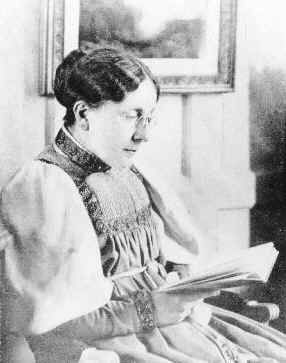
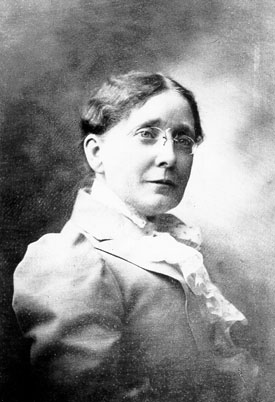
fwillard.jpg I promise I won’t post on Frances Willard’s A Wheel Within a Wheel every day, but I have come across another quotation I can’t resist recording here:

I finally concluded that all failure was from a wobbling will rather than a wobbling wheel. I felt that indeed the will is the wheel of the mind — its perpetual motion having been learned when the morning stars sang together. When the wheel of the mind went well then the rubber wheel hummed merrily; but specters of the mind there are as well as of the wheel. In the aggregate of perception concerning which we have reflected and from which we have deduced our generalizations upon the world without, within, above, there are so many ghastly and fantastical images that they must obtrude themselves at certain intervals like filmy bits of glass in the turn of the kaleidoscope. Probably every accident of which I had heard or read in my half-century tinged the uncertainty that by the correlation of forces passed over into the tremor that I felt when we began to round the terminus bend of the broad Priory walk. And who shall say by what original energy the mind forced itself at once from the contemplation of disaster and thrust into the very movement of the foot on the pedal a concept of vigor, safety, and success? I began to feel that myself plus the bicycle equaled myself plus the world, upon whose spinning-wheel we must all learn to ride, or fall into the sluiceways of oblivion and despair. That which made me succeed with the bicycle was precisely what had gained me a measure of success in life — it was the hardihood of spirit that led me to begin, the persistence of will that held me to my task, and the patience that was willing to begin again when the last stroke had failed. And so I found high moral uses in the bicycle and can commend it as a teacher without pulpit or creed.

I feel the truth of Willard’s point that the mind is at least as important as the body when it comes to riding; where I’m limited as a rider, it comes from mental weakness — laziness and fear, in particular. I could work harder and ride more if had more mental drive, and I am limited by my fear of riding fast, particularly in a large, tightly-packed group, and especially around corners. At times I’m haunted by the “ghastly and fantastical images” Willard describes — images of terrible crashes and collisions with cars and severe injuries. This fear probably only hurts me rather than helps keep me safe — I’m not at all likely to be reckless and so don’t need fear to hold me back, and timidity, at least when riding in a group, can get one into trouble.

And yet, on a more positive note, her point that what “made me succeed with the bicycle was precisely what had gained me a measure of success in life” is a wonderful one, and true for me as well; where I’ve had success, it’s come from endurance, doggedness, and showing up regularly, qualities one needs to learn how to ride well. One also needs patience, determination, and the help of a few good friends. It hasn’t been about talent (I have no idea what amount of innate talent I have for cycling or athletics generally — I was a reasonable long-distance runner in High School, but nothing stellar), but about making the best use of whatever ability I’ve got. So I, along with Willard, feel that I can “commend [the bicycle] as a teacher without pulpit or creed.”

10 Comments

Filed under Books, Cycling, Nonfiction

A Wheel Within a Wheel

willard.jpg I am enjoying Frances Willard’s book A Wheel Within a Wheel so much, I’ve decided I’m going to post on it regularly, although it may mean I end up quoting much of the book, as it’s so short. But it has so many gems, I can’t resist. It’s something I could easily finish in an evening, but I don’t want to rush it, and this way I can report on the details better.

One of the things I like best about the book is Willard’s combination of moralizing and rebelliousness. It’s such an odd combination in a way — she seems both conservative and progressive — but when you think about her time period, it makes perfect sense. She’s a “proper lady” in some ways, taking every opportunity to find a moral or a lesson in whatever she is writing about. But she’s also known for trying to shake up the status quo in her roles as a suffragette and as the founder of the Women’s Christian Temperance Union. And learning how to ride a bicycle at the age of 53 in her day and age is an act of defiance in and of itself. So she sounds both old-fashioned and very modern, and it’s a combination I find amusing at times, and very appealing.

Here is a taste of her style; in a paragraph enclosed in parentheses, she gives this advice about learning to ride:

Just here let me interpolate: Learn on a low machine, but “fly high” when once you have mastered it, as you have much more power over the wheels and can get up better speed with a less expenditure of force when you are above the instrument than when you are at the back of it. And remember this is as true of the world as of the wheel.

She strikes me as someone who would know just how to expend the most force, both on the bicycle and in the world. She is not someone I would want to contradict; when she tells her friends she wants to learn to ride, initially no one approved, but:

they posed no objection when they saw my will was firmly set to do this thing; on the contrary, they put me in the way of carrying out my purpose …

It does not surprise me that her friends would capitulate quickly. She does show a vulnerable side, however, which she reveals in this passage, a passage that also shows her quickness to turn her cycling lessons into lessons about life:

That which caused the many failures I had in learning the bicycle has caused me failures in life; namely, a certain fearful looking for of judgment; a too vivid realization of the uncertainty of everything about me; an underlying doubt — at once, however (and this is all that saved me), matched and overcome by the determination not to give in to it.

But I’ll leave you with the most delightful passage, which comes when she hears the bicycle speak to her, in “softly flowing vocables.” Here is what her bicycle says (a long passage, but worth quoting — don’t miss the last paragraph):

Behold, I do not fail you; I am not a skittish beastie, but a sober, well-conducted roadster. I did not ask you to mount or drive, but since you have done so you must now learn the laws of balance and exploitation. I did not invent these laws, but I have been built conformably to them, and you must suit yourself to the unchanging regulations of gravity, general and specific, as illustrated in me. Strange as the paradox may seem, you will do this best by not trying to do it at all. You must make up what you are pleased to call your mind — make it up speedily, or you will be cast in yonder mud-puddle, and no blame to me and no thanks to yourself. Two things must occupy your thinking powers to the exclusion of every other thing: first, the goal; and, second, the momentum requisite to reach it. Do not look down like an imbecile upon the steering-wheel in front of you — that would be about as wise as for a nauseated voyager to keep his optical instruments fixed upon the rolling waves. It is the curse of life that nearly everyone looks down. But the microscope will never set you free; you must glue your eyes to the telescope for ever and a day. Look up and off and on and out; get forehead and foot into line, the latter acting as a rhythmic spur in the flanks of your equilibriated equine; so shall you win, and that right speedily.

It was divinely said that the kingdom of God is within you. Some make a mysticism of this declaration, but it is hard common sense; for the lesson you will learn from me is this: every kingdom over which we reign must be first formed within us on what the psychic people call the “astral plane,” but what I as a bicycle look upon as the common parade-ground of individual thought.

12 Comments

Filed under Books, Cycling, Nonfiction

A Book about Bikes

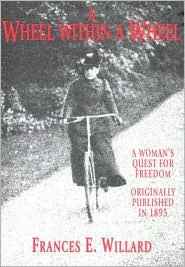
16785279.jpg I received a very nice surprise in my mailbox today. I came home to find an envelope that looked like it held a book, so I figured it was my latest Book Mooch request, but when I looked at the envelope more closely, I saw that it was from Stefanie. It turns out she and her husband had an extra copy of Frances Willard’s book A Wheel Within a Wheel and decided to send it along to me. Aren’t they the coolest?

I’m so pleased with my new book. I love the picture on the front cover, and I rather desperately want it turned into a poster so I can hang it in my study or my office (or both). The book was originally published in 1895 and was reprinted in the 1990s by Applewood Books. It’s a very short book, about 80 pages, and it tells the story of how Willard learned to ride a bike when she was 53 years old. Willard, the back of my book tells me, was the founder of the Women’s Christian Temperance Union and was a well-known suffragette. The back cover offers this quotation from the book about Willard’s cycling costume:

[It] consisted of a skirt and blouse of tweed, with belt, rolling collar, and loose cravat, the skirt three inches from the ground; a round straw hat, and walking-shoes with gaiters. It was a simple, modest suit, to which no person of common sense could take exception.

I’m suspecting she might be horrified by what people wear on their bike rides today. Or perhaps not — I should read the book before I guess what her reaction would be to today’s not-at-all modest cycling outfits.

I’ve read only the first two pages, but already I’ve fallen in love with the book. I can’t resist quoting from the beginning:

… Born with an inveterate opposition to staying in the house, I very early learned to use a carpenter’s kit and a gardener’s tools, and followed in my mimic way the occupations of the poulterer and the farmer, working my little field with a wooden plow of my own making, and felling saplings with an ax rigged up from the old iron of the wagon-shop. Living in the country, far from the artificial restraints and conventions by which most girls are hedged from the activities that would develop a good physique, and endowed with the companionship of a mother who let me have my own sweet will, I “ran wild” until my sixteenth birthday, when the hampering long skirts were brought, with their accompanying corset and high heels; my hair was clubbed up with pins, and I remember writing in my journal, in the first heartbreak of a young human colt taking from its pleasant pasture, “Altogether, I recognize that my occupation is gone.”

How tragic! Oh, I sympathize completely, even though I never experienced such a thing — I know I would have hated it. High heels and corsets! Terrible.

My work then changed from my beloved and breezy outdoor world to the indoor realm of study, teaching, writing, speaking, and went on almost without a break or pain until my fifty-third year, when the loss of my mother accentuated the strain of this long period in which mental and physical life were out of balance, and I fell into a mild form of what is called nerve-wear by the patient and nervous prostration by the lookers-on. Thus ruthlessly thrown out of the usual lines of reaction on my environment, and sighing for new worlds to conquer, I determined that I would learn the bicycle.

“Sighing for new worlds to conquer,” getting mental and physical life into balance, the bicycle as anti-depressant — you can see, can’t you, that I will love this book?

13 Comments

Filed under Books, Cycling, Nonfiction

Talking About Books I Haven’t Read

That’s exactly what I’m going to do in this post, as I haven’t read Pierre Bayard’s How to Talk About Books You Haven’t Read and probably won’t ever. But I did read Jay McInerney’s review of the book from the NYTimes and was intrigued by some of the points it made. While I’m no fan of pretending to have read something one hasn’t (those students in grad school who would dominate the conversation even though they hadn’t done the reading drove me nuts), Bayard makes the larger point that reading is such a complex act that there are many ways of doing it and many ways to relate to a book (see how easily I slip into making pronouncements about Bayard’s book as though I’ve actually read it? Bayard would approve).

There’s skimming, skipping sections, reading about a book, and reading a book and then forgetting about it. McInerney adds the example of the book reviewer who implies that she has read an author’s entire output, when she really has not. And I wonder, while some of these are clearly not reading — reading about a book or implying one has read books when one hasn’t — what about the others? How do you classify skimming or reading everything but the boring parts? War and Peace without the war? Moby Dick without the whaling parts? What about reading and then forgetting? This one interests me most, as it’s the one on this list I do most often (alas). Who has a better grasp of a book, the one who skims or skips and remembers, or the one who has read and completely forgotten? If I’ve completely forgotten a book, should I say I’ve read it? Am I really re-reading if I pick it up again?

Here’s what Bayard says about skimming:

The fertility of this mode of discovery markedly unsettles the difference between reading and nonreading, or even the idea of reading at all. … It appears that most often, at least for the books that are central to our particular culture, our behavior inhabits some intermediate territory, to the point that it becomes difficult to judge whether we have read them or not.

Yes, that makes perfect sense; I love the idea of the intermediate territory between reading and nonreading. Reading is not by any means a clear-cut act. Scanning the words of a book with one’s eyes to comprehend their meaning is both a reductive definition and a complicated one — mere scanning of words doesn’t seem like enough, but what does it mean to comprehend their meaning?

Bayard also writes about the notion of an “inner book”:

The set of mythic representations, be they collective or individual, that come between the reader and any new piece of writing, shaping his reading without his realizing it.

Not only is the act of seeing and comprehending words a complicated one, but we also bring a whole host of preconceptions and assumptions to reading that shape our experience of it. We can never escape this background, can never (or rarely) approach a book completely innocently, with no expectations.

While I don’t like the Bayard’s idea that talking about books you haven’t read is a creative act (that puts too much positive spin on it), I am intrigued by his analysis of what it means to read. McInerney ends his review this way:

I seriously doubt that pretending to have read this book will boost your creativity. On the other hand, reading it may remind you why you love reading.

Perhaps I should read this book after all?

12 Comments

Filed under Books, Nonfiction, Reading

The Year of Reading Proust

I recently finished Phyllis Rose’s book The Year of Reading Proust: A Memoir in Real Time, and I felt ambivalently about it the whole way through. Have you had the experience of enjoying not liking something, or going back and forth about it? I felt that way about this book. I considered quitting after the first couple of chapters, which didn’t work for me, but I stuck with it when the topics Rose was covering became more interesting, and from there on out, I found myself both moving quickly through it with a certain amount of pleasure and thinking the whole time about how mildly annoying the book is.

On the positive side, Rose is a good storyteller, and I liked the way she wrote about herself and her life honestly, sometimes telling things about herself that weren’t flattering. She’s a good personal essayist. She also knows tons of writers and has some good gossip about them; for example, she writes about her long-time friendship with Annie Dillard that’s full of complications and ups and downs. It’s quite fun to hear about, say, a dinner party she held for Salman Rushdie.

However, if you are picking this book up to read about Proust, you will most likely be disappointed. In fact, I don’t think I did this book justice, because I went into it thinking it was one thing and it took me a long time to figure out it’s actually something else. I like reading memoir/essay type books, however, so I adjusted my expectations and found some pleasure in it. In her first chapter, she describes her project of reading Proust in a year, discussing what the experience was like and giving her impressions of the novel. Subsequent chapters begin with a quotation from Proust and then tell a story from Rose’s experiences that relate to the quotation. She integrates brief discussions of Proust into the chapters to flesh out the point she’s making. Her chapters cover such things as her history with television, her passion for collecting, her first marriage, her struggles trying to write a novel, and battles with her neighbors over landscaping. She can frequently be entertaining, especially in the chapters on sex and relationships, and she captures her academic, literary world quite well.

But her descriptions of this world — a world where well-known writers hang out in Key West and Salman Rushdie drops in for dinner parties — annoyed me too, and my annoyance stems from class issues, I think. On the one hand, I’m fascinated by this story of a literary, academic, and social insider, someone who has lots of famous friends and what appears to be an enviable academic and economic position; she taught at Wesleyan for many years and moves back and forth between Connecticut and Florida, and she seems to have plenty of time with which to pursue her writing projects and personal interests. It sounds like a life many would envy. On the other hand, I wondered why I should care about the details of her life, about her struggles with this and that, about her fights with Annie Dillard, about her difficulty writing a novel. It’s not that I only want to read memoirs of people who have led particularly hard lives, but I wondered, sometimes, whether Rose had really done enough to make me care about her. Why devote my time to reading her story? Where, exactly, does the interest for a general reader lie?

I suppose, ultimately, the book felt a little self-indulgent to me. I feel harsh for saying this, and I’m struggling to find the right words to capture my reaction. I think that it’s a very personal reaction — I’m not sure I like Rose and therefore I’m not easily going to like her memoirs. Can you enjoy reading the memoirs of someone you don’t like? I suppose so, but it would take a different kind of writer than Rose.

So, if you are considering reading this book, please don’t take my negativity too seriously; you might like the book much better than I did.

9 Comments

Filed under Books, Nonfiction

Mothers of the Novel

Charlotte invited me to participate in NaBloPoMo (National Blog Posting Month [wait — why national? Shouldn’t it be international?]) this year, so here I am, officially posting every day this month, instead of following my usual most-likely-but-not-necessarily-posting-every-day method. We’ll see how it goes. I’m feeling a tiny bit anxious about this, as though actually committing to posting every day is so much harder than making no commitment but doing it anyway.

So, I’ve finished Dale Spender’s excellent Mothers of the Novel and can say that it’s well worth the read, even though it’s over 20 years old and tons of research has been done on these novelists since Spender wrote. But it’s an excellent overview and gives information about tons of authors and if you pick it up, it will most certainly add to your reading list. You’ll find Spender’s list here, along with some other writers thrown in for good measure.

What I liked best about the book, besides the information on new writers it’s given me, is its description of the strength of an 18C tradition of women’s writing and the accompanying disappointment that this tradition has largely disappeared. Spender stresses over and over again how vibrant women’s writing was in the 18C and how well-respected many of these writers were. She also describes female critics from the 18C and 19C who wrote about these women writers, trying to acknowledge their strength and establish a lasting tradition — which didn’t work, as we now know. Now, I knew there were a lot of women writers from the 18C, but I’m not sure I quite realized how important they were in their time and how seriously they were taken. Here is what Spender says:

Jane Austen read ‘women’s novels.’ So too did the reverend gentleman, her father. What is frequently ‘forgotten’ is that he also made his regular visits to the circulating library for the latest novel by a woman, who explored the implications of many a moral question of his time. And Mr. Austen’s reading habits were by no means unusual for a man in his position.

She also argues that over time women’s novels have tended to be lumped into one big category, that of the romance, in spite of the fact that there is great variety in their writing, both of subject matter and of quality. On the other hand, while men often wrote (and write) novels that are about romance, these works are rarely described as romances and aren’t so easily dismissed.

This dismissal happens mostly in the 19C. By the time the 19C got going, women had experienced enough success that male writers were getting nervous:

If we want to explain the dismissal of early women novelists from the literary heritage it is necessary to go much further than the misleading accounts about mass audiences and sensation, sentimental ‘blotterature.’ For in the eighteenth century, many of the women novelists who were writing for a small, refined and morally conscious audience, were held in very high repute. It is only since their time that the pervasive notion of silly novels by silly women novelists has held such sway.

The systematic devaluation of women writers and their concerns is more a product of the nineteenth century. By this time women’s position as novel writers was so well established that there were more than mutterings among the men about the dangers of women’s preeminence in the genre.

It’s a depressing story, yes, but I also find it heartening to know more about this tradition, and particularly the way women writers read and refined each other’s work, commenting on and responding to the writers who had gone before them, thereby doing much to extend what the novel can do.

Ann has asked about where to start with lesser-known writers, and while definitions of “lesser-known” will vary and while I haven’t actually read tons and tons of this stuff, I’m happy to list some of my favorites. I’d definitely read Sarah Fielding’s novels, including The Adventures of David Simple. I’ve read and enjoyed Charlotte Lennox’s The Female Quixote, Eliza Haywood’s Love in Excess, Charlotte Smith’s The Young Philosopher, Mary Hays’s Memoirs of Emma Courtney and The Victim of Prejudice, Mary Wollstonecraft’s two novels (Mary and The Wrongs of Woman), Maria Edgeworth’s Belinda, and Elizabeth Inchbald’s A Simple Story. And also Frances Burney’s Evelina and Ann Radcliffe’s gothic novels.

As for ones Spender has inspired me to read, they include Mary Brunton’s Self Control and Discipline (Austen admired Brunton greatly and learned much from her), Amelia Opie’s Adeline Mobray, and anything by Maria Edgeworth I can find. I hope to read more novels by the women listed above, as well as authors discussed in my post here, if I can find copies in print.

11 Comments

Filed under Blogging, Books, Nonfiction

Weekend Reading

And now I’m sick! Wonderful, isn’t it? I’ve got a cold that is not quite bad enough to keep me home from school, but just bad enough to make me unhappy about it. It was a beautiful fall afternoon with perfect weather for a bike ride, but I spent the time curled up in bed sleeping. Oh, well, I’m very grateful to have had a chance to take a nap.

The books I took with me on my Albuquerque trip turned out to be different from the ones I listed here. I did take along Sophia Lee’s The Recess, but I didn’t end up opening it; instead I spent my airport time switching among Dale Spender’s Mothers of the Novel and two new books — Rosamund Lehmann’s A Note in Music and Phyllis Rose’s The Year of Reading Proust: A Memoir in Real Time.

The Lehmann novel has turned me into a fan — score another one for Virago Modern Classics! I am nearly finished and so I’ll wait to say much about it until later, but for now — what a great book. I feel as though in the last couple years I have discovered so many women writers who are new to me — writers including Elizabeth Taylor, Anita Brookner, Alison Lurie, Barbara Pym, Georgette Heyer, and now Rosamund Lehmann. All of these women write similar types of novels, although there are great differences among them as well, of course; they tend to be quiet, character-driven novels about the emotional landscapes of women’s lives. I love this stuff. Lehmann’s novel is about two married couples — focusing mostly on the women (and one of them in particular), although occasionally veering into the consciousnesses of the men — who find their lives disrupted by the visit of a young man and his sister. The book described visits and conversations and outings, but mostly it describes what the characters think and feel; it has Proustian passages on memory and time and Woolf-like analyses of gender dynamics and moments of consciousness.

The other book, Phyllis Rose’s book on Proust, I’m still figuring out. It’s a mix of her thoughts on Proust and her thoughts on her own life; sometimes these two things are clearly connected, and sometimes the connection is more tenuous. I do like meditations on art and life, and I do like essayistic, rambling, all-over-the-place nonfiction books and memoirs, but I’m not entirely sure this one is making sense to me. I need to give it a bit more time. Maybe the problem is that one of her first chapters describes her love of television, a subject I cannot relate to and one only very loosely connected to Proust. And then the next chapter is about collecting ancient artifacts, and although she connects this topic more closely to Proust, it’s another area that doesn’t mean much to me. This may be a matter of a personality clash; perhaps Rose and I just don’t hit it off. But we’ll see.

P.S.  I forgot to describe one of the best parts of the conference, which was the closing poetry reading.  About a dozen of us gathered to read favorite poems from the 18C.  I didn’t come with any prepared, but ended up reading Anne Finch’s “A Nocturnal Reverie,” which is a beautiful poem, and another woman gave a very dramatic, funny reading of Aphra Behn’s “The Disappointment,” which I strongly encourage you to read — you won’t regret it!

13 Comments

Filed under Books, Fiction, Life, Nonfiction

The Fair Triumvirate of Wits

Dale Spender’s Mothers of the Novel has an intriguing chapter on “The Fair Triumvirate of Wits” — Aphra Behn, Delariviere Manley, and Eliza Haywood, all writers of the late 17C and early 18C who made their living from writing. None of them had particularly good reputations — and by that I mean their sexual reputations were suspect — and Spender makes the point that sexual reputation and writerly reputation get conflated when we’re talking about women writers of the time (and later times). The reputations of these women as writers have suffered, even though (or because?) their writings were very popular, in part because their behavior was “questionable”:

In trying to explain why it is that Aphra Behn’s novels have been ‘ignored’ and that pride of place has been accorded to Daniel Defoe, it emerges that there have been clear links between Aphra Behn’s ‘immorality’ and her expulsion from the literary mainstream. Her work has not been fit for study.

Spender devotes a lot of space to analyzing why these three women’s contributions to the novel have been ignored, and at times this can get a bit repetitive. Also, I’m reading the book from the perspective of 20 years later, when much critical writing has tried to give these women their place in literary history, so the book feels dated at times. But still, her account of what these women accomplished is interesting.

Of Aphra Behn, for example, she writes:

In her choice of subject matter, her commentary, and her style, she illustrates some of the differences in outlook between women and men; even her sense of humour — which frequently makes men the butt of the joke — contrasts markedly to the forms to which we are accustomed, and in which it is the humour of men that prevails.

Behn is important in the development of the novel because her writing moved the genre toward a new kind of realism; it is not that she’s writing the kind of realism that we are familiar with today, but that she “has a talent for minute observation, astute assessment, the portrayal of fine realistic detail.” She brought a new level of believability to older forms of writing such as the pastoral romance.

Delariviere Manley was famous for her “scandal chronicles” — works that were set in far-away, exotic places, but were clearly about local high-born people and their exploits. Spender argues that Manley’s writing furthered the novel by taking realism in yet another direction — this time instead of writing realistically about fantastical people and places as Aphra Behn did, Manley “introduced a fantastical rendition of real-life happenings.” In fact, she went to prison briefly for writing about the scandalous doings of powerful people in government. It’s in these various ways of mixing up fiction and reality, Spender argues, that a comfort with and acceptance of fiction — lies that are somehow true — as we know it today developed.

Eliza Haywood was hugely prolific and wrote in just about every genre available at the time — and in a number that weren’t:

The growth and development of the novel can be illustrated with reference to the writing of this one woman, who reveals an extraordinary creative ability, who freely experiments with form and style, and who produces an unprecedented and perhaps unparalleled range of novels. Every enduring and exemplary feature of the new genre is to be found in her writing, and yet she has never been given the credit for her contribution.

Spender argues that Haywood realized she had more and more potential readers among the middle classes and so began to write with their interests in mind. Interestingly, she claims Haywood anticipated Samuel Richardson’s “innovations” to the novel form in Pamela by writing about a middle-class heroine battling an aristocratic villain and thus introducing the kind of class warfare that would preoccupy many novelists after her. Here is how Spender sums up her achievement:

She was among the first to assert the validity of middle class experience, among the first to insist on the significance and the humanity of ‘ordinary people’ and among the first to explore the conflict of interest between the classes and sexes. And in so doing she helped to modify the very essence of a story and its meaning.

I haven’t read enough of the writings of these women! I like to think I’ve read a lot in the 18C, but reading Spender’s book makes me realize how much I’ve missed. I’ve read Behn’s Oroonoko, her play The Rover and some poems, and that’s it. I’ve read Haywood’s novel Love in Excess, but nothing else by her. And nothing at all by Manley. We’ll see what else I can add to the list.

7 Comments

Filed under Books, Nonfiction

On not liking books

I thought about giving Bruce Chatwin’s In Patagonia a proper review — oh, not really, I never review things properly, but I mean as proper as I get — but I just don’t have the energy or interest in it. I didn’t like the book very much. I found myself bored with it, and I only finished it because I’m obsessive that way and it was short, only 200 quick pages.

I think my problem with the book is that I never learned much about Chatwin himself, or his persona, to be more accurate about it. The book’s focus is not on the traveler, but on the people he meets, the places he sees, the stories he comes across, and the history of the land he travels over. Now those things shouldn’t be boring, should they? But I found myself not caring much. The stories he told tended to be short ones, and they tended to focus on externals — what people did and what they looked like. Without some attention paid to internal things — emotions, thoughts — I remain unconnected.

It’s curious that I wouldn’t like this classic of travel literature, since the scholarly work I’ve done is on travel writing. But here’s the thing — I’ve studied “sentimental” travel, meaning travel writing that focuses on emotions and on internal states (see Laurence Sterne’s A Sentimental Journey for a prime example). In a way, this is an odd type of travel writing, since one would think the genre is valuable because of what it can tell us about the world, not so much because of what it tells about the traveler (although of course it does both). But, although I like reading about the world, I want to know about the traveler too, or if not the traveler, then I want to know about the people that traveler meets, and I want to know not just brief summaries of their lives, but something about who they are and why they are the way they are. If there’s no emotional element or if there are no ideas, then I’m left cold.

And In Patagonia didn’t have anything in the way of emotions and not much in the way of ideas either. It had a lot of cool facts and some interesting speculations about things like the inspiration of Coleridge’s “Rime of the Ancient Mariner” and the Patagonian sources of Darwin’s theories. But this wasn’t enough.

This is not to say that you won’t like the book. You may love it; it’s probably a great book for people who like this kind of book — and I don’t mean to sound judgmental when I say that. In some cases when I don’t like books it’s because I think they are genuinely bad, but in this case, it’s simply that this was not the book for me.

8 Comments

Filed under Books, Nonfiction, Reading

Mothers of the Novel

I have begun Dale Spender’s book Mothers of the Novel, and I have the feeling I’ll be posting on it regularly, as it’s full of interesting information. The book looks at women’s novels in the time period before Jane Austen, arguing that while we tend to think of Jane Austen as the first great woman novelist, it’s really the case that Austen drew on a long tradition of women’s writing as she created her own work. Mothers of the Novel was published in 1986 and there’s been tons of critical work (tons!) done on women novelists of the 17C and 18C since then, but this book is still a valuable overview. I’ve already added a couple writers to my reading list, including Amelia Opie and Mary Brunton.

Here are some interesting things I learned:

  • The majority of novels in the 18C were written by women, and the novel was so closely associated with women that some men used a female pseudonym when they published their books. This caused a backlash against women writers which was at least partly successful, so that by the 1840s, the situation was reversed and women were adopting male pseudonyms when they published. This backlash is partly why the “canonical” novelists of the 18C are Fielding, Richardson, Defoe, Smollett and Sterne, a list which, of course, doesn’t include any women.
  • Scholars have concluded that women today constitute only 20% of published writers (I don’t know how dated this figure is), which makes the statistic about women writing a majority of 18C novels even more interesting. Spender says this is evidence that the publishing world wasn’t always so unfair to women. I’m fascinated by the fluctuations in women’s status and the quality of their lives over the years; it hasn’t been a steadily upward trend by any means.
  • Spender argues that women were successful at and interested in writing novels because novel writing is “a logical extension of women’s role” — many novels of the time were epistolary, and letters were a form of writing women were encouraged to participate in. She says letters are a good form in which to explore emotional and familial concerns, both subjects of the novel.
  • Spender says her research into the novel has turned up over 100 women novelists before Jane Austen and no more than 30 men. So to end up with 5 canonical novelists all of whom are men doesn’t make much sense, unless it could possibly be the case that those 5 are better than over 100 women writers, which seems highly unlikely (assuming we could establish what “better” means). This is a perfect example for thinking about how the canon is flawed.

20 Comments

Filed under Books, Nonfiction

Mind as palimpsest

I’m on to De Quincey’s third essay in my collection, “Suspiria de Profundis,” or “Sighs From the Depths.” This is such a rich essay that I find myself wanting to write a blog post about many sections from it — isn’t it a delight to find a good book that inspires many blog posts? I think of these books as “bloggable” ones, ones that will keep a regular poster going for quite a while.

Anyway, there’s a short section about halfway through called “The Palimpsest” that I found particularly fascinating; it spends five pages or so explaining what a palimpsest is — a manuscript written on multiple times and nearly erased after each use but leaving a trace of the previous text that is still readable. In his example, a Greek tragedy is written and then scraped away, a legend about a Christian monk replaces it, and a romance about knights replaces that. De Quincey gives no indication where he is going with the topic until he has explained it thoroughly, at which point he makes it all clear:

What else than a natural and mighty palimpsest is the human brain? Such a palimpsest is my brain; such a palimpsest, O reader! is yours. Everlasting layers of ideas, images, feelings, have fallen upon your brain softly as light. Each succession has seemed to bury all that went before. And yet in reality not one has been extinguished.

What a wonderful metaphor, is it not? The idea is that nothing we have experienced is lost; it’s simply been covered over by something else and by something else again. But traces remain:

Yes, reader, countless are the mysterious handwritings of grief or joy which have inscribed themselves successively upon the palimpsest of your brain; and, like the annual leaves of aboriginal forests, or the undissolving snows on the Himalaya, or a light falling upon light, the endless strata have covered up each other in forgetfulness.

The more I read the more I realized how Proustian this whole metaphor is, but instead of involuntary memory — when a sensory experience triggers a memory of a long-forgotten moment — as the mechanism that reveals the forgotten layers in our minds, for De Quincey, it’s approaching death, severe illness, or opium that brings the memory back:

[Memories] are not dead but sleeping. In the illustration imagined by myself, from the case of some individual palimpsest, the Grecian tragedy had seemed to be displaced, but was not displaced, by the monkish legend; and the monkish legend had seemed to be displaced, but was not displaced, by the knightly romance. In some potent convulsion of the system, all wheels back into its earliest elementary stage.

Perhaps De Quincey’s conception of memory allows for a more active role than Proust’s does — one can take opium to induce these memories, if one wishes. For Proust, involuntary memory simply happens, outside our control.

De Quincey also begins to found Freudian:

But the deep tragedies of infancy, as when the child’s hands were unlinked for ever from his mother’s neck, or his lips for ever from his sister’s kisses, these remain lurking below all, and these lurk to the last. Alchemy there is none of passion or disease that can scorch away these immortal impresses.

So the partially erased layers of the palimpsest are the unconscious, waiting for its chance to emerge — to be read. But this implies there is little more we can do but “read” the layers; they cannot be fully wiped away.

5 Comments

Filed under Books, Nonfiction

On the Knocking At the Gate in Macbeth

I have now read the second De Quincey essay in my collection; it’s called “On the Knocking At the Gate in Macbeth,” and it tries to explain why De Quincey finds the knocking that takes place after Duncan’s murder so eerie.  The essay is about five pages long, and it makes a fairly simple point about Macbeth (the knocking brings us back from the horror of murder to the everyday world — and returning to the everyday world deepens the horror of murder), but along the way it is full of digressions, taking in a philosophical point about the mind, the story of a real-life murder, what it’s like to witness someone fainting, and what it’s like to watch a state funeral procession.

Here is part of the philosophical digression:

Here I pause for one moment to exhort the reader never to pay any attention to his understanding when it stands in opposition to any other faculty of his mind.  The mere understanding, however useful and indispensable, is the meanest faculty in the human mind and the most to be distrusted: and yet the great majority of people trust to nothing else; which may do for ordinary life, but not for philosophical purposes.

I love this philosophical digression that warns us against paying too much attention to our understanding!  He goes on to illustrate this point with an example: if you were to ask someone to draw a picture of a street, they probably wouldn’t do a very good job, unless they happened to know the rules of perspective.  Here is why:

The reason is — that he allows his understanding to overrule his eyes.  His understanding, which includes no intuitive knowledge of the laws of vision, can furnish him with no reason why a line which is known and can be proved to be a horizontal line, should not appear a horizontal line …

Even though we can see with our eyes the way a street actually looks, our understanding takes over when we try to draw it and it messes us up.  We’d be better off trusting our eyes and getting our mind out of the way.

The purpose of this digression?

But, to return from this digression, — my understanding could furnish no reason why the knocking at the gate in Macbeth should produce any effect direct or reflected: in fact, my understanding said positively that it could not produce any effect.  But I knew better: I felt that it did: and I waited and clung to the problem until further knowledge should enable me to solve it.

That’s a long way around to make the point that reason only gets us so far and that the senses, emotion, and intuition can carry us farther, but I do like taking the long way around to get to one’s point, at least when it’s done as De Quincey does it, with something interesting along the way.

7 Comments

Filed under Books, Nonfiction

Confessions of an English Opium-Eater

7790332.gif I have just finished the title essay from a collection of Thomas De Quincey’s work, Confessions of an English Opium-Eater; the book has three longish-essays (the title one was 80 pages) and one short one. I’m planning on reading them all, but Confessions was the reason I picked this book up. I’m not sure what attracted me to it, since confessions of drug addicts aren’t my usual thing, but I’ve heard this mentioned as an interesting essay and as an example of walking literature, and I’m fascinated by De Quincey’s time period (1785-1859), so that’s reason enough.

The essay, as you might guess from the title, tells the story of De Quincey’s addiction to opium, but it does so with lots of digressions and philosophical asides and glimpses of life in De Quincey’s time. After a brief introduction justifying his decision to write an essay that exposes his weakness, he tells of his boyhood school days and his decision to run away from school at the age of 17. He wanders through parts of Wales and ends up in London, where, he says, the seeds of his addiction were planted. He runs out of money and comes very close to starving to death, which causes him stomach problems that come back to haunt him — at which point he becomes an addict, taking opium every day to relieve the pain.

But De Quincey takes his time with the Wales and London episodes, and they are some of the most interesting sections. Particularly moving is the story of his friendship with the prostitute Anne; they offer each other companionship and aid — she saves him from starvation at one point. Tragically, De Quincey leaves London briefly to try to find some money, and when he returns he can’t find her. He mourns the loss of their friendship for the rest of his life.

De Quincey took opium regularly before he became addicted; he was careful to let enough days go by between indulgences so that the drug would maintain its potency. And he writes about the pleasures of opium quite beautifully; one of the things I like best about this essay is that De Quincey is fully honest about both the pleasures and the pains. He writes:

And, at that time, I often fell into these reveries upon taking opium; and more than once it has happened to me, on a summer-night, when I have been at an open window, in a room from which I would overlook the sea at a mile below me, and could command a view of the great town of L—-, at about the same distance, that I have sate, from sun-set to sun-rise, motionless, and without wishing to move.

A bit later he goes into raptures over the drug:

Oh! just, subtle, and mighty opium! that to the hearts of poor and rich alike, for the wounds that will never heal, and for “the pangs that tempt the spirit to rebel,” bringest an assuaging balm; eloquent opium!

He goes on like that for a full paragraph. But he is also clear about the horrors of opium addiction:

[The opium-eater] lies under the weight of incubus and night-mare; he lies in sight of all that he would fain perform, just as a man forcibly confined to his bed by the mortal languor of a relaxing disease, who is compelled to witness injury or outrage offered to some object of his tenderest love: — he curses the spells which chain him down from motion: — he would lay down his life if he might but get up and walk; but he is powerless as an infant, and cannot even attempt to rise.

He does, you will be happy to know, overcome his addiction, but he is still haunted by one of the worst effects of addiction — horrible nightmares, some of which he describes in detail.

I am looking forward to seeing what the other essays are like; he’s got a style I enjoy — digressive, allusive, difficult to categorize.

10 Comments

Filed under Books, Nonfiction

Jane Austen in Context

Has anybody seen the movie Becoming Jane? It’s just come to our local theater, and I’d like to see it, although I also think it’s rubbish. It has very little relationship to Austen’s real life (I haven’t seen the movie, obviously, but I’ve read enough about it to know), but I suspect it might be fun to see, if I can keep the real Austen and the movie Austen completely separate in my mind (if such a thing is possible). By the way, there’s a good article on the movie here (thanks to Jenny D. for the link).

Much better than seeing Becoming Jane, most likely, is watching the A&E version of Pride and Prejudice, which I borrowed from the library for the weekend. I’ve seen it before, but it was a long time ago, and I can’t wait to see it again.

At this point, what with the Jane Austen in Context book and all, I’m in danger of getting sick of everything to do with Austen, but I don’t feel that way quite yet …

There were a couple fascinating bits from the book I thought I’d share (and by the way, I’m not giving away nearly all of the good stuff, so don’t think the book is spoiled because I’ve posted so much on it). In an essay on book production, the author notes that in the year Austen was born, 1775, 31 new novels were published in England. In 1811, when Sense and Sensibility was came out, 80 new novels were published. The author calls this “an expanding and competitive market for books,” but it seems quite small from our perspective, doesn’t it? If I lived then, I could plausibly attempt to read every novel published each year!

Also interesting to note is that three quarters of all novels published in 1776 were epistolary novels. It’s in that context that Austen’s complex third person point of view — her free indirect discourse — starts to look so very new and exciting.

Nearly three quarters of all novels published between 1770 and 1820 were published anonymously or pseudonymously, many of them saying only “By a Lady” or “By a Young Lady.” Also interesting is the numbers of men vs. women writing; as one critic notes about the 1810s, “The publication of Austen’s novels was achieved not against the grain but during a period of female ascendancy.” In the 1820s the balance shifted, and the men began to outnumber the women.

Also fascinating is the chapter on Austen in translation, which argues that Austen never got quite as popular on the continent as in England because continental translators didn’t know what to make of her — she didn’t fit in with their existing literary traditions and couldn’t be easily accommodated to them. Many of the early translations weren’t really translations at all, but were retellings of the stories with some dramatic changes, to tone down Elizabeth Bennett’s sauciness, for example. Some translators even omitted chapters and changed endings. Many of them lost the nuances of Austen’s third person point of view, which would make it harder to appreciate her genius. Modern-day translators would never get away with the changes Austen’s early translators made to her texts (at least I don’t think so!).

Interesting stuff, don’t you think?

10 Comments

Filed under Books, Nonfiction

More on Jane

You all know who I’m talking about in the post title, right? One of the essays in Jane Austen in Context talks about the “canonization” of “Jane” — no last name needed — as a kind of saint. It’s an essay on the “Cult of Jane Austen,” and what a cult it can be. I was amused to read that for some of the most devoted Jane fans (descendants of the late 19C “Janeites”), reading the novels is merely equal in importance, or maybe even less important, than participating in other activities such as visiting places Austen lived, having Jane Austen tea parties, dressing like Austen’s characters might, viewing Austen “relics” (she IS a saint, really), and even visiting sites where movies were made of Austen’s novels. This, as you can imagine, makes some Austen scholars unhappy, enough that they often begin articles trying to rescue Austen and her work from this industry that’s grown up around her. But the essay’s author, Deirdre Shauna Lynch, writes that this attempt to “rescue” her:

appears guided by an unattractive logic of exclusivity that runs like this: since she is my Jane Austen, she cannot be yours too.

Lynch talks about how Austen gets compared to Shakespeare in terms of her popularity and her cultural influence, but Austen’s fans have a characteristic that Shakespeare’s tend not to: they like to believe that they can see something in Austen others can’t, that they belong to a small, exclusive club of people who really get her. I’ll admit that I’ve felt this way now and then — surely no one else reading her novels feels quite like I do when I read them? This has to have something to do with genre; drama, even though it can be read alone, is public in its nature, while reading a novel is very private. So when reading novels it would be easy to feel that our private, personal experience is unique.

The funny thing about this phenomenon — and the related phenomenon of fantasizing that you know her like you know a close family member — is that it began right at the time Austen became popular and has increased all along as Austen gains more and more readers. Hundreds of thousands of people believe they have a special relationship with Austen and her works that no one else shares.

The essay on the early critical responses to Austen’s novels is fascinating too; it covers the reviews that appeared during Austen’s lifetime and shortly after her death. Early reviewers did not know what to make of her. Compared to other novels of the time — gothic novels and novels full of action and adventure — her work sometimes seemed bland. In the absence of anything better to say, they tended to comment on the moral lessons one could glean from them; of the sisters in Sense and Sensibility one reviewer says:

[Readers] may learn from them, if they please, many sober and salutary maxims for the conduct of life.

Exactly how we read the book today, right? They also expressed the uncertainty about the value of novel reading that was very common at the time; one reviewer wrote that “a good Novel is now and then an agreeable relaxation from severer studies.” This uncertainty about novels is alive and well today — the condescension in that reviewer’s tone is not so different from the people we know who say they have more serious things to read than novels.

It was Walter Scott who finally began to get it; in a review of Emma, he describes how her work differs from other novels of the time. Austen is writing a new kind of novel, one that:

present[s] to the reader, instead of the splendid scenes of an imaginary world, a correct and striking representation of that which is daily taking place around him.

Jane Austen in Context is so interesting that I’m tempted to go on and on about all the fascinating things in it; rather than doing that, though, I’ll suggest that if you love Austen’s novels you will probably love this book.

10 Comments

Filed under Books, Nonfiction

Riding and reading

Yes, I rode my bike yesterday. No, it wasn’t a good idea. I thought I’d try, just to see what it felt like, particularly since I’ve felt the tiniest bit better because of the medication I’m on. But it will take longer than a week on medication to feel well enough to ride, I’m seeing. I was able to ride for 45 minutes or so, but my heart rate was high the whole time and I felt achy and sore. I’m sure I’ll try again in the next few weeks — I’m always curious to see whether I’ve improved or not and I don’t feel like I’ll know unless I try to ride — but no, I’m sure it’s not a good idea. I don’t see my endocrinologist until August 23rd, though, and does anybody really think I’m going to wait that long to try riding again?

But what I really want to write about are two books I’ve recently finished. The first is Roger Shattuck’s Proust’s Way, a book of criticism on In Search of Lost Time. I recommend this if you are looking for an overview of the novel. I don’t recommend it if you don’t want plot spoilers, because he talks about the book as a whole, including much discussion of the ending and plot developments in the middle. But plot spoilers aside, it’s got background information on Proust; an overview of the plot, characters, and setting; chapters covering Proust’s main themes, as Shattuck sees them; and a number of cool charts and diagrams.

Some parts of this book are rather odd (I give another example in this post); toward the end of the book, he includes a fictional element — a made-up dialogue between a radio journalist and producer, a Proust scholar, and a grad student in French. These people are supposedly putting together a radio program on Proust. Shattuck says he included this section because he believes that usual expository prose can’t say everything. I rather like this idea — that some things are better said in fictional form — but I can’t quite see that this is true in Shattuck’s case. Instead, the dialogue struck me as so highly improbable that I almost laughed my way through it. Shattuck should stick to his expository prose. But still, the book is worth picking up to start to get a handle on In Search of Lost Time.

The other book I wanted to mention is Geraldine Brooks’ novel The Year of Wonders, which turned out to be a fascinating and enjoyable read. I say it’s fascinating because it takes place in a small town in England in 1666 that gets hit hard with the plague — and I find the plague fascinating. It’s not a book to read at the dinner table, let me make clear.

The story is about Anna Frith, a young servant girl who grows and matures as she deals with the ravages the plague brings to her village. She has been fortunate enough to learn how to read and write, and she has a sensitivity and openness perhaps unusual to one in her station in that time period. She’s an interesting narrator (it’s told in the first person); she admires the intelligent, knowledgeable women in her town but fears them also as they are always in danger of being branded witches. As well as telling about the plague, the novel tells how old customs — midwives who presided at the birth of babies, women who possessed ancient folk remedies and healing powers — were both enjoyed and feared. When times were good, the townspeople would welcome women’s knowledge and powers, but when times turn bad, they lash out at these women and destroy them — at their peril.

The ending is a bit odd, but otherwise, this is a thoroughly enjoyable book — it’s great history and a good story all in one.

9 Comments

Filed under Books, Cycling, Fiction, Nonfiction