Category Archives: Nonfiction

Un-put-downable books

So what do you do when you are reading two books neither of which you can put down?  I can’t exactly read them both at the same time.  I’m stuck going back and forth between them. But that’s not at all a bad way to spend a weekend.

The first one is Sarah Waters’s Fingersmith, which I’m already over half way through.  The plot starts off at a fast pace, and I’m dying to know how it all turns out, but, as is usual for me, it’s not just the plot that captures my attention — I want to know more about the characters.  The book fulfills that desire too; the second section retells the events of the first, but from another character’s viewpoint, so while the plot itself isn’t the interest here, the different interpretations each character has of what’s going on is.  I love the way this technique allows you to see how little the facts of a situation matter — what matters is your interpretation, the sense you make of those facts.  It’s a little disturbing at the same time, though, because it makes you realize how little solid ground of certainty any of us have to stand on.

The other book is Janet Malcolm’s The Silent Woman, a book about Sylvia Plath and Ted Hughes, the legends that surround both of them, and the way biographies have created those legends.  Litlove recently wrote a beautiful review of this book, which was one of the reasons I picked it up, and the other is that I’ve had my eye on Malcolm’s books for years, since they seemed to be the sort of nonfiction I like best — the uncategorizeable sort.  I have now determined that I need to read every book she has written; Malcolm is someone I will like no matter what she writes about.

The book has lots of information on Plath and Hughes, but mainly it’s about the afterlife of Plath and the sort of life-in-death experiences Hughes has had after her suicide.  It tells the stories behind the memoirs and biographies that have appeared, and the wars that advocates of Plath and those of Hughes have waged with each other over how to interpret their relationship.  It tells about Malcolm’s own experiences researching her subjects, and it also advances an argument about biography itself.

Both of these books, I’m realizing now, have much to say about the uncertainty of knowing anything.  The characters in Fingersmith think they understand and can control what is happening, but they discover, painfully, that they can’t.  The people in Malcolm’s book believe they understand exactly what sort of people Plath and Hughes were, and yet there are others out there who are equally certain the opposite is true.  There’s really nothing a person can do but flounder through all the uncertainty and hope not to get it too terribly wrong.

15 Comments

Filed under Books, Fiction, Nonfiction, Reading

The Gentleman’s Daughter, continued

First of all, make sure to check out the choices for the next Slaves of Golconda group reading — everyone is welcome to participate!

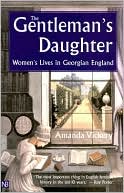
I have now finished the second half of Amanda Vickery’s The Gentleman’s Daughter: Women’s Lives in Georgian England, and I found the second half at least as interesting as the first (which I wrote about here).  The second half contains chapters on “Prudent Economy,” “Elegance,” “Civility and Vulgarity,” and “Propriety.”  Some of these chapter titles don’t fully make sense to me, as the chapter on propriety is about all the public entertainments that were available to women at the time and doesn’t analyze the word propriety at all, but that’s a small quibble.

The chapter on “Prudent Economy” was particularly interesting as it was about women’s duties as household managers, and it emphasizes the point that maintaining a household was seen as a prestigious and important role, and women were determined to enjoy what power that role gave them and not let men encroach on it:

As the mistress of a household, the genteel bride tasted of administrative power and exuded quasi-professional pride.

Now, of course, being able to manage a household would be small comfort to a woman who wanted to do other things and couldn’t, but Vickery’s point is that many women did take pride in this work and it did require considerable management ability.

One of the hardest parts of this management job was dealing with servants; when people complained about a “servant problem” it wasn’t just idle and privileged complaining.  Vickery points out that servants’ wages rose throughout the 18C and opportunities for other kinds of work, in factories for example, became more plentiful.  So genteel women were constantly having to replace their servants, particularly their female servants, who were much more likely to leave than their male counterparts.  Vickery makes the job of managing servants sound complicated:

… in its staffing the household functioned like most eighteenth-century commercial enterprises.  In the acquisition, coordination, and direction of a range of different workers, the managerial effort of the genteel mistress-housekeeper was akin to that of a putting-out master or gentleman farmer,  and far removed from the received picture of the unruffled lady of the manor.

Hiring servants was one part of the problem, but maintaining authority over them was another:

The construction and maintenance of a mistress’s authority over her servants could not be taken for granted; a point reinforced by the detailed printed advice on the preservation of supremacy and widespread warnings about a lack of innate deference in the servile.

Now this makes me wonder what the experience of the servants was; I’m pretty sure I can’t blame them for running away so often, but Vickery’s focus is specifically on the experience of genteel women, so I’ll have to find out about that in another book.  She does say that women servants seemed not to worry much about whether they could get a good reference or not and that they were “strikingly independent and mobile.”

The chapter on “Elegance” covers women’s experiences with fashion, particularly clothes and household furnishings.  Vickery’s argument here is that shopping was considered a “form of employment” and was not a frivolous pursuit as some historians have assumed; women were not simply consumers buying up the latest fashion in order to compete with their neighbors, but rather shopping functioned as a way of establishing networks among women who would help each other get information and make decisions:

Beyond its instrumental role, the exchange of information ‘in the fashion way’ had wider implications for feminine culture.  Filling their letters with ‘fashions, flounces, and flourishes’, women shared doubts, advice, and experience.  Basic to female relationships was the exchange of consumer services.

The last chapter is particularly interesting, arguing that the possibilities for entertainment outside the home increased dramatically over the course of the 18C.  Vickery goes through many examples of what was available, including the theater, various kinds of musical entertainments, and other spectacles such as militia reviews, ladies’ processions, firework displays, magic shows, and trials, which were public.  There were also assemblies, masquerades, ridottos, musical parties, and routs, as well as pleasure gardens where people could gather and experience a greater degree of freedom (and also potential danger) than they found elsewhere.  Women also participated more and more in charitable institutions, as well as other kinds of clubs devoted to literature or science.  Many of these social opportunities were available in London, but increasingly they were also popular in outlying cities.

There is so much to learn from this book. I found it highly readable; it is an academic book, so she spends a good bit of time discussing what other historians have argued and arguing against their conclusions, but it’s interesting to learn about the debates that historians have engaged in about the time period.  Overall, it’s a great description of what women of the genteel classes in the 18C were likely to experience, and a good example of history that is a pleasure to read.

9 Comments

Filed under Books, Nonfiction

Nonfiction

I just finished Amanda Vickery’s book on women in the 18th and early 19th centuries, The Gentleman’s Daughter, and I enjoyed it very much; I learned a lot from it, it was very well written, and it had cool pictures — lots to like there!  I hope to post on it again soon.

But having finished one nonfiction book, my eye was just caught by two others, one of which has to do with the same time period as Vickery’s book.  It’s Posthumous Keats by Stanley Plumly, and I heard about it in a New Yorker review by Adam Kirsch.  I love Keats, and so any book about him would catch my eye, but this one focuses on ideas about death and immortality and is subtitled “A Personal Biography,” both of which sound particularly appealing.  Here is what Kirsch says about it:

Instead of simply recounting the life and analyzing the poems, Plumly pursues his intuitions through a series of linked essays, all of them concerned with aspects of the poet’s death and afterlife … Through this interweaving of themes and episodes—a “walk around in Keats’s life and art, not simply through them”—Plumly emphasizes, as a more conventional biography never could, the fatal, fated quality of Keats’s career. He shows how Keats, in a way that feels unique even among the doomed Romantics, became posthumous while he was still alive.

Everything about this appeals to me, from the pursuit of intuitions to the series of linked essays to the quotation about walking around in Keats’s life and art.  I do love biographies that take unusual approaches (although truthfully I haven’t read that many, which doesn’t make sense, but … it’s true).  This sentence from Kirsch was interesting:

To understand why Keats meditated so constantly on death, it is not necessary to look to his biography; one need only listen to his writing.

Plumly’s book is biographical, and yet from what I can tell from the review, it doesn’t look for easy answers in the biography, but makes more complicated arguments about the relationship of art and life.

Perhaps I should read a more conventional biography of Keats too, but this kind of book appeals to me more.

The other book that caught my eye also came from the New Yorker.  One of their short reviews mentioned Collections of Nothing by William Davies King, an autobiographical book about collecting things nobody wants, like food packages and labels and illustrations from old dictionaries.  Collecting as a hobby doesn’t really interest me, but something about a person who collections illustrations from old dictionaries does.  And I like the idea of an autobiography told from a particular slant.  Here’s what the review says:

What makes this book, bred of a midlife crisis, extraordinary is the way King weaves his autobiography into the account of his collection, deftly demonstrating that the two stories are essentially one.

Now that I think about it, midlife crises don’t interest me either, but still, I want to read this book!  The author strikes me Nicholson Baker-esque, and you all know how I feel about Nicholson Baker.  Plus the author spent hours in the Yale library “reading the most obscure books he could find.”  Doesn’t he sound interesting?

This is my favorite kind of nonfiction — the kind that takes a familiar genre such as biography or autobiography and tweaks it a little to create something new.

8 Comments

Filed under Books, Nonfiction

Riding and math

Let me just say, first of all, that I had a great bike ride today, and although I may have worked so hard I’ll still be tired on Saturday when I race next, I don’t really care. I wouldn’t want to not have done this ride today. Really, great training rides are SO much more fun than races. Sometimes I feel like my racing gets in the way of my riding.

Anyway, I rode with Hobgoblin and two other friends with whom we’ve got a semi-regular Thursday ride going. We rode for three hours, although we were out closer to four when you count the stop at the coffee shop, the stop to fix a flat, and the stops to regroup. It was a fast ride, something over 18 mph (fast for me), covering 56 miles. We rode down to the Long Island Sound and back, and the weather was beautiful — in the 70s and dry. We couldn’t have asked for a better summer day.

But now on to books. I’m really enjoying Keith Devlin’s The Math Gene and am about half way through it. I like math a lot and wish I knew more about it. I haven’t studied it since high school, since I got far enough there to test out of my college requirements. It didn’t occur to me then to study it just for fun, although it occurs to me now; someday I’ll take math classes at my school, since I can do it for free.

But even if you don’t enjoy math or think you aren’t good at it, you can still read and get something out of Devlin’s book. He’s very good at writing for non-math people, and, in fact, large portions of his book are devoted to the question of why some people just can’t seem to do math — or think they can’t. You won’t be surprised to learn that he doesn’t buy the idea that some people simply can’t do math; he argues that those people haven’t been taught to understand what math is all about — they don’t get it because they don’t understand the meaning behind it. They were taught rules but have no idea what the rules mean or why they matter. This makes me appreciate my high school calculus teacher who took great pains to teach us just what calculus is useful for and how it began.

My favorite part so far is where he gets into some actual math instead of talking about it more generally; he has a section of a chapter where he explains group theory and gives the equations that explain some of the relevant concepts. He introduces this section by saying that it’s okay to skip it if the math becomes too hard, although skipping it will mean you won’t understand all of his later points fully. Of course this laid down a fun challenge, and although I struggled a bit, I made sure I understood what was going on with those equations. But I also like the way he takes care to reassure the reader that not getting it is okay. He’s a very kind and understanding author that way.

The book is also fun because it explains things like why lots of people count on their fingers, why parts of the multiplication tables can be so hard to remember (why many people, including me, have to think a bit about problems like 8×7, 8×6, and 9×6), and why Chinese and Japanese students tend to do better at math in school than Americans. This is not entirely explained by the relative quality of education, but it also has do with language: numbers are easier to learn in Chinese and Japanese because the words for numbers are easier. One study shows that most Chinese and Japanese children can count to 40 by age 4, while it takes American children one year longer to reach this point. We know this difference is due to language because, interestingly, there are no differences among these children when it comes to learning numbers 1-12, numbers that are easy to learn in English as well as Asian languages. It’s the numbers 13 and beyond that trip American children up because of the complicated way they are formed.

Devlin is excellent at explaining things — at using clear examples and telling interesting stories. If you aren’t a “math person,” but are at all tempted by this, be reassured that he makes the subject accessible and interesting. I’m looking forward to the book’s second half!

9 Comments

Filed under Books, Cycling, Nonfiction

The Gentleman’s Daughter

I’m really enjoying Amanda Vickery’s book The Gentleman’s Daughter: Women’s Lives in Georgian England; it is a survey of women’s lives in the 18th and early 19th centuries, making arguments about women throughout the country, but looking specifically at certain families in Yorkshire and Lancashire, largely because women here happen to have left lots of letters behind that are rich with information.  The book also focuses on a particular class, women of the lower gentry and those connected to the professional classes — wives and daughters of landed gentlemen, doctors, attorneys, clerics, and certain kinds of merchants and manufacturers.

The author critiques some of the arguments and assumptions that previous scholars have made about the time period, including the idea that the 18th and early 19th centuries saw the dramatic rise of the domestic woman enshrined at home and kept from all contamination by the outside world, whereas in earlier time periods, women had a more active role in public life.  Vickery writes that many scholars:

offer a narrative of decline and fall, using women’s manuscripts to  illustrate a tale of increasing female passivity and ever-tightening domestic encirclement.  In fact, it is almost impossible to open a book on wealthier British women between the sixteenth and nineteenth centuries that does not offer a catalogue of declining female options.

The actual situation was not that simple, however; the separation between home and outside world was never clearcut, and women stayed in touch with that outside world in various ways throughout the centuries.  In terms of the kind of work women did within the home and outside of it, the situation in the 19th century doesn’t look so different from earlier centuries.  Scholars argue that the idea of “separate spheres,” public and private, for men and women became more and more important in this time, and yet, Vickery argues, this idea has always existed and still exists to a certain extent today.

Vickery also argues that the category of women she’s discussing tends to get lost in scholarly accounts, that people focus on the aristocracy and also on the merchant and manufacturing classes and see these two groups as separate and antagonistic.  They miss, however, a middle group of lower gentry and professionals that connects the aristocracy and the bourgeoisie and that shows how complex social status and family connections could be.  Some families have such a mix of people, including landed gentry, professionals, and manufacturers that they are nearly impossible to classify.   She’s arguing for a more complex view of status than many scholars have seen:

It has been customary to imagine the gentry, the professions and the upper trades as distinct strata of the social hierarchy.  It makes more sense, however, to see each as a thread in the complicated texture of genteel society — a woven fabric or an intricate cobweb being more exact metaphors to conjure social structure and social relations in the provinces.

After an introduction and a chapter describing the class system, Vickery moves to chapters on love and marriage and on motherhood.  There’s all kinds of interesting stuff here, including a detailed description of one particular courtship that is representative of the time and that shows what a long drawn-out process it often was.  Getting to the altar required a lot of time and patience — all that persuading of parents and the extended family and all that negotiating about money to be done — and involved some danger on the woman’s part: if the engagement ended during the negotiation period, the woman’s reputation would be damaged, so once she accepted a proposal, it was in her best interest to finalize the marriage as quickly as possible.

Vickery also argues that we shouldn’t think in terms of arranged marriages versus love matches (one older scholarly account says that the 18th century saw the fall of the arranged marriage and the rise of the love match); instead, most marriages were a mixture of the two — a combination of affection, prudence, and parental approval, and that people could easily find themselves genuinely torn between their romantic inclination and their desire for parental approval.

In the chapter on motherhood, Vickery discusses another common story told about the 18th century, which is that the decline of the midwife and the rise of doctors to oversee births is evidence of a decline in women’s power.  At one time, the story goes, childbirth was an entirely woman-centered event and a manifestation of female solidarity, but then male doctors began to intrude on this women’s space and to establish their own power there.  Vickery argues, however, that women themselves often wanted to have the doctors present, and that women themselves can therefore be seen as responsible for the decline of the midwife.  Vickery sensibly points out that when women realized doctors were able to help them in ways midwives couldn’t, they chose in favor of the doctor.

One other interesting thing: in the writings Vickery researched, she found lots of references to the physical discomforts of pregnancy, but very few references to nausea, which is such a common thing to talk about today.  She hypothesizes that vomiting was “seen as both normal and healthy given the universal reliance on purging as a prophylactic and general cure-all.”  Much greater emphasis was put on “melancholy, aches and immobility of pregnancy.”

I’ve only gotten through the first few chapters of this book — I’m greatly looking forward to reading the rest.

8 Comments

Filed under Books, Nonfiction

The criticism of loving adoration

I have now finished George Saunders’s collection of essays The Braindead Megaphone, and I’m sad there are no essays left to read.  I wrote about the first half of the book here, where I concluded I liked the collection very much, and now having finished the book I can say I loved the collection absolutely.  Not every essay is on the same level of wonderfulness, but even the not-so-wonderful ones are great, and the truly wonderful ones are breathtaking.

The book’s second half offers an essay on conflicts at the U.S./Mexico border where Saunders spends some time with members of the Minutemen, an anti-immigration group, and one on “Buddha boy,” Ram Bahadur Bomjon, who supposedly meditated for many months without food or water.  In both of these essays, Saunders creates a persona who is out to see what he can see, keeping an open mind about everything and preparing to be surprised.  He doesn’t withhold judgment entirely — it’s clear, for example, that he doesn’t agree with the politics of the Minutemen — but he does look for the stories and the details that might surprise readers and himself.  Saunders’s specialty, it seems to me, is seeing, and then getting readers to see, the complexity of the situations he describes and the people he meets.  The entire book is an argument for reserving judgment, for taking one’s time to think about things, for really looking to see what’s out there before drawing any conclusions.  It’s a particularly humane argument and one I think our culture needs.

All that was great, but what I really, really loved were his essays on literature, the ones that made me realize there’s a genre of criticism, or perhaps I should just call it writing about literature, that I love, which is the sort of writing about literature that enthuses so eloquently, with so much passion and very little attempt at critical distance, that the reader finds it irresistible, even if the reader doesn’t know or like the literature being written about.  TJ and I have been talking about this mode of writing because of his Loving Iris blog, which promises to be a fine example of the kind of writing I’m talking about.  The title of his Iris Murdoch blog reminded me of the book Loving Dr. Johnson, which I haven’t yet read but hope to soon, and which is about the love many people have for Johnson, including the author.  All this reminded me of Nicholson Baker’s book U & I, which is a completely over-the-top celebration of Baker’s love for Updike, and then I read Saunders’s essays on Huck Finn and the Donald Barthelme short story “The School,” two brilliant examples of what I’m describing here.

TJ and I agreed that we love this form of criticism, but we can’t decide what to call it.  TJ suggested “adoration crit” but wasn’t really pleased with it, and all I can think of is my post title, “the criticism of loving adoration,” which has a nice rhythm to it, I think, but is obviously too unwieldy.

Can you think of a better term for what I mean, if what I’m meaning is making sense?  More importantly, can you think of other examples of this type of writing?

Saunders’s essay on Huck Finn was written as an introduction to the Modern Library paperback edition to the novel, but it’s not a typical introduction, which comes as no surprise if you know Saunders at all.  It opens with this sentence:

Let me begin by confessing that I have had more trouble with this piece than I’ve ever had writing anything in my life, mainly because I love this book and was deathly afraid I would fail to do it justice, which caused me to rush off to the library and do hours and hours of research, which only terrified me further and reduced me to writing quaking tautological sentences like “Much has been written about the fact that much has been written about the fact that, whereas the shores of the Mississippi, mythologically speaking, represent America’s violence, the center of the river, which traditionally has been represented as Utopian, is also occasionally seen to contain bloated floating corpses.”

Fortunately, Saunders gets past this difficulty and comes up with his “Tentative Narrative Theory regarding Huck Finn” (he capitalizes Important Ideas in all his essays, a tic which would usually annoy me but which somehow seems to work with Saunders), which he explains by way of a brilliant analogy involving airport people movers and piles of dirt.  Saunders can work magic with an analogy.  I’ll let you read the essay to find out what the Tentative Narrative Theory is, but I will say that the essay deals with the complicated issues of race and class in the novel in a way that’s both accessible and profound.  It manages to say good things about the book and about American culture both, all the while using Saunders’s personal, colloquial, loving voice.  He loves the novel, it’s clear, but he also sees its flaws — in fact, he seems to love it for those very flaws.

And then there’s the essay “The Perfect Gerbil” on Barthelme’s short story.  This is a 10-page masterpiece of loving adoration, an essay that says wonderful things about Barthelme’s “The School” but also about the short story genre itself. Here’s an example of one of his brilliant analogies, which he uses to analyze what Barthelme does:

When I was a kid I had one of these Hot Wheels devices designed to look like a little gas station.  Inside the gas station were two spinning rubber wheels.  One’s little car would weakly approach the gas station, then be sent forth by the spinning rubber wheels to take another lap around the track or, more often, fly out and hit one’s sister in the face.

A story can be thought of as a series of these little gas stations.  The main point is to get the reader around the track; that is, to the end of the story.  Any other pleasures a story may offer (theme, character, moral uplift) are dependent upon this.

So: if the writer can put together enough gas stations, of sufficient power, distributed at just the right places around the track, he wins: the reader works his way through the full execution of the pattern, and is ready to receive the ending of the story.

These “gas stations” can be plot events, but they can also be interesting uses of language — they are any sort of surprise that brings the reader pleasure.  Saunders’s essay charts how Barthelme uses these little surprises to delight the reader and then how he creates the perfect ending, though the entrance of the “perfect gerbil” of Saunders’s title.

Saunders essay becomes like a short story itself, the story of reading and delighting in Barthelme’s story. It’s complete with tension — how will Barthelme pull this off?  Will Saunders like the ending? — and surprises — where did that character Helen come from?  Wow, there’s a love story appearing now! — and a narrator whose charming personality comes through in the tone and syntax of every page.

I’m not sure why, but writing like this pleases me in a way that no other kind of writing does.  I suppose it’s a reminder of how much fun reading can be — a reminder experienced directly in my own reaction to the piece and indirectly through the writer’s own pleasure.  Anyone want to help me with a name or more examples?

8 Comments

Filed under Books, Nonfiction, Reading

The Braindead Megaphone

I’m going on a school retreat for most of the upcoming week, and so won’t be around to post for a while … just so you know.

I’m about halfway through George Saunders’s book of essays The Braindead Megaphone and am enjoying it very much.  When I picked it up I wasn’t sure what to expect; I’ve read some his short essays in the New Yorker and found them interesting and entertaining in their bizarre other-worldliness, but I wasn’t sure I wanted to read an entire book like that.  What I discovered, though, is a mix of seriousness and strangeness that is appealing.

The essays I like best are the more traditional ones, the ones that have more-or-less traditional essayistic elements such as a thoughtful, reflective voice and a mix of personal experience and social commentary.  The title essay, for example, makes a point about the dumbing down of our culture caused at least in part by certain media figures blaring stupidities at us all day long — these figures are like a guy coming into an intelligent, literate party with a megaphone and starting to talk.  He’s not necessarily saying the stupidest things that could be said, but in fact it hardly matters what he says because everyone is forced to listen to him and they find it hard if not impossible to keep their own conversations going.  The smart people are drowned out and everyone suffers because of it.

I don’t find the argument of this essay particularly original, but his style makes it worth reading — it’s funny, conversational, insightful in a low-key, understated kind of way.  Here are the closing two paragraphs to give you a taste of what it’s like:

This battle, like any great moral battle, will be won, if won, not with some easy corrective tidal wave of Total Righteousness, but with small drops of specificity and aplomb and correct logic, delivered titrationally, by many of us all at once.

We have met the enemy and he is us, yes, yes, but the fact that we have recognized ourselves as the enemy indicates we still have the ability to rise up and whip our own ass, so to speak: keep reminding ourselves that representations of the world are never the world itself.  Turn that Megaphone down, and insist that what’s said through it be as precise, intelligent, and humane as possible.

This is so typically George Saunders (if I’ve read enough to make such a claim), with its capitalized “Total Righteousness” and the whipping of our own asses — the directness of it — and it’s inspiring and moving in a way I don’t see in his more satirical pieces.  I like this more personal, intimate, sincere voice.

I enjoyed some of the later essays even more, though; the second essay is about a trip to Dubai in which Saunders describes the fabulous wealth on display, as well as all the poor people working to make those displays possible.  His persona in the essay is that of a man who hasn’t seen much of the world and is thrust into an entirely new situation and left to grapple with it alone.  His reactions vary wildly as he notices the extreme economic inequities but also the happiness with which exploited workers live out their exploitation, for their home countries offer much less opportunity than they can find here.  All this sounds so serious, though, and while the essay has a serious point to make (and a very moving conclusion, but I don’t want to keep quoting his conclusions here), it’s lightly humorous at the same time.  One of Saunders’s strengths, I’m seeing now, is using humor to make you want to relax and enjoy the ride, and then with the easiest, most natural of transitions hitting you with a moving scene or a profound thought, and then moving off in another direction toward another point that adds to or modifies or maybe even contradicts the first one.  It’s a style that invites pleasure and contemplation both and that allows for nuance and complexity, as Saunders wanders here and there, exploring an idea or an experience rather than preaching about it.

There is also a wonderful essay telling how Kurt Vonnegut transformed his ideas about reading and writing and another one on Esther Forbes’s Johnny Tremain as an early inspiration to become a writer.

What matters most to me in an essay collection is the voice, the sense of the person behind the words (the extent to which this sense is an illusion doesn’t matter), and it’s this quality that makes me wish this book wouldn’t end.  I’m a bit surprised to say that Saunders makes a good companion; I knew he was a funny, sharp social satirist, but not that he could write essays with so much feeling in them.

8 Comments

Filed under Books, Nonfiction

Against Against Happiness

One of my book groups was supposed to meet today to discuss Eric Wilson’s Against Happiness, but it got postponed, so I’ll have another couple weeks to stew over this book’s flaws. No, I did not like it one bit (first thoughts here). The idea sounded interesting, if not entirely new — that Americans are obsessed with happiness to the detriment of our souls and our deeper imaginative, creative selves — but the execution failed. At times I got so annoyed with the book I found myself wanting to defend happiness. Can it really be so bad??

The problems begin with the writing itself. It’s overwritten, florid, occasionally verging on the incomprehensible. There are too many passages like this:

The American dream might be a nightmare. What passes for bliss could well be a dystopia of flaccid grins. Our passion for felicity hints at an ominous hatred for all that grows and thrives and then dies — for all those curious thrushes moving among autumn’s brownish indolence, for those blue dahlias seemingly hollowed with sorrow, for all those gloomy souls who long for clouds above high windows.

I sort of see what he means here — the demand for constant happiness can flatten out experience and make it bland — and yet does happiness really mean that one does not notice thrushes and dahlias and the beauty of clouds? The writing too often veers toward bad poetry, the sort of thing angsty adolescents might compose. It’s also repetitive, and I couldn’t discern what made one chapter different from another. Against Happiness would have been much better as an essay rather than a book; it feels bloated at a mere 150 pages.

A friend told me that Wilson incorporates short biographies of famous depressives, and my first response was to be suspicious of these, thinking that I’d be bored by the familiar list of people like Virginia Woolf and Vincent Van Gogh whose depression may have contributed to their ability to produce great art. And yet when I sat down to read the book, I came across these sections with relief, as they helped to ground the writing a little bit. But even so, these sections are the familiar, clichéd portraits of famous depressives I was afraid I was going to find.

The argument can be vague as well. He assumes we know what he means by the difference between happiness and joy and by his talk of “polarities,” as in:

What is existence if not an enduring polarity, an endless dance of limping dogs and lilting crocuses, starlings that are spangled and frustrated worms?

and:

to be alive is to realize the universe’s grand polarity. Life grows out of death, and death from life; turbulence breeds sweet patterns, and order dissolves into vibrant chaos.

All this sounds grand, but what does it mean? I can get a vague emotional sense of what he means, but not a concrete logical understanding.

He works with two categories of people, the melancholic and the happy, that are vastly oversimplified. At times I feel like I know the kinds of people he’s talking about when he talks about “happy types,” the people who look for an uplifting lesson in everything they read, for example, or people who don’t have the imagination to understand the suffering that someone else is going through. But most of the time the “happy types” he describes don’t seem real to me. My guess is that many people, certainly more than Wilson claims, will acknowledge the tragic side of life, even if they need to be pressed, and they’ll agree that the search for happiness is ultimately bound to be futile. He makes much of the statistic that 85% of Americans claim to be happy, but he (or perhaps the study that generated the statistic) doesn’t define what people mean by that claim. If I were asked whether I consider myself happy, I might be among the 85% that said yes, although I don’t consider myself a “happy type.” I would probably say yes, though, because even though I suffer from melancholy and maybe even mild depression now and then, I have a good life and I have joyful moments and I feel like I’m doing okay even though life is so harsh and our existence ultimately doesn’t make a whole lot of sense. I’m muddling along, and that’s about the most anybody can hope for, and so I’d call that a kind of happiness.

The book has an uncomfortable feeling of self-congratulation, of pleasure taken in the fact that the author is part of an elite group of people who aren’t deluded like the vast majority of idiots out there. Maybe I’m too optimistic about what “most people” are like, but this attitude doesn’t sit well with me.

I did feel a moment of recognition when Wilson described how the happy types long for complete control over their lives; they don’t like the idea that a sad event can occur at any moment or that their lives could be turned upside down in an instant. I recognized myself in his description, as I am always looking for just the right way of doing things — the right balance of work and life, the perfect job, the perfect place to live, the right way of organizing my day, the right balance of social and solitary time. I want to feel perfectly organized and on top of things so that nothing takes me by surprise to cause any busyness or stress or worry. Obviously this is impossible, but I still hope, somehow, to make things perfect. I would be better off learning to see, as Wilson recommends, that the stability I long for is really a sort of premature death, and that living means constant change.

I wanted to have more moments of recognition like this one, however, and was disappointed. I’ll have to look to other writers for a more convincing celebration of melancholy.

You can read Hobgoblin’s take on the book here.

8 Comments

Filed under Books, Nonfiction

Saturday rambling

There are a number of posts I’d like to write soon, including one on a surprisingly beautiful Wallace Stevens poem (surprising because I thought the poem’s title was one of the more ridiculous titles I’ve ever heard — more on that later) and one on Samuel Beckett’s play Endgame, which I recently read for class and which is wonderfully strange. But I’m in a mood to write something rambling and disconnected instead of a more focused post, so that’s what you’ll get.

I spent a lovely evening in Manhattan yesterday with a fabulous group of bloggers (and one fabulous woman who unfortunately doesn’t blog); you’ll find them at Telecommuter Talk, Musings from the Sofa, ZoesMom, and The Reading Nook. Have I mentioned before how much blogging has enriched my life? Well, it has. All of these people, and quite a few others besides, I’ve met because of blogging. We had fun traipsing around from bar to restaurant to bar, celebrating Becky’s impressive new job and drinking unbelievably overpriced cocktails. That’s Manhattan for you — fun but expensive.

In the train on the way to the city, I discovered to my horror that the book I chose for one of my reading groups is terrible. I didn’t choose it all on my own, actually; it was one of three books I selected that everyone else voted on, but still I’m instrumental in the choice, and now I feel guilty. I can see why one of the group’s members was noncommittal in her reaction to it, perhaps not wanting to offend me. Hobgoblin has yet to pick it up, but when he does, I’m looking forward to the conversation in which we mock it mercilessly.

Okay, now I’m a little afraid to mention what book it is, just in case the author googles himself and finds my unkind comments. But — oh, well. It’s Eric Wilson’s book Against Happiness, a book I’d heard some bad things about but also some good things, and so was prepared to like, if possible. It does exactly what the title says — argues against America’s obsession with the pursuit of happiness. This is fine in itself, but the way he makes the argument is the trouble … but more later, when I’ve actually finished the book and can write a proper review.

Have you had the experience of choosing a reading group book that everybody hates? Did it feel terrible? (I may be in luck though — perhaps the other members won’t agree with me …)

Today I went on a 3 1/2 hour ride, heading out to the Housatonic Hills race course to practice climbing all those hills; it was in the mid-60s and dry, pretty much perfect bike riding weather. All the way around the race course, though, I remembered what it’s like to race up those hills, and it filled me with dread. There’s nothing worse than finding yourself at the bottom of a steep hill with your heart rate already maxed out, chasing a pack of riders so as not to get dropped and hoping that you don’t fall over from exhaustion. I have this experience to look forward to in June …

20 Comments

Filed under Blogging, Books, Cycling, Life, Nonfiction, Reading

A Sense of the Mysterious

I’ve been enjoying reading Alan Lightman’s book A Sense of the Mysterious: Science and the Human Spirit; I am nearly finished, with only a few essays left. The essays I liked best were the first few; these first looked at Lightman’s life and his experiences in science and novel-writing and then turned to his ideas about creativity, science, and language. There follows a series of essays on famous scientists including Albert Einstein, Richard Feynman, and others. These essays are interesting, each one telling a little about the scientist’s life and contributions plus something about their quirks as people and as researchers, but I prefer the more theoretical essays that look at science more broadly. I think the remaining essays may turn again in this direction.

One of the things I love about the book is how sensitive Lightman is to what happens to a scientist when he or she is working, what goes on in their minds and how their bodies are involved in the process. He describes his own experiences of inspiration, the moment when he finally breaks through to the core of a problem and finds he can solve it, and the description is intensely physical:

Then one morning, I remember that it was a Sunday morning, I woke up about five a.m. and couldn’t sleep. I felt terribly excited. Something strange was happening in my mind. I was thinking about my research problem, and I was seeing deeply into it. I was seeing it in ways I never had before. The physical sensation was that my head was lifting off my shoulders. I felt weightless. And I had absolutely no sense of myself. It was an experience completely without ego, without any thought about consequences or approval or fame….

The best analogy I’ve been able to find for that intense feeling of the creative moment is sailing a round-bottomed boat in strong wind. Normally, the hull stays down in the water, with the frictional drag greatly limiting the speed of the boat. But in high wind, every once in a while the hull lifts out of the water, and the draft goes instantly to near zero. It feels like a great hand has suddenly grabbed hold and flung you across the surface like a skimming stone. It’s called planing.

This feeling is not unique to science, of course; it’s a feeling one can have in any creative moment, but it’s interesting to me that while science can seem so cerebral, Lightman draws attention to the way it affects the scientist’s body as well as his mind.

Not only does scientific discovery manifest itself physically in the scientist’s body, but Lightman says the scientific manifestations can be different than those of art:

Over the years, I have learned to recognize the different sensations of science and of art in my body. (Sometimes the sensations, such as the creative moment, are the same.) I know the feeling in my body of deriving an equation. I know the different feeling in my body of listening to one of my characters speak before I have told her what to say. I know the line. I know the swoop of a idea. I know the wavering note. Most of the time, these feelings all swirl together as a rumbling in my stomach, a wondrous and beautiful and finally mysterious cry of the world ….

Am I mistaken, or is this kind of writing, physical and mystical at the same time, not at all typical of science writing?

Not only does Lightman write about how the body is involved in scientific discovery, but he writes about emotion, too, and aesthetics. He quotes the mathematician Henri Pointcaré on the subject:

The privileged unconscious phenomena, those susceptible of becoming conscious, are those which directly or indirectly affect most profoundly our emotional sensibility. It may be surprising to see emotional sensibility invoked à propos of mathematical demonstrations which, it would seem, can interest only the intellect. This would be to forget the feeling of mathematical beauty, of the harmony of numbers and forms, of geometric elegance. This is a true aesthetic experience that all real mathematicians know, and it surely belongs to emotional sensibility.

“Mathematical beauty,” “geometric elegance” — doesn’t this make you want to become a mathematician? It has that effect on me, at any rate. He goes on to talk about how Einstein and others were surely motivated by aesthetics when they looked for new theories, and he gives examples of scientists who judge theories based on their beauty or ugliness or elegance:

The Nobel chemist Roald Hoffmann tells his students that it is the awareness and appreciation of the “aesthetic aspects of science,” rather than mere quantitative analysis, that leads to discovery.

This makes me realize that science and art are not so far apart after all, which, I’m sure, is part of Lightman’s point.

10 Comments

Filed under Books, Nonfiction

Reading notes

I have begun a new book of nonfiction, Alan Lightman’s A Sense of the Mysterious, a collection of essays that look at science — what it is, how it works, and what its connection to language and the arts is. Lightman is both a scientist and a novelist, so he’s got some intriguing ideas about how, for example, metaphor works in science as opposed to literature and about the creative process in science and in the arts. He starts off with a personal essay telling about his love of both science and writing and about how he’s managed to make both disciplines work in his life. He started off with science because he figured out that most scientists do their best work while they are relatively young, and many novelists produce their best work when they are older. Science, he points out, doesn’t require much experience of the world; you need agility of mind, but not necessarily years and years of living. Novel-writing, on the other hand, benefits from that experience. So he made a career for himself as a physicist, and then later began writing essays and eventually novels. His novel Einstein’s Dreams was a bestseller, and I’m very curious about it, as I like his essay writing. Has anyone read it?

I’m also still reading Wuthering Heights, or rather looking it over again as I teach it. I’m learning to love the book as I’m spending so much time thinking about it; it’s so wild and gothic and deeply weird. My students seem to be enjoying it too, somewhat to their surprise, I think. One student asked what makes this book anything more than a potboiler, and in response we generated a list of ideas it deals with and themes it takes up, and I think this student ended up surprised and impressed by our long list.

I’m looking forward, though, to picking up a new novel, and I have no idea what it will be. I alternate between wanting something challenging (Gertrude Stein’s Three Lives maybe? or another Brontë novel? — I have three unread ones on hand after all), something more familiar (another Alison Lurie novel? another Rosamund Lehmann?), and something new and fun (Clare Clark’s The Nature of Monsters?). We’ll see what mood hits when I’m finally ready to pick up something new.

I have also acquired a couple new books, including Edward P. Jones’s collection of stories All Aunt Hagar’s Children, which I’ve heard wonderful things about and am looking forward to. I’ve been wanting to read some more short stories, after all. I mooched a few books, including William Gass’s book Reading Rilke: Reflections on the Problems of Translation, which promises to be wonderful, and two Georgette Heyer books, Venetia and The Masqueraders. I feel lucky to have gotten these, as they get snapped up quickly.

But now I’m off to do a little reading before bed …

11 Comments

Filed under Books, Fiction, Nonfiction, Teaching

History and fiction

There’s a very interesting article in The New Yorker by Jill Lepore on the relationship of history and fiction as it has played out over time, touching briefly on the recent scandals over fake memoirs such as the one by Margaret Jones (aka Seltzer). I love this article because it reminds us that ideas we take for granted now were not always seen as true, and, as many articles of this sort do, it uses the eighteenth century as a reference point.

The argument is that while today we take for granted the differences between history and fiction — one tells us facts, the other makes things up — in the past and particularly up until the eighteenth century, history was a place where invention was expected and encouraged:

Invention was a hallmark of ancient history, which was filled with long, often purely fictitious speeches of great men. It was animated by rhetoric, not by evidence. Even well into the eighteenth century, not a few historians continued to understand themselves as artists, with license to invent. Eager not to be confused with antiquarians and mere chroniclers, even budding empiricists confessed a certain lack of fussiness about facts.

Eighteenth-century novels, on the other hand, were often labeled “true history,” even though their contents were fabricated. Writers like Defoe and Richardson claimed that they were presenting genuine, real-life, historical documents they found, not ones they made up. Novels were also considered truthful in the sense of containing human, universal truth, if not the literal, factual “truth” we accept today. Lepore writes that for Fielding:

… there are two kinds of historical writing: history based in fact (whose truth is founded in documentary evidence), and history based in fiction (whose truth is founded in human nature).

Lepore points out that the history we’re familiar with today developed around the same time as the novel, interestingly enough, and so is a relatively new discipline. Lepore then connects these developments to gender; she points out that from the novel’s beginning (more or less) in the eighteenth century it has been associated with women, and that history has been associated with men. This dynamic continues today, with most fiction buyers being women and most history buyers being men. In the early days of the novel, when people (usually although not always men) worried about the time women were “wasting” reading novels, they recommended that women spend their time reading history instead. Over time, history came to be seen as the professional discipline, the domain of seriousness and truth, while fiction was seen as frivolous.

All this is interesting, isn’t it? Lepore doesn’t say that much about the “fake memoir” genre — she compares Margaret Seltzer unfavorably to Henry Fielding, arguing that while they both claimed their fictions were truthful:

“Love and Consequences” is a fraud; “Tom Jones” is not. Fielding was playing; Seltzer was just lying.

Yes, Seltzer’s book is a fraud, but the point remains that the differences between fact and fiction, history and novel, have never been all that easy to sort out and people have not always understood these terms in the way we do today. Our outrage at Seltzer and people like her is partly a product of relatively recent developments in the way we think about genre. I must say I find it rather silly when people denounce Seltzer with great seriousness and claim that she represents the degeneracy of our times. I’d rather just think of her as another example of the way we can never say exactly what it is we’re holding when we’ve got a book in our hands.

10 Comments

Filed under Books, Fiction, Nonfiction, Reading

Nonfiction fantasy

Eva has written recently about learning to love nonfiction; I’ve loved certain forms of it for quite a while, although I still read many more novels than nonfiction books. Eva’s post caught my eye because I’ve had a longing lately to read some good nonfiction; alas, I don’t seem to be able to get to it, as my reading time has been limited and when I do have time to read I read novels for class or for book groups. So I thought I’d do a little a little fantasizing here about what nonfiction books I would read if I had the time and energy for them. I’m going to pretend for a few moments that I have nothing to do for the next couple months but read for fun. Here are some of the nonfiction books I’d pick up:

  • Richard Holmes’s Coleridge: Early Visions, 1772 – 1804. Although I didn’t particularly like the Romantics when I studied them in college, I’ve changed my mind completely since then and have become a bit obsessed by them. I just received this biography of Coleridge from Book Mooch, and I’d love to dive in.
  • Also about the Romantic time period is Amanda Vickery’s The Gentleman’s Daughter: Women’s Lives in Georgian England. I so want to know what a woman’s life in Georgian England was like!
  • William James’s The Varieties of Religious Experience. I’ve been meaning to read this one for ages, and it’s high time I get to it.
  • John Kelly’s The Great Mortality: An Intimate History of the Black Death, the Most Devastating Plague of All Time. I’ve been interested in this book ever since reading Geraldine Brooks’s novel Year of Wonders, which is also about the plague. It would be great to have a nonfiction as well as a fictional perspective.
  • Helen Deutsch’s Loving Dr. Johnson. Here is what Amazon says about the book: “Loving Dr. Johnson uses the enormous popularity of Johnson to understand a singular case of author love and to reflect upon what the love of authors has to do with the love of literature.” That sounds appealing, doesn’t it?
  • Robert Burton’s The Anatomy of Melancholy. NYRB has an attractive-looking edition of this 17C classic. Amazon says this: “Dr. Johnson, Boswell reports, said it was the only book that he rose early in the morning to read with pleasure.” That intrigues me …
  • William St. Clair’s The Reading Nation in the Romantic Period. The Romantics again. You can see what kind of nonfiction I am most attracted to — the literary history and biography kind. The title is self-explanatory — about reading habits in the Romantic period, based on quantitative research.
  • Jenny Diski’s On Trying to Keep Still, or any of her work, actually. I fell in love with her blog (although she doesn’t post much) and must now read her books.

That would keep me busy for a while, wouldn’t it? Are there any nonfiction books you’ve been longing to read?

19 Comments

Filed under Books, Lists, Nonfiction

Essays on the novel

I’ve now read the first five essays in Franco Moretti’s book on the novel (I wrote about the first essay here), and so far the verdict is mixed, although that’s not really a surprise, given the range of material included. I didn’t finish the second essay, as I found it unreadable — or least not worth the trouble of trying to make sense of out it. The writing was dense and the argument elusive in that way academic writing can unfortunately sometimes be. I don’t mind working hard if I sense there’s a payoff or if it’s a topic I’m interested in — in fact I’m happy working hard in these conditions — but I read enough of this essay to know it wasn’t going to win me over.

But the next three essays were better. One of them is called “Historiography and Fiction in Chinese Culture,” and it discusses the relative importance and respect granted to fiction and history in China up until the early 20C, history being the genre with all the respect, and fiction getting very little:

Since historiography was the highest genre, fiction had to justify its existence by claiming to serve as its popularized illustration, or as its supplementation. Therefore, fiction hardly represented the genuine spirit of Chinese culture but rather its distorted exposition. Some critics even regard Chinese fiction as the expression of the social unconscious, which was silenced in “normal” cultural discourses but let loose in those “inferior” genres.

This essay and others like it make me wish I had copies on hand of the novels under discussion so I could understand more concretely what’s being argued. Or maybe not? When I look some examples up at Amazon, what I find are books like this: Outlaws of the Marsh, a four volume set with 2,149 pages! At any rate, I’m learning things about the history of the novel I certainly never knew before.

Another essay traces the origins of the ancient Greek novel, arguing that rather than originating from one early example, the Greek novel developed from a number of different types of stories that slowly converged into one genre. This essay taught me a lot about the various forms of Greek fiction — and I was only barely aware that such a thing existed — but it did assume that the reader already had a certain amount of knowledge about Greek prose, and so it wasn’t as useful an introduction as it could have been. I’m discovering that about these essays — a general reader can follow any of them, but many of them are best read by someone who already has a solid base of knowledge about the topic. So the essays that mean the most to me are those about areas I’m familiar with — novels from the West in the last few centuries.

So, Walter Siti’s essay “The Novel on Trial” I found quite intriguing; he charts suspicious attitudes towards fiction in the West, pointing out that:

Of all the literary genres, the novel is the only one that feels the need to deny itself.

I come across this attitude in 18C novels frequently — the claim that novels are bad, which appears in the novels themselves. The author has to prove somehow that her novel is not like the others, not frivolous and a waste of time. What’s so scary about the novel, according to Siti, is that anyone can write one; it appears, at least, not to require a whole lot of skill (I’m sure practicing novelists would disagree with that notion, but the novel doesn’t have the “rules and regulations,” as Siti puts it, that, say, the epic has). Not only is the novel dangerously democratic, but it promotes bad habits of mind:

The general accusation was that novels lowered the cultural level and promoted curiosity and gossip, to the detriment of “litérature savante.” Novels wean people from the habits of thinking. “You never reread a novel,” wrote Vauvenargues in 1745.

The novel can also spread “obscenity and sedition” and introduce a vulgarity into society that threatens to undermine high culture. It privileges pleasure in reading instead of edification and high-mindedness.

But Siti argues that here is where the novel finds its source of strength:

… the novel’s vocation to satisfy its reader’s pleasure is what steered it toward those delicate spots where pleasure rubs up against reality; its vulgarity, in short, is the condition for the antisystematic perspicacity that is its strength … the protean and undisciplined surrender to the folds of the present and its dishonorable status drives the novel into murky territories where other genres fear to tread.

It took a long time for people to recognize the strengths of the novel as a genre, however; only in the 18C, Siti argues, did a shift begin to take place that slowly turned the novel into a respectable and serious genre. These days we don’t fear novels in the way people used to:

In the seventeenth century you could pay with your life for having written a novel; nowadays trials against literature generally end in acquittals and embarrassment for the accusers.

While it’s nice to think that novels can have social and political power, it’s a much better state of things that nobody has to pay with their life for having written one. Well, for the most part that’s true; Salman Rushdie might have thought otherwise at certain times of his life.

So — in spite of my mixed verdict on this book, I’m looking forward to seeing what the rest of the essays have to teach me.

9 Comments

Filed under Books, Fiction, Nonfiction

The Novel

First of all, Muttboy is feeling much better and wants to thank those of you who offered your good wishes. He was out running around by this afternoon and behaving in such a way as to make his owners wonder whether his yelps last night weren’t the tiniest bit theatrical in nature. But no, he just heals quickly.

So, on to books. I have begun looking into The Novel: History, Geography, and Culture, edited by Franco Moretti; I’m not sure to what extent I’ll read this straight through or pick and choose — the book seems made for picking and choosing, but I really don’t like to read that way, and all of the essays do look interesting. The first one offered a good start, at any rate.

The book is divided into sections on various aspects of the novel, although the section titles aren’t always crystal clear, so it’s hard to say what they are about; I’m not sure why the first section is entitled “The Struggle for Space,” for example, although maybe when I read further into it, it will become clearer. A short introduction by Moretti helpfully explains that there are three types of pieces in the book. First there are “Essays,” which are:

… works of abstraction, synthesis, and comparative research: they establish the great periodizations that segment the flow of time, and the conceptual architecture that reveals its unity.

“Readings,” the second type, “are shorter pieces, unified by a common question, and devoted to the close analysis of individual texts.” Finally, there are sections called “Critical Apparatus,” which:

… study the novel’s wider ecosystem, focusing, for instance, on how the semantic field of “narrative” took shape around keywords such as midrash, monogatari, xiaoshuo, qissa — and, why not, romance.

Hmmm … I’m not sure what some of those words mean … I’ll look forward to learning about them.

The first essay, “From Oral to Written: An Anthropological Breakthrough in Storytelling” by Jack Goody, begins by discussing the extent to which storytelling was as important to oral cultures as people generally believe it was. Goody argues that it was not:

Indeed, I want to argue that, contrary to much received opinion, narrative … is not so much a universal feature of the human situation as one that is promoted by literacy and subsequently by printing.

Images that we might have of people in purely oral cultures quenching their thirst for narrative by listening to a bard recite long stories of heroes and war might not be realistic — rather, epic and other forms of narrative seem to require the development of reading and writing:

…the societies of the Heroic Age during which the epic flourished were ones where early literacy was present. By contrast, in the purely oral cultures of Africa, the epic is a rarity, except on the southern fringes of the Sahara, which have been much influenced by Islam and by its literary forms.

The reasons for this scarcity of narrative — particularly long narrative — include the difficulty of listening to long recitations — the attention they demand. But also narrative, in the sense of fictional storytelling, was mistrusted because of its complicated relationship to truth; fiction is, after all, lies, even though it may have a particular kind of truth to tell. But fiction was, if anything, associated with childishness and so existed most commonly in the form of folklore meant for children.

After this opening section, Goody turns to the development of writing and the novel. It’s writing that makes longer narratives more likely to arise; in writing, it’s much easier to understand and digest a long complicated story and the writer doesn’t have to deal with interruptions from listeners. But the problem of fiction and lies remains, and this is why, Goody argues, the novel developed fairly late and unevenly across cultures. Early novels tried to get around this problem by claiming that they were truthful, even though they weren’t; Robinson Crusoe, for example, is presented as an autobiography featuring real events that Daniel Defoe is merely presenting to us, not writing himself. Slowly, over time, fiction became more acceptable, although even so it tended to be relegated to “frivolous” women readers, while the men focused on serious nonfiction.

And the uncertainty about fiction remains today; we still get upset when lines between fiction and nonfiction are blurred, as the James Frey debacle will attest. Goody believes that even today nonfiction is taken much more seriously than fiction; this may be true, although it’s hard for me to see, novel-lover that I am.

So, after this interesting start, we’ll see where the rest of the book leads …

11 Comments

Filed under Books, Fiction, Nonfiction

Final thoughts on Out of Sheer Rage

While I liked Geoff Dyer’s Out of Sheer Rage a lot (a lot — my previous posts on it are here, here, and here), the last 50 pages or so had some irritating sections. I suppose when you read a book as raw as this one, some places are bound to irritate you. Dyer says some strange things about women, he sounds more whiny than he did earlier in the book, and he begins to write more about his rage, which is interesting I suppose, but what he describes is so far outside my own experience I began to tune out a bit.

But, still, I loved this book; I love this kind of quirky, non-categorizable nonfiction, the kind that takes you interesting places, although along the way you have no idea where you’re going. I want more books like this one! (If you know of any, please say so.)

I’ll leave you with a passage, one that captures something I’m familiar with — the way our desires and regrets shift and change:

I accept the consequences of doing things which I will later regret. In a sense then I regret them before I do them. Instead of resolving to learn to cook I regret to inform myself that by the end of the year I will still not know how to cook (because I hate cooking) even though learning to cook would improve my life no end. Instead of doing the exercises which will save my right knee … I resign myself to regretting not having done something about what will, in a few years, be a debilitating, potentially crippling ailment. I resign myself to things: this is my own warped version of amor fati: regretting everything but resigning myself to this regret. However things turn out I am bound to wish they had turned out differently. I am resigned to that.

Take this book which is intermittently about Lawrence. Right now I profoundly regret ever having started it. I wish I hadn’t bothered. But if I hadn’t started it I would have regretted not having done so. I knew this and so I got on with it and now that I have got on with it I regret that I got on with it in the way I did. I regret that it will not turn out to be the sober, academic study of Lawrence that I had hoped to write but I accept this because I know that, in the future, when it is finished, I won’t want it to be any different. I’ll be glad that this little book turned out how it did because I will see that what was intended to be a sober, academic study of D.H. Lawrence had to become a case history. Not a history of how I recovered from a breakdown but of how breaking down became a means of continuing. Anyone can have a breakdown, anyone. The trick is to have a breakdown and take it in one’s stride. Ideally one would get to the stage where one had a total nervous breakdown and didn’t even notice.

5 Comments

Filed under Books, Nonfiction

Novels and notes

I was never terribly won over by the novels of D.H. Lawrence, and Out of Sheer Rage is not making me change my mind about that, but it is interesting me in Lawrence’s other works, his letters and criticism.

(I was trying to trick you with my post title into believing that I’d finally moved on to something besides Out of Sheer Rage, but I haven’t — sorry! I will post about something else soon — the Elizabeth Bowen novel I just finished, for example.)

Geoff Dyer himself feels ambivalently about Lawrence’s novels; he knows he should re-read them for his book, but he really can’t bear to, and so he doesn’t. It’s not that he disliked them that much; it’s just that he has no desire to re-read them. Instead, he’d rather read more in the other material — the notes to the great works rather than the great works themselves:

As time goes by we drift away from the great texts, the finished works on which an author’s reputation is built, towards the journals, diaries, letters, manuscripts, jottings. This is not simply because, as an author’s stature grows posthumously, the fund of published texts becomes exhausted and we have to make do not only with previously unpublished or unfinished material but, increasingly, with matter that was never intended for publication. It is also because we want to get nearer to the man or woman who wrote these books, to his or her being …. A curious reversal takes place. The finished works serve as prologue to the jottings; the published book becomes a stage to be passed through — a draft — en route to the definitive pleasure of the notes, the fleeting impressions, the sketches, in which it had its origin.

I have not experienced this myself, or perhaps I haven’t yet reached that stage, except possibly in the case of Virginia Woolf, but I do find what he has to say about Lawrence’s notes and letters intriguing. He quotes from Lawrence’s wife Frieda to explain his attraction to these more ephemeral forms of writing:

“Since Lawrence died, all these donkeys years already, he has grown and grown for me … To me his relationship, his bond with everything in creation was so amazing, no preconceived ideas, just a meeting between him and a creature, a tree, a cloud, anything. I called it love, but it was something else — Bejahung in German, ‘saying yes’.”

Dyer goes on to write that he finds this “saying yes” most clearly in Lawrence’s letters — it exists in the novels but comes through most excitingly elsewhere. There’s something about Lawrence’s writing that makes a reader wish to have known him, in a way no one, he says, really wishes to have known E.M. Forster.

Dyer then connects these ideas about Lawrence’s notes and letters to his own writing:

If this book aspires to the condition of notes that is because, for me, Lawrence’s prose is at its best when it comes closest to notes.

I do like this reversal of the traditional genre hierarchies, the “rules” that say that novels are more important and literary than letters and certainly more so than notes. I love the idea of aspiring to the condition of notes and would say that Out of Sheer Rage does have a note or letter-like quality; the ideas are developed, yes, but there is a rambling nature to the book, a spontaneity that you don’t often find in nonfiction.

Dyer gives Lawrence’s book Sea and Sardinia as an example of fine Lawrentian prose; Lawrence took no notes while visiting Sardinia, and wrote his book a few weeks afterwards based on memories:

The lack of notes, in other words, accounts for the book’s note-like immediacy. Notes taken at the time, on the move, and referred to later … would have come between the experience and the writing. As it is, everything is written — rather than noted and then written — as experienced. The experience is created in the writing rather than re-created from notes. Reading it, you are drenched in a spray of ideas that never lets up. Impressions are experienced as ideas, ideas are glimpsed like fields through a train window, one after another. Opinions erupt into ideas, argument is conveyed as sensation, sensations are felt as argument.

I wonder about this, actually — couldn’t it be the case that writing that seems the most spontaneous and impressionistic might be the writing the author most labored over? Wouldn’t spontaneity more likely be an illusion than a reality? I wonder if Lawrence really wrote the book in the way Dyer describes, and if, in fact, Dyer really wrote his book the way these passages imply he might have — carelessly, lazily, on-the-fly. Perhaps he labored over every transition, every seemingly-spontaneous and emotion-filled fragment and exclamation point.

At any rate, Dyer closes this particular section with an intriguing paragraph:

“A book which is not a copy of other books has its own construction,” warned Lawrence and the kind of novels I like are ones which bear no traces of being novels. Which is why the novelists I like best are, with the exception of the last-named, not novelists at all: Nietzsche, the Goncourt brothers, Barthes, Fernando Pessoa, Ryszard Kapuscindki, Thomas Bernhard …

A future reading list perhaps?

6 Comments

Filed under Books, Nonfiction

Out of Sheer Rage, continued

In a comment on my previous post about Geoff Dyer’s Out of Sheer Rage, Smithereens, drawing attention to the book’s title, asked, “Is there anywhere in the book a raging moment or is it pure second degree?” Actually, there’s not a whole lot of rage in the book, at least not of the obvious, overt sort. For the most part, what rage there is lies under the surface, smoldering beneath Dyer’s melancholy, laziness, indecision, and contrariness.

The book’s title comes from a D.H. Lawrence quotation:

Out of sheer rage I’ve begun my book on Thomas Hardy. It will be about anything but Thomas Hardy, I am afraid — queer stuff — but not bad.

This is a perfect epigraph for the book — Dyer’s own book is ostensibly about D.H. Lawrence, but really is not about Lawrence at all. Or perhaps it’s more accurate to say it’s about much more than Lawrence. It’s also “queer stuff — but not bad.” Not bad at all.

There is one section I’ve come to with more overt rage, however, and it’s the only section I’ve felt ambivalently about, the only one where Dyer began to irritate me. In this section he talks about a book a friend had given him, a collection of critical essays on Lawrence, the sort with titles like “Lawrence, Foucault and the Language of Sexuality” and “Alternatives to Logocentrism in D.H. Lawrence.” Merely reading the book sends him into a rage:

Oh it was too much, it was too stupid. I threw the book across the room and then I tried to tear it up but it was too resilient. By now I was blazing mad. I thought about getting [the editor’s] phone number and making threatening calls. Then I looked around for the means to destroy his vile, filthy book. In the end it took a whole box of matches and some risk of personal injury before I succeeded in deconstructing it.

I burned it in self-defence. It was the book or me because writing like that kills everything it touches.

Yes, Dyer throws a temper tantrum because he can’t stand academic criticism. He goes on about how much he can’t stand academics either:

Walk around a university campus and there is an almost palpable smell of death about the place because hundreds of academics are busy killing everything they touch.

I’m very tired of this clichéd idea that academics secretly hate the thing they study and that they can’t write and that everything they say is inscrutable and pointless. Yes, sometimes this is the case, but obviously not always, maybe not even often.

But Dyer knows this too. First he starts talking about literary criticism he does like, the criticism written by other writers:

If you want to see how literature lives then you turn to writers, and see what they’ve said about each other, either in essays, reviews, in letters or journals — and in the works themselves. ‘The best readings of art are art,’ said George Steiner (an academic!); the great books add up to a tacit ‘syllabus of enacted criticism’.

He claims that writerly criticism is different from academic criticism because writers throw their lives into it:

Brodsky has gone through certain poems of Auden’s with the finest of combs; Nabokov has subjected Pushkin to forensic scrunity. The difference is that these works of Pushkin’s and Auden’s were not just studied: they were lived through in a way that is anathema to the academic …

And then, with that closing ellipsis — Dyer’s, not mine — he saves himself, in my opinion, by finally coming to some sense. The next paragraph reads:

Except this is nonsense of course. Scholars live their work too. Leon Edel — to take one example from hundreds — embraced Henry James’s life and work as perilously intimately as any writer ever has. I withdraw that claim, it’s ludicrous, it won’t stand up to any kind of scrutiny. I withdraw it unconditionally — but I also want to let it stand, conditionally.

And now he gets all angry again —

Scholarly work on the texts, on preparing lovely editions of Lawrence’s letters is one thing but those critical studies that we read at university … Research! Research! The very work is like a bell, tolling the death and the imminent turning to dust of whichever poor sod is being researched. Spare me. Spare me the drudgery of systematic examinations and give me the lightning flashes of those wild books in which there is no attempt to cover the ground thoroughly or reasonably.

Well. As much as I’d like to stay irritated with Dyer, I relent a little bit, because that closing sentence was wonderful, and so is this passage, just a little after the above:

That’s why Lawrence is so exciting: he took the imaginative line in all his criticism, in the Study of Thomas Hardy or the Studies in Classic American Literature, or the ‘Introduction to his Paintings’. Each of them is an electrical storm of ideas! Hit and miss, illuminating even when hopelessly wide of the mark (‘the judgment may be all wrong: but this was the impression I got’). Bang! Crash! Lightning flash after lightning flash, searing, unpredictable, dangerous.

Yes, I too love criticism that takes the imaginative line, which Dyer’s book certainly does, and which any kind of critic is capable of doing, writer or not — a fact Dyer does recognize, if grudgingly. This makes me long to read the Study of Thomas Hardy and Studies in Classic American Literature. And, although I’m still mildly irritated with Dyer, I’m more than willing to read on in his book …

9 Comments

Filed under Books, Nonfiction

Out of Sheer Rage

1625693.gif I’m reading Geoff Dyer’s book Out of Sheer Rage and am liking it at least as much as his later book Yoga for People Who Can’t Be Bothered to Do It. (Interestingly the cover of my edition is similar to the one pictured here, except that Dyer has no beard and his head is shaven. I have an ARC, which would explain things; I guess he grew some hair out before the hard cover edition.) It’s a book about not writing a book about D.H. Lawrence. It’s a little about his obsession with Lawrence (and here it occasionally reminds me of one of my favorite books ever, Nicholson Baker’s U and I), but mostly it’s about his attempts to write and his failure, and all the things he does to work around this problem. He’s got a very dry sense of humor, which I find immensely appealing and which makes me laugh, when I hardly ever laugh at books. He’s also got a contrarian view of the world, which I also find appealing and funny.

I thought I’d give you a few excerpts today. There’s really so much to enjoy in this book, it’s one I could write multiple blog posts about, although I’m reading it too fast to make that work. Here’s a passage where he talks about his writing process:

From the start I’d known that I had to write my book as I went along. There are people who like to complete all the reading, all the research and then, when they read everything that there is to read, when they have attained complete mastery of the material, then and only then do they sit down and write it up. Not me. Once I know enough about a subject to begin writing about it I lose interest in it immediately. In the case of Lawrence I knew I’d have to make sure that I finished writing my book at exactly the moment that I had satisfied my curiosity, and to do this the writing had to lag fractionally behind the reading.

The book he’d originally intended to write about Lawrence will never get written, although this one got written in its place, but there are times I wish the original idea had worked out, although exactly what the original idea was I’m not entirely sure. But here’s one vision of what the original idea might have been; this passage comes after a discussion of Dyer’s collection of photos of Lawrence:

What I might do, it occurred to me in Rome, was prepare an album of these pictures, arrange them in a fashion that pleased me — interspersing them, when appropriate, with pictures of my family and myself — provide captions (lengthy ones, quite often) and then, late in the day, remove the pictures so that only the captions and the ghosts of photos remained. And not to stop there: to rearrange these captions so that they referred only occasionally to the photographs for which they had been intended, so that they existed, instead, in relation to each other, — that, I thought to myself, might not only enable me to get started on my study but even prevent my falling into idleness and depression for a while.

In a way he has done this, as much of the book discusses photos of Lawrence. He also has interesting passages on language and emotion — how language doesn’t really capture what we feel — or don’t feel:

The sea: you watch it for a while, lose interest, and then, because there is nothing else to look at, go back to watching it. It fills you with great thoughts which, leading nowhere and having nothing to focus on except the unfocused mass of the sea, dissolve into a vacancy which in turn, for want of any other defining characteristic, you feel content to term ‘awe.’

And then there’s this:

We drank our beer on the balcony of the deserted cafe, looking across the deserted road at the deserted station, engulfed, periodically, by the thunder of hooves and the whine of ricochets from the television. For the third or fourth time that day a strange floaty indifference to everything came over me. Since this sensation was utterly unfamiliar and not at all unpleasant I decided that, if experienced again, I would refer to it as contentment.

Dyer’s persona is often like this: detached, melancholic if not depressed, analytical, isolated, and often surprising. As he’s obsessed with getting and not getting writing done (mostly not), he returns often to the figure of the writer and the space within which a writer works:

… did it matter so much where you lived? The important thing, surely, was to find some little niche where you could work; to settle into a groove and get your work done. Logically, yes, but once, in north London, I had found myself walking along the road where Julian Barnes lived. I didn’t see him but I knew that in one of these large, comfortable houses Julian Barnes was sitting at his desk, working, as he did every day. It seemed an intolerable waste of a life, of a writer’s life especially, to sit at a desk in this nice, dull street in north London. It seemed, curiously, a betrayal of the idea of the writer. It made me think of a picture of Lawrence, sitting by a tree in the blazing afternoon, surrounded by the sizzle of cicadas, notebook on his knees, writing: an image of the ideal condition of the writer.

Or so it had appeared in memory. When I actually dug it out it turned out that there was no notebook on his knees. Lawrence is not writing, he is just sitting there: which is why, presumably, it is such an idyllic image of the writer.

This, I suppose, accounts for some of Dyer’s “failure” as a writer (although obviously he’s not, really): his image of the writer doesn’t actually involve the writer doing any writing. This book is about wanting to be a writer, but not wanting to do the work. Which would be highly annoying, if Dyer weren’t, in reality, such a good writer …

9 Comments

Filed under Books, Nonfiction

Tristram Shandy

Here’s a passage from Patricia Meyer Spacks’s discussion of Tristram Shandy in her book Novel Beginnings:

The narrator’s intense involvement with the workings of his own consciousness generates the novel’s unique enchantment. The leaps and sallies of his mind, the alternations of peevishness and jollity, the exuberance of wordplay, the excursions into bawdiness (with attendant rebukes to the reader for seeing it), the liveliness of imagination — such aspects of Tristram’s central subject create much of the intense enjoyment (and perhaps patches of irritation as well) that many readers experience with Tristram Shandy. Much of the enjoyment, but not quite all; some comes from the preposterous behavior of characters besides Tristram, as seen through his eyes. At the heart of the encounter with Sterne’s novel, though, lies the exploration of mind and sensibility, not by means of systematic introspection but by a precursor of stream of consciousness writing.

The passage makes me want to read Tristram Shandy again, although I’ve read it at least twice, maybe three times already. And I have to say, I never felt any “patches of irritation” that Spacks mentions. It was all pure pleasure. To give you a small taste of what it’s like, here’s the first chapter in its entirety, where Tristram complains about the circumstances of his conception and the scattering of the “animal spirits” that then took place, which, Tristram believes, is the cause of all his troubles in life:

I wish either my father or my mother, or indeed both of them, as they were in duty both equally bound to it, had minded what they were about when they begot me; had they duly consider’d how much depended upon what they were then doing; — that not only the production of a rational Being was concern’d in it, but that possibly the happy formation and temperature of his body, perhaps his genius and the very cast of his mind; — and, for aught they knew to the contrary, even the fortunes of his whole house might take their turn from the humours and dispositions which were then uppermost: — Had they duly weighed and considered all this, and proceeded accordingly, — I am verily persuaded I should have made a quite different figure in the world, from that, in which the reader is likely to see me. — Believe me, good folks, this is not so inconsiderable a thing as many of you may think it; — you have all, I dare say, heard of the animal spirits, and how they are transfused from father to son &c. &c. — and a great deal to that purpose: — Well, you may take my word, that nine parts in ten of a man’s sense or his nonsense, his successes and miscarriages in this world depend upon their motions and activity, and the different tracts and trains you put them into, so that when they are once set a-going, whether right or wrong, ’tis not a halfpenny matter, — away they go cluttering like hey-go-mad; and by treading the same steps over and over again, they presently make a road of it, as plain and as smooth as a garden-walk, which, when they are once used to, the Devil himself sometimes shall not be able to drive them out of it.

Pray, my dear, quoth my mother, have you not forgot to wind up the clock? —– Good G–! cried my father, making an exclamation, but taking care to moderate his voice at the same time, — Did ever woman, since the creation of the world, interrupt a man with such a silly question?

Pray, what was your father saying? — Nothing.

9 Comments

Filed under Books, Fiction, Nonfiction