Category Archives: Fiction

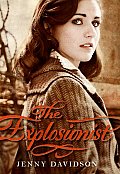
The Explosionist

I really loved fellow blogger Jenny Davidson’s young adult novel The Explosionist; it was a good story with an appealing heroine and an interesting concept — what would the world be like if Napoleon had won the Battle of Waterloo?  It’s an alternative history novel where the political configurations are nothing like what we know today — much of Europe is one entity that has taken over England, and Scotland, where the novel is set, is allied with various other northern European countries to form the New Hanseatic League.  These two groups are perilously close to war.

The novel is set in the 1930s and tells the story of Sophie, a teenager in Edinburgh who lives with her great-aunt and has a fairly normal life attending school and spending time with friends.  But her great-aunt has some peculiarities — she is politically well-connected and influential, for one thing, and she also has a strong interest in mediums and the spirit world and holds séances at her house.  In this alternate universe, though, this kind of spiritualist interest is more wide-spread than it is in ours, so the great-aunt’s involvement in it is only mildly unusual and not alarmingly strange.

It does become alarming, however, when Sophie attends a séance conducted by a woman who delivers a frightening prophecy and then ends up dead just a little while afterwards.  Sophie and her friend Mikael investigate the death and find themselves in a much more complicated situation than they ever expected — they run into trouble with the law, investigate suspicious politicians, communicate with the spirit world, and much more.

I loved the novel for a bunch of reasons; one of the main ones was Sophie herself, who is smart and thoughtful, and although she does doubt herself at times, which is what one would expect in a 15-year old who has to deal with some strange situations, she trusts her insights and her intelligence.  She knows that boys and girls, men and women, are equally capable and smart, and she makes sure she holds her own in her adventures with Mikael.  She believes just as strongly that children are basically young versions of adults and are capable of much more than adults usually give them credit for.  Her actions in the novel prove her point.

All the historical and cultural differences between the novel’s world and our own are a lot of fun to discover as well.  Many famous names appear in the novel, but they are famous for different reasons than they are in our world — Sigmund Freud, for example, has a talk show on the radio and blathers on about the Daedalus complex.  Albert Einstein writes poetry and James Joyce is famous for his operas.

And, of course, it’s a good story, too, with a plot that moves along at a steady, satisfying pace.  One of the most chilling parts of the plot has to do with an organization called IRYLNS, the Institute for the Recruitment of Young Ladies for National Security.  The acronym is pronounced “irons,” and its activities, which I won’t describe here, are horrifying.  Sophie learns more about it than she ever wanted to know.

Like all good young adult novels, this one is excellent reading for people of all ages.  If you’re interested, you’ll find an author’s blog here.

9 Comments

Filed under Books, Fiction

Death in a White Tie

I’m enjoying my tour through the world of mysteries, both with my mystery book club and on my own, and Ngaio Marsh’s novel Death in a White Tie was a fun, albeit lightweight, example. It’s the first Marsh I’ve read and not necessarily the last, although she is a writer for a particular kind of mood — the kind of mood where you need something calming and predictable.

Set in the 30s, the novel tells of debutantes, balls, and London social seasons; the detective, Inspector Alleyn, comes from this high class world, although having a real job, he’s a little at odds with it as well. The first few chapters introduce you to the cast of characters (it does this very straightforwardly with a chapter entitled “The Protagonists”). We learn of trouble beneath the facade of glamour and luxury; some of the characters are being blackmailed, and one of the novel’s most likeable characters, Bunchy, otherwise known as Lord Robert Gospell, is put on the case. When he ends up murdered, Alleyn is saddened by the loss of his friend but must manage to put his feelings behind him so he can conduct the investigation — an awkward business, since many of those he must investigate are his friends.

The novel follows a very predictable structure, and at times this can get a bit dull; there is a long section in the middle where Alleyn interviews every major character, and these go on a bit. But there is pleasure to be found in following Alleyn as he and his assistant Fox piece the puzzle together, and as we meet some intriguing minor characters, such as the odd, extremely inhibited secretary Miss Harris. It’s the pleasure, I suppose, of knowing pretty much exactly where you’re going and happily enjoying the journey.

There are certainly a number of strange moments in the book, for example the hard-to-believe, at times embarrassingly awkward love story between Alleyn and the painter Agatha Troy. And then there is the bizarre conversation Alleyn and his mother have about gender politics. She argues that

… no woman ever falls passionately in love with a man unless he has just the least touch of the bounder somewhere in his composition.

Alleyn is surprised by this argument in favor of male arrogance and bullying, but then he tries it out on Troy with surprising success. I didn’t like this, but I was amused by the way Alleyn’s mother calls this gender dynamic “savagery” and argues that it is the same savagery that lies behind the church wedding ceremony and behind the season itself:

As long as one recognizes the more savage aspects of the Season, one keeps one’s sense of proportion and enjoys it.

I read this on vacation, and it was a good vacation book — not too mentally taxing, fun in a low-key kind of way. Not everyone in my book group was as easy to please as I was; many of them didn’t like it at all while some others reacted much as I did, with mixed feelings. I don’t know who we are reading next, but I’m looking forward to finding out.

5 Comments

Filed under Books, Fiction

Adeline Mowbray

I very much enjoyed reading Amelia Opie’s 1804 novel Adeline Mowbray; if you are interested in reading novels from the time period, something beyond Austen, Scott, or Burney, you might consider this one — it’s a very interesting take on the institution of marriage, dealing with it in a way that might surprise contemporary readers.

Adeline is a young woman who was raised by a mother foolishly obsessed with philosophy — I say foolishly because while she prides herself on her intellect, she has no practical skills whatsoever, and is the type of mother who composes a treatise on the education of children all the while neglecting her daughter. Adeline herself is fortunate to be raised by her grandmother as well as her mother; she inherits her mother’s philosophical bent but also learns usefulness and practical skills from her grandmother.

What she does not learn, however, is how harsh and unforgiving the social world of her time can be, and so when she reads a book arguing that marriage is an outmoded, unnecessary institution, she has no idea how shocking this is. She finds the arguments set forth perfectly logical and makes up her mind never to marry.

Meeting and falling in love with the man who wrote the anti-marriage book doesn’t change her mind in the least; instead, she decides she would like to live with him in a relationship that is as stable and steady as marriage but without actually undergoing the ceremony. This man, Glenmurray, now finds himself in a dilemma. On the one hand, he believes in the validity of his own anti-marriage arguments, but he knows that Adeline would pay a high price for choosing cohabitation. He decides he is willing to bend to the dictates of society and get married. On the other hand, he can’t back down from his beliefs without disappointing Adeline and losing her respect. She believes it is a matter of honor that he stick to his beliefs, and she is determined she will not allow him to compromise for her sake.

A chain of events eventually leads to their cohabitation, and here things get interesting, for Adeline finally must learn just how high a price she will pay for her radicalism. And what a price she pays. From here on out, everything goes wrong — she loses all her friends, for no respectable woman would associate with a “kept” mistress. She is subject to attacks by men — practically every man she runs into — because each one assumes she is sexually available. When Glenmurray becomes ill, she realizes she will be penniless if he dies. She becomes pregnant but the distress of her life leads to a miscarriage. She is estranged from her mother, the only one who could protect her were Glenmurray to die. She spends the rest of the novel stumbling from one disaster to the next, never able to recover from her initial “mistake,” if you choose to see it that way.

It’s possible to read this as a pro-marriage, anti-radical novel, which is the way the Victorians saw it. And there may be some truth to this reading, as by the end of the novel Adeline is so thoroughly demoralized and so convinced that her anti-marriage stance was a huge mistake, that the novel seems to argue against doing anything that deviates from tradition and social expectations.

And yet it seems to me that this is less a pro-marriage novel than it is a critique of an oppressive society that allows women absolutely no room for error whatsoever. All the awful things that happen to Adeline — her isolation, her vulnerability, her economic distress, her sexual danger — seem way too high a price to pay for her youthful beliefs, especially since she had no idea just how dangerous they would be. Whether her anti-marriage arguments have any validity at all seems almost beside the point; what matters is that her “mistake” was entirely innocent and she was not allowed to recover. There are a few people along the way who help Adeline out, but the vast majority of people, especially men but also women, mock her, take advantage of her, and shun her. Even a sympathetic man, one who is attracted to her and considers marrying her, decides he cannot because she is “damaged goods.”

Adeline so clearly does not deserve this treatment; she is a much stronger, much smarter, much more honorable, and much more honest person than anyone else in the novel. The novel leads us to sympathize with her and wonder just what it is about a strong woman that society cannot handle. When she finally changes her mind about marriage and comes to believe in it as a necessary institution, she claims that she changed her mind because of logical reasoning, and yet it’s hard not to feel that it was the battering, the non-stop abuse that led to the change. No one could have withstood it.

Adding another layer of interest to the novel is that fact that it was loosely (very loosely) modeled on the life of Mary Wollstonecraft, a radical woman who fell in love with an anti-marriage philosopher, William Godwin, and then wound up marrying him. Amelia Opie moved in radical circles herself, at least in the earlier parts of her life before she became a Quaker, and was known to admire Wollstonecraft, a fact that bolsters more subversive interpretations of the novel.

This can be a painful read at times, as the above description probably makes clear, and yet it’s fascinating to watch an 18/19C woman grappling with an issue that seems to us to be so very contemporary. We are certainly not the first ones to wonder if cohabitation makes more sense than marriage and also to lament that women so often have to pay a high price for acting on an unpopular belief.

17 Comments

Filed under Books, Fiction

The Boat

Nam Le’s book of short stories, The Boat, has an incredible range of settings, situations, and types of characters. The first story is the most traditional, the most stereotypical, perhaps (although this is not to say it’s not a good story), with its main character who is a student in the famous Iowa creative writing program. From there, though, we take off to Colombia and read about 14 year old hitmen (hit children?) and then to New York City, Australia, Japan, Iran, and Vietnam. Le writes about each of these places with admirable ease and assurance, describing them as though he knows the places and the people intimately (leading me to speculate about the author’s life, although I generally try to be more sophisticated than that).

The stories are all action-filled, each one centering on some highly dramatic moment, often a violent one. For example, the story set in Iran tells of political protests and arrests through the lens of two estranged friends trying to understand each other, and the Australia story tells of teenage love, jealousy, bullying, and schoolyard fights. The last story is a harrowing account of Vietnamese “boat people” on a journey that lasted much longer than it should have.

But these stories aren’t simply interesting for their plot; they are wonderfully written as well. Le’s sentences beautifully capture the characters’ exterior world as well as their interior landscapes; they often startle you with a brilliant image or an unexpected observation. At times the writing veers toward stream of consciousness as Le takes you deep into a character’s mind. Here’s a passage that shows how Le writes about action and consciousness all at once:

Finally the storm arrived in force. The remaining light drained out of the hold. Wind screamed through the cracks. She felt the panicked limbs, people clawing for direction, sudden slaps of ice-cold water, the banging and shapeless shouts from the deck above. The whole world reeled. Everywhere the stink of vomit. Her stomach forced up, swashed through her throat. So this was what it was like, she thought, the moment before death.

She closed her eyes, swallowed compulsively; tried to close out the crawling blackness, the howl of the wind. She tried to recall her father’s stories — storms at sea, waves ten, fifteen meters high! — but they rang shallow against what she’d just seen: those dense roaring slabs of water, sky lurching overhead like a puddle being mucked with a stick. She was crammed in by a boatload of human bodies, thinking of her father and becoming overwhelmed, slowly, with loneliness. As much loneliness as fear. Concentrate, she told herself. And she did — forcing herself to concentrate, if not — if she was unable to — on the thought of her family, then on the contact of flesh pressed against her on every side, the human warmth, feeling every square inch of skin against her body and through it the shared consciousness of — what? Death? Fear? Surrender? She stayed in that human cocoon, heaving and rolling, concentrating, until it was over.

How can you read this and not want to know what happens next and also not want to know more about this young person caught in horrible circumstances?

The stories have an interesting metafictional element too. The first story about the creative writing student seems highly autobiographical (particularly as the character shares the author’s name), and in it, the character grapples with the question of whether he should write about Vietnam. Ethnic lit., he is told, is incredibly hot right now, and he could exploit that trend with tales about his father, a victim of the war, and with stories about Vietnamese boat people. A friend tactlessly tells him:

You could totally exploit the Vietnamese thing. But instead, you choose to write about lesbian vampires and Colombian assassins, and Hiroshima orphans — and New York painters with hemorrhoids.

Interestingly enough, most of the stories his friend lists appear in Le’s book (the lesbian vampire story isn’t there, unfortunately). So the whole collection becomes an exploration of writing and identity. What should a person write about? Should a person write about his or her roots, particularly if that’s what people want to read about and if it’s more likely to get published? Should a person instead explore other worlds?

Le does both of these things, writing about the familiar (he himself was a student in the Iowa program)  and writing stories about Vietnam (the first story about personal consequences of the Vietnam War and also the closing story about the boat people) and also writing stories about places and situations that seem remote from him. The book seems to argue that a writer can have it all, can write about his experiences and can stray far from them. And why not?

I admire the way Le uses the opening story to prepare the reader for the rest of the book and the way that story gives it a kind of unity, while at the same time the collection as a whole is incredibly diverse. Added to this unity-in-diversity is a self-awareness I admire, a questioning attitude about the relationship of writers to their material. All-in-all, Le has managed to pull off a pretty wonderful feat with this book.

9 Comments

Filed under Books, Fiction, Short stories

Thoughts for Thursday

I seem to be having trouble blogging regularly this week. It’s low motivation partly, which surprises me, as I’d expect to have all kinds of energy because it’s summer and my schedule is much slower than usual.  But instead I feel sluggish. It’s also harder to blog this summer because I’m spending more time online than usual with my online class.  After an afternoon of grading papers on the computer, I just want to put the thing away.  Posting may be light for a while, although generally when I write such a thing here, my motivation comes back almost instantly.

My online class is going well, by the way, although summer courses have such a fast pace, I can tell my students’ energy is flagging, as is my own.  It will be over in a week, which is hard to believe, as I feel I’ve just gotten started.  I’ve had a few students not appear in the class at all, and some are there only occasionally, but the ones who are into it are doing a great job.  It’s fun to look through the discussion board and see them politely agreeing or disagreeing with each other, backing each other up, debating things.  I’m generally a nice person in the classroom (sometimes with some effort), but it’s even easier to be nice and friendly online, when I don’t actually have to see people.  I like seeing people, I really do, but it’s nice sometimes not to have to 🙂

As for reading, I’m almost finished with Nam Le’s The Boat, which I will write more about later, but for now I’ll say that I’m amazed at the range of material he’s got to work with.  The stories are set in various places all over the world and deal with an incredible variety of people and situations.  I’m curious what places and experiences the author has had himself, what ones he has learned about from other people, what ones he learned about solely through research, or what it was he did to get all that material.  I suppose what I want to know is the answer to that obnoxious question I would never ask an author: where do you get your ideas?

Finally, I realize I never wrote my final thoughts on Fingersmith.  I don’t suppose there is any real need for another review of the book, though, as it’s one that most people out there seem to have heard a lot about if not read themselves.  So I’ll just say that it’s a fabulous story, very well told, and if you like historical fiction at all, you’ll be likely to enjoy this.  I thought there were a few places where the pacing was a little off and a few places where the action was implausible, but that was very minor compared to all the pleasure this book offers.  If you read it, you will enjoy the story, but you will also learn interesting things about 19C London and how thieves operate and what it was like to be a woman at the time.  I’m looking forward to more Sarah Waters already.

8 Comments

Filed under Books, Fiction, Reading, Teaching

Two wonderful, entirely different books

There are two wonderful but entirely different books I’d like to write about tonight. The first is Keith Devlin’s The Math Gene, which Emily kindly loaned to me. I wrote about the first half of the book here (raving about it and going on about how much I like math). The second half isn’t quite as good as the first, but it’s still very good. What I like about the book as a whole is how much it covers and with what remarkable clarity. It has a whole lot to say about math, of course, including what it is, what it’s like to be a mathematician, how we learn math, what animals know about numbers, why some people think they can’t do math. It also has a chapter explaining one aspect of math — group theory.

But that’s only part of it. It also covers current theories in linguistics and the universal structure of language. And it also covers theories about how and why language and math evolved, and how the two are connected, giving a history of human evolution along the way. It’s a lot, right? And yet I never felt he rushed or skimped on anything. I was able to follow all of it.

The book was published in 2000, and I’m curious what new research has appeared on the subject subsequently (although probably not curious enough to do the work to find out …). I can’t say whether Devlin’s argument — briefly, that our ability to do math comes from the same brain capacity that gave us language — is right or not, but what interests me most about the book is not so much the larger argument, but all the information he gives about math, linguistics, and evolution along the way to make that argument. If you are at all interested in those subjects — or if you think there’s a chance you might be — I highly recommend this book.

The other book I wanted to write about is the latest in Ella’s Absent Classic series, The Folktales of the Bezai. I’d love to rave about this book, but I feel a little badly doing it, as it’s not something widely available, and I don’t exactly want to make anybody long for a book they can’t have (although if you come visit me, I’ll let you read it). The book does promise a catalog and more information if you email Ella (the address is on her website). This is a homemade book, and you can read about the bookmaking process here, here, and here.

This edition of Ella’s fake books has a foreword by Maurice Glassoni, Ph.D., which tells of the discovery of the papers of Josephine Winterbottom, a former student of Glassoni’s who supposedly disappeared while traveling in the 1930s. However, she left behind diaries and notes from the time she spent living with an unknown tribe called the Bezai. In these papers is a long manuscript recounting stories told about a man named Anah. The Folktales of the Bezai offers a small selection of these.

The stories work together to tell the tale of a journey Anah undertook to save a peacock who has been imprisoned in a tree. The journey takes Anah to many strange places where he undergoes adventures and meets challenges and sees many strange things. It’s a charming story, told with simplicity and humor. Each segment of the story ends with a proverb of the sort you often find in folktales; in this case all of the proverbs sound borderline nonsensical and borderline profound, for example, “For he who gambles must make cheese of his own heart,” and “For he who smiles with sharp teeth is not to be easily kissed.” None of the proverbs relate in an obvious way to the preceding story, which means you can simply laugh at them and move on, or you can exercise your imagination to try to find connections between the proverb and the story. I found the latter exercise kind of fun.

What I love about the Absent Classic books is the sense of humor underlying them. In this case, I found myself laughing during the story itself, but I’m particularly fond of the foreword, which is written by a professor who apparently is quite judgmental, stuck on himself, and not interested in seeing a former student of his succeed in any way. His disdain for Winterbottom’s anthropological work is clear:

As a reader of fiction, I can see little quality in the work — it is trite, sexless, and composed around proverbs that bewilder in their nonsensicality — perhaps a problem in the translation? — and as an anthropologist, I can see even less value in the tale ….

Perhaps one day the Bezai will be discovered or a very clever fraud revealed. Who can say? In the meantime, Mr. Bishop of the Absent Classic has decided to publish a small selection for the public’s amusement, and it is my sincere hope that it may interest a few readers in the study of folktales with genuine anthropological interest.

In other words, forget about my former student and buy my book instead.

The other wonderful thing about the book is its illustrations, which, a note explains, are copies of a series of “Bezai tiles” which were based on Winterbottom’s sketches of Bezai pottery. They are little pictures of birds and plants, presumably from the landscape in which the Bezai lived.

I am now eagerly awaiting Volume 4, which, I understand, is entitled “A Guide to Lost Colors.” I can hardly wait.

11 Comments

Filed under Books, Fiction, Nonfiction

Un-put-downable books

So what do you do when you are reading two books neither of which you can put down?  I can’t exactly read them both at the same time.  I’m stuck going back and forth between them. But that’s not at all a bad way to spend a weekend.

The first one is Sarah Waters’s Fingersmith, which I’m already over half way through.  The plot starts off at a fast pace, and I’m dying to know how it all turns out, but, as is usual for me, it’s not just the plot that captures my attention — I want to know more about the characters.  The book fulfills that desire too; the second section retells the events of the first, but from another character’s viewpoint, so while the plot itself isn’t the interest here, the different interpretations each character has of what’s going on is.  I love the way this technique allows you to see how little the facts of a situation matter — what matters is your interpretation, the sense you make of those facts.  It’s a little disturbing at the same time, though, because it makes you realize how little solid ground of certainty any of us have to stand on.

The other book is Janet Malcolm’s The Silent Woman, a book about Sylvia Plath and Ted Hughes, the legends that surround both of them, and the way biographies have created those legends.  Litlove recently wrote a beautiful review of this book, which was one of the reasons I picked it up, and the other is that I’ve had my eye on Malcolm’s books for years, since they seemed to be the sort of nonfiction I like best — the uncategorizeable sort.  I have now determined that I need to read every book she has written; Malcolm is someone I will like no matter what she writes about.

The book has lots of information on Plath and Hughes, but mainly it’s about the afterlife of Plath and the sort of life-in-death experiences Hughes has had after her suicide.  It tells the stories behind the memoirs and biographies that have appeared, and the wars that advocates of Plath and those of Hughes have waged with each other over how to interpret their relationship.  It tells about Malcolm’s own experiences researching her subjects, and it also advances an argument about biography itself.

Both of these books, I’m realizing now, have much to say about the uncertainty of knowing anything.  The characters in Fingersmith think they understand and can control what is happening, but they discover, painfully, that they can’t.  The people in Malcolm’s book believe they understand exactly what sort of people Plath and Hughes were, and yet there are others out there who are equally certain the opposite is true.  There’s really nothing a person can do but flounder through all the uncertainty and hope not to get it too terribly wrong.

15 Comments

Filed under Books, Fiction, Nonfiction, Reading

Maisie Dobbs: An Incomplete Revenge

I recently finished the latest Maisie Dobbs novel, An Incomplete Revenge, and it was an interesting experience because this is the first in the series (of five novels so far) that I read in book form rather than listening to it on audio.  I have to say it was very different reading as opposed to listening.  I enjoyed the novel and got wrapped up in the story, but I found myself more critical of the writing and plotting than I was with the earlier books.

The story takes up interesting themes, particularly class and racial tensions; it’s set in a small town known for growing hops and every fall a number of people from various places and backgrounds convene there to pick the hops for a little break from the city and a way to make some money.  There are Londoners who come for some fresh air, including Billy Beale, Maisie’s assistant, and there are gypsies who set up camp for a while, working but keeping themselves aloof.  This creates some tension, as the locals resent the presence of these other groups, although they rely on them too.

But the tension in this particular town is even more complicated, as it has a dark and mysterious history, which it quickly becomes Maisie’s job to uncover.  During World War I (or simply The War, as they would have called it), a zeppelin raid destroyed one of the town’s families, and the memory of this violence still haunts the place.  No one wants to talk about what happened.  And no one wants to talk about the series of fires that have occurred around the same date every year.  No one is surprised by these fires and no one calls the authorities for help; they just put the fires out themselves and go on with their business.

So, as is usual in this series, the mystery revolves around the lingering effects of the war, and Maisie must help people face what happened and come to terms with it.  She must also come to terms with her own experience — in this novel she faces the death of her war-time sweetheart and needs to learn how to put that episode of her life behind her and move on.

There is a lot going on that I like — the historical aspect, Maisie’s own appeal as a character, the class/race tensions, the spiritual and psychological aspects — but I found myself reading with more of a critical distance than I expected.

One problem is that I thought the dialogue was awkward in places.  Now, I never noticed this when I listened to the earlier books on audio, and I find it odd that I would only pick up on it while reading the words.  If the dialogue is awkward, wouldn’t it be more noticeable when someone is reading the text rather than less?  Perhaps the readers were doing a particularly good job, or perhaps I’m wrong in my initial assumption.  Maybe my greater emotional involvement when I’m listening rather than reading means I don’t pick up on awkward spots.

Another issue is that I figured out the mystery, at least most of it, fairly early on.  I’ve said before on this blog that if I can figure out the mystery there must be some kind of problem with the plotting, because I’m terrible at figuring things out.  I never figure things out.  With this book, though, as the plot moved toward the conclusion I found myself just a tiny bit bored with it because there weren’t a whole lot of surprises left.

The truth is, though, that I’m more interested in the characters and the history than I am in the plot, so for me this issue ultimately didn’t matter all that much.  I still enjoyed reading this book, and I’m looking forward to future installments in the series.  I really want to know what happens to Maisie!

16 Comments

Filed under Books, Fiction

The next Slaves of Golconda book

Stefanie has asked me to choose the next Slaves of Golconda book, and I’ve picked out four possibilities for people to vote on. Come on over and let me know what you think!

Leave a comment

Filed under Books, Fiction

The Glimpses of the Moon

Edith Wharton’s novel The Glimpses of the Moon was an immensely satisfying read; it’s a good story that moves along at just the right pace, and it offers much to think about: it deals with love and marriage, money and society, ambition, work, children, novel-writing, travel, class, isolation, loneliness, and probably more things that I’m not thinking about now.  I don’t think the book is quite on par with The Age of Innocence or The House of Mirth, maybe because it is more narrow in focus than the other two and perhaps because I’m biased towards books with a tragic rather than a comic structure.  But still, I felt a depth and heft to this book that I too often feel is missing in more contemporary fiction.

The novel tells the story of Susy Branch and Nick Lansing, both of whom have no money but have found ways of living comfortably in high society — they have been sponging off of friends in order to support the lifestyles to which they have been accustomed.  When they meet and hit it off, they decide to marry and live as long as they can off the wedding presents they receive and the offers of houses to visit that come from their rich friends.  The novel opens with the couple beginning their honeymoon at a friend’s villa on Lake Como.  The catch, though, is that they have agreed to end the marriage if one or the other finds someone rich who will marry them.  Their marriage is opportunistic through and through, although they are, without a doubt, quite fond of each other.

With this precarious situation at the novel’s opening, things are bound to unravel, and unravel they do.  First of all, Nick and Susy discover that their intense focus on money is bound to warp their relationship.  It turns out they have different ideas about what manipulation and deception, what “management” — an important term in the novel — is acceptable when it comes to securing money or a house to live in.  They quarrel about whether Susy should take a box of cigars left by their friend, and this quarrel causes a rift that won’t soon heal and that hints at the even greater struggles the two of them will soon face.

This conflict is interesting because of the way it’s gendered; as a woman Susy is more vulnerable than Nick is and therefore needs a moral code that is more flexible to maintain her position.  Nick has the luxury of being a little more discriminating.  Wharton describes this conflict in satisfying detail, especially the way Susy regrets that she has disappointed Nick and longs to attain a higher moral standard, but at the same time fully understands the reasons for her behavior and is able to forgive herself.

From here things fall apart further; friends and their friends’ children intrude into their honeymoon bliss, jealousies flare, misunderstandings arise.  Nick and Susy have much to learn, both about themselves and about the world they live in.  They eventually are faced with the demoralizing realization that the world they worked so hard to maintain their place in is ultimately frivolous and shallow.  Their friends lead silly, pointless lives and are intensely selfish.  They only care about Nick and Susy to the extent that they have something to gain from them.

In contrast to their wealthy but frivolous friends are the Fulmers, a family of struggling artists and many children who lead honest lives but have no money.  Susy and Nick are horrified by these people, by their obliviousness to fashion and their unsophisticated happiness.  But they are innocent and relatively unspoiled by the idleness and silliness of the other characters (at least at first).  Eventually Susy and Nick will learn something from these people; their changing attitude towards the Fulmers will mark changes within themselves.

The novel’s structure is satisfying too (although perhaps a trifle too neat?  I enjoy this kind of neatness though).  I’m going to be discussing plot events from later in the novel, so take care — after Nick and Susy split they each find another love interest and another family to take care of them, and each of them have lessons to learn about themselves and about each other.  Only after they have learned these lessons apart from one another are they able to find a way to come together again.  I found the ending plot twists exciting, although a tad unrealistic, but I was willing to get over this for the sake of the pleasure the ending brought.

Overall, what a satisfying book this is!  Check out the Slaves of Golconda site for other posts and discussion.

7 Comments

Filed under Books, Fiction

Beat Not the Bones

Charlotte Jay’s novel Beat Not the Bones manages an unusual feat: it is interesting and boring at the same time.  It has a lot of ideas, a lot of good things to discuss, but the experience of reading it was dull.  Surely you’ve had that experience before?  I kept wondering why I wasn’t enjoying myself more; I felt I should have enjoyed it, but I found it too easy to put the book down.

I was relieved to read that Emily found it boring too, and to hear that many of the members of my mystery book group agreed (Hobgoblin’s take on the novel is here).  One member wondered if he was reading it under poor circumstances, which might explain why he found it hard to get through, but when others said that they had a similar experience, it seemed clear that it’s a fault of the book and not of the reader.

The book is marketed as a mystery and it won the Edgar Allan Poe award in 1954, but it felt to me like it could just as easily be considered literary fiction as mystery.  There is a mysterious death that gets explained by the novel’s end, but the heart of the novel is really in the changes that take place in the main character, Stella, and there is no way for the reader to figure out how the plot will resolve itself — there are no clues to follow and there is no detective.  I wondered if I would feel differently about the book if I approached it as literary fiction rather than as mystery — when I pick up a mystery, I expect a fast-moving plot at least, but with other kinds of fiction I’m more tolerant of slowness.

The story is about the death of Stella’s husband which took place in the colonial outpost of Marapai in New Guinea.  Stella, who had been living apart from her husband in the time leading up to his death, travels to Marapai to discover what happened to him.  People have told her that he committed suicide, but she believes he was murdered.  In the novel’s opening chapters we are introduced to a potential suspect, Alfred Jobe, who has discovered gold in the jungle village of Eola.  Stella’s husband has blocked his claim to the gold, providing him with a motive for murder.  Stella’s quest is initially to find Jobe, but she soon learns that the situation is much more complicated than she originally thought.

The novel’s colonial context is one of the most interesting things about it; there is the inevitable tension between the white colonialists and the Papuans, and it quickly becomes apparent that most if not all of the colonialists are incapable of seeing the Papuans as human beings.  Racial inequality is a given; the colonialists are there to bring “civilization” to the natives and the natives are there to gratefully accept it — and to work as servants.  The atmosphere is even darker than this description implies, however, as the whites have largely stopped believing in their “mission” and are focused on survival and perhaps on making some money.

All this raises the question of Jay’s own take on the colonial situation and on race relations.  I couldn’t help but feel that the book is meant as a critique of racism and colonialism and that the bleakness of the situation is a reflection on what inevitably happens when one group of people tries to control another.  As the novel progressed, I was overwhelmed by the ugliness of it all, the horror of what the colonizers were willing to do to maintain their position and to protect themselves from any culpability, and I think Jay meant the reader to feel that way.

On the other hand, I’ve been struggling to figure out exactly what to make of Jay’s portrayal of the Papuans.  The book is a little like Somerset Maugham’s The Painted Veil (many thanks to Becky for pointing out this comparison) in the sense that both novels use a colonial setting as the backdrop to the tell the story of a woman’s growth and self-realization, and I can’t help but wonder whether the plight of the natives gets a little lost.  Is this another example of a colonial setting functioning mainly as the spur to change in the colonizers?

And yet while Jay largely keeps her focus on the white characters and their struggles and challenges, she does offer a complex and powerful Papuan character in Hitolo, and in a way it makes sense for her to focus on the colonizers rather than to try to get into the minds of the Papuans, which might feel presumptuous and arrogant.  And what I think ultimately matters is the sense a reader almost inevitably leaves the novel with that the colonial project is hopelessly corrupt and doomed.  The ugliness of it pervades every page.

So with all this interesting stuff going on, I’m sad that the novel wasn’t a more absorbing read.  Part of the problem was that the characters weren’t developed enough to be believable — they tended to do strange and unexpected things, and I never found a way to fit all the pieces of each character together.  The pace was too slow as well, and it had abrupt and uncomfortable transitions that unfortunately invite a reader to set the book aside.

I am interested, though, in the combination of mystery novel and colonial setting.  Can you think of other books that do something similar?  Hobgoblin mentioned The Moonstone as a possibility.  Any others?

9 Comments

Filed under Books, Fiction

The Loving Couple

The Loving Couple is written by Virginia Rowans, who is really Patrick Dennis, the guy who wrote Auntie Mame. The authorial gender switching makes the book that much more interesting because it is split in half, one part from the perspective of a woman and the other from that of a man — in fact, the two parts each have their own cover complete with a title page and publishing information so you can’t tell which part you are supposed to begin with. You just pick one side, read to the middle, flip the book over and start with the other.

I started with the woman’s story, and as I was reading I found it jarring when I remembered that a man wrote it. I felt as though it were written by a woman. But then when I got to the man’s story, I found it hard to believe that the same person had written the woman’s version I’d just finished. It felt like two different people wrote the book. This is pretty impressive, I think.

The novel covers one bad day in the life of a marriage — it begins with a horrific fight and a breakup, and then follows the man and the woman as they have one of the worst days ever. They meet awful people, get caught up in awful parties, get tracked down by angry family members, feel trapped, get betrayed, learn things about other people, and learn things about themselves. The structure is interesting as the characters go through parallel events; for example, each character meets someone who tempts them into a possible affair, and they have to decide how they will respond.

The parallel narratives cover the same day, but for the most part they don’t cover the same exact events, so we don’t get the psychologically-interesting technique of having each character’s perspective on the same conversation or event. Instead what we get is a more exterior view, a satirical look at what happens to two people as they try to recover from their vicious fight by running away to fascinating new people and places.

The book is light and entertaining, as it was meant to be, and yet it offers a contemporary reader a lot to think about, as it is very much a book of its time, 1956, in terms of the way it portrays social issues. My God, is this a snobby book. Rowans has all kinds of fun lampooning the awful suburban culture the characters have moved into — the elite development somewhere on the Hudson that cross-examines potential members to make sure they are the right sort, although the right sort can be pretty horrid, as we learn when we meet the neighbors. Opposed to this stuffy suburban life is the wild city where you can meet bohemians and artists deep in the heart of Greenwich Village. Part of the plot is the characters’ need to figure out just where they belong — who are their real friends and where is their real home?

The city/suburb conflict is amusing, but the pervasive sexism and racism is not. I’m not sure how much of this Rowans is satirizing or how much is simply a reflection of the way people, including the author, thought at the time, but it’s hard to read casual comments about, for example, how one family was excluded from membership in the development because of a Jewish ancestor and to see that the only African-Americans are servants and are very stereotypically portrayed.

It’s a good reminder of all that has changed in the last fifty years, which isn’t that long, really. As I read I went back and forth between enjoying myself and wincing at some new dismissal of women or some other detail offensive to modern readers. It’s not as though in 2008 we’re so terribly enlightened, but a book like this can show that we’ve made some progress at least.

So all in all it’s an interesting read, and for a number of different reasons. I’m glad I picked it up.

8 Comments

Filed under Books, Fiction

More on Anne

Tomorrow I am leaving to go visit Emily in Pennsylvania; in addition to the pleasure of seeing Emily herself, I have something else to look forward to: she has promised to leave a stack of books on my nightstand for me to look through and perhaps borrow.  I’m very curious to see what she chooses.  I’ll be back on Monday.

For now I want to write a bit about my Anne of Green Gables rereading.  As much as I admire Kate’s plan to read the book slowly, I can’t follow suit; if I hadn’t had a busy couple of days and if I weren’t reading a few other books I would have finished the novel already.  I don’t think I’m capable of showing any discipline when it comes to that book; I can’t resist reading just one more chapter.

I’ve been trying to figure out what the source of Anne’s appeal is for me.  I’m not at all like her.  I don’t talk much, I have little imagination (at least of the sort Anne has), I’m not artistic, and I am not, as the narrator describes Anne, “feminine to the core.”  But of course I don’t have to be like a character to feel drawn toward her.  I suspect I’m much more like Diana Barry, who is different from Anne in a lot of ways too.  Diana doesn’t have Anne’s imagination or talent for coming up with ideas (or for getting into trouble), but she is willing to go along with whatever Anne proposes and is ardently devoted to her.  I could see myself happily being Anne’s sidekick.  As I read along I find myself wondering if Anne would consider me a kindred spirit if I met her in real life, and I can’t help but hope she would.  Perhaps that’s part of her appeal too — the reader can’t help but want to be a part of her inner circle, one of the chosen, one of those people who really gets her.

I’ve also been thinking about religion in the novel, something I’m pretty sure I didn’t pay much attention to as a kid, although perhaps I absorbed some important lessons without being aware of it.  I’m struck by Anne’s irreverence and her determination to stick to her own view of God and of people, no matter how much Marilla rebukes her.  This comes up, of course, in Anne’s doubtfulness about the value of prayer when Marilla first asks her to say her prayers at night (“Mrs. Thomas told me that God made my hair red on purpose, and I’ve never cared about him since”), and in her response to the minister’s prayers in church (“He was talking to God and he didn’t seem to be very much interested in it, either.  I think he thought God was too far off to make it worth while”).

It’s not that Anne doesn’t believe in God, exactly, but that God seems kind of beside the point in her life.  As Marilla describes her, she is a “freckled witch of a girl who knew and cared nothing about God’s love, since she had never had it translated to her through the medium of human love.”  She also seems to value her own perceptions of the world most of all, and she will admit to the existence and importance of God only to the extent that this makes sense to her. I don’t get the sense that Anne would ever subordinate her own instincts about life in order to conform to traditional piety in the name of religious faith.  She trusts herself too much to do this.  I find this attitude appealing; it’s a confidence I myself have developed only very slowly and mostly as an adult, but I wonder if I didn’t learn a little bit of it from Anne.

I also am struck by one particular way Anne talks about imagination; in the Aunt Josephine episode, the one where Anne and Diana incur her wrath by jumping into her bed in the middle of the night, she says this:

Have you any imagination, Miss Barry?  If you have, just put yourself in our place.  We didn’t know there was anybody in that bed and you nearly scared us to death.  It was simply awful the way we felt.  And then we couldn’t sleep in the spare room after being promised.  I suppose you are used to sleeping in spare rooms.  But just imagine what you would feel like if you were a little orphan girl who never had such an honor.

Anne is asking Josephine Barry to empathize with her and to do so through an act of imagination.  Here is one aspect of Anne’s imagination I care a lot about and hope to share — to be able to understand people, to put myself in their place, by thinking creatively and thereby, maybe, to refrain from judging them or from getting angry at them.  There is an ethical aspect to imagination, and I admire Anne for drawing on it here.

14 Comments

Filed under Books, Fiction

What Was Lost

Catherine O’Flynn’s novel What Was Lost (my copy sent to me by the publisher) is a good read, not perfect, but absorbing; it’s a mystery, sort of, not a traditional one with a detective who solves the crime, but a mystery nonetheless — it tells the story of a young girl who one day disappears and of the people left behind who after 19 years discover what happened.

The novel begins with a 70-page section on that young girl, Kate Meaney, an orphan living with her grandmother.  Actually when I said the novel doesn’t have a detective, that’s not quite true; this novel’s detective is the one who disappears, Kate herself.  Armed with her book How to Be a Detective, she sets up her own detecting business, although so far it’s had only one customer, her friend Adrian, a young man who works at a nearby shop.  This section of the novel is utterly charming, and that’s because Kate is such a great character — smart, lively, full of ideas, serious and unselfconscious in that way only children can be.  Kate has lost much — she doesn’t remember her mother who left when she was very young, and she found her father’s body after he died from a stroke — but she seems to have found ways of coping, her detecting work perhaps chief among them, with its focus on putting the world to rights.

The next section, which makes up the bulk of the book, shifts 19 years into the future, and here I felt some dissatisfaction, as I didn’t want to leave Kate’s company, and I thought the pace slowed and dragged in some moments.  Kate had done most of her detecting work in the Green Oaks Mall, and in the second section the scene settles here permanently, introducing us to a number of new characters, most importantly Lisa, Adrian’s sister who knew Kate slightly and who works in a music store, and Kurt, a mall security guard.  Both of these characters, who don’t know each other at the section’s beginning, although they eventually meet, are unhappy in their jobs and with their lives, but they haven’t yet found any way of changing their situations.  The novel spends a good deal of time introducing us to their families and their lives.

The two sections intersect when Kurt notices a mysterious young girl on the security camera; his efforts to track this girl down lead him toward Lisa and toward solving the mystery of what happened to Kate.

The book is about lost people — not only is Kate lost, but her friend Adrian also disappears when he is accused of complicity in Kate’s disappearance — but it’s also about lost communities and lost dreams.  The Green Oaks Mall becomes the concrete symbol of these more nebulous losses; after its construction the city center disappears, its shops forced to close because of the mall’s power to lure their customers away.  The mall was built over an abandoned industrial site and so in its very being tells the story of the loss of solid manufacturing jobs and their replacement by service positions.  Kurt’s father was laid off by one of the now-abandoned factories, and he refuses to shop at the mall or to allow his family to shop there, the symbol of their lost economic security.

O’Flynn is particularly good at describing the horrors of the mall (and I’m particularly open to hearing about how horrible they are, as there are few places I hate more than a mall); an institution that bleeds the life out of its employees, who work low-wage jobs with abusive bosses and equally abusive, sometimes insane, customers.  The mall seems to bleed the life out of the customers as well, who often appear as zombie-like creatures, wandering around buying things because they have nothing better to do.  It’s a nightmarish place, symbolizing a society that has lost its way and perhaps lost its soul.

This is not an entirely sad book, as its ending does have glimmers of hope and promise, and the mystery does get solved, but the novel does such a good job of showing loss on many levels that I closed it feeling sad for the people and the world it describes.  The novel’s structure and pacing left me a little dissatisfied, but there are lots of other things to admire in the novel, and if the subject matter sounds interesting to you, I would recommend it.

7 Comments

Filed under Books, Fiction

Elizabeth Gaskell’s Cranford

Elizabeth Gaskell’s Cranford is a delightful novel, although calling it a “novel” doesn’t seem quite right, as it’s really more a series of sketches which only eventually settle into a conventional plot. It tells the story of a place, the small, isolated town of Cranford, more than it tells the stories of people’s lives, although it does plenty of that too. Cranford is old-fashioned, peaceful, beyond the reach of fads and fashions, and seemingly unchanging, although, of course, new people do arrive now and then, and people grow up, get married (or more often don’t), and grow old, as people must. Hardly anyone does any traveling, and London is portrayed as a far-away exotic place, different in all respects from Cranford, and by no means an object of anyone’s desire. People in Cranford like their lives and don’t see any need to try to make them any better.

As the very first sentence points out, the town is dominated by women:

In the first place, Cranford is in possession of the Amazons; all the holders of houses above a certain rent are women.

To call these women “amazons” hardly seems right, as they are by no means warrior-like or fierce. But they do keep their town going, establishing their own customs and habits — their clothes are forever out of date and their social rules different from other places — and they take care of each other, at least when they aren’t involved in petty feuds about such things as whether Samuel Johnson is a more worthy author than Charles Dickens.

The book is not all about the town on a general level, though; it starts that way, and then moves into the lives of particular characters. There is the narrator, first of all, who doesn’t live permanently in Cranford, but visits friends there frequently. We never discover much about her life, except that she has never traveled beyond the bounds of Cranford and her hometown. She makes a good narrator for the novel, as the inhabitants of Cranford ask her to visit whenever anything exciting happens, after which she heads home again, a circumstance which allows Gaskell to skip around in time at will, just giving us the good bits without having to fill in the rest or make awkward transitions from one time period to another. The novel is told in the first person, and the narrator’s voice is quiet and contemplative, as it should be to portray a place such as Cranford properly, but it is also sensitive to the humorous aspects of Cranford, and now and then gently ironic, showing the reader how odd and charming the place can be, but never criticizing or complaining about it. There were moments when I laughed out loud at some of the narrator’s observations.

There is also Miss Matty, who becomes more and more important as the book goes on; she is a sweet, timid woman, getting on in years but still dominated by the memory of her now-deceased sister whose strong opinions ruled her life for many years. Miss Matty comes to seem like Cranford itself — she has her quirks and oddities and is extremely old-fashioned and set in her ways, but she proves to have sources of strength in the face of trials she must face, trials that form what there is of the book’s plot.

In some ways one might call this a conservative novel; it celebrates tradition, stability, and permanence, and it explicitly contrasts the quiet, virtuous lives led in Cranford with the uncertain, dangerous, ever-changing world around it. It values self-sufficient community, where people live peacefully with what money they have rather than seeking riches and self-aggrandizement. The characters are also extremely class-conscious, carefully maintaining boundaries between middle-class merchants and the genteel leisured class.

On the other hand, there is something subversive about this town made up mostly of women. Yes, at the novel’s end money comes in the form of a long-lost male relative returning from the east, but throughout the novel, the women take care of themselves and each other, deciding on their own when they want to invite in some male help. Many of them are suspicious of men, and they clearly value their female-centered community and don’t want it disrupted. They are “amazons” in the sense that they rule their own little world, finding their fulfillment in each other. Men seem to be largely beside the point.

This is the third Gaskell novel I’ve read; at this point I’m looking forward to reading and rereading more.

13 Comments

Filed under Books, Fiction

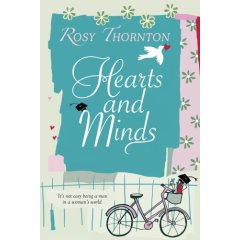
Hearts and Minds

It seems about right to be writing about Rosy Thornton’s campus novel Hearts and Minds on a day my students have given me a headache.  Yes, the end of the semester is terrible, as usual.  It’s too bad I’ve already finished this novel, because reading it would provide some comfort after a long day, whereas the book I’ve just begun, Against Happiness, will not.  But maybe it will make me feel better to write about somebody else’s problems with faculty politics and student drama rather than dwelling on my own.

Hearts and Minds is a thoroughly entertaining novel.  It takes place at Cambridge, specifically at an all-women’s college, St. Radegund’s, which has recently hired a male Head of House, to the consternation of many of the faculty.  James Rycarte is his name, and although he’s an able administrator and knows how to deal with difficult people, he finds himself with some formidable opponents, especially faculty member Ros Clarke, who is determined to undermine his leadership and see him gone.

The other main character is Martha Pearce, an Economics faculty member and Senior Tutor, an administrative post that is due to end at the close of the year, leaving Martha without a job.  Because of the demands of the Senior Tutor position, she has neglected her research, which will make it difficult to find another post.  In addition to this looming problem, her husband has been more and more distanced of late and her daughter is showing signs of serious depression.  She is left to manage this all on her own.

The plot thickens when a potential donor appears, a friend of Rycarte’s, whose money could save the library, which is sinking into the mud at an alarming rate.  This friend appears to be the college’s savior, until he declares that his daughter will be applying for admission and implies that he expects the donation and his daughter’s acceptance to go hand in hand.  Here is an issue that could potentially divide the faculty and give Ros Clarke the ammunition she needs to force Rycarte out.

I enjoyed the story and liked spending time with the characters, but another of the novel’s pleasures is reading about the college itself, with its traditions and oddities.  Very near the beginning of the novel Rycarte arrives on campus for the first time since his interview, and so readers can learn about the college at the same time he does, watching him figure out details like the powers of the Head Porter and the lack of copy machines, and can follow along with him as he figures out who’s who amongst the faculty.  It’s a good introduction to a place that in a lot of ways sounds charming — nearly everyone travels around on bicycles, which sounds wonderful — but which has its share of troubles, not least of which is a severe shortage of funds. The signs of financial hardship are everywhere, from the decision to stop offering the college’s residents breakfast to the existence of research fellowships that offer no stipend whatsoever.  The college has been limping along for quite some time now, and Rycarte hopes the potential donation will turn things around, but he is unsure at what cost.

One aspect of the book bothered me — Martha Pearce’s relationship with her husband was hard to take.  Martha is an extremely hard-working, extremely dedicated person, one who cares deeply about the college and is willing to do whatever it takes to serve the school and to keep her family going.  Her husband, though, spends his days lounging around, napping, and claiming to be working on his poetry.  He offers her very little support, most distressingly when their daughter is obviously suffering.  There were moments in the novel when I wanted Martha to walk out on him immediately and not look back.  Martha’s self-sacrifices happen in real life quite often I’m sure, so it’s not a failure of realism, but still I couldn’t help but get annoyed at this character that readers are clearly meant to sympathize with.

But this issue aside, I read the novel with great enjoyment; it’s a good book for when you want something that’s both smart and plot-driven, and I think lots of people would enjoy it, even those who haven’t set foot on a campus for decades.

12 Comments

Filed under Books, Fiction

PEN World Voices: Rushdie, Eco, and Vargas Llosa

When I saw that Salman Rushdie, Umberto Eco, and Mario Vargas Llosa were to appear together at the PEN World Voices festival, I bought tickets immediately, and I’m glad I did — the event was fabulous. Even before the event itself began, good things were happening; I ran into Anne Fernald from the blog Fernham and got to chat with her for a couple minutes. Then Hobgoblin pointed out that Richard Ford and Jeffrey Eugenides were sitting two rows in front of us. I also had a nice conversation with the elderly woman sitting next to me; she told me about her book that had been published years ago and her successful career and her great-grandchildren who are too busy to visit very often.

Then the event began; first there was a general introduction, and then Umberto Eco appeared. He explained that each writer would read from his work in his native language, and then he began to read a section from Foucault’s Pendulum in Italian, while the English translation was projected onto a screen. It was thrilling to hear Eco read in his native language; the Italian was beautiful to listen to, and I soon stopped following the words on the screen and in order to pay more attention to the way the language sounded. When he finished he left the stage and Rushdie came out to read from his new novel, The Enchantress of Florence. It was a funny passage (or maybe it’s just funny when you’re listening to it in a crowd) about the Emperor Akbar who has built a “house of worship” in honor of reason, which turns out to be a tent because rationality is an impermanent thing. Then Vargas Llosa read from his 2007 novel The Bad Girl, in Spanish. This time I followed the English words to see what I could understand from the Spanish; the passage was about the narrator falling in love with the flamboyant Lily, a girl newly arrived in his town of Miraflores. The passage had the same light and humorous tone that I saw in the one work of his I’ve read Aunt Julia and the Scriptwriter, a book I read with enjoyment.

After the readings, all three writers came out on stage and were joined by Leonard Lopate (a WNYC talk show host), the moderator for their discussion, and things really got going. They began talking about the “Three Musketeers” theme — this was the title of the night’s event — and the story of how the three writers had met a decade earlier and had such a fabulous time they gave themselves the name from Dumas. Now they were here for a reunion. This story quickly turned into a discussion of Dumas himself, and how badly The Three Musketeers is written — Rushdie and Eco took great pleasure in describing just how sloppily Dumas could write and how wordy he could be, and one of them said, “The magic of The Count of Monte Cristo is due to the fact that it is badly written.” These two had the audience laughing uproariously; they both have fabulous senses of humor — Rushdie is dry and witty, and Eco exudes energy and expressiveness in that stereotypical Italian way, complete with hand gestures. He was utterly charming. Then Vargas Llosa, who is funny too but in a more dignified way, stepped in with a defense of “bad writing”; he argued that if the writing draws you in and moves you then it can’t be bad writing and that good writing isn’t merely a matter of good grammar and pretty words. This drew hearty applause from the audience.

Then Lopate stepped in started asking them serious questions about the clash of cultures in their novels — I would have preferred that he just let the writers keep up their debate and their jokes because the minute he asked a serious question the energy fell and the mood changed. But the conversation was good, of course; they talked about how writers in the U.S. don’t have any meaningful political role, which is often not the case in other countries, and why this might be so, and they debated whether writers flourish more in dictatorships rather than democracies (because they are the only ones speaking truths the country wants and needs to hear). They all seemed to agree that the U.S. is a special case because of the way its writers are seen as entertainers rather than as important political figures. In his deadpan way, Rushdie claimed that this problem is entirely due to movie stars, which then turned the conversation to Rushdie’s own experiences acting in movies, and he quipped, “I’m so glad you’re asking me about my best work.”

Then Lopate asked a couple questions solicited on index cards from the audience; the first question, asking the writers to describe their writing methods, got only boos from the audience because of its banality, and I was delighted to see Richard Ford yell out “Next question!” Before they moved on, though, Eco, looking inordinately pleased with himself, explained his writing method — he starts on the left side of the page and works his way over to the right. This got a laugh.

The next and last audience question got them talking about the virtues of the English language; Rushdie described it as “a bendy language,” and one of the others, I can’t remember who, argued that its flexibility is both a virtue and a risk — its openness and adaptability have led to some of the world’s greatest literature, but these same qualities can possibly lead to its dissolution, as people from all around the world make English their own.

And that was it — afterwards was a book signing, but we didn’t stick around, as we hadn’t brought any of our books and needed to run off to catch the train. I left vowing once again to take advantage of opportunities like this more often than I do; living within easy traveling distance of NYC can be a wonderful thing.

22 Comments

Filed under Books, Fiction, Life

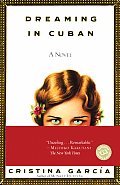
Dreaming in Cuban

I’m not sure I’m going to do justice to Cristina Garcia’s novel Dreaming in Cuban for a couple of reasons, one of which is that while I’m slowly emerging from my reading funk I still don’t feel like I’m reading well, and the other is that I’m particularly tired this evening but I’m also not willing to put off writing this post any longer. So I’ll just have to make the best of things.

I did enjoy reading this book, and I’m happy that the Slaves of Golconda chose it because otherwise I doubt I would ever have picked it up. It’s a good read — an entertaining and smart novel about the intersection of family, politics, and religion. I’ll admit that I’m generally not fond of the kind of point of view switching that goes on in the novel — it shifts not only from character to character, which I have no problem with, but between first and third person, which does irritate me a bit — but
since having multiple voices speaking throughout the novel is so obviously important to Garcia, I can see why she chose to do it. Part of the point of the book is to get multiple perspectives; not only does the narrative focus shift from character to character, sometimes rapidly, but we see at least some of the characters from the inside, where they sometimes speak for themselves, as well as from the outside. Interspersed throughout the novel are one character’s letters as well, offering another perspective on the story. All this has the effect of capturing a great amount of complexity in relatively few pages (240 or so); the technique mimics the interconnectedness and the web of relationships it seeks to describe.

The story is about a Cuban family as it changes throughout the politically turbulent years of the mid-20C. At its heart is the matriarch Celia, a self-sufficient woman living on the Cuban coast who gets caught up in the furor of the revolution headed by Castro, who is never named but is a powerful presence in the novel. Her two daughters (she has a son as well but we don’t learn much about him) follow very different paths as adults; one of them, Lourdes, emigrates to the U.S. and becomes a proper American capitalist, working hard and eventually owning two successful bakeries. Her daughter, Pilar, isn’t impressed by this success, however, and finds ways to rebel against her mother’s strident pro-Americanism and moral conservatism. She becomes a painter and attends art school; one of the novel’s best scenes tells of a painting she completes for her mother’s new bakery, which is supposed to be patriotic in its message and ends up being something quite else.

The other daughter is Felicia, who remained in Cuba and who struggles throughout her life with mental illness. Her story is a sad one, as she is caught up in a difficult marriage and has trouble raising her three children; one summer, the summer of the coconuts, she and her young son survive on nothing but coconut ice cream. Her children are torn between their need for and love of their mother and their curiosity about their estranged father; they suffer from their mother’s bouts of illness, but she, too, is a victim. Celia does what she can to help her grandchildren, but her interventions can only do so much good.

The novel is ultimately about the ways our families shape who we are — they define us, whether we live in close proximity to them or thousands of miles away. Several of the characters are haunted by the ghosts of dead relatives or are able to communicate telepathically with far-away family members. Others, such as Pilar, are haunted by memories of the lost home in Cuba; while her mother wants only to live securely in America, Pilar wonders what life is like on her lost island and what kind of relationship she could have with her grandmother Celia. No one can escape the influence of family, whether it be the memories they create for us or the standards they set against we can try, often unsuccessfully, to rebel.

No one can escape their political context either; the Cuban revolution divides the family both ideologically and physically, causing a rift that is symbolized by Celia’s picture of Castro which she has placed over a picture of her husband and which Lourdes flings into the sea in a fit of rage. The picture symbolizes how political and familial forces blend in intricate ways to shape each of the novel’s characters. They can’t change the circumstances of their birth; they can only respond to them in the best way they can.

7 Comments

Filed under Books, Fiction

Sweet Danger

Margery Allingham’s Sweet Danger was the novel under discussion at my latest mystery book club meeting; once again it was a great discussion that went on for nearly four hours. We talked a lot about the details of the novel, of course, but also about the mystery genre itself, and we made comparisons between Sweet Danger and the club’s previous novel, Dashiell Hammett’s The Glass Key. On the surface these two novels couldn’t be more different — one is light and comic and the other is darkly violent without a ray of hope in it anywhere — but they do have some similarities, including main characters who are appealing largely because of the way we learn to trust them as the novel progresses, but who remain mysteries themselves, never described in detail and never given much of an inner life.

I’m glad we’re focusing on one genre, as it makes this kind of comparison possible, and it means that each time we meet we’re building common ground that will make future discussions that much richer. It feels a bit like a really good graduate class with a group of smart, enthusiastic people who have a lot to say. Except, of course, that we don’t have a professor, and we don’t have to write a course paper or give a presentation, and the topic is more fun than grad class topics usually are, and the reading load is lighter. And no one is showing off by dropping names of obscure theorists, or obnoxiously dominating the conversation in order to impress anybody, or using big words just to sound smart. Okay, it’s not like a grad class at all. Forget that.

Anyway, the group’s response to the book was mixed. Some people hated it and could barely finish it, others loved it, and others were somewhere in the middle. Those who didn’t like it complained about its lack of realism and its lack of depth — it didn’t seem to have any larger purpose and didn’t offer much entertainment to make up for that lack.

I was one of the ones who loved it, however. It took me a while to get in the spirit of the book — I wasn’t expecting its plot to be so complex and its tone to be so light and at times silly — but once I began to get a sense that this is what it would be like, I relaxed a bit and decided to enjoy the ride. Sometimes I resist when a book does something I don’t expect, but I like to try to take it on its own terms if I can and enjoy it for what it is, so with this book I began to appreciate the humor and the eccentricity of the characters and to appreciate the main character, Albert Campion, a man who is constantly described as “vague and foolish-looking” or as having an expression “vacant almost the point of imbecility” and yet who never fails to figure everything out. He doesn’t mind looking foolish either, at one point in the novel dressing up in women’s clothing for a purpose I can’t remember now but with hilarious results. The narrator describes him this way:

that was the beauty of Campion; one never knew where he was going to turn up next — at the third Levee or swinging from a chandelier …

I also loved the other main character Amanda (Emily has praised her highly too), an amazingly smart, talented, resourceful, and funny 17-year-old girl who single-handedly runs a mill to keep her family going. She’s easily a match for Campion, and it’s a delight to watch them work together to solve the mystery. I particularly liked her physical energy; as the narrator says, “Mr. Campion was fast learning that association with Amanda always entailed strenuous physical exertion.” She is beautiful, but poverty and general carelessness mean that “her costume consisted of a white print dress with little green flowers on it, a species of curtaining sold at many village shops” — and this is her nice outfit.

I haven’t told you much about the story, and I don’t think I will, as it’s a very complicated one, but, briefly, it’s about a tiny country in Europe (although it’s not set there); a lost inheritance; an uncertain family tree; a crazy country doctor; a fabulously wealthy and powerful corporate villain; a mysterious inscription on a tree; a drum, a bell, and a crown; and a whole crowd of trouble-makers. How all these fit together you’ll have to read the book to find out.

I don’t know yet what our next book will be, but I’m looking forward to it already.

11 Comments

Filed under Books, Fiction

Book therapy

Another way I’ve found to deal with my reading funk, in addition to listening to P.D. James novels on audio, is visiting my local used bookstore. Inspired by Kate’s group reading of Anne of Green Gables, I went out to find a copy this afternoon (and, inspired by Emily’s Eco-justice Challenge, I walked!). I had a complete set of the Anne books when I was a kid, but I left them behind when I grew up and have been deprived ever since. Now, though, I’m the proud owner of Anne of Green Gables once again. I realized after I got home that I’ll probably have to go back to find the rest of the Anne books, because will I want to stop after just one book? Probably not.

While I was at the store I couldn’t resist picking up another couple books, including E.M. Delafield’s Diary of a Provincial Lady, which looks like tremendous fun, and Barbara Comyns’s Our Spoons Came from Woolworths. It’s a Virago Modern Classic, which interests me automatically, but the back cover description was especially intriguing:

Sophia is twenty-one years old, naive, unworldly, and irresistible — most particularly to Charles, a young painter whom she married in haste and with whom she plunges into a life of dire poverty. Desperate, Sophia takes up with the dismal, aging art critic Peregrine, and learns to repent both marriage and affair at leisure. How Sophia survives to find true love is delightfully told in this engaging and eccentric novel, which also gives a wonderful portrait of bohemian life in London in the 1940s.

It’s the bohemian life in the 1940s part in particular that got my attention. My used bookstore had a number of interesting-looking Viragos, but I decided I couldn’t carry them all home, so I may have to go back to get more later. And I just mooched Rosamund Lehmann’s Invitation to the Waltz, so I’m thrilled to have yet another Virago on the way.

8 Comments

Filed under Books, Fiction, Reading