Category Archives: Fiction

The Tapestry of Love

I had the pleasure of reading a Rosy Thornton novel a couple years ago and I enjoyed it very much, so when she offered to send me her latest, I was happy to take it. Secretly I was hoping for another academic novel like Hearts and Minds, but even though it wasn’t that, The Tapestry of Love was a real pleasure to read. The storytelling is strong, the situation is interesting, and the characters are engaging.

The novel tells the story of Catherine Parkstone, a woman in her late 40s who moves to France to live in the Cevennes. She has bought a house and plans to set up a needlework business, creating drapes, cushions, and maybe even tapestries for the local farmers and villagers. She is nervous heading off on her own, and sad to leave her son and daughter behind, busy as they are with their careers and studies, but this is a dream of hers she is willing to take risks to fulfill.

In the opening chapters of the novel, she gets herself settled in the new house and tries to adjust to a new life — the quiet, the isolation, the tiny hamlets and villages, and, the first morning, a neighbor farmer delivering hay to her door for reasons she doesn’t understand. The pace is slow and enjoyable as we watch Catherine negotiate meeting the neighbors and coming to learn a little bit about the local culture. There are just a few residents on her mountainside, including the mysterious Patrick Castagnol who is native to the area but doesn’t quite seem to fit in at the same time.

Catherine slowly develops relationships with these people and begins to find her place there, meeting with business success as people begin to place orders for her creations and she sells her wares at the local market. The peace gets interrupted, though, when her sister visits and upsets the emotional and social balance Catherine had established. She has to figure out how she will respond to what feels like an intrusion.

One of the pleasures of the book lies in the quiet, thoughtful nature of Catherine’s character as she tries to find her way toward a completely new kind of life. The setting is another source of pleasure — the mountains are beautiful, and it’s enjoyable to read about Catherine’s walks through the woods and her drives up and down twisty mountain roads. And I enjoyed the book for a picture of a dying way of life; because of the establishment of a National Park, new businesses aren’t allowed in the area, and while there are a growing number of tourists, the local young people have been leaving, and the farmers are getting older and older. In a way, Catherine’s presence is a hopeful sign, since she brings new energy to the place, but she discovers before too long that her business is at risk because of the park rules. She waited too long to investigate the rules for setting up new businesses and now has to pay the price.

This was a satisfying read, and if you like thoughtful, well-written, quiet types of books, I can recommend it.

8 Comments

Filed under Books, Fiction

Then We Came to the End

I finished Joshua Ferris’s 2007 novel Then We Came to the End recently and found it a pleasure to read. A friend recommended it to me because of its portrayal of the workplace and because of its interesting point of view, and I liked the book on both counts. The novel takes place almost entirely in an advertising agency and is about a group of “creatives,” or the people who dream up ideas for ads. It tells about workplace habits and rituals, crazy colleagues, scary bosses, endless gossip, and, after a while, layoffs. Most of my jobs haven’t been typical 9-5 office jobs, but still I could recognize the world Ferris describes, and he’s captured it perfectly.

It starts off at a leisurely pace, describing the main characters and their quirks and telling some of the most famous stories, as though author and reader were taking part in one long gossip session. All this is funny and insightful. The characters do their work but have plenty of time left over for hanging out in each other’s offices, dreaming up jokes and pranks, and sometimes carrying on flirtations or trying to recover from workplace love affairs gone wrong. You don’t get a whole lot of information of the lives the characters lead outside of work, just brief summaries. Instead, work seems like their whole world, even though they see their time outside the office as precious. Work is what gives them a feeling of belonging and purpose, and even though they love their weekends, in this novel, it’s the weekdays that are full of life.

Once the layoffs start, the tension picks up, as everyone wonders who will be next and how they will manage to fill their time and look busy, when there isn’t much work. There are other sources of tension as well, particularly with their boss, Lynn, who may or may not be desperately ill. Everyone begins to wonder whether some of their more unstable colleagues who have been laid off might not return to revenge themselves on the people who cast them out. There’s a clear dividing line between the days, set in the boom years of the 1990s, when success and money came easily, and the harder times at the turn of the century where worry and suspicion began to take over. This isn’t really a 9/11 novel, but Ferris deals with the day in an understated way that’s powerful and effective.

Besides all the workplace stuff, the other thing the book is interesting for is its point of view, which is first person plural. The narrator says “we” and “us” all the way through, as though it were the collective voice of the agency speaking. This captures the sense of community — even a troubled one — that exists in the office and also the feeling that gossip is what unites the place more than the work they do. Reading “we knew,” “we heard,” “we believed,” “we gathered” over and over again makes it feel like the people don’t so much have individual identities as that they find their identity through participation in the group. As more and more people quit or are let go, this sense of the group becomes strained — it’s their world falling apart.

I don’t imagine it’s easy to use this unusual point of view so consistently through an entire novel, but Ferris pulls it off perfectly.

12 Comments

Filed under Books, Fiction

Thus Was Adonis Murdered

I was a little worried when I began Sarah Caudwell’s Thus Was Adonis Murdered for my mystery book group because Hobgoblin had not liked the book at all. We don’t always agree on books, but we agree often enough to give me reason to worry. And the critiques he made sounded like ones I might make too. But as it turns out, this is one of those books we don’t agree on, and I ended up liking it a lot. The book has a very strong and distinctive voice, which means that if you don’t take to the voice, you will hate the book. Fortunately for me, it was a voice I found amusing.

The book was published in 1981 (although I kept feeling it was set in an earlier time — it didn’t feel like the 1980s), and is about a group of young barristers in London, one of whom, Julia, travels to Venice on vacation with a group of art lovers, one of whom is murdered. Julia has been taken in for questioning. The barristers back in London worried about Julia traveling to Venice because of her extreme lack of practicality and street smarts. They were right to worry, but nobody expected she would be accused of murder.

The book never actually takes us to Venice, however, except in letters. The main action all takes place back in London and is narrated by a person named Hilary whose gender is never specified (although I sort of forgot that men can be named Hilary and assumed it was a woman until I read Emily’s post on the book). It’s Hilary’s voice that you will most likely either love or hate; Hilary is an Oxford don and is friends with the London barristers, although not really a part of their group. Hilary is obsessed with scholarship and the logical and investigative skills that come with being a scholar, although also curiously willing to forgo actually doing scholarship when something more exciting comes along. You can catch a bit of the novel’s tone and its humor from one of my favorite passages:

On my first day in London I made an early start. Reaching the Public Record Office not much after ten, I soon secured the papers needed for my research and settled into place. I became, as is the way of the scholar, so deeply absorbed as to lose all consciousness of my surroundings or of the passage of time. When at last I came to myself it was almost eleven, and I was quite exhausted: I knew I could not prudently continue without refreshment.

Hilary is self-obsessed and self-important, but is a willing and able guide through the story, and in fact takes on the role of guide self-consciously, telling us early on who solves the murder (Hilary) and speaking to us directly to give clues as to how the story is put together.

What I particularly liked about the novel, in addition to the tone and the humor, is the fact that so much of it is made up of letters. Julia writes Selena, one of the barristers, long letters telling her experiences, and the group sits around while Selena reads them out loud. The letters are interrupted by commentary and discussion from the group, so we get not only the story as told by Julia, but also the reactions of the barristers who already know about the murder and can read the letters for clues. The mystery is solved from this reading, as Hilary smugly reveals to everyone at the end.

I also liked Julia’s character — she is bumbling and disaster-prone (or at least this is how the barristers characterize her; it’s possible to wonder how fair they are being), but she is a brilliant tax lawyer and a beautiful, sexually-forthright woman who hopes for some erotic adventures on her trip. It is clear that she is not looking for romance, but instead wants sex, and she is made impatient by the fact that men might actually want women to pay attention to their minds rather than just their bodies. In a letter to Selena, she writes:

It is your view, as I understand it, that when dealing with young men one should make no admission, in the early stages, of the true nature of one’s objectives but instead should profess a deep admiration for their fine souls and splendid intellects. One is not to be discouraged, if I have understood you correctly, by the fact that they may have neither. I reminded myself, therefore, that if I could get the lovely creature into conversation, I must make no comment on the excellence of his profile and complexion but should apply myself to showing a sympathetic interest in his hopes, dreams, and aspirations.

The bending of gender stereotypes is great fun, and one of the book’s interests is finding out whether Julia finds her wishes fulfilled.

I’ll admit there were parts of the ending I didn’t find convincing, but by that point it didn’t really matter — the fun of the book is in its humor and its structure and the plotting felt almost incidental.

12 Comments

Filed under Books, Fiction

More good books: Manservant and Maidservant

I had hoped to post on Ivy Compton-Burnett’s novel Manservant and Maidservant in time for the Slaves of Golconda group read, but I didn’t get the book read on time and was on vacation anyway. But I wanted to write about it at least briefly. It’s kind of an odd book, in a good way, and it made me think a lot about dialogue and conversation. The book has tons of dialogue in it and much of it struck me as the sort of conversation you wouldn’t hear in real life. But I don’t think this is necessarily a bad thing. It seems to me there is a kind of novelistic dialogue that is unrealistic in a bad way — painfully awkward, stilted, florid, dull, etc. But there is a kind of unrealistic dialogue that is … interesting and that serves some larger point. I’m not entirely sure what the larger point here is, but somehow the dialogue, strange as it sometimes is, reveals important truths about the characters and gets ideas out on the page in a dramatic way.

The novel has a very tight focus — one main family with children and servants, one other family and a couple other characters and that’s it. The book is made up of conversations and some narration to connect all the talk. There is little context — little description of places, no historical or social background, not much but talk and internal conflict. This means that we are thrown into the world of relationships.

It’s the fact that these relationships are so interesting that makes this book work. As you would guess from the title, master/servant relationships are a big focus; the servants argue amongst themselves about their status relative to each other and also to their employers. The family gossips and worries about what the servants are doing. But the biggest source of conflict comes from the father, Horace Lamb, who terrorizes his wife, his cousin, his servants, and his five children. He makes their lives miserable through his miserliness, pestering, and suspicion. The novel’s plot lies in the telling of how the family responds to this abuse. What was so fascinating is that it captures little interactions between people in a way that seems perfectly true to life, even if the dialogue does not. It portrays jealousy, anger, sadness, suspicion, love, regret, hope, disappointment, and much else in a manner I don’t think I’ve seen in a novel before.

I wonder, though, about my claim that the dialogue is unrealistic. The number of people I have talked to or overheard in my life is very, very small compared to the number of people out there talking, so who am I to say that people don’t really talk that way?

6 Comments

Filed under Books, Fiction

More good books — Stoner

There are a couple more books from this summer that I wanted to mention as being particularly good. First of all, John Williams’s novel Stoner was an excellent read. It’s not at all what you might think based on the title, having nothing to do with drugs and instead being about academia and midwestern American life. William Stoner is the novel’s protagonist, a man who grows up on a farm with limited prospects, until his father learns that Stoner can go to the University of Missouri to study agriculture and bring his knowledge back home to help improve the family farm. Stoner heads off to school with the best of intentions but — through a pretty harrowing class experience — decides he wants to study English literature instead. He graduates and goes on to earn a Ph.D., eventually becoming a professor and spending his life in academia. The novel charts the ups and downs of his career and his family life.

That all sounds straightforward, and the novel is written in a simple, realistic style that doesn’t draw attention to itself. But the story is devastating. Stoner marries a woman he shouldn’t and unintentionally makes enemies with a powerful colleague and finds himself struggling and unhappy. And there is not much he can or will do about it. It’s a novel of quiet struggle, capturing a time and a culture when people endured rather than rebelling or running away. An early scene in the novel when he tells his parents that he will not be returning to the farm but instead is going to go to graduate school captures this devastatingly: he hadn’t given his parents a hint of the blow that he was about to give them, and when they receive it they are shocked but mute — they don’t have the words to say what they are thinking and feeling. They have never really talked to each other and don’t know how to begin. So, they just quietly part, heartbroken.

This is an academic novel, but it’s unlike any other I’ve read. It deals with questions of the role of the university and the value of scholarship, but the point is not to skewer academia or to laugh at it, as so many academic novels do. Instead, it paints a picture of a man who is trying his best and who takes what opportunities come his way, but finds there is only so far he can travel, that he can’t leave his past behind, and that life can trap him, in spite of his best efforts. It sounds depressing, and I suppose it is, but the experience of reading the book didn’t feel that way. It has the ring of truth to it, harsh as it may be.

13 Comments

Filed under Books, Fiction

And now back to reading

It’s felt like an odd summer as far as my reading goes, largely because while I like to take on a challenge or two in the summer, something long and difficult (Infinite Jest last year for example), it hasn’t happened this time around. I had hoped to read Pynchon’s Gravity’s Rainbow, but the time never seemed right to pick it up. Instead I stuck to shorter books and then did some reading for a class in world literature I’m teaching this fall.

One book I read that could count as a challenging book, although it’s not terribly long, is Jacob’s Room by Virginia Woolf, as part of my effort to read through her major works in order. I’ve been a little scared of Woolf’s more experimental fiction after trying to read The Waves quite a lot of years ago and not doing very well with it. I love To the Lighthouse and Mrs. Dalloway, but my impression was that Jacob’s Room might defeat me just as The Waves did. Well, I ended up enjoying it greatly, and it makes me wonder how I will do with The Waves when I get there for a reread. It was definitely a challenge, with quick shifts in perspective and time and without a whole lot of explanation to help get the you get situated in each new scene. Woolf lets you make connections on your own without spelling them out. The book demands that you read slowly.

But the writing was so beautiful, and, most importantly to me, it had the insights about people and relationships and experience that I value so much in Woolf. She can capture a moment and a feeling so perfectly and describe it so accurately that I’m left thinking, yes, that’s it, that’s exactly right, there’s no need so say anything else.

The Common Reader is next, and while I’ve read it before, I loved it so much the first time around, I’m anticipating loving it again.

Another book from earlier this summer that stands out is Rosamund Lehmann’s Invitation to the Waltz. This is my third Lehmann book; the first one I read I loved (A Note in Music), but the second one I didn’t (The Echoing Grove — it felt like a slog), so I was happy to find that I’m back to loving her writing again. Invitation to the Waltz is thoroughly charming, and it also does what I admire Woolf for doing, which is to say, it looks closely at a small group of people and digs in deep. The novel tells the story of two sisters as they prepare for and then attend a waltz. That seems really simple, and yet so much goes on — there is so much the sisters think about, experience, agonize over, and analyze, and the drama of it all, quiet as it is, is really moving. Lehmann is a writer I look forward to reading more of, perhaps someone whose work I will read in its entirety.

9 Comments

Filed under Books, Fiction, Reading

The TBR Challenge: Beckett

Today I finished my 12th book for Emily’s TBR challenge (you can see my list in the sidebar to the right). That is, I read my 12th book out of a planned 20, and I’m in the middle of a 13th. Considering the fact that the challenge goes until the end of this year, I’d say I’m doing quite well. I’m enjoying having a longish list of books to choose from, which gives some structure to my choices but also isn’t too limiting. We’ll see how I feel when I get down to just a couple books left, but since I have more than six months to read them, I have plenty of time and can read books off as well as on the list. I like this structure so much, I might compile another list of 20 when I’ve completed this one, just for the fun of it.

So the book I finished today is Samuel Beckett’s novel Molloy. Well, that was an interesting read. It was odd and wonderful in the way you expect from Samuel Beckett, if you’ve read him before. I could tell that this book was written by the same author who wrote Waiting for Godot and Endgame, two plays I’ve read and/or taught, and which I enjoyed in a bewildered, bemused kind of way. I responded to this novel in much the same spirit.

The book splits into two parts, and I’ll admit to liking the first part much better than the second. The first part is told in the first person from Molloy’s perspective, and it’s a stream of consciousness narrative of his journey through some unnamed territory. He’s no regular traveler, though; he’s a vagrant, with no money, very few possessions, and one simple quest — to find his mother. He’s not sure where she is, though, and he’s also not sure where he is; all he knows is that he wants to find his mother, but he keeps running into obstacles that keep him away. He’s physically decrepit, first of all, with one bad leg and a “good” leg that is in danger of going bad, and a whole host of other ailments. He travels around on a bicycle that he can’t move very well. He can’t remember much either, and he keeps running into people who arrest him or insist on taking him in, which he wants none of.

What makes this narrative appealing is the rambling voice, which is comic, bawdy, philosophical, and despairing by turns. He moves from a wonderfully funny meditation on how to store his 16 “sucking stones” — stones that keep him from feeling the full extent of his hunger — so that he sucks on each one equally and in order, to serious thoughts on death, to comic passages on the body, and back to seriousness again. It’s absurd and crazy and sometimes moving.

The second section is narrated by a mysterious detective-type named Moran who receives instructions to find Molloy. This part of the book is about his preparations for and execution of this mission (or his attempted execution of it). While Molloy is endearing in an odd sort of way, Moran is an ugly character: he treats his son and his housekeeper abominably, and he’s full of pride, hypocrisy, and cruelty. As he sets out to find Molloy, his world begins to fall apart around him until he becomes a lot like Molloy himself — lost, physically falling apart, despairing, hopeless.

While I didn’t enjoy the second half as much I did the first, I still loved the bizarreness of it all. This is the kind of novel where you have to get rid of your expectations of what a novel usually is and accept a completely different kind of world, with entirely different rules. I like the challenge of this, at least now and then. It’s not a difficult novel, really; it’s just off in its own corner far away from all the other novels, doing its own unique thing.

For my 13th book in the TBR challenge, I’m reading a collection of essays by the poet Louise Glück, Proofs and Theories. I’ve read only the first essay so far, which I thought was wonderful: it’s an autobiographical essay on the experiences that turned her into the type of poet she has become. The writing is thoughtful and smart, writing to take one’s time with.

And now I need to go choose another novel. I’ll probably pick something not on the TBR challenge list, just for a change of pace. But I have no idea what it will be.

10 Comments

Filed under Books, Fiction

Bike maintenance and a reading slump

Let me just say that as much I love riding my bike, I do not love taking care of my bike. Cleaning it is always an ordeal, one that leaves me with cuts and scrapes on my hands and black grease under my fingernails (and often on my arms and legs as well). Tonight I needed to put two new tires on, and the whole thing was an utter failure. After some struggle I pried the tires off, put new tubes in, and pried the tires back on (and banged up my knuckles in the process). That was okay. But when I tried to pump up the tubes, they wouldn’t hold air. It turns out I punctured the tubes at some point while trying to get the tires on. In one case the tube got pinched, and in another some mysterious small, sharp metal object got in between the tire and tube and ruined everything. Sigh. Poor Hobgoblin got tired of listening to my complaints and curses and finally stepped in to finish up the job for me. Poor Muttboy was so stressed by the whole scene that he couldn’t eat his milkbone. I got grease on my jeans and on my t-shirt and had to scrub my arm so hard to get the grease off that I practically made myself bleed.

I should be better at this by now, but I’m just not.

I did go on a great 75-mile ride yesterday, however, with two other women on my racing team. We are well matched in terms of strength, and we had fun riding hard and enjoying the beautiful, sunny day. I have now made a good start on my summer cycling tan: I have an inch of burnt skin on my wrist, the part that’s exposed between my arm warmers and my cycling gloves. I also have about five inches of tanned skin on the lower part of my calves and shins, the part that’s between my knee warmers and my socks. I’m working on a pretty sharp line on my arms below my shoulders as well. I’m ready for the beach, right?

As for reading, it’s been up and down. I finished Jane Gardam’s novel Old Filth and was disappointed. When I last wrote about it here, I was enjoying it a lot, but immediately after I wrote that post, I hit a section where there were a number of odd coincidences, the plot took a turn I didn’t like, and all the sudden the characters felt unfamiliar. I never quite recovered after that. I was knocked out of the world of the book, all the sudden wondering whether I was reading it properly. The story just didn’t ring true to me anymore.

That said, though, the premise of the book is very interesting, and I’m guessing not everyone will have the reaction I had above. The novel deals with the vestiges of British colonialism, telling the story of a young boy growing up in Malay and left to the “natives” for his upbringing. His mother died shortly after giving birth and his father did his best to lose himself in his work, so it was only his aunt who paid him any attention. Eventually he was sent off to England to be raised by strangers, unfortunately, as it turns out, cruel and abusive ones, and after that he went to boarding school. It’s an absolutely awful childhood, one full of neglect and abuse. It seems like a fairly common one, however, since many British children growing up in the colonies were sent back to England by their parents who hoped they could get a good education and learn how to be properly English.

The main character, Edward Feathers, grows up to become a lawyer and then a judge, working for a while in Hong Kong (hence the “FILTH” acronym: Failed in London, Try Hong Kong), and then retiring in England, which is where we meet him. The present-day action of the novel takes place during Edward’s retirement, with lengthy flashbacks to his younger years. Gradually, we discover the full extent of everything that happened to him.

I liked the back-and-forth narration (in fact, it’s when the novel paused for a lengthy period in the present day that it started to falter), the gradual revelation of Edward’s life story, and the glimpse the novel gives into colonial culture. I just wish the narrative pacing had been better and that the characters had remained convincing throughout.

Because I seemed to be having a hard time with literary fiction (Old Filth and Vertigo leaving me underwhelmed), I decided to try a mystery novel and picked up Elizabeth George’s Payment in Blood. I did much better with that one, enjoying it a lot. Then this afternoon I just finished Agatha Christie’s The Murder of Roger Ackroyd, which I surprised myself by totally loving. At this point, I’m hoping I’m out of the short reading slump I was in, and now I have the fun of choosing something new.

11 Comments

Filed under Books, Cycling, Fiction

Reading and riding notes

First about cycling: yesterday I went on a wonderful, epic bike ride with Hobgoblin and eight or so other people, up north into an area with all the hills and dirt roads you could want. All the hills and dirt roads you could want if you happen to be looking for those things, which, amazingly enough, I sort of am. Just to be clear — this wasn’t a mountain bike ride; instead, we were seeking out dirt roads to ride our road bikes on. I heard one person yell out “road bikes?!” in an amazed voice as he passed us in his car on a particularly nasty stretch.

The reason we were looking for such a course to ride on is this, the Tour of the Battenkill, a fairly well-known Pro/Am race that people travel from all over to compete in. It’s famous for being a brutal course — hilly, and with long sections of dirt roads. The race is this Saturday, and I’m a little frightened.

The ride yesterday was tons of fun, though; I love how after going over a horrifyingly frightening stretch with deep gullies and large chunks of gravel that send my wheels sliding all over the place, the regular sections of dirt roads with just plain old dirt come to seem easy. I was zipping down the hills at 20 mph or more, flying over potholes and feeling okay.

BUT, the forecast for the race this weekend calls for rain, both the day before and the day of the race. What will it be like to ride in mud? I’m frightened, as I said. Very frightened. I’ll let you know how it goes. Secretly, I’m hoping to come down with the flu or something between now and Saturday.

Now on to books: I’m happily in the middle of Jane Gardam’s 2004 novel Old Filth. A look at Wikipedia tells me this is her 23rd novel, after publishing her first in 1971, and she also has eleven collections of short stories. She is someone I wouldn’t have known about if it weren’t for blogging, though; I can add her to the long list of writers I’ve learned about that way. The term “Old Filth” refers to the main character, Sir Edward Feathers, who made up the acronym FILTH, which stands for “Failed in London, Try Hong Kong.” The novel is set in contemporary times, when Filth (as people consistently call him) is an old man. The present-day setting becomes a kind of frame narrative, as the novel takes us back in time to tell of Filth’s childhood and adulthood, spent partly in England and partly in Hong Kong. So far the story is interesting and well-told, and the writing is sharp and funny.

I picked this up after setting aside Rebecca Goldstein’s book 36 Arguments for the Existence of God: A Work of Fiction, which sounded very interesting as an idea-driven, philosophical novel. The chapters are each named after an argument for the existence of God, and the story is about a psychology professor who unexpectedly finds himself famous after publishing a book on religion that hit a cultural nerve. All this sounded good, but after reading the first chapter, I wasn’t hugely impressed. The story and the main character didn’t captivate me, and I got a little worried looking at the 400 or so pages left to read. So back to the library it went. I do want to read some of Goldstein’s nonfiction, though; she has a book on the philosopher Spinoza that sounds interesting.

15 Comments

Filed under Books, Cycling, Fiction

Maisie Dobbs and other reading notes

The Mapping of Love and Death is Jacqueline Winspear’s latest Maisie Dobbs novel. I’ll admit at this point that this series isn’t wowing me, exactly, although I do want to keep reading the latest installments, just to see where it goes. The Maisie Dobbs books are good ones to turn to at this particular point of the year, when I’m tired and busy and ready for the end of the school year, but the end of the school year is still so far away. At this point I need something familiar and absorbing and not terribly challenging, and Maisie Dobbs is just the thing.

The series doesn’t wow me for two reasons, basically, one of which is that the plots have begun to feel lackluster. I’m not one to read much for plot, though, so this is okay. The historical context and the character development are more interesting, so that’s good. The other problem, though, is that I get irritated by the way Maisie uses her unusually strong powers of intuition to figure out who committed the crime. This feels too much like cheating. Yes, Maisie is smart and has the powers of deduction we would expect of a detective, but still she relies too heavily on feelings of foreboding that come over her whenever something significant is about to happen.

But, on the other hand, I do want to know what happens to Maisie, having followed her story this far, and the book is satisfying in that regard. Significant things happen to her, and I’m glad I know about them. For a much better, much more thorough review, read Danielle’s thoughts here.

On to other bookish things: I finished Balzac’s novel Cousin Bette and never wrote much about it, and at this point, I’ve forgotten too much about the novel to have much to say. I’ll just say that I didn’t like it much and move on. I’m not ready to give up on Balzac entirely, though, as surely I’m missing something? I’m not one to dismiss a classic author quite so easily just because I failed with him once. So some day perhaps I’ll pick up a shorter novel of his, if there is one, and see if my mind has changed.

I just now finished W.G. Sebald’s Vertigo, but more thoughts on that later, as the Slaves of Golconda are discussing the book this Wednesday. I am also in the middle of David Foster Wallace’s collection of essays A Supposedly Fun Thing I’ll Never Do Again. I am enjoying it immensely. I have read five of the book’s seven essays (many of them quite long), and I think every one of them is great. Wallace is a writer who can make any subject interesting. I just finished an essay on the film director David Lynch and I loved it, even though if I’ve ever seen a Lynch film I don’t remember it. There’s another great essay on the Illinois State Fair and another one on tennis, math, the midwest, and wind. The other two I’ve read are more literary in nature, one of them a pre-Infinite Jest essay that shows Wallace thinking through some of the ideas that made their way into the novel. It’s all excellent, and I haven’t even gotten to the title essay yet, probably his most famous essay of them all. It’s crossing my mind now and then that I might want to reread Infinite Jest soon. I don’t know if I will, but I am tempted. It’s just such a fabulous novel.

12 Comments

Filed under Books, Fiction

American Wife

I didn’t expect to love Curtis Sittenfeld’s novel American Wife as much as I did. I liked her first book Prep quite a lot, so I know she’s an author whose sensibility speaks to me, but I thought this book was even better than the previous one. Now, I listened to this on audio, and I tend to like books I listen to more readily than those I read, so I’m not sure how reliable my response is, exactly, but still, I spent several weeks looking forward to the time when I could get in the car to listen to a little bit more of the story.

As I wrote about here, reading this book was an odd experience because I never expected to enjoy being in the company of characters who are modeled on George and Laura Bush. But, while the George character was often irritating (though not as much as I would have expected, given how I feel about the real-life person), Alice, the one modeled on Laura, was a fascinating person whom I came to admire.

Alice is a first-person narrator, and she tells her life story up until about 1 1/2 years from the end of Charlie’s (George’s) second term as president. I was talking to a friend recently about how knowing the trajectory a novel will follow — that we will move from Alice’s childhood up through the time she becomes first lady — can get dull, but in this case it wasn’t. As soon as she met Charlie, I knew who he was and that she would marry him, and, of course, I knew that he would be politically successful beyond her wildest dreams. But the story of their journey to the White House was enthralling the entire way, all because of Alice’s thoughtful, careful, measured, and balanced voice. That description doesn’t sound enthralling, I know, but when extraordinary things happen to someone who thinks and talks kind of like I do and whom I feel I could be friends with, I’m drawn in.

The first extraordinary thing that happens to Alice is something tragic: at 17, while driving to a party, she ran a stop sign and hit a car driven by a high school classmate, Andrew Imhof, with whom she was just beginning to realize she couldpossibly fall in love. This tragedy follows her for the rest of her life, not just because she was responsible for someone else’s death, but because she could never know whether their relationship would have blossomed into romance, had he lived. What, she thinks later, if she and Andrew had married and she had become a farmer’s wife? She may never have met Charlie in that case, much less married him and become the first lady.

But marrying Andrew is not what happened, and instead when Alice meets Charlie, the two fall for each other hard. They are engaged in six weeks and married in a few months. In so many ways, Charlie is perfect for Alice — he is funny and gregarious and light-hearted, to balance out her seriousness and thoughtfulness. He is confident and carefree, to balance her worried and insecure nature. She makes him a little more serious, while he helps her loosen up. Their differing traits attract them to each other, but, not surprisingly, they become a source of conflict over time, and eventually Alice comes to question the choice she made.

Or was it even a choice? There is a sense in which Alice was pulled into that relationship by forces beyond her knowledge, or perhaps it was her unconscious that led her there. At any rate, she thinks deeply about why she did what she did, and why people do what they do, and the extent to which any of us have any real say in the course of our lives.

These questions become even more urgent when she finds herself as First Lady and wife of a husband who has taken the country to war, in highly questionable circumstances. How in the world did she end up there? And what is she supposed to do now? What are her responsibilities, given that she’s not entirely sure that the war is right — or that it is wrong? And what exactly does she owe her husband’s administration? Should she hide her true feelings if they conflict with administration talking points?

American Wife covers a lot of ground, moving from small-town middle-class Wisconsin to the upper-class Wisconsin sanctuaries where Charlie’s family resides (Sittenfeld changed some key details — I don’t know how many, in fact, and it would be interesting to know), to the campaign trail, to the Governor’s mansion, to the White House. The wonder of it, to Alice, is that she is the same person through it all. How does an average middle-class midwestern woman who never in her wildest dreams would have thought she could become as powerful and famous as she became end up where she did? This question never ceases to puzzle Alice, and I loved the book’s implication that this is only an extreme version of the question that plagues us all. How in the world did any of us end up in the places we did?

16 Comments

Filed under Books, Fiction

The Talented Mr. Ripley

My mystery book group met last night to discuss Patricia Highsmith’s The Talented Mr. Ripley, a book that indicates we are branching out a bit from mystery fiction to crime fiction more generally. Detectives appear in Highsmith’s book, but only briefly, and they aren’t very good. They are pretty foolish, in fact. The real star of the book is Tom Ripley, the murderer.

What a wonderful, difficult, bizarre book this is. I loved it, but it left me feeling anxious and vaguely guilty, as though I’d done something wrong myself. The reason for this is that the story is told from a very close third-person perspective that leaves the reader in Tom’s consciousness the entire time, with no relief. It’s such a disturbing consciousness that I was both fascinated by the person that Tom is, and deeply unsettled.

As the novel opens, Tom finds himself followed by a man who turns out to be the father of an acquaintance. Tom was worried that the man was following him because of the tax fraud Tom had recently committed (he sent out letters to people telling them they owed more in taxes — just for fun and to see what would happen), but it turns out he wants Tom to travel to Europe to try to bring his son Dickie back home to run the family business. Tom soon figures out that even though he doesn’t know Dickie as well as his father thinks he does, this is a great opportunity to live in the lap of luxury for a while.

He meets Dickie in a small, coastal Italian town and quickly becomes a part of his life. He and Dickie’s friend Marge spend their days swimming, sunbathing, and eating long and luxurious meals. Tensions soon develop, though: Tom is devoted to Dickie but jealous of Marge, while Marge decides that Tom is a bad influence on Dickie and treats him coldly and suspiciously. This love triangle of a sort (Marge is in love with Dickie, although he appears not to return the feeling, and Tom is obsessed with Dickie to a degree that is obvious but ambiguous in nature) gets more and more complicated until one day Tom, in a fit of jealousy and worried that Dickie is pushing him away, kills him in horrifically bloody fashion in a boat on the ocean.

What’s so awful about this murder is that it’s so senseless, so horrible, and yet to Tom it’s simply an unfortunate action that he had little control over. Once the idea entered his mind, he knew there was little he could do except follow through. He’s not remorseful at all, just cautious about what to do next. What he does is become Dickie himself, stepping into his shoes, forging his signature to collect his money, and living the life that Dickie might have lived.

Tom not only lacks any moral sense, but he lacks any sense of himself at all; he’s a cipher, an empty shell who is incapable of caring for another person. He is extremely isolated. The people around him are pawns in his personal game or they are nobodies to be gotten rid of if necessary. What Tom has — or what he wants to have — in place of any sense of self or any emotional connection to others is objects and money. Once he has taken Dickie’s place, he enjoys himself extremely well wearing Dickie’s clothes, eating fabulous meals alone in expensive restaurants, and traveling across Europe seeing the sights. As long as he has the objects that make up the right kind of identity, it doesn’t matter to him that the identity is a sham. For him, it’s real, or, at any rate, it’s enough.

He slips into the role of Dickie frighteningly easily, and not only that, but he quickly forgets what it was like to be Tom:

It was a good idea to practice jumping into his own character again, because the time might come when he would need to in a matter of seconds, and it was strangely easy to forget the exact timbre of Tom Ripley’s voice. He conversed with Marge until the sound of his own voice in his ears was exactly the same as he remembered it.

It’s possible to say that this is a psychological exploration of a sociopath, but I think the book resists psychological explanations and is therefore even more chilling. The narrator explains that Tom lost his parents when he was young and that he was raised by an emotionally abusive aunt. But this history is told so quickly, with so few details, that it’s almost as if Highsmith is playing with our need for an explanation, making fun of it by providing us with one so unsatisfactory. There’s no real reason for Tom, no way of explaining him or of avoiding him.

As other members of my book group said, I loved the book, but I don’t necessarily want to read more of the book in the series or even more of Highsmith’s work at all. It’s good — very good — but so disturbing it’s hard to subject oneself to it.

14 Comments

Filed under Books, Fiction

Weirded out by American Wife

I’m not quite halfway through listening to Curtis Sittenfeld’s novel American Wife and I’m enjoying it immensely, but I’m also finding it to be a really odd emotional experience. I’m enjoying it so much I’m tempted to get the audiobook out of the car and listen to it in the house, which is something I never, ever do. I’m caught up in Alice Lindgren’s voice, her thoughtful, careful, smart way of thinking about everything that happens to her.

The weird emotional experience part began when Alice met Charlie Blackwell, whom she has not yet married, but has become engaged to. Remember how this is the book that’s really about Laura Bush, even though the names and some of the circumstances are changed? That makes Charlie Blackwell George Bush, although his family is from Wisconsin, not from Texas. And reading about Charlie Blackwell/George Bush as a romantic lead has been bizarre.

It’s probably no surprise that I’m anything but a George Bush fan — I can’t stand the man, in fact. And yet in the context of this book, he’s … well, obnoxious quite a lot, but also sometimes charming. And every time I think he does something even a little bit charming, I have this moment where I think, ew! That’s George Bush! Ew! He’s awful, not charming in the least!

And yet in the context of the book, it makes sense that Alice is attracted to him. He is a lot of things that she is not — outgoing, confident, determined, at ease with people — and they make a good pair in some ways. And I like Alice a lot. In fact, she is in some ways kind of like me, or at least I feel some kinship with her. Her way of thinking and acting is familiar to me. But … she married George Bush! Ew!

There are lots of moments where Charlie/George does something utterly obnoxious such as order Alice around, get mad at her if she isn’t politically supportive enough, or assume she’s going to drop her career for his sake, and then I have fun getting annoyed and yelling at him for being the jerk that he is. But then they make up, and I understand that Alice is happy once again, and that’s a good thing, because I like Alice, but it means she’s happy with George Bush. Ick! And then there are the sex scenes, which are the weirdest of all …

This book has been an interesting imaginative exercise, as it makes me think about how someone I like could be attracted to someone I most definitely don’t, and how the person I most definitely don’t like can sometimes be likable. And also how a sometimes likable person is capable of doing awful things, like start the Iraq war. I’m very curious to see what Sittenfeld does with the rest of the story; the couple isn’t even married yet and the presidency is way off in the future.

18 Comments

Filed under Books, Fiction

Figuring out audio books

I’ve had a mixed experienced with audio books so far this year; the first one I finished I loved at first and was bored with by the end. I’m in the middle of my second one now and can’t wait to hear more.

I was looking forward to the first one, Jedediah Berry’s The Manual of Detection, having heard excellent things about it. And it might have worked better if I read it rather than listened to it. I’m still not sure which type of book works best on audio; while I’ve enjoyed listening to mystery and detective fiction in the past, in the last six months or so a couple of examples haven’t worked well for me, and I’m beginning to wonder whether the genre is tricky to listen to. The Manual of Detection didn’t work well and Agatha Christie didn’t either, while Maisie Dobbs worked great, as did P.D. James. I’m thinking that perhaps the more plot-driven books are harder to listen to, while the slower-paced ones that focus a lot on character and setting work better.

I started off enjoying The Manual of Detection. It’s opening is dark and atmospheric, with a strange, noirish mood to it. It’s set in an unknown city where it’s always raining, and the main character, Charles Unwin, rides to work on a bicycle complete with an umbrella to keep him dry. He’s a clerk in a large detective agency, and he’s very happy with his job processing the reports of a detective he’s never met Travis Sivart. The detective agency is a cold, mechanistic place where people follow strict rules and focus only on their own specialized tasks, nothing else. We learn nothing about any private life Charles Unwin might have; he’s basically a cipher, and he’s perfectly happy to stay that way. When he finds himself unexpectedly promoted to the rank of detective, the only thing he wants is his old job and his old peaceful life back.

All that was excellent; I loved the mood and the tone of the book. But then as Unwin tries to find Sivart in order to return everything to normal, the plot gets odder and odder, more and more fantastical, and I started to lose interest. I’m not quite sure whether it was the plot that didn’t work for me, the fantastical element, or the fact that I was listening to it, but by the end, I was only half paying attention. It was a disappointment.

Now I’m listening to Curtis Sittenfeld’s novel American Wife, and I’m mesmerized. It’s a loose, fictionalized retelling of the life of Laura Bush, and I’m loving its slow, thoughtful pace and tone. The main character is named Alice, and she’s intriguing, in an odd, dull sort of way — she’s careful, quiet, bookish, and independent, not that exciting of a main character, and yet awful things happen to her and soon enough she will become a really well-known and important person (I haven’t gotten to that part yet). It’s fascinating to watch her respond to everything life throws at her.

So, perhaps I need to give up listening to plot-driven mysteries and focus on slow-paced character-driven novels instead?

9 Comments

Filed under Books, Fiction

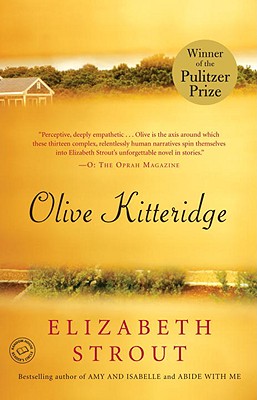
Olive Kitteridge

I really loved Elizabeth Strout’s book Olive Kitteridge. This is the first book of linked stories I’ve read, and I liked the genre more than I expected to. I’m not sure whether this is because Strout does a particularly good job with it or because I like the genre for itself, but in this case it worked beautifully. I can be uncertain about reading short story collections because it feels as though they require so much energy: you have to orient yourself to new characters and new situations each and every time. You have to do that with linked stories too, but with Olive Kitteridge there is enough to tie all the stories together that I felt a sense of coherence and wholeness that was satisfying.

Olive herself is the main thread that ties the book together, although there are others; she appears in each chapter, sometimes as the main character and sometimes only briefly, as a minor character in someone else’s story. The first chapter is from the point of view of Olive’s husband, Henry, a man other people in their town feel pity for, because Olive is known for being difficult — moody, unhappy, harsh, critical. But Henry, in spite of longings he feels for other kinds of relationships, loves her, a love that is a source of mystery for other characters and for the reader, too.

Olive lives in the town of Crosby, on the coast of Maine, which is the kind of place where everyone knows everyone else and secrets are hard to keep. She was a junior high math teacher — retired now — of the sort who terrified her students with her prickly teaching persona. She and Henry have one son, Christopher, whom they both love deeply, but not necessarily in a healthy way; he feels that she has smothered him and it’s no surprise when his new wife whisks him off to California, to get as far away from the in-laws as possible.

One of the things that is so wonderful about the book and about how Strout uses the linked story structure is that we get a satisfyingly complex view of the characters. In one story — one of my favorites — we see into Olive’s mind on her son’s wedding day and watch her as she struggles with having to let her son go to a woman she does not like and listen to that woman mock the dress she is proud of. In other stories, though, we see what other characters think of her — the way they dismiss or fear or marvel at her — and we can compare what it’s like to be someone with a rich and complicated interior life and to see that person from the outside, understanding some things and being bewildered by others. We can see what Olive means to a whole range of people — that she can be a figure of fun, a tragic figure, an overbearing and frightening woman one wants to run away from. And we can also see that she frequently has no idea of all those perceptions people have of her. Other people have no idea what she thinks and feels and suffers, except for glimpses now and then.

Many of the stories are sad, although in a way that is recognizable and true, not overdone. They are about longing, love, relationships gone bad, new relationships attempted, relationships that survive, remarkably; in some cases they are about violence, death, and loss — about a whole range of things that can and do happen to people living together in one place.

The place itself is another thread that holds the book together. Olive and Henry have built their house together and have also built a house for their son, and it is no surprise that they are deeply shaken when their son escapes to California. It’s no surprise that he needs to escape, either. That house was intended as an act of love, but it couldn’t help but appear to Christopher as a prison, Olive’s attempt to keep him at her side, following in her footsteps. Other characters come and go, figuring out who they are as they define themselves against the town that has shaped them. The town changes, but it remains an isolated place that’s beautiful and distinctive, and that is hard to really leave behind.

So yes, I loved this book. It’s beautifully written, emotionally complex, full of nuanced characters, and moving in the stories it tells.

18 Comments

Filed under Books, Fiction

Stevie Smith’s Novel on Yellow Paper

Stevie Smith’s Novel on Yellow Paper was an enjoyable book in moments and a puzzling book in others; it’s one of those books I can’t quite figure out how to respond to, and I’m not sure another reading would help. There’s a lot I liked in the book, but what puzzles me about it is that given the books that appeal to me most, I should love this one, and it turns out I don’t, quite.

I admire its form and structure most; it’s the kind of novel where not much happens and instead we have someone sharing her thoughts with us the entire way through. The main character is called Pompey, and she writes in a way that seems spontaneous, telling us whatever is on her mind at the moment. We hear about her job — she works as a secretary for a certain Sir Phoebus —  her love affairs, her friends, her family — especially her aunt, the “Lion of Hull” — and her thoughts about society, literature, and politics.

Basically, there is no form or structure (as far as I can tell), and instead it’s a loose-flowing stream-of-consciousness monologue. Novel on Yellow Paper reminds me most of Nicholson Baker’s novel The Anthologist, where there is a structure and plot, but these are so basic they hardly count and the real point of the book is the voice. The pleasure of the book comes from listening to the main character share his thoughts. That’s what we’re offered in Smith’s book — a chance to get inside the main character’s head a little bit.

However, now that I think about it a little more, I’m not sure how much we do get inside Pompey’s head. It’s feels a little more like she uses words to charm and entertain us and to tell us about herself, but in such a way that she hides as much as she reveals. Words are as much a shield for her true self, or a cloud in which to hide, as a way to reveal herself.

She certainly is amusing and charming, and she has funny quirks that make her voice very distinctive. This passage illustrates her use of repetition and rhythm and also shows how frank and open she can be (or appear to be):

Oh how I enjoy sex and oh how I enjoy it. There have been many funny things about sex in my life that have made me laugh and so now I will tell you.

There was once a woman called Miss Hogmanimy. That was certainly a queer name. That was a name you would certainly want to get married out of. But this woman was very queer and wrought up over babies and the way babies are born, and she gave up her whole life going round giving free lectures on how babies are born. And it certainly was queer how ecstatic she got about this way how babies are born, and always she was giving lectures to young girls of school or school-leaving age. And all the time it was mixed up in a way I don’t just remember with not drinking, not drinking alcohol, but just carrying on ginger beer, kola and popgass. And so well this Miss Hogmanimy she got up in our school, now I think it was our school, chapel and so there she was in this school chapel, giving a lecture with illustrating slides to young girls on how babies are born …

…to listen to Miss Hogmanimy you’d think just knowing straight out how babies was born was to solve all the problems of adolescence right off. You’d come out straight and simple and full of hearty fellowship and right thinking if you just got it clear once and for all how babies are born. There’d be no more coming out in spots and getting self-conscious about the senior prefect, nor getting a crush on the English mistress, nor feeling proud and miserable like you do at that time, before you get grown up. There’d be none of this at all if you just knew how babies are born. So there she was.

Pompey is great at this kind of amusing light satire. There is a wonderful section on women’s fiction where she describes the typical “Fiction for the Married Woman,” which is all about learning to be happy with housewifely duties. The section is funny, but there is anger underneath the light surface. She decides that describing fiction for the unmarried woman is just too painful:

I cannot tell you about the stories for unmarried girls, the ones that are so cleverly and coyly oh. And they are so bright and smiling and full of pretty ideas that are all the time leading up to washing-up. You will know how they go but I cannot tell you. I am already feeling: No, I should not have said all this. It is the ugliest thing that could ever have been conceived, because it is also so trivial, so full of the negation of human intelligence, that should be so quick and so swift and so glancing, and so proud. And you Reader, whom I have held by the wrist and forced to listen, I am full of regret for you, because I have forced you to listen to this.

As I type out these passages, I’m thinking about how much I like them and how much I liked quite a few sections of the book. The phrase “so full of the negation of human intelligence” is just great, as is the apology to the reader (I wrote about another great section here).

The problem is that in between these sections I felt impatient and occasionally irritated. I couldn’t follow the way her mind worked very well, and the picture of who Pompey is and what her life is like remained hazy. I wanted a more coherent picture to come together, even if that took a while. I love voice-driven novels where plot is not the focus, but I think I need just a bit more coherence, direction, and forward-movement than I got here.

I also just don’t know anybody who talks like Pompey does or who thinks like she does, and I found her a little hard to believe. I suspect, to be really simple and non-literary-critical about things, that Pompey and I probably wouldn’t be friends. With this kind of novel, I want to be able to imagine having a conversation with the main character, and I’m having trouble imagining it here.

So, to sum up, it’s an original, puzzling, strange, frustratingly quirky book I would have loved to love.

You can read other posts on the novel here and join in the discussion at the forums here.

4 Comments

Filed under Books, Fiction

Farewell, My Lovely

Today was the first day of classes for me, and I’m still reeling from the day. The first day of classes is never difficult — just introductions and going over the syllabus and maybe an activity or exercise or something — but it’s always a shock to be back in school again. I suppose it didn’t help much that I went on a 50-mile bike ride before heading off to class. That’s maybe not the best way to get myself ready. But it was so much fun. I went with Hobgoblin and one other friend, and we stopped to get cupcakes halfway through the ride, and the whole thing was lovely.

But on to books … my mystery book group met last Saturday to discuss Raymond Chandler’s novel Farewell, My Lovely, and it was a great meeting, as usual. I was glad to read Chandler this time around because he’s such an important figure in the genre and someone I hadn’t yet read. We had already read a number of books you might call hard-boiled — Dashiell Hammett, Chester Himes, Cornell Woolrich — and it was time we got to Chandler.

I thoroughly enjoyed the novel and finished it feeling that I’d like to read Chandler again soon (although, of course, it probably won’t happen, given everything else I want to read soon). The funny thing is that this is SO not the kind of book I like. It’s plot-driven, first of all, and without much in the way of character analysis or direct discussion of ideas, and also without any complex, non-stereotypical female characters (well, arguably — there’s one who might count). It’s very stereotypically male and violent.

But still, it’s nice to read something different from the kind of thing I usually like. I won’t even try to tell you much about the plot, as that would be way too complicated. Basically, the main character Philip Marlowe follows a strange-looking, very, very large man into a bar, just because the situation looks interesting, and mayhem and murder ensue. In the course of investigating the violence — Marlowe isn’t actually hired to do this, but he doesn’t seem to have much else going on — he gets himself into a whole mess of trouble. He is attacked, drugged, warned away by the police, seduced (well, seduction is attempted, at least), attacked again, and attacked again.

The great thing about Marlowe is that he just keeps going. I think it’s his character and especially the way his character is portrayed through the first-person narration that I enjoyed so much about the book. There’s a bitterness and anger about how messed up the world is that keeps him going — that and the fact that he has to make a living somehow, although surely there are safer ways? As a private detective, though, he can work on his own, make his own rules, take the cases he wants, and look into things he wants to even if no one has hired him to do it. There’s a jaded, world-weariness about him, along with cleverness and surly quick-wittedness that seem to mask an inner, very well-hidden sentimental side. Why else would he put himself at risk for such an uncertain, ill-paid job, if he didn’t believe in the work, somehow, and think that what he is doing is worthwhile? Or maybe it’s just that he’d be bored otherwise. Or maybe he likes the danger and the excitement of it. There’s something mysterious about his motivation, and that mysteriousness is part of the appeal.

The other great thing about the book is the writing. Chandler gets the tone exactly right — lyrically bitter. He’s especially good with metaphor and simile:

I sat there and puffed my pipe and listened to the clacking typewriter behind the wall of my office and the bong-bong of the traffic lights changing on Hollywood Boulevard and spring rustling in the air, like a paper bag blowing along a concrete sidewalk….

I looked at my watch once more. It was more than time for lunch. My stomach burned from the last drink. I wasn’t hungry. I lit a cigarette. It tasted like a plumber’s handkerchief….

A girl passing me on the way from the elevators back to her work turned and gave me one of those looks which are supposed to make your spine feel like a run in a stocking.

He also has a great sense of humor, and I laughed out loud at a lot of passages. Here’s how one chapter opens:

I was sitting on the side of my bed in my pajamas, thinking about getting up, but not yet committed. I didn’t feel very well, but I didn’t feel as sick as I ought to, not as sick as I would feel if I had a salaried job. My head hurt and felt large and hot and my tongue was dry and had gravel on it and my throat was stiff and my jaw was not untender. But I had had worse mornings.

It was a gray morning with high fog, not yet warm but likely to be. I heaved up off the bed and rubbed the pit of my stomach where it was sore from vomiting. My left foot felt fine. It didn’t have an ache in it. So I had to kick the corner of the bed with it.

There’s something exhilarating about the language in the book — exhilarating as Marlowe’s adventures are, maybe. It’s such a pleasure listening to him wise-crack and swagger in such wonderfully poetic language.

13 Comments

Filed under Books, Fiction

Novel on Yellow Paper

First of all, check out the new Diversify Your Reading blog, a “a clearinghouse of blog reviews of books by authors underrepresented in English-language publishing today.” There are lists of authors and books from around the world with links to the blogs that reviewed them. You are welcome and encouraged to add links to your own reviews on the site. I just added a bunch of links today. I think it’s a great idea for a blog and a wonderful place to find out about books from a whole range of authors.

I want to write a review of Raymond Chandler’s novel Farewell, My Lovely and write about last night’s mystery book group meeting, but for tonight, I think I’ll post a long passage from Stevie Smith’s Novel on Yellow Paper, which is the next Slaves of Golconda read (discussion to begin on January 31st).

I’m not entirely sure what I think about the novel, but it does have some utterly charming passages. This is one where the narrator talks about what kind of novel she is writing, and I’m a sucker for this kind of metafictional approach.

But first, Reader, I will give you a word of warning. This is a foot-off-the-ground novel that came by the left hand. And the thoughts come and go and sometimes they do not quite come and I do not pursue them to embarrass them with formality to pursue them into a harsh captivity. And if you are a foot-off-the-ground person I make no bones to say that is how you will write and only how you will write. And if you are a foot-on-the-ground person, this book will be for you a desert of weariness and exasperation. So put it down. Leave it alone. It was a mistake you made to get this book. You could not know.

And it is not to be proud I say: I am a foot-off-the-ground person; or to be superior that I say: Foot-on-the-ground person — Keep out. It is to save you an exasperation and weariness that have now already hardly brought you to this early page.

But if you do not know whether you are a foot-off-the-ground person or a foot-on-the-ground person, then I say, Come on. Come on with me, and find out.

And for my part I will try to punctuate this book to make it easy for you to read, and to break it up, with spaces for a pause, as the publisher has asked me to do. But this I find very extremely difficult.

For this book is the talking voice that runs on, and the thoughts come, the way I said, and the people come too, and come and go, to illustrate the thoughts, to point the moral, to adorn the tale.

Oh talking voice that is so sweet, how hold you alive in captivity, how point you with commas, semi-colons, dashes, pauses and paragraphs?

Foot-on-the-ground person will have his grave grave doubts, and if he is also a smug-pug he will not keep his doubts to himself; he will say: It is not, and it cannot come to good. And I shall say, yes, it is and shall. And he will say: So you think you can do this, so you do, do you?

Yes I do, I do.

That is my final word to smug-pug. You all now have been warned.

I appreciate an author who warns me about what I will find in the book I’m about to read. As for being a foot-on-or-off-the-ground kind of person, I don’t really know what I am, so I’m coming along to find out.

7 Comments

Filed under Books, Fiction

The Book of Fathers

I didn’t love Miklós Vámos’s novel The Book of Fathers (I received a review copy from the publisher), but I admired it and felt like I learned something from it. It’s the kind of novel that can tell you so much about a culture and a country and how it changed over the course of centuries. It opens in the early eighteenth-century, and tells the story of the Csillag family who live in Hungary, although various family members move elsewhere temporarily. We hear first about Kornél Csillag, whose grandfather returned to Hungary from Germany and brought him along. What they find on their return, though, is a village under threat of violence, and soon that violence overtakes them. What follows is a harrowing tale.

But this is only the first chapter. The novel has an interesting structure: each chapter tells the story of a new generation of Csillags (or Sternovskys, Sterns, or Berda-Sterns, as the family is variously known through the years). The story gets passed down from father to son through twelve generations that bring us up to the present day. So as the family story is told, the country’s story is told too, and it’s a story full of war, uncertainty, and change. The family fortunes rise and fall; there are gamblers, singers, actors, businessmen. At times they have money and at other times they have nothing. Most of the time, the father dies young and violently, sometimes never knowing his son.

All this is very well done; it’s interesting to see how the fate of the country and the family intertwine. Although the Csillag family is not initially Jewish, one of the descendents marries a Jewish woman and converts, and from that point on, the history of the family becomes partly a history of Jewish persecution, on up to the Holocaust and beyond.

The Csillags are at typical family in a lot of ways, but they share an unusual characteristic: each father passes down to his son the ability to see the past and sometimes to see the future. The Csillag sons see visions during significant times or times of stress, visions that turn out to be glimpses into the lives of their fathers. Some of them inherit the whole body of knowledge their ancestors possessed and are able to sing songs and speak languages no one had taught them (no one living, that is). Others have visions of their future, which in some cases causes trouble, as knowing what will happen to them affects the choices they make. This special insight is as much a burden as anything else; the visions of the past and future they see are often troubling. These men do not lead easy lives.

The Csillag fathers also passes down a book — the Book of Fathers — to their sons. Each generation makes its own contribution to the family saga, writing down events, thoughts, and feelings, and the history of this book — eventually becoming multiple volumes — is as varied as the history of the people who write in it.

There was much to admire in the book, but I did find that once I figured out the structure and got into the rhythm of the story, it got somewhat repetitive. The events within each generation varied, but the overall structure of one generation moving on to the next stayed the same, and it was sometimes hard to care about what happened to each character, as I knew I would be reading about him for only one chapter. I prefer the kind of story that takes more time to develop each character and allows me some space to come to know the characters well. This isn’t necessarily a flaw in the book; it’s just that it sets out to do something different than what I most enjoy. This is a book about history and ideas, not so much about depth of character or plot. If you know and accept that going in, there’s a lot to enjoy in the book.

8 Comments

Filed under Books, Fiction

The Anthologist

Those of you who read this blog regularly will know that I am a huge Nicholson Baker fan and that I loved The Anthologist enough to read it twice, one time right after the other. During the first reading I got caught up in the flow of the narrator’s thoughts and read quickly to the book’s end. But this is the kind of book I like to linger over to enjoy the ideas and the language, and so as I was zipping along during the first reading, I promised myself I’d read it again, this time more slowly, to make sure I didn’t miss anything. I enjoyed the second reading just as much as the first.

Baker tends to write books that focus on capturing a character’s thoughts, and they often cover a very short period of time, for example the time it takes for the narrator to ride an escalator from one floor to another in The Mezzanine. That book covers a whole lot more than the escalator ride, moving back in time to tell stories and explain ideas, but still the present action of the novel is very short. The Anthologist is another novel about a character’s thoughts, but it covers a longer period of time and has something you might call a plot, or something that borders on it at least. Things happen and there is a bit of narrative tension.

But those things are mostly beside the point (to the extent that the wrapping-up at the end feels perfunctory, almost an ironic, knowing nod to the idea of plot). What really matters is what is going on the narrator’s mind. That narrator is Paul Chowder, a poet who has had some success in his life — he’s published some poems in magazines and has several books out — but now he’s faltering. He’s putting together an anthology of poetry to be called Only Rhyme, the idea being that rhyming poetry is poised to make a come-back, and he now has to write the introduction. But he finds he can’t write it. It just won’t happen.

This means his editor is calling him regularly, sounding more and more ominous each time, but more importantly it has also meant that his girlfriend, Roz, has left him. She has decided that he is just too helpless, too silly, too disappointing, too foolish for not writing that stupid introduction, and she is also unhappy that Paul can’t manage money and doesn’t earn much and then wastes time getting all angsty about writing the introduction instead of sitting down and writing it. I’ll admit I have some sympathy for Roz — and I can also see why she fell for Paul in the first place. He is an utterly charming man who is probably both delightful and difficult to live with.

The book itself is a record of Paul’s thoughts as he tries to write the introduction and as he contemplates how to get Roz back. He thinks about a whole lot of things, and his thoughts sometimes wander rapidly from one thing to the next, often without much of a transition. It’s an attempt to mimic the way the mind works, and it captures perfectly the way thoughts will pop up suddenly, seemingly out of nowhere, and the way the mind will keep returning to particular ideas again and again, even if we don’t want it to.

Paul thinks a lot about poetry, obviously, and he tells us what kind of poetry he likes, his history of reading poetry, the kind of poetry he writes (these days it’s free verse, even though he prefers poetry that rhymes), his tricks for getting poetry written, his favorite poetry anthologies, and his theories about why rhyme matters and how rhythm works. He’s convinced that poets and scholars get it all wrong when they say that iambic pentameter is the most natural rhythm for the English language, arguing instead for the importance of the four-beat line, and he explains his point in language that’s clear and funny. He hates teaching, but the way he explains his ideas makes it clear he could be an excellent teacher if he wanted to.

He also thinks about Roz, of course, and the upcoming poetry conference where he will give a talk (which he dreads doing), the process of cleaning out his office, the interactions he has with his neighbors, and anything else that will fill the space Roz has left and that he can’t seem to fill with his work. What keeps this from getting dull — who wants to hear about someone trying to clean out his office after all? — is the absolute honesty with which he records the path his thoughts take, and his wonderful sense of humor.

Here’s a taste of what his voice is like:

People are going to feed you all kinds of oyster crackers about iambic pentameter. They’re going to say, Oh ho ho, iambic pentameter! The centrality of the five-stress line! Because “pent” is five in Babylonian, and five is the number of fingers on your hand, and five is the number of slices of American cheese you can eat in one sitting. They’re going to talk to you about Chaucer and about blank verse — another confusing term — and all this so-called prosody they’re going to shovel at you. And sure — fine — you can handle it. you’re up to whatever mind-forged shrivelments they’re going to dish out that day. But just remember (a) that the word “prosody” isn’t an appealing word, and (b) that pentameter came later on. Pentameter is secondary. Pentameter is an import from France. And French is a whole different language. The real basis of English poetry is this walking rhythm right here.

Woops — dropped my Sharpie.

Right here: One — two — three — four. “Plumskin, ploshkin, Pelican jill. We think so then, we thought so still.” I think that was the very first poem I heard, “The Pelican Chorus,” by Edward Lear. My mom read it to me. God, it was beautiful. Still is. Those singing pelicans. They slapped their feet around on those long bare islands of yellow sand, and they swapped their verb tenses so that then was still and still was then. They were the first to give me the shudder, the shiver, the grieving joy of true poetry — the feeling that something wasn’t right, but it was all right that it wasn’t right. In fact it was better than if it had been right.

I don’t know about you, but that makes me want to go read some poetry.

I have no idea if Baker writes poetry himself (one would think so reading this book, but who knows), but his use of language is marvelously inventive and fun. Another passage — Paul is talking about old magazines that published poetry “back in the day”:

The magazine is going to have some kind of big thoughtful piece about Teddy Roosevelt, say, and then it’s going to have a bit of serialized fiction, and it’s going to have some “cuts” — that is, some art — and a few color pages tipped in, maybe, if it’s The Century magazine, maybe by Maxfield Parrish, and it’s going to have some poems. The long nonficton piece comes to an end, and it’s about being a stevedore in Baltimore, something like that. And then at the bottom of the page is this poem in two columns, with six stanzas, and each stanza has indentations, and the conventionality and vapidity of it will stun you. “The shades of summer’s bosky hue, o’erlie thy modest floobie doo.” The editors of The Century didn’t expect you to read that poem with your full mind. They knew it was just some rhymes thrown pell-mell together with some cornstarch. They knew full well, because this is America, land of bad poetry. Yes, sir! Bad poetry, sir! Loads of it in the back, sir! Just keeps coming. Tipped in. The shovel eases the soft tonnage of poetry over the rim, and it just pours into the pit, pluth. The pit of what has been said. And the lost gulls are flapping and calling — peer! peer!

And yet we still want more. There’s still that craving. Give us more, give us new. The hope. The hope that really does: it springs eternal. “Hope springs eternal in the human breast.” That’s clean crisp iambic pentameter. And I have some tips to pass on to you about iambic pentameter, how it’s all a misnomer, as I said. But that’s for later.

Sorry about the long passages. I just get caught up in the flow of the words, and I don’t want to stop …

I’m a poetry fan, so I’m not entirely sure about this, but I think that non-poetry fans would enjoy this book as well. There is an awful lot of poetry talk, but the narrator makes everything clear, and I’d guess he might inspire some non-poetry fans to give poetry a try.

14 Comments

Filed under Books, Fiction