Category Archives: Fiction

Sex on Gethen

People told me I could expect to find some interesting gender dynamics in Ursula Le Guin’s novel, The Left Hand of Darkness, and that’s exactly what I’ve found. The story takes place on a planet that is called Gethen by its inhabitants and Winter by everyone else because of its extremely cold climate.

The inhabitants of Gethen have a very different kind of sexuality than humans do, and I’m finding it fascinating. Gethenians are ambisexual, meaning that they are capable of being male or female and they switch between the two. They follow a sexual cycle slightly shorter than a month that begins in a sexually neutral state; towards the end of the cycle they enter what’s called “kemmer,” a period of sexual activity that lasts 4-6 days. During this time if they find a desirable partner also entering kemmer they each take on either male or female characteristics and can have sex. They have no control over which partner is male and which female. Either partner is capable of taking on the female role and therefore either partner can become pregnant.

Kind of interesting, isn’t it? One of the book’s narrators, who is not from Gethen and therefore whose sexuality is like ours, speculates on how these differences in sexuality lead to differences in culture. I’m going to quote a long passage from this section, which I think would be better than if I were to summarize it; speaking of kemmer, the narrator says:

Everything gives way before the recurring torment and festivity of passion. This is easy for us to understand. What is very hard for us to understand is that, four-fifths of the time, these people are not sexually motivated at all. Room is made for sex, plenty of room; but a room, as it were, apart. The society of Gethen, in its daily functioning and in its continuity, is without sex.

Consider: Anyone can turn his hand to anything. This sounds very simple, but its psychological effects are incalculable. The fact that everyone between seventeen and thirty-five or so is liable to be … “tied down to childbearing,” implies that no one is quite so thoroughly “tied down” here as women, elsewhere, are likely to be — psychologically or physically. Burden and privilege are shared out pretty equally; everybody has the same risk to run or choice to make. Therefore nobody here is quite so free as a free male anywhere else.

Consider: There is no unconsenting sex, no rape. As with most mammals other than man, coitus can be performed only by mutual invitation and consent; otherwise it is not possible. Seduction certainly is possible, but it must have to be awfully well timed.

Consider: There is no division of humanity into strong and weak halves, protective/protected, dominant/submissive, owner/chattel, active/passive. In fact the whole tendency to dualism that pervades human thinking may be found to be lessened, or changed, on Winter.

Would you want to live in a world like that? There are other aspects of Gethen that don’t sound so appealing, but I can’t help but like the idea of a world where sex and gender still exist, but without the inequality and violence associated with them.

One challenge this model of gender presents to the author is what to do about pronouns; male or female pronouns aren’t really accurate and neuter ones aren’t either, since Gethenians aren’t neuter at all. Le Guin has her narrators use the male pronoun, and although I don’t really like this — it makes it seem as though Gethen is populated only by men — I’m not sure what I would choose instead. To make up a pronoun?
9 Comments

Filed under Books, Fiction

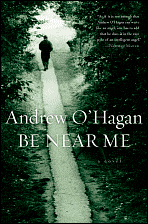
Be Near Me, by Andrew O’Hagan

12864414.gif I’m down to only two books I’m currently reading, and I’m about to finish one of them! I haven’t been in this situation in a long time. The only thing to be done about it is to start a couple new books, at least. Ursula LeGuin’s Left Hand of Darkness, Walter Scott’s Waverly, and Bruce Chatwin’s In Patagonia are the ones I’m planning to choose from.

But for now, I want to write a bit about Andrew O’Hagan’s new novel Be Near Me. I thought the novel had a few flaws, but overall it’s beautifully-written, absorbing, and moving. It’s about a Catholic priest, David Anderton, assigned to a small parish in Scotland who finds himself (David often seems passively drawn into things) involved with two teenage kids, Mark and Lisa. Mark and Lisa are wild; they do their best to shock David, but find themselves drawn to him when he isn’t shocked — when they see he wants to spend time with them. The three of them hang out after school and at night, talking and driving places; David takes the teenagers on trips to local landmarks they had never visited; generally, they have a lot of fun, although it’s clear from early on that these relationships are complicated and bound to become more so.

The novel is told in first person, and mixed in with the Mark and Lisa scenes, David tells about his past, his time at school and at Oxford, especially, and the story of falling in love with Conor, a fellow student. These background stories help to fill in David’s character. He doesn’t fit in easily anywhere and says he’s not sure where he belongs; he had an exciting youth, participating in the student protests of the 60s (he’s now in his 50s), but when he became a priest, he turned away from all that and has since lived a very quiet life, serving in parishes in England and only recently in Scotland.

He seems disconnected from himself, and his voice comes across as stoic and a little bit melancholy, as though he knows he has missed out on much but refuses to admit it. His housekeeper Mrs. Poole, with whom he has forged a friendship, tells him has spent his life trying to avoid life, but he refuses to believe this.

So when he meets and befriends Mark and Lisa, it inaugurates something new; he sees in them the youthful energy he no longer has, but he also grasps at the chance to change himself, to be a participant in life, to take risks and do foolish things. This is the most moving part of the book, I think; the longing David has for newness that he finally allows himself to indulge.

But it all goes wrong, inevitably, and David pays dearly for this experience of freedom and abandon.

What I loved best about the book is how richly it describes David’s sense of self and his interiority; it’s a very smart, thoughtful book, rather sad in the way it portrays growing older and taking stock of what one has become, but hopeful about the possibility of change, even in the midst of disaster. I did feel the narrator’s voice was sometimes a little too withholding, a little too reticent, and in these moments, rather than communicating hidden depths, the narrator left me a bit cold. This is the danger of using first person with a character like David, I suppose; his ambivalence about himself can at times make him seem a little blank.

But I only felt this blankness in moments, and mostly the experience of reading this book was a pleasure.

4 Comments

Filed under Books, Fiction

A little too much patriarchy

I’m reading Naguib Mahfouz’s novel Palace Walk right now and enjoying it greatly; it’s a long, rich, satisfying read, about a family in Cairo after World War I (although I had to look up the date, which I couldn’t figure out from the novel itself — this is probably my fault for not getting historical references). It’s the kind of book you can live with for a long time; it moves slowly but in a good way, giving you lots of detail about setting and character. It feels like a Victorian novel in a lot of ways, as one of its main preoccupations is getting the young people properly married.

Its resemblance to Victorian novels is making me realize that I’ve been reading an awful lot about how much life used to suck for women — which is not to say that it doesn’t suck today, at least for some, especially outside of the Western world. But still — Palace Walk right after The Crimson Petal and the White reminds me of just how grim life could be. Yesterday I wrote about how Faber’s novel describes the impossibilities women faced in Victorian society, so I won’t repeat that. In Palace Walk, the situation seems even worse, although the women in the novel haven’t yet expressed any dissatisfaction. Here, the two young daughters, as respectable women eligible for marriage, are not allowed to be seen by any man, not even through through a window. They spend their days in the house, mostly doing housework, as far as I can tell. They have little education. The mother — the whole family actually — defers to every whim and desire of the father. The mother is little more than a glorified servant.

I’m not surprised by this at all, but it does make me long to read something with a more feminist bent to it, and soon. I remember people mentioning that Ursula LeGuin’s Left Hand of Darkness has an interesting take on gender; perhaps this is a good possibility?

10 Comments

Filed under Books, Fiction, Reading

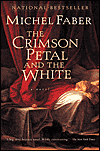
The Crimson Petal and the White

6938770.gif Michel Faber’s The Crimson Petal and the White was such an enjoyable book; it’s about 900 pages long, but it felt much shorter. The pages flew by. The excitement and speed doesn’t come from an incredibly complex plot; rather, it comes from the fun of being caught up in a vividly-realized world so very different from our own.

The book is set in London in 1875, and the author takes special delight in describing all that was horrid about the place — the filth, the smells, the poverty, the inequality, the prostitutes, the thieves, the beggars and pickpockets. Maybe there’s something a little wrong about enjoying these things in one’s reading, but still, it is delightful to read about a time not so far back in history that makes a person glad she’s alive today and not then. It makes one think, though — maybe people will one day read historical fiction about our time and wonder how we ever managed to survive when things were obviously so very terrible.

The story revolves around three main characters, William Rackham, head of a perfume industry; Agnes Rackham, his wife; and Sugar, the prostitute William falls in love with. Each character is vividly portrayed. Sugar is very smart and knows how to manipulate weak men such as William; she uses William’s infatuation with her to the fullest extent possible. She’s writing a novel describing her fantasies of revenge against all the men who have abused her in her life. William is insecure and foolish; he wanted a literary life but gave that dream up so he could make money, but he never quite trusts himself or his decisions. He wants to have the perfect home with wife and child and luxury and refinement, but he also wants Sugar for the pleasure and flattery she brings. He wants it all, and he lives in a society that gives him no reason to think he can’t have it.

Agnes, the wife, is one of the most fascinating characters; she’s startlingly ignorant about sex and reproduction, ashamed of her body, and unwilling to acknowledge that she’s given birth to a daughter. She’s the perfect Victorian woman — proper, modest, polite, and ignorant. But she’s also teetering on the brink of insanity. The point is obvious — conventional Victorian womanhood drives women mad — but it’s still a pleasure to see how Faber makes it all work out. Agnes and Sugar fall into the virgin/whore dichotomy, but these roles slip and slide and undermine each other and by the end, both women refuse to be what William — and society — want them to be.

Faber takes pleasure in spelling out just how restrictive the rules of proper society were; I knew something about what it meant to be a high-class Victorian woman, but I was still shocked at the many, many rules. It wasn’t proper for a woman to laugh with her mouth open. She couldn’t acknowledge any bodily function whatsoever. She was supposed to walk in such a way as to deny she has legs; she’s supposed to glide across the floor as though she is an angel. She couldn’t do any physical labor whatsoever, not so much as closing the curtains or putting a log on the fire. She couldn’t acknowledge there was such a thing as prostitution. It’s all this detail that makes historical fiction so much fun, isn’t it?

14 Comments

Filed under Books, Fiction

On finishing Proust’s In Search of Lost Time

I want to write just a few words about finishing Proust’s In Search of Lost Time; I don’t feel up to writing a big long summing-up post that tries to say smart things about what it all means, but I do want to say something. I am happy to have finished, but I do miss reading Proust a bit; I’ve been used to a near-daily dose of the narrator’s slow-moving, contemplative voice, and now I don’t have that.

It’s hard to see how a 3,000-page book without all that much plot, relatively speaking, could cohere, but I think it does. I found the ending, say, that last couple hundred pages, really did wrap things up; it provides an answer to the question that has haunted the whole book — will Marcel ever write his masterpiece? This is a question that has lingered from the very first volume when it becomes clear that Marcel has an interest in, and perhaps a talent for, writing. The answer the book provides is satisfying, and realistic, given everything that has happened up until that point.

My favorite volumes were the first two and the last one; the third and fourth, The Guermantes Way and Sodom and Gomorrah, got a little long, but then the fifth volume, which contains The Prisoner and The Fugitive begins to pick up a bit in preparation for the grand ending. It’s the long party scenes in some of the middle volumes that got tiresome. What I loved about the book are the insights into the mind, art, time, and love, but the novel is also obsessed with society and rank and how people behave at parties, topics that didn’t thrill me quite as much. But even here there are things to interest; Proust captures snobbery and hypocrisy and the deadness that can lie behind the glittering masks of high society beautifully well.

But mostly this novel is worth reading because of what it can teach about observing the world around you and in you. Proust has a meticulous eye for how the mind perceives input from the senses and for how we come to understand our experiences, and, of course, he has a beautiful way with a sentence to capture all that insight. I love how there can be so much wisdom and experience in one of those long sentences — how they can take in so much.

12 Comments

Filed under Books, Fiction

On finishing Don Quixote

7075756.gif Most of this post will be about the second half of Don Quixote and the ending, so if you don’t want to hear about it, you might want to save this post for later. I loved the way the second part of the novel became a kind of commentary on the first (is this what people are talking about when they say that everything comes together in the second half?), how everyone Don Quixote and Sancho Panza meet have read the novel’s first half and so are in on the story of his peculiar form of madness. Most of them decide to have some fun playing jokes on the two, to see just how far the madness of Don Quixote will go. So, in addition to all the metanarrativity that was already going on in the first part — the multiple authors and the long conversations on storytelling and the frequent mentions of Cide Hamete Benengeli — Cervantes adds his critique of the false sequel to Don Quixote published in between his two volumes and mixes up real life and fiction even more by having Don Quixote confront the results of his literary fame again and again.

It is this playfulness about fiction and authorship that I will remember about the book, long after I’ve forgotten individual episodes — episodes it probably won’t take me all that long to forget, in truth, because some of them dragged on a bit and my attention wandered. But I love that self-interrogation is built into the structure of one of the first novels ever, depending on how one defines “novel,” or, at the very least, one of the earliest and most influential novels. Don Quixote is a novel about madness, friendship, adventure, and love, but it’s also very much a novel about novels, and it starts a very long tradition of novels that reflect on themselves, a traditional so influential that even ostensibly realistic novels usually have some kind of self-reflexive element to them.

About the novel’s ending: it is so sad! I didn’t expect to see Don Quixote regaining his sanity, and even less did I expect that moment of sanity to be rather depressing:

“Señores,” said Don Quixote, “let us go slowly, for there are no birds today in yesterday’s nests. I was mad, and now I am sane; I was Don Quixote of La Mancha, and now I am, as I have said, Alonso Quixano the Good. May my repentance and sincerity return me to the esteem your graces once had for me, and let the scribe continue.”

And he goes on reciting his will. It’s this melancholy at the end that convinces me (even further than I was already convinced) that Cervantes has great affection for his two main characters, in spite of their foolishness. It’s the energy of their madness that carries the story forward, so that as soon as Don Quixote regains his sanity, there is no story anymore, and the novel abruptly ends. Without Don Quixote’s madness, Cervantes has nothing. So, yes, Cervantes mocks Don Quixote’s foolish and naïve way of reading, but I think he glories in the energy and the fun of it too. To me, Don Quixote comes across as admirable in his imagination, his resourcefulness, his persistence, and his liveliness. I realize this is a very contemporary way of looking at the novel, and earlier readers may not have seen anything admirable in Don Quixote whatsoever, but I can’t help reading as a contemporary person, can I?

4 Comments

Filed under Books, Fiction

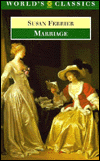
Marriage, by Susan Ferrier

1134997.gifSusan Ferrier’s novel Marriage, published in 1818, is a good read and interesting in a number of ways, one of which is its Scottishness. Ferrier lived her whole life in Edinburgh, and her novel deals with the ideas Scottish and English people have about each other and the complexity that existed behind stereotypes of the day. The critic who wrote the novel’s introduction noted the multiplicity of “mixed” marriages — between Scots and English — to argue that Ferrier rejects the kind of nationalism developing in her time period. She also shows complexity within Scotland, portraying different areas and different types of people within it, and therefore undermining any simple idea of a Scottish “character.” Ferrier’s best characters are capable of living happily in both places, and they tend to combine the best traits characteristic of both areas.

Ferrier does, however, have some fun portraying comic characters who fail at her kind of worldiness — she writes about loud, blustery Highland lairds and foolish maiden aunts and spoiled English girls who refuse to live within their incomes. Ferrier uses these stereotypes for comic effect, and then has her more sympathetic characters critique the foolish, stereotypical ones.

Another main interest in the book is education, particularly women’s education — a topic so many, many novels of the time took up. Ferrier treats this subject largely through contrasts. She has three main female characters, Lady Juliana and her twin daughters Mary and Adelaide. Lady Juliana’s own education was abysmal:

Educated for the sole purpose of forming a brilliant establishment, of catching the eye, and captivating the senses, the cultivation of her mind, or the correction of her temper, had formed no part of the system by which that aim was to be accomplished.

Her father is largely to blame for this:

[He] was too much engrossed by affairs of importance, to pay much attention to any thing so perfectly insignificant as the mind of his daughter. Her person he had predetermined should be entirely at his disposal …

Women’s bodies matter more than their minds, according to this view, but what the father has forgotten is that after marriage women become responsible for raising children and they need a certain amount of sense to do this successfully. This was a common concern of the time — women should be educated not so much because of its inherent worth, but because women needed a certain amount of training to run a family well.

Marriage spells out the consequences of poor education for women (education in morals as well as academic subjects); Lady Juliana is a terrible mother and raises her daughter Adelaide to be much like she is — vain, selfish, and foolish. Mary, however, Adelaide’s twin, is raised by another woman, Mrs. Douglas, who does a much better job and trains Mary to be everything that Adelaide is not — kind, thoughtful, knowledgeable. Through these twins we can see how much is at stake in a young person’s training and education, and how Lady Juliana is perpetuating the cycle of ignorance. How is she supposed to know how to raise a daughter when she never received any attention or training herself? No one was there to teach her how to be selfless and patient.

Many of the characters in this novel are either thoroughly good (Mary, Mrs. Douglas) or thoroughly bad (Lady Juliana, Adelaide), so it was a pleasure to come across Lady Emily who is neither. It’s in this sense that Marriage feels like an 18C novel to me — so many 18C novels have perfect heroines, annoyingly perfect ones, leaving the more minor characters to have some complexity. Lady Emily is flawed — according to the standards of the book — by being too critical, too
quick to speak her mind, too witty, too independent. Mary as heroine could never get away with displaying these traits; they are too unfeminine. But Emily is sympathetic too; she does her best to take care of Mary when she needs it, and she has a sense of her own flaws. Mary is drawn to Emily but worried about her future; she may be a little too wild for her own happiness. This uncertainty is left unresolved. Readers today are probably more likely to sympathize with Emily than with Mary, who can be a little insipid and annoyingly obedient. I’m not so sure what readers at the time would have thought.

This puts Austen’s novels in an interesting light — her heroines are not the perfect Mary types; they have flaws, such as Emma’s self-absorption and they make mistakes like Elizabeth Bennet’s too-quick judgments. It seems that other novelists were more likely to explore flaws, not in their heroines, but in other characters. The heroines remain saint-like.

I love reading novels from this time period; I think Marriage is an interesting one to look at for what it says about national identity and about women’s place in society, but it’s also a fun read — a good story with lots of comic touches.

8 Comments

Filed under Books, Fiction

Proust on art

I just came across some wonderful passages in Proust; I’m about 150 pages from end, determined to finish it and Don Quixote by the end of the summer. The narrator has just had a series of experiences of involuntary memory, where something in his present — a sound or taste or sight — will trigger a memory that recreates in his mind whole sections of his past that he had previously forgotten. The madeleine scene from Swann’s Way is the most famous of these, although there are many. Immediately before these memories come to the narrator, he despairs of ever becoming a writer; he has spent years and years of his life wasting time, avoiding doing the writing he has always wanted to do. The memories start the process of bringing him back to his vocation, and they set him off on a long meditation on literature, writing, and the relationship of art and life.  I thought I’d share some short sections:

Real life, life finally uncovered and clarified, the only life in consequence lived to the full, is literature. Life in this sense dwells within all ordinary people as much as in the artist. But they do not see it because they are not trying to shed light on it. And so their past is cluttered with countless photographic negatives, which continue to be useless because their intellect has never “developed” them … it is only through art that we can escape from ourselves and know how another person sees a universe which is not the same as our own and whose landscapes would otherwise have remained as unknown as any there may be on the moon.

I love the idea that we all have the materials of art within us; the difference between artists and everyone else is that artists learn how to make use of those materials. Proust calls art “translation” — taking our experiences, whatever they are, and plumbing the depths of them to find meaning and to transform that meaning into something beautiful. And he says it requires courage. We like to live with certain illusions about ourselves; we whitewash our darker characteristics and cover over our failings, but the artist will look for the truth, no matter how difficult it is to face.

Here’s another passage on art and life, this time about imagination and sensitivity:

It may well be that, for the creation of a work of literature, imagination and sensitivity are interchangeable qualities, and that the second may without any great disadvantage be substituted for the first, in the same way as people whose stomach is incapable of digesting pass that function over to the intestine. A man born sensitive but with no imagination might none the less write admirable novels. The suffering that other people cause him, his efforts to prevent it, the conflicts that it and the cruel other person created, all of this, interpreted by the intelligence, might make the raw material of a book … as beautiful as it would have been if it had been imagined …

So making art isn’t the same thing as making things up. I’ve never liked the idea that imagination is as simple as making things up; to me, it has more to do with putting ideas together, making connections, seeing what’s in front of you in a new way. So in my way of thinking, the sensitivity Proust is talking about, combined with intelligence, is actually a certain kind of imagination.

And finally, here’s a passage on criticism:

[Criticism] hails a writer as a prophet, on account of his peremptory tone and his very public scorn for the school that preceded him, when in fact he has absolutely nothing new to say. These aberrations on the part of criticism are so constant that a writer might almost prefer to be judged by the general public …. For there is a closer analogy between the instinctive life of the public and the talent of a great writer, which is no more than an instinct religiously listened to while imposing silence on everything else, an instinct perfected and understood, than between it and the superficial verbiage and shifting criteria of the recognized arbiters of judgment.

Apparently Proust isn’t so fond of critics.  (Although he’s not so fond of the general public either — to shorten the quotation I took out a parenthesis on how the general public generally doesn’t understand what an artist is doing.) He gives an interesting definition of art here, doesn’t he, that it’s “instinct religiously listened to”? And I do buy his argument that critics often get it wrong, that they take loud voices for true ones and newness for greatness.

3 Comments

Filed under Books, Fiction

Marriage, the novel

As I’m reading Jane Austen in Context, I can’t help but feel that maybe I should re-read one of Austen’s novels. I almost picked one of them up the other day, but instead turned to Susan Ferrier’s novel Marriage, which was published one year after Austen’s death in 1818. I figured something from the same time period would do just as well. So far it’s highly entertaining, although not very Austen-like — which I don’t hold against it, as that would be unfair. If I didn’t know the date  of publication and had to guess I would have said it was written earlier, as it reminds me of eighteenth-century novels such as Evelina, with its lively, humorous characters that — at least so far — are types rather than the fleshed-out characters that we’ve come to expect in novels.

But those types are highly entertaining — in Marriage we have the ill-educated, fashionable, vain young woman; several blustery, temper-prone fathers; a trio of foolish, prating aunts who believe that a good bowl of soup is the cure for everything; a young man swept off his feet by beauty, who quickly realizes his mistake, but does so too late.

The book is set in Scotland, where the ill-educated, fashionable, vain young woman, Lady Juliana, finds herself after her marriage. When she discovers just what she’s gotten herself into — life in a gloomy, isolated castle in the Scottish Highlands — she falls into fits of hysterics. Susan Ferrier lived in Edinburgh her whole life, and she seems to be enjoying making gentle fun of her own countrypeople as well as mocking the spoiled Englishwoman who can’t function away from fashionable society.

This book is good fun, and I’m only a little ways into it … I’ll post more on it later, I’m sure.

5 Comments

Filed under Blogging, Fiction

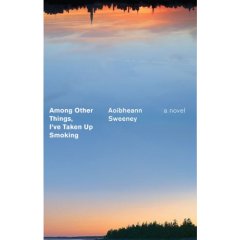
Among Other Things, I’ve Taken Up Smoking

41jnw9gnil_aa240_.jpgAmong Other Things, I’ve Taken Up Smoking, by Aoibheann Sweeney is an enjoyable read; I breezed through it in just a couple of days, which is unusual for me.  Which is not to say that it’s light reading, necessarily, just that it’s a book I was happy to spend hours with.  My copy came recently as a review copy from Penguin.The novel tells the story of Miranda, a young girl who lives first on an island in Maine with her father and later, after she finishes High School, in Manhattan. Her mother died somewhat mysteriously when she was three, leaving Miranda and her father on their own, although they are joined at times by Mr. Blackwell, a friend from the town across the bay. The father is working on a translation of Ovid’s Metamorphoses, but as time passes, it becomes clear that this is a project that will probably never be complete.  It is a pretense of work that keeps him occupied and give him a reason to live in such isolation.

About the first quarter of the book takes place in Maine, covering Miranda’s entire childhood, and then her father arranges for her to work at the Institute for Classical Studies in Manhattan amongst old friends of his. Once there, she struggles to make her way in a strange city and to absorb the new information she learns about her parents, and also about herself.

Miranda’s relationship with her father is one of the novel’s central story lines; the father spends most of his time lost in his studies and has no practical sense and little skill in maintaining a household, and so Miranda, with the help of Mr. Blackwell, learns early how to cook and care for the house and how to navigate across the bay on her own to get to school. She learns how to type so she can type up her father’s manuscript. She spends so much time alone with her father and devotes so much time to caring for him, and yet he is emotionally remote, caught up in the past and living with secrets that Miranda discovers only when she goes away.

Miranda’s father reads to her from his translation of Ovid often enough that the tales in Metamorphoses come to be familiar, and she tells several of the stories throughout the book (it’s in first person from Miranda’s point of view). They become a way for her to think about her own metamorphosis, or lack thereof, as she grows up curious about change and yet longing for things to stay the way they are. Ovid’s stories are about desire and its transformations, and they become the lens through which Miranda views the changes desire wreaks in others and in herself:

The tales in Metamorphoses rarely ended happily; the process of transformation, of hands turning into claws and feathers sprouting on shoulders, was sometimes a punishment and sometimes a reprieve. But mostly it was a compromise of some sort, a way to negotiate the chasm between desire and mortality, between human nature and human need.

There are many mysteries in the book — what exactly happened to Miranda’s mother? why is her father so reclusive? what exactly is the nature of his relationship to Mr. Blackwell? — some of which get resolved and others of which don’t. One of the most intriguing mysteries for Miranda is the mystery of desire itself — what it is and what it makes people do.

As in all first-person narratives, the pleasure of the reading lies in the reader’s response to the storyteller. Miranda speaks with a voice that is vulnerable and questioning, but there’s a toughness too, and even a kind of reticence — her life has not been easy, but she doesn’t spend her energy mourning it so much as trying to understand it.

The book was a pleasure to read — smart and meditative, with a narrator that enjoyed spending time with.

10 Comments

Filed under Books, Fiction

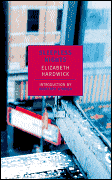
Sleepless Nights by Elizabeth Hardwick

11357909.gifI’ve been trying to decide what to say about Sleepless Nights by Elizabeth Hardwick for quite a while now, and I’m still not sure. I feel conflicted not so much about the book itself but about what I actually feel and what I think I should feel about this book. I want to like non-traditional, experimental fiction. And I’d really like not only just to like it but to unequivocally enjoy the reading of it. But that doesn’t always happen. With Wittgenstein’s Mistress I appreciated it and thought about it a lot and am glad I read it, but I didn’t savor the experience. I didn’t mind putting it down after a while.

With Sleepless Nights I felt something similar. I appreciate what she’s doing, and I enjoyed the reading of it — more than I enjoyed Wittgenstein’s Mistress — but I also didn’t mind putting it down after a while. I read this book in short chunks — and the structure of the book makes that easy, with short “parts” and shorter sections within those parts — and I don’t think I could have read it fast if I’d tried.

Maybe the most damning thing I have to say about it (in my mind) is that I find myself not having a whole lot to say about it. With Wittgenstein’s Mistress, at least, I felt like I had a lot to say. As I sit here and try to pull together my thoughts on Sleepless Nights, what comes into my mind most often is the question of how I felt as I was reading it. I have already forgotten many of the book’s details, and I don’t have a strong sense of the book’s mood or atmosphere or a strong sense of character that might make me look back on my reading experience with pleasure.

But — enough of this navel-gazing. The book is short, about 130 pages, and is a collection of the thoughts and memories of a woman named Elizabeth. This is way the book opens:

It is June. This is what I have decided to do with my life just now. I will do this work of transformed and even distorted memory and lead this life, the one I am leading today ….

…..

If only one knew what to remember or pretend to remember. Make a decision and what you want from the lost things will present itself. You can take it down like a can from the shelf.

This makes a suitable introduction to the book, as it introduces the narrator and her task — to gather her memories and write them down. But it also warns us that what she remembers may be distorted, that she is not giving us a history of her life, but rather a picture of her life as she remembers it now. Everything is filtered through her present consciousness.

The narrative doesn’t follow chronological order, skipping around from place to place and year to year, as our memories do. So we get glimpses into her life — a youth spent in Kentucky and adulthood in New York City, Boston, Maine, and Amsterdam. She describes lovers, friends, and acquaintances, events and observations. There isn’t any connective tissue to any of this, no transitions that tell us how one story relates to another; instead they are simply bump up against one another, again, as our memories tend to do.

The narrator’s mother haunts many of the pages; early on she describes her life:

My own affectionate, tireless mother had nine children. This fateful fertility kept her for most of her life under the dominion of nature. It was a thing, a presence, and she seemed to walk about encased in the clear globe of it. It was what she was always doing, and in the end what she had done.

The narrator makes sure that she does not share this fate; instead her own story is of freedom and independence, of writing and travel and experience. She rejects her mother’s femininity (“an ineffable femininity, tidal”), and yet she’s aware of how it shapes her writing:

Tickets, migrations, worries, property, debts, changes of name and changes back once more: these came about from reading many books. So, from Kentucky to New York, to Boston, to Maine, to Europe, carried along on a river of paragraphs and chapters, of blank verse, of little books translated from the Polish, large books from the Russian — all consumed in a sedentary sleeplessness. Is that sufficient — never mind that it is the truth. It certainly hasn’t the drama of: I saw the old, white-bearded frigate master on the dock and signed up for the journey. But after all, “I” am a woman.

She is not writing an adventure tale of the type that men can much more easily experience and record; rather, her life and therefore her book are shaped by the domestic and by the reading she has done in those domestic spaces. This passage declares her refusal to write a traditional novel with a clear beginning and end and with action and adventure and drama; the novel that will portray her experience as a woman cannot be traditional. Instead it experiments with the elements of storytelling that have been passed down to her, in an attempt to write something new that can capture the memories circling around in her head.

There were moments when I read with pleasure, enjoying a portrait of a character Hardwick drew with skill. Her description of Billie Holiday, for example, is devastating. The book didn’t sustain that level of interest or pleasure, however.  I’m very curious to hear what other people thought!

8 Comments

Filed under Books, Fiction

Riding and reading

Yes, I rode my bike yesterday. No, it wasn’t a good idea. I thought I’d try, just to see what it felt like, particularly since I’ve felt the tiniest bit better because of the medication I’m on. But it will take longer than a week on medication to feel well enough to ride, I’m seeing. I was able to ride for 45 minutes or so, but my heart rate was high the whole time and I felt achy and sore. I’m sure I’ll try again in the next few weeks — I’m always curious to see whether I’ve improved or not and I don’t feel like I’ll know unless I try to ride — but no, I’m sure it’s not a good idea. I don’t see my endocrinologist until August 23rd, though, and does anybody really think I’m going to wait that long to try riding again?

But what I really want to write about are two books I’ve recently finished. The first is Roger Shattuck’s Proust’s Way, a book of criticism on In Search of Lost Time. I recommend this if you are looking for an overview of the novel. I don’t recommend it if you don’t want plot spoilers, because he talks about the book as a whole, including much discussion of the ending and plot developments in the middle. But plot spoilers aside, it’s got background information on Proust; an overview of the plot, characters, and setting; chapters covering Proust’s main themes, as Shattuck sees them; and a number of cool charts and diagrams.

Some parts of this book are rather odd (I give another example in this post); toward the end of the book, he includes a fictional element — a made-up dialogue between a radio journalist and producer, a Proust scholar, and a grad student in French. These people are supposedly putting together a radio program on Proust. Shattuck says he included this section because he believes that usual expository prose can’t say everything. I rather like this idea — that some things are better said in fictional form — but I can’t quite see that this is true in Shattuck’s case. Instead, the dialogue struck me as so highly improbable that I almost laughed my way through it. Shattuck should stick to his expository prose. But still, the book is worth picking up to start to get a handle on In Search of Lost Time.

The other book I wanted to mention is Geraldine Brooks’ novel The Year of Wonders, which turned out to be a fascinating and enjoyable read. I say it’s fascinating because it takes place in a small town in England in 1666 that gets hit hard with the plague — and I find the plague fascinating. It’s not a book to read at the dinner table, let me make clear.

The story is about Anna Frith, a young servant girl who grows and matures as she deals with the ravages the plague brings to her village. She has been fortunate enough to learn how to read and write, and she has a sensitivity and openness perhaps unusual to one in her station in that time period. She’s an interesting narrator (it’s told in the first person); she admires the intelligent, knowledgeable women in her town but fears them also as they are always in danger of being branded witches. As well as telling about the plague, the novel tells how old customs — midwives who presided at the birth of babies, women who possessed ancient folk remedies and healing powers — were both enjoyed and feared. When times were good, the townspeople would welcome women’s knowledge and powers, but when times turn bad, they lash out at these women and destroy them — at their peril.

The ending is a bit odd, but otherwise, this is a thoroughly enjoyable book — it’s great history and a good story all in one.

9 Comments

Filed under Books, Cycling, Fiction, Nonfiction

Wittgenstein’s Mistress

I recently finished David Markson’s novel Wittgenstein’s Mistress, and I thought the book was smart, beautiful, unique, and, at times, moving. At times I found it dull. As this novel is something I think I can safely call experimental, I’m not sure what this says about me as a reader. Or maybe I should leave the term “experimental” out of it, and just comment on the book itself and what the book tells me about my reading. This is probably the fairest thing to do.

So — I wouldn’t have minded if this book were a bit shorter, but I’m glad I read it anyway. It’s about a woman named Kate who either is, or thinks she is, the only person left on earth. Everyone has simply vanished, and all the animals have vanished too; houses and possessions are left just as they were before this vanishing happened, and cars are abandoned in the streets. Kate has taken possession of a house on the coast somewhere — we’re not told where — and she has begun writing. Markson’s novel is the manuscript she produces.

I’m tempted to say she has begun writing her story, but that’s not what she’s done at all; what she writes is what’s on her mind, with pieces of her story told now and then. We never learn all that much about her life before everyone disappeared, a few details about a husband and son are about it. What we learn is the contents of Kate’s mind — her thoughts about her surroundings, her travels (she has traveled all around the emptied-out world), her memories, and about the art she has seen, books she has read, and music she has heard.

But what’s really interesting about the book is Kate’s (Markson’s) writing. The novel is written in short, usually one-sentence, paragraphs, first of all, and these paragraphs cycle through a series of topics, moving from one to another to another, occasionally dropping some and introducing others. It’s repetition with slight changes each time — we get new information or sometimes contradictory information with each mention. It’s very hard to find an excerpt to give here because everything in the book depends on what came before to make any sense, but here’s a passage anyway, from near the beginning:

It was that winter during which I lived in the Louvre, I believe. Burning artifacts and picture frames for warmth, in a poorly ventilated room.

But then with the first signs of thaw, switching vehicles whenever I ran low on gas, started back across central Russia to make my way home again.

All of this being indisputably true, if as I say long ago. And if as I also say, I may well have been mad.

Then again I am not at all certain I was mad when I drove to Mexico, before that.

Possibly before that. To visit at the grave of a child I had lost, even longer ago than all of this, named Adam.

Why have I written that his name was Adam?

Simon is what my little boy was named.

The whole book is like this — it’s Kate’s mind pursuing thoughts until they lead her to other thoughts and then to other thoughts and others, and eventually around to the first thought again.

Nothing is certain in the book — Kate’s not sure if and when she was mad long ago, and the reader is not certain whether to trust Kate’s description of her world and her situation. Kate’s not sure of her memories and her facts; stories slip away and facts change shape. She’s trying to capture something certain in her writing, but instead she returns again and again to this lament:

What do any of us ever truly know, however?

Kate also writes about language and its strangeness; she frequently points out inaccuracies and ambiguities in everyday language:

Once, Turner had himself lashed to the mast of a ship for several hours, during a furious storm, so that he could later paint the storm.

Obviously, it was not the storm itself that Turner intended to paint. What he intended to paint was a representation of the storm.

One’s language is frequently imprecise in that manner, I have discovered.

And she writes about the relationship of objects outside the mind with representations we create of them inside the mind:

In fact the very way I was able to verify that I had ever even been to the other house, some few pages ago, was by saying that I could distinctly remember the poster.

On the wall.

Where was the poster when it was on the wall in my head but was not on the wall in the other house?

Where was my house, when all I was seeing was smoke but was thinking, there is my house?

A certain amount of this is almost beginning to worry me, to tell the truth.

So — and I think you could say that about many experimental novels, and certain about postmodern novels — this book is as much about language as it is about anything else. It’s about the way we depend on language to create our world for us, and the way language fails to deliver the kind of certainty and comfort we crave. But it’s also about the consolations of art — Kate is preoccupied with questions about art and history and ideas, and, of course, she turns to her own writing for comfort. We may in the end know very little about our world and ourselves, but we can find pleasure in exploring and experiencing the process of trying to find out.

The more I write about this book the more I like it. Have you experienced having your feelings about a book strengthened as you write about it — good feelings or bad ones? To echo what I said at the beginning, at times I wished the book were shorter, but I do recommend it for those of you interested in this kind of book or looking to try something like it — smart and philosophical and beautiful.

9 Comments

Filed under Books, Fiction

Notes on Proust

I’m reading and enjoying Roger Shattuck’s book Proust’s Way, but I found myself puzzled and amused by part of one chapter where he complains bitterly and at length about how awful the 1989 Pléiade edition of Proust’s novel is. He quotes himself on the subject at one point, inserting part of a talk he gave at a conference into his text (this practice of quoting himself strikes me as odd — why not just rewrite the idea so it will make sense in the new context?):

I propose that we boycott the overblown, misconceived, and over-priced new Pléiade edition. It saps and traduces Proust’s life-long devotion to a single work … Let us not yield to the temptation to accept unthinkingly the prestige of the Pléiade collection.

Why the religious language of temptation here? The problem with the Pléiade edition Shattuck hates so much (the earlier 1954 version is acceptable) is that it includes extensive notes, early drafts, and variants, so that Proust’s 3,000 page novel swells to 7,300 pages — and that this edition isn’t meant to be a scholarly one. It’s not just that he can’t stand all the textual apparatus, but that the textual apparatus, especially the drafts of the novel, isn’t confined to a book produced solely for scholars. The general reader, he thinks, should have only the novel itself with just the essential footnotes.

He’s making an argument against “genetic criticism”: “the study of the evolution of a work out of earlier outlines and drafts and sketches into its (presumably) final state.” According to Shattuck, the editor of the Pléiade edition, Jean-Yves Tadié, is a practitioner of this form, and Shattuck sees his 7,300-page edition of Proust as an embodied argument for this form of reading and study.

Shattuck hates this. He wants to see the author’s final version, and that’s it:

The genetic critics, particularly when led by so disciplined and informed a figure as Jean-Yves Tadié, were able to do something that deconstructionists never succeeded in accomplishing. They unmade a work of literature. Intending to carry In Search of Lost Time to its final apotheosis in their sumptuous 7,300-page edition, Tadié and his associates have in effect buried Proust’s novel in trappings and distractions and commentary. The volumes honor scholars’ decisions about what to include more than they honor Proust’s decisions about what to exclude … [the edition] shrouds and demeans the author’s work.

Am I the only one who thinks this is going a bit too far? I don’t see how all the textual apparatus could demean an author’s work. Shattuck seems entirely too worshipful of Proust and of authorship generally. I do see that there’s a theory of reading built into the way an edition is shaped (and I find that an interesting idea), but I don’t agree with Shattuck’s argument that this particular way of reading is a bad one.  I think having the early drafts and variants is valuable. Why not have a multiplicity of ways of reading Proust?  If the Pléiade edition were the only one available, I might see his point, but that’s not the case.

He’s careful to say that he thinks all the apparatus ought to be available — but available only in scholarly editions. I don’t like this idea at all — I’m not likely to want to read early drafts of Proust’s novel, but why assume that only Proust scholars would be interested? His argument strikes me as an insult to the general reader.

6 Comments

Filed under Books, Fiction, Reading

Sigrid Nunez and other things

Right now I’m intensely aware of how changeable I am; last night when I wrote my post about wanting comfort reads I really, really meant it, but shortly after I wrote about that desire I read a post on the book Blood Relations: Menstruation and the Origins of Culture over at The Existence Machine that inspired me to want to read difficult things again. Blood Relations sounds like a fascinating book, and I may read it at some point, by my point right now is that thinking about this book made me want to read more history and science and philosophy, and I got to thinking about how it would be so cool to re-read some of the philosophy I studied in college, and I was off on this plan to begin a philosophy project like the one Stefanie has been doing. Chances are I won’t actually do this, but it’s fun to think about.

Thinking this way is what gets me caught up in big projects like reading In Search of Lost Time. It’s so fun to begin a big reading project, although it’s a lot harder to keep it going, and my changeability causes problems almost right away, because as soon as serious reading gets the slightest bit dull, I’m wanting something comforting again. It’s back and forth and back and forth for me, I’m afraid.

Okay, but I’ve been meaning to write about Sigrid Nunez’s novel The Last of Her Kind. It’s about two friends, Georgette, known to many as George, and Ann, who meet at Barnard in 1968. Ann comes from a rich family from Connecticut and George comes from a poor town in upstate New York, so the first part of the book is about how they negotiate their differences and survive as roommates. The story moves on from there to follow their lives through middle age.

Ann has always been sensitive and idealistic, hating her parents for their wealth and privilege, so it’s no surprise that she becomes involved in the counterculture, organizing and protesting and marching. George is the first-person narrator and, as well as telling her own story of making her way into adulthood, she follows Ann as her life takes off in a very unexpected direction (I read the inside flap of my hardcover copy which gave away this plot event — you might want to be careful not to do the same). George is much more ambivalent about the ideals of the 60s, and, specifically, Ann’s ideals, and so she recounts Ann’s actions with a sometimes admiring, sometimes impatient tone.

The novel is the story of their friendship, but even more so, it’s the story of changing times, as the 60s and 70s give way to the 80s and 90s, and the dreams and aspirations of the earlier time period come to seem hopelessly naive and slightly ridiculous. I loved reading about that earlier time period, and, although I’m not sure I’d want to live through it, exactly, it made me lament the way so many young people seem so politically apathetic these days.

I found much of this book deeply absorbing, but there were parts that slowed, particularly in the second half. Nunez is covering an awful lot of years and an awful lot of events, and at times I felt she rushed through her material a bit. The changes that were happening to the characters didn’t always feel believable, or rather, the characters started to feel alien to me, even though earlier I’d felt like I could have known them.

But this is a small quibble about what was an enjoyable read, especially worth reading if you’re interested in the legacy of the 60s.

7 Comments

Filed under Books, Fiction, Reading

Alison Lurie’s Foreign Affairs

I want to say at least a few words about Alison Lurie’s Foreign Affairs before the book begins to fade in my memory (which can happen all-too-distressingly fast I’m afraid). I really enjoyed this book, and Lurie is fast becoming a new favorite of mine. This is my second Lurie novel (the first one was The War Between the Tates), and I’ve found them both well-written, entertaining, smart reads.

Foreign Affairs has two main characters, Vinnie (Virginia) Miner and Fred Turner, both of whom are English professors at Corinth College and both of whom are traveling to London on leave to work on their research. They don’t know each other particularly well and don’t get to know one another much as the novel progresses, but their paths cross as they share some of the same friends, and eventually Vinnie finds herself helping Fred in ways she never would have expected. The novel charts the various friends they make and lovers they find and also their changing feelings about England itself. At times it is a magical place, full of culture and sophistication and history, and at other times it is dreary and lonely and cold.

The chief pleasure of this novel for me is Vinnie herself. She is in her 50s, single, and a bit eccentric — she steals things now and then and imagines her self-pity as a little dog Fido who follows her everywhere — but she knows this and accepts it, and Lurie never mocks her, instead presenting Vinnie as she might want to be presented, so we come to understand her thought processes, her explanations and justifications. She is lonely, but she does the best she can with brief affairs that are readily available, when she is interested. She is very aware of the way people stereotype her — as the stiff, unfriendly, set-in-her-ways, old maid professor. This bothers her, but she’s also aware she’s created a pretty nice life for herself, and she tries to appreciate what she has. There’s something very appealing about her — her observations about people are funny and insightful and her self-assessment brave and honest.

I mentioned in a previous post that Lurie refers to the novel itself occasionally; this never becomes too intrusive or overbearing, but it does introduce a certain self-reflexivity to the story (and I like this — why not recognize that what you’re writing is a novel and not pretend it’s real life?). At one point Vinnie considers what role people like her, women in their 50s, have in novels — which is to say, not much of one:

In most novels it is taken for granted that people over fifty are as set in their ways as elderly apple trees, and as permanently shaped and scarred by the years they have weathered. The literary convention is that nothing major can happen to them except through subtraction … Vinnie has accepted the convention; she has tried tor years to accustom herself to the idea that the rest of her life will be a mere epilogue to what was never, it has to be admitted, a very exciting novel.

But eventually Vinnie comes to change her mind about this acceptance:

Why, after all, should Vinnie become a minor character in her own life? Why shouldn’t she imagine herself as an explorer standing on the edge of some landscape as yet unmapped by literature: interested, even excited — ready to be surprised?

And this is a good description of what Lurie is doing — mapping a relatively untouched landscape for the pleasure of her readers (how untouched is this area? I haven’t thought much about how many main characters in novels are like Vinnie, although I know older novels are mainly about youth).

She also refers several times to Henry James, clearly a model and inspiration for Lurie’s own work; her writing is similarly concerned with Americans abroad, and with relationships and consciousness — what it’s like to be a thinking being in the world. At one point, Fred compares his experience to a James novel:

James again, Fred thinks: a Jamesian phrase, a Jamesian situation. But in the novels the scandals and secrets of high life are portrayed as more elegant; the people are better mannered. Maybe because it was a century earlier; or maybe only because the mannered elegance of James’ prose obfuscates the crude subtext. Maybe, in fact, it was just like now …

Isn’t this a fascinating question? Were manners better then, or did James merely make them seem more elegant? Have things changed, or haven’t they? As much as James might be an inspiration for Lurie, she has produced a different kind of novel, one that more readily acknowledges what was once subtext.

There is so much to enjoy here, that I could go on and on … I will certainly be reading more Lurie when I get the chance.

9 Comments

Filed under Books, Fiction

Happy Independence Day!

Happy 4th of July to those of you who celebrate it; to those of you who don’t — happy Wednesday. It’s pouring rain right now, and it’s been relatively cool all day, unusually so for July. I’ve spent the day reading, napping, riding my bike (a nice easy ride which I probably shouldn’t have taken since I’m still feeling a bit sick, but I told you I’m bad at laying off the exercise …), and I’ll probably spend the evening comforting Muttboy when the locals set off their fire crackers and he gets scared. The 4th of July is not a good holiday for dogs.

I began reading Roger Shattuck’s book Proust’s Way today; I didn’t intend to begin the book until I finished In Search of Lost Time, but it looked so interesting, I couldn’t resist. LK rightly warned me that the book has spoilers, so I’ve been trying to avoid bits that might give away plot events that occur in the last volume — but, as I’ve said before, I don’t think one really reads Proust for the plot.

The book is quite good so far — it’s got suggestions for how to read the novel, which are coming a bit late for me, but which are interesting anyway, as they explain things like the structure of a typical Proustian sentence and how that structure reinforces the sentence’s meaning. The book has a number of cool charts — ones that explain the main characters, the various love interests, the structure of the novel’s action, and the places the action occurs, among other things. It has a section on Proust’s life, but it’s not a biography — mostly it gives an overview of what the novel’s all about and offers interpretations of its meaning and significance.

I’m pleased to be reading something that will help me think about Proust more deeply and will help me pull my experience of reading him together, even though I’m not quite finished. Reading Shattuck’s book sometimes teaches me new things and sometimes reinforces things I’ve already thought about Proust.

I prefer to read about a book after experiencing the book itself, rather than preparing for reading a book first and then picking it up. Sometimes that means I’m bewildered as I read the primary text and don’t get things I might if I’d prepared first. But I prefer to experience something directly first and then to try to make sense of the experience afterwards by doing the critical reading, if I’m going to do any critical reading at all.

6 Comments

Filed under Fiction, Life

Reading Proust

I haven’t posted on Proust in a while (which Stefanie’s post reminded me of); I’m not sure why I haven’t, except perhaps laziness — it feels like a lot of effort to pull together a post on In Search of Lost Time. But I have been reading steadily away, and have reached the middle of The Fugitive, the second to last volume. I plan on finishing the entire thing by the end of the summer, assuming nothing unexpected gets in the way.

To be honest, I don’t think I’d be able to keep reading this if I didn’t have a steady pattern of reading 50-60 pages a week. I mean, if I read now and then, stopping and starting, picking it up as I have time and am inspired, I probably would have stopped for good at some point. I would have piled other books on top of it and would have eventually given up. But a regular schedule keeps me going; reading Proust is just one of the things I do every week. When I’m finished reading Proust I will feel a sense of loss, I think. He’s been a constant companion for a year now.

Oh — I just remembered that it’s almost exactly one year since I began reading Proust. Involuntary Memory, the group blog devoted to reading Proust began last July. I wonder how the other members are doing with the book? That blog has languished of late.

I don’t want to imply that reading Proust has not been enjoyable — it certainly has. It’s just that … well, one doesn’t keep reading it for the plot. It’s beautiful and thought-provoking and brilliant, but not exciting. So a little bit of discipline helps me out.

I found the first two volumes Swann’s Way and In the Shadow of Young Girls in Flower to be the best so far (I’ve heard wonderful things about the last volume, though, so I don’t know which ones will turn out to be my favorites). The third and fourth volumes, The Guermantes Way and Sodom and Gomorrah are a bit slower going. They still have much that’s wonderful — those long passages where the narrator analyzes his thoughts and feelings in such wonderful depth and detail and that say so many wonderful and true things about life and existence — but they also have long passages describing parties and social intrigues and gossip that aren’t quite as fascinating. (This is one advantage of reading through the volumes slowly — I never feel that bogged down when things get slow, since I’m only reading 10-20 pages at a time.)

I’ve felt that in The Prisoner and The Fugitive the book is closer to what it was in the first two volumes. There are fewer party scenes and more passages of introspection and analysis. These are the Albertine volumes, where the narrator describes his ever-changing feelings toward her — and believe me, they are ever-changing.  Nobody captures the vicissitudes of feeling better than Proust.  I have just finished a section of The Fugitive, about half the volume, where the narrator describes his feelings in response to a big plot event — which I won’t give away here, although someone gave the event away to me a while back, so I’ve spent a long time wondering when this big thing would happen.  It’s a little like reading Clarissa, where big events don’t happen very often, so you learn to treasure the ones that do.

I’m far enough along in the book now that I’m quite sure I’ll finish it, and I know I will be happy that I did.  The world will never look quite the same again after reading Proust.

If we went to Mars or Venus while keeping the same senses, everything we might see there would take on the same aspect as the things we know on Earth.  The only real journey, the only Fountain of Youth, would be to travel not towards new landscapes, but with new eyes, to see the universe through the eyes of another, of a hundred others, to see the hundred universes that each of them can see, or can be …

8 Comments

Filed under Books, Fiction

The perfect thing

I began Alison Lurie’s novel Foreign Affairs last night and continued reading it for a while this afternoon, and I’m finding it to be the perfect thing to read right now. It’s a novel that I feel I can read for hours on end; although I really loved The Voyage Out, I didn’t feel I could read it for hours on end (maybe one or two, but not longer). I’m in need of something absorbing — something serious, but just a little on the lighter side. Lurie is perfect.

It’s got a lot of things I like — it’s about characters and relationships and emotions and conversations; it’s also about academic-type people, which, although I sometimes feel this is a masochistic tendency, I like reading about. (Don’t I spend enough time among academics as it is?) It’s about Americans in London, so I can read and fantasize about being there myself.

The story is about two English professors from Corinth University, which, since it’s prestigious and in upstate New York, I’m presuming is something like Cornell; plus there’s the fact that Lurie has taught at Cornell for many years. Both professors are conducting research in London. One of them is a woman in her 50s, independent and eccentric; the other is in his late 20s, recently separated from his wife, and very unhappy. So far they have met in London a few times and don’t like each other particularly.

One thing I’ve noticed — a couple of times Lurie refers directly to her text; for example, she mentions the length of a particular paragraph, or in Chapter 3 she makes a reference to Chapter 1. She’s being playful, I suppose, pointing out to readers that it’s a novel they’ve got in their hands, not trying to be perfectly realistic and to make readers forget that it’s a book they are reading. And the tone of the novel is light; it seems like she had fun writing it, and I’m having fun reading it.

11 Comments

Filed under Books, Fiction

Virginia Woolf’s The Voyage Out

I have now finished Virginia Woolf’s The Voyage Out, and I just finished reading the chapter on the novel in Julia Briggs’s Virginia Woolf: An Inner Life. I enjoyed all this reading very much and would like to continue reading more of her work and more about her, although I’m not sure I’ll pick up another novel really soon. But I can see myself reading through Woolf’s novels slowly over the course of a few years. I always talk about how much I love Woolf’s writing, and yet there’s so much of hers that I haven’t read, or that I should re-read. I read both The Waves and Jacob’s Room and found myself a bit bewildered, and I wonder if I re-read them now whether I would have a different response. I like Woolf’s other novels and essays enough to be willing to give it a try.

The Voyage Out is a more traditional novel than many of Woolf’s later works, although even here she is playing around with narrative conventions. I can’t really describe how she plays around with these conventions or I’d have to give away the ending, but let’s just say that the ending does something quite different from your typical 19C novel.

The story is about a group of English people who travel to South America; among them are Rachel Vinrace, a young woman who has led a very sheltered life, and Helen Ambrose who takes charge of Rachel and attempts to educate her. In South America, they meet a group of people staying in a resort hotel, and the novel describes the interactions among all these people — the love affairs, engagements, arguments, irritations, likes and dislikes, etc.

Underneath all these interactions lies much that is deeper and darker. Rachel has many difficult things to learn; she undergoes a sort of sexual initiation that leaves her shaken. She learns about prostitutes in Piccadilly and realizes:

“So that’s why I can’t walk alone!”

By this new light she saw her life for the first time a creeping hedged-in thing, driven cautiously between high walls, here turned aside, there plunged in darkness, made dull and crippled for ever — her life that was the only chance she had — a thousand words and actions became plain to her.

“Because men are brutes! I hate men!” she exclaimed.

Women’s status in society is a recurring theme — the characters talk about differences between men and women, the possibility that women will gain the vote, and the compromises that marriage requires. The novel considers the various fates that await women; one woman is single and must work for a living, and the other characters admire but mostly pity her. For another character, Susan Warrington, marriage seems to be a way out of a life spent caring for an aging relative, but she is heading into a similar relationship with her husband-to-be. And even Helen’s marriage, which seems to be the strongest, has flaws.

Through the course of the novel, Rachel learns much about the flawed, complicated world Woolf describes — and she only ambivalently finds her own place within it. She’s haunted by dreams that speak to the difficulty of the initiation she is undergoing.

The book has a dream-like quality to it, perhaps partly because of its exotic location; the characters feel adrift in a world that is so different from England — they try to recreate English traditions, but it often feels like play-acting. A group of them take a trip into the interior to see a native village and (in a way that is reminiscent of Heart of Darkness) feel themselves increasingly uneasy and disoriented as they travel inland.

The conversations struck me as odd, although they also struck me as typical of Woolf’s writing; there isn’t the psychological exploration in this novel that she would develop in her later ones, but I do see the beginnings of it in the way the characters often seem to be speaking from the depths of their minds. The dialogue doesn’t seem realistic to me at all, but somehow it captures a truth about these characters’ experiences and it works to create that dream-like mood. To me, Woolf captures what it feels like to exist, to be aware of one’s own mind and the minds of others.

9 Comments

Filed under Books, Fiction