Category Archives: Books

On Virginia Woolf

In the comments to my previous post, people got to wondering what they reveal about themselves in their blogging – not when they are writing about themselves but precisely when they aren’t. It’s impossible to know what you are communicating when you write anything, which strikes me as the scary thing about writing for the public and the thing that makes it worthwhile.

The best you can do is to read your writing after a lapse of time – then it’s a little like reading the work of a stranger, and you get a better sense of the quality of what you’ve written. I tell my students to write their papers enough ahead of time so that they can set them aside for a while and look at them fresh. I don’t think they listen to me though. Reading your writing after letting time go by can be painful. Here’s Virginia Woolf writing in her diary about re-reading it:

I got out this diary, & read as one always does read one’s own writing, with a kind of guilty intensity. I confess that the rough & random style of it, often so ungrammatical, & crying for a word altered, afflicted me somewhat. I am trying to tell whichever self it is that reads this hereafter that I can write very much better; & take no time over this; & forbid her to let the eye of man behold it. And now I may add my little compliment to the effect that it has a slapdash & vigour, & sometimes hits an unexpected bulls eye.


I like the way she describes the future Virginia Woolf who will read the diary once again as a different self – when returning to an old diary, who exactly are you reading? She goes on to discuss the value of diary writing:

But what is more to the point is my belief that the habit of writing thus for my own eyes only is good practice. It loosens the ligaments. Never mind the misses & the stumbles. Going at such a pace as I do I must make the most direct & instant shots at my objects, & thus have to lay hands on words, choose them, & shoot them with no more pause than is needed to put my pen in the ink. I believe that during the past year I can trace some increase of ease in my professional writing which I attribute to my casual half hours after tea.


I wonder about this myself – how diary writing, or for me, blog writing, will affect other kinds of writing I do. I think the daily practice is invaluable. I’m curious – for those of you who write other things besides blogs, what is the relationship between the kinds of writing you do? Does one affect the other? Then Woolf asks:

What sort of diary should I like mine to be? Something loose knit, & yet not slovenly, so elastic that it will embrace any thing, solemn, slight or beautiful that comes into my mind. I should like it to resemble some deep old desk, or capacious hold-all, in which one flings a mass of odds and ends without looking them through. I should like to come back, after a year or two, & find that the collection had sorted itself & refined itself & coalesced, as such deposits so mysteriously do, into a mould, transparent enough to reflect the light of our life, & yet steady, tranquil composed with the aloofness of a work of art.


Sigh. Do you see why Woolf is one of my favorite writers? I love the idea that what she writes will take on meaning over time, even though when she first wrote, she was writing only what mattered in the moment. But what seems disconnected, disjointed, fragmentary at first, over time can come to seem connected, can begin to form a coherent story.

Is there anything more one can hope for from one’s daily writing?

Perhaps she contradicts herself here: what was at first a contemplation of the changing self becomes a hope that the self will, over time, begin to cohere. But perhaps she is merely playing with the tension between the disconnected events of life, the shifting self, and the desire to see wholeness.
Leave a comment

Filed under Books

Privacy

Sunday, June 04, 2006

Privacy

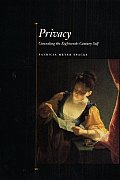
So I began a new book called Privacy: Concealing the Eighteenth-Century Self by Patricia Meyer Spacks — I chose it because I was looking for interesting books about the eighteenth century, but then I began to realize that the topic is perfect for me to think about right now, having begun this blog only a couple months ago, because I’m sorting through what I think about privacy in a very direct way every time I write a post. Since this book looks at privacy through the lense of literature, largely the novel although including other genres, I’m afraid, reader, that you will be subjected to more quotations about Samuel Richardson. But not today.

Oh, sorry — I just found the quotation I wanted to give you and it’s about Clarissa. Okay, you will be endlessly subjected to quotations about Richardson, and I guess you’ll have to deal with it. This is Spacks talking about the contradictions in Clarissa’s attitude towards privacy:

Desiring to slide through life unnoticed, she resolutely separates herself — physically, as much as she can; psychically, almost completely — from others … Yet all eyes are upon her: the eyes of all she encounters, but also, by her prearrangement, the eyes of all who survive her: not only family and friends, but potential readers of the book to be compiled by Belford, for which she also arranges. She wants to slide through life unnoticed; she also wants all eyes upon her. She wants privacy; she wants fame.


This is quite the paradox — she wants to be alone and wall herself off from others but she arranges her own exposure through writing and reading; she wants privacy and fame both. It sounds a bit like blogging, doesn’t it? I write about exactly what I choose to write about, including some personal details and excluding others — a lot of others — and thereby I’m preserving my privacy. Sort of. Having a blog means that I’m violating my own privacy to some extent (if such a thing is possible — if I’m the one doing the violating, is it violation?). I’m both hiding and revealing myself. The thing that amuses me about the picture I put up of myself on the blog a while back is that it’s self-revelation — but not really. It’s Clarissa herself who’s hiding my face. Clarissa writes and writes and writes — the novel is made up of letters, a large number from Clarissa herself — but her character is in a lot of ways still obscure. Writing about oneself can be a way of revealing oneself, but, paradoxically, of shielding oneself too.

I recently came across this post from Tales from the Reading Room, where Litlove describes why she blogs:

If I did believe that identity was in fact composed of a myriad assortment of small narratives, and that our sense of self changed with the ebb and flow of the stories we told, wouldn’t it be intriguing to watch such a dynamic in action?


The wording here is interestingly ambiguous — who is intrigued? Watching the “ebb and flow of the stories we told” is intriguing for the writer and for the reader both, the “we” of Litlove’s phrase. The writer is discovering things as she writes just as the readers is discovering as she reads. I would add that what’s intriguing is not only watching the ebb and flow of a changing and fragmentary identity, but getting the sense of what is not said as well — of the person that lies behind the posts, undescribed and unrevealed. Making writing public somehow enhances the feeling of depths unexplored, kept private.

Leave a comment

Filed under Books, Nonfiction

Book reviews

Thanks to Ella and her post introducing some new book bloggers (including me — thanks again Ella!), I went over to check out Eve’s Alexandria, a cool blog with lots of great book reviews. I saw this post on Zadie Smith, her book On Beauty, and Victoria’s review of it. The story is that the review was negative, people left comments agreeing with the negative response, and Zadie Smith, or someone claiming to be Zadie Smith (impossible to tell), left a comment defending herself — not defending the novel per se, but clarifying that she doesn’t consider herself “the great young genius of the contemporary English novel,” a phrase from one of the comments. Victoria’s follow-up post is a discussion of negative reviews and the responsibilities of a book reviewer.

Victoria argues that a person has a responsibility to respond to reading honestly. She says:

I’ve often heard it said that a citizen’s democratic duty is to question its government and to speak out when said government loses its way (that way, inevitably, being subjective). As I see it this is also a reviewer’s duty: to engage with the written word thoughtfully at a visceral level, to question its values and its purposes, and then to *write* back.


I remember reading at least one blogger arguing something different, although I can’t remember who it was — that in a world where (some would argue) reading is a threatened activity, where getting published is difficult, where writers should be encouraged, the best response when one doesn’t like a book is to keep quiet about it. To ignore a bad or mediocre book, in this view, is to help ensure that it disappears and that better books get attention. The idea here isn’t to be false to one’s opinions, but simply to keep quiet about the negative ones.

Ultimately, I think, I come down on Victoria’s side — that it’s best to say what I think, positive or negative or mixed, and thereby take part in and encourage a debate. I’m no fan of scorching Dale Peck-type reviews that are more about showing off one’s ability to insult than about real engagement with a book, but I think lively debate about books is the best way to keep interest in reading alive. Only the kind of full engagement with reading that includes voicing negative opinions as well as positive ones will keep that debate going. Victoria says it beautifully:

I want to be energised by my reading. If we don’t write back with all our energy how will they, the novelists and the future novelists, know what we’re looking for?


I would, however, freak out if I thought an author had read my negative response to a book. I don’t want to discourage any writer. I want to make everyone happy. Zadie Smith’s comment — if it really was her — sounded pretty hurt. This is difficult. But I think the value of analyzing one’s response, be it positive or negative, outweighs the hope of encouraging reading by focusing on the positive (unless we’re talking about a book by a friend — in that case, preserving the friendship is more important).

One could also argue that negative reviews should have some kind of larger point to them — the negativity should serve the purpose of illuminating what it is that makes good writing or how the writer could improve. This argument is stronger, but I’m still not fully convinced. I guess I don’t like dictating the terms — for myself or for others — under which negativity is acceptable. I don’t think we need to treat books as delicate things that need preserving.

The subject is complicated by the fact that this is a blog and not a formal book review site — I think that the responsibility to be honest about negative opinions is greatest for someone who is paid to write reviews and those reviews get published in places where people look to get honest opinions about books (yes, maybe I’m naive — I know things don’t always work that way, but that’s the idea). Here, it’s not my “job” to give my best assessment of a book — no one’s paying me to do it — people who happen to read the blog have no reason to trust me or to think they are getting my full opinion. I choose what I want to write about and what I want to say about it and I don’t pretend to be complete or completely objective about anything.

But still — if another book blogger wants to keep quiet about books she doesn’t like, that’s fine, but I’d prefer to think through — by writing about it on my blog — why I like and don’t like certain things, recognizing that my view is subjective and others might not agree. I think to expend energy on books in this way ultimately helps out all writers.

Leave a comment

Filed under Books, Writing

On poetry

I’ve had trouble, at times, fitting poetry reading into my life — I’ve always wanted to be the kind of person who reads and appreciates poetry, but the image of myself as a reader and the kind of reader I actually am don’t always match. And it’s not just an image thing — I’ve truly wanted poetry to matter to me.

I think part of my problem with reading poetry has been that I’ve felt I needed to read a bunch all at once — to make my way through a book of poems in a relatively short time. I don’t know why I felt that way. Maybe it has to do with getting impatient if I’m in the middle of a book for too long.

At any rate, I’m trying not to care if it takes me months to read through a book, and to read poems only a couple at a time, for short periods of time here and there. If I try to read a whole bunch of poems at once, I feel like I’m not absorbing them and that there’s no way I will remember them. Even reading only a couple at a time, I may not remember them, but I’m more likely to. If I set out to read only two or three poems at a time, then I’ll spend more time with each one, and really feel like I’m engaging with them.

But that leads me to the other problem I have with reading poetry: I’m uncertain about how long to spend with each one. For me, it’s like looking at art in a museum — I get self-conscious about how long to look at each piece and when to move on. I begin to think about how long I’ve been standing there and how much longer I should stand there, rather than thinking about the art itself. With prose, while I may re-read a passage here and there to understand it better, the expectation is that a person will read through it once. But with poetry, obviously, re-reading is much more important.

I’m in the middle of Jane Hirschfield’s book Given Sugar, Given Salt, and I’ve found that she has many poems that consider the relationship of writing and life — how the page can merge with one’s experiences in the world. Here is one example. I like the image she has of memory as a book where the ink bleeds through the pages and the idea that even our blank pages — or new days — are already written on by our previous experiences:

Waking this Morning Dreamless After Long Sleep

But with this sentence:
Use your failures for paper.”
Meaning, I understood,
the backs of failed poems, but also my life.

Whose far side I begin now to enter —

A book imprinted without seeming reason,
each blank day bearing on its reverse, in random order,
the mad-set type of another.
December 12, 1960. April 4, 1981. 13th of August, 1974 —

Certain words bleed through to the unwritten pages.
To call this memory offers no solace.

“Even in sleep, the heavy millstones turning.”

I do not know where the words come from,
what the millstones,
where the turning may lead.

I, a woman forty-five, beginning to gray at the temples,
putting pages of ruined paper
into a basket, pulling them out again.

Leave a comment

Filed under Books, Poetry

One more post on Ann Tyler

I finished Digging to America last night and have just a couple more things I want to say about it. If you’re planning on reading this book, you might want to skip the post, although I’ll warn you when I’m about to give something big away about the plot.

First of all, for those of you who are planning on reading this book, notice the “binky party” that happens near the end. Please, please, under no circumstances, ever hold a binky party for your child.

I liked this line from another part of the book:

Maryam stood in the kitchen doorway with a salad bowl in her hands and wondered if every decision she had ever made had been geared toward preserving her outsiderness.


As someone who can think of herself as an “outsider” and who likes to stand outside of things, I was touched by this character and by her realization. Maryam’s way of negotiating this dilemma of insider- and outsiderness is central to the book, and it makes sense to me that it takes her a while to understand that she may have been reinforcing her outsider status without fully realizing it.

But I was uncertain what to think about a couple of things Maryam contemplates (and stop reading here if you don’t like to know much about a book before you read it). She says at one point:

Oh, the agonizing back-and-forth of romance! The advances and retreats, the secret wounds, the strategic withdrawals!

Wasn’t the real culture clash the one between the two sexes?


Later, when she is thinking about relationships, she says:

Sometimes lately she felt as if she had emigrated all over again. Once more she had left her past self behind, moved to an alien land, and lost any hope of returning.


Now, I’m not sure I buy this equation of relationships with emigration and with culture clashes. On the one hand, it’s a cool metaphor for what it’s like to enter a relationship with someone — it’s about leaving behind one’s old world and entering a new, about adapting one’s life — one’s culture — to enter into someone else’s, about having an experience with alienness and otherness.

But these lines, and the events that happen right at the end of the book, seem to me to collapse love with immigration/culture clashes in a way that overly simplifies what it means for a person to take on a new culture and nationality. I don’t think the real culture clash is the clash between the sexes. This seems to me to privilege the experience of gender above other kinds. At the very end of the book, Maryam makes a decision to engage with the Americans who have entered her life instead of blocking them out, and it becomes a question of whether she will stay in her relationship with Dave, who seems to her to be the quintessence of Americanness. And so she resolves her questions about culture and national identity by deciding to keep the relationship going. This seems like an interesting way of solving the problem — what could be a more decisive way of changing and adapting than falling in love with an American? — and yet something bothers me about this narrative solution. Can cultural clashes get solved solely through personal relationships?

I’m definitely not being clear here. I guess, to a degree, problems of immigration and cultural differences can work themselves out, for individuals, in the context of family and love, but the novel’s ending seems to imply that this is the best and maybe only available context. This seems to me to be untrue to the rest of the book, which did a good job of showing how politics and family interweave without collapsing the two areas into one another. The personal is political, yes, but are all politics personal?

Leave a comment

Filed under Books, Fiction

More on Ann Tyler

I’m about 50 pages from the end of Tyler’s latest novel Digging to America, and one of the things I am liking about the book is how politics of various types are an important part of the novel, but are in the background in a way that strikes me as realistic — at least realistic for some. Tyler shows how politics shapes people’s lives — both specific historical events and the more nebulous “identity politics,” but she does it in a muted kind of way. Politics and history are sometimes topics of conversation, but more often, political forces lie behind the thoughts and actions of the characters and the reader is left to figure out how the characters are affected by them.

The most direct entrance of politics into the novel concerns events in Iran. One of the main characters, Maryam, the grandmother of one of the two adopted babies at the center of the novel, thinks about how the Iranian community in America was divided by their different opinions of the Shah — she was friends with many other Iranians until the question of whether one is loyal to the Shah or not began to rip the group apart. From this point on, she lives even more isolated from her past.

September 11th happens during the timeframe of the novel, but it doesn’t get a description — it surfaces mainly as a matter of increased airport security and the annoyances this causes. One of the Iranian characters describes the fear other people manifest in the presence of anyone of middle-eastern descent. Dave, another grandparent, gives an emotional speech to Maryam about how he doesn’t like being grouped with other “ugly Americans” — how he’s affected by the stereotype — and Maryam retorts, “Whereas we Iranians, on the other hand … are invariably perceived as our unique and separate selves.” This is Dave experiencing both the discomfort of being a victim of stereotyping, and the realization that, as angry as this makes him, he can’t expect everyone else to feel his outrage.

Everyone in the novel is affected in some way by this kind of racial and ethnic stereotyping. Maryam is invested in the idea of herself as a “foreigner,” and because of this she has trouble opening up to her American friends. She is naturally introverted, but this status as “foreigner” feeds into and exaggerates that characteristic. Bitsy tries hard to teach Jin-Ho, her adopted daughter, Korean customs to help her learn about her birth country, but she finds this is more complicated than she expects, and when Jin-Ho grows up a bit, she resists this training. Sami was born and raised in America and he refuses to speak Farsi, although he can understand it, but at the same time he takes great pleasure in mocking Americans as though he weren’t one himself, to the amusement of the Iranians present. All of Tyler’s main characters are involved in some kind of effort to figure out their identity and to negotiate the various elements that go into it: nationality, gender, class, personal history. It is in describing these negotiations that Tyler excels.

Leave a comment

Filed under Books, Fiction

On Pamela

Before I put away my novel history book, Licensing Entertainment, there is one more thing I want to say about it. In his chapter on Samuel Richardson, William Warner makes some big claims for the importance of his novel Pamela. He describes the fight over Pamela: critics and readers argued heatedly over whether she was as virtuous as she claimed to be. Warner says that Pamela and this critical conflict was partly responsible for our way of reading character:

It is at this point that English readers start engaging in the sort of sympathetic identification with and critical judgment of fictional characters that will lie at the center of novel reading from Richardson, Fielding, and Frances Burney through Jane Austen, George Eliot, and Henry James … The following are some of the interrelated elements of this new practice of reading: Pamela’s readers “read through” the words and ideas of the novel’s eponymous heroine in order to assess her character to discover whether Pamela is what the text’s subtitle declares her to be – a personification of virtue – or its reverse, a mere sham. By conferring on a character in a novel some of the free-standing qualities of a real person, and insisting that judgments of literary character reflect as much light on those who judge as they do on the judged, both sides in the Pamela wars confer an unprecedented moral seriousness upon the evaluation of fictional characters. The strife around Pamela draws readers into particular practices of detailed reading: selecting what to read so as to emphasize one thing instead of another; being provoked by incomplete descriptions; filling out the picture to one’s own taste; using one’s imagination to read between the lines; discerning the supposedly “real” intention of the author; and, finally, distinguishing the “proper” from the “improper” in a text, in order to judge whether a text is “readable” or “unreadable.”


Isn’t it surprising, if you buy Warner’s theory (and I see no reason not to), that our way of reading characters – seeing them as real people and judging them on realistic and moral grounds comes out of the eighteenth century and particularly from Pamela? From a story about a young girl resisting rape? Isn’t the history of the novel fascinating? Don’t you want to go read some eighteenth-century novels now?

I’ve said this before, but I very much like the idea that our ideas about reading that seem so natural – that we want to identify with a character, for example, and that we talk about characters as though we might meet them in person – have a history that isn’t so very long. If you buy Warner’s theory, that is.

It comes down to the question of whether Pamela is really as innocent as she makes herself out to be. For the other side of the story, read Henry Fielding’s Shamela, which is quite funny. I read Pamela twice, for two different graduate school classes, and I can’t say the book follows any of the “rules” of good fiction that we might come up with today – the structure of the thing is terrible – but that’s judging by contemporary standards which didn’t exist at the time. Pamela the character can be infuriating and the book can get boring, especially at the end, but as far as a book that is culturally significant and that can teach you something about eighteenth-century culture, you can’t go wrong with it.

Leave a comment

Filed under Books, Fiction, Nonfiction

Book groups

I’m completely new to book groups, and now I am participating in two of them! One of them is the Slaves of Golconda, an online book group, for which I’ll be reading Muriel Spark soon, and the other is a brand new group — what should I call it — in-person? face-to-face? the regular, old-fashioned kind? the kind where you meet in someone’s house and have coffee and dessert? We’re starting small with my husband and me and one other couple, and if it goes well, we might expand it later. The idea is to keep things low-key and without any showing-off or intellectual posturing. For that reason, we’re being careful about whom to ask — we want it to be fun, and one person with the wrong attitude could throw the discussion off.

So our first book is Anne Tyler’s new novel Digging to America. I’m about 100 pages into it right now, and it’s a good read. Tyler is so very skilled at capturing family dynamics — the “little” interactions that aren’t little at all, but are the things that make up much of the substance of our lives. So far, the narrative has been a series of parties to celebrate the two little Korean babies two families — both American but one white and the other of Iranian descent — have adopted.

Now that I think about it, this structure is remarkably similar to Alan Hollinghurst’s novel The Line of Beauty (which I posted on here), in a funny kind of way, since the novels are in most cases very, very different. But Hollinghurst’s novel, too, was basically a series of parties one after the other, which offers an author a chance to bring a whole bunch of characters together and have them interact in ways that reveal who the characters are and move the plot along. And both novels chart the intersections between politics and family life. Tyler so far hasn’t given nearly as much political detail as Hollinghurst did, but it’s there for both of them — in Hollinghurst’s case, it’s Thatcherite Britain, and for Tyler, it’s the political and religious upheaval in Iran. And both novelists give exquisite detail about tone of voice, significant looks, hurt feelings, “friendly” competition and aggression, unexpected alliances.

And a bit of satire too — Tyler’s novel is funny in places, especially about Bitsy and Brad, the “all-American” couple, Bitsy a hippy type with very strong opinions about how children should be raised and no fear about sharing them. In an early scene Bitsy and Brad have a “raking party” where they invite the other family over to help them rake the lawn. Hmmm. Should I start holding “housecleaning parties”? Yeah, friends, come on over and help scrub the kitchen floor! If you’re lucky, you’ll get to clean the toilet! It’ll be great fun!!

Anyway, more on Tyler later.

Leave a comment

Filed under Books

Colette’s hair

I finished Colette’s My Mother’s House and Sido last night; if you aren’t familiar with it, the short chapters in My Mother’s House were published serially first and then collected in book form in 1922, and Sido was published seven years later. Sido is made up of three sections, one each about Colette’s mother, father, and siblings.

I enjoyed the book very much and recommend it — I do think it should be read slowly. I read it a bit fast and sometimes felt like it was rushing past me and I was missing things. The writing was beautifully lyrical, which is a phrase that would turn me off if I read it in someone else’s review, but in this case the writing worked for me. The short chapters are like prose poems, each capturing a story or a character or a mood. They got me interested in reading a biography of Colette; there are things hinted at in this book that I’d like to know more about — Colette’s conflicted feelings about femininity and sexuality, in particular.

Here is Colette writing about her hair:

I was twelve years old, with the manners and vocabulary of an intelligent, rather uncouth boy, but my gait was not boyish because my figure already showed signs of development, and above all because I wore my hair in two long plaits that swished through the air around me like whips. These I used indiscriminately as ropes from which to hang the picnic basket, as brushes to be dipped in ink or in paint, as whips for a recalcitrant dog or as ribbons to make the cat play. My mother wailed to see me maltreat these two golden brown thongs for whose sake I was daily condemned to get up half an hour earlier than my school-fellows. At seven o’clock on dark winter mornings I would fall asleep again, sitting before the wood fire, while my mother brushed and combed my nodding head. From those mornings I date my invincible hatred of long hair.


As someone who would head out in sub-zero weather with wet hair rather than wake up ten minutes earlier to use the blow-dryer, I sympathize. I love her impulse to think of her hair as a whip before she thinks of it as an object of beauty or a source of attention. She ends the paragraph this way:

Long hairs would be discovered tangled in the lower branches of the trees in the garden, long hairs attached to the cross-beam from which hung the trapeze and the swing. A pullet in the barnyard was supposed to be lame from birth, until we ascertained that a long hair, covered with pimply skin was bound tightly round one of its feet and atrophying it.


Could she be clearer about seeing the conventions of femininity as crippling? However, the next paragraph takes another turn:

There is just one moment, in the evening, when the pins are withdrawn and the shy face shines out for an instant from between the tangled waves; and there is a similar moment in the early morning. And because of those two moments everything that I have just written against long hair counts for nothing at all.


Colette both loves and hates her hair, she feels it holds her captive, but she is also captivated when it’s let loose. It can cover and hide her face, but the moment of her face “shining” through the dangling hair somehow compensates for everything. She is oddly removed from this passage; it’s not “my shy face” but “the shy face” that shines through, as though she can appreciate her own beauty only if she pretends it is someone else’s.

Colette’s chapter called “Maternity” is similarly conflicted. Her sister makes an unfortunate marriage and is estranged from the rest of the family; when they find out she is pregnant, here is Colette’s response:

I had ceased to think about her, nor did I attach any special significance to the fact that just at that time my mother began to have attacks of nervous faintness, nausea and palpitations. I only remember that the sight of my sister, distorted and grown heavy, filled me with still more embarrassment and disgust.


When her sister is giving birth, her mother, kept from her side because of the family feud, goes over to the sister’s house and lingers outside, listening for sounds that would tell her what is happening. Colette writes this remarkable passage:

A second cry, pitched on the same note, almost like the opening of a melody, floated towards us, and a third …. Then I saw my mother grip her own loins with desperate hands, spin round and stamp on the ground as she began to assist and share, by her low groans, by the rocking of her tormented body, by the clasping of her unwanted arms, and by all her maternal anguish and strength, the anguish and strength of the ungrateful daughter who, so near to her and yet so far away, was bringing a child into the world.


Colette is shocked and embarrassed by this physical spectacle, and yet she is fascinated by her mother as well, seeing the horror of her mother’s anguish and her tremendous strength at the same time. She knows, as a woman, she is a part of this process — the writer Colette has given birth to a daughter by this time — and she agonizes and at the same time she can’t keep herself away.

Leave a comment

Filed under Books, Nonfiction

Childhood reading

I am about half way through Colette’s book My Mother’s House and Sido and am enjoying it very much. It’s made up of short vignettes, usually about 4 or 5 pages long, each telling a story or developing a theme about Colette’s childhood, her house, her mother or siblings, her friends. They are beautifully written, at least they are in my translation, meditative and thoughtful and atmospheric.

One of the most interesting chapters so far is the one where she describes her childhood reading. Colette captures the magic that books can acquire when one is young and the way one remembers this magic:

After all these years, I have only to shut my eyes to see once more those walls faced with books. In those days I could find them in the dark. I never took a lamp when I went at night to choose one, it was enough to feel my way, as though on the keyboard of a piano, along the shelves. Lost, stolen or strayed, I could catalogue them today. Almost everyone of them had been there before my birth.


This reminds me of the shelf of “classics” my father had, on a wall of bookshelves in my parents’ bedroom. Here is where I found the great Victorian novelists and the great 19th-century Russian novelists, where I picked up books such as War and Peace that were beyond my reach at the time but struggled through them anyway, and surely learned a lot about reading in the process. I think my first experiences of reading things beyond “children’s” or “young adult” books came from what I found on this shelf.

And it was, appropriately enough, high up on the shelves, above the stacks of science fiction and fantasy my father reads, as though my father were making a statement about their relative worth by placing them there, even though he found, and finds, great enjoyment in reading the fantasy books. He remains devoted to his 19th-century novels as his “serious” reading. There is something almost archetypal about raiding our parents’ bedrooms or private libraries for reading – about venturing into an adult world where we don’t truly belong but are preparing to enter. I know there are a lot of novels that describe how the young characters learn things – both useful and frightening – about the adult world in this way. I’m reminded of Charlotte Lennox’s book The Female Quixote where the main character Arabella reads romances from her dead mother’s library and discovers a very complicated legacy. We need our parents to help us make sense of our reading, and yet, when they don’t, interesting things happen.

Colette writes about this kind of reading too. Her father did not want her to read Zola and locked his books away, and Colette rebels. She asks her mother to give her the “safe” Zola novels but even this isn’t satisfactory:

She gave me La Faute de l’Abbe Mouret, Le Docteur Pascal, and Germinal, but I, wounded at the mistrust that locked away from me a corner of that house where all doors were open, where cats came and went by night and the cellar and larder were mysteriously depleted, was determined to have the others. I got them. Although she may be ashamed of it later, a girl of fourteen has no difficulty, and no credit, in deceiving two trustful parents. I went out into the garden with my first pilfered book. Like several others by Zola it contained a rather insipid story of heredity, in which an amiable and healthy woman gives up her beloved cousin to a sickly friend, and all of it might well have been written by Ohnet, God knows, had the puny wife not known the joy of bringing a child into the world. She produced it suddenly, with a blunt, crude wealth of details, an anatomical analysis, a dwelling on the colour, odour, contortions and cries, wherein I recognized nothing of my quiet country-bred experience. I felt credulous, terrified, threatened in my dawning femininity. The matings of browsing cattle, of tom cats covering their females like jungle beasts, the simple, almost austere precision of the farmers’ wives discussing their virgin heifer or their daughter in labour, I summoned them all to my rescue.


And this brings us to one of the other big themes of the book: her feelings about her femininity. But that’s a post for later.

Leave a comment

Filed under Books, Reading

I’ll play too!

Here’s my contribution to the “what would you save?” game going around the book blog world. The idea is to list the 10 books one would save in a fire, if one could only save 10, inspired by Anna Quindlen. I guess this makes more sense to me if I change it to the desert-island question — because if I’m saving things from a fire, I would go for the things I couldn’t replace, when I can buy new copies of most books. I suppose I could save the ones with lots of my writing in them or the ones that are signed. But when other people do the list, it seems to be books that they’d want to have with them when no others are available. So that’s what I’m doing. For other lists, see Lotus Reads, Liquid Thoughts, and Anna Quindlen’s original list, from A Work in Progress, with commentary by Danielle. Here’s mine:

1. The Bible
2. The Bhagavad-Gita
3. The complete Shakespeare
4. The complete essays of Montaigne
5. Pride and Prejudice by Jane Austen
6. The Life of Samuel Johnson by James Boswell
7. Middlemarch by George Eliot
8. The Brothers Karamazov by Fydor Dostoyevsky
9. Mrs. Dalloway by Virginia Woolf
10. Absalom! Absalom! by William Faulkner

Okay, on a different day, I’d pick a completely different list. This is a very serious list of mostly pre-20th century stuff, except for the last two. But if I’m going with the desert-island scenario, I’d want things I know I could spend a lot of time with.

What’s your list?

Leave a comment

Filed under Books, Lists

Colette is my hero

Here’s why. This is from the introduction to Colette’s book My Mother’s House and Sido, by Judith Thurman:

[Writing] was not, however, the only bridge to liberation. Colette had perceived, precociously, that the beauty of a woman’s muscles is identical with their purpose, which is self-support. By 1902, she had installed a private gymnasium, with a trapeze and parallel bars in the studio upstairs from the luxurious conjugal apartment on the rue de Courcelles that Willy [her husband] had financed with her earnings.


A woman writer athlete! I’d like to know more about women who were writers and intellectuals and also were athletic, especially women from earlier periods when it was more complicated for a woman to be athletic than it is now. One of the things I admire about Mary Wollstonecraft was her insistence that women exercise and gain physical strength at the same time they worked their intellectual muscles. I also admire Dorothy Wordsworth for her amazing feats of walking. Does anyone know of more examples?

Here’s another reason to admire Colette. Again, according to Judith Thurman:

Colette was a pagan whose life and appetites were Olympian in their vitality, as was her oeuvre. She published nearly eighty volumes of fiction, memoir, drama, essays, criticism, and reportage, among them perhaps a dozen masterpieces.

A woman writer athlete who’s also a pagan? I simply must learn more.

Here, perhaps, is a clue to what makes Colette so unconventional. This quotation from Thurman is about Colette’s mother, whom Colette calls Sido:

Sido called marriage, only half-ironically, a “heinous crime,” and would rejoice in Colette’s liaison from 1905-1911 with a cultivated and melancholy lesbian tranvestite, the Marquise de Morny, largely because “Missy’s” generosity and solicitude were so wholesome for Colette’s fiction. Nor was Sido’s “precious jewel,” childless until forty, ever encouraged by her mother to procreate.

Does anyone know if Thurman’s biography of Colette is the best available, or are there other better ones?

Leave a comment

Filed under Books, Nonfiction

Novel anxieties

I’m almost finished with my novel history book, Licensing Entertainment, and I continue to be fascinated by the controversies over the early novel and its place in culture. Here’s a passage that compares plays to novels, showing some of the sources for this anxiety about fiction:

If plays could cause riots, novels could act at a distance. If plays put too much control in the hands of the playwrights, actors, and directors of the theater, novels put too much power in the hands of the reader, and of those who wrote and sold what they read. If plays offer an unseemly spectacle of vice, novels invite readers to produce this spectacle within their own head. While the play’s concentration of spectacle increased its danger, it opened it to state control. The very diffuseness of novelistic spectacle made its effects uncertain, and its control nearly impossible.


This reminds me of passages in Alberto Manguel’s book A History of Reading, where he discusses the subversive potential of reading. And this fear is a part of the novel’s early history — if you were invested in controlling the public, people’s morals or their actions or their politics, I would think novels would scare you. Once something is out in print, it is nearly impossible to gain control over it — both the book itself and the ideas it contains. Now I like plays a lot, but this comparison shows why, I think, I like novels even better.

People were particularly worried about women reading novels, which the increasing popularity of circulating libraries gave them easy access to. Warner points out that this worry came from two sources:

The first of these is that women’s leisure reading, as evidenced by circulating library use, upset those who wanted women doing useful domestic or commercial work. Second, circulating-library use might not just transmit romance delusions — it could also give women access to reading that could put in question traditional cultural authority.


Women’s relationship to publication and reading is fascinating; so many women in the eighteenth-century and later published anonymously or pseudonymously to avoid being accused of stepping into professional areas they “didn’t belong in” — areas that were designated “male.” And the sight of women reading could make people nervous because they had little control over the content of that reading and the thoughts it might produce. They were at best “wasting time,” and at worst, imbibing ideas that would lead them to having affairs or asking for power and independence.

Warner points out that evidence shows women probably weren’t reading novels in higher numbers than men, but the perception existed that they were, which indicates the extent of this fear.

All this is interesting to think about when we consider issues of gender and reading and publication today — I don’t see evidence that anybody worries too much about the amount of reading women do, but I do think women still often aren’t taken seriously as writers or readers. If you are interested, check out this article from the Guardian on why the Orange prize, a prize for women writing in English, is necessary. The article talks about how prize juries tend to see male writers as the “safe” choice for praise and recognition. And, of course, there’s that New York Times list of the best novels of the last 25 years that includes very few women. I think women readers are often considered as consumers of books — there as a potential market to be exploited, but not to be taken seriously as thinkers. And women writers are often not given the credit they deserve — sometimes because they write about domesticity or family or subjects that aren’t recognized as important.

Leave a comment

Filed under Books, Nonfiction

What’s next

Now that I’m finished with Cloud Atlas, I have picked up Colette’s My Mother’s House and Sido to fill the “fiction” slot in my reading — but I’m not really sure what this book is — fiction, memoir, fictionalized memoir? Here’s what the back cover says:

In My Mother’s House and Sido, Colette plays fictional variations on the themes of childhood, family, and, above all, her mother.


So it’s “fictional,” but based on her life. I will have to look into this question of genre more — it’s this sort of book that makes me laugh at things like the James Frey “scandal.” How can people be so naive? People fictionalize their lives all the time!

Anyway, this book has been on my mental to-be-read list for the last ten years, ever since a college professor recommended it to me because of something she saw in my writing that reminded her of Colette. This could mean that reading the book will illuminate something about my writing style — or not, since that happened one third of my life ago.

I tend to be like this with book recommendations. I love getting them (thanks very, very much to all of you who recommend things to me here!), but they usually circulate in my mind for ages before I actually get the book. Either I write them down in my little notebook or (now) on my computer file, or they stick in my brain to stay there until the time is right. I buy books based on what feels right in the moment, and sometimes it takes ten years to reach that point. But if a recommendation is from someone I like, of a book that looks good, I will usually read the thing eventually.

Leave a comment

Filed under Books

Cloud Atlas

I finished Cloud Atlas, and if there any of my readers who haven’t yet gotten to this book, I can recommend it highly. It has an experimental structure: made up of six different stories, they are nestled like Russian dolls, with one story in the middle and the others, broken in two, surrounding it. Mitchell relates this structure to the nature of time:

One model of time: an infinite matryoshka doll of painted moments, each “shell” (the present) encased inside a nest of “shells” (previous presents) I call the actual past but which we perceive as the virtual past. The doll of “now” likewise cases a nest of presents yet to be, which I call the actual future but which we perceive as the virtual future.


The past, present, and future, although seemingly distinct, really form one whole, and the six stories of this book, each very different, form a unity. I had a couple of worries about this book before I began; one, that it would feel like a postmodern trick but not be that interesting as a story, not that emotionally engaging, and two, that it would feel more like a short story collection than a novel, when what I wanted was a novel. But neither of these worries stayed with me: the stories were engaging and they linked together to make the book feel coherent, and it wasn’t simply postmodern trickery, but was emotionally engaging. I do, often, consider these things mutually exclusive, and assume that something postmodernist is going to be a bit dry and sterile. That’s a mistake, I’m guessing, or at least an assumption that, if explored, would get me into considering the definition of “postmodern,” a direction I’m not going to go in right now.

The book was smart – not merely in a dazzling, show-offy way (although there’s inevitably a show-offy element with this kind of structure), but with ideas about what, ultimately, humans are really like – are we just like animals, or is there something more to us? Or less? It’s about predators and prey, war and technology and how we are ruining the earth. It’s that kind of big novel, which makes a statement about where human beings are headed, and the picture isn’t pretty, for the most part.

Some of the stories take place in the past and some in the far-off future, so Mitchell gets a chance to speculate on our trajectory and to think about cycles of human history, where greed and selfishness on a grand scale lead to destruction, and the hope of humanity lies in the hands of a few people. I suppose in this sense the novel is more Romantic than Postmodern – idealistic about the effects individuals can have on history. It’s got the structural experimentation we associate with postmodernism, but it still believes, ultimately, in the power of individual people acting on the world. Not that the book is overly optimistic, by any means. But it explores the effects, however small, of people who try to hang on to some kind of ideal. These characters are often hapless, trying to do one thing and accomplishing another – failing to do the good thing they had wanted to but intentionally succeeding in something much better. This haplessness is often moving.

And the book is smart in another way: Mitchell draws on various modes of storytelling, and creates a series of very different voices, proving his dexterity with language. We get a Victorian-era travelogue, a thriller set in the 70s, and a dystopian vision of the future, among other forms. Each one is well done and convincing.

The stories often become reflections on writing and stories themselves: one of them becomes a movie a later character watches, and another story we find out is a book manuscript submitted to a publisher who is the main character of a later story. The plot of one of the stories revolves around various characters trying desperately to get their hands on a manuscript that would incriminate a nuclear power company trying to build a reactor. The story set farthest off in the future – the “end,” although it is really in the middle of the book – closes with characters hanging on to the remains of an earlier story, not fully understanding it, but listening to it nonetheless. It is narrative that connects these stories, and narrative and memory that offers any hope.

Here is a quotation that partly explains the novel’s title:

Souls cross ages like clouds cross skies, an’ tho’ a cloud’s shape nor hue nor size don’t stay the same, it’s still a cloud an’ so is a soul. Who can say where the cloud’s blowed from or who the soul’ll be ‘morrow? Only Sonmi the east an’ the west an’ the compass an’ the atlas, yay, only the atlas o’ clouds.


I like this description of the soul – changeable, moving, unknowable, with uncertain borders, but something we can recognize nonetheless.

Leave a comment

Filed under Books, Fiction

I joined the army

The George Saunders army, that is. I did this a few weeks ago, on a whim, since I really liked Saunders’s first book of stories, CivilWarLand in Bad Decline, and I occasionally read his stories and humor pieces in The New Yorker. They promised to send those who sign up a package full of cool stuff. I didn’t really believe it, or figured supplies would already be gone.

But no, my stuff arrived yesterday, and it’s really kind of fun. It includes a poster with the above picture on one side and a “Saunders book cathedral step-by-step construction guide” on the other, and an In Persuasion Nation (his latest book) “recruitment tool,” which gives advice on how to sell more Saunders books, by saying things like CivilWarLand in Bad Decline is really about:

An attractive puppy who actually speaks English sentences as he repeatedly saves his master’s life, only no one can hear him but the family bunny, who is dying very bravely while imparting valuable life lessons to the talking puppy, who sometimes gets discouraged because no one understands his words and they just keep picking him up.

Or, it is really about:

The Civil War, but in an upbeat way, with lots of jokes, dancing, and redemptive humor that reinforces traditional American values, such as shooting while running uphill.


Which, by the way, isn’t what the book is about at all. I also got a chapbook with previously uncollected nonfiction pieces, and some iron-ons and temporary tattoos. I have to admit that I haven’t read his last two collections of stories, but I would like to. It just takes me forever to get around to reading stories. Sorry, short story writers.

I met George Saunders once. About ten years ago when I was working in a bookstore, I learned from a fellow employee that his wife went to church with George Saunders and his family, who happened to live locally. A bookish friend visited me shortly after I learned this, and, being big fans of CivilWarLand, we decided to go find the poor author and get him to sign our books — before the Sunday church service. We waited in the parking lot until they showed up. Saunders was quite nice to us, although I wonder what he thought. It’d be cool to have fans tracking you down, but … on the way to church? And if you know something about Saunders’s fiction, you might find it odd that he’s a church-going guy (or was), but I found that all the more interesting. Actually, I think I read in an interview that he is now a Buddhist.

I’ll have to find a place to hang the poster. If you want to get a sense of what this guy is like, check out this interview.

By the way, since I’ve been thinking about various types of blogs (see yesterday’s post), I found this interesting: Daniel Green from The Reading Experience has a post about how lit blogs can help foster a reading culture.

Leave a comment

Filed under Books

Virginia Woolf’s Diary

I haven’t posted on my Virginia Woolf reading for a while, so here are some quotations I’m come across in the last few weeks:

First, a defense of the imagination:

Now I confess that I have half forgotten what I meant to say about the German prisoners; Milton & life … All I can remember now is that the existence of life in another human being is as difficult to realise as a play of Shakespeare when the book is shut. This occurred to me when I saw Adrian talking to the tall German prisoner. By rights they should have been killing each other. The reason why it is easy to kill another person must be that one’s imagination is too sluggish to conceive what his life means to him — the infinite possibilities of a succession of days which are furled in him, & have already been spent.


Perhaps this is naively optimistic about the powers of imagination, but I like the idea that the imagination can, possibly, in certain circumstances, make it harder to harm another person. Imagination is no innoculation against violence, but it seems right to me that refusing to think about what another’s life is like would make it easier to destroy it.

Then, some literary criticism, on Paradise Lost:

The substance of Milton is all made of wonderful, beautiful, & masterly descriptions of angel’s bodies, battles, flights, dwelling places. He deals in horror & immensity & squalor & sublimity, but never in the passions of the human heart. Has any great poem ever let in so little light upon one’s own joys & sorrows? I get no help in judging life; I scarcely feel that Milton lived or knew men & women; except for the peevish personalities about marriage & the woman’s duties … But how smooth, strong & elaborate it all is! What poetry! I can conceive that even Shakespeare after this would seem a little troubled, personal, hot & imperfect. I can conceive that this is the essence, of which almost all other poetry is the dilution. The inexpressible fineness of the style, in which shade after shade is perceptible, would alone keep one gazing into, long after the surface business in progress has been dispatched. Deep down one catches still further combinations, rejections, felicities, & masteries. Moreover, though there is nothing like Lady Macbeth’s terror or Hamlet’s cry, no pity or sympathy or intuition, the figures are majestic; in them is summed up much of what men thought of our place in the universe, of our duty to God, our religion.


Could she ever write a diary entry. I love how she can fully appreciate the great things that Milton does, while keeping a keen sense of what he doesn’t do. I suspect if she had to, she’d choose Shakespeare over Milton, but since she doesn’t have to, she can write brilliantly about Milton’s strengths.

Finally, a passage about the writing life:

It’s the curse of the writer’s life to want praise so much, & be so cast down by blame, or indifference. The only sensible course is to remember that witing is after all what one does best; that any other work would seem to me a waste of life; that on the whole I get infinite pleasure from it; that I make one hundred pounds a year; & that some people like what I write.


Indeed, Virginia Woolf, some people do like what you write.

Leave a comment

Filed under Books, Nonfiction

Fun with Cloud Atlas

From the Timothy Cavendish section:

Why have you given your life to books, TC? Dull, dull dull! The memoirs are bad enough, but all that ruddy fiction! Hero goes on a journey, stranger comes to town, somebody wants something, they get it or they don’t, will is pitted against will. “Admire me, for I am a metaphor.”


From An Orison of Sonmi-451:

Wing-027 warned me, “Sonmi-451, you must create Catechisms of your own.”


It will be my life’s goal.

Leave a comment

Filed under Books

Who would you vote for? Or would you vote at all?

The creation of the list from the New York Times of the best American novel of the last 25 years and all the commentary on it is highly annoying, but I can’t keep myself away. If you haven’t read up on it, the methodology of the NYT was to ask a couple hundred writers and critics for a vote on the best American novel; 125 of them responded. The winner, Beloved, got 15 votes. The runners-up got between 7 and 11 votes. So, this means a very small group of people made up the list and a tiny group is responsible for the “winner.”

What I find annoying about all this is the way it’s an exercise in self-gratification and self-importance – the Times is established as a guardian of culture, it asks for votes from the guardians and creators of culture, and the books it chooses are pretty staid, canonical ones. I didn’t see anything that really surprised me. The Elegant Variation notes that no bloggers were asked to participate and wonders if the list would change if they were. Maybe, but it’s highly, highly unlikely the Times would include bloggers even though it should. That’s way too democratic and open-minded.

A.O. Scott wrote an essay on the choices (an essay which strikes me as arrogant in tone, suitably enough) and said that a lot of the people polled didn’t vote because they disagreed with the whole enterprise. What is “best” after all? And who is qualified to pronounce upon it?

I’m also annoyed because the list is so predominantly male. Yes, Toni Morrison’s Beloved won, and Marilynne Robinson’s Housekeeping is included as a book that got multiple votes, but other than that, it’s a lot of the usual suspects: Updike, Roth, Delillo, McCarthy. A passage from the A.O. Scott essay is revealing, I think:

We all have our personal favorites, but I suspect that something other than individual taste underwrites most of the choices here. The best works of fiction, according to our tally, appear to be those that successfully assume a burden of cultural importance. They attempt not just the exploration of particular imaginary people and places, but also the illumination of epochs, communities, of the nation itself. America is not only their setting, but also their subject.


The best books are culturally important, and they have something to say about America. And I think that cultural importance is coded “male.” Something more woman-centered like, say, Barbara Kingsolver, is about women, while Roth’s fiction is about our culture, and about America. Lists like these reflect the state of literary culture, but they shape it too, so the implicit message is that what really matters are the stories about men.

And A.O. Scott says something else interesting too: that if the question were “Who is the greatest novelist of the last 25 years?” instead of “What is the greatest novel?” the answer would have been Philip Roth. Or, if the Nathan Zuckerman books had been treated as one (like Updike’s Rabbit books are), then he would have won. As it is, Roth’s votes got split amongst several of his books. So Morrison’s win is shaped by the nature of the question asked.

So, if you were asked to name the best novel or the best novelist, who would you choose? Or would you not choose at all?

Leave a comment

Filed under Books, Lists

Some random Friday thoughts

  • It’s pouring rain right now. This is going to wreak havoc on my bicycle riding plans, I’m afraid. I might even, God forbid, have to ride indoors on my trainer (which turns my bike into a stationary bike). I think it’s a crime to ride indoors in May, but I’m training for races here, and the rain ….
  • I’m really liking Cloud Atlas. I’ve been wanting something I can’t put down, and at first I didn’t think this was going to do. I figured out the structure — the interlocking stories — and then I wasn’t that excited about having to begin new stories all the time. This is why I don’t read many collections of short stories — I think it takes a lot of work to orient myself to a new story with new characters, setting, etc. And in that respect, I can be a lazy reader. The first story in Cloud Atlas didn’t grab my attention right away, and I got a bit worried. But when the part about Robert Frobisher began, things turned around. I liked his character quite a bit. And now I’m into the Luisa Rey part, and am feeling like I don’t want to put the book down. So all is good.
  • I’m beginning to get into The Tale of Genji a bit more. I’ve been reading a chapter here and there, and at first each chapter was about a new woman Genji was chasing after. I was having to get to know new characters every chapter. I’m trying to figure out where Murasaki’s perspective as a woman comes in here, if at all. I mean, the narrator has sympathy with the women who suffer because of Genji, but the story is told from his perspective, and the narrator doesn’t condemn what he does, in any way I can pick up on. But lately (I’m 300 pages into a 1,000-page book), there are new plot elements besides Genji pursuing women, and I’m getting drawn in. The story has its own rhythm, and you just have to go with it. There’s something appealing to me about the slow, slow development of a story. I’m guessing this is why I didn’t hate Clarissa. If 1,500 very large pages with tiny print that contain three major plot events sounds like fun to you, Clarissa is your book.
  • After all the discussion about connections between love and reading, I came across this in Cloud Atlas: Frobisher says, “A half-read book is a half-finished love affair.” Indeed.
  • For poetry Friday, I thought I’d leave you with the lyrics to a song I’ve had stuck in my head all week. I don’t listen to much music these days, alas, since I don’t read very well with music in the background, and in the car I’m usually listening to NPR. But a friend sent me a CD recently, which I’ve fallen in love with. Here are the lyrics to “Roll my Blues,” which in the version that’s in my head is sung by Jolie Holland.

    I’ve been knocked out
    Drugged and loaded
    River’s roarin’ on before me
    And I look down at my reflection
    Where its headed, no direction
    River
    Won’t you roll my blues away

    All my life I’ve been alone
    And never have I had a home until you came
    But now love’s gone bad
    Its kind of sad
    But I guess that I’m to blame
    ‘Cause I’m just untamed

    Oh I can see that I have fallen
    From your grace which was my calling
    West wind is blowin’ hard against me
    Flat out road is all that I see
    Highway
    Won’t you roll my blues away

    Oh never have I longed so dearly
    My mind sees you oh so clearly
    Freight train is coming fast and strong
    Steady rollin’ on and on
    Freight train
    Won’t you roll my blues away

    Oh I can see that I have fallen
    From your grace which was my calling
    West wind is blowin’ hard against me
    Flat out road is all that I see
    Highway
    Won’t you roll my blues away

Leave a comment

Filed under Books, Life