Category Archives: Books

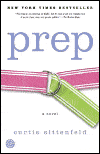
Prep’s painful pleasure

This book captures the experience of adolescence excruciatingly well. It tells the story of Lee Fiora, a student at Ault, a prep school in Massachusetts. She is from Indiana, and isn’t quite sure why she ended up at a boarding school — she had a vague desire for something different, a new experience, and the next thing she knew, she’d won a scholarship and was on her way east. The novel follows her through her four years at the school.

Lee feels like an outsider in many ways: she is on scholarship, which she desperately hopes no one will find out, although she knows very well that there are no secrets at Ault. She didn’t grow up with money and is a bit bewildered by those who did. She is confused by the east coast culture that feels colder and warier than what she is used to. She’s not part of the “cool” crowd; in fact, she has trouble making any friends at all. Most of all, she feels awkward everywhere, unsure of how to talk to people and whether to talk to people and desperately afraid of doing the wrong thing and drawing attention to herself.

Lee is an acute observer, and the story is told in first person from her perspective, so her insights into what she experiences make up one of the chief pleasures of the novel. She strikes me as very smart, but she doesn’t do particularly well in her classes; rather, her intelligence shows itself in her ability to understand the minute details of social interactions and to analyze people’s feelings and motivations. Here is what she says about how she relates to people:

I often messed up with people, it was true, but it rarely happened because I was reading them wrong; it was because I got nervous, or because I could see too clearly that I was not what they wanted. And, in fact, it was in falling short that I truly excelled. I might fail to be what that other person sought, but as a failure, I’d accomodate them completely.


She is a careful researcher of the school; we see her reading through past yearbooks and current school directories to glean all the information she can about the students and the school culture. She doesn’t expect that others might do the same, however. When she meets Conchita, a fellow student she befriends briefly, she is surprised that Conchita has done her research too:

Certainly, I had ideas about other people, but Conchita was the first person I’d encountered who seemed to have ideas about me. Besides, in spite of my zest for gathering information about other students, I would never have revealed what I’d learned to the people whom it concerned; I knew enough to know that if, say, over dinner you said to some guy you’d never spoken to before, Yeah, you have a sister who went to Ault, too, right? Alice? Who graduated in 1983? It would only creep him out.


Lee feels invisible at Ault. She puts together as complete a picture of the school as she can, but she’s not sure of her place in that picture and doesn’t have the confidence to carve out a spot for herself.

And this is the painful part — Lee’s descriptions of high school are so accurate, it frequently made me wince. The social rules are so strict and the penalties for violating them so severe, that Lee feels paralyzed. One of the worst moments is when Lee’s parents visit for Parents’ Weekend. Lee is happy to see them — she is living an 18 hour drive from home after all — but the visit quickly turns ugly as her parents inevitably say and do exactly the wrong thing and Lee, in her agonizing self-consciousness, gets irritable and angry. I felt sympathy for Lee who is trying to navigate her way through a clash of cultures — her parents who knew her as a different type of person than she has become at Ault and the school where she’s so uncertain of her place. But I also felt sympathy for her parents, who mean well, but who just can’t figure out how why Lee is so different and what she wants from them and why they embarrass her so much.

I think this book has some flaws: especially in the beginning some characters appear, you get interested in them, and then they fade away. I suppose this is a potential danger when an author is trying to cover the four years of high school with some thoroughness and accuracy. Also, the story is told by Lee in her late twenties, and while her perspective is usually that of a teenager, Sittenfeld occasionally switches into Lee’s older voice and viewpoint. This switching can feel awkward at times.

But this strikes me as minor. Lee is a wonderful character: her intelligence, wit, and honesty keep her self-pity from getting annoying. And her insights into school culture, social dynamics, and relationships make the experience of reliving one’s adolescence as one reads a pleasure.

2 Comments

Filed under Books, Fiction

How do we read

Litlove has a recent post on “ethical criticism,” a term taken from Wayne Booth, which refers to reading and judging books based on their ethical stances. Litlove writes about the difficulty of figuring out what to do with books that express something ethically troubling — for example Huck Finn, and the way one can label it racist — or not — and Camus’s The Outsider and its story of the casual killing of an Arab man. So, the question becomes, how do we read these books? DO we read them? How should we write about them? How do we handle them when we can’t come to a consensus about them?

I don’t have any great answers to these questions, other than to say that I don’t think anyone should discourage anybody from reading anything because of ethically dubious content. But that doesn’t mean those ethical problems aren’t up for discussion and critique. When it comes to course syllabi, it’s a bit more complicated because a syllabus by its nature excludes, and so it becomes easier to keep replace something troublesome with a text more pleasing to contemporary readers. But I think the classroom is a great place to read books that challenge our sense of ethics — to consider the ways Huck Finn might or might not be racist. These books should be part of a debate, not excluded from it.

This discussion reminds me of a conversation I had with a graduate school professor with whom I took a couple classes in contemporary American poetry. I had a talk with her in her office one time about poetry, and I don’t remember the full context, but I mentioned liking Robert Lowell, and I remember that she gave me a funny look. The look was unintentional, I’m sure, and probably she wasn’t even aware of it, but it seemed to me to express disapproval of my poetic tastes. It said something like, “oh, you poor thing, why do you like that poet? He treated women so badly! He owes a huge debt to Anne Sexton he never acknowledged, and he stole material from his wife to use in his own poems. If you thought about it more, you’d decide you don’t like Lowell after all.” She didn’t say anything, but the look was enough to make me realize she was judging me — probably thinking I was a naive reader, a victim of the patriarchy that made me read texts and authors that belittle women all my life.

Now that might actually be true — I might have been a naive reader, and I certainly had had to read texts that portray women badly all my life — but why should anyone judge me for getting something valuable out of those texts anyway? Why can’t I like Lowell? I think it is important to consider the ways Lowell might have written about women badly — I don’t want to be a naive reader after all, if I can help it — but that, in my opinion, doesn’t mean I can’t read him or appreciate what he does in his poems.

I’ll bet this professor wasn’t really aware of what she was communicating to me, and on some level I was highly sensitive about the issue, or I wouldn’t have read so much into such a short exchange. But I wish she hadn’t been so quick to judge me. There are all kinds of reasons to read people with whom we might disagree, or who might offend us in some way. I might decide that the bad outweighs the good in a particular author and conclude that I don’t want to read that person anymore, but I wouldn’t want to impose that personal decision on anybody else. Wayne Booth’s ethical criticism sounds valuable; I think it’s important to consider the moral world created by a work of art, but I think an ethical criticism that sets out to keep people from reading something or that makes judgments about people’s pleasure in reading something just isn’t worth it.

Leave a comment

Filed under Books, Reading

Saturday randomness

  • I had my first in-person book club meeting yesterday, and my first online one as well, and both turned out to be fun. For the in-person one, we discussed Ann Tyler’s book Digging to America. There were four of us, so it was small and comfortable, and the discussion was good; we had some interesting disagreements, nice ones, to keep things lively. We plan on meeting again in a month or so and reading John Updike’s new novel Terrorist. The discussion for the online book group, the Slaves of Golconda, is ongoing over at Metaxu Cafe.
  • Yesterday, while I was waiting for the pizza I’d ordererd to be ready, I wandered into the one used bookstore in town I hadn’t yet visited. I’m embarrassed at how long it took me to get there — I live in a small town with a surprisingly large number of used bookstores, four, and I guess I was satisfied with the other three. But now I’ve checked it out, and it’s small, with a specialty in history books which I tend not to read that much, but it has some good fiction shelves as well. I came across two Elizabeth Taylor books, In a Summer Season and The Sleeping Beauty. I’d only heard of Taylor recently, on blogs, and she seems like someone I should check out.
  • I joined the Proust reading group. The group blog is Involuntary Memory; if anyone is interested in joining, let Stefanie know — she’s the organizer, and I’m sure she’d love it if you joined. I’ve never read Proust before, beyond perhaps a quotation here and there, so I’m excited. The people I know who’ve read Proust — okay, two of them — enjoyed it but struggled a bit too. One of these people is still slowly working his way through the novel, I think, although he may have abandoned it. So my impression is that I’ve gotten myself into something big. But I love big reading goals, and I like very much the idea of doing this with a group, for the deadlines and for the discussion. It looks like we’ll be reading at the pace of 50-60 pages a week, which is manageable for me.
  • But in order to get ready for Proust, I want to finish the big novel I’m in the middle of right now: The Tale of Genji. It’s almost 1,100 pages, and I’ve got about 400 left. I’m enjoying it, but … you know that feeling when you get 2/3 or 3/4 of the way through something and you start to get anxious because you’re ready to finish it and move on to something else? I’m in that mode right now. So I should dedicate this weekend to finishing it, and by that time my Proust volumes should have arrived in the mail.
  • I’m also itching to finish my nonfiction read, Privacy, and move on. It’s a really interesting cultural and literary history of privacy in the 18C, but again, I’m ready for something else. I’ll be reading a biography of Olaudah Equiano next which I’ll be reviewing for a journal, and then I think I’ll pick up Elaine Scarry’s On Beauty and Being Just.
  • Last but not least — I’m on vacation until July 10th. I’ll be home, and posting regularly, but I’ll be lounging around, reading, and riding my bike and not thinking about work at all. Yippee!

Leave a comment

Filed under Books

The Prime of Miss Jean Brodie

I liked this book well enough to read it twice (as I considered doing in this post), one time right after the other. It was well worth the re-read.

The story is about the “Brodie set,” six girls whom Miss Jean Brodie, a schoolteacher, takes under her wing, nurturing them and teaching them her version of culture – and sometimes the regular school lessons too. Spark sums up each of the girls in a few phrases which she repeats throughout the book. There is Monica Douglas, “famous mostly for mathematics which she could do in her brain, and for her anger which, when it was lively enough, drove her to slap out to right and left.” There is Rose Stanley, “famous for sex,” Eunice Gardiner, “small, neat and famous for her spritely gymnastics and glamourous swimming,” Jenny Gray, who will become an actress and is “the prettiest and most graceful girl of the set,” and Mary Macgregor “whose fame rested on her being a silent lump, a nobody whom everybody could blame.” Most importantly, though, there is Sandy Stranger, whom the book will follow most closely. She is famous for her squinty, disconcerting eyes.

Brodie is an unconventional teacher; she spends much class time telling stories, some of which are about her love life, and while she tells stories she sometimes asks students to hold up their books so that if the headmistress walks into the classroom they will look like they are working. She doesn’t balk at instilling her particular eccentric opinions and biases, and while she claims the sciences have their place, she makes it clear that art is what really matters.

Most importantly, she forms her “set,” the girls she cultivates particular relationships with, and who remain loyal to her even once they have passed through her classroom and moved on to higher grades. Her unconventional teaching and the loyalty of this set upset the other teachers and the headmistress, who spend the book scheming to get rid of Miss Brodie. This forms part of the tension of the novel: will she lose her job? Will the girls remain loyal to her? Who is it who finally betrayed her?

The nature of Brodie’s relationship with the girls is what’s really at the center of the novel, and this relationship changes – at first they admire her and follow her almost unthinkingly, and as the novel progresses, the girls grow up, and begin to question her, Sandy especially. And Brodie herself changes, from an idealistic, independent role model, dedicating the “prime of her life” to the girls, to something much more sinister. Sandy must separate herself from Brodie in order to figure out who she is and to become an adult. Sandy struggles with the feeling that she is too-closely identified with Brodie quite early on; in one scene when Sandy is tempted to be nice to Mary, a girl to whom almost no one is nice, she stops when she realizes Brodie is nearby:

The sound of Miss Brodie’s presence, just when it was on the tip of Sandy’s tongue to be nice to Mary Macgregor, arrested the urge. Sandy looked back at her companions, and understood them as a body with Miss Brodie for the head. She perceived herself, the absent Jenny, the ever-blamed Mary, Rose, Eunice and Monica, all in a frightening little moment, in unified compliance to the destiny of Miss Brodie, as if God had willed them to birth for that purpose.

She was even more frightened then, by her temptation to be nice to Mary Macgregor, since by this action she would separate herself, and be lonely, and blameable in a more dreadful way than Mary who, although officially the faulty one, was at least inside Miss Brodie’s category of heroines in the making.


And, ominously, Brodie admires Mussolini and the fascists. The novel is set in the 1930s, and we as readers understand just what it means to admire Mussolini. And here are Sandy’s thoughts, shortly after the passage quoted above:

It occurred to Sandy, there at the end of the Middle Meadow Walk, that the Brodie set was Miss Brodie’s fascisti, not to the naked eye, marching along, but all knit together for her need and in another way, marching alone. That was all right, but it seemed, too, that Miss Brodie’s disapproval of the Girl Guides had jealousy in it, there was an inconsistency, a fault. Perhaps the Guides were too much a rival fascisti, and Miss Brodie could not bear it. Sandy thought she might see about joining the Brownies. Then the group-fright seized her again, and it was necessary to put the idea aside, because she loved Miss Brodie.


So Sandy’s struggle with Brodie – her love for her, her admiration for her, her suspicion of her, and eventually her feeling of suffocation because of her – becomes a way of thinking about the larger cultural lure of and struggle with fascism.

The girls’ curiosity about sex is a part of the story too; they try to imagine Brodie with her lovers and figure out the mechanics of sex, and then they observe in fascination as she begins an affair with one instructor, Mr. Lowther, and falls in love with another, Mr. Lloyd. They are both thrilled and horrified. But Brodie crosses a line when she starts scheming to turn the now late-adolescent Rose into Mr. Lloyd’s lover, as a proxy for herself. Sandy is fully aware of what is going on, and reacts in her own, completely unexpected way. Near the end of the novel, she tries to come to terms with what is happening:

She thought of Miss Brodie eight years ago sitting under the elm tree telling her first simple love story and wondered to what extent it was Miss Brodie who had developed complications throughout the years, and to what extent it was her own conception of Miss Brodie that had changed.


It is when Sandy realizes that Brodie “thinks she is Providence … she thinks she is the God of Calvin, she sees the beginning and the end” that she is able to separate herself fully. Sandy is a mysterious character; I’m intrigued by her decision to become a nun, and I’m not sure I fully understand it, except that she has a longing for order, inspired in part by Brodie:

All the time they were under her influence she and her actions were outside the context of right and wrong. It was twenty-five years before Sandy had so far recovered from a creeping vision of disorder that she could look back and recognize that Miss Brodie’s defective sense of self-criticism had not been without its beneficent and enlarging effects …


Sandy seems to shuttle back and forth between longing for order and feeling stifled by an order too powerfully imposed on her. It takes her a long time, and perhaps it also takes the experience of being a nun, to learn to value a fruitful disorder. But this is something that as an adolescent she is not prepared to deal with.

The writing style is spare and economical, and Spark uses repetition – of the girls’ defining characteristics, of the phrase “the prime of life,” – which creates a sense of an incantation, as though she can conjure up a sense of her characters, not through the accretion of detail, but by dwelling on the most telling details over and over again. And she moves around in time, skipping back and forth while the story slowly reveals itself. It’s as though she’s circling around the main point, approaching it from many angles, giving us the story in a disjointed way that over time begins to come together.

I found Sandy’s artistic interests intriguing; here Spark dwells on the way the artist seeks out patterns and creates patterns out of life. Sandy realizes after a while that Brodie embellishes her stories and changes them to suit her moods. In this example, the girls are thinking about Brodie’s retelling of the story of her love affair with Hugh, an event that predates the novel:

This was the first time the girls had heard of Hugh’s artistic leanings. Sandy puzzled over this and took counsel with Jenny, and it came to them both that Miss Brodie was making her new story fit the old. Thereafter the two girls listened with double ears, and the rest of the class with single.


Sandy is fascinated by this method of making patterns with facts, and is divided between her admiration for the technique and the pressing need to prove Miss Brodie guilty of misconduct.

This is the same conflict we saw in Sandy’s response to Brodie’s “group-think,” the lure of Brodie’s cult of personality and the fear of chaos she evokes. Sandy is attracted and repelled by Brodie’s disorder, the willingness to play with facts if this makes a better story, the impulse to shape the world to meet the demands of art.

Spark’s own shaping of the raw materials of life is obvious in the novel; she draws attention through the repetition and the shifts in time to the fact that the novel is a constructed, made thing. She is not straightforwardly “realistic.” Her characters have life and interest, but she is more concerned with locating the patterns of their lives and interactions than with accumulating detail about them, in the way most novels do. Spark does brilliant things with her short form; using just a few details, she creates the sense of real, complete human beings, but her economy of detail also allows the underlying lines and patterns to shine through.

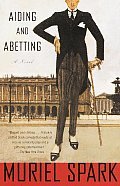
For my thoughts on another Spark novel, Aiding and Abetting, see this post.

1 Comment

Filed under Books, Fiction

Writers and friends

Stefanie has a post on writers who are her friends, in the sense that while she may not have met the authors – in fact the authors may be dead – she feels a kinship with them because of her impassioned reading of their books. And Litlove has a post on books as friends and lovers – the seductions of reading, what she calls “literature as mental kissing.”

And how can a reader not like these analogies? When we read a book we make friends with it, or we make friends with the author, or we are seduced by the author or by the author’s words, even if the books are disreputable and the seduction slightly scandalous.

As I’m sure many readers do, I occasionally think about what would happen if I could actually meet an author in the flesh, even one who is dead, not just encounter his or her books. And I sometimes conclude that those authors who feel like my friends when I’m reading their books probably wouldn’t have a whole lot to do with me if I met them in real life. I don’t say this to be self-deprecating; it’s just the way it is.

In Stefanie’s sense, Virginia Woolf is one of my best friends. She’s brilliant, period, but she’s especially brilliant when it comes to understanding and writing about people. She has that kind of intelligence that can capture just what it feels like to be stuck inside one’s brain. I value all kinds of intelligence, but to me, somehow, emotional intelligence, people intelligence, is the most interesting, most important kind, and Woolf has this in abundance. Mrs. Ramsay at the dinner table is a revelation for me. And her writing voice is exquisite – her essays are so companionable, so everyday in their language, but so filled with beauty and insight I’m astonished. Check out, for example, this quotation, posted on Kate’s Book Blog.

But if we were to meet at a party? She’d probably ignore me.

I suspect the same is true with another one of my reading friends, Mary McCarthy. I admire her sharp satirical wit. She, like Woolf, has a courageous, clear, confessional-but-self-confident voice in her essays that I find irresistible. I love her reputation for being devastatingly, brilliantly mean. Now that I think about it, if I met McCarthy, I might consider myself lucky to be ignored. She’s a great hypothetical companion, a strictly reading friend, but in real life … maybe not.

Probably I feel this way because I idolize these writers so much I just assume they are too wonderful for the likes of me. And time gives authors an aura of untouchability because … well, because they’re dead and untouchable. We generally don’t feel quite the same way about authors who are still alive and can still do stupid things and write bad books. And there’s no reason for me to change my impression of the dead authors because I’ll never meet them to find out otherwise.

And then there’s Jane Austen, who must be my best reading friend ever. She’s a true comfort read for me, someone I’d turn to if I wanted something known and familiar and soothing. I’m not sure if we’d get along if we actually met, but I think my chances are better with her than with the others. She does have the satirical wit I like in McCarthy; you can see it in the way she cuts those mean, miserly, small-spirited minor characters to shreds in her novels. Perhaps this is something I could share with her, however, instead of being overwhelmed by it and a little bit frightened, as I’m afraid I would with McCarthy.

I told a friend of mine one time that I sometimes see glimpses of myself in those minor characters Austen satirizes. I wasn’t saying I’m like them, just that Austen captures their flaws so exactly that it’s possible to see how they might exist in people I know and in me. And this friend reacted all wrong – he looked a little bit worried and muttered something that implied, “wow, that’s a big admission to make.” I thought, no, you’ve got it wrong. I’m not saying I’m a terrible person; I’m just saying I have flaws and I’m capable of recognizing flaws I share with people who are probably even more flawed than I am. Perhaps what I was saying is that I am a sympathetic reader to a rather ridiculous degree.

I also think that Austen is exaggerating the meanness of people a little bit, as part of her satire and in order to have a little fun, and that even though she has fun making up ridiculously mean people, she also is quite capable of seeing how the good and the bad are all mixed up in normal, everyday people – like me. Which is why we have a chance of being friends I think.

But even if Jane Austen and I didn’t hit it off, even if Woolf ignored me like I’m guessing she would, or if I spent my time with McCarthy trying to keep her from noticing me, they probably would care at least a little bit if I liked their books. And this is my power as a reader – I can make friends with them whether they like it or not.

Leave a comment

Filed under Books

Letters

I’ve been thinking about epistolary novels (here and here) — why they are so popular in the 18C and how they work, their narrative possibilities. I came across a passage recently in Patricia Meyer Spacks’s book Privacy on Elizabeth Bennet from Austen’s Pride and Prejudice that made me think about it further. She talks about the central plot point where Elizabeth is reading the letter from Darcy explaining his feelings for her.

What’s great about what Austen does here is that she incorporates the epistolary novel into her own work, so that her novel sort of encompasses it and surpasses it. Most of the novel isn’t in the form of letters at all, but at its center Darcy’s letter turns the course of events around completely. This way, Austen can say something about the value of letters while doing her own new thing with the third person narrator and free indirect discourse. This seems so typical of Austen: to take the materials she sees around her, in this case, the epistolary novels of Richardson and Burney and many others, and shape them into brilliant new forms.

It’s a letter that makes Elizabeth realize and recognize her true feelings for Darcy — it’s the letter that seduces her, in a way. And it allows her to “read” Darcy in a way she couldn’t before. With a letter, Darcy can take the time to compose exactly what he wants to say, and Elizabeth can take the time to read it as thoroughly as she wants to. And she has distance from Darcy himself in which to absorb what he’s telling her and to think about it and analyze her response.

And Elizabeth’s reading of the letter is analogous to what readers of the novel do. Here is what Spacks says:

Elizabeth has much at stake in interpreting Darcy’s letter, more by far than anyone coming to terms with a work of fiction. Yet she stands as a model for novel readers. She tells us of the urgency of “private” reading, and of its dangers … Elizabeth’s total immersion in the text and its problems, her effort both to use feeling and to prevent it from overpowering thought, her capacity for imaginative participation and imaginative expansion (she entertains herself by fancying — prophetically — how Lady Catherine might respond to the news of her marriage to Darcy) — the way Elizabeth reads the crucial letter exemplifies the best possibility for interpretation.


So Elizabeth becomes a model for careful, imaginative, sympathetic reading. And she reads not only Darcy’s letter, but other people as well, or, rather, she learns how to read other people, because the whole plot hinges on her initial misreading of Darcy, and his misreading of her. As Elizabeth goes through the novel learning lessons in interpretation, so does the reader — we, on a first reading at least, might get things wrong, might form the wrong impression of the characters and have to revise them. The novel is teaching readers to be careful as they form opinions, and that they should be willing to revise their interpretations.

By writing a novel in the third person, Austen can portray the act of reading itself in a way she couldn’t in an epistolary novel. She can draw on the formal innovations of earlier novelists by including letters in her work, but she can also describe Elizabeth out on a walk in the park reading her letter, so that readers can observe her as she reads and, with a narrator who enters the characters’ minds, get a glimpse of her thoughts. Elizabeth reads the letter twice, changing her interpretation of it the second time around; readers get the pleasure of following the twists and turns of her mind as she makes sense of a text, sorting out the false first impressions and the true insights. In this way, Austen can emphasize the act of reading and its importance more than an epistolary novel could.

Leave a comment

Filed under Books, Fiction

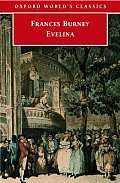
One more thing on Evelina

There’s one more thing I’ve been wanting to say about Evelina. I finished the book quite a while ago, so now I want to say my one last thing and put it back on the shelf.

Evelina the character is boring. She’s passive, she’s perfect, she’s dutiful, she’s self-effacing. She doesn’t seem to have a mind of her own. Her story at the end of the novel is entirely predictable. She tells everything there is to tell to her guardian, Villars, which is the way the story gets told, but one wishes for a sense that’s she’s hiding something or has some original thought now and then. But I didn’t find the novel itself boring. The novel’s interest, for me at least, comes from the “bad” characters, the ones Burney satirizes. These people are interesting and funny. They play bad jokes on each other, like dressing up as robbers and pretending to attack other characters, they tell bad jokes, they show ignorance and other characters laugh at them, they are harsh and mean and thoroughly vulgar, as Evelina would say.

But so much of the novel is taken up with descriptions of these characters, that even though the novel’s tone tells me I shouldn’t like them, I’m obviously supposed to enjoy them in some way, or the novel wouldn’t be worth reading and the author wouldn’t have dwelt on them quite so much. Burney satirizes them, and I truly believe we are supposed to laugh at them and determine not to be like them ourselves, but she seems to like them in some way and definitely depends on them for the very existence of the novel.

One character, Mrs. Selwyn, exists somewhere between these poles of good and bad – she is in most ways perfectly respectable, except for her satirical tongue. She loves nothing better than to get into battles of wit, particularly with men who might be tempted to belittle a woman’s sparring ability. Evelina says of her in a letter to her guardian:

You well know, my dear sir, the delight this lady takes in giving way to her satirical humour.

If we are to take Evelina as our guide in figuring out how to judge character, we are to regret Mrs. Selwyn’s sharp tongue as her one “unladylike” characteristic. And yet, if I were to take the quoted sentence above out of context, it would sound exactly like a description of the Frances Burney who wrote the novel. I don’t mean to say that Burney was known in her social circles for being satirical – I don’t know what her reputation was – but if we imagine an author based on the work she produced, we would certainly consider this author to have a sharp satirical wit. Yet the novel seems to be teaching us that women shouldn’t be satirical. Evelina is presented as the model of femininity to aspire to – her only problem is her inexperience in the world and the rest of her trials come from forces outside herself – but the bulk of the novel undermines the value of Evelina’s bland passivity.

At least it does to this twenty-first century reader. What I’m up against is trying to figure out how much of my response comes from my status as a contemporary reader and how much of it comes from Burney’s own attitudes. And this distinction is always very difficult if not impossible to make. It is easy at times to begin to read eighteenth-century novels subversively – to argue, say, that Burney appears to be praising Evelina for embodying eighteenth-century ideals of docile femininity, while she is really pointing out the pleasure to be had from a satirical mind and tongue. It is Burney’s satirical abilities, after all, that helped her gain success as a novelist.

This makes me wish it were easier to know how readers responded to the books they read, and that I knew more about the evidence that does exist for these responses. Otherwise I’m left guessing how an eighteenth-century reader might have reacted to the novel, and that really is just a guess. On one level the author’s intention doesn’t matter – I am free to take from the novel whatever ideas I want to take – but on another level, it’s interesting to consider what effect Burney might have been after, and what effect she had on her first readers.

Leave a comment

Filed under Books, Fiction

This and that

First of all, for those of you interested in our recent conversation on gender, check out Martha Nussbaum’s review of Harvey Mansfield’s ridiculous book Manliness. Nussbaum’s critique (this is being nice — it’s more like destruction than critique) of Mansfield is awesome. Has anyone read any of Nussbaum’s books? When I think of contemporary philosophy I’d like to read, I think of her. (Thanks to Jenny D. for the link.)

Then, there’s one thing I wanted to say about my current read, Prep, by Curtis Sittenfeld, which, by the way, I’m enjoying quite a lot. I’m about one third of the way through and sometimes finding it difficult to put down. But after all the talk about teaching (see my previous post for links) and instilling a love of books in students, I was curious to come across a passage that took up the issue, not about exciting a love of reading in students exactly, but about getting students to write with passion. The main character, Lee Fiora, a high school sophomore, has a brand new 22-year-old English teacher who has the class read Whitman’s Song of Myself and then assigns the class an essay in which they are supposed to write 800 words on something that matters to them. They are supposed to take a stand on something. Lee has no idea what to write. Her roommate makes some suggestions — why not write about the death penalty? Abortion? Welfare?

My English-teacher self cringes at this because these topics are always what students turn to when they have no idea what to write. They are safe and expected; you can take a stand on them and no one will be surprised at what you say. Lee agonizes and finally writes her paper on prayer in schools (another safe and predictable choice), but adds a note to the teacher: “This is not an issue I truly care about, but I believe it fulfills the assignment.” This pisses the teacher off, who betrays her youth and inexperience by letting her anger show in class and attacking Lee afterward:

“There’s nothing you feel strongly about? Here you are, you’re going to this incredible school, being given every advantage, and you can’t think of anything that matters to you. What do you plan to do with yourself?”


This is what Lee thinks in response, although she doesn’t say this to the teacher:

And not feel strongly about things? I felt strongly about everything — not just my interactions with people, their posture or their inflections, but also the physical world, the smell of the wind, the overhead lights in the math wing, the precise volume of the radio in the bathroom if it was playing while I brushed my teeth. Everything in the world I liked or disliked, wanted more or less of, wanted to end or to continue. The fact that I had no opinion on, for instance, relations between the U.S. and China did not mean I didn’t feel things.


Lee is capable of writing a Whitmanesque essay on the things that matter to her, but she can’t figure out how to carry her preoccupation with the everyday details of life into a class assignment. In fact, the possibility of writing on something she knows about personally doesn’t even occur to her. If the assignment is to write on something she cares about, how can she have fulfilled the assignment, as her note claims, if she doesn’t care about the issue? But what she writes for class is supposed to matter, and what matters, in her own opinion, is not her life or her personal experience.

This is partly a problem with the teacher, who didn’t communicate to the class what she wanted, and partly a problem with being a high school sophomore — if there’s one thing Sittenfeld describes in great detail, it’s the way high school students will work incredibly hard to avoid taking risks and being vulnerable, especially in an essay for English class — but it’s sad that Lee keeps the rich world of her mind so closed off from everyone around her. It would be a true pedagogical triumph to get Lee to write an essay on something she cares about, on people or conversation or the physical world around her. She would write beautifully.

Leave a comment

Filed under Books, Fiction, Nonfiction

He-she said / she-he said

So the Hobgoblin wrote yesterday about a talk we had on gender and reading, a topic I think is very interesting but complicated enough to drive you crazy if you spend a lot of time thinking about it. There are two problems with the topic – one is that it’s really, really hard if not impossible to say meaningful things about gender differences in reading since men and women are so complex and causality is hard to figure out. If there are differences, where do they come from? The other problem is that it’s hard to talk about gender differences without seeming to reinforce them. To talk about “women’s” ways of reading and “men’s” ways of reading is perhaps to make it sound like all women read one way and all men another. And the same is true when you talk about men’s and women’s writing.

I’d prefer not to believe in any differences at all, but if one’s social training and status in society affect one’s reading, which it seems like they must, then one’s gender does affect one’s reading somehow.

But the Hobgoblin was talking about something a little bit different – not how men and women might actually differ in their reading, but about how we might think they differ in their reading: the types of reading that might get labeled “feminine” and “masculine” based on our stereotypes of femininity and masculinity. Here’s where it gets fun, because the Hobgoblin and I tend to disagree on our reading, and it often seems like our differences come from our different takes on emotion – emotion in the book itself and in our response as readers. And he tends to talk in emotional terms and respond to emotion in books in ways that I don’t, and in ways that seem stereotypically “feminine.” I, on the other hand, tend to be a bit more analytical, which seems stereotypically “masculine.” So I guess we’re undermining the stereotypes just by existing, which I think is pretty cool. I hate discussing these stereotypes, even when my point is to undermine them, but it’s true that traditionally women have been associated with the heart and men with the brain, and I don’t think such associations disappear from our thinking all that quickly.

But to call me analytical and him emotional doesn’t capture the true picture at all. Because I’m not heartless and he’s not without analytical power. For him, I think his analysis of books begins with an emotion. And a feeling about a book is a great place to start – it can lead to insights that are deep and rich. Here, Mary Wollstonecraft helps me out: she says “we reason deeply, when we forcibly feel.” For me, emotion is a complicated thing that I tend to be analytical about. I have immediate gut reactions to things, but somehow I need to process those reactions and so I end up thinking about and talking about – getting analytical about – feeling.

We disagree a bit on Nabokov. The Hobgoblin says that “Lolita is quite an impassioned narrative, but there still seems to be some sort of distance that the author places between himself (since all of our examples at this point are men) and the story.” Yes, but … there’s distance between the narrator and the story, but that doesn’t exclude emotion. I find Nabokov’s passion about language exhilarating, and I respond to that with feeling. Actually, this has changed a bit over time – when I first read Nabokov’s novel Pale Fire, I found him cold too. I read it again, however, and had a completely different response. This time I got caught up in the word play and the intelligence and exuberance of it, and loved it.

When the Hobgoblin and I discuss our differences in reading, I find myself in a funny position because, as the supposedly more analytical one, the stereotypically “male” one, I have this fear I might sound like I’m dismissive of his “female” emotionalism. I argue for my own interpretation of Nabokov and in doing so might imply that his is too simple or not thoughtful enough, not analytical enough. I think this fear stems from my awareness that people in our culture tend to privilege the intellectual response over the emotional one – and, to the extent we think they are associated, the “male” response over the “female” one. So I’m in the position of being a woman reading in a way our culture tends to value, one that is associated with masculinity, critiquing a man reading as a “woman,” in an emotional way our culture tends to belittle.

But I don’t think one approach is right and the other wrong, and I don’t think the Hobgoblin’s way of reading is simple and mine is complex. They are just different ways of connecting thought and feeling, mind and heart. I think it’s unfortunate that academics and intellectuals tend to mistrust emotion, and I also think there are many ways of being an emotional person – some of which involve a heavy use of the brain.

Leave a comment

Filed under Books, Reading

On the 18C novel

In yesterday’s comments, Danielle, who, I’m coming to find, is a marvelous asker of questions, asked where to begin with the eighteenth-century novel.

Well. Such a question couldn’t make me happier because it gives me a chance to talk about one of my reading obsessions.

So – I won’t say where to start, but I’ll talk a bit about books I think are important in understanding the period and books that are fun to read. Sometimes these overlap, sometimes they don’t. When it comes to the 18C, it’s hard for me to tell what you would find a fun read. Any of them would be great places to begin.

True to yesterday’s post about categories, I’d recommend Aphra Behn’s novel Oroonoko, which isn’t in the 18C at all (1688) – it has the virtue of being short (which many, many 18C novels most decidedly are not), and fascinating in terms of genre – it’s sort of a novel, sort of a romance, sort of both – and connected with historical events. It has love, violence, travel, sweeping historical forces, all in 100 pages or so.

And there’s Defoe, who shouldn’t be missed. I happen to love Robinson Crusoe, and it’s a great book for understanding class, colonialism, capitalism, Puritanism, individualism, you name it, it’s in there. Well, there’s no sex. But there’s sex in his other books, which are also great places to begin: Moll Flanders and Roxana. Those give you great female protagonists trying to survive with their intelligence and wit.

As for Samuel Richardson, who is most definitely one of the most important novelists of the period, I’d read Pamela. Clarissa is great, but it’s so long it’s daunting. Pamela by no means conforms to any rules of structure and good fictional form we might believe in today, but it is just so great in the way it captures many 18C obsessions: class; sex; marriage; language, letters, and identity; the relationship of writers and readers; women and the body; anxiety over fiction itself.

And if Pamela irritates you, then you simply must read Henry Fielding (read him if you loved Pamela too), who found Pamela so annoying he wrote a parody Shamela, which is hilarious. Then Fielding wrote Joseph Andrews, which is another send-up of Pamela, this time more complicated and developed. The Richardson/Fielding pairing is very useful in understanding 18C writing – they capture two different types of novels, two ways of thinking about writer/reader relationships and what fiction should do, and it’s possible to read Austen’s novels as integrations of that Richardson/Fielding split – Richardson’s psychological interest and Fielding’s satire. Fielding’s best book is Tom Jones, but the Pamela/Shamela/Joseph Andrews story is too interesting to be missed.

I also really enjoyed Charlotte Lennox’s novel The Female Quixote: it’s her version of Cervantes’s story, about a woman who thinks the world is like one of the many French romances she has found in her dead mother’s library. And I loved Samuel Johnson’s short novel/fable Rasselas, about finding happiness. It’s a beautiful book, but sad. It makes no attempt to be realistic, so some people say it’s not a novel, but whatever it is, it tells a wise story.

I absolutely adore Tristram Shandy, which I keep mentioning around here. It’s hard for me to tell how challenging a read it would be for someone not familiar with the period. Some of the jokes might be hard to get. It’s a book about the impossibility of writing the story of one’s life, and it’s a book about sex and impotence, about philosophy and playfulness, about sentiment, but mostly about language – what it can and can’t do. If Tristram Shandy seems a bit daunting, you can try A Sentimental Journey, which has a similar tone and style.

Of course, there’s Evelina, which I’ve posted on before – an excellent place to begin.

And I could go on and on (I won’t) – but I think some of the novels of the late 18C are particularly interesting: Elizabeth Inchbald’s novel A Simple Story, Maria Edgeworth’s Belinda, Ann Radcliffe’s The Italian (for an example of the gothic – and if you think you’d like the gothic, don’t miss Horace Walpole’s Castle of Otranto or Matthew Lewis’s The Monk – these two are among the most bizarre books you’ll ever read).

Does anyone want to add a favorite?

Leave a comment

Filed under Books, Lists

More musings on categories and the novel and your comments

Thanks to everyone who commented on my post about novels and literary periods; you all wrote great stuff, and I’d like to quote you liberally.

One of the things that amuses me about eighteenth-century studies is that academics like to call the period the “long eighteenth century,” which usually means something like 1660-1830, although people will quibble about the dates. So the eighteenth “century” becomes 170 years long. 1660 makes a lot of sense to me as a beginning date, since that year saw the restoration of the monarchy after Cromwell and the Civil War in Britain, and that year the theaters opened again. You can pinpoint some significant changes in literature and culture that happened rapidly, which makes literary categorization easier. But, of course, seventeenth-century scholars will work in the years after 1660, and I’m sure some people don’t like eighteenth-century scholars’ way of taking over those decades before the actual eighteenth century starts.

And the problem with ending the “long eighteenth century” at 1830 or thereabouts is the whole Romantic period – where does that go? I’ve heard the Romantic period defined as beginning in either 1789 (French Revolution) or 1798 (publication of Lyrical Ballads) and ending somewhere in the 1830s. I think what happens is that more traditionally-minded scholars work on writers we think of as Romantic – Wordsworth, Coleridge, etc. – and eighteenth-century scholars work on those who don’t seem to fit the Romantic paradigm – Austen, Burney, Godwin, Wollstonecraft, although these people have characteristics that might mark them as “Romantic” as well. And then there are a lot of scholars who label themselves as Romanticists or eighteenth-century scholars but end up writing on a lot of the same people. In terms of what specialization they affiliate themselves with, it could have gone either way. So people sort it out and make do with a little bit of confusion.

Here’s what litlove has to say about her experience with literary categories:

… at my university (which is considered very old fashioned) we teach literature in centuries. It’s always a messy distinction because inevitably they blur together at the edges, and when we decided to split the C20th into two halves it took us a series of five meetings to agree where the borderline should fall!

To which I say, five meetings? Were there any fistfights?

But that’s all stuff that concerns academics. How scholars think about literary periods makes some interesting stories (i.e. the confusion over the Romantic period has a lot to do with opening up the canon so that scholars write on novelists and playwrights from the period in addition to the poets, who fit the definition of Romantic [if there is such a thing as an agreed-upon definition of “Romantic”] better [because, after all, the definition was made for them]), but I’m also interested in how these categories can help (or not) the general reader who doesn’t need to stake any claim on a time period or take on a label of specialist in such-and-such, and who doesn’t need to divide up the curriculum in centuries or some other time marker.

You all had some great stuff to say about this:

As far as designating literary periods goes, I personally find them useful to a degree. As long as they are used to describe the predominating mode of writing at the time it is beneficial, but as soon as they are turned into something less permeable or used to purposely exclude, then I think it does a disservice to authors and readers. [Stefanie]

I know things are not always easily and neatly categorized, but I sort of like to do so–it is interesting for someone like me not familiar with these periods to see how the novel evolved. [Danielle]

I find the idea of quantifiable differences between 18th and 19th century novels an interesting one. But, thinking about it further, I don’t think distinctions can be made easily. Literary tropes are so amorphous, and literary influence so widespread that I can only begin to speak about it in terms of changed and changing social environments and mores. [Victoria]

But each and every book exists as the still centre of a small tornado of influences and intentions, and I guess it’s good practice to remain to true to those rather than the overarching themes of the century. [litlove]


And I agree with it all. Litlove’s metaphor of the tornado is particularly pleasing and apt, and Victoria’s word “quantifiable,” used to think about differences in time periods, raises interesting questions about the type and degree of difference. I’d love to know about quantifiable differences. Danielle points out the usefulness of categories, while Stefanie rightly argues that categories should be permeable. The categories are useful, and they are deceptive. Establishing categories and understanding the ones that scholars and readers have worked with in the past seems most useful for someone just starting to study literature as a student or someone who is a general reader (not aiming to make a living out of it in some way) and who wants to understand what he or she is reading a bit better. Understanding the eighteenth-century helps tremendously when trying to understand Jane Austen, for example. And I think knowing something about modernism can help a reader understand Virginia Woolf. I take great pleasure in this kind of thing because I like order, and I like lists (for example, when the teacher says, “these are the main characteristics of Romanticism. First …”), and I like being able to explain things to people and categories help with this tremendously.

But I also get a kick out of breaking down the traditional categories. They are arbitrary. Why end a literary period just because a century ends? In this respect, having a “long eighteenth century” that overlaps with and completely subsumes Romanticism, although Romanticism continues to exist alongside it, makes a lot of sense. If the literature isn’t neatly divided itself, then why should the categories be? Why can’t we have eighteenth-century scholars who specialize in Jane Austen and Romanticists who specialize in Jane Austen? (Well, okay, the problem is they go to different academic conferences.) And I’m only talking about dates here. There’s also the question of nations. I’ve been writing about the eighteenth century, specifically the eighteenth century in Britain. But what about the period in America? In France? Studying literature from only one country can lead to a pretty narrow and inaccurate view. To understand the Enlightenment period in Britain, it helps a lot to know what is happening in France. To get early American literature, you have to know something about writing in England.

For the general reader, while the categories are useful, I think it’s best to learn about categories while keeping in mind that they are flawed – to learn about them but not to believe in them fully or trust them. So if you want to study postmodernism, please do, and have fun, but remember that Tristram Shandy is one of the best examples of postmodernism there is.

And I haven’t even gotten to the question of the differences between 18C and 19C novels. That’ll be for another day.

Leave a comment

Filed under Books, Reading

Musings on your comments

You all had some excellent questions and comments on my Evelina post, and I’ve been thinking about them a lot over the last couple days. One of the things I find most interesting about eighteenth-century literature, particularly the novel, and particularly novels written by women, is the way they explore what critics like to call the “literary marketplace” – the relationship of writers, booksellers, publishers, and readers. This stuff gets explored in novels that don’t appear to be about the literary marketplace at all, and Evelina is one example. Selling books to strangers and working with publishers and booksellers to do so is new in the eighteenth century; writers are no longer writing for patrons and getting support from them, but are figuring out ways to make money off writing by dealing with the public. And this is cause for a lot of anxiety. It’s particularly tough for women, because publishing involves entering the public sphere, engaging in public discourse, which wasn’t quite “ladylike.”

Victoria, in her comment on my Evelina post, brings up the issue of public/private worlds, and how the epistolary form bridges the gap between the those worlds in interesting ways – letters being private, but publishing them a very public act. Women, although they did sometimes have a place in public spheres, were most often relegated to the domestic and private world, and entering the public sphere was fraught with anxiety. This problem becomes part of the plot of Evelina when Evelina’s letters are in danger of getting lost and getting into the hands of the wrong reader. Her letters, coming straight out of the most private of private places – her closet (meaning a small room like a study or sitting room) or her bedroom – get sent out of the house and into the public world, and from there they can be intercepted or lost. This happens to Evelina, with some consequences that keep the plot going for quite a few pages. And this isn’t so different from what Burney herself might experience: her collection of letters, the novel itself, will, upon publication, get sent out into the world where she has no control over what will happen to them. They will be bought by strangers, reviewed by strangers, or, perhaps worse, ignored by strangers, interpreted by strangers, and there is absolutely nothing she can do about it, except write a dedication to book reviewers, which, of course, they can ignore or misinterpret.

Stefanie asked why the epistolary form is so popular among eighteenth-century writers, and I think part of it is because of the enormous influence Richardson had on writers – he was so successful with the form that others followed – and part of it is technical – letters provide a kind of immediacy in a first-person voice that could create narrative tension. Other first person narratives from the eighteenth century, such as Defoe’s, were written at the end of the narrator’s life, from the perspective of having been through everything all ready, so compared to that kind of summing-up, letters are immediate and in the moment.

Another part of the reason letters were so popular though, I’m thinking, is because of the way they let writers explore problems of how identity is formed in the tension between the public and private. Evelina is essentially a nobody – with no name, no family, no history – and by writing her letters she is writing herself into existence. The same is true for Richardson’s novel Pamela: Pamela’s letters and journals let her write her way into a much better social position than she could have originally expected. And Burney herself uses letters to write her own way into the position of famous and successful novelist. She does so only tentatively, however; she published the novel anonymously, and so was establishing her identity as a novelist by sending her work out to the public but at the same time keeping her name private. This provides her with some degree of protection, a space in which to do something dangerous and brave.

Others of you asked about differences between eighteenth- and nineteenth-century novels, and I’m probably going to think about that question some more because it’s really interesting to me – both the question itself and the larger questions that arise from it about the value of designating literary periods and categories. I mean, is such a question useful, or is another formulation of it more helpful? Thoughts anyone?

Leave a comment

Filed under Books

Jane Hirschfield

Here’s a poem for book lovers, from Given Sugar, Given Salt:

Each Day I Choose From Among the Steepening Reminders

Each day I choose
From among the steepening reminders
Of all I have failed to finish, failed to begin.
I open a right-hand cover and read the last page.

Phrases severe and perfect rise before me,
Wrung from every extremity of joy and sleek-limbed loss.
Borges, Sinyavsky, Hadewijch, Sappho, Li Po.

More arrive each week, ink sharp as new hunger.

And these are only the books:
The thing already ambered, capable of waiting, turned to words.

I love the way Hirschfield slowly builds up to her point here. At first we don’t know what the “steepening reminders” are; they could be the accumulated reminders of anything she has wanted to do but has left undone. And then in the fourth line we learn she’s talking, in part, about books, all the things she wants to read. We imagine a stack of unread books the speaker looks through longingly, aware of their possibilities. The severe and perfect “phrases” of the fifth line rise up before her also like that stack of books, and the list of names adds to the feeling of weight and potential. But the end of the poem moves back out to a larger view; books, after all, will remain, are fixed and frozen, are waiting there for her when she is ready. What is not, is life itself, the elusive “thing” of the last line, before it is captured and turned into words.

As in many of Hirschfield’s poems, I see evidence here of her Buddhism; she has a keen sense of the importance of the present moment, of all there is to be experienced and absorbed, if one would only pay attention. This poem seems to me to be about the weight of things left undone, the failure to begin and finish things, but also about the conscious choices the speaker makes to do what she does. Each day it is a choice, and the opening line emphasizes her determination to make that choice deliberately. She may fail to do many things, but what she does, she will do because she wants to, because she has chosen it. The poem seems balanced between a sense of responsibility and possibility; those reminders nag at her, like those books she knows she would love but hasn’t found time for yet, but she also takes pleasure in the new choice there is to be made every day.

Leave a comment

Filed under Books, Poetry

On Evelina

Thursday, June 15, 2006

On Evelina

I am a little more than half way through Evelina at the moment. I have read this book before, for a graduate class; this time it’s purely for fun. And I am enjoying it – it’s a good story, entertainingly told, and it is interesting for what it says about eighteenth-century culture, something I’m always happy to read about.

The book isn’t pure enjoyment though. There are painful parts, particularly when it comes to all the descriptions of how Evelina gets pushed and pulled around by everybody, sometimes made to do things she doesn’t want to do or be with people she doesn’t want to see, and sometimes physically pushed and pulled. Those parts can get hard to take because I want to yell at Evelina and say don’t let them do this to you! Stand up for yourself and just say no!

But the point is that she has very little control over her body and over her future. These two quotations pretty much sum up the situation in the novel, both of them taken from letters to Evelina:

The supposed obscurity of your birth and situation, makes you liable to a thousand disagreeable adventures.

And

Remember, my dear Evelina, nothing is so delicate as the reputation of a woman: it is, at once, the most beautiful and the most brittle of all human things.

So, put these two things together, and that’s the plot. Evelina’s “obscurity” comes from the fact that her father refuses to recognize his marriage to her mother, who is dead. Evelina was raised by the Reverend Villars, tutor to Evelina’s grandfather and author of the above quotations. Without recognition from her father, she is illegitimate and hence has no name. Without a place in a family – in the patriarchal order – she is without protection from that order and subject to abuse. She is forever objecting to the designs other people have on her, but she cannot stop them. She cannot control her body or even her name, the made-up last name of Anville:

“So I says to the porter, says I, tell his Lordship, says I, one wants to speak to him as comes from one Miss Anville, says I.”

“Good God, cried I, “and by what authority did you take such a liberty?”

People can take “liberties” with her without any authority whatsoever; with a father or husband to protect her, she is at everyone’s mercy.

The story gets started when 17-year-old Evelina leaves her home at Berry Hill to visit a friend, and from there they move on to London. Away from home she is without even the protection of Villars, and in London, she is exposed to public spaces where predatory men await. What we get is a fairly traditional kind of plot, one where the young innocent heads off into the dangerous city, and we get to see the city through the eyes of someone experiencing it for the first time. This offers Burney many possibilities for social satire, of which she takes full advantage. Much of the middle of the novel is consists of visits to the theater, the opera, dances, and other kinds of entertainments, where Burney describes interactions among people of what we would call varying social classes, although “class” wasn’t a term used at the time. We get a description of shopping, which seems to be a new activity, at least to Evelina:

We have been a shopping, as Mrs. Mirvan calls it, all this morning, to buy silks, caps, gauzes, and so forth.

The shops are really very entertaining, especially the mercers; there seem to be six or seven men belonging to each shop, and every one took care, by bowing and smirking, to be noticed; we were conducted from one to another, and carried from room to room with so much ceremony, that at first I was almost afraid to follow.

Evelina is forced to spend time with people she finds “vulgar” and “ill-bred”; they are of a lower social standing, although without her own black mark of illegitimacy. She is continually shocked at their lapses in good taste. Burney writes about the situation of women sympathetically, but this clearly does not include women of the lower social orders.

Burney seems to take special pleasure in portraying cultural conflict; some of the “ill-bred” characters fight over and over again about the relative merits of the French and the English, drawing on the traditional national stereotypes. This, as you can imagine, tries Evelina’s delicate sensibilities to no end. Burney also has some fun with physical comedy; in one scene two of the men stage a fake hold-up of a carriage carrying Evelina’s grandmother, Madame Duval, a woman who has annoyed the men by engaging in some of the book’s harshest verbal sparring. She gets dumped in a ditch, her fake curls stolen, her feet tied together, and her dress covered in mud. The men think this is hysterically funny.

The novel is epistolary in form. Most of the letters are written by Evelina to Villars, with a few written back to her. As in Richardson, this technique is rather difficult to believe: Evelina seems able to remember vast amounts of dialogue and seems to have no end of time in which to write everything down. But what I like about the technique is the way we get the story coming from one perspective and shaped specifically for the eyes of another. Motivations then become interesting: why is Evelina telling the story in this particular way?

The strongest impression I get from the book, though, is of Evelina’s vulnerability. While I wish she would assert herself as I would expect a contemporary woman to do, circumstances and social expectations dictate that she cannot. It’s painful to see her tossed about, and her frustration and anger are palpable. The book is a powerful testament to what it means to be enmeshed in a patriarchal culture – and what it’s like to live on its edges.

2 Comments

Filed under Books, Fiction

A question from the comments

Tuesday, June 13, 2006

A question from the comments

Danielle has asked an excellent question:

how you can tell if a novel is experimental or post modern?


It’s so excellent a question I hesitate to answer it all on my own. Here is my lame attempt from the comments:

I think the term “experimental” can apply to a writer from any time period — Tristram Shandy from the 18C is a good example. The term postmodern refers to works roughly from the end of WWII to the present, but it only refers to certain types of works. I don’t know that I have good definitions, but I would call something experimental if it’s setting out to change the “rules,” like Woolf does, like Gertrude Stein, Nabokov, Barnes. These people are messing around with the “realist” novel. But it’s not easy to define, because many, many writers try to do new things. It’s a matter of degree, I suppose. As for postmodern, that refers to writers who play around with language and form, who draw attention to the text as a text rather than trying to create a “realistic” portrait of the world, who question the idea of a coherent self and identity (and therefore may not have characters of the traditional sort), who question the idea of any absolute truth. You could call Nabokov, Thomas Pynchon, Don Delillo, John Barth, and David Foster Wallace postmodernist writers. This is the sort of thing critics will argue over for hours. If you come across something that doesn’t have a traditionally realist narrative and characters, it’s probably experimental in some way, and if it’s written between 1945 and the present, you could probably call it postmodern.


Does anyone have a less lame answer? I mean, even to call Tristram Shandy experimental seems to be a bit of a problem, since it was published in a time when the “rules” for novels, such as they are, are only being formed. So can one experiment with something that isn’t fully defined and formed yet? (I know, I know, the novel is never fully defined and formed, because it’s constantly changing, but I think you know what I mean.) And, to make things more complex, people sometimes will call Tristram Shandy postmodern. Now that clearly doesn’t make sense since the term postmodern only makes sense if it refers to something, well, “post” the “modern” period. But Tristram Shandy sure does seem remarkably postmodern for all that. If anyone wants to add more characteristics of the postmodern novel, or if anyone wants to quibble with what I’ve got, by all means do.

By the way, the movie “adaption” of Tristram Shandy was an awful lot of fun. I highly recommend it. You could even call it experimental. Maybe.

Leave a comment

Filed under Books

Has blogging about books changed how you read?

I’m curious what you book bloggers out there have experienced. Sandra from Book World got me interested in this question when she wrote:

I realise that the tyranny of blogging and of feeling that I have to deliver something ‘new’ has meant that in the 18 months of this blog’s existence, only one of the books I’ve read has been a re-read. That’s not at all typical of my pre-blog reading profile ….


Has anyone else felt that blogging can be tyrannical? Having begun blogging in mid-March of this year, I haven’t been doing it long enough to know, really. My reading habits have changed, but I can’t tell yet if those changes will be permanent or if I’m going through a temporary stage, doing some experimenting I’ll give up eventually. And right now I’m having so much fun blogging that it’s hard to imagine the negatives that come with it, but I’m sure they are there to be discovered.

Blogging has made me a more careful reader, at least to the extent that I take the time to post on quotations I’ve found meaningful and to develop my responses to books enough to write them down coherently. This is probably one of the best things about book blogging. (I’m imagining getting comments and taking part in conversations would be another for a lot of people). Now I have a record of quotations and my thoughts about books. Perhaps I’ll remember better what I read, or at least I’ll be better able to remember the things I’ve pulled out of my reading to write about. Writing about what I think makes me have better thoughts.

By reading blogs, I’m also hearing about more books than I did before. Well, maybe I’m paying attention to what I hear a bit more. There are tons of places to get information about books, and I’ve always heard and read a lot about the books out there, but I’m coming to think that book blog sites are among the best sources of information because I can come to know and trust the writer’s opinions. There’s context there, a much more complex one than in a regular book review. Yes, I pretty much know what to expect from, say, the New York Review of Books, and that provides a context in which I can judge how to respond to a review, and there are some reviewers who publish so frequently I get to know their opinions and tastes, but in a book blog, I get a much stronger sense of the writer and so can trust the recommendations that much more confidently.

I mark up my books more than I used to, and I catch myself thinking of blog posts as I read, looking around for good quotations and trying to decide if a particular idea or scene is worth turning into a post.

My to-be-read list is growing rapidly. I’ve had such a list for a while, but it tended to be fairly short; I’d only put books on there that I was highly likely to read at some point in the near future. But now it’s growing, partly because I’ve made a conscious decision to make it more comprehensive, and partly because I’m coming across so many more things I’d really, really like to read.

Shortly after beginning the blog, I started reading more than one or two things at once after I read about other people’s multiple-book-reading habits. It sounded like such a good way to read in different genres and to read difficult things I might not want to spend hours with in one stretch. This makes it easier for me to read poetry and difficult nonfiction.

I wonder, as I go on, if the fact that I’m blogging about reading will affect my choice of books. I can see why blogging might lead to less re-reading, as Sandra points out, since I wouldn’t want to bore you with another review of the same book I read a year ago. On the other hand, though, if every reading of the same book is different – if I read Evelina differently now than I did in a graduate school class years back – then blogging about a re-reading might be interesting, for comparison’s sake. Sometimes I’m tempted to re-read pre-blog books I really love, just so I can have the fun of blogging about them.

I can imagine wanting to read the things that other book bloggers are reading in order to be a part of the conversation, but also NOT wanting to read what other book bloggers are reading, so that I’m not talking about the same thing everyone else is. The best thing to do, of course, is to try not to let these factors influence me and just pick books that sound appealing for other reasons, but I can see that I might be affected by what other bloggers are doing anyway.

I also wonder if and when the regular blogging gets tiresome. I haven’t felt anything but pleasure in it so far, but I would expect blogging over a long period could sometimes feel like a chore, like tyranny.

I am sometimes torn between the pleasure of reading books and the pleasure of reading book blogs. This may be one of the more difficult things of being a book blogger: that there are so many good book blogs to read and all those hundreds and thousands of blogs can be a distraction from what is the main point, really – reading books. I’m not sure if I read faster or slower, more or less than before I began blogging. Sometimes I want to read faster so I can be sure I have something to post about. Other times I have so many things to post about I want to read slower, so I won’t get even more ideas, and I don’t want to post too often and overwhelm readers – and myself. Does anyone worry that they won’t have anything to write about?

So, if you have a tale to tell about how blogging has changed your reading, I’m curious to hear it.

Leave a comment

Filed under Blogging, Books

Lists

I have some lists for today; the first one is of the books you all recommended when I asked for books that … I’m not sure what, exactly, except I asked for the kind of books I would like. Let’s call them books about books or about people who love books and books that are very often experimental and self-reflexively about reading and writing and that have a lot of passion too, or are just plain quirky and fun or quirky and serious, or simply books that are likely to make me happy.

On my original list was:

Julian Barnes, Flaubert’s Parrot
Vladimir Nabokov, Pale Fire
Mary McCarthy, Memories of a Catholic Girlhood
Dave Eggers, A Heartbreaking Work of Staggering Genius
Nicholsen Baker, U and I

And I left off one of my favorite books ever, which I can’t believe I forgot:

Laurence Sterne, Tristram Shandy

So here were your recommendations:

A.S. Byatt, Possession and The Biographer’s Tale
Jaspar Fforde, the Thursday Next books
Thomas Wharton, The Logogryph
Muriel Spark, The Comforters
Jorge Luis Borges, Labyrinths
Anne Fadiman, Ex Libris
Primo Levi, The Periodic Table
Italo Calvino, If on a winter’s night a traveler
Christopher Moore, Lamb: The Gospel According to Biff
Kate Christensen. The Epicure’s Lament
Ursula Hegi, Intrusions
Peter Rushforth, Pinkerton’s Sister
David Lodge, Small World and Changing Places

Not a bad list, is it? If you have more suggestions, please let me know; I’d love to add to the list.

And then, one more list. I recently got some money as a gift and, no surprise, spent it on books. Here’s what I got. That the list below and the list above don’t overlap at all doesn’t mean I wasn’t happy with your recommendations; it often takes me ten years or so to get around things on my to-be-read list, but they are there, ready for the right time.

Curtis Sittenfeld, Prep — enough people recommended this one, including a favorite professor of mine, and I’m sure I’ll enjoy it.

Jose Saramago, Blindness — everyone seems to love him, so it’s definitely time I give him a try.

Orhan Pamuk, Snow — same as above

Elaine Scarry, On Beauty and Being Just — I’ve read an essay or two of hers and loved them, and this book looks very interesting. I’d also like to look at her book The Body in Pain.

Brian Greene, The Fabric of the Cosmos — time for some more science.

Frances Burney, Journals and Letters — time to find out more about Burney’s life. This one is in the mail right now.

I’ll be busy, won’t I?

Leave a comment

Filed under Books, Lists

Dedications

After my recent post about book reviews and reviewers, I was interested to read Frances Burney’s thoughts about reviewing in the dedication to her 1778 novel Evelina. For background, Burney published the novel anonymously and was very nervous about getting found out and worried about what kind of reviews she would get. As she wrote the novel, she kept it a secret from her father and worried about what his response would be when he discovered it. In fact, she, with the help of her brother, found a publisher for it before it was finished and only then, very nervously, did she tell her father. She was battling against her own nerves, the uncertain status of women writers at the time (hence the anonymous publication, quite common for women), and her fear of her father.

She dedicates the book “to the authors of the Monthly and Critical Reviews,” taking the reviewers on directly, and starts off:

Gentlemen, The liberty which I take in addressing to You the trifling production of a few idle hours, will, doubtless, move your wonder, and, probably, your contempt.


Now, I don’t think we can take this at face value — it was tradition to write dedications that were more about the author’s rhetorical positioning than about saying anything sincere, and modesty was a familiar — and often feigned — trope. But as Burney moves through the dedication, her attitude towards reviewing gets interesting. She claims the reviewers as her “patrons,” since she has no aristocratic patron of the traditional type, the one to whom the dedication is usually made:

to whom can I so properly apply for patronage, as to those who publicly profess themselves Inspectors of all literary performances?


She calls on their “protection,” but then says:

The language of adulation, and the incense of flattery, though the natural inheritance, and constant resource, from time immemorial, of the Dedicator, to me offer nothing but the wistful regret that I dare not invoke their aid. Sinister views would be imputed to all I could say; since, thus situated, to extol your judgment, would seem the effect of art, and to celebrate your impartiality, be attributed to suspecting it.


So what is a dedicator supposed to do, right? Flattery is traditionally a part of the dedication, but if she flatters the reviewers, she’ll be seen as angling for a good review rather than saying anything truthful. But, of course, in saying all this, she IS angling for a good review — she’s flattering them while saying she’s not. She goes on:

As magistrates of the press, and Censors for the Public, — to which you are bound by the sacred ties of integrity to exert the most spirited impartiality, and to which your suffrages should carry the marks of pure, dauntless, irrefragable truth, — to appeal for your MERCY, were to solicit your dishonour; and therefore, — though ’tis sweeter than frankincense, — more grateful to the senses than all the odorous perfumes of Arabia, — and though “it droppeth like the gentle rain from heaven upon the place beneath,” I court it not! to your Justice alone I am entitled, and by that I must abide. Your engagements are not to the supplicating author, but to the candid public, which will not fail to crave “The penalty and forfeit of your bond.”

She is saying, in effect, even though I really, really want you to have mercy on me and write me a good review — it would be a heavenly gift –and notice how I’m flattering you as I say this, oh wonderfully impartial magistrates of public opinion, I won’t ask for one. And notice how eloquently I’m not asking you for a good review, since really, although I won’t say this directly to you, I’m communicating a bit of contempt for reviewers through my over-the-top language in the midst of my compliment-laden sentences. For after all, if it weren’t for writers like me, you wouldn’t have anything to write about, although, as a first-time author, I depend on you too:

Let not the anxious solicitude with which I recommend myself to your notice, expose me to your derision. Remember, Gentlemen, you were all young writers once, and the most experienced veteran of your corps, may, by recollecting his first publication, renovate his first terrors, and learn to allow for mine.

If you have an ounce of heart in you, you’ll remember what it’s like to be me, you’ll think about the person whose work you’re critiquing and you’ll write with a picture of the anxious young author who loves her book in the back of your mind. After all this, how can you be anything but kind?

Leave a comment

Filed under Books, Fiction

Muriel Spark’s Aiding and Abetting

I finished Muriel Spark’s novel Aiding and Abetting recently. I’m reading it for the Slaves of Golconda; they are discussing The Prime of Miss Jean Brodie at the end of June and each of the members is reading one other Spark book, so this was mine. I figured I could post about it now and add my thoughts on the book during the larger discussion, if they are relevant.

This is a very short book – almost short enough to be a novella – at 165 pages with large print and margins. But so much happens in it, and Spark manages to give you lots of characters and action without creating the feeling that things are rushed and undeveloped.

How can you not like a main character with the name Hildegard Wolf? She is a wonderful character: smart, powerful, mysterious. And also deceitful. She is a psychiatrist with some unusual methods: she spends the first few sessions telling stories to the patient instead of the other way around. The patients love this, for the most part, and she is very successful. She has always had healing powers. In an earlier episode in her life she was a fake “holy stigmatic”; every month she would take menstrual blood and smear it on at least one of the places Jesus was wounded, hands, feet, or side, and people flocked to her for healing. People sent her money in return for her “miracles,” and this is how she survives until she is exposed as a fraud and has to flee. This, of course, makes one wonder about the legitimacy of her status as psychiatrist. She insists that she really did heal some people as a stigmatic, and she really does seem to help her patients, so the book becomes a meditation on the power of belief. Is she so bad for having helped people, even if she did so under false pretenses? All this, by the way, is backstory, sketched in early on before the action begins.

The other part of the story involves two men, both Hildegard’s patients, each of whom claims to be “Lucky Lucan,” an Earl who killed his daughter’s nanny in a failed attempt to kill his wife and then went into hiding for over 25 years. Hildegard, with the help of some of the novel’s other characters, tries to figure out which one is the murderer while keeping out of danger herself. This part of story touches on issues of class: at the time Lucan committed the murder, the story as people told it was mostly about Lucan himself – it was a shocking tale of upper-class “bad behavior” and the friends who aided and abetted his escape. The nanny herself, the victim, was forgotten. As time goes on, Lucan’s high-class friends begin to realize that Lucan is a murderer, not just an Earl who had string of bad luck. They lose their sense of privilege and Lucan begins to lose his friends.

The novel is a mystery story in a number of senses. Which patient is the real Lucan and which is the pretender? Or are they both fakes? How has Lucan survived all those years without getting caught? What is it about Hildegard that people respond to so strongly so that she can perform miracles when they believe in her? Is she, as a fake stigmatic, so different from the fake Lucan? Here is what the novel says about mystery:

The case of the seventh Earl is only secondarily one of an evasion of justice, it is primarily that of a mystery. And it is not only the questions of how did he get away, where did he go, how has he been living, is he in fact alive? The mystery is even more in the question of what was he like, how did he feel, what went on his mind that led him to believe he could get away with his plan? What detective stories has he been reading? What dreamlike, immature culture was he influenced by?


Isn’t that the real mystery – what people are like, what they experience, and what shapes them?

The writing here is simple and direct. It’s as though Spark knows she has a complicated story to tell in a limited space and so she must be efficient in her storytelling. The plot moves fast, the words do their job quickly, and yet somehow Spark manages to convey a completeness in those few words. She conjures up an entire world with just a few strokes.

I am now eager to see what The Prime of Miss Jean Brodie is like, and if it is at all similar to this one. Come back for that post on June 30!

Leave a comment

Filed under Books, Fiction

Reader, can you help me?

Mike from Liquid Thoughts has these posts on Flaubert’s Parrot by Julian Barnes, and they reminded me of how much I love that book and others like it. What I want your help with is giving me other examples of similar books, if you can. If you haven’t read Flaubert’s Parrot, it’s about this guy who’s obsessed with Flaubert and who’s trying to find the parrot that sat on Flaubert’s desk, but it’s also about Flaubert himself, his life and writing. It’s very playful; Mike calls it “Barnes’s intellectual game he calls a novel.” It’s really a combination essay and novel, although essay may be too serious a word for it. It’s got a couple different chronologies of Flaubert’s life that play around with the very idea of author chronologies, and it has a chapter about the color of Emma Bovary’s eyes.

I put Vladimir Nabokov’s book Pale Fire in the same category, although I don’t know what I’d call the category, exactly. But I love Pale Fire – a novel about a madman who’s obsessed with a poet. The novel’s form is experimental – it consists of a poem and commentary by the obsessed madman. The story takes place in the commentary itself, which is wildly inventive and funny and revealing. This guy is the ultimate unreliable narrator. The book is about reading itself – the writer/reader relationship, interpretation, imagination.

These two novels are experimental and postmodern, and I like that aspect of them, but I also love the passion in both of them – they are both about a love of literature, expressed in odd and quirky (and sometimes lethal) ways.

They remind of some nonfiction books, too, such as Mary McCarthy’s book Memories of a Catholic Girlhood, which I love. This book takes the form of fairly straightforward essays on McCarthy’s childhood, but interspersed between the essays are meditations on the process of writing the essays themselves, the way memory works and doesn’t work, what is left out, what McCarthy’s siblings remembered differently. She’s playing around with the memoir form, trying to make it more honest, perhaps, trying to make it do more than it usually does, although she does the “usual” memoir thing very beautifully.

Also, I’m reminded of Dave Egger’s A Heartbreaking Work of Staggering Genius, another memoir that is experimental in form and which I loved reading. It’s got a fairly sentimental story as its core, but it’s surrounded by a complicated apparatus – footnotes, revisions, very funny introductions and prefaces, and send-ups of acknowledgement and copyright pages. I think a lot of people thought all that was gimmicky, but I felt it was all part of the emotional current of the book, all part of Eggers’s attempt to capture the essence of his experience. Somehow all that “ironic” (he has a long section saying he’s not being ironic), postmodern stuff came across to me as part of a very earnest attempt to portray an awareness and self-consciousness about his life and his writing – a way to capture life more accurately.

And also, Nicholsen Baker’s book U and I, nonfiction, about Baker’s obsession with John Updike. I loved this book although I have a feeling that it’s the kind of book that in one mood is captivating and in another is annoying. It’s so over-the-top, both in Baker’s obsession with Updike and in the prose – it has some of the longest most complicated sentences with obscure vocabulary you’ll find just about anywhere. I found it irresistible; Baker makes you love Updike, even if you don’t. I don’t love Updike particularly, but I’m willing to because Baker does.

These are books I’m tempted to read again, just so I can have the fun of blogging about them while they are fresh in my mind. I would try to make you love them too. They all fit in one category for me, although I’m not sure what I’d call it – experimental, self-reflexive books that take literature and reading as their subjects, and do so with passion. Can you think of a label? Even more importantly, can you please give me more examples?

Leave a comment

Filed under Books, Lists