Category Archives: Books

Book reviews

So Kate asks, “When and why do you read reviews?” And who am I to turn down a great idea for a blog post? As I consider my answer, I feel like I need to call it a confession: I don’t like reading book reviews of authors I’ve never heard of.

Well, that’s true when it comes to fiction and even more so for poetry. As for nonfiction, I love reading those reviews because I can often get the gist of the book without going to the trouble of … actually reading the book. The vast majority of nonfiction books that get published I’ll never read, and book reviews are a great way of keeping up with the ideas out there, a great way of learning a tiny bit of the latest in history, science, psychology, economics, politics, etc. etc. Sometimes I do end up reading the book; often, though, I get what I can from the review and move on.

As for fiction, though, that’s another story. The truth is that I feel overwhelmed by the number of novels out there and I’m sometimes resistant to new authors. I’m not especially pleased with myself for this; I’d like to be more adventurous in my reading. But I wait to see how widely a new name gets talked about, to see if the people I know, in person or online, talk about an author, to see what other authors recommend that person. I’m sure I’m missing out on a lot of good writing this way, but I don’t know what else to do, really, when my to-be-read list is already so long and I’m feeling too pressured by books I’m already aware of to take a look at new ones.

So I avoid those reviews of books that are completely new to me, unless I happen to glance at a sentence that catches my attention and then I might read further. But that doesn’t happen all that often.

The other problem with reading fiction reviews, for me, is that I’m bored by plot summary. I’m happy to read a plot summary after I’ve read the book because then it all makes sense to me, but beforehand? It’s hard work to make sense of a novel’s premise from a few paragraphs. I’ll read the reviewer’s opening hook with interest, but when the plot summary begins, my mind wanders and I’m off to the next review.

What I like to read about in a review are things like the reviewer’s sense of the author’s writing career and how the new book fits into it, or about writing style, or comparisons between the author under consideration and other authors, or the reviewer’s judgments about what works and what doesn’t. I find myself reading the opening and closing paragraphs of reviews because that’s where I most often find those elements; the middle gets lost in the plot summary.

As for poetry, I’m even less likely to take a risk on a poet I’ve never heard of before, so those reviews I generally ignore also.

Maybe I should make a point of taking a risk on a new author every once in a while. If I decide to make up some reading goals for the new year, maybe that’ll be one of them: to read a book by an author I’ve never heard of before and that nobody has recommended to me. So, readers, don’t give me any ideas.

Leave a comment

Filed under Books, Reading

My difficult books

I was fascinated by Bloglily’s post on difficult books, books she doesn’t finish because they just weren’t working for her. I’m going to steal her idea and talk about my own examples. She’s talking about books that she puts aside not because they are bad — an entirely separate category, I imagine, with its own list — but because she’s not ready for them for one reason or another. As an obsessive book-finisher, I don’t give up on many books, preferring to struggle on and suffer until the bitter end. But occasionally it happens, and then it rankles a bit. I feel challenged. I may have lost that round, but I’m coming back, one day when I’m stronger.

Bloglily mentions Henry James’s novel The Ambassadors, which is top on my list of unfinished books. I tried this book a few years ago, and just couldn’t for the life of me figure out what was going on. I looked around for some help on the internet and found a little bit, but I got annoyed that I needed a plot summary to keep going, and couldn’t get it on my own, and I said forget it. I did make it through The Wings of the Dove, another late James novel, with much sweat and perserverance, so I think I can get The Ambassadors; I just need the right conditions — a fairly calm, quiet, unstressful couple of weeks during which I can spend the time to get a handle on the story. Maybe, also, I need to learn something about reading slowly and about living with a little uncertainty. Maybe Proust will help me with that stuff.

More common for me, however, are those books that I’ve read twice, and come to like the second time around, when the first time I didn’t. Something about those books brought me back again, even after an initial bad response. Pale Fire is a good example; I had to read the book for a college class, and it left me kind of cold. I re-read it a few years later, and changed my mind entirely. There was something about the language of that novel, the excitement and intensity of the commentary that came after the opening poem, the playfulness of it all that I just couldn’t appreciate the first time, and came to love the second. I needed to learn something about the pleasures of experimentation with form and language, I think.

I had a similar experience with Don Delillo’s White Noise, which also left me cold at first. I’m not sure why I read it again, except perhaps because so many people loved it that I wondered what I had missed. When I re-read it, I finally got it — the humor and the social satire. Maybe I needed to learn how to read the type of book that doesn’t necessarily work to create emotionally-vibrant, psychologically-realistic characters of the sort I’m usually drawn to. I needed to learn how to read and appreciate satire. I think that’s true about me — I don’t always respond well to satire, preferring warmer, intimate reads that take me into the heart of a character rather than books that focus on the failings of people and of society from a more exterior point of view.

Thinking along these lines, maybe I should read The Magic Mountain by Thomas Mann once again. I read it a year or two ago, and found it okay in places, downright boring in others. I’m guessing this is because of a flaw in me and not in the book. Maybe if I take another look at it again a few years from now, I’ll find its highly philosophical meanderings and its very slow pace intriguing and absorbing.

At any rate, many thanks to Bloglily for writing a thought-provoking post. I like the idea of giving certain novels a second chance — and giving myself one too.

Leave a comment

Filed under Books, Reading

A reading and riding update

Today is my second century of the year. I kind of wish it were going to be rainy, so I could have an excuse to stay home and not ride, but, no, it’s going to be a gorgeous day, so I’ll be out riding for 6-7 hours. Once I’m out there it’ll be fun, but sometimes it’s hard to get myself up and out of the house at 6:30 in the morning to go ride all day. I’ll certainly let you know how it goes!

As for books, I now have my copy of George Sand’s Indiana, so I’m ready to read for the next Slaves of Golconda discussion. I think I’ll pick up another novel before I begin Sand’s, but that’s just to make sure I don’t read it so soon I forget it before the posts are due. I’m looking forward to it a lot.

But I don’t feel like my reading is going that well these days. I’m much busier than I was a few weeks ago, so I have less time, and am only slowly dragging myself through books that I thought would go much faster. Dracula should be a fast read, but it’s not when I only get through 20-30 pages a day. I’m on schedule with Proust, at about 50 pages a week, but my other books are languishing on the shelves. It’s at this point that reading multiple books gets to be a bit more difficult, as I don’t have time to read regularly in each one, and I begin to feel disconnected from them. Not that I’m going to give it up, mind you, but I do feel that if I can get to the end of one or two of my current reads, I might not pick up new ones, to get the total number down. It’s just that I’m in the middle of a bunch of long books, so there’s no end in sight: I’m maybe 1/3 of the way through my Colette biography, 1/4 of the way through Burney’s letters and journals, and only 25 pages or so into Jane Kenyon’s poems. And no where near the end of Proust.

I AM busy buying and mooching books though; my nice, neat to-be-read shelves are beginning to look a little less neat. In addition to Indiana, I’ve recently acquired The Great Mortality about the plague, and The Heptameron. I have The Places In Between, a travel book by Rory Stewart about walking through Afghanistan, W.G. Sebald’s The Rings of Saturn, and Sara Nelson’s So Many Books, So Little Time on the way to me through Bookmooch. In times when I can’t read much, buying (or mooching) books is a decent substitute.

Leave a comment

Filed under Books, Cycling, Reading

More footnotes

I’m reading slowly these days, although fairly steadily; I’m maybe 1/3 of the way through Dracula, and finding some more funny footnotes, although nothing as good as the ones here. The editor gets pedantic about the ways the blood transfusions in Dracula are completely unrealistic, peppering the narrative with corrective comments. Here are a whole series of footnotes to a passage that’s about a page long:

In real life the hugger-mugger blood transfusions that follow would almost certainly kill both donor and patient, since no effort is made by Van Helsing or Seward to match blood types, which, in any event, they could not have known about until nearly three decades later. For those living at the end of the twentieth century, in the age of AIDS, this can be an especially poignant scene.

Veins are never empty. They are full of serum plus red blood cells.

The brightest blood is dilute, anemic blood. On the other hand, adequate normal blood is dark.

Stoker lays the groundwork for the erotic meaning of the blood transactions that are to come.

Narcotics are for pain; narcoleptic drugs and hypnotics are for sleep.

Fibrin is the clotting material in blood.

Did he transfuse the blood directly or use a receptacle?

If the loss of blood was telling on Arthur, it would be because he had given Lucy more than two pints of his own blood. The healthy adult human body has four or five quarts of blood flowing in it. Modern bloodbank practice is to limit blood donations to one pint at prescribed intervals.


It makes its own story, doesn’t it? It IS rather Pale Fire-like.

This footnote made me laugh out loud; to understand its humor, you have to remember that there are no llamas or monkeys in the book (as least as far as I know — although other animals are important), and military bands make no appearance whatsoever:

The Zoological Gardens, in the northwest corner of Regent’s Park, were open daily from 9:00 A.M. to sunset. Admission was (in Stoker’s time) one shilling, except on Monday, when it was sixpence. Children were half price. In a more God-fearing age than ours, the zoo was closed on Sunday.

On summer Saturdays at 4:00 P.M. there was a military band concert at the zoo.

Visitors were cautioned not to get too close to the llamas “on account of [their] unpleasant expectorating propensities.” The unpleasant odor of the monkey house was “judiciously disguised by numerous plants and flowers.”

Readers of Dracula will want to know that unaccountably the zoo’s bats were kept in the monkey house.


I love the “God-fearing age” detail and I do wonder, I really wonder, why the editor thought expectorating llamas and smelly monkeys were necessary to mention. And okay, there IS a bat in the book, a very important one, but why I’d want to know that the zoo’s bats were kept with monkeys I’m not sure.

And finally, another reassurance that our editor is doing his research. Here’s a passage from the novel:

We went round to the back of the house, where there was a kitchen window. The Professor took a small surgical saw from his case, and handing it to me, pointed to the iron bars which guarded the window. I attacked them at once and had very soon cut through three of them.


Here’s the footnote:

An unlikely story. An energetic undergraduate, using a modern high carbon steel surgical saw against an iron strap one eighth of an inch thick, was able to cut one-fourth of an inch into the strap in half an hour. Assuming that Seward was cutting into bars of modest thickness, three quarters of an inch per bar, the task of cutting three such bars should have taken five hours. This is to say nothing about the condition of the surgical saw which, in the modern experiment, was rendered nearly useless for iron bars and absolutely useless for surgery.

On the other hand, Seward was desperate.


So how’s that for active, experiential learning?

Oh, and I do like Dracula itself, very much. One day I’ll post on it. It’s just that the footnotes are so … great.

Leave a comment

Filed under Books, Fiction

On being a litblogger (or bookblogger?)

Courtney has a post on Richard Russo’s Empire Falls, which has some great thoughts about the book, but also some interesting musings on what it’s like to write about books and some ambivalence about claiming the title “litblogger.” She talks about finding it painful to write about books unless she is “absolutely burning up with motivation to do so” and connects that pain to years of writing about books for classes. (Courtney — forgive me if I’ve described your post inaccurately.) As a side note, I think it’s a real shame that people leave literature classes associating writing about books with pain, and as someone who occasionally makes students write about books, I’d love to know how to keep that from happening. I suppose when we’re talking about “making” students writing about books, a certain amount of pain might be unavoidable. But what I’m really interested in are the connections — or lack of connections — between what it’s like to write about books on my blog and what it’s like to write about books for class or for other scholarly purposes.

If I thought of this blog as a place to prepare for scholarly writing, I probably would have quit the blog quite a while ago. And if I thought of the blog as a place to analyze books — you know, to be thorough and careful about it, to be responsible and smart and to write real reviews and give “readings” — I wouldn’t be here. All that’s anxiety-inducing. What’s great about the blog is that I get to write about books in a way that’s purely fun. I often find myself writing about a book I’ve finished, and realizing that while I’ve got more I could say, I’m getting tired, and I’m going to wrap things up, because, you know what? — this isn’t for class or for a book review or for anybody but me, so if I don’t say everything I have to say about a book, so be it. And while I tell my students not to let quotations overwhelm their own voices, when I write about literature here, if I want to have 9/10 of my post be quotation, I can. I can let writers speak for me if I want to. I can be unabashedly personal in my responses to books; there are no restrictions on talking about what I liked or didn’t like, and I don’t even have to have a great reason for it.

It’s interesting that if you look at some of the comments to Courtney’s post, you’ll find ambivalence about the term “litblogger.” I wonder if “bookblogger” isn’t a better term, partly to get away from the feeling that we’re writing about literature, not just plain old books, and had therefore better do it well. It also interests me the way that creating a category begins to cause a bit of tension because of the way people then have to define themselves by it or against it, which can be fraught with anxiety. If I call myself a litblogger, I’ve made a claim that I’m setting out to write about literature and therefore implying that I’ve got some special insights or something to share. That requires confidence.

And you know what? After Courtney’s ambivalence about the term litblogger and about writing about books, she’s got a really great post on Russo’s novel. It’s exactly the sort of bookblogging I love: personal, thoughtful, connecting the book to an ongoing blog conversation (about plot), and offering great insights. To go from a gut feeling to analysis, without getting all serious and scholarly about it, is exactly what book blogs (or book posts, if the blog’s not solely about books) do so well. And I don’t mean to criticize those bookbloggers who get scholarly now and then — not at all; I think that, for those who enjoy it, connecting the scholarly and the personal is another thing a blog is great for, and I’d like to think that blogs might change the way we think about scholarly writing.

Leave a comment

Filed under Books

Footnotes

So you know how I thought the introduction to my edition of Dracula was funny? Well, the footnotes are funnier. I’m discovering that my edition isn’t a typically academic one; in fact, I think it’s geared more toward gothic/horror fans, although the book proclaims the editor as “the world’s premier Dracula scholar” (which reminds me of Little Miss Sunshine …).

The edition has commentary by “leading contemporary horror writers, including Harlan Ellison, Robert Bloch, and many more” and this commentary is interspersed throughout the book, so that in between chapters I’m invited to step outside of the story and think about what some other writer has to say about it. Actually, though, I just ignore those parts. The book also has “Over 35 illustrations, including stunning new Dracula illustrations by Christopher Bing.” These are fun, but I was a bit perplexed to come across a drawing of Bram Stoker himself – again, it’s disconcerting to get caught up in a story and then get pulled out of it to consider what the author looks like. Why couldn’t they just let the story be, and keep all that other stuff to the introduction or an appendix?

But the footnotes are the most intrusive of all; they are frequent, with probably 3 or 4 a page on average and often lengthy. Many of them contain useful information – a LOT of information – on the history and culture of Transylvania, on vampire stories, on Stoker’s life and times. But many of them contain no useful information at all, and instead offer interpretations of the book, point out inconsistencies in Stoker’s storytelling, make judgments on the characters’ actions, and generally just get in the way – and make me laugh. The book mentions the dish “paprika hendl,” and in the footnotes we get a recipe. The novel says that the driver “cracked his big whip over four small horses, which ran abreast,” and the footnote tells us “In no Dracula film yet made has anyone depicted the horses harnessed in this way.”

Dracula says, “I love the shade and the shadow, and would be alone with my thoughts when I may,” and the editor muses, “A surprisingly melancholy passage. Is Dracula lonely? Why does he want Harker there? Is he really testing his English, or his social skills, as he claims?” And what are these footnotes – attempts at creating a reader’s guide, complete with discussion questions? Harker considers escaping from Dracula’s castle, saying, “I shall try to scale the castle wall farther than I have yet attempted. I shall take some of the gold with me lest I want it later,” and the editor gets moralistic: “A pretty lame excuse for stealing Dracula’s gold.”

But the best footnote of all is yet to come (and I’ve only read about 60 pages! Hundreds left to go!). First, the text: this is the scene where Harker is first attacked by the three mysterious vampire women hanging out in Dracula’s castle (and the text itself is pretty funny, if you read it in the right way):

The girl went on her knees, and bent over me, simply gloating. There was a deliberate voluptuousness which was both thrilling and repulsive, and as she arched her neck she actually licked her lips like an animal, till I could see in the moonlight the moisture shining on the scarlet lips and on the red tongue as it lapped the white sharp teeth. Lower and lower went her head as the lips went below the range of my mouth and chin and seemed about to fasten on my throat. Then she paused, and I could hear the churning sound of her tongue as it licked her teeth and lips, and could feel the hot breath on my neck….


Here’s the accompanying footnote:

I have tried, calmly as well as passionately, to reproduce this churning sound with my tongue but without success. It may be a noise that only a passionate vampire can make.


I’m glad to know this editor is doing his research!

It would be better to read a less intrusive edition for my first time through the book, but I have to admit that the editorial apparatus is adding an entirely unexpected level of pleasure to my reading.

Leave a comment

Filed under Books, Reading

Introductions

Yesterday I wrote about the odd introduction to my edition of Dracula; today I read another introduction, this time to Proust’s In the Shadow of Young Girls in Flower, written by James Grieve, the volume’s translator and editor. This introduction was a little more traditional and less amusing than the Dracula introduction, but it had some odd moments too. Grieve tells us in the first paragraph that “Inclined to see this volume as a ‘listless interlude,’ Proust was surprised that ‘everyone’s reading it.'” Well, that’s going to get readers excited about the book, isn’t it? I’m guessing that the book won’t feel like a “listless interlude” — the first ten pages certainly don’t feel that way, which is what I’ve read so far — but I do wonder what made Proust see it that way.

But much odder is Grieve’s rather-too-intense focus on Proust’s shortcomings as a storyteller. In a short introduction, about 8 pages, he spends 3 or 4 describing Proust’s inconsistencies and carelessness with detail. Part of the point, I think, is to discuss the troubles a translator faces when trying to figure out whether to correct an obvious and glaring error or to leave it there. Here is a passage on Proust’s weaknesses:

Among the great novelists, as a bungler of basics Proust has no equal, save perhaps Henry James … [James] seems unskilled in introducing his characters to his reader, and in enabling characters to converse. In similar things, Proust too seems incompetent, or perhaps an improviser … His composition was not linear; he wrote in bits and pieces; transitions from one scene to another are sometimes awkward, clumsy even. He can make heavy weather of simple movements: characters get stood roughly into position so that the next demonstration may take place; action must be performed perfunctorily, so that protracted analysis of it may ensue; the narrator seems to say farewell to Elstir at his front door, yet two pages later is walking him home. Proust shows, it has been said, “utter nonchalance” about “loss of fictional verisimilitude.”

Now it makes perfect sense to me than an introduction-writer might point out some of the author’s flaws, but Grieve emphasizes them too much I think. After the above passage, he proceeds to offer pages of Proust’s errors and lapses and inconsistencies, things that could have been left to the footnotes. So maybe Grieve doesn’t need to work to convince us that Proust is great — we already know he is — but on the other hand he doesn’t need to work so hard to convince us that Proust is sloppy!

But when Grieve writes about Proust’s strengths, he does so very well. I like this explanatory passage:

Proust was intermittently unsure whether he was writing an essay or a novel. Here is a novel written by a critic and literary theorist, both a novel in the form of an essay and an essay on the novel. Proust must not only show but tell, tell rather than show, tell at the expense of showing; he must make the reader, who may wish only to revel in the fiction, admit the truthfulness of its fictionality.


This sounds exactly like the kind of book I like (although I like more traditional sorts of novels too — very much so), with its mix of essayistic and storytelling modes, and it helps me understand what Proust is up to — telling a story and meditating on stories both. And this passage might make you want to read the novel, although then again it might just depress you. I liked it anyway:

Proust’s real strengths lie in his analysis of the ordinary, his close acquaintance with feelings, the pessimism of his examination of consciousness, his diagnosis of the unreliability of relationships and the incoherence of personality, his attentiveness to the bleak truths he has to tell of time, of its unrelenting wear and tear, its indifferent outlasting of all human endeavor, its gradual annulment of our dearest joys and even our cruelest sorrows, voiding them of all that once made them ours. Life, as Proust tells it, is disappointment and loss — loss of time, as his title says, and loss of youth of course; loss of freshness of vision, of belief, of the semblance it once gave to the world; and loss of self, a loss against which we have only one safeguard, and that unsure: memory.

Leave a comment

Filed under Books

Dracula

I’ve begun reading Dracula and am discovering how closely it adheres to the gothic style, particularly that of Ann Radcliffe, two books of whose I’ve read, The Mysteries of Udolpho and The Italian. You have the journey south and east across Europe, complete with stereotypes of superstitious Catholics, exotically-dressed locals, threatening wild beasts, and dangerous climbs over rocky crags. You have the lengthy descriptions of nature, which is both beautiful and threatening — although I should say it’s sublime, to use the appropriate aesthetic term. You have the ever-increasing chaos and uncertainty the further from England the traveler ventures. It’s all quite familiar to this avid-eighteenth-century novel reader, except for the trains, but they fit into the pattern as well: “It seems to me the further East you go the more unpunctual are the trains. What ought they to be in China?” We have a punctual, time-table-driven, proper Englishman — this part strikes me as the Victorian contribution to the eighteenth-century tradition — traveling to the “exotic” east.

The introduction to the novel amused me; the editor gives a brief history of gothic novels and vampire stories, and he’s got some rather strong opinions on things that he’s not afraid to share (I’ve got The Essential Dracula, subtitled The Definitive Annotated Edition of Bram Stoker’s Classic Novel). On The Castle of Otranto, he says:

I am myself fond of Otranto without being either moved or surprised by it. It seems precisely the sort of novel a neurasthenic antiquarian with bad dreams and plenty of time on his hands would write in two months time “without knowing in the least what [he] intended to say or to relate.”


He admires Radcliffe somewhat more:

With Ann Radcliffe’s The Mysteries of Udolpho (1794), we have the first fully realized Gothic romance in the history of the genre. Despite its sometimes endless descriptions of places to which its author had never been; despite lapses into fifth-rate poetry; despite even its author’s insistence on demystifying her first-rate mysteries, the work has a compelling fascination that commands respect.


High praise, yes? His description of Matthew Lewis’s The Monk strikes me as about right:

Lewis, at nineteen, as Walpole did at forty-seven, wrote his book at top speed, finishing it in the space of ten weeks. The Monk is a work of wonderful adolescent gusto. The young Lewis intensely enjoyed the lustful and violent extravagances of his villain, Ambrosio, and devoted himself to giving them to us in every macabre and delicious detail.


He does not at all like John Polidori’s The Vampyre:

The Vampyre is a work almost without merit, having neither memorable characters, a plot worth pursuing, nor any noticeable style,

but he likes another vampire tale, Thomas Presket Prest’s Varney the Vampyre a bit better:

Varney the Vampyre (1847), a work that has no literary pretensions, is for that reason much more fun to read. The book is an enthusiastic potboiler whose energy almost never flags.


I wouldn’t take this editor’s judgments too seriously, but he does capture the feeling of a lot of these books, which, with the possible exception of Radcliffe, are more about having a lot of fun than taking care with craft. And there’s something wonderful about writing a novel solely in order to have some fun, I’d say.

Leave a comment

Filed under Books, Fiction

Some pictures


You know how I said I was going to pull out all my to-be-read books and put them on separate shelves? Well, here they are. It doesn’t look like that many, but it would take me about a year to read them all. At least.

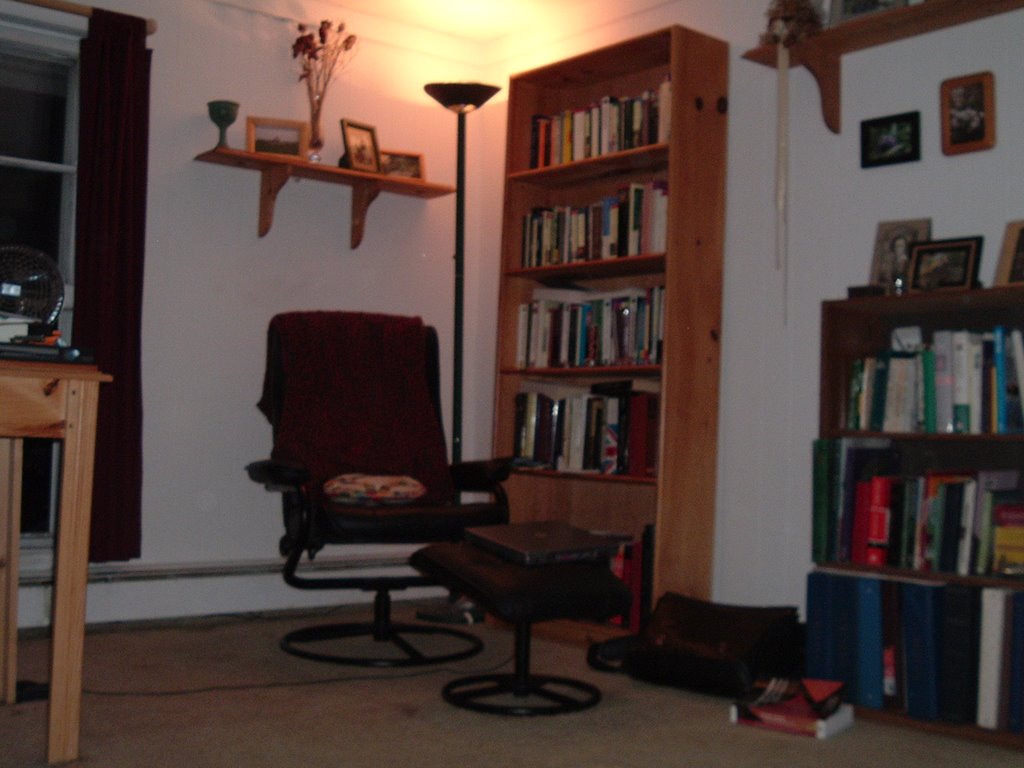
And if you are at all interested in where it is I do most of my reading, here’s a picture. It’s where I do my blogging too; you can see my laptop on the footrest.

Leave a comment

Filed under Books, Life

Swann’s Way

So I’ve now finished the first volume of Proust’s novel (and I’m counting each volume as a separate book!). It’s taken me about two months to read the entire thing; I’ve been reading in small chunks of about 10 pages or so, and read about 50 pages a week. For me, that’s the perfect way to read it; regularly enough to keep the story and ideas fresh in my mind, but at a slow enough pace to absorb it and to keep from feeling bogged down. This is most definitely not a book to rush.

And I’ve found it so very rewarding. Proust’s sentences are beautiful, long and digressive and convoluted, but they do yield their meaning, even if I have to read them a couple of times and turn the pages back and forth and back and forth to piece everything together. The book has sections that read quickly as well, particularly in the long middle section that tells the story of Swann and Odette. Here I found myself getting caught up in the story and the pages flew by. But best of all are Proust’s insights into consciousness, into what it’s like to be a young boy, for example, a very intense, intelligent, yearning young boy. We see him as both a little ridiculous – one of the things I liked was how I could imagine exactly why his parents found him exasperating – and as completely sympathetic and awe-inspiring and wonderful. His longing for his mother, and later for Gilberte, is moving; we know that such an intense, emotional child is bound to experience much struggle and pain.

This volume does have a carefully-wrought structure, although one entirely of Proust’s own devising; we begin with the unnamed narrator and a story of longing, and we end with that same narrator, a little older, longing still. All through the novel, Proust explores the way the mind mediates our experiences, shaping them through memory or desire; he considers how art affects his characters – the crucial role music and painting play in Swann’s love affair with Odette, for example. The novel is very much about reading; we learn a little about the narrator’s reading habits and desires in the first section, but also characters attempt to read one another, Swann desperately trying to understand Odette, the narrator reading much into everything his mother says, and then at the end turning the same attention toward Gilberte. The book trains readers to pay close attention, to their own minds and to other people and to the world. It contains some of most beautiful, detailed descriptions of nature I’ve read.

And the novel’s length strikes me as necessary, and not only because Proust needs the length to say what he wants to say about his characters and his ideas; there is something about living with this book for a long time, in much the same way that in reading Clarissa we come to feel like she is a companion, that we live with her, that we know her and she is a part of our lives. In Proust, we spend many, many hours luxuriating in the complexity of the mind and of emotion. We are forced – if we read carefully – to experience things slowly and to pay attention, to dig deeply into life.

And the way the narrative moves around in time, from the narrator as an older man describing himself as he is now, to the narrator telling stories from his childhood, to the narrator telling Swann’s story which took place before he was born, forces us to consider how our experience of time differs from “regular” clock time. In our minds, we move through time, back and forth, from past to present to future, easily and quickly. Proust’s central theme is memory, that capacity that holds us together and gives us a coherent identity. Except that our memories are not ours to control. A coherent identity may be an illusion, one fostered by memory, our ability to hold together disparate chunks of time, and undermined by memory too, since we can remember and forget involuntarily.

I’m looking forward to the other volumes; I’m curious about what Proust does with plot, oddly enough, perhaps. What will happen to these characters? Or will we even stay with these characters, or move on to others? But most of all, I’m looking forward to the company of Proust’s prose and his mind.

Leave a comment

Filed under Books, Fiction

Thoughts on books

With that generic post title, I can write about anything! I’m finding myself with a whole lot of little ideas on what to write here and can’t decide what to focus on, so I’ll write a little about a lot of stuff.

First of all, while I won’t tell you you must read Alison Lurie because I don’t believe in telling people they have to read things (um … unless you’re a student in my class that is — in that case, there’ll be a quiz), I think it would be great if more people read her. I finished The War Between the Tates last night and loved it. It’s smart, extremely well-written, clever and satirical, but also warm in a way many satirical novels are not. I like reading academic satires now and then, and this book would certainly qualify as one, but I do sometimes find them rather cold and brittle. Give me some emotional warmth, and I’m happy, and I found it here.

I’ve discovered a number of writers recently whom I’ve come to love — writers that are new to me, although not necessarily to others — and I’m interested that they are women: Rebecca West, Colette, Alison Lurie, Elizabeth Taylor, maybe Anne Tyler (I liked her latest book a lot, but I’m not sure I’m inspired to go read more). I’ve sensed that when I think of “great” writers of recent times, let’s say the last 100 years, I tend to think of more male writers than female; maybe I’ve picked up biases from the educational systems I’ve gone through, or maybe it’s that male authors are written about and reviewed more often than female writers. Well, I know the latter is true; maybe, my point is, I’ve picked up a bias from the media as well as from my education. And now I’m poised to read Margaret Atwood for the first time (Alias Grace, although Dracula will come first), so maybe I’ll find another woman writer to love. And the poets — yes — I’d add Jane Kenyon, Jane Hirschfield, and Mary Oliver to my list of recently-discovered women writers whom I’ve come to love. The friend of mind who loves Anita Brookner was wondering why she hadn’t heard of Brookner before, and surely it has something to do with the lack of serious attention paid to women writers — still.

But at any rate — Alias Grace just arrived in the mail through Book Mooch, and I’ve got a rather embarrassingly large number of books still to come. I’ve sent out two books to people, and have received two and am waiting on five more. I’ve accumulated points (which is what you use to request books from others) by adding books to my Book Mooch list (1/10 of a point for each book), and by mailing a book to Canada, which earned me a whole three points instead of the usual one. I justify my greed by reminding myself that people like to get books mooched from them because they can get rid of what they don’t want and use the points they earn to get ones they do. I eagerly await emails from people saying they want books of mine. So I tell myself I’m making people happy when I ask them to mail me books. It’s true, I’m sure!

So here’s what I’m waiting on: Ishiguro’s Never Let Me Go, Marguerite Navarre’s The Heptameron (in the style of The Decameron but written by a woman), Mythologies by Roland Barthes (this one I can justify because the Hobgoblin wants it), Nicholson Baker’s The Mezzanine (I like this guy a lot, and I’m not entirely sure why), and John Kelly’s The Great Mortality, the book on the plague. I’m not sure why a book on the plague fascinates me so much, but it does.

And I finished the first volume of Proust. I loved it. I’ll have to write more on it later — that surely deserves its own post, not a brief mention in this random one.

One other thing: I’m considering moving my to-be-read books to their own separate shelf, something I’ve never done before. I’ve got some space on my bookshelves upstairs in my study where I do most of my reading that would work nicely. This would please and appease my obsessive, hyper-organized self (another way to sort things!), and it would have another benefit: I’ll put the books on the shelf across the room from me, which, since it’s not a very big room, I’ll be able to see quite clearly. That way, the books I own that I haven’t read will be before me at all times, tempting me (hopefully) to read them next instead of rushing off to the bookstore to buy more books.

Leave a comment

Filed under Books, Reading

Colette and athleticism


One of the things that intrigues me about Colette is her interest in exercise and athleticism; I’m trying to figure out as I read her biography to what extent she’s pioneer in this way. I don’t know all that much about the history of women and athleticism, and I’d love to find out more. Here’s what Colette’s biographer says about it:

Colette was not the first woman of the century to work out, but she was one of the first amateurs. She had just turned thirty, and she had a morbid fear of succombing to the matronly flaccidity that was the fate of the average middle-aged woman of that era. In the process of becoming fit, she discovered that exercise strengthens one’s morale. “O molle ardeur de la femme amoureuse” — O mushy ardor of the woman in love! — she exclaims. In the gym, she was battling that mollesse, and acquiring a “modern” body: hard, supple, and, from the perspective of her era, androgynous. She was also, consciously or not, training herself for the profession she would take up when her marriage ended. Colette had understood, precociously, that the true beauty of a woman’s muscles is identical with their purpose, and that’s self-support.


It’s interesting (and probably typical) the way Colette seems to combine admirable and questionable motives for working out: she does it to conform to a cultural image of beauty but also to begin to become independent. I like very much what Thurman says about the beauty of a woman’s muscles being about self-support.

Here’s another passage, this one about the dancer Isadora Duncan:

Despite the pride and pleasure she took in her discipline [exercise], Colette wasn’t deluded about the extent to which a contemporary woman might throw off her fetters … she writes of [Duncan’s] “naive person,” and what was specifically naive to Colette was the idealism of her message. It didn’t escape her that the women who had come to cheer this “little naked creature in her veils” were corseted from their armpits to their knees, absurdly hatted, slaves to fashion, “heroic and bound.” “I muse on how peculiar women are, watching all these ladies who applaud Isadora Duncan … let us not fool ourselves! They acclaim her but they don’t envy her. They salute her at a distance, and they contemplate her, but as an escapee — not as a liberator.”

If Colette dreamed of escape, she never underestimated the difficulties posed to women by their desire to remain bound. “Reflecting on it later, it has seemed to me that I was exercising my body in the way that those prisoners who aren’t concretely planning a breakout still braid a sheet, sew gold pieces into a lining, and hide chocolate under their mattresses.” Colette’s gymnastics were flexing a will that aspired to, but wasn’t yet fit for, the rigors of freedom.


So in Colette’s time and place, strong athletic women like Duncan were admired but not emulated. This makes Colette’s own physical ambitions that much more interesting — she would be someone who would both admire and emulate, gaining strength and turning into a performer herself later on. I like the way she is practicing freedom from the constraints of the patriarchy, even though she can’t escape them yet, through physical exertion.

Leave a comment

Filed under Books

Books, bikes, and numbers

I’m interested in the ways people keep track of their reading, or don’t; in the comments to yesterday’s post, people said some interesting things about the benefits and drawbacks of lists. Yesterday I mentioned the range of books I’ll probably end up reading this year, but the truth is, this is the first year I’ve kept track of my reading, so I have no idea how representative my number of 50-60 books is of my typical reading pattern. And it’s reading blogs that gave me the idea; seeing the lists of books read in people’s sidebars made me want a list of my own. That, and I don’t always remember accurately how long ago I read something, and now I have a way of checking.

This is the good thing for me about lists — to jog my memory — and it’s a good thing about the blog itself, where not only can I look up what I read, but what I thought about it. I wish I had a better memory, but I’m better off acknowledging I don’t, and therefore keeping a good record.

But the bad thing about list-making and book-counting is that it feeds my obsessive, number-crunching, year-to-year comparing, self-critical, and worried-about-stupid-things-all-the-time side. I’d like to think that it doesn’t matter how many books I read in a year or how long it takes me to read them, or how many pages I can read an hour. Actually, I do think it doesn’t matter — what matters is what I make of my reading and how much pleasure I get from it. I really do believe that. Well, one part of me does, the sensible, reasonable part. But the other part of me, equally strong, does care about numbers and loves making comparisons and would wonder why, if one year I read 60 books, another year I’d only read 40. When this side of me speaks, it says “keep track!” When my sensible, reasonable side speaks, it says “don’t!” So which side of me will win out? Probably the number-cruncher side. The blog, in spite of all its wonderful qualities, does encourage the number-crunching side of me. It makes it so much easier to keep lists and count books. And I do like math. I like numbers and statistics. I find them fun.

Bettybetty wanted to know if this worry about reading speed is a carry-over from cycling. In one sense, no; I’m not really worried about my reading speed; I can accept my slow pace with a book when I’m less likely to accept it on the bike. But in another sense, the interest in numbers is similar in both areas. There is so much I can count with my bike computer/heart rate monitor: miles ridden on each ride, miles ridden this month, miles ridden this year, average speed, maximum speed, average heart rate, maximum heart rate, average cadence, maximum cadence, calories burned, time spent in target heart rate zones, etc. etc. I’m sure I’m forgetting something. I discovered a website this year where I can keep track of these things: Bike Journal. Here, I can enter all my information, and it’ll keep track of it and add up my monthly and yearly numbers.

This is a wonderful thing. But it’s all about codifying an experience that is wonderful for all sorts of non-codified ways. Numbers are great for serious training, so there’s no way I’m giving them up, but I can get too obsessed with them, and wonder, for example, why I rode slower today than yesterday. Why is my average speed in August slower than it was in July? Ugh. It’s impossible, thank God, to keep stats about reading in the same way I keep them about riding, but the counting impulse is still there.

Somehow I have to find a way to balance my sometimes unbalanced self.

Leave a comment

Filed under Books, Cycling, Reading

Reading time

Do you consider yourself a slow or a fast reader? I’d call myself a slow one. Obviously, such things are relative, but I’ve found that the Hobgoblin not only reads more books over the course of a year than I do, but that he seems to be able to get to the bottom of the page faster during those few times we’ve shared a magazine or newspaper. And I read book bloggers who seem to get through books awfully quickly, posting book reviews with admirable frequency. I think I’m slow in terms of the speed with which I process words and sentences, and if I read a decent number of books a year — this year I’ll probably read between 50 and 60 — it’s because I have a lot of time for reading, or, rather, I make a lot of time. The Hobgoblin and I just had a conversation about the things we could do if we didn’t read so much — things like keeping the house clean, the lawn neat, the pool free from algae (or, better yet, we’d have time to get rid of the stupid thing and do something better with the yard) — a list which is not particularly inspiring. We’ll continue to opt for the reading time.

I’m in awe of those who can regularly read a book in a day or two, who can sit down for a couple of hours and get through hundreds of pages. I must have read a book in a day at some point in my life, but I can’t remember when, and the book must have been quite short. I can read things fast if I make myself — student papers are one example of reading material I’ll rip through, eager to get to the end — but generally I’m happy to linger over words and sentences, re-read things, pause frequently and look up to consider a point, and let my mind wander.

Even more significant for me, though, is that I can’t seem to take in that much of a story in one sitting before I begin to get a bit anxious, feeling like I need a break. I need a lot of time to process what I’m reading, I think. If I read too much of a novel in one day, say more than 70-80 pages, or even less, depending on the novel, I feel as though I’m not really appreciating it, not really absorbing it. It’s like I can only comprehend a certain amount of action or information, or a certain number of plot events or character revelations before I begin to feel overloaded. And with nonfiction, it’s even worse — if I’m reading something full of facts and ideas I’d like to remember, I need even more time to process it — to think about it and make sense of it before I go on to the next thing.

Reading multiple books helps me with this problem — if it is a problem; if I feel like I’ve read enough of Proust, I can turn to my biography of Colette, or my book of poetry, or whatever else, and I won’t feel overwhelmed. I think this has less to do with the total number of hours of reading in a day than with the amount of any one book I can take in at a time, although I can’t hop from book to book for all that terribly long either — I’ll get restless.

So — while I’d love to be able to read more books than I do, I’d really, really love it, I’m not sure I could, even if I had more hours available in the day. I’d lose something by trying to cram too much in. I think that if I tried to read more than, say, 60 books a year, I’d have to force myself to read less well. I love the idea of days and weeks with not much else to do but read (and ride my bike), but the reality is that I’d be unhappy. So I’m just going to have to pretend that I will have an unlimited number of years to read what I want to read, and therefore that my slow pace doesn’t matter.

Leave a comment

Filed under Books, Reading

Alison Lurie’s The War Between the Tates

I’ve begun Alison Lurie’s novel The War Between the Tates, and I’m finding it quite good. It’s a family drama, and it’s also an academic satire, although not a satire in the comic mode of Jane Smiley’s Moo or Richard Russo’s Straight Man. It has funny moments, but the predominating mood is serious. Brian Tate, the husband, is a political science professor who has dreamed of being an important political consultant, although he now knows he never will be. He begins an affair with a graduate student (we learn this early on — no spoilers here) and the quality of his life plummets from there.

The novel begins with his wife Erica who has recently realized that she hates her two children, Jeffrey and Matilda. They have reached the sullen early-adolescent age, and have become unbearable. I like the way she is honest with herself about this feeling; while she’s no child abandoner or neglecter, and while I’m left thinking that she must, deep down, feel loyal toward her children, the feeling of hatred penetrates fairly deeply. I felt conflicted as I read about this relationship because I was just such a sullen, unbearable, anger- and frustration-inducing adolescent myself. I understand completely why the children act as they do, and I understand completely why Erica hates them for it. If I ever have children, which is most definitely not in my future plans anywhere right now, I’m certain I’m going to have just such a sullen child myself, because I deserve it completely. So Erica is unhappy in many ways, and she is learning just how much of this is her husband’s fault — he’s at fault for the affair, of course, but also for manipulating her and shutting off opportunities for her and generally being insufferable. This is a story of Erica beginning to take some control of her life.

I like Erica’s character, and I also like the narrator’s way of dealing with Brian, who is very much a jerk, but the narrator lets us see his thought processes and motivations in such a way that makes him understandable, if not likeable. And Brian’s character offers some great opportunities for academic satire:

Teachers, especially university professors, often have an elective affinity with their subjects. Whether through original tropism, conscious effort, or merely long association, language instructors born in Missouri and Brooklyn look and act remarkably like Frenchmen and Italians; professors of economics resemble bankers; and musicologists are indistinguishable from musicians …

These affinities also profoundly influence the functioning of the various Corinth University departments. They determine, for instance, which academic issues will take the longest to resolve and arouse the strongest feelings. Members of the Maths. Department tend to quarrel over the figures in their annual report, and members of the English department over its wording. In Psychology, analysis of the personality traits of candidates for promotion sometimes ends in ego-dystonic shouting; and the controversy over the new men’s washroom in the Architecture Building (during which two professors who had not designed an actual building in twenty years came to blows) has already passed into University annals.


But the political science department is the worst:

Since every member of the Political Science department is in outward manner and inner fantasy an expert political strategist, every issue provokes public debate and private lobbying. Even when there is little at stake, eloquent speeches are made; wires are skillfully pulled and logs rolled out of simple enjoyment of the sport.

We get a wonderful description of a political science department meeting, which, as you can imagine, is excruciating.

I think this book is extremely well written; the novel is set during the Vietnam War, and the war, besides hovering in the background of the plot, becomes a metaphor for what is happening to the family:

Brian and Erica, like their friends, students, and colleagues, have spent considerable time trying to understand and halt the war in Vietnam. If he were to draw a parallel between it and the war now going on in his house, he would have unhesitatingly identified with the South Vietnamese. He would have said that the conflict, begun a year or so ago as a minor police action, intended only to preserve democratic government and maintain the status quo — a preventive measure, really — has escalated steadily and disastrously against his and Erica’s wishes, and in spite of their earnest efforts to end it. For nearly two years, he would point out, the house on Jones Creek Road has been occupied territory. Jeffrey and Matilda have gradually taken it over, moving in troops and supplies, depleting natural resources, and destroying the local culture.


And Lurie goes on in this vein for another couple of pages. The cleverness of the writing doesn’t distract from the family drama; rather, it provides some comic relief from a dark tale. I’m impressed with the way Lurie effortlessly places the story in the context of the war and of the feminist movement without any awkward exposition; it comes naturally through the characters’ conversations and the narrator’s descriptions of the family dynamics.

I’ve only read the first half of the book so far; I’ll be sure to let you know how I like the second half.

Leave a comment

Filed under Books, Fiction

I just bought a bunch of books

You know how I said in a recent post that I was going to read something I already own and that I don’t need to go to a bookstore? Well, I didn’t go to a bookstore (and I am reading something I already own — the Alison Lurie, about which more to come), but I did go to a local library book sale. And I came back with 10 books, for a total of $12.50. Wasn’t that a great deal? The Hobgoblin came back with another 6 books. So now my list of books I own that I haven’t read is nearing 60, and will hit it when the books I’ve mooched from BookMooch arrive. Yes, I know that isn’t nearly as long the list of many book bloggers, but it’s still very long for me. But — paperbacks for a dollar! How can I resist?

I got a bunch of books from Jane Smiley’s 13 Ways of Looking at the Novel, which has a list of the 100 books she read over the course of a few years. Some things on the list are obvious and widely-read, but it’s still a good list to get some recommendations from. Because of that list, I picked up Mikhail Lermontov’s A Hero of our Time, Nancy Mitford’s The Pursuit of Love and Love in a Cold Climate (in one volume), and Max Beerbohm’s Zuleika Dobson.

A friend recommended Ann Patchett’s Bel Canto, so I snatched up a copy of that one, and this same friend admires Anita Brookner, so I picked up her novel Hotel du Lac. Since I’ve become an admirer of Rebecca West, I was pleased to find a hardcover edition of The Birds Fall Down for 50 cents. And, as you know if you read here regularly, I’m a Colette fan, so, for another 50 cents, I was thrilled to find The Ripening Seed. Litlove recommended that one as a good place to start reading in Colette’s fiction.

Also, Mary McCarthy’s Groves of Academe, which Kate mentioned in her discussion of academic satires. I love Mary McCarthy, but I haven’t read all her novels, or her essays for that matter, so I must fix that. Finally, I got a copy of Ivan Goncharov’s novel Oblomov, which I remember hearing about recently, but I can’t remember where, and V.S. Naipaul’s A House for Mr. Biswas.

Not a bad haul, is it?

Oh, and now I need to find a copy of George Sand’s Indiana, as it’s the new Slaves of Golconda pick. Thanks Danielle, for the great choice!

1 Comment

Filed under Books, Lists, Reading

Colette and Proust meet

Stefanie recently wrote about commonplace books; I’m afraid I’ll never be organized or energetic or diligent enough to keep one of those, so thank goodness for the blog, where I can at least keep track of some of the quotations I admire from my reading. Now why I can be organized and energetic enough to post on my blog every day but not enough to keep a commonplace book, I’m not sure, but, anyway, here’s something I’d put in my commonplace book if I had one.

The quotation is taken from Colette’s autobiographical novel Claudine en Menage (translated as Claudine Married), and it describes Claudine’s meeting with a young man who is obviously Proust. I realize that calling it an autobiographical novel is complicated, but Judith Thurman, Colette’s biographer, and others regularly look to the Claudine novels for information — however difficult to sort out — about Colette’s life. Thurman describes the passage as Colette’s “fictional version of her encounter with the young Proust at Mme Arman’s [which] gives us a glimpse of the way she was beginning to project an exaggerated stage version of herself in public.” What’s cool about it for me is, simply, that it’s a meeting between two of my literary heroes:

One Wednesday [she writes], at the house of old Ma Barmann [Mme Arman], I was cruised, politely, by a young pretty-boy of letters. (Beautiful eyes, that kid, a touch of conjunctivitis, but never mind …). He compared me … to Myrtocleia, to a young Hermes, to a Cupid by Proud’hon; he ransacked his memory and secret museums for me, quoting so many hermaphroditic masterpieces that … he almost spoiled my enjoyment of a divine cassoulet, the specialty of the house …

My little flatterer, excited by his own evocations, didn’t let go of me …. Nestled in a Louis XV basket chair, I heard him, without really listening, parade his literary knowledge …. He contemplated me with his long-lashed, caressing eyes and murmured, for the two of us:

Ah, yours is the daydream of the child Narcissus; it’s his soul, filled with sensuality and bitterness…”

“Monsieur,” I tell him firmly, “you’re delirious. My soul is filled with nothing but red beans and bacon rinds.”


This strikes me as perfect, capturing both Colette and Proust — or at least stereotyped, exaggerated, fictionalized versions of them — with devastating accuracy. From the illness, to the ransacking of his memory, to the extensive literary knowledge, to the dreaminess, Colette seems to get Proust down pat. And Colette (Claudine) gets to have the attention of a famous person, and gets to condescend to him too, calling him her “little flatterer” quite dismissively, and getting the final, funny last word in.

But, lest we think these two figures will always be at odds, Thurman goes on to say:

The “young pretty-boy of letters” who wasn’t yet “Proust” had recognized the true face and impure true feelings of the young misfit who wasn’t yet “Colette” and understood the narcissism forced upon her by her imposture.


I shall see, as I read through the biography, where, if anywhere, this relationship goes.

Leave a comment

Filed under Books

Random book thoughts

  • I’m going to do a wimpy version of Carl V’s R.I.P. reading challenge: I’m going to read … Dracula. The idea is to set yourself a challenge of some scary, eerie, frightening reading to be completed by Halloween. Many people are choosing five books, which is great, but I’m going to be realistic and set myself a “challenge” I know I can complete. I’ve been meaning to read Dracula for quite a while, just waiting around for the perfect time to do it — and here it is! Thanks Carl, for the idea.
  • I’ve joined BookMooch and have become a fan. I’ve been a member for maybe 1 1/2 weeks, and I’ve gotten two requests for books, and I’ve mooched three. The idea is that people will post books they’d like to give away, and then people will ask for yours and you’ll ask for others. All it costs is the postage to mail people books. I figured I had enough books sitting around I wouldn’t mind giving away, mostly contemporary fiction I didn’t like and a few things I acquired in some random ways. So I mailed off a copy of Meghan Daum’s The Quality of Life Report to somebody in Canada today, and I’ll be receiving Kate Atkinson’s Case Histories, Kazuo Ishiguro’s Never Let Me Go, and Margaret Atwood’s Alias Grace. Isn’t that the coolest?
  • I’ll be deciding any moment now which novel to pick up next. Dracula I think I’ll put off until October. For now, I’m not sure if I want something contemporary or something older. I tend to read older, “classic”-type books fairly regularly interspersed between two or three or four more contemporary novels, and it’s getting time to pick up something older. But — maybe not yet. I do want to read something I already own (no need to run off to the bookstore at all, no, not at all). I’ve got a copy of Balzac’s Cousin Bette which has been calling out to me, but I’ve also got my eye on Michael Martone’s book Michael Martone (which AC sent me — thanks!) and Orhan Pamuk’s Snow, and I picked up a copy of Alison Lurie’s The War Between the Tates at one of my local used bookstores after Litlove wrote about her. But there is also Anne Bronte’s The Tenant of Wildfell Hall which a random person at work gave me, if I do decide on something older. The reader’s dilemma — what next?

Leave a comment

Filed under Books, Reading

More Elizabeth Taylor

I finished Elizabeth Taylor’s The Sleeping Beauty recently, the second Taylor novel I’ve read in a few months. I like reading multiple books by the same author like this — I did this also with Muriel Spark recently — but I don’t do it much. Too many other books by new authors I haven’t read before are out there enticing me to try them. But spending a little more time with an author than just one book yields so many insights into the way that author works. To put it in boring English teacher terms, you can do some comparing and contrasting and draw some deeper conclusions.

I’m seeing about Taylor that she writes about middle-aged women very well; both books I’ve read have women of that age at their center. The Sleeping Beauty has a younger woman as a love interest — the sleeping beauty herself, but at least as interesting is Isabella, a widow with a grown son, who hopes to be the love interest and is disappointed. In a Summer Season tells about a woman who has married a significantly younger man and how this enlivens and disrupts her rather sedate life. Taylor writes about middle-class sexual repression and expression extremely well. The Sleeping Beauty isn’t set in a town called Seething for nothing. Isabella and her friend Evalie spend a significant amount of time and money on beauty treatments trying to make themselves look younger and more sexually attractive, all the while interfering when they can in the love lives of others. The class issue arises most clearly when Isabella insults her son’s girlfriend, who is a nanny, and therefore unacceptable for her educated, talented son. Another character, Rose, does what she can to keep her sister Emily locked up in the prison of her home, keeping her from wandering out into the larger world where she might meet a man who will take her away.

And yet the surface of Taylor’s novels is serene and quiet. Both books took a while to get some momentum, and, although events do happen in them, they don’t happen often and they aren’t described dramatically. These are books that you should read slowly, because if you rush through them, you might miss the subtle dynamics of a conversation, which is where the story lies. Taylor excels at writing scenes charged with emotion, but with emotion that is usually kept hidden, below the surface. She is at her best in The Sleeping Beauty describing a particularly excruciating tea with Isabella, her son, his girlfriend, and two other guests, an event that goes so horribly wrong I’m left cringing at the brutality of it, even though no actual violence occurs. Middle-class decorum is forever at odds with jealousy, fear, and fury. And hypocrisy — Isabel and Evalie condemn gambling one moment and the next moment are whispering to each other about what horse to bet on. They both project self-satisfaction and self-righteousness, but their actions are, arguably, the cruelest in the novel.

I like the way Taylor shows the dark side of lives that seem so sedate and ordinary. Behind any normal-looking comfortable small-town or country home can lurk suffering and longing and regret. And most of all — interesting stories.

Leave a comment

Filed under Books, Fiction

The Island of Dr. Moreau

I’m not sure if I’m supposed to be posting on this today or tomorrow, but I figure that if it’s supposed to be tomorrow, you all can come back and read this then. I’m also not going to do this book justice, since I read it in a rather distracted state of mind. I felt as I was reading that I should re-read in order to fully appreciate it, but I didn’t have the time.

At any rate, I enjoyed the novel very much. This is my first experience of Wells, and I’m tempted to read the two other novels in my edition, The Time Machine and War of the Worlds. I’m curious what people make of the frame narrative – is there something complicated going on here, or is it simply by way of explaining and setting up the narrative to follow? Wells participates in an old tradition of frame narratives, whether it’s the frame story of escaping the plague in Boccaccio’s The Decameron or the multiple frame narratives that encircle the creature’s narrative in Frankenstein, or the explanation Defoe gives at the beginning of Robinson Crusoe that the narrative is a true one that Defoe had stumbled upon and decided to publish. Wells’s use is certainly not as complicated as Mary Shelley’s was, but the frame does give the reader a sense of the mysteriousness to come in the main narrative, and it tells us the interesting fact that Prendick “subsequently … alleged that his mind was a blank from the moment he escaped from the Lady Vain.” Did he find that his attempts to explain what he saw on the island were so impossible that he gave it up and simply said his mind was blank to avoid explanations entirely?

I’m reminded of Hawthorne’s story “Young Goodman Brown” where Brown journeys into the woods, discovers the horrors that (supposedly) exist in the human heart, and returns home a changed man, unable to live at peace with his family again. And also Gulliver, who after his travels becomes a bitter, cynical man. In both of these books, and in Wells’s novel too, one of the central questions is about what it means to be human: are humans like the houyhnhnms or the yahoos, or neither? The ending of the novel is moving; Prendick lives in fear and horror of his fellow humans and isolates himself from people, devoting his time to scientific studies. He writes:

They say that terror is a disease, and anyhow, I can witness that, for several years now, a restless fear has dwelt in my mind, such a restless fear as a half-tamed lion cub may feel. My trouble took the strangest form. I could not persuade myself that the men and women I met were not also another, still passably human, Beast People, animals half-wrought into the outward image of human souls, and that they would presently begin to revert, to show first this bestial mark and then that.


At the heart of the novel, I think, is the conversation between Prendick and Dr. Moreau where Moreau explains the nature of his experiments. This dialogue is all about the relationship of human beings and animals – a topic that has fascinated writers since the time of Gilgamesh, another work that tries to define humanity by considering how people differ from the gods on the one hand and the beasts on the other. The question in Wells’s novel centers around pain – what it means to be able to feel pain and how we should respond to our own pain and that of others. Moreau says:

For it is just this question of pain that parts us. So long as visible or audible pain turns you sick, so long as your own pains drive you, so long as pain underlies your propositions about sin, so long, I tell you, you are an animal, thinking a little less obscurely what an animal feels … A mind truly opened to what science has to teach must see that [pain] is a little thing.


Pain is an aspect of animal experience, not human, according to Moreau; as humans separate themselves from the animal world, pain will carry less and less significance. That he brushes aside Prendick’s objections to his cruelty shows that he has lost something essential to his humanity and has become much less than an animal, which would never behave as cruelly as he has. By working so horribly on animal bodies and denying the significance of the pain they experience, Moreau shows his abhorrence of bodies in general – he desires to leave the body and all its weaknesses behind. But in denying the body, he perverts human nature into something it’s not – the body is as central to human experience as the mind.

Moreau cannot succeed in turning animals into humans to his satisfaction because he misunderstands what it means to be human and animal both. He says of his animal/human creations that:

Least satisfactory of all is something that I cannot touch – somewhere – I cannot determine where – in the seat of the emotions. Cravings, instincts, desires that harm humanity, a strange hidden reservoir to burst suddenly and inundate the whole being of the creature with anger, hate, or fear.


He wants to drive what he sees as the beast out of the human, and yet what he considers “beast” – the body that feels pain and experiences instincts and cravings – is inseparable from the human. Prendick separates himself morally from Moreau when he recognizes the humanity of one of Moreau’s creations:

It may seem a strange contradiction in me – I cannot explain the fact –, but now, seeing the creature there in a perfectly animal attitude, with the light gleaming in its eyes, and its imperfectly human face distorted with terror, I realized again the fact of its humanity.


This is a redeeming moment for Prendick, who, rather than allowing this creature to enter Moreau’s torture chamber once again, shoots it. This is an act of mercy.

Okay – there is so much more going on in this novel, but I’ll leave it up to my fellow Slaves to point those things out.

Leave a comment

Filed under Books, Fiction