Category Archives: Books

Introductions and prefaces

This is a follow-up to Danielle’s post on Introductions and Prefaces, on whether to read them or not. I began George Sand’s novel Indiana last night and went through an experience similar to Danielle’s; I had to decide whether to read the intro and the several prefaces or just go straight to the story. As I was tired and had a longing to read an absorbing story, I skipped all the opening stuff and began with the novel’s first sentence.

But I often do something a little more complicated, something more like skimming the intro hoping to find some good information on the book’s background and themes without picking up any major plot points that will give the story away. Sometimes I’ll look at an intro when I’ve gotten a little ways into the novel if I’m feeling confused or disoriented by the story; the intro will sometimes help clarify things. As for author prefaces, I usually feel like I should read those — if the author thought something preface-like should be said, then perhaps I should read it. Last night, however, I was too tired for prefaces. I’ll return to those later.

Danielle talks about the fear of not “getting it,” and it’s in this respect that reading or not reading introductions becomes complicated. I’ve felt that fear myself. I’d like to just read the novel and form my own opinion, notice what I notice, draw my own conclusions, and then test them against what the introducer says. When I’m tempted to read an introduction before the text, it’s usually because I’m nervous about not getting it — not a very good reason, is it? But I also don’t want the experience of missing something important in the novel and reading the whole thing without that key piece of information or that key idea or theme. When that happens, I will read the introduction and get frustrated because I wish I’d known that information to help me make sense of the book. While some books are very accessible on their own, others really do benefit from a little background and extra information.

Thinking about all this, I start to think that the best way to read is to read things twice. Now excluding poems and short stories, I realize that’s not feasible. But isn’t it the ideal approach? I could read something once with absolutely no outside help, no introduction and no notes. And after finishing it the first time, I could read the introduction, get some information on the author, maybe read a little criticism, and then read the text again, in the light of everything I just read. And then I could read it having gotten most of the initial comprehension issues out of the way — I’d know the plot and characters and some of the themes — and I could begin to consider more complicated interpretive questions.

But I don’t have the patience to read everything twice and don’t plan on trying. I do think, however, that it’s on a re-reading that I really begin to read.
Leave a comment

Filed under Books, Reading

Best novel of the last 25 years?

You’ve probably heard about the Observer’s poll to find the best British, Irish, or Commonwealth novel from the last 25 years. Like the American version of a while back, they asked a bunch of famous literary people to vote and came up with a list. I didn’t like the American list at all, and got quite annoyed at the whole enterprise, but I’m not having that reaction this time. I’m guessing that’s because I don’t feel any “ownership” or any stake in this because it’s not “my” country — but as you can tell from my scare quotes, I don’t particularly like feeling that way. Why feel any ownership over American literature? I’m someone who’s spent an awful lot of time studying British literature anyway! A bad list is a bad list.

But I don’t really know if the Observer’s list is a bad one or not largely because I haven’t read much on it. That probably explains my non-reaction. When I saw the list I immediately bookmarked it as a source of future reading suggestions, while the American list did not inspire me in that way at all.

In case you’re too lazy to click over here are the top winners:

First place

Disgrace (1999)JM Coetzee

Second place

Money (1984)Martin Amis

Joint third place

Earthly Powers (1980)Anthony Burgess

Atonement (2001)Ian McEwan

The Blue Flower (1995)Penelope Fitzgerald

The Unconsoled (1995)Kazuo Ishiguro

Midnight’s Children (1981)Salman Rushdie

Joint eighth place

The Remains of the Day (1989)Kazuo Ishiguro

Amongst Women (1990)John McGahern

That They May Face the Rising Sun (2001)John McGahern


Of these, I’ve read only The Remains of the Day and Midnight’s Children, and I’ve listened to Atonement on CD. All these books I loved, especially the Ishiguro and McEwan. I’ve read other books by Martin Amis, but no Coetzee (although I’ve been considering it for a while), no Burgess (I haven’t been interested, but maybe I should be?), no Fitzgerald (I’m guessing I’m missing out here), and no McGahern (no idea about this one).

There’s a longer list of other nominations, which you’ll have to click over to read; I am familiar with most of the names but some are completely new to me.

What do you think — am I more interested in this list than the American one because it’s a better list, or because I don’t know enough about it to be disappointed in it?

Leave a comment

Filed under Books, Lists

Virginia Woolf’s “Kew Gardens”

In a way, I’m hesitant to talk about Virginia Woolf’s “Kew Gardens” as a story, since it shares so little with other short stories I’m familiar with. In what sense is this a story? In a lot of ways, it seems more accurate to call it a sketch, or maybe a prose poem. It consists of a description of a flower bed in Kew Gardens and a snail slowly making its way between the plants and around the leaves. It describes the colors and the light in minute details. We read of small groups of people who walk by the flower bed; we catch little bits of their conversations, enough to begin to piece together a story, but really only fragments before they move on and we lose sight of them.

What tempts me to call the work a prose poem is not so much the beautiful description, although there is plenty of that, but more the way it creates a mood, the people and the natural world together, so that the point is not what happens but how we feel as we read it. I’m also tempted to call it a prose poem because it gives us little glimpses of stories that we have to work to put together, in the way a poem will sometimes hint at a situation without fleshing it out, and focus on the feeling of that situation more than the events, even though the events are often implicit.What we get from the vignettes are images, as we might find in poems, as when the first man thinks of 15 years previously when he sat in the gardens with Lily and asked her to marry him and she refused:

We sat somewhere over there by a lake and I begged her to marry me all through the hot afternoon. How the dragonfly kept circling round us: how clearly I see the dragonfly and her shoe with the square silver buckle at the toe. All the time I spoke I saw her shoe and when it moved impatiently I knew without looking up what she was going to say: the whole of her seemed to be in her shoe.


We picture the man staring at the Lily’s shoe and watching its impatient movements and understanding his fate, and we also picture that same man 15 year later walking through the gardens with his wife and children and remembering Lily’s rejection with relief and with regret.We see an old man walking with a younger one:

The elder man had a curiously uneven and shaky method of walking, jerking his hand forward and throwing up his head abruptly, rather in the manner of an impatient carriage horse tired of waiting outside a house; but in the man these gestures were irresolute and pointless.

He talks incessantly to the younger man about spirits who are speaking to him of heaven, and the younger man’s “look of stoical patience [grows] slowly deeper and deeper.” With the older man’s jerky movements and the younger man’s strained calm, we put together the story of failing mental powers on the one hand and youthful health and energy on the other. Woolf gives these hints of story through the images themselves; they are vibrant because they are brief and sharply focused.Woolf spends as much time describing the flower bed and the snail as she does the people; in fact, since there are four groups of people who walk by, the snail gets much more attention than any particular person does. The human stories are not privileged; the snail’s decision whether to crawl around or over or under the leaf is just as important as whether Lily said yes or no. With Woolf’s careful description of the flowers and the sunlight, she creates a feeling that the natural world, even though it is made up of individual parts that are fleeting, as a whole is more real and long-lasting than the human world.

Leave a comment

Filed under Books, Short stories

Footnotes on footnotes

As Nicholson Baker nears the end of his novel The Mezzanine, his narrator begins talking about Marcus Aurelius’s Meditations. We learn he has begun to read this book because of “a glowing mention in William Edward Hartpole Lecky’s History of European Morals (which I had been attracted to, browsing in the library one Saturday, by the ambitious title and the luxurious incidentalism of the footnotes).” And here Baker inserts a footnote. This footnote starts off with anecdotes from Lecky’s book and modulates into a discussion of footnotes themselves. This is the sentence with which the footnote ends:

Footnotes are the finer-suckered surfaces that allow tentacular paragraphs to hold fast to the wider reality of the library.


I’m not entirely sure if that’s a brilliant sentence or a terrible one. Maybe it’s brilliant in its awfulness. But I love the idea that footnotes connect the book to the rest of the library, to a wider reality.

But back to the beginning — Baker’s narrator repeats a couple of the anecdotes from Lecky’s book, one of which tells us that Spinoza “liked to entertain himself by dropping flies into spiders’ webs, enjoying the resultant battle so much that he occasionally burst out laughing.” The narrator considers why such side notes, such digressions are so much fun, and in doing so, he quotes Boswell on Samuel Johnson:

Upon this tour, when journeying, he [Johnson] wore boots, and a very wide brown cloth great coat, with pockets which might have almost held the two volumes of his folio dictionary; and he carried in his hand a large English oak stick. Let me not be censured for mentioning such minute particulars. Everything relative to so great a man is worth observing.


The narrator goes on, and here we get to the heart of his footnote on footnotes:

Boswell, like Lecky (to get back to the point of this footnote), and Gibbon before him, loved footnotes. They knew that the outer surface of truth is not smooth, welling and gathering from paragraph to shapely paragraph, but is encrusted with a tough protective bark of citations, quotation marks, italics, and foreign languages, a whole variorum crust of “ibid.s’s” and “compare’s” and “see’s” that are the shield for the pure flow of argument as it lives for a moment in one’s mind. They knew the anticipatory pleasure of sensing with peripheral vision, as they turned the page, a gray silt of further example and qualification waiting in tiny type at the bottom.


At the risk of boring you, here’s a bit more:

Digression — a movement away from the gradus, or upward escalation, of the argument — is sometimes the only way to be thorough, and footnotes are the only form of graphic digression sanctioned by centuries of typesetters. And yet the MLA Style Sheet I owned in college warned against lengthy, “essay-like” footnotes. Were they nuts? Where is scholarship going? (They have removed this blemish in later editions.)

This whole book is an illustration of what Baker means by “luxurious incidentalism”; we find this in his footnotes, but we also find it in the text itself, which wanders from topic to topic as the narrator’s mind wanders on his lunch break. I begin to wonder, not how Baker could write 135 pages about one morning, but how he could capture the whole morning in a mere 135 pages.

Footnotes on one’s own thinking interest me. How does one decide what belongs in the main text and what belongs in a footnote, especially when the main text is itself already very digressive? To footnote someone else’s text I understand, and to footnote one’s own scholarly work with further details and explanations and documentations I understand, but to footnote a record of one’s own thoughts, a record that is by no means smooth and sequential to begin with and is already full of footnote-like digressions — that shows just how complicated it is to try to capture what goes on in a mind. If the “outer surface of truth is not smooth, welling and gathering from paragraph to shapely paragraph,” then neither is the “outer surface” of the mind.

I’m curious about this because the book ends with two endings, two climaxes, one in the main text and one in a footnote. The ending in the main text is quite simple: the narrator makes it to the top of the escalator. The footnote ending is about the resolution of the shoelace dilemma (what, exactly, wears them down and causes them to snap?) After researching the question exhaustively, the narrator finds a 1984 volume of World Textile Abstracts, with the following entry by the Polish researcher Z. Czaplicki:

Two mechanical devices for testing the abrasion resistance and knot slippage performance of shoe laces are described and investigated. Polish standards are discussed.


Here is the narrator’s response:

I let out a small cry and slapped by hand down on the page. The joy I felt maybe difficult for some to understand. Here was a man, Z. Czaplicki, who had to know! He was not going to abandon the problem with some sigh about complexity and human limitation after a minute’s thought, as I had, and go to lunch — he was going to make the problem his life’s work … A great man! I left the library relieved. Progress was being made. Someone was looking into the problem. Mr. Czaplicki, in Poland, would take it from there.


He doesn’t discover what makes shoelaces wear out, but there is somebody out there just as fascinated by the question as he is. The footnote ending shadows the main text ending, but in a way it is more important than the main text ending. The footnote ending points the reader out of the novel, out of the narrator’s mind, out to the world; it is an example of those “finer-suckered surfaces that allow tentacular paragraphs to hold fast to the wider reality of the library.”

Leave a comment

Filed under Books, Fiction

Nicholson Baker’s The Mezzanine

I finished The Mezzanine last night and loved it. If you’ve ever been tempted to read Nicholson Baker but haven’t yet, or even if you’ve never been tempted, I’d say give him a try. This is one sort of book I love very much — a non-traditional narrative that’s more about thoughts and ideas than about plot. It’s the kind of book where the narrator’s personality makes or breaks it; it’s all about voice. If the voice is good, it doesn’t matter what the subject is. It’s a novel that’s closer to the essay than it is to more traditional novels.

The subject of this book, that I say doesn’t matter so much? Let’s see. The main events include riding an escalator, contemplating why the two shoelaces on a pair of shoes snapped within a short time of each other, shopping at CVS, eating a cookie and milk, talking to work colleagues, and visiting the bathroom. The book describes the escalator ride from the vantage point of a few years afterward, and it moves backward from the escalator ride to describe the morning at work which precedes it and the lunch break which the ride brings to an end.

But these things aren’t really the subjects of the book. The real subjects are the way the narrator’s mind works and his enthusiasm for the little details of modern life. This enthusiasm is boundless. When the second shoelace snaps shortly after the first one did, the narrator sets off on a quest to discover how shoelaces wear out. Is it because of the stress caused by pulling the laces tight when he ties them? Or is it the wear on the laces caused by the slight friction of lace against shoe every time he takes a step?

Now that I think about it, I realize that there are a number of more traditional narratives and genres that the book plays with, one being the quest narrative. While a quest to discover why shoelaces wear and break might seem small, what this narrator is really after is knowledge of those details that shape our day-to-day lives that most of us don’t even notice, much less understand. He’s showing that those details matter — they are our lives, after all. We are surrounded by things we don’t understand, things we use without knowing where they came from or how they got to us, or how they function and why they break. He wants to dig those details out and examine them and understand them.

He also wants to understand the way the mind works. In one passage, he considers the “periodicity of regularly returning thoughts,” the number of times he thinks of a particular thing a year. If he can study and chart this, he can understand his mental life much better; without this study, he has only a vague impression of what thoughts he actually devotes his energy to. He realizes how complicated such an endeavor would be, but he makes a chart with his best estimates, a chart that occupies a couple pages of text, and tells us that he thought about how “people are very dissimilar” about 16 times a year, and about how “people are very similar” about 12 times a year. And he thinks about staplers 7 times a year and escalator invention 12 times.

This sounds rather Proustian, doesn’t it?

Some of these thoughts are inspired by Marcus Aurelius’s Meditations, a book the narrator carries with him on his lunch break. Here is another traditional form Baker draws on, for his own book could be called meditations — meditations on the world the narrator has found himself in. He never reads very much of Aurelius’s Meditations, but he has it with him because he fell in love with one line he came across by chance while looking at the book in the bookstore. Here’s the line:

Manifestly, no condition of life could be so well adapted for the practice of philosophy as this in which chance finds you today!


The narrator’s response to the line is this:

Wo! I loved the slight awkwardness and archaism of the sentence, full of phrases that never come naturally to people’s lips now but once had: “condition of life,” “so well adapted for,” “chance finds you,” as well as the unexpected but apt rush to an exclamation point at the end. But mainly I thought that the statement was extraordinarily true and that if I bought that book and learned how to act upon that single sentence I would be led into elaborate realms of understanding, even as I continued to do, outwardly, exactly as I had done, going to work, going to lunch, going home, talking to L. on the phone or having her over for the night.


And that, you could say, is the book in a nutshell, from the enthusiasm in that opening “Wo!” to the list of things that make up an ordinary day at the passage’s end, to the idea in the passage’s middle that one can live an ordinary life profoundly.

And lest you think this book is all seriousness, let me say it’s hilariously funny, and I often laughed out loud as I read. The bathroom scene — generally I’m not big on bathroom humor, but that bathroom scene — ah, just read it.

I haven’t even gotten to the footnotes yet, but perhaps I’ll come back to them tomorrow. I must talk about the footnote on footnotes and the footnotes on the resolution of the shoelace conundrum. It’s a very moving passage, something I never thought I’d say about a passage on shoelaces.

Leave a comment

Filed under Books, Fiction

Reading notes

Diana has a post on how she’s storing up for the winter in various ways, including stocking up on books, and that’s what I appear to be doing too, although there’s no need for me to panic about running out of reading material, since I can walk to four used bookstores in town. But I have the urge to acquire and accumulate also, and I haven’t resisted it. I haven’t really even tried. Recent acquisitions include:

  • Geraldine Brooks’s novel Year of Wonders, about the plague — which makes two books I own about the plague, the other being the nonfiction book The Great Mortality. Some fun winter reading!
  • The Time Traveler’s Wife, which everyone I know who has read it (which includes quite a lot of people) says I should read and will like. Looking forward to it.
  • James Hogg’s The Private Memoirs and Confessions of a Justified Sinner, which is quite a wonderful title. I heard about this from Jane Smiley’s book on the novel.
  • Elizabeth Gaskell’s Wives and Daughters. I’ve read one book by Gaskell, North and South, and liked it and am looking forward to another. I love 19C novels, and I’m happy that Gaskell has written quite a number of novels I haven’t read. I like all the potential that means.
  • Colette’s Cheri and The Last of Cheri, because, of course, since I’m reading the biography of Colette, I have to read more of her own writing as well. And this is the one Litlove recommended to me.
  • Virginia Woolf’s Moments of Being, uncollected autobiographical writings, because I can never get enough of Woolf. Thanks to Diana, who is sending me the book!
  • Finally (for now), Carolyn Heilbrun’s Hamlet’s Mother and Other Women, because I read about it on some blog, and I can’t remember which, and it sounded really cool.

Plenty of good choices here, I know, and plenty more on the TBR shelves that have been there for a while. I should be okay this winter.

Leave a comment

Filed under Books, Lists, Reading

Proust and Joyce

There’s a review (not available online) in the 10/19 New York Review of Books of a new book on Proust, Proust at the Majestic: The Last Days of the Author Whose book Changed Paris by Richard Davenport-Hines. The book tells the story of an exclusive supper party hosted by Violet and Sydney Schiff, who held the party in order to introduce Proust and James Joyce. Here’s the reviewer’s account:

The Schiffs behaved like zoo-keepers coaxing two rare and skittish beasts into the same cage and hoping that something magical would come of their brief union — a bon mot, a fascinating discussion, a lasting friendship. The scene was set for one of the great meetings of Modernist minds. The food had already been cleared away when a shabby, drunken man blundered in, sat down next to Sydney Schiff, and, according to the art critic Clive Bell, “remained speechless with his head in his hands and a glass of champagne in front of him.” Later, he was heard to snore. This was the author of Ulysses. Then, between two and three o’clock in the morning, a small, dapper figure wrapped in a fur coat slipped into the dining room. If Clive Bell’s description is accurate, he looked somewhat like a rat: “sleek and dank and plastered.” This was the author of A la recherche du temps perdu.

Joyce and Proust failed to live up to the historic occasion. There was no sparkling conversation and the two writers never met again. This did not prevent gossips and writers of memoirs from inventing the dialogue later on. Davenport-Hines quotes six different versions, the most interestingly boring of which is the version Joyce himself gave to Frank Budgen:

“Our talk consisted solely of the word ‘no.’ Proust asked me if I knew the duc de so-and-so. I said, ‘No.’ Our hostess asked Proust if he had read such and such a piece of Ulysses. Proust said, ‘no.’ And so on. Of course the situation was impossible.”

Something about this pleases me. Why should two great writers perform for these people after all? It would feel like an obvious set-up, like two single people at a dinner party who are clearly supposed to meet and fall in love. It would make me want to rebel and act badly.

The review also describes Proust’s apartment, his last home, on the Rue Hamelin, and sheds some light on “involuntary memory.” Objects in the apartment:

were not ornaments but the apparatus of experiments in progress. Sydney Schiff noticed that a particular object — a jug, a coffee cup, or a half-emptied beer glass that had caught the sun in a particularly way — would be left where it was. “Sometimes he insisted on it remaining indefinitely, because he wanted to renew the sensation it had given him.” In A la recherche du temps perdu, these apparently trivial sensations occur only by chance. They bring about the epiphanic moments when the narrator grasps the whole “edifice of memory” and can begin to transform “lost time” into a work of art. In Proust’s apartment, those sensations were continually on tap. The apartment in the Rue Hamelin was a novelist’s laboratory in which involuntary memories could be generated at will.


So — is it involuntary memory or not? I’m not sure what to make of the real-life difference from the novel. I like the idea of the artist’s apartment as a laboratory, but it makes the ideas about memory in the novel seem artificial. As I’m reading Proust, I tend to think of it as reflecting reality — as Proust’s ideas about what life and the mind are really like — but of course, it’s fiction and there’s no reason to think the narrator’s ideas are necessarily Proust’s. He’s just so good at making you think that the narrator is Proust and that we’re getting Proust’s thoughts, when really, that’s not how it works. I know that’s not how it works, but the experience of reading makes me forget.

I learned another interesting thing from the review:

A man who subjects himself to a steady diet of caffeine, opiates, barbiturates, amyl nitrate, and pure adrenalin is unlikely to remain oblivious to the functioning of his brain. The quantity and variety of drugs that went into the writing of A la recherche du temps perdu are probably unparalleled in French literature. Proust urged his critics not to trace facile patterns of cause and effect when analyzing the process of literary creation, but it is probably reasonable to suppose that the vivid, hallucinatory memories that the narrator of his novel enjoys at intervals of several years were more common occurences for the author, and that they were produced by substances less innocuous than a madeleine dipped in a cup of herbal tea.


Quite interesting, yes?

Leave a comment

Filed under Books

A mad King George III chases Frances Burney in Kew Garden

So I just read this extraordinary passage in Frances Burney’s Journals and Letters that I’ll give you some excerpts from; this is from February 1789 and King George III is suffering from a bout of insanity. Burney has a position as “Second Keeper of the Robes” to Queen Charlotte, so she’s a part of court life, but she’s trying to stay away from the king because he’s rather unpredictable. She fails:

I strolled into the Garden; I had proceeded, in my quick way, nearly half the round, when I suddenly perceived, through some Trees, two or three figures … I concluded them to be workmen, and Gardeners;–yet tried to look sharp, — and in so doing, as they were less shaded, I thought I saw the Person of his Majesty!

Alarmed past all possible expression, I waited not to know more, but turning back, ran off with all my might — But what was my terror to hear myself pursued! — to hear the voice of the King himself, loudly and hoarsely calling after me “Miss Burney! Miss Burney!–”

I protest I was ready to die; I knew not in what state he might be at the time; I only knew the orders to keep out of his way were universal; that the Queen would highly disapprove any unauthorised meeting, and that the very action of my running away might deeply, in his present irritable state, offend him.

Heavens how I ran! — I do not think I should have felt the hot Lava from Vesuvius, — at least not the hot Cinders, had I so ran during its Eruption. My feet were not sensible that they even touched the Ground.


He chases her for a while, along with some attendants who are trying to get her to stop. She refuses and keeps running out of terror. Finally she stops when the attendants tell her it hurts the king to run:

When they were within a few yards of me, the King called out “Why did you run away?–“

Shocked at a question impossible to answer, yet a little assured by the mild tone of his voice, I instantly forced myself forward, to meet him — though the internal sensation which satisfied me this was a step the most proper, to appease his suspicions and displeasure, was so violently combatted by the tremor of my nerves, that I fairly think I may reckon it the greatest effort of personal courage I have ever made.

The effort answered, — I looked up, and met all his wonted benignity of Countenance, though something still of wildness in his Eyes. Think, however, of my surprise, to feel him put both his hands round my two shoulders, and then kiss my Cheek! I wonder I did not really sink, so exquisite was my affright when I saw him spread out his arms! — Involuntarily, I concluded he meant to crush me; — but the Willis’s, who have never seen him till the fatal illness, not knowing how very extraordinary an action this was from him, simply smiled and looked pleased, supposing, perhaps, it was his customary salutation!

I have reason, however, to believe it was but the joy of a Heart unbridled now, by the forms and proprieties of established customs, and sober Reason …

Leave a comment

Filed under Books, Nonfiction

What is a poem?

I wrote about poetry reading generally yesterday, so today I thought I’d write about how my current poetry read is going, Jane Kenyon’s Otherwise. I’m liking it, although I don’t think I’ve quite figured it out yet. I’ve read maybe 40 pages out of 200 or so, so I still have time. I’m not quite sure what I mean when I say I haven’t figured it out yet, except that I’m thinking as I read about what it is that makes the poems poetry, what unites them, if anything, what Kenyon’s style is, what makes her a great poet, if she is indeed a great poet.

Although I’ve sort of read poetry for a while, mostly in my capacity as a teacher, I’ve taken up more serious and steady poetry reading purely for pleasure once again after a long, long break without reading it much. So as I read, I’m figuring out what it is I like in a poem and what kind of poetry draws me. So far I’ve been very pleased with my choices; I’ve read Mary Oliver’s American Primitive and Jane Hirschfield’s Given Sugar, Given Salt and was blown away by them both. I think I loved them both so much because their poems were beautiful and they were wise. Kenyon’s are those things too, but I’m still figuring out how.

I’m realizing that poetry may do something substantially different for me than fiction does. I try to be widely read in fiction — I try to read from different cultures and different time periods and I try to read different novel types. With poetry, I’m less interested in that kind of coverage. I read poetry very slowly — these days I’m reading only a handful of poems a week so it will take me forever to get through a book — and so will never read all that widely. And with poetry, I’m more likely to go for what I think will be a comfort read. In fiction I might try an author I’m afraid I won’t like; in poetry I wouldn’t do that.

Jane Kenyon’s Otherwise is made up of “new and selected” poems; it makes me wish I had full, individual volumes of her work instead of selections from the different books, as I wonder how much each book has a central theme, and how much I might be missing reading poems outside the context of the original book. I’m reading selected poems from her book From Room to Room right now, and many of the poems seem to be about visiting or living with her husband’s family, about visits to elderly relatives, about funerals and mourning. And I wonder if there’s a story behind the book or a theme that runs through the book that I’m not getting. In that case, the poems would be discrete units in and of themselves, but they would also together form a whole as a book.

Here’s an example of a poem from the book:

Cleaning the Closet

This must be the suit you wore
to your father’s funeral:
the jacket
dusty, after nine years,
and hanger marks on the shoulders,
sloping like the lines
on a woman’s stomach, after
having a baby, or like the down-
turned corners
of your mouth, as you watch me
fumble to put the suit
back where it was.

So what makes that a poem? It’s got images in it — the hanger marks slope like lines on a woman’s stomach or like the corners of the man’s, probably her husband’s, mouth. It creates a mood and captures a moment – the husband seems unhappy, frowning at being reminded of his father’s funeral. The dust and hanger marks make the passing time vivid, and yet the emotion is still there. You’ve got the death and life theme, with the reference to having a baby, and cleaning out the closet makes one think of renewal.

The situation is rather complex, really, as the speaker is speaking directly to the man, who seems to frown at what is happening – not liking to be reminded of the funeral or unhappy that the speaker has taken the suit out, and the speaker fumbles to put the suit back, as though she has done something wrong, invaded some space she shouldn’t have. Watching the woman clean out the closet is too painful for the man, I suppose, so the speaker tries to make up for evoking hard memories by returning the suit to its original place, as though she could undo her original action. Maybe she doesn’t even know for sure that that’s the suit her husband wore to the funeral but can gauge it by her husband’s reaction. Cleaning out the closet brings too much into the daylight.

There’s probably more going on there, that I haven’t gotten to?

Okay – one thing I can say about what makes a poem a poem, is that a poem says more in a few words than I can say in a lot of them in prose!

Leave a comment

Filed under Books, Poetry

On poetry

David Orr has a very interesting article on poetry in yesterday’s New York Times Book Review; he’s reviewing a new book by Stephen Fry called The Ode Less Travelled, which, though it’s a terrible title, sounds like a great book, and I liked the review because Orr writes very sensibly about what it takes to understand poetry and why many people are a bit afraid of it. I’m guessing I’ll never read Fry’s book about poetry, but the review is good enough I’m tempted. Orr talks about how people come to poetry with unreasonable expectations; they expect “either to be awed by excellence or overwhelmed by the Raw Passion of It All” and instead are disappointed:

only rarely do lay readers experience poems as a cross between an orgasm and a heart attack; usually, the response is closer to “What?” or “Eh” or at best “Hm.” This doesn’t mean that other reactions aren’t possible; but such reactions generally come from learning what exactly is going on.

He goes on to say, “You learn what’s going on by reading carefully, questioning your own assumptions and sticking with things even when you’re confused or nervous.”

Orr is particularly good on what he calls The Fear — the anguished or icy reaction teachers get from students when asked to respond to poetry in class. General readers too often see poetry as unapproachable, difficult, impossible for the average person to get. And so they stay away from it or resent it.

I like Orr’s point that understanding poetry takes time and practice — I agree, at least once you get beyond the most immediately accessible stuff — and it takes an interest and curiosity and a certain self-confidence. Many students don’t have these things, and so give up before they’ve really tried and poetry remains off in its own world they’ll never willing venture into.

I’m not sure what a teacher should do about this, except maybe try to get students to build some confidence by rewarding their interpretive efforts even when they are a bit lacking. I’ve entertained some pretty unlikely interpretations in class simply because I don’t want to crush a student’s excitement at having begun to figure things out. I think, though, that students are alert to any hint of the idea that poetry can mean whatever you want it to, and they jump at the opportunity that idea offers to say whatever they want, but at the same time they despise the wishy-washiness of that stance.

I’ve known a lot of students who like to write poetry, but once they hear about poetry’s technical details, they disconnect from their personal experience with poetry and begin to feel The Fear. That’s too bad because if they could take their personal interest in writing poetry, no matter how bad that poetry might be, and use that energy to tackle the kind of poems they read in class, they’d learn a lot.

Orr says that Fry’s goal is to:

demystify the art without deadening it; to make it seem as open to the interested amateur as “carpentry and bridge and wine and knitting and brass-rubbing and line-dancing and the hundreds of other activities that enrich and enliven the daily toil of getting and spending.”

I like that attitude. Poetry does not require mystical insight or super-human intelligence; rather, while it requires experience and skill to grasp, those things are within the reach of anyone.

Leave a comment

Filed under Books, Poetry

Reading update

I’m feeling a bit overwhelmed. Not at the moment actually, but when I look forward to the next month, I’m overwhelmed; when I look forward to Monday, I’m overwhelmed. And that means the familiar feeling that there’s so much I’d like to read right now that I just can’t is worse than usual. I won’t post another picture of my TBR shelves (yet), but they are getting worse. I keep mooching books at Book Mooch even though I have no idea when I’ll read them. I’ve got The Time Traveler’s Wife on the way, and Vivian Gornick’s The Situation and the Story, a book litlove wrote on a while back. The latest to arrive is Mary Gaitskill’s novel Veronica, and I’ve requested Geraldine Brooks’s novel Year of Wonders and Moments of Being, a collection of autobiographical writings by Virginia Woolf. This last one is coming from Diana — thank you!

This last book reminds me of this cool new reading group I can’t join: Woolf for Dummies. They are reading The Voyage Out and Lyndall Gordan’s biography at the moment. I’d love to read both, but I just can’t add another reading group right now. Sigh. I’m also jealous of another group, Our Coffee Rings, which is reading Louisa May Alcott’s Little Women right now. What a marvelous book! I’d love to re-read it.

And bloggers have been writing about so many great books I want to read immediately. Sandra has reminded me how much I want to read Anita Brookner, and Danielle’s post on Henry James’s The Turn of the Screw, as well as the posts of many other bloggers on that novella, has made me want to re-read that book. I’ve been saying that in the comments section in many, many blogs, I believe. And Danielle and others have raved about Lewis Buzbee’s The Yellow-Lighted Bookshop, which I need to get my hands on. And Jenny had a post up awhile ago about Elizabeth Gilbert’s Eat, Pray, Love that convinced me I need to read it.

I’m enjoying my current books very much, but that doesn’t stop me from looking ahead and hoping to be able to pick up new books soon. It’s nice having my unread books on shelves up in my study across the room from my reading chair, so I can see them easily, but having them right there makes me want to pick them up immediately.

Let me leave you with a footnote, this one from The Mezzanine. The narrator contemplates a sandwich labeled, “cream cheese and sliced olive,” and this is how he footnotes his own contemplations:

I was especially interested that the food service had inserted “sliced” in the title of their sandwich, perhaps on the model of “sliced egg sandwich.” You don’t have to say “tuna and sliced celery,” or even “tuna and celery”; the reason we flag the existence of olives is that while the tuna is tan and crumbly and therefore aggregative, cream cheese is a unitary scrim, and the olives inset into it demand an equal billing. In truth, the question is less subtle than this: olives are a more powerful taste in a bed of cream cheese than celery is within the tangy disorder of tuna: celery is often used simply as an extender, texturing and adding a cheap chew-interest, while olives are more expensive ounce for ounce than cream cheese, and therefore demonstrate higher yearnings, nobler intentions. What can freshen and brighten that blandness? the food scientist asked himself, assigned the task of making a simple cream cheese sandwich appetizing. Mushrooms? Chives? Paprika? And then — he sliced one olive, worth maybe two cents wholesale, into six pieces, spaced them evenly in their white medium, and suddenly all the squinting, cackling, cocktail-wickedness of a narrow gourmet jar of Spanish olives in the door shelf of your refrigerator inhabited the cheapest, most innocent, most childlike sandwich you can make.

Leave a comment

Filed under Books

Art and life and Proust

I have recently come across a beautiful passage from Proust on the relationship of art and life. It is a passage on Vinteuil’s sonata, the famous sonata from which comes the “little phrase” that was so important to Swann as he fell in love with Odette. Now it’s the narrator who is thinking about its significance.

This is what he thinks: upon encountering a new work of art — “new” meaning something recent that departs from established methods and schools — we can’t understand it immediately. We don’t have the background to make sense of it; it seems foreign and chaotic, and maybe ugly. We can’t analyze it — break it into parts — because we can’t get a grasp of the entire thing in order to understand its structure. When we do begin to appreciate the new work of art, we don’t appreciate the right things:

Not only does one not immediately discern a work of rare quality; but even within such a work, as happened to me with the Vinteuil sonata, it is always the least precious parts that one notices first.


When we finally understand the work more fully, those things we valued at the beginning of the process, we have now forgotten. And here is his conclusion:

Because it was only in successive stages that I could love what the sonata brought to me, I was never able to possess it in its entirely — it was an image of life.


If we were to possess life entirely, it would have to be from the perspective of death, wouldn’t it? Otherwise, we are always changing and so can’t possess a thing in flux. But because we are changing constantly, our understanding of art is constantly changing, so we can’t possess the work of art either. Art isn’t so much a way of getting life to stand still as it is a way of charting its movement.

Proust elaborates:

But the great works of art are also less of a disappointment than life, in that their best parts do not come first. In the Vinteuil sonata, the beauties one discovers soonest are also those which pall soonest, a double effect with a single cause: they are the parts that most resemble other works, with which one is already familiar. But when those parts have receded, we can still be captivated by another phrase, which, because its shape was too novel to let our mind see anything there but confusion, had been made undetectable and kept intact; and the phrase we passed by every day unawares, the phrase which had withheld itself, which by the sheet power of its own beauty had become invisible and remained unknown to us, is the one that comes to us last of all. But it will also be the last one we leave. We shall love it longer than the others, because we took longer to love it.


I like what this says about art; I’m not sure I like what it says about life. About art, this tells me that some of the greatest pleasures to be had are those I have to wait and work for. It tells me, as I think about my post from a couple days ago, that pleasure and effort and patience are not opposed. If I stick with a difficult and bewildering work of art, it will begin to reveal beauties to me.

About life, Proust implies that the best parts come first, that we have the greatest access to beauty when we are young. I’m not sure I like this because I find it depressing, and also because I’m not sure it’s true. Perhaps we have more intense experiences of life when we are young — perhaps — but surely the nature of one’s experiences become deeper and more complex. Surely there is beauty in life that witholds itself until we have been patient long enough to see it revealed.

Leave a comment

Filed under Books, Fiction

What is it with me and footnotes lately?

I’ve begun reading The Mezzanine, by Nicholson Baker, and guess what? It’s a novel with footnotes! Not the usual kind of scholarly footnotes written by an editor, but footnotes written by the first-person narrator. I had no idea! I’ve only read about 15 pages of the novel — which is short at 135 pages — so I can’t say much about whether they work or not, but so far, I’m liking it. In typical Nicholson Baker-fashion, the book gives you everything in minute detail: the setting, the character’s thoughts, the action — which, as I understand it, consists of the main character taking an elevator ride. The footnotes elaborate in great detail on the already detailed main text, explaining such things as the history of staplers, the history of straws, and how the narrator pulls up his socks. This could be intensely annoying, but so far it’s not, although I am predisposed to like this book, as I like other things Baker’s written (especially U & I).

Thanks to Barry for pointing out Mark Dunn’s novel Ibid, a novel made up entirely of footnotes. This, clearly, I will have to check out.

One of the blurbs for The Mezzanine says this:

I love novels with gimmicks. The list of great ones — Tristram Shandy … Pale Fire … Ulysses, the ultimate gimmick novel. The Mezzanine is a definite contribution, a very funny book about the human mind. Mesmerizing.

I don’t like this reviewer calling these novels gimmicky. Isn’t the term “gimmicky” kind of dismissive? These novels are more than just gimmicks; they are experiments, explorations, novels where the author is pushing the limits of what a novel can do. If something is gimmicky, it’s interesting only in its newness and tricksiness, but these books do new things and also old things — old things like telling us what it’s like to be a person or to live in one’s mind or to experience the world or to be obsessed with another person.

Anyway, here’s an excerpt from one of Baker’s footnotes, one that’s about reading and eating:

I stared in disbelief the first time a straw rose up from my can of soda and hung out over the table, barely arrested by burrs in the underside of the metal opening. I was holding a slice of pizza in one hand, folded in a three-finger grip so that it wouldn’t flop and pour cheese-grease on the paper plate, and a paperback in a similar grip in the other hand — what was I supposed to do? The whole point of straws, I had thought, was that you did not have to set down the slice of pizza to suck a dose of Coke while reading a paperback. I soon found, as many have, that there was a way to drink no-handed with these new floating straws: you had to bend low to the table and grasp the almost horizontal straw with your lips, steering it back down into the can every time you wanted a sip, while straining your eyes to keep them trained on the line of the page you were reading. How could the staw engineers have made so elementary a mistake, designing a straw that weighed less than the sugar-water in which it was intended to stand? Madness!

Leave a comment

Filed under Books, Reading

Old and new books

I was intrigued by Patrick Kurp’s post on the value of reading old books as opposed to new ones — old meaning published many years ago, not old as in used. He says, “the past is a much bigger place than the present, so it follows that most worthwhile books were published not last week but some time in the previous three millennia. Every minute devoted to reading the new and middling is a minute spent languishing away from the old and dependably superior.” This makes sense to me in a way. Almost everything we read that’s recently published won’t last; it will be forgotten, and there’s no knowing which very few books are the exceptions. I was interested to read in Virginia Woolf’s diary about the books she reviewed, and I noticed that many of them I hadn’t heard of before. The books we are debating about today, people won’t have heard of 100 years from now. The things we read from the past are by definition the stuff that has lasted, and perhaps that means they’re superior to today’s books.

Patrick also argues, following William Hazlitt, that it’s the older books that are really new: they can show us a world different from the one we inhabit. Older books can shake us up a bit, show us new things, get us out of the familiar and make us encounter the alien. I like that idea too. I look for the new and unfamiliar in my reading, often.

And yet, I wonder. Why do we read? Is it for edification and instruction, or for comfort and pleasure? Okay, it can be both, sometimes both at once, sometimes in separate reading experiences, depending on one’s mood.

But here’s what I really wonder: does it matter why we read? I kind of buy the argument that reading older books can be an encounter with the new and can help us break out of our private comfortable worlds as Patrick argues. But does it have to be older books that do this? Can’t we have that experience with new books, if that experience is what we are looking for, ones that show us worlds different from the ones we know?

And when it comes to the argument that older books are the ones that have lasted and new books probably won’t, and that therefore reading older books is more worthwhile, I begin to wonder what we mean by “worthwhile.” What do we seek to get out of reading? I guess this kind of argument presumes that we should be reading for self-edification, for self-improvement, that reading should be a learning experience.

I’ve often thought that myself. I’ve read a whole lot of older books because I wanted to be a better person. I wanted to be well-read and well-educated, and knowledgeable and open-minded. But sometimes I wonder what the point of all that is. Does every minute we spend have to be spent in a worthwhile manner?

Maybe after all pleasure and not edification is a better goal. A part of me shudders to say that — forget being a better person, just enjoy yourself! I’ve spent most of my life thinking I needed to be a better person and that every minute should be devoted to it. Ultimately, I wouldn’t be able to shake that way of thinking, even if I decided I really wanted to. But I do sometimes think I might be better off if I decided that not a whole lot matters but enjoyment of the present moment, and in that case I’ll read what I damn well please, old or new.

I guess ultimately I think that if everyone decided that not a whole lot matters but enjoyment of the present moment, the world would be a messed-up place (oh, wait … the world IS a messed up place …), but I also think that people like me who are driven fairly mercilessly to spend every moment of time wisely might be better off seeking pleasure more often.

And so I’m having a bit of a bad reaction to the idea that my reading should be worthwhile. Would it hurt me much if my reading were more escapist?

Hmmm … I’m off to read Proust. Make of that what you will.

Leave a comment

Filed under Books, Reading

Thoughts on footnotes

I’ve written a number of times about the footnotes to my edition of Dracula (you can find those posts here and here), and I’ve continued to think about how fun they were — perhaps not so much as a first-time reader of the novel, but still, they were fun. And I’m reminded of a comment Mandarine left on one of those posts:

I was thinking someone should set up a literary comments/editing/footnote wiki, where one would suggest classics, and everybody could add/edit all sorts of comments around the text. Each comment would have categories, so a reader can then check or uncheck the ‘fun’, ‘gothic’, ‘schoolboy’, ‘academic’, ‘cultural reference’ footnotes as they please.


Now wouldn’t that be awesome? I think that’s a great idea. I have no idea how to set this up, but someone else surely does (maybe someone’s done this already?). The footnotes in Dracula make me realize how much fun this would be, because those footnotes provide a range of information, from historical background to personal responses to almost off-topic musings to textual inconsistencies. They are much more personal than footnotes generally are; in places they are more like a reader’s musings than formal footnotes. And reader’s musings are very interesting to read, provided, of course, that the reader is interesting. Maybe one of the options on this hypothetical literature wiki would be to follow the footnotes or comments of one particular author, so you could find a writer you liked and follow his or her way through the text.

For those of you who know Nabokov’s novel Pale Fire, you have a glimpse of how much fun this can be; that novel starts with a 999-line poem and the rest of it is one person’s notes on that poem, notes that are … fascinating. Given the right primary text and the right reader, or group of readers, this could be a great exercise in thinking about how people read. Or it could be just plain old fun.

And, of course, you could have the scholarly comments, the historical footnotes, the theoretical ponderings, the critical citations. And these wouldn’t be limited by space constraints. They could be limitless in number and endless in length.

The commentary would get much longer than the primary text, I would think. You’d need to make sure a person could search through the material and get a handle on it somehow. I guess you’d run into the problems they have over at Wikipedia with fights over who gets to post what material. But anyway — it would be cool to experiment with, wouldn’t it?

As I’m typing this, in the oddest of coincidences, the Hobgoblin is laughing uproariously at this website: Joe Mathlete Explains Today’s Marmaduke in 500 Words or Less — it’s a site that has a commentary on the cartoon that’s just as funny as or funnier than the cartoon itself. I call it a coincidence, because it’s kind of like the commentary I’m talking about with Dracula — parasitic, perhaps, second-hand, but very clever and funny. The internet makes this sort of thing easy. Isn’t the internet the best?

Leave a comment

Filed under Books, Reading

Dracula

I reached my goal for the weekend: I finished Dracula, and what fun it was! The ending is very tense and exciting. And so now my rather lame RIP challenge is finished, only one book, and it’s not even October yet. I have time to read more RIP books if I like. We’ll see.

I thought the book was good in a number of ways, most of all, perhaps, because it was a great story. It’s a relatively long novel, but Stoker kept the tension high throughout. He’s fabulous at creating the frightening, eerie mood that this novel absolutely must have. The parts that take place in Transylvania — at the beginning and the end — are the most exciting and atmospheric, but the middle parts in England maintain the momentum.

The book is also good in ways Stoker might or might not have intended: it strikes me as the perfect late 19C novel (1897), reflecting so precisely so many of the period’s preoccupations. It’s about the too-thin veneer of order and rationality that we sometimes think is all of life, and how easily this gets ripped away to reveal the chaos and irrationality beneath. The book is full of train time tables and business accounts, signs of an orderly society at work, but order and rationality are at war with the supernatural. Nice, neat categories such as “alive” and “dead” are disturbed and forced to make room for the “undead” vampire. Up until the very end, the time tables are there, symbols of “civilization,” weapons the characters must wield against Count Dracula, whose powers and actions defy the rules that generally govern humanity.

The book is also about very weird and disturbing gender dynamics, and it’s obsessed with sexuality. You have the typical Victorian bifurcated view of women: Lucy, for example, the innocent, beautiful, sexually-attractive-but-pure, soon-to-be wife and angel of the house at first, who then transforms into a lustful, aggressive, evil vampire who must be killed. The issue is complicated, however, because while the men in the novel insist that Mina, the other main female character, remain out of their planning to destroy Dracula, they soon learn that Mina is precisely the one they need to track him down. It’s her good memory for those train tables and her forceful logical thought that save them in the end. The women in this novel are either perfectly pure or perfectly corrupt, but it is a woman who employs the stereotypically male power of logic to deduce Dracula’s whereabouts at a crucial moment in the story.

And Stoker has way too much fun playing around with images of sucking people’s blood and blood transfusions and exchanges of blood as thinly veiled sex acts. Sexuality is equated with vampirism, showing how a fear of and obsession with sex underlie Victorian staidness. Sex haunts the book, just as do a fear of the supernatural and of death.

I think Dracula belongs to the class of book which is at least as interesting for the ways it reveals something about the culture it came out of as it is for its story and characters. Any book will reveal something about its time and place of origin, but some books sum up what’s characteristic of its time and place so well that that becomes one of the chief pleasures of reading it. This novel is quite like The Monk and The Castle of Otranto in the way they all are often a bit sloppy and sometimes unintentially hilarious (well, maybe this is intentional?) but very good and interesting nonetheless, because of the energy and pleasure that obviously went into the writing and also because of the way they so perfectly speak to their times.

This book certainly has its flaws: I wished Stoker hadn’t bothered with the accents, especially Van Helsing’s, which is horribly distracting, and, like the accent of a bad actor, comes and goes. And not only are the gender stereotypes pervasive, but the national stereotypes are as well. The American character, Quincy Morris, made me laugh; he was from Texas, of course! and was rather cowboy-like. And the farther east the characters traveled across Europe, the more “primitive” and superstitious and irrational the natives became. But the book was just too much fun to let its flaws get to me.

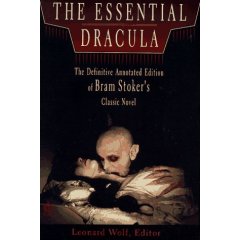
If you’ve read Dracula before and are looking to read it again at some point, I highly recommend this edition. It’s not good for a first-time read (as mine was) because the footnotes are very intrusive and give away parts of the story early on, but it’s excellent for a re-reading. The footnotes are thorough and very funny in places; you can see my delighted posts on them here and here. They are the footnotes of a book-lover as well as a scholar, and they make good reading in and of themselves.

Leave a comment

Filed under Books, Fiction

TBR shelves

Here are my nice, neat, pretty shelves full of books I own but haven’t yet read, from two weeks ago:

And here are my shelves today:

I blame this on Book Mooch; I swear I haven’t been near a bookstore recently, except to buy a copy of Indiana, which I need for a book group and Book Mooch doesn’t have. And now I’ve got two more books on the way: The Periodic Table by Primo Levi and Veronica by Mary Gaitskill. I’ll need a new shelf soon!

Leave a comment

Filed under Books, Reading

Anarchy Soup

I’m having a whole lot of fun reading the Hobgoblin’s novel. Something about writing one’s novel on a blog strikes me as really, really cool. Part of the fun of reading it for me is recognizing some of the settings and characters from our real life. I won’t discuss those details because you probably wouldn’t know what I was talking about anyway, but the locations and some of the characters sounded quite familiar to me, and I was right: the Hobgoblin confirmed that he used some places we’ve spent time in and people we’ve spent time with as inspirations for his writing. One of the professors we both knew from grad school quit her job to write academic mysteries, and I remember people in the English department speculating about which character corresponded to which faculty member. In that department the “cookie key” was well-known — the key that got you into any office — and it made an appearance in this professor’s novel, which delighted us all.

I also think it’s very interesting to be writing a novel and getting feedback on it as he goes along. I’ll probably never write a novel, so I won’t know about these things first-hand, but it must be very, very different writing a novel in the usual way and publishing chapters online as they get written. I doubt any of the reader comments will change the way the Hobgoblin is writing his novel, but those comments have an influence anyway — the encouragement that comes from the comments must have an impact, and simply knowing that people are reading the chapters as he produces them must influence his motivation to write. It makes novel-writing a less isolating endeavour and a more communal one. I guess people working on novels in writing workshops can have a similar experience, but the reader/writer relationship is different, and the way readers encounter the novel is different too.

This kind of publication is like the old 19C way of serializing novels, so that the author could get reviews and other forms of feedback before the end of the novel is written. With a blog, however, the feedback can be more immediate and direct. I’ve come to see how blogging is a form of journal-writing gone public, so that one’s journal becomes more communal than private, but to apply that model to novel writing seems to be a different thing. Journals lend themselves to daily or at least frequent publication, where it seems more natural to be able to see the process of living and thinking and writing at work. But readers rarely get a glimpse of the process of novel writing (check out Bloglily’s excellent post on the subject if you are interested).

Okay, let me go and ask the Hobgoblin when I can expect his latest chapter …

Leave a comment

Filed under Books, Writing

Book notes

It’s a good day when you come home and find three books in your mailbox! I came home yesterday and found three Bookmooch books: The Places in Between by Rory Stewart, So Many Books, So Little Time, by Sara Nelson, and Never Let Me Go, by Kazuo Ishiguro. And now, as I have no points left at Bookmooch, I’ll have to wait until someone mooches a book off of me before I can get any more.

I’m determined to finish Dracula this weekend. It’s been too long since I’ve finished a book, and I’m getting anxious. I want to start something new! And I’m closest to finishing Dracula, so that’s what it’ll be.

What I really wanted to talk about, though, is Frances Burney’s Journals and Letters, which has been so much fun to read. She meets nearly everybody famous in eighteenth-century England, it seems. She’s good friends with or hangs out at parties with Samuel Johnson, Joshua Reynolds, Edmund Burke, Hester Thrale Piozzi, and David Garrick. And the part I just began has her meeting King George III, and Queen Charlotte. She eventually becomes an attendant in the queen’s court, which it turns out she doesn’t like at all, since she has little privacy and time to herself. Reading her journals reminds me that the London literary world was fairly small and everybody seemed to know each other. Burney was very famous after the publication of Evelina; everyone wants to meet her everywhere she goes. She is painfully shy about her writing and seems to hate the attention she gets. However, the voice that comes through in the journals and letters makes me forget how famous she was. She seems so unassuming and quiet and doesn’t draw any attention to her success as a novelist that she comes across as just a regular person with a rather extraordinary life instead of the famous, very talented person she really is.

Leave a comment

Filed under Books

Proust and the inconsistency of emotion

One of the things I’m enjoying in my Proust reading is the way he captures the waywardness of the mind and emotions, the manner in which a person can feel one thing in one moment and then the opposite in the next. He describes the contrariness of emotion and desire so excruciatingly well; I recognize my own shifts and variations and inconsistencies in Proust’s characters.

Towards the beginning of In the Shadow of Young Girls in Flower, the narrator talks a lot about his desire to be a writer and his confidence, or lack of confidence, in his ability to write. And his feelings change constantly. When the narrator’s father says about the narrator’s desire to write that “The main thing is to enjoy what one does in life. He’s not a child anymore, he knows what he likes, he’s probably not going to change, he’s old enough to know what’ll make him happy in life,” he has a strange response. He knows he should be happy because his father had wanted him to be a diplomat, and now, instead, he’s getting permission from his father to do what he’s dreamed of — be a writer. But instead:

On this occasion, much as an author, to whom his own conceptions seem to have little value because he cannot think of them as separate from himself, may be alarmed at seeing his publishers putting themselves to the trouble of selecting an appropriate paper for them and setting them in a typeface that he may think too fine, I began to doubt whether my desire to write was a thing of sufficient importance for my father to lavish such kindness upon it.


Now that his father is taking his desire to be a writer seriously, he’s not so sure that he’s worthy of it. And this proclamation from his father makes him nervous for other reasons; his father’s statement that he’s old enough to know what he likes and that he won’t change has made him realize that his life has truly begun. He is no longer on the threshold of life, full of possibility, but instead is already living, and, what’s worse, his life may not change all that much. Isn’t it often true that when we finally get the thing we’ve been longing for, we realize it’s a disappointment, or that we didn’t really want it, or that getting what we want just creates a whole new set of problems?

Near the above passage, Proust offers another example of the inconsistency of our minds and emotions:

Think of the travelers who are uplifted by the general beauty of a journey they have just completed, although during it their main impression, day after day, was that it was a chore.


He talks about the “promiscuity of the ideas that lurk within us.” Isn’t that a great way to describe what living in one’s mind is like? It’s true for me, certainly. That example of the traveler works particularly well for me, because I’m reminded of my backpacking trips, which I have fond memories of, many great memories, and yet when I try hard to remember what each moment actually felt like when I was backpacking, I have to admit that it was a lot of pain, misery, boredom, and unhappiness.

So which is it? Are my backpacking trips wonderful or terrible? Does the narrator want to be a writer or not? The answer depends on the moment you are asking the question.  postCountTB(’11

Leave a comment

Filed under Books, Fiction