Category Archives: Books

Too many novels!

Check out this article over at The New Yorker. It’s the latest Shouts and Murmurs, if you’re familiar with the magazine. If you’re not, Shouts and Murmurs is a humor column; I don’t always find it funny, but this time it’s great. The column starts off with this excerpt from an article on “Ten Sure Ways to Trim your Budget”:

Check books out of the library instead of buying them. . . New releases of hard-cover novels cost $25 and more these days. If you buy just two a month, that’s $600 a year.

The author, Ian Frazier, then gives a series of quotations from people who live in a made-up world where people are addicted to novels and waste tons of money on them and could turn their financial lives around if only they’d stop buying novels. Some highlights:

Mrs. Louise Rodgers, Eau Claire, Wisconsin: “I never owned brand-new hardcovers when I was a girl, and now I want my twin sixteen-year-old boys to enjoy opportunities I didn’t have. My boys are like any American teen-agers, in that they eat, sleep, and breathe novels. And they don’t want the three-dollar used paperback version, either. It’s got to be new, mint, original dust jacket, the works. How do you tell a youngster that he can’t have that just-released Modern Library edition of the complete Sinclair Lewis he’s been dreaming of? But I guess that’s what I’m going to have to do; I don’t see any other option.”

Jules Amthor, Torrance, California: “Let me give you a hypothetical situation: I’m walking down the street, I pass a bookstore, and they have a little table out front with some of the latest novels. I pick one up. The jacket says it’s about a male professor of writing who has an affair with a much younger female student. I leaf through the book, and I come across a sentence about the student, who is also very beautiful, sleeping in the passenger seat of a car that the narrator (the professor) is driving, and the student wakes, and stretches, and looks at the professor, and—here’s the part that gets me—the pattern of the car-seat upholstery is still imprinted on her cheek. Well, there’s simply no way I’m not going to buy that book. I can be dead broke, nothing left on the credit cards—doesn’t matter. And that’s what happens to me, over and over again.”

Mitch Gelman, West Hempstead, New York: “As an accountant, the first thing I tell my clients is ‘Get a library card!’ Otherwise, you’re too subject to temptation, and liable to find yourself in over your head. Few people know that the leading cause of personal bankruptcy in the United States is the ‘Clan of the Cave Bear’ novels. You overspend on one, and, just when you begin to dig yourself out, the next installment comes along. Public libraries began during the Depression as a government measure against this very problem. They’re there for our protection, so we should use them.”

Melissa S., Manhattan: “Eventually, I was able to cut back on novels to one a month, then half a novel, then just a few pages. As of this week, I have not looked at a novel (except from the library) for eighteen months, knock wood. For the first time, I’m learning what it is to live within a budget. At the end of the month, I’m always surprised to find a positive balance in my checking account—it’s nice. Little by little, I’ve reacquainted myself with my TV. There have been some innovations in the formats of reality shows that I had known nothing about. Every morning now I make it a point to get dressed and go outside. I’m paying more attention to my hair. If I hadn’t happened to pick up that copy of the News that day, I don’t know where I’d be.”

I may have given you most of the article. Anyway — wouldn’t that be a very different world to live in?
Leave a comment

Filed under Books, Links

Hotel du Lac

I just finished Anita Brookner’s Hotel du Lac and ended up enjoying it quite a lot. You’ll find my earlier post on the book and my musings on Brookner’s reputation here. The ending — I won’t give anything away — was satisfying; it was suitably, quietly dramatic. I’m eager to read more Brookner, but I’m thinking, based on comments people made on my earlier Brookner post, that she’s probably best read occasionally rather than all in a rush. She strikes me as someone, like Elizabeth Taylor, who is good to have on hand for when the right mood strikes. I’m going to try to get her latest, Leaving Home, when it comes out in paper, and I’m curious about Look at Me after the wonderful review on Book World.

The main character, Edith, is a romance novelist, and it seems to me that it might be fun for an author to have a main character who is a writer. You can play around with ideas about writing and what authors are like and what they do and you could explore some of your own feelings about writing, or maybe create a writer who’s very different than you are.

Brookner plays around with the genre of the romance a bit: Edith can be said to have a romantic outlook on the world and on her life, in the sense that she believes in love’s power to transform. She refuses to take a more “practical” approach to her life, although many people put pressure on her to do so when she has the chance to marry a good man she does not love. We find out early on that she is involved in an affair with a married man, and the drama of the rest of the book is not so much about what will happen to that relationship, but about whether Edith will give up on love itself. Hotel du Lac is not at all a romance novel of the type Edith would write, but it is a romance novel in another sense – it’s a novel that ponders what it means to be devoted to the ideals of romance.

The hotel itself is almost a character in its own right. It’s an out-of-fashion resort hotel where one finds people who have gone there for years out of habit, and it’s a place where families and friends send women they aren’t quite sure what to do with, women who need some rest and recovery, who may have strayed from acceptable behavior and need some time to ponder their sins. Edith is there for this reason, to get herself back to normal, and, as one might expect in a novel, this is precisely what she doesn’t do. As you can imagine, a hotel of this sort is a wonderful setting for a novel – it’s a confined space full of interesting people, and Brookner makes good use of it.

What makes this novel work, I think, is the strength of the main character. I loved seeing the world through her eyes. In several scenes, Edith sits in her hotel room writing letters to her married lover, describing the hotel’s odd characters and the slow pace of life there, and I was struck as I read those letters at the way Brookner creates a sense of a gap between how Edith felt about her life and how she wrote about it in her letters. She’s trying to give shape to her life and inject some energy into it through her writing – this is true of her novels too – and the writing seems very brave and hopeful but also that much sadder because we know that real life isn’t like what it is in novels and brave, cheery letters. Edith comes across as heroic – an odd sort of hero, but a hero nonetheless.

Leave a comment

Filed under Books, Fiction

Books and book blogs

In addition to the four books I’ve had going in recent days, I’ve begun reading Sara Nelson’s So Many Books, So Little Time. I’ve got mixed feelings about it. It’s kind of fun, and it keeps me interested and happily turning the pages, but … I’m just not that impressed with her book discussions. The idea behind the book is that she’ll read a book a week for a year and then write about them. The chapters are short meditations on some of those books — she’s also got a list at the back of books she read but didn’t discuss — where she writes about how she found the book, what the book’s about, what she thinks about it. The chapters tend to have more on context, how she found the book and the circumstances in which she’s reading it, than about content.

She’s got a chapter on “The Clean Plate Book Club,” about how she learned to set down books she’s not enjoying rather than suffering through to the end, and another on what it means when a new friend gives you a book — it’s the moment of truth, when you find out for sure if this friendship will last. She writes about how important the location and the timing are in determining how much you will enjoy a book, and about what it feels like to get completely wrapped up in a book so much so that you can’t put it down.

All that’s good. But I’m reading along and thinking that my blog writer friends do this exact same thing and do it better. It’s a reading diary, and an exploration of what it’s like to be a reader, and a discussion of a lot of individual books, and I love that stuff, but I’m thinking I now prefer to get it from a bunch of blogs rather than a book. It strikes me as much nicer to read a person’s reading diary as it gets produced, in regular blog posts, and to be able to comment on it and maybe influence how that reader thinks and what he or she reads, and to be able to respond on my blog, and do all the things book bloggers do. As far as reading diaries go, they seem much more interesting on blogs than in books, where they can be interactive and immediate.

I’m also not connecting with Nelson’s choice of books, which accounts for some of my mixed feelings. I picked up the book hoping to get some good recommendations, at least, but nothing she’s reading is really getting my interest. For this type of book to work, the author has to win the reader over, and I’m feeling a little bit resistant still. I’m hoping to get a little more excited about the book as I read further (being a loyal member of the Clean Plate Book Club, I’m afraid), and it is reliably entertaining, but I’m coming away from it feeling more than justified in all the time I devote to reading book blogs.

Leave a comment

Filed under Blogging, Books, Nonfiction

Anita Brookner

In addition to the four books I’ve had going in recent days, I’ve begun reading Sara Nelson’s So Many Books, So Little Time. I’ve got mixed feelings about it. It’s kind of fun, and it keeps me interested and happily turning the pages, but … I’m just not that impressed with her book discussions. The idea behind the book is that she’ll read a book a week for a year and then write about them. The chapters are short meditations on some of those books — she’s also got a list at the back of books she read but didn’t discuss — where she writes about how she found the book, what the book’s about, what she thinks about it. The chapters tend to have more on context, how she found the book and the circumstances in which she’s reading it, than about content.

She’s got a chapter on “The Clean Plate Book Club,” about how she learned to set down books she’s not enjoying rather than suffering through to the end, and another on what it means when a new friend gives you a book — it’s the moment of truth, when you find out for sure if this friendship will last. She writes about how important the location and the timing are in determining how much you will enjoy a book, and about what it feels like to get completely wrapped up in a book so much so that you can’t put it down.

All that’s good. But I’m reading along and thinking that my blog writer friends do this exact same thing and do it better. It’s a reading diary, and an exploration of what it’s like to be a reader, and a discussion of a lot of individual books, and I love that stuff, but I’m thinking I now prefer to get it from a bunch of blogs rather than a book. It strikes me as much nicer to read a person’s reading diary as it gets produced, in regular blog posts, and to be able to comment on it and maybe influence how that reader thinks and what he or she reads, and to be able to respond on my blog, and do all the things book bloggers do. As far as reading diaries go, they seem much more interesting on blogs than in books, where they can be interactive and immediate.

I’m also not connecting with Nelson’s choice of books, which accounts for some of my mixed feelings. I picked up the book hoping to get some good recommendations, at least, but nothing she’s reading is really getting my interest. For this type of book to work, the author has to win the reader over, and I’m feeling a little bit resistant still. I’m hoping to get a little more excited about the book as I read further (being a loyal member of the Clean Plate Book Club, I’m afraid), and it is reliably entertaining, but I’m coming away from it feeling more than justified in all the time I devote to reading book blogs.

Leave a comment

Filed under Books, Fiction

A recent acquisition

We’ve got four used bookstores in my small town, which I’m sure I’ve mentioned before, and last night, while we were waiting for our takeout pizza, the Hobgoblin and I wandered over to one of them. It’s a very odd bookstore, mainly because it’s kind of hard to get to the books. It’s a small room to begin with, and then every aisle is full of boxes, which block some of the books and make it hard to get at the others. I have no idea why this is. And I wonder how much money the owner makes with the place. My town really isn’t big enough to support four used bookstores, and this one doesn’t seem to get many customers as far as I can tell.

The owner is rather odd. Does that come with the territory? Are many used bookstore owners odd? I’d love to own a used bookstore myself, and I’m not sure if I’m odd enough. Maybe I am. It’s difficult to measure one’s own oddness. Although, truth be told, when I try to think about what makes this man odd, I can’t come up with particulars except for the boxes that block the books and the sense that he spends an awful lot of time alone in the store, most likely talking to himself. He seems caught up in a world all his own, and walking into the store feels a little bit like a personal invasion.

Anyway, he’s very chatty, and he remembered what I bought the last time I was in the store: two Elizabeth Taylor novels. I was impressed. I was also very happy to see that he had two more Elizabeth Taylor novels in stock, and I made sure to walk away with one of them: The Blush, which, I just this very moment discovered is not a novel, in fact, but a book of short stories.

It’s nice to know that there’s another Elizabeth Taylor book for sale within walking distance of my house, the book I left behind. I loved the two novels I read last summer, and I’ve decided it’s a very good thing to have an unread Elizabeth Taylor book in the house, ready for me when the mood strikes.

I wasn’t planning on buying any more books, but it’s rare that I walk into a used bookstore without buying something — and that’s not so much because I see things I can’t resist but because there’s something about the smallness and intimacy of used bookstores that makes me very aware of the owners, and I feel this urge to help them out and support the store. And it’s not hard to give in to this urge when the books are fairly inexpensive. So I find something or other I’ll want to read eventually and feel much better. There’s something I really don’t like about walking out of a used bookstore empty handed.

Leave a comment

Filed under Books, Life, Reading

A challenge!

Here’s a challenge I think I can do. It’s from Overdue Books, and here’s what it is:

“If you are anything like me your stack of purchased to-be-read books is teetering over. So for this challenge we would be reading 5 books that we have already purchased, have been meaning to get to, have been sitting on the nightstand and haven’t read before. No going out and buying new books. No getting sidetracked by the lure of the holiday bookstore displays.”

Now, what to pick? Following Kate’s example, I’m going to try to pick books, at least some books, that have been sitting around for a while, not ones I’ve recently acquired. I’ll try to pick at least one difficult book — something that feels like a challenge and that I’ve been avoiding reading because I feel intimidated by it.

Okay, here’s a try. I reserve the right to make some changes as I go along, but if I do make changes, I’ll substitute something I’ve had around for a roughly equivalent period of time.

  • The Lover, Marguerite Duras. I’ve had this forever. And when I’m finished reading it, I can take another look at Litlove’s post on it from a while back.
  • Molloy, Samuel Beckett. I’ve also had this one around forever. This is my “challenge” challenge read — something I’ve been avoiding because it looks scary. Perhaps I’ll be surprised.
  • Snow, Orhan Pamuk. I haven’t had this one quite as long, but it’s been staring at me from my TBR shelves for a while now.
  • Buddenbrooks, Thomas Mann. I’ll have more time on my hands than usual in December, so I think I can commit to a longer novel, and I’ve had this one for a number of years.
  • Runaway, Alice Munro. I’ve never read her, and I simply must.

One of these books overlaps with my Thirteen Classics in 2007 challenge: Thomas Mann’s Buddenbrooks. Now it’s virtually certain that I’ll make it through that book 🙂

Leave a comment

Filed under Books, Lists, Reading

The Time Traveller’s Wife, part II


I finished the book last night, and I liked the second half almost as much as the first (which I posted on here). A couple things bugged me, though. The first is that I felt the novel got a bit long; about 2/3 of the way through it, the pace slowed down and I felt ready to get to the end.

The bigger thing that bugged me was a conversation Henry and Clare had when Clare confessed to Henry some of her sexual experiences before their relationship began (The adult relationship, that is — they’d had a friendship going on when she was a child and he was time-traveling to her as an adult … it’s complicated). Henry had slept with lots of women before he met her and Clare didn’t have much trouble with that fact. She worried, though, about what Henry would say about her own experiences, and I kept waiting for Henry to point out the potential double standard or for Clare to realize it, but neither of them did. That struck me as strange.

And then at the end (I’m not really giving anything away here), Niffenegger gives us a quotation from The Odyssey about Odysseus and Penelope reunited at long last, and I’m reminded of how Penelope spent the whole Odyssey waiting, and I realize Clare spends the whole book waiting too; in fact, the first words of the book are “It’s hard being left behind. I wait for Henry, not knowing where he is, wondering if he is okay. It’s hard to be the one who stays.” I’m bugged by the stereotypes here. These two things together — Clare as the woman waiting and as a woman who worries that her husband will be angry that she slept with another man, well before their marriage — are making me rethink my response to the book.

So, if this is a kind of retelling of The Odyssey, in a very loose sort of way, does Niffenegger do any updating of the traditional gender roles in that ancient story? I’m thinking not, but maybe I’m missing something. Any thoughts, those of you who have read this??

BUT, the experience of reading this book was great, and I do recommend it, the above reservations aside. Its chief pleasures, for me, were trying to wrap my mind around what it would be like to time travel and meet myself as a younger or older person. Also, Niffenegger does interesting things with the problem of how knowing the future can possibly change the future; Henry refuses to tell some things about the future, saying that he feels it would be wrong, but there’s nothing to stop him from giving things away, and, in fact, he uses his ability to time travel to make lots of money on stocks and lotto. He does tell people what will happen to them now and then. But he always says that those things will happen anyway no matter what people do and that they can’t change it — and in a few cases he creates future events by telling people that those events will happen.

So we’re left with the question of free will: it seems from what Henry says that the future is set and we can’t change it, and yet sometimes he seems to interfere with the future. But when he interferes with the future, is he really changing it or is he living out what would have happened anyway, no matter what?

The book makes you think about interesting questions like this — and it’s an entertaining love story. Not bad, eh?

Leave a comment

Filed under Books, Fiction

Audiobooks: An experiment update

Last week I wrote about experimenting with listening to audio books while riding on the trainer. My update is that I haven’t actually conducted the experiment yet; fortunately for me, the weather has been good enough that I could ride outside — yesterday, for example, I rode outside for two hours and although my toes were a bit cold when I returned, I did fine.

I have been listening to my chosen audio book, however, Jacqueline Winspear’s Pardonable Lies: A Maisie Dobbs Novel; I’ve just been doing it in the car. I’ve got a half hour commute to work, and while I usually listen to NPR to keep up with the news, I was so excited about the novel that I decided to listen to it right away.

I used to listen to audio books all the time, back when I had a really horrendous commute of 1 1/2 hours. They were what kept me going; I could only listen to NPR for so long before the stories started to repeat and I started to go crazy. Listening to Winspear’s book now, I’m reminded of how much I like listening to audio books, and how I missed listening to them after we moved and I didn’t have as much time for them anymore (although I definitely did not miss that long commute). For most of the books I listened to, I liked the reader — which is crucial in an audio book — and I felt like the reader became a character him or herself, one that I could get to know a bit. I found myself responding much more emotionally to an audio book than to a regular book. Sometimes I’d be crying as I drove down the highway. I wonder if anybody ever noticed. I’m not sure what this means, exactly. Is my reading with a regular book detached and more cerebral somehow? There’s something about a real voice telling a story that makes it seem intimate and very real.

The reader for the Maisie Dobbs novel is great; I love her voice and it’s fun listening to her do different British accents. For all I know she may be butchering some of them, but it all sounds good to these American ears.

And I’m enjoying the novel too. I don’t read mysteries all that often, and now I’m wondering why. Luckily, all I have to do is check out Danielle’s post over here to find a whole bunch of them that look good. I’ll write in more detail about the novel when I’ve finished it, but so far, I like the main character a lot, and I’m interested in the time period — it’s set in 1930 and it deals with the aftermath of World War I. One of Maisie’s assignments is to investigate the deaths of two British soldiers in France in the war. And it’s got an element of eastern mysticism and philosophy that’s intriguing. More on that later.

Leave a comment

Filed under Books, Fiction

Reading update


I think I posted recently about not wanting to acquire new books. Well. I have. First of all, I needed to buy volumes three and four of Proust, The Guermantes Way and Sodom and Gomorrah. I’m less than 200 pages away from finishing volume two, so I need to have the next books on hand. They look serious. Proust is such a stable, steady part of my life these days, I’m glad to have some more thick volumes on hand.

Then, the way that Book Mooch works is that you can create a wishlist, and then when other people post books from your wishlist on the site, they’ll send you an email letting you know the book is now available. So I can decide with the best of intentions not to mooch any more books, but then they send me those emails about books I’d really like that I can get for free, and it’s hard to resist.

So when I got an email about Bill Bryson’s A Short History of Nearly Everything, I snapped it up. I’ve now got two science books on my shelves (the second one is Brian Greene’s The Fabric of the Cosmos), so I should get to one of them soon. I do like reading science, although I don’t do it often.

Also, I’ve heard such good things about Nick Hornby’s The Polysyllabic Spree, I couldn’t resist that one either. It sounds like a fun book about books and reading, which strikes me as a perfect thing to read right now. And also, I saw Mark Danielewski’s House of Leaves, and decided to try it. I’m not sure if I’ll love it or find it gimmicky, so I’m curious. I’ve found that things people call gimmicky I tend to like, so I’m optimistic.

Who knows when I will get to these, but I’m glad they are around. I still have five points left, which could mean five more free books, so I’ll see what possibilities turn up in my email box.

Leave a comment

Filed under Books, Reading

Frances Burney

I’m nearing the end of Frances Burney’s Letters and Journals, about 100 pages from the end of a 560-page collection. As I think back over the book, I’m realizing that a few sections really stand out and the other parts, while I might not remember them in detail, give me a more general feeling for what Burney’s life was like. The parts that stand out are the publication of Evelina and Burney’s acute embarrassment any time anybody mentioned the novel — and they mentioned it a lot because it was hugely successful, the sections where Burney meets a lot of famous people (Johnson, Reynolds, Burke, for example), the period she was working at court and got to know the king and queen, and, just recently, her account of her mastectomy.

This last is truly horrifying. She got breast cancer at the age of 58 while she was living in Paris with her French husband. She saw numerous doctors, some of whom wanted to operate and others who did not. About a year after she first noticed the lump in her breast, they decided to operate. She tells the story over 10 pages or so, and it’s one of uncertainty and agony. The doctors — for some reason — decided that they wouldn’t tell her the date of the operation but would give her only two hours notice. And then they wait for three weeks until they actually follow through, so she spends three weeks wondering when it will happen.

And, of course, there’s no anesthesia at this time. Burney didn’t mention any kind of pain-killer whatsoever, and it seems she was conscious through the entire operation. She describes it with a lot of raw detail; I won’t quote here because it’s too awful, but she doesn’t spare the reader at all. She describes being in tremendous pain, but also being embarrassed when seven doctors enter the room to perform and observe the operation. She does her best to keep her maid and nurses by her side to have some feminine comfort, but all but one dash off in fear. She describes climbing up into her bed surrounded by all the doctors — how different from a modern operating scene! — who place a hankerchief over her face, although it does little good as she can see through it. When she sees the “glitter of polished steel,” she shuts her eyes.

I’ve never read anything like this before, and I wonder at Burney’s motivations for telling it in such detail. She tells the story in a letter to her sister, and she frames the story with a warning to women to pay attention to the signs of cancer. It must be that the experience was so profound she felt she needed to record it, and it’s probably also the novelist in her who has turned many episodes of her life into set-pieces in the letters and journals. And I would think describing the details would help her get some kind of control over or distance from the experience.

I’ve always been grateful for modern medicine, but I feel this even more strongly now.

Leave a comment

Filed under Books, Nonfiction

The Time Traveller’s Wife

I’m about half way through The Time Traveler’s Wife and it was exactly what I’ve been needing: something absorbing and long but that reads quickly so that I don’t feel I’m getting bogged down or that I’ll be reading it forever.

What an interesting book it is! The basic premise — and I’m not giving anything away — is that of the two main characters, one of them, Henry, travels through time. The other, his girlfriend/wife, Clare, doesn’t. What makes the book interesting, I think, is that time traveling turns out not to be glamorous at all; rather, it is a huge pain in the neck. Henry has no control over when he will travel through time, so he’s constantly worried about disappearing at the wrong moment. He won’t drive a car, for example, for fear that he’ll time travel while driving and cause horrible accidents.

And when he time travels, he leaves a pile of clothes behind him and lands in his new time completely naked. So the first thing he has to do, always, is find clothes before people find him and he gets into all kinds of trouble. He becomes a first-rate thief in order to steal clothes and food — he’s also always ravenous when he time travels. He runs obsessively to keep in shape so he can flee pursuers. Clare loves him deeply but just about everyone else in the novel finds him suspicious, and it’s clear that Henry is a complicated, potentially dangerous, mysterious, and difficult person.

He tends to travel to times and places in his own life that caused him great stress. This means he revisits some awful memories again and again. Because he travels to scenes in his own life, he meets older and younger versions of himself. He also visits Clare, which creates some very odd situations. He visits her when he is older, in his 40s, for example, and she is younger, say, 6. Can you imagine such a scene? Meeting your spouse when he/she is a child and you are an adult? So when Clare meets Henry in “real time,” she’s already spent hours and hours with him because of his time traveling.

This book is a mind-bender.

It’s written in first-person, switching back and forth between Henry and Clare, and the switches occur frequently, so I sometimes get confused about who is talking and have to turn the page to check. The effect of this, I suppose, is that the two main characters blend together, although I do like getting their different perspectives on the same scene.

One of the interesting characteristics of Henry’s time travel is the way he’s more likely to disappear into another time when he’s under a lot of stress. So he tries to keep himself calm in order to stay in one place. This leads to some high drama on his wedding day — because what could be more stress-inducing than going through a wedding ceremony? His particular problem is that this stress might mean that he leaves his bride stranded at the altar.

Henry talks about his efforts to keep calm as attempting to stay in the present moment. So the phrase “staying in the present” that we use to mean staying focused on what’s going on around us rather than wandering off to other places in our minds becomes, for Henry, something physical as well as mental. His “staying in the present” means, literally, not traveling to the past or the future. So in a way, Henry’s struggles to stay in one place become a way of thinking about the efforts we might make to “stay present,” or “stay grounded.” Who wants to be absent from their own life? The novel plays with the mind/body relationship: is a wandering mind that much different from a wandering body?

I shall let you know how I like the second half of the book …

Leave a comment

Filed under Books, Fiction

George Sand’s Indiana

I liked this book very much; unfortunately, I wasn’t in the mood to focus closely as I read it or to take notes or even gather my thoughts much about it as I read, so I won’t have a long or particularly intelligent post.

But I do recommend it if you haven’t read it and are interested. It’s a good story, and it takes up a lot of interesting ideas, chief among them, for me, about women’s lot in a society run by men. Indiana doesn’t get a great education and she doesn’t have much experience in the world. A lot of what she learned about matters such as love and marriage come from novels — always a sign of danger to come. It is a long and venerable tradition to use a novel to warn against novel reading.

She is married at 16 to an older man so she has no time to explore life and look around her as an adult. She lives in a time when emotional displays are valued in women, but rationality is not; Indiana seems not to have had the opportunities to develop her mind and the male characters seem lacking in the ability to value emotion. How is she to judge Raymon when he comes along? How is she to know she should stay far, far away? She has no real grounding from which to make sense of her situation.

And what an odd situation it is. She is married to Colonel Delmare, a jealous and violent man; she is watched over by the reserved and mysterious Ralph, a childhood friend; and she is pursued by the charming but untrustworthy Raymon. Her closest female friend dies early in the novel, leaving her quite alone. So the men vie for her attention and she falls for Raymon, not realizing that he is incapable of returning her love. The novel becomes the story of Indiana slowly making that realization — that she is a much better, stronger person than the one she loves — and dealing with the consequences.

I was shocked at the descriptions of Delmare’s violence toward Indiana. This struck me as a harsher, more direct condemnation of men’s power over women than I’m used to seeing in novels of the time period. Stefanie pointed out the horrifying scene when the dog Ophelia is brutally killed, and I think you can see this as an echo of what happens to Indiana herself — she is portrayed as an innocent creature brutally struck down by a cruel world.

Ralph is an odd character, with his perfectly impassive face and his seeming heartlessness, although we learn by the end of the novel that seeing him as heartless is a mistake. But through most of the novel he hovers about, shadowing Indiana and rescuing her repeatedly, but not making clear his intentions or his role until the novel’s end. And what makes Ralph an even odder character is his semi-incestuous relationship with Indiana. He’s described as being her brother, her guardian, and her lover. In this sense, I’m not sure what it means that Indiana ends up with him at the end — has she found her true love, or has she settled for something more familiar and calm and safe?

I understand that the novel’s ending is controversial. The question seems to be whether we should see Indiana as subdued once again by the patriarchy — she seems lifeless and spiritless at the end — or whether this is actually a hopeful ending, illustrating how one woman escaped from the two men who caused her so much pain and established a comfortable life devoted to helping others. For she and Ralph decide to spend their time and energy and money buying the freedom of slaves.

I feel conflicted about this. It was my impression as I read that Indiana’s voice and energy were written out of the text; in the final pages Ralph tells her story and all she seems to do is retire early to bed. This didn’t seem like the Indiana of the earlier part of the novel. On the other hand, though, she has escaped, and, most importantly, escaped alive and she will live on to affect the lives of many people — those slaves that she and Ralph are working to free. We are led through the novel to expect her death and to see death as her only option, but the novel’s final word thwarts this expectation.

I’ll be curious to see what others have to say about this.

Leave a comment

Filed under Books, Fiction

Can you guess the book?

I’m stealing this from Dr. Crazy who got it from Anastasia. I’m all about memes these days. They are great when I’m feeling tired and uninspired.

1. Grab the nearest book.
2. Open the book to page 123.
3. Find the fifth sentence.
4. Post the text of the next 4 sentences on your blog along with these instructions.
5. Don’t you dare dig for that “cool” or “intellectual” book in your closet! I know you were thinking about it! Just pick up whatever is closest.

“His work no longer seemed as inevitable as before. I began to wonder whether originality really shows that great writers are gods, each of them reigning over a kingdom which is his alone, whether misleading appearances might not play a role in this, and whether the differences between their books might not be the result of hard work rather than the expression of a radical difference in essence between distinct personalities.

We went in to dinner. Lying beside my plate was a carnation, its stem wrapped in silver paper.”

Hmmm. I don’t think that’s hard to guess at all, especially if you’re a regular or semi-regular reader of this blog. I could have picked something harder, but I was following direction #5 to the letter, and went for the closest thing. And my chair is right next to my … oh, never mind. Just guess. And then try it for yourself!

Leave a comment

Filed under Books, Memes

The Bible

I was reading recently about Victoria’s Bible-reading project and found myself intrigued. She’ll be reading one or two books of the Bible every month until she’s finished, doing it partly for intellectual reasons and partly for personal ones. As you all know if you read my post yesterday, I come from a Bible-reading family; I grew up reading, studying, listening to, memorizing, analyzing, hearing sermons on, and doing creative projects in Sunday School about the Bible. I feel like I know it well.

I couldn’t even tell you how many times I’ve read it because it was such an ever-present part of my life. I may have tried to read it systematically once or twice, but mostly I read bits and pieces as we studied it in Sunday School or youth group or Bible camp or Vacation Bible school or whatever else I was doing. I’m pretty sure there’s not a sentence of the Bible I haven’t read, but that’s not because I read it in the usual way one reads a book.

There must be a huge value to studying a book in this way as a child; even though my Christian upbringing causes me a lot of trouble and grief in some ways, I’m always grateful for that training in history and theology and myth and language.

And yet I feel like I have so much to learn about it still. I grew up reading and studying the Bible as though it were the inspired word of God — which, if you read yesterday’s post you’ll know I no longer believe — and this is very different from the way I’d read it now. I haven’t read it in quite a few years, except for short passages if I happen to attend a church service, which happens rarely these days.

But I have read some books about the Bible, and I’ve greatly enjoyed doing so. If you are interested in this sort of thing, I highly recommend Jack Miles’s book God: A Biography and Karen Armstrong’s A History of God and anything by Elaine Pagels, but especially Beyond Belief. These books were so much fun for me because I was finally seeing the history of the Bible that nobody had told me about when I was younger — the uncertainty about authors (not God!) and the complicated textual histories and the sheer weirdness of Genesis. When you look into it closely and learn something about the history and cultural background, you’ll discover that Genesis is one of the weirdest things ever written. There’s a whole world of Bible scholarship I never learned about, some of it written by believers and some by non-believers — scholarship that doesn’t take core evangelical beliefs in the divine inspiration and inerrancy of the Bible as a starting point. I find this scholarship fascinating.

All of this was a revelation to me, and it still is in a way; I haven’t read a book about the Bible in a while, but I’ve got my eye on Bart Ehrman’s books and am always on the lookout for others like them.

So I’m just as fascinated in the Bible as ever, and I’m pleased that my life story has a book as a central part of it, even though the role that book has played has changed dramatically. I’m not planning on re-reading the Bible anytime soon, but what I’d like to do at some point, some years down the road, is to read it again and see how it’s changed for me. Right now I’m content to read about the Bible occasionally, but someday I should take another look at the text itself. I may see some surprising things in it once again.

Leave a comment

Filed under Books, Reading

Book notes

I now have seven points over at Book Mooch. That means seven free books, if I choose to mooch them. But, like Danielle, I’m trying not to mooch too many more books than I mail out, so I’ll let those points sit around for a while and I’ll wait for a book that I just can’t resist to appear.

That doesn’t mean I haven’t made requests over the last couple weeks, however. That’s just a resolution to take effect starting now. I just received Penelope Fitzgerald’s The Blue Flower, a book I’ve heard about from Ex Libris, and I’ve got Peter Ackroyd’s The Lambs of London on the way, which I remember hearing about on Book World. And the wonderful Victoria just sent me A Gentle Madness by Nicholas Basbanes.

Also, W.G. Sebald’s The Emigrants will also be arriving shortly, as will De Quincy’s Confessions of an English Opium Eater, a book on my list of classics for next year.

And then there’s Mariama Ba’s So Long a Letter, which it turns out the Hobgoblin had and I didn’t realize it until recently, so now I’ve claimed it for my TBR shelves. That one I read about at Around the World in 100 Books.

What Kate said about blogs enriching our reading is absolutely true, isn’t it?

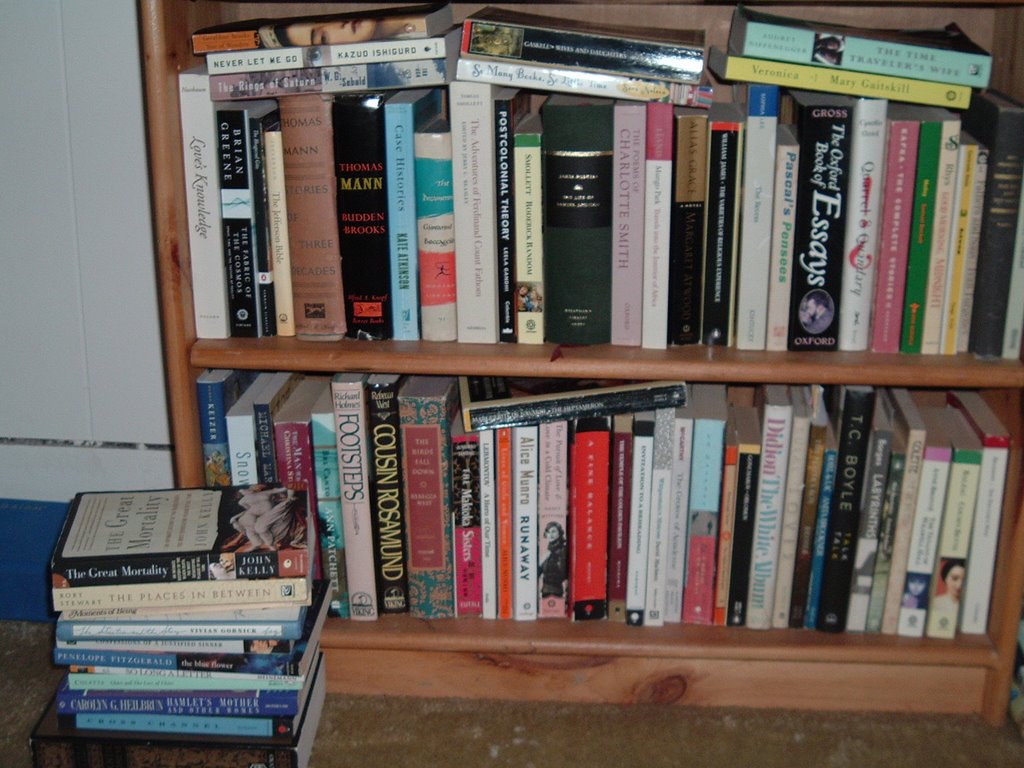
But when will I have time to read all this? I’m about to finish Indiana, and then I’ll get to choose what’s next. I’m considering the Fitzgerald book, or perhaps a Nancy Mitford novel, or perhaps The Time Traveler’s Wife, which has been sitting around for a little while. I’ve got lots of choices. Take a look at the latest version of my TBR shelves:

Leave a comment

Filed under Books, Reading

Lists, lists, lists!

A while back people were writing quite a lot on that book 1001 Books You Must Read Before You Die, and thanks to Bookslut’s recent mention, people seem to be doing it again. So I clicked over to the list and counted how many I’ve read. Whew! That was hard work. I can’t believe I just spent all that time counting. I’m not entirely sure I didn’t miscount. But my estimated total is 185 books read from the list. There are a lot left!

But … it’s not as easy as that. If you’ve looked at that list or a similar one and tried to do your own count, you probably have noticed how difficult it can be to figure out what you’ve read and what you haven’t. For me, I wasn’t sure whether or not to count books I’ve listened to on tape or CD. Ultimately, I decided not to count those. And then there’s the category of books I know I read when I was very young and now hardly remember. Yeah, I read To Kill a Mockingbird, but I really don’t feel I should count it because I couldn’t tell you a thing about it. And then there are books I’m not sure if I read or not. Did I really read Of Mice and Men, or am I remembering incorrectly? Which Graham Greene books did I read? And then there were a couple titles of short stories, and I wasn’t sure if the list was referring to the short story only or if the title was also a title of a collection. I’ve read “The Yellow Wallpaper,” but is that story the thing the list is referring to?

If I only counted those books I could write a reasonable summary or review of, my 185 number would be a lot smaller.

I did a lot better in the earlier centuries than in the 20th and 21st. I rocked in the 18C. I could complete that century without too much trouble: 16 books left. Well, that would be a little bit of trouble. But I’m not planning on following that list. I’ll hang on to it for a good source of ideas when I want them, and that’s it.

And then there’s Susan’s Thursday Thirteen list: 13 Classics to read in 2007. My list is a day late, and it’s not a list I’m committed to, but I thought I’d play along anyway. Here’s my list of 13 classics I’m considering reading in 2007:

1. Marcel Proust, The Guermantes Way, Sodom and Gomorrah, The Captive, The Fugitive, and Time Regained. If I can’t think of 13, I’ll separate these out and count them individually, but for now, I don’t want to bore you with too much Proust.
2. Anne Bronte, The Tenant of Wildfeld Hall. I’ve had this book around for a while. Someone mentioned it’s kind of gothic, so maybe it’s a good October 2007 read.
3. Frances Burney, Cecilia or Camilla. I’ve read her other two novels already, and now it’s time for these two. Or one of the two, at least.
4. Miguel de Cervantes, Don Quixote. This is a major one I need to tackle.
5. Virginia Woolf, The Voyage Out.
6. Virginia Woolf, The Years. Must read more Woolf.
7. Thomas Mann, Buddenbrooks. This is on Susan’s list also, and I’ve had it around for a long time. It looks like a great long, absorbing read.
8. Gertrude Stein’s Three Lives. Another one I’ve had around forever. A recurring theme in this list is “books I’ve had around forever but have been avoiding because they are slightly intimidating.” Time to get over this.
9. Elizabeth Gaskell, Cranford and/or Wives and Daughters. I love 19C novels, so I’m expecting to love these.
10. Balzac’s Cousin Bette. I’ve never read Balzac and would really like to.
11. William James, The Varieties of Religious Experience (see #8).
12. Thomas DeQuincy’s Confessions of an Opium Eater. Who can resist that title?
13. James Hogg, Private Memoirs and Confessions of a Justified Sinner. Ditto. I’m fascinated by confessions.

We’ll see how I do!

Leave a comment

Filed under Books, Lists

Mid-semester reading and riding

I started an experiment last spring with reading multiple books at once, and I have come to love it, but I’ve been needing to revise that practice lately. It turns out that when I’m stressed and busy — as I always am in the middle of a semester — I can’t handle it as well, and I feel the need to cut back. Danielle has a post on this topic, on wanting to cut back, and I’m agreeing here. I get even more stressed when I feel that I’m not reading in a particular book enough — those of you who are working on a book for months or years, how do you keep the momentum going?

Now I’ll be working on Proust for months and maybe years, but I’ll be doing that steadily. What’s harder for me to understand is reading in a book — especially a novel — only now and then so that the reading process extends for ages. I need to be making steady and regular progress. Without that, don’t you lose the thread of the story, forget characters, have to skim what came before? Or maybe that’s just me and my bad memory. I like having multiple books going, but I need to have time to read in all of them at least a couple times a week; otherwise I don’t really feel like I’m really reading.

So I finished the biography of Colette, and I’m not going to start another book until I finish something else. That leaves me with four books, one of which is a book of poems (Jane Kenyon’s Otherwise) which I don’t feel I need to read as quickly. And then there’s George Sand’s Indiana, which I will probably finish next, Fanny Burney’s Journals and Letters, and, of course, Proust.

As for riding — yesterday was my coldest ride yet at 47 degrees, and it started raining halfway through. Riding in the middle of the semester is even tougher than reading in the middle of it, but I’m determined to carve out some hours for both. Luckily, I don’t teach on Tuesdays and Thursdays until mid-afternoon, so I have some guaranteed daylight hours on those days. The challenge with riding in the winter is to fit it in before sunset (I won’t ride in the dark — too dangerous), and that makes the college teacher’s life perfect, with its flexible schedule. Unless, of course, I have meetings, which I did yesterday. Then I have to get on my bike even earlier to get home on time and then straggle into the meeting a minute or two late and with my hair still damp from my late-morning shower (because I refuse to use a hair dryer — what’s the point when the air will dry my hair for me?).

But you know what? I have priorities, and riding my bike is pretty high on the list. Don’t tell this to anybody at work, but when it comes to where I put most of my thoughts and energy, it’s not into work, it’s into my riding and my reading. That’s what keeps me sane, I think.

Leave a comment

Filed under Books, Cycling, Reading

Colette

I have finished reading Judith Thurman’s biography of Colette, Secrets of the Flesh, and I’m looking forward to reading some of Colette’s fiction (at some point in the future — I’m not entirely sure when). I probably should have read more of the fiction to begin with and the biography later because I got a little tired of Thurman’s descriptions of books I hadn’t yet read. This is not a criticism of Thurman’s writing — just an observation of how it felt to read about the books rather than reading the books themselves. I very much like the idea of Kate’s upcoming Virginia Woolf project (briefly mentioned here): reading Woolf’s work chronologically as she reads through Julia Briggs’s biography Virginia Woolf: An Inner Life. With Colette that would be a huge undertaking — and I imagine it would be a pretty big undertaking with Woolf also — and one I’m not capable of doing with any author right now. But doesn’t that sound fun? What a sense of the author’s development you’d get, and what interesting dialogue between the work and the biography you’d hear.

As for Colette, she’s a fascinating person. She’s such a different person from me, I’m not sure she could be any more different, and that’s part of why I liked reading about her. I like reading about people I probably wouldn’t like or would be scared of and people who would ignore me or dislike me from the safe distance of the corner of my study. She had amazing energy first of all. She wrote a lot, including essays, memoirs, novels, novellas, stories, reviews, plays, screenplays, journalism. She was an actress and a mime and she toured endlessly. She ran her own business selling beauty products.

And she worked hard to subvert social expectations and norms. She had numerous love affairs with both men and women. She became an actress when this was unacceptable for a woman from her social background. Her great themes of love and sex scandalized some readers. She’s an elusive figure, often exaggerating stories about herself and doing whatever she needed to to tell a good story. I imagine it was very hard to write a biography about her because of these evasions; Thurman was constantly having to second guess and qualify and question Colette’s own claims about herself.

In a way Colette comes across as very selfish. She is known for neglecting her daughter and her mother at times and for failing to take a stand in World War II during the German occupation of France when she published her works alongside Nazi propaganda. Her husband during the war was a Jew, and Colette worked hard to get him out of a detention camp, and yet she seemed oblivious to the resistance movement and to the larger political implications of her actions.

And yet while recognizing her selfishness or whatever we might want to call that troubling quality of hers, we can also see her as a powerful, larger-than-life woman who’s admirable for her energy, her strong will, and her insistance on being exactly who she is and nothing else. And, of course, what will matter in the long run is the writing.

I recently received her novels Cheri and The Last of Cheri in the mail, and I will probably start there when I begin to read her fiction. For those of you interested in her, I read My Mother’s House and Sido recently, both autobiographical works (sort of — as always with Colette one must qualify!) that I recommend highly.

Leave a comment

Filed under Books

So much for book reviews

As I’ve written about before, I read book reviews less often than I used to, but I do still enjoy a quick skim through the New York Times Book Review on Sunday mornings. Yesterday made me wonder why. The main problem was that I didn’t like Daniel Mendelsohn’s review of Jonathan Franzen’s new book The Discomfort Zone. The review struck me as overly focused on Franzen as a person, whom Mendelsohn clearly does not like. Mendelsohn does critique the writing too, but the whole thing is colored by his opening complaint about Franzen’s “excessively lofty sense of himself.” He describes the book as

an unappetizing new essay collection that makes it only too clear that the weird poles between which the author seemed to oscillate during l’affaire Oprah — a kind of smug cleverness, on the one hand, and a disarming, sometimes misguided candor, on the other; a self-involved and self-regarding precocity and an adolescent failure to grasp the effect of his grandiosity on others — frame not only the career, but the man himself.


Franzen has done a number of stupid things (the Oprah incident being the worst), but I can’t find it in myself to get as annoyed with him as a lot of people seem to. I’ve noticed on a number of the bigger book blogs that Franzen-bashing is kind of normal and expected — like you don’t have to bash the guy at all, just mention his name and people know what you mean — but I don’t see why. I liked his novel The Corrections, and I liked his book of essays too, How to Be Alone. And he strikes me as someone who has some flaws, like speaking before he thinks and therefore saying stupid things that get him into trouble, but also as someone who tries hard to write honestly about himself, flaws and all. In his essays, I suppose, I see a level of candor that I like. He has a quality I see in other essayists I like such as Mary McCarthy: a desire to tell the truth even if it makes him look foolish.

I don’t take gleeful delight in mocking Franzen because I can somehow see myself saying something stupid at just the wrong time to the wrong person, and although that person almost certainly won’t be Oprah, I’d feel trapped by the whole incident anyway and I’d hate to be defined by it, in the way Franzen is defined by his bad incident.

I’m not certain I’ll read Franzen’s new book, but that’s largely because I’ve already read big chunks of it in The New Yorker. We’ll see. I might check it out anyway.

The other thing that annoyed me about the book review yesterday was the quotation from Adam Gopnik’s new book Through the Children’s Gate that the reviewer ends with. This is about a chess match:

“Luke next played a slow girl who was taking everything down in proper notation,” Gopnik writes about his son. Of course the boy lost, learning a concrete lesson. “ ‘Girls with notebooks are risky,’ he said, truer words never having been spoken.”


At this point, I was ready to fling the paper across the room. Yeah, smart girls — you gotta watch out for those.

And I’ve been wanting to read Daniel Mendelsohn, who wrote the bad Franzen review, and Adam Gopnik as well. I might read both of them, but I’ll probably put it off for a while.

Leave a comment

Filed under Books, Reading

Friday reading notes (warning: a bit whiny)

I’ve been in what feels like a long reading slump where I can’t seem to get in a rhythm with my reading. I feel like everything takes too long to read and I get bored with it about half way through, and I’m not focusing on what I’m reading so I forget a lot or rush through details that are important. The fault lies with work, I’m sure; I’m having a good time at my new job, but it’s a lot of stress and in the evenings when I usually have some time for myself, I don’t have a lot of energy and reading often doesn’t go so well.

I did enjoy The Mezzanine a lot, but that was very short, and I read even that one in a disconnected way that I’m not really happy about. And my blog writing doesn’t feel inspired in the least. I don’t have as much energy for it either. I do still like the discipline of writing every day, but it gets harder when I’m not reading as much, and you’re more likely to find whiny posts like this one.

I’m nearing the end of my Colette biography, and I’m happy I’m near the end. I’m enjoying it — really — but it’s so long and I want something new! She’s fascinating, but even so, it’s time to move on. I’ll write about her soon, and I hope to read some of her fiction soon too.

I’m chugging along with Proust also. I have a tendency to decide to do something and then stick with it no matter what — sometimes well after the pleasure in it is gone — and while the pleasure is not gone here, it occasionally feels like an obligation. But I’ve got this stubborn side, and I’m not letting go. So onward with Proust! Sometimes this trait is good; without it I might not have made it through graduate school. I might not ride centuries either. At other times, my stubbornness gets silly.

Now and then I’d like to throttle Proust’s narrator. Is it really that bad to leave your home and your mother and go to Balbec for a little while? Is it really so hard to sleep in a strange bed? Really??

George Sand’s Indiana has begun well, but I’m afraid I might end up reading it in my distracted manner and won’t do it justice. That would be a shame.

And I keep looking at my TBR shelves and thinking about everything I want to read and feeling frustrated that I’m obviously not getting there. I’ve got a whole new list of writers to look at after my post the other day on the Observer’s list of great novels of the last 25 years, writers people recommended to me in the comments especially, such as JM Coetzee and John McGahern and Anthony Burgess. And Penelope Fitzgerald and Edna O’Brian.

I have this feeling that I’ve written pretty much this exact same post before — in that case, sorry! I warned you this would be whiny.

Leave a comment

Filed under Books, Life