Category Archives: Books

Lionel Shriver’s The Post-Birthday World

12314620.gif It seems like it’s been a long time since I’ve written a substantive post on books; actually, it seems like it’s been a while since I’ve been truly absorbed in a book at all. I read a bit here and there, but mostly I’ve been busy doing this and that (retreats, visits with friends, errand-running), and I’ve been on a manic exercise kick that keeps me busy. For those of you who follow my races, last night’s race went very well; it was the longest, fastest race so far this season, and I stayed with the pack the whole time. I didn’t even work all that terribly hard to do it. Don’t get me wrong — I was definitely working — but it wasn’t kill-myself working. This weekend’s race got postponed, so the next race is Tuesday, which means I have some days available to do some long rides. I hope to begin tomorrow.

But, yeah, I’m going to write about books. I finished Lionel Shriver’s The Post-Birthday World last week and can report that I liked the experience very much; this is my first Shriver novel, but probably not my last (I need to read Double Fault next, if only because it’s got women athletes in it). It was a gripping novel, one I was happy reading for hours at a time, and, at over 500 pages, one that lasts a while too. It’s got three main characters, and we stay with them and only them for most of the novel; there are other minor characters here and there, but mostly it’s a lot of time with those three people. So, as you can probably guess, there’s lots and lots of character analysis, lots of relationship analysis, lots of scenes of agonized and agonizing dialogue and critique and confession. There are lots of fights and frustration and anger. It could feel claustrophic, all that time in a fairly narrow world, but it didn’t feel that way to me. Or maybe that’s just the way life is — a lot of time spent thinking about just a few relationships.

The main character, Irina, is practically married, although not quite, to Lawrence — they’ve been together many years but have never gotten around to the ceremony — and early in the novel (I won’t give anything much away) Irina is tempted to kiss Ramsay Acton, a snooker star, on his birthday. What happens is that two versions of the “post-birthday world” arise — one where she does kiss him, and one where she doesn’t. From that point on, the narrative splits into two strands, one following each world and each one narrated in alternating chapters. We get to see how things work out each way.

Shriver has a lot of fun (or it strikes me that it would have been fun) narrating the two worlds side-by-side; things are different in each world, obviously, but not as different as we might think. A lot of the same things happen in each version, but not always done by the same person or with the same meaning. Similar conversations take place, but the dialogue gets spoken by different people; Irina finds some successes and some failures in one world, and mirroring ones in the other; the roles of victim and victimizer, betrayer and betrayed shift around. It’s hard to say which world is better, and surely that’s part of the point — that the decisions we make can seem so very significant and life-changing, but from a larger perspective perhaps don’t make as much difference as we think.

I was struck throughout the novel at what jerks both Lawrence and Ramsay could be; although they are very different types of people, which is why Irina has such trouble making up her mind about them (she says at one point that they would be perfect combined into one man), they both tend to treat her badly, bossing her around, judging her, not letting her be herself. I’m not sure what to make of this — are we supposed to feel bad for Irina, that even though she loves both of these men, and they each make her happy in their own, very different ways, she doesn’t seem realize just what controlling bastards they can be? I wanted her to figure more of that out, to complain about it more, but she tends to accept their criticism and their pettiness and to blame herself, as though she’s constantly making mistakes, when she’s not.  I suppose this isn’t really a complaint about the novel, since the story is told from Irina’s point of view (third person, but following her consciousness), and it’s part of Irina’s character not to stick up for herself as much as she might, but it was painful to read about nonetheless.

At times I thought the writing was a bit sloppy; the point of view didn’t always seem consistent — it was told from Irina’s perspective, but sometimes a voice would intrude, saying things that Irina wouldn’t, in order to get across some information. But that’s a minor quibble. Mostly I was enthralled with this very close look at love and romance, at the varied types of love different relationships can offer, at the effects of time on any relationship.

It turns out that Charlotte has recently read this book too; make sure not to miss her post on it.
13 Comments

Filed under Books, Cycling, Fiction

Summer Reading

So I’ve committed to not doing a summer reading challenge, and I’m not going to, but I would like to muse a little bit about what I might read this summer. If I make a list of things I will read, I will feel constrained and will quickly get tired of all my choices. But I can think about some things I could possibly pick up, or, better yet, some categories of things I’d like to read, the exact titles to be chosen later. So this is not a very exact list, and it’s also not one I’m sticking to. It’s just some thoughts for the moment:

  • I am committed to reading Proust and Cervantes. I’d like to finish both of these before Labor Day, although that may not be possible. But I’ll try.
  • Back in the days when I was more likely to sign up for reading challenges, I decided to do Kate’s Reading Across Borders challenge, and it’s one I’m still excited about (probably because there are so many possibilities and I didn’t commit myself to any particular titles). So far this year I’ve read 2 books out of my goal of 5 (these include So Long a Letter and Aunt Julia and the Scriptwriter). This summer I’d like to read at least one more; possibilities include Mahfouz’s Palace Walk and Eileen Chang’s Love in a Fallen City. But other interesting ones may pop up.
  • I’d like to read some more travel writing. I haven’t read much contemporary examples, but the ones I have I’ve liked (Yoga for People Who Can’t Be Bothered To Do It; Eat, Pray, Love; The Places in Between). I’ve got Peter Matthieson’s The Snow Leopard on the shelves, and also Bruce Chatwin’s In Patagonia.
  • A literary biography might be fun too; I’ve got a short one of Proust and am also interested in reading biographies of Virginia Woolf and Jane Austen. I haven’t read that many biographies in my life — largely because they are so often long and I’m a slow reader — but I would like to know more about some of my favorite authors.
  • More poetry — I’m in the middle of Rilke’s Duino Elegies and enjoying it a lot, but I’m trying to decide what poet to read next. Part of me would like to read somebody from an earlier time period, like Keats, for example, and another part of me wants to return to contemporary writers. I’m not sure which side will win out.
  • There are a couple books I’ve been meaning to read because friends recommended them to me (as have other litbloggers); they include McCarthy’s The Road and Ann Patchett’s Bel Canto, and anything by Geraldine Brooks, although The Year of Wonders is what I have on my shelves.
  • I’d like to read something challenging. I’m not sure what this means; perhaps a long and difficult novel like The Recognitions which Ted recently sent me (thank you!) or something philosophical like the Martha Nussbaum book I’ve got on my shelves, or perhaps William James’s The Varieties of Religious Experience, which I’ve been wanting to read for a long time. That one wouldn’t be a difficult read, but it would be challenging in the sense of making me think a lot.
  • Perhaps I’ll finally, finally get around to reading the Bhagavad Gita?
  • I’d also like to read as many books as possible from my TBR shelves — not so much to clear them out as to create space for more new books. Here is where my vague plans start to shift into fantasy …

8 Comments

Filed under Books, Lists

A Sentimental Murder

I finished John Brewer’s A Sentimental Murder quite a while ago, but still want to write one last post on it (a previous post is here). It’s a wonderful book, in short. It tells the story of James Hackman’s murder of Martha Ray, mistress of the Earl of Sandwich, in 1779. But it does so much more than that — the first chapter tells what we know of the basic facts, and then subsequent chapters tell the story of how the story got told, how various versions developed, the “facts” changed, sympathies shifted.

There isn’t much we know of the facts, actually; Hackman had fallen in love with Martha Ray, but we don’t know for sure what her feelings were in return. On the night of the murder, he seemed more likely to commit suicide and leave Ray in safety, but something changed his mind, and he shot her just outside Covent Garden Theater. He tried to shoot himself, but failed.  He was tried for murder and hanged.

As the story gets shaped and retold through the end of the 18C and on into the 19C and 20C, the story focuses on different characters and different interpretations; at one point Hackman becomes a kind of sentimental hero — even though he is the murder — and at another, the focus is on Sandwich as an example of the corrupt aristocratic rake, and at another, on Martha, sometimes as an example of a fallen woman and sometimes as an exemplar of loyalty and devotion.

But the book does more than give varying interpretations of the story; it uses the story as a way to examine the culture surrounding it. Brewer includes a chapter on the 18C press, explaining how its openness and relatively amateur status meant that those in power could shape news stories as they saw fit (although those with competing versions of the story could do that too). He explains the late 18C culture of sensibility and how it fed into interpretations of the murder — this is a culture that valued emotional displays and loved to theorize about the political and social consequences of feeling. As he moves into the Victorian era, Brewer explains how writers took the murder as evidence of the decadence of late 18C life, compared, at least, to the moral uprightness of their own time.

One of my favorite parts of the book is the very end where Brewer backs up a bit to discuss theories of history and how his own story fits into them. He describes how, since the 1960s, the discipline of history has moved away from focusing solely on the public world of politics and economics and the big names — kings and presidents and prime ministers — and has moved toward telling the stories of everyday people. Writers of history also began to move away from using a detached and objective voice and wrote in a more subjective, personal, and engaged way. They began to look to new sources too — diaries and letters were sources of information, as well as the more traditional sources such as records of parliamentary debates.

Brewer explains how these changes in the discpline of history shaped his book:

The recent attempt to rethink the practice of historians, in other words, is a challenge not a threat. And it is in this spirit that I have written this book, partly as a certain kind of new history but also as an experiment, to see if it will work. I deliberately foreswore an approach that set out to recover the truth about events between 1775 and 1779, though I, as much as anyone, wonder about what lay behind the miasma of news, rumour, and information that circulated after Martha Ray’s death … I did not want to treat all subsequent accounts of the affair merely as sources of facts or evidence … I took what I considered a less invasive alternative. I tried to treat these accounts as stories or narratives with their own histories — not as databases of facts. The significance of each individual account — whether novel, anecdote, or essay — lay not in what it told us about James Hackman, Martha Ray, and the Earl of Sandwich, but in what it told us about the relationship between itself and the events of 1779, the connection between the past it was describing and its present.

If this book is an experiment in new forms of historical writing, I think it succeeds very well; he talks about history written from the bottom up, and this strikes me as a wonderful example — he gives us a picture of the late 18C century (and Victorian and 20C views of the late 18C) by focusing on one small story and following its development and implications. The story includes an aristocrat, but it’s a love story, not a political one — it’s a very personal story, and yet it tells us so much about the culture of the time. And the point is not so much what actually happened between Martha Ray and James Hackman — so much is unclear — but what the various versions of their story meant, what they reveal about the people telling the stories.

3 Comments

Filed under Books, Nonfiction

A rambling post

I have all kinds of posts I’d like to write at some point, several on A Sentimental Murder, one on Don Quixote, one on Rilke’s Duino Elegies, but I don’t feel like writing them now. Instead, I feel like rambling. So this will be a rambling post.

This morning, Hobgoblin, Muttboy, and I went on a walk in a local park (something like 1,000 acres in size with lots of forest) and found that our usual trail had been completely devastated by a storm that passed through here last Wednesday. I heard rumors of tornados, although I don’t know if any actually developed, but at the very least it was brief but incredibly powerful; I don’t usually get nervous when storms come through, but this time I was, and I was ready to head down to the basement at any moment. Our neighborhood was fine — we didn’t even lose power — but other neighborhoods near us weren’t so lucky; roads were closed everywhere, trees were down all over the place, and people lost power for days. A trip that usually takes Hobgoblin 30 minutes took him 1 hour 40 minutes because he couldn’t find roads that were open.

So, at the beginning of our walk, we noticed a few trees down, but it didn’t seem that bad until we got to a higher elevation, and there we saw that trees were down everywhere. Everywhere we looked, we saw fallen branches, tree trunks ripped apart, roots pulled up from the ground. We had to pick our way around fallen tree after fallen tree that blocked our path. The path gets used by mountainbikers a lot, but it won’t be rideable for a long time, until somebody spends hours with a chainsaw clearing things out, if it even gets cleared at all. I couldn’t help but wish I’d seen the storm come through — if I could somehow have known I would be safe, I would love to have been there, seeing and hearing what it was like. Walking through the forest was sad, with all those damaged trees, but it was dramatic and exhilarating too.

I attended graduation at my school on Thursday, so now my semester is officially over (although it’s never really over — I’m attending a work-related retreat next week …); I’ve been slipping into summer mode, which means there still is work to be done, but at a slower pace and with lots more time to read. I’ve been devouring Lionel Shriver’s The Post-Birthday World, and today I devoured the second section of my friend’s novel, the one I’m commenting on as she works on revising it. It’s such a pleasure to read without work hanging over my head! As much as I love teaching, I do get tired of always having work to do on the weekends, which means guilt is never far away — the feeling that I should be grading or reading for school or prepping for class. I tempted to make some goals for summer reading, but I’m trying not to, in favor of keeping things more spontaneous. I already have plans to continue with Proust and Cervantes, and probably that’s plan enough.

I’ll end with a question: do you ever have the experience where you decide to read an author and you turn to his or her best work, and you read it and love it, and want to read more, but all that’s left is the work that everybody says is not quite as good, and you’re a bit afraid to try it because it may disappoint you? I was reminded of that problem when I read Ted’s post on Nabokov’s Pnin, which didn’t quite live up to his expectations. I’ve experienced this with Nabokov myself — I adore Pale Fire and Lolita and Speak, Memory, and would happily read more, but, at least as far as what people generally say, I’ve read the best already. This is true for Virginia Woolf as well; after Mrs. Dalloway and To the Lighthouse, will I find The Voyage Out disappointing? Do I really want to spend time with a book that will disappoint me? With an author’s works of lesser reputation? I know reputation isn’t always a reliable way to decide if I will enjoy something or not, but I still feel a lingering hesitation about picking up the lesser-known things.

14 Comments

Filed under Books, Life, Reading

Reading like a Writer II

I thoroughly enjoyed reading Litlove’s and Stefanie’s posts on Francine Prose’s book Reading Like a Writer, and, if you haven’t read them yet, suggest that you go and read them first, and then return here.

I’ve now finished this book, and agree with Stefanie’s comment that the later chapters are better than the earlier ones. These later chapters cover things like character, dialogue, gesture, and detail, and perhaps these things are more complex and therefore more interesting than the topics of the earlier chapters, words, sentences, and paragraphs. At any rate, although my enjoyment of the book increased as I went on, I still have reservations about its quality.

To be fair, though, I’m not sure how I would have written such a book differently. Litlove confesses that she can be a quotation skipper at times, something I do as well, and much of this book is quotation (sometimes they go on for pages and pages). I got a little tired of quotation after quotation and felt that Prose’s analysis was sometimes a bit short and perfunctory. But how would one write this without the quotations? It’s good that the book was short or I would have found it tiresome; as it is, every time boredom threatened, I found I was near the end of a chapter and so contentedly moved on to another topic.

I’m also grateful the book was short (that sounds mean, although I don’t intend it to be) because what I found most valuable about it was the way it inspired me to pay more attention to the technical aspects of fiction, and that can be accomplished without reading something long. I loved Litlove’s point in her post that Prose is reading in a way that would make authors happy — she is pointing out their brilliance, calling attention to how they have carefully crafted their language — which is only one way of reading; another, perhaps deeper, way of reading is to read against the grain — to pay attention to the things an author may not have been so conscious of, to read subversively, as Litlove says. I’m trained to read in this latter way, and yet I’m intrigued by the former, by Prose’s attention to technical details. All this is to say that I’m grateful for Prose’s reminder of the pleasure to be found in enjoying a well-crafted sentence or bit of dialogue or a masterfully-chosen detail. Also I’m thinking about the technical aspects of writing more and more as I read my friend’s novel and talk with her about it and as I talk with Hobgoblin about his own writing process. All these things have added up to a fun glimpse into a writer’s life.

One more thing — my favorite chapter in Prose’s book is one near the end called “Learning from Chekhov”; here, Prose describes teaching a fiction writing class where her students notice the way she gives them advice about writing but then qualifies it and cites exceptions and backtracks, so much so that this turns into a class joke. She gives example after example of “rules” she has offered her students and then describes the almost eerie way she reads a Chekhov story after class that invariably breaks the rule. She tells a student that he needs to distinguish his two main characters more, and then reads a Chekhov story that has two main characters with the same name, for example, or she’ll tell a student to clarify a story’s point of view and then read a Chekhov story where the point of view similarly shifts.

I like this way of making a point that Prose has been developing throughout: that there really are no rules to fiction writing. It’s not that people sometimes break the rules; it’s that there are no rules. If I were a writer, I might find this idea a little bit terrifying (Prose’s students wanted some guidance, and I can understand why); as a reader, I find it completely freeing — I’m free to enjoy the infinite number of ways a story can be told.

5 Comments

Filed under Books, Nonfiction

Books and races

First of all, the books: I had to run errands in town today, and since I had a little time, I decided to wander into one of the several used bookstores in my town.  This particular one has a lot of really cheap slightly damaged and remaindered books for sale; they had a bunch for only $1, so I spent quite a bit of time looking through those.  Unfortunately, most of them weren’t the kind of book I wanted to read, but I did find two.

I came home with Elaine Scarry’s book Resisting Representation; since I enjoyed her book On Beauty and Being Just so much last summer, I snapped it up.  This one is about “the complicated problems of representation in diverse literary and cultural genres,” according to Amazon.  I also found a small collection of Katherine Mansfield’s stories called The Garden Party and other Stories.  I read good things about her in Francine Prose’s book, and have heard so much about her because of Virginia Woolf, and I enjoyed “At the Bay,” which I read for A Curious Singularity, so I’m happy about this one.

But on to the race.  Today wasn’t so good.  I dropped out somewhere around lap 15 or 16 out of 25, although I was dropping out in good company; Hobgoblin and a couple other teammates didn’t make it to the end either.  Today’s race was a points race, which means that instead of the usual format, where whoever crosses the finish line on the last lap wins, there are laps designated as points laps.  This means that whoever wins those laps (or the top 2 people or 5 people or whatever the race organizer decides) gets points, and the person with the most points from all the points laps wins.  What that means is that every lap that can earn somebody points is a sprint, so it can be a lot of hard work.

And the way it worked today is that laps 14-25 were all points laps, so every single one was a sprint.  It was too fast for me.  It’s not so bad if there are breaks between the points laps so everybody can have time to recover, but with no break, it was just too much.  Oh, well — there’s always next time.

6 Comments

Filed under Books, Cycling

New reading

I’ve recently started two new books of fiction that promise to be interesting; one of them is Denis Johnson’s collection of stories Jesus’ Son. This is one of those books I’ve been meaning to read for so long, that I can’t remember how I originally heard about it or who recommended it to me, but now that I’ve actually read the first two stories I’m realizing it’s nothing like I thought it would be. I didn’t have any concrete expectations, actually, but I still found myself surprised — the first two stories are dark.

The book is a collection of linked stories and is told in the first person by what appears to be the same narrator in each one. The stories tell about car wrecks, drugs, violence, anger, recklessness, death, desolation — and that’s only in two stories, both of which are very short.

But they are also beautifully written. There’s something mysterious and wonderful about them, although I’m not sure what — it includes a powerful use of language, but also something honest and bracing about the narrator’s voice.

I also began Lionel Shriver’s The Post-Birthday World; this book is quite long, at something over 500 pages, but I have a feeling that one of these days I’m going to have trouble putting it down and will ignore all my other books to devote all my time to it. I’m enjoying the story, the characters, and the narrative voice; I’m not that far into it, maybe 40 pages, but I’m already won over by the main character Irina, and I really want to know what happens to her. I’ve read that the narrative splits and explores two possible tracks based on a decision Irina makes — I’m very curious to see how I like this narrative experimentation, but my initial feeling is that I will like it very much.

And then I find myself in the delicious situation of having finished a nonfiction book, A Sentimental Murder, about which I’ll write more later, and so wanting to pick up another and getting to decide which one it will be. Should I read Adam Sisman’s book Boswell’s Presumptuous Task, on the writing of his great Life of Johnson? Should I read Edmund White’s biography of Proust? Robinson Jeffrey’s book on walking in the Romantic period? Calvin Trillin’s About Alice? Hmmm …

8 Comments

Filed under Books, Fiction, Reading

Reading and writing in Don Quixote

As I’m reading Don Quixote, I’m reminded of a certain type of eighteenth-century novel, particularly those of Henry Fielding, which I realize is backwards, of course — Henry Fielding’s novels should remind me of Don Quixote, not the other way around — but I came to Henry Fielding first. As backwards as my response is, I’m pleased, because one of the reasons I wanted to read Don Quixote was to understand more about the history of the novel, although, no surprise, I’m ending up with more questions than answers. But I’m seeing the same light-hearted tone in Don Quixote that I learned to love in Tom Jones and Joseph Andrews; the same picaresque, episodic style; the same violence; the same stories within stories; the same type of humorous, vulnerable but also paradoxically invulnerable type of character — the type who gets bruised and battered over and over and over and always ends up being just fine.

If Henry Fielding was hugely influenced by Cervantes, I’m left with questions about Cervantes’s influences. Obviously, he was inspired by those chivalric romances the novel is always mentioning — inspired to make fun of them, that is — but I wonder what other models and sources lie behind this novel. What conventions that Cervantes draws upon come from those chivalric works, what come from other types of books, and what things weren’t conventions at all, but were things Cervantes made up? Perhaps I’ll have to do some reading about this …

I’m also interested in the way both Fielding and Cervantes have a lot to say about writing and reading, and how much they draw attention to their books as artifacts. They are not trying to get you lost in the story and to make you forget you are reading a book; rather, they draw your attention to that fact again and again. Obviously, Cervantes is writing about reading when he makes Don Quixote so very obsessed with romances and determined to become a knight just like the ones he’s read about. Cervantes has so much to say about the pleasures and the dangers of reading in this sense.

But he also draws attention to books and authors in other ways, for example, in the library scene, where the priest, barber, and housekeeper go through Don Quixote’s collection of books to throw out those dangerous tales of chivalry — comically, the priest winds up wanting to keep most of them, finding something of value in them after all. And then between Parts One and Two of the novel’s first part, the narrator interrupts the story to tell us a bit about the text itself. Cervantes has presented himself, not as somebody who has made up a story, but as the one who found Don Quixote’s true history written up by others, and as the one who is putting various texts together into a coherent story. And at the end of Part One, he tells us that he has reached the end of his sources and must look around for others:

But the difficulty in all this is that at this very point and juncture, the author of the history leaves the battle pending, apologizing because he found nothing else written about the feats of Don Quixote other than what he has already recounted. It is certainly true that the second author [that is, Cervantes] of this work did not want to believe that so curious a history would be subjected to the laws of oblivion, or that the great minds of La Mancha possessed so little interest that they did not have in their archives or writing tables a few pages that dealt with this famous knight; and so, with this thought in mind, he did not despair of finding the conclusion to this gentle history, which, with heaven’s help, he discovered in the manner that will be revealed in part two.

This passage accomplishes a lot of things: it ends Part One with a cliffhanger — Don Quixote has been battling “the gallant Basque” and we’ll want to rush on to Part Two to find out how it goes — but it also allows Cervantes to talk up his subject. Surely so great a story as that of Don Quixote wouldn’t remain untold? Surely the story that Cervantes has so enjoyed, other people will have enjoyed in the past and will again in the future? How could we, Cervantes’s readers, not love what he is offering to us?

The author becomes a reader too, something we see even more clearly near the beginning of Part Two:

… at that extremely uncertain point, the delectable history stopped and was interrupted, without the author giving us any information as to where the missing parts could be found.

This caused me a good deal of grief, because the pleasure of having read so small an amount was turning into displeasure at the thought of the difficult road that lay ahead in finding the large amount that, in my opinion, was missing from so charming a tale.

Cervantes is acting out what he wants his reader to experience — enjoyment in the story, grief when the story ends.  A bit later, once Cervantes has found another manuscrupt, the continuation of the story, we get this wonderful passage:

I say, then, that for these and many other reasons, the gallant Don Quixote is deserving of continual and memorable praise, as am I, on account of the toil and effort I have put into finding the conclusion of this amiable history, though I know very well that if heaven, circumstances, and fortune do not assist me, the world will be deprived of the almost two hours of entertainment and pleasure the attentive reader may derive from it.

I love this passage. The author steps in and tells us not only that his main character is wonderful, but that he, the author, is wonderful too, having put so, so much work into producing his book. If he hadn’t done it, and if he didn’t have heaven’s help, the reader might lose out on two hours of pleasure. He’s mocking himself and his enterprise a bit, of course, but there’s also a seriousness to it — two hours of entertainment and pleasure may not be such a little thing after all.

3 Comments

Filed under Books, Fiction

This and that

My legs are aching once again — I took a break from riding yesterday, but today Hobgoblin and I went on a very hilly 60-mile ride that has me beat. It was a beautiful day for it; when we left it was 65 and when we got back it was about 77, with mostly clear skies and not much wind. It doesn’t get a whole lot better than that. And the countryside we rode through was beautiful. But oh those hills! I’m not very good at hill climbing, but I’m slowly getting better. I need to do more rides like this one, I suppose.

But on to books … I recently mooched a book that looks interesting; it’s Susan Ferrier’s 1818 novel Marriage. I read about it on some book blog — I forget which one; I’m always happy to find novels from that time period that I haven’t heard of before or know little about. This is what Amazon says about it:

Like her contemporaries, Maria Edgeworth and Jane Austen, Susan Ferrier adopts an ideal of rational domesticity, illustrating the virtues of a reasonable heroine who learns act for herself. By giving her novel a Scottish heroine who leaves her domestic haven in the Highlands to brave the perils of faraway London, Ferrier reversed the usual trajectory of the female coming-of-age fiction. Challenging the conventions of romance narrative, the novel also serves to expose English prejudice towards the Scots as itself a form of provincialism.

Sounds interesting, doesn’t it?

I haven’t bought that many books lately — I’ve been trying to be good, and partly succeeding — but yesterday the Hobgoblin and I walked past two of the used bookstores in town on our way home from dinner and couldn’t resist checking them out. What nicer thing is there to do on a Friday evening than wandering in used bookstores on the way home from dinner? I was good and only came home with one book, Alison Lurie’s Foreign Affairs. This will be a comfort read if I need it at some point this summer. I read Lurie for the first time last year and knew then that I’d be reading more of her books — she’s just the kind of writer I like.

While I’m continuing to feel ambivalent about Francine Prose’s Reading Like a Writer (I’m enjoying it enough to read it pretty quickly — I’m now over 2/3 of the way done — but it feels uneven; sometimes I’ll come across a great anecdote or the perfect example, but at other times I’m irritated at the length of the passages she discusses and the brevity of some of her comments on them), I am finding a number of books she discusses that I’d like to read. Chief on my mind is Henry Green — has anyone out there read him before? She discusses his novel Loving as an example of a novel with particularly well-done dialogue:

How can we possibly choose the passage that best illustrates the subtlety, the depth, the originality and complexity with which Green uses conversation to create character and to tell the mininally dramatic, low-key story that, thanks to the dialogue, seems positively riveting?

That’s my kind of story: minimally dramatic but riveting. Prose is also making me happy that I have some Denis Johnson on my shelves; I’ve got his collection of stories Jesus’ Son, which I may begin soon.

Now I need to go read Don Quixote. I hope to write a post on it soon.

6 Comments

Filed under Books, Cycling, Reading

Eat, Pray, Love, III

I finished Elizabeth Gilbert’s Eat, Pray, Love a while ago, but I haven’t written about the last part yet. I suppose I won’t say a lot about it, so I can let those of you who are planning to read it discover it on your own. But I will say that while the middle section in India was my favorite, I liked the last section too; it’s set in Bali where Gilbert goes to try to find a balance between pleasure and prayer.

She visited Bali a few years earlier and met a medicine man who told her she would return, and that when she does, she should seek him out and study with him. She takes him at his word, and although she goes through a few scary moments when he doesn’t seem to recognize her, eventually she says the right thing to remind him of who she is, and he welcomes her and invites her to spend big chunks of her day with him. I very much admire Gilbert’s courage here — her ability to take risks, her willingness to tolerate not knowing exactly what she will do and who she will stay with and if the medicine man will remember who she is or even if he meant what he said or if he was just putting her on. Gilbert’s method of traveling is simply to show up somewhere and to see what happens. If I were a traveler, I might do it that way too — I’d get myself into all kinds of problems and have adventures, and I’d love it.

Anyway, there’s lots more stuff that goes on in this chapter — it’s got more action and is less philosophical than the India section. I did want to give you a few of the more meditative passages in the chapter, however; Gilbert reflects on happiness in one section, describing a lesson she has learned from a spiritual teacher:

Happiness is the consequence of personal effort. You fight for it, strive for it, insist upon it, and sometimes even travel around the world looking for it. You have to participate relentlessly in the manifestations of your own blessings. And once you have achieved a state of happiness, you must never become lax about maintaining it, you must make a mighty effort to keep swimming upward into that happiness forever, to stay afloat on top of it. If you don’t, you will leak away your innate contentment. It’s easy enough to pray when you’re in distress but continuing to pray even when your crisis has passed is like a sealing process, helping your soul hold tight to its good attainments.

Now, I don’t know about you, but makes me feel exhausted. I kind of get what she’s saying — we can’t just expect happiness to fall into our laps, right? — but I shy away from any philosophy or form of spirituality requiring me to put in that much effort. Maybe I’m lazy, but I think it’s more likely that this is a hold-over from my younger days when I felt like I had to strive for perfection and could never, ever quite make it. I’m still exhausted from feeling that way. I used to think that I had to constantly guard my soul against sin, that I was in danger of messing up at any moment, that I needed to be forever vigilant against making a mistake. I’m not opposed to putting effort into a spiritual practice, not at all, but it’s got to come from an inner motivation, not from somebody else telling me what to do. And I tend to think that happiness actually does fall into our laps, that when we strive for it, it becomes elusive, and when we are focused on other things, it appears.

I liked this passage about happiness better:

I also keep remembering a simple idea my friend Darcey told me once — that all the sorrow and trouble of this world is caused by unhappy people. Not only in the big global Hitler-‘n’-Stalin picture, but also on the smallest personal level. Even in my own life, I can see exactly where my episodes of unhappiness have brought suffering or distress or (at the very least) inconvenience to those around me. The search for contement is, therefore, not merely a self-preserving and self-benefiting act, but also a generous gift to the world. Clearing out all your misery gets you out of the way. You cease being an obstacle, not only to yourself but to anyone else. Only then are you free to serve and enjoy other people.

I like that idea — that being happy means you are out of the way. You are less likely to trip other people up. I think this is a very freeing idea — wanting to be happy isn’t a selfish thing at all; finding happiness is a way of helping to make the people around you happy.

11 Comments

Filed under Books, Nonfiction

Narration

In the chapter on narration in Francine Prose’s Reading Like a Writer, she talks about the problem of figuring out who you are writing for or who your narrator is addressing when you are writing your novel or story:

Who is listening? On what occasion is the story being told, and why?  Is the protagonist projecting this heartfelt confession out into the ozone, and, if so, what is the proper tone to assume when the ozone is one’s audience?

She solved this problem initially by writing framed stories — stories where narrators told their experiences to other people.  The listener would appear at the novel’s beginning and end and in the middle now and then to comment on or react to the story. In this way, the audience was obvious and the writing came more easily.  She knew exactly who was talking and who was listening and why the narrator was telling the story and what led up to the telling of the story and what the narrator’s motivations were.  This method led her to the question:

Would anyone imagine that these recounted events would hold another human being’s interest, and would the reader believe that anyone, even a fictional character, would stay focused and pay attention all the way through?

What Prose says after this interests me:

It was fortunate that I had lived so much in books, and especially in the books of the past.  For one thing, I seemed not to know that no one wrote that way anymore.  For another, I was somehow unaware that no one lived that way any longer — that is, in circumstances that encouraged and facilitated the telling of long stories.

She goes on to talk about how we don’t have the patience to listen to other people’s stories these days, and we tend to do our best to avoid them (unless they are telling their story on a TV show), so a story like Chekhov’s “On Love” where a group of men tell long stories to each other about their past love affairs can seem highly unrealistic.

I’m not sure if this is true or not — if we really don’t believe anymore that people will listen with interest to other people’s long stories — but it certainly isn’t true for me.  The kind of book Prose is talking about is exactly the kind I like.  Perhaps that makes me old-fashioned, or perhaps Prose hasn’t got it quite right.  I don’t know, but I think this explains why I like epistolary novels — books that are all about people telling each other stories.  Here it’s assumed that your audience is  interested and will read and respond, and that the time put into reading and writing letters is time well-spent.  Yes, at times books like Samuel Richardson’s Pamela or Clarissa come to seem unrealistic — how could they really write all that?  when did they find the time? — but I like the sense of an ongoing conversation in those novels, that the characters can assume that people value their stories, and that they believe taking the time to shape their stories for a particular audience has value.

Prose gives Wuthering Heights as another example of a book about storytelling, this one “constructed like a series of Russian nesting dolls,” beginning with Mr. Lockwood, who gets Nelly to tell him the story, and then with Heathcliff and others telling stories within hers.  Frankenstein is constructed like this too; it opens with letters from Robert Walton to his sister, moves to Frankenstein’s story, which he tells to Walton, and then moves to the creature’s story, which he tells to Frankenstein.  Each of these narratives is quite long.

Perhaps few write this way anymore (I can’t think of modern examples like this, although they must exist — ??), but it doesn’t strike me as unrealistic.  In the past I’ve been known to write long letters myself, and although I don’t tell long stories or expect that people would want to hear them if I did, I like to hear other people’s long stories, provided they are interesting.  Can you think of modern examples of this type of novel, or is Prose right (excepting her own early work, of course)?

10 Comments

Filed under Books, Fiction, Nonfiction, Reading

Reading like a writer

Today was my last day of classes, and I feel like I’m in an in-between state — it’s not quite summer yet, but it’s so close, and so I’m tempted to start all kinds of new books because I can feel some free time opening up in front of me. I’ll have plenty of work to do over the summer (including teaching a class), but I’ll certainly have a lot more time for reading than I do during the semester, and I’m so looking forward to it! But for right now, I still have papers and exams to grade, and meetings and workshops to attend, and so I probably should hold off on starting all those books I’d like to start.

I did, however, begin Francine Prose’s Reading Like a Writer last night, a book I requested from the library and which came much sooner than I thought it would. As I don’t plan on becoming a writer (in the sense of someone who writes creative stuff for purposes of publication), I’m not reading it for the writing advice, but it looked interesting for what it says about reading.

So far I’m feeling rather ambivalently about the book. I like the advice about reading — I’ve now read the chapter on Prose’s reading and educational history and the one entitled “Words” about how we should read slowly in order to pick up on the significant word choices writers make, although describing it in this way makes her advice seem incredibly obvious and dull. I suppose this sort of book lives in the examples, and her examples are fun to read. She does a particularly good analysis of the opening to Flannery O’Connor’s story “A Good Man is Hard to Find.”

The other pleasure in reading this book must surely be in picking up some reading recommendations. So far, Prose has me interested in reading more Katherine Mansfield and has made me want to read and re-read some Chekhov. There’s a fun list of “Books to be Read Immediately” in the back of the book, although a quick glance through it tells me that there’s no way I’m reading all those books immediately; there are many, many of them that I haven’t read.

At some points Prose’s attitude bothers me; I really didn’t like her dismissive attitude toward literary theory. I’m most certainly no big theorist myself, but I get tired of the way smart people bash literary theory in stupid ways. She assumes that people who “do theory” don’t love literature — that the two are mutually exclusive — and that’s an assumption I just don’t buy. Prose sounds as dismissive of theory as she says theorists are of literature. I’ve known too many people who love literature and who use theory brilliantly to help them understand it to believe her argument.

That aside, the book should be interesting, and I’m guessing that besides the pleasure it brings, it will be most useful to me in the way I teach literature — I would like to know more about the craft of writing in order to discuss that more intelligently with students. Prose talks about her own experiences teaching literature, and I was interested to read about her methods — she likes to go through a story or through a passage word by word, sentence by sentence, digging out the meaning slowly and systematically. Now, there’s no way I’m teaching like that because to me it sounds deadly boring (surely she must have ways of making that fun — but what?), but I do like the idea of balancing wide-ranging discussions of themes with close critiques of passages, something I do already, but could do more of, I’m sure.

14 Comments

Filed under Books

Prologue to DQ

Cross-posted at Tilting at Windmills 

I read the prologue to Don Quixote with great delight; there’s something very appealing about its lighthearted tone that bodes well for my enjoyment of the rest of the book (and having read the first couple chapters now, I can say I’m enjoying it greatly). Sylvia has already written an interesting post on the Prologue; I thought I’d add to her post a few thoughts on some of my favorite passages.

I love the way Cervantes claims that he’s not asking for the generosity of readers as they read and judge his book, and yet he’s asking for their generosity at one and the same time. He says:

I do not wish to go along with the common custom and implore you, almost with tears in my eyes, as others do, dearest reader, to forgive or ignore the faults you may find in this my child, for you are neither his kin nor his friend, and you have a soul in your body and a will as free as anyone’s, and you are in your own house, where you are lord, as the sovereign is master of his revenues, and you know the old saying: under cover of my cloak I can kill the king. Which exempts and excuses you from all respect and obligation, and you can say anything you desire about this history without fear that you will be reviled for the bad things or rewarded for the good that you might say about it.

How can you read this passage and have any desire whatsoever to criticize this poor author? How could you heartlessly attack this novel after the author so kindly refrained from asking you not to attack it? I like the way this figures the author/reader relationship — no, the author can’t do anything whatsoever to keep readers from criticizing his book, except to appeal to their sense of kindness, to call the book his child, to imply that they couldn’t possibly be so mean as to say a harsh word. All the author has, besides the strength of the book itself, is the chance to flatter the reader into liking it.

After this uncertain opening, the author’s self-doubt deepens; first we get a description of writer’s block — he absolutely could not write the Prologue, try as he might:

For I can tell you that although [the book itself] cost me some effort to compose, none seemed greater than creating the preface you are now reading. I picked up my pen many times to write it, and many times I put it down again because I did not know what to write.

Fortunately for him, a friend comes along while the author continues to bemoan his weakness and uncertainty. He’s worried about how the public will receive the book, about how long it’s been since he’s published anything, how he has no sonnets by famous people to open his book with, how he’s lacking all the serious, scholarly paraphernalia other books have, the citations from Aristotle and Plato and the marginal notes and indexes. In despair, he says:

In short, my friend … I have decided that Don Quixote should remain buried in the archives of La Mancha until heaven provides someone who can adorn him with all the things he lacks; for I find myself incapable of correcting the situation because of my incompetence and my lack of learning, and because I am by nature too lazy and slothful to go looking for authors to say what I know how to say without them.

He comes across here as someone worried only about the quality of the book, as someone self-effacing enough to put the book away until an author more qualified comes along to publish it. He is not in this for personal gain. If he is lazy and slothful, it’s because he’s honest and doesn’t want to ask others to say what he can say himself. What is not to like about this poor, beleaguered author?

His friend answers with a hilarious speech about how the author can overcome all these problems:

By God, brother, now I am disabused of an illusion I have lived with for all the time I have known you, for I always considered you perceptive and prudent in everything you do. But now I see that you are as far from having those qualities as heaven is from earth.

What a friend. He goes on to say that the author can solve these problems quite simply: he can write his own sonnets and falsely attribute them to famous people; he can insert Latin phrases that he already knows by heart into relevant passages to make them seem more scholarly with a minimum of effort; he can create instant annotations by naming characters after famous people and then write notes to explain the allusions; he can make up a list of references to add to the back of book and he doesn’t have to worry if he doesn’t actually use those references — no one will notice or care.

But then after this joking, the friend gets more serious and says that the book doesn’t need all this scholarly apparatus because it’s doing something completely different. His goal is to mock books of chivalry, and that’s something classical authors knew nothing about. The author is heading off into a completely new direction and he needs to rules and guidelines. What he needs to do instead is:

to make use of mimesis in the writing, and the more precise that is, the better the writing will be … instead you should strive, in plain speech, with words that are straightforward, honest, and well-placed, to make your sentences and phrases sonorous and entertaining, and have them portray, as much as you can and as far as it is possible, your intention, making your ideas clear without complicating and obscuring them.

What he should worry about is the writing itself, not the book’s packaging, the apparatus that surrounds the story itself. It’s the story and the writing only that matter:

Another thing to strive for: reading your history should move the melancholy to laughter, increase the joy of the cheerful, not irritate the simple, fill the clever with admiration for its invention, not give the serious reason to scorn it, and allow the prudent to praise it. In short, keep your eye on the goal of demolishing the ill-founded apparatus of these chivalric books, despised by many and praised by so many more, and if you accomplish this, you will have accomplished no small thing.

He will have accomplished no small thing indeed. This strikes me as a wonderful description of what the novel, or at least one form of it, can do — it’s about mimesis, or capturing life as accurately as possible, and doing so in beautiful and clear language. And it’s a form that everyone can enjoy, from the melancholy to the cheerful, from the simple to the clever.

4 Comments

Filed under Books, Fiction

Elizabeth Gaskell’s Wives and Daughters

I finished Elizabeth Gaskell’s Wives and Daughters a couple days ago and found it was a satisfying read; it wasn’t quite as absorbing as I wanted it to be, but as I’ve written here before, that could well be my fault. I did find myself consistently interested in the characters and stories and I found lots to think about. I’d say this is a book that was more likely to make me pause and think than to keep turning the pages at a fast pace.

The novel’s title is a big clue as to its themes, of course; it’s all about family relationships, particularly as they affect women. This is a typical 19C novel in the sense that it’s about young women as they reach marriageable age, telling the story of how they and their families negotiate all the difficulties this brings. Two of the main characters, Molly and Cynthia, contrast in interesting ways; Molly is a quiet, meek, obedient, nearly-perfect heroine, but Cynthia is much more complex and troubling. She is flirtatious and popular; she is secretive and slightly suspicious; she is not quite regular and proper and therefore destined to a nice-quite-perfect fate. Molly is likeable, but Cynthia is much more compelling; Gaskell makes it clear that it is her upbringing — her mother’s neglect, in particular — that has made her the way she is, and while this is not her fault, there is no getting around the fact that she must suffer for it. Cynthia knows this and she seems to mourn it a little, but she also accepts it bravely.

There is something troubling about this; Gaskell leads the reader to sympathize with Cynthia — Molly sympathizes with her too — but it’s clear that there is no way Cynthia can overcome this handicap. She is doomed by her upbringing. Well, not really doomed — she ends up in a reasonably nice marriage — but there is no way she will reach the level of Molly’s goodness and happiness. This is typical of 18C and 19C novels where characters can seem stuck; a certain amount of change may occur but ultimately they’ll get sorted out according to their family background, their upbringing, their innate level of goodness, and rewarded or punished at the novel’s end accordingly. You know from fairly early on that Molly will find a good husband and be happy, and that Cynthia will struggle and suffer and make mistakes and wind up with a clearly less-than-perfect end. Her story is more about how she will accept her circumstances rather than how she might change them.

I was also interested in the fates of the two main male characters, Roger and Osborne (whom I wrote about here). Not surprisingly, these two have more room to change and grow and make mistakes than the female characters do; Roger’s main story is that he falls in love with the wrong woman, but he is allowed to recover from this and eventually find the right one, and Osborne marries the “wrong” woman who eventually turns out to be the right one, or at least an acceptable one, and he is forgiven. These are things that Molly would never, ever do, and that Cynthia gets punished for.

Roger is an outdoorsy type, a scientist, a traveler, and a writer; the introduction to my edition notes that Gaskell modeled him after Charles Darwin. He’s a much more stereotypically masculine figure than his brother Osborne, the poetry-writer, the romantic, the handsome one, the one with a secret life. It’s like Gaskell is writing the end of the Romantic era and the beginning of the Victorian one; the book was published in 1866, and my introduction tells me it was set about 40 years earlier than its writing. The book is clearly written from an 1860s perspective, looking back at the 1820s; it’s full of references to the way things used to be, to the peaceful, quiet past, and also to changes to come, the railroads, for example.

This is only a brief sketch of a few things going on the in novel; there is so much more to notice. Molly’s father I find troubling — at the beginning of the book he mentions in conversation that he doesn’t think women need much training in reading and writing, which surely is Gaskell’s signal that we are to be a bit suspicious of him — and her stepmother is as well. She’s a comic figure much of the time, so self-absorbed and manipulative she’s almost unbearable. There is also a host of minor characters who are amusing and annoying and thought-provoking in turn. This makes the second Gaskell novel I’ve read; I think I may well end up reading more.

9 Comments

Filed under Books, Fiction

Introduction to DQ

I was hoping to post on Harold Bloom’s introduction to Don Quixote after I’d had a chance to read it this evening, but I’ve just finished it and I thought it was terrible, so I won’t be posting on it after all.  Has anybody else read it, from the Edith Grossman translation?  Yes, I’ll admit I’m tired this evening and not at my reading best, but still I couldn’t make much sense out of it and I’m sure I wouldn’t have liked it even if I’d felt more alert.  It’s rambling and vague and has rather too much Hamlet in it.

So, instead, I’ll give you a paragraph from Edith Grossman’s “Translator’s Note to the Reader,” which is short but much better than Bloom’s irritation introuction.  Describing Cervantes’s writing, she says:

[It] is a marvel: it gives off sparks and flows like honey.  Cervantes’s style is so artful it seems absolutely natural and inevitable; his irony is sweet-natured, his sensibility sophisticated, compassionate, and humorous.  If my translation works at all, the reader should keep turning the pages, smiling a good deal, periodically bursting into laughter, and impatiently waiting for the next synonym (Cervantes delighted in accumulating synonyms, especially descriptive ones, within the same phrase), the next mind-bending coincidence, the next variation on the structure of Don Quixote’s adventures, the next incomparable conversation between the knight and his squire.  To quote again from Cervantes’s prologue: “I do not want to charge you too much for the service I have performed in introducing you to so noble and honorable a knight; but I do want you to thank me for allowing you to make the acquaintance of the famous Sancho Panza, his squire….”

Tomorrow — to the novel itself!

8 Comments

Filed under Books, Fiction

Eat, Pray, Love, II

I finished the second part of Elizabeth Gilbert’s Eat, Pray, Love today, and while it’s quite different from the first (which I wrote about here), I enjoyed it very much. In this section, instead of seeking pleasure in Italy, Gilbert is seeking God in India. The section has a completely different feel to it; now, instead of practicing Italian and eating pasta all day, she scrubs floors, chants, and meditates in an Indian ashram. She intends to stay at this ashram only 6 weeks and then to travel around India for the next couple months, but after the first 6 weeks are up, she finds herself wanting to stay, so she does.

The section describes her spiritual explorations, her struggle with meditation, first, and then her extreme dislike of the ashram’s practice of chanting the Gurugita every morning. The Gurugita is 182 verses long, and it takes 1 1/2 hours to chant. People get up at 3:00 a.m. and get breakfast only after a session of meditation and then the chanting. Gilbert struggles and struggles with the discipline necessary to do all of this, and with her mind’s unwillingness to settle itself. This is how she describes her struggle with the Gurugita:

When I try to go to the chant, all it does it agitate me. I mean, physically I don’t feel like I’m singing it so much as being dragged behind it. It makes me sweat … Everyone else sits in the chant huddled in wool blankets and hats to stay warm, and I’m peeling layers off myself as the hymn drones on, foaming like an overworked farm horse. I come out of the temple after the Gurugita and the sweat rises off my skin in the cold morning air like fog — like horrible, green, stinky fog. The physical reaction is mild compared to the hot waves of emotion that rock me as I try to sing the thing. And I can’t even sing it. I can only croak it. Resentfully.

But she does learn to sing it. One morning she wakes up to find her roommate has padlocked her into her room and that she is about to miss the chant. Before she realizes what she’s doing, she finds herself jumping two stories out her window so she can join the others. There was something in her that didn’t want to miss it, that insisted she be there. When she arrives she tries to think of a way to make the chanting meaningful, and she decides to dedicate it to her nephew Nick, and this makes all the difference. The chant now becomes one of the most important parts of her time in India.

Gilbert describes a number of spiritual “breakthroughs” she experiences, times when she feels her mind finally quieting down, when she enters new levels of consciousness, when she has dreams and visions. All of this interests me very much, although I find myself, not suspicious or disbelieving of it, but distanced from it somehow. I am very interested in spirituality, but I don’t seem to be able to stick with any kind of spiritual practice long enough to experience anything similar. I’m not sure I’m the kind of person who can. But then again, I don’t know, and I wonder if I’m missing out on something wonderful.

I’m a little uncertain about giving meditation (or any other spiritual practice, for that matter) a serious try partly because, I think, I went through many years as a child of trying to participate in worship and prayer at my parents’ church and not succeeding very well. I grew up thinking I should be feeling God’s presence in church or in prayer on my own and sometimes thinking that I did, but then doubting myself almost immediately afterward. I spent a lot of time feeling like a spiritual failure, and one of the best things that happened to me was growing up and coming to believe that I was actually okay with being a spiritual failure, and that a life without believing in God or feeling God’s presence was quite all right with me.

So I remain intrigued by stories of people’s spiritual journeys, particularly those stories from outside the Christian tradition, and I also feel a bit wistful. There’s something in me that responds to these stories and that feels curious about them, and that also thinks I could learn a lot and benefit from picking up with my own journey. And there’s another part that would prefer to stay far away.

At any rate, Gilbert is now on her way to Indonesia for the last part of the book, which is supposed to be about finding pleasure and devotion both. I’m sure to post on it when I’ve finished.

24 Comments

Filed under Books, Nonfiction

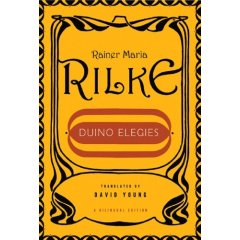
Rilke’s Duino Elegies

51tv9khwakl_aa240_.jpgI have read only the first elegy of ten from Rainer Maria Rilke’s Duino Elegies, but already I’m glad I picked up this book; the first elegy is quite beautiful. Rilke begins by asking this question: “If I cried out, who could hear me up there, among the angelic orders?” The poem goes on to describe the speaker’s sense of isolation; since he does not believe that angels will hear him, he asks, “Oh who can we turn to, in this need? Not angels / not people, and the cunning animals realize at once / that we aren’t especially at home in the deciphered world / What’s left?”

To this question, the only answer the poem gives is this: “But listen / to that soft blowing … that endless report that grows out of silence. / It rustles toward you from those who died young. When you went into churches / in Naples and Rome didn’t their fates touch you gently?” The speaker is thinking about death and finds himself completely alone except for the “soft blowing,” the “report,” that seems to come from those who died young. He thinks about how strange death is: “Of course it is odd to live no more on the earth / to abandon customs you’ve just begun to get used to / not to give meaning to roses and other such / promising things.”

I think all of this is beautiful, but especially the very end of the poem when the speaker thinks about the purpose of suffering. He ends the poem with this question:

Is the old tale pointless
that tells how music began in the midst of the mourning for Linos
piercing the arid numbness and, in that stunned space
where an almost godlike youth
had suddenly stopped existing, made emptiness vibrate in ways
that thrill us, comfort us, help us now?

My book’s notes tell me that Linos was “a vegetation god similar to Adonis” and that the one mourning Linos was likely Orpheus, “the legendary first poet and musician.” So music and, by extension, art, comes from grief, suffering, and death. Music has made the “emptiness vibrate.” There is no angelic order to comfort us, and there is nothing but silence and the voices of the dead to help us face death, but there is, in consolation, the beauty of music. All this is a question, though — the speaker wonders if the old tale of Linos and Orpheus is pointless after all.

I’m not doing justice to David Young’s translation, however; he’s decided to break each of Rilke’s lines up into three shorter ones, the second and third sections of the line below the first, and each one indented (I can’t reproduce this on WordPress, or at least I can’t without driving myself crazy trying). Young says he was inspired by William Carlos Williams’s triadic line. Here is his reasoning:

As I began to work on the Elegies I found that the long lines of the original were difficult to reproduce in English (or, more strictly speaking, American). Read aloud, they sounded fine; the listener could follow in the reader’s voice the emphases, hesitations, and variations in speed. On the page, however, the long line did not readily suggest the “living” quality, and was one of the features most likely, I came to feel, to make the poem seem like a museum piece.

Williams’s triadic line worked for him because “a long line made up of three shorter, overlapping units makes an extremely flexible instrument of expression. The more I have worked with it, the deeper my respect for it has grown.” I feel that perhaps I shouldn’t like this because it’s messing so much with the original, but, then, translating a poem necessarily means messing with it, and I do like reading the poem in short lines; it’s got a flow to it that’s a pleasure to follow. Two other translators of Rilke, Edward and Vita Sackville-West, wrote this about Rilke’s lines, that they are like “an immense road, admitting many thoughts and images abreast of one another, and seeming to suggest movement in more directions than one,” and I think Young’s translation captures this well.

9 Comments

Filed under Books, Poetry

Eat, Pray, Love

I’ve now finished the first of three sections in Elizabeth Gilbert’s Eat, Pray, Love, and although at first I found the writing style a bit glib and Gilbert’s sense of humor a little silly, I now find myself completely won over. The book is about how Gilbert decided to spend a year traveling after suffering through a bitter divorce and a heart-wrenching affair; she travels first to Italy to find pleasure, then to India to practice devotion, and then to Indonesia to try to find a balance between the two.

In the Italian section, Gilbert finds pleasure mainly by eating the best food possible in Rome and every other Italian city she travels to. She also takes joy in learning Italian, first through lessons at a language school and then simply by talking to as many Italians as she can.

Part of what won me over was simply the forthright honesty with which Gilbert tells her story — she describes her horrendous divorce in ways that make it clear just how awful it was but that also don’t ask for your pity and don’t sound whiny or self-indulgent. I think her light, almost glib tone works better when she’s describing something serious; somehow the serious subject matter modulates the voice so that it comes across as brave rather than annoyingly light.

But I also like the ideas she’s exploring, and, as I understand it, the next section on prayer and devotion are even more idea-driven, so I’m looking forward to it. In the Italian section, she writes a lot about the pursuit of pleasure and why she and Americans generally have such a hard time with it. These passages really spoke to me:

Generally speaking, though, Americans have an inability to relax into sheer pleasure. Ours is an entertainment-seeking nation, but not necessarily a pleasure-seeking one. Americans spend billions to keep themselves amused with everything from porn to theme parks to wars, but that’s not exactly the same thing as quiet enjoyment … Americans don’t really know how to do nothing. This is the cause of that great sad American stereotype — the overstressed executive who goes on vacation, but who cannot relax.

For me, though, a major obstacle in my pursuit of pleasure was my ingrained sense of Puritan guilt. Do I really deserve this pleasure? This is very American, too — the insecurity about whether we have earned our happiness. Planet Advertising in American orbits completely around the need to convince the uncertain consumer that yes, you have actually warranted a special treat.

I can be like this — not able to enjoy myself and relax and do nothing because I’m haunted by this feeling that I need to be using my time productively, need to be doing something worthwhile, need to be improving myself in some way. I am very much an inheritor of that Puritan guilt, the mindset and work-ethic that turns pleasure-seeking into a sin.

Towards the end of the section, Gilbert writes this:

It was in a bathtub back in New York, reading Italian words aloud from a dictionary, that I first started mending my soul. My life had gone to bits and I was so unrecognizable to myself that I probably couldn’t have picked me out of a police lineup. But I felt a glimmer of happiness when I started studying Italian, and when you sense a faint potentiality for happiness after such dark times you must grab onto the ankles of that happiness and not let go until it drags you face-first out of the dirt — this is not selfishness, but obligation. You were given life; it is your duty (and also your entitlement as a human being) to find something beautiful within life, no matter how slight.

Isn’t that last sentence beautiful? Seeking beauty in life is not a bad goal to have at all.

16 Comments

Filed under Books, Nonfiction

Too many books?

I may be getting myself into, oh, just a tiny bit of trouble. I had a nice list of three “currently reading” books going for a while, the Proust, Gaskell, and Brewer, but then I got the urge last weekend to begin another book, and when the Alberto Manguel one on reading didn’t work out, I decided to try some poetry. So I’m now reading Rilke’s Duino Elegies. There are ten elegies, and I’ve finished the first. It’s quite beautiful, and I may post on it soon; for now I’ll say that I’m enjoying the dual-language edition, with German on one page and English on the other. I can read a little German, so I had fun thinking about the decisions the translator made.

So that’s fine, not a big deal, but then I decided to request some books from my library, and one of them turned up much sooner than I thought. I picked up Elizabeth Gilbert’s Eat, Pray, Love yesterday and couldn’t help but begin it right away. I’ve now read about 50 pages and may have trouble putting it down to spend some time with my other books. I find her breezy writing style occasionally just the tiniest bit irritating, but otherwise, this is exactly the kind of book I like — a mix of genres (travel, memoir, spiritual autobiography, food writing) and an appealing persona — she’s open, honest, courageous, and smart. I’ll be writing more about this soon.

Okay, so that’s a lot to be reading, but what’s really got me worried is that I’m supposed to be starting Don Quixote soon. I will be starting it next week, definitely, and I’m excited about it, but I think I’d better get a lot of reading done this weekend, or I’ll soon enough find myself in the middle of 6 books, a number I haven’t yet reached and won’t really know how to handle.

13 Comments

Filed under Books, Reading

Novels on novels, II

I’m a little more than halfway through Elizabeth Gaskell’s Wives and Daughters, and although I’ve found it slow in places, I think that’s my fault and not the book’s, and there are just as many times I’ve found myself wanting to read on as I’ve been tempted to put the book down. All that’s to say, I’m still reading this book and am glad I’m doing so.

When I was reading Jane Austen’s Sanditon, I noticed that Austen had some things to say about novels and reading, and it turns out Gaskell does too; it seems to be the case that we can judge a character based on what Gaskell tells us about his or her reading habits. (And, really, isn’t that the way the world should be? That all our time spent reading would communicate volumes, so to speak, about what wonderful people we are?)

Mrs. Hamley, for example, is meant to be a sympathetic character; the novel’s heroine, Molly, loves her very much, and she turns out to be a peaceful center in the novel, the other characters missing her very much when she’s gone. And this is how Gaskell describes her reading:

Mrs. Hamley was a great reader, and had considerable literary taste. She was gentle and sentimental; tender and good.

I love the easy slide here from being a great reader with taste to being a good person.

Molly herself is not a deep reader; when asked if she likes reading, she says, “It depends upon the kind of book … I’m afraid I don’t like ‘steady reading’ as papa calls it.” But she does love poetry and she is capable of losing herself in a Sir Walter Scott novel (The Bride of Lammermoor). She turns out to be suggestible when it comes to reading; when she befriends Roger, another central character, he becomes her personal tutor, suggesting books for her to read and discussing them with her. When Molly and Roger are separated for a while:

He felt something like an affectionate tutor suddenly deprived of his most promising pupil; he wondered how she would go on without him; whether she would be puzzled and dishearted by the books he had lent her to read …

A little later in the novel another character accuses her of becoming a bluestocking and reading “deep books — all about facts and figures.” She responds that she has come to find those “deep books” interesting. As befits a novel’s heroine, she has proven her ability to learn and change.

Roger has a brother Osborne, and early on we learn that Osborne reads and writes poetry, while Roger:

is not much of a reader; at least, he doesn’t care for poetry and books of romance, or sentiment. He is so fond of natural history; and that takes him, like the Squire, a great deal out of doors; and when he is in, he is always reading scientific books that bear upon his pursuits. He is a good, steady fellow, though …

The family owns a portrait of these brothers showing Osborne deep in a book of poetry, and Roger trying to draw his attention to something outdoors. I get the feeling that Gaskell thought of reading and writing poetry as a feminized pursuit and therefore a little unsuitable for Osborne; it’s fine for Molly and Mrs. Hamley to love poetry, but not for Osborne — he turns out to be a disappointment, a weak and susceptible failure, not “manly” enough. Roger, however, turns out splendidly, becoming his family’s savior; his scientific reading and his love of nature bring him worldly success — he earns some fame for publishing an important scientific paper — but it also seems to prove he is, according to Gaskell, the proper sort of man, energetic, capable, outdoorsy, and scientific, but not poetic. In her “deep” reading of facts and figures, Molly may be venturing a bit into “male” territory, but she is doing so with a man’s guidance, and so this doesn’t really disrupt the proper gender roles.

Molly has a stepmother, Mrs. Gibson, who is — no surprise! — a major pain. And this is what Gaskell says about her reading:

About novels and poetry, travels and gossip, personal details, or anecdotes of any kind, she always made exactly the remarks which are expected from an agreeable listener; and she had sense enough to confine herself to those short expressions of wonder, admiration, and astonishment, which may mean anything, when more recondite things were talked about.

No, she is not known for her intelligence or her insight. She also reads light novels, ones, not at all like Wives and Daughters, that are meant merely to pass the time, “the dirty dog’s-eared delightful novel[s] from the Ashcombe circulating library, the leaves of which she turned over with a pair of scissors.” She considers these novels “little indulgences that were innocent enough in themselves, but which [her] former life had caused her to look upon as sins to be concealed.”

Mrs. Gibson’s daughter, Cynthia, who is a sympathetic character but not entirely trustworthy and with a dark secret in her past (at least I think so — it hasn’t been revealed yet, but there are hints …), turns out not to be much of a reader; she prefers millinery to reading, we learn. Mrs. Gibson tries to get Cynthia to undertake some “improving reading,” but her motives for this are bad ones, and neither Mrs. Gibson or Cynthia persist in this quest to improve Cynthia’s mind.

So, I’m fascinated by the way one’s reading is a clear guide to one’s character in this novel, and the way reading gets gendered. I shall have to see how all this plays out as the novel continues …

7 Comments

Filed under Books, Fiction