Category Archives: Books

On the Knocking At the Gate in Macbeth

I have now read the second De Quincey essay in my collection; it’s called “On the Knocking At the Gate in Macbeth,” and it tries to explain why De Quincey finds the knocking that takes place after Duncan’s murder so eerie.  The essay is about five pages long, and it makes a fairly simple point about Macbeth (the knocking brings us back from the horror of murder to the everyday world — and returning to the everyday world deepens the horror of murder), but along the way it is full of digressions, taking in a philosophical point about the mind, the story of a real-life murder, what it’s like to witness someone fainting, and what it’s like to watch a state funeral procession.

Here is part of the philosophical digression:

Here I pause for one moment to exhort the reader never to pay any attention to his understanding when it stands in opposition to any other faculty of his mind.  The mere understanding, however useful and indispensable, is the meanest faculty in the human mind and the most to be distrusted: and yet the great majority of people trust to nothing else; which may do for ordinary life, but not for philosophical purposes.

I love this philosophical digression that warns us against paying too much attention to our understanding!  He goes on to illustrate this point with an example: if you were to ask someone to draw a picture of a street, they probably wouldn’t do a very good job, unless they happened to know the rules of perspective.  Here is why:

The reason is — that he allows his understanding to overrule his eyes.  His understanding, which includes no intuitive knowledge of the laws of vision, can furnish him with no reason why a line which is known and can be proved to be a horizontal line, should not appear a horizontal line …

Even though we can see with our eyes the way a street actually looks, our understanding takes over when we try to draw it and it messes us up.  We’d be better off trusting our eyes and getting our mind out of the way.

The purpose of this digression?

But, to return from this digression, — my understanding could furnish no reason why the knocking at the gate in Macbeth should produce any effect direct or reflected: in fact, my understanding said positively that it could not produce any effect.  But I knew better: I felt that it did: and I waited and clung to the problem until further knowledge should enable me to solve it.

That’s a long way around to make the point that reason only gets us so far and that the senses, emotion, and intuition can carry us farther, but I do like taking the long way around to get to one’s point, at least when it’s done as De Quincey does it, with something interesting along the way.
7 Comments

Filed under Books, Nonfiction

A few random things

I have a few short things to write about this Friday evening. The first is this article about Percy Shelley from The New Yorker; it’s about a new book called Being Shelley by Ann Wroe. According to the article:

Wroe tries to see as Shelley saw—to inhabit his consciousness and capture its every movement. This is, as she frankly says, ‘an experiment,’ and any reader who opens the book expecting a conventional biography is in for a surprise.

I do love unconventional biographies! And I’ve enjoyed reading Keats and now De Quincey so much that I’m considering reading more of the Romantics and could turn to Shelley at some point. I remember having to read Prometheus Unbound in college, though, and being a bit bewildered by it — I liked it, it was just something … strange. He’s a writer who intimidates me a bit. Perhaps I’ll turn to Coleridge first.

Then I was pleased to see this list of “The 86 Greatest Travel Books of All Time” (link via The Literary Saloon), but saddened to note that I’ve read only 4 of them — Hunter S. Thompson’s Fear and Loathing in Las Vegas, Rory Stewart’s The Places in Between, W.G. Sebald’s The Rings of Saturn, and Tobias Smollett’s Travels Through France and Italy. Clearly I need to read more travel writing, as I do enjoy the genre. Perhaps I’ll read some Bruce Chatwin next; I’ve been meaning to for ages.

Then I thought insomniacs or people whose thoughts trouble them at night might like this Keats poem, which I thought beautiful, particularly the last six lines:

Sonnet to Sleep

O soft embalmer of the still midnight,
Shutting with careful fingers and benign
Our gloom-pleased eyes, embower’d from the light,
Enshaded in forgetfulness divine:
O soothest Sleep! if so it please thee, close,
In midst of this thine hymn, my willing eyes,
Or wait the Amen ere thy poppy throws
Around my bed its lulling charities.
Then save me or the passed day will shine
Upon my pillow, breeding many woes;
Save me from curious conscience, that still hoards
Its strength for darkness, burrowing like the mole;
Turn the key deftly in the oiled wards,
And seal the hushed casket of my soul.

Finally, a health update. Muttboy is healing very well, and has his full appetite and energy back. He has to wear a t-shirt much of the time, though, to keep him from scratching or licking his belly where the stitches are, so he looks undignified and undog-like. Poor thing.

I am healing quite well also; when I saw the endocrinologist yesterday and mentioned that I have been riding some, in spite of her orders not to, she said “I’ll pretend I didn’t hear that” and then told me to take it easy, which I’m taking as permission to ride as much as I’d like. Yay! When I talked to my mother about this, telling her about the early riding, she said she would have done the same thing. You see why I am the way I am??

10 Comments

Filed under Books, Life, Links

Confessions of an English Opium-Eater

7790332.gif I have just finished the title essay from a collection of Thomas De Quincey’s work, Confessions of an English Opium-Eater; the book has three longish-essays (the title one was 80 pages) and one short one. I’m planning on reading them all, but Confessions was the reason I picked this book up. I’m not sure what attracted me to it, since confessions of drug addicts aren’t my usual thing, but I’ve heard this mentioned as an interesting essay and as an example of walking literature, and I’m fascinated by De Quincey’s time period (1785-1859), so that’s reason enough.

The essay, as you might guess from the title, tells the story of De Quincey’s addiction to opium, but it does so with lots of digressions and philosophical asides and glimpses of life in De Quincey’s time. After a brief introduction justifying his decision to write an essay that exposes his weakness, he tells of his boyhood school days and his decision to run away from school at the age of 17. He wanders through parts of Wales and ends up in London, where, he says, the seeds of his addiction were planted. He runs out of money and comes very close to starving to death, which causes him stomach problems that come back to haunt him — at which point he becomes an addict, taking opium every day to relieve the pain.

But De Quincey takes his time with the Wales and London episodes, and they are some of the most interesting sections. Particularly moving is the story of his friendship with the prostitute Anne; they offer each other companionship and aid — she saves him from starvation at one point. Tragically, De Quincey leaves London briefly to try to find some money, and when he returns he can’t find her. He mourns the loss of their friendship for the rest of his life.

De Quincey took opium regularly before he became addicted; he was careful to let enough days go by between indulgences so that the drug would maintain its potency. And he writes about the pleasures of opium quite beautifully; one of the things I like best about this essay is that De Quincey is fully honest about both the pleasures and the pains. He writes:

And, at that time, I often fell into these reveries upon taking opium; and more than once it has happened to me, on a summer-night, when I have been at an open window, in a room from which I would overlook the sea at a mile below me, and could command a view of the great town of L—-, at about the same distance, that I have sate, from sun-set to sun-rise, motionless, and without wishing to move.

A bit later he goes into raptures over the drug:

Oh! just, subtle, and mighty opium! that to the hearts of poor and rich alike, for the wounds that will never heal, and for “the pangs that tempt the spirit to rebel,” bringest an assuaging balm; eloquent opium!

He goes on like that for a full paragraph. But he is also clear about the horrors of opium addiction:

[The opium-eater] lies under the weight of incubus and night-mare; he lies in sight of all that he would fain perform, just as a man forcibly confined to his bed by the mortal languor of a relaxing disease, who is compelled to witness injury or outrage offered to some object of his tenderest love: — he curses the spells which chain him down from motion: — he would lay down his life if he might but get up and walk; but he is powerless as an infant, and cannot even attempt to rise.

He does, you will be happy to know, overcome his addiction, but he is still haunted by one of the worst effects of addiction — horrible nightmares, some of which he describes in detail.

I am looking forward to seeing what the other essays are like; he’s got a style I enjoy — digressive, allusive, difficult to categorize.

10 Comments

Filed under Books, Nonfiction

All In Together Girls

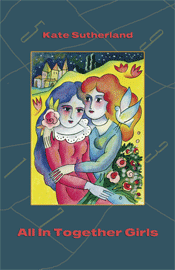
b1.gif I have just finished Kate (of Kate’s Book Blog fame) Sutherland’s collection of short stories All In Together Girls, and enjoyed it very much; the collection has 14 stories, all of them quite short, each one capturing a glimpse into the life of a female protagonist.

Many of the stories are about young girls in their early or late teens who are trying to figure out their relationships with parents and with friends and with boys; these stories describe acts of disobedience and rebellion and often also moments of humiliation and frustration. They are about trying to find one’s identity while negotiating the needs and demands of others. They tell of the desire for freedom and the uncertainty about what to do with it; the first story, for example, is about a group of friends who lie to their parents so they can spend the night hanging out, but things quickly go sour leaving them wanting nothing but to go home. In a later story a girl skips her dance lessons to hang out with friends, and in another the protagonist lies to her parents and spends the night with her friends trying, but failing, to smoke dope. In each of these stories, the promised fun times never quite materialize, and instead the protagonists are left with an air of sadness and worry.

The adult protagonists of some of the other stories seem just as lost; in “Outside the Frame,” the narrator tries to piece together her mother’s story from a photograph, seeking to understand the quality of her mother’s marriage as her own is falling apart. The story alternates between the mother’s experience, as imagined by the narrator, and the narrator’s accounting of why she is leaving her husband. In “Notes for a Documentary,” one of my favorites, the protagonist travels to Scotland to do research and to see family; she visits the places where her parents courted and ponders what to do about her own love affair. She is unsettled, positioned between an unchanging past and an uncertain future.

I enjoyed each and every one of these stories. Many of them are told in the first person, and the voices are clear and appealing, telling their stories straightfowardly, recounting hard times but not asking for pity. The language is simple and direct, drawing attention not to itself, but to the predicaments of the characters — it’s their thoughts about themselves and their lives that matter here.

This is the second collection of short stories I’ve read this year (the first was Jesus’ Son), which fulfills my short story-reading goal; I’m enjoying reading more in the genre, though, and may pick up another. I’ve got Mavis Gallant’s Paris Stories on my shelves if I get the urge.

8 Comments

Filed under Books, Short stories

On finishing Proust’s In Search of Lost Time

I want to write just a few words about finishing Proust’s In Search of Lost Time; I don’t feel up to writing a big long summing-up post that tries to say smart things about what it all means, but I do want to say something. I am happy to have finished, but I do miss reading Proust a bit; I’ve been used to a near-daily dose of the narrator’s slow-moving, contemplative voice, and now I don’t have that.

It’s hard to see how a 3,000-page book without all that much plot, relatively speaking, could cohere, but I think it does. I found the ending, say, that last couple hundred pages, really did wrap things up; it provides an answer to the question that has haunted the whole book — will Marcel ever write his masterpiece? This is a question that has lingered from the very first volume when it becomes clear that Marcel has an interest in, and perhaps a talent for, writing. The answer the book provides is satisfying, and realistic, given everything that has happened up until that point.

My favorite volumes were the first two and the last one; the third and fourth, The Guermantes Way and Sodom and Gomorrah, got a little long, but then the fifth volume, which contains The Prisoner and The Fugitive begins to pick up a bit in preparation for the grand ending. It’s the long party scenes in some of the middle volumes that got tiresome. What I loved about the book are the insights into the mind, art, time, and love, but the novel is also obsessed with society and rank and how people behave at parties, topics that didn’t thrill me quite as much. But even here there are things to interest; Proust captures snobbery and hypocrisy and the deadness that can lie behind the glittering masks of high society beautifully well.

But mostly this novel is worth reading because of what it can teach about observing the world around you and in you. Proust has a meticulous eye for how the mind perceives input from the senses and for how we come to understand our experiences, and, of course, he has a beautiful way with a sentence to capture all that insight. I love how there can be so much wisdom and experience in one of those long sentences — how they can take in so much.

12 Comments

Filed under Books, Fiction

On finishing Don Quixote

7075756.gif Most of this post will be about the second half of Don Quixote and the ending, so if you don’t want to hear about it, you might want to save this post for later. I loved the way the second part of the novel became a kind of commentary on the first (is this what people are talking about when they say that everything comes together in the second half?), how everyone Don Quixote and Sancho Panza meet have read the novel’s first half and so are in on the story of his peculiar form of madness. Most of them decide to have some fun playing jokes on the two, to see just how far the madness of Don Quixote will go. So, in addition to all the metanarrativity that was already going on in the first part — the multiple authors and the long conversations on storytelling and the frequent mentions of Cide Hamete Benengeli — Cervantes adds his critique of the false sequel to Don Quixote published in between his two volumes and mixes up real life and fiction even more by having Don Quixote confront the results of his literary fame again and again.

It is this playfulness about fiction and authorship that I will remember about the book, long after I’ve forgotten individual episodes — episodes it probably won’t take me all that long to forget, in truth, because some of them dragged on a bit and my attention wandered. But I love that self-interrogation is built into the structure of one of the first novels ever, depending on how one defines “novel,” or, at the very least, one of the earliest and most influential novels. Don Quixote is a novel about madness, friendship, adventure, and love, but it’s also very much a novel about novels, and it starts a very long tradition of novels that reflect on themselves, a traditional so influential that even ostensibly realistic novels usually have some kind of self-reflexive element to them.

About the novel’s ending: it is so sad! I didn’t expect to see Don Quixote regaining his sanity, and even less did I expect that moment of sanity to be rather depressing:

“Señores,” said Don Quixote, “let us go slowly, for there are no birds today in yesterday’s nests. I was mad, and now I am sane; I was Don Quixote of La Mancha, and now I am, as I have said, Alonso Quixano the Good. May my repentance and sincerity return me to the esteem your graces once had for me, and let the scribe continue.”

And he goes on reciting his will. It’s this melancholy at the end that convinces me (even further than I was already convinced) that Cervantes has great affection for his two main characters, in spite of their foolishness. It’s the energy of their madness that carries the story forward, so that as soon as Don Quixote regains his sanity, there is no story anymore, and the novel abruptly ends. Without Don Quixote’s madness, Cervantes has nothing. So, yes, Cervantes mocks Don Quixote’s foolish and naïve way of reading, but I think he glories in the energy and the fun of it too. To me, Don Quixote comes across as admirable in his imagination, his resourcefulness, his persistence, and his liveliness. I realize this is a very contemporary way of looking at the novel, and earlier readers may not have seen anything admirable in Don Quixote whatsoever, but I can’t help reading as a contemporary person, can I?

4 Comments

Filed under Books, Fiction

Finished!

I finished Don Quixote yesterday, and today I completed In Search of Lost Time.  Woo-hoo!

This opened up so much free time today that I ended up filling it by mopping my kitchen floor.  This is quite a rare occurrence, let me assure you.

I’ll write my thoughts on completing these books soon, but I think I’ve spent enough time staring at the computer today and my eyes are tired.

Before I go, though, I’ll point you to this interesting article from The Atlantic (link via Bookslut), described as “an attack on the growing pretentiousness of American literary prose.”  The argument in the article is basically that contemporary literary prose is sloppy and badly done, and we would be better off reading classics.  I have to say, though, as much as I didn’t like the author’s over-generalizations and all-around crankiness, I liked the part where he critiques Annie Proulx, whose novel Shipping News I didn’t like at all, and I found the Cormac McCarthy section amusing.  I wasn’t agreeing with him at all about Don Delillo, however.

11 Comments

Filed under Books, Links, Reading

Second person?

I am enjoying Michel Faber’s The Crimson Petal and the White very much — thanks to all of you who recommended it! It’s quite long, 900 pages, but the pages fly by. Long books that fly by are their own particular sort of pleasure, aren’t they? Absorbing, fun stories that you can spend hours with and that seem never to end.

I’m not sure what I think, though, of the author’s use of second person. Those of you who have read the book before, did you like it? Here is how the book begins:

Watch your step. Keep your wits about you; you will need them. This city I am bringing you to is vast and intricate, and you have not been here before. You may imagine, from other stories you’ve read, that you know it well, but those stories flattered you, welcoming you as a friend, treating you as if you belonged. The truth is that you are an alien from another time and place altogether.

The narrator goes on like this for a while, leading “you,” the reader, through the city to the room where the story itself begins. He (I’ll just assume the narrator is “he”) talks to the reader about the reader’s expectations of the setting and time period, and then introduces the characters and gives information on their relative importance. Once the story is underway, the narrator interrupts now and then to keep up this “conversation” with the reader, making little jokes and anticipating what the reader’s reactions will be. For example:

(What? Sugar? Why are you thinking about Sugar? Don’t worry about her anymore; she’s spoken for! And also try to put William from your mind. Everything is in hand I assure you.)

One advantage of this technique is that it allows the author to address the fact directly that this is historical fiction and that we as 21st century readers are trying to work our way imaginatively into a world that is long gone — so there’s no pretending this is a 19C novel or that 19C people could have read it. Why not just acknowledge that this is a 21C version of a 19C novel?

It also gives the author the chance to prepare the reader for what’s coming and to give the reader clues as to how to read the book, and it gives the book a lighter tone than it might otherwise have. It’s also a clever updating of those 19C third person omniscient narrators (and 18C ones) who were powerful presences in many novels and who were characters in and of themselves.

I get all this, and yet I also find this use of second person just a tad silly.

Have you come across writers who use the second person? Who use it successfully? I know such things exist, but I can’t think of many examples.

10 Comments

Filed under Books, Reading

Outmoded authors

I have tried to stay away from reading challenges because, although I like the idea in principle, in practice I find myself not doing all the reading, pushing myself to do the reading, and then getting annoyed with myself when I don’t. And reading should be fun, right?

But … you know how it goes. Someone comes along with a new challenge and it seems intriguing, and next thing I know I’m signed up. I should not get so caught up in trying to finish these things and should just think about what they are good for: getting me to read things I might not otherwise.

(I still am thinking about Kate’s Reading Across Borders challenge, by the way, which is an excellent one for getting me to read new things. I feel like I should do some version of this challenge every year, perhaps with a different focus or theme. You see why it’s hard for me to stay away from these things?? I’ve completed three out of my planned five books, but I have until the end of the year so finish, so I just might make it.)

This time it’s Imani who’s come up with interesting new challenges, and the Outmoded Authors one has caught my eye (she has also proposed the Index Librorum Liberoram challenge). She’s created a list of unfashionable authors that participants can choose from, and the plan is to read as many books as people want from the list over the course of six months.

The list is quite long, and there are tons of authors I’d happily read from it. I think, though, to increase my chances of actually completing this thing, I won’t decide for sure which ones until the last moment, with one exception: I’d really like to read Walter Scott. I’ll probably read Waverley, as it’s the one I have on my shelves. Other than that, I’d like to read maybe two or three other authors from the list. Here are some possibilities:

  • Christina Stead. I own a copy of her novel The Man Who Loved Children, and I don’t know anything about it whatsoever, except that it’s on Jane Smiley’s list from her book 13 Ways of Looking at the Novel. Perhaps it’s time to find out.
  • Djuna Barnes. I’ve wanted to read Nightwood for quite a while, although I’m a bit nervous about not getting it; as I understand it, it’s an experimental novel and sometimes those work for me and other times they don’t.
  • Elizabeth Bowen. I think she’s someone I’ll like when I finally read her. I own a copy of The Last September, which would do nicely.
  • John Dryden. He’s someone I suggested, not so much because I’m excited about reading him, but because he someone I don’t think non-academic readers read very often. If people are going to read something from his time period, it’s more likely to be Aphra Behn or maybe one of the comic plays, or more likely it’ll be something from a bit later like Daniel Defoe. But maybe I should read more of his work (beyond what I’ve read for various classes).
  • Radclyffe Hall. I own a copy of her book Adam’s Breed, and Imani has written so intriguingly about The Well of Loneliness, I may just give it a try.
  • Sybille Bedford. Litlove mentioned A Favourite of the Gods as one of her favorite books from 2006, so surely that would be a good choice.
  • Other possibilities: Merce Rodoreda, Ivy Compton-Burnett, Malcom Lowry.

10 Comments

Filed under Books, Reading

Marriage, by Susan Ferrier

1134997.gifSusan Ferrier’s novel Marriage, published in 1818, is a good read and interesting in a number of ways, one of which is its Scottishness. Ferrier lived her whole life in Edinburgh, and her novel deals with the ideas Scottish and English people have about each other and the complexity that existed behind stereotypes of the day. The critic who wrote the novel’s introduction noted the multiplicity of “mixed” marriages — between Scots and English — to argue that Ferrier rejects the kind of nationalism developing in her time period. She also shows complexity within Scotland, portraying different areas and different types of people within it, and therefore undermining any simple idea of a Scottish “character.” Ferrier’s best characters are capable of living happily in both places, and they tend to combine the best traits characteristic of both areas.

Ferrier does, however, have some fun portraying comic characters who fail at her kind of worldiness — she writes about loud, blustery Highland lairds and foolish maiden aunts and spoiled English girls who refuse to live within their incomes. Ferrier uses these stereotypes for comic effect, and then has her more sympathetic characters critique the foolish, stereotypical ones.

Another main interest in the book is education, particularly women’s education — a topic so many, many novels of the time took up. Ferrier treats this subject largely through contrasts. She has three main female characters, Lady Juliana and her twin daughters Mary and Adelaide. Lady Juliana’s own education was abysmal:

Educated for the sole purpose of forming a brilliant establishment, of catching the eye, and captivating the senses, the cultivation of her mind, or the correction of her temper, had formed no part of the system by which that aim was to be accomplished.

Her father is largely to blame for this:

[He] was too much engrossed by affairs of importance, to pay much attention to any thing so perfectly insignificant as the mind of his daughter. Her person he had predetermined should be entirely at his disposal …

Women’s bodies matter more than their minds, according to this view, but what the father has forgotten is that after marriage women become responsible for raising children and they need a certain amount of sense to do this successfully. This was a common concern of the time — women should be educated not so much because of its inherent worth, but because women needed a certain amount of training to run a family well.

Marriage spells out the consequences of poor education for women (education in morals as well as academic subjects); Lady Juliana is a terrible mother and raises her daughter Adelaide to be much like she is — vain, selfish, and foolish. Mary, however, Adelaide’s twin, is raised by another woman, Mrs. Douglas, who does a much better job and trains Mary to be everything that Adelaide is not — kind, thoughtful, knowledgeable. Through these twins we can see how much is at stake in a young person’s training and education, and how Lady Juliana is perpetuating the cycle of ignorance. How is she supposed to know how to raise a daughter when she never received any attention or training herself? No one was there to teach her how to be selfless and patient.

Many of the characters in this novel are either thoroughly good (Mary, Mrs. Douglas) or thoroughly bad (Lady Juliana, Adelaide), so it was a pleasure to come across Lady Emily who is neither. It’s in this sense that Marriage feels like an 18C novel to me — so many 18C novels have perfect heroines, annoyingly perfect ones, leaving the more minor characters to have some complexity. Lady Emily is flawed — according to the standards of the book — by being too critical, too
quick to speak her mind, too witty, too independent. Mary as heroine could never get away with displaying these traits; they are too unfeminine. But Emily is sympathetic too; she does her best to take care of Mary when she needs it, and she has a sense of her own flaws. Mary is drawn to Emily but worried about her future; she may be a little too wild for her own happiness. This uncertainty is left unresolved. Readers today are probably more likely to sympathize with Emily than with Mary, who can be a little insipid and annoyingly obedient. I’m not so sure what readers at the time would have thought.

This puts Austen’s novels in an interesting light — her heroines are not the perfect Mary types; they have flaws, such as Emma’s self-absorption and they make mistakes like Elizabeth Bennet’s too-quick judgments. It seems that other novelists were more likely to explore flaws, not in their heroines, but in other characters. The heroines remain saint-like.

I love reading novels from this time period; I think Marriage is an interesting one to look at for what it says about national identity and about women’s place in society, but it’s also a fun read — a good story with lots of comic touches.

8 Comments

Filed under Books, Fiction

Reading notes

  • Is there any better feeling than finishing a book and starting a new one? I just read Danielle’s post about the excitement of finishing Don Quixote, and I’m looking forward to experiencing that feeling myself — I should finish DQ by next weekend or the following one at the latest. I’ve enjoyed reading the book, but still I’m looking forward to finishing. I’m about to finish Proust too, which means in another week or so my reading world will look very different. I feel sometimes that I shouldn’t be so eager to finish books, that I should savor them while they last, but the pleasure of moving on to something new usually wins out.
  • I’m experiencing that happy-to-be-finished feeling right now, actually, as I just finished Susan Ferrier’s Marriage. I’ll write a post on that book shortly.
  • Along with the pleasure of finishing a book, I’m experiencing the pleasure of beginning a new one: Michel Faber’s The Crimson Petal and the White. I didn’t know it was quite so long! It’s about 900 pages, but I’m guessing it will read fast. It looks like it will be fun — an absorbing story about a prostitute in Victorian London.
  • Hobgoblin suggested that I might like to read The Crimson Petal quite a while ago after he read and liked it. As usual, I didn’t listen to his suggestion. Instead, I waited until I got recommendations from other people, and then I got excited about it and decided to pick it up. Hobgoblin seems to understand this and doesn’t take offense, for which I am grateful.
  • Imani has proposed a couple of reading challenges, one of which, the Outmoded Authors challenge I’m considering signing up for. She’s currently compiling a list of authors — a list I contributed a couple of names to. If you know anything about my reading tastes, you might be able to guess which ones!
  • The whole idea of outmoded authors is quite interesting, I think — the way authors come in and out of fashion, the way they sometimes are popular in their day and then forgotten and then revived again. I love reading stories about how the reputations of authors rise and fall and the factors that play into those changes. A writer like John Steinbeck is an interesting case — I don’t know if we can call him outmoded, as he still gets read and probably assigned in high schools, but I don’t think he’s been a favorite amongst academic critics, unless there’s been a revolution in thinking that I don’t know about. A guy I knew in grad school wanted to write his dissertation on Steinbeck, but wasn’t sure if that was wise — it might be the case that critical work on an unfashionable author would be valuable because no one else is working on him and the work would seem fresh, or it might be the case that no one would be interested in the work at all.

10 Comments

Filed under Books, Reading

Jane Austen in Context

Has anybody seen the movie Becoming Jane? It’s just come to our local theater, and I’d like to see it, although I also think it’s rubbish. It has very little relationship to Austen’s real life (I haven’t seen the movie, obviously, but I’ve read enough about it to know), but I suspect it might be fun to see, if I can keep the real Austen and the movie Austen completely separate in my mind (if such a thing is possible). By the way, there’s a good article on the movie here (thanks to Jenny D. for the link).

Much better than seeing Becoming Jane, most likely, is watching the A&E version of Pride and Prejudice, which I borrowed from the library for the weekend. I’ve seen it before, but it was a long time ago, and I can’t wait to see it again.

At this point, what with the Jane Austen in Context book and all, I’m in danger of getting sick of everything to do with Austen, but I don’t feel that way quite yet …

There were a couple fascinating bits from the book I thought I’d share (and by the way, I’m not giving away nearly all of the good stuff, so don’t think the book is spoiled because I’ve posted so much on it). In an essay on book production, the author notes that in the year Austen was born, 1775, 31 new novels were published in England. In 1811, when Sense and Sensibility was came out, 80 new novels were published. The author calls this “an expanding and competitive market for books,” but it seems quite small from our perspective, doesn’t it? If I lived then, I could plausibly attempt to read every novel published each year!

Also interesting to note is that three quarters of all novels published in 1776 were epistolary novels. It’s in that context that Austen’s complex third person point of view — her free indirect discourse — starts to look so very new and exciting.

Nearly three quarters of all novels published between 1770 and 1820 were published anonymously or pseudonymously, many of them saying only “By a Lady” or “By a Young Lady.” Also interesting is the numbers of men vs. women writing; as one critic notes about the 1810s, “The publication of Austen’s novels was achieved not against the grain but during a period of female ascendancy.” In the 1820s the balance shifted, and the men began to outnumber the women.

Also fascinating is the chapter on Austen in translation, which argues that Austen never got quite as popular on the continent as in England because continental translators didn’t know what to make of her — she didn’t fit in with their existing literary traditions and couldn’t be easily accommodated to them. Many of the early translations weren’t really translations at all, but were retellings of the stories with some dramatic changes, to tone down Elizabeth Bennett’s sauciness, for example. Some translators even omitted chapters and changed endings. Many of them lost the nuances of Austen’s third person point of view, which would make it harder to appreciate her genius. Modern-day translators would never get away with the changes Austen’s early translators made to her texts (at least I don’t think so!).

Interesting stuff, don’t you think?

10 Comments

Filed under Books, Nonfiction

New books

Thanks to all for your kind comments from yesterday; Hobgoblin and I had a nice day, although, as it turns out, we didn’t spend it in Manhattan. Shortly after I posted here, I learned that a huge storm had hit the city, leaving flooded roads and shut down subways. We decided not to head there — we may have been fine, but maybe not, and we didn’t want to risk it. So, we went to New Haven instead. It’s not as exciting as Manhattan, but it’s still a nice place to spend some time, and, as hoped for, we ate some good food, went to a history museum, and bought some books. So, as promised, here’s what I got, from Book Trader, a used bookstore:

  • Jane Stevenson’s The Winter Queen. Historical fiction fans will be proud of me; this is the first novel in a trilogy which is set, in part, in 17C Holland. I heard about it on a listserv I’m on and thought I’d give it a try. Has anybody else read it?
  • John McGahern’s Amongst Women. I’d heard about McGahern from Kimbofo, and now I finally have something of his.
  • Geraldine Brooks’s March. I’d been trying to get this on Book Mooch again and again; it kept appearing, but somebody always snagged it first. So finally I bought it. I liked Brooks’s Year of Wonders so much I thought I’d try another one.
  • Harriet Martineau’s novel Deerbrook. I’d heard of Martineau before, although I’d never read her and didn’t know she wrote fiction; this is her only novel. It’s published by Penguin, I just found out, but the edition I bought is a Virago. I picked it up because I like Virago books, and it sounded intriguing.

That’s all I got yesterday (although there was plenty more that was interesting), but I’ll also list some books I’ve recently mooched:

  • Robyn Davidson’s Tracks. This is the story of how Davidson walked 1,700 miles across Australia. Amazing, right? Danielle recommended this one to me.
  • Alison Lurie, The Last Resort. I’ve decided it’s a good idea to have an unread Lurie novel lying around, just in case I get in the mood. This will be my third when I get to it.
  • Ursula Le Guin’s The Left Hand of Darkness, to add some science fiction to the mix!

16 Comments

Filed under Books, Life

Proust on art

I just came across some wonderful passages in Proust; I’m about 150 pages from end, determined to finish it and Don Quixote by the end of the summer. The narrator has just had a series of experiences of involuntary memory, where something in his present — a sound or taste or sight — will trigger a memory that recreates in his mind whole sections of his past that he had previously forgotten. The madeleine scene from Swann’s Way is the most famous of these, although there are many. Immediately before these memories come to the narrator, he despairs of ever becoming a writer; he has spent years and years of his life wasting time, avoiding doing the writing he has always wanted to do. The memories start the process of bringing him back to his vocation, and they set him off on a long meditation on literature, writing, and the relationship of art and life.  I thought I’d share some short sections:

Real life, life finally uncovered and clarified, the only life in consequence lived to the full, is literature. Life in this sense dwells within all ordinary people as much as in the artist. But they do not see it because they are not trying to shed light on it. And so their past is cluttered with countless photographic negatives, which continue to be useless because their intellect has never “developed” them … it is only through art that we can escape from ourselves and know how another person sees a universe which is not the same as our own and whose landscapes would otherwise have remained as unknown as any there may be on the moon.

I love the idea that we all have the materials of art within us; the difference between artists and everyone else is that artists learn how to make use of those materials. Proust calls art “translation” — taking our experiences, whatever they are, and plumbing the depths of them to find meaning and to transform that meaning into something beautiful. And he says it requires courage. We like to live with certain illusions about ourselves; we whitewash our darker characteristics and cover over our failings, but the artist will look for the truth, no matter how difficult it is to face.

Here’s another passage on art and life, this time about imagination and sensitivity:

It may well be that, for the creation of a work of literature, imagination and sensitivity are interchangeable qualities, and that the second may without any great disadvantage be substituted for the first, in the same way as people whose stomach is incapable of digesting pass that function over to the intestine. A man born sensitive but with no imagination might none the less write admirable novels. The suffering that other people cause him, his efforts to prevent it, the conflicts that it and the cruel other person created, all of this, interpreted by the intelligence, might make the raw material of a book … as beautiful as it would have been if it had been imagined …

So making art isn’t the same thing as making things up. I’ve never liked the idea that imagination is as simple as making things up; to me, it has more to do with putting ideas together, making connections, seeing what’s in front of you in a new way. So in my way of thinking, the sensitivity Proust is talking about, combined with intelligence, is actually a certain kind of imagination.

And finally, here’s a passage on criticism:

[Criticism] hails a writer as a prophet, on account of his peremptory tone and his very public scorn for the school that preceded him, when in fact he has absolutely nothing new to say. These aberrations on the part of criticism are so constant that a writer might almost prefer to be judged by the general public …. For there is a closer analogy between the instinctive life of the public and the talent of a great writer, which is no more than an instinct religiously listened to while imposing silence on everything else, an instinct perfected and understood, than between it and the superficial verbiage and shifting criteria of the recognized arbiters of judgment.

Apparently Proust isn’t so fond of critics.  (Although he’s not so fond of the general public either — to shorten the quotation I took out a parenthesis on how the general public generally doesn’t understand what an artist is doing.) He gives an interesting definition of art here, doesn’t he, that it’s “instinct religiously listened to”? And I do buy his argument that critics often get it wrong, that they take loud voices for true ones and newness for greatness.

3 Comments

Filed under Books, Fiction

Books I’ve Missed

I received some interesting answers to my questions from yesterday (and I welcome more at any time!).  I will clearly have to read Scott soon, and I’m thinking of a couple of possibilities: perhaps Waverly because it’s what we’ve got on the shelves, or perhaps Ivanhoe, which Victoria highly recommends, or perhaps The Heart of Midlothian, recommended by Ed.

In answer to my question about what types of books I’m missing, I got some great responses, which fall into these categories:

  • I need to read some science fiction/fantasy.  I knew this would probably come up — it’s an area I know little about.  I read some Isaac Asimov as a teenager but that’s about it, unless you count books like Kazuo Ishiguro’s Never Let Me Go, which has science fiction elements, which I’m not inclined to count, as I didn’t pick it up for that reason.  Stefanie suggested Ursula LeGuin’s Left Hand of Darkness, so I think I’ll start there.
  • I haven’t read much historical fiction, although I read a lot of novels published in previous centuries.  I pick historical fiction up now and then, but not often — I’ve read Ferdinand Mount’s Jem and Sam, about Samuel Pepys, and Beryl Bainbridge’s According to Queeney, which has Samuel Johnson and the Thrales in it.  I’ve also read the first novel in Neal Stephenson’s Baroque Trilogy and the first of Patrick O’Brien’s Aubrey-Maturin series, both of these suggested by Victoria.  I liked them both … but I wasn’t in love with them to the extent that I wanted to keep reading the series.  I think I have a hard time with series unless I can breeze through them fast like I did with Philip Pullman’s series (which, now that I think about, is an example of speculative fiction I’ve read).  I consider this a failing of mine.  I did really like reading about late 17C England in the Stephenson novel, however.  Both Victoria and Danielle recommended Michael Faber’s The Crimson Petal and the White, so I think I till turn to that one next, or perhaps Fingersmith by Sarah Waters.
  • Finally — mysteries.  I’ve enjoyed the Maisie Dobbs books I’ve listened to, but there are more.  And Danielle recommends P.D. James, whom I will read at some point soon.

Thanks for these great suggestions!

10 Comments

Filed under Books, Reading

Questions, rhetorical and otherwise

  • I checked Andrew O’Hagan’s novel Be Near Me out from the library a little while ago, on a whim and because I read this review from The New York Review of Books. Will I actually read it before it’s due back (the rhetorical question)? I’d like to, but so much else is on my shelves waiting to be read. Checking books out of libraries doesn’t always work for me because, while I want to read whatever book I’ve checked out, I don’t necessarily want to read it right away.
  • Reading my Jane Austen in Context book and reading a novel from Jane Austen’s time, Susan Ferrier’s Marriage, has reminded me that I have yet to read one of the most famous authors from Austen’s time: Walter Scott. Not one single novel of his have I read, which wouldn’t mean much, except I like to think I know something about that time period. My father is a huge fan of Walter Scott — I inherited my love of 19C novels from him — but somehow, along with my interest in Austen and Eliot and Dickens, I never picked up an interest in Scott. Does anybody have a favorite Scott novel? A place I should begin? Something to stay away from?
  • This is a rather obnoxious question, but I’m curious, so I’ll ask anyway. I try to read a variety of kinds of books — books from different time periods, books about different subjects, books from different genres. But I’m sure there are types of books I’m missing, some of which I might actually like. Obviously there are tons of authors I’ve never read, but that’s not what I mean — I’m thinking about categories of books, like 18C novel or contemporary experimental fiction, or whatever. So, have you ever thought something along the lines of “I wonder why Dorothy never reads ______” or “I love ______ and now that I think about it, Dorothy’s never mentioned that she’s read it” or even “I love _______ but I bet Dorothy would hate it”? You see why this is an obnoxious question? Who thinks about what I’m missing in my reading life except for me? Who knows all the kinds of books I’ve read but me? But still, maybe somebody has had such a thought. It doesn’t hurt to ask. And I’m curious. What am I missing? If I get some suggestions, I don’t promise I’ll read them, but I’ll think about it seriously.

10 Comments

Filed under Books, Reading

Among Other Things, I’ve Taken Up Smoking

41jnw9gnil_aa240_.jpgAmong Other Things, I’ve Taken Up Smoking, by Aoibheann Sweeney is an enjoyable read; I breezed through it in just a couple of days, which is unusual for me.  Which is not to say that it’s light reading, necessarily, just that it’s a book I was happy to spend hours with.  My copy came recently as a review copy from Penguin.The novel tells the story of Miranda, a young girl who lives first on an island in Maine with her father and later, after she finishes High School, in Manhattan. Her mother died somewhat mysteriously when she was three, leaving Miranda and her father on their own, although they are joined at times by Mr. Blackwell, a friend from the town across the bay. The father is working on a translation of Ovid’s Metamorphoses, but as time passes, it becomes clear that this is a project that will probably never be complete.  It is a pretense of work that keeps him occupied and give him a reason to live in such isolation.

About the first quarter of the book takes place in Maine, covering Miranda’s entire childhood, and then her father arranges for her to work at the Institute for Classical Studies in Manhattan amongst old friends of his. Once there, she struggles to make her way in a strange city and to absorb the new information she learns about her parents, and also about herself.

Miranda’s relationship with her father is one of the novel’s central story lines; the father spends most of his time lost in his studies and has no practical sense and little skill in maintaining a household, and so Miranda, with the help of Mr. Blackwell, learns early how to cook and care for the house and how to navigate across the bay on her own to get to school. She learns how to type so she can type up her father’s manuscript. She spends so much time alone with her father and devotes so much time to caring for him, and yet he is emotionally remote, caught up in the past and living with secrets that Miranda discovers only when she goes away.

Miranda’s father reads to her from his translation of Ovid often enough that the tales in Metamorphoses come to be familiar, and she tells several of the stories throughout the book (it’s in first person from Miranda’s point of view). They become a way for her to think about her own metamorphosis, or lack thereof, as she grows up curious about change and yet longing for things to stay the way they are. Ovid’s stories are about desire and its transformations, and they become the lens through which Miranda views the changes desire wreaks in others and in herself:

The tales in Metamorphoses rarely ended happily; the process of transformation, of hands turning into claws and feathers sprouting on shoulders, was sometimes a punishment and sometimes a reprieve. But mostly it was a compromise of some sort, a way to negotiate the chasm between desire and mortality, between human nature and human need.

There are many mysteries in the book — what exactly happened to Miranda’s mother? why is her father so reclusive? what exactly is the nature of his relationship to Mr. Blackwell? — some of which get resolved and others of which don’t. One of the most intriguing mysteries for Miranda is the mystery of desire itself — what it is and what it makes people do.

As in all first-person narratives, the pleasure of the reading lies in the reader’s response to the storyteller. Miranda speaks with a voice that is vulnerable and questioning, but there’s a toughness too, and even a kind of reticence — her life has not been easy, but she doesn’t spend her energy mourning it so much as trying to understand it.

The book was a pleasure to read — smart and meditative, with a narrator that enjoyed spending time with.

10 Comments

Filed under Books, Fiction

More on Jane

You all know who I’m talking about in the post title, right? One of the essays in Jane Austen in Context talks about the “canonization” of “Jane” — no last name needed — as a kind of saint. It’s an essay on the “Cult of Jane Austen,” and what a cult it can be. I was amused to read that for some of the most devoted Jane fans (descendants of the late 19C “Janeites”), reading the novels is merely equal in importance, or maybe even less important, than participating in other activities such as visiting places Austen lived, having Jane Austen tea parties, dressing like Austen’s characters might, viewing Austen “relics” (she IS a saint, really), and even visiting sites where movies were made of Austen’s novels. This, as you can imagine, makes some Austen scholars unhappy, enough that they often begin articles trying to rescue Austen and her work from this industry that’s grown up around her. But the essay’s author, Deirdre Shauna Lynch, writes that this attempt to “rescue” her:

appears guided by an unattractive logic of exclusivity that runs like this: since she is my Jane Austen, she cannot be yours too.

Lynch talks about how Austen gets compared to Shakespeare in terms of her popularity and her cultural influence, but Austen’s fans have a characteristic that Shakespeare’s tend not to: they like to believe that they can see something in Austen others can’t, that they belong to a small, exclusive club of people who really get her. I’ll admit that I’ve felt this way now and then — surely no one else reading her novels feels quite like I do when I read them? This has to have something to do with genre; drama, even though it can be read alone, is public in its nature, while reading a novel is very private. So when reading novels it would be easy to feel that our private, personal experience is unique.

The funny thing about this phenomenon — and the related phenomenon of fantasizing that you know her like you know a close family member — is that it began right at the time Austen became popular and has increased all along as Austen gains more and more readers. Hundreds of thousands of people believe they have a special relationship with Austen and her works that no one else shares.

The essay on the early critical responses to Austen’s novels is fascinating too; it covers the reviews that appeared during Austen’s lifetime and shortly after her death. Early reviewers did not know what to make of her. Compared to other novels of the time — gothic novels and novels full of action and adventure — her work sometimes seemed bland. In the absence of anything better to say, they tended to comment on the moral lessons one could glean from them; of the sisters in Sense and Sensibility one reviewer says:

[Readers] may learn from them, if they please, many sober and salutary maxims for the conduct of life.

Exactly how we read the book today, right? They also expressed the uncertainty about the value of novel reading that was very common at the time; one reviewer wrote that “a good Novel is now and then an agreeable relaxation from severer studies.” This uncertainty about novels is alive and well today — the condescension in that reviewer’s tone is not so different from the people we know who say they have more serious things to read than novels.

It was Walter Scott who finally began to get it; in a review of Emma, he describes how her work differs from other novels of the time. Austen is writing a new kind of novel, one that:

present[s] to the reader, instead of the splendid scenes of an imaginary world, a correct and striking representation of that which is daily taking place around him.

Jane Austen in Context is so interesting that I’m tempted to go on and on about all the fascinating things in it; rather than doing that, though, I’ll suggest that if you love Austen’s novels you will probably love this book.

10 Comments

Filed under Books, Nonfiction

Sleepless Nights by Elizabeth Hardwick

11357909.gifI’ve been trying to decide what to say about Sleepless Nights by Elizabeth Hardwick for quite a while now, and I’m still not sure. I feel conflicted not so much about the book itself but about what I actually feel and what I think I should feel about this book. I want to like non-traditional, experimental fiction. And I’d really like not only just to like it but to unequivocally enjoy the reading of it. But that doesn’t always happen. With Wittgenstein’s Mistress I appreciated it and thought about it a lot and am glad I read it, but I didn’t savor the experience. I didn’t mind putting it down after a while.

With Sleepless Nights I felt something similar. I appreciate what she’s doing, and I enjoyed the reading of it — more than I enjoyed Wittgenstein’s Mistress — but I also didn’t mind putting it down after a while. I read this book in short chunks — and the structure of the book makes that easy, with short “parts” and shorter sections within those parts — and I don’t think I could have read it fast if I’d tried.

Maybe the most damning thing I have to say about it (in my mind) is that I find myself not having a whole lot to say about it. With Wittgenstein’s Mistress, at least, I felt like I had a lot to say. As I sit here and try to pull together my thoughts on Sleepless Nights, what comes into my mind most often is the question of how I felt as I was reading it. I have already forgotten many of the book’s details, and I don’t have a strong sense of the book’s mood or atmosphere or a strong sense of character that might make me look back on my reading experience with pleasure.

But — enough of this navel-gazing. The book is short, about 130 pages, and is a collection of the thoughts and memories of a woman named Elizabeth. This is way the book opens:

It is June. This is what I have decided to do with my life just now. I will do this work of transformed and even distorted memory and lead this life, the one I am leading today ….

…..

If only one knew what to remember or pretend to remember. Make a decision and what you want from the lost things will present itself. You can take it down like a can from the shelf.

This makes a suitable introduction to the book, as it introduces the narrator and her task — to gather her memories and write them down. But it also warns us that what she remembers may be distorted, that she is not giving us a history of her life, but rather a picture of her life as she remembers it now. Everything is filtered through her present consciousness.

The narrative doesn’t follow chronological order, skipping around from place to place and year to year, as our memories do. So we get glimpses into her life — a youth spent in Kentucky and adulthood in New York City, Boston, Maine, and Amsterdam. She describes lovers, friends, and acquaintances, events and observations. There isn’t any connective tissue to any of this, no transitions that tell us how one story relates to another; instead they are simply bump up against one another, again, as our memories tend to do.

The narrator’s mother haunts many of the pages; early on she describes her life:

My own affectionate, tireless mother had nine children. This fateful fertility kept her for most of her life under the dominion of nature. It was a thing, a presence, and she seemed to walk about encased in the clear globe of it. It was what she was always doing, and in the end what she had done.

The narrator makes sure that she does not share this fate; instead her own story is of freedom and independence, of writing and travel and experience. She rejects her mother’s femininity (“an ineffable femininity, tidal”), and yet she’s aware of how it shapes her writing:

Tickets, migrations, worries, property, debts, changes of name and changes back once more: these came about from reading many books. So, from Kentucky to New York, to Boston, to Maine, to Europe, carried along on a river of paragraphs and chapters, of blank verse, of little books translated from the Polish, large books from the Russian — all consumed in a sedentary sleeplessness. Is that sufficient — never mind that it is the truth. It certainly hasn’t the drama of: I saw the old, white-bearded frigate master on the dock and signed up for the journey. But after all, “I” am a woman.

She is not writing an adventure tale of the type that men can much more easily experience and record; rather, her life and therefore her book are shaped by the domestic and by the reading she has done in those domestic spaces. This passage declares her refusal to write a traditional novel with a clear beginning and end and with action and adventure and drama; the novel that will portray her experience as a woman cannot be traditional. Instead it experiments with the elements of storytelling that have been passed down to her, in an attempt to write something new that can capture the memories circling around in her head.

There were moments when I read with pleasure, enjoying a portrait of a character Hardwick drew with skill. Her description of Billie Holiday, for example, is devastating. The book didn’t sustain that level of interest or pleasure, however.  I’m very curious to hear what other people thought!

8 Comments

Filed under Books, Fiction

Novel reading, continued

There were so many good things people wrote in answer to my questions from yesterday, that I want to highlight them up here in a post. My blog readers never do let me down! I might as well put my responses into a regular post, because otherwise I’ll be burying a post-length piece of writing in the comments section.

What Susan had to say cracked me up: “My mother always maintained that she didn’t want to waste her time reading something that was made up. She watched 3-and-a-half hours of soap operas every afternoon, though, and one of her favorite papers was the National Enquirer. It’s awfully easy to get a story fix without ever cracking the pages of a novel.” That’s true! If part of what we need from fiction is narrative, we can find narrative in all kinds of places. To claim that you don’t read fiction isn’t to claim that you don’t enjoy those aspects of it you can find elsewhere. Not that the narratives you find elsewhere are necessarily going to be satisfying beyond a basic level (the soap opera).

But what’s wrong with enjoying narrative on a basic level? And if people choose not to read fiction, I can’t exactly call it a moral failing, or even a failing of the imagination. What I object to is the attitude that reading fiction is a waste of time. That attitude shows a failure of imagination, I think.

But that brings me to a point several other people made, which is that nonfiction works are narratives too, and that the line between fiction and nonfiction is not entirely clear. Litlove says that “history, science and autobiography are all beholden to the laws of narrative,” and Sylvia says, “non-fiction can be crafted into a story as well, which of course involves real people and real events.” If you claim you read only nonfiction and never fiction, that’s true only in a narrow sense, because the nonfiction books you pick up contain stories and elements of narrative and often fictionalized elements.

Some of my favorite books, in fact, walk the line between fiction and nonfiction; I’m thinking of W.G. Sebald’s The Rings of Saturn, a book I’m not at all clear how to categorize, or Nicholson Baker’s The Mezzanine, which is clearly a novel, but contains long sections of writing that could easily appear in a nonfiction text, and which also contains footnotes. How do you categorize Sophie’s World, a story and a history of philosophy all in one?

I liked Fendergal’s point that fiction writers face the problem of the ending – of wrapping things up (although some choose not to wrap things up, of course), because wrapping things up can sometimes seem awkward and maybe jolting after you’ve read a novel that up until the ending seemed very life-like. Stories in real life don’t end very often like stories in novels, do they? If a writer wants to provide the reader with the type of satisfying ending where everything seems fully concluded, all connections made, all lose ends tied up, then the writer pulls us away from what we recognize as real life. But that brings up the question of what fiction is supposed to do – to capture real life or to do something else entirely.

And then there’s the point to be made that fiction can tell a certain kind of truth that nonfiction may not be able to; Imani writes, “it’s entirely possible, if not probable for a novel like Middlesex by Eugenides (for example) to present a more truthful account of gender issues, that resonates, than an “autobiographical” account from a so-so writer.” And then there’s Emily who wittily says, “I don’t believe anything I read except fiction.” That’s probably not a bad idea, actually. The person who says that she doesn’t read fiction because it’s not true surely has a narrow understanding of truth. If I’m seeking out specific facts nonfiction is probably better, but surely there is much we learn from reading novels?

I just realized that I have my very own test case in front of me, if I choose to take it up: I just finished Geraldine Brooks’ novel The Year of Wonders, about the plague, and I have on my shelves John Kelly’s nonfiction book, The Great Mortality, also about the plague. I don’t recall ever reading fiction and nonfiction in tandem like this (except reading criticism of a text along with the text itself, but that’s different). While I haven’t read Kelly’s book, I imagine it’s chock full of information on the plague, and also that it’s full of stories, and I know that the Brooks’ novel has a good story, but also a lot of (horrifying) facts about the plague. And Brooks’ novel captures the feeling of living during plague times – what it might feel like to have your world crumble all around you. Maybe Kelly’s book does that too.

I suppose ultimately I respect people’s decision to read only nonfiction if they have good reasons for doing so (although personally I find that preference hard to understand), but what really bugs me is the implication that reading fiction is a waste of time.

6 Comments

Filed under Books, Reading