Category Archives: Books

Advice on Reading

The very first essay in my book of Seneca’s letters-which-are-really-essays is advice about reading. What fun!

Let’s see if we agree with what he says:

Be careful, however, that there is no element of discursiveness and desultoriness about this reading you refer to, this reading of many different authors and books of every description. You should be extending your stay among writers whose genius is unquestionable, deriving constant nourishment from them if you wish to gain anything from your reading that will find a lasting place in your mind. To be everywhere is to be nowhere.

….

A multitude of books only gets in one’s way. So if you are unable to read all the books in your possession, you have enough when you have all the books you are able to read. And if you say, “But I feel like opening different books at different times,” my answer will be this: tasting one dish after another is the sign of a fussy stomach, and where the foods are dissimilar and diverse in range they lead to contamination of the system, not nutrition. So always read well-tried authors, and if at any moment you find yourself wanting a change from a particular author, go back to ones you have read before.

Hmmm. I’m guessing Seneca would not approve of my reading. I do like the food metaphors in this passage, as I like to think of reading as a kind of eating, but I don’t see the problem with variety in one’s meals.

I can’t really agree with him, at least not fully. I see nothing wrong — and, in fact, I see a lot of good — in reading new things and a variety of things. And I don’t like the idea of reading nothing but “well-tried” authors either. I want to read well-tried authors, but I want to read little-known ones as well. What Seneca is calling for is reading within a very traditional canon, and I’ve spent way too long hearing about the virtues of opening up the canon to new authors to buy Seneca’s argument. I’d question his idea of “unquestionable genius” — okay, Shakespeare is an unquestionable genius and so are some other authors, but with some exceptions in mind, is it always so clear who is a genius and who is not?  Who gets to decide?

I do like the idea of taking your time with authors, to fully digest their writings. There’s something very satisfying — and surely very healthy — in knowing some writers well because you have absorbed their words into your being.

Do you agree with Seneca?
17 Comments

Filed under Books, Essays, Reading

The Left Hand of Darkness

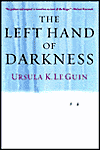
7798497.gifI wrote earlier about how much I liked Ursula Le Guin’s The Left Hand of Darkness, and I’d like to try to explain why a little further. I’m generally not a science fiction reader, and that may not change, but I did enjoy this book enough to be open to other recommendations, or perhaps to reading other Ursula Le Guin books (thoughts, anyone??).

Ultimately what did it for me is the personal relationship the novel describes. I’ll always go for the social and personal dynamics in a novel, rather than for its other attractions — in this case, the political dimension Le Guin develops. I can’t really describe the relationship that develops between the two main characters, Genly Ai, the alien visitor on the planet Gethen, and Estraven, a Gethenian political leader, because it would give too much of the story away. But the novel opens with an encounter between these two, and as they meet and interact throughout the novel, their ideas and feelings about each other change in dramatic and satisfying ways. It’s through these two that Le Guin explores most deeply what it’s like to confront “otherness” in someone else and to try and understand that person, in spite of cultural obstacles. There is much they say to each other that the other misinterprets, and it’s a pleasure to watch them realize their mistakes and try to overcome them.

But the political element of the novel is fascinating too; the two countries on the planet Gethen that we hear about, Karhide and Orgoreyn, are going through a transformation, within themselves and in relation to each other. Karhide has modernized itself in many ways but has not yet developed some of the problems our modernized countries on earth experience, such as war or the consequences of the industrial revolution. Its citizens are not nationalistic in their thinking. And yet these things are changing; Karhide finds itself under new leadership that seeks to foster fear and hatred of other peoples and countries in order to consolidate power. Orgoreyn is a much harsher place; it has a system of surveillance and a powerful government reminiscent of fascist states here on earth. Tensions between these two countries are rising.

Into this political situation comes Genly Ai, a representative from the Ekumen, an alliance of planets dedicated to furthering, as Genly puts it:

Material profit. Increase of knowledge. The augmentation of the complexity and intensity of the field of intelligent life. The enrichment of harmony and the greater glory of God. Curiosity. Adventure. Delight.

The members of the Ekumen have left behind many of the problems Karhide and Orgoreyn are only now beginning to face; they do not understand patriotism or nationalism and do not participate in war. The story, then, is about how well Genly fares in his quest to get the countries of Gethen to join the enlightened Ekumen, which can potentially change the course of their development.

So there’s all this going on, which is a pleasure to read, and there’s also an adventure tale of a trek across glaciers that’s incredibly exciting. And there are also sections interspersed between many of the chapters that tell of Gethenian myths, legends, and historical events so you get a sense of the history and culture of the people who inhabit Gethen. And there are the fascinating sex practices and gender dynamics that are so different from those on earth, which I wrote about here.

It took me a little while to get fully involved in the story — I supposed I’m not used to learning about a brand new world as one usually must when reading science fiction — but once I got a little ways into it, I was hooked and didn’t want it to end.

5 Comments

Filed under Books, Fiction

On Noise

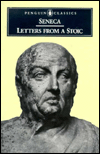
1127397.gif My book Letters from a Stoic — essayistic letters by Seneca — arrived the other day, and I’m reading through the introduction now. But what I want to write about today is an essay from Lopate’s book, Seneca’s “On Noise.” He begins the essay this way:

I cannot for the life of me see that quiet is as necessary to a person who has shut himself away to do some studying as it is usually thought to be.

As I’d written about this very subject recently, this opening caught my eye. If what Seneca says is true, then I am wrong and this is a flaw of mine, since I need quite a bit of quiet to concentrate. Seneca goes on to argue that a person with a well-ordered mind should be able to block out distractions:

For I force my mind to become self-absorbed and not let outside things distract it. There can be absolute bedlam without so long as there is no commotion within, so long as fear and desire are not at loggerheads, so long as meanness and extravagance are not at odds and harassing each other. For what is the good of having silence throughout the neighbourhood if one’s emotions are in turmoil?

He talks about how people often don’t find peace even when it’s perfectly quiet — even when they are sleeping — which shows that it’s not so much outside noise that is the problem, but inside turmoil. To a certain extent I agree with this. I have trouble concentrating sometimes because my mind is often not at peace. I’m not very good at forcing the kind of “self-absorption” Seneca is describing, and perhaps if I practice I could improve. This would be a good thing.

But I also think, particularly when we’re talking about noise produced by people, that distractableness can be a sign of something more positive: it can indicate an interest in people, a quality of tuned-in-ness to others. I can’t shut voices out very easily because I love to eavesdrop on conversations and observe how people interact and how they sound. If I’m continually distracted from my book by the kids playing outside that may indicate my lack of mental calm, but it may also indicate a irresistible curiosity about what the kids are saying as they play their games.

To me, there’s some connection between being good with people and being unable to shut out their voices. By being “good with people” I mean something like being focused on others, wanting to take care of them, wanting to keep things peaceful, wanting everybody to be happy. I often feel responsible (rightly or wrongly) for making sure everybody is content and everything is okay, and listening to people’s voices, even if they’re not directed at me, is a way to make sure that happens.

As much as I don’t fully agree with Seneca, I do, however, like this line from the essay:

The only true serenity is the one which represents the free development of a sound mind.

This I can agree with.

12 Comments

Filed under Books, Essays, Reading

The Fun of Blogging about Books

I was interested to read this post from The Literary Saloon about the panel “Grub Street 2.0: The Future of Book Coverage,” which was part of the NBCC’s symposium: “The Age of Infinite Margins: Book Critics Face the 21st Century.” I don’t want to write about the future of book coverage, exactly, but a few of Literary Saloon blogger M.A. Orthofer’s comments caught my attention. Orthofer notes that the panel’s participants didn’t seem to recognize one value of book blogs vs. print reviews that seems crystal clear to me: that book blogs deal with older works as well as newly-released ones, and that even when it comes to newly-released books, book blogs offer more variety of coverage:

the fact that the big newspaper (and magazine) book sections tend to have an awful lot of overlap in what titles they cover was not raised — and the fact that the reach of the online sites is, if nothing else, much deeper seems to have gone unnoticed by all.

Well, duh, right? Anyone who has read even a few book blogs for a little while will notice that a broad range of books gets discussed and you never know what you’ll find, but you are almost certain to find something new. Isn’t it clear that if a reader wants to find out about books published in the past, even the recent past, print reviews are not the place to go? And might not blogs be a good place to start such a search?

The other thing I noticed is a comment made by one of panelists, paraphrased by Orthofer as the suggestion that:

unlike someone writing a novel or poetry and finding satisfaction in creating something like that, even if it was never published, no one writes book reviews just for their own pleasure and satisfaction.

Orthofer disagrees with this idea, and I do too, at least to a certain extent. Now, I’m quite certain that I would never write a book review if I knew no one would see it ever. But I’m happy to write about books without attempting to publish what I write in any traditional venue (recognizing that publishing them on a blog is a sort of publication). I write this blog purely for my own pleasure and satisfaction; I’ve never wanted to use the blog to try to find myself some other kind of writing work and I know I’ll never make any money from it – and I don’t even try.

In fact, the writing I do on the blog is, depending on how I look at things, possibly keeping me from doing other kinds of writing that would help my career, in some way. The time I spend writing for this blog I could actually spend writing scholarly articles, if I were interested in spending more time on them. Or I could spend the time writing specifically for non-academic types of publication – review articles or maybe even a book of some sort. I write about 300-800 words just about every night for this blog – if I wrote for some other, more “useful” purpose, those words would accumulate pretty quickly into publishable work (in the traditional sense). But I’m not terribly interested in doing more of those things than I do now, so I don’t.

(I’m not pretending to be a book reviewer on this blog, let me clarify; if I thought of myself as a “book reviewer” I’d work harder on writing more thorough posts. But I do write things that could be considered related to book reviews, and so do most of the bloggers I read.)

There’s something wonderful about producing writing about books for no reason other than the enjoyment of it — if I were paid to blog, I bet it wouldn’t be as much fun.

9 Comments

Filed under Blogging, Books

Bullets for Friday

  • My plan was to ride 60 miles this weekend, which I have already accomplished — yay me! This means that the rest of the weekend I can sit on my ass. Okay, maybe I’ll go on a short ride on Sunday. And walk a few miles. Otherwise, I’m resting. The ride was nice — hilly, of course, but the weather was beautiful, upper 60s, lower 70s, a little breezy, smelling like fall.
  • I finished listening to the audio version of Mark Haddon’s The Curious Incident of the Dog in the Night-Time, and can I just say that I loved this book? I won’t write a whole post on it because I think most people know what it’s about if they haven’t read it already, so I’ll just add my voice to the chorus of people who have praised it and leave it at that. The first person voice is immensely appealing, and I liked getting into the mind of an autistic character and seeing what it’s like in there. I’m definitely hunting down Haddon’s latest book, preferably on audio if I can find it.
  • I finished reading Ursula Le Guin’s The Left Hand of Darkness, and can I just say that I loved this book? I really did. Thanks to those of you who recommended it; trust me — book bloggers don’t lead you wrong. More thoughts on the book later.
  • I’m off to a cycling party tonight; it’s for people who raced in the Tuesday night races in my town. It should be fun — a last chance to see fellow cyclists for a while (as I don’t usually participate in group training rides with them).
  • Enjoy your weekend!

11 Comments

Filed under Books, Cycling

I forgive you Walter Scott

Remember how I was complaining that the opening of Waverley is a bit slow? Well, Walter Scott has read my thoughts and kindly apologized:

I beg pardon, once and for all, of those readers who take up novels merely for amusement, for plaguing them so long with old-fashioned politics, and Whig and Tory, and Hanoverians and Jacobites. The truth is, I cannot promise them that this story shall be intelligible, not to say probable, without it … Those who are contented to remain with me will be occasionally exposed to the dulness inseparable from heavy roads, steep hills, sloughs, and other terrestrial retardations; but, with tolerable horses and a civil driver … I engage to get as soon as possible into a more picturesque and romantic country, if my passengers incline to have some patience with me during my first stages.

Thank you for the warning! I’m not quite to the “picturesque and romantic country” yet, but I’m certain I’ll get there and this novel will be fun — it surely was so popular for a reason. Can you imagine a contemporary author asking for the reader’s patience in this way? Yes, the novel will be dull in places, but bear with me; I promise there’ll be good bits.

Actually, there are good bits even in the introductory chapters; the very first chapter doesn’t begin the story at all but is a discussion of the novel’s title, and if you know me, you’ll know I can’t resist this kind of novelistic navel-gazing. What he’s doing in discussing the title is placing his novel in its context amongst other novels of the period. He found the choice of “Waverley” relatively simple, but his subtitle plagued him for a while. He considered “Waverley, a Tale of Other Days,” but that sounded too Radcliffean; if he had used that subtitle:

… must not every novel-reader have anticipated a castle scarce less than that of Udolpho, of which the eastern wing had long been uninhabited, and the keys either lost, or consigned to the care of some aged butler or housekeeper, whose trembling steps, about the middle of the second volume, were doomed to guide the hero, or heroine, to the ruinous precincts?

He considered “Waverley, a Romance from the German,” but then readers would have expected:

a profligate abbot, an oppressive duke, a secret and mysterious association of Rosycrucians and Illuminati, with all their properties of black cowls, caverns, daggers, electrical machines, trap-doors, and dark-lanterns.

“Waverley, A Sentimental Tale” would have meant (this one is particularly good):

a heroine with a profusion of auburn hair, and a harp, the soft solace of her solitary hours, which she fortunately finds always the means of transporting from castle to cottage, although she herself be sometimes obliged to jump out of a two-pair-of-stairs window, and is more than once bewildered on her journey, alone and on foot, without any guide but a blowzy peasant girl, whose jargon she hardly can understand.

And the last one, “Waverley, A Tale of the Times,” which must have involved:

a dashing sketch of the fashionable world, a few anecdotes of private scandal thinly veiled, and if lusciously painted, so much the better.

Sorry for all the quotations, but I find them irresistible. Scott gets away with both establishing what his own work does and doesn’t do, and making fun of the stereotypes of the fiction of his time. What he settles on is “Waverley; or, ‘Tis Sixty Years Since,” a time not so long ago as to be exotic nor so recent as to make people think they are reading a commentary on modern times. Instead, the time period allows him to put the focus on his characters and on their passions, instead of on their context. He wants characters likely to be seen as universal types, and he decides this is the best way to achieve them.

So, yes, after that wonderful opening chapter and with the promise of excitement to come, I’m willing to put up with a little dullness.

9 Comments

Filed under Books, Fiction

More essays

My essay project is taking off in unexpected directions, which isn’t a bad thing, not at all, but it means the project gets a little bigger every time I give it a little thought. I feel like Tristram Shandy, who is trying to tell his life story but who has so much to tell that every day of his life he falls a little more behind. Every day I find myself backing up and adding more to my reading list.

I originally wanted to focus my essay-reading on John Gross’s Oxford Book of Essays, which I chose not because it’s wonderful, but because I hadn’t yet read it. And I still will use that one. But I realized that Gross’s book has only essays written originally in English — which explains the otherwise inexplicable absence of Montaigne — and I prefer to include some essays in translation. So I got out Phillip Lopate’s The Art of the Personal Essay to give it another look-through and I realized that there are many essays in there I haven’t yet read. So I’m going to read essays from that book too.

Then I discovered that Lopate begins his essay survey with some essays from classical writers such as Seneca and Plutarch, and I decided I’d better back up and begin not with Bacon, but with these early writers. And then I read the first selection from Seneca and loved it, and so now I’ve got Seneca’s Letters from a Stoic on order from Amazon — and if you’re wondering why I’m ordering letters for an essay project, it’s because Lopate calls the letters “essays in disguise.” So, I’m now planning on reading the Seneca book, Montaigne’s complete essays, and then Bacon’s essays. And who knows where I’ll go from there, or if I’ll even get that far before I discover a new author whose work I need to read more fully.

This is fun, but will I ever actually make any progress? Who knows.

7 Comments

Filed under Books, Essays

Intro to Walter Scott’s Waverley

I have very mixed feelings about the introduction to my edition of Walter Scott’s Waverley; I’ve read only part of it, as I don’t like to hear an editor’s thoughts on the plot and characters until I’ve finished the novel, but I do like to read about the author’s life and context, so from that section of the introduction, I can quote a bit I found immensely annoying:

Scott’s triumph became a triumph for the form he wrote in. The novel gained a new authority and prestige, and even more important perhaps, a new masculinity. After Scott the novel was no longer in danger of becoming the preserve of the woman writer and the woman reader. Instead it became the appropriate form for writers’ richest and deepest imaginative explorations of human experience.

Yes, it’s the idea that women’s concerns are narrow and small, things that no man need worry about, but men’s concerns are wide and rich and universal. And heaven save us from those ubiquitous women writers and readers who are always threatening to take over everything. What the hell? The introduction was published in 1972, which is not to excuse it because of its relatively early date, but to wonder why Penguin couldn’t bother to get a less sexist editor in all that time.

The editor somewhat redeems himself with his discussion of Scott’s faded reputation. Scott was immensely, hugely popular in his time and was surely one of the most influential novelists of the 19C, so what happened? The editor claims that the 20C’s reaction against Victorianism and especially against Romanticism is to blame. His comparison of Scott and Austen is useful; he describes how his fortunes fell as hers rose:

Where Jane Austen is strong, Scott is weak: her careful sense of form and structure against his slack and slow-moving narrative procedures; her superb control of the complexities of tone against his pedestrian heavy-footedness; her profoundly ironic vision of human nature and human society against his complacent conventionality of attitude; her flexibility of language and style against his stilted, formal rhetoric.

I’ve been trying to imagine a world where Scott is valued more highly than Austen, and I can’t quite do it; it’s very hard for me to see why not everyone in all times and all places would see the genius of Austen and the lesser light of Scott as I do, but maybe that’s just me.  Oh, wait — I haven’t actually read Scott yet.  Mustn’t rush to judgment.

I’ve begun the first few chapters, and … well … they aren’t that good. I found them kind of obscure and hard to follow. But I know things will get improve and I fully expect to enjoy the book. As Sandra has rather wonderfully pointed out, 19C novels don’t tend to begin with a bang.

5 Comments

Filed under Books, Fiction

Naguib Mahfouz’s Palace Walk

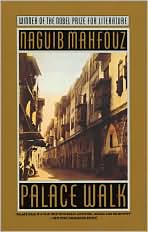
13986001.jpg What a pleasure this book was to read. Many thanks to Emily for giving me a copy for my birthday!

Palace Walk by Naguib Mafouz is a long, sprawling saga about a family in Cairo who finds itself caught up in political turmoil at the end of World War I. The earlier sections of the novel are devoted to describing the family — a father and mother with five children — and its dynamics. As I’ve described before, the father, Al-Sayyid Ahmad, has an extremely tight hold over the rest of the family; he dictates what everyone does and where they go.

This is particularly hard on the women, as Al-Sayyid Ahmad insists they follow extremely strict traditional rules of modesty — the mother, Amina, is not allowed out on the streets at all, except for a very occasional visit to her mother. In one incident when Al-Sayyid Ahmad is away from home for a day, Amina breaks this rule and visits a local temple. It is an act of devotion, but it only lands her in trouble: out on the streets she gets hit by a car and when Al-Sayyid Ahmad discovers her injuries and finds out where she has been, he banishes her from the house. Only after his children and friends beg him to take her back does he allow her to return.

The novel describes the struggles each of the children have with this patriarchal authority; one son wants to marry, but Al-Sayyid Ahmad believes he is not ready and refuses to give permission. A daughter receives a marriage proposal she would gladly accept but the father is angry when he finds out the suitor has caught a glimpse of his daughter’s face through the window.

What the children don’t know, however, is that Al-Sayyid Ahmad spends his nights getting drunk, carousing with friends, and having love affairs. Amina sees his drunkenness every night, but even she doesn’t really know how he spends his time. Al-Sayyid Ahmad believes he is talented enough a person and strong enough a father to keep this double standard going; he is a model father as far as he is concerned, and he sees no need for consistency in his behavior.

As you can probably guess from this set-up, Al-Sayyid Ahmad is in for a world of frustration as his children find ways of doing what they want, in spite of their fear of him. The novel charts the increasing difficulty the father has in controlling them, a difficulty made much worse by increasing political unrest. The later sections of the novel become more political in nature, and tell the story of Egyptian demonstrations against the English occupiers. Violence takes over the city, putting the family and its traditional ways at risk.

The novel is slow-moving in the very best sense — it’s never dull or plodding, but rather rich and detailed about the lives and emotions of its characters. With his omniscient point of view, Mahfouz does a good job giving the reader a glimpse into the minds and emotions of many characters, and he can make us understand and even sympathize with the most unlikeable people. I like the way Mahfouz blends the personal, family story with the political one; I didn’t feel that the family story was told in the service of the political one or vice versa, but that Mahfouz wove the two together, showing how national dramas affect people’s intimate lives, and how the private world reaches out into and shapes the public one.

Fortunately for me, this is the first novel in a trilogy, so I have the pleasure of reading further in the lives of this family.

12 Comments

Filed under Books, Fiction

Sex on Gethen

People told me I could expect to find some interesting gender dynamics in Ursula Le Guin’s novel, The Left Hand of Darkness, and that’s exactly what I’ve found. The story takes place on a planet that is called Gethen by its inhabitants and Winter by everyone else because of its extremely cold climate.

The inhabitants of Gethen have a very different kind of sexuality than humans do, and I’m finding it fascinating. Gethenians are ambisexual, meaning that they are capable of being male or female and they switch between the two. They follow a sexual cycle slightly shorter than a month that begins in a sexually neutral state; towards the end of the cycle they enter what’s called “kemmer,” a period of sexual activity that lasts 4-6 days. During this time if they find a desirable partner also entering kemmer they each take on either male or female characteristics and can have sex. They have no control over which partner is male and which female. Either partner is capable of taking on the female role and therefore either partner can become pregnant.

Kind of interesting, isn’t it? One of the book’s narrators, who is not from Gethen and therefore whose sexuality is like ours, speculates on how these differences in sexuality lead to differences in culture. I’m going to quote a long passage from this section, which I think would be better than if I were to summarize it; speaking of kemmer, the narrator says:

Everything gives way before the recurring torment and festivity of passion. This is easy for us to understand. What is very hard for us to understand is that, four-fifths of the time, these people are not sexually motivated at all. Room is made for sex, plenty of room; but a room, as it were, apart. The society of Gethen, in its daily functioning and in its continuity, is without sex.

Consider: Anyone can turn his hand to anything. This sounds very simple, but its psychological effects are incalculable. The fact that everyone between seventeen and thirty-five or so is liable to be … “tied down to childbearing,” implies that no one is quite so thoroughly “tied down” here as women, elsewhere, are likely to be — psychologically or physically. Burden and privilege are shared out pretty equally; everybody has the same risk to run or choice to make. Therefore nobody here is quite so free as a free male anywhere else.

Consider: There is no unconsenting sex, no rape. As with most mammals other than man, coitus can be performed only by mutual invitation and consent; otherwise it is not possible. Seduction certainly is possible, but it must have to be awfully well timed.

Consider: There is no division of humanity into strong and weak halves, protective/protected, dominant/submissive, owner/chattel, active/passive. In fact the whole tendency to dualism that pervades human thinking may be found to be lessened, or changed, on Winter.

Would you want to live in a world like that? There are other aspects of Gethen that don’t sound so appealing, but I can’t help but like the idea of a world where sex and gender still exist, but without the inequality and violence associated with them.

One challenge this model of gender presents to the author is what to do about pronouns; male or female pronouns aren’t really accurate and neuter ones aren’t either, since Gethenians aren’t neuter at all. Le Guin has her narrators use the male pronoun, and although I don’t really like this — it makes it seem as though Gethen is populated only by men — I’m not sure what I would choose instead. To make up a pronoun?

9 Comments

Filed under Books, Fiction

Essays

Today I rode a slightly different version of the course I rode last week, but it was a completely different experience: no parades, no embarrassing scenes in the market, no saddle slippage. And I was a bit faster. Yay! Today’s ride was 53 miles, and next week I’m riding 60.

After thinking about my potential reading projects, I decided to begin one of them. We’ll see how they go. One thing I have to do is give myself permission to bail on it if it becomes uninteresting. I’m terrible at giving up on books and reading projects, even if they aren’t going well. But I can’t let myself get stuck in a long reading project I’m not enjoying.

So, I decided to begin the essay project; I read the first essay last night, Francis Bacon’s “On Truth,” which has a wonderful first line: “What is truth? said jesting Pilate, and would not stay for an answer.” The essay is quite short, only a couple pages, and it describes both the allure of lies and half-truths:

This same truth is a naked and open daylight that doth not show the masques and mummeries and triumphs of the world half so stately and daintily as candlelights.

and the goodness of truth:

Yet truth, which only doth judge itself, teacheth that the inquiry of truth, which is the love-making or wooing of it, the knowledge of truth, which is the presence of it, and the belief of truth, which is the enjoying of it, is the sovereign good of human nature.

I think the pleasure of reading his essays will lie not so much in the ideas themselves, but in the beauty of the sentences. The prose is dense — I read very slowly — and rich.

I have a collection of Bacon’s essays that I was assigned in grad school; after reading Bacon in The Oxford Book of Essays, I pulled down the Bacon collection and saw that I’d marked up the entire text. Hmmm. I don’t remember reading the entire thing. My class in 17C prose was one of the rare classes where I skipped a significant amount of the reading. But Bacon was the first book we read, and I suppose I was still feeling motivated at the beginning of the semester (before I found out I wasn’t so fond of the professor and stopped giving the class my full attention). I plan on looking through this collection again, reading in it as long as it interests me.

I thought Montaigne was in this collection, but I just checked, and he’s not — I was considering reading through his complete essays as a part of this project. Hmmm. I’ve read many of them, but not all — I tried a complete read-through once but stopped after a while. Should I go back and try again??

6 Comments

Filed under Books, Cycling, Essays, Reading

Reading projects?

In spite of the fact (or because of the fact?) that the semester has begun and I have less time for reading, and am therefore trying to keep the number of books I’m currently reading down to a minimum, I have felt a longing lately to start ridiculously long reading projects. For example, I’ve got The Oxford Book of Essays (edited by John Gross) that I’m tempted to begin reading in, and it’s a long book in itself, but I’d also like to read not just individual essays in the collection, but books by the authors I like along the way. I’d make it a big, long study in the essay. Doesn’t that sound like fun? And something that would take forever?

Or I could brush up on the history of philosophy as I’ve been thinking about for a while, except this time, study the authors in more depth rather than rushing through them as one must in a year-long course. Or could start reading novels in German again, because surely after a while I’d remember the vocabulary I once knew and reading them would get faster and be lots of fun? Or I could take this big fat anthology of 18C literature I’ve got and, maybe not read through it exactly, but do a study of the authors I don’t know very well?

I’m often torn between wanting to read systematically, and wanting to read at whim. Or I can put it this way — I’m torn between wanting to be an expert in one or two (or three or four) areas, and wanting to read a little bit of everything.

And the thing is, I’m not so terribly good at taking on long reading projects (Proust excepted, I suppose, but there I have the satisfaction of finishing a volume now and then). I get frustrated when I don’t finish books in a month or two, at the longest. Perhaps I need a “long-term reads” or “ongoing projects” category such as Danielle has; perhaps then I’d give myself permission to take my time. This is just one of the ways I’m sometimes at war with myself …

10 Comments

Filed under Books, Reading

Booking Through Thursday

I’ve never answered one of the Booking Through Thursday questions, but today the question caught my eye, so maybe today is a good day to start. Here’s the question:

Okay, so the other day, a friend was commenting on my monthly reading list and asked when I found the time to read. In the ensuing discussion, she described herself as a “goldilocks” when it comes to reading–she needs to have everything juuuuuust right to be able to focus. This caught my attention because, first, I thought that was a charming way of describing the condition, but, two, while we’ve talked about our reading habits, this is an interesting wrinkle. I’d never really thought about it that way.

So, this is my question to you–are you a Goldilocks kind of reader?

Do you need the light just right, the background noise just so loud but not too loud, the chair just right, the distractions at a minimum?

Or can you open a book at any time and dip right in, whether it’s for twenty seconds, while waiting for the kettle to boil, or indefinitely, like while waiting interminably at the hospital–as long as the book is open in front of your nose, you’re happy to read?

I’m too much like a “goldilocks” reader for my own comfort. I don’t require perfect conditions, but I require very good ones. I can read when there are distractions around, but I read very slowly when there are — even more slowly than usual. I wish I were the kind of person who could focus well, but I’m not.

It’s rare, actually, that I’m completely absorbed in what I’m reading. I often look up from my book, sometimes to think about a passage, sometimes to notice something about my surroundings, and then my thoughts will wander and I’ll have to drag myself back to the book once again. I’m particularly bad about this when there are people around. I love to watch people, and I can’t help but notice social dynamics, so reading in airports or doctor’s offices is hard (although I do it). I’ll notice if someone starts a conversation, and once that happens, I can’t help but listen in. If people are having an argument, my book becomes useful only as something to hide the fact that I’m eavesdropping.

And I find it hard to quiet my mind to settle into reading. I suspect I’d benefit greatly from meditating regularly — I need to teach myself not to let my thoughts distract me from my book or whatever else. This is particularly hard when the semester is underway and I’ve got lots to think about. I’ll read for a few minutes and then notice that I’m not reading anymore and am thinking instead about how class went that day. Over the course of an evening’s reading, this gets better; by the evening’s end, I’m able to pay closer attention.

6 Comments

Filed under Books, Reading

Starting new books

I’ve been enjoying starting new books — what greater pleasure is there than diving in to a new book? One of them is Ursula LeGuin’s Left Hand of Darkness; I’m about 40 pages into it and think I’ve figured out what’s going on — it takes a while to get all the new names and new vocabulary and the rules of a new world when reading science fiction — or when reading any book, really, but science fiction especially. It promises to be fun. It’s the first science fiction I’ve read in, oh, probably a couple decades. Perhaps when I’m finished with this I’ll ask for more recommendations.

I also began Bruce Chatwin’s travel book In Patagonia. I’m still figuring out how this book works, too, although once I figure it out I think I’ll end up liking it. Actually, it’s not so different from beginning Left Hand of Darkness because I also have to figure out the “world” of the book — before I began it, I barely knew where Patagonia was. And I have to figure out exactly how Chatwin goes about writing a travel tale. It’s not exactly a straightforward narrative, but is made up of very short chapters, 1-2 pages long, each with their own vignette. So far there’s not much discussion of why he traveled and how he went about all the little steps of the trip — all the connective tissue of the journey; instead, he focuses on interesting people he meets and on the landscape, and he moves really quickly from one incident to the next. It’s amusing — he’ll mention walking down a road, running into a man walking the other direction, and next thing I know, Chatwin is visiting the man’s house, getting introduced to his family, and spending the night there. I’m not exactly sure how they got from passing each other to becoming friends. As far as I can tell, he’s a drifter who sleeps in a bed when he can get one, and behind a bush when he can’t.

I also began listening to Mark Haddon’s The Curious Incident of the Dog in the Night-time, and oh, what a fun book! I love the reader’s voice and accent, and I find the main character so very appealing. Listening to it makes me want to meet him and show him that I get it — that I’m not one of those annoying people who uses sloppy language and tells lies. This book is so charming.

6 Comments

Filed under Books, Reading

Be Near Me, by Andrew O’Hagan

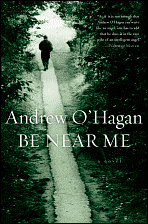
12864414.gif I’m down to only two books I’m currently reading, and I’m about to finish one of them! I haven’t been in this situation in a long time. The only thing to be done about it is to start a couple new books, at least. Ursula LeGuin’s Left Hand of Darkness, Walter Scott’s Waverly, and Bruce Chatwin’s In Patagonia are the ones I’m planning to choose from.

But for now, I want to write a bit about Andrew O’Hagan’s new novel Be Near Me. I thought the novel had a few flaws, but overall it’s beautifully-written, absorbing, and moving. It’s about a Catholic priest, David Anderton, assigned to a small parish in Scotland who finds himself (David often seems passively drawn into things) involved with two teenage kids, Mark and Lisa. Mark and Lisa are wild; they do their best to shock David, but find themselves drawn to him when he isn’t shocked — when they see he wants to spend time with them. The three of them hang out after school and at night, talking and driving places; David takes the teenagers on trips to local landmarks they had never visited; generally, they have a lot of fun, although it’s clear from early on that these relationships are complicated and bound to become more so.

The novel is told in first person, and mixed in with the Mark and Lisa scenes, David tells about his past, his time at school and at Oxford, especially, and the story of falling in love with Conor, a fellow student. These background stories help to fill in David’s character. He doesn’t fit in easily anywhere and says he’s not sure where he belongs; he had an exciting youth, participating in the student protests of the 60s (he’s now in his 50s), but when he became a priest, he turned away from all that and has since lived a very quiet life, serving in parishes in England and only recently in Scotland.

He seems disconnected from himself, and his voice comes across as stoic and a little bit melancholy, as though he knows he has missed out on much but refuses to admit it. His housekeeper Mrs. Poole, with whom he has forged a friendship, tells him has spent his life trying to avoid life, but he refuses to believe this.

So when he meets and befriends Mark and Lisa, it inaugurates something new; he sees in them the youthful energy he no longer has, but he also grasps at the chance to change himself, to be a participant in life, to take risks and do foolish things. This is the most moving part of the book, I think; the longing David has for newness that he finally allows himself to indulge.

But it all goes wrong, inevitably, and David pays dearly for this experience of freedom and abandon.

What I loved best about the book is how richly it describes David’s sense of self and his interiority; it’s a very smart, thoughtful book, rather sad in the way it portrays growing older and taking stock of what one has become, but hopeful about the possibility of change, even in the midst of disaster. I did feel the narrator’s voice was sometimes a little too withholding, a little too reticent, and in these moments, rather than communicating hidden depths, the narrator left me a bit cold. This is the danger of using first person with a character like David, I suppose; his ambivalence about himself can at times make him seem a little blank.

But I only felt this blankness in moments, and mostly the experience of reading this book was a pleasure.

4 Comments

Filed under Books, Fiction

What I’m reading

I hope everyone is enjoying their Labor Day weekend; I’m not doing anything special, just riding a bit, reading a bit, and trying not to think about school starting soon. I’ve completed or am nearing the end of several books, the De Quincey one, first of all, of which I have about 25 pages left. This is one of the odder books I’ve read in a while. I’ve written a few posts on it (here, here and here), but these posts by no means capture the oddness of it. I’ve given you little snippets, but it’s the contexts they come out of that are so strange. His writing is so digressive; he takes you all over the place, and often you don’t know where he’s going until you get there, and then he’s off someplace else.

The book takes some patience to read, for me at least, since his writing is fairly dense, but it’s very much worth it. He leaves you wondering and wondering what’s going on until he hits with you a beautiful passage that takes your breath away. He tells a story in “Suspiria de Profundis” about a mountain called the Brocken in Germany with an optical effect where, if you climb to the top at the right time of day, you see an image of a person of gigantic size a couple miles off in the distance, set against the sky or clouds or rocks. Only after noticing that the gigantic figure follows all of your movements, do you realize that it’s an image of yourself. De Quincey calls this the “Dark Interpreter” and the passage starts to get psychological:

This trial is decisive. You are now satisfied that the apparition is but a reflex of yourself; and, in uttering your secret feelings to him, you make this phantom the dark symbolic mirror for reflecting to the daylight what else must be hidden for ever.

The Dark Interpreter turns out to be an aspect of yourself that, separate from the self you are familiar with, allows you to reveal your hidden depths. De Quincey says the Dark Interpreter is often the “self” that appears in his dreams. He takes the metaphor further; as the apparition of the Brocken is sometimes disturbed by storms so that it no longer looks like him, so the Dark Interpreter is sometimes like an alien being living in him:

What he says, generally is but that which I have said in daylight, and in meditation deep enough to sculpture itself on my heart. But sometimes, as his face alters, his words alter; and they do not always seem such as I have used, or could use. No man can account for all things that occur in dreams.

So the apparition of the Brocken turns out to be the strange version of ourselves that appears in dreams, sometimes recognizable, sometimes so strange that we wonder how those words and ideas got in our heads in the first place.

Kind of cool and strange, right? The whole book is obsessed with dreams — the sources of them and how our minds transform those sources.

The essay I’m reading now, the last one, is about mail coaches. Yes, he’s written a fascinating 50-page essay on mail coaches. Report to follow.

But I didn’t mean to turn this into a post on De Quincey, which is what it has become, I’m afraid. I’m also about to finish my book of Keats poems, which I have enjoyed tremendously, and I just finished Andrew O’Hagan’s novel Be Near Me. I’ll write about that one next, to give you a break from all this De Quincey.

6 Comments

Filed under Books

Library sale!

If you’ve read Hobgoblin’s post today, you’ll have an idea what mine is going to be about. Yes, we went to another library sale. How could we not when it’s huge and just a few miles up the road? I swear this is the last library sale I’m going to until … next year. Here’s what I found:

  • Rosamund Lehmann, A Note in Music. Litlove recommended the author to me, although not this particular title. It’s a Virago edition.
  • Somerset Maugham, The Razor’s Edge. I loved Of Human Bondage, I’m ready to try another Maugham novel, and how could I resist after reading Becky’s post?
  • Anne Bronte, Agnes Grey. I already have one unread Anne Bronte novel (The Tenant of Wildfell Hall), but I love having unread Victorian novels lying around, so I snatched it up.
  • Frances Burney, Camilla. She has two very long novels I haven’t yet read, this one and Cecilia. Someday I’ll get to both of them.
  • Elizabeth Taylor, A Game of Hide and Seek. I discovered Taylor last summer when I read two of her novels and loved them, so I’m happy to find another.
  • Rose Macaulay, The Towers of Trebizond. Surely this will make Emily happy! I found a pretty NYRB classics edition, and it was only $1.50.
  • Penelope Fitzgerald, The Book Shop. This is a slim volume, and how could I resist the title? I’ve never read Fitzgerald, but I keep hearing she’s good.
  • Nicholson Baker, Room Temperature. Yes, I am a Nicholson Baker fan.
  • Edith Wharton, The Buccaneers. I love the Wharton novels I’ve read, and Hepzibah writes about Wharton so well, I had to get this one.
  • William Styron, Sophie’s Choice. This kind of speaks for itself, doesn’t it? A great book, so I hear.
  • Samuel Taylor Coleridge, Biographia Literaria: Biographical Sketches of My Literary Life and Opinions. To further my interest in the romantics. Copies on Amazon seem like of pricey, so I’m glad I got it.

Who knows when I’ll actually read these, but I’m happy to have them now.

11 Comments

Filed under Books, Lists

Mind as palimpsest

I’m on to De Quincey’s third essay in my collection, “Suspiria de Profundis,” or “Sighs From the Depths.” This is such a rich essay that I find myself wanting to write a blog post about many sections from it — isn’t it a delight to find a good book that inspires many blog posts? I think of these books as “bloggable” ones, ones that will keep a regular poster going for quite a while.

Anyway, there’s a short section about halfway through called “The Palimpsest” that I found particularly fascinating; it spends five pages or so explaining what a palimpsest is — a manuscript written on multiple times and nearly erased after each use but leaving a trace of the previous text that is still readable. In his example, a Greek tragedy is written and then scraped away, a legend about a Christian monk replaces it, and a romance about knights replaces that. De Quincey gives no indication where he is going with the topic until he has explained it thoroughly, at which point he makes it all clear:

What else than a natural and mighty palimpsest is the human brain? Such a palimpsest is my brain; such a palimpsest, O reader! is yours. Everlasting layers of ideas, images, feelings, have fallen upon your brain softly as light. Each succession has seemed to bury all that went before. And yet in reality not one has been extinguished.

What a wonderful metaphor, is it not? The idea is that nothing we have experienced is lost; it’s simply been covered over by something else and by something else again. But traces remain:

Yes, reader, countless are the mysterious handwritings of grief or joy which have inscribed themselves successively upon the palimpsest of your brain; and, like the annual leaves of aboriginal forests, or the undissolving snows on the Himalaya, or a light falling upon light, the endless strata have covered up each other in forgetfulness.

The more I read the more I realized how Proustian this whole metaphor is, but instead of involuntary memory — when a sensory experience triggers a memory of a long-forgotten moment — as the mechanism that reveals the forgotten layers in our minds, for De Quincey, it’s approaching death, severe illness, or opium that brings the memory back:

[Memories] are not dead but sleeping. In the illustration imagined by myself, from the case of some individual palimpsest, the Grecian tragedy had seemed to be displaced, but was not displaced, by the monkish legend; and the monkish legend had seemed to be displaced, but was not displaced, by the knightly romance. In some potent convulsion of the system, all wheels back into its earliest elementary stage.

Perhaps De Quincey’s conception of memory allows for a more active role than Proust’s does — one can take opium to induce these memories, if one wishes. For Proust, involuntary memory simply happens, outside our control.

De Quincey also begins to found Freudian:

But the deep tragedies of infancy, as when the child’s hands were unlinked for ever from his mother’s neck, or his lips for ever from his sister’s kisses, these remain lurking below all, and these lurk to the last. Alchemy there is none of passion or disease that can scorch away these immortal impresses.

So the partially erased layers of the palimpsest are the unconscious, waiting for its chance to emerge — to be read. But this implies there is little more we can do but “read” the layers; they cannot be fully wiped away.

5 Comments

Filed under Books, Nonfiction

A little too much patriarchy

I’m reading Naguib Mahfouz’s novel Palace Walk right now and enjoying it greatly; it’s a long, rich, satisfying read, about a family in Cairo after World War I (although I had to look up the date, which I couldn’t figure out from the novel itself — this is probably my fault for not getting historical references). It’s the kind of book you can live with for a long time; it moves slowly but in a good way, giving you lots of detail about setting and character. It feels like a Victorian novel in a lot of ways, as one of its main preoccupations is getting the young people properly married.

Its resemblance to Victorian novels is making me realize that I’ve been reading an awful lot about how much life used to suck for women — which is not to say that it doesn’t suck today, at least for some, especially outside of the Western world. But still — Palace Walk right after The Crimson Petal and the White reminds me of just how grim life could be. Yesterday I wrote about how Faber’s novel describes the impossibilities women faced in Victorian society, so I won’t repeat that. In Palace Walk, the situation seems even worse, although the women in the novel haven’t yet expressed any dissatisfaction. Here, the two young daughters, as respectable women eligible for marriage, are not allowed to be seen by any man, not even through through a window. They spend their days in the house, mostly doing housework, as far as I can tell. They have little education. The mother — the whole family actually — defers to every whim and desire of the father. The mother is little more than a glorified servant.

I’m not surprised by this at all, but it does make me long to read something with a more feminist bent to it, and soon. I remember people mentioning that Ursula LeGuin’s Left Hand of Darkness has an interesting take on gender; perhaps this is a good possibility?

10 Comments

Filed under Books, Fiction, Reading

The Crimson Petal and the White

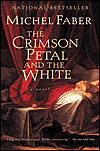
6938770.gif Michel Faber’s The Crimson Petal and the White was such an enjoyable book; it’s about 900 pages long, but it felt much shorter. The pages flew by. The excitement and speed doesn’t come from an incredibly complex plot; rather, it comes from the fun of being caught up in a vividly-realized world so very different from our own.

The book is set in London in 1875, and the author takes special delight in describing all that was horrid about the place — the filth, the smells, the poverty, the inequality, the prostitutes, the thieves, the beggars and pickpockets. Maybe there’s something a little wrong about enjoying these things in one’s reading, but still, it is delightful to read about a time not so far back in history that makes a person glad she’s alive today and not then. It makes one think, though — maybe people will one day read historical fiction about our time and wonder how we ever managed to survive when things were obviously so very terrible.

The story revolves around three main characters, William Rackham, head of a perfume industry; Agnes Rackham, his wife; and Sugar, the prostitute William falls in love with. Each character is vividly portrayed. Sugar is very smart and knows how to manipulate weak men such as William; she uses William’s infatuation with her to the fullest extent possible. She’s writing a novel describing her fantasies of revenge against all the men who have abused her in her life. William is insecure and foolish; he wanted a literary life but gave that dream up so he could make money, but he never quite trusts himself or his decisions. He wants to have the perfect home with wife and child and luxury and refinement, but he also wants Sugar for the pleasure and flattery she brings. He wants it all, and he lives in a society that gives him no reason to think he can’t have it.

Agnes, the wife, is one of the most fascinating characters; she’s startlingly ignorant about sex and reproduction, ashamed of her body, and unwilling to acknowledge that she’s given birth to a daughter. She’s the perfect Victorian woman — proper, modest, polite, and ignorant. But she’s also teetering on the brink of insanity. The point is obvious — conventional Victorian womanhood drives women mad — but it’s still a pleasure to see how Faber makes it all work out. Agnes and Sugar fall into the virgin/whore dichotomy, but these roles slip and slide and undermine each other and by the end, both women refuse to be what William — and society — want them to be.

Faber takes pleasure in spelling out just how restrictive the rules of proper society were; I knew something about what it meant to be a high-class Victorian woman, but I was still shocked at the many, many rules. It wasn’t proper for a woman to laugh with her mouth open. She couldn’t acknowledge any bodily function whatsoever. She was supposed to walk in such a way as to deny she has legs; she’s supposed to glide across the floor as though she is an angel. She couldn’t do any physical labor whatsoever, not so much as closing the curtains or putting a log on the fire. She couldn’t acknowledge there was such a thing as prostitution. It’s all this detail that makes historical fiction so much fun, isn’t it?

14 Comments

Filed under Books, Fiction