
Just a short post tonight to say that I’m about 3/4 of the way through Ian McEwan’s On Chesil Beach, and I’m finding it quite hard to put down. I know what it’s all about, I know the whole plot and all the background, and I know what tons of reviewers have said about it. Normally this would turn me off of a book. I do get tired of reading reviews of the same books over and over again and sometimes it gets to the point where even though the book might have initially sounded quite good, I won’t read it, because I feel like I already have. But when I saw On Chesil Beach in the library, I grabbed it, and here I am gobbling it up (after Hobgoblin did the same thing; here’s his review). It’s been a while since I’ve picked up a book that has made me want to abandon all my other books until I finish it — not that it takes very long to finish McEwan’s book, as it’s a very quick 200 pages.
Category Archives: Books
Beginning Djuna Barnes’s Nightwood
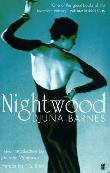 I have begun reading Djuna Barnes’s Nightwood, and I can already tell I’m going to need to read it again. I’m considering reading it again immediately after I finish the first time around, although I’ll wait to see how I feel when I get there. It’s a short book, 150 pages with large font, and I’ve already read about 45.
I’m not entirely sure what to make of it or even how to describe my difficulty knowing what to make of it. Perhaps quoting the opening line is the best thing to do:
Early in 1880, in spite of a well-founded suspicion as to the advisability of perpetuating that race which has the sanction of the Lord and the disapproval of the people, Hedvig Volkbein, a Viennese woman of great strength and military beauty, lying upon a canopied bed of a rich spectacular crimson, the valance stamped with the bifurcated wings of the House of Hapsburg, the feather coverlet an envelope of satin in which, in massive and tarnished gold threads, stood the Volkbein arms — gave birth, at the age of forty-five, to an only child, a son, seven days after her physician predicted that she would be taken.
Yes, that gives you a taste of what it’s like to read this book. The prose is exquisitely well-crafted; I love how this sentence slowly winds its way around to its point, taking in along the way all kinds of information about Hedvig, who turns out not to be a character in the book at all, but is important, perhaps, for the way she sets the tone and gives us information about what kind of person that son will be — who is a character in the book.
The pace of the book is both fast and slow; after two chapters a lot of events have occurred — that son has grown up and now has a child of his own — but the narrator also lingers over conversations at length, allowing the character called “the doctor,” although I don’t think he really is one, to go on and on. I’m not always sure exactly what he’s saying. The characters seem a little like Hedvig, larger than life, not quite real, and fascinating.
You see why I’m going to have to read this book again? It’s not coming together for me in the way books usually do by the time I’m nearly 1/3 of the way through. But this book strikes me as good enough to spend some time with, trying to figure it out.
Dear Walter Scott
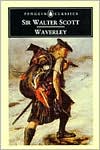 I finished! I’m sorry Walter Scott, I really tried. I wanted to like this book; I was patient and gave it time to get better after a slow start. I kept hoping and hoping that the action would pick up, the characters become more meaningful — and more comprehensible — the romances would get more interesting, but it never happened for me. Well, Walter Scott, you obviously have done quite well enough without my approval; you’ve got so many books in print after nearly 200 years, and you have lots of readers, including, as a matter of fact, my father, who reads every book of yours he can find. You don’t really need me.
I wish, though, that you had toned down those accents a bit. Baron Bradwardine was so nearly impossible to follow. His high-flown diction and his Latin phrases mixed in everywhere drove me crazy. The problem is, I stopped trying to figure him out after a while. I could follow the action without understanding every word he said, and so it turned out not to be worth my while to decipher his language. Couldn’t he have talked just a bit more normally?
I found myself having a hard time caring about any of the characters too. They were all types, not real people. Edward was foolish, though not irremediably so; clearly he was going to have to learn a lesson, but, also clearly, he would prove himself capable of doing so. Rose was the perfect young heroine, beautiful, modest, capable but not overly smart. It was crystal clear to me after I encountered her what her fate would be. And the same for Flora and Fergus, the Scottish siblings — there wasn’t much doubt what would happen to them. Both of them fascinate Edward, tempt him, lure him into questionable things, but both of them would ultimately prove themselves too dangerous. There was no suspense! Nothing to keep my interest for very long. And I’m generally very bad at predicting the endings of books. When I can figure it out, you’re in trouble.
And here’s another thing I don’t get: you’re Scottish, right? Why portray Scotland and the Scottish people as unstable and dangerous, and the English as the bastions of safety and normality and order? Why exoticize the Scottish? They lure Edward into all kinds of danger and you portray his attraction to them as understandable but flawed and a weakness he needs to outgrow. Well, okay, let me revise this — you’re really portraying the Highlanders as exotic and dangerous. The Lowlanders are merely odd. So am I supposed to see the Lowlanders as roughly aligned with the English in their “normalcy” and the Highlanders as the dangerous other? I’m not sure I like this.
This doesn’t mean that I won’t read other books of yours. I’m curious about why you were so popular, and I don’t feel I understand it yet. What was it about Waverley that fascinated people so much? Those Highlanders are kind of romantic and thrilling, but, still, even there I thought you could do a better job describing them and their lives. Anyway, maybe I’ll try Ivanhoe next. I’m willing to give you one more shot.
The Fair Triumvirate of Wits
Dale Spender’s Mothers of the Novel has an intriguing chapter on “The Fair Triumvirate of Wits” — Aphra Behn, Delariviere Manley, and Eliza Haywood, all writers of the late 17C and early 18C who made their living from writing. None of them had particularly good reputations — and by that I mean their sexual reputations were suspect — and Spender makes the point that sexual reputation and writerly reputation get conflated when we’re talking about women writers of the time (and later times). The reputations of these women as writers have suffered, even though (or because?) their writings were very popular, in part because their behavior was “questionable”:
In trying to explain why it is that Aphra Behn’s novels have been ‘ignored’ and that pride of place has been accorded to Daniel Defoe, it emerges that there have been clear links between Aphra Behn’s ‘immorality’ and her expulsion from the literary mainstream. Her work has not been fit for study.
Spender devotes a lot of space to analyzing why these three women’s contributions to the novel have been ignored, and at times this can get a bit repetitive. Also, I’m reading the book from the perspective of 20 years later, when much critical writing has tried to give these women their place in literary history, so the book feels dated at times. But still, her account of what these women accomplished is interesting.
Of Aphra Behn, for example, she writes:
In her choice of subject matter, her commentary, and her style, she illustrates some of the differences in outlook between women and men; even her sense of humour — which frequently makes men the butt of the joke — contrasts markedly to the forms to which we are accustomed, and in which it is the humour of men that prevails.
Behn is important in the development of the novel because her writing moved the genre toward a new kind of realism; it is not that she’s writing the kind of realism that we are familiar with today, but that she “has a talent for minute observation, astute assessment, the portrayal of fine realistic detail.” She brought a new level of believability to older forms of writing such as the pastoral romance.
Delariviere Manley was famous for her “scandal chronicles” — works that were set in far-away, exotic places, but were clearly about local high-born people and their exploits. Spender argues that Manley’s writing furthered the novel by taking realism in yet another direction — this time instead of writing realistically about fantastical people and places as Aphra Behn did, Manley “introduced a fantastical rendition of real-life happenings.” In fact, she went to prison briefly for writing about the scandalous doings of powerful people in government. It’s in these various ways of mixing up fiction and reality, Spender argues, that a comfort with and acceptance of fiction — lies that are somehow true — as we know it today developed.
Eliza Haywood was hugely prolific and wrote in just about every genre available at the time — and in a number that weren’t:
The growth and development of the novel can be illustrated with reference to the writing of this one woman, who reveals an extraordinary creative ability, who freely experiments with form and style, and who produces an unprecedented and perhaps unparalleled range of novels. Every enduring and exemplary feature of the new genre is to be found in her writing, and yet she has never been given the credit for her contribution.
Spender argues that Haywood realized she had more and more potential readers among the middle classes and so began to write with their interests in mind. Interestingly, she claims Haywood anticipated Samuel Richardson’s “innovations” to the novel form in Pamela by writing about a middle-class heroine battling an aristocratic villain and thus introducing the kind of class warfare that would preoccupy many novelists after her. Here is how Spender sums up her achievement:
She was among the first to assert the validity of middle class experience, among the first to insist on the significance and the humanity of ‘ordinary people’ and among the first to explore the conflict of interest between the classes and sexes. And in so doing she helped to modify the very essence of a story and its meaning.
I haven’t read enough of the writings of these women! I like to think I’ve read a lot in the 18C, but reading Spender’s book makes me realize how much I’ve missed. I’ve read Behn’s Oroonoko, her play The Rover and some poems, and that’s it. I’ve read Haywood’s novel Love in Excess, but nothing else by her. And nothing at all by Manley. We’ll see what else I can add to the list.
Filed under Books, Nonfiction
Barbara Pym’s Excellent Women
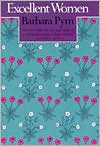 I thoroughly enjoyed Barbara Pym’s 1952 novel Excellent Women. It tells the story of Mildred Lathbury, a woman in her 30s whose life is taken up with part-time work helping “impoverished gentlewomen,” attending services and volunteering at the church, and maintaining friendships with the vicar and his sister. She also finds herself endlessly caught up in other people’s business:
I suppose an unmarried woman just over thirty, who lives alone and has no apparent ties, must expect to find herself involved or interested in other people’s business, and if she is also a clergyman’s daughter then one might really say that there is no hope for her.
She is one of the “excellent women” of the novel’s title, women who aren’t wrapped up in families of their own and so have time to — and are expected to — devote themselves to taking care of others.
As the novel opens, a new couple is moving into the flat above Mildred’s; they are Helena and Rocky, and Mildred does not know what to make of them. Helena is an anthropologist and not terribly interested in her marriage; she spends her time with fellow-anthropologist Everard, working on writing up their field notes. She is a terrible housekeeper, a fact that disturbs and intrigues Mildred. Rocky is utterly charming and perhaps a trifle fake; Mildred quickly falls for him, but also wonders, as she does, whether Rocky really means to charm her, or whether he simply can’t help but make women fall in love with him.
Helena and Rocky disrupt Mildred’s quiet life. She is quickly doing things she has never done before, such as attending lectures in anthropology and mediating marital squabbles. Her life is further disrupted when the vicar — her close friend and up to now a confirmed bachelor — begins a flirtation and gets engaged.
The novel is told in the first person, which Pym uses very cleverly to capture Mildred’s thoughtful, intelligent voice, but also to make clear to the reader her naivete and lack of experience; Helena, for example, hints that the vicar might be gay, but this passes right over Mildred’s head. And yet Mildred knows she hasn’t experienced much — she’s very aware of her limitations, painfully aware at times. She does her best, wading into the deeper waters recent experience has led her to, but she also longs for things to be the way they once were, quiet and comfortable.
As much as she is aware of her lack of experience, however, Mildred has a strong sense of identity; she knows who she is, what her social role is, and how she wants to live. As an “excellent woman,” she accepts that many people expect her to help them out — why shouldn’t she, after all? What else does she have to do? She tries to be useful, but also to keep from being used — and here she fails now and then, as each of the main characters takes advantage of her at one point or another. It’s frustrating at times to watch Mildred trying and frequently failing to maintain the balance between taking care of others and taking care of herself.
For me, the pleasure of reading this novel lies in Mildred’s astute understanding of her small world; she knows it’s a small world, but what’s important is that it’s hers and she wants to enjoy it. She’s capable of viewing it with a critical, satirical eye, but also of loving it. She strikes me as courageous — both in accepting her life as it is and in remaining open to the ways it can possibly change.
Women Writers and Virago Modern Classics
Thanks to The Literary Saloon, I came across a fabulous article by Jonathan Coe in The Guardian called “My Literary Love Affair,” about how he discovered Virago Modern Classics. The article is fabulous for a couple of reasons: because it’s got information on the history of the series and because Coe’s story of encountering these books is a good one. He describes coming across the series in a bookstore in 1982 and being intrigued by the phrase “modern classics” connected with names he hadn’t ever heard of before — May Sinclair, Dorothy Richardson, Rosamond Lehmann. He says that calling these books by largely forgotten women authors “modern classics” was a powerful political statement at a time when the term “classic” meant a little more than it does today.
So, he reads some of these books and finds himself and his writing changed. This is what he says about the experience:
Before long, the Virago novels would unseat some of my deepest assumptions as a reader, and also alter my course as a writer. It was under their influence, in my mid-20s, that I abandoned straightforward autobiographical writing and chose a female protagonist for my first published novel, The Accidental Woman; while my latest, The Rain Before it Falls, is intended (among other things) as an hommage to the whole list and the authors which it reintroduced.
He talks a lot about Dorothy Richardson’s long, Proustian-like novel Pilgrimage (Pointed Roofs is the first part). Pilgrimage was considered hugely important in its day, but around the time of World War II fell out of favor and has never returned. Coe describes how Richardson experiments with style, trying to produce what she termed “a feminine equivalent of the current masculine realism.”
He also describes May Sinclair’s work and says of Rosamond Lehmann that he has had a decades long literary love affair with her writing. Lehmann is an interesting case study in how women writers get marginalized for taking up supposedly “female” subjects; one male reviewer wrote of The Echoing Grove that “so prolonged a voyage in an exclusively emotional and sexual sea afflicts a male reader at least with a sense of surfeit” and another that “entirely, exquisitely feminine readers, trousered or otherwise, will probably receive the book with rapture.” Coe points out that Graham Greene’s novel The End of the Affair, published at the same time and with a similar tone and theme, did not receive the same treatment.
Coe argues that the Virago series was and still is important in countering critical bias against women writers, but that work still needs to be done, and he points to the relatively few women who make the Booker prize shortlists as evidence. But he does recognize that attitudes are changing, and he makes his point with this intriguing argument:
But there is a sense that the crude gender bias in British literary culture which Virago challenged so effectively in the 1970s and 80s no longer exists. Most of the new writers who have broken through to critical acclaim and big readerships in recent years have been women: Monica Ali, Zadie Smith, Ali Smith, Lionel Shriver, Marina Lewycka, Sarah Waters and Susanna Clarke, among others. And these writers are, for the most part, writing big, historically and politically engaged novels, not voyaging in “an exclusively emotional and sexual sea” – a phrase that might rather be applied (accurately, but non-pejoratively) to a novel like Ian McEwan’s On Chesil Beach. In 2007, it’s Graham Swift who writes a novel focused entirely on the domestic and familial (Tomorrow), while writers such as Rose Tremain and Marina Lewycka examine the plight of low-paid migrant workers in the modern British economy. The old clichés about what distinguishes male writing from female writing no longer stand up to scrutiny.
Interesting, isn’t it? Reading about how important these women writers were for Coe made me quite happy, and I realized that I responded so positively because I don’t often hear male writers saying such things. Correct me if you think I’m wrong, but doesn’t it seem to be the case that it’s rare for male writers to acknowledge the importance of a specifically female tradition of writing for their own work? Coe isn’t merely pointing out one or two important female influences; he’s pointing to a tradition, and it’s one that taught him to write in ways the male writers he was already familiar with hadn’t.
Has anyone read Coe? I liked this article enough I’m curious about his own fiction.
Friday ramblings
This is going to be a rambling, pointless post because I’m feeling rather like Danielle is today, without the headache (although that may be on the way). I spent all afternoon in an intense meeting on testing procedures to place students into the proper English class, which was, as you can imagine, not so incredibly thrilling. I like my job, except for all the meetings. (Isn’t that true for tons of people? How many of you agree with me?)
I do, however, have the pleasure of picking up Penelope Lively’s novel Moon Tiger this evening. I began it last night and after only a few pages I could tell it’s something I will like. It’s got an older narrator, a woman in a hospital with cancer, who is looking back at her life. She’s an historian, and so she’s thinking about her life as history and about history itself; it sort of flows through her head and out onto the page in a random, rambling way. But themes are emerging, especially having to do with archeological metaphors and rock strata — the idea of digging through the layers of history, one’s own history and world history.
I’m determined to finish Waverley this weekend; one good push should do it, as I have fewer than 50 pages left. Believe it or not, I’m not entirely opposed to reading another Scott novel at some point in my life. I guess you could call me hopelessly optimistic, but I just might like Ivanhoe or some of the other ones. I’d kind of like to find out.
I’m working my way slowly through Dale Spender’s Mothers of the Novel and am finding it fascinating; look for a post on Aphra Behn and/or Delariviere Manly and/or Eliza Haywood sometime soon. These are the “fair triumvirate of wits,” three writers often mocked by other, mostly male, writers of the day for their hugely popular, often scandalous writing. They all seem to be very prolific, energetic, courageous writers determined to make their living from writing in a time when it was very hard for a woman to do so.
Okay, off to the books!
Seneca on exercise
I’m enjoying read Seneca’s essayistic letters, although I frequently come across passages I don’t agree with. This makes it fun, though, as I can argue with Seneca, both in my mind and here on this blog.
I’m not buying his thoughts on exercise:
For it is silly, my dear Lucilius, and no way for an educated man to behave, to spend one’s time exercising the biceps, broadening the neck and shoulders and developing the lungs. Even when the extra feeding has produced gratifying results and you’ve put on a lot of muscle, you’ll never match the strength of the weight of a prize ox. The greater load, moreover, on the body is crushing to the spirit and renders it less active. So keep the body within bounds as much as you can and make room for the spirit.
I can’t say I’m at all interested in broadening my neck and shoulders, but that’s beside the point. The real issue is that Seneca sees large amounts of exercise as detrimental to mental and spiritual health. The body and the mind are in competition, in his view, and devoting energy to one automatically means harming the other.
I suspect Seneca’s belief about education and large amounts of exercise — that they don’t belong together — continues to this day. But I don’t see it. As far as I’m concerned, exercise, even large amounts of it, contributes to mental and spiritual health rather than detracts from it. I don’t believe mind and body are in competition with each other; rather, as the body gets stronger it inspires the mind to get stronger. Exercise leaves me with more energy to devote to mental tasks, not less. To think that having a stronger body crushes the spirit strikes me as absurd — I’m more likely to see exercise as a spiritual activity in and of itself. So what our disagreement comes down to, I suppose, is a different view of the mind/body relationship. Seneca seems to be much more of a dualist than I am.
It’s not as though he’s against all exercise, though; he does say this:
There are short and simple exercises which will tire the body without undue delay and save what needs especially close accounting for, time. There is running, swinging weights about and jumping — either high-jumping or long-jumping … pick out any of these for ease and straightforwardness. But whatever you do, return from body to mind very soon.
Given his list of activities, I’m guessing he would approve of cycling if he knew of such a thing, but I don’t think he’d approve of hours and hours and hours of it. I can’t agree that shorter exercise is necessarily better, but he does have a point when he talks about time. Because I ride so much I have less time to read.
But for me, the benefits of spending all those hours on the bike outweigh the drawbacks. I need time away from books in order to enjoy my books. My job involves a lot of reading, after all, and if I didn’t ride, I’d be in danger of living a completely sedentary life and overstraining my eyes.
And, ultimately, I recognize I’m not interested in being as rational as he is. Because I know I’d stick to my view even if Seneca had the most overpoweringly logical arguments ever. I do try to be reasonable, but sometimes I just refuse to listen, and this is one of those times.
Eating in books
I’m in the middle of listening to the third Maisie Dobbs novel on audio for the second time; I listened to it about a year ago, and then listened to the first and second novels in the series last spring and this fall. I decided to listen to the third one again partly for the pure pleasure of it, and partly to get the whole story in the proper sequence. I’m trying to get the fourth one from the library (although my library system is a little skittish about sending CDs from one library to another, which is annoying). I wonder what it would be like to read one of these books … I’ve come to associate them so closely with a voice speaking to me as I drive to and from work.
I’m not entirely sure, but I think in the third installment Winspear is ridding her prose of some of the tics that annoyed me a bit in the second book. One of these is the habitual list of clothing her major and minor characters, and even those who are too minor to count as minor characters, are wearing: e.g., “the assistant, dressed in a blue cotton dress and matching cap decorated with yellow piping ….” Everyone seemed to get this treatment.
A little more serious, in my opinion, is the way Maisie never eats. In the second novel, she’s always picking at her food, skipping meals, realizing she’s hungry and then losing her appetite, asking for just a bit of dry toast, please. As far as I can tell, this doesn’t play into any of the novel’s themes in any way; it’s just a habit, and one Maisie seems to have lost by the third novel. I hate it when people don’t eat! As I was listening, I was trying to figure out how Maisie made it through her days with no food in her stomach and why she didn’t pass out from hunger at least once. I believe in all the other ways Maisie is a perfect character — I’m happy to believe in her amazing intuition, her ability to read body language, her way with setting people at ease — but I don’t believe she can make it through a day without eating.
I realize I may sound a little odd complaining about this. I’m kind of sensitive about my sensitivity about food. But as someone who can’t stand (can’t stand!!!) to be hungry, ever, even for a short while (I think my illness has made this worse), I got so distracted by Maisie’s refusal to eat. When I don’t eat, trust me, you should stay far, far away. I don’t quite get why other people aren’t the same way.
The not-eating thing feels like a quirk, but it also feels like a way of getting across the idea that Maisie is simply too important and too busy to spend much time or energy on food. It’s a way of saying she’s too wrapped up in her mind to take care of her body. Eating is too gross, too physical, and all Maisie’s energy has to go toward more ethereal things such as the mind and the emotions.
But, thank heavens, in the third novel, she’s finally recognizing she needs food; I just listened to a scene where she declares to her friend Priscilla that she’s starving and wants her lunch. Much better.
Likes and Dislikes
I’m in the middle of two novels right now, and let’s just say that the experience of reading these books has been quite different.
One of my novels is Barbara Pym’s Excellent Women, which, I’d like to say, is a truly excellent novel. I’m about 2/3 of the way through, and I’ve enjoyed every minute of it. I’ll write more about it when I’ve finished, but for now, here’s the opening paragraph:
“Ah, you ladies! Always on the spot when there’s something happening!” The voice belonged to Mr. Mallett, one of our churchwardens, and its roguish tone made me start guiltily, almost as if I had no right to be discovered outside my own front door.
This opening captures the tone of the novel perfectly. The phrase “ah, you ladies” suggests that we are going to be dealing with gender stereotypes, which we certainly are — the “ladies” of this phrase and the “excellent women” of the title refer to unmarried women who find themselves wrapped up in other people’s lives. The narrator’s startled guilt is perfect too; the narrator turns out to be Mildred Lathbury, and she never feels quite at home anywhere. She takes silly accusations like Mr. Mallett’s seriously, does her best to please everybody, but still never quite finds herself fitting in anywhere. The reference to churchwardens is a clue that the novel has much to say about the church; Mildred is a clergyman’s daughter and her best friends are the vicar and his sister. The novel is so delightfully English.
The other novel is Walter Scott’s Waverley, which is very English in its own way, and not nearly so delightful. I’ve tried my best with this novel, people, and it’s just not working for me. I’m going to finish it, but that’s only because I simply must read Walter Scott, since I study his time period and he’s so important in it. But oh boy, is this a tough one. I thought it was just the beginning that was slow and that it would improve as it went on, and I suppose it’s improved marginally, but only marginally.
Part of the problem is the slow pace of the action, but that’s not it entirely because I really don’t mind books with slow paces. I like them, in fact. I love books like Clarissa, which is exactly where you turn if you want the slowest pace possible. The other problem is the Scottish dialects Scott uses and the quirky forms of speech he gives his characters. What do you make of passages like this one:
I crave you to be hushed, Captain Waverley; you are elsewhere, peradventure, sui juris, — foris-familiated, that is, and entitled, it may be, to think and resent for yourself; but in my domain, in this poor Barony of Bradwardine, and under this roof, which is quasi mine, being held by tacit relocation by a tenant at will, I am in loco parentis to you, and bound to see you scathless.
Or this one:
“It represents,” he said, “the chosen crest of our family, a bear, as ye observe, and rampant, because a good herald will depict every animal in its noblest posture: as a horse salient, a greyhound currant, and, as may be inferred, a ravenous animal in actu ferociori, or in a voracious, lacerating, and devouring posture. Now, sir, we hold this most honourable achievement by the wappen-brief, or concession of arms, of Frederick Redbeard, Emperor of Germany, to my predeccessor, Godmund Bradwardine …”
and on and on. I can only handle so much of this before I put the book down and move on to something else. Sorry, Walter Scott.
The Woman Who Waited, by Andrei Makine
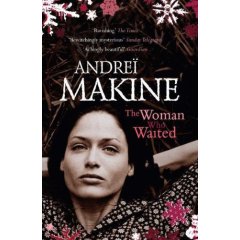 Thank you, Litlove, for recommending this book to us! Andrei Makine’s The Woman Who Waited was the Slaves of Golconda group read this time around; it’s a short novel about a woman, Vera, waiting in a small Russian village for her lover to return from the war. She’s been waiting for 30 years. Actually, what the novel is really about is the unnamed narrator’s attempts to tell Vera’s life story. The Woman Who Waited is the story of how he tries to understand who she is and why she has waited so long, instead of leaving the decaying town and forging a life elsewhere. She’s a mystery the narrative dances around.
The narrator has come to Vera’s town, Mirnoe, on a research project; he is supposed to write reports on “local habits and customs.” His instructions are to “go and jot down a few fibs about the gnomes in their forests” and on the side he will gather material for an “anti-Soviet satire.” And so, befitting this project, he comes to the town with a detached and ironic attitude, ready to observe and pass judgment on the simple villagers clinging to their old ways.
When he arrives in Mirnoe, however, he quickly finds that the reality of the place will not let him keep his distance or maintain his ironic pose. In one episode, the narrator and Vera travel to a nearby village to persuade its last inhabitant to leave her home and move to Mirnoe. The narrator finds himself shaken by what he sees:
I went over to them, offered my help. I saw they both had slightly reddened eyes. I reflected on my ironic reaction just now when reading that sentence about Stalin ordering the defence of Leningrad. Such had been the sarcastic tone prevalent in our dissident intellectual circle. A humour that provided real mental comfort, for it placed us above the fray. Now, observing these two women who had just shed a few tears as they reached their decision, I sensed that our irony was in collision with something that went beyond it.
He sees the real human suffering that lies behind historical events, events he had only understood before in their broad sweep.
But it is the narrator’s changing feelings toward Vera that really shake him out of his detachment (some spoilers ahead). He cannot understand what motivates her to continue waiting; he cannot pierce the mystery that he sees whenever he observes her. And much of the novel is exactly that — the narrator watching Vera, following her every move, trying to figure out what she is doing, where she is going, what she is feeling and thinking. The novel’s opening portrays his attempts to understand her and the way that language fails him; we first get a sentence of description in quotation marks, as though it’s from a journal or an essay, followed by this:
This is the sentence I wrote down at that crucial moment when we believe we have another person’s measure (this woman, Vera’s). Up to that point all is curiosity, guesswork, a hankering after confessions. Hunger for the other person, the lure of their hidden depths. But once their secret has been decoded, along come these words, often pretentious and dogmatic, dissecting, pinpointing, categorizing … The other one’s mystery has been tamed.
The statement and commentary that comprise the novel’s first page show the limits of language one encounters when trying to understand another human being. The novel is a kind of unraveling, moving from this certainty toward uncertainty and surprise. The narrator never does really understand Vera, and he tries in many ways, spending time with her, talking with her, stalking her, finally becoming her lover. She always eludes him, and ultimately she proves herself to be much more sophisticated, rational, and in control than he could ever be. She may seem foolish and pathetic for having spent her life waiting for a lover who will never return, and yet she has found peace and beauty and a kind of contentment.
The novel’s writing is beautiful, spare and suggestive; it captures the landscape of northern Russia with its forests, lakes, and snow. It makes me long to be there. I must admit that this is one of those books that I’m liking more and more as I write about it; at first my reaction was admiring but a little dispassionate. The more I think about it, though, the more I appreciate what a wonderful creation Vera is and what a powerful evocation Makine has given us of one person’s fumbling attempts to grapple with the mystery of another life.
A book meme!
Stefanie tagged me for a meme, and how, on a pleasant Friday evening, can I resist such a thing? You’ll find the source of the meme at Kimbooktu.
- Hardcover or paperback, and why? Either one. What I really hate are mass market paperbacks. I’ve read a number of people complaining about trade paperbacks and how expensive they are and how they are just a way to make more money, but I’m willing to pay a bit more for a book that falls open easily and has decent font size and margins.
- If I were to own a book shop I would call it… Black Dog Books. Hobgoblin and I have discussed this fantasy a number of times and have it all worked out; of course we’d have to name it after Muttboy who would be a shop fixture, and ideally we’d have an adjoining bike shop called Black Dog Bikes.
- My favorite quote from a book (mention the title) is… I don’t have one! I’m not a quotation collector.
- The author (alive or dead) I would love to have lunch with would be… Jane Austen. We would sit around, sip tea, and make fun of the other customers.
- If I was going to a deserted island and could only bring one book, except for the SAS survival guide, it would be… Probably the collected works of Shakespeare or the Bible. I’d want something rich and long and full of things to think about. That’s a boring answer, I’m afraid, but it’s the truth.
- I would love someone to invent a bookish gadget that… would allow me to do a word search in every book I’ve got. You can look up words in books online, of course, but what about when I’m reading a regular book and am desperately trying to find a particular passage?
- The smell of an old book reminds me of… Hanging out in libraries, studying and doing research. Or hanging out in used book stores trying to decide what I should buy.
- If I could be the lead character in a book (mention the title), it would be… Well, right now (my answer to this would change from day to day) I’d kind of like to be Maisie Dobbs from Jacqueline Winspear’s mystery novels. She’s so intelligent and intuitive both; she understands how people work and she’s expert at getting them to reveal their secrets.
- The most overestimated book of all time is… The Da Vinci Code. It strikes me that with so many people living on earth right now, and with a decent percentage of them having read and liked the thing, my claim might well be true.
- I hate it when a book… gives away too much of the plot, either on the back cover, the inside jacket, or in the introduction. How could publishing people do this?
I’m tagging whoever would like to do this one!
Anna Laetitia Barbauld; or, women in politics
I’ve been reading some of the poems of Anna Laetitia Barbauld (1743-1825) and enjoying them quite a bit; she’s an interesting figure for a lot of reasons (you’ll find many of her works here). She wrote some poems like “To a Lady, with some painted Flowers” with very traditional views of women and lines such as these, comparing the lady to a flower:
Nor blush, my fair, to own you copy these ;
Your best, your sweetest empire is—to please.
Mary Wollstonecraft criticized this poem in a footnote in The Vindication of the Rights of Woman for its stereotypical view of women. But Barbauld also argued for the importance of women’s education and equality. She wrote lines like these:
Yes, injured Woman! rise, assert thy Right!
Woman! too long degraded, scorned, opprest …
She wrote on a range of subjects, including domestic themes, for example in the charming poem “Washing-Day“; the natural world, as in “A Summer Evening’s Meditation“; and pregnancy, in a poem called “To a Little Invisible Being Who is Expected Soon to Become Visible.” And she wrote poems and essays on political themes, including slavery and empire. She was known as a political radical, arguing forcibly for the abolition of the slave trade and pointing out the injustices of imperialism.
One of the most interesting things about Barbauld is the story of her poem “Eighteen Hundred and Eleven,” her most famous poem, which argues that Britain would suffer decay because of the sins of imperialism. Of Britain she writes:
But fairest flowers expand but to decay;
The worm is in thy core, thy glories pass away;
Arts, arms, and wealth destroy the fruits they bring;
Commerce, like beauty, knows no second spring.
Crime walks thy streets, Fraud earns her unblest bread,
O’er want and woe thy gorgeous robe is spread,
And angel charities in vain oppose;
With grandeur’s growth the mass of misery grows.
It’s interesting to think that while British imperialism was yet to hit its high point when she wrote this poem, eventually what Barbauld predicted did come true.
I’ve been writing a bit about how women writers were relegated to women’s subjects — love, domesticity — and when they wandered into other territory — politics, for example — they were sharply criticized. Well, Barbauld obviously stepped over a line with this poem because the reviews were vicious, and they were gendered in their viciousness. One review by John Wilson Croker has this to say about “Eighteen Hundred and Eleven”; in this passage he refers to some of Barbauld’s earlier writing for children:
But she must excuse us if we think that she has wandered from the course in which she was respectable and useful, and miserably mistaken both her powers and her duty, in exchanging the birchen for the satiric rod, and abandoning her superintendance of the ‘ovilia’ [lambs] of the nursery, to wage war on the ‘reluctantes dracones’ [struggling lawgivers], statesmen, and warriors, whose misdoings have aroused her indignant muse.
We had hoped, indeed, that the empire might have been saved without the intervention of a lady-author … Not such, however, is her opinion; an irresistible impulse of public duty — a confident sense of commanding talents — have induced her to dash down her shagreen spectacles and her knitting needles and to sally forth …
and it goes on in this vein for quite a while. In other words, the reviewer is saying, get back to the nursery where you belong and stop meddling in politics.
This, unfortunately was a common response to women who wrote about “male” subjects. It hit Barbauld particularly hard, though, and although she kept on writing, she chose never to publish anything again. I suppose one could say she should have let the controversy wash over her and kept on publishing, but with a long, long history of such misogynistic criticism, it would be extraordinarily difficult to do so.
So there’s a double bind going on here — how could women experiment and write about dangerous topics when the wrath of the publishing world could fall on them (although many did this anyway), and how could people learn how to read and understand the things women were writing when aesthetic standards are defined by men?
Women and the Novel
There’s an interesting discussion going on in the comments on my post from the other day about women and the 18C novel, and I wanted to pick up on some of the ideas. Danielle asks:
I wonder if the reason some of these writings are not in the canon, or really available now is that these women’s writings are not seen as valid as men’s — or to say it a different way–a woman’s experience as valid as a man’s?
My short answer — that’s exactly it. Or perhaps I would say that for much of the last 200 years critics, most of them male, have tended overall to see women’s experiences as less valid than men’s and so have not taken women’s writing that expresses women’s experiences as seriously. In the last 20 years or so there’s been an explosion of interest in women’s writing and an attempt to think about what makes this writing valuable, but for so long 18C novels by women didn’t get attention because of a long tradition of criticism that wasn’t interested in understanding them.
Dale Spender writes about how it wasn’t so bad for women to write in the 17C and 18C as far as their reputations were concerned, but to publish their writings was risky. Here’s what she says about the 17C, before the novel took off:
The public world of letters was already by the seventeenth century a world of the ‘men of letters’, because so many women decided that the price of publicity was too high to pay, and made few or no attempts to encroach on this area of male territory. And this absence of women in print still has ramifications today, for, apart from the fact that it gave men a free hand to decree the literary conventions of the time (conventions which still make their presence felt), there is also the additional difficulty which is encountered when it comes to tracing the origins of women’s literary traditions. Women published much less, and what they published was more likely to be anonymous, little favored, and easily ‘lost’. This is in contrast to the extensive, varied public heritage of men which has been more readily preserved.
This is part of the story, that women writers struggled because entering public discourse was such a dangerous act, which meant that male writers could influence literary trends and decide what constitutes good writing, and women didn’t have much say in the matter. (I just can’t believe in objective aesthetic standards!)
The other part of the story is that once novel writing took off in the 18C and women writers began to publish in greater and greater numbers, male critics started to get dismissive about the value of novel writing. Yes, they said, novels are hugely popular, and yes women are successful at writing them, but the novel isn’t a serious genre, it’s just light entertainment, and so we’ll let women have it. Here is the dismissiveness about women’s writing and experiences that Danielle was asking about. For the longest time I don’t think we had the tools to understand and appreciate 18C novels by women because we didn’t have a tradition of thinking about them and trying to understand them.
As far as romance is concerned (another topic that has come up in the comments), that is more complicated, not least because “romance” can mean a number of things, including novels with marriage plots and novels that follow in the tradition of courtly romances with high-born characters, adventures, etc. But about the marriage plot, men and women both were writing about it — and the marriage plot is really about money and property and status when it comes down to it. Samuel Richardson’s novel Pamela is about a servant girl trying to break into a higher class through marriage and Austen’s plots are about love but also about how women of marginal status survive and about who is going to end up mistress of the big estate. It seems that everyone, men and women alike, were obsessed with what to do about young women and marriageable young men.
Oh, I could go on and on. I’d like to write soon about Anna Laetitia Barbauld who is a great example for thinking about how criticism and canon-formation hurt women writers.
Filed under Books
On not liking books
I thought about giving Bruce Chatwin’s In Patagonia a proper review — oh, not really, I never review things properly, but I mean as proper as I get — but I just don’t have the energy or interest in it. I didn’t like the book very much. I found myself bored with it, and I only finished it because I’m obsessive that way and it was short, only 200 quick pages.
I think my problem with the book is that I never learned much about Chatwin himself, or his persona, to be more accurate about it. The book’s focus is not on the traveler, but on the people he meets, the places he sees, the stories he comes across, and the history of the land he travels over. Now those things shouldn’t be boring, should they? But I found myself not caring much. The stories he told tended to be short ones, and they tended to focus on externals — what people did and what they looked like. Without some attention paid to internal things — emotions, thoughts — I remain unconnected.
It’s curious that I wouldn’t like this classic of travel literature, since the scholarly work I’ve done is on travel writing. But here’s the thing — I’ve studied “sentimental” travel, meaning travel writing that focuses on emotions and on internal states (see Laurence Sterne’s A Sentimental Journey for a prime example). In a way, this is an odd type of travel writing, since one would think the genre is valuable because of what it can tell us about the world, not so much because of what it tells about the traveler (although of course it does both). But, although I like reading about the world, I want to know about the traveler too, or if not the traveler, then I want to know about the people that traveler meets, and I want to know not just brief summaries of their lives, but something about who they are and why they are the way they are. If there’s no emotional element or if there are no ideas, then I’m left cold.
And In Patagonia didn’t have anything in the way of emotions and not much in the way of ideas either. It had a lot of cool facts and some interesting speculations about things like the inspiration of Coleridge’s “Rime of the Ancient Mariner” and the Patagonian sources of Darwin’s theories. But this wasn’t enough.
This is not to say that you won’t like the book. You may love it; it’s probably a great book for people who like this kind of book — and I don’t mean to sound judgmental when I say that. In some cases when I don’t like books it’s because I think they are genuinely bad, but in this case, it’s simply that this was not the book for me.
Filed under Books, Nonfiction, Reading
Mothers of the Novel
I have begun Dale Spender’s book Mothers of the Novel, and I have the feeling I’ll be posting on it regularly, as it’s full of interesting information. The book looks at women’s novels in the time period before Jane Austen, arguing that while we tend to think of Jane Austen as the first great woman novelist, it’s really the case that Austen drew on a long tradition of women’s writing as she created her own work. Mothers of the Novel was published in 1986 and there’s been tons of critical work (tons!) done on women novelists of the 17C and 18C since then, but this book is still a valuable overview. I’ve already added a couple writers to my reading list, including Amelia Opie and Mary Brunton.
Here are some interesting things I learned:
- The majority of novels in the 18C were written by women, and the novel was so closely associated with women that some men used a female pseudonym when they published their books. This caused a backlash against women writers which was at least partly successful, so that by the 1840s, the situation was reversed and women were adopting male pseudonyms when they published. This backlash is partly why the “canonical” novelists of the 18C are Fielding, Richardson, Defoe, Smollett and Sterne, a list which, of course, doesn’t include any women.
- Scholars have concluded that women today constitute only 20% of published writers (I don’t know how dated this figure is), which makes the statistic about women writing a majority of 18C novels even more interesting. Spender says this is evidence that the publishing world wasn’t always so unfair to women. I’m fascinated by the fluctuations in women’s status and the quality of their lives over the years; it hasn’t been a steadily upward trend by any means.
- Spender argues that women were successful at and interested in writing novels because novel writing is “a logical extension of women’s role” — many novels of the time were epistolary, and letters were a form of writing women were encouraged to participate in. She says letters are a good form in which to explore emotional and familial concerns, both subjects of the novel.
- Spender says her research into the novel has turned up over 100 women novelists before Jane Austen and no more than 30 men. So to end up with 5 canonical novelists all of whom are men doesn’t make much sense, unless it could possibly be the case that those 5 are better than over 100 women writers, which seems highly unlikely (assuming we could establish what “better” means). This is a perfect example for thinking about how the canon is flawed.
Filed under Books, Nonfiction
Sharing knowledge
I liked this bit from Seneca:
Nothing, however outstanding and however helpful, will ever give me any pleasure if the knowledge is to be for my benefit alone. If wisdom were offered to me on the one condition that I should keep it shut away and not divulge it to anyone, I should reject it.
I agree with this idea, and I think that it informs my decision to be a teacher and is part of the joy I find in blogging, not to say that I’m a dispenser of wisdom, exactly, but that I need an outlet of some sort for sharing the things I learn. I’m happy learning things on my own; I always liked school but don’t feel that I need it to learn things and often think I can learn better by myself. But what to do with knowledge I’ve gained? There’s something depressing about learning things and doing nothing with them. I think I’ve said this before, but still, it doesn’t hurt to say it again: blogging is a wonderful way do something with all the books I read and the ideas I encounter.
Bike rides and new books
I went on a lovely 76-mile ride today. The weather was perfect, in the 70s, clear and dry, and I headed up north into the countryside to enjoy seeing some hills and fields and horses. I used to live in the area I rode through today, and although I love my current town, I do miss the quieter more solitary place I left behind. With the exception of a few hills near the end that made me grumpy, I felt strong and content to sit on the bike for the approximately 5 hours it took to cover those miles. As I neared home I felt as though I could have kept going, if I’d had the time; perhaps when I do my long ride next weekend I will keep going and do a century. At this rate, I’ll be ready to do this century on October 13th with no trouble whatsoever, and I’ll get to ride with racing friend Fendergal! (She should be warned, though, that I’m not particularly fast …)
Okay, now I have or will soon have some new books to tell you about; I’ve been on a Book Mooch binge, using up lots of my points. Here’s what I’ve found:
- Penelope Lively’s Moon Tiger. A book personally recommended by Litlove — how could I not get a copy of this? I really liked Lively’s novel The Photograph, and so am eager to try something else.
- William Maxwell’s The Chateau. Also personally recommended by Litlove.
- Barbara Pym’s Excellent Women. I’m in need of a book that’s sure to be a delight — perhaps I should begin this one? I’m certain I’ll like it.
- Elizabeth Hardwick’s Seduction and Betrayal. I’ve read so many rave reviews of this book that I snapped it up.
- Ursula Le Guin’s Dispossessed. Stefanie and Emily both recommended this, and after thoroughly enjoying The Left Hand of Darkness, I felt I had to have another Le Guin.
- Heather Lewis’s House Rules. Recommended by Jenny D. (You see how seriously I take blogger recommendations?)
- Georgette Heyer’s Lady of Quality. Another Jenny D. recommendation. This looks like a fun regency romance.
And I got two books recently from Amazon, Dale Spender’s Mothers of the Novel, to learn a little more about 18C women novelists, and Djuna Barnes’s Nightwood, for the Outmoded Authors challenge. There’s lots of good reading here, don’t you think?
Walter Scott on Reading
First of all, have you ever wondered how not to write a paper?
Now to Walter Scott, who has made a contribution to the debate going on here about what one should read and how one should read it; here’s a description of his hero Edward Waverley’s reading:
With a desire for amusement, therefore, which better discipline might soon have converted into a thirst for knowledge, young Waverley drove through the sea of books, like a vessel without a pilot or rudder. Nothing perhaps increases by indulgence more than a desultory habit of reading, especially under such opportunities of gratifying it … Edward … like the epicure who only deigned to take a single morsel from the sunny side of a peach, read no volume a moment after it ceased to excite his curiosity or interest; and it necessarily happened, that the habit of seeking only this sort of gratification rendered it daily more difficult of attainment, till the passion for reading, like other strong appetites, produced by indulgence a sort of satiety.
Waverly has suffered the fate that many heroes and heroines from 18C and 19C novels suffer — he is without sufficient parental supervision of his reading material; his mother died when he was young and his father doesn’t pay a whole lot of attention. In novels from this time, trouble is sure to develop if young people are allowed unfettered access to libraries. I haven’t gotten all that far in the novel, so I’m not sure what direction it’s heading in, but I’m certain that this lack of reading discipline foreshadows some sort of trouble for the young man.
Now, I believe both in young people having unfettered access to libraries and in teaching them (somehow) to develop discipline in their reading. How do you accomplish both of these things though? I’m not sure. But discipline is important to me, just as reading purely for pleasure is. I think I’d be suspicious of someone like Waverley who never, ever finished a book he wasn’t entirely enthralled with or someone who never challenged him or herself with something difficult.
Maybe it’s good I don’t have children so I don’t have to worry about such things …
Reading the Canon
There were lots of interesting comments on my post from yesterday about Seneca’s advice for reading — thank you readers! I wanted to pick up on a few ideas here, one of which Jenclair pointed out, which is that the publishing environment we have here today is surely very, very far from what Seneca experienced. But I couldn’t really tell you what type and amount of reading material was available in his day, and I wish I could. What in the world would he (and others from ancient times) make of the abundance of books we enjoy today? When he says “a multitude of books only gets in one’s way,” what does he mean by a “multitude”? That he feels anxious about the effects of having a multitude of books available shows that the similar worries we have today are nothing new at all.
The other thing I wanted to consider was the issue of the canon; some people felt we should read largely from the canon and others that more variety was better. I liked Hepzibah’s questions on the subject: “who does get to decide what is canonized and what is not? What makes one author more worthy than another?” Very good questions indeed. It’s because of questions like these that I am suspicious of the whole idea of the canon. Danielle’s question is relevant too: “If Seneca were here today do you think many women authors would make his cut?” I’m guessing they wouldn’t.
I don’t think that canons get created solely on the basis of literary merit, although it would be nice if they were — but even here we’re on shaky ground because I think definitions of literary merit shift over time. What people valued in the 18C, for example, isn’t what we value today. I think what ends up in the canon gets there partly because of aesthetic merit, however it gets defined at any particular time, and partly because of publishing trends; political and social forces (racism and sexism, for example); literary scholarship, created by people with biases and blind spots; the literary context, i.e. what other people were doing at the time that readers can later identify as a trend that then becomes a movement and is taught as such; educational trends, meaning what sorts of texts educators want to teach at a particular time; and surely a host of other factors unrelated to merit.
Canons also have a self-perpetuating factor to them, meaning that works that are perceived as important get passed on and on, not necessarily because they are “great” works of literature, but because they are what’s taught and what the people coming before us knew. I realize this is beginning to sound circular, but I think there’s a distinction to be made between the canon defined as a collection of the best literature that’s out there and the canon defined as “the things people have paid most attention to in the past.” I think this second definition is a more accurate description of what we are referring to when we mention the canon; I don’t think the canon defined in the first way really exists.
The marginal figures are the interesting ones to think about — why is Walter Scott in and out of the canon? Or James Fenimore Cooper? Or Aphra Behn? Or Mary Shelley? Writers like these make it clear, I think, that the canon is a shifty, uncertain thing, always subject to debate and controversy.
 Of Books and Bicycles