Category Archives: Books

In defense of negativity

I got myself a bit riled up by this post — or rather, not the post itself, which is quite good, but some of the comments made by interviewees in the post. It’s about the function and status of book blogs, covering quite a lot of topics including how book bloggers can help small publishers, whether the criticism on blogs is any good, and whether book bloggers should post negative reviews. It’s this last question that gets me all irritated. Well, the second question irritates me too, but the idea that there is no good criticism on blogs strikes me as easily disproven, if only a person is willing to open their eyes and take a look around. But the question of bloggers posting negative reviews is not quite so easy.

I know I’ve written about this before, but what the hell — one thing that’s true about blogging is that it does little good to have an idea buried back in your archives from a few months ago. The post I’m referring to takes the side of freedom to write about books in whatever form you want, positive or negative, but one blogger they interview argues strongly that if you don’t like a book, you shouldn’t post about it. I think this is the sentence that got me:

… if you do not like what you read that is fine – but you do not have any authority to say so publicly and sometimes hurtfully.

Oh, dear. The things this sentence makes me want to say. Which I will refrain from saying, as I do not want to be mean and pick a fight. But I have the right to pick a fight if I want to! And I have the right to post whatever I want about any book I want, and I don’t need any authority from anybody to do it. It’s the absolute language that bothers me — you do not have any authority — whereas if somebody said to me “it might be better if you didn’t …” I would listen and politely disagree but I wouldn’t get angry.

People seem to have trouble accepting just what blogs are and what they do. Now I can understand this a little bit, especially if you are an author and you’d really rather not have random bloggers trashing your work, whom you know nothing about and, for all you know, may not have completed high school. But the reality is that if it’s going to happen there is nothing you can do to stop it. And pretending that there’s some authority out there that grants certain people the right to give their opinions and makes the others shut up won’t help any.

Blogging is a new and sometimes troubling mix of the personal and the public — it often feels like a combination of diary, casual coffee shop conversation, and published work. I can see that it’s hard to come to terms with the way blogging takes that diary or coffee shop conversation and puts it out into the world, giving a public voice to those who would have had none before. “Publishing” now has a new meaning and new connotations. These days there’s publishing as in going through the editing process and appearing in print, and there’s publishing as in typing up a blog post, with what degree of care it doesn’t matter, and clicking “publish.” It’s just not the same thing anymore, and I think it’s better to learn how to deal with it than to try to fight it.

But what I really wanted to say is that it doesn’t make sense to me that bloggers should write only about books they like. No one can stop bloggers from publishing negative reviews, yes, but I also see no reason for them to try to do so. To me personally, it feels dishonest to write only about positive responses, and I’m not sure I’d trust a blogger who never panned a book, ever. But even more significant, I think, is that the attempt to be honest and truthful is more important than an author’s feelings. One lone blogger writing reviews isn’t going to uncover the truth about a particular book — there isn’t any such truth to be found — but her opinions will add to the ongoing conversation about books in general and about that particular book specifically, and the value of that conversation supersedes the feelings of individual people. There would be no depth, no interest, in a conversation with no negativity whatsoever.

Now, really bad-natured bloggers who write nasty reviews are another matter entirely, but still, no one can stop them from publishing their nasty reviews, and any reader with sense will ignore them and move on to better blogs.

So, if you decide you’d rather not publish negative reviews, then you don’t have to, and that’s a perfectly legitimate personal decision, but it’s not one I choose to make. And I do wish people would stop telling me what I’m supposed to do or not supposed to do on this blog where I can do anything I like.
31 Comments

Filed under Blogging, Books

British Lit.

Some readers seemed curious about the British Lit. class I’m teaching, so I thought I’d write a bit about that. We’ve met for two weeks now and things are going pretty well; teaching a new course is difficult, though! It’s been a while since I’ve taught something brand new, and I’m remembering how much reading and prep goes into it. I’m looking forward to getting to Frankenstein, a text I’ve taught before, so I can rely on my old notes.

So far we’ve covered Blake, William Wordsworth, Charlotte Smith, and Coleridge — ridiculous to have done all that in two weeks, right? That’s the hard thing about a survey course — there’s so much to put on the syllabus and so little time. There are so many authors I can’t cover, and even with the ones that do make it on the syllabus, we only cover a laughably small amount of their writing. Some selections from Songs of Innocence and Experience, some selections from Lyrical Ballads, one Charlotte Smith sonnet, and Rime of the Ancient Mariner and that’s it. I was pleased that one of my students was intrigued by Charlotte Smith; she was captivated by her rather tempestuous biography and wanted to know more. Perhaps she’ll go on to read more of her work.

I took a course in college that covered the entire history of British literature in one semester, which seems insane to me now. At least with this class I only have to cover the last two centuries, and mostly we’re focusing on the first 150 years of that time.

My students are doing a good job with the material, and I’m particularly happy with the way one of my assignments is working out, an assignment that asks students to come into class every day with two questions or insights about the reading. I told the students their questions or insights don’t have to be particularly brilliant, just genuine. It’s a very informal assignment; they can write their thoughts by hand on an index card if they want. I like this assignment for a number of reasons — for one, I can start class simply by asking them to share their thoughts and questions and that can be a springboard for discussion. Or they have material in front of them that they can share later in the class if they want to.

And then when I read these over after class, I get a good sense of how well they are understanding the reading — if they are thoroughly confused by the archaic language in the Coleridge poem, for example, or if they loved it and have an idea about, say, why that archaic language is there. I’ve been so pleased with their submissions that I usually read some of them out loud in the next day’s class to follow up on the previous discussion and cover things we missed earlier. And then we’ll move on to the new reading for the day.

I’ve believed for a long time in making the students accountable for doing the reading in some way — having tried to run classes where few people were actually doing the reading and I was ready to tear my hair out at their lack of response. Usually I hold them accountable with brief reading quizzes at the beginning of class. It sounds like an annoying, childish assignment, but I’ve had a lot of students comment that they liked the quizzes because it forced them to stay on top of things. But I’m thinking I like my questions/insights assignment better and may use it more often.

So now we’re on to a Maria Edgeworth short story and the later romantics — Percy Shelley and Keats. And Mary Shelley’s Frankenstein, one of my favorite novels ever.

10 Comments

Filed under Books

Essays on the novel

I’ve now read the first five essays in Franco Moretti’s book on the novel (I wrote about the first essay here), and so far the verdict is mixed, although that’s not really a surprise, given the range of material included. I didn’t finish the second essay, as I found it unreadable — or least not worth the trouble of trying to make sense of out it. The writing was dense and the argument elusive in that way academic writing can unfortunately sometimes be. I don’t mind working hard if I sense there’s a payoff or if it’s a topic I’m interested in — in fact I’m happy working hard in these conditions — but I read enough of this essay to know it wasn’t going to win me over.

But the next three essays were better. One of them is called “Historiography and Fiction in Chinese Culture,” and it discusses the relative importance and respect granted to fiction and history in China up until the early 20C, history being the genre with all the respect, and fiction getting very little:

Since historiography was the highest genre, fiction had to justify its existence by claiming to serve as its popularized illustration, or as its supplementation. Therefore, fiction hardly represented the genuine spirit of Chinese culture but rather its distorted exposition. Some critics even regard Chinese fiction as the expression of the social unconscious, which was silenced in “normal” cultural discourses but let loose in those “inferior” genres.

This essay and others like it make me wish I had copies on hand of the novels under discussion so I could understand more concretely what’s being argued. Or maybe not? When I look some examples up at Amazon, what I find are books like this: Outlaws of the Marsh, a four volume set with 2,149 pages! At any rate, I’m learning things about the history of the novel I certainly never knew before.

Another essay traces the origins of the ancient Greek novel, arguing that rather than originating from one early example, the Greek novel developed from a number of different types of stories that slowly converged into one genre. This essay taught me a lot about the various forms of Greek fiction — and I was only barely aware that such a thing existed — but it did assume that the reader already had a certain amount of knowledge about Greek prose, and so it wasn’t as useful an introduction as it could have been. I’m discovering that about these essays — a general reader can follow any of them, but many of them are best read by someone who already has a solid base of knowledge about the topic. So the essays that mean the most to me are those about areas I’m familiar with — novels from the West in the last few centuries.

So, Walter Siti’s essay “The Novel on Trial” I found quite intriguing; he charts suspicious attitudes towards fiction in the West, pointing out that:

Of all the literary genres, the novel is the only one that feels the need to deny itself.

I come across this attitude in 18C novels frequently — the claim that novels are bad, which appears in the novels themselves. The author has to prove somehow that her novel is not like the others, not frivolous and a waste of time. What’s so scary about the novel, according to Siti, is that anyone can write one; it appears, at least, not to require a whole lot of skill (I’m sure practicing novelists would disagree with that notion, but the novel doesn’t have the “rules and regulations,” as Siti puts it, that, say, the epic has). Not only is the novel dangerously democratic, but it promotes bad habits of mind:

The general accusation was that novels lowered the cultural level and promoted curiosity and gossip, to the detriment of “litérature savante.” Novels wean people from the habits of thinking. “You never reread a novel,” wrote Vauvenargues in 1745.

The novel can also spread “obscenity and sedition” and introduce a vulgarity into society that threatens to undermine high culture. It privileges pleasure in reading instead of edification and high-mindedness.

But Siti argues that here is where the novel finds its source of strength:

… the novel’s vocation to satisfy its reader’s pleasure is what steered it toward those delicate spots where pleasure rubs up against reality; its vulgarity, in short, is the condition for the antisystematic perspicacity that is its strength … the protean and undisciplined surrender to the folds of the present and its dishonorable status drives the novel into murky territories where other genres fear to tread.

It took a long time for people to recognize the strengths of the novel as a genre, however; only in the 18C, Siti argues, did a shift begin to take place that slowly turned the novel into a respectable and serious genre. These days we don’t fear novels in the way people used to:

In the seventeenth century you could pay with your life for having written a novel; nowadays trials against literature generally end in acquittals and embarrassment for the accusers.

While it’s nice to think that novels can have social and political power, it’s a much better state of things that nobody has to pay with their life for having written one. Well, for the most part that’s true; Salman Rushdie might have thought otherwise at certain times of his life.

So — in spite of my mixed verdict on this book, I’m looking forward to seeing what the rest of the essays have to teach me.

9 Comments

Filed under Books, Fiction, Nonfiction

Notes

Oh Lord this semester is going to be a long one. I’m not going to whine in this post, don’t worry, but I do wonder what it means that I’m already counting how many classes I have left to teach this semester. I usually begin counting, oh, around two-thirds of the way through, when the end is in sight. But this time I began counting from the very beginning. That’s not good.

But I’m enjoying sitting in on my Intro to the Arts class — the one I’m observing now to teach later. The first day the professor made us draw! Now this frightened me a bit, as I have no skills whatsoever in drawing. But even though I’m not a student and am only observing, the professor handed me a sheet of paper, and I thought I couldn’t exactly refuse to do it, and I wouldn’t want to refuse to do it, anyway, as that would look silly. The assignment was to draw our lives in three panels. It’s an interesting assignment for the first day, and I’ll probably make my students do it when I teach the class. So I drew a sorry-looking book, a heavy, awkward-looking bicycle wheel (couldn’t manage an entire bike), and a third-grade-level picture of the woods to sum up my life. We were supposed to exchange pictures with other students and then the professor asked for people to share theirs for the class to analyze and interpret, and, of course, mine got chosen, so the whole class could see my sorry art work. So — I’m learning a lot in this class, including what it’s like to be a student feeling a bit out of her depth.

As for reading, these days I’m in the middle of Virginia Woolf’s novel Night and Day and am enjoying it thoroughly; it’s her second novel, and one of her more conventional ones. It’s got four main characters, two young men and two young women, and it explores their complicated relationships with each other. I’m enjoying her close attention to emotions and moods and psychological states, as well as her depiction of gender dynamics. One of the characters is involved in the women’s suffrage movement, so it’s an obvious theme, but Woolf also shows how the power dynamics play out in conversation among men and women in a way I find fascinating. I’ll say more about the book later.

And two new books have come into my possession lately, both of which I’m excited about. A friend gave me a copy of George Saunders’s book of essays The Braindead Megaphone; I’ve enjoyed Saunders’s short stories and am curious to see what he’ll do with the essay form. And then Emily sent me a copy of G.K. Chesterton’s The Man Who Was Thursday, which I won in her recent blog contest. I’m looking forward to reading both of these.

13 Comments

Filed under Books, Life

Meme time!

A while back Emily tagged me to do Eva’s meme, and I’ve decided tonight’s the night for it. Thanks to both of you for the inspiration!

Which book do you irrationally cringe away from reading, despite seeing only positive reviews? My answer isn’t going to be very original; I was in complete agreement with Becky’s response to the question, so I’ll just copy her: The Kite Runner. The more general principle here is that I want to stay away from any book that everybody seems to be reading. If I hear of it too often, I’m not interested. However, there are exceptions. If I hadn’t read and loved it, Eat, Pray, Love might have been one of those books I stayed away from. That would have been a shame. So, the lesson is I shouldn’t be a book snob because I might miss books I’ll end up loving, right? Something tells me I won’t really change …

If you could bring three characters to life for a social event (afternoon tea, a night of clubbing, perhaps a world cruise), who would they be and what would the event be? Tom Jones, Tristram Shandy, and Elizabeth Bennett. Surely these characters would strike up an interesting conversation? Elizabeth might be a little shocked by the other two, but I have a feeling her quick wit and sense of humor would serve her well. I might limit them to an afternoon tea, though; otherwise, who knows what Tom and Tristram would get up to.

(Borrowing shamelessly from the Thursday Next series by Jasper Fforde): you are told you can’t die until you read the most boring novel on the planet. While this immortality is great for awhile, eventually you realise it’s past time to die. Which book would you expect to get you a nice grave? Finnegans Wake. I made it through Ulysses, and wouldn’t mind reading it again one day, but I balk at Finnegans Wake. Okay, I haven’t tried it, but I’m very afraid it would mean absolutely nothing to me, and so I’d be running my eyes over the words and that’s it. It can’t get more boring than that, can it?

Come on, we’ve all been there. Which book have you pretended, or at least hinted, that you’ve read, when in fact you’ve been nowhere near it? I don’t have an answer to this one — I haven’t, as least as far as I can remember, said or hinted that I’d read a book when I hadn’t. I’m too scared to do this. I’m not very good at faking my way through a conversation on books I haven’t read; I don’t have the confidence for it. Clearly, I need to read this book.

As an addition to the last question, has there been a book that you really thought you had read, only to realise when you read a review about it/go to ‘reread’ it that you haven’t? Which book? This hasn’t happened to me, but the opposite has — I’ve read books but then forgotten so much about them that I could re-read them as though they were new. I read a bunch of novels as a kid that I could tell you nothing about now — David Copperfield, for example.

You’re interviewing for the post of Official Book Advisor to some VIP (who’s not a big reader). What’s the first book you’d recommend and why? (If you feel like you’d have to know the person, go ahead and personalise the VIP) It’s hard to say without knowing why the VIP is a VIP, but it seems to me that every VIP should have read some Montaigne. Yeah, the not-very-big-reader VIP might not fall in love with it right away (although I taught him once and my students thought he was great — the trick is finding the right essay), but he has such good things to teach, such as curiosity, honesty, open-mindedness, the habit of introspection and thoughtfulness, and the ability to handle complexity and contradiction.

A good fairy comes and grants you one wish: you will have perfect reading comprehension in the foreign language of your choice. Which language do you go with? Russian. I wanted to learn Russian when I was younger; now I know I probably won’t ever learn it, but it would be wonderful if I could … I’d love to read Tolstoy, Dostoevsky, and Chekhov in the original.

A mischievious fairy comes and says that you must choose one book that you will reread once a year for the rest of your life (you can read other books as well). Which book would you pick? Easy — Pride and Prejudice. I don’t think I’d ever get tired of it!

I know that the book blogging community, and its various challenges, have pushed my reading borders. What’s one bookish thing you ‘discovered’ from book blogging (maybe a new genre, or author, or new appreciation for cover art-anything)? I discovered the pleasures of reading multiple books at once. Before blogging I would occasionally read a novel and a book of poetry at the same time, but now I’m likely to have a novel or two, a nonfiction book, a book of poems, and a collection of essays, or some such combination. It’s wonderful to be able to pick and choose depending on my mood.

That good fairy is back for one final visit. Now, she’s granting you your dream library! Describe it. Is everything leatherbound? Is it full of first edition hardcovers? Pristine trade paperbacks? Perhaps a few favourite authors have inscribed their works? Go ahead-let your imagination run free. The most important thing about this library is that it have comfortable chairs. What’s the point of having a great collection of books if I can’t sit (or lie) comfortably and read? A fireplace would be nice too. A kitchen should be nearby, so I can get food and drink whenever I want. As for the books … leatherbound books would look nice, but I value comfort over appearance, so they’d be easy-to-read trade paperbacks, preferably the kind that fall open easily and that have nice wide margins for writing. I’d want all the books I currently have, plus all the books on my wishlist, plus the ability to get whatever book I wanted within a matter of minutes.

If you’d like to try this meme, please do!

15 Comments

Filed under Books, Memes

Dr. Jekyll and Mr. Hyde

I finished Robert Louis Stevenson’s novella The Strange Case of Dr. Jekyll and Mr. Hyde this afternoon, and what a fun book it is! I read it because I plan to teach it later this semester … yes, I did put something on my syllabus without having read it first … probably not the best idea, but it’s in our anthology, it’s short, and I’d heard such good things about it. Luckily for me I enjoyed it a lot and think it will be fun to talk about in class.

The book seems so very Victorian to me, with lots of London fog (lots of it), weird psychological twists, a creepy kind of repressed sexuality, and a brooding, mysterious atmosphere. It tells the story, as surely most people know, of a split personality, of Dr. Jekyll who transforms into his evil other, Mr. Hyde. The story is told, though, from the perspective of Mr. Utterson, a friend of Dr. Jekyll’s and so turns out to be a mystery story; Utterson cannot understand why Jekyll has been acting so strangely, and he doesn’t know why he has made Hyde his heir, Hyde, the one who was recently spotted trampling on a poor young girl who happened to run into him on the street.

Utterson becomes worried about Jekyll and decides to track Hyde down to learn what he can about him; ominously, he discovers that Hyde sends out a very bad vibe — whenever people encounter him, they can’t help but shudder a little bit, as though they were in the presence of evil. Eventually Utterson is called upon to help save Jekyll, who has secluded himself in his chambers; he fails at this, but he does receive several packets of papers that reveal the mystery — the horror of what Jekyll has gotten himself into.

The first part of the story sets up a mood excellently well; it’s dark and creepy and claustrophobic. The last part is fascinating for psychological reasons. Jekyll, when he finally reveals the truth of himself — in writing, interestingly, at a distance, as though the truth is too shocking to tell face to face — tells a story about loving pleasure but fearing where that love might take him:

And indeed the worst of my faults was a certain impatient gaiety of disposition, such as has made the happiness of many, but such as I found it hard to reconcile with my imperious desire to carry my head high, and wear a more than commonly grave countenance before the public. Hence it came about that I concealed my pleasures; and that when I reached years of reflection, and began to look round me and take stock of my progress and position in the world, I stood already committed to a profound duplicity of life.

It’s not that his pleasures — whatever they were — were particularly craven; the problem was that they didn’t square with “the exacting nature of my aspirations.” He cannot accept his own complexity, his capacity to contain both seriousness and gaiety. This discomfort with his own self leads to some scientific experiments, during which he learns how to separate out his good and evil elements, and eventually Mr. Hyde is born. It’s not that Dr. Jekyll is pure good compared to Mr. Hyde’s pure evil, however; Jekyll remains a mixture, so his struggle becomes a struggle between a pure state, Mr. Hyde’s evil, and a mixed one, his own complexity. Self-loathing is at the heart of this quest:

I had learned to dwell with pleasure, as a beloved day-dream, on the thought of the separation of these elements [good and evil]. If each, I told myself, could but be housed in separate identities, life would be relieved of all that was unbearable; the unjust might go his way, delivered from the aspirations and remorse of his more upright twin; and the just could walk steadfastly and securely on his upward path, doing the good things in which he found his pleasure, and no longer exposed to disgrace and penitence by the hands of this extraneous evil.

This evil is not extraneous, though, but part of every person’s complex nature. Because he cannot accept this complexity, he is doomed to fight against himself until he can’t fight anymore. In the effort to wall himself off from his own dark side, he ends up more closely wedded to it:

… that insurgent horror was knit to him closer than a wife, closer than an eye; lay caged in his flesh, where he heard it mutter and felt it struggle to be born; and at every hour of weakness, and in the confidence of slumber, prevailed against him, and deposed him out of life.

The part of yourself that you loathe and deny, in other words, will come back to haunt you and will be your downfall. It’s clear this book comes out of a culture ripe for psychoanalysis; how could Freud not come along at this point?

10 Comments

Filed under Books, Fiction

Finished books

There are two books I’ve finished recently that I haven’t yet written about. I don’t put books away in their places on the shelves until I’ve written my final post on them, and these two have been lingering around next to my reading chair for too long.

The first is Mavis Gallant’s collection Paris Stories (I wrote about the first half of the book here). I felt the same about the second half of the book as I did about the first: some stories bored me and others were magical. Most of them I liked; there were just a couple that left me cold — I think, in these cases, the action went by too quickly, and I didn’t have enough time to come to care anything about the characters. Where the stories succeed, they give you the full sweep of a life, but they also linger enough along the way to give you time to get imaginatively and emotionally caught up in the characters’ lives.

One of my favorite stories from the second half is “Grippes and Poche,” a story about the author Grippes who regularly gets called in by the government official Poche to answer questions about his income and taxes. The story follows their meetings as they take place over the course of many years; Grippes is fascinated by Poche and gleans what information he can in the short time they have together. But Poche remains mysterious and distant. Grippes is so intrigued by Poche he turns him into a character in his novels, and it turns out that Grippes depends on Poche for his creative inspiration; when Poche no longer sends for him to inquire into his finances, he feels at a loss.

The story is interesting because of the surprising nature of this relationship — even though they seldom met and hardly knew each other, Grippes depends on the polite but still antagonistic relationship to feed his creative work. I admired the way Gallant could tell so much about Grippes solely through this one seemingly-unimportant relationship.

In another story, “Mlle. Dias de Corta,” the narrator writes a letter to the titular character, a young woman who has lived in her house but is unlikely now to come back, and the letter is unlikely to reach its destination. The narrator reminisces about Mlle. Dias de Corta and their life together, and as she does so, reveals much about herself, much that she probably did not intend to reveal.

There’s lots to enjoy in this book; although I thought it was uneven, the stories that worked worked very well.

The other book I’ve recently finished is Cormac McCarthy’s The Road. I’m not going to write anything like a regular review, partly because I feel like most people already know what this book is about if they haven’t read it already, but also because I don’t feel I have much to say about it. It’s a book that left me with strong feelings but largely bereft of words.

I will say, though, that it’s a near-perfect book for what it is — what it sets out to do it accomplishes, and it does so brilliantly. It’s a harrowing book, very difficult to take, but a beautiful one too, with gorgeous writing. It’s such a simple story — father and son walking south in a post-apocalyptic world — and not much happens in it, or, rather, the same thing happens over and over again, and yet I found it so compelling, so involving, that it was very hard to put down. I wanted to keep reading for contradictory reasons — because I was caught up in the world of the story and because I wanted to get out of that world as soon as possible. That’s how great books about horrible subjects make me feel I suppose — in awe of them and wanting to get some distance on them very fast.

8 Comments

Filed under Books, Fiction

The weekend

I had a lovely weekend, beginning with dinner on Friday night with two of my favorite bloggers, Emily and Becky, and various spouses, sisters, and friends at a place called Bloodroot, a self-described feminist vegetarian restaurant and bookstore (the website explains their philosophy, particularly in this essay). Every single one of us got lost on the way there, but it was well worth the trouble of finding our way. It’s basically one large room with books at one end, right next to the kitchen, and tables at the other. Hobgoblin and I arrived first and so had plenty of time to look at the books, which was dangerous, because I came across something I couldn’t resist: Amelia Opie’s Adeline Mowbray, an 18C novel that isn’t widely available. In spite of my best intentions, how could I resist?

The restaurant is a cozy, casual place, the kind of place where you can get to know the owner a bit (which we did) and can easily strike up conversations with strangers (which one person in my group did), and where you’ll find a notice that asks you not to inquire about or comment on the number of calories in the food because it feeds into our culture’s dangerous obsession with body image.

The conversation was lively, which was no surprise, but I was a bit surprised to find fellow athletes and outdoors enthusiasts in the company, and we had fun talking about the local parks and cycling culture. It turns out I’ve been riding my bike past Becky’s house for a long time without knowing it.

Then yesterday Hobgoblin and I headed down to New York City to celebrate my birthday (which is tomorrow — unfortunately no good for celebrations, as it’s my first day of class). We headed for the Morgan Library and Museum, an institution I had never visited, and now I’m wondering why not. Many thanks to Emily, who’s recent post gave me the idea to go. It was fabulous, and I recommend you see it if you get the chance. You can look around Pierpont Morgan’s library, which is stunning — actually you can see his study and his librarian’s office as well as the library, and all three rooms take your breath away. It seemed like he had every book published in the 19C or earlier, every one of them beautifully bound.

The rest of the museum had some wonderful items as well; my favorite part was the medieval and renaissance manuscript collection (all those illuminated manuscripts) and the collection of more modern literary artifacts, including a handwritten page of Joyce’s Ulysses and poems by Auden and Eliot in their handwriting.

Then Hobgoblin and I spent some time in bookstores, this time without buying anything (amazingly enough), had a nice dinner, and headed home. Not a bad way to spend a weekend!

21 Comments

Filed under Books, Life

A new semester

So far at least, I think I’m staying true to the spirit of my New Year’s resolutions post, which is to say that I’ve stayed pretty relaxed about what I’m reading and how much and not worrying about whether I’m fulfilling challenges or finishing as many books as I did last year.

I may be taking this relaxed attitude even further in the coming months as I’ve got a busy semester ahead of me and may not have time to do as much reading as I’ve done in the past. The truth is, in pre-blogging days I probably read a lot less than I have been in the last couple years; I probably lingered over books longer and read fewer of them at once. I didn’t keep records then, so I don’t know for sure, but that’s what memory tells me.

The mood I’ve been in lately has me returning to this older, slower mode. This is not to say that blogs have been a bad influence (quite the opposite in fact!) or that I haven’t enjoyed all the reading I’ve done in the last couple years. But I’m looking ahead to the semester right now (which begins on Monday), thinking about the new class I’m teaching and all the work that will involve, about the class I’m sitting in on and all the time that will take, and also about all the exercising I want to do this spring and how I don’t want to quit going to yoga class when things get busy like I usually do, and I wonder how much time I’ll have to read.

I do hate being busy. And you should know that my definition of busy is probably pretty tame compared to most people’s. I like having lots and lots of time to myself that I can fill in any way I want to. I’m not someone who thrives on stress and tension — these things wear me down and make me unhappy.

Anyway, my point is that in order to stay calm and sane, I will need to have very low expectations for myself when it comes to reading and to blogging. If I’m busy I’ll have less time to post, but also less material to post on, as I’ll be reading less.

We’ll see how that goes; I’ve made claims about posting less in the past but have found the number of posts each week creeping up. But I may really need to back off a bit this time.

By the way, the new class I’ll be teaching is a British Literature survey from the Romantics up to the 20C. It should be fun. And I’m sitting in on a class that’s sort of a survey of various art forms — visual art, film, dance, literature, and music — in order to get ready to teach it next year. I’m excited about teaching this class, although not so excited about the time it will take to sit in on someone else’s version of it and the fact that my school is requiring that I do the observation before I teach the class itself (I’ve never had such intense training like this before, not anything like it; I always just figure out what to do on my own). On the other hand, I haven’t sat in on an entire class in quite a while, and it will be interesting to see how another teacher handles things. It may make me want to become a student again.

8 Comments

Filed under Books, Life, Reading, Teaching

Room Temperature

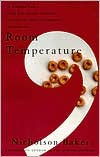
20148924.jpg As you will probably have guessed based on my post from a few days ago, I enjoyed Nicholson Baker’s novel Room Temperature. It’s his second novel, and it follows a similar format as his first, The Mezzanine: both take place during a small chunk of time — in the first novel the time it takes to ride up an escalator, and, in the second, the twenty minutes it takes for the narrator to feed his infant daughter — and they both range outwards and back in time to fill in details of the narrator’s surroundings and his life.

Both have narrators who, much like Baker himself (as evidenced in his essays at least), are extremely observant of and curious about the world around them, especially when it comes to the objects that surround them and fill their lives — the things that most of us take for granted. The Mezzanine’s narrator was obsessed with many things, but I remember, in particular, long passages on shoe laces and on drinking straws, and in Room Temperature, the narrator reminisces at length about glass peanut butter jars and the sound they make when first opened. The narrator is a former music student and aspiring composer and he once dreamed of writing a symphony that began with exactly that peanut butter jar sound.

If books about shoe laces and peanut butter jars sound boring, they are not at all. Instead of boring you, Baker inspires you to look more closely at the world you live in. There’s so much to see and learn, the books imply, so much we don’t even notice that’s right in front of our eyes. In fact, in Room Temperature Baker plays with the idea that we can reconstruct much of our own history and the history of the world if only we looked closely enough at the present. He makes this argument directly in at least two places in the novel:

I certainly believed, rocking my daughter on this Wednesday afternoon, that with a little concentration one’s whole life could be reconstructed from any single twenty-minute period randomly or almost randomly selected; that is, that there was enough content in that single confined sequence of thoughts and events and the setting that gave rise to them to make connections that would proliferate backward until potentially every item of autobiographical interest — every pet theory, minor observation, significant moment of shame or happiness — could be at least glancingly covered …

This passage sums up his aesthetic in both novels — to narrow down his focus and in the narrowing to see how his vision actually expands to include a whole life. But the passages continues:

… but you had to expect that a version of your past arrived at this way would exhibit … certain telltale differences of emphasis from the past you would recount if you proceeded serially, beginning with “I was born in January 5, 1957,” and letting each moment give birth naturally to the next. The particular cell you started from colored your entire re-creation.

You will not obtain an objective view following Baker’s method, but you wouldn’t obtain an objective view no matter what method you used anyway; any way you choose to look at the world or your life is going to shape the way you see it.

In a later passage Baker takes up this narrowing idea again, not to describe a life but to describe the world. Thinking about the miniscule currents of air moving through the room in which he’s rocking his daughter, he wonders:

If, using some as yet undeveloped high-resolution technique of flow visualization, I filmed the motion of a cubic yard of air … and if I studied that film for four hours a day, during Bug’s [the daughter’s] two naps — just looked at it, leaned into the idea of it with my entire self — at various speeds, and took the videotape from one international congress on turbulence to another, and made men of science look at it so that I could read in their polite expressions some of the particular complexities it offered their more geometrically manipulative minds, would I begin to feel that I could deduce from its veils of infinitesimal insurgence and reversion the objects in the room around which the air had flowed before it entered this domain of record? Would I deduce the shapes of the half-inflated plastic globe and the cheese grater on the rug, the superball in the fireplace, my dusty collection of mechanical coin-sorts on one of the bookshelves — and infer that a man breathing steadily through his nose in a rocking chair rocking at roughly one cycle every two seconds had held a baby also breathing through her nose on the verge of sleep?

And he goes on from there, wondering just how far he could take the information he’d gather from watching air flow through one cubic yard for twenty minutes. I thought that was rather wonderful — everything is connected to everything else, whether it’s through air or through memory, and one object or patch of air or memory will take us to another and another and another until eventually we’ve covered everything.

This book is intellectually interesting and it’s charming too. The narrator tells stories about Patty, his wife, as well as his daughter; he describes not only the air and the peanut butter jars in such great detail, but also his relationship with his family. The feeling that comes from all this is an infectious joy. This is a book about contentment; it’s curious and searching and about happiness and wonder. You can feel it in the long sentences and paragraphs Baker uses; it’s as though he’s trying to squeeze as much experience and as much life into his book as possible, and the sentences threaten to break apart with the energy and effort it takes. But they don’t — instead those Proustian sentences take you every which way, and you are happy to follow wherever they lead.

That said, I do think The Mezzanine is the better book of the two. Room Temperature takes a while to build up the kind of energy I’m describing; it has a beautiful but rather slow beginning, as though Baker needed some time to generate momentum. It does get that momentum, but overall, it’s a quieter book than The Mezzanine. The Mezzanine had so much of the energy I’ve described that it could hardly contain itself and burst out into those footnotes I wrote about a year or so ago. Still, Room Temperature is a beautiful book, and I’m determined to read more Nicholson Baker novels.

7 Comments

Filed under Books, Fiction

Post-apocalyptic

I’m reading Cormac McCarthy’s The Road right now, and — people read this sort of thing for fun?? I mean, I’m glad I’m reading it, it’s great and all, but I’m more than a little freaked out. I saw the post-apocalyptic movie I am Legend not too long ago, and I’m still recovering from that. I’ll admit I scoot back to bed in a hurry at night, thinking about those horrible zombie monster things. At least that movie didn’t give me nightmares; now we’ll see if this book does.

After this, I’m reading something full of sweetness and light.

24 Comments

Filed under Books, Fiction

Why I love Nicholson Baker’s writing

From Room Temperature:

But my mother’s informal punctuation in the op-ed letter came as a complete surprise; and the fact that my immediate instinctive response to it was to point out the misplaced commas so harshly that she wept (the only time, as far as I remember, that I ever hurt her feelings — for she understood and was even amused by my teenage request that whenever the two of us walked down the street together, she would please walk at least three yards ahead of me, so that people wouldn’t know we were related; and she even played along in her compliance, whistling, walking with a theatrical solitariness, checking her pocketbook, pausing abruptly to glance at a window display), as if these faulty commas called into question our standing as a family — the fact that I had been instinctively so cruel, made me double up with misery when, after I was married, I came across some sentences in Boswell that were punctuated just as hers had been. Boswell (and De Quincey, Edward Young, and others) had treated the sunken garden of a parenthetical phrase just as my mother had — as something to be prepared for and followed by the transitional rounding and softening of a comma. And such hybrids — of comma and parenthesis, or of semicolon and parenthesis, too — might at least in some cases allow for finer calibrations between phrases, subtler subordinations, irregular varieties of exuberance and magisteriality and fragile conjunction. In our desire for provincial correctness and holy-sounding simplicity and the rapid teachability of intern copy editors we had illegalized all variant forms — and, as with the loss of subvarieties of corn or apples, this homogenization of product was accomplished at a major unforeseen cost: our stiff-jointed prose was less able, so I now huffily thought, full of vengeance against the wrong I had done my mother, to adapt itself to those very novelties of social and technological life whose careful interpretation and weighting was the principal reason for the continued indispensability of the longer sentence.

The longer sentence, indeed. And the longer paragraph, the exuberance, the digressions, the obsession with the comma, the fact that he can write a novel about a man spending twenty minutes with his infant daughter …

10 Comments

Filed under Books, Fiction

James Hogg, part 2

6002370.gif So, back to James Hogg’s The Private Memoirs and Confessions of a Justified Sinner. It’s interesting the way people shorten the title into Confessions of a Justified Sinner; I understand not wanting to repeat the whole thing, but chopping off the first four words makes the book sound more religious than it may be — there’s tons of religion in the novel, definitely, but there’s a more secular way of reading it that the “private memoirs” part captures.

But first, I think the introduction-writer made the rather ridiculous claim I wrote about the other day because of the complexity of the book’s structure, i.e. the two narrators and the ways their stories overlap and diverge. But this makes up a big part of the fun of reading the book and doesn’t mean it’s particularly hard to follow.

The story is basically this: Robert Wringhim is raised by his mother and her severely-pious friend (or “friend” — their relationship is ambiguous) to believe that he, according to a Calvinist belief in predestination, has been chosen as one of the elect — he has received salvation and is guaranteed a place in heaven. He is taught that salvation comes not through works but by faith alone. The novel, written in 1824, takes place during the end of the 17C and the early years of the 18C in Scotland, and in the context of religious controversy, which gets played out in Robert’s life through his pious mother and her husband who cares little about religion. Robert’s parentage is uncertain; many believe that his mother’s friend is his real father (and this seems likeliest), although, of course, the friend denies it.

Into this situation comes a strange figure who quickly enmeshes himself deeply into Robert’s life. Exactly who this figure is never gets clarified. He doesn’t want to reveal any information about himself; he only reluctantly tells Robert to call him Gil-Martin, although it seems clear this is not his real name. He prefers to see Robert only when they are alone.

With the entrance of Gil-Martin, the book only gets stranger and stranger; when Robert first sees him, he is astounded because he looks exactly like Robert. He looks exactly like Robert at that particular moment, but his appearance changes. He can look like whoever he wants to at whatever moment he wants to. He also holds strange powers of attraction over Robert:

I felt a sort of invisible power that drew me towards him, something like the force of enchantment; which I could not resist. As we approached each other, our eyes met, and I can never describe the strange sensations that thrilled through my whole frame at that impressive moment.

They soon begin to spend all their time together, devoting hours to deep theological discussions. Gil-Martin appears to hold many of the same beliefs as Robert, but soon he pushes them to extremes that make Robert uneasy; he begins to argue that since Robert is part of the elect and his salvation is assured, he can do whatever he likes with no consequences. He can even commit murder — in fact, he may have a duty to commit murder, according to Gil-Martin, because if humanity is divided into two categories, the saved and the damned, and if they can tell who is who, then why not murder the damned? Why not rid the earth of them and make it a better place?

Robert at some level knows how twisted this logic is, but he is under Gil-Martin’s spell and whenever he is in his presence he loses his ability to think clearly. He is trapped.

Robert doesn’t seem to understand who Gil-Martin is, at least at first, but the reader quickly realizes that he may very well be the devil, tempting Robert to commit horrible deeds. On the other hand, and here is the more secular reading, he may be Robert’s own creation, a product of a diseased, schizophrenic mind. The two figures blend strangely and Robert begins to lose hold of his sense of self:

I generally conceived myself to be two people. When I lay in bed, I deemed there were two of us in it; when I sat up, I always beheld another person, and always in the same position from the place where I sat or stood, which was about three paces off me towards my left side. It mattered not how many or how few were present; this my second self was sure to be present in his place; and this occasioned a confusion in all my words and ideas that utterly astounded my friends … The most perverse part of it was, that I rarely conceived myself to be any of the two persons. I thought for the most part my companion was one of them, and my brother the other; and I found, that to be obliged to speak and answer in the character of another man, was a most awkward business at the long run.

By this point, Robert is a complete wreck, and the reader is on shaky ground — who is who and what is happening and what does it all mean? And then there’s the business of the two narratives. The story is not told in a straight-forward manner; rather, an editor tells what he knows of Robert’s life — his information coming partly from research but largely from tradition and so therefore suspect — and then Robert tells his story, covering some of the same ground the editor already covered and branching off in new directions. So there’s an editor who claims to be reliable but probably isn’t entirely, and there’s Robert who clearly is not reliable but who has most of the information we want, if only we could believe him.

To add to the fun, Hogg includes a page of Robert’s handwriting in the front of the text; it’s a page supposedly from Robert’s confessions. Hogg had a friend imitate handwriting from Robert’s time period to give the book a greater air of authenticity. Detracting somewhat from this sense of authenticity, however, is an appearance in the novel by James Hogg himself and by a servant of Sir Walter Scott’s. It seems that Hogg is having a little postmodern fun with his readers, blurring the boundaries between fiction and real life, refusing to offer any solid answers, drawing attention to the unreliability of history and the artificial nature of any text.

The more I write, the more complex the book seems. I still do not agree with David Groves when he says that “no one will understand very much about Hogg’s Confessions on first reading,” but I do believe that the more you think about this book, the murkier it gets. Perhaps the true situation is that the reader understands the book best on a first reading, but subsequent readings only undermine that confidence.

7 Comments

Filed under Books, Fiction

James Hogg, part 1

6002370.gif I have finished James Hogg’s The Private Memoirs and Confessions of a Justified Sinner: Written by Himself, with a detail of curious traditionary facts, and other evidence, by the editor. I love long titles! I couldn’t resist including the whole thing here. I won’t review the book tonight, but I did want to say a couple things. I loved it; it’s crazy and fascinating and weird. The long version of the title hints at its complexity: it’s got two narrators, and is a good example of the perspective-shifting technique Charlotte recently wrote about. It begins with an editor’s version of events, and then turns to the “confessions” of the justified sinner himself, and then closes with the editor again. They retell many of the same events, so part of the fun of the book is comparing their two versions.

Yes, the book is strange and weird, but I’m not sure that justifies this sentence from David Groves, the guy who wrote the introduction to my edition:

No one will understand very much about Hogg’s Confessions on first reading.

Am I wrong, or is that not the best thing to say in an introduction? It seems to me an introduction should get the reader excited about reading the book, not turn the reader off. And it’s not true. I’m sure I’d understand much more on a re-reading, but, still, I got an awful lot on the first go-round.

Okay, more on the novel soon …

10 Comments

Filed under Books, Fiction

A Compendium of Imaginary Saints

Ella from Box of Books recently sent me a copy of A Compendium of Imaginary Saints, a book she not only wrote and illustrated, but one she made, as in, created the covers and bound the pages. I am in awe — the book is extraordinary.

It’s small and easy to hold in your hand, with gold varnish on the covers. You can see pictures of it here and a description of its contents here. The inside cover tells you that the book is published by The Absent Classic publishing company: “Printers of Unexpected Books.” For those of you who don’t know about The Absent Classic series, it consists of a series of blog posts Ella created, each one featuring a made-up classic complete with a picture of the book’s cover, some excerpts, and information about the author’s life. I loved this series; I wished the books actually did exist so I could read them. Ella’s first TAC book was called Great Victorian Zombie Stories. How could anyone resist that, assuming there actually was a book to resist? Many of the books in the series came from the nineteenth century and captured perfectly a certain kind of Victorian sensibility — serious, pious, and deeply odd. (I can’t seem to find where these posts are now — help me Ella!)

Next there is the title page (also pictured in the post linked to above), which tells you that the Compendium is by Eleanor Hofstead and illustrated by Gloria Glass, Ella’s authorial and artistic pseudonyms. Then there is a brief note by Thaddeus R. Windrow, the editor-in-chief of The Absent Classic, which gives a brief biography of Hofstead — she is “a Catholic schoolteacher and amateur hagiologist,” who “spent her lifetime absorbed in the rich tradition of Christian saints.”

And then the main text begins, a one-page biography of each saint, with the saint’s portrait on the facing page. The portraits are perfect, what Ella calls “imitation medieval,” flat, simply-drawn faces in black and white, surrounded by a golden halo. And the biographies are fascinating — they are also portraits in miniature, telling about conversion experiences, visions, good works, and horrendous deaths. Each one ends by telling you what the saint is patron saint of, and this is where Ella’s sense of humor comes in, because these saints are patrons of some odd things. Here’s one of my favorites, quoted in full; it’s the biography of St. Eve of Aquitane:

St. Eve of Aquitane was born in France around 1645. As a young girl, she was noted for her extraordinary beauty, and also for her quiet, humble disposition. Although her mother, a near-destitute widow, arranged several wealthy matches for Eve, she refused them all. By the time she was in her twenties, her beauty was so famous that people came from all over the countryside to look at her. Finally St. Eve rubbed her face with nettles and thorns until she was scarred, whereupon she was left alone as she desired, to pray and meditate. She is the patron saint of acne sufferers.

There are also bios of the patron saint of reformed prostitutes, of school principles, of rescue workers, of male nurses, and of divorce lawyers. These are extraordinary saints indeed. I love the way the book mixes the realistic — the portraits, the horrific details — with the amusing and slightly absurd — there’s a patron saint of tatto artists!

Included with the book is a flyer about The Absent Classic publishing company, this particular title, and the next title to be printed: “Selected Works of J.E. Echwell,” which will “offer the best stories, drawings, and essays of that celebrated Victorian moralist, the founder of the Society for the Improvement of Literature.” I’m looking forward to it already!

7 Comments

Filed under Books

The Novel

First of all, Muttboy is feeling much better and wants to thank those of you who offered your good wishes. He was out running around by this afternoon and behaving in such a way as to make his owners wonder whether his yelps last night weren’t the tiniest bit theatrical in nature. But no, he just heals quickly.

So, on to books. I have begun looking into The Novel: History, Geography, and Culture, edited by Franco Moretti; I’m not sure to what extent I’ll read this straight through or pick and choose — the book seems made for picking and choosing, but I really don’t like to read that way, and all of the essays do look interesting. The first one offered a good start, at any rate.

The book is divided into sections on various aspects of the novel, although the section titles aren’t always crystal clear, so it’s hard to say what they are about; I’m not sure why the first section is entitled “The Struggle for Space,” for example, although maybe when I read further into it, it will become clearer. A short introduction by Moretti helpfully explains that there are three types of pieces in the book. First there are “Essays,” which are:

… works of abstraction, synthesis, and comparative research: they establish the great periodizations that segment the flow of time, and the conceptual architecture that reveals its unity.

“Readings,” the second type, “are shorter pieces, unified by a common question, and devoted to the close analysis of individual texts.” Finally, there are sections called “Critical Apparatus,” which:

… study the novel’s wider ecosystem, focusing, for instance, on how the semantic field of “narrative” took shape around keywords such as midrash, monogatari, xiaoshuo, qissa — and, why not, romance.

Hmmm … I’m not sure what some of those words mean … I’ll look forward to learning about them.

The first essay, “From Oral to Written: An Anthropological Breakthrough in Storytelling” by Jack Goody, begins by discussing the extent to which storytelling was as important to oral cultures as people generally believe it was. Goody argues that it was not:

Indeed, I want to argue that, contrary to much received opinion, narrative … is not so much a universal feature of the human situation as one that is promoted by literacy and subsequently by printing.

Images that we might have of people in purely oral cultures quenching their thirst for narrative by listening to a bard recite long stories of heroes and war might not be realistic — rather, epic and other forms of narrative seem to require the development of reading and writing:

…the societies of the Heroic Age during which the epic flourished were ones where early literacy was present. By contrast, in the purely oral cultures of Africa, the epic is a rarity, except on the southern fringes of the Sahara, which have been much influenced by Islam and by its literary forms.

The reasons for this scarcity of narrative — particularly long narrative — include the difficulty of listening to long recitations — the attention they demand. But also narrative, in the sense of fictional storytelling, was mistrusted because of its complicated relationship to truth; fiction is, after all, lies, even though it may have a particular kind of truth to tell. But fiction was, if anything, associated with childishness and so existed most commonly in the form of folklore meant for children.

After this opening section, Goody turns to the development of writing and the novel. It’s writing that makes longer narratives more likely to arise; in writing, it’s much easier to understand and digest a long complicated story and the writer doesn’t have to deal with interruptions from listeners. But the problem of fiction and lies remains, and this is why, Goody argues, the novel developed fairly late and unevenly across cultures. Early novels tried to get around this problem by claiming that they were truthful, even though they weren’t; Robinson Crusoe, for example, is presented as an autobiography featuring real events that Daniel Defoe is merely presenting to us, not writing himself. Slowly, over time, fiction became more acceptable, although even so it tended to be relegated to “frivolous” women readers, while the men focused on serious nonfiction.

And the uncertainty about fiction remains today; we still get upset when lines between fiction and nonfiction are blurred, as the James Frey debacle will attest. Goody believes that even today nonfiction is taken much more seriously than fiction; this may be true, although it’s hard for me to see, novel-lover that I am.

So, after this interesting start, we’ll see where the rest of the book leads …

11 Comments

Filed under Books, Fiction, Nonfiction

Notes and news

Today is one of those days that should have been excellent but wasn’t — my semester hasn’t begun yet, so though I still have work to do preparing syllabi and such, I’m not terribly busy. What do I have to complain about, right? Except I could never rouse myself to do much today and so had the sense that I was wasting time but didn’t have the energy to do anything about it. I’ve been enjoying my books but even they weren’t satisfying me. The weather is lousy too — wet and cold. But the worst thing is that poor Muttboy hurt himself out in the woods this afternoon; Hobgoblin noticed him walking slowly but didn’t think much of it until they were both home a couple hours later and Muttboy started whining. When he tried to stand up, it was obvious that it hurt and he would yelp now and then. A suffering dog is a really sad thing, isn’t it? Hobgoblin called the vet who basically said to give Muttboy two aspirin and call her in the morning — good advice, I’m sure, but not terribly comforting. Now he’s curled up on the couch sleeping.

But I don’t want this post to be one long whine, so I’ll mention a few things besides my troubles. For one, Litlove’s new book, The Best of Tales from the Reading Room arrived in the mail today, and what a nice looking book it is! It’s got a picture of Litlove and some comments from blog readers on the back and an introduction that tells the story of how she got into blogging. The book itself is made up of many of her best posts — ones on Rilke, Julian Barnes, Virginia Woolf and many other authors and topics, and some more personal posts as well.

And one more thing about Litlove — her new edition of The Best of New Writing on the Web is up, so go check it out!

In other news — Harper’s has an essay by Ursula Le Guin called “Staying Awake: Notes on the alleged decline of reading,” unfortunately not available online. It’s interesting, though, so if you are in a library or bookstore and see it, it might be worth a glance. In the article she says some very sensible things, in particular her point that we tend to forget that for most of history people didn’t read all that much:

… I also want to question the assumption — whether gloomy or faintly gloating — that books are on the way out. I think they’re here to stay. It’s just that not all that many people ever did read them. Why should we think everybody ought to now?

For most of human history, most people could not read at all. Literacy was not only a demarcator between the powerful and the powerless; it was power itself. Pleasure was not an issue.

Of course, it’s a shame that many people choose not to read today, but I think the point is right that we tend to think that reading is in a crisis that has never existed before. While Le Guin has no kind words for those who choose not to read, the real villain of her essay is the publishing industry. She lambastes it for seeking never-ending growth in profits in an industry that just can’t sustain it:

To me, then, one of the most despicable things about corporate publishers and chain booksellers is their assumption that books are inherently worthless. If a title that was supposed to sell a lot doesn’t “perform” within a few weeks, it gets its covers torn off — it is trashed. The corporate mentality recognizes no success that is not immediate. This week’s blockbuster must eclipse last week’s, as if there weren’t room for more than one book at a time. Hence the crass stupidity of most publishers (and, again, chain booksellers) in handling backlists….

But capitalists count weeks, not years. To get big quick money, the publisher must risk a multimillion-dollar advance on a hot author who’s supposed to provide this week’s bestseller. These millions — often a dead loss — come out of funds that used to go to pay normal advances to reliable midlist authors and the royalties on older books that kept selling. Many midlist authors have been dropped, many reliably selling books remaindered, in order to feed Moloch. Is that any way to run a business?

Finally, I’ve begun looking into Franco Moretti’s The Novel: History, Geography, and Culture and have found much to learn. I’ll post more on that later.

12 Comments

Filed under Books, Life

For the TBR pile

Which theologian are you?
created with QuizFarm.com
You scored as Paul TillichPaul Tillich sought to express Christian truth in an existentialist way. Our primary problem is alienation from the ground of our being, so that our life is meaningless. Great for psychotherapy, but no longer very influential.

Paul Tillich
 
73%
Friedrich Schleiermacher
 
60%
Jürgen Moltmann
 
53%
Anselm
 
33%
Charles Finney
 
33%
John Calvin
 
27%
Jonathan Edwards
 
20%
Augustine
 
13%
Martin Luther
 
13%
Karl Barth
 
0%

Thanks to Emily.

7 Comments

Filed under Books, Links

Paris Stories

For the most part, I am enjoying Mavis Gallant’s book Paris Stories; I say for the most part because my response to them has been a bit uneven — I’m not sure if this is my fault or the stories’ fault. But at the halfway point of the book I can say I’ve liked most of them, especially the one I just finished, “Speck’s Idea.” The story is about a gallery owner in Paris, Speck, who is trying to revitalize the gallery and earn some money to keep himself going; he gets the idea to revive the work of the artist Hubert Cruche and spends much of the story negotiating with Cruche’s widow, a woman who has some surprises up her sleeve. Although the story is a little sad — Speck seems like someone who will always dream of success and never quite find it — but it’s charmingly told. Gallant’s wit shines through and she has a brilliant way of describing her character. Unfortunately, I failed to mark any of the brilliant passages so I can’t reproduce them here, but trust me! They are brilliant.

The stories I’ve liked best in the collection are the ones where Gallant slows down the pace a bit and takes some time to describe scenes and dialogue. Some of the stories give the full sweep of a character’s life, from birth to mature adulthood if not beyond (such as “The Moslem Wife”), rarely stopping to linger on any one moment, and these leave me a bit cold; what I find myself wishing for is more detailed interaction among the characters. I do admire Gallant’s way of summing up a life, however; in just a few phrases, she can capture the essence of a person.

Many of the stories in the book are on the long side, but two of the shorter ones are particularly good; “In Transit” describes a couple as they wait in an airport — the story manages to give you a sense of their entire history while concentrating on a brief period of time. The other one, “From the Fifteenth District” is a playful tale of haunting — except it’s the living who haunt the dead rather than the other way around.

S0 — we’ll see what the second half of the book brings.

Cross-posted here.

8 Comments

Filed under Books, Short stories

Final thoughts on Out of Sheer Rage

While I liked Geoff Dyer’s Out of Sheer Rage a lot (a lot — my previous posts on it are here, here, and here), the last 50 pages or so had some irritating sections. I suppose when you read a book as raw as this one, some places are bound to irritate you. Dyer says some strange things about women, he sounds more whiny than he did earlier in the book, and he begins to write more about his rage, which is interesting I suppose, but what he describes is so far outside my own experience I began to tune out a bit.

But, still, I loved this book; I love this kind of quirky, non-categorizable nonfiction, the kind that takes you interesting places, although along the way you have no idea where you’re going. I want more books like this one! (If you know of any, please say so.)

I’ll leave you with a passage, one that captures something I’m familiar with — the way our desires and regrets shift and change:

I accept the consequences of doing things which I will later regret. In a sense then I regret them before I do them. Instead of resolving to learn to cook I regret to inform myself that by the end of the year I will still not know how to cook (because I hate cooking) even though learning to cook would improve my life no end. Instead of doing the exercises which will save my right knee … I resign myself to regretting not having done something about what will, in a few years, be a debilitating, potentially crippling ailment. I resign myself to things: this is my own warped version of amor fati: regretting everything but resigning myself to this regret. However things turn out I am bound to wish they had turned out differently. I am resigned to that.

Take this book which is intermittently about Lawrence. Right now I profoundly regret ever having started it. I wish I hadn’t bothered. But if I hadn’t started it I would have regretted not having done so. I knew this and so I got on with it and now that I have got on with it I regret that I got on with it in the way I did. I regret that it will not turn out to be the sober, academic study of Lawrence that I had hoped to write but I accept this because I know that, in the future, when it is finished, I won’t want it to be any different. I’ll be glad that this little book turned out how it did because I will see that what was intended to be a sober, academic study of D.H. Lawrence had to become a case history. Not a history of how I recovered from a breakdown but of how breaking down became a means of continuing. Anyone can have a breakdown, anyone. The trick is to have a breakdown and take it in one’s stride. Ideally one would get to the stage where one had a total nervous breakdown and didn’t even notice.

5 Comments

Filed under Books, Nonfiction