Category Archives: Books

Against Against Happiness

One of my book groups was supposed to meet today to discuss Eric Wilson’s Against Happiness, but it got postponed, so I’ll have another couple weeks to stew over this book’s flaws. No, I did not like it one bit (first thoughts here). The idea sounded interesting, if not entirely new — that Americans are obsessed with happiness to the detriment of our souls and our deeper imaginative, creative selves — but the execution failed. At times I got so annoyed with the book I found myself wanting to defend happiness. Can it really be so bad??

The problems begin with the writing itself. It’s overwritten, florid, occasionally verging on the incomprehensible. There are too many passages like this:

The American dream might be a nightmare. What passes for bliss could well be a dystopia of flaccid grins. Our passion for felicity hints at an ominous hatred for all that grows and thrives and then dies — for all those curious thrushes moving among autumn’s brownish indolence, for those blue dahlias seemingly hollowed with sorrow, for all those gloomy souls who long for clouds above high windows.

I sort of see what he means here — the demand for constant happiness can flatten out experience and make it bland — and yet does happiness really mean that one does not notice thrushes and dahlias and the beauty of clouds? The writing too often veers toward bad poetry, the sort of thing angsty adolescents might compose. It’s also repetitive, and I couldn’t discern what made one chapter different from another. Against Happiness would have been much better as an essay rather than a book; it feels bloated at a mere 150 pages.

A friend told me that Wilson incorporates short biographies of famous depressives, and my first response was to be suspicious of these, thinking that I’d be bored by the familiar list of people like Virginia Woolf and Vincent Van Gogh whose depression may have contributed to their ability to produce great art. And yet when I sat down to read the book, I came across these sections with relief, as they helped to ground the writing a little bit. But even so, these sections are the familiar, clichéd portraits of famous depressives I was afraid I was going to find.

The argument can be vague as well. He assumes we know what he means by the difference between happiness and joy and by his talk of “polarities,” as in:

What is existence if not an enduring polarity, an endless dance of limping dogs and lilting crocuses, starlings that are spangled and frustrated worms?

and:

to be alive is to realize the universe’s grand polarity. Life grows out of death, and death from life; turbulence breeds sweet patterns, and order dissolves into vibrant chaos.

All this sounds grand, but what does it mean? I can get a vague emotional sense of what he means, but not a concrete logical understanding.

He works with two categories of people, the melancholic and the happy, that are vastly oversimplified. At times I feel like I know the kinds of people he’s talking about when he talks about “happy types,” the people who look for an uplifting lesson in everything they read, for example, or people who don’t have the imagination to understand the suffering that someone else is going through. But most of the time the “happy types” he describes don’t seem real to me. My guess is that many people, certainly more than Wilson claims, will acknowledge the tragic side of life, even if they need to be pressed, and they’ll agree that the search for happiness is ultimately bound to be futile. He makes much of the statistic that 85% of Americans claim to be happy, but he (or perhaps the study that generated the statistic) doesn’t define what people mean by that claim. If I were asked whether I consider myself happy, I might be among the 85% that said yes, although I don’t consider myself a “happy type.” I would probably say yes, though, because even though I suffer from melancholy and maybe even mild depression now and then, I have a good life and I have joyful moments and I feel like I’m doing okay even though life is so harsh and our existence ultimately doesn’t make a whole lot of sense. I’m muddling along, and that’s about the most anybody can hope for, and so I’d call that a kind of happiness.

The book has an uncomfortable feeling of self-congratulation, of pleasure taken in the fact that the author is part of an elite group of people who aren’t deluded like the vast majority of idiots out there. Maybe I’m too optimistic about what “most people” are like, but this attitude doesn’t sit well with me.

I did feel a moment of recognition when Wilson described how the happy types long for complete control over their lives; they don’t like the idea that a sad event can occur at any moment or that their lives could be turned upside down in an instant. I recognized myself in his description, as I am always looking for just the right way of doing things — the right balance of work and life, the perfect job, the perfect place to live, the right way of organizing my day, the right balance of social and solitary time. I want to feel perfectly organized and on top of things so that nothing takes me by surprise to cause any busyness or stress or worry. Obviously this is impossible, but I still hope, somehow, to make things perfect. I would be better off learning to see, as Wilson recommends, that the stability I long for is really a sort of premature death, and that living means constant change.

I wanted to have more moments of recognition like this one, however, and was disappointed. I’ll have to look to other writers for a more convincing celebration of melancholy.

You can read Hobgoblin’s take on the book here.
8 Comments

Filed under Books, Nonfiction

Endgame

I had little idea of how my students would react to Samuel Beckett’s play Endgame, although a couple of them had read Waiting for Godot and so knew what they were in for. To the others I suggested that they expect something odd and that they keep an open mind about it. We’d read some challenging writers and talked about how some kinds of literature require that you suspend your need to understand what’s going on, sometimes even on a basic level, at least for a while, so by “keeping an open mind” what I meant was to expect strangeness and to try to roll with it as best as they could.

Most of them loved the play, it turned out, and what they noticed most of all is the play’s humor. This is not something I’d paid much attention to on my first reading, and I don’t remember noticing it much when I studied Waiting for Godot, so it’s interesting to me that this is what my students picked up on. I suppose I’m more naturally attuned to darkness and despair than I am to humor (which is too bad for me), but the more I read and thought about the play, the more obvious it became that it is really very funny.

If you aren’t familiar with it, it’s about four characters — Hamm, a blind, paralyzed man who spends his days sitting in his chair as close to the middle of the room as possible; Clov, Hamm’s servant and companion of sorts, who continually threatens to leave Hamm; and Nagg and Nell, Hamm’s parents, who live in ashbins. They poke their heads up every once in a while to say a few words and then retreat back into their cans. The characters stay in one room (except for Clov who wanders off into the kitchen now and then) and talk about the same things over and over. They live in a world that seems post-apocalyptic, although just what has happened is never clarified, but there seems to be nothing and no one outside their home, very little food available, and no hope of change whatsoever.

The dialogue wanders here and there, covering ground the characters have covered again and again — their dislike of one another, their questions about the weather and what’s going on outside their windows (generally nothing), their physical suffering, their memories, their weariness with life. Hamm and Clov contemplate suicide, but they always back off from acting on this impulse. They tell stories now and then, but often the stories don’t have an ending; they just trail off.

Here is a typical exchange:

Hamm: I feel a little queer. [Pause.] Clov!
Clov: Yes.
Hamm: Have you not had enough?
Clov: Yes! [Pause.] Of what?
Hamm: Of this … this … thing.
Clov: I always had. [Pause.] Not you?
Hamm: [Gloomily.] Then there’s no reason for it to change.
Clov: It may end. [Pause.] All life long the same questions, the same answers.
Hamm: Get me ready. [Clov does not move.] Go and get the sheet. [Clov does not move.] Clov!
Clov: Yes.
Hamm: I’ll give you nothing more to eat.
Clov: Then we’ll die.
Hamm: I’ll give you just enough to keep you from dying. You’ll be hungry all the time.
Clov: Then we don’t die. [Pause.] I’ll go and get the sheet.

Much of the dialogue is like this, and it doesn’t sound funny at all, right? And yet there are funny passages, particularly when you read them out loud, which we did a little of in class. There are exchanges like this one, for example:

Clov: I can’t sit.
Hamm: True. And I can’t stand.
Clov: So it is.
Hamm: Every man his specialty.

Or this:

Clov: What is there to keep me here?
Hamm: The dialogue.

I love the way this exchange refers to the dialogue between the two characters — dialogue that surely wouldn’t keep anybody anywhere — and also to the fact that there’s an audience in the theater who is kept in their seats by the very same repetitive, despairing talk.

Then there’s a passage where Hamm starts talking like a pretentious artist and insists that Clov play along:

Hamm: I’ve got on with my story. [Pause.] I’ve on with it well. [Pause. Irritably.] Ask me where I’ve got to.
Clov: Oh, by the way, your story?
Hamm: [Surprised.] What story?
Clov: The one you’ve been telling yourself all your days.
Hamm: Ah, you mean my chronicle?
Clov: That’s the one. [Pause.]
Hamm: [Angrily.] Keep going, can’t you, keep going!
Clov: You’ve got on with it, I hope.
Hamm: [Modestly.] Oh not very far, not very far. [He sighs.] There are days like that, one isn’t inspired. [Pause.] Nothing you can do about it, just wait for it to come. [Pause.] No forcing, no forcing, it’s fatal. [Pause.] I’ve got on with it a little all the same. [Pause.] Technique, you know. [Pause. Irritably.] I say I’ve got in with it a little all the same.
Clov: [Admiringly.] Well I never! In spite of everything you were able to get on with it!

Beckett is having a little fun with artistic pretension and also taking up one of the play’s themes: the point of creativity in a world that makes no sense and that leads only to death. Clov is speaking ironically and only playing a role when he admires Hamm for continuing to work on his story “in spite of everything,” and yet there’s a sense in which the admiration is real — who, after all, would get on with it, in spite of everything?

This play is certainly despairing — the title refers to the part of a chess game where the end result is beyond doubt but there are a few moves still left to play, which becomes a metaphor for the situation of all human beings as they approach death — but there’s something energetic and exhilarating about the play too. It doesn’t leave you — or at least it didn’t leave me — feeling like there’s nothing to do but commit suicide. Instead, it left me with admiration for Beckett for creating something intricately, beautifully, well-made out of some of the darkest feelings people can have. In spite of everything, most of do get on with it, and there’s something wonderful in that.

15 Comments

Filed under Books

A Wallace Stevens poem

I mentioned a poem by Wallace Stevens the other day that surprised me with its beauty — surprised me because I thought the title was ridiculous and I was afraid the poem might be as well. The poem I’m talking about is “Le Monocle de Mon Oncle.” Now with a title like that, what would you expect in the poem itself? The title sounded flippant to me, and silly, and like it was the title of a short poem that was full of little but irritating sound effects.

I was surprised to look further and find that the poem went on for several pages. When I read it, I found that it contained serious subject matter, although I wasn’t entirely sure what it was. I’m still not entirely sure how the title relates to the poem itself, and I certainly think it wasn’t a good idea to title the poem that way, but, then again, do I really want to question Wallace Stevens?

The poem has 12 sections of 11 lines each, and it’s loosely about middle-aged love, aging, and disillusionment, but also about the pleasures and consolations of the familiar. It’s got melancholy and exhilaration, vitality and nostalgia — a whole host of emotions, actually, and this is what makes it a little hard to follow. There is no narrative or sense of development; instead it moves back and forth among various thoughts and impressions, creating a mood rather than advancing an idea.

It’s got some lines that I really don’t like — I’ll get the stuff I don’t like out of the way and then talk about what I do like — including these:

And so I mocked her in magnificent measure.
Or was it that I mocked myself alone?
I wish that I might be a thinking stone.

The only way I’ll accept these lines as anything but laughable is if the last line is part of the self-mockery — I mean, if telling us that he wishes he could be a thinking stone is part of his way of making fun of himself. Because otherwise it sounds too much like adolescent self-pity to me, and the alone/stone rhyme sounds absurd. The poem doesn’t have a regular rhyme scheme, which makes this rhyming couplet stand out.

But many of the poem’s sections are wonderful, like this one, section 8:

Like a dull scholar, I behold, in love,
An ancient aspect touching a new mind.
It comes, it blooms, it bears its fruit and dies.
This trivial trope reveals a way of truth.
Our bloom is gone. We are the fruit thereof.
Two golden gourds distended on our vines,
Into the autumn weather, splashed with frost,
Distorted by hale fatness, turned grotesque.
We hang like warty squashes, streaked and rayed,
The laughing sky will see the two of us
Washed into rinds by rotting winter winds.

I like the rhythm of line 3, the way the line, in perfect iambic pentameter sums up the whole story of love, and I also like the short, abrupt sentences of lines 4-5, which state directly and unflinchingly what the lovers have experienced. Line 5 captures the contradictory nature of the experience — it moves from the bloom being gone, an image of aging, to the idea that they are fruit, which sounds full of sweetness and potential. The following lines revise this possibility, however; they are “golden gourds distended on our vines,” “splashed with frost,” “turned grotesque,” and, most amusingly, they “hang like warty squashes, streaked and rayed.” The sky laughs at them. And the speaker sees why the sky might laugh at them: the section’s very first line indicates why — the metaphor is one a dull scholar might produce.

Section 11 is great too:

If sex were all, then every trembling hand
Could make us squeak, like dolls, the wished-for words.
But note the unconscionable treachery of fate,
That makes us weep, laugh, grunt and groan, and shout
Doleful heroics, pinching gestures forth
From madness or delight, without regard
To that first, foremost law. Anguishing hour!
Last night, we sat beside a pool of pink,
Clippered with lilies scudding the bright chromes,
Keen to the point of starlight, while a frog
Boomed from his very belly odious chords.

Love, as opposed to sex, is caused by “the unconscionable treachery of fate,” making us not heroic but ridiculous — we weep, laugh, grunt, groan, and shout. The closing image is ridiculous as well: as the lovers are sitting beside a romantic pool watching the stars, a frog is booming “odious chords.”

I’m seeing now how full of the ridiculous this poem is, even though, at the same time, it’s also full of what feels to me like thoughtful sincerity. These two modes go hand-in-hand, in fact. Look at lines like these:

The fops of fancy in their poems leave
Memorabilia of the mystic spouts,
Spontaneously watering their gritty soils.
I am a yeoman, as such fellows go.
I know no magic trees, no balmy boughs,
No silver-ruddy, gold-vermilion fruits.
But, after all, I know a tree that bears
A semblance to the thing I have in mind.

I do not like that phrase “fops of fancy” — it’s too reminiscent of the poem’s odd title — and I think it’s part of the ridiculousness that runs through the whole poem, but I do like the phrase “I am a yeoman, as such fellows go,” the way it quietly contrasts his own modest poetic claims with those of the fops of fancy. He may not know magic trees or balmy boughs, but he does know “a tree that bears a semblance to the thing I have in mind” — he knows, in other words, something that is true.

Here are the closing lines; I’m not entirely sure what they mean, but I think they are beautiful:

A blue pigeon it is, that circles the blue sky,
On sidelong wing, around and round and round.
A white pigeon it is, that flutters to the ground,
Grown tired of flight. Like a dark rabbi, I
Observed, when young, the nature of mankind,
In lordly study. Every day, I found
Man proved a gobbet in my mincing world.
Like a rose rabbi, later, I pursued,
And still pursue, the origin and course
Of love, but until now I never knew
That fluttering things have so distinct a shade.

Stevens makes me follow advice I give my students, which is that they should read poetry with a dictionary next to them.  The word “gobbet” can mean “a piece or portion (as of meat),” a “lump or mass,” or “a small fragment or extract.”  So I picture the speaker, in his younger version, arrogantly studying human beings, eating them up, so to speak, as he looks around him from on high.  His older self, however, is much more circumspect.  He seeks after knowledge of love instead of assuming he already has it.  But only now does he know “that fluttering things have so distinct a shade.”  I’m not sure exactly what that line means, but it hints at the beauty and mystery of living things.  In the last two lines the speaker seems struck with awe at what he has learned, sorrowful that he didn’t know it before, but grateful that he knows it now.

Okay, so when I think about how the ridiculous and the absurd run through much of the poem, the odd title makes a little more sense.  But I’m still not sure Stevens should have risked titling the poem that way.  I almost skipped it, after all.  I’m glad, however, that I didn’t.

8 Comments

Filed under Books, Poetry

Saturday rambling

There are a number of posts I’d like to write soon, including one on a surprisingly beautiful Wallace Stevens poem (surprising because I thought the poem’s title was one of the more ridiculous titles I’ve ever heard — more on that later) and one on Samuel Beckett’s play Endgame, which I recently read for class and which is wonderfully strange. But I’m in a mood to write something rambling and disconnected instead of a more focused post, so that’s what you’ll get.

I spent a lovely evening in Manhattan yesterday with a fabulous group of bloggers (and one fabulous woman who unfortunately doesn’t blog); you’ll find them at Telecommuter Talk, Musings from the Sofa, ZoesMom, and The Reading Nook. Have I mentioned before how much blogging has enriched my life? Well, it has. All of these people, and quite a few others besides, I’ve met because of blogging. We had fun traipsing around from bar to restaurant to bar, celebrating Becky’s impressive new job and drinking unbelievably overpriced cocktails. That’s Manhattan for you — fun but expensive.

In the train on the way to the city, I discovered to my horror that the book I chose for one of my reading groups is terrible. I didn’t choose it all on my own, actually; it was one of three books I selected that everyone else voted on, but still I’m instrumental in the choice, and now I feel guilty. I can see why one of the group’s members was noncommittal in her reaction to it, perhaps not wanting to offend me. Hobgoblin has yet to pick it up, but when he does, I’m looking forward to the conversation in which we mock it mercilessly.

Okay, now I’m a little afraid to mention what book it is, just in case the author googles himself and finds my unkind comments. But — oh, well. It’s Eric Wilson’s book Against Happiness, a book I’d heard some bad things about but also some good things, and so was prepared to like, if possible. It does exactly what the title says — argues against America’s obsession with the pursuit of happiness. This is fine in itself, but the way he makes the argument is the trouble … but more later, when I’ve actually finished the book and can write a proper review.

Have you had the experience of choosing a reading group book that everybody hates? Did it feel terrible? (I may be in luck though — perhaps the other members won’t agree with me …)

Today I went on a 3 1/2 hour ride, heading out to the Housatonic Hills race course to practice climbing all those hills; it was in the mid-60s and dry, pretty much perfect bike riding weather. All the way around the race course, though, I remembered what it’s like to race up those hills, and it filled me with dread. There’s nothing worse than finding yourself at the bottom of a steep hill with your heart rate already maxed out, chasing a pack of riders so as not to get dropped and hoping that you don’t fall over from exhaustion. I have this experience to look forward to in June …

20 Comments

Filed under Blogging, Books, Cycling, Life, Nonfiction, Reading

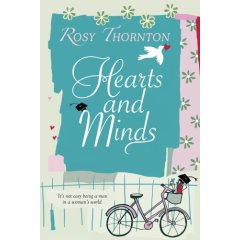
Hearts and Minds

It seems about right to be writing about Rosy Thornton’s campus novel Hearts and Minds on a day my students have given me a headache.  Yes, the end of the semester is terrible, as usual.  It’s too bad I’ve already finished this novel, because reading it would provide some comfort after a long day, whereas the book I’ve just begun, Against Happiness, will not.  But maybe it will make me feel better to write about somebody else’s problems with faculty politics and student drama rather than dwelling on my own.

Hearts and Minds is a thoroughly entertaining novel.  It takes place at Cambridge, specifically at an all-women’s college, St. Radegund’s, which has recently hired a male Head of House, to the consternation of many of the faculty.  James Rycarte is his name, and although he’s an able administrator and knows how to deal with difficult people, he finds himself with some formidable opponents, especially faculty member Ros Clarke, who is determined to undermine his leadership and see him gone.

The other main character is Martha Pearce, an Economics faculty member and Senior Tutor, an administrative post that is due to end at the close of the year, leaving Martha without a job.  Because of the demands of the Senior Tutor position, she has neglected her research, which will make it difficult to find another post.  In addition to this looming problem, her husband has been more and more distanced of late and her daughter is showing signs of serious depression.  She is left to manage this all on her own.

The plot thickens when a potential donor appears, a friend of Rycarte’s, whose money could save the library, which is sinking into the mud at an alarming rate.  This friend appears to be the college’s savior, until he declares that his daughter will be applying for admission and implies that he expects the donation and his daughter’s acceptance to go hand in hand.  Here is an issue that could potentially divide the faculty and give Ros Clarke the ammunition she needs to force Rycarte out.

I enjoyed the story and liked spending time with the characters, but another of the novel’s pleasures is reading about the college itself, with its traditions and oddities.  Very near the beginning of the novel Rycarte arrives on campus for the first time since his interview, and so readers can learn about the college at the same time he does, watching him figure out details like the powers of the Head Porter and the lack of copy machines, and can follow along with him as he figures out who’s who amongst the faculty.  It’s a good introduction to a place that in a lot of ways sounds charming — nearly everyone travels around on bicycles, which sounds wonderful — but which has its share of troubles, not least of which is a severe shortage of funds. The signs of financial hardship are everywhere, from the decision to stop offering the college’s residents breakfast to the existence of research fellowships that offer no stipend whatsoever.  The college has been limping along for quite some time now, and Rycarte hopes the potential donation will turn things around, but he is unsure at what cost.

One aspect of the book bothered me — Martha Pearce’s relationship with her husband was hard to take.  Martha is an extremely hard-working, extremely dedicated person, one who cares deeply about the college and is willing to do whatever it takes to serve the school and to keep her family going.  Her husband, though, spends his days lounging around, napping, and claiming to be working on his poetry.  He offers her very little support, most distressingly when their daughter is obviously suffering.  There were moments in the novel when I wanted Martha to walk out on him immediately and not look back.  Martha’s self-sacrifices happen in real life quite often I’m sure, so it’s not a failure of realism, but still I couldn’t help but get annoyed at this character that readers are clearly meant to sympathize with.

But this issue aside, I read the novel with great enjoyment; it’s a good book for when you want something that’s both smart and plot-driven, and I think lots of people would enjoy it, even those who haven’t set foot on a campus for decades.

12 Comments

Filed under Books, Fiction

Reading update and a question

I think I’m past my reading slump, and I think I owe this largely to Rosy Thornton’s Hearts and Minds (kindly sent to me by the author), which I read happily all weekend and of which I am now about 50 pages from the end.  I needed a book that is smart and well-written but also plot-driven and entertaining, and this one fits the bill nicely.  I’m a sucker for academic novels, too, and this one is set in Cambridge and is all about faculty intrigue and student protests and classes and exams and meetings and all the stuff one would think I get enough of at my day job.  Why I like academic novels is beyond me, actually, but I do.

I will be picking up Eric Wilson’s Against Happiness next for a book group meeting in a week and a half; I’m looking forward to digging into some nonfiction, as I’ve lately been reading a string of novels.  Nothing wrong with that, of course, except that I like a little more variety.  After that I think I’d like to pick up something either older or more challenging than what I’ve been reading lately, or both.  I’ve haven’t had the energy lately for much but contemporary fiction, but now I’m feeling ready to venture into more difficult material.  I’m also planning to read more in my Wallace Stevens collection and to get back to the George Saunders book of essays, the first one of which I read and enjoyed, but which I haven’t picked up in a while.

But now for my question: have you noticed what WordPress has been doing with the “Possibly related posts (automatically generated)” links they have been appending to each post?  Some of these are links back to my own blog but others link to other WordPress blogs, most of which I haven’t heard of before.  I can’t decide if I want to keep this feature, and I’m wondering what you think of it, those of you who use WordPress and those of you who don’t.  I don’t like it because I don’t like the idea of there being links to blogs I have never read and don’t endorse on my posts.  Also, I’m not entirely sure everyone who reads me will know that I didn’t put those links there myself.  On the other hand, WordPress claims that these links will ultimately bring me more traffic, which is hard to resist, even though I suspect these hits won’t be coming from people who will return.  So what do you think?  A cool, new idea, or just annoying?

22 Comments

Filed under Blogging, Books

PEN World Voices: Rushdie, Eco, and Vargas Llosa

When I saw that Salman Rushdie, Umberto Eco, and Mario Vargas Llosa were to appear together at the PEN World Voices festival, I bought tickets immediately, and I’m glad I did — the event was fabulous. Even before the event itself began, good things were happening; I ran into Anne Fernald from the blog Fernham and got to chat with her for a couple minutes. Then Hobgoblin pointed out that Richard Ford and Jeffrey Eugenides were sitting two rows in front of us. I also had a nice conversation with the elderly woman sitting next to me; she told me about her book that had been published years ago and her successful career and her great-grandchildren who are too busy to visit very often.

Then the event began; first there was a general introduction, and then Umberto Eco appeared. He explained that each writer would read from his work in his native language, and then he began to read a section from Foucault’s Pendulum in Italian, while the English translation was projected onto a screen. It was thrilling to hear Eco read in his native language; the Italian was beautiful to listen to, and I soon stopped following the words on the screen and in order to pay more attention to the way the language sounded. When he finished he left the stage and Rushdie came out to read from his new novel, The Enchantress of Florence. It was a funny passage (or maybe it’s just funny when you’re listening to it in a crowd) about the Emperor Akbar who has built a “house of worship” in honor of reason, which turns out to be a tent because rationality is an impermanent thing. Then Vargas Llosa read from his 2007 novel The Bad Girl, in Spanish. This time I followed the English words to see what I could understand from the Spanish; the passage was about the narrator falling in love with the flamboyant Lily, a girl newly arrived in his town of Miraflores. The passage had the same light and humorous tone that I saw in the one work of his I’ve read Aunt Julia and the Scriptwriter, a book I read with enjoyment.

After the readings, all three writers came out on stage and were joined by Leonard Lopate (a WNYC talk show host), the moderator for their discussion, and things really got going. They began talking about the “Three Musketeers” theme — this was the title of the night’s event — and the story of how the three writers had met a decade earlier and had such a fabulous time they gave themselves the name from Dumas. Now they were here for a reunion. This story quickly turned into a discussion of Dumas himself, and how badly The Three Musketeers is written — Rushdie and Eco took great pleasure in describing just how sloppily Dumas could write and how wordy he could be, and one of them said, “The magic of The Count of Monte Cristo is due to the fact that it is badly written.” These two had the audience laughing uproariously; they both have fabulous senses of humor — Rushdie is dry and witty, and Eco exudes energy and expressiveness in that stereotypical Italian way, complete with hand gestures. He was utterly charming. Then Vargas Llosa, who is funny too but in a more dignified way, stepped in with a defense of “bad writing”; he argued that if the writing draws you in and moves you then it can’t be bad writing and that good writing isn’t merely a matter of good grammar and pretty words. This drew hearty applause from the audience.

Then Lopate stepped in started asking them serious questions about the clash of cultures in their novels — I would have preferred that he just let the writers keep up their debate and their jokes because the minute he asked a serious question the energy fell and the mood changed. But the conversation was good, of course; they talked about how writers in the U.S. don’t have any meaningful political role, which is often not the case in other countries, and why this might be so, and they debated whether writers flourish more in dictatorships rather than democracies (because they are the only ones speaking truths the country wants and needs to hear). They all seemed to agree that the U.S. is a special case because of the way its writers are seen as entertainers rather than as important political figures. In his deadpan way, Rushdie claimed that this problem is entirely due to movie stars, which then turned the conversation to Rushdie’s own experiences acting in movies, and he quipped, “I’m so glad you’re asking me about my best work.”

Then Lopate asked a couple questions solicited on index cards from the audience; the first question, asking the writers to describe their writing methods, got only boos from the audience because of its banality, and I was delighted to see Richard Ford yell out “Next question!” Before they moved on, though, Eco, looking inordinately pleased with himself, explained his writing method — he starts on the left side of the page and works his way over to the right. This got a laugh.

The next and last audience question got them talking about the virtues of the English language; Rushdie described it as “a bendy language,” and one of the others, I can’t remember who, argued that its flexibility is both a virtue and a risk — its openness and adaptability have led to some of the world’s greatest literature, but these same qualities can possibly lead to its dissolution, as people from all around the world make English their own.

And that was it — afterwards was a book signing, but we didn’t stick around, as we hadn’t brought any of our books and needed to run off to catch the train. I left vowing once again to take advantage of opportunities like this more often than I do; living within easy traveling distance of NYC can be a wonderful thing.

22 Comments

Filed under Books, Fiction, Life

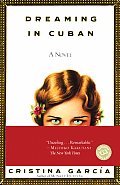
Dreaming in Cuban

I’m not sure I’m going to do justice to Cristina Garcia’s novel Dreaming in Cuban for a couple of reasons, one of which is that while I’m slowly emerging from my reading funk I still don’t feel like I’m reading well, and the other is that I’m particularly tired this evening but I’m also not willing to put off writing this post any longer. So I’ll just have to make the best of things.

I did enjoy reading this book, and I’m happy that the Slaves of Golconda chose it because otherwise I doubt I would ever have picked it up. It’s a good read — an entertaining and smart novel about the intersection of family, politics, and religion. I’ll admit that I’m generally not fond of the kind of point of view switching that goes on in the novel — it shifts not only from character to character, which I have no problem with, but between first and third person, which does irritate me a bit — but
since having multiple voices speaking throughout the novel is so obviously important to Garcia, I can see why she chose to do it. Part of the point of the book is to get multiple perspectives; not only does the narrative focus shift from character to character, sometimes rapidly, but we see at least some of the characters from the inside, where they sometimes speak for themselves, as well as from the outside. Interspersed throughout the novel are one character’s letters as well, offering another perspective on the story. All this has the effect of capturing a great amount of complexity in relatively few pages (240 or so); the technique mimics the interconnectedness and the web of relationships it seeks to describe.

The story is about a Cuban family as it changes throughout the politically turbulent years of the mid-20C. At its heart is the matriarch Celia, a self-sufficient woman living on the Cuban coast who gets caught up in the furor of the revolution headed by Castro, who is never named but is a powerful presence in the novel. Her two daughters (she has a son as well but we don’t learn much about him) follow very different paths as adults; one of them, Lourdes, emigrates to the U.S. and becomes a proper American capitalist, working hard and eventually owning two successful bakeries. Her daughter, Pilar, isn’t impressed by this success, however, and finds ways to rebel against her mother’s strident pro-Americanism and moral conservatism. She becomes a painter and attends art school; one of the novel’s best scenes tells of a painting she completes for her mother’s new bakery, which is supposed to be patriotic in its message and ends up being something quite else.

The other daughter is Felicia, who remained in Cuba and who struggles throughout her life with mental illness. Her story is a sad one, as she is caught up in a difficult marriage and has trouble raising her three children; one summer, the summer of the coconuts, she and her young son survive on nothing but coconut ice cream. Her children are torn between their need for and love of their mother and their curiosity about their estranged father; they suffer from their mother’s bouts of illness, but she, too, is a victim. Celia does what she can to help her grandchildren, but her interventions can only do so much good.

The novel is ultimately about the ways our families shape who we are — they define us, whether we live in close proximity to them or thousands of miles away. Several of the characters are haunted by the ghosts of dead relatives or are able to communicate telepathically with far-away family members. Others, such as Pilar, are haunted by memories of the lost home in Cuba; while her mother wants only to live securely in America, Pilar wonders what life is like on her lost island and what kind of relationship she could have with her grandmother Celia. No one can escape the influence of family, whether it be the memories they create for us or the standards they set against we can try, often unsuccessfully, to rebel.

No one can escape their political context either; the Cuban revolution divides the family both ideologically and physically, causing a rift that is symbolized by Celia’s picture of Castro which she has placed over a picture of her husband and which Lourdes flings into the sea in a fit of rage. The picture symbolizes how political and familial forces blend in intricate ways to shape each of the novel’s characters. They can’t change the circumstances of their birth; they can only respond to them in the best way they can.

7 Comments

Filed under Books, Fiction

Sweet Danger

Margery Allingham’s Sweet Danger was the novel under discussion at my latest mystery book club meeting; once again it was a great discussion that went on for nearly four hours. We talked a lot about the details of the novel, of course, but also about the mystery genre itself, and we made comparisons between Sweet Danger and the club’s previous novel, Dashiell Hammett’s The Glass Key. On the surface these two novels couldn’t be more different — one is light and comic and the other is darkly violent without a ray of hope in it anywhere — but they do have some similarities, including main characters who are appealing largely because of the way we learn to trust them as the novel progresses, but who remain mysteries themselves, never described in detail and never given much of an inner life.

I’m glad we’re focusing on one genre, as it makes this kind of comparison possible, and it means that each time we meet we’re building common ground that will make future discussions that much richer. It feels a bit like a really good graduate class with a group of smart, enthusiastic people who have a lot to say. Except, of course, that we don’t have a professor, and we don’t have to write a course paper or give a presentation, and the topic is more fun than grad class topics usually are, and the reading load is lighter. And no one is showing off by dropping names of obscure theorists, or obnoxiously dominating the conversation in order to impress anybody, or using big words just to sound smart. Okay, it’s not like a grad class at all. Forget that.

Anyway, the group’s response to the book was mixed. Some people hated it and could barely finish it, others loved it, and others were somewhere in the middle. Those who didn’t like it complained about its lack of realism and its lack of depth — it didn’t seem to have any larger purpose and didn’t offer much entertainment to make up for that lack.

I was one of the ones who loved it, however. It took me a while to get in the spirit of the book — I wasn’t expecting its plot to be so complex and its tone to be so light and at times silly — but once I began to get a sense that this is what it would be like, I relaxed a bit and decided to enjoy the ride. Sometimes I resist when a book does something I don’t expect, but I like to try to take it on its own terms if I can and enjoy it for what it is, so with this book I began to appreciate the humor and the eccentricity of the characters and to appreciate the main character, Albert Campion, a man who is constantly described as “vague and foolish-looking” or as having an expression “vacant almost the point of imbecility” and yet who never fails to figure everything out. He doesn’t mind looking foolish either, at one point in the novel dressing up in women’s clothing for a purpose I can’t remember now but with hilarious results. The narrator describes him this way:

that was the beauty of Campion; one never knew where he was going to turn up next — at the third Levee or swinging from a chandelier …

I also loved the other main character Amanda (Emily has praised her highly too), an amazingly smart, talented, resourceful, and funny 17-year-old girl who single-handedly runs a mill to keep her family going. She’s easily a match for Campion, and it’s a delight to watch them work together to solve the mystery. I particularly liked her physical energy; as the narrator says, “Mr. Campion was fast learning that association with Amanda always entailed strenuous physical exertion.” She is beautiful, but poverty and general carelessness mean that “her costume consisted of a white print dress with little green flowers on it, a species of curtaining sold at many village shops” — and this is her nice outfit.

I haven’t told you much about the story, and I don’t think I will, as it’s a very complicated one, but, briefly, it’s about a tiny country in Europe (although it’s not set there); a lost inheritance; an uncertain family tree; a crazy country doctor; a fabulously wealthy and powerful corporate villain; a mysterious inscription on a tree; a drum, a bell, and a crown; and a whole crowd of trouble-makers. How all these fit together you’ll have to read the book to find out.

I don’t know yet what our next book will be, but I’m looking forward to it already.

11 Comments

Filed under Books, Fiction

Book therapy

Another way I’ve found to deal with my reading funk, in addition to listening to P.D. James novels on audio, is visiting my local used bookstore. Inspired by Kate’s group reading of Anne of Green Gables, I went out to find a copy this afternoon (and, inspired by Emily’s Eco-justice Challenge, I walked!). I had a complete set of the Anne books when I was a kid, but I left them behind when I grew up and have been deprived ever since. Now, though, I’m the proud owner of Anne of Green Gables once again. I realized after I got home that I’ll probably have to go back to find the rest of the Anne books, because will I want to stop after just one book? Probably not.

While I was at the store I couldn’t resist picking up another couple books, including E.M. Delafield’s Diary of a Provincial Lady, which looks like tremendous fun, and Barbara Comyns’s Our Spoons Came from Woolworths. It’s a Virago Modern Classic, which interests me automatically, but the back cover description was especially intriguing:

Sophia is twenty-one years old, naive, unworldly, and irresistible — most particularly to Charles, a young painter whom she married in haste and with whom she plunges into a life of dire poverty. Desperate, Sophia takes up with the dismal, aging art critic Peregrine, and learns to repent both marriage and affair at leisure. How Sophia survives to find true love is delightfully told in this engaging and eccentric novel, which also gives a wonderful portrait of bohemian life in London in the 1940s.

It’s the bohemian life in the 1940s part in particular that got my attention. My used bookstore had a number of interesting-looking Viragos, but I decided I couldn’t carry them all home, so I may have to go back to get more later. And I just mooched Rosamund Lehmann’s Invitation to the Waltz, so I’m thrilled to have yet another Virago on the way.

8 Comments

Filed under Books, Fiction, Reading

Mysteries

One book I have been able to enjoy lately, in spite of my reading slump, is P.D. James’s The Lighthouse, which I’m listening to on audio in my car on the way to and from work.  I’m not sure if it’s the book itself or the experience of listening rather than reading that makes the difference, but I have looked forward to listening to it every chance I get over the last week or so.  I finished it yesterday.

One of the things that drew me to the book, in addition to the interesting characters, the well-crafted plot, the atmosphere of literate intelligence, was its setting. It takes place on Combe Island, which has been used for the last half-century or so as a place of retreat for busy, stressed VIPs who need a place to relax for a week or two.  It’s a quiet place, with no cell phones, no noise, and no work (at least for the VIPs).  Visitors to the island spend their time reading, listening to music, walking along the shore, and joining each other occasionally for dinner, although they can remain completely isolated if they prefer.  Food appears regularly at their doorsteps and the guest cottages stay immaculately clean. The island’s most important rule is that nobody should bother the visitors.   As I listened, I couldn’t help but think about how much I need such a retreat right now.  Doesn’t it sound heavenly?  Yes, I’m not a VIP, and yes, it’s not entirely safe — murder may occur, but at this point I might consider risking it.

I enjoyed the novel so much that today I began listening to it again.  I’m so terrible at figuring out the plots of mystery novels and I’m bad at remembering all the details to put everything together properly at the end (especially when I’m listening as opposed to reading) that I thought I might enjoy listening to it again knowing who the murderer is, to see how James prepares the reader for the ending.  I haven’t the faintest clue how to go about plotting a mystery novel, and I have no intention of trying it myself, but I thought it would be interesting to learn a little about how James does it by paying closer attention than I could the first time around.

Really, since I have to commute, isn’t that a good way to spend the time?

11 Comments

Filed under Books, Fiction, Reading

Reading funk

I’m beginning to think I should stop reading for a while, because every book I pick up seems to be not quite right for my mood. I’m at a loss to find the book that will do.

After feeling dissatisfied with Rosamund Lehmann’s The Echoing Grove, I picked up Georgette Heyer’s novel Venetia, thinking I couldn’t go wrong with Heyer, and yet she didn’t quite do the trick either. The novel’s slow pace bothered me. This, surely, is a sign things are not right with me, as I usually like novels with slow paces. I also found the heroine a little irritating — she laughed the entire way through the book, even in very dramatic situations where any normal person would not crack a smile. And I couldn’t quite forgive the hero for forcing a kiss on Venetia at their very first meeting. I suppose this is meant to be sexy — the bad boy hero can’t resist and the innocent heroine can’t help but like it — but I found it obnoxious.

I disliked the gender dynamics in other ways too. When Venetia meets Damerel, the rakish hero, she spends some time thinking about his history with women and how she feels about it, and she decides that men are simply that way; they can’t help but chase women and have affairs, and there’s nothing to be done about it and it really doesn’t matter a whole lot. I think she’s supposed to come across as admirably practical and realistic for thinking this way. As far as I’m concerned, though, if this is the truth about men, I think I’d rather not know.

So, I’m reading Margery Allingham’s Sweet Danger now, and so far it’s going okay, but I’m afraid it’ll head downhill at any moment, or, rather, my feelings about it will head downhill, probably for reasons that have nothing to do with the book. I feel I should apologize to any author and any book I attempt reading right now, as I surely am not doing them justice.

I’m hoping I get over this soon ….

23 Comments

Filed under Books, Fiction, Reading

On the Western Circuit

I’ll be discussing the Thomas Hardy short story “On the Western Circuit” with my class this week; I’ve always liked Hardy, in all his darkness and gloom, but I fell in love with him when I came across this sentence while preparing for class — at this point the story’s heroine is riding on a carousel, having just met the handsome Charles Bradford Raye:

Each time that she approached the half of her orbit that lay nearest him they gazed at each other with smiles, and with that unmistakable expression which means so little at the moment, yet so often leads up to passion, heart-ache, union, disunion, devotion, overpopulation, drudgery, content, resignation, despair.

When I read this long list of the results of one smiling gaze, I couldn’t help but laugh — it’s not really funny, of course, but it’s just so perfect and so much like Hardy to have one eye on the story and one eye on universal despair. I love how he mixes the positive in with the negative — it’s not just heartache and drudgery but also union and content we experience — because the presence of these positive experiences makes the overall despair seem even worse in contrast. And I love how he mixes the personal with the impersonal; it’s not just heartache and despair but also overpopulation we’re dealing with. Personal tragedies lead directly to social ones.

No, this is not a happy story. It’s about Anna, a country girl who has come to the small city of Melchester to live with Edith, a woman who has offered to train her as a servant. While riding the carousel, Anna meets Charles; they fall in love and he “[wins] her, body and soul.” Hardy describes this “winning” very briefly and without judgment. It’s something natural Anna has done, and although society might judge her for it, Hardy won’t. Work takes Charles away, and when he writes her a letter, Hardy reveals Anna’s dilemma: she is illiterate and cannot read the letter. She begs Edith to write a letter for her, which she does, and they fall into a regular correspondence, Charles and Anna/Edith. Anna begins by dictating the letters, but soon Edith edits and embellishes and even writes entire letters without Anna’s knowledge. Charles is astonished that an ill-educated country girl could write so well, and he begins to fall in love with the letter-writer. Then Anna finds herself “in a delicate situation,” as they say, and the plot thickens.

The moving thing about this story is that everyone does something wrong and yet no one is really at fault, and the story doesn’t judge them, but rather presents their actions and the consequences dispassionately, as though nothing could possibly have been any different. Charles should not have seduced an innocent girl, Anna should not have allowed herself to be seduced, Edith should not have deceived Charles by writing Anna’s letters, and yet each of the characters finds him or herself in much deeper trouble than any of these actions would suggest. Each one is portrayed sympathetically. They are trapped, caught by nature and by fate, and they suffer undeservedly. Such is the universe.

I’ve read five Hardy novels, some of them twice; I guess I’m drawn to this kind of clear-eyed pessimism, as well as to a well-told story. I read these novels quite a while ago, however; perhaps one day I’ll reread some of them or pick up ones I haven’t experienced yet. This short story has certainly whet my appetite.

15 Comments

Filed under Books, Fiction

Longing for Summer: A Thursday Thirteen

Summer is so close, and yet not nearly close enough — 3 weeks until the end of classes, and then another two weeks after that of final exams, grading, and a school retreat, at which I have to take on some responsibility instead of just whining and moaning my way through it like I did last year. (Ummm … this retreat is purely voluntary, so I really have nothing to complain about, except my inability to say no when people at work ask me to do things.)

So, inspired by Danielle’s regular (or semi-regular) Thursday Thirteens, I thought I’d spend some time thinking about what I might read this summer. I am by no means holding myself to this list; rather, it’s what I would want to read if my summer began today:

  1. Sarah Waters’s Fingersmith, which I just this minute mooched from Book Mooch. I remember reading The Crimson Petal and the Black last summer and loving it, so a return to some Victorian-era fiction sounds perfect for this summer.
  2. Rosy Thornton’s Hearts and Minds. The author graciously offered to send me a copy and I instantly accepted. I’ve heard such good things about this book, and I do love campus novels. Yes, this might be a strange thing to read over the summer, when I’m wanting to escape from school, but reading a novel about campus life is not at all like living it.
  3. Anne Bronte’s The Tenant of Wildfell Hall. I’ve been meaning to read this one forever, and after my great Wuthering Heights experience, I’m excited to read more of the Brontes. I also have Agnes Grey and Shirley on hand.
  4. Antonia White’s Frost in May. I can’t get enough of those Viragos, and this one I’ve heard mentioned quite a few times.
  5. Penelope Fitzgerald’s The Bookshop and/or The Blue Flower. I keep mixing up Penelope Fitzgerald and Penelope Lively. Perhaps once I’ve read them both I’ll stop doing that.
  6. Shalom Auslander’s The Foreskin’s Lament. Bitter, angry religious memoir? Sounds like my kind of book.
  7. Amanda Vickery’s The Gentleman’s Daughter. This is about women’s lives around Jane Austen’s time. I’d love to know more. In fact, I might begin this one before summer.
  8. Gabriel Josipovici’s Moo Pak. Anything by Josipovici, fiction or nonfiction, would be just fine.
  9. Mary Brunton’s Discipline. This was published in 1814, so she’s a contemporary of Jane Austen. I’ve heard very good things about her, and I do love novels from this time period.
  10. Roland Barthes’s The Pleasure of the Text, or perhaps A Lover’s Discourse or anything else of his that strikes my fancy. Barthes is a theorist I’d like to read more of.
  11. William St. Clair’s The Godwins and the Shelleys: A Biography of a Family. A number of books on my list either come from or are about the Romantic period — such a fascinating time, isn’t it? I also want to read St. Clair’s The Reading Nation in the Romantic Period.
  12. Louise Gluck’s Proofs and Theories. A collection of essays by one of my favorite poets. Some more of her poetry would be wonderful to read as well.
  13. W.G. Sebald’s The Emigrants. Sebald is such a fascinating writer; I loved The Rings of Saturn and am looking forward to reading more.

19 Comments

Filed under Books, Fiction, Lists, Reading

The Echoing Grove

I wrote earlier about not exactly loving Rosamond Lehmann’s novel The Echoing Grove; I was interested in the book in a sort of detached, intellectual kind of way, but it never grabbed my attention and made me love it.  I did love her book A Note in Music, and I was hoping for more of the same but didn’t quite find it.  This has something to do with my mood; I’m not in a mood to think very hard about my fun reading (I picked up a Georgette Heyer novel, Venetia, after finishing Lehmann), and The Echoing Grove was more challenging than A Note in Music.  But I’m not sure it’s just a matter of mood.  I suspect that even if I’d wanted a challenge this book wouldn’t have satisfied me, and I would have still preferred the other.

In both cases, Lehmann works with a small group of characters, describing in great detail their mental and emotional states and their relationships with one another. She writes about friendships and love affairs, about desire and longing, and about shifting moods and emotions. So what makes The Echoing Grove more challenging than the other? She does interesting things with point of view, which can sometimes make the book a bit hard to follow; while the novel is written in third person, she will suddenly slip into first person and give us a character’s thoughts directly. There are passages that slip into stream of consciousness narration, with shifts in time and topic that are disorienting. There’s a particularly long example of this early in the novel, and I began to wonder just what I’d gotten myself into, but the novel returned to more straightforward narration eventually, and I decided to keep plugging along. There are also long sections of intense, emotionally-draining dialogue, of the sort that made me wonder whether people really talk that way (I felt similarly when reading Elizabeth Bowen). There is also a complicated time structure in the novel – the narration jumps around in time so much that I had a hard time figuring out what took place when.

So what is the story about? Simply put, Madeleine and Dinah are sisters; Madeleine is married to Rickie and Dinah has an affair with him. You can imagine, I’m sure, the family tension this creates. Madeleine is a fairly conventional woman, raising a family and participating in an acceptable social circle, while Dinah is more adventuresome and bohemian, getting caught up in love affairs with questionable men and disappearing for long stretches of time, doing nobody knows what. The novel begins with a meeting between the two long-estranged women, an awkward meeting where they seem to want to discuss their past but are hesitant. It then moves back in time to tell their history with occasional returns to the present moment to chart the sisters’ attempts to make amends. Although other characters make appearances, the interest of the novel is in the nature of these three main characters – Rickie’s haplessness when it comes to women, Dinah’s free-spiritedness countered by her suffering, and Madeleine’s calm patience and longsuffering.

My struggle with the novel was simply that I never came to care a whole lot about these people, and the formal elements, while interesting, weren’t enough to make up for my lack of emotional connection. I certainly don’t need to be emotionally connected to every book I read, but something has to catch my attention and either make me feel or make me think or, ideally, both. Now, if my description of the book intrigues you, don’t be scared away by my doubts – you may find a way into this book that I couldn’t. And I certainly am not turned off of Lehmann forever; I plan on reading more of her work, and I fully expect to like it.

10 Comments

Filed under Books, Fiction

Wasting time

Alan Lightman’s closing essay “Prisoner of the Wired World,” from his book A Sense of the Mysterious, is interesting, although not entirely original in its argument. But it has made me think a lot over the week or so since I finished it, which surely is the mark of a good essay. Lightman opens the essay this way:

Not long ago, while sitting at my desk at home, I suddenly had the horrifying realization that I no longer waste time.

He goes on to describe how connected we all are, through our computers and our cell phones and other forms of technology, and how all this connectivity means that the pace of life is faster and we spend more and more of our time working, at the expense of enjoying the kind of down time that nourishes our souls. He lists what he sees as the unpleasant effects of the wired world (developing each item in a paragraph or so):

1. An obsession with speed and an accompanying impatience for all that does not move faster and faster… 2. A sense of overload with information and other stimulation… 3. A mounting obsession with consumption and material wealth… 4. Accommodation to the virtual world… 5. Loss of silence… 6. Loss of privacy…

The essay is a call to resist this speed and unthinking acceptance of technology; Lightman argues passionately for taking time to be still, doing nothing, and letting our spirits flourish.

I’m drawn by this argument, although suspicious of it at the same time. I find that people who criticize modern technology, especially the internet, rarely take the time to acknowledge sufficiently all the good it can do people. The internet can be a distraction and it can be a way to keep us chained to our jobs (answering student emails, for example) so that we rarely enjoy true leisure, but can’t it also be a place where that leisure can happen, where we can explore our minds and spirits, express our thoughts, and find people who think the same way we do? I find the internet to be an exciting, freeing place, a place where I can take risks with writing and read people doing the same thing. At the same time as I’m writing my blog posts, though, I’m sometimes checking my work email. I suspect tons of people have this complicated relationship to technology, and I wish I found it reflected in the writing on technology I encounter.

That said, I believe strongly in doing nothing and think I should do more of it. I suspect, also, that I should spend less time on the internet, hard as that may be. There’s a restful quality to time spent goofing off outdoors, for example, that I don’t experience goofing off online. But however I decide to do nothing, I hope to be able to keep doing it.

So I’ve been thinking about Lightman’s essay and have been more conscious of moments I allow my mind to drift. One of my favorite moments is in the morning when I have a chance to linger in bed after I’ve woken up. I think about my day, but I also think about … nothing. My mind works this way when I’m walking or riding my bike too. These things don’t feel like work to me; they feel like an escape from work.  A friend asked me today what I think about when I’m riding, and I had a hard time answering her. Sometimes I think about things I’m working on or plans for when I get home, but other times — a lot of the time — I can’t even say what’s on my mind. I like this. I like riding for all kinds of reasons, but one of them is that it gives my mind a break.

So even if I don’t fully agree with him, I’m grateful to Lightman for making me think of all this — for reminding me of the value of doing nothing and wasting time.

12 Comments

Filed under Books, Lists, Poetry

Wednesday whining and some poetry

This semester is dragging along, as slowly as it possibly can. I really don’t like wishing for time to pass by, as I feel like I’m wishing my life away, and that can’t be a good thing, but still … I’m longing for summer when I’ll have more time to read and sleep and ride my bike and go to yoga class and walk and read blog posts without feeling rushed. My semester, unfortunately, goes all the way through the middle of May and then some, so I have over a month left. Not that I’m counting or anything (okay, I have 4 1/2 weeks, dozens of classes to teach, hundreds of meetings to attend, and thousands of papers to grade, or something like that).

Unfortunately, I’m in a bit of a reading rut too, as I’m not enjoying Rosamund Lehmann’s novel The Echoing Grove as much as I thought I would. I loved Lehmann’s A Note in Music and thought I’d like anything she wrote. But The Echoing Grove hasn’t captured my attention and imagination as much as I’d hoped. It’s slow-moving and narrow in focus, but neither of those things is a problem for me, as I generally like that sort of book. It’s about relationships and love and family, and I generally like books about those topics. But in this case the characters haven’t grabbed me. I’m having trouble figuring out what to make of them, and I’m not finding myself very interested in their fates. Surely this is a bad thing. It was quite the opposite when I read A Note in Music, as I found myself responding emotionally to the characters and the situation. I’m not going to give up on Lehmann, though; I’m convinced I’ll like her other work. It’s just this one that’s not working for me.

I did begin a book of poems, which I’ve had a hankering to do for a while; I picked up Wallace Stevens’s Collected Poems. I’m not expecting to read through the whole collection, as it’s quite long, but I thought I might try to read the first section, his 1931 collection Harmonium, and then decide where to go from there. So far I’m enjoying the poems, although they are not yet knocking me off my feet. When I find one that does, I’ll post it here.

As for poems that do knock me off my feet, though, there is the work of Gerard Manley Hopkins, a poet we covered in my class today. I’m not a religious person these days, but Hopkins almost makes me wish I were. How can you read a poem like this one and not be tempted to believe in God?

Glory be to God for dappled things—
For skies of couple-colour as a brinded cow;
For rose-moles all in stipple upon trout that swim;
Fresh-firecoal chestnut-falls; finches’ wings;
Landscape plotted and pieced—fold, fallow, and plough;
And áll trades, their gear and tackle and trim.

All things counter, original, spáre, strange;
Whatever is fickle, frecklèd (who knows how?)
With swíft, slów; sweet, sóur; adázzle, dím;
He fathers-forth whose beauty is pást change:

Praise him.

I love the way Hopkins uses sound in the poem, for example, the alliteration that appears in nearly every line: Glory/God, couple/colour/cow, fresh/firecoal/falls/finches, plotted/pieced/plough, trades/tackle/trim, fickle/freckled, swift/slow/sweet/sour. This is a poem that simply must be read out loud to be fully experienced (true for most poetry I suppose). Hopkins likes to use alliteration and other sound effects because they reflect the design he sees in the world around him — the design created by a God taking great care of the world he’s made. Hopkins also likes to write lines that are difficult to read out loud, lines with odd rhythms and strings of words that you have to work hard to spit out: “fresh-firecoal chestnut-falls; finches’ wings” or “with swift, slow; sweet, sour; adazzle, dim.” As you are reading it, you are forced to slow down, which makes you linger over the words and perhaps take more time to consider their meaning. Reading a Hopkins poem out loud makes the words feel like physical things themselves; you can almost feel them in your mouth as you read.

And if I were to believe in God, I’d want to believe in one like Hopkins describes — one who has created and sees the beauty in “all things counter, original, spare, strange; / whatever is fickle, freckled (who knows how?).”

12 Comments

Filed under Books, Fiction, Life, Poetry

Somerset Maugham’s The Painted Veil

I have recently finished listening to W. Somerset Maugham’s novel The Painted Veil on audio, and I had a fabulous time with it. Now, I do tend to enjoy books in a simpler, more visceral kind of way when I listen to them, so I can’t say what my reaction would have been if I’d read the book, but I’m pretty sure I would have liked it that way too.

Its charm comes from the simplicity of the tale — generally speaking it charts the course of a marriage — combined with the complexity of the characterization. It tells the story of Kitty, a foolish, vain, and inexperienced woman who panics when her younger sister marries well, and in response immediately becomes engaged to Walter, a man below her social ambitions but one who has asked her to marry him when other once-plentiful suitors have stopped appearing. After the marriage, they head off to Hong Kong where Walter works as a bacteriologist; here Kitty meets Charles Townsend, an attractive, flirtatious man who quickly seduces her. This is the point where the novel begins, with Kitty deeply in love with Charles and afraid that her husband has learned about the affair.

Once the truth has come out, Walter forces her to accompany him to a province in mainland China where a cholera epidemic is raging. His ostensible reason for traveling here is to put his medical training to use to help stop the epidemic, but Kitty fears – with justification – that the real reason is to ensure that she catches cholera, as a punishment for her unfaithfulness. Kitty is terrified of the new place, seeing things she earlier had no inkling of – poverty, death, bodily decay, political unrest. The sisters of a nearby convent invite her to visit them, and she soon begins to help them with their charity work, raising young girls cast off by a society that sees them as a burden.

So, as you can guess by now, the story is about Kitty’s growth from a selfish and inexperienced person to one who begins to look outside her own small concerns to see the larger world around her. She learns something of the true worth of her lover Charles and also of her husband, who, though he is ready to commit an indirect sort of murder, is not portrayed in the novel as a monster, but as a man who is passionate and foolish in love. The pleasure of the novel, for me, lies in following the twists and turns of Kitty’s growth, as she comes to realize exactly what she has done to her husband, her lover, and herself. Maugham sticks to Kitty’s point of view, so we see the world through her eyes and watch it open up for her.

Another pleasure to be found comes from the relationship of the novel to the novel’s prologue; in the prologue the narrator (or Maugham himself) tells the story of traveling in Italy and learning Italian from a young woman who uses Dante in their lessons. From Dante he learns of the story of a man who suspected his wife of having an affair and took her off to a place where she was bound to catch an illness and die. When she fails to die soon enough, he arranges to have her pushed out of a window. The narrator broods over this story for weeks until he decides to use it in a novel of his own. I won’t tell you the extent to which the plot of The Painted Veil follows the story from Dante, but the effect of the prologue is that you know, or suspect you know, the plot events that are coming, and you can observe how Maugham leads you toward the conclusion, hoping all the while that what you suspect is coming won’t come after all. There is something enjoyable about watching an author lead you towards a known – or suspected – conclusion.

As much as I enjoyed these aspects of the novel, though, I was bothered by the portrayal of China and the Chinese. The English colony in Hong Kong is guilty of a kind of racism that is disturbing – they simply don’t see China or the Chinese, as though they don’t exist except as a source of servants – but the novel makes clear the hideousness of this attitude and one of the things Kitty must learn is to see the humanity of the Chinese people. More bothersome for me was the way China became merely the backdrop for a tale of western spiritual growth. China in the novel is a place westerners travel to in order to learn something about their own spiritual emptiness, at which point, the lesson learned, they move on. It becomes a source of enlightenment, a place where, with the aid of its beautiful landscapes and mysterious ancient religious traditions, people are able to question who they are and what they are seeking in life. It’s important for what it can teach westerners, not for what it is in itself.

So ultimately I had mixed feelings about the novel. This, too, offers its own pleasures. In my experience so far, Maugham has not let me down (Of Human Bondage is a great novel), and I’m looking forward to reading more of his work in the future.

19 Comments

Filed under Books, Fiction

A Sense of the Mysterious

I’ve been enjoying reading Alan Lightman’s book A Sense of the Mysterious: Science and the Human Spirit; I am nearly finished, with only a few essays left. The essays I liked best were the first few; these first looked at Lightman’s life and his experiences in science and novel-writing and then turned to his ideas about creativity, science, and language. There follows a series of essays on famous scientists including Albert Einstein, Richard Feynman, and others. These essays are interesting, each one telling a little about the scientist’s life and contributions plus something about their quirks as people and as researchers, but I prefer the more theoretical essays that look at science more broadly. I think the remaining essays may turn again in this direction.

One of the things I love about the book is how sensitive Lightman is to what happens to a scientist when he or she is working, what goes on in their minds and how their bodies are involved in the process. He describes his own experiences of inspiration, the moment when he finally breaks through to the core of a problem and finds he can solve it, and the description is intensely physical:

Then one morning, I remember that it was a Sunday morning, I woke up about five a.m. and couldn’t sleep. I felt terribly excited. Something strange was happening in my mind. I was thinking about my research problem, and I was seeing deeply into it. I was seeing it in ways I never had before. The physical sensation was that my head was lifting off my shoulders. I felt weightless. And I had absolutely no sense of myself. It was an experience completely without ego, without any thought about consequences or approval or fame….

The best analogy I’ve been able to find for that intense feeling of the creative moment is sailing a round-bottomed boat in strong wind. Normally, the hull stays down in the water, with the frictional drag greatly limiting the speed of the boat. But in high wind, every once in a while the hull lifts out of the water, and the draft goes instantly to near zero. It feels like a great hand has suddenly grabbed hold and flung you across the surface like a skimming stone. It’s called planing.

This feeling is not unique to science, of course; it’s a feeling one can have in any creative moment, but it’s interesting to me that while science can seem so cerebral, Lightman draws attention to the way it affects the scientist’s body as well as his mind.

Not only does scientific discovery manifest itself physically in the scientist’s body, but Lightman says the scientific manifestations can be different than those of art:

Over the years, I have learned to recognize the different sensations of science and of art in my body. (Sometimes the sensations, such as the creative moment, are the same.) I know the feeling in my body of deriving an equation. I know the different feeling in my body of listening to one of my characters speak before I have told her what to say. I know the line. I know the swoop of a idea. I know the wavering note. Most of the time, these feelings all swirl together as a rumbling in my stomach, a wondrous and beautiful and finally mysterious cry of the world ….

Am I mistaken, or is this kind of writing, physical and mystical at the same time, not at all typical of science writing?

Not only does Lightman write about how the body is involved in scientific discovery, but he writes about emotion, too, and aesthetics. He quotes the mathematician Henri Pointcaré on the subject:

The privileged unconscious phenomena, those susceptible of becoming conscious, are those which directly or indirectly affect most profoundly our emotional sensibility. It may be surprising to see emotional sensibility invoked à propos of mathematical demonstrations which, it would seem, can interest only the intellect. This would be to forget the feeling of mathematical beauty, of the harmony of numbers and forms, of geometric elegance. This is a true aesthetic experience that all real mathematicians know, and it surely belongs to emotional sensibility.

“Mathematical beauty,” “geometric elegance” — doesn’t this make you want to become a mathematician? It has that effect on me, at any rate. He goes on to talk about how Einstein and others were surely motivated by aesthetics when they looked for new theories, and he gives examples of scientists who judge theories based on their beauty or ugliness or elegance:

The Nobel chemist Roald Hoffmann tells his students that it is the awareness and appreciation of the “aesthetic aspects of science,” rather than mere quantitative analysis, that leads to discovery.

This makes me realize that science and art are not so far apart after all, which, I’m sure, is part of Lightman’s point.

10 Comments

Filed under Books, Nonfiction

Kate’s poetry challenge

Kate has an intriguing challenge for April: post something critical about poetry once during the course of the month. She notes that while she often sees poems on book blogs, she doesn’t as often see writing about poetry, and so wants to challenge herself and others to do some critical — meaning analytical — writing about the genre.

I’m up for that, I think. Over the last couple years I’ve taken to reading poetry more often than I did before and I’ve loved it; I’ve discovered some new (meaning new to me) authors such as Jane Kenyon and Mary Oliver, and I’ve reread some old favorites, like Keats. Over the last couple months I’ve been reading one particular poem, Paradise Lost, but I decided early on that I wasn’t going to post about it, so I haven’t mentioned it. All I’ll say about that experience is that I loved the poem and am in awe of it. Kate writes about feeling uncertainty when it comes to voicing an opinion about poetry, and this is exactly what I felt when faced with Milton’s poem. I didn’t want to challenge myself to write about the poem; instead I preferred simply to enjoy it. (And I decided to leave the insightful writing to Imani, who has a great series of posts about Paradise Lost).

But now perhaps it’s time to start writing about poetry again. I’m also in the mood to read more more contemporary poetry — meaning 20th or 21st century poetry, as opposed to works from earlier centuries. I’ve been considering looking into my copy of Wallace Stevens’s Collected Works, or I might take a look at what my local bookstore has and see if something strikes me. I can also write about some of the poems I will be teaching in my classes; I’m about to enter the poetry section of my Introduction to Literature class, and we read poetry regularly in my British Literature class. There will be lots of poems to choose from.

If this interests you, do check Kate’s site out, as she will be offering prizes for participants. I’m hoping to learn about some new poets from everyone who takes part.

12 Comments

Filed under Books, Poetry