
Just a few thoughts for a Friday evening. Since finishing Infinite Jest, I’ve been focusing on Laurie King’s The Beekeeper’s Apprentice, which I’m reading for my non-mystery book group, even though the book happens to be a detective novel. I’m almost finished with it, and I’ll write a proper review later, but my conclusion will be that the book is a disappointment. It has many potentially interesting things in it, but it never manages to pull everything together to be a really engaging read, and if a detective novel isn’t an engaging read, there’s a problem. From what I’ve heard from my book group friends, I don’t think there will be much controversy over this one; everyone so far has agreed it’s not that great. Oh, well.
I received one new book in the mail this week: Robert Dessaix’s Twilight of Love: Travels with Turgenev. I know nothing about Dessaix and have never read Turgenev (although I’ve been meaning to for a long time), but this book interested me because it’s a combination of memoir, travel narrative, and literary history, and I love books about books and writing that mix genres in this way. This is what Publisher’s Weekly says:
While the problem of irrational love in a world of reason is the dominant theme, Dessaix’s work explores much more: Russian theology, the experience of being far away and therefore barbarian in European eyes, the modern confusion of the erotic with the sexual, and of course, the problem of death.
And on the topic of books about books and writers, I recently learned that J.C. Hallman will be publishing a very interesting-sounding anthology called The Story About the Story, a collection of essays by writers about writing. The Table of Contents looks absolutely fabulous. It has selections by Virginia Woolf, Vladimir Nabokov, Salman Rushdie, Cynthia Ozick, Geoff Dyer, Randell Jarrell, Susan Sontag, and a whole bunch of other great people. The idea is that these selections are personal approaches to literature — great writing about great writing. (As I look over the Table of Contents I’m wondering why he didn’t include a selection from Nicholson Baker’s U&I, but, of course he couldn’t include everything).
Amusingly enough, I found out about the book on this blog, in the comments of which I called Hallman an impolite name (if you read the post, you’ll see why), and then Hallman himself appeared and responded. The internet can be such a great place, can’t it? I love it that people can be having a book discussion and then all the sudden the author can show up and contribute. Even if I do get caught out being impolite…
After I finish reading Laurie King, I’m not entirely sure what I will pick up next, although perhaps something I’m more likely to like, perhaps something older and canonical. Or perhaps an interesting nonfiction. We’ll see.
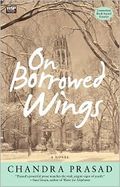 I finished Chandra Prasad’s On Borrowed Wings nearly a month ago, and so the details are beginning to get vague, but I did want to write at least a few words about the book before putting it away. I picked it up in the bookstore because I was in the mood for something easy and fun and comforting, and I remembered the title from Danielle’s very positive


 E.M. Forster’s novel Maurice is an intriguing read, largely because of the time period it was written in and the way it treats its subject matter, homosexual love. Forster wrote it in 1913 and 1914, but he resisted publishing it, and it didn’t appear in print until 1971 after he died. He was worried that people would have a hard time accepting what turns out to be a vexed but positive portrayal of homosexuality.

 Of Books and Bicycles