Category Archives: Books

Finishing Gravity’s Rainbow

I’m not planning on writing a review of Thomas Pynchon’s Gravity’s Rainbow, which might drive me insane, but I did want to write a bit on the experience of reading it. I have two main responses to the book, one of which is to admire Pynchon’s obvious brilliance and to wonder what kind of mind it takes to write such a book. The other is to admit that I didn’t really enjoy it. I liked isolated scenes here and there, found parts of it funny, parts insightful, but these moments of enjoyment weren’t enough to make me like it as a whole.

I just couldn’t quite make sense of what was going on enough of the time to satisfy me. I don’t mind dealing with a certain amount of uncertainty and confusion — I happily read Infinite Jest not getting everything that was happening — but there was too much here. I felt as though I understood what was happening in the book in very broad terms, and also I remember small scenes, but too often as I was reading, I couldn’t figure out the relationship of one scene to another, couldn’t quite remember where I’d seen a particular character before, wasn’t sure where we were in time, and wasn’t sure what the characters were doing. I did “cheat” a little bit and looked up discussions of the book online, but these only helped a little bit.

I know that the book is confusing to other readers as well, and that part of the point is to be difficult, but that didn’t change my experience of reading it much.

So, what is the novel about, exactly? It does have a main character, Tyrone Slothrop, an American who is on a quest for information about the V-2 rocket and who was the victim of some bizarre Pavlovian research as a child. There is also Captain Blicero, who creates and fires the V-2 rocket. The novel takes place during and shortly after World War II, with flashbacks to earlier times. It’s about wartime intelligence, psychological research, paranoia, fear, obsession with death, and obsession with connections between sex and death. And there’s so much more — lots of characters, lots of silly songs, lots of sex, especially of the more perverse kinds. It’s all about violence on a mass scale, and how this messes with people’s minds. It’s dark, as one would expect a book about World War II to be. It’s also emotionally cold, which is an important reason I didn’t enjoy it. It’s very much an intellectual book, detached and analytical. It is funny in places, and it’s also sad, but mostly it’s grim.

I can see that this is an important book, and that it’s an appropriate response to a horrifying war and a world that has become insanely insanely self-destructive. But, alas, it was also a bit of a slog.

11 Comments

Filed under Books

Skippy Dies

Lately I’ve been in a mood to read more contemporary fiction than I usually do (a mood that’s probably fleeting and influenced by people raving about new books on Twitter), and so I picked up Paul Murray’s Skippy Dies. I’m grateful to the people on Twitter because I enjoyed this one quite a lot.

The novel tells the story of Seabrook, a boys’ school in Dublin where Skippy is a student. In the opening pages, we witness Skippy dying a horrible death in a doughnut shop, and then the narrative backs up in time to tell about his life. The novel tells his story, and the story of his friends, classmates, and teachers. Skippy is a quiet, seemingly-normal kind of kid, the kind whose friends are much more colorful and memorable. Ruprecht, for example, is Skippy’s roommate (there are a few boarders at Seabrook, although most students commute) and is considered a scientific genius. Mario can think of one and only one thing, sex, and is capable of talking about it only in the crudest of ways. But Skippy is thoughtful and sensitive, and also in love with Lori, a student at the nearby girls’ school. Unfortunately for Skippy, Lori is way out of Skippy’s league, or everyone thinks so, and she has become involved with Carl, a drug-using, manipulative, thuggish bully.

The novel also tells the stories of the adults, most notably Seabrook’s history teacher Howard, who is unhappy in his current relationship and attracted to the beautiful substitute geography teacher (who is the only teacher who can really capture the boys’ attention in a school with very few women in it). Howard graduated from Seabrook and never thought he would end up there again, but his life has gone in unexpected directions. There is also Tom, another teacher and former Seabrook student whose relationship with Howard is long and complicated. And then there is the acting principle, whose devotion to Seabrook and its reputation is extreme to the point of being frightening.

Murray moves back and forth between these various stories, and in doing so, captures the feeling and mood of the place. The novel a reminder of just how hard it is to be a teenager — and how hard it is to teach teenagers. The kids aren’t in the least interested in learning anything, with the exception of Ruprecht, and only want to be free to hang out with each other and to dream about meeting girls, or, in some cases, to actually meet them. There’s a lot of longing, a lot of angst, and a quite a lot of drug use.

And, actually, the lives of the teachers aren’t so different. Howard can’t figure out what he wants out of a relationship and what he wants to do with his life, and he spends his time obsessed with the geography teacher, to the extent that he keeps teaching World War I beyond its allotted length of time because she expressed an interest in Robert Graves, a World War I poet. The novel is largely about dissatisfaction and longing, and this takes many forms: Howard’s obsession with a woman whom he hopes will transform his staid, boring life, for one. It’s also about Skippy’s hope that Lori — the beautiful girl who seems so far out of reach and whom he falls in love with while gazing at her from afar — will notice him. And it’s also about Ruprecht’s obsession with the possibility that other universes exist and that he might be able to make contact with aliens. Everyone hopes for something from outside them to transform their lives, when reality is boring at best and quite possibly very painful.

The story is an absorbing one, especially once it’s clear that the novel is going to tell how Skippy got to the horrible death scene in the doughnut shop. I found it hard to believe that Skippy really was going to die, and I kept rooting for him. Murray does some interesting things with narration, beginning many of the chapters about Skippy with a description of the video game he is playing, so that we are thrown into the world of the game and only eventually return to the story once again, mimicking the way Skippy loses himself in an alternate world and is reluctantly forced back into reality. Murray does a good job making us feel as though we know these characters and how their minds work and that we have something at stake in their decisions. The world he portrays is dark; he makes being a teenager seem like a curse and being an adult not a whole lot better. But the energy, compassion, and humor with which the story is told keeps some hope alive.

8 Comments

Filed under Books, Fiction

Seeing Stephen King

There has been no end to the bookish expeditions around here lately. Our latest one was a big one: a trip to Portsmouth, New Hampshire, to see Stephen King. I heard about the one and only book signing he agreed to do for his new book Full Dark, No Stars from Michele Filgate on Twitter, who works at RiverRun bookstore in Portsmouth. I also had heard that Portsmouth is a cute city, so I suggested to Hobgoblin that we go, and he happily said yes. He is the real Stephen King fan in the house; I’ve read only one novel of King’s, The Girl Who Loved Tom Gordon, and that one only because it features hiking and the Appalachian Trail. I liked it, but mostly I’m not a fan of horror, as I scare too easily and don’t find being scared fun. But Hobgoblin has been a fan for years, is a member of the Stephen King Library, which automatically sends him a copy of his King’s books, and has collected every book he’s published.

So this past Thursday we headed up the highway through Massachusetts and into New Hampshire. The city of Portsmouth, it turns out, is incredibly charming, full of interesting stores, historic neighborhoods, and parks along the water. RiverRun bookstore is small but good, with a great selection, and there is a used bookstore, Second Run Books, owned by the same person, not too far away. Hobgoblin and I explored the shops for a while, had dinner at the Portsmouth Brewery, and then made our way back to RiverRun to see what was going on. And there was Stephen King in the window of the shop signing books for people, with a crowd outside gazing in and taking pictures. We found our place in the line and took pictures ourselves. Here’s one of me with King in the background:

And here’s one of Hobgoblin shaking King’s hand:

I know that was a special moment for Hobgoblin. For me, I always like meeting authors, and it was great to meet one who is so famous and successful. From what I hear, King is one of the nicest famous authors out there as well. He seemed to be enjoying meeting his fans and to have limitless energy, although he signed something like 450 books, and that’s a lot. He seems to know that people are really excited to meet him and to want to make sure they have a good experience.

Afterward, we went to a cafe two doors down the street to eat chocolate cake and gloat over our books. Everybody else in the cafe had copies of King’s book as well, as did everybody walking down the street. A man sitting at a nearby table struck up a conversation with us about King and all the signings he’s been to and his room devoted mostly to King’s books. The atmosphere was celebratory, and it was fun.

We stayed in Portsmouth until the next morning when we drove back home. I realized for something like the hundredth time how much I enjoy living in a place with so many interesting cities and towns and with tons of bookish destinations. And I thought about how much I hope I make it back to Portsmouth again before too long.

17 Comments

Filed under Books

The Common Reader

As part of my very slow read-though of Virginia Woolf’s major works, I’m am now reading The Common Reader, her collection of literary essays. And oh my goodness, have I made it clear how much I love Virginia Woolf? Because these essays are wonderful. This is my second time through the book, and I’m loving it. I just read her essay on Montaigne, and I marveled at the way she moves back and forth between writing about him in the usual way one writes about someone else and actually embodying him, taking on his persona. She will write something like “It is life that emerges more and more clearly as these essays reach not their end, but their suspension in full career” that is clearly evaluating Montaigne from an exterior perspective, but then in the same paragraph she will start describing his ideas as though she were Montaigne herself:

In short, the soul is all laced about with nerves and sympathies which affect her every action, and yet, even now in 1580, no one has any clear knowledge — such cowards we are, such lovers of the smooth conventional ways — how she works or what she is except that of all things she is the most mysterious, and one’s self the greatest monster and miracle in the world …

By slipping into his voice, she creates a strong sense of who Montaigne was; she brings him to life, and her affection for him shines through.

But then her own voice is incredibly convincing. Woolf writes with such assurance and poise — without coming across as arrogant — that I’m ready to believe whatever she says. I love this passage from the essay “Notes on an Elizabethan Play,” which compares plays and novels:

The play is poetry, we say, and the novel prose. Let us attempt to obliterate detail, and place the two before us side by side, feeling, so far as we can, the angles and edges of each, recalling each, so far as we are able, as a whole. Then, at once, the prime differences emerge; the long leisurely accumulated novel; the little contracted play; the emotion all split up, dissipated and then woven together, slowly and gradually massed into a whole in the novel; the emotions concentrated, generalised, heightened in the play. What moments of intensity, what phrases of astonishing beauty the play shot at us!

She makes everything clear — of course that’s how plays and novels work!

She also can conjure up the feeling of a place and time beautifully. Consider this passage about medieval England from her essay “The Pastons and Chaucer”:

For let us imagine, in the most desolate part of England known to us at the present moment, a raw, new-built house without telephone, bathroom or drains, arms-chairs or newspapers, and one shelf perhaps of books, unwieldy to hold, expensive to come by. The windows look out upon a few cultivated fields and a dozen hovels, and beyond them there is the sea on one side, on the other a vast fen. A single road crosses the fen, but there is a hole in it, which, one of the farm hands reports, is big enough to swallow a carriage. And, the man adds, Tom Topcroft, the mad bricklayer, has broken loose again and ranges the country half-naked, threatening to kill any one who approaches him. That is what they talk about at dinner in the desolate house, while the chimney smokes horribly, and the draught lifts the carpets on the floor. Orders are given to lock all gates at sunset, and, when the long dismal evening has worn itself away, simply and solemnly, girt about with dangers as they are, these isolated men and women fall upon their knees in prayer.

The essay is about Chaucer and how his writing springs from his time and place, but she takes a while to get to him, lingering instead on the landscape and the people who lived in his time and read his work. I finished the essay feeling as though I had  not just learned something about Chaucer but saw and heard and felt something about him too.

11 Comments

Filed under Books, Essays

Updates

First an update on cycling, with both good and bad news. The good news is that I’ve been riding a ton and have now passed 6,000 miles since January 1st. That’s a record that smashes last year’s total of just over 5,000 miles, and it’s not even December yet. It’s getting colder here, but that just means adding more layers before I head out.

The bad news is that my thyroid has become hyperactive again, so I probably shouldn’t be riding at all, although my doctor didn’t say to back off (and I didn’t ask). The back story here is that my thyroid went bad a little over three years ago; I had a hard month or two, and since then have felt pretty much normal. About a month ago, I started feeling badly again, although nothing as extreme as when I first became sick. But it’s discouraging to be feeling badly at all, when all I want to do is to ride a lot and ride fast. So I ride, but I take it easy and go slowly. Eventually medication will get everything back in line, and then I’ll ride fast again.

As for books, well, I bought a few more the other day. I wasn’t planning on it, but I found myself in two bookstores, and what else could I do? Hobgoblin and I drove to Winchester, Virginia, to visit family for Thanksgiving, and on Friday, to entertain ourselves, we all explored the city, including the Winchester Book Gallery, where I found a copy of Tove Jansson’s The Summer Book for the next Slaves of Golconda discussion. The store was small, but had a great selection for its size. After that, we found Blue Plate Books, a nice used bookstore, where I bought Somerset Maugham’s Cakes and Ale, Sherman Alexie’s The Lone Ranger and Tonto Fistfight in Heaven (short stories), Lauren Slater’s Lying (a memoir), and Jonathan Franzen’s Freedom, which I wasn’t planning on buying, but I found it for $11 and thought why not?

I’ve been buying books like crazy lately, but have had time to read too; right now I’m immersed in Paul Murray’s Skippy Dies, a novel about a boarding school in Dublin. It’s absorbing, and I’ve been glad to have a little more time than usual to focus on it. I’ve also begun reading Virginia Woolf’s The Common Reader, or rather, re-reading it. It’s fabulous, just as I remembered. I’m about 150 pages from the end of Gravity’s Rainbow, which I’ve decided is not so fabulous. Or rather, it’s genius, brilliant, amazing, etc., but I don’t like the experience of reading it. I’m sticking with it, though, because I’m not going to let that thing beat me!

15 Comments

Filed under Books, Cycling

Very Short Reviews

I would love to write something longer, but I don’t have it in me these days. So here are brief thoughts on some of the books I’ve read lately.

  • Sylvia Townsend Warner’s Summer Will Show. I wanted to love this one, but I didn’t. It started off strong with a main character who thought very unconventional thoughts, but as I read along, I felt more and more detached from the story. I wasn’t quite believing it and got bored. It deals with some very interesting subjects — revolution in 1848 Paris, artists and rebels, unconventional love and wild adventures — but the experience of reading it wasn’t fun. I like the idea of the book more than the book itself.
  • David Markson’s Epitaph for a Tramp and Epitaph for a Dead Beat. I loved these books, which I read for my mystery book group. Why aren’t these more widely known? They take place in Greenwich Village in the early 1960s and tell the story of detective Harry Fannin, one of those detectives who keeps getting beaten up and who is amazingly able to keep going. The books are funny and very literary — Fannin is surely one of the best-read detectives out there. Some in my book group thought the plots were a bit weak, and this may well be true, but the writing made these books memorable for me.
  • Muriel Spark’s The Public Image. Spark won’t be a favorite novelist of mine because I prefer an interior, psychological style, which hers really isn’t, but I did enjoy this novel, my third by Spark. The plot moves quickly and the characters are painted in broad strokes, but the style and wit with which Spark writes is immensely fun. This novel tells the story of a married couple, both of whom are actors and both of whom are worried about the relationship of their public image and the private reality. Their attempts to maintain their public image (or fail to maintain it) take them in some unexpected directions.
  • L.P. Hartley’s The Go-Between. Another one I wanted to love, but I only liked it okay. I enjoyed the story, but ultimately I felt the narrator didn’t quite work for me. He was just a bit too self-important, too serious, too preoccupied with his own world, too … mildly irritating. It feels strange to call a first-person narrator too self-absorbed, because if he’s telling his own story, why shouldn’t he be? But I felt like he assumed his story was worth reading in detail rather than proving it for us. The first sentence is sort of famous, I guess: “The past is a different country; they do things differently there.” That’s true, I suppose, but to me it hints at the pretentiousness to come. On the other hand, the novel captures class uncertainty very well and also what it’s like to be a young person trying to figure out the adult world and generally failing. And I seem to be in the mood only for funny, witty things these days, so maybe I didn’t do it justice.

7 Comments

Filed under Books

Brattleboro Book Crawl

Today Hobgoblin and I joined two our wonderful friends and fellow-bloggers Suitcase of Courage and She Knits by the Seashore to explore bookstores in Brattleboro, Vermont. Living in Connecticut, I tend to think that Vermont is way far away, the kind of place I would drive to only if I were going to stay for a while. But it turns out that Brattleboro is only about 2 1/2 hours from where I live, which isn’t far at all, definitely drivable in a day. So when Suitcase and She Knits invited us to join them, we agreed. Brattleboro is a cute small city, really a large town, snuggled right up next to mountains. It has lots of interesting shops, but we focused mostly on the bookstores, of which there are at least five, all within easy walking distance. First was a used bookstore that I think is Baskets Paperback Palace Book Store, although I’m not entirely sure. Then we went to the Book Cellar, then Mystery on Main Street, then Everyone’s Books (“For Social Justice and the Earth,” as their website says), and finally Brattleboro Books, a used bookstore.

I came home with five books, which seems like not very many at all, considering how great the stores were and how long we spent in them. Hobgoblin came home with eleven, which seems about right. Here’s what I found:

  • Sarah Caudwell’s The Shortest Way to Hades, the follow-up to Thus Was Adonis Murdered, which I read earlier this year and enjoyed tremendously.
  • Elaine Dundy’s The Dud Avocado, a book I’ve considered getting many times now and finally felt that the time was right.
  • Zadie Smith’s Changing My Mind, a collection of essays I’ve been waiting to come out in paper.
  • May Sarton’s The Education of Harriet Hatfield. I’m glad to have something else by Sarton on my shelves as I enjoyed her novel A Small Room so much.
  • David Foster Wallace’s Brief Interviews with Hideous Men. I’m collecting all of Wallace’s work, because he is awesome.

I love taking road trips in search of cute towns and interesting bookstores, and I’m already look forward to the next one!

12 Comments

Filed under Books

The Small Room

May Sarton’s The Small Room was a satisfying, thought-provoking read. I’m a sucker for academic novels, so I was delighted to find out that this book is about a young woman who travels to small-town New England to begin her first college teaching job. Lucy Winter is fresh out of grad school, although she wasn’t your typical grad student: she went through her Ph.D. program merely because she wanted a reason to stay near her fiance who was in medical school. But now the engagement is over and she unexpectedly finds herself with a job. As the novel opens, she is on the train heading north to Appleton, a women’s college.

What she finds is a small, close-knit community that appears to be sleepy and peaceful. She goes to a beginning of semester cocktail party to meet fellow faculty and teaches her classes for the first time, all the while trying to figure out her role in this new place. She opens her first class with a long account of her educational life, hoping to make an impression on the students, but she immediately doubts herself afterward. She wants to do a good job and is willing to take risks in the classroom, but she knows she is not entirely sure what she is doing.

Of course, she can’t stay on the outside of this community for long, and, of course, it’s not nearly as sleepy and peaceful as it seems. She gets pulled into its dramas and intrigues through one of her students, a star pupil of the campus star professor. When she discovers this student has plagiarized, she immediately reveals it to a colleague, an act that sets a whole train of events in motion, events that not only cause controversy, but that make the college think hard about what it is and what it stands for.

The novel is fundamentally about teaching — what it means to be a teacher and a student and the ways the two can interact. Lucy struggles with the question of how much of herself she should share with her students. Her opening speech about her education starts things off on a personal note, but she is reluctant to respond warmly when a student shares her private troubles. She feels there should be boundaries between teachers and students, and she also knows that allowing those boundaries to drop away can be exhausting. Teaching demands a great deal of energy, and teachers need to protect themselves from giving up too much of themselves to others.

And yet strict boundaries are impossible to maintain: students are persistent in their efforts to get a personal response from Lucy, and once she stumbles into the plagiarism scandal, she is drawn even further into their lives.

The novel is also about what it means to be a woman who teaches. Early on one of the characters says, “Is there a life more riddled with self-doubt than that of a woman professor, I wonder?” The novel was published in 1961, and the question of whether it’s worth while to educate women who will just get married and raise children lingers in the air. The faculty at Appleton take a strong stand on this: as one character claims, “We don’t teach domestic science; we are not interested especially in producing marriageable young ladies.” Lucy wonders, though, what her own commitment to the intellectual life is, and what it would mean for her to stay on at Appleton. She wants a family, but with her engagement over and her life established in a quiet town full of married couples, she is not sure that will be possible. She considered her Ph.D. program as a joke, after all; does she really want to devote her life to scholarship and teaching, at the possible expense of other relationships? As I read this, I kept thinking about Dorothy Sayers’s novel Gaudy Night, which is also about women intellectuals struggling with the sacrifices the intellectual life can demand. In a culture that expects women to be wives and mothers or, if they want to take work seriously, to give up those roles, what is a smart woman supposed to do?

The novel is short and is a quick read, but it takes up a lot of great questions and offers some interesting answers. It’s satisfying to watch Lucy figure out who she is as a teacher and what she wants her place in the Appleton community to be. It’s also interesting to think about teaching generally — what really helps students learn and what roles a teacher can and can’t play. The novel shows well what a complicated job it is to try to inspire other people with the love of learning and at the same time to remain a satisfied, whole person oneself.

13 Comments

Filed under Books, Fiction

Firmin

Posting will most likely be light around here for the next few weeks, as I get myself through what feels like the busiest part of the semester. Once I reach Thanksgiving, things begin to wind down a bit. For now, I need quiet evenings for reading more than I need to keep up-to-date with the blog.

But I did want to write at least a little bit about what I’ve read over the last month or so. That includes Sam Savage’s novel Firmin. I’m not entirely sure what to think about this book. I want to say I’ve been in a little bit of a fiction slump and haven’t liked things much for that reason, but I just picked up May Sarton’s A Small Room and am loving it, so I wonder whether it’s my own reading that’s at fault or whether I just haven’t found books that work for me.

The short version is that I hoped to love this book, and I only ended up responding to it in a vague and not particularly enthusiastic way. It should be a book I enjoy, since it’s all about reading and loving books. That it’s about a rat who can read should have made the book quirky and charming. I think it’s the voice that didn’t quite work — it’s jaded and slightly bitter, worldly-wise but also able to remember youthful enthusiasm fondly. That all is fine, but it’s also a bit pompous and affected in a way I don’t like. Even though I liked the first sections of the book and it took me a while before I began to sour on it a bit, it’s passages such as this one, near the beginning when he is describing difficulties writing his life story, that capture what I mean by tone:

This is the saddest story I have ever heard. It begins, like all true stories, who knows where. Looking for the beginning is like trying to discover the source of a river. You paddle upstream for months under a burning sun, between towering green walls of dripping jungle, soggy maps disintegrating in your hands. You are driven half mad by false hopes, malicious swarms of biting insects, and the tricks of memory, and all you reach at the end — the ultima Thule of the whole ridiculous quest — is a damp spot in the jungle or, in the case of a story, some perfectly meaningless word or gesture. And yet, at some more or less arbitrary place along the way between the damp spot and the sea the cartographer inserts the point of his compass, and there the Amazon begins.

Somehow, and this is a vague thought, it doesn’t feel like the narrator has earned the right to get all poetical and metaphorical on us in this way. There’s a self-dramatizing quality and a self-consciousness about it that began to grate a little.

But the narrator — Firmin himself speaking in the first person — can certainly claim to have a very sad story to tell. He is the runt of the litter and takes to reading books in consolation for losing the battle with his siblings for food. Somehow by eating the pages, he learns to read them, and soon becomes a voracious reader. He lives in a building that houses a bookstore and spends his time gazing down at the books, the people browsing through them, and most especially the store owner. He feels he has found a kindred spirit in this man who loves books so much too. Alas, when the store owner spots Firmin staring down at him from a hole in the ceiling, all he does is put poison out. It is extremely difficult, if not impossible, for Firmin to communicate his intelligence and sympathy to the people around him. His reading fills his mind with longings and romantic images, but then he glimpses his rat face in a window and despairs. He seems doomed to loneliness.

The story should be touching, and it sometimes is, but the narrator’s tone kept me feeling distanced from it. I do like its exploration of the dangers of reading — that reading can cause unhappiness and dissatisfaction as well as pleasure is an old, old story, and this is a potentially interesting twist on the idea that reading and education can lead to isolation. And yet I’m not sure that making the main character a rat really takes us in a new direction with the theme. It simply makes the isolation deeper and the barriers to communication higher. So he pours his energies into communicating with readers in the form of the book itself. It’s an understandable move, and yet, sadly, his self-portrait failed to win me over.

13 Comments

Filed under Books, Fiction

Dancing with Dickens

From Jane Carlyle’s letter to Jeannie Welsh, 23 December, 1843. A party to die for:

But then it was the very most agreeable party that ever I was at in London — everybody there seemed animated with one purpose to make up to Mrs Macready and her children for the absence of ‘the Tragic Actor’ [I believe this is Mrs. Macready’s husband, a Shakespearean actor] — and so amiable a purpose produced the most joyous results. Dickens and Forster above all exerted themselves till the perspiration was pouring down and they seemed drunk with their efforts! Only think of that excellent Dickens playing the conjuror for one whole hour — the best conjuror I ever saw — (and I have paid money to see several) — and Forster acting as his servant. This part of the entertainment concluded with a plum pudding made out of raw flour, raw eggs — all the raw usual ingredients — boiled in a gentleman’s hat — and tumbled out reeking — all in one minute before the eyes of the astonished children and astonished grown people! that trick — and his other of changing ladies’ pockets handerchiefs into comfits — and a box full of bran into a box full of — a live guinea-pig! would enable him to make a handsome subsistence let the bookseller trade go as it please — ! Then the dancing — old Major Burns with his one eye — old Jerdan of the Literary Gazette … the gigantic Thackeray &c. &c. all capering like Maenades!! Dickens did all but go down on his knees to make me — waltz with him!

Can you imagine?

9 Comments

Filed under Books

Recent Reading

A short post to tell you what I’m reading before I dive back into my books:

  • Gravity’s Rainbow. Yeah. Sometimes I feel like I’m “reading” it. I get it in sections, and then in others, I’m lost. Mostly, I get or eventually get what’s going on in small scenes, but the larger picture is hard to put together. If you asked me to summarize what it’s about, I would say something about World War II, rockets, psychic phenomena, paranoia, and then I’d trail off. I’m reading it very slowly, maybe 10-20 pages at a time, and I’m mostly enjoying the challenge. I don’t mind not really getting it as long as I’m not the only one, which I’m quite sure is the case.
  • Jane Carlyle’s letters in I Too Am Here. These continue to be a delight. The letters are organized not chronologically, but by subject, which means you get to read about a particular aspect in some depth, but you don’t get as strong a sense of the sweep of her life. This is fine by me, as learning about her biography wasn’t my reason for picking up the book. I just finished a section on Jane’s letters about her servants, which were fascinating. Let’s just say that Jane strongly felt she had a servant problem.
  • David Markson’s Epitaph for a Tramp, soon to be followed by Epitaph for a Dead Beat. I’ve read one of Markson’s experimental novels, Wittgenstein’s Mistress, and so I was curious to see if his detective novels were similar at all. They are not. They are straightforward hardboiled detective novels, and are tremendous fun. The writing is witty and amusing, and it’s clear that Markson was having fun with the genre.

11 Comments

Filed under Books

New Books!

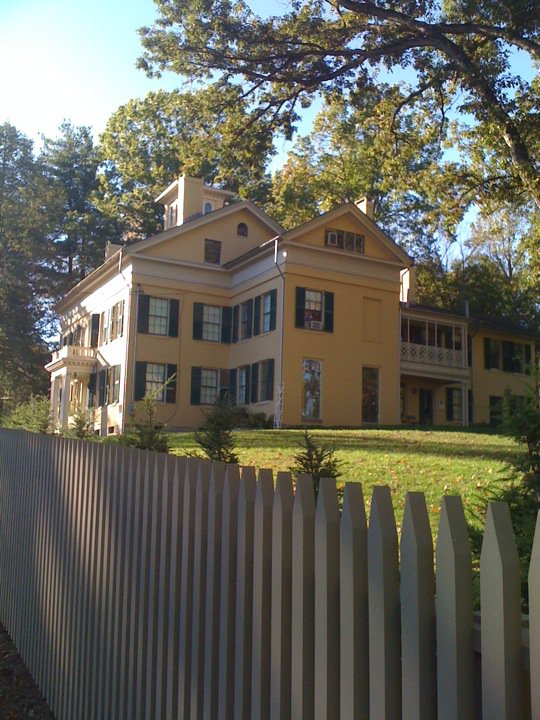
This turned out to be a very literary weekend, although by “literary” I don’t mean that I read much. I haven’t had much time for that. First, on Friday I got to walk by Emily Dickinson’s house (picture here), since I was in the area for a work conference, and then I browsed in one of Amherst’s bookstores, just up the street.

And then on Saturday, Hobgoblin and I met up with She Knits and Suitcase of Courage to go on a three-state bookstore tour. We started off meeting for breakfast at the Wandering Moose Cafe in West Cornwall, Connecticut (Suitcase of Courage knows all the great places to get breakfast), and then we headed a block or so up the road to Barbara Farnsworth’s bookstore. It’s a charming two-story shop with a great fiction section, where I spent most of my time. I didn’t buy anything there, but it’s not because there weren’t good possibilities. Sometimes it just takes me a while to figure out what I’m in the mood for.

Then we drove up to Great Barrington, Massachusetts, home of Yellow House Books, where we spent another happy hour or so. This shop is smaller than Barbara Farnsworth’s, but it also has a great selection, and I snapped up The Essays of Virginia Woolf, Volume 1. I own volume 3 already, so of course I need all the others. I’ll be on the lookout for a nice copy of volume 2 next.

Then, after lunch, we drove over to Hillsdale, New York, to visit Rodgers Book Barn, a shop that’s been a favorite of mine for many years. The store is out in the middle of upstate New York farm country, and you have to drive past barns and on gravel roads to get there, which is all part of the fun. And they have a great selection of books, priced inexpensively. I was fully into shopping mode by that time, and came away with four books (Hobgoblin found ten!). I got Darkmans by Nicola Barker, which has been on my mind to read for a while because it’s long and experimental, and I’m ready to read a long, experimental novel written by a woman instead of the ones you always hear about written by men. I like the ones by men too, but the ones by women don’t get the same attention.

I also picked up another Mary McCarthy novel, Cannibals and Missionaries, for when I next get in a Mary McCarthy mood, which happens fairly regularly. The last two are Viragos, A View of the Harbour by Elizabeth Taylor, and Year Before Last by Kay Boyle. Taylor is a favorite of mine, but Boyle is someone new I’m interested in learning more about.

After a couple hours in the Book Barn, it was time to head home to take care of Muttboy — and to read our books, of course. And that’s exactly what I need to go do now.

15 Comments

Filed under Books

Where I was today

At the Emily Dickinson house! I was only there briefly, and didn’t make it in time to take a tour, so I couldn’t go inside, but I was in Amherst for a conference for work, and I couldn’t resist the opportunity to stroll by. I’ll be back one of these days, most definitely.

12 Comments

Filed under Books

I Too am Here

I just began reading the letters of Jane Carlyle, wife of Thomas Carlyle, in a collection called I Too am Here. I don’t think I’ve ever read a volume of someone’s letters before, which seems strange to me (and makes me think I’m forgetting something??). But if this book stays as good as it has begun, I may begin to read collections of letters regularly. Recently I’ve been preparing for a letter-reading binge by buying collections here and there, including ones by John Keats, Charles Lamb, Lady Mary Wortley Montague, and Jane Austen. Since I love epistolary novels so much, perhaps reading letters by real people is a logical next step?

I’ve read only maybe 20 pages of the Jane Carlyle book, but right off the bat she charmed me with this passage, written to a friend:

Do read this book [Rousseau’s Julie, or the new Heloise] — You will find it tedious in many of its details, and in some of its scenes culpably indelicate; but for splendour of eloquence, refinement of sensibility, and ardour of passion it has no match in the French language. Fear not that by reading Heloise you will be ruined — or undone — or whatever adjective best suits that fallen state into which women and angels will stumble at a time — I promise you that you will rise from Heloise with a deeper impression of whatever is most beautiful and most exalted in virtue than is left upon your mind by ‘Blairs sermons’ ‘Paley’s Theology’ or the voluminous ‘Jeremy Taylor’ himself — I never felt my mind more prepared to brave temptation of every sort than when I closed the second volume of this strange book — I believe if the Devil himself had waited upon me in the shape of Lord Byron I would have desired Betty to show him out …

It makes me wonder how much time she spent thinking about the devil waiting upon her in the shape of Lord Byron …. The rest of the letters so far are addressed to Thomas Carlyle in the years before their engagement and marriage. The two of them write about their literary ambitions, their reading, and their feelings for each other. Unfortunately for Thomas, so far Jane has insisted that she can only love him as a friend. Her reading of Rousseau’s novel has made her impatient with common, everyday lovers, and even Carlyle with all his genius and potential can’t live up to her ideal.

I know from reading the introduction that theirs will be a difficult though loving marriage, but it’s fun for right now to read Jane’s feelings about their relationship as it is still fresh and new.

13 Comments

Filed under Books, Nonfiction

Death Rites and book groups

Alicia Gimenez-Bartlett’s Death Rites was the book up for discussion at my latest mystery book group meeting, and I am, in spite of having thought about the book before the meeting quite a lot and having spent several hours discussing it with the group, still not quite sure how I feel about it. I liked the book when I first started reading it, but then at some point I began having doubts, and then I enjoyed it again, and then I doubted, and after I finished my reaction wasn’t any clearer. Then I listened to other members of the group explain why they didn’t like it, and it was hard not to be swayed by the general consensus.

I’m not usually so indecisive. The problem seems to be that the book never quite came together for me, so I liked this part of it, didn’t like that part, and could never quite pull everything together to have a real opinion.

Much of the problem for the book group was the translation, or at least the possibility that the translation might be bad made it hard to judge whether the book itself was any good or not. The writing was certainly awkward, with badly constructed sentences and bizarre images (although some of the bizarre images I liked). But there were other problems — a main character who can be intensely unlikeable, a plot that floundered at times, and a resolution that was too predictable.

To say something about the book itself, it’s set in Barcelona and tells the story of Petra Delicado, an inspector who has been working in the documentation department and who gets called upon unexpectedly to investigate a rape case. She is assigned to work with Fermin Garzon, a rather plodding, obedient type who is close to retirement. The two have to figure out not only how to run an investigation, something Petra at least has little experience with, but also how to deal with each other. There is tension between the two of them from the very beginning; Petra isn’t used to being in charge and has to figure out how to exert authority in a world that grants it to women only grudgingly, and Fermin has to figure out how to respond to a boss who knows less about investigating than he does. Plus Fermin has some pretty old-fashioned ideas about women that Petra does not like.

The two do a pretty bad job of investigating, or at least that’s what members of the press accuse them of. They have no good leads for a very long time and spend a surprisingly long period floundering about desperately looking for some kind of breakthrough. I’m not entirely convinced that they are bad investigators, though, or at least that they are bad as people think they are. They do make some mistakes, but they are rookies, after all. But even more so, I wonder whether this portrayal of an investigation isn’t more realistic than investigations often are in novels. What do investigators do when there are no clues? When no clues appear for a very long time? When every trail they follow leads them nowhere? The press accuses them of failing in their job, but I wonder whether other, more experienced investigators would have been able to do it better. In novels, investigators struggle and take time to solve their cases, but I wonder whether they struggle a lot less and take a lot less time than real-life investigators do.

We also talked in my book group about how often Petra and Fermin take breaks from their work and how often they are to be found in restaurants or bars, rather than working on the investigation. This is probably one of their most serious mistakes, but I have to say, I’m entirely in sympathy with their commitment to eating well and resting up. This is illogical of me, I suppose, since with a rapist on the loose, they really do need to be in a hurry. And yet I do get tired of detectives who never seem to sleep and who skip meals all the time and who basically act like their non-working lives don’t matter in the least. Petra has just bought a new house, and she’s trying to settle into it, and I sympathize with her occasional feelings of resentment at a job that’s pulling her away from it.

So these elements I liked, and I also liked Petra’s vocal feminism and the struggles she goes through to figure out how to establish and maintain power, and also how to use that power effectively without abusing it (which she fails at spectacularly a time or two). But at the same time, the narrative did get dull now and then and Petra’s character remains a bit elusive. There was some spark, something lively, missing from the book. And the translation was a problem.

That’s the best I can do with this book, it seems. For other thoughts, you can read Emily’s post.

6 Comments

Filed under Books, Fiction

Happiness, once again

Jenny Diski is one of my favorite nonfiction writers (I’m scared to read her fiction in case I hate it), and as far as nonfiction goes, I like pretty much whatever she writes. That includes this essay in The London Review of Books, a review of Gretchen Rubin’s book The Happiness Project. Those of you who have read Diski will not be surprised to find that she did not like The Happiness Project, is suspicious of the whole notion of happiness, and prefers not to use the word, as well as the words “love” and “feeling.” They are all just too vague.

Here’s a taste of her style (lengthy, but every bit of the paragraph is worth it):

Back to the Twelve Personal Commandments. The first, it has to be said, is difficult: ‘Be Gretchen’. I can see the sense in that as things stand, but being Gretchen is beyond me. Apparently, it isn’t even easy for Gretchen, since she has to remind herself to be her. Still being Gretchen is the first step on the road to happiness. OK, she means: ‘Be yourself’. But like many purveyors of such advice, she gives no guidelines, and I could more easily be Gretchen than fathom how to ‘Be Jenny’. If I thought I knew that, I probably wouldn’t have the doubt-space in my head to enable me to consider myself unhappy in the first place. Some of her commandments are more clear-cut than others, but that’s true too of the more modest ten that Moses brought down from Mount Sinai. ‘Be polite and fair,’ like ‘Do not commit murder,’ may not be easy but you can see how it might save you trouble in the long run. Walk into a shop and call the proprietor a capitalist, thieving cunt, and you are likely to leave less happy than when you went in, though I can imagine circumstances in which another kind of contentment might override the social benefits of hypocrisy and self-control. There are contradictions, too: isn’t ‘Identify the problem’ cancelled out by ‘No calculation’? And ‘Act the way I want to feel’ doesn’t chime well with ‘Do what ought to be done.’ But what of the gnomic ‘Spend out’? Gretchen helps us with this and explains: ‘by spending out, I mean to stop hoarding, to trust in abundance. I find myself saving things, even when it makes no sense. Right now I’m forcing myself to spend out by wearing my new underwear.’ This does at least makes sense of the ‘Be Gretchen’ commandment, because surely anyone who wasn’t Gretchen who heard themselves say that or read it back after they’d written it would immediately head to the nearest tall building and throw themselves off.

The entire essay is a treat. And I think this even though I read books about happiness and like them. The Lovingkindness book I’m reading now is subtitled The Revolutionary Art of Happiness, and I praised the book Positivity earlier this year, which makes a point of not being about happiness, exactly, since happiness is a much narrower term than positivity, but can still be said to be about happiness anyway, in a loose sense of the word.

I don’t think I’m being entirely contradictory here. I agree with a lot of what Diski says. Unhappiness is a part of life, and there isn’t much to be done about it — it’s just the way things are. There isn’t much to be done about it, but there is something. I have found books about happiness, or positivity or lovingkindness or whatever, to offer realistic ways of responding to unhappiness. The ones I’ve read don’t argue you can get rid of unhappiness entirely, but that there are things you can do to really experience the happiness that does come to you and to encourage it to happen more. They also show how to experience and then move on from the sad moments in life — not to reject them and not to wallow in them, but to respect them and then to recover.

It seems to me that people who complain about self-help books and books about happiness tend to conflate them all into one category of badness, when the truth is there are good examples and bad examples, just as there are of any genre. I’d probably hate The Happiness Project too, but I don’t want to dismiss books that might offer genuine wisdom.

11 Comments

Filed under Books, Nonfiction

What are you reading?

The current Booking Through Thursday question is this:

What are you reading right now? What made you choose it? Are you enjoying it? Would you recommend it? (And, by all means, discuss everything, if you’re reading more than one thing!)

The quick way to answer is to direct you to my list of everything I’m reading in the sidebar, but I don’t want to answer the quick way. So here is the long version. Two nights ago I picked up Thomas Pynchon’s Gravity’s Rainbow. Because of busyness over the last couple days, I’m still only 20 pages in, and I’m wondering what I got myself into. There are a lot of pages in that book, with a lot of words on each page, and they are not all quite clear! But I need to give the book more time, of course, and the words aren’t that hard to follow, either. This will most likely be a book I will be reading for quite a while to come, which is fine. I’ll keep an easier novel on the go at the same time.

I’m nearing the end of Lawrence Weschler’s Vermeer in Bosnia, and just read a wonderful essay on the photocollages of David Hockney. There were also some good essays on California and one on Art Spiegelman I really liked. The subjects are varied, but the writing is uniformly good.

And then there are Bacon’s Essays. These are not terribly exciting, I have to say. But I can see that they are important, filled as they are with an attempt to use language carefully and precisely and to break the subject down into clear categories to capture it accurately.

I’m nearing the end of my collection of Ted Hughes’s poetry, which I have enjoyed all the way through. There have only been a few poems I have read quickly and dismissed; most of them I want to linger over to figure out how he’s using language. I first wrote about the poems here; they continue to focus on animals and landscapes, for the most part, and they still have the direct, forceful, unsentimental, colorful style I wrote about earlier.

And finally there is Sharon Salzberg’s book Lovingkindness, which is about lovingkindness meditation and Buddhism. I don’t meditate (I’d like to but haven’t found a way to keep a regular practice), but I’ve learned a lot from this book anyway. It’s full of wisdom about cultivating joy, compassion, and love, and breaking away from harmful habits of mind. I recommend it for anyone interested in spiritual reading.

And that’s it. I will pick up another novel soon, but haven’t decided what it will be.

12 Comments

Filed under Books, Fiction, Nonfiction

The Perpetual Curate

I was in the mood for something Victorian not too long ago, and Margaret Oliphant’s The Perpetual Curate was exactly what I needed. It’s a long (relatively long, 500 not-too-dense pages), absorbing story with interesting characters and an amusing tone. Its mood is light, but it deals with serious situations and genuine problems, so it never felt frivolous.

The story is about Frank Wentworth, the perpetual curate of the title, a young man who loves his work but understands that it doesn’t pay enough for him to marry the woman he loves, Lucy Wodehouse. In order for that to happen, he would have to become a rector. This is actually quite possible, as he has three aunts who will soon have a living to bestow, but, alas, Frank and the aunts do not see eye to eye when it comes to how one should run a church service. The aunts lean toward the evangelical side, while Frank is more solidly, traditionally Anglican. The aunts unexpectedly show up to Frank’s Easter service, and are shocked at the sight of flowers on the alter and are displeased with his sermon. Frank realizes that those pesky flowers, which he is not sure he cares all that much about, may have ruined his chances for married happiness.

Oliphant piles problem after problem on poor Frank’s shoulders. Not only does he have the uptight aunts to deal with, but he is seen in what looks like a compromising situation with a pretty, young shop girl, and rumors begin to fly. The town that has stood behind him for the five years or so he has worked there now starts to have doubts. Then the local rector, newly arrived in the town, gets angry at him for running services for the poor in his district. And then his brother, Gerald, decides that he wants to convert to Catholicism and become a Catholic priest, even if it means abandoning his wife. There is also the strange, unpleasant, badly-dressed man who shows up in Frank’s lodgings, and whom Frank takes in for mysterious reasons, even though his neighbors are none too pleased.

Much of the novel has Frank running around from one disaster to another, trying to figure out how to appease his family, friends, and parishioners while at the same time staying true to his principles. Fortunately, as Oliphant frequently points out, Frank is young and can bounce back from disasters quickly. But still, it’s chilling to read a convincing description of how suddenly, and for no real fault of Frank’s, everything can suddenly go wrong. People misread events and misunderstand conversations, and because Frank can sometimes be a little oblivious, he doesn’t always realize when this happens. Suddenly his world is falling apart around him, and he hardly knows how it happened. This can happen to any of us, the novel implies, at any time, and there is little to be done about it.

The things that could be done to rectify the situation Frank rejects as impossible because of his strong sense of pride and honor. He can’t simply go to his aunts and declare he really didn’t mean it about the flowers because he can’t stoop that low, and he can’t simply explain that he doesn’t care anything about the pretty shop girl because he doesn’t want to dignify the accusations. This sense of pride and honor, which he and Lucy share, becomes so powerful and his and Lucy’s feelings are so delicate, that they threaten to become absurd. In fact, by the end of the novel I was wondering whether Oliphant was having a little fun gently mocking them. This suspicion was reinforced by the way Oliphant frequently draws attention near the novel’s end to the fact that it is a novel that she’s writing, as though she is pulling away from the narrative a bit to evaluate her characters more directly than she ever did before. Endings are tricky, she seems to be saying, and sometimes they can be a little silly or unrealistic, so don’t take it all too seriously.

The Perpetual Curate is part of a series of novels called “The Chronicles of Carlingford,” and this novel is the fourth book of six. I’m pleased to know this, because it means I can return to this world and to these characters five more times if I want to. If I’m able to find the books, that is. I will certainly be on the lookout for more Oliphant in the future.

12 Comments

Filed under Books, Fiction

Sara Paretsky

I’m listening to my first Sara Paretsky novel right now, her 2005 V.I. Warshawski mystery Fire Sale. I’ve been meaning to read Paretsky for a while, ever since reading about her in Maureen Corrigan’s book Leave Me Alone, I’m Reading, where Corrigan has a chapter on mystery novels and praises Paretsky highly. With the caveat in mind that I am more likely to like a book I listen to than one I read on paper, I’m really enjoying the story so far. The novel is set in Chicago, and Warshawski is a private investigator. She has a thriving business, but in this novel, she is involved in a investigation she won’t be paid for: a case of arson and murder that she stumbles upon after agreeing to serve as a substitute basketball coach at her old South Chicago high school. The mother of one of the players asks her to investigate strange happenings at the factory where she works, and the next thing she knows, she’s caught up in a story of big business and corporate intrigue.

The basketball coaching and the investigation force her to spend a lot of time in South Chicago where she is confronted by her past, which was a harsh one. This novel doesn’t give very many details, but we do find out she lost her mother when she was young, and that she grew up to be a tough street fighter. In this novel, she still has that toughness, but also the perspective and experience of a woman who has seen more of the world. She is brave and courageous, although not without fear, and there’s a certain amount of sadness to her character, which, of course, is not at all surprising for someone who makes a living as an investigator.

The plot is overtly political, as Warshawski investigates a big Walmart-like corporation that exploits its workers and is run by a family full of nasty, suspicious, racist tightwads. The fact that they claim to be committed evangelical Christians makes them even worse. I suppose the argument here is a little too easy and too obvious — the religious characters are hypocrites, or at least the rich ones are, and all big business owners care about nothing at all but making money. But still, Paretsky’s picture of how families struggle to make a living working in low-paying jobs and are first exploited so they can barely get by and then condemned for the very fact that they struggle is a powerful one. Paretsky explores the complicated causes of poverty on the south side and why it is so many young people struggle in school and so many teenage girls get pregnant, while the big business owners live in their gated mansions in the suburbs, getting rich through their stinginess. The ideas and issues may be familiar, but Paretsky does a good job bringing them to life.

9 Comments

Filed under Books, Fiction

Current Reading

Teaching two online courses this semester is turning into a whole lot of computer time, which makes it hard to get other computer-related things done, since I don’t like being on the computer all day if I can help it. But today is one of those days where there was no avoiding being on the computer nonstop. This, by the way, is how I find time to ride my bike so much during the week — I spend my weekends catching up on work I neglected all week long. Often weekends mean long stretches of school work punctuated by occasional bike rides, with the evenings devoted to reading or friends. It’s not a perfect system, but it works okay.

So, I’m nearing the end of Margaret Oliphant’s The Perpetual Curate. It’s an engrossing story of the sort that’s anxiety-inducing because everything goes horribly wrong for the main character all at once, and I want to keep reading to see how he’s going to straighten everything out. He’s a victim of misunderstandings and petty resentments, and, since this is a Victorian novel, his honor, pride, and sense of propriety keep him from fixing things quickly. I’ve read enough 18th and 19th century novels to understand the exquisite sense of rightness and wrongness the characters have, but sometimes it’s just sort of hard to believe.

Next up as far as novels go is Alicia Gimenez-Bartlett’s Death Rites, which is the next book for my mystery book group — my choice. I picked it because I wanted us to read something not British or American and because several bloggers I know have enjoyed it, but other than that, I know little about it and so am curious to see how it goes.

I’m also in the middle of Lawrence Weschler’s essay collection Vermeer in Bosnia, which I remember hearing about on NPR quite a few years ago. I bought the book also a number of years ago, and am only now finally getting to it. There is a wide variety of essays in the book; my favorite so far has been the title essay, which opens the collection and is part of a group of three pieces on art and war. There are also essays on three Polish Holocaust survivors, or the children of survivors, and now I’m in the middle of some more personal essays on family. They are all thoughtful and smart, and I’m enjoying Weschler’s voice and sensibility.

And, as part of my on-going, life-long, never-ending quest to read tons and tons of essays, some of them in chronological order, I’ve picked up Francis Bacon’s essays. Bacon is not going to be one of my favorite essayists, I already know, but I want to read him for the sake of understanding the genre fully. So, Bacon it is, and then Sir Thomas Browne.

11 Comments

Filed under Books, Cycling